SINCE 1891
THE BROWN DAILY HERALD WEDNESDAY, DECEMBER 5, 2018
VOLUME CLII, ISSUE 112
WWW.BROWNDAILYHERALD.COM
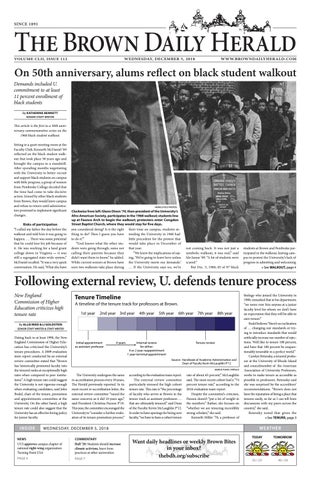
On 50th anniversary, alums reflect on black student walkout
Demands included U. commitment to at least 11 percent enrollment of black students By KATHERINE BENNETT SENIOR STAFF WRITER
This article is the first in a 50th anniversary commemorative series on the 1968 black student walkout. Sitting in a quiet meeting room at the Faculty Club, Kenneth McDaniel ’69 reflected on the black student walkout that took place 50 years ago and brought the campus to a standstill. After spending months negotiating with the University to better recruit and support black students on campus with little progress, a group of women from Pembroke College decided that the time had come to take decisive action. Joined by other black students from Brown, they would leave campus and refuse to return until administrators promised to implement significant changes. Risks of participation “I called my father the day before the walkout and told him it was going to happen. … There was some potential that he could lose his job because of it. He was working for a land grant college down in Virginia — it was still a segregated state-wide system,” McDaniel recalled. “It was a very quick conversation. He said, ‘What else have
HERALD FILE PHOTOS
Clockwise from left: Glenn Dixon ’70, then-president of the University’s Afro-American Society, participates in the 1968 walkout; students line up at Faunce Arch to begin the walkout; protesters enter Congdon Street Baptist Church, where they would stay for five days. you considered doing? Is it the right their time on campus, students atthing to do? Then I guess you have tending the University in 1968 had to do it.’” little precedent for the protest that “God knows what the other stu- would take place in December of dents were going through, some not that year. calling their parents because they “We knew the implications of saydidn’t want them to know,” he added. ing, ‘We’re going to leave here unless While current seniors at Brown have the University meets our demands.’ seen two walkouts take place during … If the University says no, we’re
not coming back. It was not just a symbolic walkout, it was real,” said Ido Jamar ’69. “A lot of students were scared.” But Dec. 5, 1968, 65 of 87 black
students at Brown and Pembroke participated in the walkout, leaving campus to protest the University’s lack of progress in admitting and welcoming » See WALKOUT, page 4
Following external review, U. defends tenure process New England Commission of Higher Education criticizes high tenure rate
Tenure Timeline A timeline of the tenure track for professors at Brown. 1st year
2nd year 3rd year
4th year
5th year
6th year 7th year
8th year
By ALLIE REED & LI GOLDSTEIN SENIOR STAFF WRITER & STAFF WRITER
Dating back to at least 1998, the New England Commission of Higher Education has criticized the University’s tenure procedures. A 2009 evaluation team report conducted by an external review committee stated that “Brown has historically promoted faculty into the tenured ranks at exceptionally high rates when compared to peer institutions.” A high tenure rate could suggest the University is not rigorous enough when evaluating candidates, said John Bodel, chair of the tenure, promotion and appointments committee at the University. On the other hand, a high tenure rate could also suggest that the University has an effective hiring policy for junior faculty.
INSIDE
Initial appointment as assistant professor
4 years
Internal review for either: 4 or 2 year reappointment 1 year terminal appointment
Tenure review
Source: Handbook of Academic Administration and Dean of Faculty Kevin McLaughlin P’12 MARLIS FLINN / HERALD
The University undergoes the same re-accreditation process every 10 years, The Herald previously reported. In its most recent re-accreditation letter, the external review committee “raised the same concerns as it did 10 years ago,” said President Christina Paxson P’19. This year, the committee encouraged the University to “consider a further evaluation of its tenure promotion process,”
WEDNESDAY, DECEMBER 5, 2018
NEWS UCS approves campus chapter of national right-wing organization Turning Point USA
COMMENTARY Hall ’20: Students should increase climate activism, learn from practices at other universities
PAGE 4
PAGE 7
according to the evaluation team report. The external review committee particularly stressed the high cohort tenure rate. This rate is “the percentage of faculty who arrive at Brown in the tenure track as assistant professors … that are ultimately tenured,” said Dean of the Faculty Kevin McLaughlin P’12. In order to have openings for hiring new faculty, “we have to have a cohort tenure
rate of about 65 percent,” McLaughlin said. The most recent cohort had a “74 percent tenure rate,” according to the 2018 evaluation team report. Despite the committee’s criticism, Paxson doesn’t “put a lot of weight in the numbers.” Rather, she focuses on “whether we are tenuring incredibly strong scholars,” she said. Kenneth Miller ’70, a professor of
biology who joined the University in 1980, remarked that in his department, “we never ever hire anyone at a junior faculty level for whom we don’t have an expectation that they will be able to earn tenure.” Bodel believes “there’s no inclination of … changing our standards or trying to introduce standards that would artificially increase our number of rejections. We’d like to tenure 100 percent, and have that 100 percent be unquestionably tenurable in a perfect world.” Carolyn Betensky, a tenured professor at the University of Rhode Island and councilmember of the American Association of University Professors, works to make tenure as accessible as possible to professors. Betensky said she was surprised by the accreditors’ recommendations. “Brown does not have the reputation of being a place that tenures easily, so far as I can tell from discussions with my peers across the country,” she said. Betensky noted that given the » See TENURE, page 3
WEATHER TODAY
TOMORROW
35 / 23
40 / 29
NEWS
PAGE 2 • WEDNESDAY, DECEMBER 5, 2018
THE BROWN DAILY HERALD
UCS approves chapter of national right-wing organization Turning Point USA, known for controversial rhetoric, aims to organize libertarian students By CORRINE BAI STAFF WRITER
The Undergraduate Council of Students recently approved a campus chapter of Turning Point USA, a nonprofit that promotes “principles of freedom, free market and limited government” on college campuses, according to its website. The national organization has attracted attention for its political tactics. With slogans like “Big Government Sucks” and “Commies Aren’t Cool,” the group is known for its controversial rhetoric. Last year, the New Yorker also reported on possible campaign finance violations and uncovered racist text messages sent by TPUSA’s former national field director. Alex Song ’20, chair of student activities, told The Herald that UCS approved the chapter because it fulfilled the general “criteria for every club.” When UCS considers an application, it looks at four requirements: if the group completes paperwork, “fills a niche,” shows interest from at least 10 students and is “a sustainable endeavor,” Song said. The Student Activities Committee oversees club applications and
consists of eight students who represent various segments of campus life, such as residential and Greek life, campus resources and recreation, and media and publications, according to UCS’ website. In conjunction with the SAC, the administrative Brown Student Activities Office also supervises club activities. SAO, which is made up of administrative faculties, “makes sure that clubs follow the law,” said Jason Carroll ’21, a representative on SAC. TPUSA is currently a category I student organization, so it does not receive funding from the Undergraduate Finance Board, Song said. But the group could “fundraise and start a bank account with SAO,” and they also “have access to the student activities fair,” he added. Christian Diaz de Leon ’21, who is affiliated with TPUSA at Brown, said that the goal of the group is to “identify and organize students who lean toward libertarian ideals.” He characterized the mission of the group as “principle activism,” which means that it will “focus on the founding principles of this country.” Though the TPUSA chapter at Brown is relatively new, it has plans to host small social events and invite guest speakers to “discuss the benefits of capitalism … (and) raise awareness of national debt issues,” Diaz de Leon said. In response to the formation of this right-wing group, Rose Lang-Maso ’20, president of Brown Democrats,
COURTESY OF GAGE SKIDMORE
UCS designated Turning Point USA as a category I student organization. It does not receive funding from the University, but the club can fundraise and participate in the student activities fairs. told The Herald that she thinks TPUSA “has the right to be on campus.” Despite her own political stance, Lang-Maso is in favor of “diversity in political discourse” and giving “a
voice (to the conservatives) in a liberal community.” But she expressed concern about the national organization’s “professor watch list,” which enumerates the names of professors
who are considered “overly liberal,” according to TPUSA’s website. Diaz de Leon told The Herald that the Brown chapter currently does not have a professor watch list.
NEWS
WEDNESDAY, DECEMBER 5, 2018 • PAGE 3
THE BROWN DAILY HERALD
»TENURE, from page 1 competitive job market for people with doctoral degrees nationwide, “the idea of making tenure even harder to get seems like a very retro piece of advice — it doesn’t seem in keeping with the times.” Furthermore, she highlighted the importance of tenure in protecting the academic freedom of professors. “Tenure is supposed to allow faculty to do their job, and to do it fearlessly. Tenure is not a guarantee of employment no matter what. You can be fired even with tenure — you need to do your job, and you need to do it well,” Betensky said. The tenure system at Brown Currently, the University utilizes an eight-year tenure track — the “probationary period” — for assistant professors hoping to become tenured associate professors, according to the Handbook of Academic Administration. These assistant professors are appointed for four years, after which they may be reappointed for two years or four years, or their “reappointment may be denied altogether,” according to the handbook. A four-year reappointment “means everything looks good,” a two-year reappointment reflects that the candidate’s department has “concerns,” and “if there are serious concerns that the person is not meeting expectations, then they get a one-year terminal contract,” McLaughlin said. At the beginning of their fourth year, assistant professors undergo an internal review process to determine whether they will be reappointed. A committee of senior faculty in the candidate’s field evaluates the candidate based on their research, teaching, publications, grants and service to the department, McLaughlin said. Service can include work on departmental or university committees, added William Keach, a professor of English who came to the University in 1986. Rather than aiming to drive down its tenure rates, the University hopes to “collectively get better, more rigorous at our internal intermediate evaluations,” Bodel said. “It’s in nobody’s advantage — not the University’s, not a department’s, certainly not a candidate’s — to
come up for tenure and get denied. It’s psychologically crushing.” To avoid denying tenure, the University regularly assesses assistant professors, Bodel said. If an assistant professor doesn’t appear to be meeting their department’s standards for a tenure position, and it seems like they may ultimately be denied tenure, the University hopes to persuade them “to leave voluntarily before they face that crisis of being slapped in the face and told no,” Bodel said. In that scenario, “everybody wins,” he added. Each field within the University has its own standards for assistant professors to meet, Bodel said. For example, scholars in the humanities and social sciences are expected to publish a wellreceived book and plan for future projects, he said. In economics, having an article published in “certain extremely competitive journals” is “enough to get you tenure,” Bodel said. The sciences can be more challenging to assess, as assistant professors aim to have their name on a vast number of publications, Bodel added. Generally, another review takes place during “the seventh year of the eightyear probationary period,” according to the handbook. Candidates submit dossiers to TPAC, along with a letter from their department chair. The tenure committee then finds at least eight leading outside scholars in the candidate’s field to write letters evaluating their work, McLaughlin said. The candidate’s department reviews that dossier and votes on whether or not to grant them tenure. If the department recommends tenure, their dossier is sent to TPAC for another recommendation. Then, the recommendation goes to the Provost, the President and the Corporation. “It’s a long process — it takes a year for it to happen,” McLaughlin said. Peer institutions follow a range of tenure systems, all with varying tenure probationary periods. Dartmouth, Harvard, Yale, Columbia and the Massachusetts Institute of Technology all generally follow an eight-year tenure track, while Cornell and Princeton follow a six-year track. Some argue that a longer probationary period ultimately hurts faculty on
the tenure track. “The seven-year limit is a necessary safeguard to protect the candidate from prolonged exploitation by his or her institution,” wrote James Andrews, a professor at the University of Iowa, in an article for AAUP. “Extension of the already substantial seven-year maximum probationary period would prolong the period in which faculty receive lower pay, exert less influence and have less job security.” But Betensky believes a longer probationary period can help faculty during their tenure process. A longer tenure track allows candidates to refine their portfolios and alleviates some of the pressures associated with the many deadlines of the tenure process. “You’re waiting on editors, you’re waiting on peer review, you’re waiting on … the schedules of editorial boards of journals and academic publishers,” she said. An eight-year tenure track “is not overly generous, … especially since the standards for tenure at a place like Brown and the standards of scholarship are really high,” Betensky said. Tenure process over the years Following the 2009 NECHE evaluation team report, the University underwent changes to make the process “more rigorous, and to give the administration a little bit more oversight,” McLaughlin said. The University’s 2010-11 Committee on Tenure and Faculty Development convened to consider whether or not the University’s policies and processes were appropriate given “Brown’s status as one of the nation’s leading research universities,” according the University’s 2013 interim report. Miller said the committee’s efforts were “met with a great deal of resistance from the faculty in general.” “Every department feels like they have their own standards for tenure, and they all think they’re sufficiently rigorous. They don’t want the central administration telling them what to do,” Miller said. The committee recommended several policy changes to the University’s tenure process, most of which were approved, McLaughlin said. Some of the changes that were implemented include extending the tenure probationary period from seven to eight years, increasing
the number of letters written by outside scholars from five to eight and increasing the quantity and frequency of candidate reviews, The Herald previously reported. When the committee made these proposals, “we had huge crowds of faculty coming out to (faculty meetings) and had a lot of very heated debate about these changes,” McLaughlin said. But “there had not yet been a significant change in the research level of faculty achieving tenure despite a change in tenure procedures since the time of the last comprehensive review,” according to the 2018 evaluation team report. Professor of Computer Science Andries van Dam has served on the faculty since 1965 and noted that the University’s “tenure standards are probably a little bit higher than they were 40 to 50 years ago, but they haven’t changed a lot.” As a member of the last tenure and promotions committee “three provosts ago,” van Dam had access to data indicating that tenure rates at the University were indeed higher than those of peer institutions at the time. “There were various theories about why that was, and there was even some (dispute) about whether” the high rates reflected effective hiring or lenient tenure standards, van Dam said. Van Dam argues that though tenure rates may be higher at the University than at competing institutions, the attitude toward tenure at the University is a healthy one. Within the computer science department, van Dam said, eligibility for tenure is not measured relative to other colleagues, but rather is assessed in the context of a faculty member’s individual achievements and external recommendations. “We try to have very high standards for hiring people, with the idea that anybody we hire should be tenurable. It’s strictly up to them to prove our judgement correct,” van Dam said. Pointing to Harvard’s tenure policies several decades ago, in which assistant professors competed for one or two spots, van Dam added that a cutthroat approach to tenure is ultimately detrimental to the wellbeing of the faculty as a whole. “If the criteria and standards are significantly higher … over time, on average, you will get a higher quality
faculty. On the other hand, it may be a faculty that is much more into competition, and there’s less collegiality and too much emphasis on publish or perish,” van Dam said. Tenure in the future “It’s important to understand that procedures around tenure really belong to the faculty,” Paxson said. To address the accreditors’ concerns, she will start by having conversations with TPAC and the Faculty Executive Committee. “We have a lot of talking ahead of us to sort out next steps,” she added. “There’s a lot of interest, and I think some concern because tenure rates are a very crude measure,” said Professor of Political Science and International and Public Affairs Ross Cheit, chair of the Faculty Executive Committee. “You would have a high tenure rate if you were being quite lenient,” but, “you would also have a high tenure rate if you hire really well,” he added. Cheit believes discussions around tenure rates are “bound to be nervewracking to people who aren’t tenured.” The Herald reached out to seven assistant professors on the tenure track, each of whom declined to comment or could not be reached for comment. Any changes made to the tenure process will have to be “carefully” considered and voted on by the faculty, Cheit said. For now, Cheit is interested in “getting additional information” on faculty’s productivity levels after they are tenured. McLaughlin believes the changes the University made since the 2009 reaccreditation report “have given us the tools that we need to make sure our process is rigorous.” As a result, the University “is not going to be making any radical changes,” McLaughlin said. “I believe that neither of the extremes — of the overly competitive, old-style Harvard model, and the overly permissive model — work for a place that wants to be a first-rank research university that also really values teaching,” van Dam said. The lack of a cutthroat process “makes for a better educational experience and a better state of being, of mental health and emotional health, for the faculty themselves.”
STAY UP-TO-DATE. FOLLOW US ON FACEBOOK. FACEBOOK.COM/BROWNDAILYHERALD
NEWS
PAGE 4 • WEDNESDAY, DECEMBER 5, 2018
» WALKOUT, from page 1 black students. They walked from the University to the Congdon Street Baptist Church. Led by the women of Pembroke College, the students remained inside the church until the University agreed to implement their demands. The protest lasted five days. Despite the substantial risks involved in participating in the walkout, younger students, like Zylpha PryorBell ’72, joined their peers after being “convinced by upperclassmen that it was a worthy cause (that) would, in the long run, benefit Brown as well as prospective minority students,” she wrote in an email to The Herald. Demanding a commitment to change Prior to the walkout, the students issued a letter of demands that outlined ways in which the University could better support black students, as The Herald previously reported. While the Pembroke students had originally presented these demands to the University the previous spring, a lack of progress in implementing the changes prompted black students throughout the entire university to walk out. Of the demands made by students, increasing black student enrollment to 11 percent of the undergraduate populations at Pembroke and Brown served as the group’s primary goal, as The Herald previously reported.
According to the position paper from the Pembroke students, they insisted on an 11 percent minimum to reflect the national percentage of black Americans at the time. In addition, students stressed that the demand was a minimum percentage and not a quota, which would have been illegal. Aside from increasing the number of black students admitted, the Pembroke students demanded the University to waive the “application fee … for any black applicant,” hire a black admission officer and implement a program to educate prospective black students about campus life, among other measures, according to the letter. “A black admission officer would have different sensitivity when looking at an application; they would have a better understanding of what African American students’ experiences were,” Jamar said. “They would be able to see signs of excellence in pockets of a student’s life that others could not see.” After the students left campus, University administrators and Corporation members sought input from remaining student leadership when drafting their official response. “I was asked to come to (President Ray Heffner’s) house to discuss their response that they were going to make to the walkout. I told them that there was going to be very strong student support (for the protesters) and that I thought that what was being demanded by the
THE BROWN DAILY HERALD black students was reasonable and that the administration should respond positively and engage in a negotiation,” said Ira Magaziner ’69, president of the Undergraduate Council of Students at the time of the walkout. “There were differences in opinion among (administrators and Corporation members). … I told them that the pressure was only going to get worse, that it would be more widespread.” As the protest unfolded, students perceived varying levels of support on campus. “Most students were very supportive of (the walkout), that was evidenced by the fact that they came out and rallied in support of the black students,” Magaziner said. Pryor-Bell, however, was less certain of the general student body’s support. “I do not believe that most people understood the need for the walkout or took it seriously at the time,” she wrote. “Other student activists got it, but for most students on campus, life proceeded without their being fazed.” Reaching a resolution The University committed to increasing black student admission to the demanded 11 percent mark and offered a timetable for when the results could be achieved Dec. 6, The Herald previously reported. During the walkout, student-protestors and administrators remained in constant communication to reach a
resolution. “The Brown students pretty much took over the negotiations because it had become universitywide, it was no longer just a Pembroke issue,” Jamar said. “Some people said, from the outside, it looked like the guys had taken over, but (the women put) so much energy and time and emotion … getting to that step, I personally was happy to let someone step in and do the negotiating. They did an excellent job,” she added. On Dec. 9, students reached a settlement with the University, which pledged $1.2 million to develop a black student recruitment program. The program aimed to match black student representation with national demographics and improve the retention of admitted black students. It also set aside money to create additional scholarships for black students and finance the travel expenses and salaries of black recruiters. The same day, students held a press conference in the Congdon Street Baptist Church and expressed a willingness to cooperate with the University. “The Afro-American Society has decided to work within the framework of concessions that the University had made, because to refuse to do so would be a disservice to black people,” they said. But the students found the University’s concessions to be “racist in nature” because they were not “sufficient
to ensure that enough black students will matriculate” and, as a result, did not reflect a legitimate change in the University’s priorities. “No matter what the figure, you can’t just say that (the money) is going to solve the problem,” McDaniel said. “Dollars don’t mean commitment, that was the essence of it.” “We felt that they had responded to a number of our concerns and demands, but there was always the concern of did we do enough to (satisfy) the needs of the students who took the chance that they took to participate in that demonstration,” said Glenn Dixon ’70, a student who participated in the walkout and then-president of the Afro-American Society. “There was no way at the time to know that.” Students worried about whether “enough of the administrators, students, faculty and existing employees of the University took it seriously enough that changes (could) be implemented,” he said. “To the extent that that was the case, those changes did begin to be addressed. … We were probably more successful at that point than we realized.” “It took a long time to begin to understand that those concerns that were expressed had to be addressed on a continuous basis, not just one time with our approach,” he added. The Pembroke women returned to campus Dec. 8 and the Brown men ended the protest Dec. 10.
TODAY
WEDNESDAY, DECEMBER 5, 2018 • PAGE 5
THE BROWN DAILY HERALD
WATSON 2.0
menu SATELLITE DINING ANDREWS COMMONS
Pizza: Spicy Sausage and Garlic, Assorted Mushroom Curry Bar JOSIAH’S
BLUE ROOM
Pasta Night, Guacamole Burgers, Quesadilla Station
Bread Bowls, Grain Bowls, Burrito Bowls, Broccoli Cheddar Soup
DINING HALLS SHARPE REFECTORY LUNCH
DINNER
Gyro Sandwich Filling, Syrian Bread, Roasted Tomato Soup, Chickpea Shawarma
Five Spiced Pork with Soba Noodles, Chicken Broccoli Pasta Alfredo, Frosted Brownies
VERNEY-WOOLLEY LUNCH
DINNER
Baked Polenta, Chicken Cutlet Parmesan, Broccoli Quiche, Chocolate Macaroon Cupcakes
Chicken Piccata, Risotto with Lemon, Batter Fried Zucchini, Frosted Brownies
sudoku
HUAYU OUYANG / HERALD
The Watson Insititute for International and Public Affairs recently expanded into 280 Brook St., adding 31,000 square feet to the growing department. The new building was designed by architect Toshiko Mori.
crossword
Q U O T E O F T H E D AY
“Dollars don’t mean commitment, that was the essence of it.” — Kenneth McDaniel ’69
See walkout on page 1. CORRECTION In an earlier version of the Dec. 4 article “’Until, Until, Until...’ re-enacts 1981 performance,” the caption and subheading misspelled the name of artist Edgar Arceneaux. The Herald regrets the errors.
calendar TODAY DECEMBER
S
M
T
W
Th
F
S 1
2
3
4
5
6
7
8
9
10
11
12
13
14
15
16
17
18
19
20
21
22
23
24
25
26
27
28
29
30
31
Decoding the Human Brain with Data 5:00 P.M. 85 Waterman, 130 Colleen Rosenfeld 5:30 P.M. Brown/RISD Hillel, Winnick Chapel
Learn to Paint Like Bob Ross 6:00 P.M. Stephen Roberts ’62 Campus Center, Lower Art Gallery Pose Watch Party 6:00 P.M. Stephen Robert ’62 Campus Center, LGBTQ Center
TOMORROW Turkish Tea 3:30 P.M. 195 Angell, 202
Chinese Talent Show 4:30 P.M. List Art Building
ServeUP: Puerto Rico Info Session 4:00 P.M. CIT, 316
Reading: Novelist Álvero Enrigue 5:30 P.M. McCormack Family Theater
COMMENTARY PAGE 6 • WEDNESDAY, DECEMBER 5, 2018
THE BROWN DAILY HERALD
C EY H U N F I R AT
Find us online! facebook.com/browndailyherald
browndailyherald.com
@the_herald
Location: 195 Angell St., Providence, R.I. www.browndailyherald.com
@browndailyherald
youtube.com/browndailyherald
Editorial Leadership
Sections
Multimedia & Production
Business
Editors-in-Chief Elena Renken Kasturi Pananjady
Arts & Culture Editors Ethel Renia
Design Editors Kyle Cui Eduard Muñoz-Suñé Assistants: Julie Wang, Kelvin Yang
General Managers Michael Borrello Matilda Lynton
Managing Editor Alex Skidmore
Metro Editors Emily Davies Isabel Gensler
Senior Editors Madison Rivlin Hattie Xu Ben Shumate
News Editors Eduard Muñoz-Suñé Priyanka Podugu Sarah Wang
Editorial Page Editor Anuj Krishnamurthy
Science & Research Editors Jonathan Douglas Jackson Wells
POST- MAGAZINE Editor-in-Chief Jennifer Osborne
Sports Editors Alexandra Russell James Schapiro COMMENTARY Opinions Editors Connor Cardoso Anuj Krishnamurthy Clare Steinman Emily Miller
Photo Editors Sam Berube Anita Sheih Copy Desk Chief Kelley Tackett Illustrations Editor Daphne Zhao Video Editor Celia Hack Graphics Editors Marlis Flinn Sarah Martinez
Office Manager Diane Silvia Directors Sales: Shreya Raghunandan Finance: Ravi Betzig Strategy: Edwin Farley
Editorial contact: 401-351-3372 herald@browndailyherald.com
Advertising contact: 401-351-3372 advertising@browndailyherald.com
Submissions: The Brown Daily Herald publishes submissions in the form of op-eds and letters to the editor. Op-eds are typically between 750 and 1000 words, though we will consider submissions between 500 and 1200 words. Letters to the editor should be around 250 words. While letters to the editor respond to an article or column that has appeared in The Herald, op-eds usually prompt new discussions on campus or frame new arguments about current discourse. All submissions to The Herald cannot have been previously published elsewhere (in print or online — including personal blogs and social media), and they must be exclusive to The Herald. Submissions must include no more than two individual authors. If there are more than two original authors, The Herald can acknowledge the authors in a statement at the end of the letter or op-ed, but the byline can only include up to two names. The Herald will not publish submissions authored by groups. The Herald does not publish anonymous submissions. If you feel your circumstances prevent you from submitting an op-ed or letter with your name, please email herald@browndailyherald.com to explain your situation. You can submit op-eds to opinions@browndailyherald.com and letters to letters@browndailyherald.com. When you email your submission, please include (1) your full name, (2) an evening or mobile phone number in case your submission is chosen for publication and (3) any affiliation with Brown University or any institution or organization relevant to the content of your submission. Please send in submissions at least 24 hours in advance of your desired publication date. The Herald only publishes submissions while it is in print. The Herald reserves the right to edit all submissions. If your piece is considered for publication, an editor will contact you to discuss potential changes to your submission. Commentary: The editorial is the majority opinion of the editorial page board of The Brown Daily Herald. The editorial viewpoint does not necessarily reflect the views of The Brown Daily Herald, Inc. Columns, letters and comics reflect the opinions of their authors only. Corrections: The Brown Daily Herald is committed to providing the Brown University community with the most accurate information possible. Corrections may be submitted up to seven calendar days after publication. Advertising: The Brown Daily Herald, Inc. reserves the right to accept or decline any advertisement at its discretion. The Brown Daily Herald, Inc. is a financially independent, nonprofit media organization bringing you The Brown Daily Herald, BlogDailyHerald and Post- Magazine. The Brown Daily Herald has served the Brown University community daily since 1891. It is published Monday through Friday during the academic year, excluding vacations, once during Commencement and once during Orientation by The Brown Daily Herald, Inc. Single copy free for each member of the community. Subscription prices: $200 one year daily, $100 one semester daily. Copyright 2018 by The Brown Daily Herald, Inc. All rights reserved. Periodicals postage paid at Providence, R.I. Postmaster: Please send corrections to P.O. Box 2538, Providence, RI 02906.
THE BROWN DAILY HERALD
COMMENTARY WEDNESDAY, DECEMBER 5, 2018 • PAGE 7
Climate change deserves your attention GALEN HALL
op-ed contributor Brown has a well-earned reputation for social justice advocacy. It’s with good reason that Fox News host Jesse Watters perennially prowls our campus for soundbites. But among the wide array of injustices that students at Brown protest, climate change lies surprisingly low on the list. It doesn’t have to — and shouldn’t — be this way. Recent events might contradict this view — including the demonstration that members of Rhode Island Sunrise staged against Democratic National Committee Chair Tom Perez’s ’83 P’18 decision to oveturn the DNC’s ban on accepting fossil fuel money. But the fact remains that climate activism at Brown is under-prioritized. The University has effectively quelled divestment campaigns multiple times, and climate activism groups see relatively low engagement. Divestment campaigns at Harvard and Yale are both active and have many times more members, judging by Facebook stats, than Brown’s (which does not appear to be active this academic year). Climate groups that I have visited in the past were lucky to see more than 10 people show up to meetings. There are environmental organizations within the University, such as the Climate Development Lab and the Institute at Brown for the Environment and Society, that do excellent work, but they do not have a prominent presence on campus outside of their niche. While I can’t speak to this semester in particular, I have often found the few events that IBES hosts each term under-attended by students outside of envi-
ronmental concentrations. As such a student myself, I rarely hear about opportunities for climate activism or education at Brown unless I go looking for them. Contrast this situation to that of Oxford University in the United Kingdom, where I am studying abroad this year. The student climate society hosts high-profile events and socials to connect and build a community around the issue. There are over 10 such events each trimester,
happening now; each harms millions of people in the United States daily. Climate change often gets framed as a problem located squarely in the future. One can also get the impression that environmental activism is a hobby for the rich and privileged, who do not have to defend themselves from immediate injustices and so focus, perhaps even for show, on the climate instead. But anyone who cares about social justice should put climate change near the top of their
Among climate scientists and researchers, it is established fact that those who are already the worst off will suffer the most from climate change. This holds true both globally and within the United States. One oft-cited international example is Bangladesh. With most of its land located below sea level, and a population still striving for developed nation status, Bangladesh will face massive and deadly consequences due to rising sea levels and more
No matter what your concentration or passion is, you can find ways apply it to climate change — the scale and complexity of the problem guarantee it.
and they are well-publicized and regularly reach capacity. Here, a large-scale and well-publicized fossil fuel divestment campaign puts constant pressure on the university administration. As a result, climate change has entered the host of subjects at the forefront of many students’ minds, and I’m sure that more than a few career trajectories have been changed. My experience here has convinced me that Brown can and should engage more deeply with climate change. Granted, it can be especially difficult to motivate student action on climate change. Many of the problems that students care about carry such importance because they are pressing. Gender discrimination is happening now, sexual assault is
list of concerns. The reason for this is simple: Left alone, climate change will start to drastically exacerbate nearly every social injustice plaguing the United States and the world within the next few years. In many cases, it already has. The Intergovernmental Panel on Climate Change report in October gave the world 12 years to prevent the worst effects associated with 2°C of warming or more. More immediate still is the threat from biodiversity loss, which has already destroyed insect populations that form integral parts of many ecosystems — including those upon which human societies desperately depend. Increasingly, people are realizing that climate change is a humanitarian emergency unfolding right now.
violent weather well before wealthy countries will. Add to this the fact that Bangladesh historically has not seen many of the benefits of carbonproducing industry in the West, and you start to see why climate change carries potential for great social injustice — as many researchers have been arguing for years. The situation within the United States looks much the same. The worst effects of climate change in the coming years will fall on our poorest and most disadvantaged communities, including indigenous peoples. Flooding along the southern coast already disproportionately affects low-income people. As such, absent radical change, global warming will massively increase inequality in our country — which means environ-
mental activism is social activism. Simultaneously, effectively fighting environmental decay and climate change will require independent social activism and progress on nearly all of the issues promoted so vigorously at Brown. Low-income and disadvantaged communities that already face the harms of climate change are still held down by institutional oppression. Movements like the one to end felony disenfranchisement in Florida will not only reduce current injustice; they will also empower people to take control of their local politics and protect themselves from future injustices. Maybe the toughest thing about climate change is figuring out what we as individuals can do about it. At Brown, however, there are clear avenues for both immediate action and long-term engagement. Groups like SunriseRI, Climate Action League and others under the emPOWER umbrella can all use more members — so join them. Aside from campus and political activism, we also each have an incredibly powerful tool for social change in the form of our future careers. As students, we should educate ourselves about the problem now so that we can work to solve it once we leave university. Take advantage of Brown’s unique flexibility to take courses on sustainable development and the environment. No matter your concentration or passion, you can find ways apply it to climate change — the scale and complexity of the problem guarantee it.
Galen Hall ’20 can be reached at galen_hall@brown.edu. Please send responses to this opinion to letters@browndailyherald.com and op-eds to opinions@browndailyherald.com.
THE BROWN DAILY HERALD