SINCE 1891
THE BROWN DAILY HERALD TUESDAY, OCTOBER 2, 2018
VOLUME CLII, ISSUE 74
WWW.BROWNDAILYHERALD.COM
Writer Chris Kraus reads from latest work Fung boasts Cranston’s
economic prosperity Cranston mayor points to low unemployment rate, increased wages as election day nears By COLLEEN CRONIN SENIOR STAFF WRITER
SAM BERUBE / HERALD
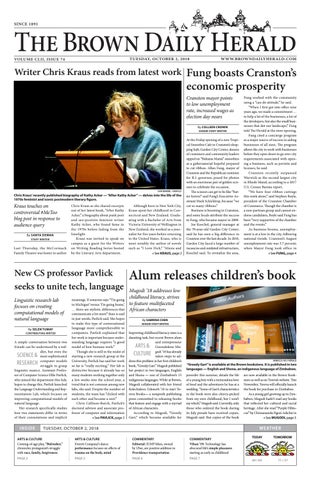
Chris Kraus’ recently published biography of Kathy Acker — “After Kathy Acker” — delves into the life of the 1970s feminist and iconic postmodern literary figure.
Kraus touches on controversial #MeToo blog post in response to audience query By SANYA DEWAN STAFF WRITER
Last Thursday, the McCormack Family Theatre was home to author
Chris Kraus as she shared excerpts out of her latest book, “After Kathy Acker,” a biography about punk poet and sex-positive feminist writer Kathy Acker, who found fame in the 1970s before fading from the limelight. Kraus was invited to speak on campus as a guest for the Writers on Writing Reading Series hosted by the Literary Arts department.
Although born in New York City, Kraus spent her childhood in Connecticut and New Zealand. Graduating with a Bachelor of Arts from Victoria University of Wellington in New Zealand, she worked as a journalist for five years before returning to the United States. Kraus, who is most notably the author of novels such as “I Love Dick,” “Aliens and » See KRAUS, page 2
At the Friday opening of a new Tropical Smoothie Cafe in Cranston’s shopping hub, Garden City Center, dozens of customers and community leaders sipped on “Bahama Mama” smoothies as a gubernatorial hopeful prepared to cut ribbon. Allan Fung, mayor of Cranston and the Republican nominee for R.I. governor, posed for photos with an enormous pair of golden scissors to celebrate the occasion. The scissors can get to be like “butter knives” said Fung’s Executive Assistant Mark Schieldrop, because “we cut so many ribbons.” Business is booming in Cranston, and some locals attribute the success to Fung, who became mayor in 2009. Joe Koechel, general manager at the 70-year-old Garden City Center, said he has seen a big difference in Cranston over the last decade. In 2010, Garden City faced a large number of vacancies and outdated infrastructure, Koechel said. To revitalize the area,
Fung worked with the community using a “can-do attitude,” he said. “When I first got into office nine years ago, we made a commitment … to help a lot of the businesses, a lot of the developers, but also the small businesses that dot our landscape,” Fung told The Herald at the store opening. Fung cited a concierge program as a major source of success in aiding businesses of all sizes. The program allows the city to work with businesses before they open doors to go over city requirements associated with opening a business, such as permits and licenses, he said. Cranston recently surpassed Warwick as the second largest city in Rhode Island, according to a 2017 U.S. Census Bureau report. “We have four ribbon cuttings this week alone,” said Stephen Boyle, president of the Cranston Chamber of Commerce. Though the chamber is a non-partisan group and cannot endorse candidates, Boyle said Fung has been “very supportive of the chamber and the events.” As business booms, unemployment is at a low in the city, following national trends. Cranston’s August unemployment rate was 3.7 percent; when Mayor Fung took office in » See FUNG, page 4
New CS professor Pavlick Alum releases children’s book seeks to unite tech, language Mugodi ’18 addresses low Linguistic research lab focuses on creating computational models of natural language By SELEN TUMAY CONTRIBUTING WRITER
A simple conversation between two friends can be understood by a toddler, but even the most sophisticated computer models struggle to grasp linguistic nuance. Assistant Professor of Computer Science Ellie Pavlick, who joined the department this July, hopes to change this. Pavlick launched the Language Understanding and Representation Lab, which focuses on improving computational models of natural language. Her research specifically studies how two statements differ in terms of their connotations and implicit
SCIENCE & RESEARCH
INSIDE
meanings. If someone says “‘I’m going to Michigan’ versus ‘I’m going home,’ … there are stylistic differences that communicate a lot more” than is said in just words, Pavlick said. She hopes to make this type of conversational language more comprehensible to computers. Pavlick explained that her work is important because understanding language requires “a good model of how humans work.” Though she is still in the midst of starting a new research group at the University, Pavlick has said her work so far is “really exciting.” Her lab is distinctive because it already has so many students working together only a few weeks into the school year, a trend that is not common among new labs, she said. Despite the number of students, the team has “clicked with each other and became a unit.” Chris Callison-Burch, Pavlick’s doctoral advisor and associate professor of computer and information » See PAVLICK, page 2
childhood literacy, strives to feature multifaceted African characters By SABRINA CHEN SENIOR STAFF WRITER
Improving childhood literacy rates is a daunting task, but recent Brown alum and entrepreneur Gwendolene Mugodi ’18 has already taken steps to address this problem in her first children’s book, “Greedy Gari.” Mugodi published her project in two languages, English and Shona — one of Zimbabwe’s 15 indigenous languages. While at Brown, Mugodi collaborated with her friend Kelechukwu Udozorh ’18 to start Toreva Books— a nonprofit publishing press committed to releasing books that feature and engage with a myriad of African characters. According to Mugodi, “Greedy Gari,” which became available for
ARTS & CULTURE
REBECCA HO / HERALD
“Greedy Gari” is available at the Brown bookstore. It is published in two languages — English and Shona, an indigenous language of Zimbabwe. preorder this summer, details the life of a young boy with a tremendous love of food and the adventures he has at a wedding. “Some of Gari’s characteristics in the book were also cherry-picked from my own childhood, but I won’t say which,” Mugodi said. Currently, only those who ordered the book during its July presale have received copies, Mugodi said. But copies of the book
are now available in the Brown Bookstore as well as on Toreva’s website. This November, Toreva will officially launch the book for purchase in Zimbabwe. As a young girl growing up in Zimbabwe, Mugodi hadn’t read any books that reflected her cultural and racial heritage. After she read “Purple Hibiscus” by Chimamanda Ngozi Adichie in » See MUGODI, page 3
WEATHER
TUESDAY, OC TOBER 2, 2018
ARTS & CULTURE Coming-of-age play, “Bulrusher,” chronicles protagonist’s struggle with race, family, forgiveness
ARTS & CULTURE Everett Company’s dance performance focuses on effects of trauma on the body, mind
COMMENTARY Editorial: JUMP bikes, owned by Uber, are positive addition to Providence transportation
COMMENTARY Vilsan ’19: Technology has obscured life’s simple pleasures starting as early as childhood
PAGE 2
PAGE 3
PAGE 6
PAGE 7
TODAY
TOMORROW
69 / 64
71 / 57
NEWS
PAGE 2 • TUESDAY, OCTOBER 2, 2018
THE BROWN DAILY HERALD
‘Bulrusher’ chronicles search for family » KRAUS, Protagonist gifted with clairvoyance grapples with racial identity in 1950s California By GRAYSON LEE STAFF WRITER
In Leeds Theatre’s production of “Bulrusher,” race, family and forgiveness are seen through the eyes of an earnest and confused young woman as she struggles to discover herself. The coming-of-age play was written by Eisa Davis and is directed by Sarah dAngelo, assistant professor of theatre arts and performance studies. Although clumsy lines and unnecessary plot points sometimes get in the way, passionate performances by the student actors coupled with powerful characters and captivating webs of language ultimately render “Bulrusher” a convincing and engaging show. The play centers on 18-year-old Bulrusher, so named because she was found as a baby in the bulrushes of the Navarro river in California. Bulrusher, played by Keanna Hunter ’21, was raised by the town’s schoolteacher, known as Schoolch (Robert Capron ’20). Bulrusher feels out of place, accentuated by her ability to
» PAVLICK, from page 1 science at Penn, said that the unusual number of students in her lab this early on is a “testament to her creativity and her energy and all the cool ideas she has with her research in (language) processing.” Before joining the University, Pavlick spent a year at Google Research in New York. Working in an academic setting primarily differs from working in the corporate environment at Google in the time horizon for her projects, she said. “Ambitious research at Google is a three-year plan,” whereas academic research just has to be completed “before I die,” Pavlick said, adding that she benefits from the freedom that an academic setting provides. As a graduate student, Pavlick worked closely with CallisonBurch, who oversaw Pavlick’s work that “helped to build the paraphrase database (that) contains 100 million English phrases paired with meaning equivalent expressions.” He also collaborated with Pavlick to build a gun violence database that tracks reported shootings from online local
from page 1
personal relationship with Acker. “She was my absolute idol,” Kraus said, adding that learning of Acker’s death “just broke my heart.” During the talk, an audience member asked Kraus to comment on a recent blog post, in which she took a controversial stance on the 2017 Title IX investigation brought by Nimrod Reitman, a former New York University graduate student, against his doctoral advisor Professor of German and Comparative Literature Avital Ronell, who was found guilty of sexual harassment in 2018 by an NYU investigation and is on leave for the academic year. In her Aug. 19 blog post, Kraus took the defense of Ronell, citing Reitman’s “accusations couched in the disingenuous sentiments of #MeToo,” she wrote. “Reitman — or any Ph.D. student at NYU — is hardly an innocent,” Kraus further wrote. During the event, Kraus responded that she “would not have (initially) gotten involved. … It was after Nimrod Reitman brought a lawsuit against Avital — a multimillion-dollar lawsuit — and he’s already a wealthy person with a legal team of seven lawyers, and she has no personal wealth. She is 66 years old. That just seemed so excessive.” “I guess I wrote (the blog post) more from an emotional place than a logical place,” she added.
foresee a person’s future when touching water with which they have had contact, causing the town to label her a witch. The story revolves around her interactions with other members of the town: Madam (Paola Jiménez ’20), who runs a brothel, Logger (Lemuel Burgos ’20), the only AfricanAmerican in the town besides Bulrusher and Boy (Sam Masto ’21), who harasses Bulrusher into being his girlfriend. Living in Boonville, California in 1955, the characters don’t seem to experience any racial tension, despite the violence across the country, and Bulrusher is unaware of the broader implications of her racial identity until the arrival of Vera (Alonnie Johnson ’21), Logger’s niece, from Alabama. Vera and Bulrusher immediately experience a deep affection for each other, and Bulrusher feels that she has finally met someone like her, calling Vera a mirror. Not everyone is thrilled with their relationship, however, and the revelations that come to light force Bulrusher to deal with hatred and love as she endeavors to find a family. Water is ubiquitous in the play, from the constant mention of the Navarro river to Bulrusher’s ability to “read water,” to the set itself. The river is central to the backdrop, and
everything seems to revolve around it. The lighting is often blue and green, while the musical interludes provide a lyrical and flowing effect. Along with water, the play is obsessed with language, with most of the characters speaking in a dialect particular to Boonville. While the intricacies of language often add beauty to the scenes, they also add a strained element to viewing the performance. When Bulrusher visits the Navarro river, she speaks to it in free verse poetry, and though Hunter valiantly attempts to inject integrity into these lines, Bulrusher’s monologues at the river often feel contrived. Equally awkward are Schoolch’s lines, or more appropriately, lack of lines. The character often doesn’t speak, resulting in odd pauses that seem unnecessary. Nonetheless, the moments when language disappoints in “Bulrusher” are far outweighed by the moments when language brilliantly drives the story. In an emotional scene between Bulrusher and Schoolch, Bulrusher asks him if she has ever had another name. Schoolch tells her that their names are their fates and they are bound by them, saying, “Once you had another name, but I forget it now. You’re a Bulrusher to me.” “Bulrusher” will run until Oct. 7.
Anorexia,” “Torpor” and “Summer of Hate,” has also dabbled in other artistic ventures, such as films and staged performances. While her earlier work was more performance-based, Kraus made the transition to writing full-time with her exemplary novel “I Love Dick” in 1997. Kraus really only began writing “in (her) late 30s, and the book didn’t come out until (she) was 40,” Kraus explained. “I Love Dick” has been taught in ENGL 1710R: “Recent Experiments in American Fiction,” an upper-level class taught by Timothy Bewes, a professor in the English department. Kraus’s book “really formed the premium text for everyone,” Bewes said. Kraus’ latest work centers around the life of postmodern literary icon Kathy Acker. After a student questioned the blend of fiction and nonfiction in her work, Kraus explained that her writing is often a mixture of the authentic and factual. She used a lot of material found in external archives and would “sometimes … import stuff from (Acker’s) diary,” which would contain personal bias and perspective, she said. For instance, Kraus looked at Acker’s correspondences and personal notes on her own work, which were found in literary archives. Kraus also discussed her own
newspapers and television to predict trends from these sources, he said. They hoped that the database would use newspaper articles to monitor gun violence in the United States, but their project was cut short. Callison-Burch added that “(Pavlick) was the best PhD student (he has) ever worked with,” saying that she will be a “very popular professor to work with” at the University. While she focused on teaching computers to understand paraphrasing during her time as a doctoral student at Penn, Pavlick came to the University to explore other avenues within natural language processing. She said that the University has a culture that is “very unique and supportive” and that she enjoys the encouragement of risk-taking. This semester, she is teaching CSCI 2952D: “Computational Semantics,” a graduate seminar focused on NLP. Though it is her first year teaching, Pavlick said that “the students are all very smart and ask great questions,” adding that they are “very involved and engaged.” She will also be teaching CSCI 1951A: “Data Science” in the spring, a larger undergraduate
lecture course. Pavlick recently joined the department, but she has already begun reaching out to others in the field at the University, including Assistant Professor Stefanie Tellex, Professor Eugene Charniak, Professor Michael Littman and Assistant Professor George Konidaris. She hopes to work with them to explore the process of building data sets and how language fits in with robotics, among other topics, Pavlick explained. She also hopes to take advantage of Brown’s interdisciplinary nature and collaborate with people in cognitive, linguistic and psychological sciences, economics and political science departments because their work aligns closely with hers. Aaron Traylor GS, Albert Webson GS and Roma Patel GS, all members of Pavlick’s lab, described her as an extremely positive person to work with, citing her research and determination as especially admirable. Webson highlighted the support she offers to her students, while Traylor emphasized her dissatisfaction with simple answers. “She thinks big,” Traylor said.
Assistant Professor of Computer Science Ellie Pavlick has launched the Language Understanding and Representation lab.
COURTESY OF BROWN UNIVERSITY
NEWS
TUESDAY, OCTOBER 2, 2018 • PAGE 3
THE BROWN DAILY HERALD
Everett Company’s ‘Good Grief ’ grapples with physical, emotional trauma Multimedia performance features dance, pantomime, dialogue, explores nature of internal conflicts By KATHERINE OK CONTRIBUTING WRITER
Thursday evening, a bustling audience gathered in the Granoff Center for Creative Arts to see Everett Company’s “Good Grief ” — a multimedia performance centered around trauma’s grip on both mind and body. The audience faced a stage cast in a cool, blue light, growing silent as members of the Everett Company began to emerge from behind a projection screen, their shadows and vague features visible among rolling ocean waves. Bells tolled in the distance while the artists swayed back and forth in composed movements, giving a sense of unity between their bodies and minds. The artists used both dance and pantomime to convey their life experiences. Dressed in various costumes, the artists employed dioramas, projected videos and used a variety of music to enact particular scenes, all of which were charged with physical and emotional intensity. Scenes ranged from conversations with an assumed therapist in a suburban living room to a depiction of a ghost-like figure trudging through a forest with
» MUGODI, from page 1 the eleventh grade, “there was an awakening to the magic of seeing someone like yourself in a book,” Mugodi said. When Mugodi returned to Zimbabwe after her first year at Brown, she became aware that 70 percent of Zimbabwean children who enter a firstgrade classroom exclusively speak one of the indigenous languages at home. Because the education system assumes that students know English, this literacy gap places many students at a disadvantage, according to Toreva’s website. The nonprofit aims to solve this problem by publishing children’s books in all of Zimbabwe’s native languages and in English. To support her entrepreneurship, Mugodi received a Swearer Center for Public Service Fellowship as well as support from the Heimark Fund and the Brown International Scholarship Committee. Mugodi also attended the Breakthrough Lab, a rigorous eightweek accelerator intended to support students developing entrepreneurial projects. “Brown allowed me to grow this idea from a dream to reality,” Mugodi said. Jason Harry, director of B-Lab and professor of the practice of engineering, noted that Toreva is an example of entrepreneurship that goes against the stereotype that resigns startups to technological focuses. “We’re looking for ventures that have impact at scale and address a significant unmet need,” Harry said. According to Harry, Toreva’s solutions to this “unmet need” include improving children’s literacy in indigenous languages, in part to prepare them for learning a new language. Both Harry and Mugodi reflected on the progress made during their summer at the B-Lab — a fully configured website, Toreva’s first book and sales. “B-Lab gave us valuable time, a working space and the mentorship we needed to actualize a lot of our goals,” Mugodi said.
literal baggage. Artists cycled through various identities, using masks, dresses, cloaks and even shadows to portray family members, emotions and stages in their lives, providing a fully immersive experience for both themselves and the audience. The physical toll of trauma was emphasized throughout the play. During dance, Everett Company’s artists provided dialogue on the nature of trauma and its physical effects on the mind and the body. Bodies became fluid as the artists leaned against, pushed and supported each other. At times, artists even grappled with “parts” of themselves, engaging in dialogue with their insecurities and trauma. Throughout the performance, artists visualized this dialogue with their “parts,” a method highlighted in Internal Family Systems, a psychotheraputic model. IFS emphasizes conflicts between “subpersonalities,” according to the Center for Self Leadership, an organization that focuses on the IFS method. At one point, with the use of a projected video, an artist began a conversation with one of their “parts,” their insecurity. At first, the dialogue was angry, aggressive and resentful,
but once the artist began approaching their part with kinder words, a sense of familiarity began to settle over the two. “Good Grief ” showed how trauma of all kinds can be a visceral experience, taking over an individual physically and cognitively, while also evidencing how the artists could begin healing and recognizing their trauma by confronting it with the IFS method, dance and theater. After the final dancing act and a standing ovation, Everett Company opened up the stage for a questionand-answer opportunity. Attendees lauded the theater troupe for their talent, skill and emotional vulnerability in presenting their story. When asked about the process of developing the theme of “Good Grief,” one of the artists replied that trauma was a focus for the performance. “We’ve been doing a lot of work in high schools,” they said. “All these artists have been going into middle schools and working with clinicians and creating artistic adaptations to clinical programs and group therapy for students who have been identified with suffering from PTSD.” The artists emphasized how significant IFS therapy was to the overall performance. They all met a therapist who specialized in IFS, and one of the members of Everett Company elaborated:
KATHERINE OK / HERALD
“Good Grief” highlighted the Internal Family Systems therapy method, which encourages engaging with one’s “subpersonalities.” “You’d go in and find a part of yourself you’d want to talk to, and talk to that part, and then we played each other’s parts; we
brought in movement. … Those were some of the ways we created some of the material.”
NEWS
PAGE 4 • TUESDAY, OCTOBER 2, 2018
» FUNG, from page 1 January 2009, the city’s unemployment rate was 10.8 percent, according to the Rhode Island Department of Labor and Training. The dip in unemployment comes as Rhode Island’s overall unemployment reaches an all-time low of 4 percent, The Herald previously reported. While more people are working in Rhode Island, they “don’t earn a lot,” said CEO of Rhode Island Center for Freedom and Prosperity Mike Stenhouse. The center looks at data across the state but has not done any specific work with Cranston, he said. But as a longtime resident of the city, Stenhouse said he has seen Fung build relationships with businesses and create a stable environment for them to thrive — though the mayor is not the only person who affects a city’s economy, he added. “We do have to give Fung some credit,” Stenhouse said. Wages have also increased in the last decade in Cranston, according to
THE BROWN DAILY HERALD
the Department of Labor and Training, which reported that the city’s average annual wages increased by $7,801 from 2009 to 2017. This positive uptick in Cranston is not unique to the city — Warwick and Providence, among others, have seen wage rises at comparable rates. Property taxes in Cranston have remained low while they have increased in other parts of the state. According to each cities’ tax assessor’s office, Cranston has the lowest commercial tax out of the state’s three biggest cities. Some of Cranston’s business success can be attributed to forces outside of the state, Koechel said. Cranston is located near the Massachusetts border and right off of three major highways — attracting shoppers from Connecticut and Massachusetts. Jill Zajac, co-owner of the new Tropical Smoothie Cafe, hopes Cranston’s success will persist and continue to attract customers to her business. “Come and try us,” she said, “We have food.”
Have opinions?
Tell us about them! See guidelines at browndailyherald.com/submissions
COURTESY OF KENNETH ZIRKEL
Allan Fung became the Mayor of Cranston in 2009. He will face incumbent Gov. Gina Raimondo in the 2018 Rhode Island gubernatorial race.
TODAY
TUESDAY, OCTOBER 2, 2018 • PAGE 5
THE BROWN DAILY HERALD
menu
brown is green
SATELLITE DINING ANDREWS COMMONS
Pizza: Pepperoni, Cajun Chicken, Spinach & Feta Curry Bar JOSIAH’S
BLUE ROOM
Dumpling Bar, Mushroom Swiss Burger, Grilled Cheese
Three Bean Chili, Chicken Mushroom Xacuti
DINING HALLS SHARPE REFECTORY LUNCH
DINNER
Pork Shoulder Chili, Corn Taco Shells, Flour Tortillas, Saffron Rice, Pinto Beans
Korean Barbecue Chicken, Mori Soba Noodles, Steamed Peas, Roasted Spaghetti Squash
VERNEY-WOOLLEY LUNCH
DINNER
Chicken Parmesan Sandwich, French Fried Onion Rings, Fresh Steamed Green Beans
Sunny Rum Ham, Baked Macaroni and Cheese, Spicy Sweet Roasted Yams
sudoku
TED ORBEN / HERALD
Despite dropping temperatures, College Hill remains filled with hidden green gems. Students taking study breaks can find refuge in places like the Nature Lab and the greenhouse as midterm season begins.
Q U O T E O F T H E D AY
“There was an amazing awakening to the magic of seeing someone like yourself in a book.” — Gwendolene Mugodi See MUGODI on FRONT. RELEASE DATE– Wednesday, March 20, 2013
Los Angeles Times Daily Crossword Puzzle c rNorris o s sandwJoyce o rNichols d Lewis Edited by Rich
ACROSS 1 Beavers’ projects 5 Eat on the run, as a sandwich 9 Dainty drinks 13 Thick-furred dog 15 Opera that premiered in Cairo in 1871 16 Make ribbing with needles 17 Ski lodge mugful 18 Febreze target 19 Wine bucket, e.g. 20 Shot from the side 23 Bygone full-size Ford 24 Federal air marshals’ org. 25 __ Nashville: country music label 26 Cosmetics mogul Mary Kay 29 Physics particles 32 Celeb with all the answers 34 End of Ali’s memorable boast 37 Green Hornet’s driver 38 Habit wearer 39 Sack lead-in 42 Diner’s cell app 47 Like cheerleaders 49 __ majesty: high treason 50 Scheming 51 Legal ending 52 Lamb’s pop 54 Billy’s bleat 56 Makeshift radio antenna 62 Valentine’s Day deity 63 “Modelland” author Banks 64 Scrabble’s blank pair 66 Respond to hilarity 67 “A likely story” 68 Bridge bid, briefly 69 Netflix rentals 70 So-so grades 71 Agts. who might use the starts of 20-, 34-, 42- and 56-Across
DOWN 41 Meddle 55 Gerontologist’s 1 Gallantry-in43 Jardin du concern combat mil. Luxembourg, par 57 Gets the wrong award exemple total, say 2 Per 44 Utterly confused 58 Branch locale 3 Very small: Pref. 45 West Point inits. 59 Small business 4 Island seating 46 Primitive shelter owner’s figurative 5 Brit’s joint 47 Wanted poster array 6 Hitchhiker’s hope offer 60 Ne or Na 7 Get a pound 48 “Foundation” 61 Artist Magritte pooch, say author 65 George W., to 8 Coffeehouse 53 “It could happen” George H.W. specialist 9 Satirical ANSWER TO PREVIOUS PUZZLE: miniature 10 Officeholders 11 Fillmore’s successor 12 Bolt in the buff 14 Full-figured 21 Superstar search show, to fans 22 Atkins no-no 26 Pose 27 RR stop 28 “Get lost” 30 Simone of jazz 31 Hard head? 33 “__ mouse!” 35 Bleak film genre 36 Suffix with differ or defer 03/20/13 xwordeditor@aol.com 40 Pioneering ISP
calendar TODAY OCTOBER
S
By Amy Johnson (c)2013 Tribune Media Services, Inc.
03/20/13
M
T
W
Th
F
S
1
2
3
4
5
6
7
8
9
10
11
12
13
13
14
15
16
17
18
19
20
21
22
23
24
25
26
27
28
29
30
31
Biological Protocols and Methods Searching 12:00 P.M. Rockefeller Library, 160
Peer Career Advisor Open Hours 1:30 P.M. CareerLab, First Floor
Econometrics Seminar 4:00 P.M. Robinson Hall, 301
BOC Presents: Blue Heart Film Screening 7:30 P.M. MacMillan Hall, 115
TOMORROW Global Independent Study Project Information Session 1:00 P.M. J Walter Wilson, 440
English Language Workshop: Academic Writing Series 3:00 P.M. Sciences Library, 520
Don’t Forget to Breathe Workshop Series: Emotional Intelligence 4:00 P.M. CareerLab, First Floor
Brown In Washington Information Session & Dinner 6:00 P.M. Swearer Center, Conference Room
COMMENTARY PAGE 6 • TUESDAY, OCTOBER 2, 2018
THE BROWN DAILY HERALD
EDITORIAL
JUMP bikes are a giant leap for Providence In early September, JUMP — the dockless bike-share program owned by Uber — launched in Providence, giving College Hill and other neighborhoods around the city a colorful makeover with its bright red bicycles. The bikes can now be found at 40 docking hubs throughout Providence, and can be easily returned to any public location where the bike can be attached to a fixed installation, such as a bike rack or streetlight. A result of seven years of efforts to bring a bike-share program to Providence, JUMP electric bikes offer numerous benefits to the city and its community members with a new, sustainable mode of transportation. This long-awaited initiative is a much-needed addition to local public transit; we applaud its implementation in Providence, along with the diverse array of stakeholders who made the program possible in the first place. As cities look for ways to ward off heavy vehicle congestion, bike-share programs have become an increasingly popular option for urban planners since bikes are, in fact, incredibly effective in reducing traffic. One
2014 study found that the 1,325 bikes operating in Minneapolis/St. Paul’s bike-share scheme contributed to a reduction of 55,000 car miles in just one year. This decrease in car travel not only curtails traffic congestion but also allows cities to reduce fuel consumption, carbon emissions and noise pollution, while encouraging commuters to live physically active lifestyles. Bike-share programs are also an effective mechanism for sustainable growth and development. Studies have linked bike-share programs to clear economic benefits; the improved spatial connectivity and accessibility afforded by bicycles result in increased local business patronage and activity. The biggest benefit provided by bike-share programs, according to some researchers, is the economic efficiency unlocked by reduced travel times, increased access to the city and its inhabitants and greater workforce participation. In short, bike share programs allow a larger proportion of urban populations to engage in their communities and local commercial activity at an affordable price.
Over time, bike-share programs act as a multiplier of the aforementioned effects by creating a cycling culture, normalizing biking as a desirable form of urban transportation. Research has found that people’s willingness to use bicycles as a mode of transport increases when there are a large number of cyclists in a community. Furthermore, if more people begin to bike, traffic safety increases and injuries are reduced. In other words, Programs like JUMP help foster a greater desire among communities as a whole to rely on bicycles as a mode of urban transport, even beyond users of the program. Providence’s new bike-share program contributes nicely to the city’s broader transportation goals. Since 1990, Providence has identified biking as an important transit option within the city and has worked on a number of infrastructure improvements to promote urban biking since then. Mayor Jorge Elorza’s time in office has brought an increased focus to this initiative; in his 2014 campaign, Elorza promised to bolster biking infrastructure by adding bike lanes and parking, creating programs around
bike safety education and bringing bike sharing to Providence. With the introduction of JUMP bikes, Providence has made it clear that safe, accessible and effective transportation is a critical component of urban life by making tremendous strides toward integrating bikes into broader urban development plans. Critics have fairly pointed out that the program can do more to make sure these benefits are more equitably distributed across the city. For example, JUMP bike docking sites are predominantly situated in the East Side and are more sparsely distributed in areas like Olneyville and Washington Park. Given the economic advantages of urban bike-share systems, it should be a long-term aspiration for the program to disperse advantages more equitably, and be more accessible to low-income, underserved neighborhoods in Providence. In the past, The Herald has bemoaned, not particularly productively, the state of public transportation in Providence. But the JUMP bikeshare program is an undeniably positive addition to existing transit options in the city. Just as importantly,
it represents a laudably fruitful partnership between a large number of stakeholders in Providence. The University, for example, convened an internal task force comprised of students, staff and faculty that advised the city on the program’s initiation and identified good locations for bike hubs on campus. The Rhode Island Public Transportation Authority and the Rhode Island School of Design, among other Providence-area organizations, were also involved in the program’s planning. In this way, JUMP bikes are a model for collaboration between public interests and private institutions in the city. Their contributions to life in Providence — from the standpoints of commerce, community engagement and public safety — will certainly be felt for years to come. Editorials are written by The Herald’s editorial page board: Anuj Krishnamurthy ’19, Rhaime Kim ’20, Grace Layer ’20, Mark Liang ’19 and Krista Stapleford ’21. Please send responses to this opinion to letters@browndailyherald.com and op-eds to opinions@ browndailyherald.com.
THIS COULD BE YOU. To advertise your: business student group event in The Herald, visit bdhsales.com.
Find us online! facebook.com/browndailyherald
browndailyherald.com
@the_herald
Location: 195 Angell St., Providence, R.I. www.browndailyherald.com
@browndailyherald
youtube.com/browndailyherald
Editorial Leadership
Sections
Multimedia & Production
Business
Editors-in-Chief Elena Renken Kasturi Pananjady
Arts & Culture Editors Connor Sullivan Ethel Renia
General Managers Michael Borrello Matilda Lynton
Managing Editor Alex Skidmore
Metro Editors Emily Davies Isabel Gensler
Design Editors Kyle Cui Eduard Muñoz-Suñé Assistants: Julie Wang, Kelvin Yang
Senior Editors Madison Rivlin Hattie Xu Editorial Page Editor Anuj Krishnamurthy POST- MAGAZINE Editor Jennifer Osborne
News Editors Eduard Muñoz-Suñé Priyanka Podugu Sarah Wang Science & Research Editors Jonathan Douglas Jackson Wells Sports Editors Alexandra Russell James Schapiro COMMENTARY Opinions Editors Connor Cardoso Anuj Krishnamurthy Clare Steinman Emily Miller
Photo Editors Sam Berube Anita Sheih Copy Desk Chief Kelley Tackett Illustrations Editor Daphne Zhao Video Editor Celia Hack Graphics Editors Marlis Flinn Sarah Martinez
Office Manager Diane Silvia Directors Sales: Shreya Raghunandan Finance: Ravi Betzig Strategy: Edwin Farley
Editorial contact: 401-351-3372 herald@browndailyherald.com
Advertising contact: 401-351-3372 advertising@browndailyherald.com
Submissions: The Brown Daily Herald publishes submissions in the form of op-eds and letters to the editor. Op-eds are typically between 750 and 1000 words, though we will consider submissions between 500 and 1200 words. Letters to the editor should be around 250 words. While letters to the editor respond to an article or column that has appeared in The Herald, op-eds usually prompt new discussions on campus or frame new arguments about current discourse. All submissions to The Herald cannot have been previously published elsewhere (in print or online — including personal blogs and social media), and they must be exclusive to The Herald. Submissions must include no more than two individual authors. If there are more than two original authors, The Herald can acknowledge the authors in a statement at the end of the letter or op-ed, but the byline can only include up to two names. The Herald will not publish submissions authored by groups. The Herald does not publish anonymous submissions. If you feel your circumstances prevent you from submitting an op-ed or letter with your name, please email herald@browndailyherald.com to explain your situation. You can submit op-eds to opinions@browndailyherald.com and letters to letters@browndailyherald.com. When you email your submission, please include (1) your full name, (2) an evening or mobile phone number in case your submission is chosen for publication and (3) any affiliation with Brown University or any institution or organization relevant to the content of your submission. Please send in submissions at least 24 hours in advance of your desired publication date. The Herald only publishes submissions while it is in print. The Herald reserves the right to edit all submissions. If your piece is considered for publication, an editor will contact you to discuss potential changes to your submission. Commentary: The editorial is the majority opinion of the editorial page board of The Brown Daily Herald. The editorial viewpoint does not necessarily reflect the views of The Brown Daily Herald, Inc. Columns, letters and comics reflect the opinions of their authors only. Corrections: The Brown Daily Herald is committed to providing the Brown University community with the most accurate information possible. Corrections may be submitted up to seven calendar days after publication. Advertising: The Brown Daily Herald, Inc. reserves the right to accept or decline any advertisement at its discretion. The Brown Daily Herald, Inc. is a financially independent, nonprofit media organization bringing you The Brown Daily Herald, BlogDailyHerald and Post- Magazine. The Brown Daily Herald has served the Brown University community daily since 1891. It is published Monday through Friday during the academic year, excluding vacations, once during Commencement and once during Orientation by The Brown Daily Herald, Inc. Single copy free for each member of the community. Subscription prices: $200 one year daily, $100 one semester daily. Copyright 2018 by The Brown Daily Herald, Inc. All rights reserved. Periodicals postage paid at Providence, R.I. Postmaster: Please send corrections to P.O. Box 2538, Providence, RI 02906.
COMMENTARY TUESDAY, OCTOBER 2, 2018 • PAGE 7
THE BROWN DAILY HERALD
The simple pleasures FABIANA VILSAN staff columnist
He is nine years old, 10 at most. His feet dangle above the ground. His tiny arms rest uncomfortably on the dinner table. He is holding in his miniature hands the newest iPhone, swiping and scrolling as though it were second nature. Conversation swells around him, but he is unaware. Then, minutes later, he carefully places the iPhone on the table and turns to his mother. “I’m bored,” he declares. “Give me the Nintendo.” Do you recognize this boy? He’s everywhere. He’s a product of the technological age — an age in which children are given iPads when their parents are busy instead of being told to go play outside. Indeed, studies show that on average, an American child receives their first phone at age 10. He is an undeniable fixture of our consumer society. He is fed advertisements with his cereal. He cannot imagine fashioning a fantastical world using only a box and a stick, because he has always had limitless entertainment at his fingertips, prepackaged for his convenience. What does this boy convey about our society, about our ability to enjoy the simple pleasures in life, instead
of buying our entertainment and exchanging the old model for the new almost immediately? As technology continues to encroach upon our daily lives, should we be adapting or fighting against it? Silicon Valley is perhaps the most recognizable technological space in the world. Yet according to Business Insider, Silicon Valley parents are
of dependency. The potential benefits of technology are innumerable, as the Silicon Valley community can certainly attest to. But that doesn’t mean that there are no associated risks. It is important to understand that technology changes the way we think, behave and interact with others. Excessive exposure from a young age has detrimental effects on our men-
pleasures in life. That child that I described at the dinner table will grow up to be a young adult who is similar to me. As a senior, I was born on the cusp of the 21st century. That means that I actually got to go play outside and that my first cell phone had an antenna. But by the time I was a preteen, social media and gadgets were very
I am asking for a little bit of imagination — for us to find the fantastical in everyday objects and realities instead of finding our entertainment in tech.
raising their children in a relatively tech-free way, because they’re fully exposed to the potentially harmful effects of socializing their children in an environment dominated by technology. Indeed, a recent survey of the Silicon Valley community uncovered common concerns that excessive technological use is shortening attention spans and creating a culture
tal health, our ability to make close friendships and our capacity to maintain focus. As college students, it’s probably too early to start thinking about parenting techniques for our future Apple-obsessed offspring, but it isn’t too early to think about the ways in which the technological age has impacted our own ability to enjoy the simple
much a part of my daily life, and as a young adult technology monopolizes most of my time. According to Robert Lustig, professor of pediatrics at the University of Southern California, technology has effects on our brains similar to those caused by drugs, ultimately leading to addiction. When exposed to technology at an age before the prefrontal cortex is fully de-
veloped, we are more susceptible to these addictive effects and more likely to feel withdrawal symptoms when we are without our phones. Think about it. When is the last time you went a full day without tech? When’s the last time you played a board game instead of a video game, or read a paperback instead of a PDF file? We may like to think that we are independent from our technology, and we may scoff at the young boy unable to put down his phone. We’re not like that, we think to ourselves. We were born before the 2000s. But the truth is we may be just as addicted to our tech and just as restless. Don’t get me wrong. I’m not arguing that we renounce technology altogether and return to ancient times. Instead, I am proposing a return to the simple pleasures in life, if only occasionally. I am proposing a tech-free Sunday, one spent with friends and family, with a good book or a board game. I am asking for a little bit of imagination — for us to find the fantastical in everyday objects and realities instead of finding our entertainment in tech.
Fabiana Vilsan ’19 can be reached at fabiana_vilsan@ brown.edu. Please send responses to this opinion to letters@browndailyherald.com and other op-eds to opinions@ browndailyherald.com.
SUMMER ZHANG
TICKETS AVAILABLE AT
tiny.cc/ovpr
SALOMON CENTER FOR TEACHING DE CICCIO FAMILY AUDITORIUM TUESDAY, OCTOBER 23 | 6 P.M.
Frontlines of the
Innovative Science-Based Solutions
KEYNOTE SPEAKER
MICHAEL BOTTICELLI Executive Director, Grayken Center for Addiction at Boston Medical Center; former Director, National Drug Control Policy at the White House
Nicole Alexander-Scott
Director, Rhode Island Department of Health; Associate Professor of Health Services, Policy and Practice
Traci Green
Adjunct Associate Professor of Emergency Medicine; Adjunct Associate Professor of Epidemiology; principal investigator, Center of Biomedical Research Excellence (COBRE) on Opioids and Overdose
Brandon Marshall
Associate Professor of Epidemiology; Scientific Director, PreventOverdoseRI
Josiah Rich
Professor of Medicine; Professor of Epidemiology; principal investigator, Center of Biomedical Research Excellence (COBRE) on Opioids and Overdose
ABOUT THE EVENT The American Academy of Arts & Sciences and the Office of the Vice President for Research at Brown University present a keynote and panel discussion about research-based creative approaches to the opioid crisis.
Tickets required. This event is free and open to the public. To request special services, accommodations or assistance for this event, please contact the Office of University Event & Conference Services at universityevents@brown.edu or 401-863-3100.