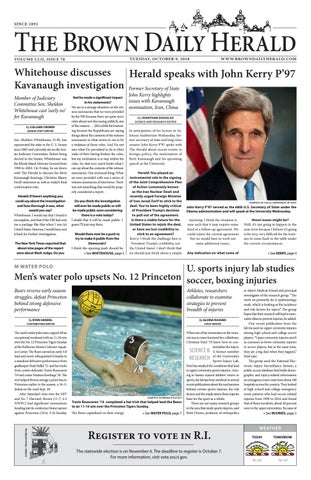
SINCE 1891
THE BROWN DAILY HERALD TUESDAY, OCTOBER 9, 2018
VOLUME CLII, ISSUE 78
WWW.BROWNDAILYHERALD.COM
Whitehouse discusses Herald speaks with John Kerry P’97 Kavanaugh investigation Former Secretary of State Member of Judiciary Committee Sen. Sheldon Whitehouse cast ‘early no’ for Kavanaugh By COLLEEN CRONIN SENIOR STAFF WRITER
Sen. Sheldon Whitehouse, D-RI, has represented the state in the U. S. Senate since 2007 and currently sits on the Senate Judiciary Committee. Before being elected to the Senate, Whitehouse was the Rhode Island Attorney General from 1998 to 2003. On Friday, he sat down with The Herald to discuss the Brett Kavanaugh hearings, Christine Blasey Ford’s statement as well as today’s final confirmation vote. Herald: If there’s anything you could say about the investigation and how thorough it was, what would you say? Whitehouse: I would say that I found it incomplete, and that if the FBI had sent me a package like that when I was (a) United States Attorney, I would have sent it back for further investigation. The New York Times reported that about nine pages of the report were about Mark Judge. Do you
feel he made a significant impact in his statements? We are in a strange situation on the witness summaries that we were provided by the FBI because there are quite strict rules about not discussing publicly any of the content. … (It’s) a little bit frustrating because the Republicans are saying things about the contents of the witness summaries in what seems to me to be a violation of those rules. And I’m not sure what I’m permitted to do in (the) wake of their having broken the rules, but my inclination is to stay within the rules. So, that very much limits what I can say about the contents of the witness summaries. One technical thing: What we were provided with was a series of witness summaries of interviews. There was not something that would be properly considered a report. Do you think the investigation will ever be made public or will be made public soon considering there is a vote today? I doubt that it will be made public. I guess I’ll just stop there. Would there ever be a push to try to make it public from the Democrats? I think the opening push should be » See WHITEHOUSE, page 3
John Kerry highlights issues with Kavanaugh nomination, Iran, China By JONATHAN DOUGLAS SCIENCE AND RESEARCH EDITOR
In anticipation of his lecture in Salomon Auditorium Wednesday, former secretary of state and long-time senator John Kerry P’97 spoke with The Herald about recent events in foreign policy, the nomination of Brett Kavanaugh and his upcoming speech at the University. Herald: You played an instrumental role in the signing of the Joint Comprehensive Plan of Action (commonly known as the Iran Nuclear Deal) and recently urged Foreign Minister of Iran Javad Zarif to stick to the deal. You’ve been highly critical of President Trump’s decision to pull out of the agreement. Is there a viable future for the United States to rejoin the deal, or have we lost credibility to stick to an agreement? Kerry: I think the challenge here is President Trump’s credibility, not the United States’. I don’t think that we should just think about a simple
COURTESY OF THE U.S. DEPARTMENT OF STATE
John Kerry P’97 served as the 68th U.S. Secretary of State under the Obama administration and will speak at the University Wednesday. rejoining. I think the situation is now such that it may require some kind of a follow-up agreement. We could rejoin the current agreement but we would have to work out some additional issues.
those issues might be? Well, it’s not going to happen in the near term because I believe it’s going to be very, very difficult for the Iranians to come back to the table under the current circumstances.
Any indication on what some of
» See KERRY, page 4
U. sports injury lab studies Men’s water polo upsets No. 12 Princeton soccer, boxing injuries M WATER POLO
Bears reverse early season struggles, defeat Princeton behind strong defensive performance
Athletes, researchers collaborate to examine strategies to prevent breadth of injuries
By RYAN HANDEL
By GLORIA NASHED
CONTRIBUTING WRITER
STAFF WRITER
The men’s water polo team capped off an exceptional weekend with an 11-10 win over the No. 12 Princeton Tigers Sunday at the Katherine Moran Coleman Aquatics Center. The Bears earned an early 3-0 lead and never relinquished it thanks to a standout defensive performance from goalkeeper Riad Hallal ’21 and hat tricks from center-defender Travis Bouscaren ’19 and center Hudson Rawlings ’20. The win helped Brown avenge a prior loss to Princeton earlier in the season, a 16-11 defeat on the road Sept. 29. After Saturday’s wins over the MIT and No. 7 Harvard, Brown (11-7, 4-2 NWPC) had significant momentum heading into its conference home opener against Princeton (10-6, 3-4) Sunday.
When one of her teammates on the women’s soccer team fractured her collarbone, Christine Etzel ’19 knew how to contextualize the injury. A former member of the University’s Sports Injury Lab, Etzel has studied the conditions that lead to upper extremity sports injuries. Aiming to hasten injured athletes’ return to sports, the lab has been involved in several recent publications about the mechanisms behind certain sports injuries, the risk factors and the implications these injuries have for the sport as a whole. There are not many research groups in the area that study sports injuries, said Brett Owens, professor of orthopedics
PIA MILEAF-PATEL / HERALD
use
COURTESY OF BROWN ATHLETICS
Travis Bouscaren ’19 completed a hat trick that helped lead the Bears to an 11-10 win over the Princeton Tigers Sunday. The Bears capitalized on their energy
» See WATER POLO, page 7
FRIDAY, OC TOBER 5, 2018
SCIENCE & Roundup: U. researchers laser scan to find lost Mayan city, release
PAGE 2
SCIENCE & RESEARCH
Register to vote in R.I.
SECTION SECTION COMMENTARY Let’s give some text that says Let’s give some text that says Schapiro ’19: The Baseball HOF something about this story so that something about this story so that should honor players whose The statewide election is on November is October people read it people read it6. The deadline to register greatness goes beyond7.numbers PAGE #
For more information, visit vote.sos.ri.gov. BACK PAGE #
at Alpert Medical School and principal investigator of the research group. “The work we primarily do is epidemiology work, which is looking at the incidence and risk factors for injury.” The group hopes that their research will lead to innovative ideas to prevent injuries, he added. One recent publication from the lab focused on upper extremity injuries among high school and college soccer players. “Upper extremity injuries aren’t as common as lower extremity injuries in soccer players, but at the same time, they are a big deal when they happen,” Etzel said. The group used the National Electronic Injury Surveillance System, a public access database that holds demographic and injury-related information on emergency room visits from about 100 hospitals across the country. They looked at high school and college emergency room patients who had soccer-related injuries from 1999 to 2016 and found that of those incidents, about 20 percent were in the upper extremities. Because of » See INJURIES, page 2
WEATHER TODAY
TOMORROW
76 / 67
79 / 67
NEWS
PAGE 2 • TUESDAY, OCTOBER 9, 2018
THE BROWN DAILY HERALD
» INJURIES, from page 1 the seriousness of these injuries, which include fractures and dislocations, the study can be used by coaches and athletes to develop strategies and exercises to prevent them, Etzel added. Another study centered on upper extremity boxing injuries in the United States. The organization USA Boxing did not record injury rates before 2011, so the paper’s results were relatively novel, said Lauren Ready MD’21, a member of the lab. New rules for the sport were implemented in 2013 to try to make boxing safer, but there hadn’t been any reviews on injury rates after the changes, she noted. The group found that there was a decrease in injuries after the rule change, highlighting the correlation between the two, she added. While it’s hard to definitively prove causation, identifying this strong correlation has a tangible benefit, Ready said. This research “can help athletes and coaches anticipate and avoid injury because they know the common injuries and the most common age groups for those injuries,” she added. To find the incidence of these injuries in boxers, the group also used the national injury database. “Since it covers enough of the nation, you can infer that (this data) reflects the national averages,” Ready said. The group searched for both men and women from 2012 to 2016, she added. “What’s great about the Sports Injury Lab is the diversity,” Ready said. “It really covers a breadth of sports and studies all (aspects) of injury.” She mentioned prevention, recovery improvement and patient experience enhancement as some facets of injury that the lab studies. “Until you can study the (injury) and understand who it’s happening to, it’s hard to intervene and try to prevent (them),” Owens said.
COURTESY OF CHRISTINE ETZEL
The University’s Sports Injury Lab studied upper extremity injuries in high school and college soccer players. Though upper extremity injuries are less common than lower extremities injures, they account for 20 percent of emergency visits from high school and college patients, the study found.
Brown University Community Council
Yves Tumor releases Warp Records debut Elusive musician plays with musical genre definitions in new experimental album By KATHERINE OK STAFF WRITER
Tuesday, October 9, 2018 4 – 5:30 p.m. Updates from the President and NECHE Accreditation Report Update on Graduate School Unionization Health and Wellness Planning Meetings are open to members of the Brown community. Meeting will be held in the Stephen Robert ’62 Campus Center, Kasper Multipurpose Room To learn more about the Community Council visit: brown.edu/go/council
Italy-based artist Sean Bowie, more famously known as Yves Tumor, released his new album “Safe in the Hands of Love” to Warp Records Sept. 5, demonstrating his ability to unravel everything that we consider to be “experimental music.” It is important to know that Yves Tumor remains a reticent figure — there are few interviews, pictures or articles on his personal life or identity. The only video of him that most listeners are familiar with is footage of him wailing, splayed out on a pile of dirt at a fashion show. Yves’ new album again puts aside personal identity for artistic expression. “Safe in the Hands of Love” is an album that recalls a lot of things: artists like Ariel Pink, Arca, Sunn O))), Jodeci, Morrissey; a diary; and the feeling of being trapped in an alternate dimension. What is so captivating about Yves Tumor’s new album is that it perhaps intends to evoke a multiplicity of aesthetics. It challenges our definitions of experimental music by suggesting that it doesn’t have to be so unfamiliar. It
shouldn’t be categorized into a binary either/or (sorry, Elliott Smith); rather, it should be experienced. Yves’ new album is as enchanting as it is haunting — it equally revels in both the oddly catchy lyrics of tracks like “Noid” and the abrasive, expansive rush of noises in “Licking an Orchid.” Yves Tumor shows himself to be a musician that can beguile us with auditory forms of anxiety and melancholy while simultaneously calling upon feelings of longing and anticipation. And this duality in composition and emotion is meant to tell us something. Throughout the album, Yves Tumor maintains an undercurrent of intensity, both emotionally and musically. The ’90s-esque, running back-beat and stringed instrumentals of “Noid” are redefined by Yves’ dark, anxious lyrics: “Sister, mother, brother, father / Have you, have you looked outside? / I’m scared for my life / They don’t trust us / I’m not part of the killing spree / A symptom, born loser, statistic.” This line is repeated, and the surprisingly accessible vocals (more palpable than those exhibited in previous albums) threaten a regular Yves fan’s drawn distance between mainstream elements and experimentation. The ironic simplicity of some tracks’ moments doubled with interludes of searing, noisy complexity invites us to reconsider what we call Yves Tumor. Yes, Yves delves
into plunderphonics, noise music and post-industrial sounds, but should we be so eager to pigeonhole “Safe in the Hands of Love” as “experimental” and subsequently conflate “experimental” with “good”? “Safe in the Hands of Love” composes a phantasmagoria of sound and lyrics at once familiar and unfamiliar. Yves Tumor condenses a myriad of tones and sounds into one album and forces us to listen from another angle. It suggests that maybe all artists should foray into the realm of “experimental,” or perhaps, it hints that the audience should all dive into an experimental sort of listening. The album can have the label of “experimental” taped onto it, but by subversively darting between different genres of sounds and noises, Yves Tumor refuses to be pinned down to one type of narrative, audience and crux. “Safe in the Hands of Love” urges listeners to consider what it means to listen to music. It’s easy to categorize certain genres with certain people: “Beach Goth” with jumpsuit-clad art kids with literal clown makeup, Canterbury scene with millennial-aged men and plunderphonics with crate-digging, list-obsessed “Rate Your Music” users. Yves acknowledges this, and his album tears up its label, insisting that we instead take his narrative of sound for what it is: music.
NEWS
TUESDAY, OCTOBER 9, 2018 • PAGE 3
THE BROWN DAILY HERALD
» WHITEHOUSE, from page 1 for a complete, thorough investigation. That’s the key step. Making public witness summaries — or sections of witness summaries — that came out of a process that appears to me more designed to step around the truth than find the truth is not as helpful as actually getting a sincere and thorough investigation completed. How will you vote today? I was an early ‘no,’ right after the first Judiciary Committee hearing, when I had a chance to see Kavanaugh in action before the committee. What factors led you to that ‘no’? The biggest factor for me is the array of indicators that he would be a highly partisan Supreme Court judge and contribute to what is a very distressing trend at the Supreme Court of five-to-four partisan Supreme Court decisions that yield big victories for big Republican interests. Following the second portion of the hearings, after Blasey Ford’s accusation came out to the public, what do you think … Kavanaugh’s (statements) revealed about his character and also his temperament? To me, it confirmed concerns that I had about his temperament and his truthfulness and his partisanship. I thought
the most telling part of his statement was when he called up the Clintons as participants in some kind of a conspiracy against him. To me, that seemed like (a) very far out conspiracy theory. And the fact that he was willing to go there was, to me, a very disturbing signal. It’s one thing to be angry, it’s another thing to have your anger take you into the land of conspiracy theory and false blame. False blame is a particularly dangerous thing from somebody who wants to be a judge. What did you make of the Republicans choosing to have a prosecutor question Blasey Ford? I think they were concerned about the appearance of the all elderly white male makeup of the Republican members of the Judiciary Committee. This was a vehicle for getting a female face into the equation. Republicans had originally said they would yield all their time to a prosecutor, and then (starting) with Lindsey Graham, … comments from came from Republican Senators themselves. What do you make about some of the anger that came from those Republican Senators? I think at some point in the day there came a realization that their strategy to hide behind a prosecutor was a complete failure and that Blasey Ford was, as
President Trump himself said, a credible and compelling witness. They basically needed to change the narrative as urgently as possible.
and on other Republicans watching from their offices.
What do you say to the Republican argument that Blasey Ford’s accusation and other accusations that have come out are really just an excuse to extend the confirmation process? It’s an argument that doesn’t align with the facts. Particularly the facts about Ford having made so many prior, consistent statements corroborating her accusation of Kavanaugh and (having) begun to try to get information about the assault to the Judiciary Committee before Kavanaugh was even the nominee.
Were there any personal experiences that you’ve had that affected your decision to vote against Kavanaugh or affected your reaction to Blasey Ford’s accusation? The most personal reaction that I have had in this episode since Blasey Ford came forward was to the incredible outpouring of support from Rhode Islanders and particularly from a group of women who each separately wrote me from a wide variety of backgrounds, from college students to grandmothers, who tell me about sexual assaults they had experienced.
Going back to last Friday, when there was the decision to start an investigation, can you describe some of the confusion or the atmosphere when Sen. Flake had what some are calling a ‘crisis of conscience’ that day? I think there was indeed a crisis of conscience on the Republican side. I think Sen. Flake was the most visible and significant figure in all of this. But I do think our persistent and forceful arguments about the failure to reopen the background investigation for these new allegations were having an effect on other Republicans on the committee
Do you think these hearings will affect the midterm elections? Is there anything you have to say to Brown students or students in general about the democratic process following these hearings? Well, there’s a very simple reason that the Republicans were able to get away with all the many violations of Senate rules, Senate norms and simple decency in the rush to confirm this nominee and that is that there is no countervailing power in Washington against the monopoly on power that Republicans hold in the House, the Senate and the White House. And however strong your feelings are
about what has happened in this process, I would hope the response is to get more engaged rather than to disengage, because the basic condition that allowed this to happen was a one-party monopoly on power and zero accountability as a result. Can I say one other thing? … I’m stuck again by these women who wrote about their own experiences. Often in the letters they said they told no one, or they said they only told their husbands, or they only told a small circle of friends. And they were sharing this private experience — something often held by them for decades — because they’ve wanted me to believe Ford because her memory and her reaction were exactly consistent with their memories and their reactions to their sexual assaults. I think that many people coming forward — which has never happened to me before, (which I’ve) never seen before and which a lot of my other colleagues in other states are seeing as well — gives us the opportunity to really make this a moment so that, as one woman said to me, her daughter and her granddaughters don’t have to grow up in a world in which these sexual assaults have be held private and kept secret because of the culture around them. We can move on in that, that’s the one really decent and even potentially beautiful thing about this wretched episode. This interview has been edited for length and clarity.
MONIKA HEDMAN / HERALD
NEWS
PAGE 4 • TUESDAY, OCTOBER 9, 2018
» KERRY, from page 1 President Trump has done a lot to undermine much of the work you did as Secretary of State: the JCPOA, the Paris Accords and more generally, the demeanor and tone of the United States to the outside world. Do you see U.S. foreign policy continuing down Trump’s belligerent path or reversing the trend over the next couple of years? It depends a lot on what the next couple of years bring us. If it’s certainly Donald Trump’s current policy with unilateralism, his willingness to pick a fight with our allies, divorce America from some of the most important initiatives that we were engaged in, then I think we’re going to have some problems. It’s hard to predict, however, what it’s going to be, but the current trend from the speech that he gave at the United Nations indicates that he intends to pursue a very different set of relationships. And I think it’s going to be very complicated because the world is demanding greater leadership from the United States and from countries as a whole because of the types of challenges we face on a global basis. Many things can’t be resolved without engagement with other countries and also without leadership from the United States. This is a very difficult period for a lot of reasons. When you look at the climate change issue, for instance, Donald Trump may have pulled out of the agreement, but the vast majority of countries are staying in the agreement and trying to keep it. It’s a loss to the United States, but it’s also a loss to the world because as every new piece of data is indicating, the challenge of climate change is getting much more difficult, not easier. Paris was never calculated to get the job done completely; it was a start to get the job done. Getting the job done will require major leadership
THE BROWN DAILY HERALD
in our country and Donald Trump is moving in the opposite direction.
you want. Specifically, if the United States were to lay the groundwork with our European allies, rather than alienating them — bringing Europe together as a trading block with the United States and with some others — then you have an enormous amount of economic clout. If you work that together with the WPO, you’re going through a process that makes it easier for the Chinese to respond. If they don’t respond to that, then you always have the virtue of having exhausted a legitimate channel or remedy and taking other action becomes far more understandable, acceptable, palatable and functional. I think that there are other ways to at least exhaust other steps, but if you just leap into a tariff and start to publicly put the Chinese in a corner, it’s harder for the leadership of China to respond in a way that you want them to.
In the New York Times Magazine this summer Nathaniel Rich wrote an essay entitled “Losing Earth” arguing that democratic societies aren’t suited to mitigating climate change because the incentives just aren’t there. How would you respond to this position? He’s right that the incentives aren’t automatic and easily there, which is why you require leadership. But in fact, the incentives are there, if you are presented with the proper set of choices. Dealing with climate change is one of the greatest market opportunities we’ve ever had because the solution to the problem of climate change is energy policy. If we would make the right choices about our energy policy, then we could begin to grow our economy in virtuous ways. For instance, getting off of coal-fired power plants to produce electricity is imperative and doable by moving to any number of options including nuclear, which is 100% clean. It’s safe and you could move faster to deal with the problem of climate change. There’s an urgent agenda that is actually job-creating, very good for our economy and good for American economic leadership.
Some have criticized that the Kavanaugh nomination process has displayed how the Senate has strayed from its norms. What are your opinions on the nomination and how do you see the Senate handling future confirmations? It’s been an extremely unfortunate process. It’s done great damage to the Senate and I think both sides actually bear responsibility for that. I don’t think anyone’s without blame. Neither Christine Blasey Ford nor Brett Kavanaugh were protected in this process and things leaked out that should have been handled more privately. I also think that the abuse by the Republicans of the process itself in terms of timing (and) pressure to rush the nomination without properly investigating it is inexcusable. There’s room for everybody to be upset, and they are upset. Both sides of the aisle, all across political thinking, people are angry about this process. It’s done harm to the institution.
You mentioned on Monday on CNBC that the Chinese “do not react well to bludgeoning” and that the U.S. will have a difficult time negotiating with the country over tariffs. What tactics do you feel would be successful in negotiating a trade deal with China? I think that tariffs as a last resort can be useful after you have approached a number of different ways to bring the Chinese on board less publicly than beating them over the head because that tends to not get the result
It’s done harm to the Supreme Court itself, no matter the outcome. It will particularly do harm if Kavanaugh is bum-rush passed and goes to serve. You’ve hinted several times that you may not be done with politics yet. Are you going to make a run for the 2020 Democratic nomination? I haven’t ruled anything out. I’m really focused on 2018 right now. We have an election in 32 days which is a possibility for a major course correction in this country. We have some terrific candidates running around the country, and I think it’s absolutely vital that people are focused on it. I don’t think (I) ought to be talking about 2020 until we get past this November. How can the Democratic party engage young people? Do you think there’s a place for a younger leadership within the party? I think younger leadership is absolutely essential not just to the party but to the country. Everything that I saw in my life, which I write about in the book, is a reflection of young people, myself included, being involved in change. We grabbed the mantle of leadership at a period of time where we pushed the civil rights movement, we pushed the peace movement, we pushed environment movement, we pushed women’s ability to break many ceilings and be treated as equal citizens in America. We tried to pass the Equal Rights Amendment. Most of the leadership on many of these issues came from young people. Every time I’ve done anything in political life, young people have been at the core of those initiatives. One of the things I want to talk about when I come up to Brown is that you can’t ignore the power that is in your individual hands to deal with new things and to get things done. For most of the important things that have happened in recent years
HOW INEQUALITY HARMS THE WEALTHY By
Robert H. Frank
Please join us on Wednesday, October 10 at 4pm for the Bernard I. Fain Lecture titled “How Inequality Harms the Wealthy”, delivered by Robert H. Frank, the Henrietta Johnson Louis Professor of Management and Professor of Economics at Cornell University. The event will be held at 85 Waterman Street, Room 130 and is co-sponsored by the James M. and Cathleen D. Stone Wealth and Inequality Project, the Department of Economics, and the Watson Institute for International and Public Affairs. The Fain Lecture honors the memory of Bernard I. Fain, a member of the Brown University class of 1952.
in our country that have made things better, young things have been at the center. Look at the Parkland students. Look at what happened on guns. Adults walked away, were standing back. It took some young folks to come back and remind people what was really at stake. That’s power. That kind of power can be taken a lot further than it is being right now. We need to talk about that. Last time you came to campus in 2005 you focused your speech on Katrina, among other topics. You’re coming to the University on Wednesday — can you give me a preview of what your remarks will look like? I’m going to talk about the challenge to our democracy and the way in which we’re going to be able to restore what we want in this country. I intend to talk about my book, “Every Day is Extra,” which plays out a roadmap for how we restore what we need to to make things function in America. We’ve got serious problems, and I’m going to talk about those problems. There’s a level of corruption in our system. There’s excessive ideological extremism that is robbing us (of) the ability to make good decisions, or any decisions. We face very serious global challenges that are not being addressed. I think people are really angry at what is happening because there haven’t been responses to the transformations taking place culturally and economically, and in terms of security. There’s just as much on the table as I’ve ever known in political life and I’ve been 28 years in the Senate, four years as Secretary of State. We have to talk about these things and people need to start to mobilize and get active. There are ways and reasons to do that that I intend to talk about when I come to campus. This interview has been edited for length and clarity.
TODAY
TUESDAY, OCTOBER 9, 2018 • PAGE 5
THE BROWN DAILY HERALD
menu
b a n n i s t e r s t r e e t s i g n s ta n d i n g ta l l
SATELLITE DINING ANDREWS COMMONS
Pizza: Cajun Chicken, Spinach and Feta Curry Bar, Taco Bar, Pho Bar JOSIAH’S
BLUE ROOM
Dumpling Bar, Bacon-Blue Burger, Tomato Soup
Three Bean Chili, Chicken Kadhai, Avail Vegetable Curry
DINING HALLS SHARPE REFECTORY LUNCH
DINNER
Chicken Mole Chili, Cuban Style Black Beans, White Fish Tacos With Mango Salsa
Jamaican Chicken Curry, Steamed Jasmine Rice, Curried Eggplant and Chickpeas
VERNEY-WOOLLEY LUNCH
DINNER
Honey Mustard Chicken Sandwich, Cajun Tofu Melt With Cheddar and Slaw, Roasted Beets
Swiss Steak, Siena Roasted Couscous, Roasted Parsnips, Roasted Vegetable Melange
sudoku
ANITA SHEIH / HERALD
Bannister Street — named for the famed black artist Edward Bannister and businesswoman Christiana Bannister — replaced Magee Street, which was named after a slave trader, at the end of last year.
Q U O T E O F T H E D AY
“We’re approaching Ivy League play as a new season. It’s a chance to forget about all the good and bad from prior
”
weeks and make a name for ourselves.
—Running Back Darius Daies ‘21
See football on PAGE 1 crossword
calendar TODAY OCTOBER
S
7
M
T
W
Th
F
S
1
2
3
4
5
6
8
9
10
11
12
13
13
14
15
16
17
18
19
20
21
22
23
24
25
26
27
28
29
30
31
Probability Seminar 11:00 A.M. 182 George St.
Study Abroad 101 12:00 P.M. J. Walter Wilson, 440
Effective Interviewing Workshop 4:00 P.M. Career Lab, First Floor
Russian Tea 4:00 P.M. Marston Hall, Rotunda
TOMORROW Finding Your Medicare Match 12:00 P.M. 85 Waterman St., 130
Endnote Tips and Tricks 1:00 P.M. Rockefeller Library, 160
The Poetry of Science 3:00 P.M. John Hay Library, Exhibition Library
John Kerry — Every Day is Extra 6:00 P.M. Salomon Hall, 101
COMMENTARY PAGE 6 • TUESDAY, OCTOBER 9, 2018
THE BROWN DAILY HERALD
THIS COULD BE YOU. To advertise your: business student group event in The Herald, visit bdhsales.com.
Find us online! facebook.com/browndailyherald
browndailyherald.com
@the_herald
Location: 195 Angell St., Providence, R.I. www.browndailyherald.com
@browndailyherald
youtube.com/browndailyherald
Editorial Leadership
Sections
Multimedia & Production
Business
Editors-in-Chief Elena Renken Kasturi Pananjady
Arts & Culture Editors Connor Sullivan Ethel Renia
General Managers Michael Borrello Matilda Lynton
Managing Editor Alex Skidmore
Metro Editors Emily Davies Isabel Gensler
Design Editors Kyle Cui Eduard Muñoz-Suñé Assistants: Julie Wang, Kelvin Yang
Senior Editors Madison Rivlin Hattie Xu Editorial Page Editor Anuj Krishnamurthy POST- MAGAZINE Editor Jennifer Osborne
News Editors Eduard Muñoz-Suñé Priyanka Podugu Sarah Wang Science & Research Editors Jonathan Douglas Jackson Wells Sports Editors Alexandra Russell James Schapiro COMMENTARY Opinions Editors Connor Cardoso Anuj Krishnamurthy Clare Steinman Emily Miller
Photo Editors Sam Berube Anita Sheih Copy Desk Chief Kelley Tackett Illustrations Editor Daphne Zhao Video Editor Celia Hack Graphics Editors Marlis Flinn Sarah Martinez
Office Manager Diane Silvia Directors Sales: Shreya Raghunandan Finance: Ravi Betzig Strategy: Edwin Farley
Editorial contact: 401-351-3372 herald@browndailyherald.com
Advertising contact: 401-351-3372 advertising@browndailyherald.com
Submissions: The Brown Daily Herald publishes submissions in the form of op-eds and letters to the editor. Op-eds are typically between 750 and 1000 words, though we will consider submissions between 500 and 1200 words. Letters to the editor should be around 250 words. While letters to the editor respond to an article or column that has appeared in The Herald, op-eds usually prompt new discussions on campus or frame new arguments about current discourse. All submissions to The Herald cannot have been previously published elsewhere (in print or online — including personal blogs and social media), and they must be exclusive to The Herald. Submissions must include no more than two individual authors. If there are more than two original authors, The Herald can acknowledge the authors in a statement at the end of the letter or op-ed, but the byline can only include up to two names. The Herald will not publish submissions authored by groups. The Herald does not publish anonymous submissions. If you feel your circumstances prevent you from submitting an op-ed or letter with your name, please email herald@browndailyherald.com to explain your situation. You can submit op-eds to opinions@browndailyherald.com and letters to letters@browndailyherald.com. When you email your submission, please include (1) your full name, (2) an evening or mobile phone number in case your submission is chosen for publication and (3) any affiliation with Brown University or any institution or organization relevant to the content of your submission. Please send in submissions at least 24 hours in advance of your desired publication date. The Herald only publishes submissions while it is in print. The Herald reserves the right to edit all submissions. If your piece is considered for publication, an editor will contact you to discuss potential changes to your submission. Commentary: The editorial is the majority opinion of the editorial page board of The Brown Daily Herald. The editorial viewpoint does not necessarily reflect the views of The Brown Daily Herald, Inc. Columns, letters and comics reflect the opinions of their authors only. Corrections: The Brown Daily Herald is committed to providing the Brown University community with the most accurate information possible. Corrections may be submitted up to seven calendar days after publication. Advertising: The Brown Daily Herald, Inc. reserves the right to accept or decline any advertisement at its discretion. The Brown Daily Herald, Inc. is a financially independent, nonprofit media organization bringing you The Brown Daily Herald, BlogDailyHerald and Post- Magazine. The Brown Daily Herald has served the Brown University community daily since 1891. It is published Monday through Friday during the academic year, excluding vacations, once during Commencement and once during Orientation by The Brown Daily Herald, Inc. Single copy free for each member of the community. Subscription prices: $200 one year daily, $100 one semester daily. Copyright 2018 by The Brown Daily Herald, Inc. All rights reserved. Periodicals postage paid at Providence, R.I. Postmaster: Please send corrections to P.O. Box 2538, Providence, RI 02906.
SPORTS
TUESDAY, OCTOBER 9, 2018 • PAGE 7
THE BROWN DAILY HERALD
Bears fall to No. 17 Rams in Governor’s Cup
COURTESY OF BROWN ATHLETICS
The Rams outscored Bruno 24-0 in the second quarter, beginning a run from which the Bears never recovered. The team will travel to New Jersey to face Princeton this Saturday.
Bears thoroughly defeated by Rams 48-0 in Saturday’s 103rd matchup between Ocean State rivals By ALEX SMOLAR SENIOR STAFF WRITER
Brown and the University of Rhode Island have met on the gridiron 103 times since 1909, but the Ocean State rivalry has never been so one-sided. Though the Bears have traditionally dominated the series against the Rams, Bruno was defeated 48-0 on the road Saturday in a game that marks Brown’s largest recorded loss to URI. “We have to understand that URI (4-1) is a very good, ranked … team who is polished and outplayed us for 60 minutes,” wrote tight end Anton Casey ’19 in a statement to The Herald. “The biggest issue today was the overconfidence that came after the (win against Georgetown) and taking Rhode Island lightly.” The Bears (1-3, 0-1 Ivy) started the
» WATER POLO, from page 1 and got off to a fast start, holding on for a one-point win despite Princeton having a late opportunity to tie. Bouscaren opened scoring for the Bears, and teammate Matt Simko ’22 soon followed with another goal. Meanwhile, Hallal held steady on the defensive end with multiple early saves. Santiago Nunez ’19 netted an impressive longrange shot to give the Bears a commanding 3-0 lead after the first period. Brown Head Coach Felix Mercado commended his team’s strong start. “Our defense, without a doubt, was on point. We limited (Princeton’s) looks on the cage. Also, by pushing the pace on
contest looking like the team that had defeated Georgetown the weekend prior, as its defense was able to stall a promising Rams drive and hold URI to just a first quarter field goal. Later in the quarter, URI drove to the outskirts of the red zone, and Brown pounced on a fumble by Rams quarterback Vito Priore to gain possession and attempt to shift momentum. But Brown’s offense was stuck in neutral all day. Quarterback Michael McGovern ’21 faced consistent pressure and was sacked seven times as the Bears could neither sustain a drive nor exploit promising opportunities. “Offensively we missed too many assignments throughout the entire game,” wrote running back Darius Daies ’21 in a statement to The Herald. “When one of us isn’t doing our job, it trickles throughout the entire squad
and makes it hard to get things going.” In the second quarter, the Rams caught fire, outscoring Bruno 24-0. The deluge started just a minute into the period, when Priore found wide receiver Aaron Parker in the back right corner of the end zone for a 19-yard touchdown pass. On the Rams’ next drive, Priore fired a 38-yard strike to put URI in scoring position and then followed up with a 25-yard touchdown pass to wide receiver Isaiah Coulter. “Football is a team game,” wrote defensive captain Michael Hoecht ’19 in a statement to The Herald. “As a defensive unit we have to defend the pass better, both from the defensive line rushing the pass and defensive backs covering their receivers.” Down 17-0 with five minutes left in the half, the Bears were in desperate need of a game-changing play. URI faced a 4th and 5 at Brown’s 35-yard line but converted on a 33-yard pass to Parker in a drive that would end in
a Rams field goal. On the next drive, the Bears managed to move the ball past midfield thanks to a face mask penalty on running back Allen Smith ’22, but they missed a 48-yard field goal and gave the Rams good field position with under two minutes left in the half. Two plays later, Rams receiver Marven Beauvais caught a deep pass, spun away from the Brown defensive back and waltzed into the end zone to put the Bears in a 27-point halftime hole. In the second half, the Bears came out of the locker room deflated, giving up two touchdowns and throwing an interception in just the first six minutes of the third quarter. In the fourth, URI added to its lead with a 25-yard touchdown pass to receiver Khayri Denny for the final score of the game. “Today, offense didn’t execute particularly well, as the score indicated, but I think one thing we could have
done better is establishing a run game early on so that teams can’t key in our pass offense as much,” Casey wrote. “The first thing we need to adjust is execution on offense (both run and pass) as well as preparing better for our opponent.” When the final whistle sounded, the Bears were outgained on offense by a margin of 580-127 yards. URI recorded 26 first downs compared to just eight from Brown. McGovern was 11-27 with 101 yards and a pick, and Chima Amushie ’21 led all receivers with 23 yards, followed by Jaelon Blandburg ’20 who posted 21 yards. “We’re approaching Ivy League play as a new season,” Daies wrote. “It’s a chance to forget about all the good and bad from prior weeks and make a name for ourselves.” The Bears will begin its slate of Ivy League contests this week as the team travels to play Princeton Saturday at 1 p.m.
offense, we forced them to play defense, which got them off rhythm,” he said. Princeton managed to rebound offensively in the second period, with Keller Maloney scoring two goals for the Tigers and Mitchell Cooper earning one. But goals by Bouscaren, Rawlings and Spencer Carroll ’19 enabled Brown to trade points with Princeton, and the Bears entered halftime with a 6-3 lead. In the third period, it appeared that Princeton was ready to mount a comeback. Brown’s offense stagnated with just one goal in the frame from Armen Deirmenjian ’20. With the Tigers down 7-5 as the period came to a close, Maloney made a long-range buzzer-beating shot to cut the deficit to just one and put the pressure
on the suddenly vulnerable Bears. “They are a good team, so it was really difficult to hold them like we did in the first half for two halves. They are a very capable team of going on a run,” Mercado added. But Brown stepped up in response to the adversity. Hallal kicked off the final frame with a leaping block to prevent Princeton from tying up the score. Then, Bouscaren completed his hat trick with a goal to give the Bears an 8-6 lead. Still, Princeton’s offense was in its groove, and each time Brown found the back of net in the fourth, the Tigers answered with a score of their own soon afterwards. As a result, Brown clung to a 10-9 lead with about two minutes left, even after two
more goals from Rawlings. Princeton had a crucial opportunity to tie the game when they had possession with under a minute left and were down by just one. Brown’s defense came up big, and the Tigers lobbed it over the net for a turnover. Carroll iced the game for Brown with a score to put them up 11-9, and a late conversion on a penalty shot was too little, too late for the Tigers. Hallal, who keyed the exceptional defensive effort by the Bears with nine saves, credits his team’s win to their energy level in the pool. “We’ve had some bad losses where we (didn’t come) in with enough energy. When we get amped up and excited and go in guns blazing, we play really well,” he said.
Bouscaren attributes part of the victory to his team’s frustration with their struggles from earlier in the season. “As we started losing, we developed an underdog mentality. … We were just sick of losing and knew this might be the last time we play this team before the championships,” he said. Brown has broken out of its earlyseason form. After capping off a 3-0 weekend, the Bears seek to carry momentum into its remaining games. Next up for Brown is the Harvard Invitational in Cambridge, Massachusetts, which will present another challenging weekend. Among the teams the Bears will face at the tournament are No. 18 Wagner and No. 20 Bucknell.
THE BROWN DAILY HERALD
COMMENTARY TUESDAY, OCTOBER 9, 2018 • PAGE 8
Can progressive values flip Texas? DEREK SIMSHAUSER staff columnist With the 2018 midterm elections less than a month away, much of the optimism for Democrats has been focused on the House of Representatives. This is for good reason — a “Blue Wave” is more likely to manifest in the larger sample of 435 House races, in which 432 have a Democratic candidate. Moreover, both polling and fundraising augur success for Democrats in the House; FiveThirtyEight’s forecast gives Democrats a 74 percent chance of winning a majority of representatives. In the Senate, however, Democrats’ ambitions are comparatively dampened. Democratic incumbents are running in ten states won by President Trump in the 2016 election. For Democrats to seize control of the Senate, they must hold all ten races, while also gaining two seats in Sun Belt states — Tennessee, Arizona, Nevada or Texas. This geographic area is vital for the Democratic Party in the near-term, but also in terms of the broader, macro-level trends of national politics. As demographic changes rapidly alter the national electorate, Democrats can no longer rely on the predominantly white, older voter in the traditional Midwestern swing states. Instead, the most pivotal question facing Democrats — for both the midterms and beyond
— is whether they can overturn the decades-long Republican hold in the Sun Belt. The Senate race in Texas, between Rep. Beto O’Rourke and incumbent Sen. Ted Cruz (R-Tex.), represents the first race in the new electoral battleground. Nowhere has the electoral landscape shifted as rapidly as it has in the Lone Star state. Once the emblem of Sun Belt conservatism, Texas’ transformation into a purple state was codified in the 2016 presidential election; Hillary Clinton came closer
a centrist Democrat. Instead, he uncompromisingly promotes tenets of the progressive agenda. At freewheeling town halls, he advocates for gun control. He stresses the need for a single-payer health care system. And he praises the fortitude of NFL players who knelt during the national anthem to protest police brutality. But above all, his campaign’s keystone issue is immigration. Throughout his campaign, he has emphasized the need to embrace all immigrants, irrespective of their status; “The right
— reflects the resonance of his experience growing up along the border. Indeed, Texas is an ideal state for his ambitious immigration platform. The Hispanic or Latino population, as identified by the U.S. Census, constitutes 39 percent of Texas, almost equivalent to the 42 percent mark of non-Hispanic whites. Historically, these populations have been disproportionately represented in Texas’ electorate — white voters contributed 62 percent of votes in the 2016 presidential election. But for
As Republicans solidify their hold in the heartland, Democrats can run on immigration to unseat the GOP in Sun Belt states — the region where Barry Goldwater birthed modern conservatism in the 1960s. to winning in Texas than she did in the apocryphal “swing state” of Iowa. For its part, the Democratic Party has invested substantially in O’Rourke’s campaign, and the campaign itself has generated enthusiasm from progressive Democrats and independents alike, thus building on his fundraising advantage. This caused the Cook Political Report to revise its forecast of Texas from “lean Republican” to “toss-up,” further concretizing the notion of Texas as a battleground state. Unlike other Democratic candidates in Sun Belt states — Tennessee’s Phil Bredesen comes to mind — O’Rourke has not branded himself as
thing to do is to legalize America,” O’Rourke has said, emphasizing that amnesty is fundamental to his message. While incumbent Democrats in red states gave ambiguous responses to Trump’s deplorable positions on immigration, O’Rourke solidified his progressive stance. O’Rourke’s background makes him uniquely suited to champion sweeping immigration reform. He grew up in El Paso and returned in 2005 to serve on the City Council. In 2012, he ran for Congress in the majority-Hispanic or Latino 16th district, easily winning with over 65 percent of the vote. His nickname — a Spanglish title, short for Robert
Beto optimists, there is a sense that the 2018 electorate will more closely resemble the actual population — by staking an admirable position of inclusion, O’Rourke will energize turnout among these underrepresented voters. The stakes of the Texas race, then, are not merely a vital seat in a closely contested Senate. Rather, it could mark an inflection point in national politics. As Republicans solidify their hold in the heartland, Democrats can run on immigration to unseat the GOP in Sun Belt states — the region where Barry Goldwater birthed modern conservatism in the 1960s. There is certainly an impetus to push
for success in these states. “If Texas went blue,” Lawrence Wright espouses in his recent book God Save Texas, “there would be a Democratic electoral lock on the presidency.” But reasons for a Democratic expansion into the Southwest extend beyond the political realm. While much of the country shares O’Rourke’s warm view of immigration, the Trumpified GOP has widened its attacks on immigrants and the very idea that the United States should embrace ethnic diversity. In August, Fox News host Laura Ingraham delimited the stakes for Trump supporters. “The America we know and love doesn’t exist anymore,” she opined in a nakedly white nationalist monologue. “Massive demographic changes have been foisted on the American people ... related to both illegal and legal immigration.” In the face of virulently nativist rhetoric, an O’Rourke victory would not only portend future success for Democrats in traditionally conservative states. It would — more importantly — signal that even in what is ostensibly “Trump country,” voters do not agree with the President’s hardline policies against immigration.
Derek Simshauser ’20 can be reached at derek_simshauser@ brown.edu. Please send responses to this opinion to letters@browndailyherald.com and other op-eds to opinions@ browndailyherald.com
DA P H N E Z HAO