SINCE 1891
THE BROWN DAILY HERALD TUESDAY, NOVEMBER 27, 2018
VOLUME CLII, ISSUE 106
WWW.BROWNDAILYHERALD.COM
Legal sports betting begins in R.I. Student elections process varies across Ivy League Candidates’ experience, campaign structure, funding, voter turnout differ across campuses By MELANIE PINCUS SENIOR STAFF WRITER
HENRY DAWSON / HERALD
The Twin River Casino in Lincoln rolled out sports betting Monday following state legalization in June 2018. As of Nov. 26, the casino is the only place in New England to have introduced legal sports betting.
First sportsbook in New England opens in Twin River Casino Monday, first of two phases By HENRY DAWSON STAFF WRITER
Just outside Lincoln, slot machines glittered and chirped as gamers clutched Cash Out Vouchers and roamed around the halls. The new flat screen TVs flashed sports statistics and spreads as bookies prepared to accept the first ceremonial wagers. This was the scene at the Twin River Casino Monday as
legal sports betting kicked off in Rhode Island. Rhode Island legalized sports betting in June 2018, one month after the U.S. Supreme Court ruled to let state governments decide the legality of the industry. As of Nov. 26, the Twin River Casino in Lincoln is the only location open for gamers to legally place sports bets in New England. The casino plans to introduce sports betting in two phases. Phase One, rolled out Monday, consists of a more “traditional, Vegasstyle sportsbook,” said Patti Doyle, spokeswoman for the casino. Bets can be placed on the NBA, NFL, MLB, NHL and NCAA teams at the book or nearby
terminals. Doyle added that gamers are not permitted to place bets on Rhode Island sports teams, which includes those at the University. Phase Two is set to launch in mid-December and consists of a new 3,600-square-foot sports lounge: “A tailgate party without having to go outside,” said Craig Sculos, vice president and general manager of property management at Twin Rivers Casino. He added that the lounge will be covered with approximately 100 TVs and have a dedicated dining service and bar. The renovation bill totaled near $1.5 million, according to John Taylor, chairman of » See BETTING, page 2
In early March, the Undergraduate Council of Students’ Elections Board held information sessions for prospective candidates to fill the council’s highest positions. By the end of the month, Shanzé Tahir ’19 had been elected president of UCS, a body that “strives to actively and authentically pursue student interests,” according to its mission statement. About 35 percent of undergraduates voted in the presidential election, with 82 percent supporting Tahir over opponent Fabrice Guyot-Sionnest ’20. Though student governing bodies have different responsibilities across the Ivy League, they each hold variations of an annual election process. The election cycle for student government typically lasts between two and three weeks at schools including Yale and Brown, or as long as four weeks, the maximum length permitted at Princeton. Elections are organized by groups of students ranging in size; at Princeton, they are led primarily by one
elections manager whereas a committee of roughly 40 students coordinates elections at Penn. Candidates When Viet Nguyen ’17 won the 2016 UCS presidential election, he broke an eight-year streak of presidents elected with experience on the council — establishing a new trend that has continued since. For the past three years, the president of UCS has been elected without any prior service on the body. “It’s just one of those things that happens,” said Kathryn Stack ’19, who has co-chaired the UCS Elections Board for the past two spring election cycles. “Most people come from some sort of leadership experience, though. It’s maybe just not in student government.” Nguyen, for instance, played a large role in establishing what is now known as the First-Generation College and Low-Income Student Center before he became president. Both Chelse-Amoy Steele ’18, who succeeded Nguyen, and Tahir had previous leadership experience on campus. Steele co-founded the student group Mosiac+, while Tahir served as the chair of Brown Lecture Board and an executive board member of the Brown Muslim Students » See GOV., page 4
Granoff exhibit reflects Undergraduate Finance Board releases budget Report provides overview of approximately $2.2 on trauma of slavery Artist Aretha Busby’s ‘Tolerably Black’ exhibit examines black identity in modern society By KAELA HINES STAFF WRITER
“As an artist, I am against division and more about unity,” Aretha Busby told The Herald in reflection on her latest art installation “Tolerably Black,” which ran Oct. 15 to Nov. 15 at the Granoff Center for the Creative Arts. The exhibit focused on the experiences of enslaved people in the United States. Busby was inspired to undertake this project when she discovered a small, blurry wanted advertisement for a runaway slave, which she later screenprinted and framed to “dignify the lives” of U.S. slaves, she said. Busby borrowed the term “Tolerably Black” from one of these ads she discovered. She noted that this term likely referenced the person’s skin color, and
INSIDE
it also sparked her own ideas about blackness. Through her art, Busby explored the idea of what it means to be “tolerably” black in today’s society. The exhibit featured various mediums, including a video of Busby and partner Hyram Laurel reenacting a couple’s escape from slavery in the 19th century, audio pieces, period costumes, six nooses hung from the ceiling as well as framed and unframed wanted advertisements. Busby chose to include these mediums so that she could reach a wide array of audience members who might react more to certain elements of the exhibit. The most controversial aspect of the show was the six nooses, which became a main topic at the discussion panel Nov. 14 led by Katherine Chavez ’19 and Benjamin Lundberg Torres Sánchez, AS220 artist-in-residence. Elon Cook Lee, a panelist and the program director and curator of The Center for Reconciliation, detailed her emotions when first encountering the exhibit and how challenging it was for » See EXHIBIT, page 2
million budget allocation for academic year By MELANIE PINCUS SENIOR STAFF WRITER
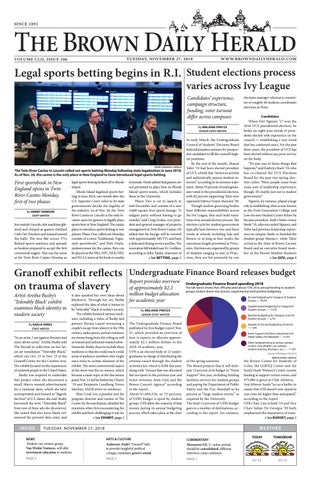
The Undergraduate Finance Board published its first budget report Nov. 21, which provided an overview of how it expects to allocate approximately $2.2 million dollars in the 2018-19 academic year. UFB is an elected body of 12 undergraduates in charge of distributing the revenue raised through the student activities fee, which is $286 this year, along with “money that was allocated but not spent in the previous year and ticket revenues from Gala and the Brown Concert Agency,” according to the report. About $1,604,526, or 73 percent, of UFB’s budget is spent by student groups. UFB allots the majority of that money during its annual budgeting process, which takes place at the close
of the spring semester. The Board projects that it will dedicate 15 percent of its budget to “Event Support” this year, including funding facilities services for student groups and paying the Department of Public Safety and the Fire Marshall to be present at “large student events,” as required by the University. The final 12 percent of UFB’s budget goes to a number of destinations, according to the report. For instance,
MARLIS FLINN / HERALD
the Brown Center for Students of Color, the LGBTQ Center and the Sarah Doyle Women’s Center receive funding to support certain events, and $75,000 is given to Club Athletics. Any leftover funds “act as a buffer to ensure that UFB doesn’t over-spend in case costs are higher than anticipated,” according to the report. UFB Chair Lisa Schold ’19 and Vice Chair Julian De Georgia ’20 both emphasized the importance of trans» See BUDGET, page 2
WEATHER
TUESDAY, NOVEMBER 27, 2018
NEWS Student-run venture group, Van Wickle Ventures, will offer investment education to students
ARTS & CULTURE Anderson .Paak’s “Oxnard” fails to provide insightful political critique, maintains groovy sound
COMMENTARY Meszsaros GS: U. online portals should be consolidated, different interfaces cause confusion
PAGE 2
PAGE 3
PAGE 7
TODAY
TOMORROW
45/ 32
43/ 33
NEWS
PAGE 2 • TUESDAY, NOVEMBER 27, 2018
» BETTING, from page 1 the Board of Directors for Twin River Worldwide Holdings Inc. In two to three months, sports betting will be expanded to the Twin Rivers Casino in Tiverton, Sculos said. Rhode Island’s development of sports betting infrastructure taps into an industry that, while illegal, was estimated to generate $150 billion nationwide each year, according to The New York Times. “It’s just an illicit industry, an untapped source of revenue,” said Ryan Burke ’19, who worked as a quantitative trading intern for a sports analytics group this summer, coding win probability models for in-game betting. He compared the potential markets in the United States to preexisting legal ones in Europe. “It’s already a big industry in Europe,” he said. “There’s a lot of industry that’s being generated over there. I think that by legalizing it you create a lot of tax revenue for the states.” “In Rhode Island, it’s a new revenue stream, which is seen as really important in state,” said Hillary Levey Friedman, a visiting assistant professor of education who has taught the course EDUC 0860: “Sports in American Society.” Rhode Island is in need of new revenue; the state predicted a $158 million budget deficit next year, according to U.S. News. Legal gambling is already a vital part of the state budget — the estimated $309 million added to the budget for the next fiscal year would make up the third-largest source of revenue in the state, according to Paul Grimaldi, public information officer at the R.I. Department of Revenue. Fifty-one percent of casino revenue goes to the state, Doyle said. In 2015, Rhode Island had the highest average state revenue generated by gambling in the country — $457 per adult — compared to the next highest of $418 in Nevada and the $113 average nationwide, according to a report by the Rockefeller Institute. The legalization of sports betting is predicted to give the already profitable gambling industry in the state a boost and possibly help
free up funds to be invested in other state priorities. President of the Rhode Island Senate Dominick Ruggerio, D-4, spoke at the sports betting opening Monday, where he suggested that some of the funds may go toward renovations for schools. “The money’s gonna go to a great cause,” Ruggerio said. “We have a referendum coming out, and we have a whole bunch of things we have to pay for. Revenue never hurts.” He also placed one of the first ceremonial wagers, betting $20 on the Houston Texans’ game Monday night. Sports betting is an appealing option for those who would not normally partake in traditional gambling: “Being able to throw $5 down on a sports game is a lot more interesting of a bet and gamble than just a scratch card,” said Ryan Ma ’19. Ma also emphasized the importance of legalization and regulation of the industry; “Regulation is really important, I think it just eliminates a lot of risk … for people interested in the community and interested (in) sports gambling.” While Monday’s launch at the casino brings hope for the state’s financial future, some Rhode Islanders worry about “cannibalizing their own services” by losing gamers who have historically participated in traditional betting in favor of sports betting, Grimaldi said. As Rhode Island continues to develop its sports betting infrastructure, Grimaldi said he hopes to make mobile betting available to further grow revenue. At the moment, the casino only takes bets on location, and it limits the sort of bets that bettors can place, possibly hurting their chance at developing a market and gaining vital revenue before other states move forward. The other states that have already legalized sports betting on a full scale are Delaware, Mississippi, New Jersey, New Mexico, Nevada, West Virginia and Pennsylvania. “I have waited 40 years for this,” Ruggerio said at the press conference Monday. “I have been coming down here every week to see if it actually happened.”
THE BROWN DAILY HERALD
Van Wickle Ventures enables student investing Student-run venture fund offers hands-on investment education, alum guidance By ISABEL INADOMI CONTRIBUTING WRITER
The soft launch of Van Wickle Ventures, a new student-run venture fund that invests in Brown- and Rhode Island School of Design-affiliated companies, is currently underway, according to Co-founders Sophie Starck ’20 and John Diorio ’20. The fund partners with the Jonathan M. Nelson Center for Entrepreneurship to bring students a unique and practical education by providing an opportunity to invest in companies. Investments are “theoretically around the size of $25,000, which, in terms of venture, is not very large” and are made “to companies where the founder is either a student, an alum or a faculty or staff member of Brown and/or RISD,” Starck said. Through case studies, guest lectures and workshops, students are taught how to reach out to companies and decide whether or not they are a good fit for investment. The group strives to educate students who may not have prior
» EXHIBIT, from page 1
her to see the nooses showcased. This was particularly painful for her due to her family’s history with lynching — a history her family still cannot talk about. Lee added that when she asked a family member why no one wanted to talk about lynching, they informed her that they were “still neighbors” with the family who lynched Lee’s ancestors. “I can’t see a noose and not see a threat,” Lee said, highlighting the relevance nooses have even in current times. Taylor Jackson GS related her family’s past traumas with lynching and racial violence, and asked in regard to the nooses in the exhibit: “How do we have the hard conversations without retraumatizing people in the process?” The panelists discussed ideas about how art should mediate and approach violence and past traumas. Professor B. Anthony Bogues, director of Center
» BUDGET, from page 1
parency in their respective campaigns during last spring’s elections, The Herald previously reported. At the start of this semester, the two launched a “transparency campaign” that featured a new stand-alone website for UFB, where the budget report is available. “Because the money that we have
knowledge on investment. “I feel like there’s this big misconception (about investing) that maybe comes from ‘Shark Tank,’” Diorio said, speaking on the widely held idea that investors are often receiving hundreds of pitches from hopeful companies. “In reality, it’s usually the opposite.” Jonas Clark, who works within the Nelson Center and is a key contact for the program, echoed the importance of education within the fund. The main focus is ensuring that “students come away with a knowledge and understanding of how this works,” he said. “The goal is not just to invest for the sake of writing checks but to do it responsibly and wisely.” Though the fund is student-run, Starck and Diorio have also recruited a board of alums experienced in venture, called an Investment Committee, to help guide students’ decisions. The board will help students make “go, no-go” decisions on whether or not ideas or ventures should be funded, Starck added. Clark said he serves mostly as “administrative support” and reinforced the idea that students will drive the fund. Though the Investment Committee is a resource for students, Clark added that “if the students end up doing more of that role, so much the better.”
Starck and Diorio have been working on the launch of VWV for nearly nine months now; the group was born out of a desire to learn useful skills outside of the Brown curriculum and to bring that knowledge to other students. The fund is defined as an “evergreen fund,” meaning that all returns on investments are reinvested back into new Brown- or RISD-affiliated companies. VWV is meant to continue as a self-sustaining system, with each generation of students building on what previous students have accomplished. In addition, there is a longer timeline for investments in the kind of companies that VWV is interested in, so students may not make a return on investments until “anywhere from five to 10 years” later, Starck noted. Diorio also commented on the privilege of this unique opportunity. Though there are a few other schools with similar programs, VWV is “the first student-run fund by undergraduate students,” he said. “There’s nothing else right now that’s giving this much responsibility to students in this space.” VWV is looking to go live Jan. 23, after fall applications and interviews to assemble a student cohort have concluded.
for Slavery and Justice, talked about the idea of “curating with care.” This practice includes paying “attention to the historical conditions of brutality.” Becci Davis, a 2018 Fellow at Rhode Island School of Design Museum, spoke of her split position between the hardship of pain and open conversation. “Without pain, these conversations would never happen,” Davis said, adding that dealing with censorship can risk erasing history. Busby talked about the painfulness of tying and adjusting the nooses while setting up her exhibition, but concluded with how “necessary it feels.” In an interview with The Herald, Busby reflected on the difficulty it took for her exhibit to come to Brown and acknowledged Brown’s “complicated history” with slavery. Busby talked about how the nooses imply a risk that runaway slaves were incurring when
they chose to flee. In this way, the artist tried to demonstrate the harsh reality of slavery. Busby stated that she does not believe her choice in subject matter and use of nooses make her a “protest artist.” The nooses were not there for the “shock value,” but to discuss the “ugly and painful” history of the United States, she said. Busby acknowledged the trauma of the work but highlighted her desire to educate and spark discourse in multicultural environments. Such a conversation was started when Busby showed her work at an elementary and middle school in New York City where children interacted with her art. “How is Aretha Busby’s work changing the world?” the principal asked the children. As Busby listened to the schoolchildren responding, she felt she “knew (she) was on the right path,” Busby said.
comes directly from the students, we have an obligation to be transparent about where that money goes,” De Georgia said. Schold and De Georgia initially projected that UFB’s first budget report would be completed by the end of September, but publication was pushed back while they worked with the Student Activities Office to better understand the online accounting
system the University uses. The Board plans to release more budget reports in the future, where they will “give more detail about where the money goes,” De Georgia said. According to De Georgia, UFB hopes the student body will provide feedback on how the Board allocates its funds because as an elected body, “that conversation with the students is really important to us.”
ARTS & CULTURE TUESDAY, NOVEMBER 27, 2018 • PAGE 3
THE BROWN DAILY HERALD
‘Oxnard’ rises with Anderson .Paak’s energy Latest album misses mark on politics, extends .Paak’s signature charisma with danceable, groovy tracks By DIVYA MANIAR SENIOR STAFF WRITER
Anderson .Paak, who performed at Brown last year during Spring Weekend, recently released his third studio album, “Oxnard.” It is a fresh and upbeat followup to “Malibu,” released two years prior. .Paak is a distinctive and promising voice in neo-soul and West Coast hip hop music. His new album follows the musical style of its predecessors, carrying with it the artist’s high energy and charisma toward which fans have long gravitated. The album’s title refers to .Paak’s hometown in California and follows the trend of previous albums also titled after locations significant to him. “When you go everywhere, you just hold on to the things that made you, you. And honestly, it’s the last phase of this beach series. You know, we went to Venice, we went to Malibu, so it’s only right that we take it to the next place, up the coast, up to the next beach,” .Paak explained in an interview with Rolling Stone. The song “6 Summers” takes on a political tone as it attempts to address current issues in the United States. “Every day, there’s a new situation that’s going on,” .Paak said in an interview with National Public Radio. “So I had to write about it.” Though .Paak may have been
ambitious with his political critique, the lyrics of “6 Summers” lack both depth and subtlety. In the song, the artist references President Trump’s alleged illegitimate child: “Trump’s got a love child and I hope that bitch is buckwild.” .Paak artlessly plays on the child’s identity and expresses his hope that she grows up to be someone Trump would not be able to like. “This shit gon’ bang at least six summers,” .Paak sings. The line refers to the longevity of .Paak’s music, and at the same time, alludes to gun violence in present-day America. “But ain’t shit gon’ change for at least three summers,” he continues, referencing the length of the current presidential term. Though .Paak’s political commentary falls flat, he succeeds elsewhere in the album. “Oxnard” is at its best when .Paak shows off his versatility and energy. The album has moments filled with .Paak’s characteristic charisma. In “Mansa Mua,” featuring Dr. Dre and Cocoa Sarai, the album spikes in dynamism. This track is a danceable and fast-paced burst of energy and style, followed by “Brother’s Keeper,” which features Pusha T. and is a well-layered track that shuffles between different tempos and styles. “Tints,” a collaboration between .Paak and Kendrick Lamar, was released as a single before the rest of the album. Musically, the track is groovy and fun. It speaks about .Paak’s experience with fame: “I can’t be ridin’ round and round that open strip / I need tints (windows tinted) / I need tints (I need my windows
COURTESY OF KADEEM ELLIS
Anderson .Paak’s album “Oxnard” includes songs that speak to the current political atmosphere as well as danceable, upbeat tracks. tinted).” .Paak further demonstrates his versatility in “Smile/Petty,” which is split into two segments. The track kicks up midway with instrumental and stylistic changes, allowing him to intersperse
different vibes into one song. Overall, “Oxnard” came with more highs than lows. Well-synthesized, energetic and dynamic, it does not leave listeners looking for .Paak’s signature style and personality.
NEWS
PAGE 4 • TUESDAY, NOVEMBER 27, 2018
» GOV., from page 1 Association. “I decided to run last year because I think UCS provides a platform to advocate for meaningful change on campus,” Tahir wrote in an email to The Herald. Presidents from outside the council are not typical across student governments. At Harvard, for instance, outsider candidates for the presidency and vice presidency have lost to candidates with experience in 22 of the past 23 elections for its Undergraduate Council. In a notable exception, the president and vice president elected in fall 2013 had no experience on the Harvard UC and ran on a platform promising tomato basil ravioli soup at all meals and thicker toilet paper. At Yale, candidates “almost always” have experience serving on the Yale College Council, said Heidi Dong, Yale CC vice president and chair of the Council Elections Commission. That experience is important to ensure continuity in the council’s projects, she added. “It’s certainly not uncommon” for candidates vying for the top positions in Dartmouth’s Student Assembly to have experience, said Luke Cuomo, chair of the Election Planning and Advisory Committee, though “we don’t really do any target recruiting for candidates.” Cornell’s Student Assembly requires that candidates at minimum apply to one of its committees before running for any office. That requirement serves “both to ensure that people … know what they’re getting into … (and) to make sure that if someone’s elected, they’re going to be engaged,” said Shashank Vura, Cornell SA’s director of elections. For at least the past four years, Cornell has had two candidates for president in each election cycle, all of whom entered the race with experience on SA, according to coverage in the Cornell Daily Sun. Vura noted that extensive experience is not required to run for the presidency, though “one common stepping stone is a position called Executive Vice-President, which is often held by a junior.” Vice presidents of Brown’s UCS have not vied for the presidency since the 2015 election, when Sazzy Gourley ’16 defeated two other candidates, though students with other UCS experience have run. Campaigning At Dartmouth, most candidates for president and vice president elect to campaign on a ticket, Cuomo said, though doing so is not required. Similarly, in past years at Yale, Penn and Columbia, candidates have been permitted to campaign together, though it is not required. Harvard’s UC requires that potential presidents and vice presidents form tickets. In c ont r a s t , c o ord i n at e d
campaigning is strictly prohibited at Brown. “The idea is just (to) make it less (about the) popularity of a certain group of people,” said Katherine Barry ’19, who has co-chaired the UCS Elections Board for the past two spring election cycles. Candidates for president and vice president of UCS may not run on tickets, nor may they speak about their platforms together. “We had an issue (last year) where some people were going around the (Sharpe Refectory) together, speaking to their two different campaigns, but we don’t allow that,” Stack said. Cornell similarly requires “all independent” tickets, Vura said. “Adding
THE BROWN DAILY HERALD on the same playing field in terms of how much time they have to put into the campaign.” The $40 spending limit is on the lower side, comparable to the $50 limit at Penn, Cornell and Princeton. At Harvard, each ticket may spend up to $400, according to the Harvard UC Constitution and Bylaws, while Yale caps spending at $100. Though Dartmouth permits candidates for president and vice president to spend up to $200, “most candidates don’t usually use all the funding,” Cuomo said. “That’s because our elections aren’t usually too competitive, or because campaign season is short and they don’t have time to use it all.”
Yale’s spring 2017 election, when 22.3 percent of undergraduates voted in a race that featured two candidates for president, and at Cornell, where turnout has ranged between 27 and 30 percent over the past three years. Student governments engage in various efforts to encourage their student bodies to participate in elections, but turnout ultimately depends on a number of factors. At Yale, 43 percent of undergraduates voted last spring, which is “really good turnout,” Dong said. “Part of that was because it was a competitive race and people were really campaigning, (and) … when students feel the YCC is really engaging with them, they are more in turn engaged with the YCC
MARLIS FLINN
a level of partisanship … would only add divisiveness where it doesn’t need to be,” he added. “Even if it made elections a lot more competitive and got people a lot more involved, … I’m not sure if it would be that conducive to getting major accomplishments in a positive (manner).” Student government election cycles also typically feature some amount of spending on campaign materials, with options for reimbursement. At Brown, the limit is $40 or 100 “publicity points,” the value of which is outlined by the Elections Board. Candidates may contact the Student Activities Office to have their campaign budget funded if they have demonstrated financial need, according to the 2018 Elections Handbook. “We just don’t want people who have unlimited funds available to them … to put others at a disadvantage by spending a ton of money on different campaign methods,” Barry said. “We want people to also not spend a ton of time on this — we want everyone to be
Engagement Roughly 35 percent of the undergraduate student body at Brown cast ballots in the 2018 UCS presidential election. This marked a 17 percent increase from the 2017 race, when 18 percent of students cast ballots for Steele, who ran unopposed. Contested elections and controversial candidates can spur higher turnout, Stack said. Over the past four years, turnout at Brown peaked at 49 percent when Sazzy Gourley ’15 narrowly defeated two other candidates in the presidential race with 50.5 percent of the vote. The 2017 UCS election, which featured uncontested races for every UCS position with a candidate, yielded the lowest turnout at Brown in the past four years, with about 22 percent of students casting a ballot. That turnout is one of the lowest in the past three years among Ivies whose turnout figures are publicly available in student newspapers. The only comparably low turnout rates occurred in
and more likely to participate in the voting process.” Princeton, which holds elections for its executive committee in the winter, saw around 50.3 percent turnout last year. “Last winter, we had four honor code referenda on the ballot,” which dealt with processes and punishments for honor code violations, and that “definitely pushes turnout,” said Laura Zecca, chief elections manager for Princeton’s Undergraduate Student Government. There were three candidates for president, and the candidate who won “did a fantastic job campaigning, so she really drummed up a lot of that voter engagement.” Zecca, who assumed her position in February, said that Princeton USG also worked on a campaign that aimed to raise turnout to 50 percent for the council’s spring elections for representatives. “In the past for spring elections, the turnout’s usually relatively low because they’re not the executive offices,” Zecca
said. To combat low turnout, Princeton USG engaged in a Facebook campaign, sent emails, tabled in Princeton’s campus center and set up voting booths on campus, Zecca said. “We didn’t get 50 percent, but I think we ended up getting about 33 percent, which was more than double what it had been in the year before,” Zecca said. “I’m planning for the winter elections for the executive positions to do something similar.” Penn’s SA does not report exact turnout numbers, but turnout in the presidential and vice presidential races tends to be close to 40 percent, said Kiley Marron, vice chair for elections at Penn’s Nomination and Elections Committee. “We have lots of discussions about how we can (get) a more educated electorate as well as keep encouraging more people to run,” Marron said. To that end, the Nominations and Elections Committee launched an information session “to encourage (people) to run and maybe answer some questions,” Marron added. At Brown, “we incentivize people to come to the debates … to hear about candidates’ platforms,” Barry said. The Elections Board also “tries to get student groups involved as much as possible … because a lot of people will vote” if their student group endorses a candidate, she added. “We expect (student groups) to have discussed (endorsements) with their group members, and that gets the word out to more of those general body members,” Stack said. Last year, UCS also reduced the number of student signatures that candidates for president and vice president are required to collect from 400 to 200, in an effort to make running for office more accessible. Barry noted at the time that the new requirement “probably wouldn’t get more people to run this year” — the change was made after the required information sessions for potential candidates — but the reduced requirement could have an effect this year. Furthermore, UCS established a Communications Committee this year, which is “creating now more avenues for transparency for the whole student body,” said Communications Director Sofia Jimenez ’21, who heads the committee. The committee is working to “solidify our communications protocol,” Jimenez said, adding that she sees their work as relevant to elections. “We do want to encourage students to be more participatory within the process of elections,” she said. After each election cycle, the Elections Board also takes time to reevaluate their policies and improve, Barry said. “We always ask the board and talk among ourselves (about) what sorts of things could’ve gone better, … and then we look at those notes in the beginning of the year and try to restructure a little bit,” she said.
TODAY
TUESDAY, NOVEMBER 27, 2018 • PAGE 5
THE BROWN DAILY HERALD
menu
here comes the sun
SATELLITE DINING ANDREWS COMMONS
Pizza: Cajun Chicken, Spinach and Feta Curry Bar, Pulled Pork Sandwiches JOSIAH’S
BLUE ROOM
Dumpling Bar, Rodeo Burger, Southwestern Bean Burger
Chicken Mushroom Xacuti, Vegetable Mango Curry
DINING HALLS SHARPE REFECTORY LUNCH
DINNER
Pork Carnitas, Stewed Pinto Beans with Collards and Kale, Roasted Butternut Squash
Tandoori Chicken Wings with Cilantro Relish, Roasted Fingerling Potatoes
VERNEY-WOOLLEY LUNCH
DINNER
Smoked Chicken and Pepper Jack Cuban Sandwich, Edamame Bean Chow Mein with Tofu
Chicken Pot Pie, Grilled Vegetable Quiche, Rice Pilaf, Fresh Snap Peas, Roasted Beets
sudoku
crossword SARA RUNKEL / HERALD
As final exams approach, many students are already nostalgic for the food and sleep they enjoyed over Thanksgiving Break. In the final weeks of class, students retreat indoors to study with cold weather creeping in.
Q U O T E O F T H E D AY
“ I feel like there’s this big misconception (about investing) that maybe comes from ‘Shark Tank.’ In reality, it’s usually the opposite.
”
— John Diorio ’20, co-founder of Van Wickle Ventures
See investing on page 2. calendar TODAY NOVEMBER
S
4
M
5
T
6
W
7
Th
F
S
1
2
3
8
9
10
Giving Tuesday 11:00 A.M. Main Green
Study Abroad 101 Information Session 12:00 P.M. Page-Robinson Hall, 440
Trans, Queer and Asian: A Panel and Mixer 6:30 P.M. Center for Students of Color
Javanese Gamelan Concert 7:00 P.M. Grant Recital Hall
TOMORROW
11
12
13
14
15
16
17
18
19
20
21
22
23
24
25
26
27
28
29
30
Rina Banerjee: In Conversation 5:30 P.M. Granoff Center
Scenes from Alternative Theater in Iran 5:45 P.M. Watson Institute
Dolla’ Dolla’ Bills, Y’all: An MPC Workshop 7:00 P.M. 85 Waterman, 130
Lisa Newman: Polk Talk 7:00 P.M. Smith-Buonanno Hall, 106
COMMENTARY PAGE 6 • TUESDAY, NOVEMBER 27, 2018
THE BROWN DAILY HERALD
Find us online! facebook.com/browndailyherald
browndailyherald.com
@the_herald
Location: 195 Angell St., Providence, R.I. www.browndailyherald.com
@browndailyherald
youtube.com/browndailyherald
Editorial Leadership
Sections
Multimedia & Production
Business
Editors-in-Chief Elena Renken Kasturi Pananjady
Arts & Culture Editors Ethel Renia
Design Editors Kyle Cui Eduard Muñoz-Suñé Assistants: Julie Wang, Kelvin Yang
General Managers Michael Borrello Matilda Lynton
Managing Editor Alex Skidmore
Metro Editors Emily Davies Isabel Gensler
Senior Editors Madison Rivlin Hattie Xu Ben Shumate
News Editors Eduard Muñoz-Suñé Priyanka Podugu Sarah Wang
Editorial Page Editor Anuj Krishnamurthy
Science & Research Editors Jonathan Douglas Jackson Wells
POST- MAGAZINE Editor-in-Chief Jennifer Osborne
Sports Editors Alexandra Russell James Schapiro COMMENTARY Opinions Editors Connor Cardoso Anuj Krishnamurthy Clare Steinman Emily Miller
Photo Editors Sam Berube Anita Sheih Copy Desk Chief Kelley Tackett Illustrations Editor Daphne Zhao Video Editor Celia Hack Graphics Editors Marlis Flinn Sarah Martinez
Office Manager Diane Silvia Directors Sales: Shreya Raghunandan Finance: Ravi Betzig Strategy: Edwin Farley
Editorial contact: 401-351-3372 herald@browndailyherald.com
Advertising contact: 401-351-3372 advertising@browndailyherald.com
Submissions: The Brown Daily Herald publishes submissions in the form of op-eds and letters to the editor. Op-eds are typically between 750 and 1000 words, though we will consider submissions between 500 and 1200 words. Letters to the editor should be around 250 words. While letters to the editor respond to an article or column that has appeared in The Herald, op-eds usually prompt new discussions on campus or frame new arguments about current discourse. All submissions to The Herald cannot have been previously published elsewhere (in print or online — including personal blogs and social media), and they must be exclusive to The Herald. Submissions must include no more than two individual authors. If there are more than two original authors, The Herald can acknowledge the authors in a statement at the end of the letter or op-ed, but the byline can only include up to two names. The Herald will not publish submissions authored by groups. The Herald does not publish anonymous submissions. If you feel your circumstances prevent you from submitting an op-ed or letter with your name, please email herald@browndailyherald.com to explain your situation. You can submit op-eds to opinions@browndailyherald.com and letters to letters@browndailyherald.com. When you email your submission, please include (1) your full name, (2) an evening or mobile phone number in case your submission is chosen for publication and (3) any affiliation with Brown University or any institution or organization relevant to the content of your submission. Please send in submissions at least 24 hours in advance of your desired publication date. The Herald only publishes submissions while it is in print. The Herald reserves the right to edit all submissions. If your piece is considered for publication, an editor will contact you to discuss potential changes to your submission. Commentary: The editorial is the majority opinion of the editorial page board of The Brown Daily Herald. The editorial viewpoint does not necessarily reflect the views of The Brown Daily Herald, Inc. Columns, letters and comics reflect the opinions of their authors only. Corrections: The Brown Daily Herald is committed to providing the Brown University community with the most accurate information possible. Corrections may be submitted up to seven calendar days after publication. Advertising: The Brown Daily Herald, Inc. reserves the right to accept or decline any advertisement at its discretion. The Brown Daily Herald, Inc. is a financially independent, nonprofit media organization bringing you The Brown Daily Herald, BlogDailyHerald and Post- Magazine. The Brown Daily Herald has served the Brown University community daily since 1891. It is published Monday through Friday during the academic year, excluding vacations, once during Commencement and once during Orientation by The Brown Daily Herald, Inc. Single copy free for each member of the community. Subscription prices: $200 one year daily, $100 one semester daily. Copyright 2018 by The Brown Daily Herald, Inc. All rights reserved. Periodicals postage paid at Providence, R.I. Postmaster: Please send corrections to P.O. Box 2538, Providence, RI 02906.
THE BROWN DAILY HERALD
COMMENTARY TUESDAY, NOVEMBER 27, 2018 • PAGE 7
Centralize access to online tools E.L. MESZAROS staff columnist
Preregistration for spring 2019 courses took place just a few weeks ago, a process that reminded me of the number of different online tools required to navigate my Brown education. While registration seemed to occur without incident, it highlighted one aspect of these online tools that could easily be made more straightforward and intuitive: the lack of a centralized method for accessing each online system. Many aspects of managing my Brown education are accessible through online portals. However, these systems are all distinct and feature separate login screens, different points of access and distinct names. Remembering where to find each piece of information and which site needs to be accessed is sometimes challenging. Providing students with a centralized access point for all pieces of their online education would reduce frustration and ensure that nothing is overlooked. For preregistration, my primary point of contact with Brown’s online systems was Courses@Brown, which allowed me to view classes and eventually select and register for my courses of choice. To pay for my classes, however, I needed to visit the Billing Center, where I pay my tuition and associated fees. Of course, as a student employee I also needed
to check in with Workday to monitor my payslips and verify when I could make a payment. I needed to see my finalized class schedule to avoid conflicts with other academic and extracurricular activities, which I access through Banner. Once classes get going, I’ll need to check the online course management tool, Canvas, where my professors upload elec-
the area and manage Brown University Health Insurance plans for my spouse and me. The list of different online systems and identities to manage is clearly non-trivial. Each online tool has a reason for existing, and I appreciate the fact that I can take all of these actions online. However, with so many different web tools, there needs to be an easy way
easier for students. Obfuscating usability in this way contributes to lost information and incomplete tasks, from failing to submit necessary documentation to not taking advantage of available options. Case in point: I’ve set up multiple Brown email aliases, something I found I could do when exploring some online portal over the sum-
Providing students with a centralized access point for all pieces of their online education would reduce frustration and ensure that nothing is overlooked.
tronic copies of syllabi and course readings. In order to print this material, I need to add money to my Bear Bucks account through the GET Portal and send these documents to the printer via MyPrint. Then, of course, there are systems like the Health Portal, which stores records of immunizations and allows me to make health services appointments, or the Health Insurance Portal, which allows me to see my coverage, find doctors in
to find and access all of them. Currently, each online portal requires a separate login and is reachable from separate launch pages. Finding the required page is often only accomplished with the aid of a Google search. Navigating online systems does not need to be this complex. Implementing a centralized access point for all these functions could reduce the number of necessary logins and make finding specific options
mer. Other students have seemed surprised by this, unaware that it was a feature offered by the University. Making features difficult to find prevents students from taking advantage of them. Consolidating online functionality and creating a centralized point of access can increase general use and help make functions that once were difficult to find common knowledge. I unfortunately am unable to remember where I found
the email alias functionality, and so I suspect my interlocutors forgot about this quest. Not setting up multiple email aliases isn’t a big deal, but what about cases where the functionality in question is more important? What about when it’s an international student submitting visa-related tax forms on Workday or a trans student identifying a chosen name in Banner? Ensuring ease-of-access for all of these online tools isn’t merely a matter of convenience but could contribute to student well-being. Importantly, it’s not that the current systems are unusable. Students, myself included, are able to navigate these sprawling online spaces regardless of how unconnected each node is. But it doesn’t have to be a mess of unconnected endpoints. Other universities have created systems that are more centralized — I myself have experience with more coherent systems at the University of Chicago and Eastern Michigan University where almost all online tools are accessed through one central hub. Creating a centralized access point is an easy action that the University could take to make the process of using these online tools more intuitive and ensure that nothing falls through the cracks.
E.L. Meszaros GS can be reached at e.l.meszaros@ brown.edu. Please send responses to this opinion to letters@browndailyherald. com and op-eds to opinions@ browndailyherald.com.
Find Post- magazine on Facebook! facebook.com/postmagazinebdh
Decoding the Human Brain with Data Opening Remarks: Diane Lipscombe Director of the Robert J. and Nancy D. Carney Institute for Brain Science
Bjorn Sandstede Director of the Data Science Initiative
Featuring: Matthew Harrison Associate Professor of Applied Mathematics
Stephanie Jones Associate Professor of Neuroscience
Dima Amso Associate Professor of Cognitive, Linguistic and Psychological Sciences
Moderated By: Cornelia Dean Visiting Professor of the Practice of Science, Technology and Society Science Writer for The New York Times
Wednesday, December 5, 2018, at 5 p.m. To request special services, accommodations or assistance for this event, please contact the University Event & Conference Services Office at universityevents@brown.edu or 401-863-3100
Institute at Brown for Environment & Society Room 130 85 Waterman Street Reception to Follow
Building on Distinction: Integrative Scholarship at Brown Featuring the Carney Institute for Brain Science and the Data Science Initiative