SINCE 1891
THE BROWN DAILY HERALD TUESDAY, DECEMBER 4, 2018
VOLUME CLII, ISSUE 111
WWW.BROWNDAILYHERALD.COM
Shiru Cafe ramps up James Perry ’00 hired as head football coach search for U.S. sponsors Following departure of Parent company Enrission expands U.S. operations, opens cafe doors in Amherst, M.A. By SOPHIE CULPEPPER AND SOPHIA SKWARCHUK SENIOR STAFF WRITER AND STAFF WRITER
Since establishing its first U.S. location in Providence in Feb. 2018, Shiru Cafe has yet to secure any corporate sponsors for its operations in the United States. Even without sponsors and the revenue sponsorships would provide, Shiru Cafe continues to expand domestically — opening its doors at Amherst College yesterday and preparing to establish cafes at Yale and Princeton. Shiru, which in Japanese means “to know,” operates under a business model wherein students list their contact information, majors, skills and career interests in exchange for free coffee. The cafe’s mission is “to create a place where students can
learn about the professional world and envision their careers,” according to the company’s website. It hopes to bring locations to “the top (universities) in the world,” wrote Shiru Cafe CEO Yusuke Kakimoto in an email to The Herald, adding that his next target locations in the United States are Harvard, Columbia and Massachusetts Institute of Technology. The parent company Enrission founded the Shiru cafe chain in Kyoto, Japan in 2013. In addition to 17 cafes in Japan, Shiru operates 28 cafes worldwide, according to its website. While the cafes in Japan tend to have over 180 corporate sponsors, Shiru cafes in America have yet to form partnerships with any corporations, according to General Manager at Enrission and Cafe Manager at Brown’s Shiru Cafe Keith Maher. As part of fortified efforts to create ties with U.S. sponsors, Enrission brought on Vice President of Client Development and Strategy for Shiru in the U.S. Isabel Strobing in October 2018. Her job is to » See SHIRU, page 4
Phil Estes, Perry looks to right ship after two winless Ivy seasons By ALEX SMOLAR SENIOR STAFF WRITER
James Perry ’00 was named the University’s 20th Head Football Coach Monday afternoon. This appointment follows the Nov. 19 departure of former Head Coach Phil Estes, who led the team for 21 seasons, The Herald previously reported. Perry played for the Bears from 1996 to 2000 and served as quarterbacks coach from 2007 to 2009. “The rest of the team (and I) are all very excited to play for James Perry,” said defensive captain Michael Hoecht ’20. “He’s a great coach, has an impressive resume and is going to do great things for this program.” In 1999, Perry led the Bears to an Ivy League title as the team’s starting quarterback. His 3,225 passing yards and 27 touchdowns helped him earn Ivy League Player of the Year that season. In 2008, with Perry on the sidelines as the Bears’ quarterbacks coach, Brown won the Ivy
‘Until, Until, Until...’ re-enacts 1981 performance Arcenaux’s experimental play reimagines controversial inaugural ball performance By ELISE RYAN
INSIDE
Whitehouse, Cicilline meet with climate lab Students find same 12 coalitions driving climate change denial movement for decades
SENIOR STAFF WRITER
“Until, Until, Until…” a performance directed, written and produced by Los Angeles-based artist Edgar Arceneaux was staged in Studio 1 at the Granoff Center for the Creative Arts on Thursday, Friday and Saturday nights last week. Presented by the Brown Arts Initiative, the multimedia play reimagines and re-enacts Broadway actor Ben Vereen’s 1981 performance at former president Ronald Reagan’s inaugural ball. The event’s program explained that in the original performance, Vereen gave an homage to vaudevillian Bert Williams, one of America’s first mainstream black entertainers, by performing the 1912 hit song, “Waiting for Robert E. Lee,” in blackface as Williams had been required to do during his vaudeville productions. Vereen followed his first song with a performance of Williams’ song “Nobody,” which commented on the harmful history of racial stereotypes within performance as he emotionally wiped the makeup
COURTESY OF BROWN ATHLETICS
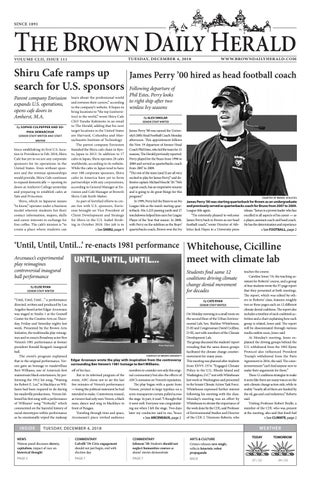
James Perry ’00 was starting quarterback for Brown as an undergraduate and previously served as quarterbacks coach for Bruno from 2007 to 2009. League title again. release. “James is a proven leader who has “I’m extremely pleased to welcome excelled in all aspects of his career — as James Perry back to Brown as our head a player, assistant coach and head coach. football coach,” wrote Director of Ath- He has the determination and experience letics Jack Hayes in a University press » See FOOTBALL, page 2
By CATE RYAN SENIOR STAFF WRITER
COURTESY OF BROWN UNIVERSITY
Edgar Arcenaux wrote the play with inspiration from the controversy surrounding Ben Vereen’s 1981 homage to Bert Williams. off of his face. But in its televised program of the event, ABC chose not to air the last five minutes of Vereen’s performance — losing the political statement he had intended to make. Controversy ensued, as viewers had only seen Vereen, a black man, dance and sing in blackface in front of Reagan. Traveling through time and space, Arceneaux’s piece invited audience
members to consider not only this original commentary but also the effects of ABC’s omission on Vereen’s reputation. The play began with a quote from Vereen, printed in large typeface on a semi-transparent curtain pulled across the stage. In part, it read: “I thought that it went well. Everyone was congratulating me when I left the stage. Two days later my conductor said to me, ‘brace » See ARCENEAUX, page 2
On Monday morning in a small room on the second floor of the Urban Environmental Lab, Sen. Sheldon Whitehouse, D-RI and Congressman David Cicilline, D-RI, met with members of the Climate Development Lab. The group discussed the students’ report revealing that the same dozen groups facilitated the climate change countermovement for many years. This meeting was planned after students from ENVS 1574: “Engaged Climate Policy in the U.S.: Rhode Island and Washington, D.C.” met with Whitehouse last week in Washington and presented to the Senate Climate Action Task Force. Whitehouse expressed further interest following his meeting with the class. Monday’s meeting was an effort by Whitehouse to elevate the importance of the work done by the CDL, said Professor of Environmental Studies and Director of the CDL J. Timmons Roberts, who
teaches the course. Caroline Jones ’19, the teaching assistant for Roberts’ course, and a group of four students wrote the 37-page report that they presented at both meetings. The report, which was edited by others in Roberts’ class, features roughly two or three pages each on 12 different climate denial coalitions. The report also includes a timeline of each coalition’s activities and a chart explaining how each group is related, Jones said. The report will be disseminated through various media outlets soon, Jones said. At Monday’s meeting, Jones explained the driving groups behind the U.S. withdrawal from the 1992 Kyoto Protocol also influenced President Trump’s withdrawal from the Paris Agreement in 2016, she said. The countermovement “can’t find anyone new to make their arguments for them.” These 12 coalitions strategize to make it seem like there are many voices on the anti-climate change action side, while in reality “nearly all of them are funded by the oil, gas and coal industries,” Roberts said. Visiting Professor Robert Brulle, a member of the CDL who was present at the meeting, also said that fossil fuel » See CLIMATE, page 2
WEATHER
TUESDAY, DECEMBER 4, 2018
NEWS Watson panel discusses slavery, capitalism, impact of race on historical thought
COMMENTARY Calvelli ’19: Civic engagement should not just begin, end with election day
COMMENTARY Johnson ’20: Students should not neglect humanities courses as alums’ stories demonstrate
ARTS & CULTURE Grimes releases new single, reflects futuristic robot propaganda
PAGE 3
PAGE 7
PAGE 7
BACK
TODAY
TOMORROW
37 / 22
34 / 23
NEWS
PAGE 2 • TUESDAY, DECEMBER 4, 2018
» ARCENEAUX, from page 1 yourself.’” The curtain opens to reveal actor Frank Lawson, playing Vereen, rehearsing his entrance to Reagan’s inaugural ball. The hour-long performance continued with a series of other scenes, including one featuring actress Jes Dugger, who played Marie Osmond, the singer at the inaugural ball who followed Vereen’s act. Near the show’s conclusion, stage assistants stepped into the audience, beckoning them to enter the curtained, square stage area. Most of the audience followed the assistants into empty chairs along either side of the stage. Lawson applied the black-and-white makeup to himself and resumed the performance. After an imaginary bartender rejected his request to serve the audience drinks, Lawson’s subsequent dialogue conveyed his frustration at being denied service due to the color of his skin. Lawson’s character then proceeded to sing Williams’ seminal song “Nobody.” During this performance, Lawson removed the black makeup from his face, signaling the portion of Vereen’s original performance
that ABC denied viewers across the nation. At the end of the song, Lawson thanked the audience and stood pensively for a few long moments before exiting the curtained stage area, leaving the audience waiting for a cue to signal the end of the performance. After some time, a camera operator panned across the faces of the audience, replacing the projected images of the 1981 inaugural ball attendees on the stage curtains during the final song. Friday, the audience sat for nine silent minutes before one member finally left. His exit cued a shift in the music and lights, indicating that the performance had concluded. Thursday, it took only about two-and-ahalf minutes for the first audience member to leave, Arceneaux said. “Until, Until, Until…” featured varied multimedia technology including projected images and videos as well as music and special audio effects. These techniques “created this world in which we as audience members could sort of transgress multiple boundaries. … At one point, we were an external Brown audience watching the play, and then
THE BROWN DAILY HERALD at another point, we were in a sense transported and had become the audience at Ronald Reagan’s inauguration,” said Butch Rovan, faculty director of the Brown Arts Initiative. Arceneaux utilized the multimedia technology to invoke ideas of memory, trauma and reflection. “I decided to tell the story not from a historical perspective, but from the way that Ben Vereen remembers it — which is as a series of traumas,” he said. “So in that regard, I’m being faithful to the feelings of the memory, without trying to do what I think is essentially impossible — which is to tell it exactly as it happened.” Arceneaux first saw Vereen’s 1981 performance on a VHS tape as part of a documentary on black artists in 2007. The documentary included Vereen’s entire performance, leaving Arceneaux unaware of the negative professional and psychological ramifications that the televised version had on Vereen’s life and work. That is, until he encountered Vereen himself at a birthday party. “He was very welcoming,” Arceneaux said. “But when I mentioned his performance in 1981, he shuddered. I could tell that I’d struck a
nerve. But I didn’t know why.” Based off the artist’s actual interactions with the performer, “Until, Until, Until…” includes a scene where Arceneaux, playing himself, sits with the actor playing Vereen in his living room, watching the original footage. Ultimately, Arceneaux said he hoped his work could teach his audience “something about the world.” He watched the individuals in the audience struggling with the decision to leave, realizing that “at some point you then start asking yourself, well is this story over yet?” With that questioning comes a transformation: Audience members look around at the individuals that surrounded them and realize that their next move had become a group decision. “It’s like this idea of going from ‘I’ to ‘we.’ People start to figure out how to negotiate that space. … It’s kind of like a little tiny microcosm of society that happens inside (the curtains),” Arceneaux said. “The amazing thing about the piece is that it doesn’t offer closure. You leave, and it doesn’t end. As an audience member you’re left to just try to create your own closure — and maybe it doesn’t ever end for you,”
Rovan said. “The issues that it raises are still things that we are grappling with today.” Rovan stressed the ability of this experimental work to remain accessible to a wide audience. “This piece worked on so many different levels — it was visceral, it was cerebral, it was contemplative, it was very emotional,” he said. Arceneaux hopes to continue performing the piece around the country. While it has toured nationally since its creation in 2015, Arceneaux said the 2016 election “changed my resolve to tour it and show it more, considering this very surreal political reality that we’re in where entertainment and politics have become so intertwined.” He added, “a story like this allows us to see the truth in a way that I think telling the story straight couldn’t do.” He hopes that they can bring the performance to as many politically divided and red states as possible, where the piece might cause controversy but also might inspire people to reconsider their views. This latter possibility gives him hope that the performance “might shift their sense of justice,” he said.
» CLIMATE, from page 1
» FOOTBALL, from page 1
companies know that pollution has adverse implications for the climate. They have all the best science available to them, he said, “yet at the same time, they are putting out all of this other propaganda.” Roberts, Brulle and Jones hope to reveal the forces behind the climate change denial movement with their research. Whitehouse specifically referenced Brulle’s work, which collects data on who has testified about climate change in Congress over the past 50 years and involves an ongoing analysis of the types of people and groups involved, Brulle told the legislators. Roberts is hopeful that his class’ meeting with Whitehouse was “the start of expanding his understanding of what we do and how it might be useful in the fight to create adequate climate policy in the United States and open opportunities for Brown students to be a part of that.” “We’ve had a developing relationship with Senator Whitehouse based on his … truly profound interest and concern and dedication to fighting climate change and fighting denial of climate change,” Roberts said, adding that Cicilline’s presence at the meeting was also important.
to lead the Brown football program back to the upper echelon of the Ivy League.” Perry is taking over a team that finished last place in the Ivy League the past two seasons under Estes. Despite this losing streak, Estes was a three-time Ivy League Champion and is the secondwinningest coach in Brown history with 115 victories. After Perry finished his prolific career as Bruno’s quarterback, he served as the assistant quarterbacks and wide receivers coach at Dartmouth, quarterbacks coach at Williams College and a graduate assistant coach with the University of Maryland football team. In 2007, Perry rejoined the Bears as the quarterbacks coach under Estes and helped Brown win the 2008 Ivy League championship. By 2010, Perry was the offensive coordinator at Princeton, where he crafted an explosive offense that won two Ivy League titles in 2013 and 2016. Perry earned his first head coaching job with Ocean State rival Bryant University in 2017. In his two seasons with Bryant, the team averaged more than 30 points per game and posted consecutive 6-5 records. Perry has been able to create quarterback-friendly offenses in many of his previous coaching positions. At Brown, Michael Dougherty ’09 became a top Ivy League quarterback during the 2008 championship run, finishing his career with the eighth most completions in the history of the Ancient Eight. In Perry’s seven seasons at Princeton, three of his quarterbacks were selected as Ivy League Players of the Year. This resume will prove helpful for Bears’ quarterback Michael McGovern ’21, who had a promising first season as a starter, throwing for the 39th most passing yards in the nation with 2,202 yards and eight touchdowns. Perry’s “success at the schools he has coached is impressive, and the Brown community should be excited about him coming back home,” McGovern said. “Personally, I’m very much looking forward to being coached by a (former) Brown quarterback, especially one who had the success that he had.”
REBECCA HO / HERALD
After students met with legislators in Washington D.C. last week, a small group presented to Sen. Sheldon Whitehouse, D-RI, and Congressman David Cicilline, D-RI, to further discuss their research. Cicilline is in a “unique position” to be the very front in Congress, I see that this relations machinery” that has effectively influential and make change given his is actually not a partisan issue,” White- taken over the Republican party. “The party’s recent victories in the U.S. House house said. “I have too many conversa- biggest gap that we have on a pathway of Representatives, he explained. tions with Republican colleagues who to success on climate is our failure to Whitehouse emphasized the im- understand that this is real, and want have shown the public who is behind portance of reaching across the aisle to to get ahead of it, to believe that it’s a the curtain on so much of the nonsense pursue climate change initiatives. partisan issue,” he continued. Accord- that gets propagated as climate denial,” “The reason that I’m here and that ing to Whitehouse, climate change has he added. I love what Brown is doing here is that become a partisan issue by a “very wellAfter the meeting, Jones reflected on in my experience, fighting this battle at developed piece of political and public her experiences with the CDL. “Timmons treats his undergraduate students like they are graduate students, which is an incredible opportunity to do research and to collaborate,” Jones said. She added that the class and her work at the CDL have allowed her to build a network that has helped her get summer internships. Roberts has worked to get undergraduate students involved with climate policy since 2010. In previous semesters when the class and the CDL focused their research on helping developing countries understand climate change, he brought undergraduates to United Nations negotiations around the world. Last year, while with his class in Bonn, Germany, Roberts realized that his efforts were needed in Washington rather than abroad in the current political climate. “All the students at Brown, they don’t want to wait until they graduate to start to change the world and make it better. … Brown students want to save the world now,” Roberts said.
NEWS
TUESDAY, DECEMBER 4, 2018 • PAGE 3
THE BROWN DAILY HERALD
Scholars discuss slavery, capitalism in Watson panel Panelists delve into race, capitalism through economic, literary, historical lenses By HENRY DAWSON STAFF WRITER
Academic scholars and experts who study slavery and justice convened at the Watson Institute for International and Public Affairs Monday night to discuss the relationship between slavery and capitalism. The conversation addressed the impact of race and racism on historical thought and the complexity of studying history through the lens of race. The event, titled “Slavery, Capitalism and the Making of the Modern World,” was co-hosted by the Center for the Study of Slavery and Justice. Professor of History at Harvard University Walter Johnson, a panelist at the event, emphasized the importance of considering the history of capitalism as inherently connected to race. “It’s empirically true … at root, when you talk about the history of capital in the Atlantic World, the capital you are talking about is in many instances human beings,” Johnson said, referencing the English cotton trade. For example, “the capital that … supports the industrial capitalism of Liverpool, that capital is either stolen land or stolen people.”
Johnson concluded with an imperative to incorporate racial consideration into the history of capitalism. “If one insists upon capitalism as always already racial, one imagines a different sort of historical subject as the central subject of our studies, our history and the lessons we can draw from history.” In response to a question from the audience, Johnson compelled his listeners to embrace the “enormously complicated and not always synchronous stories” of history. “At the risk of oversimplifying, I want to say that race and racism make us lazy thinkers,” said Jennifer Morgan, department chair and professor of Social and Cultural Analysis and History at New York University and panelist at Monday’s event. Morgan established what would become a theme throughout the talk: dealing with the scale and complexity of the relationship between slavery and capitalism. Race and racism “stand in for careful consideration of processes and offer up simple explanations for complex and foundational historic phenomenon.” She contextualized her point by saying that “we live in a moment when we simply cannot fathom an encounter between an African and a Europeandescended person unsaturated by racial recognition or racial hierarchy.” Anthony Bogues, director of the Center for the Study of Slavery and
HENRY DAWSON / HERALD
The Center for the Study of Slavery and Justice and the Watson Institute for International and Public Affairs co-hosted a discussion titled “Slavery, Capitalism and the Making of the Modern World” Monday night. Justice and professor of Africana Stud- you have to think through a different to provide a theoretical framework ies at the University, started by speak- conception of freedom,” Bogues said. to link different modes of thought. ing about his research project, a book The seminar also included considMassachusetts resident Kevin that “began as a study of freedom. But eration of the broad, invisible network Smith and Providence resident Teury I realized in writing it that I cannot of material goods linking slavery to Marte both came to the seminar out of do a study of freedom without doing the northern United States and be- an interest in “the history that hasn’t a study of the history of capitalism yond, led by panelist and Associate been told here,” Smith said. After the itself,” he said. Professor of History Seth Rockman. talk finished, the two engaged in their “What you’re looking at is the re- The discussion also touched on theory own, smaller discussion, touching on duction of man to labor … and so about the intersections of sexuality gold mines in Haiti and the way histherefore to think about this particu- and reproduction with slavery, in ad- tory is taught in schools today. lar reduction … means in my mind dition to using W.E.B. DuBois essays
Shirley Ebenstein ‘51 1929 - 2018
ADVERTISEMENT
Shirley Ebenstein, 89, of Boca Raton, Florida died peacefully, surrounded by her family, on October 9, 2018. Born on April 8, 1929, in Worcester, Massachusetts, she is predeceased by her parents, Saul and Ida Gorlick, her brother, Leonard Gorlick, and her devoted husband of 65 years, Norman “Norm” Ebenstein. Shirley was an honor roll student at Brown University and graduated second in the class of 1951. It was at Brown that she met the love of her life, Norman Ebenstein. Shirley earned a master’s degree in education and then taught in an inner-city school, sharing her enthusiasm for reading and writing with underprivileged children. Her dedication to education has been an inspiration to her children and grandchildren. Shirley was a prolific reader and especially enjoyed biographies. Shirley was President of the Women’s Republican Club at Brown and during her college years she won a Guggenheim Fellowship after demonstrating exceptional capacity for scholarship. Shirley served as a Trustee of the Brown University Alumni Association. While Norman Ebenstein was visible as a businessman and leader of Jewish organizations, Shirley was by his side. She took pride in the many years she spent working with Norm and eventually her son Douglas “Doug” Ebenstein as both an officer and director of the family company, Capital Commercial Properties, building a portfolio of shopping centers, malls, and multi-family residential properties. Intelligent and personable, Shirley always saw the best in people and had a kind word for everyone. She was devoted to her family and took great pride in the accomplishments of her beloved children and grandchildren. She enjoyed spending time with her family and cruising the world with Norm and her granddaughters Lisa and Lori. Shirley is survived by her daughter Jaime Ruth Ebenstein, her son Douglas Ebenstein and his wife Robin, and grandchildren Lisa Ebenstein and Lori Ebenstein, all of whom loved her dearly and will never forget her sweetness, grace, and abiding love and caring for them. Contributions may be made to Jewish Federation of South Palm Beach County, Congregation B’nai Israel of Boca Raton, Florida, and Tri-County Animal Rescue of Boca Raton, Florida.
NEWS
PAGE 4 • TUESDAY, DECEMBER 4, 2018
THE BROWN DAILY HERALD
Tan Lin shares poetry, film in Literary Arts event Poet, filmmaker considers poetry readings methods, presents work inspired by Getty Museum By JANGO MCCORMICK CONTRIBUTING WRITER
Poet and filmmaker Tan Lin presented selections of his work in the McCormack Family Theater Tuesday night. Though the event was labeled as a poetry reading by the Literary Arts Department, much of the hour was spent watching films that Lin had made, which presented his poems as pieces to be both read and watched. Theadora Walsh GS, a secondyear graduate student in the Literary Arts Department introduced Lin. “Tan Lin wants to remind us all that reading is a durational exercise, that it is a physiological exercise,” she said. In a previous presentation at the University, Lin had emphasized the difference between reading a text in a book, where one sits with a hunched posture, and reading a text on a wall, “where your back is straight, and your chest is open,” Walsh said. Lin’s writing, she added, “radically opens and interrogates perception (and)
» SHIRU, from page 1 establish relationships between Shiru and potential sponsors by partnering “with companies looking to innovate their recruitment strategies,” according to her position description on LinkedIn. “We really want to provide students all over the country with these different opportunities and … learn more about industries or types of companies they might not know about,” she said. Though Providence’s Shiru Cafe generates some revenue through selling pastries, its offerings to University students of free coffee in house and $1 coffee to go necessitate funding by its parent company Enrission, Maher said. “The rest of the equation is kind of still coming together” for the cafe’s American financial model, Strobing added. For the past 10 months, the cafe has been focused on preparing to partner with sponsors, which requires addressing “logistical issues” including “real estate and getting the cafe up and running,” Strobing explained. Enrission maintains close involvement in oversight of U.S. cafes as they are “always in contact with the CEO in Japan,” Maher said. Strobing described Enrission as “very well integrated” into the Providence cafe and cited “support and training” provided by Enrission. Even with close oversight, “everything and nothing is the norm,” as Enrission allows Shiru in Providence enough autonomy to explore the best strategies for succeeding in the new and different U.S. market, Strobing added. The company is still “definitely very early in the stages of developing those relationships and
reading.” During the presentation, Lin introduced the first of his films, in which one of his poems appeared one word at a time on a blue screen as a robotic voice narrated the piece. “I did this because I really dislike poetry readings,” Lin said. “I don’t like reading too much, and I thought, ‘oh, I’ll make something that will read for me.’” The film ran for 11 minutes, presenting the beginning of Lin’s 2010 poetry book “Seven Controlled Vocabularies and Obituary 2004. The Joy of Cooking: AIRPORT NOVEL MUSICAL POEM PAINTING FILM PHOTO HALLUCINATION LANDSCAPE.” Despite Lin’s proclaimed dislike of poetry readings, he also presented some of his poetry in a more conventional and familiar form, reading some of his work without visual accompaniment. The inspiration for the book came from time he spent at the J. Paul Getty Museum in Los Angeles doing a project on Andy Warhol’s shadow paintings, Lin said. While he was there, the Getty “had come up with a … controlled vocabulary system they could use to categorize works of art.” This inspired Lin to consider what a similar
system would look like for poetry. “If poetry is a kind of genre,” he asked, “what would the controlled vocabulary system for poetry be, and how would it overlap with other genres like painting or photography?” One part of his response to this question was another film that presented the bibliographic materials of a dissertation as poetry with an accompanying soundtrack. “Movies have soundtracks,” Lin said. “Why can’t bibliographies have soundtracks?” The resulting film was a fifteen-minute-long bibliography, presented in colorful and varying fonts that slowly appeared on the screen through a variety of slideshow-style transitions. It was accompanied by a rhythm-heavy medley soundtrack reminiscent at some moments of experimental rock, at other times of indie pop. The poem itself varied in character, with some slides consisting entirely of a long HTML link and others including more legible text, such as “Norwegian architectural review volume 36…” As the presentation finished and Lin took questions, he played a video in the background which also presented a poem as a slideshow. He
sponsorships,” Maher said. “We’re getting ready to welcome sponsors soon,” Kakimoto wrote. The company may establish ties with its first sponsors as early as next semester, and Strobing said it was feasible that they may be brought on board as early as January. Shiru Cafe has initiated contact with some companies, while others have reached out to the cafe themselves. More companies have reached out to Shiru as the cafe has attracted more attention through media, Strobing said. Shiru Cafe is interested in partnering with companies of varying structures and scale for its U.S. operations, from larger, well-established multinational corporations to startups, Strobing explained. She reaches out to companies on behalf of the cafe and has “seen interest from all different types of companies,” she said. The cafe will select sponsors using the data it gathers in the survey required for students to get free coffee — noting student career and academic interests, Strobing said. “We are going to pay close attention to the data once we really start ramping up our sponsor companies,” Strobing said. The cafe also hopes to partner with sponsor companies that constitute a large part of the U.S. economy in the same way that it does in India. Shiru Cafe in India has several manufacturing corporate sponsors, since manufacturing companies proliferate in the Indian economy, Strobing explained. At the same time, student interests in the United States are very “diverse,” which makes it “quite hard to say now what our core market is going to be,” Strobing added. While the cafe does not have a set quota of sponsors it hopes to fill, Kakimoto wrote that around “150
sponsors would be a good start.” Maher imagines that “the more sponsors we bring on board, the bigger benefit is for the students,” as sponsors would provide networking and career opportunities to students at the participating universities.“We don’t have that magic number,” Strobing confirmed, adding that the company does not want to “inundate students with too much information, but we want to give them the diversity of companies where they’re receiving information and meeting all the different types of professionals.” “The market and geographical restraints” in the United States might alter the model of recruiting sponsors from the one used in Japan, Strobing said. The company will continue to “evaluate as we go and be open and flexible in terms of what we think makes the most sense for our students,” Strobing added. This semester, the cafe has received input from the consulting services of Brown Consulting Club. Brown Consulting Club was founded last semester, and Shiru Cafe was its first client, wrote BCC Shiru Project Leader Sally Pan ’21 in an email to The Herald. The club provides the service for free, since its objective is to teach students about consulting rather than to make a profit, Pan noted. BCC reached out to Shiru Cafe last spring “because we were sourcing for our Fall Project,” Pan wrote. The collaboration between Shiru and BCC amounts to “weekly meetings and client calls to present and discuss our deliverables,” Pan wrote. BCC’s research includes “identifying Shiru’s value proposition for potential sponsors, as well as formulating recommendations based on primary and secondary research for the client to
COURTESY OF BROWN UNIVERSITY
Poet and filmmaker Tan Lin read his poetry and shared his films during his presentation at the McCormack Family Theater last Tuesday night. explained that the video was 24 hours long, adding that “this should really be a six-month piece.” After being asked how he generated content for a piece of that length, he explained his process of sampling other texts. Some of the text was bibliographic and “paratextual.” “I’m really interested in the exterior elements of textual production and authorship,” he said. Some of the sampling was more spontaneous. “I put a vacuum cleaner manual in,”
he added. Miller White ’20 attended Lin’s presentation after reading “Seven Controlled Vocabularies” for a class. “I thought it was a fantastic display of what I would consider the most contemporary version of poetry … that approaches interdisciplinary subject and form,” White said. Lin’s poetry studies “the identification and the examination of the poetics of another discipline,” he added.
consider and implement,” she wrote. The club will reveal the results of its research in a consultation before the end of the semester, after which the groups’ collaboration will cease. But if Shiru follows up with requests for further assistance, BCC would be “happy to be of help,” Pan added. Pan believes that Shiru has the potential to expand career opportunities for University students, she wrote. Shiru has not planned any other collaborations with student groups at this time, but Strobing hopes to implement “more systematic options” for student groups to work with the cafe, she added. Other University organizations have considered opportunities Shiru could provide to students. According to Director of CareerLAB Matthew Donato, CareerLAB has looked into collaboration with Shiru in the past. “I’ve met with the Shiru managers at least two or three times over the past year just to talk about whether there are opportunities for collaboration or whether there are ways we could share resources. We haven’t really hit on anything that seems like a good fit yet,” he said. Regardless of the lack of sponsors for Providence’s cafe, Shiru Cafe’s management says the cafe is thriving. “We’ve seen a ton of success engaging with students,” Strobing said, adding that Shiru is planning on constructing even larger physical spaces for future U.S. locations. Providence’s location processes 600 orders per day, and 76 percent of Brown students are registered users, according to the company’s website. The cafe is “at full operating capacity,” Strobing said. Head Barista Dean Tricarico has been working at Shiru Cafe in Providence for about six months. “I’ve definitely seen business grow,”
he said. A larger part of his job description includes “creating more of a professional environment,” he said, which for many students means simply a good place to do homework. “The ultimate goal is to just enhance the next generation that is coming into the workforce,” Tricarico added. Students have asked questions about data collection and the corporate focus of Shiru Cafe’s business model. “When we first opened, there was a lot of skepticism” from students about a company that asks for their data, Tricarico said. “When you register with us, I really like to describe it as you’re just filling out a kind of sample resume,” he said. Even as Shiru cafes in the United States work toward offering professional opportunities, the Providence cafe continues to prioritize providing quality space and beverages to its community. The cafe is “definitely customized to the American coffee culture,” Maher said. The convenience of free coffee and the workspace draws even those students who harbor reservations about the corporate ethos of Shiru Cafe. “Our coffee is such an important part of what we do; our business has to do with students first,” Strobing said. “Our goal is definitely to be able to contribute positively to the Providence community and to the Brown University community,” Maher said. While she enjoys the beverages and in particular the study environment, Shiru regular Allison Meakem ’20 remains uncertain about Shiru Cafe’s business model. “I do think we should be a little skeptical,” Meakem said. “There’s no such thing as a free lunch and here there’s no such thing as a free coffee.”
TODAY
TUESDAY, DECEMBER 4, 2018 • PAGE 5
THE BROWN DAILY HERALD
menu
h o l i d ay c h e e r a r r i v e s
SATELLITE DINING ANDREWS COMMONS
Pizza: Pepperoni, Cajun Chicken, Spinach and Feta, Pepperoni, Sausage and Jalapeño, Curry Bar JOSIAH’S
BLUE ROOM
Dumpling Bar, Guacamole Burger, MYO Grilled Cheese
Chicken Kadhai, Avial Vegetable Curry, Tomato Florentine Soup
DINING HALLS SHARPE REFECTORY LUNCH
DINNER
Grilled Citrus and Herb Chicken, Barbeque Style Grain Bowl, Garden Bean Chili, Brownies
Huli Huli Chicken, Crispy Thai Style Tofu, Fried Veggie Burger, Gingerbread with Carmel Sauce
VERNEY-WOOLLEY LUNCH
DINNER
Cannellini Bean Ragout, Buffalo Wings, Baked Mac and Cheese, Nacho Bar, Crinkle Cut Fries
Beef Noodle Soup, Rotisserie Style Chicken, Creamy Rosemary Polenta, Traditional Salad Bar
sudoku
DANIELLE EMERSON / HERALD
crossword
Providence welcomed the holiday season with the lighting of the Christmas tree at Kennedy Plaza Friday. This event began a weekend of holiday festivities, including the Winter Lights Market and an ice skating show.
Q U O T E O F T H E D AY
“All the students at Brown, they don’t want to wait until they graduate to start to change the world and make it
”
better. ... Brown students want to save the world now.
— J. Timmons Roberts, Professor of Environmental Studies
See climate on page 1.
calendar TODAY DECEMBER
S
M
T
W
Th
F
S 1
2
3
4
5
6
7
8
9
10
11
12
13
14
15
16
17
18
19
20
21
22
23
24
25
26
27
28
29
30
31
Workshop: Preparing for Finals 12:00 P.M. Page-Robinson Hall, 203
Summer Study Abroad 101 Information Session 12:00 P.M. Page-Robinson Hall, 440
Math in Industry Luncheon 1:30 P.M. 170 Hope Street
AMP Jazz Recital 4:00 P.M. Fulton Rehearsal Hall
TOMORROW Talk: Richard Townsend, Columbia University 12:00 P.M. CIT, 368
Wellness At Brown!: Winter Preparedness 12:00 P.M. South Street Landing
Africana’s Holiday Party 4:00 P.M. Churchill House
Colleen Rosenfeld Lecture 5:30 P.M. Brown/RISD Hillel
COMMENTARY PAGE 6 • TUESDAY, DECEMBER 4, 2018
THE BROWN DAILY HERALD
Find us online! facebook.com/browndailyherald
browndailyherald.com
@the_herald
Location: 195 Angell St., Providence, R.I. www.browndailyherald.com
@browndailyherald
youtube.com/browndailyherald
Editorial Leadership
Sections
Multimedia & Production
Business
Editors-in-Chief Elena Renken Kasturi Pananjady
Arts & Culture Editors Ethel Renia
Design Editors Kyle Cui Eduard Muñoz-Suñé Assistants: Julie Wang, Kelvin Yang
General Managers Michael Borrello Matilda Lynton
Managing Editor Alex Skidmore
Metro Editors Emily Davies Isabel Gensler
Senior Editors Madison Rivlin Hattie Xu Ben Shumate
News Editors Eduard Muñoz-Suñé Priyanka Podugu Sarah Wang
Editorial Page Editor Anuj Krishnamurthy
Science & Research Editors Jonathan Douglas Jackson Wells
POST- MAGAZINE Editor-in-Chief Jennifer Osborne
Sports Editors Alexandra Russell James Schapiro COMMENTARY Opinions Editors Connor Cardoso Anuj Krishnamurthy Clare Steinman Emily Miller
Photo Editors Sam Berube Anita Sheih Copy Desk Chief Kelley Tackett Illustrations Editor Daphne Zhao Video Editor Celia Hack Graphics Editors Marlis Flinn Sarah Martinez
Office Manager Diane Silvia Directors Sales: Shreya Raghunandan Finance: Ravi Betzig Strategy: Edwin Farley
Editorial contact: 401-351-3372 herald@browndailyherald.com
Advertising contact: 401-351-3372 advertising@browndailyherald.com
Submissions: The Brown Daily Herald publishes submissions in the form of op-eds and letters to the editor. Op-eds are typically between 750 and 1000 words, though we will consider submissions between 500 and 1200 words. Letters to the editor should be around 250 words. While letters to the editor respond to an article or column that has appeared in The Herald, op-eds usually prompt new discussions on campus or frame new arguments about current discourse. All submissions to The Herald cannot have been previously published elsewhere (in print or online — including personal blogs and social media), and they must be exclusive to The Herald. Submissions must include no more than two individual authors. If there are more than two original authors, The Herald can acknowledge the authors in a statement at the end of the letter or op-ed, but the byline can only include up to two names. The Herald will not publish submissions authored by groups. The Herald does not publish anonymous submissions. If you feel your circumstances prevent you from submitting an op-ed or letter with your name, please email herald@browndailyherald.com to explain your situation. You can submit op-eds to opinions@browndailyherald.com and letters to letters@browndailyherald.com. When you email your submission, please include (1) your full name, (2) an evening or mobile phone number in case your submission is chosen for publication and (3) any affiliation with Brown University or any institution or organization relevant to the content of your submission. Please send in submissions at least 24 hours in advance of your desired publication date. The Herald only publishes submissions while it is in print. The Herald reserves the right to edit all submissions. If your piece is considered for publication, an editor will contact you to discuss potential changes to your submission. Commentary: The editorial is the majority opinion of the editorial page board of The Brown Daily Herald. The editorial viewpoint does not necessarily reflect the views of The Brown Daily Herald, Inc. Columns, letters and comics reflect the opinions of their authors only. Corrections: The Brown Daily Herald is committed to providing the Brown University community with the most accurate information possible. Corrections may be submitted up to seven calendar days after publication. Advertising: The Brown Daily Herald, Inc. reserves the right to accept or decline any advertisement at its discretion. The Brown Daily Herald, Inc. is a financially independent, nonprofit media organization bringing you The Brown Daily Herald, BlogDailyHerald and Post- Magazine. The Brown Daily Herald has served the Brown University community daily since 1891. It is published Monday through Friday during the academic year, excluding vacations, once during Commencement and once during Orientation by The Brown Daily Herald, Inc. Single copy free for each member of the community. Subscription prices: $200 one year daily, $100 one semester daily. Copyright 2018 by The Brown Daily Herald, Inc. All rights reserved. Periodicals postage paid at Providence, R.I. Postmaster: Please send corrections to P.O. Box 2538, Providence, RI 02906.
COMMENTARY TUESDAY, DECEMBER 4, 2018 • PAGE 7
THE BROWN DAILY HERALD
Your voice is more than your vote. Keep talking. AIDAN CALVELLI staff columnist The 2018 midterm elections happened about a month ago. Public engagement was high, but now that the results have all been tallied, it feels like political interest has died down on campus. This reflects a prevailing idea that a citizen’s job in a democracy starts and ends on Election Day. An Election Day announcement from the Swearer Center for Public Service embodies that thought. It read: “Your vote is your voice! The midterm elections are TODAY.” Swearer should be promoting civic engagement, but they have a core point wrong: your vote is not your voice. This common refrain promotes the notion that casting a ballot is the only way citizens can meaningfully participate in democracy. That idea wrongfully delimits democratic engagement as a once-every-two-years endeavor and disempowers citizens in their everyday interactions. Citizens have their voices 365 days of the year. For democracy to flourish, everyone has to use those voices to speak out about what matters to them, both inside and outside the realm of formal politics. “Your vote is your voice,” is probably meant to convey that voting is
the most tangible form of civic participation. But if your vote is your voice, then citizens’ voices are little more than a faint whisper. In U.S. elections, the secret ballot system means that voting is not a publicly communicative act; state records show who voted, but not whom anyone voted for, meaning your vote doesn’t signal to anyone what you believe in. What’s more, your vote has functionally no impact on the outcome of any election, as the likelihood of a single
All these examples of speech help elected officials remain accountable to their constituents’ opinions and remind citizens that their civic work can have practical impact on government. But perhaps more important than voting and other formal channels of political speech — and definitely more overlooked — are the ways our everyday voices can contribute to a flourishing democratic culture. Politics, to me at least, is ultimately about
while volunteering. The possibilities are endless. They are all facilitated by the simple capacity we have to speak to each other. The importance of speech to democracy is illustrated by the First Amendment, which bans infringements on the “freedom of speech” — not the “freedom to vote on election days.” Free speech’s far-reaching ideal encompasses the ways we talk to each other and the environment in which we do. Citizens are legally empow-
Politics, to me at least, is ultimately about improving others’ lives and fostering communities we can be proud of — not winning majority contests. vote being determinative is essentially zero, with rare exceptions. If your voice is your vote, and your vote neither publicly communicates anything nor affects who wins elections, then it would seem like you don’t have much of a voice. Fortunately, though, if you realize you can use your voice on days other than election days, you’ll find seemingly unending opportunities to speak democratically. Just in the realm of formal politics, citizens can speak by contacting representatives, asking questions at debates, submitting public comment on regulations or canvassing voters for a campaign.
improving others’ lives and fostering communities we can be proud of — not winning majority contests. Within that broader democratic framework, voting is just one of many ways to make a civic impact. Beyond their votes, people can use their voices to deliberate over issues that matter to them, engage in constructive dialogue, forge friendships that sustain communities or elevate the voices and ideas of those left out of formal political institutions. This could happen at community meetings, on Facebook, in public forums, with neighbors across the street, around the Thanksgiving table, at work or
ered to speak their minds every day of the year, enabling an intentional exchange of ideas that can make politics a project of collective self-governance. Voting is private and resultsoriented; speaking is public and, at its best, can promote understanding and conflict resolution. However, the democratic ideal of free speech will falter if people equate their democratic responsibility to speak with their responsibility to vote. Voting is an important component of civic life and can make people invested in their communities. But voting does not exempt you from your responsibility to speak out
more broadly. Your voice, as a tool perpetually at your disposal, is your best vehicle for expressing your values, convincing others to share your opinions and understanding your fellow citizens. When you speak in the public sphere, you enter an interpersonal dialogue and build a more intimate relationship with democracy, apart from the cacophony of legislative halls. Casting a secret ballot (and wearing a sticker announcing you did so) is a minor “speech” act compared to the myriad ways you can use your voice to affect and change the political culture in which you live. Ultimately, your voice can be so much more than simply one count in a tabulation for an elected office. Come the next Election Day, you should cast your ballot as a way to express your candidate preference. But don’t wait until that Tuesday to make your voice heard. The more you use your voice to build civic bonds and connect with fellow citizens, the more you’ll realize how much more to democratic speech there is than voting.
Aidan Calvelli ’19 concentrates in political theory, if you couldn’t tell. He can be reached at aidan_calvelli@brown.edu. Please send responses to this opinion to letters@browndailyherald.com and op-eds to opinions@browndailyherald.com.
Don’t overlook the humanities CHANEL JOHNSON staff columnist In 2016, Ugur Cetintemel, a professor of computer science and the department’s chair, described in a Herald article that one in five current undergraduates will have taken a computer science course before graduation. Students at Brown are becoming more interested in computer science courses because the skills they learn in these classes can be applied to various jobs, according to a 2017 Herald article. Within elite research universities, the percentage of students pursuing humanities degrees has dropped from 17 percent to 11 percent in the past decade. Most academics attribute this major shift to the lingering effects of the Great Recession. Many students value financial stability, and sometimes that does affect the path they choose when it comes to their concentrations. The most recent Herald poll found that 40.4 percent of Brown students rank salary as one of their top two considerations when choosing a career. While it is a valid concern to have some plan for financial stability in the future, students should not allow this to deter them from studying the humanities if that’s their interest. Even as a computer science concentrator, I have found that some of the best classes I have taken have been in the humanities, learning about how ideas have evolved and developed over time to inspire social changes. One of the distinctive aspects of Brown is the open curriculum, which allows students the freedom to develop their own “core classes.” And while Brown provides students with the freedom to craft an education within their interests, the open curriculum gives students the opportunity to be open to ideas, people and perspectives
that they might not otherwise have discovered. By taking a humanities course or concentrating in a humanities degree, students not only learn how to be informed and critical citizens, but they also develop communication and writing skills, which are vital for many jobs. There are also many Brown alums whose background in the humanities helped them develop businesses and pursue innovative ideas. For instance, after graduating with American History and American Studies degrees, respectively, Tom First ’89 and Tom Scott ’89 decided they wanted to stay in Nantucket, M.A. and work odd jobs like shucking scallops and shampooing
brings prominent thinkers together in conversation on a variety of issues. In frequent guest lectures in ENGN 0090: “Management of Industrial and Nonprofit Organizations,” First and Scott underscore the role that studying the humanities played in helping them understand how to relate to people and create an impactful business. First and Scott aren’t the only Brown alums whose humanities degrees led them to an unexpected career in a new niche. Molly Rosen Guy ’99 graduated with a humanities degree but initially faced trouble in her writing career. She sold a book to Grove Press, but her book contract eventually dissolved after she saw how many ed-
Even as a computer science concentrator, I have found that some of the best classes I have taken have been in the humanities, learning about how ideas have evolved and developed over time to inspire social changes. dogs to pay for rent. For a Nantucket cooking contest, First decided to enter on a whim by trying to recreate a peach drink he had in Spain and went on to win the contest. After that, though neither of them took a business course at Brown and both failed an accounting course, they decided to start selling the juice off of Scott’s boat. They named their business Nantucket Nectars. Despite some initial business mistakes, the company made $15 million in sales in 1995. They eventually decided to sell a major portion of the company to Ocean Spray in 1997 for $70 million. Currently, First works with a private equity firm that invests in inventive consumer brands and Scott focuses his time on the Nantucket Project, a conference held on Nantucket Harbor that
its it required. While she was working at a beauty copywriting job that she hated, Guy was planning a wedding and couldn’t find the small, edgy boutique she imagined would be in New York. So, without any experience in business or fashion, she decided to create her own boutique, Stone Fox Bride. This boutique has been a success for many years. Now, she is the creative director of Stone Fox Bride, the contributing editor of Vogue.com and the executive weddings editor at Domino, an American home magazine. These Brown alums gained valuable skills from their humanities degree that allowed them to be successful on their own terms later in life. This does not even count the hundreds of humanities graduates annually who go into fields
like law, government and public service. Since the humanities focuses on the study of human society and culture, people who study these fields are able to develop interpersonal and writing skills. Even though these Brown alums did not initially have any background in the new fields that they ended up pursuing, they were able to use their abilities to understand and relate to their audiences to sell their innovative ideas. Their stories highlight how humanities degrees can offer intangible value to careers and encourage individuals to take unexpected risks. As STEM fields become more and more popular, it is important not to lose sight of the value that these interpersonal skills provide. Though expected salary and financial security are important considerations, undergraduate students should not let the fear of a nontraditional career path deter them from their passion in the humanities. It may be a good idea to take a couple classes in some STEM fields to learn some tangible skills in the job market; but humanities courses challenge students to think creatively and critically about the world we live in. Whether it’s a philosophy course that forces students to ask ethical questions or a history course that allows them to understand the past, humanities courses push students to gain knowledge of the human experience. STEM courses will certainly teach students to innovate, but humanities will teach them how to use that knowledge to make a meaningful impact in their careers and beyond.
Chanel Johnson ’20 can be reached at chanel_johnson@brown.edu. Please send responses to this opinion to letters@ browndailyherald.com and op-eds to opinions@browndailyherald.com.
NEWS THE BROWN DAILY HERALD
TUESDAY, DECEMBER 4, 2018
Grimes releases technology-themed single ‘We Appreciate Power’ Song inspired by North Korean all-girl band marks Grimes’ first release since 2015 album By KATHERINE OK STAFF WRITER
Singer, songwriter and producer Grimes dreams of a new metal world of robot overlords. Claire Boucher, known as Grimes, released her highly anticipated single “We Appreciate Power” Nov. 29. Featuring frequent collaborator HANA, this track is the first new work since Grimes’ 2015 critically acclaimed album “Art Angels.” The artist is expected to drop a new album by the end of this year, according to Paste Magazine. In her new single, Grimes repeats “we appreciate power” 31 times. What power is she talking about, exactly? In her new song, Grimes prefigures power, or domination, as a tool to glimpse into our future. Power serves as the knowledge and greeting to a simultaneous nightmare and dream of a landscape ruled by artificial intelligence. Representing a propaganda-esque anthem of some not-so-distant metallic future, “We Appreciate Power” repeats its titular phrase incessantly, urging listeners to submit to this kind of mechanized authority. She calls for her audience to elevate their status to the artificial in siren-like tones with lines such as: “And if you long to never die / Baby, plug in, upload your mind / Come on, you’re not even alive / If you’re not backed up on a drive.”
COURTESY OF JORDAN UHI
Grimes, the Canadian singer, songwriter and producer, explores the influence of artificial intelligence and group propaganda in her latest single, “We Appreciate Power.” According to a statement re- their message and be likely to delete established innovative aural prowleased by Grimes, “We Appreciate your offspring,” the press release ess. She has a knack for nu-anything; Power” draws its primary influence stated. Grimes re-engineers a flurry of noise, from North Korea’s all-girl band There is something to be said screams and distortion to mold an Moranbong. “‘We Appreciate Pow- about a song inspired by actual pro- almost religious nu-metal-esque er’ is written from the perspective paganda from an actual dictatorship. soundscape — one that is simultaof a Pro-Artificial Intelligence Girl But “We Appreciate Power” adds to neously 1990s Trent Reznor of Nine Group Propaganda machine who that sentiment with layers of irony. Inch Nails dark industrial shock and use song, dance, sex and fashion to It is self-conscious, self-aware of 1090s Hildegard of Bingen beautiful spread goodwill towards Artificial its status as a single meant to make medieval holiness. Grimes builds a Intelligence,” the press release stated, listeners aware of a not-so-distant, cathedral of guitar loops and synadding that the mechanization of ev- technologically dominated future, thesizers, but at this cathedral, we eryday life is coming even if it is not with phrases such as “upload your are robots that “pledge allegiance to desired. “Simply by listening to this mind” recalling our social media- the world’s most powerful computer.” song, the future General A.I. over- controlled lives. As an artist, Grimes is a renaislords will see that you’ve supported Grimes’ release adds to her sance woman. The Canadian artist
writes her own songs, produces her own albums and creates her own album art. She kicked off her artistic career in 2010 with the release of “Geidi Primes,” a concept album based on Frank Herbert’s novel “Dune,” before releasing “Halfaxa,” her self-described “medieval” album later that year. “Visions,” however, is what propelled Grimes into indie-electronic-synthpop stardom in 2012. “Visions” was named album of the year by publications such as AllMusic, and its single “Oblivion” was awarded best song of 2012 by renowned music magazine Pitchfork. “Art Angels,” released in 2015, featured a much more poptimistic sound compared to her previous albums — symbolizing a reinvention of the genre that showcased the purely fun, imaginative power of an experimental pop vision. In all, to say that Grimes’ next album is greatly anticipated is an understatement. Grimes knows exactly what she’s doing as a musician. Some critical listeners, even professional reviewers, can be quick to say that “We Appreciate Power” is a science-y song influenced by Elon Musk, her boyfriend. Yes, she is dating the anti-union, billionaire aerospace tycoon; but like any other musician, her relationship status shouldn’t define her artistry. Her first studio album from 2010 is a science fiction concept album, and her “Flesh without Blood/Life in the Vivid Dream” music video features “Looper”-inspired time travel concepts. It’s unfair to say that “We Appreciate Power” is a Musk anthem. Listeners should take Grimes’ new single for what it is — a spellbinding, pseudo-propaganda robot anthem.
JOIN
The Brown Daily Herald SINCE 1891
NO EXPERIENCE NECESSARY STAY UP-TO-DATE. FOLLOW US ON FACEBOOK. FACEBOOK.COM/BROWNDAILYHERALD
Photo Graphics Web Video Opinion Sales thebdh.org/join