SINCE 1891
THE BROWN DAILY HERALD THURSDAY, OCTOBER 24, 2019
VOLUME CLIV, ISSUE 36
BROWNDAILYHERALD.COM
METRO
UNIVERSITY NEWS
Officer drove truck into protesters during Aug. 14 rally outside Wyatt Detention Facility
Undergrads cite climate change as most pressing issue
Wyatt correctional officer will not face indictment
Students reference political landscape, scientific findings as factors behind urgency
BY OLIVIA GEORGE SENIOR STAFF WRITER A state grand jury has decided not to file criminal charges against a former Wyatt Detention Facility captain who was captured on video driving a truck into a line of peacefully-assembled protesters in August, announced Rhode Island Attorney General Peter Neronha Wednesday. On Aug. 14, hundreds of community members led by Jewish advocacy group Never Again Action gathered outside the Wyatt in Central Falls, R.I. to protest the facility’s ties to U.S. Immigration and Customs Enforcement and voice opposition to an agreement that would sell the 770-bed prison to a for-profit, private company. A group of protesters were sitting on the sidewalk blocking an entrance to facility parking when a black pickup truck swerved toward them. In a viral video captured by attendees, protesters screamed and scrambled to get out of the way as the driver laid on the horn. The truck briefly paused before lurching fur-
ARTS & CULTURE
Granoff opens new Math+Art exhibition
Exhibition showcases mathematical concepts in artistic forms BY REBECCA CARCIERI CONTRIBUTING WRITER The Granoff Center’s Atrium Gallery began exhibiting a new exhibit, Math+Art, Oct. 18, featuring multimedia works created by mathematicians and artists from across the country. The exhibit is part of the Institute for Computational and Experimental Research’s “Illustrating Mathematics” program which aims to bring together mathematicians, makers and artists who share an interest in
SEE EXHIBIT PAGE 4
BY NITYA THAKKAR CONTRIBUTING WRITER
and other local advocates condemned the decision, showing up to demonstrate outside of Neronha’s office following the announcement yesterday. “The Attorney General gave a green
Almost 40 percent of Brown undergraduates agree that issues relating to the environment and climate change are the most important facing this country today, according to The Herald’s fall 2019 undergraduate poll. No other answer garnered more than 16 percent of undergraduates’ support — the second and third most common answers were current government leadership and the gap between the rich and poor, which came in at 15.9 percent and 10.9 percent, respectively. Interviews with students across class years revealed that the urgency
SEE WYATT PAGE 2
SEE CLIMATE PAGE 3
OLIVIA GEORGE / HERALD
Never Again Action condemned the grand jury’s decision not to indict the correctional officer who drove a truck into their protest Aug. 14. ther forward. Captain Thomas Woodworth, then a correctional officer at the facility, was at the wheel. Other correctional officers spraying pepper spray then swarmed the crowd. The incident left five people hospitalized, The Herald previously reported .
Neronha confirmed that, after an “extremely thorough” investigation in which over 70 people were interviewed, the 23-member grand jury has declined to indict anyone involved in the actions that night. Members of Never Again Action
UNIVERSITY NEWS
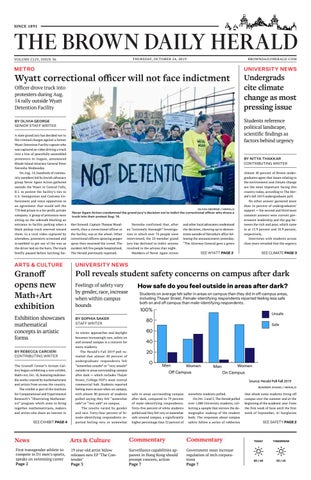
Poll reveals student safety concerns on campus after dark Feelings of safety vary by gender, race, increase when within campus bounds BY SOPHIA SAKER STAFF WRITER As winter approaches and daylight becomes increasingly rare, safety on and around campus is a concern for many students. The Herald’s Fall 2019 poll revealed that almost 40 percent of undergraduate respondents felt “somewhat unsafe” or “very unsafe” outside in areas surrounding campus after dark — which includes Thayer Street, College Hill’s most central commercial hub. Students reported feeling more secure when on campus, with almost 80 percent of students polled saying they felt “somewhat safe” or “very safe” on campus. The results varied by gender and race. Forty-four percent of female-identifying respondents reported feeling very or somewhat
How safe do you feel outside in areas after dark? Students on average felt safer in areas on campus than they did in off-campus areas, including Thayer Street. Female-identifying respondents reported feeling less safe both on and off campus than male-identifying respondents.
100%
Unsafe
80
Safe
60 40 20 0
Men
Women
Off Campus
Women
Men
On Campus Source: Herald Poll Fall 2019 SUMMER ZHANG / HERALD
safe in areas surrounding campus after dark, compared to 79 percent of male-identifying respondents. Sixty-five percent of white students polled said they felt very or somewhat safe around campus, a significantly higher percentage than 52 percent of
nonwhite students polled. On Oct. 2 and 3, The Herald polled over 1,000 University students, collecting a sample that mirrors the demographic makeup of the student body. The responses about campus safety follow a series of robberies
News
Arts & Culture
Commentary
Commentary
First transgender athlete to compete in D1 men’s sports, speaks on swimming career Page 2
19 year-old artist bülow releases new EP ‘The Contender’ Page 3
Surveillance capabilities apparent in Hong Kong should prompt concern, action Page 7
Government must increase regulation of tech corporations Page 7
that shook some students living off campus over the summer and at the beginning of the academic year. From the first week of June until the first week of September, 41 burglaries
SEE SAFETY PAGE 2
TODAY
TOMORROW
66 / 46
65 / 45
2
THE BROWN DAILY HERALD | NEWS
THURSDAY, OCTOBER 24, 2019
SPORTS
Schuyler Bailar speaks on being first trans D1 athlete in men’s sports Former Harvard swimmer shares challenges of transition process, athletic career BY RANDI RICHARDSON STAFF WRITER Schuyler Bailar, the first transgender athlete to compete on a NCAA Division 1 men’s team, spoke last Thursday about his experience of transitioning in the middle of his Harvard swimming career. The event marked the secondto-last stop of Bailar’s six-week tour, which consisted of 43 presentations in 25 cities. Bailar began his talk by describing his childhood and the beginnings of his swim career. He started walking and swimming at the age of one, and began competitive swimming at age seven. By the time he got to middle school, Bailar was routinely bullied for not being “girly” enough. He described instances when he was thrown out of bathrooms, forcing him to run “across the school to find the (gender neutral) staff bathroom.” He often felt most comfortable “presenting masculine or boyish tendencies,” he told the audience. Bailar also described feeling stressed because he “wasn’t boy enough to be a boy, or girl enough to be a girl, so (he existed) in between.” In an effort to stop the bullying, Bailar said he tried to conform to societal expectations of feminity. He grew his hair out, shopped in the girls section for clothing and even wore makeup a couple of times. Bailar said this took a toll on his mental health because even though he made national swim records and was heavily recruited by many Ivy League schools, he felt “sad, miserable and disconnected.” In August 2014, Bailar sustained a back injury that forced him to stop swimming for three months. Bailar described swimming as his only outlet from living conflicting lives, so his injury negatively impacted his mental health. “My mental health was trash and
WYATT FROM PAGE 1 light to people who wish to enact violence against peaceful protesters,” said Tal Frieden ’19.5, a Never Again Action member who participated in the August protest. “I recognize there is disappointment here,” said Neronha at the news conference. “I understand how they feel, and it is not lost on me the pain that they’re in.” For many at the August protest, Neroha’s words felt empty. “It’s clear that law enforcement is given a green light to do whatever they’d like and enact any type of violence on peaceful protesters and others in the state,” Frieden said. Woodworth’s attorney, Gary G. Pelletier, could not be reached for comment late Wednesday. At the demonstration outside Neronha’s office, former State Representative and Never Again Action organizer Aaron Regunberg ’12 spoke about members of Never Again who were interviewed by the grand jury. “Every single one of our witnesses came out demoralized,” Regunberg said. “Many of them were in tears.” Regardless of the jury’s decision, Neronha hopes that August’s event
deteriorated,” Bailar said. “I was hospitalized a couple times for depression.” Bailar saw a therapist who recommended an extended stay at a residential treatment center, which meant taking a gap year after already committing to the Harvard Women’s Swimming team for the following fall. He spoke to the coaches, and they agreed it was something he needed to do before starting college. While at the treatment center in Florida, Bailar said he experienced one of the most quiet, introspective times of his life. It was also the first time that Bailar acknowledged to himself that he was transgender. He came out to his parents, who “did an excellent job of delivering love in those moments,” Bailar said. When Bailar told the women’s swimming coach at Harvard, she told him he still had a spot on the team. “I don’t know what that means for my sport,” Bailar said to her. “I just know I want to swim.” Shortly after Bailar left the treatment facility, he began using male pronouns and cut his hair. Bailar remembered his coach telling him, “you’re taking these steps to be a man, but you’re on the women’s team.” So in January 2015, Bailar said his coach asked the men’s coach if Bailar could join their team. Bailar said that the men’s coach readily agreed and offered Bailar a spot on the squad. “Thinking about the sociopolitical climate and gender in sports,” Bailar said, “(is what made) this so incredible.” The coaches gave Bailar until September of that year to make a decision, and during that time he underwent a mastectomy, after which he decided to join the men’s team. “I did it to be happy,” Bailar said. Though switching to the men’s team was not always a smooth transition, Bailar believes that the unconditional support from his teammates and coaches and their efforts to include him made the whole experience easier. “They were wonderful and tried hard, but sometimes that failed. They misgendered me a lot, especially my
will lead to more robust safety protocols in the future. “A peaceful protest – a right enshrined in our Constitution – devolved into an extremely unfortunate incident that could have been avoided had better systems been in place to ensure public safety,” he wrote in a press statement. “There is much to learn from this incident. It is my hope that we will do so.” For Regunberg, the actions of prison guards on Aug. 14 and yesterday’s decision to move forward without pressing charges are served as examples of harm created by an unjust system. “Immigrants are arrested for no crime other than seeking a better life for their family. Yet for law enforcement, you’re totally justified in driving a truck into a crowd of peaceful protesters on camera and have no charges,” he said. “It’s very concerning to think about the signal this sends to folks all around our state and the country.” —With additional reporting from Dylan Clark
AREEZ KHAN / HERALD
Schuyler Bailar, the first transgender athlete to compete on a NCAA Division 1 men’s team, spoke at the University last Thursday. first year,” Bailar said. But successfully switching teams “exemplifies that transgender athletes can truly be included in a Division 1 team.” During the event’s question and answer session, Bailar said that the number one resource for people tran-
SAFETY FROM PAGE 1 were reported in District Nine, which includes much of College Hill. While these numbers are not abnormally high for summer months in Providence, according to Crime and Information Systems Specialist for the Providence Police Department Dan Clement, students nonetheless reported unease around the incidents, The Herald previously reported. Violent crime, on the other hand, has fallen in the area over the last year — decreasing from 21 reported incidences in 2018 to ten so far this year. “There has been a spike in some property crime categories over the past couple of months. That can certainly make people feel unsafe but overall the area around the University is seeing less reported crime,” wrote Lindsay Lague, public information officer for PPSD, in an email to The Herald. Some students interviewed by The Herald said they are especially nervous when walking on Thayer Street. “When walking up Thayer at night, especially up north, I am definitely more cautious,” said Alexandra Blizter ’22.
sitioning is meeting other transgender people. He also acknowledged that every day is one step toward who he is. “Your identities do not ever have to rob you of your passions,” Bailar said. Brittney Merrit, residential area coordinator for the Office of Residen-
tial Life, attended the event and found Bailar “genuinely authentic.” She also enjoyed hearing “how people were/ are super open to his story and how he approaches the work,” she wrote in a statement to The Herald.
Anna Kate Lembke ’23 shared this sentiment, recalling a night when she had concerns about walking on Thayer to get home from the house of her Meiklejohn peer advisor. “I knew I felt uncomfortable, so I asked my Meiklejohn to walk me home,” she said. The University has worked to increase safety for students on and around campus — operating a shuttle and an OnCall transportation service that run seven days a week until 2 or 3 a.m. The University also provides SafeWalk — a service in which students can be escorted to their destinations by their peers — and has installed around 150 outdoor emergency phones illuminated by blue lights. “I think a lot of students are unaware of the safety measures we have in place,” said Chief of Police Mark Porter. Jordan Watts ’23 attributes feelings of security on campus to measures implemented by DPS. “I feel a lot safer on campus because there are people around and safety tools like the blue lights or DPS,” he said. Emma McFall ’23 cited SafeWalk as a reason for feeling comfortable on College Hill. “I feel a lot safer
knowing it is an option for students,” she said, though she has never taken advantage of the service. Outside of University programs, there are other measures students can take to feel safer outside. “If I ever feel unsafe, I’ll let the person whose house I left know where I am, just in case,” said Bryan Zhang ’21. “There are some moments when I get a little bit anxious, but for the most part I feel fine,” said Caymus Price ’20.
THURSDAY, OCTOBER 24, 2019
THE BROWN DAILY HERALD | NEWS
3
ARTS & CULTURE
bülow sings edgy, glamorous pop in new five-track EP, ‘The Contender’ ‘The Contender’ released Oct. 4 covers themes of love-lost, childhood naivety, confidence BY KAITI YOO SENIOR STAFF WRITER Rising pop singer Megan Bülow, who is known by the stage name bülow, delighted fans with the Oct. 4 release of her five-track EP “The Contender.” The German-born and Canada-based 19 year old has been praised for her songwriting skills in her past works, “Damaged Vol. 1” and “Damaged Vol. 2,” and “The Contender” only continues to uphold this reputation. Imbued with thoughtful lyrics and diverse musical arrangements, the five-song anthology is an ode to growing pains — the ugly, the beautiful and everything in between. bülow kick-starts the album with “Own Me,” an empowering, feminist anthem that claims defiant autonomy against an unnamed person she is tired of answering to. It appears to be sung from the perspective of a protagonist who has been running from subjugation, but finally breaks free. The song is riddled with strong, spiteful and biting diction, including this poignant bridge: “I know that you probably wish that I would just back down / Would that make you happy? / But you should know that / I would rather die / Than to watch you have that finale.” bülow uses her lyrics to defiantly taunt her threatener — refusing to be controlled any longer. The usurping of this power dynamic is amplified by the static synth of the
CLIMATE FROM PAGE 1 to tackle climate change stems from a number of sources, such as the current political landscape and recent scientific findings. “I do think that climate change is the biggest problem facing the world and this country,” said Hannah Bashkow ’23. “This is due to government officials resisting to fix this problem, which is causing younger people to get more worked up about it.” Just a year ago, Sunrise, a youthbased environmental activist group, established itself on campus and in Providence. The group has been active in both national and city movements, sitting in at House Speaker Nancy Pelosi’s office in February and supporting the creation of a Rhode Island Green New Deal in March. Gabriel Civita Ramirez ’21, the communications leader for Sunrise Brown, saw the release of the October 2018 IPCC report as an incentive for action. “(The report) said we have 12 years to curb carbon emissions and other greenhouse gases, so we don’t increase the planet’s temperature by more than 1.5 degrees Celsius,” Ramirez said. “Even with the IPCC report giving a ‘deadline,’ it seems … like climate change is almost an invisible problem. However, we are already feeling its effects and have to take preventative steps before it gets worse.” This poll result comes about eight months after New York Rep. Alexan-
SUMMER ZHANG
background guitar and the overlapping of bülow’s many autotuned vocals. Together, the lyrical and musical elements coalesce, immersing the listener in sound. Next up in the tracklist is the lead single “Boys Will Be Boys,” released Sept. 19. Before the EP’s release, the song racked up more than one million Spotify streams on its own. Although a much lighter tune and tale than “Own Me,” this song is a continuation of that same confident, girl power energy. The opening line is a light yet powerful punch to the gut of her ex-lover: “I’m going all-white to your funeral / If you think I’m gonna cry, you’re delusional.” Then, the chorus repeats religiously: “Boys will be boys, boys,
dria Ocasio-Cortez and Massachusetts Sen. Ed Markey introduced a resolution for a Green New Deal, which proposes environmental and economic reform to minimize the effects of climate change and completely eliminate carbon emissions in the U.S. by 2030. The resolution was blocked by the Senate in March. Zoe Mermelstein ’21, president of the Brown Democrats, echoed the need to act quickly. She said she found the poll result unsurprising, largely because of the issue’s salience to college students. “Climate change is a pressing issue, especially since we, the young people, don’t have that much time to turn it around but are the ones stuck with its repercussions,” Mermelstein said. Taking action to support a local and national Green New Deal has emerged as a top issue within the Brown Dems, though they are in the process of officially determining their priorities for this year, she added. The Democratic primaries also offer more attention to the issue and engage the general public, Mermelstein said, since so many candidates are talking about it. Candidate Jay Inslee, who dropped out in August, focused his entire campaign on addressing climate change, and most top presidential candidates publicly support a Green New Deal. Of the poll participants who listed their top issue as climate change, about 30 percent said they would vote for Elizabeth Warren, a Green New Deal signatory, in the Democratic pri-
boys / Break heart like toys, toys, toys / Now fuck all that noise, noise, noise,” ardently warning her fellow ladies against falling for pretty-boy heartbreakers. The song’s playful, bold percussion beats and lighthearted pop tune are a celebration of lessons welllearned from a heartbreak well-spent. Indeed, this song is proof that bülow is no longer mourning, but moving on. In “Puppy Love,” bülow collaborates with artist Jimi Somewhere to bring fans a nostalgic, hope-filled narrative. The lyrics explore a myriad of themes: childhood, dreams and uncertainty. bülow calls upon the childlike optimism that many of us once had: “I, be poppin’ wheelies on my bike / Be doing something with my life /
Everything gon’ be fucking fine.” By re-cultivating a “puppy love” for life, she appears to be telling both herself and her listeners that everything will work out, like it always could when they were young. Consistent with this piece’s contemplative and nostalgic sentiment, its musicality follows suit. Relying on a retro, authentic guitar melody and a shouting vocal chorus in the background, the song echoes the techniques widely used in popular music eras of the past. “Upside Down” then proceeds to show fans a truly vulnerable side of bülow. Accompanied by the strum of a reverb electric guitar, bülow questions all motives and purposes for love, evidently defeated by her pursuit of it.
Lost and at a standstill, she constantly searches for answers: “What the fuck you fall in love for? / Couldn’t I have been enough for you?” she asks, continuing “Broken hearts they turn my world upside down / I don’t know anymore, what’s the right way around?” The lyrics are direct, amplifying the desperation embedded within them. As the EP’s longest and most somber song, this piece is a testament to the sadness, loneliness and confusion that many listeners can empathize with. Finally, the last song is “Sundress,” which is hands down the stylistic standout of the five. Unlike the other songs, which all contain some implementation of electronic music and percussive beats, this one is utterly raw in its approach. bülow’s voice is raspy, unfiltered and authentic. The melody is composed of unaltered, uninterrupted acoustic guitar. Structurally, the song is completely different as well — it lacks a chorus and a bridge, instead laying out three verses to tell a vaguely linear narrative. Indeed, it reveals a completely different persona of bülow — earning the song it’s place as the EP’s finale track. Ultimately, “The Contender” continues the twist on the pop genre that bülow introduced with her debut in 2017: darker, punchier and certainly trippier. Each song within this album exhibits an individualistic exploration, enrapturing and enticing listeners with every hit of the play button. bülow is currently on tour with the artist Lauv, who is famous for viral pop hits including “I Like Me Better (When I’m With You),” paving a path toward future success.
Most important issue facing the United States according to Brown students The Herald polled 1006 students and asked what they considered to be the most important issue facing this country today. Climate change received the greatest number of votes, with 37.8% of respondents selecting it.
40% 35 30 25 20 15 10 5 0 Climate Change
Gap Current Governmental Between Rich and Leadership Poor
Gun Control
Healthcare
Race Poverty/ Relations/ HomelessRacism ness
Immigration
National Debt Unemployment
Other
Source: Herald Poll
JACK WALKER / HERALD
mary. Warren was overall the most popular choice for poll participants, as well. But other students said they could not prioritize climate change or environmental concerns over other issues in the country, which they felt were of equal or greater importance. “(Climate change) is an important issue, but other issues like gun control are maybe even more important right now because they seem more urgent and pressing,” said Jocelyn Chu ’23. Gun control was only slightly less important to Brown students than the income gap between rich and poor, with the issues receiving 10.1 percent and 10.9 percent of undergraduates’
support, respectively. For the Brown Progressive Action Committee, climate change is a large priority, but does not dominate the group’s agenda, according to Jenna Israel ’21, chair of BPAC. The committee is not an issue-based organization, but rather partners with and supports other issue-specific groups. Alongside its plans to work with Sunrise, BPAC is currently working with organizations that advocate for gun control, healthcare and voter rights — issues that BPAC sees as equally important as climate change. Michael Gianatasio ’21 agreed that climate change cannot necessarily be prioritized over other issues, but
recognized the need to address it. “Climate change is important, but so is gun control, the socioeconomic gap in our country and also the fact that our current government leaders are doing nothing to help with any of these problems,” Gianatasio said. “But I do think climate change is really important since it is so detrimental to everything.”
4
THE BROWN DAILY HERALD | NEWS
THURSDAY, OCTOBER 24, 2019
UNIVERSITY NEWS
UCS amends club recognition policies, discusses initiatives Changes formalize current UCS/SAO practices, bar nonstudent control BY KAMRAN KING SENIOR STAFF WRITER The Undergraduate Council of Students passed two amendments to its code of operations concerning student group recognition and heard updates on committee initiatives during its Wednesday meeting. The first amendment establishes an enrollment requirement for UCS-approved student groups. Category I student groups must maintain 10 or more members while Category II and III groups must have at least 15, according to the text of the amendment. Groups that fail to meet this requirement for two consecutive semesters will face “de-constitution,” said Alex Song ’20, chair of Student Activities. Previously, the bylaws did not formally require that student groups keep up enrollment, though the Student Activities Office and UCS had an informal version of the policy. The second amendment bars faculty or other non-student advisors from having power over a student group’s operations or finances, reinforcing an informal expectation. “There have been circumstances in the past where that’s the case,” Song said. “We just want to align ourselves so we can see those kind of situations out.”
If a student group fails to remove an advisor’s control after meeting with UCS, SAO and “other necessary parties” about such an infraction, the new rule will allow UCS to potentially abolish that organization, according to the text of the amendment. Song noted that these policies only apply to student groups registered through UCS. At the end of the meeting, representatives from many of UCS’ internal committees shared their recent work with the general body. Chair of Wellness Shivani Nishar ’20 said that her committee is working on restocking and expanding food pantries on campus. Zanagee Artis ’22, chair of Campus Life, said that his committee was working with the Office of Sustainability to organize a winter clothing drive. Jason Carroll ’21, UCS vice president and chair of Outreach and Advocacy, noted that his committee has addressed concerns about unclean water in buildings on Wriston Quadrangle, an issue he discussed in his campaign for vice president. The Division of Campus Life “let me know that that’s been finished by Facilities,” Carroll said. The University could not be reached for comment by press time on steps they have taken to address unclean water. During the midsemester check-in portion of the meeting, UCS discussed an Oct. 23 article in The Herald that revealed over half of undergraduates have no opinion of UCS. Members discussed ways to increase engagement
REBECCA HO / HERALD
At yesterday’s UCS meeting, the Council passed two amendments regarding student group recognition. with students, and later mentioned initiatives to expand UCS’ social media presence, such as by posting more frequently. UCS also heard announcements from members of the Brown Consulting Club and from a representative of Dance Marathon. The BCC was founded last year and “works with companies to address their research
needs and help them grow,” said UCS Treasurer Summer Dai ’22, who is a member of BCC. BCC is consulting for UCS to improve the organization’s efficiency and develop best practices. The first stage of the consulting process involves learning about UCS. To this end, the group requested interviews with members of the Council. A representative from Dance Mar-
The Institute for Computational and Experimental Research gathered mathematicians and artists for a multimedia exhibition.
EXHIBIT FROM PAGE 1 visualizing mathematical concepts. ICERM is a University-based think tank funded by the National Science Foundation that aims to bring academics and professionals together to “broaden the relationship between mathematics and computation ... and support theoretical advances in computation,” according to the organization’s website. Elisenda Grigsby, one of two deputy directors of ICERM and a leader for the organization’s 2019 Illustrating Mathematics program, explained that the organization’s programs do not typically involve an artistic component, but this program is specifically catered to those who are interested in visualizing their mathematical work, The Herald previously reported.
The Math+Art exhibit was funded by the Alfred Sloan Foundation and has been in the works since the summer of 2018 with ICERM approaching many galleries to showcase the work. “We didn’t quite know who would say yes,” Grigsby told The Herald. “Eventually, (the Granoff Center) approved the exhibit. They have been amazing.” Leading up to the exhibition, ICERM partnered with the Bridges Organization, a Kansas-based group devoted to promoting interdisciplinary work in math and art, to develop a platform for participants to submit their artwork online, Grigsby said. A curating committee then met online and reviewed all of the submissions. Henry Segerman, Oklahoma State University mathematics professor and one of the judges for the exhibition,
said the judges not only valued “the mathematical content of each of the submissions, but also the fact that it was aesthetically pleasing.” “A big part of my work is visualizing mathematics and mathematical ideas,” Segerman said. “I, as well as many of the other participants, do the traditional teaching, making proofs and publishing papers. But I’m very interested in the visual component.” Frank Farris, a professor of computer science and mathematics at Santa Clara University, has artwork featured in the exhibit. The title of his piece “Alla fine diventava tutto viola,” which means “In the end, everything was becoming purple,” was inspired by a phrase he learned on the language-learning app, Duolingo. “Of course, I had to make something that was less purple, and then
as you evolve to the outside, it’s more purple than you can possibly imagine,” Farris said. His piece was made using mathematical wave formulas and a photograph of sweet peas, which Farris grew himself. The photograph of the sweet peas is located in the bottom right hand corner of the work. Farris, like many of the other mathematicians, views his artwork as a way to showcase mathematics in a more accessible and beautiful way. “Everyone has a general understanding that you can make everything out of waves, such as with CD recordings. This does the same thing but in the visual domain,” Farris said. The exhibit is open seven days a week and will remain open to the public until Nov. 21. The exhibit will also be a stop on the Gallery Night
athon, a fundraising event for Hasbro Children’s Hospital, told the Council that the event will occur Nov. 15, from 4 p.m. to midnight, and will feature games in addition to the dancing.
AREEZ KHAN / HERALD
Providence trolley, a tour that goes through the Providence area on the third Thursday of every month and stops at various art exhibitions. The tour stop provides “an opportunity for the general public to mingle with the artists and learn about what’s being displayed,” said Ruth Crane, assistant director of ICERM.
THURSDAY, OCTOBER 24, 2019
THE BROWN DAILY HERALD | TODAY
5
CA L E NDA R TODAY
OCTOBER S
6
M
7
Tu
W
Th
F
S
1
2
3
4
5
8
9
10
11
12
13
14
15
16
17
18
19
20
21
22
23
24
25
26
27
28
29
S U D O KU
30
31
Leavetaking Info Session 12:00 P.M. Stephen Robert ‘62 Campus Center
A Day with Dan Cnossen: Keynote 12:00 PM Alumnae Hall
Human Trafficking in Brazilian and Jamaican Contexts 2:30 P.M. Nicholson House
Climate Crisis Town Hall Watch Party 5:30 P.M. McCormack Family Theater
TOMORROW Fall 2019 Brown Legal History Workshop 9:00 A.M. Faculty Club
DScoV: Deep learning $150 12:00 P.M. 164 Angell Street
Ethnic Studies Open House 2:00 P.M. Nicholson House
Mindfulness Center Open House 3:30 P.M. Sayles Hall
Q U OTE OF TH E DAY
“Every single one of our witnesses came out demoralized.” —Aaron Regunberg ’12 —AARON REGUNBERG ’1
C ORRECTI ON The Oct. 23 article “Education Department designs new teaching degree” referenced the “then called the Annenberg Institute for School Reform.” In fact, the Institute’s full name remains the Annenberg Institute for School Reform. The Herald regrets the error.
CR O S SWO R D
C O L L EG E H I L L
MUKUL KHANNA/ HERALD
Beauty is everywhere on College Hill, especially as the leaves change colors and line the streets around academic buildings and student residences.
6
THE BROWN DAILY HERALD | COMMENTARY
THURSDAY, OCTOBER 24, 2019
LETTER TO THE EDITOR
Perception of Brown in Tapiero letter is misguided To the Editor: It should be noted that Dan Tapiero’s BA ‘90, MA ‘91, and 1989 Associate Managing Editor of the Herald, Oct. 22 letter in The Herald was sprinkled with rose-colored views of a mythical Brown University. When he wrote, “I recall that at one time Brown was considered a breeding ground for CIA recruitment. We did not possess the arrogance nor the stridency to opine upon matters that we had not researched, that we knew very little about as students,” he conveniently leaves out both the 1981 student protest during a lecture delivered by CIA Director William Casey and the 1984 student protests of CIA recruiters. ‘ To claim that “the Brown community has always been a place where fair, balanced, thoughtful and researched ideas were welcome, from whatever side,” falls into a fairly uninspired trope of bothsidesism. The well-documented history of student protests against the Vietnam War, nuclear proliferation, Apartheid and police brutality shows that students have always been capable of using moral and ethical principles to guide research and action to achieve a more equitable future. In many of these cases, it is the administration and the leaders of the University who realign to match the more egalitarian vision of the world students have imagined. So on the topic of Kanders, it’s evident that a coalition of students and
alums continues to build on the work laid out by both artists and the activist organization ‘Decolonize This Place.’ They have posed the question: Should prestigious educational institutions associate with companies that make tools to perpetuate violence? It is a complicated question given how interconnected and labyrinthine the flow of global capital has become. For me, it does seem worth answering especially when considering that our phones barrage us daily with videos of violence committed by militarized police around the globe. The words of former Border Patrol Agent, Francisco Cantú, whose comments appeared in the same issue as Mr. Tapiero, suggest a way forward: “In the end, our feelings and our tears are useless unless they compel us to act in a way that might someday improve (migrants’) situation.” Those raising the question of Kanders’ role in the University are clearly compelled to say Brown does not have to associate with tear gas production. The Herald (along with students from many other universities) has clearly been compelled to demand renewed clarity in donation protocols that could prevent scandalous and unethical donations from entering the University’s endowment. What I wonder is how will Mr. Kanders feel compelled to act?
THE BROWN DAILY HERALD Managing Editors Anna Kramer Priyanka Podugu Senior Editors Anita Sheih Sarah Wang Editorial Page Editors Grace Layer Krista Stapleford post-magazine Editor-in-Chief Anita Sheih
Sections Arts & Culture Editors Elise Ryan Annabelle Woodward Metro Editors Dylan Clark Sophie Culpepper Alex Reice News Editors Celia Hack Jacob Lockwood Melanie Pincus Allie Reed Science & Research Editors Cate Ryan Chris Schutte Sports Editors Alexandra Russell Alex Smolar
FACEBOOK.COM/BROWNDAILYHERALD
Joey DiZoglio MD ’20
SINCE 1891
Editorial Leadership Editor-in-Chief Emily Davies
STAY UP-TO-DATE. FOLLOW US ON FACEBOOK.
Commentary Opinions Editors Rebecca Aman Jamie Flynn Derek Simshauser Multimedia/Production Design Editors Bilal Ismail Ahmed Keelin Lyons Dylan Tian Head Photo Editors Tiffany Ding
Business General Managers Ravi Betzig Nicholas Masiakowski Office Manager Diane Silvia Directors Sales: Bersabel Yifru Finance: Rudra Srivastava Reynaldo Blandon
Copy Desk Chief Kelley Tackett Illustrations Editor Summer Zhang Graphics Editor Sarah Martinez
@the_herald
facebook.com/browndailyherald
@browndailyherald
youtube.com/browndailyherald
195 Angell St., Providence, RI (401) 351-3372 www.browndailyherald.com Editorial: herald@browndailyherald.com Advertising: advertising@browndailyherald.com
Submissions: The Brown Daily Herald publishes submissions in the form of op-eds and letters to the editor. Op-eds are typically between 750 and 1000 words, though we will consider submissions between 500 and 1200 words. Letters to the editor should be around 250 words. While letters to the editor respond to an article or column that has appeared in The Herald, op-eds usually prompt new discussions on campus or frame new arguments about current discourse. All submissions to The Herald cannot have been previously published elsewhere (in print or online — including personal blogs and social media), and they must be exclusive to The Herald. Submissions must include no more than two individual authors. If there are more than two original authors, The Herald can acknowledge the authors in a statement at the end of the letter or op-ed, but the byline can only include up to two names. The Herald will not publish submissions authored by groups. The Herald does not publish anonymous submissions. If you feel your circumstances prevent you from submitting an op-ed or letter with your name, please email herald@browndailyherald.com to explain your situation. You can submit op-eds to opinions@browndailyherald.com and letters to letters@browndailyherald. com. When you email your submission, please include (1) your full name, (2) an evening or mobile phone number in case your submission is chosen for publication and (3) any affiliation with Brown University or any institution or organization relevant to the content of your submission. Please send in submissions at least 24 hours in advance of your desired publication date. The Herald only publishes submissions while it is in print. The Herald reserves the right to edit all submissions. If your piece is considered for publication, an editor will contact you to discuss potential changes to your submission. Commentary: The editorial is the majority opinion of the editorial page board of The Brown Daily Herald. The editorial viewpoint does not necessarily reflect the views of The Brown Daily Herald, Inc. Columns, letters and comics reflect the opinions of their authors only. Corrections: The Brown Daily Herald is committed to providing the Brown University community with the most accurate information possible. Corrections may be submitted up to seven calendar days after publication. Periodicals postage paid at Providence, R.I. Postmaster: Please send corrections to P.O. Box 2538, Providence, RI 02906. Advertising: The Brown Daily Herald, Inc. reserves the right to accept or decline any advertisement at its discretion.
The Brown Daily Herald, Inc. is a financially independent, nonprofit media organization bringing you The Brown Daily Herald, BlogDailyHerald and Post- Magazine. The Brown Daily Herald has served the Brown University community daily since 1891. It is published Monday through Friday during the academic year, excluding vacations, once during Commencement and once during Orientation by The Brown Daily Herald, Inc. Single copy free for each member of the community. Subscription prices: $200 one year daily, $100 one semester daily. Copyright 2019 by The Brown Daily Herald, Inc. All rights reserved.
THURSDAY, OCTOBER 24, 2019
THE BROWN DAILY HERALD | COMMENTARY
7
Regulate tech giants, because they can’t police themselves ARJUN SHANMUGAM ’23 STAFF COLUMNIST
In 2018, it was revealed to the public that political consulting firm Cambridge Analytica had illicitly harvested the personal data of millions of Facebook users. These data were used to create misleading targeted advertisements in the 2016 presidential election; authorities followed a paper trail leading back to Russia. Consequently, Facebook found itself at the center of an intense national debate over user privacy and the sanctity of American elections. Washington has been scrutinizing tech companies with laser focus. The Federal Trade Commission subjected Facebook to a $5 billion fine, states across the country have opened antitrust investigations into its business dealings and lawmakers around the world are demanding that CEO Mark Zuckerberg testify about the scandal.
CISSY LUO
Congressional effort to regulate firms like Facebook is necessary to safeguard citizen privacy and democratic elections. Though these tech giants claim that they can police their own platforms, we cannot rely on them to do so. Facebook’s business model itself depends on the abuse of user data. The federal government needs to act decisively to create a framework to govern tech companies’ collection, distribution and monetization of personal information. Internet behemoths like Google and Facebook have always had a complicated relationship with the confidentiality of user data. Faced with controversies over privacy, these corporations have tried to save face with vows to self-regulate. Twitter CEO Jack Dorsey promised “independently vetted … metrics to measure the help of public conversation on Twitter.” What he actually means by this is unclear, and that is likely intentional. For proof, take a look at the business strategies that tech companies are employing. They collect detailed data on the billions of people who use their platforms, in the form of search histories, purchases, media preferences and more. These data are essentially treasure-troves for political campaigns, retailers and other entities that rely on marketing. They contact a company like Twitter, define a target audience — Lululemon, for instance, would probably be on the lookout for wealthy, health-conscious athletes — and the internet does the rest. This business model accounts for 87 percent of Google’s total revenue and 89 percent of Facebook’s. Citizens don’t seem poised to push for change, either. Seventy-four percent of Facebook users don’t even realize that the site collects their data in the first place. This means that Congress must be proactive in protecting Americans from such data harvesting. Just as we cannot
expect cigarette companies to impose an excise tax on themselves, we should not count on tech giants to adequately safeguard user privacy. Big tech has also failed in protecting democracy itself. This is especially worrisome in a world where social networks facilitate the vast majority of political discourse. Throughout the
used false and misleading information to sway our election. And once again, Facebook’s leadership succumbed to its profit motive. It should have been a red flag for Facebook when a series of overseas corporations purchased ad space in rubles (Russia’s currency). But to Facebook, cash was cash
“Though these tech giants’ claim that they can police their own platforms, we cannot rely on them to do so. Facebook’s business model itself depends on the abuse of user data.”
2016 election cycle, internet giants took advantage of a laggard regulatory environment to profit off of the motives of foreign actors. For example, Facebook sold about $100,000 dollars of ad space to firms servicing the Russian government. Russia-linked advertising was seen by an estimated 126 million Americans. The Federal Election Commission has been slow to draw clear boundaries on what is and isn’t required of small digital political ads — for instance, whether tech companies must publicly disclose who purchased ad space — leaving social media companies with little to no oversight. That would explain why Twitter and Facebook didn’t think twice before accepting huge sums of money from Russian-backed organizations, which spread advertisements that consistently
— dollars or not. In the absence of government oversight, it had no reason to put the sanctity of our elections before cold, hard profit. The government cannot and should not halt the development of technology itself. But just as it has regulated other media — from phones to TV — it must take a stand in this new technological frontier. Our privacy and democracy hang in the balance.
Arjun Shanmugam ’23 can be reached at arjun_shanmugam@brown.edu. Please send responses to this opinion to letters@browndailyherald.com and op-eds to opinions@ browndailyherald.com.
Preventing a new era of hyper-surveillance ANDREW REED STAFF COLUMNIST
“He thought of the telescreen with its never-sleeping ear. They could spy upon you night and day.” In the fictional province of Oceania, there is a telescreen on every street, in every building, on every wall. These two-way viewing devices allow the “Thought Police” to surveil citizens and ensure that any subversive expression can be immediately suppressed. Prescient as he was, George Orwell was 35 years early. The year is 2019, and at long last, we’ve arrived in 1984. It has become thoroughly cliche to declare something Orwellian, but over the last few weeks, videos have surfaced showing protesters in Hong Kong tearing down facial recognition towers — which are essentially tall poles topped with an array of cameras bearing an eerily similar function to Orwell’s telescreens. Using artificial intelligence-driven facial recognition software, the Chinese government has the ability to identify, track and therefore suppress political dissidents. As a result, protesters have taken to covering their faces with masks and using lasers to blind the towers. This is but one moment in a long, shameful history of Chinese civil and human rights abuses in Hong Kong. And while this example may be the most striking in recent memory, it’s emblematic of a broader issue: the dual uses of surveillance technology and its ever-expanding role in society. The same technology that can help us catch violent criminals is also an invaluable tool in a dictator’s woodshed — one that has the potential to maintain autocratic regimes, clear the way for political repression and de-
stroy civil liberties worldwide. The international community must draw the line between acceptable and unacceptable uses of this technology now, before it’s too late. It seems hardly necessary to justify the utility of surveillance technology in certain circumstances. If a terrorist makes a phone call, knowing what they say could mean the difference between thwarting an attack or en-
stick? The difference is the manner in which this technology operates: Surveillance tech is used in the shadows. Its covert nature gives dictators the information necessary to suppress protests before they begin, and by doing so, gives the outside world the illusion of stasis. It is a tool that is effective, in large part, because you can never really be certain when
“Prescient as he was, George Orwell was 35 years early. The year is 2019, and at long last, we’ve arrived in 1984.”
during one. But the same technology used to track terrorists can be used to track political opponents as they walk down the street. So how can we stop the technology from being used in ways that violate civil liberties? One way is to prevent the emergence of the technology to begin with — but it seems undesirable and anyway impossible to stymie technological progress for a long time, let alone forever. The realistic, and necessary, alternative is to regulate its possession and use, similar to the way we regulate nuclear weapons worldwide. Surveillance technology may not have the power to destroy the world, but it certainly has the power to subjugate it. Some may ask how surveillance technology is qualitatively different from other widely accepted, yet potentially repressive, tools — after all, most wouldn’t call for an international treatise regulating tear gas. And isn’t this just a different, though perhaps bigger,
or how it’s being used. For example, in the case of Hong Kong, there is a real possibility that facial recognition technology is being used to identify protesters now, so that when the protests have subsided and the media spotlight is off Hong Kong, the Chinese government can use that database of names to round up dissidents. The second difference is that surveillance tech is used best when it is used broadly. Necessity dictates its extensibility: If you knew who your targets were, then you could exclusively monitor them. But if the goal is to identify targets, as it almost always is, then you must collect data from everyone — or at least from large swaths of people. This is what is commonly referred to in the United States as bulk collection. Dictatorships may be the most cinematic scenarios for misuse of this technology, and this form of government is — thankfully
— somewhat foreign to the American experience. But it’s not just use by despots and it isn’t just political repression that are concerning about this technology. Consider, for example, the potential utility in law enforcement. Would we really feel comfortable with the government monitoring our every move as we walked down the street, even if it meant that there were fewer burglaries in our neighborhoods? It is the essence of a police state: eternal invigilation. You jay-walk on Monday, and by Friday there’s a citation in your mailbox. In such a world, wearing a mask in public is the contemporary equivalent of putting a piece of tape over your laptop’s camera. The best time to regulate this technology is before its use becomes ubiquitous — in other words, now. Those nations who value the preservation of civil liberties must pressure those without a similar predilection to rein in this technology. Otherwise, governments around the world will have the ability to construct a daily record of where you’ve been, how long you were there and who you were with. And, on that day, the concept of privacy becomes but a quaint memory—there will be no hiding from Big Brother.
Andrew Reed ’21 can be reached at andrew_reed@brown.edu. Please send responses to this opinion to letters@browndailyherald.com and op-eds to opinions@ browndailyherald.com.
8
THE BROWN DAILY HERALD | NEWS
THURSDAY, OCTOBER 24, 2019