SINCE 1891
THE BROWN DAILY HERALD VOLUME CLIV, ISSUE 27
THURSDAY, OCTOBER 10, 2019
UNIVERSITY NEWS
UNIVERSITY NEWS
University cancels free drug testing service U. ends service for Code of Student Conduct, legal violations BY LI GOLDSTEIN SENIOR STAFF WRITER Students will no longer have access to free drug testing on campus after the University canceled a service formerly offered by Students for Sensible Drug Policy. The University stopped the group’s drug testing program Sept. 20, after suspending the service last Spring Weekend — the annual weekend-long campus concert that tends to be the busiest for the group, said President of SSDP Jackson Kealey ’21. SSDP appealed the decision last spring, but the University has notified group leaders that their drug testing practices are in violation of the Code of Student Conduct, as well as federal and state laws regarding unauthorized drug possession, according to Director of News and Editorial Development
BROWNDAILYHERALD.COM
U. policy targets derecognized group activity New Code of Student Conduct prohibits student participation in derecognized groups
Brian Clark. The University’s Chief Risk Office reviewed the appeal with representatives of Student Activities Office, the Office of the General Counsel, Environmental Health and Safety and the Department of Public Safety. Prior to the suspension, SSDP offered free and anonymous drug testing to University students which helped identify substances and verify their exact composition. SSDP does not collect statistics on participation in the program in order to protect student privacy, Kealey said. Kealey acknowledged that drug use alone is never without risk, but said that the drug testing program made experiences safer for students. “It’s a lot better for people to know what they are putting in their body (so) they can then do it more properly and they can know what to expect,” he said. “Regardless of the student group’s positive intentions, it would be irresponsible for the University to authorize a program knowing fully that it would place students in the position of violating not only Brown policy,
BY SPENCER SCHULTZ SENIOR STAFF WRITER In an effort to decrease incidents of “risky behavior,” including hazing and alcohol consumption, the University’s 2019-20 Code of Student Conduct prohibits participation in derecognized student groups. Derecognized student are “groups, teams, or organizations that have had their University recognition suspended or permanently revoked by the University for disciplinary reasons,” according to the Code of Student Conduct. Participation includes joining, rushing, pledging or “being involved in any activity that would normally be associated with being a member of such an organization.” Any organization created by members of a derecognized group “in an attempt to continue its presence on campus” constitutes a violation of the code as well. The rule changes arrive as University officials begin to acknowledge the
SEE SSDP PAGE 4
HANNA RASHIDI / HERALD
continued activity of derecognized groups on campus. “We know about the Lantern. We’ve known since the beginning, but we haven’t been able to address it since we don’t know who’s in it,” according to Yolanda Castillo-Appollonio, senior associate dean of students and director of student conduct and community standards. Lantern, a group of students, is known on campus for its association with the fraternity Phi Psi. The fraternity was banned by the University in 2015, The Herald previously reported. A member of Lantern did not respond to multiple requests for comment. The policy change also follows the suspension of two prominent student groups within the last year. The University suspended Buxton Internation-
UNIVERSITY NEWS
al House in January 2019 for a series of Code of Student Conduct violations, including “violation of the operational rules and procedure of Residential Life and unauthorized possession of alcohol,” The Herald previously reported. In September, Sigma Chi fraternity lost University recognition for a period of five years following a March 2019 incident that involved both hazing and alcohol violations, The Herald previously reported. The OSCCS’s official complaint filing system is currently the only method the office has to regulate student participation in derecognized student groups. For the office to know of a student’s membership in an unrecognized
SEE CONDUCT PAGE 3
UNIVERSITY NEWS
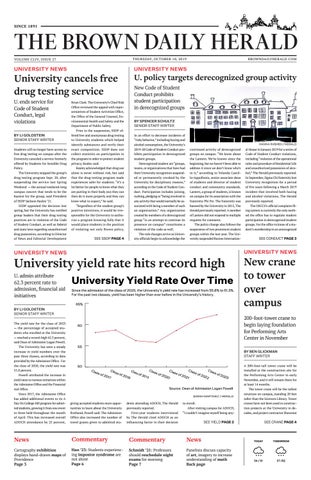
New crane U. admin attribute to tower University Yield Rate Over Time 62.3 percent rate to admission, financial aid over initiatives campus
University yield rate hits record high
Since the admission of the class of 2020, the University’s yield rate has increased from 55.8% to 61.3%. For the past two classes, yield has been higher than ever before in the University’s history. 65%
BY LI GOLDSTEIN SENIOR STAFF WRITER
200-foot-tower crane to begin laying foundation for Performing Arts Center in November
The yield rate for the class of 2023 — the percentage of accepted students who enrolled at the University — reached a record-high 62.3 percent, said Dean of Admission Logan Powell. The University has seen a steady increase in yield numbers over the past three classes, according to data provided by the Admission Office. For the class of 2020, the yield rate was 55.8 percent. Powell attributed the increase in yield rates to various initiatives within the Admission Office and the Financial Aid Office. Since 2017, the Admission Office has added additional events to its A Day On College Hill program for admitted students, growing it from one event to three held throughout the month of April. This has increased overall ADOCH attendance by 25 percent,
giving accepted students more opportunities to learn about the University firsthand, Powell said. The Admission Office also increased the number of travel grants given to admitted stu-
News
Commentary
Commentary
News
Cartography exhibition displays hand-drawn maps of Providence Page 3
Han ’23: Students experiencing impostor syndrome are not alone Page 6
Schmidt ’21: Professors should reschedule night exams for morning Page 7
Panelists discuss capacity of art, imagery to increase understanding of math Back page
60
55
BY BEN GLICKMAN STAFF WRITER 50 Cla
ss o
Cla
f 20
17
ss o
f 20
Clas 18
s of
201
Cla 9
ss o
f 20
Cla 20
ss o
to enroll. After visiting campus for ADOCH, “I couldn’t imagine myself being any-
A 200-foot-tall tower crane will be installed at the construction site for the Performing Arts Center in early November, and it will remain there for at least 14 months. The tower crane will be the tallest structure on campus, standing 20 feet taller than the Sciences Library. Tower cranes have not been used in construction projects at the University in decades, and project contractor Shawmut
SEE YIELD PAGE 2
SEE CRANE PAGE 4
f 20
Cla 21
ss o
f 20
Cla 22
ss o
f 20
23
Source: Dean of Admission Logan Powell SARAH MARTINEZ / HERALD
dents attending ADOCH, The Herald previously reported. First-year students interviewed by The Herald cited ADOCH as an influencing factor in their decision
TODAY
TOMORROW
54 / 51
57 /52
2
THE BROWN DAILY HERALD | NEWS
THURSDAY, OCTOBER 10, 2019
ARTS & CULTURE ROUNDUP BY ANNABELLE WOODWARD AND ELISE RYAN
Hip-hop Artist Akua Naru helps students workshop lyrics, think critically about songwriting Last night, Akua Naru, hiphop artist and Center for the Study of Race and Ethnicity in America artist-in-residence, invited students to participate in a lyrics workshop, where she spoke about her own writing process and helped them brainstorm techniques for songwriting. Through her music and scholarship, Naru attempts to “theorize the myriad experiences of black women through rhyme along a sonic spectrum from Jazz to Soul,” according to her website. She has performed hundreds of shows in more than 50 countries with her six-piece band and has been invited to lecture at schools such as Harvard, the University of Oxford and Princeton.
Celebrated writer, translator Lizzie Davis ’15 to read at the McCormack Family Theater Tonight at 5:30, Writer and Translator Lizzie Davis ’15 will read from her recent works at the McCormack Family Theater in the Literary Arts building. An expert in Spanishto-English translation, Davis has worked with established writers such as Pilar Fraile Amador, Daniela Tarazona, Daniel Saldana Paris and Paulina Flores. She currently serves as an editor at Coffee House Press in Minneapolis and holds a B.A. in Literary Arts. “Exposing Unseen Boundaries” examines borderlines, narratives of U.S. and Mexico border On Monday, “Exposing Unseen Boundaries” opened at the Sarah Doyle Center for Women and Gender with a public lecture and opening reception. It features works by fiber artist Consuelo Jimenez Underwood that transport
“viewers to the mystical threshold between the void and the mundane,” according to the event description. For “Exposing Unseen Boundaries,” Underwood’s works consider the effects of the U.S. and Mexico border on people and the environment. The exhibit includes “The Brown-Violet Borderline,” a wall installation that is part of Underwood’s “Borderlines” series. Underwood has work featured in the permanent collections of many museums, including the Smithsonian American Museum of Art, the National Hispanic Center for the Arts in New Mexico and the Mexican Museum in San Francisco. His exhibit in the Sarah Doyle Center marks the end of a week-long artist residency supported by the Institute for Transformative Practice, following the institute’s year-long theme of “Crossing Borders, Unsettling Boundaries.” The exhibit will show until May 23, 2020.
Spirit Sounds Symposium invites experts, community to consider religion and music Today and tomorrow, the Spirit Sounds Symposium will convene in the Granoff Center for the Creative Arts to explore the role of spirituality and religion in black American music. Featuring lectures, discussions and music, the symposium begins today with a panel from 1:00-3:30 p.m., “Revealing Religion in Black Music,” moderated by Andre Willis, assistant professor of religious studies. On Friday, the symposium will conclude with a workshop and concert from Cory Henry & The Funk Apostles, whose music blends “blues, soul, R&B, Afrobeat, gospel and jazz,” according to their website. In in the afternoon, Cory Henry & The Funk Apostles will work with participants in the Brown Arts Initiative’s weekly songwriting workshop.
YIELD FROM PAGE 1 where else, because I felt like the happiest version of myself would be here,” said Asenette Ruiz ’23. Gabe Merkel ’23 said that the ADOCH program he attended last spring gave him the impression that “Brown really does want its students to enjoy their experience here and find success academically.” Merkel added that he “didn’t get that sense from other schools that (he) visited for admitted students’ days, both from the students and from the activities that were planned, and the speeches that were given.” Additionally, Powell said the Brown Promise — which eliminated loans from financial aid packages starting with the class of 2022 — made the University more attractive to students weighing aid packages from other institutions. Though initiatives such as the Brown Promise increase the University’s yield rate, they are not conceived with this goal in mind, Powell added. The implementation of the Brown Promise was a “transformative moment” for the University, he said, adding that Brown is currently one of only a few peer institutions “that are need-blind for all domestic applicants, that meet full demonstrated need and
that don’t package loans in financial aid awards.” The Brown Promise was particularly appealing to Ruiz, who applied only to institutions she believed would offer her competitive financial aid packages. Similarly, for Isaac Jenemann ’23, “knowing that (the admission process) was need-blind” was a draw for him to apply in the first place. In addition to the Brown Promise, the Financial Aid Office has made efforts to increase aid offered to middle and moderate-income students and decrease parent contributions in these cases, said Dean of Financial Aid Jim Tilton. The University also offers a health insurance scholarship to every student on financial aid who doesn’t have “comparable insurance coverage,” an award of approximately $3,800, he said. Aside from Admission Office and Financial Aid Office initiatives, the Open Curriculum also helped convince first-years interviewed by The Herald to enroll at the University. Katherine Dowling ’23, who was unsure what she wanted to study before matriculating, felt that the Open Curriculum would offer her the freedom to take classes across many disciplines. Jenemann was similarly attracted to the size of the University and the liberal arts curriculum.
THURSDAY, OCTOBER 10, 2019
THE BROWN DAILY HERALD | NEWS
3
ARTS & CULTURE
Mapping exhibit invites community to reimagine Providence JNBC exhibit explores how people understand cities, invites attendees to draw maps BY CHANIKARN KOVAVISARACH CONTRIBUTING WRITER Over a hundred hand-drawn maps of Providence adorn the walls of the public gallery in the John Nicholas Brown Center for Public Humanities and Cultural Heritage. University students and other members of the Providence community created the maps for “Map It Out – Providence,” an exhibit that opened Sept. 26 in collaboration with Toronto-based artists Gwen MacGregor and Sandra Rechico. Curated by Marisa Angell Brown, assistant director of programs at the JNBC, the exhibition displays the maps, which were created during workshops that MacGregor and Rechico held earlier in the month. Brown explained that this exhibition is part of a larger, yearlong social project called “Year of the City,” which invites people to “see Providence in a new way.” For Brown, the exhibit encompasses one of the key aspects of public humanities by “bridging the kind of research that happens within the University and then the life outside of (it).” She outlined the importance of maps in synthesizing valuable data and presenting it in an appealing and accessible way. “Ask someone to draw something, and you’ll often get a ‘No,
CONDUCT FROM PAGE 1 student group, OSCCS would have to receive a formal complaint about their participation. The consequences of affiliating with a derecognized student group would depend on the specific circumstances of each situation and could range from a reprimand to an expulsion, Castillo-Appollonio said. “If you are found responsible for any (prohibited) behavior, the range is from reprimand up to expulsion,” she said. But expulsion would only be considered for the most serious of disciplinary cases, Castillo-Appollonio said. Expulsion goes against the OSCCS’s philosophy as an “educational entity” of the University. The OSCCS often addresses
COURTESY OF BROWN ARTS INITIATIVE
The exhibition is part of the year-long social project “Year of the City,” which combines academic and social perspectives of Providence. I’m not an artist.’ Ask someone to map something and they’ll say ‘Yeah, give me a pen,’” she said. MacGregor expanded on this idea, explaining that the exhibition acts as a way to explore “how we think about ourselves moving through the space and the places we live in” and challenges “ideas of what we think a map is.” This Providence exhibit acts as the fourth installment in MacGregor and Rechico’s collaborative “Map It Out” project, which began in Berlin in 2011. The artists, who have worked together since 2006, came up with the idea after experimenting with galleries and
public spaces when they were in Berlin presenting another project. MacGregor said the project “had a really organic life” as they were invited to recreate the interactive exhibit in Long Island, New York and then again in Cardiff, Wales as part of an academic conference. What was most interesting for MacGregor was the “different vibe” they encountered in each location. The groups of people that responded and their varying levels of enthusiasm to the project were key highlights for the artists. In addition to this, the artists noted that there was often a “visual shorthand” that was emblematic of the
conduct violations through restorative justice, a process that “focuses on bringing responsible parties and harmed parties together in facilitated dialogue about incidents that have caused harm,” according to the OSCCS website. “When an organization is derecognized and is continuing to perpetuate some of their behaviors off campus and without any oversight,” there could be a heightened risk to the health and safety of students, Castillo-Appollonio said. “Thinking about our concerns regarding the health and safety of students, we wanted to put (a policy) in place to help mitigate that.” The new prohibited behavior is one of several policy changes made to the University’s Code of Student Conduct for the 2019-2020 academic year, which
the Corporation approved last spring in accordance with a University-mandated code review, said Castillo-Appollonio. This review is undertaken every five years by the Committee to review the Code of Student Conduct, which includes student representation and a representative from the Office of the General Counsel, Castillo-Appollonio said. After drafting a new Code of Student Conduct, the OSCCS presented the proposed changes to the Undergraduate Council of Students, the Graduate Student Council and the Greek Council last spring, she added. “Sometimes our policies will be more restrictive to student behavior,” Castillo-Appollonio said. “Our values are our values and that’s what we’re going to uphold as an institution.”
How awesome are The Herald’s graphics? Email herald@browndailyherald.com to join the graphics team. Excellent Awesome Outstanding Amazing Fantastic
city, recurring in many maps; in Cardiff, for instance, many people would include the Cardiff Castle. In Providence, MacGregor said it was interesting to see how “each place was quite different in the way people responded and who responded.” During the Rhode Island Heritage Festival, for example, many parents saw it as an activity oriented toward children and expressed surprise when they were also asked to make maps. When MacGregor and Rechico worked with the city planners, they noticed a friendly competitiveness among participants in the details individuals included in
their maps. “It’s eye-opening to see how people think about their city and what moving through it means to them,” said Nikki Wong ’23. She mentioned how she was intrigued by the varying level of realism in each of the maps on the boards, and how personal, or impersonal, they could be. Prior to the opening of the exhibit, MacGregor and Rechico had an “action packed” residency between Sept. 18 and Sept. 28, during which they worked with the Providence community at the Dorcas Place International, the Rhode Island Heritage Festival, 44 Westminster Street and the Sankofa Market to produce the maps on display. MacGregor highlighted how grateful she is for Marisa Angell Brown’s existing relationships with the community and how integral they were to the project. While the artists are no longer in Providence, Brown said she welcomes everyone to visit the gallery and add their own maps so “we can continue to grow the collection and see how people think about the city.” Drawing her own map helped Brown “realize something about myself and about how I understand my own day … through relationships rather than through space and location,” she said. She hopes that all who visit gain such insight themselves. “Map It Out – Providence” is open from 10am to 4pm, Monday through Friday, and will be on display in the public gallery at the JNBC until Nov. 14. There will also be gallery talks on Oct. 18 and Nov. 14 and a reception night on Oct. 17 from 5pm to 9pm. Admission to the exhibit is free.
4
THE BROWN DAILY HERALD | NEWS
SSDP FROM PAGE 1 but also a range of federal and state laws regarding possession of illegal drugs,” Clark wrote in an email to The Herald. SSDP initially appealed the suspension in the spring before being rejected in September. The group tried to address the University’s concerns in the appeal. For example, they proposed marketing changes to address the criticism that testing students’ drugs
CRANE FROM PAGE 1 Design and Construction has only opted to use three in its nearly 40-year existence, partially due to logistics. “Nobody I’ve talked to is aware of the last time Brown ever had a tower crane on campus,” said Paul Dietel, assistant vice president of planning, design and construction, though he
THURSDAY, OCTOBER 10, 2019
would suggest that there were no risks associated with the substances. Kealey said SSDP has made an effort to be transparent with the University, pointing to their funding requests to the Undergraduate Finance Board as an example. “We definitely weren’t hiding what we were doing,” he said. Muki Benkler ’17, a former leader of SSDP, urged the University to recognize the importance of the group’s drug safety testing. “Whenever you stigmatize drug use, you’re gonna drive people to use in less safe conditions,” he said. “So if the University is trying to push students to not be more open with each other, they’re gonna use in private, they’re not gonna feel comfortable going to the University for help.” The group will continue to educate the University community on topics of substance use and harm reduction, in addition to continuing their lobbying efforts against policies that drive drug use and increase the prison population in the larger Rhode Island community, Kealey said.
The University has canceled Students for Sensible Drug Policy’s signature drug testing program, which offered free and anonymous testing on campus. SSDP formed in 2002.
added that the SciLi, constructed in 1971, may have used one. The Federal Aviation Administration must approve the crane before it arrives on campus because the structure falls within the flight path of T.F. Green Airport. The Providence Department of Inspections and Standards and the Providence Fire Department will also review the crane before its arrival. It will
arrive at campus in 22 different pieces contained in 15 trailer loads. The crane is expected to be installed between Nov. 2 and Nov. 4, with the help of a smaller, assisting crane at the PAC site between Angell and Olive streets. Construction will then begin on the PAC’s concrete foundation and eventually on the building’s steel framework.
HERALD FILE PHOTO
According to Dietel, the erection of the crane will involve a third-party testing agency to ensure that installation meets safety standards. There will be monthly inspections of the crane following its installation. During the installation period, the area around the site will be a “controlled access zone,” meaning no one will able to enter within the swing radius of the
VICTORIA YIN / HERALD
The tower crane will be the tallest structure on campus, standing 20 feet taller than the Sciences Library. It will stand for at least 14 months.
crane, said Mike Kotuby, project superintendent for Shawmut. The mobile component of the crane, called the boom, can carry loads of up to 55,000 pounds and measures 170 feet. While the crane is in use, the boom of the crane will swing over the street and pedestrian walkways. However, Dietel said “we would never swing a load over a walkway or a street.” “Everything we’re doing is safe, certified and monitored,” he added. Standing 200 feet above street level and 226 feet from the base of the construction site, the crane will be powered electrically. Compared to diesel-powered alternatives, called crawler cranes, the tower crane has “no impact (on) traffic outside the project site,” Dietel said, adding that its noise level will also be low. The electric crane also allows for more flexibility with where trucks can be located and has a limited effect on pedestrians, Kotuby said. “We just want to make sure the community understands that we are doing everything possible on the project to lessen the impact to the community,” Dietel said. According to Senior Lecturer in Environment and Society Kurt Teichert, the tower crane is more environmentally friendly than diesel-powered equipment. While crawler cranes create emissions on their own, like trucks and cars, tower cranes are connected to power plants. “Whenever (pollutants are) emitted from trucks and cars at ground level, you’ve got smog-forming particles,” Teichert said, explaining that such emission is linked to respiratory illnesses.
125 Years of quality, daily journalism www.browndailyherald.com/donate
THURSDAY, OCTOBER 10, 2019
THE BROWN DAILY HERALD | TODAY
5
CA L E NDA R TODAY
OCTOBER S
6
M
7
Probability Seminar Presents Rick Be Safe Brown Event Durrett, Duke University 10:30 A.M. 10:00 A.M. Main Green 182 George Street
Tu
W
Th
F
S
1
2
3
4
5
8
9
10
11
12
How I Teach with Art 12:00 P.M. 224 Benefit Street
13
14
15
16
17
18
19
20
21
22
23
24
25
26
27
28
29
S U D O KU
30
31
The Mixed Messages of Medical School 5:30 P.M. 222 Richmond Street
TOMORROW Forum with Anooradha Iyer Siddiqi 12:00 P.M. Watson Institute
Brown Gender History Workshop 12:00 P.M. Norwood House
Buddhist Practice 101 4:30 P.M. Page-Robinson Hall
Cory Henry and The Funk Apostles 7:30 P.M. Granoff Center
Q U OTE OF TH E DAY
“Ask someone to draw something, and you’ll often get a ‘No, I’m not an artist.’ Ask someone to map something and they’ll say ‘Yeah, give me a pen.”
—Marisa Angell Brown SEE MAPS PAGE 2
EX I T ? CR O S SWO R D
MUKUL KHANNA / HERALD
A broken “exit” sign hangs by its wires in Archibald-Bronson, turning a safety measure into a safety hazard for any student over 5’7”.
6
THE BROWN DAILY HERALD | COMMENTARY
THURSDAY, OCTOBER 10, 2019
If you’re feeling like an impostor, I’m right there with you BLISS HAN’23 OP-ED CONTRIBUTOR The period of transition into college is different for everyone, but for most, Brown is an entirely new world. Many of us were among the most accomplished students in our high schools, and upon arriving at Brown, we realize that we are no longer as special as we thought. College is a completely different academic setting than high school. There are more options, more opportunities and, especially at Brown, way more freedom. Suddenly, it is up to us to manage our schedules and choose which clubs to join, to find new friends and plan out weekend activities. The new environment can be overwhelming, and with the prominence of social media, it can seem as though everybody has it figured out except for you. For me, the pressures of settling in at Brown resulted in an internal pressure to live up to the social expectation of a Brown student. But I felt like a fraud on the inside. For the first couple of weeks, I lived in constant fear of being found out as undeserving, uncool or just unacceptable to this new community that I desperately wanted to join. This condition is called impostor syndrome. A phenomenon that occurs in response to specific stimuli, impostor syndrome was first identified in a 1978 article that examined the feeling of being an impostor among high-achieving women. Doctors Pauline Clance and Suzanne Imes found that the participants in their study, despite receiving constant external validation, believed that others were overestimating their skills and intelligence — which led to a constant fear of being discovered as frauds. Clance
and Imes believed that the phenomenon was at least partly attributable to gender stereotypes, as women in higher positions found themselves in increasingly unfamiliar and often hostile work environments. But impostor syndrome has since been proven to affect people of all genders. The most important thing to know about impostor syndrome is that it is far from un-
up. They question how they got accepted into a selective program, and they perceive that their accomplishments are more due to good luck than hard work or personal attributes. This experience is especially salient at Brown. When the class of 2023 was selected with a minuscule 6.6 percent acceptance rate, it is all too easy for someone to look around and wonder what they did to deserve this oppor-
“When the class of 2023 was selected with a miniscule 6.6 percent acceptance rate, it is all too easy for someone to look around and wonder what they did to deserve this opportunity.”
common. Famous people who have addressed their experiences with impostor syndrome include Maya Angelou, Neil Armstrong, Michelle Obama, Tom Hanks and Brown University’s very own Emma Watson ’14. In fact, according to a review article in the International Journal of Behavioral Science, an estimated 70 percent of people will experience the impostor phenomenon at least once in their lives. The same article presents evidence that impostor syndrome has a negative effect on students specifically. Students constantly compare themselves to their classmates and inevitably conclude that they do not measure
tunity. Research reveals a multitude of factors connected to impostor syndrome, including familial expectations, overprotective parents, anxiety, depression, low self-esteem and perfectionism. In his article in the Journal of Multicultural Counseling and Development, Dr. Kevin Cokley and other researchers also found that high-achieving students of color are disproportionately affected by the impostor phenomenon. He also found that continued feelings of fraudulence result in more acute psychological distress. Impostor syndrome is common, and its effects are real.
There are many proposed techniques for dealing with the impostor phenomenon. In their 1978 article, Clance and Imes recommended group therapy sessions where people with impostor syndrome can see that they are not alone. They found that just knowing that other people felt the same way reduced feelings of impostorism. Researchers support other management techniques as well, such as emphasizing self-worth, using intrinsic rather than extrinsic motivation and psychotherapy. For new college students, research by the University of Vermont’s Dr. Queena Hoang in 2013 indicates that a mentor program allows for a smoother transition into higher education. There are many groups on Brown’s campus that provide mentors for first-year students, and in my experience, they help first-years feel more supported and give them a greater sense of belonging. I don’t have an answer to the perennial first-year question of “How to Fit in at Brown.” How could I, when I am still very much a work in progress myself? But I’ll venture to offer just one piece of advice: don’t rush your process of settling in at Brown. If you feel uncomfortable or unsettled, you are far from alone. As poet Max Ehrmann wrote in his 1927 poem, “Desiderata,” “You are a child of the universe, no less than the trees and the stars; you have a right to be here. And whether or not it is clear to you, no doubt the universe is unfolding as it should.”
Bliss Han ’23 can be reached at bliss_han@brown.edu. Please send responses to this opinion to letters@browndailyherald.com and op-eds to opinions@browndailyherald.com.
Want daily headlines or weekly Brown Bites in your inbox? linktr.ee/browndailyherald SINCE 1891
THE BROWN DAILY HERALD Editorial Leadership Editor-in-Chief Emily Davies Managing Editors Anna Kramer Priyanka Podugu Senior Editors Anita Sheih Sarah Wang Editorial Page Editors Grace Layer Krista Stapleford post-magazine Editor-in-Chief Anita Sheih
Sections Arts & Culture Editors Elise Ryan Annabelle Woodward Metro Editors Dylan Clark Sophie Culpepper Alex Reice News Editors Celia Hack Jacob Lockwood Melanie Pincus Allie Reed Science & Research Editors Cate Ryan Chris Schutte Sports Editors Alexandra Russell Alex Smolar
Commentary Opinions Editors Rebecca Aman Jamie Flynn Derek Simshauser Multimedia/Production Design Editors Bilal Ismail Ahmed Keelin Lyons Dylan Tian Head Photo Editors Tiffany Ding
Business General Managers Ravi Betzig Nicholas Masiakowski Office Manager Diane Silvia Directors Sales: Bersabel Yifru Finance: Rudra Srivastava Reynaldo Blandon
Copy Desk Chief Kelley Tackett Illustrations Editor Summer Zhang Graphics Editor Sarah Martinez
@the_herald
facebook.com/browndailyherald
@browndailyherald
youtube.com/browndailyherald
195 Angell St., Providence, RI (401) 351-3372 www.browndailyherald.com Editorial: herald@browndailyherald.com Advertising: advertising@browndailyherald.com
Submissions: The Brown Daily Herald publishes submissions in the form of op-eds and letters to the editor. Op-eds are typically between 750 and 1000 words, though we will consider submissions between 500 and 1200 words. Letters to the editor should be around 250 words. While letters to the editor respond to an article or column that has appeared in The Herald, op-eds usually prompt new discussions on campus or frame new arguments about current discourse. All submissions to The Herald cannot have been previously published elsewhere (in print or online — including personal blogs and social media), and they must be exclusive to The Herald. Submissions must include no more than two individual authors. If there are more than two original authors, The Herald can acknowledge the authors in a statement at the end of the letter or op-ed, but the byline can only include up to two names. The Herald will not publish submissions authored by groups. The Herald does not publish anonymous submissions. If you feel your circumstances prevent you from submitting an op-ed or letter with your name, please email herald@browndailyherald.com to explain your situation. You can submit op-eds to opinions@browndailyherald.com and letters to letters@browndailyherald. com. When you email your submission, please include (1) your full name, (2) an evening or mobile phone number in case your submission is chosen for publication and (3) any affiliation with Brown University or any institution or organization relevant to the content of your submission. Please send in submissions at least 24 hours in advance of your desired publication date. The Herald only publishes submissions while it is in print. The Herald reserves the right to edit all submissions. If your piece is considered for publication, an editor will contact you to discuss potential changes to your submission. Commentary: The editorial is the majority opinion of the editorial page board of The Brown Daily Herald. The editorial viewpoint does not necessarily reflect the views of The Brown Daily Herald, Inc. Columns, letters and comics reflect the opinions of their authors only. Corrections: The Brown Daily Herald is committed to providing the Brown University community with the most accurate information possible. Corrections may be submitted up to seven calendar days after publication. Periodicals postage paid at Providence, R.I. Postmaster: Please send corrections to P.O. Box 2538, Providence, RI 02906. Advertising: The Brown Daily Herald, Inc. reserves the right to accept or decline any advertisement at its discretion.
The Brown Daily Herald, Inc. is a financially independent, nonprofit media organization bringing you The Brown Daily Herald, BlogDailyHerald and Post- Magazine. The Brown Daily Herald has served the Brown University community daily since 1891. It is published Monday through Friday during the academic year, excluding vacations, once during Commencement and once during Orientation by The Brown Daily Herald, Inc. Single copy free for each member of the community. Subscription prices: $200 one year daily, $100 one semester daily. Copyright 2019 by The Brown Daily Herald, Inc. All rights reserved.
THURSDAY, OCTOBER 10, 2019
THE BROWN DAILY HERALD | COMMENTARY
7
Professors should stop scheduling exams at night RACHAEL SCHMIDT ’21 STAFF COLUMNIST Nothing is worse than a night exam. Many classes, especially large lectures in STEM fields, schedule exams late in the evening. At their worst, these exams can span from 7 p.m. to 10 p.m. They may seem to be a necessary evil, since the regular class time is often not long enough for an exam, and the evening is often the only block of time when most students have a few hours free. But at the end of a long, arduous day, these exams end up doing more harm than good. Brown professors should therefore do their best to avoid scheduling night exams. To some students, night exams, in theory at least, might sound like a sweet set-up. They have the whole day to study for the test — assuming they have no other classes, extracurriculars or sports practices to attend — and this extra time ensures that they can be as prepared as possible once the sun sets. It’s also easy to see how exams at this hour of the night can encourage students to get more sleep. Most of them are probably less inclined to trade sleep
for study time if their test the next day is in the evening rather than bright and early in the morning. But these students may not actually realize how bad night exams really are. Taking tests so late in the day negatively affects performance on the test. A study conducted on students at Danish public schools found that for every hour later in the day, standardized test scores decreased by 0.9 percent of a standard deviation. The researchers concluded that, because their mental fatigue grows over the course of a day, students perform worse on exams when they are held later in the day. Brown students are also often mentally fatigued by the end of the day because they fill their schedules with tons of classes. In addition, students often have to accommodate practices and work shifts late into the evening. As a result, when students have to take exams at the end of the night, this mental fatigue can stunt their performance and produce lower test scores. The steps to get rid of night exams aren’t easy; those pesky logistical issues limit viable solutions. But one solution is to schedule particularly long exams in the morning before classes begin. This could get the most men-
tally taxing event of any college student’s day — a midterm, or other long exam — out of the way earlier. Often in the morning, moreover, students’ problem solving minds are at their
“To give students more of a fighting chance to excel on their exams, and to test their brains when they are the least mentally fatigued, exams should not be held at night.”
students might groan about having to wake up early, they should realize that they will earn higher grades on the exam the earlier they take it. Another solution is for professors simply to make their exams short enough to fit a regular class time. This would be much easier for everyone, since students who are busy during the evenings would not have to go through the trouble of scheduling make-up exams. Having a few extra hours during the day to study for exams may seem appealing at first, but students bear the real cost of night exams when they leave the exam room physically drained and doubtful of their performance. They bear another cost of late night exams when they have to see their scores posted on Canvas. To give students more of a fighting chance to excel on their exams and to test their brains when they are the least mentally fatigued, exams should not be held at night.
peak capacity, before they are impaired by mental fatigue. For morning exams to work, they would have to begin at 7:00 a.m. at the latest, since the earliest classes are at 8:30 a.m. every day except for Friday. While some
Rachael Schmidt ’21 can be reached at rachael_schmidt@brown.edu. Please send responses to this opinion to letters@browndailyherald.com and op-eds to opinions@browndailyherald.com.
8
THE BROWN DAILY HERALD | NEWS
THURSDAY, OCTOBER 10, 2019
ARTS & CULTURE
ICERM panel highlights intersection of mathematics, art Math + Art discussion explores concepts of visualization, experimentation BY ALEX VALENTI CONTRIBUTING WRITER
SYMPOSIUM
Researchers and artists from around the country discussed the capacity of images to facilitate mathematical understanding at a panel discussion Monday. Moderated by Providence artist Allison Paschke and Professor of Mathematics Richard Schwartz, the Math + Art panel highlighted the intersection and importance of experimentation in the two subjects. The discussion was part of the semester-long “Illustrating Mathematics” program hosted by the Institute for Computational and Experimental Research in Mathematics. On Monday, the four panelists — who hailed from a number of different academic fields and professional back-
Register: whalingmuseum.org or 508-997-0046
grounds — answered questions from the moderators and audience and gave short presentations of their work, which ranged from research on complex geometric objects to installation art. Werner Sun, a visual artist and particle physicist by training, displayed his folded-paper wall sculptures, which explore the mathematical idea of recursion and the way knowledge builds upon itself. After creating a piece, he photographs it and uses the photograph as a base for a new piece. Sun said that this way of working is analogous to what a mathematician does, starting with a set of given axioms and exploring “the implications as thoroughly as you can.” “You’re experimenting all along the way,” Sun told The Herald. “If you know where you’re going, it ceases to be a work of art and it ceases to be a work of math.” David Dumas, a mathematician at the University of Illinois at Chicago, discussed the role of visualization both in facilitating mathematical understanding among researchers and bringing
de wind is op! Climate, Culture and Innovation in Dutch Maritime Painting
October 18 9 am – 6:30 pm Presented by New Bedford Whaling Museum Partners: Museum of Fine Arts, Boston; Harvard Art Museums; Dutch Culture USA Program of the Consulate General of the Kingdom of the Netherlands
$50 Museum Members $65 Non-Members $25 Students with ID
18 Johnny Cake Hill, New Bedford, MA 02740
math to a wider audience. Images allow both experts and non-experts to appre-
nipulate geometric forms like lines and grids to explore the “ambiguity of per-
ciate the “deep structure and beauty of mathematics,” Dumas said. Artist Serge Marchetta showcased works in a variety of media that ma-
ceptions.” His pieces often include an element of optical illusion, attempting to confuse the viewer about “what they see, what they think (they) see, and
USHA BHALLA / HERALD
what it is in reality,” he said. Schwartz said one goal of the Math + Art panels is to act as an “icebreaker” between ICERM and the Rhode Island School of Design. “ICERM and RISD are these two great institutions which are right next to each other,” Schwartz said. “This is a way of getting people in the building to see what’s going on, maybe sparking future collaborations, even friendships.” Masha Ryskin, a multidisciplinary artist and associate professor at RISD, displayed paintings and drawings at the panel that featured intricate abstract spaces. “What I’m interested in is an experience of space and what it feels like to be in a space,” she said. “I have loose structures imposed on these spaces, and then I break these structures.” Audience member Lucinda Drake ’24, a Brown/RISD dual-degree student, said she appreciated the breadth of topics the panelists covered. She said she enjoyed the way the panel explored not only the intersection of math and art, but also the “conceptual elements and emotional elements of art.”