SINCE 1891
THE BROWN DAILY HERALD THURSDAY, SEPTEMBER 6, 2018
VOLUME CLII, ISSUE 56
WWW.BROWNDAILYHERALD.COM
U. removes SAT, ACT writing requirement Providence student shot
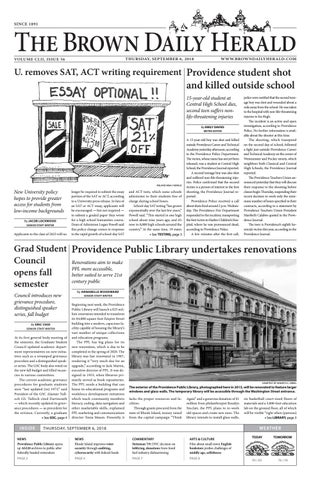
and killed outside school 15-year-old student at Central High School dies, second teen suffers nonlife-threatening injuries By EMILY DAVIES METRO EDITOR
ROLAND HIGH / HERALD
New University policy hopes to provide greater access for students from low-income backgrounds By JACOB LOCKWOOD SENIOR STAFF WRITER
Applicants to the class of 2023 will no
longer be required to submit the essay portion of the SAT or ACT, according to a University press release. In lieu of an SAT or ACT essay, applicants will be encouraged — but not required — to submit a graded paper they wrote for a high school humanities course. Dean of Admission Logan Powell said this policy change comes in response to the rapid growth of school-day SAT
and ACT tests, which some schools administer to their students free of charge during school hours. School-day SAT testing “has grown exponentially over the last few years,” Powell said. “This started in one high school about nine years ago, and it’s now in 8,000 high schools around the country.” At the same time, 19 states » See TESTING, page 3
A 15-year-old boy was shot and killed outside Providence Career and Technical Academy yesterday afternoon, according to the Providence Police Department. The victim, whose name has not yet been released, was a student at Central High School, the Providence Journal reported. A second teenage boy was also shot and suffered non-life-threatening injuries. Police confirmed that the second victim is a person of interest in the first shooting, the Providence Journal reported. Providence Police received a call about shots fired around 2 p.m. Wednesday. The Providence Fire Department responded to the incident, transporting the first victim to Hasbro Children’s Hospital, where he was pronounced dead, according to Providence Police. A few minutes after the first call,
police were notified that the second teenage boy was shot and wounded about a mile away from the school. He was taken to the hospital with non-life-threatening injuries to his thigh. The incident is an active and open investigation, according to Providence Police. No further information is available about the shooter at this time. The shooting, which transpired on the second day of school, followed a fight just outside Providence Career and Technical Academy on the corner of Westminster and Fricker streets, which neighbors both Classical and Central High Schools, the Providence Journal reported. The Providence Teachers Union announced yesterday that they will discuss their response to the shooting before classes begin Thursday, suspending their recent decision to work only the minimum number of hours specified in their contracts, according to a statement by Providence Teachers Union President Maribeth Calabro quoted in the Providence Journal. The teen is Providence’s eighth homicide victim this year, according to the Providence Journal.
Grad Student Providence Public Library undertakes renovations Council Renovations aim to make PPL more accessible, opens fall better suited to serve 21st century public semester Council introduces new grievance procedure, distinguished speaker series, fall budget By ERIC CHOI SENIOR STAFF WRITER
At its first general body meeting of the semester, the Graduate Student Council updated academic department representatives on new initiatives such as a revamped grievance procedure and a distinguished speaker series. The GSC body also voted on the new fall budget and filled vacancies in various committees. The current academic grievance procedures for graduate students were “last updated (in) 1973,” said President of the GSC Alastair Tulloch GS. Tulloch cited Dartmouth — which recently updated its grievance procedures — as precedent for the revision. Currently, a graduate » See GSC, page 4
INSIDE
By ANNABELLE WOODWARD SENIOR STAFF WRITER
Beginning next week, the Providence Public Library will launch a $25 million renovation intended to transform its 84,000 square foot Empire Street building into a modern, capacious facility capable of housing the library’s vast number of unique collections and education programs. The PPL has big plans for its new renovation, which is due to be completed in the spring of 2020. The library was last renovated in 1987, rendering it “very much due for an upgrade,” according to Jack Martin, executive director of PPL. It was designed in 1953, when libraries primarily served as book repositories. The PPL needs a building that can house its educational programs and workforce development initiatives which teach community members literacy, coding, data navigation and other marketable skills, explained PPL marketing and communications director Tonia Mason. Presently, it
COURTESY OF KENNETH C. ZIRKEL
The exterior of the Providence Public Library, photographed here in 2015, will be renovated to feature larger windows and glass walls. The temporary library will be accessible through the Washington Street entrance. lacks the proper resources and facilities. Through grants procured from the state of Rhode Island, money raised from the capital campaign “Think
Again” and a generous donation of $1 million from philanthropist Rosalyn Sinclair, the PPL plans to re-work old spaces and create new ones. The library intends to install glass walls,
six basketball court-sized floors of materials and a 3,000-foot education lab on the ground floor, all of which will be visible “right when (patrons) » See LIBRARY, page 3
WEATHER
THURSDAY, SEPTEMBER 6, 2018
NEWS Providence Public Library opens up AS220 archives to public after federally funded restoration
NEWS Rhode Island improves voter security through auditing, cybersecurity with federal funds
COMMENTARY Steinman ’19: DNC decision on lobbying, donations from fossil fuel industry disheartening
ARTS & CULTURE Film about small-town English bookstore probes challenges of middle age, selfishness
PAGE 2
PAGE 4
PAGE 7
PAGE 8
TODAY
TOMORROW
93 / 65
76 / 59
NEWS
PAGE 2 • THURSDAY, SEPTEMBER 6, 2018
THE BROWN DAILY HERALD
AS220 archives made public Providence Public Library opens archives of arts organization following two-year restoration
U. creates position to aid international students
By ELISE RYAN SENIOR STAFF WRITER
This summer, the Providence Public Library opened the archives of AS220, a Providence-based community arts non-profit, to the public. This release concludes a two-year effort by the library and AS220 to house and preserve the organization’s archives. According to the press release, the archives include over 110 linear feet of records and 700 gigabytes of digital files that represent the organization’s lifespan. AS220, founded in 1985, works “to provide an unjuried and uncensored forum for any Rhode Island artist working in just about any medium imaginable,” said David Dvorchak, communications director for AS220. The organization provides gallery spaces and performance venues that are open to all artists producing original work, he said. AS220 owns three buildings in downtown Providence, which accommodate the gallery spaces as well as private housing for artists and a restaurant. The nonprofit also offers a youth program geared toward young adults ages 14 to 21 in the custody or care of the state of Rhode Island, Dvorchak explained. Put simply, “it is a multifaceted organization that tries to provide support for artists in Rhode Island,” he added. Following previous requests for the use of AS220’s materials, an archival effort began about two years ago, said Kate Wells, curator of the Rhode Island Collections at Providence Public Library. AS220 sought a “permanent home for their archives,” which they found across the street at the PPL. “We’ve been trying to build collections … since the library’s beginning, and this collection fits in with a lot of what we have,” said Jordon Goffin, head curator of collections at the library. This is a new type of collection for the PPL, as the library has not housed many large archival collections in the past, he added. The library acquired a federal grant from the National Historical
COURTESY OF NADYA PEEK
The archives were prepared over a two-year period by Janaya Kizzie. Federal grants helped to pay for the project. Preservation and Records Commission a way that very few other organizations to hire a project archivist, Janaya Kizzie. could,” Kizzie said. Kizzie has worked with the collection One popular element of the colfor over a year to both determine the lection is the posters, document“high-level philosophical” organiza- ing events spanning the 33 years of tion of the collection — as it must be AS220’s existence. This collection not usable by potential researchers — and only chronicles the “great artists who work out the smaller details, such as have been in Providence and are in removing paper clips and rusted staples. Providence right now,” Kizzie said, but “You can’t have a collection that is a also recalls the designs that at once, complete mess in an intellectual sense, “seem so ubiquitous, but then all of and you also can’t have a collection sudden, they’re gone.” The archive also that’s covered in things that are slowly includes episodes of AS220’s cable acdestroying it,” she said. Otherwise, “you cess show, TV220, which ran for 15 won’t have a collection at all.” years and showcased the breadth of The archives are meant to appeal AS220’s work in that period, Wells said. to people with varying goals, just as The growth of AS220, as illustrated AS220 supports individuals in “creating by the collection, coincides with the art, … viewing art or appreciating art,” revitalization of downtown Providence. Dvorchak said. “When we were first founded back in Wells said that people are already 1985, Providence was not the most welutilizing the collection for “a lot of cre- coming or supportive place for artists,” ative works that would be serving as Dvorchak said, noting that people who an inspiration point for new artwork.” studied urban art often looked to bigThe archive is also being used by those ger cities — such as New York and Los “interested in the social justice aspect Angeles — for opportunities. AS220’s of AS220,” she added. This includes efforts to make creating and viewing organizations hoping to provide access art accessible allowed them “to open up to underserved communities’ perspec- those opportunities for the community tives, she said. here in Rhode Island,” Dvorchak added. “AS220 is more than an arts orga- AS220’s history is a “core component of nization — they built a community what makes Providence a really creative from the ground up and they did it in city,” Wells said.
STAY UP-TO-DATE. FOLLOW US ON FACEBOOK. FACEBOOK.COM/BROWNDAILYHERALD
COURTESY OF BROWN UNIVERSITY
Divya Mehta ’18 will use her own experience as an international student to offer guidance to peers in the job search process.
Mehta ’18 to plan international career fair, encourage collaboration between resource groups By TRISHA THACKER SENIOR STAFF WRITER
The University hired Divya Mehta ’18 in July 2018 to serve as its first ever International Student Career Coordinator in the Office of Global Engagement. Mehta, who will hold the position for one year, will assist international students in the job search process. “Given her own experiences as an international student at Brown, Divya brings an informed and empathetic perspective to this position,” wrote Asabe Poloma, assistant dean for international students, in an email to The Herald. Poloma, who will supervise Mehta, also added that the position “fills a long-time need for inclusive career and professional development support for international undergraduate students.” In order to help international students, Mehta said she is working to promote collaboration between different resources on campus. “I’m trying to create collaborative events between CareerLab, OISSS, Dean of the College and Global Engagement to offer information, so that a student doesn’t have to run from office to office to get an answer,” she said. Mehta will also plan this year’s Global Brown Center’s Career Con, formerly called the ISE Career Con. The event brings together international students, faculty and alums to discuss challenges and opportunities available in the job search process, as The Herald previously reported. As a former international undergraduate student, Mehta said she understood the complexities of the job application process. “I have discovered that there are some deficiencies in terms of assisting international
students in a more collaborative process with the … job search in the (United States.)” Chantal Marauta ’19, an international student interested in pursuing marketing and advertising, said she believes that the University could further help international students by facilitating “the channels of connection between students and companies.” “There’s been a dearth of resources on campus, and as a senior I feel like I’ve missed out on a lot of opportunities based on not knowing avenues available on campus,” wrote Maheen Syed ’19, another international undergraduate student, in an email to The Herald. “Having an international student who went to Brown and has a job in the (United States) in itself is so inspiring and I feel very comfortable approaching someone who’s lived through the experience in all senses of the word.” Mehta intends to aid international students interested in pursuing graduate education by creating an informational series on the application processes for graduate, medical and law school. She has already created a Canvas page called “International@Brown” that includes an events calendar and a discussion forum. The page is accessible to all undergraduate international students on campus. “We are hoping somewhere down the line we could create a mentoring initiative with (alums),” she added. While Mehta’s position was created to focus primarily on undergraduate international students, Mehta said she faces a challenge when asked to provide assistance to international graduate students. “There is also demand for this particular capacity on the graduate level,” she said. “I am getting a lot of requests from graduate students to have conversations with them.” Mehta said her position was created “out of student advocacy and student need.” “I did not apply for the position, I created the position,” she added.
NEWS
THURSDAY, SEPTEMBER 6, 2018 • PAGE 3
THE BROWN DAILY HERALD
» TESTING, from page 1 currently fund school-day ACT testing, according to Powell. But since providing the optional writing section costs more, around 30 percent of school-day SAT testing opportunities and about half of school-day ACT opportunities do not include the essay portion, Powell said. “That landscape changed so quickly that we had to respond to it,” he added. Previously, students who took school-day tests without the essay portion would not fulfill the old writing requirement. These students would need to pay to take the SAT or ACT with the essay portion on a Saturday, Powell explained. This would cost $64.50 for the SAT with writing or $67.00 for the ACT with writing this year. Although some low-income students qualify for fee waivers to cover these costs, students with other obligations — such as work, sports or
» LIBRARY, from page 1 walk in,” Martin said. The library will also see the additions of a children’s room, a teen space and new study areas for college students, as well as a museum-quality exhibition space and a “Special Collections Suite” for researchers and the general public. The renovations will encompass increased accessibility measures, which will serve to “adapt the (library) to the needs of 21st-century patrons,” according to an article published in the Providence Journal about the renovations. “(The library) will no longer be
family responsibilities — may have trouble taking an exam on a Saturday, Powell said. “This policy change made the most sense for all the students who might be thinking about applying to Brown,” Powell said. “We think it provides much greater access for students from low-income backgrounds (and) rural backgrounds.” Current first-year students who were required to submit the SAT or ACT writing portion agreed that this policy change will make applying to the University more financially accessible. “Removing that barrier to entry is probably better for the University’s goals” than keeping the writing requirement, said Adam Furman ’22, who took a school-day SAT with essay. “If I was considering Brown and none of the other schools I was looking at required (the SAT or ACT essay portion), I might think twice before applying.” Grace Ouedraogo ’22, who did not
have access to a school-day testing opportunity, felt the writing requirement was unnecessary. “We already have the Common (Application) essay and the other Brown essays,” she said. “I think that’s enough.” Although students no longer need to submit SAT or ACT essays, “we still deeply value writing,” Powell said. In order to provide applicants “an opportunity to showcase their writing ability in a way that doesn’t cost them any money or any additional time,” the Admission Office will allow students to upload a graded paper — preferably with comments from an instructor — to their Brown applicant portal, Powell explained. Nathaniel Hardy ’22 said he thought a graded paper from high school would more closely resemble college-level writing than the SAT essay or other application portions. “The Common App essay is basically a creative writing assignment,” he said.
“An actual argumentative piece written for school is a lot better than the SAT.” The University announced its decision to make the SAT or ACT essay optional soon after other universities — including Harvard and Yale — dropped their writing requirements. Powell said the University’s decision was not influenced by policy changes at other schools.“We were really responding to what we were seeing in the national landscape for secondary schools, seeing the growth in school-day testing around the country,” he said. The University’s writing requirement has changed three times since the SAT essay first became an optional portion of the test in March 2016. The SAT or ACT writing section was made optional for the class of 2021 but required for the class of 2022, The Herald previously reported. Powell explained that last year’s switch to requiring the SAT or ACT writing portion was part
of a move to eliminate a more inconvenient and costly testing policy — the requirement that students submit either the ACT or the SAT with two SAT subject tests. This meant that students in areas where only the SAT is offered had to sit for at least two test administrations while students with access to the ACT only needed to take one test. “That policy seemed unfair structurally,” Powell said. Now that both SAT subject tests and the SAT or ACT essay have been made optional for applicants to the class of 2023, “we think this is the right balance based on the national landscape of testing policy,” Powell said. But he added that the testing policy — and the application as a whole — is reevaluated every year. “We shouldn’t be locked into a particular testing policy if it doesn’t make sense for our applicants,” Powell said. “We change that policy as necessary to be fair and to provide access.”
an imposing gray monster on Empire Street,” Martin said. “Its limestone will be gleaming.” According to Martin, the library serves around 160,000 patrons annually from all over the state of Rhode Island. It houses the Statewide Reference Resource Center — an electronic resource database that every person in Rhode Island has access to with a library card. It has collections on a vast number of topics, from whaling to the Civil War to the history of typography, and it recently acquired the AS220 collection, focused on the history of AS220 as a Providence-based
arts organization, which is “very funky and cool” according to Martin. The library is perhaps most proud of its 90-year catalog of the Providence Journal, which spans from 1900 to 1990 and is searchable by subject. Last week, PPL hosted an online auction of the furnishings from the old building, which raked in just over $14,000 — all of which will go toward the renovation. Among the items auctioned off were mini chandeliers, magazine stands and a whole room of oscillating fans. “Sure, one oscillating fan isn’t very cool,” said Martin. “But a room of
them is very neat.” According to Mason, the most popular items were the old card catalogs, which each fetched a few hundred dollars. “Rhode Islanders have a real nostalgia for the PPL,” Martin said. “We have stories of people whose parents proposed here. People want to own a piece of the history.” While the renovations are underway, the library will be temporarily relocated to a smaller space termed the Rhode Island Room, which is accessible through the library’s Washington Street entrance. There
will be computers, workspaces and a boutique selection of books specially curated by the library’s staff. “We’re going to have an awesome place at the heart of the city that will have all the facilities and capabilities to provide the types of services that we’ve been providing,” Mason said. “We’ll be able to have more of them, and more opportunities for people to come in and access our collections.” “I can’t wait to stand at the bottom of the Grand Staircase and welcome everybody,” Martin said.
New Courses in Religious Studies Fall 2018 RELS 0415: Ancient Christian Culture Prof. Dora Ivanisevic T/Th 9-10:20a.m.
RELS 1610: Sacred Sites: Law, Politics,Religion Prof. Nathaniel Berman, Th 4-6:30p.m.
RELS 1650: Gospel Music from the Church to the Streets Prof. Charrise Barron, T/Th 2:30-3:50p.m.
LITERARY ARTS COURSES, FALL 2018 For First Year Seminars: LITR 0100 workshops (Introduction to Fiction, Introduction to Poetry) and LITR 0710 seminars: spaces were filled by the Dean of the Collegeʼs office. No wait lists are created before the first class meeting; attend the first class to see if space has become available. These courses are open to First Year undergraduate students only. For LITR 0110 workshops (Fiction I, Poetry I, Digital Language Arts I, Screenwriting I) and LITR 1110N*: spaces were filled during the registration period. No wait lists are created before the first class meeting; attend the first class to see if space has become available. For LITR 0210 (Fiction II, Poetry II), LITR 1010 (Advanced Fiction, Advanced Poetry, Advanced Digital Language Arts, Advanced Screenwriting, Writing 3D) & LITR 0310* (Special Topics) workshops: writing samples are due in the front hallway of the Literary Arts Building, 68.5 Brown Street, between 10 am and 4 pm on Wednesday, 5 September. Most sections may accept samples through early afternoon, Friday, 7 September. For LITR 1110S* and 1150/1151* workshop/seminars: attend the first class session; bring a writing sample with you. For LITR 1200 and 1230/1231* literature courses: register through Banner during the registration period; and/or attend the first class.
For more information or to see a full course List, visit our website: www.brown.edu/academics/religious-studies
LITR 0310K – The Web Narrative ~ LITR 1110N – Potential Literature ~ LITR 1101S – Fiction Into Film ~ LITR 1150A – Ecopoetics in Practice ~ LITR 1150M – Short Fiction Experiments ~ LITR 1151X – Interdiciplinary Arts: Translation as Concept ~ LITR 1151Y – Against Genre ~ LITR 1151Z – Paysagisme: Art and Ecological Responsibility (1/2 credit course) ~ LITR 1200 – Writers on Writing ~ LITR 1231I – Sacred and Profane: Dante, Milton, Rushdie
For details, see https://www.brown.edu/cw or visit “courses at brown”
NEWS
PAGE 4 • THURSDAY, SEPTEMBER 6, 2018
THE BROWN DAILY HERALD
Rhode Island targets election security 2018 federal bill appropriates $3 million to Rhode Island, $380 million given nationwide By COLLEEN CRONIN SENIOR STAFF WRITER
MARIANNA MCMURDOCK / HERALD
The GSC also voted to approve a slightly larger budget for this fall compared to last fall at the Graduate Student Lounge on Wednesday.
» GSC, from page 1 student “must attempt to resolve the issue directly with the person or persons involved” before the student can file a grievance, according to the Graduate School’s website. A working group of deans and graduate students came up with a new proposal over the summer to bring the grievance procedures up to speed, Tulloch said. The Graduate School will then bring the changes to the General Counsel and “hopefully” a draft will be available by October for the GSC to review, Tulloch added. The GSC also introduced a new speaker series exclusively for graduate students. Chair of Student Life Jack Krantz GS introduced the initiative, stating that the series was created because undergraduates always “forget to invite us.” Krantz promised to bring well-known speakers who would be oriented to a “general audience.” The first speaker will be decided in a “month or two,” Krantz added. Having already organized a forum on unionization, the GSC will continue its “information-gathering” process by hosting a town hall for graduate students to discuss unionization,
Tulloch said. The GSC plans to hold the town hall Tuesday at 4 p.m. The GSC also voted to approve a slightly larger budget for this fall compared to last fall. Last fall’s budget amounted to $74,355, while this year’s budget increased by 2 percent to $75,855. Treasurer Kara Lau GS presented the new budget, adding that conference funding increased by $1,000. After graduate students asked for explanations about changes in the line items, they overwhelmingly voted to approve the budget. Funding for the GSC’s budget comes from fees paid by graduate students each semester amounting to around $60 per person, Tulloch said. The majority of the GSC’s time was spent soliciting volunteers to sit in on its various committees. These included the nomination, social and student life, finance and Master’s advocacy committees. With a maximum of eight members for each committee, the GSC found enough graduate students to fill its vacancies. Committee members may sit on their respective committee until they graduate or resign at the end of the academic year.
Rhode Island has received $3 million of the $380 million doled out by the federal government in April 2018 to improve election security. The state will dedicate the majority of its funding to improving the voter registration database, cybersecurity and auditing practices, according to the Help America Vote Act 2018 Funding Recommendations. Rhode Island voters will cast their ballots in primary elections Sept. 12. HAVA originated two years after the disputed 2000 presidential election, and is resurfacing with additional funds following evidence of Russian interference in the 2016 presidential election. A 2018 bill appropriated hundreds of millions of dollars to the HAVA 2018 Election Security Fund — the first appropriation since 2010, according to the U.S. Election Assistance Commission’s website. President Trump signed the appropriations bill, titled the Consolidated Appropriations Act of 2018. More than half of Rhode Island’s $3 million election security budget will go toward upgrading the Central Voter Registration System, according to the HAVA 2018 Funding Recommendations, compiled by R.I. Secretary of State Nellie Gorbea. The R.I. Department of State looks to include experts from the
University and Salve Regina University to increase the strength of the CVRS, according to the 2018 Election Cybersecurity report. Substantial funding has also been allotted to improve cybersecurity and data recovery as well as to implement risk-limiting audits. Risk-limiting audits are the “gold standard” when it comes to election auditing, according to Liz Howard, counsel for the Brennan Center for Justice at the New York University School of Law. Howard, who previously worked as deputy commissioner for the Virginia Department of Elections, focuses her work on cybersecurity and elections. The audits use statistical analysis to determine if any intentional or unintentional factors have affected the outcome of an election, Howard said. While a regular audit looks only at an individual voting block or precinct, the new audit system will review the entire jurisdiction. The new system may allow state officials to review fewer ballots than under a traditional audit by mandating that officials scan the entire state instead of closely focusing on individual precincts, Howard said. During closer races, however, more ballots will be reviewed. A 2017 bill passed by the state Legislature mandates that the risk-limiting audits be used for the 2020 presidential primary and general elections. Sen. Sheldon Whitehouse, D-R.I., is focused on the importance of election security as he campaigns for his re-election in September. “President Trump’s most senior intelligence officials report that Russia is
targeting our midterm elections right now. That comes on top of troubling reports from state and local officials, tech companies and nonpartisan experts about sophisticated Russian campaigns to influence our elections,” Whitehouse wrote in a statement to The Herald, adding that he and Sen. Jack Reed, D-R.I., are working hard to “bolster our defenses by increasing funding for state election security.” While elections in five states depend entirely on electronic machines, Rhode Island is sticking with paper, according to Deputy Director of Elections Miguel Nunez. Paper voting is one of the most important mechanisms to ensure election security, Howard said, citing a 2017 DEFCON 25 Voting Machine Hacking Village report that showed paperless machines were vulnerable to hacking. “Every piece of equipment in the Voting Village was effectively breached in some manner,” the report read, adding that even “participants with little prior knowledge and only limited tools and resources were quite capable of undermining the confidentiality, integrity and availability of these systems.” Still, paper machines are also vulnerable. “No machine is unhackable,” Howard said, adding that the audit is necessary to check for interference. While Rhode Island remains loyal to paper voting, the state is changing up check-in protocol. The biggest change voters will see on election day is an electronic poll book, which will allow voters to sign their names before voting on an iPad, Nunez said.
MARLIS FLINN / HERALD
MEAL PLAN
changes
STEP ONE:
Choose a Meal Plan.
REMINDER:
T DAY THE LASEA L PLAN
TO MAKE M EDNESDAY, CHANGES IS W
SEPT. 2 !
VIEW OPTIONS AT BROWN.EDU/FOOD
• You can ADD a new Meal Plan at any time during the year • You can make one CHANGE per semester. Fall deadline is 9/2 • Meal Plan CANCELLATIONS for the whole year are due by 9/2
STEP TWO:
Let us assist you!
EMAIL DINING_SERVICES@BROWN.EDU OR CALL 863-3343 WITH QUESTIONS
• Changes can only be made in person weekdays from 9:00AM to 4:00PM at the Brown Dining office located at 144 Thayer Street (Sharpe Refectory).
brown.edu/food
TODAY
THURSDAY, SEPTEMBER 6, 2018 • PAGE 5
THE BROWN DAILY HERALD
menu
pumped for shopping period
SATELLITE DINING ANDREWS COMMONS
Pizza: Barbecue Bam Bam, Chicken Parmesan Make Your Own Pasta, Make Your Own Salad, Sorbet Station JOSIAH’S
BLUE ROOM
Dumpling Bar, Rodeo Burger, Quesadilla Station
Chicken Tikka Masala, Madras Vegetable Curry
DINING HALLS SHARPE REFECTORY LUNCH
DINNER
Manhattan Clam Chowder, Coconut Red Curry Beef Stir Fry, Ranger Joe Cookies
Rotisserie Style Chicken, Baked Sweet Potatoes, Miso Fish Of The Day, Steamed Green Beans
VERNEY-WOOLLEY LUNCH
DINNER
Shaved Steak Sandwich, Seasoned Curly Fries, Italian Sausage Soup With Tortellini
Roast Turkey with Gravy, Shells With Broccoli, Homemade Bread Stuffing, Mashed Potatoes
sudoku
ANITA SHEIH / HERALD
The shining silver people of Tom Friedman’s “Circle Dance” seem to jump with joy when students arrived back on campus this week to start classes and enjoy the remnants of summer weather.
Q U O T E O F T H E D AY
“Sure, one oscillating fan isn’t very cool, but a room of them is very neat.” — Jack Martin, executive director of the Providence Public Library
See library on page 1. crossword
calendar TODAY SEPTEMBER NOVEMBER MARCH
S
2 5 9 12 16 19 23 26 30
M
3 6 10 13 17 20 24 27
T
W
Th
F
4 7 11 14 18 21 25 28
1 5 8 12 15 19 22 26 29
2 6 9 13 16 20 23 27 30
3 7 10 14 17 21 24 28 31
S 1 4 8 11 15 18 22 25 29
Workshop: How to Make the Most of Shopping Period 12:00 P.M. J. Walter Wilson, 203
Swearer Center Engagement Fair 12:00 P.M. Sayles Hall
Fall Orientation Activities Fair 5:00 P.M. OMAC
Chipotle Block Party 6:30 P.M. 168 Lloyd Ave.
TOMORROW Food on the Move Fruit and Vegetable Market 12:00 P.M. 121 S. Main St., 241
First Year Friday at the Curricular Resource Center 2:00 P.M. Campus Center, 228
Entrepreneurship Picnic 3:00 P.M. Main Green
U-FLi Student Welcome/ FLi Center Open House 5:30 P.M. Sciences Library, Floor 5
COMMENTARY PAGE 6 • THURSDAY, SEPTEMBER 6, 2018
THE BROWN DAILY HERALD
Find us online! facebook.com/browndailyherald
browndailyherald.com
@the_herald
Location: 195 Angell St., Providence, R.I. www.browndailyherald.com
@browndailyherald
youtube.com/browndailyherald
Editorial Leadership
Sections
Multimedia & Production
Business
Editors-in-Chief Elena Renken Kasturi Pananjady
Arts & Culture Editors Connor Sullivan Ethel Renia
General Managers Michael Borrello Matilda Lynton
Managing Editor Alex Skidmore
Metro Editors Emily Davies Isabel Gensler
Design Editors Kyle Cui Eduard Muñoz-Suñé Assistants: Julie Wang, Kelvin Yang
Senior Editors Julianne Center Madison Rivlin Hattie Xu Editorial Page Editor Anuj Krishnamurthy POST- MAGAZINE Editor Jennifer Osborne
News Editors Eduard Muñoz-Suñé Priyanka Podugu Sarah Wang Science & Research Editors Jonathan Douglas Jackson Wells Sports Editors Alexandra Russell James Schapiro COMMENTARY Opinions Editors Connor Cardoso Anuj Krishnamurthy Clare Steinman Emily Miller
Photo Editors Sam Berube Anita Sheih Copy Desk Chief Kelley Tackett Illustrations Editor Daphne Zhao Video Editor Celia Hack Graphics Editors Marlis Flinn Sarah Martinez
Office Manager Diane Silvia Directors Sales: Shreya Raghunandan Finance: Ravi Betzig Strategy: Edwin Farley, Caroline Ziegler
Editorial contact: 401-351-3372 herald@browndailyherald.com
Advertising contact: 401-351-3372 advertising@browndailyherald.com
Submissions: The Brown Daily Herald publishes submissions in the form of op-eds and letters to the editor. Op-eds are typically between 750 and 1000 words, though we will consider submissions between 500 and 1200 words. Letters to the editor should be around 250 words. While letters to the editor respond to an article or column that has appeared in The Herald, op-eds usually prompt new discussions on campus or frame new arguments about current discourse. All submissions to The Herald cannot have been previously published elsewhere (in print or online — including personal blogs and social media), and they must be exclusive to The Herald. Submissions must include no more than two individual authors. If there are more than two original authors, The Herald can acknowledge the authors in a statement at the end of the letter or op-ed, but the byline can only include up to two names. The Herald will not publish submissions authored by groups. The Herald does not publish anonymous submissions. If you feel your circumstances prevent you from submitting an op-ed or letter with your name, please email herald@browndailyherald.com to explain your situation. You can submit op-eds to opinions@browndailyherald.com and letters to letters@browndailyherald.com. When you email your submission, please include (1) your full name, (2) an evening or mobile phone number in case your submission is chosen for publication and (3) any affiliation with Brown University or any institution or organization relevant to the content of your submission. Please send in submissions at least 24 hours in advance of your desired publication date. The Herald only publishes submissions while it is in print. The Herald reserves the right to edit all submissions. If your piece is considered for publication, an editor will contact you to discuss potential changes to your submission. Commentary: The editorial is the majority opinion of the editorial page board of The Brown Daily Herald. The editorial viewpoint does not necessarily reflect the views of The Brown Daily Herald, Inc. Columns, letters and comics reflect the opinions of their authors only. Corrections: The Brown Daily Herald is committed to providing the Brown University community with the most accurate information possible. Corrections may be submitted up to seven calendar days after publication. Advertising: The Brown Daily Herald, Inc. reserves the right to accept or decline any advertisement at its discretion. The Brown Daily Herald, Inc. is a financially independent, nonprofit media organization bringing you The Brown Daily Herald, BlogDailyHerald and Post- Magazine. The Brown Daily Herald has served the Brown University community daily since 1891. It is published Monday through Friday during the academic year, excluding vacations, once during Commencement and once during Orientation by The Brown Daily Herald, Inc. Single copy free for each member of the community. Subscription prices: $200 one year daily, $100 one semester daily. Copyright 2018 by The Brown Daily Herald, Inc. All rights reserved. Periodicals postage paid at Providence, R.I. Postmaster: Please send corrections to P.O. Box 2538, Providence, RI 02906.
THE BROWN DAILY HERALD
COMMENTARY THURSDAY, SEPTEMBER 6, 2018 • PAGE 7
Dirty money has no place in the DNC CLARE STEINMAN opinions editor
The Democratic National Committee took a critical step here in Providence this past June, passing a resolution that banned political contributions from the fossil fuel industry, namely oil, gas and coal companies and their associations. The need for such a resolution was meant to address the industry’s history of using political donations and lobbying to spread discord concerning the validity of climate science. With deliberate misinformation campaigns dating back to the 1970s, they were engaging in fake news before the term existed. It is therefore disheartening to see the DNC, led by Watson Senior Fellow Tom Perez ’83 P’18, walk that commitment back last month with a confusingly worded decision to allow contributions from fossil fuel industry workers and “employers’ political action committees.” While the resolution seemingly aims to allow the ordinary worker to contribute, its phrasing leaves the door wide open for top executives to pour money into the DNC through their own PACs, exactly the flood of dirty money that the June decision was passed to avoid. Every year, fossil fuel companies and their trade groups spend around $115 million to shut down efforts to reduce carbon emissions and combat climate change. For comparison, the gun lobby, which is notorious for using political spending to doom common sense initiatives with broad popular support, spent just $10 million in 2014. When future genera-
tions look back at our inaction during the decades when catastrophe could have been avoided, this spending will stand out as damning evidence of our guilt. And to be sure, it has been money well spent for the industry. Since former President Barack Obama’s election in 2008, Republican lawmakers have abandoned any attempt to cut emissions, following a concerted effort by fossil fuel titans like David and Charles Koch to compel them to block any regulations of the industry — or else face a primary
such as the Investment Tax Credit, which is set to expire for residential taxpayers in 2021. All told, the renewable energy industry receives $5.6 billion in temporary subsidies annually, which, according to detractors like Energy Secretary Rick Perry, “hav(e) a large impact on the functioning of markets, and thereby challeng(e) our power generation mix.” These freemarket conservatives feel much more at ease, however, when it comes to the $20.5 billion that oil, coal and gas industries receive each year at the fed-
ning scheme to pit the working class and climate activists against each other in a way that ultimately benefits fossil fuel executives at the expense of the planet. Given that the decision leaves a loophole for PACs, it is exceedingly likely that the bulk of donations stemming from the reversal of this ban will come not from ordinary workers, but from top leadership. Ultimately, the needs of labor are aligned with the goals of the climate movement. As Guy Ryder, directorgeneral of the UN’s International La-
It would be a mistake for a Democratic National Committee that is already struggling to maintain currency to find itself siding with an outdated and destructive industry.
challenge from someone who would. They elevated climate skeptics onto a level playing field with the 97 percent of scientists who agree that humancaused warming is occurring. In fact, they have been so successful in this effort that only 13 percent of conservative Republicans — and, distressingly, 27 percent of American adults — believe humans are the key cause of climate change. The close links between the fossil fuel industry and politics haven’t just been used to throw wrenches into climate science. The industry is reliant upon political favor for its very survival. The Trump administration and other conservatives love to malign the subsidies that renewable energy sources like solar and wind received under Obama and his predecessors,
eral and state level, $7.4 billion of which comes from permanent subsidies that have been around for decades — in some cases up to a century. While many of these subsidies originated before the link between fossil fuels and climate change was as robust as it is now, and while there are compelling reasons to ensure a stable national energy supply, it is clear that the fossil fuel industry is being propped up by much-needed government money, while a clean and safe alternative is within reach. Proponents of the DNC decision are framing the issue fundamentally as one of labor rights, an attempt to ensure that ordinary energy workers and their unions can participate in the democratic process. This is an unfortunate continuation of a long-run-
bour Organization, put it last month, “There are no jobs on a dead planet.” At the same time, transitioning away from an economy that runs on fossil fuels will create tens of thousands of new jobs in energy, infrastructure, agriculture and other industries in what is becoming known as the “Green New Deal.” Over a thousand Democrats currently running for federal, state and local office have made individual pledges not to accept any fossil fuel money. That’s an encouraging start and yet another indication that the party momentum heading into the November midterm elections is coming from the grassroots. It would be a mistake for a DNC that is already struggling to maintain currency to find itself siding with an outdated and
destructive industry. Quite frankly, a party committed to the well-being of future generations, to protecting vulnerable populations from the ravages of humaninduced disasters, to the triumph of truth over oil-slicked fiction must turn away money that is derived from the processes that threaten those aims most. It is no secret — despite what a decades-long misinformation campaign would have you believe — that burning fossil fuels and increasing the concentration of carbon dioxide in our atmosphere is changing the climate. The effects of these changes can already be seen, and yet they have the potential, without timely action, to go beyond what we can conceive. It is also no secret that the fossil fuel era has created great wealth along with technological advances for every citizen of industrialized nations. But though we have all shared the benefits, and therefore all bear the onus for averting the worst of the costs, no one has more to lose at this stage than the fossil fuel executives whose income streams are at risk. It would only be rational self-preservation for them to put their political donations to work to preserve their industries. In making it clear that these funds should have no place in our political process, the DNC must pursue its own rational self-preservation — for party and for planet.
Clare Steinman ’19 can be reached at clare_steinman@brown.edu. Please send responses to this opinion to letters@browndailyherald.com and op-eds to opinions@browndailyherald. com.
ARTS & CULTURE THE BROWN DAILY HERALD
THURSDAY, SEPTEMBER 6, 2018
‘The Bookshop,’ while heartfelt, struggles with pace Visually appealing film on small-town bookstore probes selfishness, sentimentality too slowly By GRAYSON LEE STAFF WRITER
“The Bookshop,” a film adaption of Penelope Fitzgerald’s original novel, echoes the leisurely pace of the book itself. The film’s plodding nature allows for a fully developed storyline, but struggles to retain the viewer’s attention through the duration of the movie. At times, the plot wanders and the film drags, and even borders on soporific; however, the crawling pace of the film is at times an asset, and gives prominence to the scenery and characters’ emotions. Near the conclusion, everything seems to speed up with a series of events that releases bottled-up emotions, giving weight to characters’ actions. “The Bookshop” is a movie about selfishness and to what degree each character will relinquish their selfish inclinations. It is not a film driven by plot, but by characters. The little that happens is largely inconsequential and often dull, but the relationships
developed between characters lend the film a touching sincerity. Set in eastern England in 1959, the film follows Florence Green, a lonely middle-aged widow looking to open a bookshop in the sleepy coastal town of Hardborough, England. As she establishes her store in the so-called Old House, a decaying stone building, she prompts the mannerly ire of the wealthy and influential Violet Gamart. Violet had planned to remake the Old House into an arts center, and much of the story is dictated by her aspirations, although she commands a surprisingly small amount of screen time. Although some in Hardborough dismiss or reject the idea of a bookshop, Florence finds a kindred spirit in Mr. Brundish, a reclusive old widower who has ostensibly lost faith in humanity and rarely leaves his mansion, and prefers to spend his time reading. After Florence’s business finds modest success, she is introduced to Vladimir Nabokov’s scandalous and recently published “Lolita.” Tension in the town builds as she orders 250 copies for the store, but as is the case with most of the film, the consequences fall flat, and serve mostly to illustrate the growing intimacy between Florence and Mr.
Brundish. Another of Florence’s supporters is the reluctantly sympathetic Christine, a young and opinionated girl working as an assistant in the shop. At their first meeting, Christine informs Florence that life passes slowly for women without children, a potentially sore point for the childless Florence. The subsequent growth of their relationship is one of the most heartfelt pieces of “The Bookshop.” Although the movie comes off as purposefully nostalgic and bookish, it is neither overly sentimental nor sickeningly sweet. Reality is expressed through awkward interactions and repressed emotions. The small village of Hardborough is steeped in the subdued grays and blues of the northern English coast, and the camera frequently pans over thistles or wildflowers blowing in the wind by the sea, adding to the movie’s bookish feel. Although the visuals are appealing, an abundance of silences is one of the greatest successes of the film. The majority of the action occurs in soft tones or without words altogether, though sometimes the background music becomes unnecessarily loud and overpowering and takes away from the potency of the silence.
PLEASE JOIN US NEXT WEEK, WE’VE HEARD YOU’RE GREAT COMPANY.
COURTESY OF JOELLA MARANO
Florence Green was played by Emily Mortimer, an actress and screenwriter known for her roles in “Shutter Island,” “The Newsroom” and “Cars 2.”
Bain & Company has a proud track record of helping the world’s great companies solve their toughest challenges. Many of these are brands you’ve heard of and use every day. Our formula for success is simple: We hire immensely talented people and give them everything they could possibly need to feel supported, be happy and great at what they do. And we’d love to meet you. AN INTRODUCTION TO BAIN & COMPANY All Juniors and Seniors are welcome to attend • Wednesday, September 12th • 8:00pm • MacMillan Room 117 Business casual attire recommended. If you’d like to apply for a position then please do so via bain.com/careers and the Career Development Center. Please include a cover letter, resume and unofficial transcript.
bain.com/careers