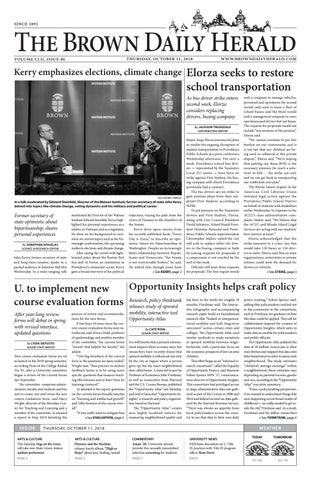
SINCE 1891
THE BROWN DAILY HERALD THURSDAY, OCTOBER 11, 2018
VOLUME CLII, ISSUE 80
WWW.BROWNDAILYHERALD.COM
Kerry emphasizes elections, climate change Elorza seeks to restore
school transportation As bus driver strike enters second week, Elorza considers replacing drivers, busing company By JACKSON TRUESDALE CONTRIBUTING WRITER
JACK JACOBY / HERALD
In a talk moderated by Edward Steinfeld, director of the Watson Institute, former secretary of state John Kerry delved into topics like climate change, voting dynamics and his military and political career.
Former secretary of state optimistic about bipartisanship, shares personal experiences By JONATHAN DOUGLAS SCIENCE & RESEARCH EDITOR
John Kerry, former secretary of state and long-time senator, spoke to a packed audience in Salomon Hall this Wednesday. In a wide-ranging talk
moderated by Director of the Watson Institute Edward Steinfeld, Kerry highlighted his personal experiences as a soldier in Vietnam and as a legislator. He drew on his background to comment on current topics such as the Kavanaugh confirmation, the upcoming midterm elections and climate change. After easing the crowd with lighthearted jokes about the Boston Red Sox and Al Forno, an institution in Providence’s restaurant scene, Kerry gave a broad overview of his political
trajectory, tracing his path from the rivers of Vietnam to the chambers of the Senate. Kerry drew upon stories from his recently published book, “Every Day is Extra,” to describe an optimistic future for bipartisanship in Washington. Despite an increasingly bitter relationship between Republicans and Democrats, “the Senate is not irretrievably broken,” he said. He added that though some have » See KERRY, page 2
Mayor Jorge Elorza announced plans to resolve the ongoing disruption of student transportation to Providence Public Schools at a press conference Wednesday afternoon. For over a week, Providence school bus drivers — represented by the Teamsters Local 251 union — have been on strike against First Student, the busing company with which Providence previously had a contract. The bus drivers are on strike to gain pension plans from their employer First Student, according to WPRI. To put pressure on the Teamsters drivers and First Student, Elorza, along with City Council President David Salvatore, School Board President Nicholas Hemond and Providence Public Schools Superintendent Christopher Maher, stated the city will seek to replace either the drivers or the busing company or both by issuing requests for proposals if a compromise is not reached by the end of the week. Officials will issue three requests for proposals. The first request would
seek a company to manage vehicles, personnel and operations; the second would only seek to lease a fleet of school buses; and the third would seek a management company to cover operations and drivers but not buses. The requests for proposals would not include “any mention of the pension,” Elorza said. “We cannot continue to put this burden on our community, and it is not fair that our children are being used as collateral in this private dispute,” Elorza said. “We’re hoping that putting out these RFPs is the necessary pressure (to reach a solution) so that … the strike can end, and we can get back to transporting our 9,000 kids everyday.” The Rhode Island chapter of the American Civil Liberties Union initiated legal action against the Providence Public School District on behalf of students with disabilities earlier Wednesday. In response to the ACLU’s class administrative complaint, Maher said, “We believe that the ACLU and Rhode Island Legal Services are acting with our students’ best interest at heart.” Elorza acknowledged that the strike amounts to a crisis, one that would take 150 buses or 150 drivers to solve. Elorza said that no state organizations, universities or private entities could meet the demand for drivers or vehicles. » See STRIKE, page 3
Opportunity Insights helps craft policy U. to implement new policy thinktank course evaluation forms Research, releases study of upward After year-long review, forms will debut in spring with revised interface, updated questions By LYDIA DEFUSTO SENIOR STAFF WRITER
New course evaluation forms are set to launch in the 2019 spring semester, according Dean of the College Rashid Zia ’01, after a University committee began a review of the current forms last September. The committee comprises administrators, faculty and students and has met to create, test and revise the new course evaluation form, said Mary Wright, director of the Sheridan Center for Teaching and Learning and a member of the committee. It released a report in May 2018 detailing the
INSIDE
process of review and recommendations for the new forms. It has been 10 years since the current course evaluation forms were introduced, said Alison Field, professor of epidemiology and another member of the committee. The current forms “weren’t that helpful for faculty,” she added. “One big drawback of the current form is, the questions are open-ended,” Wright said. “Best practice in student feedback forms is to be using more specific questions that measure teaching effectiveness and to have them be learning-centered.” As detailed in the report, questions on the current forms broadly touches on “learning and intellectual growth” and “effectiveness of the course overall.” “If you really want to mitigate bias » See EVALUATION, page 4
mobility, interactive tool Opportunity Atlas By CATE RYAN SENIOR STAFF WRITER
It is well known that a person’s environment impacts them in many ways, but researchers have recently found that upward mobility is influenced not only by the city or region where a person grew up, but the exact neighborhood they called home. A team led in part by Professor of Economics John Friedman, as well as researchers from Harvard and the U.S. Census Bureau, published the “Opportunity Atlas” last Monday, and with it launched “Opportunity Insights,” a research and policy organization based at Harvard. The “Opportunity Atlas” creates new, highly localized metrics for measuring neighborhood quality and
has been in the works for roughly 18 months, Friedman said. The interactive infographic and accompanying research paper build on foundational research that “looked at intergenerational mobility and kid’s long-term outcomes” across certain cities and colleges. The Opportunity Atlas used similar methods to study variations in upward mobility between neighborhoods, with a particular focus on the economic prospects of low-income children. This effort began as an “informal research consortium” called the Equality of Opportunity Project, said Shannon Felton Spence MPA ’17, communications director of Opportunity Insights. This consortium had privileged access to large administrative data sets gathered as part of the Census in 2000 and 2010 and federal income tax data gathered by the Internal Revenue Service. “There was always an appetite from local policymakers across the country to use that data in their own daily
policy making,” Felton Spence said, adding that policymakers reached out to the economists in the consortium, such as Friedman, for guidance on how this data could be applied. This call for collaboration inspired the creation of Opportunity Insights, which aims to make data accessible for policymakers and public officials. The Opportunity Atlas analyzed the data of 20 million Americans in their mid-thirties and mapped this data onto their hometowns in order to assess each neighborhood. The study estimates “children’s average earnings” within a neighborhood; these estimates vary depending on parental income, gender and race, according to the “Opportunity Atlas” executive summary. “From a policymaking perspective, if we wanted to understand things that were happening across broad swaths of childhood — we really needed to get inside the city,” Friedman said. As a result, Freidman and his fellow researchers » See THINKTANK, page 4
WEATHER
THURSDAY, OC TOBER 11, 2018
ARTS & CULTURE This Saturday Gigs on the Grass will take over Main Green, feature student performers
ARTS & CULTURE Florence and the Machine releases fourth album, “High as Hope” about love, healing, tumult
COMMENTARY Aman ’20: University should provide free sexually transmitted infection screening for students
UNIVERSITY NEWS UCS hosts discussion on U. Title IX practices with Title IX program officer Rene Davis
PAGE 2
PAGE 3
PAGE 7
BACK
TODAY
TOMORROW
73 / 60
63 / 45
NEWS
PAGE 2 • THURSDAY, OCTOBER 11, 2018
THE BROWN DAILY HERALD
Gigs on the Grass to take on Main Green Saturday Third edition of festival set to showcase diverse lineup of 14 acts including DJs, solo performers, bands By ELISE RYAN SENIOR STAFF WRITER
This Saturday, the Main Green will once again become music festival stomping grounds— this year’s edition of Gigs on the Grass will be taking place on the campus’ largest quad. The third annual day-long festival celebrates student performances from a wide range of musical styles, complemented by food trucks and art. Gigs on the Grass is presented by the Brown University Class Coordinating Board and the Brown Concert Agency. Organized by Melissa Lee ’20, community outreach officer of the 2020 CCB, and Marisa Kouroubacalis ’19.5, president of the 2019 CCB, Gigs on the Grass will present 14 student acts throughout the day, including solo acoustic performers, DJs and bands. Lee and Kouroubacalis hosted auditions for 60 individuals and groups for the event before selecting nine musical groups and five solo performers. Gigs on the Grass is the brainchild of Pia Struzzieri ’18, Kouroubacalis explained. When brainstorming events for CCB, Struzzieri’s housemate expressed frustration about the lack of on-campus events for student bands. “She kind of created the idea based on that, so she started the event two years ago and (she ran) it
entirely by herself ” until she graduated, Kouroubacalis said. Struzzieri graduated last May but continued to help with the production of Gigs on the Grass this year by offering her references, notes and guidance through FaceTime calls. “It’s set up to be at Brown forever because of all the amazing work that she did,” Kouroubacalis said. In the past, Gigs on the Grass engaged crowds on smaller fields, beginning on Pembroke Field in 2016 and moving to Wriston Quadrangle in 2017. It was originally structured as a battle-of-the-bands with two opposing stages facing each other, Kouroubacalis said. This year, the event is moving to its largest venue yet — the Green — with only one large stage, as Lee and Kouroubacalis decided to remove the battle aspect. “We didn’t want it to be like a competitive thing where someone walks away winning,” Kouroubacalis said, continuing, “we just wanted to showcase the talent.” “We didn’t have any (particular) musical theme in mind per se. We just wanted to create a cohesive lineup that showcases Brown’s musicians,” Lee said, emphasizing they considered what the student population would enjoy in making their selections. Bree Zhang ’22 will be performing solo on the guzheng, a twenty-onestringed Chinese harp. “Since I was young I’ve been trying to perform to spread the culture of the instrument so that more people can know about it and more people can appreciate
ALEJANDRO SUBIOTTO / HERALD
The first Gigs on the Grass took place in 2016 and was held on Pembroke Field. This year, the music festival will gather students on the Main Green for a day-long event which will also feature food trucks and art. the history that comes with (this) instrument,” she said. She will be performing three songs, including an original composition and a lyrical, traditional piece titled “Spring Comes to the Snowy Mountain.” “I think that it’s important for events to show off any sort of talent. It doesn’t have to be just music, …
Photograph by Maria Baranova
MA and PhD in Decorative Arts, Design History, Material Culture Students at Bard Graduate Center in New York City study the cultural history of the material world from the arts of
Address 38 West 86th Street New York City 1
Application Deadline January 4, 2019
For more information and to request a campus tour admissions@bgc.bard.edu bgc.bard.edu/admissions
but whatever kind of capabilities we have at Brown,” Zhang said, adding that the range of talent at the festival should reflect the diversity found at Brown. “It kind of brings us together,” Zhang said. Haley Barthel ’20, another individual performer, will be showcasing her soft pop sounds on Saturday.
“I’ve always liked singing and playing guitar, but … I kind of just do it for fun, and so it seemed like a cool opportunity to put myself out there and perform,” she said. Gigs on the Grass will “really (be) an event for the students from the students, … so we hope that everyone comes out and enjoys it,” Lee said.
» KERRY, from page 1
pointed out that despite the massive gains in efficiency that have been brought about by changes in recent decades, researchers have yet to come to an agreement on how many workers will be impacted by artificial intelligence and other such technology. On the connection between Vietnam and Afghanistan, Kerry felt strongly that there was little in common between the two. The war in Vietnam was “based upon a lie,” Kerry said, while the United States entered Afghanistan seeking to find those behind the 9/11 attacks. He added that unlike in Vietnam, prematurely pulling troops out of Afghanistan would lead to a collapse of the country’s political and economic systems. He emphasized that the United States should pull out of Afghanistan but only after a successful transition over to stable Afghani institutions. While wrapping up his commentary, Kerry stressed the importance of the midterm elections and the crucial role that students will play in it. “We need you. No student is exempt from the responsibility of citizenship,” he said. Kerry came across as surprisingly strong on climate change, said Chloe Khosrowshahi ’22, who attended the talk. However, she felt that Kerry heavily emphasized energy’s role in reducing carbon emissions but dismissed other important factors such as agriculture and overfishing. Micah Bruning ’22 was more critical of Kerry and said that his comments felt like “empty political rhetoric,” repeating many of the same stories that have been told by politicians for years.
criticized Senate rules for creating partisanship, the real responsibilty for gridlock and animosity between the parties lies with those currently in office. Kerry used this explanation as a call to action to drive people to the polls next month. Kerry also tried to explain the factors behind Donald Trump’s presidency and the current political climate. “American voters are pissed off,” he said. He cited broken communities, the bad economy and differences between the coasts and heartland of the country as drivers of polarization. In turn, voters were pulled to divergent ends of the political spectrum and voted for Bernie Sanders and Donald Trump, he said. Considerable speaking time was also devoted to a passionate discussion of climate change. Kerry said this issue is one of the most important global needs and emphasized recent extreme weather events as only the beginning of a potentially grim future. He pushed the economic market as one of the potential solutions. The solution to climate change is “the mother of all markets,” Kerry said, pointing out huge growth in wind and solar energy revenues. He criticized President Trump’s climate record and scorned his decision to remove the United States from the Paris Accords, which Kerry helped negotiate. Kerry addressed a number of questions from the audience, which ranged from the impact of automation on the workforce to the connection between the wars in Vietnam and Afghanistan. When discussing automation, he
NEWS
THURSDAY, OCTOBER 11, 2018 • PAGE 3
THE BROWN DAILY HERALD
Florence and the Machine’s new album gives raw account of healing With poignant lyrics, Florence Welch touches on intricacies of love, tumult, intimacy, spirituality By DIVYA MANIAR SENIOR STAFF WRITER
Florence and the Machine’s “High as Hope” is an invitation to come closer. This latest album is intimate, raw and unapologetically human. Florence Welch stays true to herself and her previous work: Her haunting voice, dramatic instrumentals and spiritual motifs are reminiscent of past albums. At the same time, her newest work is both stripped down and eruptive. As part of the album tour, Florence and the Machine will be performing in Boston this Friday, Oct. 12. The album opens with “June,” which features a slow vocal and instrumental buildup. Lyrically, it is a deliberately repetitive opening track. The chorus can be read as an imperative, as it contains only the repeated line: “Hold on to each other.” This is summative of the album, which forms a lyrical journey of healing as listeners are invited to come along.
But just as life has its ups and downs, love and healing are not without their own tensions and uncertainties. The song ends with a low, as she chants, “I’m so high, I’m so high / I can see an angel.” Welch, now two years sober, alludes both to the “high” of love and to her own issues with substance abuse. “Hunger” sounds more upbeat; Welch sings of the ways in which she has tried to satiate an insatiable hunger. She speaks frankly of her overuse of drugs and performance to reach fulfillment. Not everyone suffers from the same issues of excess of which Welch sings. But her lyrics bring to the surface a hunger, a longing, that we can all relate to: “We never found the answer / But we knew one thing / We all have a hunger.” The emotional zenith of Welch’s troubles and musical output might be “Sky Full of Song,” a traumatic and ballad-like acknowledgment of how difficult it is to achieve catharsis and growth. “I thought I was flying / But maybe I’m dying tonight,” she sings. The album transitions into a muchneeded sense of redemption in its second half, however. “Grace” is at once an apology and an ode to the importance of familial relations. The song is addressed to Grace, Welch’s
sister, and its lyrics carry poignant double meanings. “Grace, I don’t say it enough,” can be both an apology to a sister named Grace, and a statement about our lack of gratitude and not saying our graces. She sings of her faith in her sister’s love and of her desire for redemption: “This is the only thing I’ve ever had any faith in / Tell me what I can do, I will make it up to you.” In the album’s entire musical landscape, seemingly incongruent strands of pain and loss come together to lyrically display the complexity of human life. It draws us to what we must wash away, and the kind of love that must end for open and honest love to begin. Welch concludes the album on a melancholic and deeply hopeful note, as she sings, “Things seem so unstable / But for a moment we were able to be still.” Though musically simpler than previous albums, “High as Hope” conveys emotional depth in its lyrics. Welch touches upon love, loss and redemption in this intimate look at her own life and relationships. Healing is difficult, and there are always lows — but the repeated lyrical motif in “Patricia” seems to hold true: “It’s such a wonderful thing to love.”
COURTESY OF JASON PERSSE
Florence and the Machine will be going on tour with their fourth album, “High as Hope.” They will be performing in Boston this Friday, Oct. 12.
» STRIKE, from page 1 If the parties do not reach a resolution, an RFP for a new busing arrangement could take months to fulfill. Both First Student and the Teamsters Local 251 drivers could lose the Providence Public School District as a client. “Potentially everybody loses,” Elorza said. “We need to find a vendor that can render the services that the kids need,” Hemond said. Providence officials have begun conversations with other districts in New England to prevent similar situations from occurring. “I’ve heard the grumblings that ‘It’s Providence this day,’ but this is a dispute that might be played out in maybe other cities potentially in-state and out of state as well.”
JACKSON TRUESDALE / HERALD
Mayor Jorge Elorza (center), City Council President David Salvatore (center-right), School Board President Nicholas Hemond (left) and Providence Public Schools Superintendent Christopher Maher (center-left) discussed options for the City if a compromise is not reached by the end of the week.
NEWS
PAGE 4 • THURSDAY, OCTOBER 11, 2018
THE BROWN DAILY HERALD
» THINKTANK, from page 1 adopted a highly localized approach, focusing on specific neighborhoods rather than the cities as wholes. Given the degrees to which different areas within a large city vary, “thinking about it as a whole, especially for the outcomes of kids, just didn’t seem right,” Friedman added. In order to take a more detailed look at districts in the United States, the group analyzed “census tracts,” which are subdivisions devised for census data collection. The study showed that the poverty level within each tract impacted outcomes for children who grew up there, Friedman said. Researchers also examined whether or not adjacent tracts, or nearby neighborhoods, have an impact on outcomes. The study concluded that economic mobility outcomes “only correlate within your census tract … even blocks in your census tract that are further away than about half a mile don’t really correlate with your outcomes. It’s this incredibly localized impact of neighborhood that seems to matter the most,” Friedman said. Another important facet of Friedman and his team’s work was its capacity to show how “neighborhoods may really matter in different ways for different groups. Even within an area, African American versus Hispanic individuals (for example) … seem to have different outcomes,” said Eric Chyn, assistant professor of economics at the University of Virginia. Policy interventions will have to consider these nuances resulting from race and gender in order to be successful, according to the executive summary. “Just how much variation there is within cities is super important and that’s something that this study is directly trying to shed light on,” Chyn said.
» EVALUATION, from page 1 and promote feedback, you want to move from global evaluations to specific learning-centered questions,” Zia said. “We as Brown faculty know that our students are incredibly smart and committed to their own learning, and we think if we ask you for specific advice, that process will help engender and promote teaching.” “We want to get this information in a way that speaks to the experience of a student in a course and how we might improve it,” he added. In order to evaluate the current forms, the committee gathered questions and information from the course evaluation practices of other colleges, including the other Ivy League institutions and schools such as the University of Chicago and the Massachusetts Institute of Technology. After receiving this information and compiling a large number of questions, the committee “vetted those (questions) and chose the best one or two items that we felt captured that aspect of effective teaching,” Wright said, citing clarity, organization and engagement as examples. The resulting form was presented to undergraduates in focus groups as well as to the Undergraduate Council of Students and the Graduate Student Council, Wright said. The committee then incorporated their feedback as it continued to revise the form, and piloted it in 15 courses in the middle
COURTESY OF OPPORTUNITY INSIGHTS
This chart shows that there is no association between job growth in a given U.S. metropolitan area and average income of those who grew up as low-income in those areas; job growth and upward mobility are not correlated. The “Opportunity Atlas” interactive tool, available online, allows users to input their census tract and engage with the data for their region against the backdrop of national trends in social mobility. Researchers and the general public are increasingly interested in “trying to understand neighborhood quality,” Friedman said. Neighborhoods have traditionally been assessed using statistics like home values, incomes, percent of residents with high school and college diplomas and job availability, of the 2018 spring semester. “Generally, there was very positive feedback from the faculty,” she added. During the current semester, the committee is “talking with various constituencies on campus about their feedback about the new form,” Wright said. “We’re also working on the interface.” The form will have a core set of questions used for all courses in addition to a “variety of questions that can be added if different departments want them,” Field said. “We realize the different disciplines have different ways of teaching and assessing teaching.” With the current forms, professors can add questions to their course evaluation, but Field said doing so is “incredibly cumbersome” and few departments actually use this ability. The new program will also allow professors to conduct mid-semester evaluations more easily, which can be “incredibly useful for everybody,” Field said. This action is “basically impossible” with the current process, Field added. Currently, the completed course evaluation forms can be accessed by the instructor, department chair, head of the curriculum committee in the department and the Tenure, Promotions and Appointments Committee. This level of access differs from the procedures at peer institutions, where all students and faculty members often have access to course reviews, Field said.
for example. But these metrics fail to directly measure how children from a neighborhood fare later in life, Friedman said, adding that there may or may not be a correlation with children’s long-term outcomes. Some of the common metrics that cities may use to describe growth or development actually don’t directly impact the outcomes of children growing up there, Friedman said. He drew upon the example of Atlanta, Georgia, where job growth is occurring at a rapid rate without any major positive
impact on local residents since jobs are being filled by people from outside the city. Only about half of the discrepancies in neighborhood quality can be predicted by these common metrics; sometimes two neighborhoods may look statistically similar but still differ in terms of the outcomes of children growing up there, Friedman said. The new metrics developed by “Opportunity Atlas” aim to provide a more accurate picture, he added. Already, Opportunity Insights has
influenced policy initiatives in various cities. “We are partnering with the Seattle Housing Authority and the King County Housing Authority in Washington to help families with housing vouchers understand what are neighborhoods that are higher opportunity and what are neighborhoods that are lower opportunity,” he said. “We are actively trying to help move kids to places that are better.”
JENNY KIM / HERALD
A University committee began a review of the current evaluation forms in September 2017. The committee hopes to introduce questions that are more specific to accurately measure teaching effectiveness. The committee originally considered broadening access to the completed evaluations, but “there was definitely a fair amount of pushback saying you shouldn’t change too many things at once,” Field said. “We had a lot of legitimate
concerns from people about how to (share the results of course evaluations more broadly) in a way that was thoughtful and consistent with inclusion on campus,” Zia said, adding that the University would review this topic in the future.
The University will also evaluate the new forms for bias-related issues after their launch. “The best (way to evaluate bias) is collect your own data,” Field said. “If we do find some evidence of bias, that’s a really teachable moment.”
TODAY
THURSDAY, OCTOBER 11, 2018 • PAGE 5
THE BROWN DAILY HERALD
menu
horsing around
SATELLITE DINING ANDREWS COMMONS
Pizza: BBQ Bam Bam, Chicken Parmesan, Pepperoni Boneless Chicken Wings, Make Your Own Pasta JOSIAH’S
BLUE ROOM
Taco Thursday, Bacon Blue Burger, Quesadilla Station
Mango and Mint Chicken Curry, Aloo Saag, Turkey Chili
DINING HALLS SHARPE REFECTORY LUNCH
DINNER
Coconut Red Curry Beef Stir Fry, Cajun Pasta with Chicken, Steamed Summer Squash
Miso Fish of the Day, Manhattan Clam Chowder, Brazilian Chocolate Cake
VERNEY-WOOLLEY LUNCH
DINNER
BBQ Beef Sandwiches, Nacho Bar, Mexican Salad Bar, Pumpkin White Chocolate Cookies
Meatball Tomato Alfredo Pasta, Hot and Sour Tofu Stir Fry, Coconut Ginger Rice
sudoku
VICTORIA YIN / HERALD
Sunbathing students crowded the Main Green to enjoy the unseasonably warm October day. They were surprised by two horses present for the Department of Public Safety’s Community Resource Fair.
Q U O T E O F T H E D AY
“Our students are incredibly smart and committed to their own learning. … If you ask for specific advice, that process will engender and promote teaching.
”
— Rashid Zia, dean of the college
RELEASE DATE– Friday, September 19, 2014
See evaluation on page 1.
Los Angeles Times Puzzle c r o sDaily s w oCrossword rd Edited by Rich Norris and Joyce Nichols Lewis
ACROSS 1 Caesar in “Rise of the Planet of the Apes,” for one 6 Road __ 9 Long-legged wader 14 Halos 15 Bold alternative 16 Really ticked 17 Start of a riddle 18 “Shirt Front and Fork” artist 19 Well-mannered fellows 20 Summertime woe 23 “__ Shorty”: Elmore Leonard novel 24 Sumptuous meals 27 Some microbrews 29 Rm. coolers 30 Riddle, part two 32 Big piece 34 Kazakhstan, once: Abbr. 35 Polite gesture 39 Chevrolet SUV 41 Mystery guest moniker 43 Highs and lows, perhaps 44 Suppress 46 KOA visitors 48 Mice, to owls 49 Riddle, part three 52 Buddy 53 Monkey wrench wielder? 56 Catch in a web 58 Many a lap dog 59 Coat closet locale, often 61 Dropped the ball 63 Sellout sign, briefly 64 End of the riddle 68 Lagoon border 69 Goad, with “on” 70 Heroic stories 71 Like a string bean 72 Burnt __ crisp 73 Unauthorized disclosures
DOWN 1 Farm field cry 2 “Thatʼs a surprise” 3 Lyricist Gershwin 4 British subject? 5 Currency replaced by the euro 6 Beef, e.g. 7 Answer to the riddle 8 Melonlike fruit 9 Headlight setting 10 “Let us part, __ the season of passion forget us”: Yeats 11 Singerʼs asset 12 River mammal 13 Makes a home 21 Egyptian snakes 22 Actor Green of “Robot Chicken” 24 Doesnʼt take anything in 25 Fanfare 26 Tokyo-based brewery 28 Bar, in law 31 Suffix with Mao 33 Smashing, at the box office 36 Singer with the Mel-Tones
37 A muse may inspire them 38 “Fooled you!” 40 With joy 42 Louis __, eponym of the Kentucky city 45 All square 47 Lose sleep (over) 50 Square one 51 Tooth covering 53 Pinch
54 Cardiologistʼs concern 55 Lakers coach __ Scott 57 Nearsighted one 60 Activity on a mat 62 Image on the Michigan state flag 65 Through 66 “Gross!” 67 Small opening?
CORRECTION An earlier version of the Oct. 10 article, “University clarifies policy on third-party events,” stated that the University’s million-dollar liability insurance policy does not apply to campus partners that support the University’s educational mission. In fact, the University’s million-dollar liability insurance policy does not apply to certain campus partners that support the University’s educational mission. The Herald regrets the error.
ANSWER TO PREVIOUS PUZZLE:
xwordeditor@aol.com
calendar
09/19/14
TODAY OCTOBER
S
7
By Jacob Stulberg ©2014 Tribune Content Agency, LLC
09/19/14
M
T
W
Th
F
S
1
2
3
4
5
6
8
9
10
11
12
13
13
14
15
16
17
18
19
20
21
22
23
24
25
26
27
28
29
30
31
National Coming Out Day Celebration 10:30 A.M. Main Green
Perception & Action Talk, Junkyung Kim 12:00 P.M. Metcalf Research Building
Don’t Forget to Breathe Workshop Series 12:00 P.M. CareerLAB
Middlebury Language Schools Info Session 4:00 P.M. CareerLAB
TOMORROW Food on the Move: Fruit and Vegetable Market 12:00 P.M. 121 S. Main, Room 241
Social Cognitive Science Seminar Series Talk 1:30 P.M. Metcalf Research Building
Pumpkin Carving Contest 5:00 P.M. Barus & Holley Gardens
Brown Wind Symphony Concert 8:00 P.M. Grant Recital Hall
COMMENTARY PAGE 6 • THURSDAY, OCTOBER 11, 2018
THE BROWN DAILY HERALD
THIS COULD BE YOU. To advertise your: business student group event in The Herald, visit bdhsales.com.
Find us online! facebook.com/browndailyherald
browndailyherald.com
@the_herald
Location: 195 Angell St., Providence, R.I. www.browndailyherald.com
@browndailyherald
youtube.com/browndailyherald
Editorial Leadership
Sections
Multimedia & Production
Business
Editors-in-Chief Elena Renken Kasturi Pananjady
Arts & Culture Editors Connor Sullivan Ethel Renia
General Managers Michael Borrello Matilda Lynton
Managing Editor Alex Skidmore
Metro Editors Emily Davies Isabel Gensler
Design Editors Kyle Cui Eduard Muñoz-Suñé Assistants: Julie Wang, Kelvin Yang
Senior Editors Madison Rivlin Hattie Xu Ben Shumate Editorial Page Editor Anuj Krishnamurthy POST- MAGAZINE Editor-in-Chief Jennifer Osborne
News Editors Eduard Muñoz-Suñé Priyanka Podugu Sarah Wang Science & Research Editors Jonathan Douglas Jackson Wells Sports Editors Alexandra Russell James Schapiro COMMENTARY Opinions Editors Connor Cardoso Anuj Krishnamurthy Clare Steinman Emily Miller
Photo Editors Sam Berube Anita Sheih Copy Desk Chief Kelley Tackett Illustrations Editor Daphne Zhao Video Editor Celia Hack Graphics Editors Marlis Flinn Sarah Martinez
Office Manager Diane Silvia Directors Sales: Shreya Raghunandan Finance: Ravi Betzig Strategy: Edwin Farley
Editorial contact: 401-351-3372 herald@browndailyherald.com
Advertising contact: 401-351-3372 advertising@browndailyherald.com
Submissions: The Brown Daily Herald publishes submissions in the form of op-eds and letters to the editor. Op-eds are typically between 750 and 1000 words, though we will consider submissions between 500 and 1200 words. Letters to the editor should be around 250 words. While letters to the editor respond to an article or column that has appeared in The Herald, op-eds usually prompt new discussions on campus or frame new arguments about current discourse. All submissions to The Herald cannot have been previously published elsewhere (in print or online — including personal blogs and social media), and they must be exclusive to The Herald. Submissions must include no more than two individual authors. If there are more than two original authors, The Herald can acknowledge the authors in a statement at the end of the letter or op-ed, but the byline can only include up to two names. The Herald will not publish submissions authored by groups. The Herald does not publish anonymous submissions. If you feel your circumstances prevent you from submitting an op-ed or letter with your name, please email herald@browndailyherald.com to explain your situation. You can submit op-eds to opinions@browndailyherald.com and letters to letters@browndailyherald.com. When you email your submission, please include (1) your full name, (2) an evening or mobile phone number in case your submission is chosen for publication and (3) any affiliation with Brown University or any institution or organization relevant to the content of your submission. Please send in submissions at least 24 hours in advance of your desired publication date. The Herald only publishes submissions while it is in print. The Herald reserves the right to edit all submissions. If your piece is considered for publication, an editor will contact you to discuss potential changes to your submission. Commentary: The editorial is the majority opinion of the editorial page board of The Brown Daily Herald. The editorial viewpoint does not necessarily reflect the views of The Brown Daily Herald, Inc. Columns, letters and comics reflect the opinions of their authors only. Corrections: The Brown Daily Herald is committed to providing the Brown University community with the most accurate information possible. Corrections may be submitted up to seven calendar days after publication. Advertising: The Brown Daily Herald, Inc. reserves the right to accept or decline any advertisement at its discretion. The Brown Daily Herald, Inc. is a financially independent, nonprofit media organization bringing you The Brown Daily Herald, BlogDailyHerald and Post- Magazine. The Brown Daily Herald has served the Brown University community daily since 1891. It is published Monday through Friday during the academic year, excluding vacations, once during Commencement and once during Orientation by The Brown Daily Herald, Inc. Single copy free for each member of the community. Subscription prices: $200 one year daily, $100 one semester daily. Copyright 2018 by The Brown Daily Herald, Inc. All rights reserved. Periodicals postage paid at Providence, R.I. Postmaster: Please send corrections to P.O. Box 2538, Providence, RI 02906.
COMMENTARY THURSDAY, OCTOBER 11, 2018 • PAGE 7
THE BROWN DAILY HERALD
U. should cover students’ STI tests REBECCA AMAN staff columnist At the start of the semester, I visited Health Services for my annual screen for sexually transmitted infections. Before going to the lab, my doctor asked me to call my insurance provider to make sure Lifespan labs — where Health Services sends patients’ bloodwork and other samples — was “in-network,” and to make sure they covered STI screenings. Apparently, some private insurance plans don’t cover STI tests unless the patient has symptoms. If my insurance didn’t cover an STI screen, I was told tests were pricey, about $100 each. In addition, I was told that since I’m on my parents’ insurance plan, the screening might show up on my parents’ statement. Luckily, my family has comprehensive health care that covers regular STI screenings, and I could text my mom a heads-up that an STI test might show up on the insurance statement, which was mildly awkward, but not a big deal. But many students are not as fortunate and may not get tested as a result. The University can and should address this issue by providing free STI testing for students whose insurance won’t pay, and for students who cannot use their family insurance for STI tests without serious repercussions. Though some private insurance companies will not cover STI screenings if patients do not exhibit symptoms, many STIs can be asymptomatic but still contagious and, if left
untreated, can lead to serious complications including infertility. Thus, the Centers for Disease Control and Prevention recommends that women under 25 be tested for chlamydia and gonorrhea once a year, and that gay, bisexual and other men who have sex with men be tested for syphilis, chlamydia and
Brown students already pay a $443 Health Services fee every semester. At peer schools like Dartmouth, Cornell and Harvard, the health fee is used to make STI testing free for all students. Other schools, like Princeton, heavily subsidize STI testing for students with private insurance; chlamydia and gonor-
Clearly, the way insurance handles STIs doesn’t match how STIs actually spread, according to CDC guidance. Until health insurance catches up to reality, the University can and should fill this critical gap.
gonorrhea once a year on top of regular HIV tests. Clearly, the way insurance handles STIs doesn’t match how STIs actually spread, according to CDC guidance. Until health insurance catches up to reality, the University can and should fill this critical gap.
rhea tests cost $9.50 each. At Yale, students receive free STI tests regardless of whether they pay an optional specialty care fee. Yet, while Health Services does offer free HIV tests and subsidizes safer sex supplies, other STI tests are not covered under the health services fee,
leaving some students without access to crucial STI screening. Some may worry that including STI screenings will necessarily increase the health services fee for all students. But peer institutions that do cover STI screenings with the student health fee do not necessarily have higher fees. The student health fee is $91 per quarter at Dartmouth, $185 per semester at Cornell and $589 per semester at Harvard. Total student fees are $465 per semester at Princeton. Furthermore, if the University encourages students who can use private health insurance to pay for STI screening to do so, this would partially defray the cost of STI tests incurred by the University. In the end, access to regular STI screenings is a crucial part of maintaining sexual health. By age 25, one in two sexually active people will get an STI. But, while people aged 15 to 24 account for nearly 10 million STI cases every year, only 12 percent of this age group got tested in the last year. In Rhode Island specifically, newly diagnosed cases of chlamydia, gonorrhea and syphilis have increased sharply in the past 10 years, hitting a 10-year high in 2017. To prioritize student health and wellbeing, the University should make STI screenings as accessible as possible.
Rebecca Aman ’20 can be reached at rebecca_aman@brown.edu. Please send responses to this opinion to letters@browndailyherald.com and op-eds to opinions@browndailyherald.com.
NEWS THE BROWN DAILY HERALD
THURSDAY, OCTOBER 11, 2018
UCS hosts discussion on U. Title IX practices Title IX program officer Rene Davis answers questions, requests program feedback By MELANIE PINCUS SENIOR STAFF WRITER
The Undergraduate Council of Students held a discussion with Title IX Program Officer Rene Davis at its general body meeting Wednesday night about current Title IX practices and what navigating the Title IX process can look like at the University. UCS had planned to co-host a town hall to “to review (Secretary of Education Betsy) DeVos’s Title IX guidances and discuss what it could mean in practice at Brown University,” according to an Oct. 3 Today@ Brown event listing, but amended the event because those guidelines have not officially been released yet, Chair of Student Wellness Shivani Nishar ’20 said. “We thought it would be better to postpone that event so that we can talk about the official guidelines (when they) are released for public comment,” Nishar said. Davis opened the floor for questions and feedback on the Title IX process at Brown. “I know that Title IX is a contentious process and people don’t like it. If you have constructive feedback or criticism of the process, that is welcome,” Davis said, adding that she also likes to hear about what the office does well “so that we can continue to replicate that.” Davis fielded several questions from those in attendance in addition to inquiries submitted anonymously, which Nishar read aloud. UCS Treasurer Austin Lessin ’19 asked Davis what, “given the current
JASMINE RUIZ / HERALD
Title IX Program Officer Rene Davis fielded questions about University Title IX policies Wednesday at a discussion hosted by the Undergraduate Council of Students. political climate, (are) some of the … risks you see associated with people coming forward,” and whether there might be “less interest in people coming forward.” Davis noted that “we have centuries of bad behavior around survivors coming forward and survivors being believed, and so I think I’m still fighting that, let alone the current climate.” A lt h o u g h t h e re m ay b e
“reputational risks around people coming forward, I feel like that’s the only way we’re going to make change,” she said. “We really have to understand what’s happening, how things are happening, who is creating harm, what communities are coming forward, that’s all really important.” In response to a question about what the Title IX Office is working to change, Davis highlighted efforts
“to rebuild trust around our process in that we do care about the experience of individuals that are moving forward, and that we are not going to sort of retraumatize individuals … using the process.” Davis offered a two-fold approach in response to a question about holding friends accountable if they are contributing to harm. “We have to one, destigmatize what
it means to support someone who has caused harm,” Davis said. “We need to recognize that that work needs to happen and we need to create a capacity for that to happen.” Second, it is important to “call your friend out,” Davis said. “It’s not just ‘don’t sexually assault someone,’ … it’s about calling them out around the behaviors before it gets to the midnight assault.”
U. jointly organizes disaster preparation institute in Philippines Speakers hope to prepare local communities in interdisciplinary field of humanitarian response By BENJAMIN KOBLINER CONTRIBUTING WRITER
Early-career professionals from Southeast Asia will convene for an institute at Holy Angel University in the Philippines from Oct. 21 through Oct. 27. Organized jointly by the Brown International Advanced Research Institutes, the Humanitarian Innovation Initiative and the Philippine Disaster Resilience Foundation, the event will allow participants to learn from a variety of expert lecturers how their communities can better prepare for and respond to natural disasters. Since 2009, BIARI has invited scholars and practitioners from around the world to the University’s campus for intensive two-week institutes that address important global issues, according to BIARI’s website. For the last three years, HI2 has worked with BIARI to host the Humanitarian Response and PostConflict Reconstruction Institute, which has aimed to improve the
ability of low- and middle-income nations to respond to humanitarian emergencies. Going forward, however, HI2 and BIARI will travel to the regions of the world most likely to be affected by natural disasters so that program leaders “can have the opportunity to adapt the training to the specific needs of that local setting and also be able to train more people for lower cost,” said Associate Professor of Emergency Medicine and Director of HI2 Adam Levine. Levine and his team have worked with PDRF and other local partners to ensure that the training is specifically relevant to issues faced by the Philippines and other countries in Southeast Asia. Community resilience — or the ability of local communities to prepare for and respond to natural disasters — is critically important to disaster-prone nations like the Philippines, Levine said. When disasters occur, locals will respond first. “They’re going to be the ones who are the first to help their neighbors, the first to dig people out, the first to provide food and shelter to the survivors, the first to bury the dead,” Levine said. Governmental, military and international actors arrive later, he added. Preparing local communities
requires input from a wide variety of academic and professional fields. “Humanitarian response is a really interdisciplinary field to begin with,” Levine said. “You have to have not just the medical and public health, but also the engineering, design, anthropology, gender studies and other lenses to be able to make sure that you’re responding from a comprehensive standpoint.” More than half of BIARI Philippines lecturers and teachers are experts from the region, while others will come from academic institutions in the United States. Rhode Island School of Design Professor of Landscape Architecture and Architecture Elizabeth Dean Hermann, who will speak at the institute, has worked for over 20 years in South Asia and has addressed issues ranging from poverty to flooding. For the last nine years, she has been working on postwar reconstruction in Sri Lanka. “It’s about rebuilding community, building capacity, building livelihoods,” she said. Hermann’s lectures will focus on gender issues and will draw from her work experiences. “In Sri Lanka, when the government failed, when all of the foreign aid agencies failed, be it during the 2004 tsunami or be it during the
(civil) war, it was the women’s groups that were usually the most agile, the most easily able to regroup and organize others, and so that’s what I’m going to be talking about,” she said. “Both the vulnerability of women and also their agency.” Hermann wants participants to understand that “they need to think at a systems level. They need to think long in advance and long after.” She added that preparedness means people are sure of their roles and priorities when disasters happen. Pamela Gloria Cajilig, a BIARI alum and HI2 international fellow who founded Curiosity, a design research firm based in the Philippines, emphasized the importance of not only preparedness and response but also recovery and reconstruction, which she said pose the largest challenges though they are less dramatized and less covered by media than initial disaster response. When recovery and reconstruction are neglected, “the next disaster hits and people find themselves deeper into poverty,” Cajilig said. The Philippines is an ideal location for BIARI, Cajilig said, noting the typhoons, effects of climate change and commonality of disasters in the
country. “This is really a timely and urgent topic to tackle,” Cajilig said. The Philippines is in an earthquake-prone region that experiences many natural disasters, Hermann said. Overpopulation and high rates of poverty magnify the severity of these issues, she added. BIARI participants will be more than just students; they will be teachers, too. “We’ll probably learn as much from the participants as from the faculty themselves, so we’ve set up each of the different training modules to be more of a discussion than just a lecture,” Levine said, and added that the lessons learned from BIARI will extend beyond the participants themselves. “We want to develop a cadre of local individuals in the Philippines and other Southeast Asian nations that can carry on their own trainings and also develop their own research programs.” Cajilig encourages institute participants to develop “a more critical and more holistic way of looking at resilience,” she said, adding that “resilience is really systemic. … It takes a lot of sectors working together and it takes real social change over the long term for communities to be truly resilient.”