SINCE 1891
THE BROWN DAILY HERALD THURSDAY, NOVEMBER 15, 2018
VOLUME CLII, ISSUE 102
WWW.BROWNDAILYHERALD.COM
Fall 2018 Herald poll results Provost hosts open forum
on 2019 University budget
Among other findings, 65.7 percent of eligible undergrads voted in the 2018 midterm elections By JONATHAN DOUGLAS AND EMILY DAVIES
University Resources Committee proposal prioritizes student support in upcoming fiscal year
SCIENCE & RESEARCH EDITOR AND METRO EDITOR
By TRISHA THACKER SENIOR STAFF WRITER
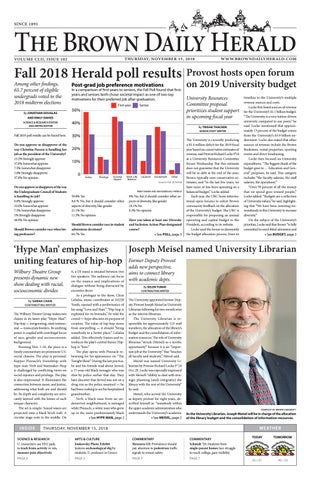
Fall 2018 poll results can be found here. Do you approve or disapprove of the way Christina Paxson is handling her job as the president of the University? 15.2% Strongly approve 37.8% Somewhat approve 7.5% Somewhat disapprove 1.6% Strongly disapprove 37.8% No opinion Do you approve or disapprove of the way the Undergraduate Council of Students is handling its job? 8.8% Strongly approve 33.8% Somewhat approve 7.5% Somewhat disapprove 1% Strongly disapprove 48.9% No opinion Should Brown consider race when hiring professors?
EMILY DAVIES AND JON DOUGLAS / HERALD
59.0% Yes 8.6 % No, but it should consider other aspects of diversity, like gender 21.1% No 11.3% No opinion Should Brown consider race in student admissions decisions? 64.7% Yes
8% No, but it should consider other aspects of diversity, like gender 19.1% No 8.3% No opinion Have you taken at least one Diversity and Inclusion Action Plan-designated course? » See POLL, page 3
The University is currently predicting a $5.4 million deficit for the 2019 fiscal year based on conservative estimates of revenue, said Provost Richard Locke P’18 at a University Resources Committee forum Wednesday. But this estimate does not guarantee that the University will be in debt at the end of the year; Brown typically uses conservative estimates, and “in the last few years, we have more or less been operating on a balanced budget,” Locke added. Each year, the URC hosts informational open forums to solicit Brown community feedback on the allocation of the University’s budget. The URC is responsible for proposing an annual operating and capital budget to the President, according to its website. Locke used the forum to desmystify the budget allocation process, from its
timeline to the University’s multiple revenue sources and costs. Locke first listed sources of revenue for the University’s $1.1 billion budget. “The University is a very tuition-driven university compared to our peers,” he said. Locke mentioned that approximately 13 percent of the budget comes from the University’s $3.9 billion endowment. Locke also stated that other sources of revenue include the Brown Bookstore, rental properties, sporting events and direct fundraising. Locke then focused on University expenditures. “The biggest chunk of the budget goes to … Education and General” purposes, he said. This category includes “the faculty salaries, the staff salaries, the operations.” “Over 70 percent of all the money that we spend goes toward people,” Locke added. “Budgets are a reflection of University values,” he said, highlighting that “We have been investing tremendously in this University to increase diversity.” On the subject of the University’s priorities, Locke said that Brown “is fully committed to need-blind admission and » See BUDGET, page 2
Joseph Meisel named University Librarian ‘Hype Man’ emphasizes Deputy Provost uniting features of hip-hop Former adds new perspective, Wilbury Theatre Group presents dynamic new show dealing with racial, socioeconomic divides By SARAH CHAN CONTRIBUTING WRITER
The Wilbury Theatre Group makes two claims in its latest play “Hype Man”: Hip-hop — invigorating, stark testimonial — transcends borders. Its unifying power is coupled with centrifugal forces of race, gender and socioeconomic background. Running Nov. 1-18, the piece is a timely commentary on prominent U.S. social chasms. The play is personal: Rapper Pinnacle’s friendship with hype man Verb and beatmaker Peep is challenged by conflicting views on social injustice and privilege. The play is also impersonal: It illuminates the connection between music and justice, addressing what both are and should be. Its depth and complexity are intricately layered with the lenses of each unique character. The set is simple. Sound waves are projected onto a black brick wall. A circular stage rests in the middle. On
INSIDE
it, a DJ stand is situated between two live speakers. The audience can focus on the nuance and implications of dialogue without being distracted by excessive decor. As a prologue to the show, Chris LaSalsa, music coordinator at AS220 Youth, opened with a performance of his song “Love and Hate.” “Hip-hop is exploited for its bravado,” he told the crowd — hype obscures its purpose of creation. The value of hip-hop stems from storytelling — it should “bring somebody to a better place,” LaSalsa added. This effectively frames and introduces the play’s central theme: Hiphop is “love.” The play opens with Pinnacle rehearsing for his appearance on “The Tonight Show.” During the last practice, he and his friends read about Jerrod, a 17-year-old black teenager who was shot by police earlier that day. They later discover that Jerrod was not on a drug run as the police assumed — he had been rushing to see his hospitalized grandmother. Verb, a black man from an underserved neighborhood, is outraged while Pinnacle, a white man who grew up in the same predominately black » See HYPE MAN, page 2
aims to connect library with academic depts. By SELEN TUMAY CONTRIBUTING WRITER
The University appointed former Deputy Provost Joseph Meisel as University Librarian following his two-month stint as the interim librarian. The University Librarian is responsible for approximately 125 staff members, the allocation of the library’s budget and the consolidation of information resources. The role of University librarian “struck (Meisel) as a terrific opportunity” because it is an “important job at the University” that “touches all faculty and students,” Meisel said. Meisel was named University Librarian by Provost Richard Locke P ’18 Oct. 29. Locke was especially impressed with Meisel’s “ability to deal with strategic planning (and) integrat(e) the library with the rest of the University,” he said. Meisel, who served the University as deputy provost for eight years, described himself as “somebody within the upper academic administration who understands the University’s academic » See MEISEL, page 2
COURTESY OF BROWN UNIVERSITY
As the University Librarian, Joseph Meisel will be in charge of the allocation of the library budget and the consolidation of information resources.
WEATHER
THURSDAY, NOVEMBER 15, 2018
SCIENCE & RESEARCH U. researchers use EEG pads to track brain activity in rats, measure pain objectively
ARTS & CULTURE Joukowsky Photo Exhibit features archeaological dig by students, U. professor in Greece
COMMENTARY Meszaros GS: Providence should pay attention to pedestrian traffic signals to ensure safety
COMMENTARY Schmidt ’21: Students from single-parent homes face struggle to reach college, gain visibility
PAGE 2
PAGE 3
PAGE 7
PAGE 7
TODAY
TOMORROW
35 / 31
45 / 33
NEWS
PAGE 2 • THURSDAY, NOVEMBER 15, 2018
THE BROWN DAILY HERALD
U. researchers develop new method for pain analysis » BUDGET, EEG pain measurement strategy could be applied to humans, improve medications, treatment By EUGENE HRABARCHUK STAFF WRITER
A new study by University researchers aimed to measure the amount of pain patients experience through brain activity, which could improve pain medications and treatments. Led by Carl Saab, associate professor of research in the departments of neuroscience and neurosurgery, the study sought to identify a more objective way to measure pain. Currently, medical professionals evaluate pain on a visual analogue scale, or VAS, Saab said. Patients choose a number from one to 10 and a facial expression to indicate their pain level.“In order for drugs to be developed, you need a powerful screen to test for efficacy. Current screens for pain are not reliable and subjective,” he added. Researchers attached electroencephalogram pads to rats and analyzed their pain reactions. “Your brain is filled with billions of cells called neurons, and they work by sending electrochemical signals from one to the other,” said Joshua Levitt ScM ’17, clinical research Program coordinator at Rhode Island Hospital. “When you have lots of neurons doing the same thing at once, this creates patterns called oscillations, which are picked up by the EEG electrodes,” he added. These brainwaves are analogous to
» MEISEL, from page 1 missions and goals.” Meisel’s prior experience overseeing grants and networking with University administrators as a program officer at the Mellon Foundation provides him “a perspective about the University … that is really important,” said Deputy University Librarian Nora Dimmock. Meisel will also draw on this work to better align his vision with ‘Building on Distinction,’ the University’s 10-year strategic plan, she added. Meisel also has extensive experience with “temporary leadership” after serving as interim librarian, he said, a position in which he relied on library staff to show him the ropes. He has tried to meet “one on one with every member of the staff. … This has been tremendously educational,”
COURTESY OF BROWN UNIVERSITY
Medical professionals currently use a visual analogue scale to measure pain. The method is subjective as patients may indicate the severity of their pain on the pictured scale and pick a number from one to 10. sound waves, Levitt said; just as certain sound waves correlate to specific musical notes, brainwaves correlate to specific brain functions. There are many causes for the variation in brainwave patterns, and scientists can model the effects pain and medications have on brain activity, said Samuel Neymotin, assistant professor of neuroscience research. Researchers tracked these oscillations and induced pain by poking the rats and exposing them to hot temperatures, Saab said. This study represents an early step in quantifying animal pain, Saab said. “EEG is fast, and it records neural activity at a fast rate. It’s cheap, user-friendly
and noninvasive, he said. First, the researchers are planning to use EEG data in veterinary hospitals, Saab said. Similarities in neural circuitry for pain in animals and humans indicate that this method could be applied to human subjects in the future, Saab said. “At the end of the day, I am interested in their verbal report of what their pain is,” he added. “Ultimately, it ought to be possible to correlate EEG pattern of activity with VAS.” “For chronic types of pain, that are defined as pain lasting more than 6 months, (patients) become resistant to traditional treatment,” Saab said, which suggests that traditional methods of pain
he added. Locke and President Christina Paxson P ’19 heard that Meisel “was doing such a great job from members of the library” as interim librarian and decided to make his appointment permanent. One of Meisel’s key changes as interim librarian was the creation of a diversity and equity and inclusion training program for library staff, Dimmock said. Looking ahead, Meisel will “connect the library even more strongly with academic opportunities on campus,” Meisel said. He hopes to do so through meeting with leaders like department chairs to understand their priorities. Meisel said he has become increasingly aware that the “library is a critical aspect of realizing Brown’s academic mission” of supporting research and advances in academia.
» HYPE MAN, from page 1 neighborhood, only wants to focus on his upcoming gig. Verb and Pinnacle’s contrasting reactions spark tensions within the group. This tension culminates in Verb’s public advocation for justice during Pinncacle’s live appearance on television — thus jeopardizing Pinnacle’s career. The heated aftermath is a reflection of contemporary polarizing cleavages. But “Hype Man” does not necessarily boil down to a conversation about white privilege. Pinnacle faces his own struggles. As a low-income white rapper, he faces adversity relating to his socioeconomic class. The sexualization and marginalization of women in rap is also highlighted in the play. However, this topic is only briefly touched upon by Peep — her discussion with Verb is underdeveloped and incomplete. Ultimately, this theme is incidental to the plot of the play. Music has “the transformative power … to do good,” Director Don Mays wrote in the play’s program. The hype man’s “hype” is conscious. It is a celebration of his life and the issues he is intimately tied to, Verb says in the concluding scene. As Peep punctuates: A “dog does not know what it’s like to be a cat.” This, the play contends, is why music exists. A song is never just a song. Beats and lyrics are inextricable: The words will always “creep in like second-hand smoke,” she says. The ending of “Hype Man” echoes LaSalsa’s take on hip-hop. It is a story — a story that impersonalizes personal outlooks and makes the diverse audience a little more “sympathetic” to “all types of people,” Peep argues.
measurement may be less reliable. In these cases, doctors often overprescribe highly addictive opioid medications. “You would want to intervene with more effective drugs that are not opioidbased,” Saab said. “Next would be to pursue the human paths and validate what we have discovered,” Saab said. EEG could be particularly helpful for young populations, since children and babies have trouble verbalizing pain. Individuals with different conditions, including Parkinson’s, Alzheimer’s, ADHD and Schizophrenia, may benefit from this research, which could give rise to better and more personalized treatment, Neymotin said.
from page 1
… is trying to meet the full cost of attendance.” As a result, financial aid and work study form a significant portion of the budget, Locke said. “On average, tuition and fees go up around 4 percent a year and the financial aid budget goes up around 7 percent a year.” The University has increased stipends for graduate students, Locke said. Transitional stipends — meant to cover the costs of moving to Providence — amounting to $1,500 were introduced this year, he said. In the coming year, the University is planning to increase funding for graduate students who have children or dependents, Locke added. Attendees raised concerns that graduate student unionization would increase costs for the University. Locke does not expect unionization to increase costs since the University has already recently increased graduate student stipends, he said. The University has also approved an increase in stipends for graduate students in the biomedical sciences, Locke added. Jordan Kei-Rahn ’21, an undergraduate representative of the URC, told The Herald, “We’re going into the budget deliberation process and it’s always good to hear other perspectives.” Community feedback is important to the URC “to make sure we are not expanding unequally, but equally” and to allow “everyone to have funding and support,” he added. The budget for the following fiscal year becomes official “in February, after the corporation votes on the budget,” Locke told The Herald.
COURTESY OF JOSH SHORT
“Hype Man” showcases the transcendent power of hip-hop and explores perspectives on social injustice. The play will run until Nov. 18. “Hype Man” is brilliant in its poignancy surrounding ultra-current affairs and rejection of passivity. It reminds artists to “get on up” and say
their stories, hardships, worldviews and more. In doing so, they would be uniting an increasingly disunited country through hip-hop.
NEWS
THURSDAY, NOVEMBER 15, 2018 • PAGE 3
THE BROWN DAILY HERALD
Photo exhibition chronicles archeological excavation Professor, students showcase summer excavation findings from Neolithic village in Greece By GRAYSON LEE STAFF WRITER
The photo exhibition “Light-Writings: Koutroulou Magoula 2017-2018” at the Joukowsky Institute for Archeology and the Ancient World features the people, materials and processes of an archeological dig. Last summer, Yannis Hamilakis, professor of archeology and modern Greek studies, and six undergraduate students from Brown and the Rhode Island School of Design traveled to central Greece for four weeks. They participated in an ongoing excavation of the archeological site Koutroulou Magoula, a Neolithic village and burial site. Two of these students, Justin Han ’22 and Kelly Tackett ’20, Herald copy desk chief, helped Hamilakis curate the exhibition, choosing the pictures out of hundreds taken at the site, Tackett said. Fotis Ifantidis, an archeologist and photographer, took the photos last
» POLL, from page 1 21.9% Yes 44.7% No 19.1% Not sure 14.3% I do not know what that designation is How often do you use an E-cigarette (e.g. JUUL)? 4.9% Daily 2.5% Once a week 4.1% Two to three times a week 8.7% Once or twice a month 79.7% Never Are you registered to vote? 9.7% Yes, in Rhode Island 64% Yes, but not in Rhode Island 10.4% No 1.2% I do not know 14.7% I am not eligible to vote in the United States Did you vote in the midterm elections? 56.2% Yes 29.4% No 14.4% I am not eligible to vote in the United States
summer. Han and Tackett divided the photographs into five categories: Tactilities, Landscapes, Diggers, Bodies and Theatre. The subjects of the pictures vary widely as they feature panoramic scenery, students digging in the dirt, a spoken-word performance and an excavated skeleton. The curators wanted to include “photographs that comment visually on the process of archeology, on excavation and on field practices, photographs which are at the same time artistic creations but which can also operate as photo-ethnographic objects,” the exhibition flyer read. “We want to exhibit these things to generate more discussion,” Hamilakis said, explaining how the photos provoke interactions between humans and artifacts. Tackett described how the photographs capture the human aspect of an archeological dig. “We really wanted to think about the people who were doing archeology and the processes that were people-driven rather than thinking about it as a purely scientific endeavor,” Tackett said. Every category in the exhibition includes people, she noted. She described how people were present
What are your primary motivations in considering your first job after graduation? (Select your top two.) 40.4% Salary 13.5% Prestige 43.1% Societal impact 26.2% Work-Life balance 19% Location 35.1% Excitement 4.8% Other Do you support admission processes that give an advantage to potential varsity athletes? 23% Yes 55.5% No 21.5% No opinion How important do you think athletics is to the Brown community? 7.7% Very important 26.8% Somewhat important 22.7% Neutral 28.9% Somewhat unimportant 13.9% Very unimportant How important do you think athletics » See POLL, page 4
at every juncture of the experience, from the team working on the project to the community workers around them. In lieu of captions, the exhibition incorporated excerpts from the students’ journals. The exhibition also included a sound component, created by Han. Sounds of chickens clucking, dogs barking and traffic driving filled the room. “I recorded in the town neighboring the site, Neo Monastiri, and I was also interested in working with the sound of labor — thinking how we can represent that through sound in way that is less problematic than if it were to be recognized visually,” Han said. The recordings were also used as a background to the spoken-word performance of a local artist who performed at a community gathering in Neo Monastiri. The performance centered around all the routes that different peoples and objects had taken to arrive at that place. Halle Krieger ’21, another one of the students who worked on the dig at Koutroulou Magoula, explained her project involving the clay figurines that were found on the site. More than 400 figurines were found at Koutroulou
COURTESY OF YANNIS HAMILAKIS
Students and faculty collaborated to curate this photo exhibit featuring images of the Koutroulou Magoula archeological site in central Greece. Magoula, Krieger said, and she created a clay model of one for the exhibition using local clay that she brought from a riverbed near the site. Krieger was also the student who first discovered a foot
while digging, which would eventually lead the team to excavate an entire skeleton. The exhibit featured pictures of the skeleton alongside those of students in the process of excavating.
UCS briefed on CAPS initiatives CAPS Director Will Meek discusses progress of reduced wait times, increased staff diversity By MELANIE PINCUS SENIOR STAFF WRITER
At the Undergraduate Council of Students’ weekly general body meeting Wednesday evening, Director of Counseling and Psychological Services Will Meek spoke on efforts to make CAPS’ services more accessible to the student body. When Meek assumed his role in spring 2017, CAPS had “just launched” a new system to reduce appointment wait times, Meek said. “Historically there was a two- to three-week wait to get a first appointment.” Students typically now get appointments at CAPS within three to four days of requesting one, and about half of students who call can schedule a same-day appointment, Meek added. This change is “something we’ve been really proud of and something that has made a huge difference, I think, in terms of the care we’re able to provide and how responsive we are,” Meek said. CAPS is looking to further shorten wait times in the spring “as the demand for the same-day stuff has really continued to increase,” he added. CAPS has also worked to improve the diversity of its staff. “When I got here … about 45 percent of the providers considered themselves to be providers of color,” Meek said. “It’s 65 percent now,” he estimated. CAPS also offers therapy in five languages in addition to English, Meek said. “That’s another effort that we’re going to continue to try to expand out as much as possible.” Another CAPS project is to identify and develop methods to provide longterm care, he said.
JASMINE RUIZ / HERALD
CAPS director Will Meek, right, spoke to UCS general body members about CAPS’ work to develop long-term care opportunities for students. Though CAPS’ “bread and butter” is “goal-focused care” where students work toward a specific objective, Meek noted that the office is “really working on ways of providing (long-term care) where it’s really needed, particularly for students whose ability to even stay at Brown is in jeopardy.” “I would hope to come back to UCS next year and be able to say we’ve got a real plan” for long-term care, he added. UCS Secretary Vanessa Garcia ’20.5 asked Meek about how he is “responding to” a lawsuit filed against Stanford University alleging that the university improperly placed students on involuntary medical leave. Garcia asked Meek how he plans “to regain the trust of people who have been involuntarily put on medical leave” at Brown. Meek said he is not aware of any involuntary medical leaves originating from CAPS since he started as director in March 2017. CAPS does not have a policy against placing people on involuntary medical leave, he said. But “what I’ve tried to create is the philosophical approach … to be a force that can try to prevent the need for medical leave at all, if possible, let alone these sort of involuntary” cases, Meek said.
Meek has worked to reduce barriers for taking medical leave and to reform the process of returning from medical leave, he said. “I’m all about people’s choices. I don’t stigmatize people that want to leave. I think that’s okay, too.” UCS Appointments Chair Jason Carroll ’21 asked Meek whether he thinks it can “ever be intimidating” for students concerned about privacy to come to CAPS, considering its current location on the fifth floor of PageRobinson Hall. Meek said the current location is “not at all the ideal situation,” noting its proximity to the IT Service Center and frequent traffic on the floor. “If we’re talking about stigma or somebody holding on to some of that,” the location is a “barrier that I’m really unhappy about,” he said. CAPS will relocate to the planned health and wellness center at 450 Brook St., which is scheduled to be completed in fall 2021. Meek also stressed the importance of student feedback and his dedication to CAPS’ continued improvement. Students can email Meek or CAPS to provide feedback, Meek added. “I’m all ears for ideas.”
NEWS
PAGE 4 • THURSDAY, NOVEMBER 15, 2018
THE BROWN DAILY HERALD
» POLL, from page 3 should be to the Brown community? 9.6% Very important 31.7% Somewhat important 30.1% Neutral 18.1% Somewhat unimportant 10.6% Very unimportant The poll was conducted over the course of three days — Nov. 7-9. The margin of error is 3.1 percent with 95 percent confidence. The margins of error for specific subsets are as follows: 3.8 percent for females, 4.3 percent for males, 4.5 percent for first-years, 4.7 percent for sophomores, 5.1 percent for juniors, 5.6 percent for seniors, 4.4 percent for students who receive financial aid and 3.8
percent for students who do not receive financial aid. The sample of students who took the poll is demographically similar to the undergraduate student body. The sample was 42.1 percent male and 56.4 percent female. First-years made up 29.7 percent, sophomores 27.5 percent, juniors 23.8 percent and seniors 19 percent of the poll. Of students represented in the poll, 32.9 percent receive grants covering some costs, 9.8 percent receive grants covering all costs and 57.4 percent receive no financial aid. Varsity athletes made up 11.5 percent, while non-athletes made up 88.5 percent of the sample. Of students surveyed, 79 percent identify as heterosexual, 5.4 percent as gay, 11.2 percent as bisexual and 4.3 percent as other. Those involved in a greek life organization made up 10.9 percent, while non-greek affiliated made up 89.1 percent. Of students surveyed, 54.5 percent identify as white, 35.7 percent as Asian, 10.6 percent as Hispanic, 9.1 percent as black, 0.7 percent as American Indian/ Alaska Native, 1.1 percent as Native Hawaiian/Pacific Islander and 3 percent
as other. (Note that percentages add up to more than 100 percent since some students selected more than one race/ ethnicity.) Students also marked their concentration area(s) — 31.4 percent are in the humanities/arts, 22.9 percent in life sciences, 35.2 percent in physical sciences, 15.8 percent in business (BEO or economics) and 21.7 percent in social sciences. Of students polled, 14.5 percent are legacy students, meaning they have a parent, grandparent or sibling who attended Brown, and 85.5 percent are not. First-generation students made up 15.3 percent of students surveyed and non-first-generation students made up 84.7 percent of the sample. Statistical significance was established at the 0.05 level. All cross tabulations are statistically significant. Science and Research Editor Jonathan Douglas ’20 and Metro Editor Emily Davies ’19.5 coordinated the poll. Herald section editors, senior staff writers and other staff members conducted the poll. Over the next several weeks, The Herald will publish a series of articles about individual poll questions.
A Restless Melancholy
Celebrating Forrest Gander Reading by Eliot Weinberger Thursday, 15 Nov. 2018 at 5 pm Martinos Auditorium, Granoff Center, 154 Angell St.
Screening of video works by Forrest Gander Thursday, 15 Nov. 2018 at 8:30 pm Martinos Auditorium, Granoff Center, 154 Angell St.
The Art of Publishing Contemporary Poetry with Declan Spring, Sr. Editor, New Directions Publishing Friday, 16 Nov. 2018 at 11 am McCormack Family Theater, 70 Brown St.
Readings by Laura Mullen & Raúl Zurita (with translator Anna Deeny Morales) Friday, 16 Nov.2018 at 1:30 pm Martinos Auditorium, Granoff Center, 154 Angell St.
Readings by Bei Dao and Jorie Graham Friday, 16 Nov. 2018 at 4 pm Martinos Auditorium, Granoff Center, 154 Angell St. A Restless Melancholy marks the recent retirement of Forrest Gander, Adele Kellenberg Seaver Professor Emeritus. It is sponsored by Brown University’s departments of Literary Arts and Comparative Literature and has been made possible by generous support from the Office of President Christina Paxson, the Brown Arts Initiative and the CV Starr Foundation Lectureship Fund.
TODAY
THURSDAY, NOVEMBER 15, 2018 • PAGE 5
THE BROWN DAILY HERALD
c a n w h at i s b r o k e n b e f i x e d ?
menu SATELLITE DINING ANDREWS COMMONS
Pizza: Pepperoni, Spicy Sausage and Garlic, Roasted Mushroom Po’ Boy, Curry Bar JOSIAH’S
BLUE ROOM
Taco Thursday, Southwestern Bean Burger
Build Your Own Burrito Bowl, Beef Chili With Beans
DINING HALLS SHARPE REFECTORY LUNCH
DINNER
Coconut Red Curry Beef Stir Fry, Steamed Summer Squash, Frosted Brownies
Manhattan Clam Chowder, Fish of the Day with Miso Glaze, Baked Sweet Potatoes
VERNEY-WOOLLEY LUNCH
DINNER
BBQ Chicken Breast Sandwich, Spicy French Fries, Mediterranean Stew
Falafel Burger, Roasted Red Potatoes with Herbs, Butternut Squash with Shallots
sudoku
GUS REED / HERALD
This print is from Rhode Island School of Design’s private collection and was created by John Langdon in 2011. It is the twelfth print in a series of two hundred and was made using a color screen on woven paper.
Q U O T E O F T H E D AY
“Hip-hop is exploited for its bravado.”
RELEASE DATE– Monday, November 10, 2014
Los Angeles Times Daily Crossword Puzzle c rNorris o s sandwJoyce o rNichols d Lewis Edited by Rich ACROSS 1 Digital periodical, briefly 5 Part of CBS: Abbr. 9 Comics title character who married Irving 14 Kitchen floor covering, in Kent 15 __ Ness monster 16 Earth pigment 17 Sooner State city 18 Architectural Scurve 19 Rays of light 20 Taking the top spot 23 Roman fountain 24 Volcano in Sicily 25 “What’s happenin’?” 28 In the least favorable case 31 Brit’s “Bye-bye” 32 Cleopatra’s undoing 35 Slim and muscular 36 Annie with a gun 38 With 40-Across, remaining focused 40 See 38-Across 41 Gold purity measures 42 Brother of Cain 43 Item in a P.O. box 44 This, in Seville 45 Fed up with 48 For what reason 49 Capricorn’s animal 50 Creates 54 Betting it all 58 “Hot corner” base 60 Cowboys quarterback Tony 61 R&B singer India.__ 62 Exposed 63 Explorer __ the Red 64 Reject as false 65 Brass or bronze 66 CPR pros 67 It’s a long story DOWN 1 Put into office 2 Insignificant
— Chris LaSalsa, music coordinator at AS220 Youth
See HYPE MAN on FRONT.
3 Japanese 39 Former NBA 53 Parting words, cartoon style center __ Ming perhaps after the 4 Premium 40 U.K. award visit suggested chocolate brand 42 Painting or by the starts of 5 Walk laboriously, sculpture 20-, 38-/40- and as through mud 46 “No argument 54-Across 6 Quotable Berra from me” 55 Twistable 7 The stuff of many 47 Electrical cookie postcard photos capacitance units 56 Fail to mention 8 Burglaries 49 Dizzy with delight 57 Mythical birds 9 Hooded snake 51 Divided country 58 TV schedule 10 King beaters 52 Barely managing, abbr. 11 “It’s not true!” with “out” 59 Actor Holbrook 12 Pants bottom 13 Decade tenths: ANSWER TO PREVIOUS PUZZLE: Abbr. 21 Knucklehead 22 Chanted 26 Sch. with a Chattanooga campus 27 Subscriptionbased home entertainment 29 Churchill of the United Kingdom 30 Charity’s URL ending 31 Fight stopper, for short 32 Cockeyed 33 Hidden supply 34 Free-spirited socializer 37 Poise 11/10/14 xwordeditor@aol.com
Enjoying this free paper? Support The Herald www.browndailyherald.com/donate
calendar TODAY NOVEMBER
S
4
M
5
T
6
W
7
Th
F
S
1
2
3
8
9
10
Brown Give Annual Bake Sale 8:00 A.M. 121 South Main Street
MCAT Decoded Information Session 4:00 P.M. CareerLAB
Bologna, Italy Summer Information Session 4:00 P.M. Page-Robinson Hall, 440
Reading: Essayist Eliot Weinberger 5:00 P.M. Granoff Arts Center
TOMORROW
By Teresa Colby (c)2014 Tribune Content Agency, LLC
11
12
13
14
15
16
17
18
19
20
21
22
23
24
25 11/10/14
26
27
28
29
30
Sustainability Help Desk 12:00 PM Page-Robinson Hall
Engineering Research Fair 4:30 P.M. Engineering Research Center
Screening of Truman 6:00 P.M. Watson Institute
The Soldier’s Tale 8:00 P.M. List Art Building
COMMENTARY PAGE 6 • THURSDAY, NOVEMBER 15, 2018
THE BROWN DAILY HERALD
Find us online! facebook.com/browndailyherald
browndailyherald.com
@the_herald
Location: 195 Angell St., Providence, R.I. www.browndailyherald.com
@browndailyherald
youtube.com/browndailyherald
Editorial Leadership
Sections
Multimedia & Production
Business
Editors-in-Chief Elena Renken Kasturi Pananjady
Arts & Culture Editors Ethel Renia
Design Editors Kyle Cui Eduard Muñoz-Suñé Assistants: Julie Wang, Kelvin Yang
General Managers Michael Borrello Matilda Lynton
Managing Editor Alex Skidmore
Metro Editors Emily Davies Isabel Gensler
Senior Editors Madison Rivlin Hattie Xu Ben Shumate
News Editors Eduard Muñoz-Suñé Priyanka Podugu Sarah Wang
Editorial Page Editor Anuj Krishnamurthy
Science & Research Editors Jonathan Douglas Jackson Wells
POST- MAGAZINE Editor-in-Chief Jennifer Osborne
Sports Editors Alexandra Russell James Schapiro COMMENTARY Opinions Editors Connor Cardoso Anuj Krishnamurthy Clare Steinman Emily Miller
Photo Editors Sam Berube Anita Sheih Copy Desk Chief Kelley Tackett Illustrations Editor Daphne Zhao Video Editor Celia Hack Graphics Editors Marlis Flinn Sarah Martinez
Office Manager Diane Silvia Directors Sales: Shreya Raghunandan Finance: Ravi Betzig Strategy: Edwin Farley
Editorial contact: 401-351-3372 herald@browndailyherald.com
Advertising contact: 401-351-3372 advertising@browndailyherald.com
Submissions: The Brown Daily Herald publishes submissions in the form of op-eds and letters to the editor. Op-eds are typically between 750 and 1000 words, though we will consider submissions between 500 and 1200 words. Letters to the editor should be around 250 words. While letters to the editor respond to an article or column that has appeared in The Herald, op-eds usually prompt new discussions on campus or frame new arguments about current discourse. All submissions to The Herald cannot have been previously published elsewhere (in print or online — including personal blogs and social media), and they must be exclusive to The Herald. Submissions must include no more than two individual authors. If there are more than two original authors, The Herald can acknowledge the authors in a statement at the end of the letter or op-ed, but the byline can only include up to two names. The Herald will not publish submissions authored by groups. The Herald does not publish anonymous submissions. If you feel your circumstances prevent you from submitting an op-ed or letter with your name, please email herald@browndailyherald.com to explain your situation. You can submit op-eds to opinions@browndailyherald.com and letters to letters@browndailyherald.com. When you email your submission, please include (1) your full name, (2) an evening or mobile phone number in case your submission is chosen for publication and (3) any affiliation with Brown University or any institution or organization relevant to the content of your submission. Please send in submissions at least 24 hours in advance of your desired publication date. The Herald only publishes submissions while it is in print. The Herald reserves the right to edit all submissions. If your piece is considered for publication, an editor will contact you to discuss potential changes to your submission. Commentary: The editorial is the majority opinion of the editorial page board of The Brown Daily Herald. The editorial viewpoint does not necessarily reflect the views of The Brown Daily Herald, Inc. Columns, letters and comics reflect the opinions of their authors only. Corrections: The Brown Daily Herald is committed to providing the Brown University community with the most accurate information possible. Corrections may be submitted up to seven calendar days after publication. Advertising: The Brown Daily Herald, Inc. reserves the right to accept or decline any advertisement at its discretion. The Brown Daily Herald, Inc. is a financially independent, nonprofit media organization bringing you The Brown Daily Herald, BlogDailyHerald and Post- Magazine. The Brown Daily Herald has served the Brown University community daily since 1891. It is published Monday through Friday during the academic year, excluding vacations, once during Commencement and once during Orientation by The Brown Daily Herald, Inc. Single copy free for each member of the community. Subscription prices: $200 one year daily, $100 one semester daily. Copyright 2018 by The Brown Daily Herald, Inc. All rights reserved. Periodicals postage paid at Providence, R.I. Postmaster: Please send corrections to P.O. Box 2538, Providence, RI 02906.
COMMENTARY THURSDAY, NOVEMBER 15, 2018 • PAGE 7
THE BROWN DAILY HERALD
Better pedestrian signals for a safer Providence E.L. MESZAROS staff columnist
On my short walk to campus, I cross intersections with pedestrian traffic signals where the light has burnt out, where the light never changes and where the whole light pole has been turned to face away from the intersection. While much of pedestrian safety is beyond the power of these little lighted signs, their presence stands stalwart in the fight to ensure the safety of walking traffic. Why, then, are so many in such a state of disrepair? Providence should pay attention to pedestrian traffic signals to ensure the safety of pedestrians, taking action to fix the ones we have while also changing how they function and how we, as a society, interact with them. The campus organization Safety at Brown offers little advice on dealing with pedestrian signals. “Pay attention,” they write, “to traffic lights and signals at crosswalks,” places where traffic flow is predictable and steady. Their link to the U.S. Department of Transportation’s National Highway Traffic Safety Administration is broken, but the intrepid internet user can find on this website pedestrian safety statistics from 2016 — the most recent year available — that indicate a 9-percent increase nationwide in pedestrian fatalities over the previous year, marking the highest number since 1990. Increasing the safety of walking traffic is critical and should be a focus for a college city with a young population and limited parking opportunities. Pe-
destrian signal lights that are broken should be fixed. Signs that are missing or tilted should be replaced. But more than that, we as a community need to understand the role these signals play and how to interact with them as pedestrians and as drivers. Many issues with pedestrian signals can be addressed through physical repairs. Taking stock of lights that are burnt out, broken or otherwise damaged would allow the city to restore them to functioning order. Repair is critical because the presence
terpret pedestrian signals is also important. A few weeks ago, I had begun crossing an intersection with a “walk” signal, which transitioned to the blinking “don’t walk” signal to indicate I could finish crossing but shouldn’t start. A car turned left into my crosswalk and nearly ran into me. He gestured angrily out his window at the blinking “don’t walk” sign as if to suggest that he had the rightof-way and the near-incident was my own fault. Ensuring pedestrian safety in situations like this is less the fault
the direction of travel is green. Sometimes pressing this button affects traffic patterns, stopping or altering traffic to provide safe crossing opportunities. Other times, this button just alerts the light to signal a safe time to walk when traffic is flowing in the same direction as the pedestrian. In either case, the pedestrian often has to wait a full cycle or more in order to cross safely. Many pedestrians know this and, rather than waiting, will take opportunities of pauses in traffic flow to cross the street against the traffic
Increasing the safety of walking traffic is critical and should be a focus for a college city with a young population and limited parking opportunities.
of pedestrian signals at intersections suggests to those walking and driving alike that there is a pattern that should be followed. It leads drivers to assume, however correctly, that pedestrians will only be found in the intersection when the signal indicates that this is okay. Without a functioning traffic light, pedestrians will cross not necessarily unsafely or against the flow of traffic but certainly against typical traffic light patterns, placing them in potential danger from drivers who don’t expect them to be there. Educating drivers on how to in-
of the traffic signal than it is of how drivers are taught to interpret it. But a sign is only meaningful in its interpretation; if a blinking “don’t walk” sign is assigned different meanings by pedestrians and automobile traffic, then it can’t ensure safety — it can’t do its job. There are more difficult actions that must be taken regarding these traffic signals, however, focused on more entrenched issues. Many pedestrian traffic signals operate in a mode where they remain illuminating the “don’t walk” hand unless a button is pressed, even when the traffic light in
sign. While this may be illegal action, it is not necessarily unsafe action. Crossing with the flow of traffic and at a designated crosswalk is exactly the correct, safe practice for cases where activating the pedestrian signal doesn’t change traffic patterns either quickly or at all. It becomes problematic, however, if drivers assume that the pedestrian signal means the crosswalk will be empty. Additionally, a green traffic light doesn’t always guarantee a pedestrian enough time to cross the street safely, while pedestrian signals give an indication of how
much time is left. The dysfunction of pedestrian signals may therefore turn a safe crossing into an illegal action and make it unsafe. For lights that don’t impact traffic patterns, where pushing the button for a pedestrian signal doesn’t change the traffic lights for automobiles: Automate the walk signals to change with traffic. Simply ensuring that the pedestrian traffic signal is aligned with the traffic light (instead of defaulting to “don’t walk”) will certainly increase the frequency with which the signal is obeyed. Simple changes like this can encourage pedestrians to cross with the signal, increasing visibility and predictability for drivers and making it easier to tell whether they can finish crossing before the flow of traffic changes. For a community, school and city with a sufficient history of pedestrian accidents, taking small actions to encourage continued pedestrian safety should be an easy choice. Replacing lights and fixing broken signals should be a priority. Re-evaluating how pedestrian traffic interacts with crosswalks, signals and traffic lights is an even more important step in improving how this campus and the city of Providence can be navigable and safe.
E.L. Meszaros GS can be reached at e.l.meszaros@brown.edu. Please send responses to this opinion to letters@browndailyherald.com and other op-eds to opinions@browndailyherald.com.
The plight of the single-parent household RACHAEL SCHMIDT staff columnist An amazing opportunity for Brown students is the exposure to people from a variety of cultures and backgrounds and getting to learn from their experiences. But there’s a group of students that is often overlooked, with not many people understanding the burdens upon them: those coming from single-parent households — who have only one parent in their lives. These students and their plights often go unnoticed at Brown and in the Ivy League community at large. The psychological and communal impact of a single-parent household goes beyond having only one parent come for Family Weekend or watching friends and peers show both of their parents around campus. Having one parent’s income to fall back on and working to pay off loans can be an overwhelming burden. Yet these struggles extend beyond economic factors and can have a significant impact on mental health. According to a 2006 U.K. study on childhood mental illness and divorce conducted by the Office for National Statistics, 13 percent of girls who had a divorced or widowed parent had a mental disorder, compared to 5 percent of girls whose parents were still together. The statistics for boys in the study echoed a similar trend: Almost 20 percent of boys living with a single parent had similar experiences with mental illness, compared to 8 percent of boys coming from a two-parent household.
In addition, numerous studies have shown how students from divorced families are educationally disadvantaged and less likely to pursue higher education. Students from single-parent households face specific challenges in the college application process. If they have big dreams of attending a top university, like an Ivy League school,
dent body was from a single-parent household, compared to the national divorce rate at the time of roughly 50 percent. There are a variety of factors that help explain the disproportionately low number of students from divorced families who attain college degrees — from lower average test scores to a decreased likelihood of participating in extracurriculars.
There’s one group of students that is often overlooked, with not many people understanding the burdens upon them: Those coming from single-parent households.
to further their education, the odds are stacked even further against them. A study conducted by researchers at Cornell in 1996 showed that children whose parents are divorced are only half as likely to attend a top, selective school compared to those coming from a two-parent background. The same study also showed that in a class at Cornell, only 10 percent of the stu-
Given so many socioeconomic factors that students from single-parent households face, it is astounding these students, myself included, were able to attend elite universities. I remember when I first came to Brown, I grazed my palm over the Gate and all of its gilded years, in awe that despite all I had faced in my childhood, I was still graced with the opportunity to at-
tend one of the top institutions in the world. My mother always reminded me of where I came from — an only child from a household that was torn apart when I was just nine years old. I was supposed to “become a statistic,” as she put it, and never go as far as I, and my peers who have come from a similar background, have gone. And yet, it seems as though not many people in the Brown community talk about this struggle. Child support and parental income are factored into financial aid packages, but awareness and understanding of the plight of those who have made it here despite all odds are lacking. Because of the small proportion of students from divorced households coming into the Ivy League and into the Brown community, thinking about the struggles these students face can be out of sight and out of mind for the majority of the community. But, especially in a community in which students from the top 1 percent outnumber those from the bottom 60, acknowledging the adversity faced by students who have only one parent in their lives is essential to erase the isolation students from single-parent households may feel. Their struggles should not be invisible, and they should be proud that in spite of everything, they are still standing and thriving at a top university.
Rachael Schmidt ’21 can be reached at rachael_schmidt@brown.edu. Please send responses to this opinion to letters@browndailyherald.com and other op-eds to opinions@browndailyherald.com.
YOUR VOTE MATTERS GRADUATE STUDENT UNIONIZATION
VOTING INFORMATION:
NOVEMBER 14, 15, 16 AND 19 10 AM TO 6 PM VOTERS ASSIGNED TO A POLLING STATION BASED ON DEGREE PROGRAM. BROWN OR GOVERNMENT-ISSUED ID REQUIRED TO VOTE.
POLLING LOCATIONS BIOMED & LIFE SCIENCES
SIDNEY FRANK HALL | CONF ROOM 218 185 MEETING STREET
ENGINEERING & PHYSICAL SCIENCES
ENGINEERING RESEARCH CENTER (ERC) | ROOM 325 345 BROOK STREET
HUMANITIES & SOCIAL SCIENCES
SALOMON CENTER | UPPER LOBBY 79 WATERMAN STREET | LOCATED ON MAIN GREEN
PUBLIC HEALTH
121 SOUTH MAIN STREET | ICERM | ROOM 1014 LOCATED ON 10TH FLOOR OF 121 SOUTH MAIN STREET
For more information, visit brown.edu/go/be-informed