SINCE 1891
THE BROWN DAILY HERALD MONDAY, APRIL 25, 2022
VOLUME CLVII, ISSUE 35
UNIVERSITY NEWS
UNIVERSITY NEWS
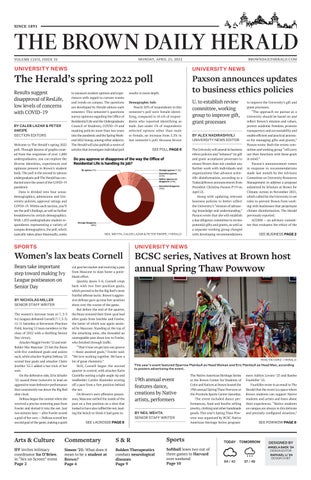
The Herald’s spring 2022 poll Results suggest disapproval of ResLife, low levels of concerns with COVID-19 BY CALEB LAZAR & PETER SWOPE SECTION EDITORS Welcome to The Herald’s spring 2022 poll. Through dozens of graphs created from the responses of over 1,000 undergraduates, you can explore the diverse identities, experiences and opinions present in Brown’s student body. The poll is the second in-person undergraduate poll The Herald has conducted since the onset of the COVID-19 pandemic. Data is divided into four areas: demographics, admissions and University policies, approval ratings and COVID-19. Within each section, you’ll see the poll’s findings, as well as further breakdowns by certain demographics. With 1,033 undergraduate student respondents representing a variety of campus demographics, the poll, which typically takes place biannually, seeks
to measure student opinion and experiences with regard to current events and trends on campus. The questions are developed by Herald editors each semester. This semester’s questions survey opinions regarding the Office of Residential Life and the Undergraduate Council of Students, COVID-19 and masking policies more than two years into the pandemic and the Spring Weekend 2022 lineup, among other subjects. The Herald will also publish a series of articles that investigate individual poll
Demographic Info Nearly 50% of respondents in this semester’s poll were female-identifying, compared to 45.6% of respondents who reported identifying as male. Just under 5% of respondents selected options other than male or female, an increase from 3.3% in last semester’s poll. Because Brown
BY NICHOLAS MILLER SENIOR STAFF WRITER The women’s lacrosse team (6-7, 3-3 Ivy League) defeated Cornell (7-7, 3-3) 12-11 Saturday at Stevenson-Pincince Field, leaving 12 team members in the class of 2022 with a thrilling Senior Day victory. Attacker Maggie Fowler ’22 and midfielder Mia Mascone ’23 led the Bears with five combined goals and assists each, while attacker Sophia DeRosa ’22 scored four goals and attacker Claire Jeschke ’22.5 added a hat trick of her own. On the defensive side, Erin Schafer ’22 caused three turnovers to lead an aggressive team defensive performance that consistently ran down the Big Red shot clock. DeRosa began the contest when she received a precise centering pass from Fowler and slotted it into the net. Just two minutes later — after Fowler scored a goal of her own — DeRosa scored her second goal of the game, making a quick
Arts & Culture IFF invites intimacy coordinator Ita O’Brien in “Sex on Screen” event Page 2
SEE POLL PAGE 6
NEIL MEHTA, CALEB LAZAR & PETER SWOPE / HERALD
Women’s lax beats Cornell Bears take important step toward making Ivy League postseason on Senior Day
Paxson announces updates to business ethics policies
results in more depth.
SPORTS
cut past her marker and receiving a pass from Mascone to slam home a pointblank effort. Quickly down 3-0, Cornell crept back with two free-position goals, which proved to be the Big Red’s most fruitful offense tactic. Brown’s aggressive defense gave up nine free-position shots over the course of the game. But before the end of the quarter, the Bears restored their three-goal lead after goals from Jeschke and Fowler, the latter of which was again assisted by Mascone. Standing at the top of the attacking zone, she threaded an unstoppable pass down low to Fowler, who finished through traffic. “That’s how we get into our groove — those assisted goals,” Fowler said. “We love working together. We have a lot of great chemistry.” Still, Cornell began the second quarter in control, with attacker Katie Castiello netting a tight-angle rip and midfielder Caitlin Slaminko scoring off a pass from a free position behind the net. On Brown’s next offensive possession, Mascone rattled the inside of the post on a free position on a shot that looked to have also ruffled the net, leading the bench to think it had gone in.
Simon ’25: What does it mean to be a student at Brown? Page 4
U. to establish review committee, working group to improve gift, grant processes BY ALEX NADIRASHVILI UNIVERSITY NEWS EDITOR The University will amend its business ethics policies and “enhance” its gift and grant acceptance processes to ensure Brown does not conduct any further work with individuals and organizations that advance scientific disinformation, according to a Today@Brown announcement from President Christina Paxson P’19 on April 22. Along with updating relevant business policies to better reflect the University’s “mission of advancing knowledge and understanding,” Paxson wrote that she will establish a due diligence committee to review potential gifts and grants, as well as a separate working group charged with developing recommendations
to improve the University’s gift and grant processes. “The approach we pursue as a University should be based on and reflect Brown’s mission and values, protect academic freedom, promote transparency and accountability and enable efficient and practical processes for managing gifts and grants,” Paxson wrote. Both the review committee and working group “will carry out their functions with these goals in mind.” Paxson’s announcement comes in response to recommendations made last month by the Advisory Committee on University Resources Management to address a proposal submitted by Scholars at Brown for Climate Action in November 2021, which called for the University to set rules to prevent Brown from working with businesses that perpetuate climate disinformation, The Herald previously reported. ACURM — an advisory committee that evaluates the ethics of the
SEE BUSINESS PAGE 2
UNIVERSITY NEWS
BCSC series, Natives at Brown host annual Spring Thaw Powwow
ROSLYN CORIZ / HERALD
This year’s event featured Sparrow Plainbull as Head Woman and Eric Plainbull as Head Man, according to posters advertising the event.
19th annual event features dance, creations by Native artists, performers BY NEIL MEHTA SENIOR STAFF WRITER
SEE LACROSSE PAGE 8
Commentary
BROWNDAILYHERALD.COM
S&R Bolden Therapeutics combats neurological diseases Page 9
The Native American Heritage Series at the Brown Center for Students of Color and Natives at Brown hosted the 19th annual Spring Thaw Powwow at the Pizzitola Sports Center Saturday. The event included dance performances, food and booths selling jewelry, clothing and other handmade goods. This year’s Spring Thaw Powwow was organized by BCSC Native American Heritage Series program-
Sports Softball loses two out of three games to Harvard over weekend Page 10
mers Ashlyn Lovato ’23 and Raelee Fourkiller ’22. Fourkiller wrote in an email to The Herald that the event is a space where Brown students can support Native students and artists and learn about their experiences. “Native students on campus are always in this delicate and precisely configured situation,”
SEE POWWOW PAGE 8
TODAY TOMORROW
DESIGNED BY ANGELA BAEK ’24 DESIGN EDITOR
64 / 43
57 / 49
RAPHAEL LI ’24 DESIGN CHIEF
2
THE BROWN DAILY HERALD | NEWS
MONDAY, APRIL 25, 2022
BUSINESS FROM PAGE 1 University’s investment and business practices in accordance with its mission and values — recommended that the University amend its business ethics policy to indicate its refusal to work with such organizations, maintain its gift acceptance policy and support an effort to identify organizations that deny climate change. Throughout March, Paxson fielded community responses to ACURM’s recommendations. The feedback ranged from “full support (of the recommendations) to concerns about possible impacts on academic freedom, the exclusive focus on climate … disinformation and the practicalities of enforcing the recommendations,” Paxson wrote. The formation of both the review committee and the working group is part of an effort “to increase trust and transparency within our community” about the University’s gift and grant acceptance policies, according to the announcement. The due diligence committee — composed of Provost Richard Locke P’18, Executive Vice President for Finance and Administration Sarah Latham and one faculty member from both Brown’s Research Advisory Board and ACURM — will serve in an advisory role to Paxson and the Corporation, the University’s highest governing body. Paxson expects to establish a permanent committee in fall 2022, according to the announcement. The separate working group — made up of senior administrators, faculty and Corporation members — will make recommendations to ensure that the University’s gift and grant-related processes reflect Brown’s values,
JACK WALKER / HERALD
The working group will also develop recommendations on how to guarantee that the University’s business policies and practices “do not politicize gift and grant acceptance or use business practices as an advocacy tool,” Paxson wrote in a Today@Brown announcement. enhance trust within the community, protect academic freedom and are “fair, efficient and timely,” Paxson wrote. The working group will also develop recommendations on how to guarantee that the University’s business policies and practices “do not politicize gift and grant acceptance or use business practices as an advocacy tool,” Paxson wrote. J. Timmons Roberts, professor of environmental studies and sociology and member of SBCA, said he believes the University could go further in its
initiative by developing a clearinghouse that would review “funders and disinformation groups to develop a list of inappropriate groups for Brown to receive money from,” he wrote in an email to The Herald. Roberts previously advocated for SBCA’s proposal at faculty meetings. ACURM recommended the creation of a clearinghouse in its report, but “the proposed methods for the ‘clearinghouse’ are not finely targeted enough to accurately identify organizations or individuals that advance science disinformation, and it
would be inappropriate to use these methods for decision-making on gifts and grants,” Paxson wrote in the announcement. John Westbrook, a postdoctoral fellow in the Cognitive, Linguistic and Psychological Sciences department who is also a member of SBCA, wrote in an email to The Herald that these changes are “a very important first step that will be the foundation for an effective academic response to the rise of disinformation and its corrosive effects throughout society.” “For the policy to achieve its goals,
Brown will need to be transparent and open about how decisions are made about business and financial relationships to which this policy applies,” he wrote, adding that one way to improve on the proposal would be to include University faculty, staff and students in decisions and making firm commitments. Paxson added that the University will share further information on its updated business ethics policies and practices as well as the formation of the new committee and working groups in the coming months.
ARTS & CULTURE
Ita O’Brien discusses ‘Sex on Screen’ in hit shows in IFF talk “Sex Ed,” “Normal People” intimacy coordinator sheds light on role
BY AALIA JAGWANI SENIOR STAFF WRITER On Friday, the Ivy Film Festival hosted a virtual conversation with Ita O’Brien, the intimacy coordinator for “Sex Education,” “Normal People,” “Brave New World” and “I May Destroy You,” among other productions. “An intimacy coordinator is somebody who brings a clear structure and process when filming intimate scenes in theater, TV and film,” O’Brien explained in a video from The Guardian that she played at the start of the event. A significant part of her job includes ensuring that actors feel safe and comfortable when filming intimate scenes. “With a fight, the injury that you’re taking care of can be physical. With intimate content, the injury can be physical but it also can also be emotional and psychological,” she said in the video. O’Brien has been widely acknowledged as a pioneer of the intimacy coordinator role, and she also founded the company Intimacy on Set to “provide trained professional Intimacy Coordinators to the industry,” according to her website. O’Brien’s work as an intimacy coor-
dinator was inspired by her career as a movement teacher in dance, as well as her experiences as a director and writer, she said. While casting for a piece she wrote exploring “the dynamic between perpetrator and victim,” she asked herself how she could best create a safe space for her actors as they explored that dynamic, she said. When she was a movement teacher, O’Brien talked to her students about the lack of structure in the industry for creating intimate content, which inspired her to create “standard guidelines in order to bring everybody a clear professional structure,” she said. She first approached the Personal Managers Association about her idea in June 2017, but her appeals gained traction around October of the same year, as the environment in the film industry changed with the rise of the #MeToo movement, she said. “People realized they cannot continue to turn a blind eye,” O’Brien explained. As an intimacy coordinator, in addition to managing matters of agreement and consent as well as the choreography of the intimate scenes, O’Brien keeps “an open conversation going” about budgets, casting decisions and rehearsal schedules with producers and directors. She added that she initially faced some pushback to the idea of “rehearsing” for sex scenes. “With a stunt or a dance of course people make time to rehearse,” she said. Now, however, more people are realizing that sex scenes should be treated as a “body dance,” she said, saying that
COURTESY OF GEORGIA SALKE
Ita O’Brien’s work as an intimacy coordinator was inspired by her career as a movement teacher in dance. “(rehearsing) allows the details of the director’s vision to be served.” O’Brien’s job comes into play not just in sex scenes, but also for all the scenes in a script involving nudity or intimate touch. But the “aftercare” procedure for actors is also crucial, she said. Actors sometimes leave the set after shooting their intimate scenes feeling
perfectly fine, she said, but they might reflect and realize how they truly feel only after going home. She stresses the importance of “checking in with them and making sure that everyone feels empowered about what eventually goes out there and that everyone consents to it.” The guidelines she has developed
have been “codified” in the written document “The Intimacy On Set Guidelines,” she said. Without this structure, “people were just embarrassed to talk about (intimacy on screen), so there was no room to talk about it creatively,” she added. O’Brien’s first official hire as an intimacy coordinator was for “Sex Education” on Netflix. “In my very first conversation with Ben Taylor — the director and one of the showrunners of ‘Sex Education’ — we spoke about how a lot of young people turn to pornography as their teachers (for sex),” O’Brien said. “He wanted this to be something that brings more reality to these young people.” O’Brien ended her talk with advice for aspiring filmmakers who may not have access to an intimacy coordinator for their projects. Apart from consulting the “Intimacy On Set Guidelines,” filmmakers should go through the intimate content in the script once it is written and ask themselves why it is there and if it is gratuitous, she said, adding that intimate scenes should always be meaningful and intentional. O’Brien emphasized the importance of respecting the boundaries within the actors’ agreement and consent, especially considering the degree of vulnerability inherent to nudity. “Be creative with your camera angles and with your physical storytelling so you can still tell the story that you want … without overstepping anybody’s boundaries,” she said.
MONDAY, APRIL 25, 2022
THE BROWN DAILY HERALD | NEWS
3
ARTS & CULTURE
Brown Opera Productions presents ‘Sweeney Todd’ Show highlights anticapitalist themes through characters, set design BY NEIL MEHTA SENIOR STAFF WRITER “Sweeney Todd: The Demon Barber of Fleet Street,” produced by Brown Opera Productions, opened in Alumnae Hall Friday night. Based on the 1979 operetta by Stephen Sondheim, “Sweeney Todd” tells the story of the titular barber who kills his clients and sends them to be baked into meat pies by his partner, Mrs. Lovett. The BOP production of “Sweeney Todd” was co-directed by Amelia Wyckoff ’22 and Will Benjamin ’23.5 with musical direction by Wyckoff and Xinru Li ’22. The group’s interpretation of “Sweeney Todd” was different from that of other productions, according to Wyckoff. “Most (productions) would say that this is a story about how revenge drives a man to evil. … They would characterize (the story) as one of revenge,” Wyckoff said. “I would say our (production) is about someone who has been wronged by so many people and so many systems, and has … experienced immense cruelty.” The directors’ note in the playbill stated that Wyckoff and Benjamin “wanted to take this text, which (they) have decided to reframe as anti-capitalist, and allow it to engage with the version of capitalism we are currently living under.” Wyckoff explained that the interactions between the characters helped to highlight the production’s anti-capitalist interpretation. “The way that Sweeney is reborn at the end of the play is an opportunity to talk about
NEIL MEHTA / HERALD
Despite two members of the cast testing positive for COVID-19 hours before opening night, the cast and crew worked through changes to produce a show praised by audience members who spoke to The Herald. the cyclical nature of the system of capitalism and how it creates violence,” they said. “Victorian England is very well known for the industrial revolution, but also for its class inequality,” Benjamin said. He added that the show’s set design includes elements from the era while maintaining a “scrappier quality” that reinforces the production’s anti-capitalist themes. Li, who also conducted the orchestra, noted the importance of keeping the show and music accessible for all audiences and performers. Opera “is something that, historically, has been very inaccessible for various reasons,” Li said, adding that many operas are in Italian. “Opera is
not something that is very accessible … for non-trained opera singers, so a big challenge was (that) this may be the first time (some cast members have) ever done this job.” Li explained that communicating the timing of a show and cueing performers for their parts — as some members do not read sheet music — was part of making the performance more accessible. She wrote in an email to The Herald that the show was especially challenging for the musicians in the orchestra, who had to “readjust and change the way they play music at a moment’s notice to accommodate changes in acting. This means oftentimes musicians are literally playing things not written in
their music in order for the show to sound good.” The cast faced COVID-19-related hurdles leading up to the opening night. Two cast members tested positive for the virus on Friday afternoon, three hours before opening night. The roles were filled by two other BOP members shortly following the news, according to Wyckoff and Benjamin. “We immediately went to (Smith-Buonanno Hall), we all skipped class and we spent two hours working through the changes and the ensemble,” Wyckoff said, adding that the cast “all tested before we entered the building.” The production earned praise from audience members for staging, perfor-
mance and music. “I thought that the movement fit the show perfectly and I think all of the actors had a great sense of their character,” said Josie Diaz ’25, who attended the opening night performance. “I think that they are all doing great, especially considering the COVID issues that have come up tonight. I think that the show is going seamlessly.” “What really stuck out to me from this production was the lighting,” added Catie Manning ’25. “I feel like it really enhances whatever was going on and the orchestra … is absolutely amazing.” “Sweeney Todd” will close with its fourth performance in Alumnae Hall Monday at 8 p.m.
STAY UP-TO-DATE. FOLLOW US ON FACEBOOK. FACEBOOK.COM/BROWNDAILYHERALD
4
THE BROWN DAILY HERALD | COMMENTARY
MONDAY, APRIL 25, 2022
Simon ’25: Reflections on a tumultuous first year Last September, I wrote about how, even as a new student, I knew that this year at Brown was destined to be different. Seven months later, I feel confident that my prediction was correct, although it is impossible to pinpoint exactly what made this year unique. As a first-year student, there is no control, no baseline from which to judge an experience we know is abnormal in too many ways to count. But my position is just as strange as that of the seniors who became 22.5-ers overnight, or of sophomores who have been on campus for four semesters without an extended break. Even though I wasn’t present for all of it, I can feel the impact of the liminal time of the pandemic that separates the before from the now. Maybe that’s why I still find myself searching for something solid to land on through it all, something that can encapsulate what it means to be a student here, what it means to be a part of Brown right now. The answers that come to me first are simple: brown rice pilaf at the Sharpe Refectory, the warm spot right behind the sliding doors of Page-Robinson Hall and the picnic blankets laid out over the Main Green when the sun is out. Being at Brown means knowing these things and their places in our lives. But still, I wonder if there is something more intrinsic, something universal that we can lay claim to. It’s hard to feel like I’m at all qualified to answer. With only a month left in my first year at Brown, I still find myself confronted with surprises at every turn. April comes around and I watch the trees outside of Sayles Hall, the Rockefeller Library and my dorm window burst into beautiful, pink blossoms. I find daffodils popping up in spots I never knew their bulbs existed and rabbits cutting across my path back to my dorm at night. It’s all a humbling reminder that the spaces I thought I knew so well by now are still new to me in many ways. Maybe that’s something to hold onto: the way the familiar always manages to change on you. Of course, there are plenty of forces chang-
ing what it means to be a student right now. The pandemic continues to shape our academic and social lives. Over the span of just over a year, we’ve swung from in-person classes to virtual lectures and back again, from mandatory testing to optional masking and from strict social distancing to packed libraries and classrooms. Beyond COVID-19, a full-on war in Europe, a series of increasingly dire reports on climate change and a continual divisiveness in
like the heart of my education rather than a side feature. Brown also continues to assert itself as an institution that values freedom and the pursuit of the unexpected at a time when the classic liberal arts education is facing a serious reckoning. A growing culture of pre-professionalism at other institutions stresses building marketable skills for our future careers over the more fluid and personalized approach to education that
“I still find myself searching for something solid to land on through it all, something that can encapsulate what it means to be a student here.”
American politics have all become the unsettling background of day-to-day life on campus. To go to class amid international panic sometimes feels impossible. Other times it feels like the only thing I’m capable of. But in my courses here about gender and mythology and environmental science, I haven’t found an escape from the events going on beyond campus. Instead, I’ve talked about how the continued debate over Roe v. Wade reflects the interests of a legal system centered around the male body, or what the current geopolitics of Ukraine could signify for the future of green energy industries and climate change. Connecting course content to its real world implications is hardly unique to Brown’s curriculum. But here, grappling with the turbulence of recent real-world events feels
the open curriculum embodies. As easy as it is to poke fun at the overemphasis on the open curriculum in Brown’s marketing, there is some truth to the idea that its philosophy is central to a Brown experience, during the pandemic or otherwise. Brown defines its mission (on its “About” page) as cultivating “student-centered learning and deep sense of purpose.” On paper, these concepts can feel flat and abstract. But over just a few semesters, I’ve met countless individuals who inspire me with the depth and surprising directions of their passion — a sense of purpose that feels entirely their own. Still, there’s more to being a student here than what I witness in the classroom. Every time I become part of the crowd flowing down Brown Street or the chain of people holding
CA L E N DA R
the door for each other as we exit the Ratty, I am reminded of how much we share, for better or worse: homework assignments, meals, dorm bathrooms, pleasure at a sunny day and physical space. This sense of collectivity also manifests as solidarity in face of the things that are difficult or imperfect: chaotic housing assignments, long hours spent in the library and questions of what it means to cultivate community in spaces tied to historic injustices. For as much as individuality is emphasized on campus, there is also a sense of responsibility for the collective that has surprised me with its intensity. Maybe all of this, these moments and patterns, are too obvious to be worth reflecting on. And maybe there’s not a single common perspective we can truly say everyone at Brown shares. But it feels important to name those experiences anyway, to not take anything for granted in light of all we’ve gone through in the last few years. When I’m sitting out in the sun with a Blue Room latte or listening to my professor lecture in person, I feel acutely aware of just how precious all of it is. This year has left me continually surprised with myself, exposed to ideas with tangible significance and surrounded by people who inspire me and remind me that I am part of something much larger than myself. But in the middle of such a chaotic year, I’ve learned that it’s still better to live in the present. As I move further into that present at Brown, I finally feel able to release the need to know what’s around the corner. I now know better than to try and imagine what the rest of my time at Brown will be like, but I can’t imagine having begun it any other way.
Alissa Simon ’25 can be reached at alissa_ simon@brown.edu. Please send responses to this opinion to letters@browndailyherald. com and op-eds to opinions@browndailyherald.com.
COVID -19 AT BROWN APRIL 14 TO 20
APRIL S
3
M
4
Tu
5
W
6
Confirmed positives
Th
7
F
210
S
1
2
8
9
10
11
12
13
14
15
16
17
25
19
20
21
22
23
24
25
26
27
28
29
30
Students in on-campus, designated off-campus quarantine housing
130* APRIL 7 TO 13 Confirmed positives
171 Students in on-campus, designated off-campus quarantine housing
83* *APPROXIMATE
MONDAY, APRIL 25, 2022
THE BROWN DAILY HERALD | NEWS
5
ARTS & CULTURE
Divine Rhythm Step Team performs first show since pandemic Steppers become spies in themed annual show in List Art Center on Friday BY RYA VALLABHANENI SENIOR STAFF WRITER Brown’s Divine Rhythm Step Team hit the stage of List Art Center Room 120 on Friday night with its annual show, “Codename D.I.V.I.N.E.” The performance was the group’s first since the pandemic began in the spring of 2020. It involved the work of 10 steppers, a lively crowd and a master of ceremonies performance by Maryclare Chinedo ’22. The show was spy-themed and followed the journey of a group of recruits as they made their way through a spy academy (Act I) and onto their first mission (Act II). It began with the steppers surprising the audience from behind, snaking their way through the aisle to Henry Mancini’s “The Pink Panther Theme”. From there, they hopped onto the stage, got into formation and then the first step commenced — steady, resounding and in unison. By the time the show ended, the recruits had a completely new confidence surrounding them. They had traded in their black t-shirts for camouflage ones and added glow stick jewelry. The stage lights had been switched to a deep red, and music filled the air in contrast to the first act’s relatively speechless
COURTESY OF CARISSA CHAE
The group put together a cohesive performance that ultimately centered around what step is all about, according to Co-Captain Ty Scott ’22. “It (is) a way for people to make music with their bodies,” they said. steps. The recruits continued to make music with all parts of their bodies — feet, hands, chest, etc. — but they took some of their steps to the floor this time, which elicited excitement from the audience. Divine Rhythm member Aidan Harbison ’25 described this last step, known as the Clapback, as one of his favorites. “I love the feeling of doing all this really fast, and then you just fall back as hard as you can into the floor, and you just lay there, and you can kind of just rest,” he said.
Harbison is one of Divine Rhythm’s newest steppers. He auditioned in the fall with a friend who had been stepping all throughout high school. But, like some other team members, he didn’t have any step experience. “She kind of just dragged me to auditions and made me try out with her, and I ended up on the team,” he said. Co-Captain Ty Scott ’22 explained that Divine Rhythm is made up of steppers with varying levels of experience. “Some people joined this semester, some people joined last semester, some
people have been on the team for a year,” they said. Nonetheless, the group put together a cohesive performance that ultimately centered around what step is all about, according to Scott. “It (is) a way for people to make music with their bodies,” he said. As co-captain, Scott explained that they handle a lot of the teaching of the steps; choreography, by contrast, is open to anyone on the team. Scott also helps to coordinate practices twice a week and commu-
nicates with other steppers, which can sometimes present difficulties, they added. “There are only so many mirrored spaces on this campus,” Scott said. As a result, he explained that team members were learning choreography up until the week of the show. “We were trying to tackle a lot of it early on and really pace it out throughout the semester,” said Scott. “But still, just the way it goes … there are so many communication things that have to be done last-minute.” Both Scott and Harbison described a few minor technical difficulties occurring during the show. “I feel like you’d have to be a very conscientious stepper to know what was going on,” Harbison said, referring to a slight musical delay. “I think we had a really good audience,” Scott said. “All that matters to me is that the audience loved it.” The crowd offered continuous cheering and lots of clapping in response to the performance. “It was so amazing to watch the dancers showcase their talent,” said audience member Isabella Yoo ’25. “I could tell how excited they were just to be on stage.” Haribson said that significant work goes into preparing for the performance during rehearsals, from focusing on perfecting the choreography to fine-tuning timing. “I’m proud of them, of course,” Scott said, referring to the team. “I know these steps are hard.”
THE BROWN DAILY HERALD | NEWS
6
POLL FROM PAGE 1 reports gender demographics on a binary scale consistent with federal requirements, we cannot precisely compare demographics of survey respondents to that of the undergraduate population as a whole. The class of 2024 was most represented in this semester’s poll, with sophomores making up 38.5% of respondents. First-year students represented the next largest group at 32.2%, followed by juniors at 19.8% and seniors at 9.4%. About 56% of respondents reported receiving no financial aid from Brown, while 32.6% reported receiving grants covering some costs and 11.5% reported receiving grants covering all costs. In October, the University announced that it will cover the cost of tuition for all students whose families earn under $125,000 a year. According to the University’s Common Data Set, during the 2021-22 academic year, approximately 42% of undergraduate students at Brown were awarded any financial aid. Breaking this data down further, we found that 19% of surveyed legacy students receive financial aid from the University, compared to 48% of non-legacy students. Almost 85% of first-generation respondents receive some form of financial aid from Brown, over double the 37% of non-first-generation respondents who receive financial aid. Only 26% of international students receive grants, compared to 48% of domestic students. While the University currently takes financial status into account for international applicants, the University announced in October that admissions will be need-blind for international students beginning with the class of 2029. Just over 10% of respondents were varsity athletes. Brown does not report the percentage of student athletes in the undergraduate population. Sixty-three percent of varsity athlete respondents identified as white, compared to 43% of non-varsity athlete students. Almost 62% of respondents identified as straight, a decrease from the 68% who identified as straight in the fall 2021 poll. About a fifth of respondents identified as bisexual, 7% as queer, 5.5% as gay, 3.2% as lesbian, 2.4% as pansexual, 1.6% as asexual and 4.8% as questioning or unsure. A majority — 54.6% — of respondents described their race as white, with Asian as the next largest racial group at 33.8%. Nearly 13% identified as Black and 11.3% identified as Hispanic, while 1.5% identified as Native American or Alaska Native and 0.6% identified as Pacific Islander or Native Hawaiian. For comparison, according to the 2021-22 Common Data Set — which does not track the racial or ethnic identities of international students — just over 41% of degree-seeking undergraduates were white, 18.2% were Asian, 11.3% were Hispanic or Latino and 7.6% were Black or African American. The CDS counts those who identify as two or more races separately. Physical sciences (including mathematics and computer science) was the most popular concentration area among respondents, followed closely by the humanities or arts. Concentrations in the life sciences and social sciences followed, with business (including Business, Entrepreneurship and Organizations and economics) the least represented. This mirrors the results of the fall 2021 poll, in which physical sciences and humanities/arts were the most popular concentrations and business the least popular among re-
spondents. Due to a technical error, the first 158 respondents to the survey were unable to select multiple concentrations, so these statistics only represent 875 respondents. About 13% of respondents were legacy students, meaning they had a parent, grandparent or sibling who attended Brown. Breaking down legacy data by racial group, we found that 70% of legacy student respondents are white, compared to 41% of non-legacy student survey participants. Approximately 15% of respondents identified as first-generation college students. Roughly 17% of admitted students in the class of 2026 identify as first-generation college students, The Herald previously reported, following a trend of 17% of admitted students in the class of 2025 and 18% in the class of 2024. About 17% of respondents were international applicants when they applied to Brown, slightly higher than the 15% that the University reports. Though the number of incoming international students in the United States decreased for the first time in 70 years due to the COVID-19 pandemic, Brown once again increased its number of international students in last year’s admissions, The Herald previously reported. The University also implemented plans to increase admission of students from Afghanistan and Ukraine amid violence in both countries. Greek life recruitment took place this spring, and our poll found that just under 10% of respondents are involved with a Greek life organization. This year’s Greek life involvement is down from 13.1% in the Spring 2020 poll. This year, the trend of decreasing recruitment numbers continued at the University’s remaining nationally-recognized sororities. The University’s first Black sorority, Alpha Kappa Alpha, returned to campus in the fall after being inactive since 2012. There is no significant difference in the proportion of survey participants who receive financial aid among those involved and not involved with Greek life. About 58% of students involved with Greek life identified as white, higher than the 47% of students not involved with Greek life who identified as white. About 88% of respondents live on campus, while just under 12% live off campus. US News reported in 2020 that around 28% of Brown undergraduates live off campus; the disparity on this poll could be partially explained by the overrepresentation of underclassmen in the survey. APPROVAL RATINGS Do you approve or disapprove of the way Christina Paxson is handling her job as the president of the University? About 45% of respondents disapprove of President Christina Paxson P’19’s handling of her job, while 32.9% approve. These results mirror those of The Herald’s fall 2021 poll, in which 47.1% of respondents expressed disapproval and 32.8% expressed approval. Students receiving financial aid expressed slightly lower approval of Paxson. First years and seniors expressed less approval of Paxson than sophomore and juniors. Paxson’s approval rating is 11% higher among legacy students than non-legacy students. While a slightly greater proportion of legacy students approve of Paxson than disapprove, more non-legacy students disapprove of Paxson than approve.
Do you approve or disapprove of the way the Undergraduate Council of Students is handling its job? About 40% of respondents approve of how UCS is handling its job, while about 20% disapprove. In both the spring 2022 and fall 2021 polls, the most common response was “No opinion,” in line with low turnout in UCS elections — just 1,556 students voted in the recent 2022-23 academic year UCS elections. The poll took place before this semester’s UCS elections, the results of which were contested and will be followed by a runoff election. Do you approve or disapprove of the Biden administration’s actions since inauguration? Over a year after Biden’s inauguration, a slight majority — 51.3% — of Brown students continue to approve of his administration, while 33.2% of respondents disapprove. Biden’s standing among the Brown community has declined slightly since The Herald’s fall poll, where 53.9% of respondents expressed some level of approval and 30% expressed some level of disapproval. Do you approve or disapprove of the way the Office of Residential Life is handling its job? Almost 84% of respondents disapprove of how the Office of Residential Life is handling its job, with nearly two-thirds — 66.4% — of respondents strongly disapproving. ResLife’s approval rating was a mere 4.4%. The Herald’s poll was conducted during this year’s housing lottery, when students reported unclear communication and a lack of available beds, causing ResLife to initiate a secondary housing selection process on April 25, The Herald previously reported. A significant majority of on-campus respondents — 87% — disapprove of the way the Office of Residential Life is handling its job, compared to 59% of students living off campus. The proportion of students living off campus who reported having no opinion was five times greater than that among those living on campus. Disapproval of ResLife is highest among sophomores at 92%, followed by 87% among first-year students, 75% among juniors and 57% among seniors. “No opinion” was twice as common a response for seniors — who did not have to participate in this year’s housing process — than for any other class year. How do you feel about the 2022 Spring Weekend lineup? Student opinions on the 2022 Spring Weekend lineup were widely distributed, with 18.7% and 10.8% of respondents somewhat or strongly approving, while 19.7% and 12.5% somewhat or strongly disapproved. The most common response was “no opinion,” which was selected by 20.9% of respondents; 17.3% neither approve nor disapprove. This year’s Spring Weekend, taking place April 29 to 31, will be the first in-person Spring Weekend since 2019 and will feature artists including Flo Milli, Ari Lennox and Amaarae. Firstyear and senior respondents were the least excited about the Spring Weekend lineup, with respective approval ratings of 29% and 23%. Juniors, the oldest group which is yet to experience an in-person Spring Weekend, reported a 49% approval rating, the most favorable opinion of the lineup. Just 3.9% of seniors and 9% of first years said that they strongly approve of the lineup, compared to 18% of sophomores and 23% of juniors. Breaking down Spring Weekend reactions by racial group, we found that
MONDAY, APRIL 25, 2022
non-white respondents reacted more favorably to the Spring Weekend lineup than white respondents, with 32% and 25% approval ratings, respectively. Conversely, 36% of white respondents disapproved of the lineup compared to 28% of non-white respondents. About a fifth of each group had no opinion.
other 26% of respondents were in favor of mandatory masking in classes, while 12.3% supported mandatory masking in other indoor spaces. Only 7.6% of respondents supported limits on the size of social gatherings, and 41.1% said there should be no mitigation policies in place.
COVID-19
ADMISSIONS/UNIVERSITY POLICIES
How concerned are you about the spread of COVID-19 on campus? Over two years into the COVID-19 pandemic, Brown students expressed limited concern about the spread of the virus overall. A strong majority — 61.4% of respondents — reported being either slightly concerned or not concerned at all. Only 11% of students reported being very or extremely concerned, while 27.6% reported being somewhat concerned. The University made masking and testing optional in March with some exceptions, and in the week preceding the poll, 134 students and 37 employees reported testing positive for COVID-19. Concern about the spread of COVID-19 on campus is roughly the same among all class years. At 56%, a slight majority of varsity athlete respondents said that they are not concerned about the spread of COVID-19 on campus, compared to 30% of non-athlete students.
Do you believe that Brown should permanently adopt a test-optional admissions policy? Close to half of all respondents — 49.2% — would prefer that the University adopt a permanent test-optional admissions policy, while 22.2% expressed opposition to such a change. The University first announced the adoption of a test-optional policy for the class of 2025 in May 2020 before extending the policy for the 2021-22 admission cycle and the 2022-23 admission cycle. In a 2021 non-binding UCS referendum proposed by Students for Educational Equity, more than 70% of students voted in favor of the policy being made permanent. Some public universities in multiple states, including the University of California system, have permanently removed standardized testing from admission considerations, and some private institutions including Davidson College have gone test-optional. While some Ivy League universities have extended their policies beyond the 2022-23 admissions cycle, none have adopted the policy permanently.
Under the University’s mask-optional policy, in which of the following spaces do you more often than not wear a mask? Since the University moved to a mask-optional policy, 41.1% of respondents reported not wearing a mask more often than not in all indoor spaces where masks are not required. Masking remains most prevalent in classes, with 38.7% of respondents reporting wearing a mask more often than not. At least 30% of respondents reported wearing masks more often than not in dining halls, libraries and other study spaces and dorm hallways and bathrooms. Roughly a quarter of respondents report wearing a mask in indoor athletic facilities. The University’s mask requirement for indoor athletic facilities, as well as for theater productions, music, dance and a capella, was lifted in early March, prior to the broader shift to a mask-optional policy. Since Brown made COVID-19 testing optional, approximately how often have you tested yourself? With no requirements by the University, students may choose how often to test themselves for COVID-19. Previously, the University required testing twice a week; now, just 10.8% of respondents reported testing at least twice a week, and 22% said they test weekly. A plurality — 40.7% — reported testing less than once a week, and 26.5% said that under optional testing, they never test for COVID-19. While 35% of students who are not varsity athletes said they test for COVID-19 at least once a week under the University’s optional testing policy, only 16% of varsity athletes do so. Over one-half of varsity athletes reported never testing for COVID-19 since testing became optional, compared to about one-quarter of students who are not varsity athletes. What policies do you believe should be in place to mitigate the spread of COVID-19 on campus? Since the University made masking and testing optional, student opinions are split on policies to prevent the spread of COVID-19. The most popular policy was mandatory testing, which 46.8% of respondents supported. An-
Do you believe Brown should take legacy status into account in admissions? Nearly two-thirds — 65.9% — of respondents said that Brown should not take legacy status into account in admissions, with 12.7% supporting consideration of legacy status. These results reflect a growing movement against legacy admissions both at Brown and nationally, with activism from student groups like Students for Educational Equity, an October UCS resolution calling on the University to end preferential admission for legacy students and a bill being debated in the U.S. Congress that would ban higher education institutions participating in federal student aid programs from awarding admissions preference to legacy students or students whose families are donors. Almost a fifth — 18% — of legacy students said that the University should take legacy status into account for admissions, compared to 12% of non-legacy students. Just over 60% of legacy students do not believe that the University should consider legacy status, slightly lower than the 67% of non-legacy students who answered the same way. Do you believe Brown should be paying more in taxes to the city of Providence? Just over half — 51.6% — of respondents said that Brown should be paying more in taxes to the city of Providence, while 28.7% said they were unsure and 8.2% disagreed. With Brown’s arrangement with the city of Providence on optional payments set to expire next year, the city is reconsidering how much Brown should be contributing. In 2021, the University reimbursed Providence $13 million, 27% of the $49 million the University would owe if it paid full property taxes, The Herald previously reported. METHODOLOGY
MONDAY, APRIL 25, 2022
The Herald’s spring 2022 poll was conducted over the course of three days from April 12 to 14 across four major locations on campus: Page-Robinson Hall, the Sciences Library, Faunce Arch and outside the Sharpe Refectory. The poll only includes responses from undergraduate students. Poll responses were collected through a combination of Google Form responses and paper forms. All questions on
THE BROWN DAILY HERALD | NEWS
the online form were required, and The Herald did not include results from paper forms that were not fully completed. The Herald collected 1,033 complete responses to its poll. Because of a technical error that did not allow respondents to select multiple responses in the “concentration area(s)” section, only 875 responses were counted in data relating to concentrations. For all other questions, all 1,033 responses were used.
The Herald collected poll responses anonymously to preserve the privacy of all students who participated. Only select senior members of The Herald’s staff had access to the complete raw data for analysis to preserve this privacy. The margin of error is 2.8% with 95% confidence. We did not re-weight the dataset to reflect the demographics of the Brown undergraduate population. The margins of error for spe-
cific subsets are as follows: 5.2% for first years, 4.8% for sophomores, 6.7% for juniors, 9.9% for seniors, 3.9% for no financial aid, 5.2% for grants covering some costs, 8.9% for grants covering all costs, 3% for non-varsity athletes, 9.5% for varsity athletes, 3.1% for non-legacy students, 8.3% for legacy students, 3.1% for nonfirst generation students, 7.8% for first generation students, 3.1% for domestic applicants, 7.3% for inter-
GRAPHICS BY NEIL MEHTA, CALEB LAZAR & PETER SWOPE / HERALD
7
national applicants, 3% for students not involved in Greek life, 9.8% for students involved in Greek life, 3% for students living on campus and 8.8% for students living off campus. All margins of error were calculated with 95% confidence using N=7,349 to represent Brown’s total undergraduate population. Statistical significance was established at the 0.05 level. All cross-tabulations are statistically significant.
THE BROWN DAILY HERALD | NEWS
8
LACROSSE FROM PAGE 1
MONDAY, APRIL 25, 2022
game. “We want to be a suffocating defense (so) that people who play us, when they get back on the bus, say, ‘There was no way we could have gotten around them,’” said goalie Erin Tucker ’22. Head Coach Keely McDonald said the defense was not perfect, but it was effective. “I thought we stuck to the game plan for the most part and when
POWWOW FROM PAGE 1
Later in the possession, it appeared that midfielder Annie Burton ’25 had scored, but the officials ruled that a Cornell foul had occurred before the shot. On the ensuing free position, the ball ended up on the ground, sparking a frenzied and physical scrum in front of the net before it found its way into
one-woman effort from Costello, who found the net with just 1.3 seconds left. In the fourth quarter, Costello continued her heroic effort, scoring her fifth goal of the game to draw Cornell equal for the first time in the match. But Jeschke responded a minute later, cutting down the right side before firing a shot to restore the Bruno lead. Forty-eight seconds later, Mascone
they wrote. “We’re hyper-invisible — meaning, people know we’re here, but what do we actually do and how do we feel?” Planning for the event began months beforehand, according to the organizers. “We started reaching out to our
Sun over the water, another artist at the event, attended Spring Thaw Powwow for the second time this year. They noted the importance of the creations to their identity, explaining that their art “is something that’s within me.” Spring Thaw Powwow was “the first one in two years” because of COVID-19 restrictions, the two pro-
the stick of attacker Jackie Mason ’24.5, who quickly deposited it in the goal. The two teams each scored once more before the end of the half, entering the locker rooms with Brown leading 7-5. To begin the second half, Jeschke and DeRosa scored in rapid succession to give the Bears a four-goal advantage, their largest lead of the game. But Cornell would net three unanswered goals after a timeout, fueled by three Brown turnovers and four Cornell free positions. DeRosa gave the Bears a two-goal cushion with less than 30 seconds left in the quarter when she dumped a free-position shot from close range into the net, but Cornell pulled one back on a
added the game’s exclamation point: Standing near the restraining line, she faked a cut left, leaving her marker behind, before bursting to her right and firing a pinpoint shot through the goalie’s legs. Mascone’s goal proved crucial, as Cornell scored another to draw within one. A suffocating Brown defense the rest of the game forced two shot-clock violations for Big Red and kept the narrow lead intact. With 27 seconds left, on their final chance to equalize, Cornell committed a turnover. Midfielder Maddie Joyce ’24.5 picked up the ball and, against an aggressive 12-woman press, sent a long pass over the top to Mascone to eliminate the chance of an equalizer and kill the
we didn’t, there were some holes, but what I liked most is that we recovered and then continued to play great for the rest of the half and the game,” she said. After this win, Brown is now tied for third place in the Ivy League with Cornell and Harvard (5-7, 3-3) heading into its final conference game in Cambridge against the Crimson next weekend. The top four teams in the conference make the Ivy League tournament, to be held May 6 to 8. “We needed this one and we just need one more next week,” Fowler said. The win was particularly special for the senior class, who had never before beaten Cornell and were honored after the game. “Nothing feels better,” said Fowler of the senior day victory.
Head Staff and vendors months prior,” Lovato and Fourkiller wrote in an email to The Herald. “The entire planning process for powwow took around seven months.” While finding businesses to join the event, the team “reached out to friends and community members who are local, or have local contacts,” they wrote. Lovato and Fourkiller explained that because neither are local to Providence, “we lean heavily (and graciously) on our contacts from this area.” At the same time, the team brought back the “emcee, arena director and sound man” from previous years “to show gratitude” and honor them. Business owners at the event included Belinda Miliano, a contemporary Passamaquoddy artist who creates jewelry and other beaded creations. “This is my first time (at Spring Thaw Powwow) and it is quite an honor,” Miliano said. “I really appreciate it.”
gram organizers wrote. According to Fourkiller, the event “was much the same, location and attendance wise” when held during their first year at Brown in 2018. Most years, Spring Thaw Powwow is run by approximately 12 volunteers, but this year, approximately 40 students joined the volunteer team, according to Lovato and Fourkiller. “It was amazing to see how many people showed up to support and help with the event, which really takes the load off of our Natives at Brown community,” they wrote. “Powwow is a time and place when people on campus can actually show up for our community,” they continued. “It’s a place where you can really learn from Natives, where you can support Native artists and you can maybe stop feeling like we’re unapproachable, or like you have to say ‘you’re a settler on occupied land’ and just volunteer so that we can vibe and rest comfortably.”
COURTESY OF BROWN ATHLETICS
On the defensive side, Erin Schafer ’22 caused three turnovers to lead an aggressive team defensive performance that consistently ran down the Big Red shot clock.
SINCE 1891
THE BROWN DAILY HERALD
132nd Editorial Board Editor-in-Chief Ben Glickman Managing Editors Benjamin Pollard Caelyn Pender Senior Editors Katie Chen Gaya Gupta Jack Walker post-magazine Editor-in-Chief Kyoko Leaman Sections Arts & Culture Editors Rebecca Carcieri Irene Chou Laura David Metro Editors Brendan Gardner Oliver Kneen Liza Mullett Katy Pickens Sameer Sinha
University News Editors Corey Gelb-Bicknell Will Kubzansky Caleb Lazar Alex Nadirashvili Shilpa Sajja Kaitlyn Torres Science & Research Editors Kathleen Meininger Gabriella Vulakh
Multimedia Photo Chiefs Danielle Emerson Victoria Yin Photo Editors Elsa Choi-Hausman Roslyn Coriz Julia Grossman Dana Richie
Senior Science & Tech Editor Claire Liu
Illustrations Chiefs Ashley Choi Loki Olin
Sports Editor Peter Swope
Social Media Chief Alejandro Ingkavet
Commentary Editorial Page Editor Johnny Ren
Podcasts Chief Livi Burdette
Opinions Editors Augustus Bayard Bliss Han Jaehyun Hong Jackson McGough Matt Walsh
Podcasts Producer Da-Young Kim Production Copy Desk Chief Lily Lustig
Submissions: The Brown Daily Herald publishes submissions in the form of op-eds and letters to the editor. Op-eds are typically between 750 and 1000 words, though we will consider submissions between 500 and 1200 words. Letters to the editor should be around 250 words. While letters to the editor respond to an article or column that has appeared in The Herald, op-eds usually prompt new discussions on campus or frame new arguments about current discourse. All submissions to The Herald cannot have been previously published elsewhere (in print or online — including personal blogs and social media), and they must be exclusive to The Herald.
Design Editors Julia Grossman Lena He Neil Mehta Anna Ryu Brandon Wu
Submissions must include no more than two individual authors. If there are more than two original authors, The Herald can acknowledge the authors in a statement at the end of the letter or oped, but the byline can only include up to two names. The Herald will not publish submissions authored by groups. The Herald does not publish anonymous submissions. If you feel your circumstances prevent you from submitting an op-ed or letter with your name, please email herald@ browndailyherald.com to explain your situation.
Digital News Graphics Chief Aanchal Sheth
You can submit op-eds to opinions@browndailyherald.com and letters to letters@browndailyherald. com. When you email your submission, please include (1) your full name, (2) an evening or mobile phone number in case your submission is chosen for publication and (3) any affiliation with Brown University or any institution or organization relevant to the content of your submission.
Director of Technology Jed Fox Business Office Manager Chelsey Barton-Keenes General Managers Alexandra Cerda Sophie Silverman
Please send in submissions at least 24 hours in advance of your desired publication date. The Herald only publishes submissions while it is in print. The Herald reserves the right to edit all submissions. If your piece is considered for publication, an editor will contact you to discuss potential changes to your submission. Commentary: The editorial is the majority opinion of the editorial page board of The Brown Daily Herald. The editorial viewpoint does not necessarily reflect the views of The Brown Daily Herald, Inc. Columns, letters and comics reflect the opinions of their authors only.
Sales Directors Joe Belfield Amit Levi
Corrections: The Brown Daily Herald is committed to providing the Brown University community with the most accurate information possible. Corrections may be submitted up to seven calendar days after publication. Periodicals postage paid at Providence, R.I. Postmaster: Please send corrections to P.O. Box 2538, Providence, RI 02906.
Finance Director Andrew Willwerth
Advertising: The Brown Daily Herald, Inc. reserves the right to accept or decline any advertisement at its discretion.
Design Chief Raphael Li
@the_herald
facebook.com/browndailyherald
@browndailyherald
youtube.com/browndailyherald
88 Benevolent, Providence, RI (401) 351-3372 www.browndailyherald.com Editorial: herald@browndailyherald.com Advertising: advertising@browndailyherald.com
The Brown Daily Herald, Inc. is a financially independent, nonprofit media organization bringing you The Brown Daily Herald and Post- Magazine. The Brown Daily Herald has served the Brown University community daily since 1891. It is published Monday through Friday during the academic year, excluding vacations, once during Commencement and once during Orientation by The Brown Daily Herald, Inc. Single copy free for each member of the community. Subscription prices: $200 one year daily, $100 one semester daily. Copyright 2021 by The Brown Daily Herald, Inc. All rights reserved.
MONDAY, APRIL 25, 2022
THE BROWN DAILY HERALD | NEWS
9
SCIENCE & RESEARCH
Bolden Therapeutics researches drugs for degenerative diseases University researchers, students form biotech startup to further pursue research BY ANNA KIM SENIOR STAFF WRITER Bolden Therapeutics is a biotechnology company that develops therapeutics to promote the birth of new neurons in the adult brain for potential treatment of neurological diseases such as Alzheimer’s disease. The company arose from a collaboration between the Fallon Lab and the Webb Lab and works to “translate exciting research that has come out of these labs into therapeutics that can have an impact on patients,” Johnny Page ’18 MD ’25, co-founder and CEO of Bolden, said. The Webb lab studies the decline of neurogenesis — the process by which neural stem cells in the brain create new neurons that contribute to normal brain function and memory — during aging and neurodegeneration, said Ashley E. Webb, assistant professor of molecular biology, cell biology and biochemistry and Scientific Advisory Board member of Bolden. During aging and in disease, “neural stem cells are driven into a deeper state of quiescence, a state where they don’t want to divide due to the hostile environment that they’re residing in,” Page added. Different cell signaling pathways contribute to this process. “Several years ago, our lab discovered a novel signaling pathway by which cells communicate — the Musk-BMP pathway. We recognized that we had found a way that this pathway could be modulated,” or regulated, said Justin Fallon, professor of neuroscience and professor of psychiatry and human behavior and Scientific Advisory Board chair of Bolden. After hearing Webb present her research at a retreat for graduate students
COURTESY OF JOHNNY PAGE
Bolden Therapeutics is part of a new wave of research companies that grew off of university-based research. The biotechnology company’s work is based off of joint research between University faculty that was started with the Seed Award Grant from the University. and scientists, Fallon “realized that we each had part of the solution to a problem.” He and Webb talked over lunch about combining their research efforts to test Musk-BMP’s role in neurogenesis during aging. Their joint research started with “a small grant from the Office of the Vice President here at Brown — the Seed (Award) — which allowed us to do the experiments that showed that this Musk-BMP pathway was important in neurogenesis,” Fallon said. These results were promising, showing that the Musk-BMP pathway is “essentially a switch to modulate the quiescence” of neural stem cells, Page said. To further address whether the pathway could potentially be manipulated through drugs to treat neurodegenerative diseases, Fallon, Webb and Page — who pre-
viously worked as an undergraduate in Fallon’s lab, co-founded Bolden Therapeutics. Bolden’s research goal is to bring neural stem cells “out of quiescence to make them divide again and to contribute to the formation of new brain cells … to improve cognitive function and outcome” in patients with central nervous system diseases like Alzheimer’s, Page said. In order to do this, they are “developing a specific pharmacological agent to target neurogenesis in the brain,” Webb added. The company is funded publicly with grants from the National Institutes of Health, philanthropically with grants from foundations and privately by private investors. “Our goal for the next 12 months is to validate the effectiveness of our candidate drugs in mouse models of
neurological disease,” Fallon said. They are aiming to move from mouse models to human clinical trials within two years, he added. This is an ambitious but not unrealistic goal, as the particular modality of the therapeutic they are developing — antisense oligonucleotides — are developed very quickly, according to Fallon. Historically, the majority of research behind drug development was conducted by pharmaceutical companies themselves. But now there are “very few pharma companies or even biotech companies that do their own basic research,” Fallon said. Bolden is part of a new wave of research companies that grew off of university-based research. “The new targets and the new therapeutics will arise largely in academic labs as university and non-profit-generated ideas
are now becoming the norm,” he added. Students at Brown have access to an “amazing opportunity … to really be actively engaged in the early critical stages of therapeutic development,” Fallon said. “With Brown’s excellent resources and growing support for this kind of work, I would really encourage (students) to talk with their advisors” if they have a research topic they would like to further explore, Page said. “If you have an idea, be vocal about it, because I think a lot of professors … are excited about the opportunity (for) their research (to) have a broader impact,” he added. “If you look at the statistics you know biotech rarely works,” Page said. “It would be hard not to be daunted by those odds, but if nobody tries then nothing’s going to happen.”
10
THE BROWN DAILY HERALD | NEWS
MONDAY, APRIL 25, 2022
SPORTS
Seniors on softball step up in weekend series loss to Harvard Bears adjust to win second game Saturday, but Crimson takes series finale BY ADIZA ALASA STAFF WRITER Softball (13-23, 5-13 Ivy League) lost two of three games to Harvard (17-16, 11-4) in a weekend series in which every contest was decided by one run. After dropping the series opener Saturday 2-1, the Bears locked in on defense to render Harvard scoreless in the second game and tied the series with a 1-0 win. The class of 2022 led Brown’s batting in the Senior Day game on Sunday, but despite a tough battle, the Bears fell to the Crimson’s on a one-run homer in extra innings. Harvard 2, Brown 1 Brown’s pitcher Lauren Innerst ’22 made things difficult for Harvard in Bruno’s loss to open the series, allowing one earned run on two hits and striking out seven batters. Neither team scored until the fourth inning when a Crimson batter walked with the bases loaded and two outs. Brown caught a pop fly to end the inning and limit the damage. The Bears did not get on the board until the fifth inning when Laurel Moody ’25 led off with a one-run homer over the left field wall to tie the game. The Bears tried to keep the scoring momentum going — Vanessa Alexander ’25 singled and Elayna Tsiouplis ’22 reached base on a dropped third strike — but no more runs scored. The Crimson scored again in the following inning, taking advantage of a Brown error on a mishandled bunt. Innerst escaped a bases-loaded jam, ending the inning down one run. The Bears could not get another hit in their last two turns at bat, and the game ended with a final score of 2-1. Brown 1, Harvard 0 The Bears tightened up and refused to allow a run in the following game. Erin Elgas ’23 started for Brown in the victory. Harvard baserunners threatened to score in early innings, but could not cross the plate. Brown stifled a bases-loaded scoring opportunity for the Crimson in the top of the fifth inning. With only one out, Katie O’Leary GS fielded a ground ball to third and touched the base before firing a throw to first just in time to get the runner out, and complete the double play.
COURESY OF BROWN ATHLETICS VIA TAMAR KRIETMAN
Despite Harvard’s ultimate victory, Brown senior Madeline Charles ’22 scored a solo home run over the left field wall in the second inning, putting Brown up 1-0 in the second inning. The Bears broke the deadlock in the bottom of the fifth, beginning with Moody doubling down the left field line. Moe Kastens ’24 singled through the right side and a Harvard throwing error allowed Moody to score. The Bears defense never relented and they took the game 1-0. Harvard 4, Brown 3 Brown battled in the series-deciding game on Senior Day, taking the game into extra innings, but Harvard came out on top. With four of Brown’s seven hits coming from seniors in their final home game, the group’s leadership was on full display. Madeline Charles ’22 blasted a solo home run over the left field wall to put Brown up 1-0 in the second inning. The Bears added to their lead in the next inning, taking advantage of Harvard errors to score two more runs. Leah Carey ’25 singled and advanced to second on a Crimson throwing error. Nicole Kim ’23 followed with a bunt to advance Carey. A botched throw to first allowed both Carey and Kim to score on an error that cost four bases. Brown got in a tough spot with
Harvard’s fifth inning turn at bat. The Crimson scored after a bases-loaded pop-out, and a fielder’s choice plated another run. Brown ended the inning maintaining the lead 3-2. Harvard tied the game the following inning, sending the tying run home on a single. A runner on third threatened to give the Crimson the lead, but Brown ended the inning with the score set 3-3. Neither team could score for the remainder of regulation. In extra innings, Harvard’s lead-off batter hit a solo home run over the left field wall to give the Crimson the winning run for a final score of 4-3. The Bears had another opportunity at bat but were unable to score. Charles’ homerun was her first of the season, as the senior had been sidelined due to injury for all of March. “I was just really excited to get out there and start playing,” Charles said. Going into her at-bat, Charles said she was focusing on reaching base, rather than hitting the ball out of the park. “Knowing that my team had a lot of faith in me to go up there and do something big definitely drove me to get an even bigger hit than I might
have” otherwise, she said. O’Leary, who graduated last year and returned this season as a graduate student, has been Brown’s most consistent hitter, leading the team with a batting average of .299. She was unable to compete her senior year due to sport season cancellations during the pandemic. She said she has been making the most of her opportunity to play as a graduate student. Her experience as a graduate student athlete has given her a unique perspective, one that has aided her success on the field, she said. “The intensity is there, but I’m just playing softball and that’s great,” O’Leary said. “I can just relax and play the game that I want to play and that helped me a lot.” “There are two ways to approach it. You can have all of the pressure in the world or say ‘I wasn’t even supposed to be here in the first place,’ ” O’Leary added. “This is a gift, and if you treat it like a gift, it ends up being easier.” O’Leary reflected on the progress she has witnessed within the program since her start at Brown. “I remember in my freshman year watching us get
run-rolled and (now) we’re run-rolling people,” O’Leary said. “We didn’t win today but the fact that it’s a one-run ball game is just a world of difference from where it used to be. I find that encouraging and I’m glad to be a part of that” change. Brown’s wins and close losses against talented teams like Harvard highlight the team’s tenacity, according to Head Coach Kate Refsnyder. “It’s all a coach really wants,” Refsnyder said of her team’s work ethic. “They’re fighting so hard. They’re getting better every single day. We’re always going to battle and we’re always going to pick each other up.” Refsnyder said she appreciates the team’s resilience in the face of adversity, particularly the senior class, all of whom dealt with having canceled seasons and many of whom dealt with injuries. When Refsnyder took over as head coach in 2018, the class of 2022 were first years. “There’s going to be some big shoes to fill,” Refsnyder said. “They’ve bought in, they’ve delivered and they really are going to be crucial in what becomes the future of this program.”
MONDAY, APRIL 25, 2022
THE BROWN DAILY HERALD | COMMENTARY
11
Thio ’22: Moving on from COVID-19 shouldn’t mean doing nothing We are tired of COVID-19. Surveys suggest the majority of the United States thinks we need to move on, and many moved on a while ago. I’m tired, too — it’s been a long two years. When experts say almost everyone will get the virus, it can be easy to wonder why one should bother avoiding COVID-19 at all. With protective vaccines and a litany of other global, local and personal crises to focus on, it can feel reasonable to move on. However, I think many people are making these judgments without fully understanding the risks at play. What does “moving on’’ actually mean? As a society, we can choose how we approach COVID-19 moving forward, and we should not allow our desire to return to normal cloud our ability to assess and mitigate the genuine danger that the pandemic continues to pose. Some say that controlling COVID-19 is pointless and that we should stop trying because the virus may be impossible to fully eradicate. But this argument is predicated on bad logic. Importantly, a disease’s continued existence does not mean ongoing mitigation is worthless. For example, just because we are unlikely to completely eradicate HIV or tuberculosis does not mean we should just get used to them and let them spread unchecked. Controlling COVID-19 is not black-and-white — cutting cases by half may leave a plethora of cases, but it will still likely save many lives. Further, our prevention and treatment methods will continue to improve, becoming less intrusive and more effective with time. Billions of dollars have been spent on research into tests, vaccines and treatments, and this work will in all likelihood limit the impact of any single case of COVID-19 in the future. Some say that with vaccines, COVID-19 becomes similar to a seasonal flu. While I completely support the vaccines, they aren’t perfect, and breakthrough COVID-19 is still causing significantly more deaths than the flu
— so far, Rhode Island has recorded 400 breakthrough COVID-19 deaths. In the moderately severe 2018-19 flu season, 39 people died of flu-related causes in the state. That’s a significant difference, especially when considering that those breakthrough COVID-19 deaths mostly occurred during a period where other mitigation strategies such as masking were required. In 2022 so far, COVID-19 has remained the second leading cause of death in the Unit-
and non-intrusive interventions when cases are increasing, as they are now. In addition to vaccines, policies such as proper ventilation, masking, testing and paid sick leave, while imperfect, can seriously reduce spread. To achieve a new “normal,” the government should provide funding to make these interventions continually accessible, because they aren’t presently. We also need to strike back against the idea that a vaccination against or infection of
“Doing nothing and forgetting the pandemic would be easy — that doesn’t mean it would be right.”
ed States, and has stayed in the top three for the vast majority of the pandemic. If the goal of public health is to prevent disease, injury and premature death, it seems absurd to give up on controlling one of the leading causes of mortality in the United States. When it comes to actually mitigating COVID-19, the boogeyman of lockdowns is often referenced to argue against controlling the spread. The argument is simple: Fully mitigating cases of COVID-19 would require lockdowns, and lockdowns were a cure worse than the disease. But this entrenches a false dichotomy, forcing a choice between lockdown or a complete return to pre-pandemic normal. For one, we must remember that “normal” has always been a moving target — it was once normal not to wash our hands. “Normal” can change, and sometimes it should. While I think 2020-level restrictions are certainly unnecessary at this point, we should be open to ongoing
COVID-19 gives one sufficient, durable immunity. COVID-19 is probably not a one-time deal — since our immunity to the virus declines with time from the last vaccination or infection, reinfections are becoming increasingly common. New variants, which are not guaranteed to be milder, could cause more severe disease and will likely find new ways to evade our immune systems. Reinfections mean people will continue to get sick and die from COVID-19. Even if everyone survives their first bout with the virus, which itself is a flawed assumption given existing medical vulnerabilities in society, we all get older and more vulnerable to COVID-19 with time. What if your second or third round of COVID-19 comes after a cancer diagnosis, after you’ve developed heart problems or after you’ve had to take steroids that suppress your immune system? Finally, there’s the continuing threat of long
COVID-19. People with long COVID-19 have reported a dizzying array of symptoms, from extreme fatigue to brain fog to trouble breathing. While these symptoms range widely in severity, some people have become seriously disabled from long COVID-19. Vaccination decreases risk of long COVID-19, but research shows it does not fully eliminate the threat, decreasing the likelihood of developing certain symptoms by about half. That risk remains high, with research estimating the odds of symptoms persisting for at least a month at 5%. Further, COVID-19 isn’t solely a respiratory disease, and it can inflict damage across multiple organ systems: Research on 150,000 people infected with the virus showed that even a mild case of COVID-19 increased the risk for heart attacks, strokes and other cardiovascular diseases after recovery. Other studies indicate increased risk of neurological and gastrointestinal diseases and thrombosis after an infection. As it’s frequently put, an ounce of prevention is worth a pound of cure, so failing to cheaply control COVID-19 means consigning more people to costly long-term suffering. COVID-19 mitigation is unpopular, and I wish we didn’t have to consider establishing a new “normal” to fight this disease. However, I don’t think returning to the 2019 “normal” is responsible given the serious risks the virus continues to present to individuals and society. It’s worth it to try to avoid infection and advocate for structural mitigation. Doing nothing and forgetting the pandemic would be easy — that doesn’t mean it would be right.
Ethan Thio ’22 can be reached at ethan_ thio@brown.edu. Please send responses to this opinion to letters@browndailyherald.com and op-eds to opinions@browndailyherald.com.
MONDAY, APRIL 25, 2022
THE BROWN DAILY HERALD | NEWS
12
METRO
Arts groups oppose RIDE’s readiness-based graduation requirements Opponents say proposed changes could threaten arts education in high schools in state BY JULIA VAZ SENIOR STAFF WRITER The Rhode Island Department of Education presented its new proposal of readiness-based graduation requirements for public comment on March 7, which would expand the number of requirements to graduate high school in the state. Since then, state arts associations have opposed the proposal, claiming that it deprioritizes art education and puts the subject in an even more precarious position within school systems. In an email to The Herald, Victor Morente, communications director for RIDE, explained that the purpose of the new requirements is to ensure that K-12 students are better prepared for admission into state colleges. “The goals of this effort are to prepare all of our graduates to create their own future by making sure they are participating in the course experiences that will graduate them career and college ready,” he wrote. Under the proposal, students would be required to take two credits of both lab science and world language, in addition to currently required coursework in English and mathematics. The new rules would also require one additional credit of college preparatory coursework and necessary proficiency in civics, computer science and financial literacy. Finally, the proposal accounts for three more free credits, which “are presumed to include, but (are) not limited to the arts, computer science, physical education and health,” it reads. The requirements also introduce the concept of “flex credits,” which allow students to incorporate, at minimum, two subject areas into one credit. The addition is meant “to increase real-world relevant learning for students,” according to the text of the proposal. But the lack of a dedicated arts re-
MADELEINE CHERR / HERALD
quirement in the new rules has caused groups such as the Rhode Island Music Education Association and the Rhode Island Art Education Association to oppose the plan. Activists for arts education in the state say that adding requirements that don’t include arts courses will decrease students’ available time for arts. While Morente emphasized that the arts continue to be defined as a “core content area” within the revised proposal, a “standalone arts credit requirement is not currently a statewide graduation requirement,” he wrote. In March, RIMEA launched a petition demanding that RIDE “prioritize arts education in its revision to new state graduation requirements.” The petition, which had more than 5,000 signatures at press time, requests that RIDE’s new rules include a minimum requirement of one full credit for art coursework and a clear definition of “arts proficiency.” Additionally, the petition asks for the abolition of flex
credits. In an op-ed in the Providence Journal, David Neves, RIMEA’s advocacy cochair, wrote that by allowing students to take courses in which art is only one component as opposed to those which have students directly engage in the artistic process, flex credits could discourage classes which focus specifically on artistic practice. Emma Hookway, president of RIMEA, told The Herald that there has been a long battle in the state to defend arts education. She said that RIMEA also fought to include arts education in RIDE’s Basic Educational Plan in 2018. The BEP is “the overarching set of regulations for the Rhode Island public education system,” according to RIDE’s website. Hookway said the new proposal rejects the importance of art education and creates conditions that advance inequity across the state. She added that the proposal will give license to schools, even those with “appropriately funded (art) programs,” to cut
the subject from their investments and curriculums. “Music is seen as that easy thing to chop because it’s not testable, it’s not on the SATs,” she said. Susan Kolenda, president of the RIAEA, echoed Hookway’s perspective on the importance of art, especially because the arts offer students a platform to express different abilities than those evaluated by standardized tests. “While standardized testing is beneficial in one capacity,” she said, art “embraces the notion that students are different.” For Hookway, art education should be a crucial part of any student’s formation because it is an essential part of humanity. “Music itself has been an integral part of every culture around the world since time immemorial … so we know it is an integral part of civilization,” she said, adding that deprioritizing music in education will lead to the loss of a part of the country’s culture. Morente wrote that “RIDE is not proposing any cuts or changes to arts education” through the new propos-
al, adding that the department hopes “to see the arts increase in our high schools through the creation of the flex credit which supports interdisciplinary academic experiences aligned to the passions of our kids.” RIDE believes that “every young person should have the option to choose college and career after high school graduation,” Morente wrote. But Hookway said the proposal diminishes the possibility of students pursuing college and career paths in the arts. “What does that do to a ninth grader who has now found this passion they want to devote their life to and we’ve got this power telling them it’s not worth it? How much would that crush someone?” she said. Hookway added that she worries that a lack of music prioritization for K-12 students will impact art at the university level. “We now have kids that are unprepared to go into a music program at universities,” she said, adding that fewer students enrolling in undergraduate arts will damage these programs. Kolenda emphasized that learning the arts offers skills that are crucial for any career path. According to RIAEA’s research, “students that take a combination of arts programs demonstrate improved reading and math skills (and) they show greater capacity for higher thinking skills such as analyzing and problem solving,” she said. The COVID-19 pandemic has increased the importance of exposing students to art, Hookway said. “There is this palpable energy that transmits from musician to musician when they are performing together,” she said. “Especially in these years post-COVID-19 … students are starving for” connection. RIDE will continue to hear public comments on the new graduation requirements until May 10, Morente wrote. The proposal “became the most commented upon set of regulations in the history of K-12 education in Rhode Island,” according to RIDE’s website. “The arts community as a whole … have all really teamed together to reiterate the importance of art in education,” Kolenda said.