SINCE 1891
THE BROWN DAILY HERALD MONDAY, OCTOBER 2, 2017
VOLUME CLII, ISSUE 77
WWW.BROWNDAILYHERALD.COM
Speakers call for racial justice in R.I. sister rally March for Racial Justice highlights local, national issues such as police brutality, gentrification By RHAIME KIM SENIOR STAFF WRITER
Rhode Island’s March for Racial Justice, one of the 18 marches that took place across the nation this weekend, kicked off at India Point Park Sunday afternoon with about 450 people. The Rhode Island march featured 14 speakers, who highlighted both statespecific and national issues regarding race and equality, such as gentrification in Providence, mass incarceration, police brutality and LGBTQ+ rights. The speakers included State Rep. Marcia RanglinVassell, D-Providence, and City Councilwoman Nirva LaFortune GS. “The point of this day is to lift the movement for black lives and platform points that are already being worked on within the community, and a call for action to the things that have yet to be addressed,” said Adria Marchetti, head organizer of the Rhode Island march. “I am black, once undocumented. I’m an immigrant, mother of a black son and daughter, and my life matters,”
LaFortune said. Ranglin-Vassell spoke about the meaning of her position as the only black woman in the Rhode Island General Assembly and the need to elect black representatives. “We got to (President) Trump because of racism,” she said. Ranglin-Vassell also mentioned her plans to reintroduce a bill calling for the reduction of out-of-school suspensions, which she said disproportionately affect students of color and is part of the systematic prison complex that is subsidized on “the backs of black and brown people.” The Rhode Island march was organized in conjunction with 20 partners and five local campaigns, including the Direct Action for Rights and Equality, FANG Collective and RI NOW, all of whom are “working at the intersection of race, class, ability, gender, sexuality and environment,” according to the march’s website. The march was dotted with several booths, including a Rhode Island voter registration table. Another booth urged the end of Rhode Island public schools’ “lunch shaming” in which students without enough money for lunch are provided with more cheaply produced meals — efforts akin to a bill introduced by Ranglin-Vassell in April. The march was supported by an
MARIANNA MCMURDOCK / HERALD
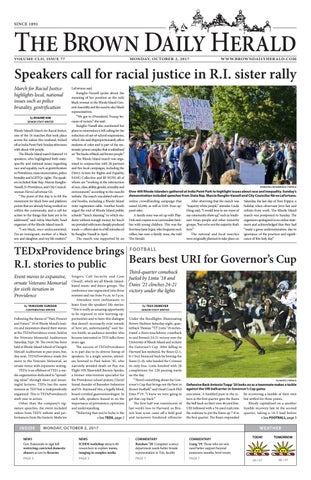
Over 400 Rhode Islanders gathered at India Point Park to highlight issues about race and inequality. Sunday’s demonstration included speeches from State Rep. Marcia Ranglin-Vassell and City Councilor Nirva LaFortune. online crowdfunding campaign that raised $2,040, as well as $101 from apparel sales. A family zone was set up with PlayDoh and crayons to accommodate families with young children. This was the first time Janie Segui, who frequents such rallies, has seen a family zone, she told The Herald.
After observing that the march was “majority white people,” attendee Linda Heng said, “I would love to see more of my community show up,” such as Southeast Asian people and other minority groups, “but we’re not the majority that’s here.” The national and local marches were originally planned to take place on
Saturday, the last day of Yom Kippur, a holiday when observant Jews fast and refrain from work. The Rhode Island march was postponed to Sunday. The organizers apologized in an online statement and acknowledged that they had “made a gross underestimation, due to ignorance, of the practices and significance of this holy day.”
TEDxProvidence brings FOOTBALL Bears best URI for Governor’s Cup R.I. stories to public Event moves to expansive, ornate Veterans Memorial for sixth iteration in Providence By TANUSHRI SUNDAR CONTRIBUTING WRITER
Following the theme of “Past, Present and Future,” 16 of Rhode Island’s leaders and innovators shared their stories at the TEDxProvidence event, held at the Veterans Memorial Auditorium Saturday, Sept. 30. The event has been held at Rhode Island School of Design’s Metcalf Auditorium in past years, but, this year, TEDxProvidence made the move to the Veterans Memorial, an ornate venue with expansive seating. TEDx is an offshoot of TED, a media organization dedicated to “spreading ideas” through short and meaningful lectures. TEDx has the same mission as TED but is independently organized. This is TEDxProvidence’s sixth year in action. Other than the company’s signature speeches, the event included videos from TED’s website and performances from the Eastern Medicine
INSIDE
Singers, Call Security and Case Closed!, which are all Rhode Islandbased music and dance groups. The conference was segmented into three sessions and ran from 9 a.m. to 5 p.m. Attendees were enthusiastic to learn from the speakers’ life stories. “This is really an amazing opportunity to be exposed to new learning opportunities and to have this dialogue that doesn’t necessarily exist outside of here yet, unfortunately,” said Steven Smith, an audience member who became interested in TED talks three years ago. The success of TEDxProvidence is in part due to its diverse lineup of speakers. In a single session, attendees listened to Paul Salem ’85, who narrowly avoided death on Pan Am Flight 103; Shawndell Burney-Speaks, a former intervention specialist for the Providence school system; Cheryl Snead, founder of Banneker Industries and Dr. Raymond Mis, a legally blind, board certified gastroenterologist. In each talk, speakers honed in on the importance of persistence, optimism and understanding. “Believing that you’re lucky is the » See TEDX, page 2
Third-quarter comeback fueled by Linta ’18 and Daies ’21 clinches 24-21 victory under the lights By TESS DEMEYER SENIOR STAFF WRITER
Under the floodlights illuminating Brown Stadium Saturday night, quarterback Thomas “TJ” Linta ’18 orchestrated a three-touchdown comeback to seal Brown’s 24-21 victory over the University of Rhode Island and reclaim the Governor’s Cup. After falling to Harvard last weekend, the Bears (2-1, 0-1 Ivy) bounced back by besting the Rams (1-4), who handed the Crimson its only loss. Linta finished with 28 completions for 226 passing yards on the day. “There’s something about the Governor’s Cup that brings out the best in Brown football,” said Head Coach Phil Estes P’19. “I knew we were going to get that cup back.” The first half was reminiscent of last week’s loss to Harvard, as Bruno’s lone score came off a field goal and turnovers hindered offensive
ELI WHITE / HERALD
Defensive Back Antonio Trapp ’20 looks on as a teammate makes a tackle against the URI ballcarrier in Governor’s Cup game. execution. A fumbled punt in the re- by recovering a fumble of their own turn in the first quarter gave the Rams but settled for three points. the ball back on their own 46 yard line. Rhody capitalized on a another URI followed with a 54-yard rush into fumble recovery late in the second the endzone to put the Rams up 7-0 in quarter, taking a 14-3 lead before the first quarter. The Bears responded » See FOOTBALL, page 3
WEATHER
MONDAY, OC TOBER 2, 2017
NEWS Gov. Raimondo to sign bill restricting convicted domestic abusers access to firearms
NEWS ICERM workshop attracts 60 researchers to explore waves, imaging in complex media
COMMENTARY Renshaw ’20: Computer science department needs better female representation in TAs, faculty
COMMENTARY Liang ’19: Those who are sick need better support beyond awareness months, brief events
PAGE 3
PAGE 3
PAGE 7
PAGE 7
TODAY
TOMORROW
69 / 47
68 / 47
NEWS
PAGE 2 • MONDAY, OCTOBER 2, 2017
THE BROWN DAILY HERALD
BSE sends balloon into atmosphere
Brown Space Engineering team launches their second balloon this year to test space technology By JACKSON WELLS SENIOR STAFF WRITEER
Brown Space Engineering launched a balloon into the upper atmosphere near Springfield, Mass. the morning of Sunday, Oct. 1 as part of a project meant to test new technology and demonstrate the accessibility of space. The balloon reached a height of nearly 100,000 feet and then flew south for two hours before landing in an 80-foot tree in Lebanon, Connecticut, according to Henry Belcaster ’19, the leader of the team behind the balloon project. The balloon was equipped with a number of information-gathering apparatuses, said David Schurman ’20. The balloon itself was attached to a 3.5-kilogram payload, which has sections carved out to hold the technology. It contained a live analog camera that the team checked in real time, a GoPro and a 360-degree video camera. At the Earth’s surface, the balloon was 12 feet in diameter, Belcaster said. The latex balloon was filled with helium, which would cause it to rise. The team carefully planned the launch: After between an hour and a half and two hours, the balloon would reach peak height with a diameter of about 35 feet. At this point, the pressure inside the balloon would exceed that of the atmosphere, and the balloon would burst. A parachute attached to the payload would then deploy, and the contraption would float back down to Earth. The team would track the balloon, which might end up 50 to 60 miles away, via a GPS locator. This is the second balloon launch of the project, Schurman said. At the beginning of last year, the research and development sector of Brown Space Engineering began to look toward the future of space technology and how it
COURTESY OF HENRY BELCASTER
The balloon reached a peak height of almost 100,000 feet and captured live footage of its surroundings during its two-hour descent. could be tested. The resulting idea was to launch a balloon to immensely high altitudes. They began planning that semester and started to assemble the balloon at the beginning of spring. The team launched the first balloon that April, but there were a number of problems. The electronics died before launch due to a bad battery and the assembly process was not organized enough, Schurman said. This second launch was executed “with great success,” Belcaster wrote in an email to The Herald. “Previous systems that failed in our spring launch lasted the entire flight,” he added. Planning for the second launch began this summer, and the team strived to rectify the issues from the previous one, Schurman said. Development continued, culminating with the launch Oct. 1. Another launch is planned for the spring, Belcaster added. The balloon was supposed to collect many different sorts of information, said Asutosh Swain ’20, who worked on the project. Virtual reality would allow people to view the extended 360-degree footage, and there would also be a temperature and altitude reading. There are a number of organizations
that use high-altitude balloons, Belcaster said. The federal government and various meteorological services take advantage of them, as they give a good reading of the atmosphere while being low-cost and quick to return data. One of the main purposes of the launch was to test technology for future projects. Brown Space Engineering is currently working on a satellite called EQUiSat, which is a 10-centimeter “CubeSat.” Its LED lights will be visible from space, shining as brightly as the North Star, Swain said. It will be launched from the International Space Station in March, Schurman said. He also said that the purpose was to make a satellite that was not costly; indeed, the team is aiming to build the satellite for a total of $5,000. Another central focus of the launch is to dispel the perception of space as esoteric, Swain said. Many people have the notion that sending technology into space is an expensive and long endeavor, which is not the case, he added. Making space seem more accessible is one of the goals of the balloon project, emphasized by the fact that there were a number of freshman on the “balloon team,” he said.
COURTESY OF WIKI COMMONS
TEDxProvidence featured video programming alongside its signature speeches that evoked themes of perserverance and optimism.
» TEDX, from page 1 most important thing you can have in life,” Salem said. Salem’s father told him that “he was born under a lucky star,” and this idea eventually came to define Salem’s outlook in life. This mindset not only made him take more chances but also allowed him to persist through periods of temporary failure — like when he applied and was rejected from “a thousand jobs.” He is now the co-founder and senior managing director of Providence Equity Partners. This theme of perseverance came up in other talks. “If there’s an obstacle or challenge, I know there’s a way over it, under it and through it,” Snead said, the first African-American female to graduate with a degree in mechanical engineering from the University of Massachusetts, Amherst. Talks also delved into personal stories and desires for change within Providence. “My dream is to attend more graduation ceremonies, weddings and award ceremonies — not funerals and jailhouse visits of the
The Presidential Faculty Award Lecture
O , : .. JCB Library Nancy Duke Lewis Professor of Modern Culture and Media and Political Science
Bonnie Honig
will deliver the Presidential Faculty Award Lecture What Literature Can Teach Politics: “Moby-Dick” as a Critique of Hobbes’ “Leviathan”
young,” Burney-Speaks said, whose son was murdered in a fatal shooting in Providence earlier this year. Children in Providence need stronger support networks — kids can only thrive when they have positive role models in their lives to mentor them, she said, adding that investing in education would be one of the first steps toward achieving this in Providence. Attendees were enthused by the talks they went to throughout the day. “The performer that I really liked was Christopher Johnson,” said Florence “FloJo” Badejo, a doctoral candidate in pharmacy at the University of Rhode Island. “His spoken word pieces were very inspiring. He had the whole crowd going. You couldn’t sit in that room and not be enthralled by what he had to say and how he had to say it.” “I was just over the moon,” said Darien Strassfield, another student at URI. From the thunderous applause and bustling conversation at the end of the event, there seemed to be inspiration for everyone at TEDxProvidence.
NEWS
MONDAY, OCTOBER 2, 2017 • PAGE 3
THE BROWN DAILY HERALD
R.I. Governor to sign bill limiting access to guns for domestic abusers Rhode Island joins 27 other states, Washington D.C. in passing firearms bill By DYLAN MAJSIAK CONTRIBUTING WRITER
Convicted domestic abusers in Rhode Island will be restricted from owning firearms once the Protect Rhode Island Families Act is signed by Gov. Gina Raimondo this week. By implementing more restrictive measures for gun owners convicted of domestic violence, Rhode Island now joins 27 other states and Washington, D.C. The bill, sponsored by state Rep. Teresa Tanzi, D-Narragansett, and Sen. Harold Metts, D-Providence, was passed Sept. 19 in the House with 58 yes votes and the Senate with 33 yes votes. The bill was initially introduced three years ago by Tanzi, but the proposal was defeated at the time. “It sounds like common sense legislation, but each year we found that it hit roadblocks and had obstacles from different perspectives in the legislature,” said Deborah DeBare, executive director of the Rhode Island Coalition Against Domestic Violence. “So this year we were really pleased to see a revised version of the bill come out that had support from both the House
leadership and the Senate leadership.” Different groups — such as the Rhode Island Coalition Against Domestic Violence, Moms Demand Action for Gun Sense in America, the Rhode Island Coalition Against Gun Violence, as well as a large religious coalition — all advocated for the legislation by attending hearings, publishing papers, lobbying the state house, writing letters and meeting with officials, said Jennifer Boylan, a volunteer leader of Moms Demand Action for Gun Sense in America. Though federal law already restricts domestic abusers from possessing firearms, there was no state-level enforcement in Rhode Island. Tanzi cited a comprehensive study by Everytown for Gun Safety that reviewed three years’ worth of protective orders throughout Rhode Island and found that the courts only issued for firearms to be surrendered 13 percent of the time, despite complainants specifically indicating that people’s lives had been threatened with use of their spouse’s gun. This legislation closes the state-level loophole by requiring that persons convicted of domestic violence and under restraining orders forfeit any guns in their possession within 24 hours. The guns are first to be transferred to a licensed firearms dealer before a third party — who can be neither a relative of the prohibited person nor someone
residing in the same household — assumes responsibility of the firearms. Prohibited persons could collect their guns upon completing their sentence or when their restraining orders are lifted, but the bill imposes severe penalties on persons who manage to take their guns back before their prohibition period is over. “We know that easy access to a gun for domestic abusers can put the victim in an extremely dangerous situation,” Boylan said. “We know that (in) states … where domestic abusers do not have easy access to guns, there’s lower instances of domestic violence shootings and homicides. So we know these laws work.” According to the study conducted by Everytown, the risk of homicide is increased five-fold when an abuser has access to a firearm. In Rhode Island specifically, the study found that 28 percent of women who were killed by their partners between 2008 to 2012 were shot to death. Before the bill was passed, the National Rifle Association issued a statement in June: “Anti-gun groups have co-opted domestic violence organizations simply to notch a victory that they can use as momentum for their larger gun ban agenda.” The statement called on Rhode Island gun owners to push their legislators to oppose the bill. “The Second Amendment folks
KATE TALERICO / HERALD
and the NRA folks were worried that this was just a superficial attempt to have people’s guns taken away. And it really was not the case,” Tanzi said. “It was 100 percent data-driven, and it had nothing to do with taking guns away from law-abiding, responsible gun owners.” “What we have seen is many, many
states over the past 10 years have strengthened laws against domestic abusers,” said Adam Winkler, professor of constitutional law at the University of California, Los Angeles School of Law. “And, in fact, it’s been the kind of restrictive gun law that’s even been adopted in states that are quite hostile to gun control as a general matter.”
Workshop attracts researchers to examine waves, imaging in complex media ICERM event gathers 60 researchers, encourages exchange of ideas, interdisciplinary approach By CATE RYAN CONTRIBUTING WRITER
The Institute for Computational and Experimental Research in Mathematics held a workshop on waves and imaging in random media last week, uniting scientists and mathematicians from different fields, institutions and backgrounds to present research on the many facets of the subject. With so many practical applications, ranging from medical scanning to radar and seismology, the workshop’s focus is one of the “hottest topics in applied mathematics,” and the field has been expanding over the past 20 years, said Kui Ren, a coordinator and professor of mathematics at the University of Texas, Austin. One well-known instance in which waves are used to penetrate “random media” is the common x-ray: Waves travel through tissue to allow a visual of what lies inside, Ren said. Medical implications may offer the most direct and immediate effect on
» FOOTBALL, from page 1 halftime. The second half was an entirely different story, as Brown hung 21 unanswered points on the Rams in the third quarter. Bruno went 74 yards in four plays on its first offensive possession after the half as Linta hit Jakob Prall ’20 for a 41-yard bomb to open the scoring drive. Darius Daies ’21 recorded his first collegiate touchdown in his first
the public — “better resolution” fosters faster detection of birth defects, for example, suggested Chrysoula Tsogka, one of the coordinators of the workshop and professor of applied mathematics at Greece’s University of Crete and Stanford University. Other important applications include monitoring volcanoes, scanning the earth for oil and observing seismic activity. “We would like to understand how complex media might affect our capabilities of imaging,” said Tsogka. Ren called this “one of the central issues in imaging,” due to the fact that “in general there is nowhere you are in a clean environment.” Seeking this understanding meant bringing together a diverse cohort of experts. The workshop gathered about 60 mathematicians and researchers from across the globe and featured 20 speakers with varied research histories. “That’s the goal of this workshop: to make people from different fields meet, talk together and exchange ideas,” said Josselin Garnier, professor of applied mathematics at France’s Ecole Polytechnique and an organizer of the workshop. Tsogka expressed the same sentiment, adding that “ideas that have worked in one application can be
transferred to others. … It’s this interdisciplinary application that usually brings new insights for everybody.” There was generative overlap between two speaker’s presentations, according to Tsogka — a method one had seen work in seismology, another had found to be similarly applicable to optics. “We might see a lot of imaging applications because of that,” she added. A key unifying factor amongst the
workshop’s presentations and the differing fields represented is a single mathematical model, Garnier noted. “The values of the parameters, the scaling regime, what is small, what is large, depends on the application — but the basis is the wave equation,” he said. The wave equation is central to this research, though it is only part of a much larger mathematical picture. At the conference, people were discussing
“almost anything you can think of in mathematics,” Ren said. This workshop is part of ICERM’s semester-long program tackling “Mathematical and Computational Challenges in Radar and Seismic Reconstruction.” The workshop topic was the “perfect fit” for the broader program given its exploration of imaging methodologies that are crucial to these applications, Ren added.
appearance this season, rushing 22 yards and flipping into the end zone to cut Rhody’s advantage to four. “The leaders in the locker room really stepped up at halftime trying to get everyone composed,” said free safety Connor Coughlin ’18. “It was still a ball game. We knew we were playing very well and that we just needed to execute a little better than we did in the first half.” Once the Bears’ offense clicked, there was no stopping it. A pair of
rushes from Daies and another clutch reception by Prall put Brown back in the red zone, where Linta found Issac Whitney ’18 for 18 yards and a touchdown, giving Bruno a 17-14 lead — its first of the game. To cap off the comeback, Daies notched his second rushing touchdown of the night with 2:57 left in the third quarter, bringing the score to 24-14. “We’re trying everything we can now to get the best people on the field
who can give us a spark,” Estes said. “The Darius adjustment was really good. He became our secret weapon.” With the lead, Brown’s defense kept URI in check, allowing only one more score in the final quarter. A desperate attempt to tie the score resulted in a Rhody field goal sailing wide left as the game clock dwindled. Coughlin broke up three passes on the night but made his presence especially known in the fourth quarter, disrupting a completion on a crucial URI fourth down to
settle the final score. Rhode Island Governor Gina Raimondo presented co-captains Isaiah Thompkins ’19 and Richard “Dewey” Jarvis ’17.5 with the Governor’s Cup, as the team celebrated Brown’s 73rd victory in 102 all-time matchups in the series. The Bears are back on the road Saturday, traveling to Florida to face off against Stetson University before returning home to reopen conference play against Princeton Oct. 14.
ANH-LISE GILBERT
SPORTS
PAGE 4 • MONDAY, OCTOBER 2, 2017
THE BROWN DAILY HERALD
W. SOCCER
Bears edged 1-0 in fifth overtime contest of the season Etzel ’19 posts seasonhigh seven saves in 1-0 overtime loss to first-place Columbia By ALEXANDRA RUSSELL SENIOR STAFF WRITER
Following a victory over Dartmouth last weekend to open conference play, the women’s soccer team had its fivegame winning streak snapped, falling to Columbia 1-0 in overtime Saturday. Columbia’s Natalie Neshat scored the evening’s lone goal in the 97th minute, tapping a first-touch shot in the back of the net from the left side of the box. A strong defensive showing allowed the Bears (8-3-0, 1-1 Ivy) to fend off a persistent Lions (6-4-1, 2-0) offense in regulation. Veteran goalkeeper Christine Etzel ’19 made a season-high seven saves in a busy night as Bruno was outshot 18-8 overall and 8-4 in shots on goal. “Our defensive unit was very solid — we handled them well,” Etzel said. “We needed to push the game offensively a bit more and put away some of our chances.”
“Defensively, we’re getting better every game, taking our roles a little bit more seriously and being more aggressive,” said Head Coach Kia McNeill. “The most disappointing part is that I didn’t feel like we threw our full arsenal at them — I didn’t think we had much of an attack.” Offensively, the Bears struggled to capitalize early and establish themselves with enough conviction in the final third to generate goals. “As the game wore on, we didn’t get enough connection from our backs to our forwards, and that was ugly,” McNeill said. “It forced us to play a more defensive game than I would have liked. Columbia did a good job of trying to disrupt our rhythm as a team and really disrupt our attacking presence.” Mikela Waldman ’18 led Bruno with two shots on goal in the loss. As the stakes of conference play rise with five games remaining, the Bears remain confident and focused on securing an Ivy crown. “We know every Ivy League game is just like a championship because we only play each team once,” Etzel said. “The mentality we have going into every game is … really pushing the game,
COURTESY OF BROWN ATHLETICS
Though the Bears brought an impressive five-game winning streak into their game with Columbia, Bruno was on the wrong side of a late overtime goal for only the second time this year, bringing the team’s OT record to 3-2. doing our best to try and get the result we really want.” “The pressure builds with every game, but our team is confident in ourselves and in our ability,” McNeill said. “We just have to play to our potential and we know that.”
McNeill emphasized the importance of effective practice in preparation for this weekend’s clash against a Princeton team that sits tied with Columbia in first place. “We need to have a really focused week of training and really execute a
couple things that will make us dangerous,” McNeill said. “We know what’s on the line, and our team will rise to the occasion.” The Bears will host Princeton at Stevenson-Pincince Field Saturday. Kickoff is scheduled for 3:30 p.m.
M. SOCCER
Bears shutout in first conference road game against Lions
Bears unable to match Columbia’s high-powered offense in 3-0 loss to defending Ivy co-champs By ALEX SMOLAR CONTRIBUTING WRITER
Coming off of a victory against Boston University Tuesday, the Bears took to the road for their Ivy League opener against the Columbia Lions. Bruno (5-2-1, 0-1 Ivy) was unable to capitalize on scoring opportunities and was dealt a 3-0 loss. The Lions (5-0-2, 1-0), who are defending Ivy League co-champions and currently ranked 23rd in the country, were hot coming into conference play after three straight victories. “We created enough chances to win the game,” said Toby Howell ’19. “But we were overall second best to them in and around the box.” The Bears started fast, trying to exploit their height advantage against the Lions with high throw-ins toward the 18-yard box. But Columbia struck first on a counterattack in the sixth minute after a throw-in. The Bears were unable to clear the ball out of their 18-yard box, allowing Dylan Mott to take advantage
of Bruno’s defensive breakdown to create a one-on-one with the goalkeeper and score his first goal of the season. Following the goal, the Bears could not get into an offensive rhythm and failed to consistently get the ball out of their defensive zone. Mott threatened again with a header, but this time it was easily handled by Joey Cipicchio ’18. Columbia looked primed to add a second goal in the middle of the first half, as Cipicchio came out of his box to defend, leaving the net wide open. Fortunately for the Bears, their strong defense was able to shut down the scoring opportunity. The Lions continued to dominate possession of the ball and create shot opportunities throughout the first half. Disaster struck for the Bears in the 35th minute when Columbia forward Arthur Bosua was fouled in the 18-yard box on a corner, leading to a Lions penalty kick. Alex Bangerl took the penalty and placed it perfectly in the top right corner to put the Lions up a pair of goals late in the first half. The one-sidedness was clear in the stats, as the Lions outshot the Bears 10-2 and led 5-3 in corner kicks. As the second half began, both teams traded shots, but none were close to a scoring opportunity.
COURTESY OF BROWN ATHLETICS
Midfielder Daniel Schiller ’20 takes control of the ball. In the first Ivy League match of the season, the Bears were unable to keep the Lions at bay in the box, leading to a 3-0 loss against a formidable Columbia side. Conor Gregory ’20 nearly put the Bears on the board in the 57th minute with a rocket off of a throw-in by Quinn English ’18 that just barely missed the net. The Bears had a much more determined attack in the second half, but the Lions kept Bruno without a shot on goal for most of the period with
timely blocks. Bruno’s strong second half was not enough; after a Bears defensive turnover in the 79th minute, the Lions scored again. The goal from Bosua, off a pass from Beto Carillo, doomed any possibility of a Brown comeback. “We’re frustrated, but we know what we need to work on now, so we’re not
leaving completely empty-handed,” Howell said. “We knew going into this game that our season wasn’t going to be won or lost in the next 90 minutes.” The Bears will look to rebound when they return home for their second Ivy League match against the Princeton Tigers at 7 p.m. Saturday at StevensonPincince Field.
TODAY
MONDAY, OCTOBER 2, 2017 • PAGE 5
THE BROWN DAILY HERALD
menu
s at u r d ay n i g h t l i g h t s
SATELLITE DINING ANDREWS COMMONS
Pizza: Caprese, Chicken Ranch, Pepperoni Poke Bowl JOSIAH’S
BLUE ROOM
Mushroom Swiss Burger, Make Your Own Grilled Cheese
Blue Room Grain Bowl, Turkey Chili, Spinach and Feta Soup
DINING HALLS SHARPE REFECTORY LUNCH
DINNER
Chicken Kiev, Curried Eggplant and Chickpeas, Oatmeal Chocolate Chip Cookies
Lemon Sesame Chicken, Mediterranean White Beans, Magic Bars
VERNEY-WOOLLEY LUNCH
DINNER
Taco Bar, Vegetarian Corn Chowder, Oatmeal Chocolate Chip Cookies
Pizza Rustica with Spinach, Italian Vegetable Saute, Honey Batter Bread
sudoku
ELI WHITE / HERALD
The football team is greeted by fans as it re-enters the locker room after Saturday’s victory over URI. Bruno brought home the Governor’s Cup under three sets of floodlights installed especially for the game.
Q U O T E O F T H E D AY
“I am black, once undocumented, I’m an immigrant, mother of a black son and daughter, and my life
RELEASE DATE– Wednesday, April 4, 2012
Los Angeles Times Puzzle c r o sDaily s w oCrossword rd Edited by Rich Norris and Joyce Nichols Lewis
ACROSS 1 “Survivor” host Probst 5 Dan Patrick’s former employer 9 Treble and tenor 14 Leap on skates 15 By way of, in verse 16 “Groundhog Day” director Harold 17 *Stand to reason 20 Product design dept. 21 Lace place 22 *Show with Sharks 26 Sunset feature 27 Frigid 28 Maritime military org. 29 Liver, for one 31 Part of MoMA 32 Move like a bee 36 *Immature 40 On a clipper, say 41 “Mike Tyson’s Punch-Out!!” video game console 42 Salk vaccine target 43 Aleppo’s land: Abbr. 44 It may precede a treaty 46 Swiss river 47 *”The Impossible Dream” musical 51 Speedily 53 __ male 54 19th-century American doctrine suggested by the phrase formed by the first words of the answers to starred clues 59 Turn __ ear 60 Place with slips and sloops 61 Juggle conflicting demands 62 Word before bad news 63 Canadian singer Murray 64 Offended DOWN 1 Binge 2 Prefix with -thermic
3 Chosen number? 4 Use a line, perhaps 5 Like some cuisine 6 Poor, as craftsmanship 7 Excessively proper type 8 “Kidding!” 9 Preschooler’s writing tool 10 Coating 11 Poet Dickinson 12 “Okay” 13 Army NCO 18 Subduing with a shock 19 Begins 22 “__ gonna call? Ghostbusters!” 23 Bicolor coins 24 Smooth transition 25 Go from blog to blog, say 30 Santa __ winds 31 Many craigslist postings 32 Mel’s Diner waitress 33 Purple shade 34 Former hoops star Thomas 35 Birch of “Ghost World”
37 “__ else?” 38 Soft ball 39 __ Book Club 43 Big Bird’s mammoth friend, familiarly 44 Thoreau memoir 45 Unit of current 47 Like lions and horses 48 Helvetica alternative
”
matters.
49 Like about half of American states’ mottos 50 “You bet!” 51 Basic 49-Down word 52 “I did it!” 55 Massage locale 56 Debtor’s letters 57 “Morning Edition” airer 58 Thus far
— Nirva LaFortune GS, Providence City Councilwoman
See RALLY on page 1.
ANSWER TO PREVIOUS PUZZLE:
xwordeditor@aol.com
calendar
04/04/12
TODAY OCTOBER MARCH
S
M
T
W
Th
F
S
1
2
3
41
52
63
74
85
96
10 7
11 8
12 9
13 10
14 11
15 12
16 13
17 14
18 15
19 16
20 17
21 18
22 19
23 20
24 21
25 22
26 23
27 24
28 25
29 26 By Julian Lim (c)2012 Tribune Media Services, Inc.
04/04/12
30 27
31 28
29
30
31
Vinyasa Yoga 11:00 A.M. Hillel, Winnick Chapel
Fitbit Tech Talk 12:00 P.M. CareerLab
SIAM: Kick-Off Ice Cream Social 5:00 P.M. 170 Hope Street, 108
ChemDUG Meet & Greet 5:30 P.M. Geo-Chem Building, 351
TOMORROW Study Abroad 101 Info Session 12:00 P.M. J. Walter Wilson, 440
Library FYI Workshop 3:00 P.M. Rockefeller Library, Hecker Room
Out of Bounds Sketch Comedy Auditions 6:00 P.M. List Art Building, 120
Telescope Observing Night 7:00 P.M. Ladd Observatory
COMMENTARY PAGE 6 • MONDAY, OCTOBER 2, 2017
THE BROWN DAILY HERALD
comic Comic |Cehyun Firat
Find us online! facebook.com/browndailyherald
browndailyherald.com
@the_herald
Location: 195 Angell St., Providence, R.I. www.browndailyherald.com
@browndailyherald
youtube.com/browndailyherald
Editorial Leadership
Sections
Multimedia & Production
Business
Editor-in-Chief Lauren Aratani
Arts & Culture Editors Ethel Renia Madison Rivlin
Design Editors Christy Leung Ameer Malik Jessica Yu Assistant: Eduard Muñoz-Suñé
General Managers Henry Ritter Ben Wesner
Managing Editors Matt Brownsword Rebecca Ellis Kate Talerico POST- MAGAZINE Editor Saanya Jain BLOGDAILYHERALD Editor Angelica Cotto
Metro Editor Gwen Everett News Editors Isabel Gensler Alex Skidmore Hattie Xu Science & Research Editor Elena Renken Sports Editors Ben Shumate Nicholas Wey COMMENTARY Opinions Editors Connor Cardoso Anuj Krishnamurthy Mili Mitra
Photo Editors Head: Marianna McMurdock Assistant: Lilly Nguyen Gus Reed Sara Runkel Anita Sheih Copy Desk Chief Abby Borges Multimedia Editor Roland High
Directors Sales: Erin Lueck Sales: Matilda Lynton Finance: Reena Zhan Strategy: William Nober Strategy: Caroline Ziegler Managers Sales: Michael Borello Sales: Elizabeth Doykan Sales: Ariel Shusterman Collections: Ravi Betzig
Editorial contact: 401-351-3372 herald@browndailyherald.com
Business contact: 401-351-3260 gm@browndailyherald.com
Submissions: The Brown Daily Herald publishes submissions in the form of op-eds and letters to the editor. Op-eds are typically between 750 and 1000 words, though we will consider submissions between 500 and 1200 words. Letters to the editor should be around 250 words. While letters to the editor respond to an article or column that has appeared in The Herald, op-eds usually prompt new discussions on campus or frame new arguments about current discourse. All submissions to The Herald cannot have been previously published elsewhere (in print or online — including personal blogs and social media), and they must be exclusive to The Herald. Submissions must include no more than two individual authors. If there are more than two original authors, The Herald can acknowledge the authors in a statement at the end of the letter or op-ed, but the byline can only include up to two names. The Herald will not publish submissions authored by groups. The Herald does not publish anonymous submissions. If you feel your circumstances prevent you from submitting an op-ed or letter with your name, please email herald@browndailyherald.com to explain your situation. You can submit op-eds to opinions@browndailyherald.com and letters to letters@browndailyherald.com. When you email your submission, please include (1) your full name, (2) an evening or mobile phone number in case your submission is chosen for publication and (3) any affiliation with Brown University or any institution or organization relevant to the content of your submission. Please send in submissions at least 24 hours in advance of your desired publication date. The Herald only publishes submissions while it is in print. The Herald reserves the right to edit all submissions. If your piece is considered for publication, an editor will contact you to discuss potential changes to your submission. Commentary: The editorial is the majority opinion of the editorial page board of The Brown Daily Herald. The editorial viewpoint does not necessarily reflect the views of The Brown Daily Herald, Inc. Columns, letters and comics reflect the opinions of their authors only. Corrections: The Brown Daily Herald is committed to providing the Brown University community with the most accurate information possible. Corrections may be submitted up to seven calendar days after publication.
Illustrations Editor Pia Mileaf-Patel
Advertising: The Brown Daily Herald, Inc. reserves the right to accept or decline any advertisement at its discretion.
Graphics Editor Laura Felenstein
The Brown Daily Herald, Inc. is a financially independent, nonprofit media organization bringing you The Brown Daily Herald, BlogDailyHerald and Post- Magazine. The Brown Daily Herald has served the Brown University community daily since 1891. It is published Monday through Friday during the academic year, excluding vacations, once during Commencement and once during Orientation by The Brown Daily Herald, Inc. Single copy free for each member of the community. Subscription prices: $200 one year daily, $100 one semester daily.
Directors of Web Development Eli White Ivy Wong
Copyright 2017 by The Brown Daily Herald, Inc. All rights reserved. Periodicals postage paid at Providence, R.I. Postmaster: Please send corrections to P.O. Box 2538, Providence, RI 02906.
COMMENTARY MONDAY, OCTOBER 2, 2017 • PAGE 7
THE BROWN DAILY HERALD
Fighting the tech gender gap at Brown LENA RENSHAW staff columnist Last week, the New York Times published a piece entitled “Push for Gender Equality in Tech? Some Men Say It’s Gone Too Far.” The men in the article argue that Silicon Valley gender diversity initiatives are unnecessary, and that tech companies have completely closed the gender gap. But, in reality, we’re not even close. In 2015, women held only 25 percent of all computing jobs, a figure that has been declining since 1991, when it was at 37 percent. At Brown, nine of the 40 faculty members of the computer science department are women. The gender gap isn’t caused by biological differences between genders or lack of interest in computer science. It is caused by systemic issues perpetuated by those in the tech world — including universities like Brown, where computer science is the most popular concentration — that make it less accessible to nonmale participants. Gender inequality in tech is a real problem, and colleges have a responsibility to use their influence and clout to take action. Gender discrepancies in computer science at Brown might not be immediately apparent. The introductory sequences seem to have a pretty good balance of women and men, and a lot
of the teaching assistants are women. Unfortunately, as you move into upper level classes, there are fewer and fewer women. As a computer science concentrator and a teaching assistant myself, I’ve noticed many reasons for this imbalance. I certainly felt that several students, especially men, in the introductory sequence I took my freshman year had more coding experience and that I wouldn’t ever be able to match them. In addition, imposter syndrome — which describes individuals who are marked by an inability to
tion, they should remind students that bragging about how fast they finished projects or how easy things are is unhealthy, because those projects might not be easy for everybody. Simple acts like this could help students stick with a field they enjoy. Further, improving the gender diversity of TA staffs can encourage more women to participate in the computer science department. At a mandatory diversity training I attended this fall for computer science TAs, I was struck by how few of the upper level
because they have served as role models and mentors to me,” said Eleanor Avril ’20, a friend of mine who studies computer science. “I’ve had some really great male TAs, certainly, but sometimes I feel more of an immediate connection with my female TAs.” But hiring female TAs can be hard to do if women don’t take upper level classes. In the class that I am a TA for, only one of every six students is female. Again, this is why it’s so important to make sure that women who are interested in computer science stick with it. The
For those of us in the tech world, nothing regarding the gender gap in technology is news. It’s an issue we hear about every single day. At Brown, we have a responsibility to take action to rectify this discrepancy.
internalize their accomplishments and a persistent fear of being exposed as a “fraud” — is something that particularly impacts women in the department. That is probably because success for women is often contradicted by societal expectations; women just aren’t expected to do well in STEM fields. To make the computer science department more inclusive and retain more women, professors need to explicitly address the self-doubt that female students may feel, particularly at the introductory level. In addi-
course TAs were female. Sure, I was the only female TA on my staff, but I didn’t realize this would be true for almost every course represented. Some TAs at the training even voiced their concerns about how to treat women fairly in their course, given their staff had no women at all. Since the TA system is such a big part of the computer science department at Brown (this semester there are over 250 TAs), the department needs to do more to make sure the TA staff for every class is diverse. “I really like having female TAs
fewer women who progress to upper level courses, the fewer women TAs for those courses — which creates a vicious cycle of exclusion. And, though there may be smaller applicant pools of women for TA positions in certain courses, the department should do its best to refrain from hiring all-male TA staffs. Revisiting hiring practices for TAs is a concrete step Brown can take to make sure that women continue to feel comfortable and supported in the department. For those of us in the tech world,
nothing regarding the gender gap in technology is news. It’s an issue we hear about every single day. At Brown, we have a responsibility to take action to rectify this discrepancy. To its credit, Brown does okay: 37 percent of computer science graduates at Brown are women, which is not an impressive number, but it’s better than the national average. Student-led initiatives like Women in Computer Science, Women in Science and Engineering and diversity advocacy in the computer science department are amazing, but the work can’t stop there. The pipeline begins through education, and we ought to arm women with the tools and drive they need to succeed in the tech world. Brown’s own faculty seem to agree. Tom Doeppner, associate professor of research of computer science and vice chair of the Department of Computer Science, told me, “I have a granddaughter who has just started high school and is showing some interest in computer science — I really want her to have a fair chance at succeeding if she decides to go on with (it).” Let’s stop pretending that the gender gap has been solved or is a joke or is less of an issue than it really is. Let’s instead promote the measures already in place and push our universities to take these initiatives even further.
Lena Renshaw ’20 can be reached at lena_renshaw@brown.edu.
Emperor of all maladies MARK LIANG staff columnist My mother has breast cancer. It takes a lot for me to write that. It was caught early. The timeline, as it often does in times of trauma, flashes in bits and pieces. I remember whispered conversations in the shoe aisles of thrift stores. There are the hushed phone calls, the second opinions and the blood tests. My family, filled with experienced and knowledgeable doctors, sitting silently in a room with nothing to say. She had surgery as I flew back to campus this semester, and her chemotherapy will continue on through Thanksgiving, Christmas and the next year. “Cancer, the emperor of all maladies,” writes Siddhartha Mukherjee in his 2011 Pulitzer Prize-winning book. It is an insidious disease, thriving in the shadows and recurring out of the blue. It can hide in the prostate and emerge in the brain or the lungs. It kills, often tragically and painfully. And, as researchers are currently studying, its causes can be passed down from generation to generation. My grandmother had breast cancer. Her husband, my grandfather, died of cancer. For families like mine, with patterns of recurrence, the standard protocol is genetic testing. And so, last month, my mother deposited another sample of blood and the fear of cancer entered another person’s chapter: mine. As students and young adults, we often
think in terms of immortality. We might complain about exams or the pace of classes, but most of us view life as demarcated by years, even decades, rather than months or weeks. Very few of us are unlucky enough to become preoccupied with death — our own and others’. But trust me, many students are. Society may celebrate the causes célèbres, such as Lady Gaga coming out with fibromyalgia or Selena
sickness, physical or mental, thrives on isolation and secrecy. And I’ve learned in the worst possible way that it’s not enough to talk about these things — we have to actually engage with them. October is Breast Cancer Awareness Month. It is part of a long cycle of events across the country and on campus to raise money for one sickness or another. Brown Football Bench
October is Breast Cancer Awareness Month. It is part of a long cycle of events across the country and on campus to raise money for one sickness or another. It becomes easy for these activities to become mere words on a resume, a social activity or part of an afterthought.
Gomez getting a kidney transplant for her Lupus. Hell, Julia Louis-Dreyfus just came out with her own breast cancer diagnosis and used it to advocate for accessible national healthcare. But a good majority of health issues impact people, including people on campus, who aren’t afforded that kind of exposure. Cancer and disease in general are often talked about in whispers, with shame or a sort of pity. At least for my family, it’s something we kept within closed walls, as a private matter. Even then, my mom didn’t tell me about her diagnosis for weeks. But I think that all
Press for Cancer. Relay for Life. It is very easy to fall into this pattern of participation, where you take part in a challenge for five minutes, raise some money and move on with your life. I know I have done this in the past: Anybody remember the Ice Bucket Challenge? Do we still remember what we raised money for? It becomes easy for these activities to become mere words on a resume, a social activity or part of an afterthought. But we should take the time to Google search Lawrence Rubida ’05, a Brown football player whose death led to the first Bench Press for Cancer. We should fol-
www.browndailyherald.com
low up with students on medical leave, because these are the people who are directly impacted. We shouldn’t forget them. Sickness is ubiquitous in society, but how we deal with disease varies immensely. Communities in college are unique because they completely turn over their populations in four years. Trends can rise and fall and things can be forgotten, no matter how much they mattered once upon a time. But the momentum we gain for disease awareness should not lose energy at the end of the month, or the end of the academic year or even after our time at Brown. We cannot overlook the individuals in our own communities who face illness even after the awareness month, the bench presses and the video challenges end. Every year, I shop ANTH 0300: “Culture and Health,” and every year I have to drop it because it doesn’t fit in with my schedule. I’ve kept the syllabus, nevertheless, and have slowly made my way through the reading list on my own time. There is a graphic novel, “Cancer Vixen,” about a hip, fashionable New Yorker who survived breast cancer; she is supported by her own mother, her fiancé and a nearly endless list of friends. She fights, she suffers and she ultimately survives. Her story offers a visceral look on what it really means to be affected by sickness. I often wondered why the class is asked to read such a narrative in the first few weeks of the course. But after giving a copy to my mom, I think I know.
Mark Liang ’19 can be reached at mark_liang@brown.edu.
SPORTS THE BROWN DAILY HERALD
MONDAY, OCTOBER 2, 2017
W. VOLLEYBALL
Bears fall to Princeton, raise over $9,000 for ALS research Despite closely decided first, third sets, Bruno loses to Tigers in annual Strike ALS match By MARI HERREMA CONTRIBUTING WRITER
At the annual Strike ALS match Friday, the volleyball team fell three sets to zero against Princeton, the defending Ivy League Champions. Despite the outcome, standout performances from Shirin Tooloee ’18 and Joanne Won ’21 and a near-comeback in the third set kept the crowd excited. In the first set, Bruno’s (5-9, 0-3 Ivy) high energy manifested itself into crisp passing and sharp attacks that kept the Tigers (10-3, 3-0) on their toes. A five point streak bolstered by Tooloee’s dominance from the baseline gave Brown a 14-12 lead. But the advantage was short-lived — after leveling the score at 15, Princeton kept the lead and ultimately won the set, 25-21. The hope of a fresh start in the second set did not last long. Bruno dropped the first three points and never recovered the lead. Princeton’s blocking was nearly impeccable, particularly against attacks from Bruno’s right side hitters, while the Bears’ blocking faltered more than
it succeeded. The Tigers won the set 25-16. “In the first set, they fought really hard,” said Head Coach Diane Short of her team. “In the second set, we ran into a bad rotation that seemed to suck all the energy out of us.” The third set saw a complete reversal. After regrouping in the locker room, Brown found its rhythm again. A solo block by Courtney Palm ’19 followed shortly by a kill from Tooloee — her ninth of the match — set the pace, as Bruno took a 2-0 lead in the set. “We realized that we all need to come together and bring our energy back up,” Tooloee said. “That was the big difference. In the first and third sets we had so much energy and we were so excited to play. In the second set we just kinda lost it a little bit.” Despite the Bears’ rally, the Tigers got a second wind after calling timeout trailing 17-20. Bruno became scrambled on court, losing rallies on attack errors and miscommunications. Ultimately, Princeton scraped by in the set with a 25-23 win to claim the match. In the loss, Tooloee had a .310 hitting percentage and led the team with 12 kills. Won registered a teamhigh 13 digs in only her second Ivy League apperance as Brown’s libero. Despite the loss, Coach Short,
ELI WHITE / HERALD
Bruno volleyball fell in three sets to Princeton in the team’s annual Strike ALS match, which raised over $9,000 for ALS research, surpassing a $6,000 fundraising goal set by the team earlier in the week. Tooloee and teammates have reason to be optimistic. For one, the Spike ALS Match raised over $9,000 — far exceeding the $6,000 goal — to support ALS research. The Bears are also
eager for the chance to test themselves on court again. “If anything, this makes us just want to win more,” Tooloee said. “We have fueled the fire now.”
Brown dropped Saturday’s match to Penn in five sets. The team will continue conference play, hosting Cornell Friday and Columbia Saturday.
To learn more, visit watson.brown.edu/events