SINCE 1891
THE BROWN DAILY HERALD MONDAY, OCTOBER 29, 2018
VOLUME CLII, ISSUE 90
WWW.BROWNDAILYHERALD.COM
Scooter regulations stress access, affordability Unioni-
zation vote set for Nov. 14, 15
Department of Public Works regulates number, distribution of Bird, Lime electric scooters By HENRY DAWSON STAFF WRITER
Electric scooters made their return to Providence earlier this month with rideshare companies Bird and Lime. Last July, Bird’s surprise overnight debut encountered pushback after the scooters interrupted traffic flow and obstructed sidewalks. Bird subsequently discontinued the service to be compliant with Department of Public Works policy while the department began work on new regulations for electric scooters in the city. The department’s new rules — released in August — regulate the placement and use of electric scooters over the course of a year-long trial period. According to the policy, there can be no more than 300 active scooters within the city, and the “fleets” must be distributed evenly throughout Providence’s five districts. The City tried to “ensure that the zones pushed scooter companies to provide mobility access to Providence residents with an eye to both racial and income equity,” wrote Ben Smith, deputy director of communications for Mayor Jorge Elorza, in an email to The Herald. These goals tie into the affordability programs offered by the services; Lime
SUGSE, AFT have filed election petition, submitted authorization cards supporting vote By ERIC CHOI SENIOR STAFF WRITER
GUS REED / HERALD
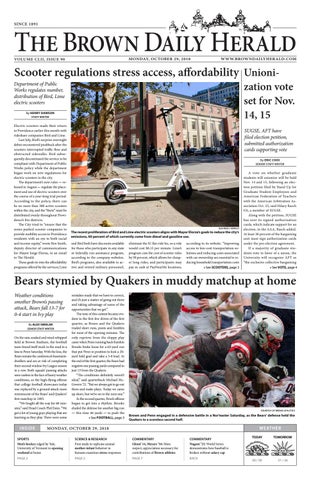
The recent proliferation of Bird and Lime electric scooters aligns with Mayor Elorza’s goals to reduce the city’s emissions, 90 percent of which currently come from diesel and gasoline use. and Bird both have discounts available for those who participate in any state or federally run assistance program, according to the company websites. Bird’s programs, also available to active and retired military personnel,
eliminate the $1 flat-ride fee, so a ride would cost $0.15 per minute. Lime’s program cuts the cost of scooter rides by 50 percent, which allows for cheaper long rides, and participants may pay in cash at PayNearMe locations,
according to its website. “Improving access to low-cost transportation solutions and reducing costs associated with car ownership are essential to reducing household transportation costs » See SCOOTERS, page 3
A vote on whether graduate students will unionize will be held Nov. 14 and 15, following an election petition filed by Stand Up for Graduate Student Employees and American Federation of Teachers with the American Arbitration Association Oct. 25, said Hilary Rasch GS, a member of SUGSE. Along with the petition, SUGSE has sent its signed authorization cards, which indicate support for an election, to the AAA, Rasch added. At least 30 percent of the bargaining unit must sign authorization cards under the pre-election agreement. If a majority of graduate students vote in favor of a union, the University will recognize AFT as “the exclusive collective bargaining » See VOTE, page 4
Bears stymied by Quakers in muddy matchup at home Weather conditions smother Brown’s passing attack, Bears fall 13-7 for 0-4 start in Ivy play By ALEX SMOLAR SENIOR STAFF WRITER
On the rain-soaked and wind-whipped field at Brown Stadium, the football team found itself stuck in the mud in a loss to Penn Saturday. With the loss, the Bears remain the conference’s basementdwellers and are at risk of completing their second winless Ivy League season in a row. Both squads’ passing attacks were useless in the face of heavy weather conditions, so the high-flying offense that college football showcases today was replaced by a ground attack more reminiscent of the Bears’ and Quakers’ first matchup in 1895. “We fought all the way for 60 minutes,” said Head Coach Phil Estes. “We got a lot of young guys playing that are learning as they play. There were some
INSIDE
mistakes made that we have to correct, and it’s just a matter of going out there and taking advantage of some of the opportunities that we get.” The tone of this contest became evident in the first few drives of the first quarter, as Bruno and the Quakers traded short runs, punts and fumbles for most of the opening minutes. The only reprieve from the sloppy play came when Penn running back Karekin Brooks broke loose for a 63-yard run that put Penn in position to kick a 20yard field goal and take a 3-0 lead. At the end of the first quarter, the Bears had negative one passing yards compared to just 13 from the Quakers. “The conditions definitely weren’t ideal,” said quarterback Michael McGovern ’21. “But we always got to go out there and make plays. Today we came up short, but we’re on to the next one.” In the second quarter, Penn’s offense began to get into a rhythm. Brooks eluded the defense for another big run — this time 46 yards — to push the » See FOOTBALL, page 3
COURTESY OF BROWN ATHLETICS
Brown and Penn engaged in a defensive battle in a Nor’easter Saturday, as the Bears’ defense held the Quakers to a scoreless second half.
WEATHER
MONDAY, OCTOBER 29, 2018
SPORTS Men’s hockey edged by Yale, University of Vermont in opening weekend at home
SCIENCE & RESEARCH First study to replicate animal mother-infant behavior in humans examines stress responses
COMMENTARY Glenn’ 14, Meyers ’16: More respect, appreciation necessary for contributions of Brown athletes
COMMENTARY Nugent ’21: World Series demonstrates how baseball is broken without salary cap
PAGE 2
PAGE 2
PAGE 7
BACK
TODAY
TOMORROW
58 / 38
51 / 36
NEWS
PAGE 2 • MONDAY, OCTOBER 29, 2018
THE BROWN DAILY HERALD
Bears edged by Yale, Vermont in opening weekend Crozier ’22, Jallen ’22 score first career goals, penalty kill goes five-forfive against Yale Friday By ALEXANDRA RUSSELL SPORTS EDITOR
The men’s hockey team opened its season with a pair of close contests this weekend, falling to Ivy rival Yale 3-2 Friday and recording a 2-1 loss to the University of Vermont Sunday. A trio of Bears scored in the contests, including Tristan Crozier ’22 and Justin Jallen ’22, who posted their first career goals Friday and Sunday, respectively. Trey Dodd ’20 also recorded a pair of assists over the weekend. Brown 2, Yale 3 Friday night, Crozier and Brady Schoo ’19 each scored to equalize the game, but the Bears (0-2, 0-1 ECAC) were edged by the Bulldogs (1-0, 1-0) in a back-and-forth matchup at Meehan Auditorium. Joe Snively put Yale on the board at the 14-second mark with a goal on the team’s first shot of the evening, but Crozier answered 10 minutes later for the Bears. Alone in the left circle, Crozier collected a feed from Alec Mehr ’21 and sent the puck past Bulldogs netminder Corbin Kaczperski to tie the game at one. “It was a really nice pass by (Mehr) — our line’s been working really well,” Crozier said. “I just tried to get it off my stick as quickly as I could, and I was fortunate enough for it to go in the net.” Snively notched his second score of the evening, an unassisted goal off of a turnover, to give Yale a 2-1 advantage before the period was over. But Schoo responded two and a half minutes into the second frame, sending the puck rotating past Kaczperski catcher side on a wrist shot. Dodd and
COURTESY OF BROWN ATHLETICS
The men’s hockey team opened its 2018-19 campaign with a pair of close duels against Yale and the University of Vermont this weekend at Meehan Auditorium. The Bears will continue conference play with visits to Colgate University Friday and Cornell Saturday. Jallen recorded assists on the play. Luke Stevens added a goal to reclaim the lead for Yale late in the second period. The Bears mounted a late offensive surge and peppered the Bulldogs’ net with shots in the third, outshooting Yale 13-4 in the stanza, but Kaczperski held off the attack to seal the victory for the Elis. “It would be really nice to get some more shots on net, and I think if we’re more tenacious on the forecheck, we’ll be able to turn over more pucks and hopefully have a better result in the end,” Crozier said. In the crease, goaltender Luke Kania ’21 posted 23 saves. Brown went five-for-five on the penalty kill, denying Yale the chance to convert. “The penalty kill was excellent. … It was the best I’ve seen in a long time,” said Head Coach Brendan
Whittet ’94. “We pressured very well, I thought we took away their time and space and I thought we took away their options.” “We’ve been doing a good job pressuring them both in their zone and in our zone” on the penalty kill, Jallen said. “We really want to force them to make a play they don’t want to make, and so far, it’s been working out for us.” Brown 1, Vermont 2 Two nights later, Bruno led the University of Vermont (2-2, 0-1 Hockey East) by one entering the third period, but the Bears were unable to maintain the advantage as the Catamounts notched a pair of goals for the comeback in the final frame. The Bears dominated possession and pressured the Vermont net early
in the first, recording nine shots on goal during the period. Catamounts netminder Stefanos Lekkas was able to fend off Bruno’s persistent offense until Jallen found the back of the net late in the second stanza. Joachim Weberg ’21 came from behind the net and drove the puck into the crease, where Lekkas made the initial save before Jallen finished off the rebound. Christan Evers equalized the game six minutes into the third with a power play goal for Vermont before Craig Puffer scored five minutes later to claim the lead. Netminder Gavin Nieto ’20 recorded 27 saves as the Bears were edged in shots 29-28. As the Bears seek to increase offensive production, Whittet emphasized the importance of playing with poise and composure in the zone.
“We have to find a way to change angles where we’re shooting from, we have to find a way to miss shinpads (and) we have to find a way to get the rebounds,” Whittet said. “We’ve got to be a little calmer maybe around the net … (and) have a poise to us.” Looking ahead to a pair of visits to Colgate University and Cornell this weekend, the team maintains a positive and industrious approach. “Our goaltending’s been really good, and I think that we’ve done a really good job outworking opponents,” Jallen said. “We just haven’t been able to find a way to win yet, but I think that’ll come with time, and if we continue to work hard, I think this team will find success very soon.” The Bears will face off against Colgate Friday and Cornell Saturday.
Study shows breastfed infants have higher stress tolerance Study first to replicate animal research on mother-infant behavior using human participants By JANET CHANG CONTRIBUTING WRITER
A study published this month illustrates a biological link between a mother’s breastfeeding and other nurturing behaviors on the health of her baby. The study showed that breastfeeding is associated with higher tolerance to stress, as indicated by difference levels in cortisol — a stress response hormone. Additionally, a
second biomarker used was DNA samples from buccal cells, or cheek swabs, that showed the degree of suppression of genes related to stress. The study is the first to replicate animal studies investigating how mother-infant behavior can affect infant health using human participants, said Barry Lester, professor of psychiatry and pediatrics and lead author of the study. Previous studies were only performed on rodents, he added. In consideration of how the findings from animal studies apply to human studies, “if that were true in humans, the implications are staggering,” Lester said. The study divided mother-infant
pairs into two groups: one group of infants that was breastfed and another that was not. Infants that were breastfed saw lower levels of DNA methylation — a process that suppresses genes — of stress-related genes such as NR3C1. “You can have a methylation test comparable to a blood test that can determine your methylation,” Lester said. “If moms are depressed during pregnancy, the fetus also has increased methylation of NR3C1, and (cortisol is) more reactive at birth.” But there is not yet a biomarker currently available for use in screenings or treatment, he added. The study “demonstrates the
importance of supporting the early caregiving environment and how critical it is for helping children to develop appropriate stress response systems … and coping patterns,” said Elisabeth Conradt, assistant professor of developmental psychology at the University of Utah and an author of the study. Conradt also acknowledged that breastfeeding children may not always be possible. “There are many challenges associated with breastfeeding and we shouldn’t assume that all parents are able to do it,” she said. Both Lester and Conradt agreed on the need for follow-up studies to replicate these results. “The sample
size was lower than what would have been ideal,” Conradt said. “We are planning on performing a replicating study (at the University of Utah), … and we also hope to see some longitudinal studies.” “In the future, we can … look at other markers and behavioral parameters,”said Todd Levine, clinical associate professor of psychiatry and human behavior, who was unaffiliated with the study. Overall, the study has “strong implications for how we raise children,” Levine added. The research is “a point of pride” for the hospital, he said.
NEWS
MONDAY, OCTOBER 29, 2018 • PAGE 3
THE BROWN DAILY HERALD
» FOOTBALL, from page 1 Quakers down to the three-yard line. But the Brown defense stepped up and ripped the ball from running back Abe Willow’s grasp. Michael Hoecht ’20 jumped on the fumble and saved Bruno from falling into a deeper hole. But Brown could not hold off the Quakers forever. With less than three minutes left in the half, Penn quarterback Nick Robinson led his offense into the red zone and found Steve Farrell in the back right corner of the end zone on 3rd and 11. With the touchdown, the Bears found themselves facing a 10-point deficit. Bruno’s prospects for victory deteriorated again before halftime, as Penn regained possession with a bit more than two minutes to play. The Bears earned a stop at midfield, but a penalty for roughing the kicker on the ensuing punt gave the Quakers 15 yards and a first down. Penn capitalized on Bruno’s special teams error, and knocked in a field goal before the half to take a 13-0 lead. Brown’s offense left much to be desired in the first half — the team had no passing yards, only one first down and 49 rushing yards. Meanwhile, the Quakers ran wild in the mud, and rushed for 211 yards in just 30 minutes of play. In the final two quarters, the Bears’ defense absolutely shut down the Quakers offensive attack. In the first drive after halftime, Bruno forced a turnover on downs, and after McGovern threw an interception deep in Bears’ territory, Brown blocked a field goal. But besides one punt after another, the rest of the quarter and the start of the fourth were devoid of highlights. “We all flew to the ball and we all played our assignments pretty well,”
said linebacker Brendan Pyne ’20. “The coaches put us in good position for this game, and we just gave it our all.” As the clock ticked towards zero, the Bears’ offense finally came to life. Wide receiver Scott Boylan ’21 escaped for a 28-yard run to put Brown in scoring position. But on the next play, McGovern was engulfed by the Quakers’ defensive line and fumbled the ball to end Bruno’s drive without critical points. On the Bears’ last chance of the game to prevent another shutout, McGovern led his team down the field for a touchdown. A 27-yard pass to Graeme Davis ’21 put the Bears deep in Quaker territory, and Jakob Prall ’20 capped the drive with a 20-yard touchdown reception with only 27 seconds to go. “We scored,” Estes said. “We got to do that more often.” The score cut the Quaker lead to six, but the touchdown ultimately was too little, too late. Brown attempted an onside kick, but Penn recovered, and ended any chance of a comeback by the Bears. “You’re always trying to score,” McGovern said. “It’s definitely nice getting the zero off the board. We’re just going to go into the next game the same as every other game — trying to get a win, stay confident, stay up (and) keep our heads high.” When the final whistle sounded, the Quakers had outgained the Bears 370-195 in total yards, and 18-11 in first downs. McGovern was 9-19 with 93 yards, a touchdown and an interception in the loss. Boylan led Bruno on the ground with 44 yards rushing. The Bears have three more chances this season to earn a win in the Ivy League and climb out of the conference basement. Brown will travel to New Haven Saturday to take on Yale at 1 p.m.
USHA BHALLA
» SCOOTERS, from page 1 for Providence residents,” Smith wrote. The Department of Public Works’ policy also re-iterates ordinances against obstructing the public rightof-way to prevent scooters from being parked and tipped over in front of residences and businesses. Scooters are now equipped with instructions on proper parking and outfitted with tip-over sensors. In line with the policies introduced with the bike-share programs, Lime
and Bird also “must agree to share all data with the City at no cost in order to be eligible for authorization,” Smith wrote. This data is important for developing apps such as the Transit App, ensuring companies comply with regulations and informing future planning decisions on public use of the scooters. Currently, 90 percent of the city’s emissions come from diesel and gasoline, but Elorza has set a goal for Providence to become carbon neutral by 2050. As the trial period for the
scooters moves forward, environmental groups in the city will assess the scooters’ effect on carbon emissions. The Office of Sustainability of the City of Providence is looking to update their greenhouse gas inventory for next year and will be able to assess the impact of the ridesharing services in greater detail after the report is released, said Municipal Energy Manager Dino Larson. Bird and Lime spokespeople could not be reached for comment by press time.
NEWS
PAGE 4 • MONDAY, OCTOBER 29, 2018
THE BROWN DAILY HERALD
» VOTE, from page 1
ROLAND HIGH / HERALD
University graduate students planning to vote on unionization follow in the footsteps of Georgetown University graduate students, who will vote on unionization Nov. 5 to 8.
Brown University Presents
A Conversation with
John Banville “Without question, one of the great living masters of English-language prose.” – Timothy Rutten, The Los AngelesTimes
Monday, 29 October at 7 pm 001 Salomon Center Following a short reading from his work, distinguished Irish novelist John Banville, author of the Booker Prize-winning novel, The Sea, will be joined in conversation by Paul Armstrong, Professor of English. This event has been made possible by support from Marshall Woods Lectureship Foundation of Fine Arts, the Brown Arts Initiative, a Salomon Curricular Mini-Grant and is sponsored by the departments of Literary Arts and English
representative,” according to the agreement. The University’s “principal relationship with graduate students is as students,” wrote Provost Richard Locke P’18 in a recent email to the University community, adding that the administration “has consistently affirmed that we would comply with the prevailing law and support discussions among graduate students.” The filing comes alongside recent developments at Georgetown University, where graduate students will also vote on unionization Nov. 5 to 8. Similar to SUGSE, Georgetown Alliance of Graduate Employees signed a pre-election agreement with Georgetown in April.
TODAY
MONDAY, OCTOBER 29, 2018 • PAGE 5
THE BROWN DAILY HERALD
menu
t h r o u g h t h e l e av e s
SATELLITE DINING ANDREWS COMMONS
Pizza: Sammy Special, Barbecue Chicken Ranch, Caprese Pulled Pork Sandwiches, Queen’s Green Salad JOSIAH’S
BLUE ROOM
Chicken Pot Pie, Panini Grill, Southwestern Bean Burger
Turkey Chili, Blue Room Grain Bowl, Tom’s Bao Bao
DINING HALLS SHARPE REFECTORY LUNCH
DINNER
Roast Chicken Sambal with Chimichurri Sauce, Sticky Rice, Rice Krispie Treats
Asian Style Barbecue Ribs, Stewed Black Barley, Coconut Cream Pie
VERNEY-WOOLLEY LUNCH
DINNER
Cajun Pasta with Chicken, Grilled Vegetable Quiche, Spicy French Fries
Taqueria, Italian Meatballs with Sauce, Pizza Rustica with Spinach, Italian Bread
sudoku
DANIELLE EMERSON / HERALD
crossword
The First Unitarian Church of Providence, which sits at the corner of Benefit Street and Benevolent Street, was constructed in 1816 and hosts the annual commencement ceremony of the Alpert Medical School.
Q U O T E O F T H E D AY
“
We scored. We got to do that more often.
”
— Head Football Coach Phil Estes See FOOTBALL on page 1.
calendar TODAY OCTOBER
S
7
M
T
W
Th
F
S
1
2
3
4
5
6
8
9
10
11
12
13
13
14
15
16
17
18
19
20
21
22
23
24
25
26
27
28
29
30
31
Twitter Lobby Hours 10:00 A.M. CIT, 1st Floor Lobby
Music Now with Shawn Jaeger 12:00 P.M. Orwig Music Building
Careers in Public Policy 12:00 P.M. Joukowsky Forum
Luke Moldof Exhibit: Traditional Terrain 1:00 P.M. List Art Gallery, 221
TOMORROW Chinese Language Table 12:00 P.M. Page-Robinson Hall, 340
Natasha Eaton: Decolonial Mimesis in South Asia 4:00 P.M. Watson Institute
Wellness at Brown 12:00 P.M. Friedman Hall, 201
Econometrics Seminar with Kevin Song 4:00 P.M. Robinson Hall, 301
COMMENTARY PAGE 6 • MONDAY, OCTOBER 29, 2018
THE BROWN DAILY HERALD
Find us online! facebook.com/browndailyherald
browndailyherald.com
@the_herald
Location: 195 Angell St., Providence, R.I. www.browndailyherald.com
@browndailyherald
youtube.com/browndailyherald
Editorial Leadership
Sections
Multimedia & Production
Business
Editors-in-Chief Elena Renken Kasturi Pananjady
Arts & Culture Editors Ethel Renia
Design Editors Kyle Cui Eduard Muñoz-Suñé Assistants: Julie Wang, Kelvin Yang
General Managers Michael Borrello Matilda Lynton
Managing Editor Alex Skidmore
Metro Editors Emily Davies Isabel Gensler
Senior Editors Madison Rivlin Ben Shumate Hattie Xu
News Editors Eduard Muñoz-Suñé Priyanka Podugu Sarah Wang
Editorial Page Editor Anuj Krishnamurthy
Science & Research Editors Jonathan Douglas Jackson Wells
POST- MAGAZINE Editor-in-Chief Jennifer Osborne
Sports Editors Alexandra Russell James Schapiro COMMENTARY Opinions Editors Connor Cardoso Anuj Krishnamurthy Clare Steinman Emily Miller
Photo Editors Sam Berube Anita Sheih Copy Desk Chief Kelley Tackett Illustrations Editor Daphne Zhao Video Editor Celia Hack Graphics Editors Marlis Flinn Sarah Martinez
Office Manager Diane Silvia Directors Sales: Shreya Raghunandan Finance: Ravi Betzig Strategy: Edwin Farley
Editorial contact: 401-351-3372 herald@browndailyherald.com
Advertising contact: 401-351-3372 advertising@browndailyherald.com
Submissions: The Brown Daily Herald publishes submissions in the form of op-eds and letters to the editor. Op-eds are typically between 750 and 1000 words, though we will consider submissions between 500 and 1200 words. Letters to the editor should be around 250 words. While letters to the editor respond to an article or column that has appeared in The Herald, op-eds usually prompt new discussions on campus or frame new arguments about current discourse. All submissions to The Herald cannot have been previously published elsewhere (in print or online — including personal blogs and social media), and they must be exclusive to The Herald. Submissions must include no more than two individual authors. If there are more than two original authors, The Herald can acknowledge the authors in a statement at the end of the letter or op-ed, but the byline can only include up to two names. The Herald will not publish submissions authored by groups. The Herald does not publish anonymous submissions. If you feel your circumstances prevent you from submitting an op-ed or letter with your name, please email herald@browndailyherald.com to explain your situation. You can submit op-eds to opinions@browndailyherald.com and letters to letters@browndailyherald.com. When you email your submission, please include (1) your full name, (2) an evening or mobile phone number in case your submission is chosen for publication and (3) any affiliation with Brown University or any institution or organization relevant to the content of your submission. Please send in submissions at least 24 hours in advance of your desired publication date. The Herald only publishes submissions while it is in print. The Herald reserves the right to edit all submissions. If your piece is considered for publication, an editor will contact you to discuss potential changes to your submission. Commentary: The editorial is the majority opinion of the editorial page board of The Brown Daily Herald. The editorial viewpoint does not necessarily reflect the views of The Brown Daily Herald, Inc. Columns, letters and comics reflect the opinions of their authors only. Corrections: The Brown Daily Herald is committed to providing the Brown University community with the most accurate information possible. Corrections may be submitted up to seven calendar days after publication. Advertising: The Brown Daily Herald, Inc. reserves the right to accept or decline any advertisement at its discretion. The Brown Daily Herald, Inc. is a financially independent, nonprofit media organization bringing you The Brown Daily Herald, BlogDailyHerald and Post- Magazine. The Brown Daily Herald has served the Brown University community daily since 1891. It is published Monday through Friday during the academic year, excluding vacations, once during Commencement and once during Orientation by The Brown Daily Herald, Inc. Single copy free for each member of the community. Subscription prices: $200 one year daily, $100 one semester daily. Copyright 2018 by The Brown Daily Herald, Inc. All rights reserved. Periodicals postage paid at Providence, R.I. Postmaster: Please send corrections to P.O. Box 2538, Providence, RI 02906.
THE BROWN DAILY HERALD
COMMENTARY MONDAY, OCTOBER 29, 2018 • PAGE 7
Cutting Brown athletics isn’t a joke TOMMY GLENN, CHRIS MEYERS op-ed contributors With the start of the new week came the revival of an old debate: Is there value in Brown athletics? Many of us arrived to work last Monday to find multiple messages from friends sharing the opinion piece by August ’19, Kent-Daggett ’19 and Taswell ’19 entitled, “A slam dunk proposal for Brown athletics.” We will be blunt: It’s disappointing to see the disrespect that some Brown students show their peers who play sports. We are still unconvinced that the op-ed we are responding to was 100 percent earnest. It may only be a half-serious and half-provocative piece, but it is certainly a halfbaked take intended to revitalize the longstanding debate on the value of Brown athletics. We doubt even the basketball teams at Brown, who have earned a specific amount of respect and admiration from the authors, would support the plan to make the “Brown Athletic Department” the “Brown Basketball Department.” Our belief is that we need to nip this anti-athlete sentiment in the bud, as it is breeding an impression among student-athletes that the general student body finds their attendance at Brown to be undeserved, or even worse, fraudulent. Lest we forget, students at Brown would not be able to call themselves “Ivy Leaguers” without Brown’s financial contributions and student-athletes’ time commitment to Ivy athletics. The Ivy League is, first and foremost, an athletic conference — built on studentathletes’ efforts in practice and competition — that provides the student body social and professional prestige. This is not written to criticize The Herald for publishing this piece, but to address the fact that fellow alums, current students and casual readers (as exemplified by comments on the op-ed) could not tell if the article was serious or if it was meant for the Brown Noser. It is disappointing to see three students attack members of 36 athletic teams in the belief that, in short, basketball is better than other sports and people like it more. Their op-ed dismisses out of hand the perspectives of student-athletes, who have each spent thousands of hours mastering their sport to compete at the highest levels of the NCAA, by simply stating, “Brown sports teams are bad. So bad.” (Incidentally, one of the authors of this piece, Tommy, was a multiple-time NCAA qualifier who finished Top 16 at NCAAs in
ANNIE WANG
swimming and went on to train and compete professionally with Michael Phelps post-graduation.) Student-athletes represent nearly 13 percent of Brown students. We invite you to imagine a situation in which one student (or group of students) wrote an article criticizing a large swath of students without any pushback. Were someone to write about cutting Brown’s theater program because not every theater major becomes a Broadway star or Hollywood actor, the condemnation would be swift and powerful. We readily admit $17.7 million is not a trivial amount of money. However, one can see after looking into the University’s annual expenditures that the athletic budget is a drop in the bucket compared to the billions spent on other equally worthy items. $17.7 million is 56 percent of the sum that the University spent on Development and Alumni Relations in 2017-18 (there was no publicly available line-item budget for athletics published in 2018-19). That is, the University spends almost twice as much money trying to recruit alumni to give them more money than
they do on current student-athletes. Graduate student support ($107.9 million) is over six times higher than Brown’s expenditures for athletics. The facts lay out the reality that Brown expends six times more on graduate students, who may stay for as little as one year, than athletes who typically stay for at least four years. The value of athletics on campus, however, goes beyond the University’s ledgers. As written before, there are communal effects that sports, no matter their level of success, provide a community and city. Hockey and football games are frequently attended by Providence locals who have no connection to the University besides being woken up by students on Saturday nights. Are children from East Providence less inspired by the lacrosse abilities of Dylan Molloy ’17 than that of their favorite MLL player? Does hosting several NCAAlevel tournament events not help the University recoup at least some of the $17.7 million spent to provide the opportunity for community in a University? Another economics lesson: $17.7 million for athletics is an invest-
ment in the alumni network that Brown develops through its athletic program — and the returns are tangible. Last year, Tom McMullen ’62, a former varsity swimmer, donated $5 million to the University as part of the BrownTogether fundraising campaign. Athletes who go into finance on Wall Street, become doctors, shape politics, make music and beyond are willing and dedicated to a university that provided them the opportunity to attend and compete for an Ivy League school. Less than a week ago, David Given ’75 donated $3 million to endow the men’s ice hockey coaching position, stating, “I am deeply grateful for the experience that I enjoyed as a hockey player at Brown, both as a student and as an athlete. My objective with this endowment is to foster similar experiences for young men who love hockey and want an incredible college education.” One of the least appreciated aspects of sports is the opportunities they provide to students who may come from disadvantaged backgrounds. Not every student-athlete comes from a family with a history
of college education and professional schooling. The NCAA publicizes that 16 percent of student-athletes are first generation, and only 47 percent of these student-athletes strongly agreed they would have attended a four-year college had they not been an athlete. Of course, these statistics are not necessarily representative of Brown’s student-athlete population, but athletic recruitment could still be a valuable avenue for first-generation and low-income students. Athletic and academic gifts combined make the University accessible. I would hope that 34-time participants in intramural sports and three-time intramural champions would see the benefits that sports can provide not only to oneself, but also to the Brown community and society at large. While the ultimate goal of all sports teams (especially at the NCAA Division I level) is winning, there are character-building traits, teamwork skills and other benefits achieved along the way. These values are embodied by the refrain, “It’s about the journey, not the destination.” The lessons learned from athletics are similar to those of any activity that builds work ethic, discipline and camaraderie: Successes are often attributed to hard work and failures can be overcome with persistence. Student-athletes are just like students at Brown — the only difference is that the extracurriculars we participate in are varsity sports rather than intramurals, music, theater or other activities. Some appreciation for the time, effort and passion with which student-athletes represent the University would go a long way to healing this seemingly growing chasm between those who compete in sports and those who do not. We will finish this piece by reiterating a frequent refrain of student-athletes: We are Ever True.
Tommy Glenn ’14, Nick Johnston ’17, Gina Matsumoto ’16 and Chris Meyers ’16 all swam for four years on the varsity swim team and can be reached at thomas_glenn@alumni. brown.edu, christopher_meyers@alumni.brown.edu, gina_ matsumoto@alumni.brown.edu and Nicholas_johnston@alumni.brown.edu. Together, they represent nine Brown University swim team records, dozens of top-8 Ivy League finishes, over half-a-dozen Ivy League championship titles and multiple NCAA championship and Olympic Trial appearances.
COMMENTARY THE BROWN DAILY HERALD
MONDAY, OCTOBER 29 , 2018
2018 World Series proves baseball’s salary system needs a change PATRICK NUGENT sports columnist It’s been nearly seven months since all 30 MLB teams broke camp with finalized rosters and plenty of lofty expectations. Now, seven months and 28 teams are gone. By the time of printing, that number may already be 29 with the 2018 season done and dusted. But, despite all that, it doesn’t matter who wins the World Series. Red Sox or Dodgers, this year is a perfect illustration of why baseball is broken without a salary cap. Both teams started with a financial advantage that would be impossible in other sports and rode the slanted playing field all the way to the World Series. There is an elite in baseball, and while 30 teams play the game, only a select few have any realistic title aspirations. By roster salary, the Red Sox rank first, followed closely by the second place Dodgers. Baseball is a money game, and the last few years have been no exception. The next two teams in the payroll rankings? 2017 World Champion Houston Astros and the 2016 champion Chicago Cubs. The problem isn’t that some teams have more money — that’s true in every sport — but rather the level of the disparity. Unlike the salary cap-enforced parity of the other three major sports leagues, the NFL, NBA and NHL, the distance from first to last in baseball is staggering. The lowest-salary MLB team,
the Tampa Bay Rays, could fit their player budget into each of the four aforementioned teams’ salaries six times over. If that kind of spending inequality continues to be allowed, small market teams will never have a real chance at the championship. Mil-
er. And the Royals’ subsequent loss of the players that got them there when financial push came to shove shows that the small-market success window is too short. Without something stronger than the current luxury tax system, which lets the rich pay extra for the privilege of ex-
players and build around them. As the Royals built their World Series winner, they spent away the money that could have kept Eric Hosmer and Lorenzo Cain last year. Meanwhile, Boston can keep players around with ease while still adding the likes of David Price and J. D.
A system that almost invariably rewards big market money creates a caste system in Major League Baseball, and right now we’re seeing the top caste stomp out any competition.
waukee almost bucked the trend this year, but only by spending big on Lorenzo Cain and selling the farm for midseason acquisitions. Even that came up short. The last team to build a winner through smart drafting and development rather than outspending the competition was the Royals in 2015, but that win registered as an anomaly rather than a shift in pow-
travagant spending, we’ll sit around waiting for the once in a generation team like the Royals while the big market teams win rings by the dozen. Which brings us to the 2018 World Series. The Red Sox do have a core of players developed by their own system, but where small market teams and big market teams really differ is the ability to retain those
Martinez on huge deals. The Dodgers likewise have the money to keep a Hall of Fame talent like Clayton Kershaw when he hits the open market, where a small market team would have to let him walk. Every team in the three other major sports leagues has to consider the cap as they go after superstars or attempt to retain their own. As players like Joc Pederson and Mookie
Betts hit free agency in the coming years, Boston and L.A. should have to do the same. Coming back to the Cubs and Astros: While those teams are hailed for building cores through the draft and savvy trades, their World Series success was dependent on spending big money to add the one or two extra pieces to win it all. Both were back in the playoffs this year, and the Astros came within three wins of another World Series berth. The two also have payrolls north of $150 million. They may have grown into contenders as underdogs, but both teams’ sustained success comes from the same flawed salary system that gave us this year’s Fall Classic. Teams like the Rays can try to bluff their way into the playoffs on tiny budgets all they like, but without a change in the system, don’t count on it proving successful. So while it matters a great deal who wins the World Series to the fan bases of the two teams involved — and to plenty of people who hate the two teams involved — for baseball at large a coin flip would do just as well at this point. A system that almost invariably rewards big market money creates a caste system in Major League Baseball, and right now we’re seeing the top caste stomp out any competition. It’s time for a change.
Patrick Nugent ’21 can be reached at patrick_nugent@ brown.edu. Please send responses to this opinion to letters@browndailyherald. com and op-eds to opinions@ browndailyherald.com.