SINCE 1891
THE BROWN DAILY HERALD MONDAY, NOVEMBER 12, 2018
VOLUME CLII, ISSUE 99
WWW.BROWNDAILYHERALD.COM
Panels talk Southeast Asian representation in academia Facilities
takes over Project Tampon
Free menstrual products available in 32 buildings as UCS initiative transitions to Facilities Management By MELANIE PINCUS SENIOR STAFF WRITER
JENNAH GOSCIAK / HERALD
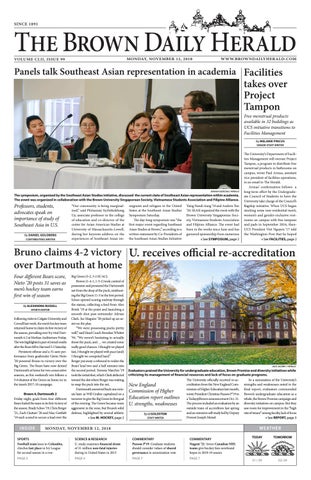
The symposium, organized by the Southeast Asian Studies Initiative, discussed the current state of Southeast Asian representation within academia. The event was organized in collaboration with the Brown University Singaporean Society, Vietnamese Students Association and Filipino Alliance.
Professors, students, advocates speak on importance of study of Southeast Asia in U.S. By DANIEL GOLDBERG CONTRIBUTING WRITER
“Our community is being marginalized,” said Phitsamay Sychitkokhong Uy, associate professor in the college of education and co-director of the center for Asian American Studies at University of Massachusetts-Lowell, during her keynote address on the experiences of Southeast Asian im-
migrants and refugees in the United States at the Southeast Asian Studies Symposium Saturday. The day-long symposium was “the first major event regarding Southeast Asian Studies at Brown,” according to a written statement by Co-Presidents of the Southeast Asian Studies Initiative
Taing Nandi Aung ’19 and Andrew Ton ’20. SEASI organized the event with the Brown University Singaporean Society, Vietnamese Students Association and Filipino Alliance. The event had been in the works since June and has garnered sponsorship from numerous » See SYMPOSIUM, page 2
The University’s Department of Facilities Management will oversee Project Tampon, a program to distribute free menstrual products in bathrooms on campus, wrote Paul Armas, assistant vice president of facilities operations, in an email to The Herald. Armas’ confirmation follows a long-term effort by the Undergraduate Council of Students to have the University take charge of the Council’s flagship initiative. When UCS began stocking some non-residential men’s, women’s and gender-inclusive restrooms on campus with free tampons and pads in September 2016, thenUCS President Viet Nguyen ’17 told the Washington Post that he hoped » See FACILITIES, page 2
Bruno claims 4-2 victory U. receives official re-accreditation over Dartmouth at home Four different Bears score, Nieto ’20 posts 31 saves as men’s hockey team earns first win of season By ALEXANDRA RUSSELL SPORTS EDITOR
Following visits to Colgate University and Cornell last week, the men’s hockey team returned home to claim its first victory of the season, prevailing over Ivy rival Dartmouth 4-2 at Meehan Auditorium Friday. The win highlighted a pair of mixed results after the Bears fell to Harvard 5-2 Saturday. Persistent offense and a 31-save performance from goaltender Gavin Nieto ’20 powered Bruno to victory over the Big Green. The Bears have now denied Dartmouth at home for two consecutive seasons, as this weekend’s win follows a 3-0 shutout of the Green on home ice in the team’s 2017-18 campaign. Brown 4, Dartmouth 2 Friday night, goals from four different Bears fueled the team to its first victory of the season. Brady Schoo ’19, Chris Berger ’21, Zach Giuttari ’20 and Max Gottlieb ’19 each scored to secure a lead over the
INSIDE
Big Green (3-2, 3-2 ECAC). Brown (1-4-1, 1-3-1) took control of possession and pressured the Dartmouth net from the drop of the puck, outshooting the Big Green 11-5 in the first period. Schoo opened scoring midway through the stanza, collecting a feed from Alex Brink ’19 at the point and launching a smooth shot past netminder Adrian Clark. Joe Maguire ’20 picked up an assist on the play. “We were possessing pucks pretty well,” said Head Coach Brendan Whittet ’94. “We weren’t hesitating to actually shoot the puck, and … we created some really good chances. I thought we played fast, I thought we played with pace (and) I thought we competed hard.” Berger put away a rebound to widen the Bears’ lead two and a half minutes into the second period. Tommy Marchin ’19 took the initial shot, which Clark deflected toward the slot where Berger was waiting to snap the puck into the net. Dartmouth answered back one minute later as Will Graber capitalized on a turnover to give the Big Green its first goal of the evening. The Green became more aggressive in the zone, but Bruno’s solid defense, highlighted by several athletic » See M. HOCKEY, page 2
JACK JACOBY / HERALD
Evaluators praised the University for undergraduate education, Brown Promise and diversity initiatives while criticizing its management of financial resources and lack of focus on graduate programs. The University officially received re-acIn a summation of the University’s creditation from the New England Com- strengths and weaknesses noted in the New England mission of Higher Education last month, final report, evaluators commended Commission of Higher wrote President Christina Paxson P’19 in Brown’s undergraduate education as a Education report outlines a Today@Brown announcement Oct. 31. whole, the Brown Promise campaign and The process included an evaluation by an diversity initiatives on campus. But they U. strengths, weaknesses outside team of accreditors last spring saw room for improvement in the “high and an extensive self-study led by Deputy rate of tenure” among faculty, lack of focus By LI GOLDSTEIN Provost Joseph Meisel. STAFF WRITER » See REPORT, page 3
WEATHER
MONDAY, NOVEMBER 12, 2018
SPORTS Football team loses to Columbia, clinches last place in Ivy League for second season in a row
SCIENCE & RESEARCH U. study examines financial drain of 31 million non-fatal injuries during in United States in 2013
COMMENTARY Paxson P’19: Graduate students should consider values of shared governance in unionization vote
COMMENTARY Nugent ’21: Seven Canadian NHL teams give hockey fans newfound hopes in 2018-19 season
PAGE 3
PAGE 4
PAGE 7
PAGE 7
TODAY
TOMORROW
51 / 39
52/ 29
NEWS
PAGE 2 • MONDAY, NOVEMBER 12, 2018
THE BROWN DAILY HERALD
» M. HOCKEY, from page 1 saves from Nieto, staved off the attack to preserve the advantage entering the final stanza. Giuttari extended the lead midway through the third period, gathering a pass from Tony Stillwell ’21 and launching a powerful shot past Clark from the blue line. Quin Foreman scored for Dartmouth six minutes later to keep Brown on its heels, but Gottlieb notched an empty net goal in the penultimate minute to secure the victory for the Bears. In the crease, Nieto’s 31-save performance marked his third consecutive game with over 30 stops. The Bears’ penalty kill went 6-for-6 in the contest. “We just outworked them,” Giuttari said. “We started out really well — we got in on the forecheck right away, they couldn’t break the puck out, our (defensemen) were jumping down and their forwards couldn’t do anything. … We definitely had a focus on getting more shots because we only had 20 or 25 shots in the last couple of games, and that’s just not enough.” Brown 2, Harvard 5 The following night, Tristan Crozier
DANIELLE EMERSON / HERALD
Chris Berger ’21 handles the puck. Berger was one of four Bears to score in Friday’s 4-2 victory over Dartmouth, the team’s first win of the season. ’22 and Marchin scored as the Bears claimed an early lead over their Ivy rival, but Bruno was unable to sustain momentum against a solid Harvard offense in the second and third periods. “We came out at the beginning in the first period and played really well, and I think we just kind of tiptoed into the second period instead of pushing the pace and making them play to us,”
Marchin said. “We just need to carry out that first-period energy throughout the whole game.” The Bears’ first tally of the evening came on a power play late in the first stanza. With two minutes remaining in the frame, Crozier collected a pass from Stillwell at the top of the right circle and fired a shot past Crimson goaltender Michael Lackey to give Brown an early
» SYMPOSIUM, from page 1 centers within the University. The symposium convened students and faculty to discuss the current state of Southeast Asian representation within academia and the community at large, the need for coursework dedicated to Southeast Asia and how such a program could be implemented at Brown. SEASI wanted to “connect students … who want to study Southeast Asia, but don’t have the resources here at Brown to people in the area who are knowledgeable,” Aung told The Herald. Professors, doctoral candidates and student and community activists all spoke during several panels covering a wide range of topics, including issues in Vietnam, Cambodia, Laos, Burma and the Philippines, as well as the United States’ current relationship to its own Southeast Asian population. Another panel focused on the activism and advocacy work of the Providence Youth Student Movement and Alliance of Rhode Island Southeast Asians for Education. Engaging with Rhode Island’s Southeast Asian community was of particular importance to SEASI. “We need to make sure that local communities can benefit from what we’re doing up here (at Brown),” Ton said. “Our history is very traumatizing, … and it gets passed on to the youth,” said panelist Brian Aun, a junior facilitator at ARISE. Beyond formal panels, the symposium concluded with a community conversation and dinner event. “We wanted to open up the floor” and hear from as many interested students and faculty as possible, Aung said. Uy opened the conference by citing statistics on “current community
» FACILITIES, from page 1 the program would become “an institutional part of Brown.” Facilities Management’s update comes after UCS President Shanzé Tahir ’19 and Vice President Camila Pelsinger ’20 wrote in a Nov. 6 email to the student body that “UCS
edge. Jake Harris ’22 also recorded an assist on the play. Harvard (1-2-2, 1-2-2) answered with a trio of goals in the second period to reclaim the lead. After Jack Donato tied the game two and a half minutes into the stanza, Bruno successfully killed off a 5-on-3, but conceded two goals — including one to the Crimson’s power play — late in the frame, entering the third at a deficit. Jack Badini added a power play goal for Harvard eight and a half minutes into the final stanza, though Brown responded two minutes later when Marchin launched a shot past Lackey from the left circle. The Bears pulled Nieto for an extra skater on the power play with two minutes remaining, but Adam Fox cemented the victory for the Crimson with an empty net goal. While the Bears’ penalty kill unit has been successful this season, leading the ECAC with a success rate of 88.9 percent entering the weekend, Whittet emphasized the importance of avoiding unnecessary penalties in future competition. “We can’t be short for the amount of time that we’ve been short for,” Whittet said. “We have a great penalty kill this year
— we have good individuals, and we have good systems, but again, like anything, the more time you give a team time on the power play, they’re going to score.” On the penalty kill, “instead of worrying too much about what we’re doing, we’re just working harder, getting on pucks faster and making the other team make mistakes faster,” Marchin added. “It’s been successful so far, but we’d love to not be on the penalty kill as much as we have been.” The Bears have a quick turnaround with a visit to the University of Connecticut for a non-conference contest Tuesday, before resuming ECAC play at Clarkson University and St. Lawrence University after the Thanksgiving break. Looking ahead, Bruno seeks to sustain a productive work ethic and carry momentum forward from its successes, both within the 60 minutes and in the longer term. “Building off of a good period — building and continuing to take steps toward winning the game and playing confidently” is important for the team, Marchin said. “Instead of letting the other team make decisions and (playing) to what they’re doing, if we just keep pushing the pace and make them react to us, we’ll be good in the long run.”
issues,” specifically poverty, low educational support and legislation that puts Southeast Asian immigrants at a high risk for deportation. Southeast Asians get “lost in the aggregate” of East Asian and South Asian immigrants’ economic and educational successes, according to Uy, who recalled how an anthropology professor once told her that Southeast Asian Americans were “statistically insignificant.” Uy also spoke about the geopolitical significance of studying Southeast Asia and referenced the United States’ Secret War bombing campaign on Laos during the 1960s and 1970s. Uy concluded her talk with her thoughts Brown’s Diversity and Inclusion Action Plan. “Without Southeast Asian studies, Brown cannot meet their mission statement,” she said, stressing the importance of “finding (oneself) in the curriculum.” To meet this goal, students “need to make demands.” One panel in the symposium, “Building and Engaging Southeast Asian (American) Studies,” invited a number of academics and students to speak on the practice of studying Southeast Asia. Elsa Clavé, assistant professor of Southeast Asian studies at Goethe University, Frankfurt, spoke on the importance of studying cultures “in relation, and not in domination” through a modern and holistic lens. “It was in (college) that I realized that political change can be made when we have knowledge about our communities,” said Quan Tran, lecturer in the ethnicity, race and migration studies program at Yale, during her talk on Vietnamese refugees in the United States. Student panelists Christy Bae and Rebecca Tsaiyo Leu related their experiences successfully advocating for tenure-track positions in Asian
American Studies at Wellesley College and advised Brown students on how to better advocate for Southeast Asian Studies. “Meeting with (administrators) regularly is really important” in putting a face to the movement, Bae said. “Utilize all the networks, … all the technology you can, because it helps you leave a record, … and reach out to your audience.” “Make yourselves known, sign your name, don’t be afraid to be proud,” Leu said. Leu is an international student but said “I realized as long as I’m an Asian body in America, people are going to racialize me, … so I should study this.” Reflecting on the purpose of the symposium, Aung said that “our primary goal is to get Southeast Asian Studies at Brown with institutional support.” Currently, there are no tenure-track positions dedicated to Southeast Asian Studies, and the Critical Review only lists five reviews for courses on Southeast Asia. History courses were offered in 2005, 2006 and 2011, each for a different class on the Vietnam War, and an English course on Southeast Asian literature was offered in 2003 and 2005. SEASI is currently working on a proposal to be presented to the University’s Academic Priorities Committee by the end of the spring semester. Students are advocating for “a top-down, institutionally-supported” initiative to bring Southeast Asian studies to Brown, Ton said. In the meantime, Ton and Aung are excited for “Southeast Asia’s Entangled Pasts: Excavated, Curated, and Contested,” a seminar taught by Postdoctoral Fellow Lauren Yapp, which will take place next semester. It is the first non-GISP course on Southeast Asia to be offered in both co-presidents’ time at Brown.
is continuing work to institutionalize Project Tampon.” UCS now considers Project Tampon to be under the purview of Facilities Management after the department confirmed the transition to Tahir Nov. 8. “UCS can have ongoing conversations with Facilities as needed, but … the whole initiative is within Facilities’
domain now,” Tahir said. UCS “is really happy that Facilities has confirmed and agreed to take over the initiative. There’s been a lot of work put in by the students of UCS over these past few years, so we’re excited that it’s being institutionalized.” Currently, “all existing hygiene » See FACILITIES, page 3
NEWS
MONDAY, NOVEMBER 12, 2018 • PAGE 3
THE BROWN DAILY HERALD
Bears collapse in second half, fall to Lions 42-20 on Senior Day Bears outscored 28-0 in second half, sit one loss away from another winless Ivy campaign By ALEX SMOLAR SENIOR STAFF WRITER
Following a five-game winless skid, Saturday’s contest felt different for the football team. In a game where 17 seniors made their final appearance at Brown Stadium, Bruno looked ready to deliver the best gift possible to its graduating class: a win. But try as they might, the Bears have simply not performed to their potential this season, and a second-half collapse precipitated another blowout loss, this time against Columbia. With the defeat, the Bears clinched last place in the Ivy League standings for the second year in a row. “It was a tale of two halves,” said Head Coach Phil Estes. “First half, we made big plays. Second half, we failed to make plays. When we learn to play 60 minutes, we’ll have a chance.” The Bears (1-8, 0-6 Ivy) came out of the locker room with energy and seized momentum early. In the first quarter, Columbia (5-4, 2-4), led by quarterback Ty Lenhart and wide receiver Kyle Castner, embarked on a long, eight-minute drive deep into Brown territory. But on 4th and 2 on the Bears’ 24-yard line, Brown’s defense forced an incompletion to stop the promising series. Just two plays later, quarterback Michael McGovern ’21 threw to wide receiver Scott Boylan ’21 on a quick swing pass on the right side of the field. Boylan found the edge and sprinted downfield, speeding past Columbia defenders and tiptoeing the sideline on his way to a 76-yard touchdown. “First half, we had a lot of big plays,” Boylan said. “I think we got complacent.”
» REPORT, from page 1 on graduate programs, lack of contingency plans in the management of financial resources and inadequate transparency and collaboration between University administration and the Graduate School. Meisel said he was not particularly surprised by any of the recommendations offered by the accreditation team, especially because he and Paxson frequently met with the committee throughout the process. Paxson told The Herald that she and other administrators have yet to make any concrete decisions about how they will respond to the criticism. “We do have to respond to this, the question is how,” she said. Paxson acknowledged that “the report had constructive criticisms in a number of areas.” The accreditors suggested “improving the quality of our PhD programs, making them even stronger than they are now,” Paxson said. “That’s something that I think is … aligned with what we’re doing anyway — we care about building very strong doctoral programs.” To address these concerns, the administration must consider diverse viewpoints within the community, Paxson said. “It’s important for a discussion like this, which is actually quite sensitive, to make sure we get a lot of buy-in from the community and listen to a lot of voices before we dive in.” The University undergoes the same re-accreditation process every 10 years.
DANIELLE EMERSON / HERALD
Jakob Prall ’20 races past the Columbia defense on a 90-yard touchdown run in the second quarter Saturday. The score put the Bears up 20-14, but Brown proved unable to score for the rest of the game. On Bruno’s next possession, the offense faced 2nd and 10 on its 48yard line. McGovern took the shotgun snap and fumbled the ball, but quickly scooped it up and launched a deep rocket to wide receiver LJ Harriott ’20. Harriott had snuck behind the Lions’ secondary and was wide open downfield for the 52-yard touchdown strike. By the end of the first quarter, the Bears led 14-0. But Brown’s scoring barrage and stiff defense would not last, as the Lions drove methodically down the field for two touchdowns in the second quarter. In the span of just five minutes, Columbia had tied the score at 14 with eight minutes left in the half. So when the Bears’ offense took the field on their own 10-yard line after blowing an early lead, hope was not abundant in the stands of Brown Stadium. But Estes dug into his bag of tricks, and the team ran a reverse
handoff to wide receiver Jakob Prall ’20 who accelerated into the secondary. Though Columbia’s defenders had the angle, Prall zoomed past everyone en route to a 90-yard score to send the Brown sideline into a frenzy and put the Bears up 20-14. After the Lions missed a 37-yard field goal before halftime, the Bears seemed to be in firm control of the game with a six-point lead. But the signs of a second-half collapse were already present. While the Bears had earned a lead, they had done so with big, chunk plays, as seen by the fact that the team only had five catches and averaged 29.6 yards per reception. Despite facing a halftime deficit, the Lions led in first downs 13-3 and yards 261-228. So when the big plays stopped materializing for the Bears and the Lions continued to play consistently on offense, the rout was on. On the Lions’ first drive of the half, they marched down the field in just a
minute and a half to score a touchdown and take the lead. Columbia got the ball back after a quick three-and-out from the Bears, and again cut through the Brown defense like a hot knife through butter. On a trick play that saw the Lions use a lateral behind the line of scrimmage, Ryan Young got the ball and weaved through the Brown defense for a 25-yard score. Despite giving away the halftime lead, the Bears still had life and only trailed by eight points. On back-to-back Columbia possessions at the end of the third quarter and start of the fourth, Bruno’s defense earned big fourth down stops to seemingly shift momentum back to the home team. But the offense was wildly ineffective, only gaining 26 yards in the entire half. McGovern was constantly under pressure and was forced to focus on escaping Columbia’s defensive linemen rather than throwing the ball downfield. The
“The effort offers public assurance about the quality of our academic programs,” Paxson wrote in the Today@Brown announcement. “Accreditation is critical for advancing the goal, both at Brown and across higher education, of ensuring accountability and transparency.” Accreditation is a voluntary system, Meisel added. For the external evaluation process, the accreditation team met with representative members from various University departments, such as Academic Affairs, Campus Life and the Budget and Finance Committees, according to the report. The team later met with other senior administrators, including Paxson, Meisel, Dean of the Faculty Kevin McLaughlin and former Dean of the College Maud Mandel. Lastly, the accreditors had “three open forums — one each with faculty, students and staff,” and “held meetings with a small group of tenure-track assistant professors, as well as a larger group of non-tenure-track lecturers and faculty,” according to the report. The NECHE establishes a set of nine accreditation standards for member universities to meet, under categories such as “Mission and Purposes,” “Planning and Evaluation” and “Organization and Governance,” Meisel said. Meisel said that “not every standard applies to (the University), because they look at a broad spectrum of institutions.” For example, the open curriculum does not fit into the standard of “General Education,” and therefore, the University must be evaluated in the context of its unique educational program.
The self-study — which culminated in winter 2016 — is the “mechanism through which the University responds to” these nine standards, Meisel said. The process of self-evaluation forced Meisel and other coordinators to ask themselves, “Do we have the resources, the organization and the accountability mechanisms that allow to us to successfully live up to the mission that we say we have?” Meisel said. During the self-study, multiple committees were created to address each NECHE standard. The self-study team was also able to make use of existing committees on campus to tackle specific standards. For example, the University Resources team, which already handles campus finances, was responsible for the “Finance” category. The members of the external evaluation team were comprised of 11 individuals from institutions similar to the University, which helps them understand how the University functions, Meisel said. These individuals “understand the kind of students we have, (the) kind of issues that institutions like Brown have,” he added. According to the final report, the evaluators came from New York University, Colby College, Princeton, University of Chicago, Tufts University, Dartmouth, Harvard, Trinity College, Cornell and Massachusetts Institute of Technology. The committee was chaired by NYU president Andrew Hamilton. — With additional reporting by Allie Reed
» FACILITIES, from page 2 product dispensers in restrooms” are free to use, Armas wrote. These products were made free in 32 buildings on campus in late September and October, wrote Director of News and Editorial Development Brian Clark in an email to The Herald. Gender-inclusive restrooms in the Stephen Robert ’62 Campus Center and Page-Robinson Hall and women’s restrooms that do not currently have hygiene product dispensers will be equipped with them, Armas wrote. Armas did not provide a timeline for the installation of those dispensers. Two restrooms on the third floor of the Rockefeller Library are slated to be renovated over winter break. As part of the renovation, they will be designated gender-inclusive and offer free product dispensers, Armas wrote. A gender-inclusive restroom equipped with a dispenser will also be constructed on Level A of the Rock this summer, Armas added. Project Tampon’s transfer to Facilities Management follows months of mixed messages from the University and UCS leadership about the initiative’s future. After distributing free tampons and pads to around 40 bathrooms in the 2016-17 academic year and 52 bathrooms in fall 2018, UCS halted distribution efforts last spring without notifying the student body, The Herald
Lions’ defense earned 10 sacks throughout the game to push the Bears back 61 yards. With eight minutes left in the contest, Brown’s defense finally broke. On 4th and 1 at the Bears’ 31-yard line, Castner went untouched on a long touchdown gallop that put Columbia up double-digits and buried the Bears. The touchdown would be Castner’s fifth of the game, as he was credited with passing for two and rushing for three. Just a few minutes later, the Lions would reach the endzone again to bring the score to 42-20. Senior quarterback Nicholas Duncan ’19 relieved McGovern in the last few minutes, but the offense did not fare any better. “Next week, we just need to get up early like we did this week,” Boylan said. “(We need to) continue to play hard, keep up with those big plays and keep scoring touchdowns.” When the final whistle sounded, the Bears’ early successes and touchdowns felt as if they had happened seasons ago. The Lions led in first downs 24-6 and total yards 515-254. McGovern passed 7-18 on the day for 164 yards, two touchdowns and one interception. The Brown defense recorded zero sacks and zero turnovers, giving up more than 40 points for the fifth time this season. “It’s truly bittersweet,” said cornerback Jorquel Condomina ’19. “We would have liked to have come out on top obviously, but it has been a pleasure to be here. I love the program, and Brown changed my life.” Since standardized Ivy League football began in 1956, Bruno has never gone 0-7 in the Ivy League for two consecutive years. The Bears will take to the field for their final game of the season away against Dartmouth Saturday at 1:30 p.m. and are at risk of making history. previously reported. Former UCS President ChelseAmoy Steele ’18 told The Herald in April that UCS was working toward institutionalizing Project Tampon — a goal she mentioned at the first UCS general body meeting of her presidency in September 2017. Steele then announced in a June 1 email to the general body that she had “worked with Brown University Facilities (Management) on an implementation plan for Project Tampon that will start in the fall of 2018.” But, as of Sept. 17, the University would not confirm any plans to implement Project Tampon. Though there was “still a possibility” of Facilities Management taking over, “no plan to administer the initiative that UCS launched” had been adopted, Clark wrote in response to an inquiry from The Herald. Brown joins peer schools in institutionalizing the distribution of free menstrual products. Harvard began providing free tampons and pads in residential buildings this semester after two years of work by its undergraduate student government and a menstrual hygiene advocacy group. Yale’s student government launched a distribution initiative last spring, with the hope that the university will eventually take over. Brown institutionalizing Project Tampon “is hopefully a step that can inspire other universities … to also take on this initiative,” Tahir said.
NEWS
PAGE 4 • MONDAY, NOVEMBER 12, 2018
THE BROWN DAILY HERALD
Nonfatal injuries cost U.S. nearly $1.8 trillion yearly Study finds that nonfatal injuries have long-term financial consequences, decrease quality of life By EMILIJA SAGAITYE CONTRIBUTING WRITER
From broken bones to concussions, injuries afflict millions across the United States. While some may appear common and of minimal consequence in the long term, they can quickly drain individuals’ pockets and well-being. In response, Associate Professor of Emergency Medicine and Pediatrics Mark Zonfrillo ’99 MD ’03 led a study that determined the costs and prevalence of nonfatal injuries. The study uniquely aimed to quantify and break down not only the financial burden of medical spending but also the impact from job loss and quality of life. Using statistics from 2013, the study found that the 31 million nonfatal injuries from that year cost about $1.853 trillion, with over a trillion of that amount stemming from
a decrease in quality of life. Looking at the results, the $1.8 trillion is “an astronomical value,” Zonfrillo said. “If you think about the injuries occurring to all U.S. citizens in one year and the sort of lifetime cost as the result of those injuries, it is profound.” The results also illustrated that nonfatal injuries are common issues, affecting about one in every 10 people annually in the United States. The analysis of nonfatal injuries contributes to the study’s significance. “Deaths are just the tip of the pyramid when it comes to the burden of injuries,” wrote Abdulgafoor Bachani, assistant professor of international health at Johns Hopkins University, in an email to The Herald. He was not involved in this study but has done research on the socioeconomic and health-related effects of injuries in nations with lower average incomes than the United States. While the study was published in October, analysis of the data began around February 2017, Zonfrillo said. The team collected data from injured patients across emergency department
visits and hospitalizations and surveyed the medical reports to classify the injuries. In recent years, the number of states classifying injuries has increased, which gave the team better data for their analysis, said Bruce Lawrence, a research scientist at the Pacific Institute for Research and Evaluation and a co-author of the study. Assessment of the decrease in quality of life also set this study apart. While the U.S. government has only recently tried to perfect a method of quantifying quality of life, the team tried to put this methodology to use for its analysis, which allowed researchers to obtain a more holistic picture of the financial impact of injuries, beyond traditional metrics. The statistics for the study were five years old, but Zonfrillo said more recent data would not be significantly different. Even with the study’s improved methodology, the $1.8 trillion price tag may not encapsulate the full cost of nonfatal injuries. Traumatic brain injuries and spinal cord injuries — the most costly categories studied — cause
long-term consequences and their financial impacts are difficult to quantify. “Because the impact (of TBI and spinal cord injuries) is lifelong, it’s hard for any one study to get at the full impact. You have to follow a patient for so many years that it’s hard to study,” Lawrence said. Zonfrillo has prior experience with research on injury epidemiology, and the repercussions of injuries encouraged him to conduct the study in the first place. Noticing the preventability and cost of nonfatal injuries, he hopes that his work will help decrease their prevalence in the United States. “(Injuries are) one of the leading causes of death and disability (in) people of all ages, and they’re very costly,” he said. But educational initiatives, economic incentives, enforcement of policy measures and engineering can all help prevent injuries. In the past, similar research has influenced legislation. “Most dangerous products tend to bring policy responses to make them safer,” Zonfrillo said. The U.S. Consumer Product Safety Commission has used injury cost analyses to
identify harmful products and address their dangers, he added. Finding solutions is not easy, however; falls — the primary cause of injuries nationally, with over eight million cases in 2013 — vary so widely in type and root cause that creating a common means of prevention is challenging. Going forward, Lawrence believes the results from this study may help governments decide which injuries should command their attention and resources. “From a policy standpoint, (the data) would help government officials in charge of health and safety policy when they’re determining where to put their emphasis with respect to different types of health problems,” he said. “They could use this information to compare to other health problems.” Bachani also believes that approaching the problem through economics “can assist us in making a better case for more investments in injury prevention interventions and programs that are very cost-effective compared to other public health interventions,” he added in his email to The Herald.
The Brown Budget: Get Informed! Get Involved! The University Resources Committee (URC) needs your input. Plan to attend the open forum to learn about the process and share your ideas and insights.
Wednesday, November at 4pm Thursday, November 17 at 14 4pm Stephen Robert’62 ‘62Campus Campus Center Stephen Robert Center Petteruti Lounge,2nd 2nd Floor Petteruti Lounge, Floor Provost Richard M. Locke will discuss the process for developing the University’s budget, sharing primary sources of revenue and spending, and outlining key decisions that need to be made to advance the University mission. Community input is essential to the process. For more information about the URC see the following link: http://www.brown.edu/about/administration/provost/universityhttp://brown.edu/go/urc resources-committee-urc
TODAY
MONDAY, NOVEMBER 12, 2018 • PAGE 5
THE BROWN DAILY HERALD
go bruno!
menu SATELLITE DINING ANDREWS COMMONS
Pizza: Sammy Special, Barbecue Chicken Ranch, Caprese Pulled Pork Sandwiches, Corey’s Trip to Thailand JOSIAH’S
BLUE ROOM
Dumpling Bar, Jalapeno Burgers, Southwestern Bean Burgers
Focaccia Bar, Frittata and Breakfast Sandwich Bar
DINING HALLS SHARPE REFECTORY LUNCH
DINNER
Barbecue Chicken, Top Your Own Baked Potato Bar, Cream Cheese Brownies
Turkey Sweet Potato Shepherd’s Pie, Cheese Ravioli with Sausage and Eggplant, Cajun Apple Cake
VERNEY-WOOLLEY LUNCH
DINNER
Hot Roast Beef Slices with Au Jus, Achiote Tofu with Grilled Red Onion, Green Peas
Taqueria Bar, Brown Sugar and Cumin Rubbed Pork Loin, Ziti Pasta with Olive Oil
sudoku
SAM BERUBE / HERALD
Women’s soccer midfielder Abby Carchio ’20 celebrates with her teammates in a 2-1 overtime victory against Holy Cross. The Bears finished with a record of 8-8-1 overall and in sixth place in the conference standings.
Q U O T E O F T H E D AY
crossword
“We would have liked to have come out on top obviously, but it has been a pleasure to be here. I love the program, and Brown changed my life.
”
— Jorquel Condomina ’19
See football on page 3.
calendar TODAY NOVEMBER
S
4
M
5
T
6
W
7
Th
F
S
1
2
3
8
9
10
Veterans Day Ceremony 12:00 P.M. Sayles Hall
Be the Help Until Help Arrives 12:00 P.M. CIT, 267
Hindi Language Table 4:00 P.M. Page-Robinson Hall, 312
Ogden Lecture: Ernest Zedillo 5:00 P.M. Salomon Center
TOMORROW
11
12
13
14
15
16
17
18
19
20
21
22
23
24
25
26
27
28
29
30
Chinese Language Table 12:00 P.M. Page-Robinson Hall, 340
Study Abroad 101 Information Session 12:00 P.M. Page-Robinson Hall, 420
Dean in the Commons 5:00 P.M. Engineering Research Center
Lyft Information Session 6:00 P.M. CareerLab
COMMENTARY PAGE 6 • MONDAY, NOVEMBER 12, 2018
THE BROWN DAILY HERALD
EDITORIAL
Project Tampon updates welcome news, but questions remain In the fall of 2016, Brown students were welcomed back onto campus with the heartening news that the Undergraduate Council of Students would begin supplying pads and tampons in women’s, men’s and gender-inclusive restrooms throughout campus — an initiative now known as Project Tampon. In the spring of 2017, however, the project was put on pause, as UCS worked throughout the rest of the academic year to transfer the responsibility for the program’s administration over to the University. Since April 2018, when The Herald reported on these changes, the exact status or future of Project Tampon remained unclear to the community. Last Tuesday, UCS President Shanzé Tahir and UCS Vice President Camila Pelsinger ’20 stated in a communitywide update that dispensers around campus are being stocked with free menstrual hygiene products. UCS also noted plans to install more dispensers in restrooms around campus. In today’s Herald, the Department of Facilities Management has finally confirmed that it will take over the administration of Project Tampon. While we applaud UCS leadership and Facilities for successfully institutionalizing Project Tampon, key questions around the project’s path to sustainable implementation remain.
For one, it is unclear why institutionalizing the project necessitated the level of confusion the Brown community experienced over the past year. The program was plagued by miscommunication while it remained in limbo. While former UCS President Chelse Amoy-Steele ’18 explained to the student body at the beginning of her term last year that institutionalizing Project Tampon was a priority, the project’s status as Facilities and UCS began talks was never made clear. In April last semester, UCS halted the distribution of free menstrual products without notifying the student body, The Herald previously reported. At the end of the last semester, Steele sent an email to UCS general body members explaining that Facilities would take charge of Project Tampon this fall, but The Herald was unable to confirm this with the administration over the summer and as of Sept. 17. Though Tahir initially informed the first UCS meeting of the 2018-19 academic year that Project Tampon’s transfer to Facilities Management was “all set to go,” Tahir later told The Herald that “UCS is looking into Project Tampon’s sustained implementation” after being informed of the University’s response. Tahir and Pelsinger’s update last
week is a welcome breath of fresh air in a situation that has been rife with inconsistency. But while UCS has made strides in terms of transparency, on an institutional level the Council must reassess the manner in which it communicated the status of Project Tampon to the wider Brown community to ensure that future updates are timely and responsive to student concerns. Facilities’ update in today’s Herald taking ownership of Project Tampon’s administration also provided muchneeded clarity on the status of the project. Facilities outlines a plan for the program’s expansion beyond the 32 campus buildings where one can currently access free menstrual products. Specifically, women’s restrooms that don’t already have dispensers will be equipped with them, as will gender-inclusive restrooms in the Stephen Robert ’62 Campus Center and Page-Robinson Hall. Three restrooms in the Rockefeller Library are also slated to be installed with dispensers. But the plan still lacks key details: a clear timeline for the implementation of these changes and information on the sourcing of the menstrual products. Providing a timeline would serve as a mechanism for community members to ensure accountability, and is particularly
called for in light of the delays and miscommunication the transfer has already encountered. Though UCS has erred in communicating the transfer of the program to Facilities, it commendably was very open with students over the sourcing of menstrual products. In October 2017, when students raised concerns about Tampon Tribe, UCS changed suppliers and communicated this change promptly to community members less than 12 hours after a public announcement of the Tampon Tribe partnership. At the time, UCS indicated that it would be sourcing tampons from Boxed; in June 2018, Steele wrote in a community-wide email that Project Tampon would be using Aunt Flow, a gender-inclusive company that creates 100 percent organic compostable products. Facilities would do well to follow UCS’ lead in this regard and inform community members of how it will source products as the department takes over its implementation. To be sure, the importance of Project Tampon cannot be overstated; its objectives lie at the very heart of the University’s values of promoting diversity and inclusion on campus. By offering free hygiene products in certain public restrooms around campus, Project Tampon actively breaks down
the economic barriers that those who menstruate face while juggling the typical stresses of college life. Without the necessary hygiene products, it becomes impossible for these students to attend classes, focus on their studies and be active and engaged members of our community. This project is an incredibly impactful way for the University to better ensure that every student feels comfortable at Brown and has the resources at hand to thrive here. Institutionalizing the program is no less of an achievement for UCS leadership and demonstrates the University’s commitment to the well-being of its students. But it is clear that Project Tampon could have benefitted — and, going forward, can benefit — from more timely communication to empower students to hold the University to the standards it has set for itself.
Editorials are written by The Herald’s editorial page board: Anuj Krishnamurthy ’19, Rhaime Kim ’20, Grace Layer ’20, Mark Liang ’19 and Krista Stapleford ’21. Please send responses to this opinion to letters@browndailyherald.com and opeds to opinions@browndailyherald.com.
CORRECTION A previous version of the Nov. 8 article “SUGSE updates GSC on unionization election dates” stated that absentee ballots will be available for students who will be off campus during election time. In fact, absentee ballots will be available for graduate students who have academic appointments abroad. The Herald regrets the error. A previous version of the Nov. 9 article “Watson panel extols virtues of marriage” stated that the Watson Institute for International and Public Affairs was a co-host of the event. In fact, the event was just hosted at Watson. The Herald regrets the error.
Find us online! facebook.com/browndailyherald
browndailyherald.com
@the_herald
Location: 195 Angell St., Providence, R.I. www.browndailyherald.com
@browndailyherald
youtube.com/browndailyherald
Editorial Leadership
Sections
Multimedia & Production
Business
Editors-in-Chief Elena Renken Kasturi Pananjady
Arts & Culture Editors Ethel Renia
Design Editors Kyle Cui Eduard Muñoz-Suñé Assistants: Julie Wang, Kelvin Yang
General Managers Michael Borrello Matilda Lynton
Managing Editor Alex Skidmore
Metro Editors Emily Davies Isabel Gensler
Senior Editors Madison Rivlin Hattie Xu Ben Shumate
News Editors Eduard Muñoz-Suñé Priyanka Podugu Sarah Wang
Editorial Page Editor Anuj Krishnamurthy
Science & Research Editors Jonathan Douglas Jackson Wells
POST- MAGAZINE Editor-in-Chief Jennifer Osborne
Sports Editors Alexandra Russell James Schapiro COMMENTARY Opinions Editors Connor Cardoso Anuj Krishnamurthy Clare Steinman Emily Miller
Photo Editors Sam Berube Anita Sheih Copy Desk Chief Kelley Tackett Illustrations Editor Daphne Zhao Video Editor Celia Hack Graphics Editors Marlis Flinn Sarah Martinez
Office Manager Diane Silvia Directors Sales: Shreya Raghunandan Finance: Ravi Betzig Strategy: Edwin Farley
Editorial contact: 401-351-3372 herald@browndailyherald.com
Advertising contact: 401-351-3372 advertising@browndailyherald.com
Submissions: The Brown Daily Herald publishes submissions in the form of op-eds and letters to the editor. Op-eds are typically between 750 and 1000 words, though we will consider submissions between 500 and 1200 words. Letters to the editor should be around 250 words. While letters to the editor respond to an article or column that has appeared in The Herald, op-eds usually prompt new discussions on campus or frame new arguments about current discourse. All submissions to The Herald cannot have been previously published elsewhere (in print or online — including personal blogs and social media), and they must be exclusive to The Herald. Submissions must include no more than two individual authors. If there are more than two original authors, The Herald can acknowledge the authors in a statement at the end of the letter or op-ed, but the byline can only include up to two names. The Herald will not publish submissions authored by groups. The Herald does not publish anonymous submissions. If you feel your circumstances prevent you from submitting an op-ed or letter with your name, please email herald@browndailyherald.com to explain your situation. You can submit op-eds to opinions@browndailyherald.com and letters to letters@browndailyherald.com. When you email your submission, please include (1) your full name, (2) an evening or mobile phone number in case your submission is chosen for publication and (3) any affiliation with Brown University or any institution or organization relevant to the content of your submission. Please send in submissions at least 24 hours in advance of your desired publication date. The Herald only publishes submissions while it is in print. The Herald reserves the right to edit all submissions. If your piece is considered for publication, an editor will contact you to discuss potential changes to your submission. Commentary: The editorial is the majority opinion of the editorial page board of The Brown Daily Herald. The editorial viewpoint does not necessarily reflect the views of The Brown Daily Herald, Inc. Columns, letters and comics reflect the opinions of their authors only. Corrections: The Brown Daily Herald is committed to providing the Brown University community with the most accurate information possible. Corrections may be submitted up to seven calendar days after publication. Advertising: The Brown Daily Herald, Inc. reserves the right to accept or decline any advertisement at its discretion. The Brown Daily Herald, Inc. is a financially independent, nonprofit media organization bringing you The Brown Daily Herald, BlogDailyHerald and Post- Magazine. The Brown Daily Herald has served the Brown University community daily since 1891. It is published Monday through Friday during the academic year, excluding vacations, once during Commencement and once during Orientation by The Brown Daily Herald, Inc. Single copy free for each member of the community. Subscription prices: $200 one year daily, $100 one semester daily. Copyright 2018 by The Brown Daily Herald, Inc. All rights reserved. Periodicals postage paid at Providence, R.I. Postmaster: Please send corrections to P.O. Box 2538, Providence, RI 02906.
THE BROWN DAILY HERALD
COMMENTARY MONDAY, NOVEMBER 12, 2018 • PAGE 7
The value of shared governance CHRISTINA PAXSON op-ed contributor In the coming days, graduate student teaching and research assistants at Brown will vote on whether or not to unionize. This is an incredibly important decision. The outcome of this election will shape the processes that determine compensation, benefits and working conditions for current and future graduate students and affect the relationship between graduate students and the University. Though some of the rhetoric around unionization has been contentious, I see broad consensus on many points. We can all agree that graduate students are entitled to fair compensation and benefits, safe work environments and equitable treatment when concerns about working conditions are surfaced. We all want Brown to provide an inclusive and supportive environment where graduate students grow professionally and personally, work collaboratively with great colleagues and take pride and pleasure in their research and teaching. The question is not what we want, but how best to achieve it. Graduate students are currently being asked to weigh the pros and cons of unionization, factoring in possible gains in compensation and improvements in working conditions against the mandatory membership fees that come with unionization. As graduate students make this
choice, I encourage them to also consider the possible adverse consequences of unionization for Brown’s current system of shared governance, in which students, faculty and administrators work as partners to advance common goals. Brown has a long and strong commitment to shared governance, more so than at any other university I have seen. This commitment is reflected in Brown’s mission statement, which describes the University as “a part-
ability. They serve on search committees for new senior administrators like provosts and deans. The president of the Graduate Student Council represents graduate student concerns on the Corporation Committee on Campus Life. In these formal roles — and at times through valuable activism — graduate students have championed diversity and inclusion, driven change in Brown’s Title IX policies and helped create childcare subsidies, among many other things. The Uni-
ate student stipends that exceeded increases in the salary pools for faculty and staff, as well as improvements in health insurance and summer support. And these recommendations were approved. Through this process, the faculty, staff and undergraduate students on the URC demonstrated their appreciation for the important role that graduate students play at Brown, and became their champions. I don’t claim that shared governance works perfectly. Sometimes it
I am concerned that unionization could shift the relationship between graduate students and the University in a way that damages the spirit and practice of shared governance.
nership of students and teachers in a unified community.” This ideal is reflected by the active and widespread participation of graduate students — who are both students and teachers — in the governance of Brown. What does shared governance look like in practice? Currently, graduate students participate in at least 20 University committees that address everything from equity and diversity to the creation of new graduate student programs and campus sustain-
versity has long recognized and celebrated these contributions as fundamental to the fabric of a community committed to student-centered learning. To give a concrete example: Graduate students are represented on the University Resources Committee, which makes recommendations each year on the University’s operating budget. In three of the past five years, the URC unanimously recommended percent increases in gradu-
is slow and unwieldy. For example, over the past several years it became clear that Brown needed a better policy for handling graduate student grievances. These concerns eventually led to the formation of a Graduate School committee (with graduate student representation) that worked over the summer to produce a new policy. The policy was vetted with relevant campus groups over the fall, and was approved by the faculty earlier this month. Though this pro-
cess was slower than we would like, it yielded a great outcome. And it brought graduate students, faculty and administrators together to advance the wellbeing of graduate students. If Brown graduate students decide to unionize, I am committed to continuing on our current path of building superb graduate programs at Brown. We can’t be a great university without great graduate programs. And we will continue to practice shared governance where we can, in areas that don’t fall under the purview of the union. I am concerned, though, that unionization could shift the relationship between graduate students and the University in a way that damages the spirit and practice of shared governance and, ultimately, weakens the quality of the Brown experience for graduate students. I fear that, as we become categorized into workers and management who stand on opposing sides of a bargaining table, we will erode the unified partnership of students and teachers who work collectively to support graduate students and advance graduate education. This would be a loss for the entire Brown community.
President Christina Paxson P’19 can be reached at christina_paxson@brown.edu. Please send responses to this op-ed to letters@browndailyherald. com and op-eds to opinions@ browndailyherald.com.
Canadian Cup competition is coming PATRICK NUGENT sports columnist Calgary, Edmonton, Montreal, Ottawa, Toronto, Vancouver, Winnipeg. Seven cities with little in common except their country, the presence of an NHL team and no recent Stanley Cup success. It’s now been 25 years since one of Canada’s seven NHL teams took home a Stanley Cup. No team north of the border has even made the Finals since Vancouver lost to Boston in 2011, and three seasons ago, no Canadian team played past the regular season. That said, the tide appears to be finally turning up north, and Canada looks ready to be a force for years to come. In the Eastern Conference, both Toronto and Montreal are sitting in playoff spots. Of the two, the Maple Leafs look more likely to break their more-than-50-year championship drought. Still, the fact that both Canadian Original Six teams are relevant in their division as we approach the quarter mark of the season is significant. In the West, all four teams are jockeying for playoff spots. Winnipeg looks like a serious contender to reach the Western Conference Finals for a second straight year. Farther west, Calgary, Edmonton and
Vancouver are starting to see results at long last from their respective rebuilds. It’s still early, but at the time of writing, every Canadian team other than Ottawa is at least tied for a playoff spot. But beyond this ear-
vares in free agency, but in the less glamorous Canadian cities, slow, methodical rebuilds are starting to turn their teams competitive. Winnipeg is seeing the success of its rebuilt core now, and only a few losses to the Golden Knights kept them
bia are finally paying dividends. Edmonton has built a core around perennial Hart Trophy candidate Connor McDavid that can compete with the Pacific Division heavyweights further south. Calgary is still working out the kinks of its own rebuild,
The tide appears to be finally turning up north, and Canada looks ready to be a force for years to come.
ly success, which looks tenuous in Vancouver and Montreal, the current state of these teams has set Canada up to succeed not just this year, but for the better part of the next decade. Toronto may have the advantage of luring big names like John Ta-
out of last year’s Stanley Cup Final. Both teams are already legitimate contenders with key pieces under team control and looking to pace their respective conferences this year. Meanwhile, several years of losing in Alberta and British Colum-
but the pieces seem to be falling into place. In Vancouver, the team’s surprising early season success is being met with skepticism that their own rebuild is not as far ahead of schedule as it seems. But even if this year’s team fades, the Canucks are not far from being competitive as
their deep prospect pool continues to mature. Similar to Vancouver, the Canadiens are experiencing unexpected wins this year but may not be able to sustain them as the season grinds on. But if either team can keep winning, Canada will be well-represented in the playoffs for the first time in a long time. Beyond Toronto and Winnipeg, at least two and as many as four other teams could still be standing after 82 games, a far cry from the country being shut out of the playoffs entirely. While the Senators still look destined to be on the outside looking in come May, trades made with the future in mind have Ottawa only a few years behind their countrymen. This year might not be the year for Canada to finally shake off the long, harsh winter its hockey teams have been weathering for two and a half decades, but don’t count out the possibility. Even if this isn’t the year for a Canadian Cup, the window is open for one, and it isn’t closing anytime soon. For the foreseeable future, Canada is a force to be reckoned with in the NHL.
Patrick Nugent ’21 can be reached at patrick_nugent@ brown.edu. Please send responses to this opinion to letters@browndailyherald. com and op-eds to opinions@ browndailyherald.com.
NEWS THE BROWN DAILY HERALD
MONDAY, NOVEMBER 12, 2018
YOUR VOTE MATTERS GRADUATE STUDENT UNIONIZATION
VOTING INFORMATION:
NOVEMBER 14, 15, 16 AND 19 10 AM TO 6 PM VOTERS WILL BE ASSIGNED TO A POLLING STATION BASED ON DEGREE PROGRAM. BROWN OR GOVERNMENT-ISSUED ID REQUIRED TO VOTE.
POLLING LOCATIONS
HUMANITIES & SOCIAL SCIENCES: SALOMON CENTER FOR TEACHING ENGINEERING & PHYSICAL SCIENCES: ENGINEERING RESEARCH CENTER BIOMED & LIFE SCIENCES: SIDNEY FRANK HALL PUBLIC HEALTH: 121 SOUTH MAIN STREET
For more information, visit brown.edu/go/be-informed