SINCE 1891
THE BROWN DAILY HERALD MONDAY, MARCH 6, 2017
VOLUME CLII, ISSUE 27
WWW.BROWNDAILYHERALD.COM
Syrian student stranded in Turkey due to visa complications Petition for student’s return circulates in Brown community, cites unfair federal process BY PRIYANKA PODUGU AND ELI BINDER SENIOR STAFF WRITER AND STAFF WRITER
When Khaled Almilaji GS got to the airport in Gaziantep, Turkey Jan. 7 to come back to Brown and his pregnant wife in Providence, he was told by Turkish Airlines that he would not be allowed to enter the United States. Almilaji, a Syrian, had traveled to Turkey for a week to check up on the humanitarian team at the aid organization that he chairs, known as Canadian International Medical Relief Organization in the United States. It took until Jan. 17 for the U.S. consulate to notify him that his J-1 visa had been revoked, Almilaji said over WhatsApp from Gaziantep. They did not give a reason for the revocation but gave him an expedited appointment to file a new visa application. However, his interviewers at the consulate did not ask him any questions when he resubmitted his application. By contrast, Almilaji was “heavily vetted” when he and his Syrian wife first applied for a U.S. visa before beginning his studies at Brown. His wife, now beginning her second trimester, is
W. BASKETBALL
Bruno wins twice, earns postseason berth With season on line, Bears beat Columbia, Cornell to punch ticket to Ivy League tournament By CAL BARASH-DAVID SENIOR STAFF WRITER
COURTESY OF BROWN UNIVERSITY
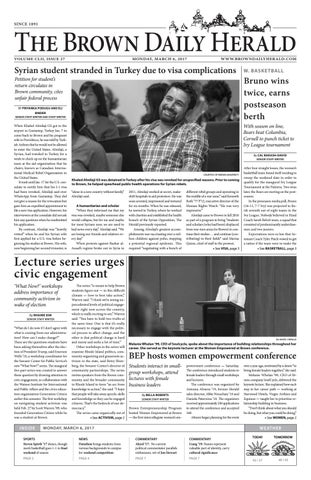
Khaled Almilaji GS was detained in Turkey after his visa was revoked for unspecified reasons. Prior to coming to Brown, he helped spearhead public health operations for Syrian rebels. “alone in a new country without family,” Almilaji said. A humanitarian and scholar “When they informed me that my visa was revoked, maybe someone else would collapse, but for me and maybe for most Syrians now, we are used to bad news every day,” Almilaji said. “We are losing our friends and relatives every day.” When protests against Bashar alAssad’s regime broke out in Syria in
2011, Almilaji worked at secret, makeshift hospitals to aid protesters. He was soon arrested, imprisoned and tortured for six months. When he was released, he moved to Turkey, where he worked with charities and established the health branch of the Syrian Opposition, The Herald previously reported. Among Almilaji’s greatest accomplishments was vaccinating over a million children against polio, stopping a potential regional epidemic. This required “negotiating with a bunch of
different rebel groups and operating in the middle of a war zone,” said Kenneth Roth ’77 P’12, executive director of the Human Rights Watch. “He was very impressive.” Almilaji came to Brown in fall 2016 as part of a program to bring “students and scholars (who had been) displaced from war-torn areas (to Brown) to continue their studies … and continue (contributing) to their fields” said Marisa Quinn, chief of staff to the provost. » See VISA, page 3
After four straight losses, the women’s basketball team found itself needing to sweep the weekend slate in order to qualify for the inaugural Ivy League Tournament at the Palestra. Two wins later, the Bears are moving on the postseason. In the preseason media poll, Bruno (16-11, 7-7 Ivy) was projected to finish seventh out of eight teams in the Ivy League. Nobody believed in Head Coach Sarah Behn’s team, a squad that consisted of predominantly underclassmen and two juniors. Expectations were so low that Assistant Coach Tyler Patch vowed to get a tattoo if the team were to make the » See BASKETBALL, page 3
Lecture series urges civic engagement ‘What Now?’ workshops address importance of community activism in wake of election By RHAIME KIM SENIOR STAFF WRITER
“What do I do now if I don’t agree with what is coming from our administration? How can I make change?” These are the questions students have been asking themselves after the election of President Trump, said Emerson Wells ’18, a workshop coordinator for the Swearer Center for Public Service’s new “What Now?” series. The inaugural five-part series was created to answer these question by drawing attention to civic engagement, in collaboration with the Watson Institute for International and Public Affairs and the civics education organization Generation Citizen earlier this semester. The first workshop on navigating student activism was held Feb. 27 by Scott Warren ’09, who founded Generation Citizen while he was a student at Brown.
INSIDE
The series “is meant to help Brown students figure out — in this difficult climate — how to best take action,” Warren said. “I think we’re seeing unprecedented levels of political engagement right now across the country, which is really exciting to see,” Warren said. “You have to hold two truths at the same time: One is that it’s really necessary to engage with the political process to affect change, and the other is that political change is hard and messy and seeks a lot of time.” Other workshops in the series will examine Rhode Island politics, community organizing and grassroots activism in the state, said Betsy Shimberg, the Swearer Center’s director of community partnerships. The series invites speakers from the Brown community and the broader community in Rhode Island to form “an arc from knowledge to action,” she said. “I hope that people will take away specific skills and knowledge so they can be engaged citizens. That’s the bedrock of our democracy.” The series came organically out of » See ACTIVISM, page 2
ELI WHITE / HERALD
Melanie Whelan ’99, CEO of Soulcycle, spoke about the importance of building relationships throughout her career. She served as the keynote lecturer at the Women Empowered at Brown conference.
BEP hosts women empowerment conference Students interact in smallgroup workshops, attend lectures with female business leaders By BELLA ROBERTS SENIOR STAFF WRITER
Brown Entrepreneurship Program hosted Women Empowered at Brown — the first intercollegiate women’s em-
powerment conference — Saturday. The conference introduced students to female leaders through small workshops and lectures. The conference was organized by Antonia Alvarez ’19, former Herald sales director, Abby Neuschatz ’18 and Daniela Paternina ’18. The organizers received approximately 230 applications to attend the conference and accepted 160. Alvarez began planning for the event
over a year ago, motivated by a desire “to bring female leaders together,” she said. Melanie Whelan ’99, CEO of fitness company SoulCycle, delivered the keynote lecture. She explained how each step in her career path — working at Starwood Hotels, Virgin Airlines and Equinox — taught her to prioritize relationship building in business. “Don’t think about what you should be doing, but what you could be doing,” » See WOMEN, page 2
WEATHER
MONDAY, MARCH 6, 2017
SPORTS Steven Spieth ’17 shines, though men’s basketball goes 1-1 in final weekend of season
NEWS Datathon brings students from various backgrounds to campus for weekend competition
COMMENTARY Akyol ’17: No current political commentator parallels enthusiasm, wit of Jon Stewart
COMMENTARY Liang ’19: Names represent valuable part of identity, carry cultural significance
PAGE 2
PAGE 4
PAGE 7
PAGE 7
TODAY
TOMORROW
42 / 27
49 / 45
NEWS
PAGE 2 • MONDAY, MARCH 6, 2017
THE BROWN DAILY HERALD
M. BASKETBALL
Brown routs Columbia, falls to Cornell on seniors’ final weekend
Bears follow dominant offensive play with defensive struggles in upand-down weekend By NICHOLAS WEY SENIOR STAFF WRITER
Heading into the final two games of the season against Columbia Friday and Cornell Saturday, the men’s basketball team looked to honor its departing leaders, co-captains Steven Spieth ’17, JR Hobbie ’17 and Tavon Blackmon ’17 in their final weekend in Brown uniforms. The Bears (13-17, 4-10 Ivy) took home an impressive 88-68 win against the Lions (11-16, 5-9). But against the Big Red (8-21, 4-10), Bruno had a hard time stopping Cornell’s fast offense and sharpshooting, falling 92-78. In the first half against the Lions Friday, the lead changed hands multiple times — with 9:12 on the clock,
the Bears were up 25-22. But after four three-pointers from Hobbie and Spieth, the Bears pulled away, capping a 26-6 run that put Brown up by 23 going into halftime. Bruno’s 51 points in the first half was its most since a 53-point outburst against Johnson and Wales University Dec. 10. “We played great against Columbia,” Travis Fuller ’19 said. “We played great defense and really shared the ball on offense. Guys were knocking down shots.” But Columbia’s offense rallied to cut the lead to just 12 with an emphatic dunk from Rodney Hunter with 10 minutes remaining that steered the momentum in favor of the Lions. The Bears did not let Columbia take control of the lead, going on a 17-5 run which ended on a three-pointer from Corey Daugherty ’19 to give Bruno a 80-56 lead. Columbia was unable to fight back. After CJ Davis made the score 88-68, neither team scored for the game’s
BEN SHUMATE / HERALD
» WOMEN, from page 1
» ACTIVISM, from page 1
she said. In terms of women’s empowerment, “the world has come a long way since I’ve been at Brown, (but) there are still systematic challenges that affect women in business,” Whelan told The Herald. Melissa Tischler ’98, an associate partner and the head of the strategy team at strategy and design firm Fahrenheit 212, delivered the closing remarks. Previously, Tischler launched EOS personal care products and helped found the nonprofit Women in Innovation. “If this conference gives people that level of confidence to go out and create what they wouldn’t otherwise, it’s a success,” Tischler said. Danielle Peterson ’17 attended the conference “to have access to role models and be inspired by the women today,” she said. “I wish something like this existed when I was at Brown. I think it’s pretty incredible,” Whelan told The Herald. Alvarez said they are planning another women’s empowerment conference for 2018.
the Swearer Center’s commitment to public service, she said, adding that civic engagement is a way to create just, equitable and peaceful communities. “In many ways, democracy is at risk, not just because of who’s in the White House, but because we need a revival of civic engagement in this country,” Warren said. Warren will lead the third workshop in the series March 16 on the future of civics education after Trump’s election and the Brexit vote. Under a Trump presidency, “we literally need all hands on deck. Because now, we’re in a moment where we have to take these theories that we talk about … and put them into practice straight away. It’s just that urgent,” said Marco McWilliams, social entrepreneur in residence at the Swearer Center. “We have to be very sober about the moment that we’re in.” But Wells and Shimberg emphasized that the series is a nonpartisan project. In an effort to attract students from across the political spectrum,
ELI WHITE / HERALD
Steven Spieth ’17 drives against a Cornell defender. Spieth scored 20 in Friday’s win against Columbia. In his final game in a Brown uniform, Spieth tallied a career-high 31 points in a senior-night loss to Cornell. remaining three minutes, allowing Brown to take home the win. Saturday, Bruno got off to a poor start, allowing a 19-2 run to start the first half against the Big Red. Brown made several substitutions after falling behind early, but Cornell had built a 41-26 lead with seven minutes remaining in the second quarter. The Bears cut the margin to just nine points going into halftime. “We have to do a better job of being ready to play the full 40 minutes,” said Head Coach Mike Martin ’04. “We had a nice little burst when we made some changes in the lineup to get to single digits, but when you let a team score 92 points, there’s obviously some issues there defensively, and we have got a lot of work to do.” The Big Red surged again to start the second half, building a 70-55 lead in the first 10 minutes. Despite Bruno’s efforts, the team could not close this
gap and eventually fell 92-78. “We thought if we could keep the ball out of the paint, that could help us limit their three-point attempts,” Martin said. “They got straight line drives to the rim, they got deep post touches and they got some offensive rebounds that lead to some kick out threes.” Still, the three departing captains have surely stamped their legacy in the Brown record books. Spieth is the fifth all-time leading scorer in program history and has started more games in his career than any other Brown player. Hobbie set a new Brown record in career three-pointers, with 257 — good for fifth-most in Ivy League history. Blackmon is seventh all-time in career assists. As they were subbed out for one last time, Spieth and Hobbie received a standing ovation. Blackmon missed both Friday and Saturday’s games due
to injury. As Martin remarked, the three seniors have been more than just impact players on the court. “Those three seniors have meant so much to me personally,” Martin said. “They have meant so much to our program.” “I was happy for our seniors. They had accomplished some great milestones and all had great careers,” Fuller said. Brown finished the season tied for sixth in the Ivy League, sharing the spot with Cornell and Dartmouth. Princeton, Harvard, Yale and Penn will move on to the inaugural Ivy League Tournament at the Palestra in Philadelphia, competing for a conference title and a spot in the NCAA tournament. “We have made good progress as a program this year in a lot of ways,” Martin said. “We are a lot better today than we were 365 days ago.”
workshop coordinators reached out to Bryce Campanelli ’18, president of No Labels, a national bipartisan political action group whose Brown chapter was formed last year. “I think ‘What Now?’ is when we all work together to band (together) for the fundamental elements that make this country great, and that’s something that does not have to be specifically by political party,” Campanelli said. “It’s standing up for American core values, and understanding that we, in this time, cannot demonize each other.” During the first workshop, Warren spoke about his own experience in politics and activism. At Brown, Warren was actively involved with efforts related to the genocide in Darfur in Sudan. As part of the Darfur Action Network, Warren pushed Brown and Rhode Island to divest from companies with business ties to Sudan. Rhode Island eventually became the first state in the country to do so. At Brown, “students really do have the opportunity to (take) effective and meaningful action at the local level,” Warren said. “Especially at this day
and age, that’s really important.” Because Rhode Island “is a smaller area,” state representatives and city council members “tend to be really receptive to constituent feedback,” he added. “I saw that when I was a student at Brown. So I think part of the series is really focusing on that local action.” Warren encouraged students to get more involved in grassroots activism in Rhode Island if they want to affect lasting change. The second workshop, “Rhode Island Politics 101,” to be held on March 13 explains how politics works in the state, Shimberg said. Confirmed speakers are State Rep. Shelby Maldanado, Chief of State for the Rhode Island’s Secretary of State Gonzalo Cuervo and Nicole Pollock, chief of staff for Mayor Jorge Elorza. The fourth workshop, “Community Action Off the Hill,” will bring students from local universities and high schools to Brown. Shimberg said the session will attempt to answer “questions like, ‘How do we address the challenge of not recreating power dynamics within community organizing?’” Coordinators envision that the
workshop will feature a student panel and then split into working groups to encourage collaboration between the students, McWilliams said. McWilliams is encouraging students from public schools in the state to attend the sessions in order to ensure socioeconomic diversity in workshop participants, he said. McWilliams has been in touch with students at Rhode Island College, University of Rhode Island and Providence College, and will reach out to Classical High School, Central High School, Times Squared Academy, Mount Pleasant High School and Hope High School, he said. “The problem is that at Brown, students don’t know what students at URI are doing. And students at URI don’t know what students at PC are doing, … (yet) all of these schools are within a one mile radius with each other,” McWilliams said. The last workshop scheduled for April 18 aims to impart “practical skills to engage politically,” such as how to start a political campaign, and will cover “community organizing basics,” Shimberg said.
NEWS
MONDAY, MARCH 6, 2017 • PAGE 3
THE BROWN DAILY HERALD
» BASKETBALL, from page 1 conference’s postseason. Bruno entered the final weekend of the season knowing it had to win its final two games to keep its postseason hopes alive. “These last couple of days, Coach has been emphasizing (that) we just have to refuse to lose at this point,” said captain Megan Reilly ’18. “We are kind of sick of losing right now.” The Bears took this mantra to heart, convincingly besting Columbia and Cornell in consecutive contests over the weekend. “We knew we still weren’t out of it, so we had to put everything on the floor … we didn’t want to regret anything,” said guard Shayna Mehta ’19. The action started off in New York
City Friday night when Brown faced off against Columbia (13-14, 3-11). After a slow start in the first quarter, the Bears fell behind 21-15. But Bruno burst out in the second quarter, outscoring Columbia 25-8 to take a 40-29 lead heading into the halftime break. The Bears further extended their lead in the third, nailing four threes while stretching their lead to 21 going into the final stanza. Though the Lions outscored Bruno in the final 10 minutes, they would only do so by a margin of four points. The Bears won 76-59 in their most dominant conference win of the season to date. Much of Bruno’s offense came from the bench. Janie White ’18 led the Bears in scoring with 18 points.
ELI WHITE / HERALD
Shayna Mehta ’19 bounds up court. She tallied a double-double Friday in a 76-59 win over Columbia before scoring 28 points in Saturday’s game.
» VISA, from page 1 Almilaji said that he and his wife, who is studying to become a pediatrician, planned to “get the maximum education” possible in the United States and then go to the Middle East to continue working with Syrians. “Public health in Syria is very needed. With very limited resources and lack of health workers and medical workers, the only way to be very efficient in dealing with the health in most of the regions of Syria is prevention. And that is the mandate of public health.” Getting a visa and being accepted to the University was a door being “opened to a lot of opportunity. I was very lucky to be at Brown last semester,” Almilaji said. University support and response “I could not have guessed that I could find any community or family like Brown,” Almilaji said. He said that many administrators and faculty, including President Christina Paxson P’19, have reached out to him and have been “very supportive.” A recent petition calling for his visa to be reissued was created by his classmate, Andriy Chybisov GS, and has garnered over 2,000 signatures, Chybisov said. “With the removal of (President) Trump’s travel ban, we thought he’d be able to come back without a problem,” Chybisov said. “It’s (been) more than a month, so we decided we needed to do something.” The University has been working to provide Almilaji with academic and legal support while he is barred from the United States, said Terrie Fox Wetle, dean of the School of Public Health. Paxson also reached out to the U.S. ambassador to Turkey to advocate for Almilaji’s return, Quinn wrote in a follow-up email to The Herald. The administration has connected Almilaji to an attorney and has pursued
other resources to help him with his case, Quinn added. Administrators and Almilaji declined to comment on the nature of legal support due to privacy concerns. The administration has also been in “constant communication with members of Congress advocating for the … students (who might potentially be affected) at Brown and around the country,” said Steve Gerencser, the assistant director of governmental relations who also acts as the University’s liaison to Rhode Island’s congressional delegation. Senator Jack Reed’s, D-RI, office has “been assured that Mr. Almilaji’s case is being handled in a fair and timely manner and are continuing to monitor the progress,” wrote Chip Unruh, Reed’s press secretary, in an email to The Herald. However, he noted that the visa application process can take 90 days or more and “there are rules and procedures in place that must be followed by everyone.” The University is continuing to provide him with a stipend and tuition support, Almilaji said. This support completely covers tuition and provides health insurance to his wife, he added. Almilaji is currently enrolled as a student at Brown and has the option to take classes long distance, Wetle said. Though Almilaji is trying his “best to follow up, it is difficult because those courses are not meant to be remote or part-time courses,” and studying remotely is not going very well, he said. Bringing Almilaji back to the United States is the University’s primary goal, but, Wetle said, “I want to make sure that he can complete his studies for (a master’s in public health), so I’ve also contacted and have been writing letters of reference to Canadian universities.” Almilaji said he received a verbal offer from the University of Toronto’s Dalla Lana School of Public Health and is waiting to see what kind of financial package they can offer him. “I respect and appreciate the support
“Janie and (Abby O’Keefe ’20) really stepped up,” Reilly said. O’Keefe “had two big threes. She’s always so tough on defense.” Taylor Will ’19 added 14 points of her own, and Mehta notched a doubledouble with 13 points and 10 rebounds. The following night’s season finale in Ithaca had a postseason berth on the line. Brown entered the game with a 6-7 conference record. Cornell (16-11, 7-7) entered the contest with one more Ivy win than the Bears. Having bested the Big Red earlier in the season, Bruno held the tiebreaker, so the winner of the game would be the fourth seed in the Ivy League Tournament. In sharp contrast with Brown’s runand-gun style of play, most of Cornell’s conference games have been marked by low scoring and strong defense. In the Big Red’s previous eight games, Cornell held its opponents to 63 points or less. Cornell has not been the strongest offensive team either — the Big Red posted only 34 points in a loss to league-leading Penn the previous weekend. “Offense comes naturally to us,” Reilly said. “We are number one in the Ivy (League) for most points scored. So if we just run on them, we know that offense will take care of itself … but our main focus tonight is just locking down on defense.” The game started off tight, as the two teams were knotted at 16 after the first quarter. But Bruno’s emphasis on defense
BEN SHUMATE / HERALD
paid off. Holding Cornell to seven points in both the second and third quarters gave Brown a strong 46-30 lead going into the final frame. Mehta was precise all night. Midway through the third quarter, the sophomore had 21 of Brown’s 39 points. Bruno outscored the Big Red 21-16 in the final 10 minutes, and the Bears won 67-46. The 21-point win was their largest margin of victory against a conference opponent all season. “I don’t know how we pulled out the wins by over 20 points each,” Mehta said. “I think we were just super fired up, and we just knew we had to leave it all on the court.” Mehta led the way for the Bears and posted a prolific 28 points and six rebounds. She shot 11-16 from the field and was 4-5 from beyond the arc in the win. Justine Gaziano ’20 and Will added 13 and 10 points respectively. Mehta said that the team knew its preseason ranking was not
representative of its skill. For them, the tournament berth is validation. “It feels good, and it feels like we’ve proved something,” Mehta said. Mehta added that the bus ride home was a celebratory one. “We had dance parties on the bus with our coach. We were just on another level.” Bruno will face off against Penn (19-7, 12-1) Friday in the first round of the Ivy League Tournament. “We’re the underdog,” Mehta said. “We’re also the youngest team in the league — we start all underclassmen, so it’s super fun to show what we do.” At the same time, the Bears know they can hang with anybody. “The last time we played (Penn), we lost by three. So they know that we can beat them,” Mehta said. “The game’s up in the air. Any team can win.” While the team’s immediate future is uncertain, one thing is for sure: Patch will soon be getting a tattoo of a Brown “B” on either his back or his rib cage. The team will vote on the final design.
of Brown,” Almilaji said. “But I cannot just stay (in Gaziantep) for an indefinite time.” He said that he will have to decide in the coming weeks if he wants to transfer or try to return to Brown. “I need the time to finish my master’s. Everything postponing this goal is postponing me coming back (to Gaziantep) and working full-time on the projects here,” Alimaji said. While he waits for a decision on his visa application, “everything is on hold now,” he added. A new world Daniel Berger, an immigration lawyer based in Massachusetts, said embassies have the authority to cancel visas without offering an explanation under a practice known as “administrative processing.” “Administrative processing is just a general (phrase) for background check … usually the FBI is involved, and we don’t usually have details on what they’re looking for,” he said. “If you’re not a U.S. citizen and you’re not on U.S. soil, you have very few due process rights,” Berger said. “The State Department, as a part of foreign policy, doesn’t have to answer a lot of questions.” Though Trump’s immigration ban has been effectively “nullified” by the courts’ decision to implement a legal stay, Berger said administrative processing has not stopped and that there has been a “general trend toward giving immigration officials discretion … to be extra careful.” While consulates generally cancel visas under minor criminal infractions, Berger said that after 9/11, Iran had been a “particular concern for security.” As a result, international students from Iran were often subjected to administrative processing. To revoke Almilaji’s visa under the suspicion of Almilaji being a security threat “shows the complete arbitrariness of the whole process. (The officials) didn’t even bother to do a simple Google
LAURA FELENSTEIN / HERALD
search to figure out who Khaled was,” Roth said. “It’s essentially on the basis of profiling that they did this.” Clearing the security check can take three months, which is “pure bureaucracy,” he added. Roth also said, “There’s no reason to think there’s any genuine security concern. This is just paranoia that has only been (exacerbated) by Trump’s arrival.” “The (United States) is not a normal country — it’s the leader in calling for a free world and democracy,” Almilaji said. “As activists fighting for democracy, for the free world, we are worried because we all need support from a country like the (United States).” Almilaji has noticed changes in the way people view the United States since Trump’s election. “I can feel, I hear it and I see it every time I talk my U.S.
colleagues and friends. They are worried about the principles and life of American society,” he said. Revoking Almilaji’s visa “is a black eye for the (United States). We look horrible,” said Cindy Coffman, an American humanitarian aid worker who met Almilaji while working for Relief International in Gaziantep. “He should be welcomed with open arms,” she added. When talking to American colleagues and friends, Almilaji often ends up having to reassure the person on the other end of the line. “Every time I talk to (colleagues and friends), it starts with them telling me that they are supporting me. And at the end of the call … I am supporting them. I am telling them that everything will be okay … There’s a storm, and it will pass.”
NEWS
PAGE 4 • MONDAY, MARCH 6, 2017
THE BROWN DAILY HERALD
ELI WHITE / HERALD
The first-place winners, “Physicists Feeding Forward,” pose for a photo after the competition. Prizes included Phantom 3 4k drones, Bose wireless noise-cancelling headphones and Google Homes. Students from Brown, Yale, the Massachusetts Institute of Technology, Princeton, Bucknell University, Harvard and local high schools came to Brown for the weekend-long event.
Datathon brings 180 students together for weekend competition Competitors analyze realworld data in areas such as travel, terrorism, health care to inspire projects By JACKSON WELLS STAFF WRITER
College and high school students, general data enthusiasts and hackers alike came together this weekend to learn and work overnight in the University’s 2017 Datathon. A datathon is “a hackathon with datasets,” said Tanay Padhi ’17, one of the head organizers of the event. “We want to get more and more students some sort of platform where they can start working on problems involving data.” Brown’s Smith-Buonanno Hall was
abuzz with activity this weekend as teams labored tirelessly to win the competition, finding new ways to apply data to the real world as they worked. The first day began with a presentation by keynote speaker Marzyeh Ghassemi, a Ph.D. candidate conducting research at the Massachusetts Institute of Technology Computer Science Artificial Intelligence Laboratory. She delved into the use of clinical data and machine learning in health care. After the talk, students formed teams and began their projects. Padhi emphasized the autonomy that the teams had in their projects, noting their freedom to use any languages or frameworks they chose. The organizers offered participants data from different sources, including areas like travel, terrorism and health care.
Teams could also use external data sources as long as they used at least one provided by the datathon. “What they come up with can be in many different forms,” Padhi said. “They could do literally whatever they want.” Participants began learning and working with data through workshops offered over the course of the weekend. “We felt like we needed a diverse overview of everything,” said Charlene Wang ’20, the head organizer of the workshops. Some of the workshops aimed to increase the inclusivity of the event, such as one for those who had no background in computer science, she said. Judges, including University faculty from math, computer science and biostatistics programs and a Google employee, evaluated each team based on a rubric.
“One thing that people did quite well was telling a story with their data,” said Jeffrey Brock, director of the Data Science Initiative and chair of the mathematics department, who acted as one of the judges for the competition. He looked for creativity in the presentations and teams that brought a deeper statistical or methodological knowledge to the table, he added. “There aren’t many events like this,” Padhi said. The three winning teams each received a prize: DJI Phantom 3 4K drones for the first-place winners, Bose wireless noise-cancelling headphones for the second place winners and Google Homes for the third-place winners. The organizers improved upon the smaller datathon they hosted last year,
offering more datasets and opening up the event to students outside of Brown. The team received a total of 540 applications, and 180 of the selected applicants attended, Padhi said. Seventy of these applicants came from other schools, including Yale, the Massachusetts Institute of Technology, Princeton, Bucknell University, Harvard and local high schools. The datathon organizers decided to host a weekend-long event instead of coordinating semester-long endeavors so they could provide participants with the resources they needed to work on their projects, such as space, food and data. Padhi hoped that students would leave the datathon with a sense of confidence that they can approach any dataset and understand how to analyze it and use it to answer questions.
TODAY
MONDAY, MARCH 6, 2017 • PAGE 5
THE BROWN DAILY HERALD
menu
t h e y wa l k e d l i k e p r o s
SATELLITE DINING ANDREWS COMMONS
Pizza: Caprese, Chicken Ranch Grinders JOSIAH’S
BLUE ROOM
BBQ Chicken Burrito Bowl Chicken Caesar Salad
Burrito Bowl Soup: Turkey Chili
DINING HALLS SHARPE REFECTORY LUNCH
DINNER
Lemon Chicken with Artichoke Hearts, Roasted Asparagus, M&M Cookies
Tuscan Pork Roast, Curry Chicken Saute, Sugar Snap Peas and Tarragon, Key Lime Pie
VERNEY-WOOLLEY LUNCH
DINNER
Pepperoni French Bread Pizza, Green Beans with Tomatoes, Blondie Bars
Tomato and Rice Soup, Cajun Pasta with Chicken, Florida Key Lime Pie
sudoku
ELI WHITE / HERALD
The inaugural class of the Executive Master in Science and Technology Leadership program walked through the Van Wickle Gates Sunday as part of their convocation ceremony.
Q U O T E O F T H E D AY
“Every time I talk to (colleagues and friends) it begins with them telling me that they are supporting me, and at the end of the call (it becomes) that I am supporting
”
them.
— Khaled Almilaji GS
See visa on page 1
crossword
calendar TODAY MARCH
S
M
T
W
Th
F
S
1
2
3
4
5
6
7
8
9
10
11
12
13
14
15
16
17
18
19
20
21
22
23
24
25
26
27
28
29
30
31
Environment America Coffe Chat 12:00 P.M. CareerLAB
Epidemiology Seminar: Angela M. Bengston 12:00 P.M. 121 South Main, 375
Theory Seminar: Ben Golub 4:00 P.M. Robinson Hall
China Care Dumpling and Bun Sale 6:00 P.M. Sciences Library
TOMORROW Study Abroad 101 General Info Session 12:00 P.M. J. Walter Wilson, 440
Afternoon Chats with Dr. Ron Aubert 12:00 P.M. Lippitt House
The Future of the Republican Party 5:00 P.M. List, 120
Telescope Observing Night 7:00 P.M. Ladd Observatory
COMMENTARY PAGE 6 • MONDAY, MARCH 6, 2017
THE BROWN DAILY HERALD
EDITORIAL
The women’s basketball team, our representative in the inaugural Ivy League tournament, has had a strong year, capping its season by sweeping Columbia and Cornell over the weekend to finish fourth in the conference and earn its postseason berth. We wish the Bears success against Penn at the Palestra on a potential underdog run to their first NCAA tournament since 1994. Ask any top athletic or academic administrator at the highest levels at Brown about the success of our athletes, and they’ll agree that our athletes accomplish amazing things during and after their Brown careers: Brown’s athletes ranked first among all NCAA Division I schools in academic achievement last year. Out of the seven most popular collegiate sports — hockey, baseball, softball, lacrosse, soccer, football and basketball — two of Brown’s teams have an
average Ivy League winning percentage of over .500 in the last five years: men’s soccer and men’s lacrosse. It comes as no surprise that out of Brown’s 29 Ivy League championships since 2000, those two programs have 10 of them. Outside of our representation in the nation’s most popular sports, Brown consistently excels in men’s water polo, men and women’s crew and women’s skiing. And after a study from the Equality of Opportunity Project showed Brown is one of several colleges where students from the top 1 percent outnumber students from the bottom 60 percent, it might be telling that the sports Brown excels at can mirror the image of privilege reinforced by the data. We’re certainly not charging the University with favoring some sports over others. There is a pattern for consistent success in our top athletic programs; however, there are lessons to
LAURA FELENSTEIN / HERALD
Go Bruno
be learned from Brown’s inability to compete in an Ivy League conference it helped found. Our women’s rugby program advanced to the varsity level three years ago and was instantly a model program. The team went 11-2-1, winning a conference title in the first year of the program’s existence. In year two, the team lost to Dartmouth twice and was the runner-up in the Ivy League. This year, Brown lost to Harvard, Princeton and Dartmouth, winning just one Ivy League game. Success in Ivy League sports certainly comes and goes, but it’s interesting that co-captain Oksana Goretaya ’17 expressed concern about institutional investment in the team last year. “Give it a year or two, and we won’t be able to compete anymore because other teams have a full side of recruited players, and we’ll have walk-ons,” she said, noting that new rugby teams at Harvard and Dartmouth were given recruiting spots immediately after becoming varsity sports, The Herald previously reported. Brown spent $749,571 on recruiting in the 2014-15 academic year — only Penn spent less — while four other teams in the Ivy League spent over a million dollars. Brown was one of two schools to spend under $300,000 on recruiting for women’s athletics — Penn was the other. Brown also pays its women’s team’s coaches the lowest average salary in the Ivy League and its men’s team’s head coaches the second lowest. After two successful seasons at Brown, former men’s lacrosse coach Lars Tiffany ’90 departed to the University of Virginia — one example of how difficult it can be to hold onto high-profile coaches without paying them a competitive salary. While Mike Daly seems an apt successor after building a Division III powerhouse at Tufts, one has to wonder how the neverending shuffle of head coaches can affect the perception of Brown among elite
Find us online! facebook.com/browndailyherald
browndailyherald.com
@the_herald
Location: 195 Angell St., Providence, R.I. www.browndailyherald.com
@browndailyherald
youtube.com/browndailyherald
Editorial Leadership
Sections
Multimedia & Production
Business
Editor-in-Chief Lauren Aratani
Arts & Culture Editors Julie Center Madison Rivlin
Design Editors Christy Leung Ameer Malik Jessica Yu Assistant: Eduard Muñoz-Suñé
General Managers Henry Ritter Ben Wesner
Managing Editors Matt Brownsword Rebecca Ellis Kate Talerico POST- MAGAZINE Editor Monica Chin
News Editors Kyle Borowski Kasturi Pananjady Suvy Qin Elena Renken Alex Skidmore Hattie Xu
BLOGDAILYHERALD Editor Anica Green
Sports Editors Jackson Chaiken Ben Shumate COMMENTARY Opinions Editors Margaret Hu Anuj Krishnamurthy Mili Mitra
high school athletes. The connection to dollars spent and athletic success is well-documented: Brown’s basketball team has won two Ivy League titles, the fewest in conference history. In 2014, Brown’s total expenses for basketball were the lowest in the Ivy League. Brown is the only school that has received less than 30 conference titles in the last 17 years — the lowest in the Ivy League. Penn — the only school to consistently spend similar amounts to Brown — has won 57 in that same time frame. Since 2010, Brown has won five Ivy League titles in all sports — again the fewest in the league. It’s not as if Brown’s athletes, teams or their recruiting prowess can not stack up to the titans of the Ancient Eight — Harvard, Yale and Princeton — or even top national programs. Brown field hockey beat No. 14 Louisville in 2013. In 2014, Brown basketball beat a Providence team that was a six seed in the NCAA tournament. Brown men’s hockey beat No. 6 Harvard in 2015 and No.1 Providence last season. Christian Taugner ’17 kept the number one baseball team in the country to one run, Caroline Morant ’17 is racking up all-around titles and Ivy first-team accolades and three juniors on the men’s hockey team were drafted by NHL teams. Dylan Molloy ’17 was the winner of the most prestigious award in college lacrosse last year and has made a name for himself across the college game. Yet, this University consistently ranks among the lowest in the Ivy League in championships, awards and wins across the board. We know that not all students may be interested in attending an athletic event at Brown, partly due to Brown’s lack of athletic success. We hope all those who take a t-shirt stay to cheer on the Bears, but as former Herald sports editor Alex Wainger ’16 pointed out in a February 2016 column “Come for
Photo Editors Head: Eli White Assistant: Sam Berube Anita Sheih Sara Runkel Copy Desk Chief Julia Stemmer Multimedia Editor Roland High Illustrations Editor Dorothy Windham Graphics Editor Laura Felenstein Directors of Web Development: Lucy Wei Ivy Wong
Directors Finance: Reena Zhan Sales: Antonia Alvarez Sales: Erin Lueck Strategy: William Nober Strategy: Gianna Jasinski Managers Sales: Elizabeth Doykan Sales: Gabriella Elanbeck Sales: Matilda Lynton Sales: Ariel Shusterman Collections: Ravi Betzig Operations: Gür Ağci
the shirt, stay for the game,” interest in sports is not ingrained in Brown’s culture. Hopefully, the success of the men’s lacrosse team in the NCAA tournament last season, and the increase in interest in the men’s and women’s basketball teams — with postseason berths on the line — display the effects that success has on attendance. We would like to see accountability and consistent oversight bolstering a desire to compete with peer institutions on the field. Whether it be increased efforts at athletic investment or refocusing the department, it is clear that a change has to be made. We write this with an understanding that some readers will point to necessary spending in other areas of the University as a detriment to our athletic spending and performance. That theory is outdated. Improving academics, diversity and structure makes Brown a more inclusive and attractive place to recruits who won’t receive an athletic scholarship from the Ivy League. Increasing financial aid across the board allows Brown to recruit exceptional athletes from all different backgrounds. Sports are a source of traditional and present-day community, linking two generations far apart by a common thread. Sports bring alums back to campus in support of their University. Sports can unite Brown students, administrators, faculty, staff and community members behind a common cause. In a response to a column published in the Yale Daily News Feb. 27 that argued Yale should not recruit athletes, Emily Reinwald, a senior at Yale, defended the way athletes are embraced in Yale’s mission statement — not dissimilar from Brown, which used to require students to take a swim test in order to graduate. The women’s basketball team plays Penn at 11 a.m. Saturday. Go Bruno. Editorials are written by The Herald’s editorial board: Lauren Aratani ’18, Matt Brownsword ’18, Rebecca Ellis ’18 and Kate Talerico ’18.
Editorial contact: 401-351-3372 herald@browndailyherald.com
Business contact: 401-351-3260 gm@browndailyherald.com
Submissions: The Brown Daily Herald publishes submissions in the form of op-eds and letters to the editor. Op-eds are typically between 750 and 1000 words, though we will consider submissions between 500 and 1200 words. Letters to the editor should be around 250 words. While letters to the editor respond to an article or column that has appeared in The Herald, op-eds usually prompt new discussions on campus or frame new arguments about current discourse. All submissions to The Herald cannot have been previously published elsewhere (in print or online — including personal blogs and social media), and they must be exclusive to The Herald. Submissions must include no more than two individual authors. If there are more than two original authors, The Herald can acknowledge the authors in a statement at the end of the letter or op-ed, but the byline can only include up to two names. The Herald will not publish submissions authored by groups. The Herald does not publish anonymous submissions. If you feel your circumstances prevent you from submitting an op-ed or letter with your name, please email herald@browndailyherald.com to explain your situation. You can submit op-eds to opinions@browndailyherald.com and letters to letters@browndailyherald.com. When you email your submission, please include (1) your full name, (2) an evening or mobile phone number in case your submission is chosen for publication and (3) any affiliation with Brown University or any institution or organization relevant to the content of your submission. Please send in submissions at least 24 hours in advance of your desired publication date. The Herald only publishes submissions while it is in print. The Herald reserves the right to edit all submissions. If your piece is considered for publication, an editor will contact you to discuss potential changes to your submission. Commentary: The editorial is the majority opinion of the editorial page board of The Brown Daily Herald. The editorial viewpoint does not necessarily reflect the views of The Brown Daily Herald, Inc. Columns, letters and comics reflect the opinions of their authors only. Corrections: The Brown Daily Herald is committed to providing the Brown University community with the most accurate information possible. Corrections may be submitted up to seven calendar days after publication. Advertising: The Brown Daily Herald, Inc. reserves the right to accept or decline any advertisement at its discretion. The Brown Daily Herald, Inc. is a financially independent, nonprofit media organization bringing you The Brown Daily Herald, BlogDailyHerald and Post- Magazine. The Brown Daily Herald has served the Brown University community daily since 1891. It is published Monday through Friday during the academic year, excluding vacations, once during Commencement and once during Orientation by The Brown Daily Herald, Inc. Single copy free for each member of the community. Subscription prices: $200 one year daily, $100 one semester daily. Copyright 2017 by The Brown Daily Herald, Inc. All rights reserved. Periodicals postage paid at Providence, R.I. Postmaster: Please send corrections to P.O. Box 2538, Providence, RI 02906.
COMMENTARY MONDAY, MARCH 6, 2017 • PAGE 7
THE BROWN DAILY HERALD
I want Jon Stewart back
NAZ AKYOL
op-ed contributor I am still not over the break-up: Though it has been over a year since Jon Stewart announced his retirement, I still miss him every Monday through Thursday at 11 p.m. 42 weeks out of the year. I understand that breakups are never easy. You get your heart broken, you mourn the loss, you go through some rebounds and eventually you move on. But I have come to realize that there are two reasons why I might never move on from Stewart: First, his recent TV reappearance reminded me, once again, that his brand of political commentary is completely unique and irreplaceable. Second, the rebound guy just isn’t filling the shoes that Stewart left empty — suddenly and badly timed. Recently, Stewart joined Stephen Colbert on “The Late Show” to tell the American media to get its groove back and to remind all of us that without Stewart, American audiences have lost their groove too. During his brief appearance, he gave us everything we had been craving in our state of Stewart withdrawal: He performed an unrestrained impression of President Trump, made Colbert sweat a little by yelling about Tom, Drudge and Breitbart “doing anal” and dished out some tough love, telling the media to “take up a hobby, perhaps journalism.” It was all very frank and provocative, descrip-
tions that I consider synonymous with Stewart — almost exclusively so. Ever since I bid farewell to my side bangs and Green Day t-shirt as a seventh grader in Turkey, I have been invested in political news. Stewart’s segments on “The Daily Show” allowed me to follow news cycles in a country that imposed serious limitations on free press. Like so many audiences around the world, I was immediately and devotedly drawn to his bold and unapologetic humor, unabashed parti-
should be opinionated, angry, loud and, at the very least, substantial. He didn’t just hit the highlights of the daily newspapers and throw in a couple of puns attacking the Republican Party ad hominem. He selected issues that personally affected him and the American audiences he was so stubbornly devoted to stirring. He never denied being opinionated in his delivery, but he remained conscious of the impact his brand of opinion authorship had and used his power very carefully.
provided us with glimpses of honesty. Stewart’s successor, Trevor Noah, is more comfortable on TV, on camera and in the studio. While Stewart twitched, twirled, snarled and oozed exasperation in his seat, Noah occupies the same seat with an aura of sleek, easy charisma. At 33 years old, he is much more marketable in his stylish suits and his melodic South African accent. His composed voice rarely even grazes the peaks and troughs that Stewart’s frantic rants used to reach on a daily basis.
What made Stewart so engaging and relatable was precisely his discomfort — not only in relation to the political fiascos he discussed, but also in his position behind the camera.
sanship, dutiful scrutiny and poignant criticism. I didn’t need Stewart to get my news — I needed him to tell me what to think about it. But as someone who never needed additional encouragement to keep up with political news, I wasn’t the most significant object of Stewart’s magnetism. The truth is that millennials don’t vote, and they couldn’t care less about politics. Yet Stewart somehow got my notoriously disaffected and apolitical generation interested in politics! He did so by making the radical claim that, since political news is often unsettling and emotive, its delivery can and
It is no secret that Americans live and breathe television. In a 65-year life, the average American spends nine years staring at a TV screen. Viewers overwhelmingly trusted the “The Daily Show with Jon Stewart” as their source of news: More than one in 10 young adults said they trusted “The Daily Show” or its now-departed spinoff, “The Colbert Report,” to tell them about political news. It is safe to say that many Americans got the truth, not from the heavily rhetorical, stale speeches of politicians, but from the precious moments when Stewart’s quick wit caught them off guard and
Cool and collected is an understatement when describing Noah in relative terms. But what made Stewart so engaging and relatable was precisely his discomfort, not only in relation to the political fiascos he discussed, but also in his position behind the camera. With Stewart, “The Daily Show” always felt like a heated conversation at the Thanksgiving table, whereas with Noah, the audience is constantly aware that he is just a charming guy reading a script on camera. I gave the rebound a fair chance. Noah has had a year to gain some confidence and experience, become invest-
ed in American politics and grow out of his caution and timidity. And yet, save for his truly amazing Ben Carson impression and his decidedly insightful handling of issues related to race, he still falls flat. Perhaps most disappointing are the constant strikeouts at the interview portions of the show, which used to always be highlights during the Stewart era. I remember watching the episode in which Noah interviewed former President Barack Obama — and that’s about it. I’m certain that I watched the entire thing — and with high expectations, given that the interview came at such a critical time in Obama’s tenure — but I recall nothing from the substance of the interview due to the uninspiring, open-ended and vague probes Noah tossed the former president’s way. So there it is: I still miss Jon Stewart. I miss him because his courage and knack for inspiring, relevant and constructive political insight made him irreplaceable. I miss him because Trevor Noah still hasn’t found his voice or his guts. But most of all, I miss him because American audiences (as well as audiences worldwide) need his reprimands and advice now more than ever in the backdrop of today’s climate — dangerously far-right, extremist populism coupled with political apathy, desensitization and compassion fatigue.
Naz Akyol ’17 can be found watching old segments of “The Daily Show” at the Rock. She can be reached at naz_akyol@brown.edu.
What’s in a name? MARK LIANG staff columnist I enjoy writing down my middle name for people and then watching them butcher it out loud. Go ahead, try it: it’s written in English as Chih-Wei, but the actual phonetic sound varies depending on whether someone is using a Mandarin, Cantonese or Taiwanese dialect. All for a name meaning “Great Intelligence.” Go figure. For three generations, my family has kept this tradition of making our Chinese names official on paper while keeping them hidden in our middle names. You can call us Grace, Raymond, Angela and Julie. We all have normal American first names and traditional Chinese middle and last names. I say “normal” in that we will never be chastised by recent Oscar hosts for not having “a real name.” It’s normal in that my first name ranks on the list of “hottest names that will get you the most dates,” along with creative names such as Tyler, Andy and Zach. I’ll only get cringing attempts at airports and the DMV, rather than on a daily basis. Though of course, my last name still means I’m going to have fewer job interviews, according to studies from Ryerson University and the University of Toronto. I like my name — all of it. It’s indicative of my rich Chinese and American heritage, and I’m proud to live up to it. But I understand why my
parents named me Mark Chih-Wei rather than Chih-Wei Mark. As immigrants, they chose to play a game with the odds stacked in my favor as much as possible — in a country that still doesn’t play fair to everyone. They named me in the same way that many East Asian international students at this school choose an American name, either to fit in or better their job or social prospects. There are critics to this choice of my parents to “hide” my “real” name into the background. There’s also
ences. Names have a unique paradox of being both inherently ours and exhibited for the world to see. It’s like the unwritten rules in the American deaf community, where sign names are mutually decided by an individual and the collective whole, rather than cherry-picked by anyone wanting to feel “hip.” Some people like Muhammad Ali have rejected so-called “slave names,” offering signs of white resistance and embracing other cultures. Others, like a good chunk of
You have to have agency in your name, but you also have to respect the sensitivities and power constructs that come with them. By all means, change your name to Nick or Stacy if you so wish. But if you even for a second consider Jesus or Leong or Devante, try again. equal criticism of those who choose to keep their names when integrating into different communities — for example, when a Texas legislator recommended in testimony that all people of Chinese, Japanese and Korean descent should change their names to be “easier for Americans to deal with.” Here’s to all the Joe’s and Shao-Wei’s and Crystal’s who have to navigate that maze, because I still surely am. We are entitled to these names because these identifiers arise from our lived cultural experi-
East Asian immigrants, take the opposite stance. They embraced “American (i.e. white)” names as a promise for financial and social gain in a new country. These names become contracts between people and between worlds. We reach interesting problems when that kind of relationship becomes one-sided. It’s Kimmel laughing at a name like Yulerie, but accepting Patrick; or when someone like Rachel Anne Dolezal changes her name to Nkechi Amare Diallo, which has roots in Igbo and Fula origins de-
spite her being neither Nigerian nor raised Muslim. Names should be dialogues, not call and responses. Some people may argue that names are just that: words that are simply what people choose to identify with. But that’s just not true — names carry huge cultural and social significance and should be treated as such. Just look at couples figuring out what last name to take after marriage, or people choosing to change their names to fit into new communities or identities. You have to have agency in your name, but you also have to respect the sensitivities and power constructs that come with them. By all means, change your name to Nick or Stacy if you so wish. But if you even for a second consider Jesus or Leong or Devante, try again. Some final advice: Unless you lived with a Chinese family who gave you a name or actually did your research, please stop calling yourself “white lotus flower” or “Tiger Lily” or whatever name you think sounds good in a different language but has no actual significance (also, don’t tattoo it to your butt). I know your heart is in the right place, but changing a name to become culturally “aware” is just wrong for someone who doesn’t face the same experiences as those who have to face discrimination. Just use the phonetics, and if you think Chinese butchers your Anglo-Saxon name, welcome to my world.
Mark Liang ’19 can be reached at mark_liang@brown.edu.
Got something to say? Leave a comment online! Visit www.browndailyherald.com to comment on opinion and editorial content.
NEWS THE BROWN DAILY HERALD
MONDAY, MARCH 6, 2017
M. HOCKEY
Men’s hockey caps season with unsuccessful playoff bid
Early deficits, shots-ongoal discrepancies haunt Bruno in final weekend of contests at Quinnipiac By ALEXANDRA RUSSELL SENIOR STAFF WRITER
LITERARY ARTS PRIZES 2017
The men’s hockey team closed out its season with a pair of losses to Quinnipiac University in the first round of the ECAC playoffs last weekend. Bruno was eliminated from the best-of-three series after falling to the Bobcats Friday and Saturday by tallies of 6-1 and 5-1, respectively. The losses signal the end of a rocky season for the Bears (4-25-2, 3-18-1 ECAC), which entered the postseason as the twelfth seeded-team in the conference. Friday night, the Bears were unable to recover from an early deficit against the Bobcats (21-13-2, 13-8-1), the fifth seed in the ECAC. Quinnipiac scored six unanswered goals against goaltender Gavin Nieto ’20 before Max Willman ’18 put Bruno on the board in the final six minutes of play. Alex Whelan opened scoring 32 seconds into the first stanza, slotting in a backhanded shot past Nieto off a rebound. Nine minutes later, Landon Smith found the top shelf with a shot past Nieto’s shoulder from the left circle, giving the Bobcats a two-goal advantage entering the middle frame. Tim Clifton scored the only goal of the second period off a pass from Whelan before Thomas Aldworth opened the Bobcats’ three-goal third period with a power play goal at 1:27. Connor Clifton and K.J. Tiefenwerth each found the back of the net before Willman trimmed the deficit with six minutes remaining. Willman knocked the puck past netminder Andrew Shortridge for his eleventh goal of the season
ELI WHITE / HERALD
Max Willman ’18 handles the puck. The Bears ended their season with a 6-1 loss Friday, followed by a 5-1 defeat Saturday. The two games marked Bruno’s eighth and ninth consecutive losses. The Bears have not won a game since besting Dartmouth Jan. 21. after collecting the rebound off a shot from Charlie Corcoran ’18. Sam Lafferty ’18 also picked up an assist on the play. Nieto made 36 saves before giving way to Connor Maher ’18, who took to the crease with seven minutes left in the third stanza. Maher delivered a four-save performance to keep the score intact as the Bobcats outshot the Bears 46-20 in the contest. “Quinnipiac’s a team where they shoot from any angle, even if they’re under pressure,” Nieto said. “There were times in the game when they were outshooting us, but we were playing pretty even.”
The following day, Bruno was unable to withstand significant offensive pressure from the Bobcats. Lafferty narrowed the deficit to one with a goal in the second period, but Quinnipiac responded with three consecutive goals to secure the win. Smith notched a goal at 4:41 for the early lead before Tanner MacMaster scored on the power play to lift the Bobcats to a 2-0 advantage entering the second frame. “They came out really strong in the first period of both games,” Nieto said. “They were able to come out and get a lot of shots early and put the pressure on
The Literary Arts Department is sponsoring the following prizes for the Brown community:
Academy of American Poets Prize: For the best poem (up to 10 pages). Open to all Brown students. Kim Ann Arstark Memorial Awards: For the best poem or poems (up to 20 pages) written in celebration of life. Open to all Brown students. Feldman Prizes in Fiction: For the best story or stories (up to 50 pages). Open to all Brown students. Beth Lisa Feldman Prize in Children’s Literature: For the best story or stories for children four to eight years old (up to 50 pages). Open to all Brown students (and may be a collaboration). Frances Mason Harris ’26 Prizes: For a book-length manuscript of poetry or prose fiction by a currently enrolled undergraduate or graduate woman. John Hawkes Prize in Fiction: This contest honors the memory of John Hawkes, the internationally-recognized author and dedicated professor of creative writing at Brown University. The contest is open to all students currently enrolled in the Graduate Program in Literary Arts. The submission must be a work of fiction (up to 50 pages). Edwin Honig Memorial Prizes in Poetry: Honoring the memory of Edwin Honig — poet, translator and founder of the Literary Arts Department at Brown University (up to 10 pages). Open to all Brown students. Keith and Rosmarie Prizes for Innovative Writing: For literary work, any genre, that best exemplifies the spirit of innovation found in the writings and translations of Keith and Rosmarie Waldrop. Up to 15 pages. Open to all Brown students. DEADLINE: 11 PM ON 16 MARCH. ALL APPLICATIONS ARE COMPLETED ONLINE. TO APPLY,VISIT: HTTPS://WWW.BROWN.EDU/ACADEMICS/LITERARY-ARTS/LITERARY-ARTS-PRIZES-2017-LISTING
before we were able to kind of get our grips on the situation.” After winning the faceoff, Lafferty angled a shot from Ben Tegtmeyer ’18 toward the net at 15:16 in the second period for his 13th goal of the season. The Bobcats answered less than two minutes later at 17:05 with a goal from Tommy Schutt, doubling the lead. Bruno nearly closed the gap later in the period as Zach Giuttari ’20 had a power play goal waived off for high sticking with 4.3 seconds remaining. Connor Clifton sent a wrist shot past Nieto six minutes into the final stanza to secure the Bobcats’ lead before Bo Pieper
finished the contest with an empty-net goal in the final three minutes of play. Nieto posted a career-high 42 saves in the loss, recording 20 saves in the first period alone. The Bobcats outshot Brown 47-25. Following last year’s 5-19-7 (3-13-6) record, the Bears closed out their season with a total of four victories, 25 losses and one tie, including three wins, 20 losses and one draw in conference play. “Everyone’s determined to turn this thing around next year,” Nieto said. “We’re all going to do what needs to be done to improve our game and be a top contender in our conference.”