SINCE 1891
THE BROWN DAILY HERALD MONDAY, MARCH 5, 2018
VOLUME CLIII, ISSUE 27
WWW.BROWNDAILYHERALD.COM
Bears finish second on Senior Day Students plan birding Gymnastics team honors buddies program five seniors during its final competition at home meet
Program will use bilingual birding guide, pair schoolchildren with college students
By TESS DEMEYER SENIOR STAFF WRITER
Coming off an unexpected fourth-place finish at the Ivy Classics last weekend, the gymnastics team bounced back with a second-place finish in its final home meet of the season Sunday. The Bears tallied a 193.150 team score to beat Southern Connecticut State University and the College at Brockport but fall to the University of Bridgeport. “This was a complete 180 from Ivies,” said co-captain Maggie McAvoy ’18. “We came in with the mindset of having fun because at Ivies we got a little nervous, got a little ahead of ourselves and rushed everything, but this time we were just taking it slow, having fun and enjoying ourselves. We were on for all four events.” For the team’s five seniors, the quad meet was their last time performing in the Pizzitola Sports Center. After the competition, the veterans were recognized for their dedication and contributions to the program.
By SABRINA CHEN CONTRIBUTING WRITER
ELI WHITE / HERALD
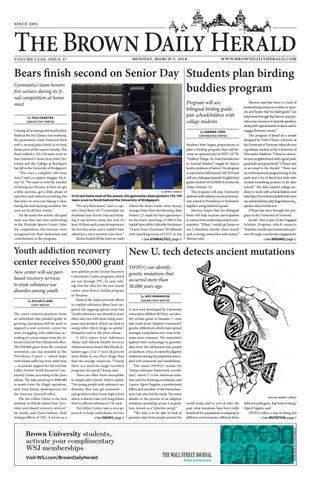
In its last home meet of the season, the gymnastics team posted a 193.150 team score to finish behind the University of Bridgeport. “It’s very bittersweet,” said co-captain Claire Ryan ’18. “I remember my freshman year Senior Day and thinking it was forever away, but now it’s here. It’s been such a special experience the last four years, and I couldn’t have asked for a more positive time here.” Brown kicked off the meet on vault,
where the Bears made some lineup changes from their last showing. Kate Nelson ’21 made her first appearance on the event, notching a 9.500 in the leadoff spot while Gabrielle Hechtman ’19 and Anne Christman ’20 followed with matching scores of 9.575. In the » See GYMNASTICS, page 3
Students have begun preparations to pilot a birding program that will become an optional part of HIST 1977B: “Feathery Things: An Avian Introduction to Animal Studies,” taught by Nancy Jacobs, professor of history. The program is expected to fully launch Fall 2019 and will use a bilingual Spanish-English bird guide entitled AVES/BIRDS written by Adam Moreno ’18. The program will pair University students with children at a local elementary school in Providence to birdwatch together using Moreno’s guide. Moreno hopes that his bilingual book will help increase participation in nature from underrepresented communities. “When I would go home to my Colombian family, there wasn’t such a strong connection with nature,” Moreno said.
Moreno said that there is a lack of birdwatching resources written in Spanish and hopes that his field-guide “can help break through that barrier and provide more resources to Spanish speakers, along with opportunities to learn and to engage between nature.” This program is based on a model designed by Trish O’Kane, a lecturer at the University of Vermont, when she was a graduate student at the University of Wisconsin-Madison. “I lived in a lowerincome neighborhood with a great park, great kids and great birds,” O’Kane said in an email to the Herald. “There was no environmental programming in the park and a lot of latch-key kids who needed something positive to do after school.” She then trained college students to work with schoolchildren and help http://www.browndailyherald.com/ wp-admin/admin.php?page=wpzoom_ options them birdwatch. O’Kane has since brought her program to the University of Vermont. Jacobs’ class is part of the Engaged Scholars Program, which connects “students, faculty and community partners through community engagement, » See BIRDING, page 2
Youth addiction recovery New U. tech detects ancient mutations center receives $50,000 grant SWIF(r) can identify New center will use peerbased recovery services to treat substance use disorder among youth By DYLAN CLARK STAFF WRITER
The court-ordered payment from an individual who pleaded guilty to growing marijuana will be used to support a new recovery center for teens struggling with addiction, according to a press release from the Attorney General Peter Kilmartin’s office. The $50,000 grant from the criminal restitution case was awarded to The Providence Center — which helps individuals suffering from addiction — to provide support for the new Jim Gillen Anchor Youth Recovery Community Center, according to the press release. The state seized up to $900,000 in assets from the illegal operation, said Amy Kemp, spokesperson for the Attorney General’s office. The Jim Gillen Center is the first institute in Rhode Island that “provides peer-based recovery services” for youth, said Owen Heleen, chief strategy officer of TPC. It serves as a
genetic mutations that occurred more than 30,000 years ago By JEFF DEMANCHE SENIOR STAFF WRITER
A new tool developed by University researchers, dubbed SWIF(r), can identify certain genes in humans — ones that result from “adaptive mutations,” genetic differences which have spread amongst a population over time to become more common. The researchers applied their technology to genomic data from the ‡Khomani San people of southern Africa to identify adaptive mutations among the population associated with immunity and metabolism. The name SWIF(r) stands for “sweep inference framework correlation,” where ‘r’ is the statistical notation used for denoting correlation, said Lauren Alpert Sugden, a postdoctoral fellow and member of the Ramachandran Lab, who led the study. The name alludes to the process of an adaptive mutation spreading across a population, known as a “selective sweep.” “The idea is to be able to look at genomic data from people around the
ANH-LISE GILBERT / HERALD
world today and to sort of infer the past: what mutations have been really beneficial for populations in adapting to different environments, different diets,
WEATHER
MONDAY, MARCH 5, 2018
Brown University students, SECTION activate your complimentary Let’s give some text that says something about this story so that WSJ memberships people read it
SECTION Let’s give some text that says something about this story so that people read it
WSJ.com/BrownDailyHerald PAGE Visit # PAGE #
different pathogens, that kind of thing,” Alpert Sugden said. SWIF(r) offers a way of doing just » See MUTATION, page 2
SECTION Let’s give some text that says something about this story so that people read it
SECTION Let’s give some text that says something about this story so that people read it
PAGE #
PAGE #
TODAY
TOMORROW
HI / LO
HI / LO
© 2018 Dow Jones & Co., Inc. All rights reserved.
INSIDE
new addition to the Anchor Recovery Community Center programs, which are run through TPC, he said, adding that the idea for the new youth center came from a similar program in Houston. Most of the state’s previous efforts to combat substance abuse have targetted the ongoing opioid crisis, but “youth substance use disorders most often start out with teens using marijuana and alcohol, which can lead to using other illicit drugs as adults,” Kilmartin said in the press release. A 2015 report from Substance Abuse and Mental Health Services Administration found that Rhode Islanders ages 12 to 17 were 28 percent more likely to use illicit drugs than than the average American. “Clearly there is a need for target recovery programs for youth,” Kemp said. Teens are often most susceptible to relapse after school, Heleen added. “For young people with substance use disorder, they may get treatment … and go back to their home high school where it doesn’t take very long before they’re offered substances,” he said. The Gillen Center uses a new approach to help individuals recover » See GRANT, page 2
NEWS
PAGE 2 • MONDAY, MARCH 5, 2018
THE BROWN DAILY HERALD
» MUTATION, from page 1
COURTESY OF ADAM MORENO
Adam Moreno ’18, author of the only locally-based English-Spanish bird-guide for children and beginners, hopes his book will increase the accessibility of birdwatching. He self-published the guide in November 2017.
» BIRDING, from page 1 engaged scholarship and social innovation,” according to the website of the Swearer Center for Public Service. Because of the ESP, the class received a grant to bring O’Kane as a guest speaker on Feb. 18. The class studies the intersection between history and animals. “Our relations with animals are structured by all of the same many qualities that structure every other part of our life.
Race, class and gender really shape how people relate to birds,” Jacobs said. The birding program will complement the “Feathery Things” course by allowing students to engage with the community and impact local children. Moreno started his bird guide as a final project for Jacobs’ class, and then turned it into a book that he self-published in November 2017. His book is unique in that it is the only bilingual locally-based bird-guide tailored to children and beginners, he said. The
hardest part of the process was “finding all the names in Spanish for the birds,” Moreno said. For every book that is purchased, Moreno will donate one to schools. Abigail Atkinson ’19, president of the Brown Student Birding Club, said that she and other members of the club plan to participate in the birding program. “Once the program has been established, I think that it can become really wonderful for both college and elementary school students,” Atkinson said.
COURTESY OF WIKIMEDIA COMMONS
The new Jim Gillen Center will be part of the Providence Center’s effort to help the recovery of youths from addiction. Adolescents in R.I. aged 12 to 17 are 28 percent likely to use drugs than the average American.
» GRANT, from page 1 from substance use disorders — a process called peer-based recovery. “People with lived experiences of addiction help other people who are in recovery maintain their recovery. It’s
all about peer(s) providing support,” Heleen said. The new center is currently in a “soft open” stage — it is only providing services to students at the Anchor Learning Academy, which is a part of the Anchor Recovery
Community Center programs, Heleen said. “They’re our first participants… It will very shortly be expanding to other high schools,” Heleen said. “In the long run we hope to intervene early and help young people stay in recovery.”
that, by scanning different genomes and calculating the probability that a specific mutation is adaptive, Alpert Sugden said. The method can detect mutations that took place more than 30,000 years ago. “As we did it, it just became very clear how powerful SWIF(r) is compared to existing methods,” said Sohini Ramachandran, associate professor of biology and computer science, director of the Center for Computational Molecular Biology and co-author of the study. Ramachandran’s lab and the CCMB use mathematical modeling and statistics to study genetic data. Prior methods of detecting adaptive mutations involved scanning sequenced genomes and applying statistical models to identify genes that are outliers, said Brenna Henn, assistant professor in the Department of Ecology and Evolution at Stony Brook University and co-author of the study. However, factors such as large reductions in population size or rapid growth can mimic signals of adaptive selection within a group of people even when the group is not undergoing natural selection, Henn said. SWIF(r) improves upon these methods by accounting for the histories of the populations in question and giving an easy-to-interpret output that shows whether any given gene is adaptive, Henn said. To test the efficacy of SWIF(r), the team analyzed genetic data Henn helped gather from the ‡Khomani San people. This group has the greatest genetic diversity of any living population and is thought to have lived in their
current environment for a very long time, meaning they have a high chance for adaptations to arise and are likely already adapted to their current environment, Alpert Sugden said. In running SWIF(r) on genetic data from the ‡Khomani San population, the researchers arrived at two key findings, according to Alpert Sugden. The first involved a collection of genes associated with immunity, called the Major Histocompatibility Complex. Researchers also found evidence in genes related to metabolism supporting the “Thrifty Gene Hypothesis,” which states that the ability to store as much energy as possible arose from food insecurity in hunter-gatherer populations. The example of ‡Khomani San genetics was a great test case for SWIF(r), said Lorin Crawford, assistant professor of biostatistics, “because it kind of shows the breadth of what (SWIF(r)) could do.” Crawford believes the tool could be applied to many different sets of genetic data to locate adaptive mutations. Ramachandran wants people to adapt the technology to expand its capabilities. “The F in SWIF(r) stands for ‘framework’ and so the goal is that it’s implemented very flexibly,” she said, adding that ideally the tool could be used on organisms other than humans. The project began in 2014 and went through an extensive period of development and calibration. “These things always take a lot longer than you expect them to,” Alpert Sugden said. “It’s neat to see it out in the world,” Ramachandran said, adding that other researchers in the field have expressed interest in using the tool and collaborating with the team on new datasets.
NEWS
MONDAY, MARCH 5, 2018 • PAGE 3
THE BROWN DAILY HERALD
» GYMNASTICS, from page 1 anchor position, Julia Green ’19 earned a 9.725 for her front handspring front pike to close the first rotation. Bruno was trailing all three visiting teams going into uneven bars, but the team put up big numbers on its second event to make up some ground. Alyssa Gardner ’21 got the momentum swinging with a stuck double back tuck dismount, earning a 9.575. Erin Howell ’20 came off a shoulder injury to make her season debut with a solid 9.675, and Ryan matched her careerhigh 9.800. Anya Olson ’18 contributed a 9.750, and Emma Hansen ’21 nailed her double back tuck dismount to receive a 9.825. Halfway through the meet, Brown sat in second behind Bridgeport. A fall early in the balance beam lineup added pressure on the remaining gymnasts, but the Bears pulled off five hit routines to stay on pace with the Knights. “If somebody falls, we’ve kind of got to hit that reset button and just pick it back up,” Ryan said. “We’ve gotten really, really good at doing that … and it definitely showed in the meet today.” In the leadoff spot, Ryan posted a 9.550, and freshman Rose Domonoske ’21 showed veteran composure in the middle of the lineup, earning a 9.675 for a bobble-free routine. Hansen hit a perfect back handspring step-out layout step-out series for a 9.525, and beam specialist Regan Butchness ’18 capped off the rotation with a stuck dismount and a 9.725. A 47.925 on balance beam secured Bruno’s second-place standing going into the final rotation. Still chasing Bridgeport, the Bears had a slate of
ELI WHITE / HERALD
After the first rotation, the Bears sat in fourth behind the three visiting teams, but high marks on the uneven bars propelled Brown into second place. The team would hold onto this position through the final two events, hitting five routines on the balance beam and performing well on floor. strong performances on floor exercise to notch a 48.750. “I don’t think there was (pressure),” McAvoy said of the team’s mentality going into the last event. “We did amazing on floor last week, and we were just going to repeat the same thing.” McAvoy overcame an elbow injury to return to the lineup, giving her team a 9.725 to build on. Christman and
Green added twin 9.775s to tie their personal bests, and Anya Barca-Hall ’18 notched a 9.825 in the final performance of the meet. The 193.150 is Bruno’s secondhighest mark this season and puts the team in a good position as it tries to qualify for the USAG Collegiate National Championships. “This (score) helps so much,” McAvoy said. “(Regional qualifying scores)
can still change drastically. We have three meets left, and I just got word that we finished at the top of the Ivies for this weekend. It’s only going to help us.” As the Bears turn their attention to a quad meet against Yale, the University of Kentucky and the University of New Hampshire, Ryan added that she felt the team’s performance on Sunday was a good indicator of how the rest
of the season will pan out. “It is really, really going to help us with our confidence going forward,” Ryan said. “Obviously Ivies didn’t go exactly how we wanted it, and we needed a meet like this to pick it up. We still have a lot of our season left and a lot of ground to make, and we definitely still can.” Brown will take to the floor at 1 p.m. in New Hampshire Sunday.
STAY UP-TO-DATE. FOLLOW US ON FACEBOOK. FACEBOOK.COM/BROWNDAILYHERALD
COMMENTARY PAGE 4 • MONDAY, MARCH 5, 2018
THE BROWN DAILY HERALD
TODAY
MONDAY, MARCH 5, 2018 • PAGE 5
THE BROWN DAILY HERALD
menu
s m o o t h s ay l i n g
SATELLITE DINING ANDREWS COMMONS
Pizza: Cheese, Pepperoni, Caprese, BBQ Chicken Ranch Grinder JOSIAH’S
BLUE ROOM
Philly Burger Grilled Cheese
Grain Bowl Chicken Noodle Soup
DINING HALLS SHARPE REFECTORY LUNCH
DINNER
Hot and Sour Pork Stir Fry, Chow Mein Noodles with Tofu, Vegetable Barley Soup
Cider Glazed Turkey, Country Style Baked Ham, Baked Polenta, Pineapple Upside Down Cake
VERNEY-WOOLLEY LUNCH
DINNER
Black Bean Lousiana, Italian Meatball Grinder, Swiss Broccoli Pasta, French Fried Potatoes
Shredded Pepper Chicken, Ravioli A La Vodka With Eggplant and Peppers
sudoku
COURTESY OF KAITLYN LEW
Students crowded on the Main Green outside Sayles Hall to enjoy a brief day of blue skies and spring weather last week before a freak nor’easter drenched College Hill and brought back grey skies.
Q U O T E O F T H E D AY
“I lived in a lower-income neighborhood with a great park, great kids and great birds.”
RELEASE DATE– Saturday, April 7, 2012
— Trish O’Kane, lecturer at the University of Vermont
Los Angeles Times Daily Crossword Puzzle crossword Edited by Rich Norris and Joyce Nichols Lewis
ACROSS 1 Human mind 7 Petty disagreement 15 Show whose original house band was The Buckaroos 16 Shoe parts 17 Phrase that gets a caller’s attention? 18 Clancy’s Jack Ryan, e.g. 19 Closer 20 Round Stic maker 21 Frond part 22 __ jure 23 Nut crackers 25 Modify 26 21st Greek letter 27 Hairstyles like MacGyver’s 29 Understand 30 Upright citizen? 32 Meshed dividers 34 Words from the head of a line 35 Kind of justice 39 Work that can’t be done alone 41 Undermine 42 Wagner’s “__ Rheingold” 45 Pump pick 47 Rabbit friend 48 Marine predator 50 Leg strengthener 51 Streamlet 52 City in Florida’s horse country 54 Carrier letters 55 Enter 56 Home entertainment piece 58 Delivery class? 59 Regularly monitored, in a way 60 Brings out 61 City near the Khyber Pass 62 Shooting locale? DOWN 1 City where a Pauline letter was received 2 Ranking angels 3 Reminiscent of the 1919 poem “The Second Coming”
4 City with a California State campus 5 Dish of leftovers 6 Lea bleater 7 Talkative 8 Popular financial software 9 Hagen of the stage 10 “Immediately!” 11 “I made more lousy pictures than any actor in history” speaker, familiarly 12 Homogenizes 13 “Of Mice and Men” rabbit lover 14 Impressive spread 20 Middle manager? 23 Raid squad 24 Run an errand, say 27 Error 28 It’s often preceded by a warning 31 “Pushing Daisies” pie maker 33 Ninth in a series: Abbr. 36 Japanese restaurant order
37 Adored 38 Hipster’s trait 40 Only word heard in a 1958 song of the same name 41 Reunión attendees 42 Genre characterized by nonsense syllables 43 Recherché
44 Works near an arena, perhaps 46 Assemble, as troops 49 To whom many pray 51 Clean again 53 Vibes 55 Island brew 57 “Immediately!” 58 The Once-__: “The Lorax” character
ANSWER TO PREVIOUS PUZZLE:
See BIRDING on page 1.
CORRECTION Due to an editing error, an earlier version of the Feb. 28 article “New series to help support grad students of color” stated that according to the University’s website, the RESET Series aims to serve as a safe space where graduate students of color can initiate dialogue, create bonds and learn about available resources. In fact, the University’s website does not describe the RESET Series as a safe space. The Herald regrets the error.
CORRECTION A previous version of the Feb. 27 column “I, not a robot, wrote this article” referred to Meredith Broussard as a professor at Temple University. In fact, Broussard is currently a professor at New York University. The Herald regrets the error.
xwordeditor@aol.com
calendar
04/07/12
TODAY MARCH
S
M
T
W
Th
F
S
28
29
30
31 1
12
23
34
45
56
67
87
89
10 9
10 11
Massage Mondays 12:00 P.M. Stephen Robert ’62 Campus Center
LaTeX Graphics Workshop 12:00 P.M. Science Center
Copyright in the Academy 2:00 P.M. Rockefeller Library
Let’s Talk: Gun Control 8:00 P.M. Sayles Hall, 300
TOMORROW
11 12
12 13
13 14
14 15
15 16
16 17
17 18
18 19
19 20
20 21
21 22
22 23
23 24
24 25
25 26 By Peter A. Collins (c)2012 Tribune Media Services, Inc.
04/07/12
26 27
27 28
28 29
30
31
The Public Health Blood Drive 10:00 A.M. 121 S. Main Street
Royce Fellowship Information Session 12:00 P.M. Lippett House
Build Your Social Confidence 2:00 P.M. J. Walter Wilson
Cognex Info Session 5:00 P.M. Barus and Holley, 751
COMMENTARY PAGE 6 • MONDAY, MARCH 5, 2018
THE BROWN DAILY HERALD
LETTER TO THE EDITOR
Why does the PTP feel the need to pay students? To the editor: Regarding the March 2nd op-ed, “In defense of the Political Theory Project,” by Daniel Shemano ’19: Does The Herald or Shemano have any obligation to disclose that Shemano is paid $500 per semester to participate in PTP programming? The program — the Philosophy, Politics and Economics Society — is perhaps unique among
undergraduate academic programs at Brown in paying money to students to attend talks and lectures. Is this a testament to the overarching power of the timeless ideas at the core of the PTP? Or is this evidence of a failure to compete in the marketplace of ideas? Seth Rockman Associate professor of history
comic
P HO E B E AY R E S
Comic | Ceyhun Firat
Find us online! facebook.com/browndailyherald
browndailyherald.com
@the_herald
Location: 195 Angell St., Providence, R.I. www.browndailyherald.com
@browndailyherald
youtube.com/browndailyherald
Editorial Leadership
Sections
Multimedia & Production
Editor-in-Chief Elena Renken
Arts & Culture Editors Connor Sullivan Elizabeth Toledano
Design Editors General Managers Kyle Cui Michael Borrello Eduard Muñoz-Suñé Matilda Lynton Assistants: Julie Wang, Kelvin Yang
Metro Editors Emily Davies Bella Roberts
Photo Editors Sam Berube Anita Sheih
News Editors Anna Kramer Eduard Muñoz-Suñé Priyanka Podugu Sarah Wang
Copy Desk Chief Abby Borges
Managing Editor Kasturi Pananjady Senior Editors Julianne Center Madison Rivlin Alex Skidmore Hattie Xu POST- MAGAZINE Editor Saanya Jain
Science & Research Editors Jonathan Douglas Jackson Wells Sports Editors Alexandra Russell Nicholas Wey COMMENTARY Opinions Editors Connor Cardoso Anuj Krishnamurthy Clare Steinman
Illustrations Editor Pia Mileaf-Patel Directors of Web Development Eli White
Business
Office Manager Diane Silvia Directors Sales: Shreya Raghunandan Finance: Ravi Betzig Strategy: Caroline Ziegler
Editorial contact: 401-351-3372 herald@browndailyherald.com
Advertising contact: 401-351-3372 advertising@browndailyherald.com
Submissions: The Brown Daily Herald publishes submissions in the form of op-eds and letters to the editor. Op-eds are typically between 750 and 1000 words, though we will consider submissions between 500 and 1200 words. Letters to the editor should be around 250 words. While letters to the editor respond to an article or column that has appeared in The Herald, op-eds usually prompt new discussions on campus or frame new arguments about current discourse. All submissions to The Herald cannot have been previously published elsewhere (in print or online — including personal blogs and social media), and they must be exclusive to The Herald. Submissions must include no more than two individual authors. If there are more than two original authors, The Herald can acknowledge the authors in a statement at the end of the letter or op-ed, but the byline can only include up to two names. The Herald will not publish submissions authored by groups. The Herald does not publish anonymous submissions. If you feel your circumstances prevent you from submitting an op-ed or letter with your name, please email herald@browndailyherald.com to explain your situation. You can submit op-eds to opinions@browndailyherald.com and letters to letters@browndailyherald.com. When you email your submission, please include (1) your full name, (2) an evening or mobile phone number in case your submission is chosen for publication and (3) any affiliation with Brown University or any institution or organization relevant to the content of your submission. Please send in submissions at least 24 hours in advance of your desired publication date. The Herald only publishes submissions while it is in print. The Herald reserves the right to edit all submissions. If your piece is considered for publication, an editor will contact you to discuss potential changes to your submission. Commentary: The editorial is the majority opinion of the editorial page board of The Brown Daily Herald. The editorial viewpoint does not necessarily reflect the views of The Brown Daily Herald, Inc. Columns, letters and comics reflect the opinions of their authors only. Corrections: The Brown Daily Herald is committed to providing the Brown University community with the most accurate information possible. Corrections may be submitted up to seven calendar days after publication. Advertising: The Brown Daily Herald, Inc. reserves the right to accept or decline any advertisement at its discretion. The Brown Daily Herald, Inc. is a financially independent, nonprofit media organization bringing you The Brown Daily Herald, BlogDailyHerald and Post- Magazine. The Brown Daily Herald has served the Brown University community daily since 1891. It is published Monday through Friday during the academic year, excluding vacations, once during Commencement and once during Orientation by The Brown Daily Herald, Inc. Single copy free for each member of the community. Subscription prices: $200 one year daily, $100 one semester daily. Copyright 2017 by The Brown Daily Herald, Inc. All rights reserved. Periodicals postage paid at Providence, R.I. Postmaster: Please send corrections to P.O. Box 2538, Providence, RI 02906.
COMMENTARY MONDAY, MARCH 5, 2018 • PAGE 7
THE BROWN DAILY HERALD
Beware the Political Theory Project JULIA ROCK AND HARRY AUGUST op-ed contributors In response to recent debate about the Brown Political Theory Project, we feel the need to warn students that the PTP is not a center for “thriving intellectual discourse,” in the words of Daniel Shemano ’19. Instead, we must be critical of what it means to have a political center on our campus that has received significant contributions from the Charles Koch Foundation. We ask students to consider the history of Koch money in our country and reject the claims that the PTP exists to contribute to our academic community at Brown. The millions in Koch money on our campus threaten our values and our community. Charles and David Koch have a long history of influencing American politics and institutions to advance their own interests, particularly those related to their petrochemical business, Koch Industries. They have been explicit about their use of universities toward this goal: Charles Koch, in a 1974 speech, said they should only support universities that “contribute in some way to our individual companies or to the general welfare of our free enterprise system.” Thus, Koch’s contributions cast serious doubt on the PTP’s “commitment to pluralism” — instead,
they fit into the Kochs’ broader scheme, one with a strict ideological agenda. In 2013, the Atlantic reported that the two private charitable institutions owned by Charles Koch had donated a total of more than $19.3 million to 210 colleges and universities across the country in 2012 alone. As the Atlantic reported, “Koch officials routinely cultivate relationships with professors and deans and fund specific courses of economic study pitched by them.” Professor John Tomasi wrote in his recent op-ed that “the PTP allows do-
deregulation.” The Kochs’ donations may not be explicitly quid pro quo, but we are confident that if the PTP’s scholarship strayed from the Kochs’ radical agenda, the Kochs would cut funding to the PTP and start afresh with a new charismatic professor and a new project to support. The evidence of this influence bleeds through the PTP’s well-manicured website. In his op-ed, Shemano claimed that “indeed, one could survey the PTP’s current collection of profes-
ogy. But it doesn’t stop there: PTP professors pad their bios with academic awards they’ve received. Most of them come from Koch-affiliated institutions. Take the “Gordon Tullock Prize” that PTP Professors Emily Skarbek and Daniel D’Amico list in their bios: Unsurprisingly, this award is granted by the Center for Study of Public Choice, hosted — where else — but at GMU. Or take the “Israel M. Kirzner Award,” from the Society for the Development of Austrian Economics, of
We should be deeply afraid of the Kochs’ agenda, not because we disagree with them but because their ideas are affronts to the legitimacy of our country’s democracy. nors no input regarding any of our activities.” We don’t doubt this is true, but it would be absurd to think that the Charles Koch Foundation donated $3.2 million to the PTP out of pure benevolence. The Kochs make these donations to support their anti-government, “free market” agenda in order to safeguard their wealth and power. And this is not purely conjecture. According to the International Business Times, the Koch brothers have long considered universities to be “the foundation of their ‘Structure of Social Change,’ an effort to convert Americans to libertarianism and push through steep tax cuts and
sors and post-doctoral research associates and find that its scholarship is largely independent of any Koch-inspired agenda.” We did in fact survey the PTP’s professors, and their CVs are littered with oil-stained Koch fingerprints. Looking at the ‘People’ page of the PTP’s website, you will notice that everyone but Professor Tomasi received their economics PhDs from George Mason University. Charles Koch has donated $96 million to George Mason University, where he established the Mercatus Center — a heavily-endowed incubator for radical libertarian ideol-
which both Professors D’Amico and David Skarbek boast: Again, unsurprisingly, this is actually just a GMU student award. Furthermore, Tomasi himself received the literal “Charles G. Koch Prize” at, again, GMU. The fact they received GMU awards and degrees alone is not evidence they are torch-bearers of the Koch ideology, but when you look at the extent of support they’ve received throughout their careers, a clearer picture of the Kochs’ talent pipeline comes together. For example, these professors have also been repeatedly published in Koch and GMU-affiliated journals, like the Re-
view of Austrian Academics, the Public Choice Journal and the Cato Journal. But what is most alarming is that the PTP is employing this same strategy, using Koch Industry money to legitimize a dangerous ideology, at Brown. Students who join the PTP’s Philosophy, Politics and Economics Society are rewarded with $500 and often cite leadership positions on PTP’s undergraduate journal, accolades that in turn give them access to the entire Koch network. This includes internships, research opportunities and eventually jobs, all backed by the same individuals. The Koch’s ‘Talent Pipeline,’ as many call it, starts at Brown. And let us not forget in this debate that we should be deeply afraid of the Kochs’ agenda, not because we disagree with them but because their ideas are affronts to the legitimacy of our country’s democracy. They have led efforts to gerrymander election maps for Republicans, fought against limits to corporate spending in elections and cultivated the Tea Party, one of the largest astroturf movements in American history. Students should not be fooled.
Julia Rock ’19 and Harry August ’19 can be reached at julia_rock@brown.edu and harry_august@brown.edu. Please send responses to this opinion to letters@browndailyherald.com and other op-eds to opinions@ browndailyherald.com.
How to fix college basketball GEORGE KLEIN sports columnist The sports world erupted last weekend when FBI documents revealed deep corruption in college basketball. Several storied programs — including those at Duke University, University of North Carolina and the University of Kentucky — gave cash benefits to recruits to entice talented players. Though some of these benefits were minor, there were also substantial offenses, including at the University of Arizona, where coach Sean Miller was caught discussing a $100,000 payment for star DeAndre Ayton’s services. My only question: Why is everyone in college basketball acting so outraged and saddened? Let’s be honest: everybody knows that top recruits are receiving money. And those players deserve the money, too. The college basketball system is broken and filled with incomprehensible rules. Don’t get me wrong — I love college basketball. But I think we all can admit that the sport needs fixing fast. Here’s how I would go about it. 1. Allow college players to make money off their own names. The NCAA does not let athletes profit from their likenesses and autographs. The organization has maintained that players are students first and that they must retain their amateur status. Well, I’m a student too, and if anyone was willing to pay for my autograph, I would sign everything in sight. Players, and especially national stars, should not be as limited as I am, considering they produce tons of revenue for schools and the NCAA itself thanks to TV contracts and merchandise. Head Coach of the Kentucky Wild-
cats John Calipari is a controversial figure to be sure, but is absolutely correct when he says, “It’s their name and likeness. It’s not ours, it’s theirs.” As adults, college athletes should be able to use their images in whatever manner they choose. Are members of Final Four teams who play in front of full football stadiums not mature enough to represent their own brand? Ridiculous. 2. Get rid of the one-and-done rule.
high school graduates to enter the draft for a period, then remove their candidacy if their draft stock is not satisfactory? Another argument is that high school prospects are simply not prepared for the NBA life and will be busts like Kwame Brown, who is widely mocked for his NBA failures. Well, Kwame Brown played in the NBA for 13 seasons and earned just under $64 million in career earnings. Where do I sign up to be a $64 million
Let’s be honest: everybody knows that top recruits are receiving money. And those players deserve the money, too. … But I think we all can admit that the sport needs fixing fast.
There has been a lot of conversations about changing this regulation. Top high school basketball players should not be forced to attend college, especially when they won’t gain anything from the experience. Ben Simmons did not need the experience of leading LSU to the NIT alongside a bunch of lesser players. He was NBA-ready from the moment he stepped on a college court. A common argument against removal of oneand-done is that players could get lost in the draft and lose their college eligibility. Why not allow
bust? Out of the 44 men who were drafted out of high school, 32 became solid NBA players — that list includes Kevin Garnett, Kobe Bryant, Tracy McGrady, Amar’e Stoudemire, LeBron James and Dwight Howard. Not too shabby. Somehow, Kobe and LeBron were able to hold their own against NBA players without a year at college. 3. Build-up the G League as another option. The NBA is heading in this direction, too. I think it is clear that no upper-echelon prospect like DeAndre Ayton or Marvin Bagely is going to
choose the Maine Red Claws over the NBA or a top college program. But guys who are just below that mark and want to improve their NBA draft stock should be able to pursue basketball as their sole focus, without the forced, time-consuming distractions of classes and other college responsibilities. Take Duke’s Trevon Duval, for example. He has underperformed on the court at times and is not projected to be a lottery pick. If, hypothetically, he wants basketball to become his full-time job but does not want to enter the NBA draft yet, he should have another viable option besides returning to Duke. An expanded (and better paying) G-League would allow players to work alongside NBA coaching talent and adjust to the NBA game more gradually. The influx of superior players would drive up attendance for G League games, and the league would truly be off and running. With these three rules, I have removed all the players who don’t want to be in college and have given athletes their rightful compensation. Top college teams could play together for longer without the interruption of one-and-dones, and the quality of play would improve accordingly. Players would get to know each other’s tendencies, and rivalries like Duke and UNC would ramp up even further as starting lineups play against each other year after year. And best of all, we don’t have to act surprised when DeAndre Ayton makes some money.
George Klein ’20 can be reached at george_klein@brown.edu. Please send responses to this opinion to letters@browndailyherald. com and op-eds to opinions@browndailyherald.com.
NEWS THE BROWN DAILY HERALD
MONDAY, MARCH 5, 2018
Bears fall to No. 15 Rutgers in home opener Phil Goss ’20 shines in goal, records 20 saves despite team struggles in second quarter By EMORY HINGORANI CONTRIBUTING WRITER
Following a close overtime loss to Quinnipiac University and a decisive victory over Stony Brook University, the men’s lacrosse team hoped for a strong showing in its home opener against No. 15 Rutgers University (4-1) Saturday. Despite claiming an early lead, the Bears (1-2) fell to the Scarlet Knights 10-8. Rutgers opened scoring in the first minute, but Brown responded strongly. Goals from Jack Kniffin ’20, Luke McCaleb ’20 and Brian Prigmore
’19 gave Bruno a 4-1 lead midway through the first quarter. Rutgers found the net once more with just over five minutes left in the first. Outscored 5-1 in the second quarter, Bruno struggled to keep pace with the Knights. Prigmore scored the lone Brown goal — his second of the afternoon — in the second stanza, and the Bears entered halftime trailing Rutgers 7-5. Michael Panepinto ’19 opened scoring in the second half by posting a goal nine minutes into the third quarter. But Brown’s offense stalled for the rest of the frame and put up only three shots to Rutgers’ eight. Rutgers tallied a goal with 7:04 left in the period and entered the fourth quarter at an 8-6 advantage. Panepinto scored again early in the fourth to put the Bears within
one goal of the Scarlet Knights, but Rutgers responded with back-to-back points to widen their lead to three with 4:50 left to play. Carson Song ’19 posted a goal in the last two minutes of the matchup, but time ultimately ran out for the Bears as the game ended 10-8, giving Brown its second loss of the season against a competitive Rutgers team. “Our kids battled hard and I was proud of that, but I’m definitely looking for a little more consistency,” said Brown Head Coach Mike Daly. “Against a good team they’ve got talent everywhere, but so do we … We expect our guys to win those matchups and make the plays they’re capable of.” The silver lining of the game was the exceptional play of goalie Phil Goss ’20, who logged 20 saves and
COURTESY OF BROWN ATHLETICS
Phil Goss ’20 defends the net against Rutgers Saturday. He recorded 20 saves, but the Bears still fell in their first home game of the season. kept the game within reach for the Bears. “We need to do a better job protecting (Goss) and giving him a chance, because when we do he makes
the plays that we need,” Daly said. The Bears have a quick turnaround this week as they travel to play an undefeated No. 7 Villanova University (5-0) squad Tuesday.
Brown finishes season with losses to Princeton, Penn Bears lose sixth straight game to close out season in seventh place in Ivy League standings By ALEX SMOLAR SENIOR STAFF WRITER
This weekend, the men’s basketball team dropped home contests to Princeton 78-63 and Penn 99-93 to close out its season. The Bears lost their sixth straight game and finished the year ranked seventh in the Ivy League with a 4-10 conference record. “Our guys realize that there is a bigger picture,” said Head Coach Mike Martin ’04. “We’re trying to build our program with a lot of freshmen and sophomores and one senior. So I think that every time you have the opportunity to compete, you should appreciate that opportunity.” Penn’s victory has given them a significant postseason berth, as they are now tied with Harvard for the number one seed in the Ivy League Tournament later this month. Following this weekend’s results, Yale and Cornell will also make appearances in the tournament. Bruno was in striking distance of postseason competition for weeks, but cold shooting down the stretch ultimately put the Bears (11-16, 4-10 Ivy) out of contention. With a young and athletic core group of players, Brown is poised to compete for a spot in the tournament in future seasons. Brown 63, Princeton 78 The Bears and the Tigers (13-16, 5-9) jumped out of the locker room to play consistent offense in the first half. At first, the score was tight, but three straight treys from Princeton gave the Tigers a 20-14 advantage. Princeton
started the contest by shooting 4-8 from beyond the arc while Bruno shot just 1-5 during this span. At the half, Princeton led 32-25. The Bears shot just 31 percent from the field and 14 percent from three-point range in the opening period and recorded 23 rebounds and three blocks. Obi Okolie ’19 and Joshua Howard ’20 led Bruno with six points each. “We’re going through a difficult stretch,” Martin said. “Sometimes the ball goes in, and sometimes it doesn’t.” To open the second stanza, the Tigers went on a quick 9-1 scoring run to extend their advantage to 15. After two three-point shots from Devin Cannady, Princeton’s lead quickly widened to 18 points. Cannady scored 12 points in the first seven minutes of the period and finished the game with 16. The Bears began to drive to the basket and play strong defense in an attempt to fend off the Princeton scoring attack. Okolie was fouled and drained both of his free throws to bring the Bears within 12 points of the Tigers with just over nine minutes to play. Moments later, Okolie sunk a three-point shot and Zach Hunsaker ’20 knocked in two free throws to trim the Tigers’ lead to nine. But a three-point shot from Jerome Desrosiers stunted Brown’s run, and the Bears were unable to fight their way back into the game. Myles Stephens fueled Princeton’s 15-point victory by scoring 22 points for the Tigers. “We missed some shots,” Martin said. “How many did you see, in the second half, that the ball just sat on the rim and rolled out on our end?” Bruno shot 34 percent from the field in comparison to Princeton’s 46 percent. Okolie led all Brown scorers with 17 points and nine rebounds, while the team grabbed 44 rebounds and committed 11 turnovers.
COURTESY OF BROWN ATHLETICS
Brandon Anderson ’20 drives to the basket in a loss against Penn Saturday. He and Tamenang Choh ’21 both finished the contest with 23 points in the final game of the season. “I think we can do a better job at the things we can control,” Martin said. “At the end of the day we want to overcome all of that stuff.” Brown 93, Penn 99 The Quakers (22-8, 12-2) came out hot beyond the arc from the opening tip. Ryan Betley hit three treys to give Penn an early edge. Betley’s fourth three-pointer of the half gave Penn a nine point lead, while the Bears had made just one three up to that point. Bruno was unable to find open shots for most of the first period and could not claw its way back. At halftime, Penn led Brown 47-31. The Bears
shot 41 percent in the first half and 1-9 from beyond the arc, compared to the Quakers’ 55 percent and 7-9 mark from three-point range. Tamenang Choh ’21 led all Brown scorers with eight points, followed by Hunsaker with seven. “They were hard for us to guard all night long,” Martin said. “We had just enough droughts offensively that we dug ourselves too big of a hole.” In the second stanza, the Bears could not overcome their deficit and fight back into contention. Although a late steal and three-point shot from Desmond Cambridge ’21 helped the Bears trim the Quakers’ lead in the
final two minutes, Penn managed to stave off the Brown attack. The Quakers stayed red-hot from three-point range and continued to be led by the shooting of Betley, who finished with 30 points. “I’m most happy that the guys kept playing,” Martin said. “They didn’t stop until the horn sounded off at the end.” Choh finished with 23 points and nine rebounds, followed by Brandon Anderson ’20, who also notched 23 points. The team shot 49 percent from the field and 32 percent from beyond the arc. Brown also grabbed 34 rebounds and recorded 40 points in the paint.