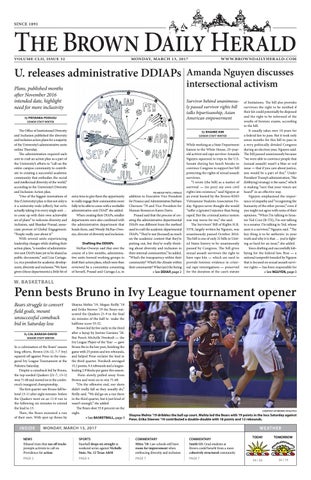
SINCE 1891
THE BROWN DAILY HERALD MONDAY, MARCH 13, 2017
VOLUME CLII, ISSUE 32
WWW.BROWNDAILYHERALD.COM
U. releases administrative DDIAPs Amanda Nguyen discusses intersectional activism
Plans, published months after November 2016 intended date, highlight need for more inclusivity
Survivor behind unanimously passed survivor rights bill talks bipartisanship, Asian American empowerment
By PRIYANKA PODUGU SENIOR STAFF WRITER
The Office of Institutional Diversity and Inclusion published the diversity and inclusion action plans for a majority of the University’s administrative units online Thursday. The administration required each unit to craft an action plan as a part of the University’s efforts to “call on the entire campus community to contribute to creating a successful academic community that embodies the social and intellectual diversity of the world,” according to the University’s Diversity and Inclusion Action plan. “One of the biggest innovations of this (University) plan is that not only is it a university-wide (effort), but we’re actually taking it to every single unit … to come up with their own achievable set of plans” to welcome diversity and inclusion, said Shankar Prasad, asssociate provost of Global Engagement. “People really care about it.” With several units experiencing leadership changes while drafting their action plans, “a number of administrative unit DIAPs have yet to be shared as public documents,” said Liza CariagaLo, vice president for academic development, diversity and inclusion.“We have given (these departments) a little bit of
By RHAIME KIM SENIOR STAFF WRITER
extra time to give them the opportunity to really engage their communities more fully to be able to come with a workable administrative unit DIAP,” she added. When creating their DIAPs, smaller departments were also combined with the administrative department that heads them, said Wendy McRae-Owoeye, director of diversity and inclusion. Drafting the DDIAPs McRae-Owoeye said that over the course of a few months, administrative units formed working groups to draft their action plans, which were then reviewed by a committee consisting of herself, Prasad and Cariaga-Lo, in
PIA MILEAF-PATEL / HERALD
addition to Executive Vice President for Finance and Administration Barbara Chernow ’79 and Vice President for Human Resources Karen Davis. Prasad said that the process of creating the administrative departmental DIAPs was different from the method used to craft the academic departmental DIAPs. “They’re not (focused) as much on the academic content that they’re putting out, but they’re really thinking about diversity and inclusion in their internal communities,” he added. “What’s the transparency within their community? What’s the climate within their community? What (are) the hiring » See DDIAP, page 2
While working as a State Department liaison to the White House, 25-yearold activist and rape survivor Amanda Nguyen squeezed in trips to the U.S. Senate during her lunch breaks to convince Congress to support her bill protecting the rights of sexual assault survivors. “I wrote (the bill) as a matter of survival — (to pen) my own civil rights into existence,” said Nguyen at an event hosted by the Brown-RISD Vietnamese Students Association Friday. Nguyen never thought she would “suffer a (greater) injustice than being raped. But the criminal justice system was way worse for me,” she said. The Survivors’ Bill of Rights H.R. 5578, largely written by Nguyen, was unanimously passed October 2016. The bill is one of only 21 bills in United States history to be unanimously passed by Congress. The bill gives sexual assault survivors the right to have rape kits — which are used to provide forensic evidence in criminal rape investigations — preserved for the duration of the case’s statute
of limitations. The bill also provides survivors the right to be notified if their kit could potentially be disposed and the right to be informed of the results of forensic exams, according to the bill. It usually takes over 10 years for a federal law to pass. But it took only seven months for this bill to pass in a very politically divided Congress during an election year, Nguyen said. The bill passed unanimously because “we were able to convince people that (sexual assault) wasn’t a blue or red issue — that if you care about justice, you would be a part of this.” Under President Trump’s administration, “the (lobbying) strategy is the same,” which is making “sure that your voices are heard” in an effective way. Nguyen emphasized the importance of empathy and “recognizing the humanity of the other person,” even if you might not agree with some of their opinions. “When I’m talking to Senator Ted Cruz (R-TX), I’m not talking to a senator. I’m talking to Ted, whose aunt is a survivor,” Nguyen said. “The key thing is to be authentic in your truth and why it is that … you’re fighting so hard for an issue,” she added. Since drafting and successfully lobbying for the federal law, Rise — a national nonprofit founded by Nguyen that is focused on sexual assault survivor rights — has been responsible for » See NGUYEN, page 3
W. BASKETBALL
Penn bests Bruno in Ivy League tournament opener Bears struggle to convert field goals, mount unsuccessful comeback bid in Saturday loss By CAL BARASH-DAVID SENIOR STAFF WRITER
In a culmination of the Bears’ season long efforts, Brown (16-12, 7-7 Ivy) squared off against Penn in the inaugural Ivy League Tournament at the Palestra Saturday. Despite a comeback bid by Bruno, the top-seeded Quakers (21-7, 13-1) won 71-60 and moved on to the conference’s inaugural championship. The first quarter saw Bruno fall behind 13-11 after eight minutes before the Quakers went on an 11-0 run in the following six minutes to extend the lead to 13. Then, the Bears mounted a run of their own. With spot up threes by
INSIDE
Shayna Mehta ’19, Megan Reilly ’18 and Erika Steeves ’19 the Bears outscored the Quakers 21-9 in the final six minutes of the half to make the halftime score 33-32. Brown led by five early in the third after a layup by Justine Gaziano ’20. But Penn’s Michelle Nwokedi — the Ivy League Player of the Year — gave Bruno fits in the low post, finishing the game with 25 points and ten rebounds, and helped Penn reclaim the lead in the third quarter. Nwokedi averaged 15.2 points, 9.4 rebounds and a leagueleading 2.9 blocks per game this season. Penn slowly pulled away from Brown and went on to win 71-60. “On the offensive end, our shots didn’t really fall as they usually do,” Reilly said. “We did go on a run there in the third quarter, but it just kind of wasn’t enough,” she added. The Bears shot 33.8 percent on the night. » See BASKETBALL, page 3
COURTESY OF BROWN ATHLETICS
Shayna Mehta ’19 dribbles the ball up court. Mehta led the Bears with 19 points in the loss Saturday against Penn. Erika Steeves ’19 contributed a double-double with 18 points and 12 rebounds.
WEATHER
MONDAY, MARCH 13, 2017
NEWS Ethanol train that ran off tracks prompts activists to call on Providence for action
SPORTS Baseball drops six straight in weekend series against Nicholls State, No. 12 Texas A&M
COMMENTARY Mitra ’18: Law schools still have room for improvement when embracing diversity and inclusion
COMMENTARY Smith GS: Grad students at Brown could benefit from a more cohesively structured community
PAGE 2
PAGE 4
PAGE 7
PAGE 7
TODAY
TOMORROW
34 / 20
34 / 19
NEWS
PAGE 2 • MONDAY, MARCH 13, 2017
THE BROWN DAILY HERALD
Ethanol train runs off tracks into multi-lane road Local environmental activists call on Providence to end transportation of ethanol By GWEN EVERETT SENIOR STAFF WRITER
An ethanol train ran off its tracks around 1 a.m. Wednesday in the south side of Providence. The train crashed through a chain-link fence and into a multi-lane road, but no ethanol spilled as a result of the incident, the Providence Journal reported. In response to the derailment, some local environmental activists are calling for an end to ethanol transport through Providence. Ethanol is “explosive and extremely flammable,” according to a joint-press release from the Fight Against Natural Gas collective, Environmental Justice League of Rhode Island, the Sierra Club and No LNG in PVD.
» DDIAP, from page 1 practices of their staff?” The plans were originally intended to be published November 2016, The Herald previously reported. But their release was delayed to facilitate “faceto-face conversations” between the departmental working groups and the review committee, McRae-Owoeye said. “Diversity and inclusion (work) is not done behind emails. … It’s done through engaging, thoughtful discussion,” she said. The meetings gave the university “an opportunity to understand what each department needs,” but coordinating the schedules of everyone involved to hold these discussions took some time, she added. Each unit received a template to “help them identify goals that were actionable,” McRae-Owoeye said. These templates guided units in shaping their action plans.
LITERARY ARTS PRIZES 2017
Common themes While each action plan includes initiatives and programs that are department-specific, as a general trend,
“It is not okay that south side Providence is the sacrifice zone for these toxic and dangerous industries,” said Monica Huertes, a member of No LNG in PVD and resident of South Providence, in a quote included in the press release. The press release dubbed ethanol trains “bomb trains” and called on Providence to ban ethanol transport through the city, just as Boston did in 2015. Though Boston banned licensing of ethanol-carrying vehicles through its boroughs in its 2015 budget, the ban expired in January 2017. Subsequent budgets did not extend the ban. Two days after the Providence crash, an ethanol train ran off its tracks in Iowa. The crash caused a fire that continued for 15 hours, the Associated Press reported. In a 2015 report, the Department of Transportation predicted oil and ethanol trains would derail about 10 times per year in the coming two decades, the Associated Press reported.
The train ran through a chain-link fence into a multi-lane road Wednesday. The topic was thrust into the national spotlight two days later when an ethanol train crash in Iowa caused a fire that lasted 15 hours.
the plans focus on increasing staff representation from historically underrepresented groups and express an interest in holding workplace conversations on inclusivity and diversity. The University also defines historically underrepresented groups as individuals who identify as American Indian, Alaskan Native, African American, Hispanic or Latinx and Native Hawaiian and/or Pacific Islander, according to the DIAP. According to the University’s DIAP, the DDIAPs are encouraged to include information about “past hiring and reflect the specific steps that departments will take to identify and consider candidates from historically underrepresented groups when replacing retiring or departing faculty.” The Bell Gallery analyzed its staff demographics in its DDIAP, and after finding little HUGs representation, its plan lists the gallery’s intention of partnering with Human Resources and the Office of Institutional Diversity and Inclusion to “identify opportunities to attract applicants from HUGs.” “In order to attract and retain diverse staff, inclusion had to become a
mainstay conversation at (Counseling and Psychological Services). We have had tremendous success with our goals so far — close to half of our staff are people of color, and altogether, our staff represents a rich intersection of identities,” wrote Allyson Brathwaite-Gardner, interim director of CAPS. Fourty-five percent of CAPS staff members identify as people of color, according to the DIAP Annual Report released Thursday. In order to facilitate an inclusive climate, the Computing and Informational Services’ DDIAP aims to raise awareness among staff of “unintentional bias” through a reading of “Blindspot: Hidden Intentions of Good People.” Another initiative works to impart “the value of diversity in teams” with lectures, readings and podcasts. Other plans emphasize work climate data as a tool to help departments direct change. The working group responsible for creating the Facilities Management’s DDIAP found that staff members believed the University had “not set staff development as a priority,” according to the department’s action plan. A staff survey distributed last spring also reported
ELI WHITE / HERALD
The Literary Arts Department is sponsoring the following prizes for the Brown community:
Academy of American Poets Prize: For the best poem (up to 10 pages). Open to all Brown students. Kim Ann Arstark Memorial Awards: For the best poem or poems (up to 20 pages) written in celebration of life. Open to all Brown students. Feldman Prizes in Fiction: For the best story or stories (up to 50 pages). Open to all Brown students. Beth Lisa Feldman Prize in Children’s Literature: For the best story or stories for children four to eight years old (up to 50 pages). Open to all Brown students (and may be a collaboration). Frances Mason Harris ’26 Prizes: For a book-length manuscript of poetry or prose fiction by a currently enrolled undergraduate or graduate woman. John Hawkes Prize in Fiction: This contest honors the memory of John Hawkes, the internationally-recognized author and dedicated professor of creative writing at Brown University. The contest is open to all students currently enrolled in the Graduate Program in Literary Arts. The submission must be a work of fiction (up to 50 pages). Edwin Honig Memorial Prizes in Poetry: Honoring the memory of Edwin Honig — poet, translator and founder of the Literary Arts Department at Brown University (up to 10 pages). Open to all Brown students. Keith and Rosmarie Prizes for Innovative Writing: For literary work, any genre, that best exemplifies the spirit of innovation found in the writings and translations of Keith and Rosmarie Waldrop. Up to 15 pages. Open to all Brown students. DEADLINE: 11 PM ON 16 MARCH. ALL APPLICATIONS ARE COMPLETED ONLINE. TO APPLY,VISIT: HTTPS://WWW.BROWN.EDU/ACADEMICS/LITERARY-ARTS/LITERARY-ARTS-PRIZES-2017-LISTING
that nearly half of all respondents did not feel respected by faculty at Brown, The Herald previously reported. Facilities Management intends on using “climate survey data to … have a clear and visible policy and process that allows staff to share diversity and inclusion related concerns,” the plan states. The plans also feature varying levels of student input. “Some departments have a closer nexus to the students whereas other departments might (not),” McRae-Owoeye said. “Their goals reflected their day-to-day interactions.” Catherine Axe ’87, director of Student and Employee Accessibility Services, said that her department issued student surveys to gain feedback on where SEAS could make improvements. “We have to make sure we’re responding to student needs,” she added. While Axe admitted that there still is more work to do across administrative units, she was “excited to hear that people were including disability in their planning.” Director of the Department of Public Safety Mark Porter said that while DPS did not consult students when creating their DDIAP, “students will have their opportunity to give feedback and … we can certainly adjust our plan based on their feedback.” Funding and accountability Some departments’ plans revealed an inability to self-finance proposed
diversity initiatives. According to their action plan, CareerLAB’s working group expressed concern that “limited staff time and budget may (hinder the process) to conduct significant outreach” in hiring new staff. However, Cariaga-Lo said that if departments could not fund their unitspecific initiatives, funding could potentially come from the OIDI. However, Cariaga-Lo hopes that “through the capital campaign, we’ll be able to fund, support and provide new resources for professional development and training around diversity and inclusion in ways that we did not have the capacity to do before.” The Herald previously reported that the president’s capital campaign is ahead of its fundraising goals. Creating the DDIAPS has been a “very thoughtful and intentional process that (encourages) academic and administrative departments to be accountable and responsible for measurable outcomes” in diversity and inclusion, McRae-Owoeye said. Despite this focus on transparency and accountability, administrative units are not required to publish an annual report of their progress toward DDIAP goals, said Cariaga-Lo. However, “every single unit will be asked to do a yearend review of what progress they have made toward their goals” and share their results with the OIDI, she said. “Larger departments may (create) reports on a yearly basis,” she added.
STAY UP-TO-DATE. FOLLOW US ON FACEBOOK. FACEBOOK.COM/BROWNDAILYHERALD
NEWS
MONDAY, MARCH 13, 2017 • PAGE 3
THE BROWN DAILY HERALD
» NGUYEN, from page 1 six laws and has been working with 29 states and three countries to pass bills. Nguyen’s efforts started with one mass email “to everyone I knew,” she said. Nguyen received responses from people ranging from attorneys to coders, who asked how they could help. The first bill Nguyen helped pass was in Massachusetts, where she was raped as a student at Harvard. Every six months, Nguyen had to fight to prevent her rape kit from being destroyed. “When I went to research my options, I found out that there were huge irregularities in law by state,” Nguyen said. She was faced with a choice: “I suffer injustice, or I rewrite the law,” she said. After being told that the bill was going to die because the Speaker of House wasn’t going to bring it up, Nguyen and her team spent 14 hours speaking at every single representative and senator’s office. At the end of that day, the speaker brought up the bill, which was then passed unanimously. Nguyen and her team conducted careful research before speaking with any officials in order to present a very clear vision of how the bill would benefit them. “The thing that will attract people, no matter how many numbers you throw at somebody, is a story,” Nguyen said. “A group of 20-something-yearolds … did something that major conglomerates pay literally millions of dollars for lobbyists to do.” Rise is able to lobby so efficiently because of the authentic storytelling
of her team, “which consists of sexual assault survivors and allies,” Nguyen said. Nguyen highlighted the power of media in effectively connecting with large audiences. Rise worked with Will Ferrell’s comedy website Funny Or Die to create a video on sexual assault awareness that went viral. The video used humor and entertainment to “get the word out there” and educate people, Nguyen said. “In social movements, trauma fatigue, especially in civil rights movements, is a real thing,” causing people to feel “bombarded consistently with bad thing after bad thing,” Nguyen said. “My deep belief in social movements is that movements are sustained on hope.” Therefore, Rise’s approach is designed “to (not only) show the truth of a story” but also present pragmatic solutions. “Sometimes this work can get really tough,” Nguyen said. “Every time someone tells me their story, ... it’s another weight I hold, but it keeps my fire alive,” she said. During an Uber ride, a driver once began to cry when she explained what she does for a living. “My daughter is a rape survivor,” the driver told her, Nguyen said. He stopped the car and said, “Thank you so much for fighting for my daughter. Has anyone told you that they love you today? I love you.” “I think what has been really moving for me has been other people, other women of color, and also specifically Asian Americans or Asian people, who have reached out to me and expressed … how much it means
to see an (Asian and/or Pacific Islander) person talk about these issues,” Nguyen said. “To be very frank, in the places and community I’ve grown up in, this is a very stigmatic issue,” Nguyen said. “I cannot tell you how many times I’m in a room, talking about this issue, and I’m still the only person of color,” Nguyen said. “It’s important that we acknowledge people of color’s stories. We need more visibility, and that visibility is absolutely within our agencies.” Kimberly Le ’19, who identifies as Vietnamese-American, sees a role model in Nguyen. “I believe in the empowerment of Asian Americans and Asian American women,” she said, adding she was inspired by how outspoken Nguyen was about “her civil rights being unprotected,” she said. “I think being able to bring her here … showed that as young people, we are able to make the change that we want to see in the world,” said Arthur Tran ’18, co-president of the BrownRISD VSA. On March 22, Rise is launching a public service announcement with Tatiana Maslany, who starred in Orphan Black. Rise is also launching an online platform that same day, which is like an “Uber or Lyft” that connects people to help survivors, she said. Nguyen’s talk was funded by the University Finance Board, Office of Institutional Diversity and Inclusion, Brown Center for Students of Color, Pembroke Center and Sarah Doyle Women’s Center, said Brandon Le ’18, Friexecutive co-chair of the BrownRISD VSA.
ELI WHITE / HERALD
Amanda Nguyen spoke about her personal experiences as an Asian American activist and sexual assault survivor at an event Friday.
COURTESY OF BROWN BEARS
The women’s basketball team faced off against Penn in the first round of the inaugural Ivy League Tournament at the Palestra in Philadelphia. Despite a hard-fought effort, the Bears fell 71-60, while the Quakers went on to beat Princeton in the final 57-48 to become the first-ever champion of the Ivy League postseason tournament.
» BASKETBALL, from page 1 “The game plan was to make them go left and try to keep them off the three-point line and to rebound better,” said Head Coach Sarah Behn. “We actually did those things. But at the end of the day, they still just had a little more firepower than we did for more
minutes than we did.” The Bears put up a good fight, Behn said, and she credited Penn’s strong finish to their maturity and depth. Mehta led the Bears with 19 points, while Steeves added 18 points and 12 rebounds. “We have a lot of things to be proud of,” Reilly said. “We won the Ocean
State Tournament (and) made it to the Palestra, which were two of our biggest goals.” “We definitely grew up — we matured,” she added. “It was a great experience for us getting a feel for postseason action. Now we know what to expect next year when we make it to the Palestra and hopefully make it to
the (NCAA’s tournament),” Reilly said. “I’m proud of how the kids worked to improve the chemistry on our team … our foundation is really solid,” Behn said. The Bears will find out Monday if they are selected for the Women’s Basketball Invitational, an annual postseason tournament.
The WBI “would be a nice extension to the season and something I really hope happens,” Behn said. Penn and Princeton battled in the Ivy League Tournament’s championship game Sunday. The Quakers emerged victorious by a margin of 57-48 to earn an automatic bid to the NCAA tournament.
SPORTS
PAGE 4 • MONDAY, MARCH 13, 2017
THE BROWN DAILY HERALD
BASEBALL
Brown opens season with series losses to Nicholls State, No. 12 Texas A&M
COURTESY OF BROWN ATHLETICS
Reid Anderson ’18 gave up five hits and two runs in six innings Saturday against No. 12 Texas A&M. The Bears tallied three consecutive losses this weekend to the Aggies in College Station.
Bruno edged by Nicholls State in season opener, swept by Texas A&M in opening three-game series By ALEXANDRA RUSSELL SENIOR STAFF WRITER
The baseball team has opened its season with six consecutive losses, falling to Nicholls State University March 3 to March 5 and No. 12 Texas A&M University this weekend in a pair of threegame series. “We played extremely well,” said Head Coach Grant Achilles. “Short of getting a number in the win column, it’s been a very, very good first six games for us against two very quality opponents.”
The Bears (0-6) fell to Nicholls State (9-6) in their season opener by a tally of 4-1. Catcher Mark Sluys ’18 evened the score at one in the top of the ninth with a single to the left, but Kyle Knauth responded in the bottom of the inning with a walk-off three-run home run to secure the victory for the Colonels. The following day, Sluys narrowed the deficit to one in the ninth inning with a single, but the Colonels slighted Bruno 4-3. Sluys went 2-for-4 to lead the Bears while designated hitter Josh Huntley ’17 and third baseman Willy Homza ’19 both knocked in runs in the top of the fourth. Starter Reid Anderson ’18 threw six innings, allowing four runs and striking out six before giving way to JJ Sliepka ’19 and Calvin Farris ’20, who each posted scoreless innings.
Bruno closed out the series with a 3-1 loss. Sluys went 3-for-3 with a double and scored once. Joey Morales responded with a run in the bottom of the fifth to retake the lead before Chet Niehaus batted in an additional run for Nicholls State in the seventh. “Our older guys have been doing what’s expected of them, they’ve been competing, but it really just hasn’t clicked at the end of the game yet — things haven’t really gone our way, we’ve had some tough luck,” said outfielder Rob Henry ’17. “At Nicholls State, we had some pretty bad luck with umpire calls and just the conditions, the weather conditions, the wind was blowing in one day, and a few balls didn’t go our way.” The Bears opened their series against No. 12 Texas A&M (14-3) with a 6-4 loss.
Outfielder Garett Delano ’20 led Bruno with three hits, batting in a pair of runs on his first career home run in the top of the fourth that narrowed the deficit to three. Outfielder Rob Henry ’17 opened the first inning with a leadoff double to the left center before outfielder Sam Grigo ’18 brought him home with a single. The Aggies answered in the bottom of the inning with a solo home run from Logan Foster before adding five runs off starter Christian Taugner ’17 in the second. After Sluys walked in the top of the fourth, Delano’s home run brought the score to 6-3. Homza contributed a twoout RBI single in the sixth to trim the lead to two. Taugner allowed five earned runs in six stanzas with three strikeouts before Will Tomlinson ’20 and Samuel Hauser ’17 provided relief with consecutive scoreless innings. “We were either just even with Texas A&M or right ahead in terms of total hits,” Achilles said. “We really played very solid defense.” Saturday’s contest was postponed after eight innings due to heavy rain and was resumed Sunday. The teams entered the final frame tied at two before the Aggies walked off in the bottom of the ninth on a bases-loaded walk. Joel Davis and Braden Shewmake notched a pair of runs in the first inning to give the Aggies an early lead. Huntley opened scoring for the Bears with a solo home run to left field in the top of the fourth. In the following stanza, Henry roped a single and later scored on a two-out double from Grigo to even the tally. Henry and first baseman Marc Sredojevic ’17 picked up two hits each in the loss. Anderson threw 6.1 innings, allowing two earned runs with seven strikeouts
before being relieved by Sliepka, who surrendered one run in the final two frames. “Our pitchers faced one of the best offenses in the country this weekend and matched them pitch for pitch,” Achilles said. The Bears closed out the series with a 5-1 loss Sunday. Brown took an early lead on a single by Huntley in the third inning, but the Aggies responded with five unanswered runs to put the game out of reach. Homza paced the Bears with three hits, and Delano notched two hits for a series average of .500. So far, Bruno has posted a .249 team batting average, with a 4.22 earned run average. “Our pitchers have been doing amazing. I don’t know what their ERA is, but they have been throwing strikes,” Henry said. “They haven’t been walking guys, our starters have gone deep into games, our relievers have come in and gotten the job done, and they’ve been getting outs.” Both Nicholls State and Texas A&M are two weeks deeper into their seasons than Bruno, which puts the team at a slight disadvantage against non-conference opponents early in the season, Achilles said. “There’s a certain comfort level that you have the more games you play,” Achilles said. “You’re able to get a better feel for your pitching staff and just get more experience throughout the season.” “All and all, we’ve shown that we’re an extremely competitive baseball team, and we can play with some of the best teams in the country,” Achilles added. The Bears will open their home slate Wednesday against the College of the Holy Cross. First pitch is scheduled for 3:00 p.m. at the newly renovated Murray Stadium.
TODAY
MONDAY, MARCH 13, 2017 • PAGE 5
THE BROWN DAILY HERALD
menu
brains on the brain
SATELLITE DINING ANDREWS COMMONS
Pizza: Caprese, Chicken Ranch Banh Mi, Curry Bar JOSIAH’S
BLUE ROOM
BBQ Chicken Burrito Bowl The Josiah Chicken Panini
Soup: Turkey Chili Build-Your-Own-Burrito Bowl
DINING HALLS SHARPE REFECTORY LUNCH
DINNER
Clams and Linguine, Chicken Pesto Pasta, Curried Carrots, Frosted Brownies
Caribbean Jerk Chicken, Shrimp Fried Rice, Baked Sweet Potatoes, Chocolate Cake with Frosting
VERNEY-WOOLLEY LUNCH
DINNER
Cavatini, Vegetable Frittata, Steak Fries, Nacho Bar, Milk & White Chocolate Cookies
Ziti Pasta, Apricot Beef with Lo Mein, Chicken Pot Pie, Polenta Bread
sudoku
ELI WHITE / HERALD
Elyn Saks delivered the opening lecture for Brain Week 2016, which raised awareness about the significance and possibilities of brain research. Saks is a professor at the USC Gould School of Law and a mental health expert.
Q U O T E O F T H E D AY
“When I’m talking to Senator Ted Cruz (R-TX), I’m not talking to a senator. I’m talking to Ted, whose aunt is a survivor. crossword
”
— Amanda Nguyen, activist and sexual assault survivor
See nguyen on page 1. CORRECTION A previous version of an article published in Thursday’s paper called “Lois Lowry discusses past novels, current pursuits” misspelt the title of Lois Lowry’s novel “The Willoughbys.” The Herald regrets the error.
calendar TODAY MARCH
S
M
T
W
Th
F
S
1
2
3
4
5
6
7
8
9
10
11
12
13
14
15
16
17
18
19
20
21
22
23
24
25
26
27
28
29
30
31
Study Abroad and Accessibility 12 P.M. J.Walter Wilson, 440
Leavetaking Info Session 12 P.M. Faunce, 229
Writing Fellows Info Session 6 P.M. Wilson 301
Vinyasa Yoga 6 P.M. Brown/RISD Hillel, Winnick Chapel
TOMORROW Self-Care 2 P.M. J.Walter Wilson, 203
Econometrics Seminar David Kaplan 4 P.M. Robinson Hall
Study Abroad and Spirituality 4 P.M. J.Walter Wilson, 440
Annual Anita Glass Memorial Lecture 5:30 P.M. List Arts Center, 120
COMMENTARY PAGE 6 • MONDAY, MARCH 13, 2017
THE BROWN DAILY HERALD
LETTER TO THE EDITOR
Letter addressing misrepresentation of HUG faculty from DIAP Annual Report To the Editor: The Herald’s article reporting on Brown’s progress over the past year in achieving the goals of the Diversity and Inclusion Action Plan (“University releases first DIAP progress report,” March 10) reflected a misunderstanding of Brown’s efforts to diversify its faculty. The progress made in significantly increasing the number of regular faculty hires in the 2015-16 academic year is indicative of the intentional and highly focused efforts made by academic departments, in collaboration with the Dean of the Faculty, Dean of the Medical School, Dean of the School of Public Health and the Office of Institutional Diversity and Inclusion, to conduct outreach and recruitment efforts that have resulted in diversifying candidate pools for faculty searches. However, it is not accurate to use faculty hiring numbers to calculate faculty composition, as the article does. Faculty hiring data reflect the outcome of faculty searches done in any given year. Therefore, while faculty from historically underrepresented groups may have been hired in that period of time, it isn’t necessarily reflected in the faculty composition data if these faculty opt for a later start date at Brown. Faculty composition data in any given academic year reflect the head counts of faculty in the fall semester when these data are reported. Mechanisms such as the Presidential Diversity Postdoctoral Fellowship Programs, Young Scholars Conferences and other departmental-specific academic pipeline diversity initiatives will allow us to increasingly identify highly promising and outstanding scholars from historically underrepresented groups who will now and in the future be able to be hired into faculty positions at Brown. The two Presidential Diversity Postdoctoral Fellows from Brown’s first cohort were hired into assistant professor positions, which are tenure-track faculty positions.
AT H E NA F E N G
comic Good Credit | Patrick Huang
Liza Cariaga-Lo Vice President for Academic Development, Diversity and Inclusion
Find us online! facebook.com/browndailyherald
browndailyherald.com
@the_herald
Location: 195 Angell St., Providence, R.I. www.browndailyherald.com
@browndailyherald
youtube.com/browndailyherald
Editorial Leadership
Sections
Multimedia & Production
Business
Editor-in-Chief Lauren Aratani
Arts & Culture Editors Julie Center Madison Rivlin
Design Editors Christy Leung Ameer Malik Jessica Yu Assistant: Eduard Muñoz-Suñé
General Managers Henry Ritter Ben Wesner
Managing Editors Matt Brownsword Rebecca Ellis Kate Talerico POST- MAGAZINE Editor Monica Chin
News Editors Kyle Borowski Kasturi Pananjady Suvy Qin Elena Renken Alex Skidmore Hattie Xu
BLOGDAILYHERALD Editor Anica Green
Sports Editors Jackson Chaiken Ben Shumate COMMENTARY Opinions Editors Margaret Hu Anuj Krishnamurthy Mili Mitra
Photo Editors Head: Eli White Assistant: Sam Berube Anita Sheih Sara Runkel Copy Desk Chief Julia Stemmer Multimedia Editor Roland High Illustrations Editor Dorothy Windham Graphics Editor Laura Felenstein Directors of Web Development: Lucy Wei Ivy Wong
Directors Finance: Reena Zhan Sales: Antonia Alvarez Sales: Erin Lueck Strategy: William Nober Strategy: Gianna Jasinski Managers Sales: Elizabeth Doykan Sales: Gabriella Elanbeck Sales: Matilda Lynton Sales: Ariel Shusterman Collections: Ravi Betzig Operations: Gür Ağci
Editorial contact: 401-351-3372 herald@browndailyherald.com
Business contact: 401-351-3260 gm@browndailyherald.com
Submissions: The Brown Daily Herald publishes submissions in the form of op-eds and letters to the editor. Op-eds are typically between 750 and 1000 words, though we will consider submissions between 500 and 1200 words. Letters to the editor should be around 250 words. While letters to the editor respond to an article or column that has appeared in The Herald, op-eds usually prompt new discussions on campus or frame new arguments about current discourse. All submissions to The Herald cannot have been previously published elsewhere (in print or online — including personal blogs and social media), and they must be exclusive to The Herald. Submissions must include no more than two individual authors. If there are more than two original authors, The Herald can acknowledge the authors in a statement at the end of the letter or op-ed, but the byline can only include up to two names. The Herald will not publish submissions authored by groups. The Herald does not publish anonymous submissions. If you feel your circumstances prevent you from submitting an op-ed or letter with your name, please email herald@browndailyherald.com to explain your situation. You can submit op-eds to opinions@browndailyherald.com and letters to letters@browndailyherald.com. When you email your submission, please include (1) your full name, (2) an evening or mobile phone number in case your submission is chosen for publication and (3) any affiliation with Brown University or any institution or organization relevant to the content of your submission. Please send in submissions at least 24 hours in advance of your desired publication date. The Herald only publishes submissions while it is in print. The Herald reserves the right to edit all submissions. If your piece is considered for publication, an editor will contact you to discuss potential changes to your submission. Commentary: The editorial is the majority opinion of the editorial page board of The Brown Daily Herald. The editorial viewpoint does not necessarily reflect the views of The Brown Daily Herald, Inc. Columns, letters and comics reflect the opinions of their authors only. Corrections: The Brown Daily Herald is committed to providing the Brown University community with the most accurate information possible. Corrections may be submitted up to seven calendar days after publication. Advertising: The Brown Daily Herald, Inc. reserves the right to accept or decline any advertisement at its discretion. The Brown Daily Herald, Inc. is a financially independent, nonprofit media organization bringing you The Brown Daily Herald, BlogDailyHerald and Post- Magazine. The Brown Daily Herald has served the Brown University community daily since 1891. It is published Monday through Friday during the academic year, excluding vacations, once during Commencement and once during Orientation by The Brown Daily Herald, Inc. Single copy free for each member of the community. Subscription prices: $200 one year daily, $100 one semester daily. Copyright 2017 by The Brown Daily Herald, Inc. All rights reserved. Periodicals postage paid at Providence, R.I. Postmaster: Please send corrections to P.O. Box 2538, Providence, RI 02906.
COMMENTARY MONDAY, MARCH 13, 2017 • PAGE 7
THE BROWN DAILY HERALD
Diversity in law starts at law school MILI MITRA opinions editor On Feb. 1, I woke up to euphoric news: For the first time in its 130year history, the Harvard Law Review had elected a black woman president. Twenty-seven years after former President Barack Obama became the first black president of the prestigious student-run journal, law student ImeIme Umana made history. Over the next several weeks, as the news filtered through newspapers and newsfeeds, I saw many posts celebrating her election — with good reason. The announcement came amidst a backdrop of improving diversity indicators in law schools across the country. In 2016, women outnumbered men in law school enrollment for the first time, making up a little over 50 percent of seats at juris doctorate programs. The Harvard Law Review, a feeder for some of the most powerful positions in the legal field, recently elected its most diverse class of editors in its history. And just two weeks ago, Yale announced that law professor Heather Gerken would become the first female dean of its law school, which is currently ranked the best in
the country. But the truth isn’t nearly as rosy as some news organizations would have us believe. These isolated incidents mask the fact that law schools are still falling behind in many other indicators of diversity. For instance, while women earn 57 percent of undergraduate degrees, they only make up
still lag behind at the most prestigious institutions. Doesn’t the very fact that it took 130 years for a black woman to become president of the Harvard Law Review say something about the system in itself? Moreover, whatever improvements have been made in law school admissions have not translated to
— an absolutely ridiculous figure. According to the Bureau of Labor Statistics, law is one of the least diverse professions in the country. More research is needed to truly evaluate diversity in the legal system (particularly from an intersectional perspective), but what we know points to a more sobering reality than recent New York Times
But the truth isn’t nearly as rosy as some news organizations would have us believe. These isolated incidents mask the fact that law schools are still falling behind in many other indicators of diversity.
51 percent of law school applicants. Meanwhile, the percentage of African Americans and Hispanic Americans enrolled in law school actually decreased between 2010 and 2013. And while the overall percentages of women and minorities in law schools may have risen over the last 10 years, they
progress in future employment. A November 2016 report describes how women hold less than 20 percent of partnerships at major law firms and 33 percent of federal district court judgeships. Even more alarmingly, African Americans accounted for just 5 percent of practicing lawyers in 2010
headlines would suggest. We have come a long way from the days when law schools and law firms consisted entirely of white men, but we shouldn’t let recent progress lull us into a sense of complacency. In the wake of national soul-searching around issues of bias in the criminal
justice system, it is imperative that the legal profession become more diverse — a process that starts in the law schools. An encouraging sign is that law schools are beginning to take some action. Just last week, Harvard Law School famously announced that it will no longer require LSAT scores and would accept GRE scores instead. This move will help to diversify the applicant pool, since the GRE examination is administered more frequently and in more locations each year. Other top schools have also started to discuss changing the aid structure to reflect financial need rather than GPA and LSAT scores, shaking up an outdated system that currently favors middle-class white candidates. Yet there is much more to be done to make the law school process equitable for all. We should definitely acknowledge the progress that has taken place over the last couple of decades and rejoice at moments like Umana’s election. As a minority woman who intends to go to law school someday, I for one have never been more excited to enter the field. But we should also remember that there is still a long road ahead.
Mili Mitra ’18 can be reached at mili_mitra@brown.edu.
Building a community for graduate students BENJAMIN SMITH staff columnist Last week, a fellow graduate student and I stopped at a food truck on Waterman Street to buy dinner after class. When I asked him where he wanted to sit and eat, he pointed up the block and said, “that building over there.” “You mean Faunce?” I asked. “Dude, I don’t know the names of these buildings,” he responded curtly. A few days later, I recounted this story to another graduate student and asked what he thought about it. “I don’t know the names of most of the buildings on campus either,” he said. “My uncle went here as an undergraduate, and he always wants to talk about campus and reminisce. But I can’t have those conversations with him. I don’t even really feel like I go to Brown.” I feel similarly. As a graduate student, I do not feel a close connection to Brown. This feeling manifests itself in my day-to-day interaction with spaces on campus. I don’t know the names of most buildings, or what happens inside them. I don’t know where to find the dining halls, the theater spaces or the engineering building. If I venture off of the small number of pathways I take to and from class every day, I feel lost. Brown’s campus, as a whole, feels unfamiliar. At the (frequently occurring) moments
when I feel physically out of place on campus, I also feel distant from the larger Brown community. On the other hand, I do feel as though I am a part of a graduate student community that is distinct from the Brown community as a whole. Some might say that they don’t see a problem with this arrangement. Why not let the grad-
amongst their peers. For example, a smaller department might accept a cohort of six graduate students in a given year. If two of those students are married, and one commutes from Boston (which is often the case), the other three have to hope that they like each other. If they don’t like each other, they will have to hope that they some-
Why not let the graduate students remain a separate community? The problem with this idea is that the graduate student community is small, strongly divided by department and comprised of students at a wide range of life stages.
uate students remain a separate community? The problem with this idea is that the graduate student community is small, strongly divided by department and comprised of students at a wide range of life stages. This means there is a too-high probability that individual graduate students will not be able to find a community
how get introduced to graduate students in other departments and be invited to socialize with them. For graduate students without a socially cohesive group of peers, finding a social circle is difficult. Not all graduate students are looking for a strong social network on campus, but some are — especially the younger gradu-
ate students, like myself, who are just one year out of undergraduate and are trying to make Brown a temporary home. For us, stronger ties to the larger university community would help to establish a sense of belonging and comfort on campus. I do not think that the feeling of separation between the graduate student community and the campus community as a whole is a problem that is specific to Brown — it is likely endemic to graduate studies. But I do think there are steps Brown can take to bridge the separation. Brown could, for example, host more graduate school-wide events, along the lines of the welcome speech at Graduate Student Orientation. It would provide a sense of community and belonging to see a large number of your peers assembled in the same space. Brown might also consider creating a cluster of graduate student housing, so that graduate students could have the option to live near each other, rather than being spread out randomly around town. Brown could also create a peer-mentoring program where older graduate and undergraduate students volunteer to answer incoming graduate students’ questions and show them around campus. In graduate school, where independent reading, writing and research are paramount, community building should not be overlooked.
Benjamin Smith GS can be reached at benjamin_smith@brown.edu.
Got something to say? Leave a comment online! Visit www.browndailyherald.com to comment on opinion and editorial content.
SPORTS THE BROWN DAILY HERALD
MONDAY, MARCH 13, 2017
GYMNASTICS
Bruno emerges victorious, ties season-high total in Springfield meet Jorden Mitchell ’17 wins all-around, vault, beam floor titles with personalbest scores at Springfield By TESS DEMEYER CONTRIBUTING WRITER
Coming off a season-high 193.425 at the University of Bridgeport last Tuesday, the gymnastics team claimed its second victory of the season at a quad meet hosted by Springfield College Saturday. The Bears bested Springfield, Rhode Island College and State University of New York at Cortland with another 193.425. “It gives us a lot of confidence knowing that we can continue to score this high,” said Jorden Mitchell ’17. “By the end of the season, you get into the rhythm of practice and competing. We get in the gym, and we really focus on the fine details. We want to have clean, perfect routines, so that’s what we work for.” Mitchell led her team by placing first in the all-around with a season-high 38.875 and winning event titles on vault, beam and floor. Anya Olson ’18 nabbed the bars title to complete Brown’s sweep of the competition’s events. The Bears began with a strong showing on the balance beam. Mitchell’s 9.775 led the field, followed by second and third place finishes from Regan Butchness ’18 and Julia Green ’19, respectively.
COURTESY OF BROWN ATHLETICS
Claire Ryan ’18 performs a floor exercise in a meet at Springfield College Saturday. Ryan placed third in bars, with a score of 9.600. The Bears will continue their season next Saturday at the ECAC Championships after its second victory of the season this weekend. “Starting on beam is always nervewracking,” Mitchell said. “We had a fall in the middle of the lineup. We always talk about being there for each other, so you have to pick it up if something does happen. We were excited that we didn’t let that one fall get to us, and we finished the rotation strong and ready to take on the rest of the events.” On floor exercise, Mitchell anchored with a season-high 9.850. Green and Anne Christman ’20 posted matching season-high 9.775s to tie for second. Halfway through the meet, Brown led second-place Springfield by more than two points. Mitchell and Green tied season-highs
on vault to claim the top two spots with a 9.775 and 9.725, respectively. Going into the final rotation, the Bears had a four-point lead over the rest of the competition. Bruno collected the top three spots on bars led by Olson’s 9.700. Maggie McAvoy ’18 finished second, and Claire Ryan ’18 tied for third. After six consecutive away meets, the Bears return home Saturday to host the ECAC Championships for the first time since 2011. “We’re doing things to get excited and get pumped,” Mitchell said. “Because we had such a good weekend and did so well yesterday, that gives us a lot
of confidence and excitement going into championships.”
The competition will begin at noon in the Pizzitola Center.
BEN SHUMATE / HERALD
A collaboration between pianist John Davis ’79, the Brown University Library, the Center for the Study of Slavery and Justice, and the Brown University Music Department
Tuesday, March 14, 2017 Symposium
Exhibit Opening & Reception
Moderator: Tony Bogues, Asa Messer Professor of Humanities and Critical Theory and Director of the Center for the Study of Slavery and Justice at Brown Panelists: John Davis ’79 Eric Lott, author and English Professor at The Graduate Center, City University of New York Brandy Monk-Payton AM’12, PhD’16, Mellon Postdoctoral Fellow in the Department of Film and Media Studies and the Leslie Center for the Humanities at Dartmouth College
The exhibition is an in-depth survey of the African American roots of popular music and show business in the United States. Refreshments will be served.
2:00 – 3:30 pm | Albert & Vera List Art Building Auditorium (120)
3:30 – 5:00 pm Exhibition Gallery, John Hay Library
Concert
7:00 pm Martinos Auditorium, Granoff Center for the Creative Arts Drawing from materials on display in the exhibition, John Davis will give a multi-media concert performance with special guests Harmonizing Grace, Hance Phillipe, director, and the Old-Time String Band — both Brown student music groups.
All events are free and open to the public. No registration or ticketing is required.