SINCE 1891
THE BROWN DAILY HERALD MONDAY, FEBRUARY 13, 2017
VOLUME CLII, ISSUE 14
WWW.BROWNDAILYHERALD.COM
Corporation greenlights performing arts center Proposed building to be located opposite Granoff Center, encourage collaborative art By ALEX SKIDMORE UNIVERSITY NEWS EDITOR
LAURA FELENSTEIN / HERALD
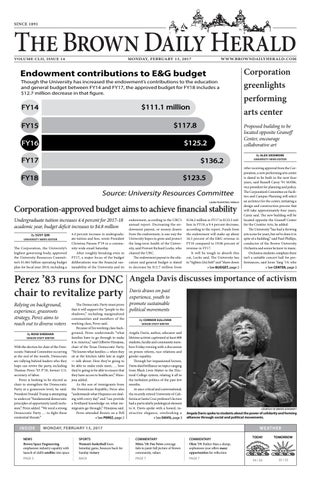
Corporation-approved budget aims to achieve financial stability Undergraduate tuition increases 4.4 percent for 2017-18 academic year, budget deficit increases to $4.8 million By SUVY QIN UNIVERSITY NEWS EDITOR
The Corporation, the University’s highest governing body, approved the University Resources Committee’s $1.061 billion operating budget plan for fiscal year 2018, including a
4.4 percent increase in undergraduate tuition and fees, wrote President Christina Paxson P’19 in a community-wide email Saturday. After roughly breaking even in FY17, a major focus of the budget deliberations was the financial sustainability of the University and its
endowment, according to the URC’s annual report. Decreasing the endowment payout, or money drawn from the endowment, is one way the University hopes to grow and protect the long-term health of the University, said Provost Richard Locke, who chaired the URC. The endowment payout to the education and general budget is slated to decrease by $12.7 million from
$136.2 million in FY17 to $123.5 million in FY18, a 9.4 percent decrease, according to the report. Funds from the endowment will make up about 16.5 percent of the E&G revenue in FY18 compared to 19.06 percent of revenue in FY17. It will be tough to absorb this cut, Locke said. The University has to “tighten (its) belt” and “shave down » See BUDGET, page 2
After receiving approval from the Corporation, a new performing arts center is slated to be built in the next four years, said Russell Carey ’91 MA’06, vice president for planning and policy. The Corporation’s Committee on Facilities and Campus Planning will select an architect for the center, initiating a design and construction process that will take approximately four years, Carey said. The new building will be located opposite the Granoff Center for the Creative Arts, he added. The University “has had a thriving arts scene for years, but we’ve done it in spite of a building,” said Paul Phillips, conductor of the Brown University Orchestra and senior lecturer in music. Orchestra students complain there isn’t a suitable concert hall for performances, said Irene Tang ’19, who » See CENTER, page 3
Perez ’83 runs for DNC Angela Davis discusses importance of activism draws on past chair to revitalize party Davis experience, youth to Relying on background, experience, grassroots strategy, Perez aims to reach out to diverse voters By ROSE SHEEHAN SENIOR STAFF WRITER
With the election for chair of the Democratic National Committee occurring at the end of the month, Democrats are rallying behind leaders who they hope can revive the party, including Thomas Perez ’83 P’18, former U.S. secretary of labor. Perez is looking to be elected as chair to strengthen the Democratic Party at a grassroots level, he said. President Donald Trump is attempting to undercut “fundamental democratic principles of opportunity (and) inclusion,” Perez added. “We need a strong Democratic Party … to fight these existential threats.”
INSIDE
The Democratic Party must prove that it will support the “people in the shadows,” including marginalized communities and members of the working class, Perez said. Because of his working class background, Perez understands “what families have to go through to make it in America,” said Gilberto Hinojosa, chair of the Texas Democratic Party. “He knows what families — when they sit at the kitchen table late at night — talk about: How they’re going to be able to make ends meet, … how they’re going to be able to ensure that they have access to healthcare,” Hinojosa added. As the son of immigrants from the Dominican Republic, Perez also “understands what Hispanics are dealing with every day” and “can provide a firsthand knowledge on what immigrants go through,” Hinojosa said. Perez attended Brown on a Pell » See PEREZ, page 2
promote sustainable political movements
By CONNOR SULLIVAN SENIOR STAFF WRITER
Angela Davis, author, educator and lifetime activist captivated at least 600 students, faculty and community members Friday evening with a discussion on prison reform, race relations and gender equality. Through her impassioned lecture, Davis shed brilliance on topics ranging from Black Lives Matter to the Electoral College system, relating it all to the turbulent politics of the past few months. At once critical and conversational, the recently retired University of California at Santa Cruz professor’s lecture had a particularly pedological element to it. Davis spoke with a honed, instructive elegance, overlooking a » See DAVIS, page 3
COURTESY OF BROWN UNIVERSITY
Angela Davis spoke to students about the power of solidarity and forming alliances through social and political movements.
WEATHER
MONDAY, FEBRUARY 13, 2017
NEWS Brown Space Engineering emphasizes industry equality with launch of club’s satellite into space
SPORTS Women’s basketball loses Saturday game, bounces back for Sunday victory
COMMENTARY Mitra ’18: Fox News coverage fails to paint full picture of Brown community, values
COMMENTARY Okin ’19: Rather than a slump, sophomore year offers many opportunities for reflection
PAGE 3
BACK
PAGE 7
PAGE 7
TODAY
TOMORROW
34 / 20
35 / 23
NEWS
PAGE 2 • MONDAY, FEBRUARY 13, 2017
» PEREZ, from page 1 Grant and his work-study experience with social justice organizations influenced his choice of career, Perez said. As a member of Big Brothers Big Sisters of America, Perez recognized that the privilege of a Brown education should be an option for more students, he said. “He has the power to motivate a different section of the Democratic Party,” said Wendy Schiller, professor of political science and international and public affairs. Perez’s background will enable him to “speak to communities that defected from the Democratic Party in this election and try to win them back,” Schiller added. “We have to reach out to working class white folks in rural America and … talk about their issues,” Hinojosa said, noting that the Democratic Party must expand its base to include groups that are not traditional allies. By pursuing a grassroots strategy and focusing on state and district races, the Democratic Party can regain state and local seats that will act as a foundation for recovering national positions, Perez said. The tendency to view the presidential contest as the only important election is misguided, as Republicans in state seats were able to stymie former President Barack Obama’s agenda due to Democratic weakness at the state level, said Pieter Brower ’18, who interned for the DNC
» BUDGET, from page 1 some investments,” such as keeping salary increases low, in order to end up with an overall deficit of $4.8 million, he added. The projected deficit for FY17 is $300,000, according to the URC’s FY17 report. “If we can grow the endowment, then a bigger income can come from the endowment,” giving the University more freedom to invest in salaries and raise tuition at lower percentages, Locke said. The URC, which is comprised of students, faculty members, staff members and administrators, strived to prioritize financial aid, academic programs and diversity and inclusion initiatives along with financial sustainability in making its budget, Locke said. As recommended by the URC’s annual report, the undergraduate tuition
THE BROWN DAILY HERALD
last summer. “Democrats must find a way to generate representation that is more proportional to their support in the population,” wrote John Friedman, professor of economics and international and public affairs, in an email to The Herald. Nationwide organization, direct conversations with voters and an effective strategy for getting voters to the polls can “increase performance for (the Democratic) party at a state, local and national level,” Hinojosa said. Leading up to the 2018 election cycle, the Democratic Party should concentrate on state legislative and gubernatorial races as state legislatures can make changes that shape the 2020 presidential election, Schiller said. Currently, Republicans have control of the House of Representatives because of gerrymandering — which was possible due to the Republican Party’s focus on state elections prior to the last census, said Richard Arenberg, adjunct lecturer in international and public affairs. When the district lines are redrawn after the 2020 census, Democrats must gain positions in state legislatures in order to ensure that the party can exercise greater control over redrawing, he added. Though the media has cast Perez as the establishment candidate of the Obama administration and his chief competition, Representative Keith Ellison, D-MN, as the face of liberal progressives, Perez is defined not by
a label, but by his progressive record and accomplishments, he said. Perez “was out fighting on civil rights issues, for LGBT marriage equality,” Hinojosa said. “He indicted and convicted police officers in New Orleans who killed African American residents during Hurricane Katrina.” Perez also spearheaded the nationwide fight for voting rights, Hinojosa added. In his commitment to fair working conditions, labor rights and democratic participation, Perez is “a good fit for what the Democratic Party advocates for,” Schiller said, adding that Perez’s experience in the civil rights division of the Justice Department also makes him an impressive candidate for DNC chair. Perez is prepared to manage the Democratic Party because of his experience as secretary of labor, where he oversaw a 6,000-person department, Hinojosa said. “He has a comprehensive knowledge of a lot of the areas that a DNC chair would need to address in a period of time where the Trump administration is going to be making … decisions that dramatically reverse the direction that this country has been going in,” he added. The media-driven dichotomy between Perez and Ellison is inaccurate, as both candidates are “working off the same broader ideas about how to reform the DNC,” Brower said. “The fact that there’s more agreement than disagreement is a good sign,” he added.
and fees will increase to $67,439 in the 2017-18 academic year, up from $64,566 in the 2016-17 academic year. The 4.4 percent increase is consistent with increases in the previous four academic years, which ranged from a 3.8 percent increase for the 201415 academic year to a 4.4 percent increase for the 2015-16 academic year, The Herald previously reported. The University’s tuition rate is “in the middle of the pack” when compared to peer institutions, which is “the right place to be,” Locke said. Tuition remains the largest source of revenue for the budget at 64 percent of the proposed education and general budget, according to the report. The budget for financial aid will increase to $122.1 million, up from $120.5 million for FY17, but the University came under budget for financial aid expenditures by about $3 million, Locke said. The actual
growth in the financial aid budget is 3.9 percent, according to the report. The University has been working hard to offer more competitive financial aid packages to middle income families so the University does not lose them to its peers that give more generous packages, Locke added. Locke said the University will meet the needs of whoever it accepts, “even if it means we have to go over budget.” The University will also increase graduate student stipends so graduate students in the humanities and social sciences receive the same 12-month stipends as graduate students in science, technology, engineering and mathematics fields, Locke said. The University will allocate $1.5 million toward implementing the Diversity and Inclusion Action Plan, which includes funding for bringing prospective students from lowincome backgrounds to A Day on
COURTESY OF WIKICOMMONS
Thomas Perez ’83 P’18, former U.S. secretary of labor, will focus on cultivating grassroots organization in his campaign for DNC chair. While the Republican Party has considerable organizational infrastructure, “the DNC is the only organization that can … organize in every state and coordinate with different state parties” for Democrats, Brower said. The Obama-era perception that “the DNC was just an appendage that wasn’t really doing much” has to be dispelled so the DNC can be maximized as an organizational resource, he added.
The DNC must “be a force for the party,” Schiller said, adding that it will be most successful if it proves to Democratic activists that it supports the party as a whole, not one particular candidate. Hinojosa said that Perez is qualified to reorient the DNC, as he understands the party’s past mistakes and has the ability “to turn this huge ship around and head it in the right direction.”
College Hill, increasing staffing at various centers, hiring a director of diversity and inclusion in the Office of Institutional Diversity and Inclusion and supporting faculty hiring, Paxson wrote. Salary pools for faculty and staff will increase by 2.75 percent, according to the report. The University recognizes the salary increase is low though it is within the competitive range of salaries offered by peer institutions, Locke said. The University is “conscientious” of the deficit and strives to eliminate it, said Christian Hanson ’17, one of four undergraduate students selected by the Undergraduate Council of Students to serve on the URC. “But sometimes there are other priorities that need to be funded that have a higher rate of return” than putting money toward reducing the deficit, he said. For example, the University
invested in room fees in response to student complaints that the suite fee was separating friends due to the financial barrier that it posed, Hanson said. Now, there is no difference in fees between a regular room and a suite, he added. The student representatives on the URC actively solicited feedback from the Brown community in creating this year’s budget plan, Hanson added. “It’s a strong budget that … incorporates the voices of all the different members of the community,” Locke said. At its meetings, the Corporation also accepted more than $62 million in gifts and approved plans to begin construction of an expansion building for the Watson Institute for International and Public Affairs and renovations for Wilson Hall. Richard Friedman ’79 P’08 was also elected to serve as the Corporation’s secretary.
STAY UP-TO-DATE. FOLLOW US ON FACEB O OK. FACEBOOK.COM/BROWNDAILYHERALD
NEWS
MONDAY, FEBRUARY 13, 2017 • PAGE 3
THE BROWN DAILY HERALD
» CENTER, from page 1 plays violin in the orchestra. Instead, performances must occur in spaces that were not meant to house the arts such as Sayles Hall, a building with “notoriously bad acoustics,” Phillips said. Comparatively, the new building will “first and foremost have excellent acoustics,” Carey said. The building will also have a large performance space, rehearsal area, dance studio, acting studio, multiple practice rooms and ample instrument storage space, said Joseph Butch Rovan, director of the Brown Arts Initiative and professor of music. The building will be different from art centers at other universities because the space will prioritize flexibility and “mirror the collaborative spirit of the
arts at Brown,” Rovan said. Maxwell Naftol ’19, a double bassist in the orchestra, said he would like the new building to have a large stage to encourage collaboration between musical groups like the orchestra and chorus. Both Rovan and Phillips noted that the new space will increase the University’s artistic pedigree and recruitment abilities. The lack of true performance and practice space is “an obvious lacuna” for prospective students interested in the arts, Rovan said. The project will allow arts at the University “to go to a new level,” he added. In anticipation of the new performance spaces, the Brown Arts Initiative will implement a “more proactive programming model” for events, starting with a three-year program on “arts and environment,” Rovan said.
ELI WHITE / HERALD
In its recent meeting, the Corporation approved plans to build a stand-alone performing arts center. The building will contain a dance studio, an acting studio and a large performance space to be utilized by students.
Engineering undergraduates to launch satellite in 2018 Student satellite EQUiSAT emphasizes accessibility of space for all, tests lithium iron phosphate batteries By GLORIA NASHED STAFF WRITER
Brown Space Engineering, an undergraduate student club, will launch its first satellite, EQUiSat, from the International Space Station Spring 2018. A ten centimeter cube weighing 1.3 kilograms, the satellite gets its name from one of the project’s most important missions: equality. The team hopes to “bridge the gap between the space industry, which is now kind of exclusive to governments and large corporations with a lot of money, and … people who want to get involved with space but don’t have massive amounts of resources,” said Tyler Fox ’17, the team’s avionics software lead. “Our slogan is ‘space for the people.’” The project began about six years ago in Professor of Engineering Richard Fleeter’s course ENGN 1760:
SCIENCE & RESEARCH
» DAVIS, from page 1 captive audience. The talk focused on the prison-industrial complex — a term the scholar is famous for coining and the subject of many of her books. Davis, the authority on the phenomenon, spoke of private prisons’ commodification of human lives, noting institutions profit off of a “surplus of people” — disproportionately black males — who have been victimized by former President Ronald Reagan’s War on Drugs. Ultimately, the prison-industrial complex serves to “exacerbate racism and sexism,”
“Design of Space Systems,” Ray said. Students from the class formed a club after finding a plausible and cheap way to build a satellite, he added. To work toward its mission, the team set up three ways for the general population to interact with the satellite. The primary means of interaction is by directly viewing EQUiSat. It will be flashing “four extremely bright LEDs from orbit,” said Ryan Izant ’17, the systems and avionics hardware lead. “(The satellite) will be in a 400 kilometer altitude orbit … anyone in the Northern Hemisphere will be able to see our satellite flashing with the naked eye.” Secondly, the team implemented a radio for anyone to be able to track the satellite as it travels around the world. “We’re really pushing the outreach component,” said Hunter Ray ’18, the project manager. “As a club, we really want to show people how close space is … people see space as this vague thing ‘up there.’” By engineering a satellite that will be visible from the earth, the team hopes that “people will be able to see space in different ways,” Ray added. The third means of interaction with the satellite is watching its
progression and the data collected on the team’s website. The team is also open sourcing the satellite’s design, according to its website. Aside from its outreach mission, the group has another important goal for the satellite: testing a new kind of battery that has never been used in space before. “NASA doesn’t want to test these batteries for the first time ever, so we’re kind of the guinea pigs,” Fox said. These lithium iron phosphate batteries have a lot of advantages, Izant said. “We can draw a lot of current from them, which is a very (necessary) technology.” Additionally, the batteries do not lose charge quickly and are less likely to explode, Ray and Fox said. A big part of building the satellite was figuring out and establishing final goals, Izant said. “After that all gets formulated, (we could) start digging in from there and ask things like, ‘How are we actually going to make the electronics that power these LEDs?’ and, ‘How are we going to charge these batteries?’” Though the majority of the work has already been completed, the team still needs to test and re-test the satellite before it is launched in 2018, said
Davis said. But the true theme of the night was broader solidarity. The scholar, with a sense of urgency, spoke of coalescing behind the struggles against systematic racial injustices and societal ills. “We have to act as if our actions can push us together in the direction of freedom,” Davis said, emphasizing the necessity of mobilizing to “shed the vestiges of slavery.” Speaking from a youth spent with the Communist Party and the Black Panthers, Davis underscored the capacity of activist movements to achieve change throughout her lecture. She
also highlighted millenials’ hand in facilitating progress. “Young people are always at the forefront of radical struggle,” Davis said. They “always make the most important contributions. One generation is standing on the shoulders of a previous one.” Evidencing this commitment to the latest generation of activists, the writer delighted in taking questions from students and local Providence and Central Falls high schoolers. She cautioned students of the futility of fast-moving but short-lived social media movements in enacting change, humorously
COURTESY OF BROWN UNIVERSITY
Brown students construct a satellite to test new lithium batteries and spread a message of space equality. The satellite will be launched next year. Kairy Herrera ’18, the team’s outreach lead. “In the time left, what we will be doing is testing all the different components to make sure that they work … We test things like flash to see how luminous it is and to make sure the
flash panels have the right circuit,” she said. “When you’re dealing with such a small satellite that literally fits in the palm of your hand, you need to make sure every millimeter is functioning properly.”
relating her past successful efforts spent mobilizing through “snailmail.” In a show of her inclination toward scholarship, Davis was also sure to remind students of education’s value. “This is the only time in your lives where the work that you’re doing is thinking and reading and discussing,” Davis said. “You have the opportunity at this historical moment to translate some of that into activism,” she added, stressing the “sustainable activism” cultivated at universities like Brown. Students praised Davis’ lecture, noting admiration for her work. Daniella Balarezo ’18 expressed her
adoration for Davis at the night’s end. Davis’ “amazing lecture made my life,” Balarzo said. Marguerite Weiss ’20, who waited in line for the book signing following the lecture, joined Balarezo in her enthusiasm. “It was such an honor to see her, and I’m excited to meet her, even for just a second.” Weiss said. The lecture, “Freedom Is A Constant Struggle,” is part of the Brown Center for Students of Color’s Black, Asian American, Latinx, Multiracial, Native American and Southwest Asian/ North African Heritage Series.
NEWS
PAGE 4 • MONDAY, FEBRUARY 13, 2017
THE BROWN DAILY HERALD
ELI WHITE / HERALD
United States Senators Jack Reed and Sheldon Whitehouse and State Representatives Jim Langevin and David Cicilline ’83 spoke to an impassioned audience Sunday afternoon, discussing paths of resistance against President Donald Trump. Though both sides expressed frustration, the elected officials encouraged supporting legal avenues to check Trump’s power.
Town hall crowd urges RI congressmen to resist Trump Amid cries for Trump’s impeachment, politicians reiterate commitment to constitution, resistance By STEPHANIE REYES SENIOR STAFF WRITER
Severe weather conditions did not stop hundreds from gathering at Sunday’s town hall meeting at East Providence High School. Rhode Islanders gathered to discuss ongoing issues affecting the Ocean State with Democratic R.I. Congressmen Sen. Jack Reed, Sen. Sheldon Whitehouse, State Rep. Jim Langevin and State Rep. David Cicilline ’83. Holding signs displaying “Persist!” and “Stay Human,” crowd members were quick to demand answers
from their elected officials. The town hall meeting centered around the fate of the Affordable Care Act, protecting the environment, increasing the minimum wage and organizing movements to resist President Donald Trump’s executive orders on legal grounds. From the start, the crowd voiced frustration with the state’s political leaders. Reed, while testing out the microphone, asked the audience if he was loud enough to be heard — “you need to be louder in Washington too,” one protester shouted in response. Sharing the crowd’s tone of frustration, Langevin encouraged community engagement and vowed to represent R.I. voters. “We’re upset, we’re angry at where the president is trying to lead our country
and we’re not just going to sit back and take it,” Langevin said. One audience member urged lawmakers to make Rhode Island a leader of the wind-power industry while also expressing concern about fracking and climate change. Though Whitehouse committed to fight climate change, he declined to place any political pressure on the deciding committee on fracking and said he supported infrastructure expansion. Additionally, Whitehouse said he had not made a decision regarding former Sen. Dan Coats’ nomination as Director of National Intelligence, resulting in an uproar from the crowd. “Just say no!” the audience chanted. A son and grandson of refugees who fled Nazi Germany, one audience member asked the officials to demand the
president’s resignation and the appointment of a Democrat as vice president. The room erupted in applause. Citing the 25th Amendment as a precedent — when Nelson Rockefeller filled the position as vice president following the 1964 resignation of former President Richard Nixon — the voter went on to plead for government unity. Reed rejected such a proposal based on constitutionality. “Yes, he has to go, but we have to recognize, ultimately we are serving the constitution,” Reed said. Whitehouse also encouraged legal and constitutional methods of resistance, primarily stating the Democratic Party’s focus on the 2018 election. “Short of impeachment, the real way to rebuke this guy is to take back (the U.S. House of Representatives) in a flood,” Whitehouse
said. Given U.S. District Court Judge James Robart’s halt on the enforcement of Trump’s order Feb. 3, Cicilline noted the importance of the judiciary in limiting the president’s power. Trump’s remarks of “fake news” and “so-called judge” at Robart’s expense are Trump’s ways of attempting to delegitimize the two institutions that hold him accountable, Cicilline said. Following the town hall meeting, some audience members said they felt more assured of the progress being made in Washington. “I feel better being here but it’s not necessarily (because of) what my democratically elected leaders have said — it’s seeing the energy in the crowd,” said audience member Mandy Jordan.
TODAY
MONDAY, FEBRUARY 13, 2017 • PAGE 5
THE BROWN DAILY HERALD
w h at t h e p u c k ?
menu SATELLITE DINING ANDREWS COMMONS
Pizza: Caprese, Chicken Ranch, Pepperoni JOSIAH’S
BLUE ROOM
BBQ Chicken Burrito Bowl
Build-Your-Own Burrito Bowl Soup: Spinach and Feta
DINING HALLS SHARPE REFECTORY LUNCH
DINNER
Chicken Fingers, Braised Rainbow Swiss Chard, Oatmeal Chocolate Chip Cookies
Shepherd’s Pie, Broccoli Rabe, Pork Chops in a Tarragon Mustard Sauce, Fudge Bars
VERNEY-WOOLLEY LUNCH
DINNER
Beef Barley Soup, Nacho Bar, Spicy French Fries, Cream Cheese Brownies
Chicken Saute with Mustard Sauce, Cheese Souffle, Chocolate Chip Cookie Dough Cupcake
sudoku
ELI WHITE / HERALD
Abby Niewchas ’19 handles the puck against Cornell Saturday. The Bears went 0-2 this weekend, dropping matchups to Colgate and Cornell. Bruno has lost six straight games going into the final weekend of the season.
Q U O T E O F T H E D AY
“I feel better being here but it’s not necessarily (because of ) what my democratically elected leaders have said —
”
it’s seeing the energy in the crowd.
— Mandy Jordan, audience member at town hall meeting
See town hall on page 4. crossword Follow us on ...
calendar TODAY FEBRUARY
S
M
T
W
Th
F
S
1
2
3
4
5
6
7
8
9
10
11
12
13
14
15
16
17
18
19
20
21
22
23
24
25
26
27
28
Pleasure Workshop with SHAG! 5:30 P.M. Petteruti Lounge
Freud Wars: A New Geography? 6:00 P.M. Pembroke Hall, 202
Dying While Black: Racism and Healthcare in America 8:00 P.M. Alpert Medical Building, 275
Spy Night at the Alpha Delta Phi Society 8:00 P.M. Goddard House
TOMORROW Valentine’s Day Social 12:00 P.M. List Art Building, 2nd Floor
PsycInfo Workshop 1:00 P.M. Rockefeller Library, Heckler Room
An Evening with Roxane Gay 7:00 P.M. Solomon Center, DECI
Princess Bride @ Tech House 8:00 P.M. Tech House Lounge, Harkness House
COMMENTARY PAGE 6 • MONDAY, FEBRUARY 13, 2017
THE BROWN DAILY HERALD
comic Like Owner Like Pet | Patrick Huang
Find us online! facebook.com/browndailyherald
browndailyherald.com
@the_herald
Location: 195 Angell St., Providence, R.I. www.browndailyherald.com
@browndailyherald
youtube.com/browndailyherald
Editorial Leadership
Sections
Multimedia & Production
Business
Editor-in-Chief Lauren Aratani
Arts & Culture Editors Julie Center Madison Rivlin
Design Editors Christy Leung Ameer Malik Jessica Yu Assistant: Eduard Muñoz-Suñé
General Managers Henry Ritter Ben Wesner
Managing Editors Matt Brownsword Rebecca Ellis Kate Talerico POST- MAGAZINE Editor Monica Chin
News Editors Kyle Borowski Kasturi Pananjady Suvy Qin Elena Renken Alex Skidmore Hattie Xu
BLOGDAILYHERALD Editor Anica Green
Sports Editor Jackson Chaiken Ben Shumate COMMENTARY Opinions Editors Margaret Hu Anuj Krishnamurthy Mili Mitra
Photo Editors Head: Eli White Assistant: Sam Berube Marianna McMurdock Lilly Nguyen Copy Desk Chief Julia Stemmer Multimedia Editor Roland High Illustrations Editor Dorothy Windham Graphics Editor Laura Felenstein Directors of Web Development: Lucy Wei Ivy Wong
Directors Finance: Reena Zhan Sales: Antonia Alvarez Sales: Erin Lueck Strategy: William Nober Strategy: Gianna Jasinski Managers Sales: Elizabeth Doykan Sales: Gabriella Elanbeck Sales: Matilda Lynton Sales: Ariel Shusterman Collections: Ravi Betzig Operations: Gür Ağci
Editorial contact: 401-351-3372 herald@browndailyherald.com
Business contact: 401-351-3260 gm@browndailyherald.com
Submissions: The Brown Daily Herald publishes submissions in the form of op-eds and letters to the editor. Op-eds are typically between 750 and 1000 words, though we will consider submissions between 500 and 1200 words. Letters to the editor should be around 250 words. While letters to the editor respond to an article or column that has appeared in The Herald, op-eds usually prompt new discussions on campus or frame new arguments about current discourse. All submissions to The Herald cannot have been previously published elsewhere (in print or online — including personal blogs and social media), and they must be exclusive to The Herald. Submissions must include no more than two individual authors. If there are more than two original authors, The Herald can acknowledge the authors in a statement at the end of the letter or op-ed, but the byline can only include up to two names. The Herald will not publish submissions authored by groups. The Herald does not publish anonymous submissions. If you feel your circumstances prevent you from submitting an op-ed or letter with your name, please email herald@browndailyherald.com to explain your situation. You can submit op-eds to opinions@browndailyherald.com and letters to letters@browndailyherald.com. When you email your submission, please include (1) your full name, (2) an evening or mobile phone number in case your submission is chosen for publication and (3) any affiliation with Brown University or any institution or organization relevant to the content of your submission. Please send in submissions at least 24 hours in advance of your desired publication date. The Herald only publishes submissions while it is in print. The Herald reserves the right to edit all submissions. If your piece is considered for publication, an editor will contact you to discuss potential changes to your submission. Commentary: The editorial is the majority opinion of the editorial page board of The Brown Daily Herald. The editorial viewpoint does not necessarily reflect the views of The Brown Daily Herald, Inc. Columns, letters and comics reflect the opinions of their authors only. Corrections: The Brown Daily Herald is committed to providing the Brown University community with the most accurate information possible. Corrections may be submitted up to seven calendar days after publication. Advertising: The Brown Daily Herald, Inc. reserves the right to accept or decline any advertisement at its discretion. The Brown Daily Herald, Inc. is a financially independent, nonprofit media organization bringing you The Brown Daily Herald, BlogDailyHerald and Post- Magazine. The Brown Daily Herald has served the Brown University community daily since 1891. It is published Monday through Friday during the academic year, excluding vacations, once during Commencement and once during Orientation by The Brown Daily Herald, Inc. Single copy free for each member of the community. Subscription prices: $200 one year daily, $100 one semester daily. Copyright 2017 by The Brown Daily Herald, Inc. All rights reserved. Periodicals postage paid at Providence, R.I. Postmaster: Please send corrections to P.O. Box 2538, Providence, RI 02906.
COMMENTARY MONDAY, FEBRUARY 13, 2017 • PAGE 7
THE BROWN DAILY HERALD
Fox News’ obsession with Brown misses the mark MILI MITRA opinions editor
On Jan. 25, Brown had a famous — or rather, infamous — visitor: Jesse Watters, the host of Watters’ World on The O’Reilly Factor. Watters came to Brown, ostensibly to interview students about toxic masculinity. In a short day on campus, he managed to interview bystanders about safe spaces, push the bounds of journalistic ethics and skate down College Hill near the Rhode Island School of Design. But what struck me the most about the threeminute segment was that it was, once again, all about Brown. The segment seems to be based on a ridiculously offensive opinion piece by Todd Starnes, published last month on the Fox News website, that critiqued the discussion of toxic masculinity in American colleges. Yet Brown was just one of several universities listed as teaching students about toxic masculinity, along with Oregon State University and Duke University. So why zero in on us? This isn’t the first time Fox has focused on Brown in detail. As Herald columnist Mark Liang ’19 pointed out earlier this semester (“Dear Jesse Watters,” Jan. 31), Fox has a
long history of arriving on campus with film crews to cover everything from debates on free speech to Christmas trees. Watters himself has covered Sex Power God and Nudity in the Upspace, spurring controversy on both occasions. The channel has also sensationally reported on free tampons in Brown restrooms and even past Herald opinions col-
ry Tower. But this deluge of coverage completely misses the mark. Fox loves to paint Brown as one of a few universities (along with the likes of University of California at Berkeley, Oberlin College and Wesleyan University) that propagate extremely liberal viewpoints at the exclusion of all others. Yet the Brown student body is not alone in protesting con-
encompasses a wide range of ideas and beliefs — not just the sound bytes presented and parodied on Watters’ World. Like any other aspiring journalist, I take issue with Fox’s techniques and predilection for skirting basic ethics. But to me, a more pernicious problem with its coverage of Brown is the utter lack of context. In its cov-
Satirical segments that poke fun at people are all well and good, but Fox’s brand of news and comedy falls short of achieving any sort of productive discourse.
umns. Just last year, Fox picked up a Herald article describing student activism and made it viral around the world. Fox certainly reports on other colleges as well, but the sheer volume of its coverage of Brown sets us apart from most other universities. In the guise of reporting on colleges, Fox has fed into the larger narrative about elitist, oblivious Ivy League students sitting atop an Ivo-
troversial speakers, embracing body positivity, supplying sanitary products, using inclusive language and engaging in student activism. There are numerous colleges across the country that do the same — and not all of them are traditionally liberal schools in blue states either. Nor is Brown a homogenous entity filled with like-minded drones. It may be a predominantly liberal institution, but the umbrella term “liberal” still
erage of Brown, Fox viewers don’t receive any sense of larger national debates or the reasoning behind liberal arguments. And, despite Fox’s selective coverage of colleges, conversations about social justice are happening all around the country, not just in liberal strongholds on the coasts. Satirical segments that poke fun at people are all well and good, but Fox’s brand of news and comedy falls short of achieving any sort of
productive discourse. Don’t get me wrong — I’m the first to admit there is a lot to criticize on college campuses and at Brown. But Fox doesn’t engage in intelligent criticism, rather it prefers to use straw men and play to the stereotypes. And by stereotyping and otherizing colleges like Brown, Fox News has lost sight of reality and managed to lose touch with college-aged students. As numerous analysts have outlined over the years, Fox’s biggest weakness is its inability to expand to a younger audience, particularly along the coasts. The median age of its primetime viewer is 68; by comparison, the median age of an average CNN primetime viewer is 59. Younger viewers are more likely to identify as liberal or centrist and already view Fox as one of the least trusted news sources in the country. If Fox truly wants to expand its college-aged market, it can’t afford to spin its own alternative version of the truth. Fox News and its proponents love to claim that we Ivy Leaguers are living in a bubble. Well, judging from their skewed coverage and obsession with Brown, so are they. Maybe I’m setting the bar too high, but I think even Fox can do better.
Mili Mitra ’18 can be reached at mili_mitra@brown.edu.
Reconsidering the sophomore slump REBECCA OKIN staff columnist Before entering my second year at Brown, upperclassmen warned me about the “sophomore slump.” According to their precautionary tales, this is a period ridden by paradox: You appreciate not being a newbie, but miss when everything was novel; friendships grow deeper, yet seem boringly familiar; classes may become more interesting, but are simultaneously too hard. To some extent, I am sure every member of the class of 2019 has discovered at least a partial truth to the slump. In literature, the “midpoint” refers to the moment that differentiates the first act from the second. At this instant, the central character encounters something — be it a tragic disaster, life changing opportunity or unbelievable secret — that promises to transform the rest of the novel. Essentially, it is when we hold our breath, anticipating the story’s biggest change. While it is not the climax, the course of action the protagonist responds with in this moment undeniably sets up that peak of the novel. Interestingly, some critics sometimes refer to the midpoint by another name: “the moment of commitment.”
During our sophomore year, we are confronted with the questions that will shape the second act of our time at Brown. The other night, I sat with a friend while she rattled off all the decisions she would have to make by the end of the semester: whether to study abroad, what to declare for her concentration, where to live on campus in the next two years. It was then that
ment, us second-year protagonists must undergo some deep reflection. What do we want from an abroad experience? Why should we concentrate in this field and not that one? Without this internal questioning, we cannot pursue the essential reactions that propel the next half of our stories here. Arguably, these serious considerations of ourselves are equally — if not more
Rather than in a declining slump, we find ourselves building momentum to the pivotal instances of action of our college lives.
I recognized the true significance of sophomore year as not only a literal halfway point of our Brown careers, but also as that figurative literary midpoint. Rather than in a declining slump, we find ourselves building momentum to the pivotal instances of action of our college lives. In order to reach these moments of commit-
— valuable than the actual choices we make based on them. In these reflections, we push ourselves to understand what we love and hate, strive for and are challenged by, can handle on our own and need help undertaking. More than anything, we unearth the passions that could remain our focal points long past our time on
College Hill. Thus, I want to propose a reconsideration of sophomore year. Instead of a tumble, a collapse, a sinking, what if we shifted the agency of “slump?” Perhaps instead of being pushed down, we are making the active decision to relax and observe our surroundings. We watch the curious freshmen, reminding us of the adjustment period it took to reach where we are now, nearing the middle of our time in college. We watch the upperclassmen, closer than us to entering the real world and thus scrambling just a little bit more to figure out who they want to be. In this way, maybe our “slump” refers more to our snug position in the Brown bubble, fully enveloped and comfortably floating, than anything else. As shopping period passes — and with it, the ability to justify not doing our readings — I urge my fellow sophomores to consider the importance of the decisions we make this semester. Moreover, appreciate the answers about ourselves we reach via our necessary internal questioning — these nuggets of self-understanding form the basis of our lives as upperclassmen and afterwards.
Rebecca Okin ’19 can be reached at rebecca_okin@brown.edu.
Got something to say? Leave a comment online! Visit www.browndailyherald.com to comment on opinion and editorial content.
SPORTS THE BROWN DAILY HERALD
MONDAY, FEBRUARY 13, 2017
W. BASKETBALL
Bears split weekend road slate, drop to fourth in league Women’s basketball team moves into second half of Ivy play with .500 conference record By CAL BARASH-DAVID SENIOR STAFF WRITER
The women’s basketball team went on the road this weekend to take on Harvard and Dartmouth. Bruno (14-7, 4-4 Ivy) fell to Harvard (18-3, 6-2) in Cambridge 69-59 and bested Dartmouth (6-15, 1-7) in Hanover 65-62. With a snow storm shutting down much of the Northeast, the games were pushed back to Saturday and Sunday, rather than their initially scheduled Friday and Saturday times. The Bears were able to have an additional productive practice on Friday because of the delay, said Shayna Mehta ’19. “We just had another day to prepare and go over Harvard’s sets and players and personnel,” she added. The first game was one with serious implications in the fight for the Ivy League title, as Brown and Harvard entered the matchup locked in a threeway tie with Princeton for second place in the conference standings going into the contest. The beginning of the game was competitive and the two teams were knotted at 16 after the first quarter. Bruno showed its ability to share the ball, as six Bears scored in the initial stanza. Superior rebounding by the Crimson and a slow Brown offense hurt
the Bears in the second quarter, and Harvard built a lead. But back-to-back threes from Janie White ’18 and Justine Gaziano ’20 cut the lead to 36-33 before the halftime break. The third quarter saw Bruno take the lead, but Harvard responded with six unanswered points in the final 1:46 of the frame. Bruno entered the final ten minutes of play down 53-48. Brown found late success in fouling Harvard’s Jeannie Boehm, a first-year forward who is shooting 19.2 percent from the line this year. “She’s a very good player inside, so whenever she got in we knew we had to just foul her,” Mehta said. The strategy worked to an extent, but the Bears shot poorly from the field all night and were unable to take advantage of Harvard’s missed free throws. Bruno’s offensive woes were especially apparent in the final frame — in which Brown posted only 11 points and shot 0-7 from three. Bruno shot 33.3 percent on the night and 16.7 percent from beyond the arc. Unable to overcome the deficit, the Bears lost 69-59, posting their second lowest point total of the season. “We didn’t move the ball well enough, and we only had seven assists last night as a team,” captain Megan Reilly ’18 wrote in an email to The Herald. “In games when we’ve had 15 or more assists, we have gone 7-0. So we definitely get better looks on offense when we are sharing the ball, getting good looks and knocking down shots.” Gaziano led all Bears with 16 points
ELI WHITE / HERALD
Shayna Mehta ’19 dribbles the ball up court. She recorded a double-double Saturday against Harvard and tallied 16 points Sunday against Dartmouth. The Bears have a 4-4 conference record with six games to play. in the contest, Taylor Will ’19 added 13 points of her own and Mehta recorded a double-double with 12 points and ten rebounds. While Dartmouth was last place in the Ivy League standings coming into Sunday’s game, the stakes were just as high as the night before, Mehta said. Dartmouth was sluggish come game time, and Brown sped out to a 17-8 lead after one quarter. In the second quarter, the roles reversed, and the Big Green poured in 21 points while holding Brown to only 10.
Dartmouth held a narrow 29-27 advantage at half in a low scoring contest. Brown tallied 19 points in each of the final two quarters and held Dartmouth to 17 and 16 in the third and fourth, respectively, eventually edging out the hosts 65-62. Bruno shot better from the field than it did Saturday at 40.3 percent but continued to come up short from beyond the arc, connecting on only 17.6 percent of their attempts. Brown only served up five assists as a team in the victory.
Erika Steeves ’19 scored 17 points and grabbed eight rebounds in the win. Gaziano and Mehta added 16 points each. Brown now holds fourth place in the Ivy League — the final spot that would allow them entrance to the Ivy League Tournament at the end of the season. Next weekend, the team squares off at home against the top two teams in the league: Penn (14-6, 7-0) and Princeton (11-9, 5-2), respectively. Both the Quakers and the Tigers are on five game winning streaks.
M. BASKETBALL
Second half, free throw line struggles down Bruno First half leads insufficient as Brown remains two games out of necessary spot for post-season berth By NICHOLAS WEY SENIOR STAFF WRITER
After splitting its road double-header last weekend, the men’s basketball team hosted Harvard Friday and Dartmouth Saturday, hoping to creep up the Ivy League standings with a few weeks before the conference’s inaugural postseason tournament. But despite leading in both games at the half, the Bears (11-13, 2-6 Ivy) struggled to finish off the Crimson (14-7, 6-2) and the Big Green (5-16, 2-6), falling 87-74 and 77-74 respectively. Heading into its first matchup of the weekend against Harvard, the Bears were well aware of the magnitude of the game, which marked the halfway point in conference play. Sitting at sixth in the Ivy League standings, the Bears needed a few wins to keep pace with the top of the conference. “Overall, the energy was extremely high,” said co-Captain and starting guard Tavon Blackmon ’17. “The guys came in ready to play, and for the most part we played well.” Bruno started off strong. While the lead changed hands multiple times in the first half, four of the Bears’ starting five put points on the board, and Bruno led 35-32 after the first 20 minutes. Starting forwards Travis
Fuller ’19 and co-Captain Steven Spieth ’17 each contributed eight points and a rebound. Guard Obi Okolie ’19 added nine points of his own, including an emphatic dunk as he was fouled just before the eight-minute timeout, which helped swing the momentum in favor of the Bears going into halftime. “The first half is an example of how we can always play,” Blackmon said, adding that the team “had some really good possessions during that stretch.” The Bears maintained this energy as the second half began, building an 11-point lead over the Crimson by the 13:09 mark. But the Bears struggled to continue their high-energy offense throughout the half. The Crimson rallied on the back of a 23-point effort from freshman Bryce Aiken, who Bruno struggled to stop as the half wore on. By 9:05, Harvard had erased the deficit entirely, and with only 3:25 remaining, the Crimson built an 11-point lead of its own, from which the Bears could not recover. When the final buzzer sounded, Harvard had taken the game 87-74. The Bears struggled from the free throw line down the stretch, shooting only 62.1 percent. Bruno had trouble finishing scoring chances in the second half, Blackmon said. “We just didn’t capitalize off of our opportunities,” he said. Brown had only 24 hours to regroup and rebound before an evening game against Dartmouth Saturday. But from the gun, the Bears responded well. Like the previous day’s matchup,
ELI WHITE / HERALD
Starting point guard Brandon Anderson ’20 faces up against a Crimson defender in Friday’s loss to Harvard. The first-year has impressed crowds, playing alongside senior guard and co-captain Tavon Blackmon ’17. Brown enjoyed scoring from an array of players in the first half. Co-Captain JR Hobbie ’17 and guard Corey Daugherty ’19 both hit pivotal threepointers off the bench, while all of Bruno’s starters contributed points. At the end of the first half, the Bears led 36-32. But once again, finishing off the opponent proved difficult for Bruno. Dartmouth’s Evan Boudreaux scored 15 of his 21 points in the second half
and added 13 rebounds to help the Big Green build a 74-69 lead with only 2:43 remaining. Bruno closed the lead with 1:18 to go, tying the game at 74. But after Dartmouth sunk a 3-point dagger with 55 seconds left, the Bears could not respond and fell 77-74. “That was a tough loss,” Blackmon said. “Overall we played solid, but we just really have to close those games and find a way to get the win. We are a really good offensive team and have
been playing solid on defense for the most part.” Moving forward, Brown hosts Penn Friday and Princeton Saturday. Despite taking two losses to their conference record, the Bears are tied for fifth place and two games behind fourth-place Columbia in the Ivy League standings with six conference games remaining. “I just want us to continue to fighting and working hard as a whole,” Blackmon said.