SINCE 1891
THE BROWN DAILY HERALD MONDAY, APRIL 2, 2018
VOLUME CLII, ISSUE 39
WWW.BROWNDAILYHERALD.COM
U. admits 7.2 percent of applicants to Class of 2022 Professor 13 percent of Class of 2022 identify as firstgeneration, 49 percent as students of color By ALICIA MIES STAFF WRITER
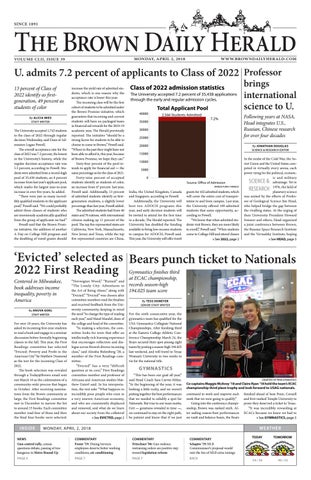
The University accepted 1,742 students to the class of 2022 through regular decision Wednesday, said Dean of Admission Logan Powell. The overall acceptance rate for the class of 2022 was 7.2 percent, the lowest in the University’s history, while the regular decision acceptance rate was 5.5 percent, according to Powell. Students were admitted from a record-high pool of 35,438 students, an 8 percent increase from last year’s applicant pool, which marks the largest year-to-year increase in over five years, he added. “There were just so many incredibly qualified students in the applicant pool,” Powell said. “We could probably admit three classes of students who are enormously academically qualified from the group of applicants we had.” Powell said that the Brown Promise initiative, the addition of another A Day on College Hill program and the doubling of travel grants should
increase the yield rate of admitted students, which is one reason why the acceptance rate is lower this year. The incoming class will be the first cohort of students to be admitted under the Brown Promise initiative, which guarantees that incoming and current students will have no packaged loans in financial aid rewards for the 2018-19 academic year, The Herald previously reported. The initiative “should be a strong factor for students to be able to choose to come to Brown,” Powell said. “Where in the past they might have not been able to afford it, this year, because of Brown Promise, we hope they can.” Sixty-four percent of the pool intends to apply for financial aid — the same percentage as for the class of 2021. Forty-nine percent of accepted students identify as students of color, an increase from 47 percent last year, Powell said. Additionally, 13 percent of admitted students identify as firstgeneration students, a slightly lower percentage than last year, Powell added. The admitted students hail from 48 states and 76 nations, with international citizens making up 11 percent of the pool. The top five represented states are California, New York, Massachusetts, New Jersey and Texas, while the top five represented countries are China,
brings international science to U. Following years at NASA, Head integrates U.S., Russian, Chinese research for over four decades By JONATHAN DOUGLAS SCIENCE & RESEARCH EDITOR
MARLIS FLINN / HERALD
India, the United Kingdom, Canada and Singapore, according to Powell. Additionally, the University will host two ADOCH programs this year, and early decision students will be invited to attend for the first time in a decade, The Herald reported. The University has doubled the funding available to bring low-income students to campus for ADOCH, Powell said. This year, the University will offer travel
grants for 432 admitted students, which will cover the entire cost of transportation to and from campus. Last year, the University offered 189 admitted students that same opportunity, according to Powell. “We know that when admitted students visit Brown, they are more likely to enroll,” Powell said. “When students come to College Hill and attend classes » See 2022, page 2
In the midst of the Cold War, the Soviet Union and the United States competed in virtually every arena, each power vying for the political, economic and military advantage. Yet in 1976, the field of planetary science was united by the efforts of Professor of Geological Science Jim Head, who helped bridge the gap between the rivalling states. At the urging of then University President Howard Swearer and others, Head organized a joint conference between Brown, the Russian Space Research Institute and the Vernadsky Institute, hoping » See HEAD, page 3
SCIENCE & RESEARCH
‘Evicted’ selected as Bears punch ticket to Nationals 2022 First Reading Gymnastics finishes third at ECAC championship, Centered in Milwaukee, book addresses income inequality, poverty in America By ANUVA GOEL STAFF WRITER
For over 10 years, the University has asked its incoming first-year students to read a book and engage in a seminar discussion before formally beginning classes in the fall. This year, the First Readings committee has selected “Evicted: Poverty and Profit in the American City” by Matthew Desmond as the text for the incoming Class of 2022. The book selection was revealed through a Today@Brown email sent out March 16 as the culmination of a community-wide process that began in October. After receiving nominations from the Brown community at large, the First Readings committee met in December to narrow the list to around 15 books. Each committee member read four of those and then the final four books were selected:
INSIDE
“Norwegian Wood,” “Ruined” and “The Lonely City: Adventures in the Art of Being Alone,” along with “Evicted.” “Evicted” was chosen after committee members read the finalists and received feedback from the University community, keeping in mind the need “to change the type of reading each year,” said Maud Mandel, dean of the college and head of the committee. “In making a selection, the committee looks for texts that offer an intellectually rich learning experience that encourages reflection and dialogue across Brown’s diverse incoming class,” said Aliosha Bielenberg ’20, a member of the First Readings committee. “Evicted” has a very “difficult question at its core,” First Readings committee member and professor of Africana and American studies Matthew Guterl said. In his interpretation, the text asks “What happens to incredibly poor people who exist in a very uneven American economy, and who are consistently displaced and removed, and what do we learn about our society from the collateral » See EVICTED, page 2
records season-high 194.025 team score
By TESS DEMEYER SENIOR STAFF WRITER
For the sixth consecutive year, the gymnastics team has qualified for the USA Gymnastics Collegiate National Championships. After finishing third at the Eastern College Athletic Conference Championship March 24, the Bears secured their spot among eight teams by posting a season-high 194.025 last weekend, and will travel to Texas Woman’s University in two weeks to vie for the national title.
GYMNASTICS “This has been our goal all year,” said Head Coach Sara Carver-Milne. “At the beginning of the year, it was looking a little rocky, and we weren’t putting together the best performances that we needed to solidify a spot for Nationals. But true to our team motto, Grit — greatness revealed in time —, we continued to stay on the right path, be patient and know that if we just
COURTESY OF PENN GYMNASTICS
Co-captains Maggie McAvoy ’18 and Claire Ryan ’18 hold the team’s ECAC championship third place trophy and look forward to USAG nationals. continued to work and improve each week that we were going to qualify.” Going into the conference championship, Brown was ranked sixth. After nailing season-best performances on vault and balance beam, the Bears
finished ahead of host Penn, Cornell and first-ranked Temple University to prove they deserved a ticket to Texas. “It was incredibly rewarding at ECACs because we knew we had to » See GYMNASTICS, page 3
WEATHER
MONDAY, APRIL 2, 2018
NEWS Gun control rally, census questions debate, passing of tree kangaroo in Metro Round-Up
COMMENTARY Foster ’19: Dining Services employees deserve better working conditions, air conditioning
COMMENTARY Fritschner ’06: Gun violence restraining orders are positive step toward legislation reform
COMMENTARY Schapiro ’19: MLB Commissioner’s proposal would ruin the fun of MLB extra innings
PAGE 4
PAGE 7
PAGE 7
BACK
TODAY
TOMORROW
54 / 34
49 / 33
NEWS
PAGE 2 • MONDAY, APRIL 2, 2018
THE BROWN DAILY HERALD
» 2022, from page 1 and meet faculty and current students, they see how special a place Brown is and they’re more likely to matriculate.” The University also admitted 88 students through Brown’s Program in Liberal Medical Education and 19 students through the Brown-RISD Dual Degree Program, both decreases from last year’s admitted class. Newly admitted students felt a mix of disbelief and elation when they received their acceptance letters. “I was so excited when I got in,” said Matthew Rauschebach of St. Louis. “I yelled and I ran up the stairs and gave my dad a big hug.” “Brown was my first choice, so I opened that (acceptance letter) last, and when it said ‘Congratulations’ I just started crying,” said Ashley Knebel of Palos Verdes, Los Angeles, who was accepted through PLME. Knebel, who is planning to attend the second ADOCH date, is excited for the flexibility of the Open Curriculum. “I would’ve wanted to study English and pre-med, and that’s hard at a school
MARLIS FLINN / HERALD
with a lot of general-ed requirements, but with Brown, it’s really doable,” she said. “I also really want to take classes at RISD because I love photography, but I’ve never had any formal training in it.” Rauschebach, who will be taking a gap year next year, added that Brown Promise was a factor in his decision to attend the University. He also said that the University paid for his travel,
covering his transportation to and from campus. Students admitted through regular decision will join the 737 students admitted through early decision in December. Of those deferred from early decision, 3.8 percent were admitted through regular decision, a decrease from the 5.4 percent accepted last year, Powell said.
COURTESY OF WIKIMEDIA COMMONS
Incoming first-years will read Matthew Desmond’s “Evicted: Poverty and Profit in the American City” before coming to campus in the fall.
» EVICTED, from page 1 industries that pop up?” The book focuses on the town of Milwaukee, narrating the stories of families evicted from their homes. Yet, according to Mandel, the “powerful” aspect of the book is how the text allows readers to “look through the eyes” of not only those evicted, but also the landlords and the movers. Guterl emphasized not only the “readability and teachability” of the book, but also its ability to “speak to meaningful and contemporary issues.” “Evicted,” “in particular, speaks to an American context right now, where income inequality and poverty are really pressing issues that students are very engaged with,” Mandel said. Bielenberg, an advocate of “engaged scholarship,” appreciates that the book, written by a sociologist, does a “really good job of balancing that kind of academic perspective with maintaining a narrative that makes it very readable.” “The goal of the First Reading(s)
program is to introduce incoming Brown students to their first intellectual conversation on campus” Mandel said. She hopes that this “collective” experience helps the students set off on a common starting point, while exciting them about the kind of learning that will ensue, she said. Though Bielenberg recognizes that the book is quite limited geographically and demographically, he hopes that the conversation in the seminars extends beyond the book itself. He added that it is possible first-years will think about their personal experiences within the context of the text: “I hope that students think about what resonates with those experiences.” Guterl also hopes that the conversation is not just constricted to the kinds of “sociological tools” the author used, the “structure” of the book or the author’s “argument.” Rather, he feels the questions posed and the social problems addressed “have no easy solution” and “require a degree of citizenship and leadership on the part of the students and faculty.”
Wherever you go, bring your own mug, reusable bottle and/or thermos. Avoid plastic cutlery. MARLIS FLINN / HERALD
It’s time we take responsibility for our waste stream.
NEWS
MONDAY, APRIL 2, 2018 • PAGE 3
THE BROWN DAILY HERALD
» GYMNASTICS, from page 1
» HEAD, from page 1
have a season high, and that can put a lot of pressure on the team,” CarverMilne said. “But they actually took it more as an opportunity, embraced it and had a blast during the entire competition.” Three competitors earned individual recognition. Cassidy Jung ’19 tied for third on beam to earn First Team AllECAC recognition and Julia Green ’19 tied for fifth on vault to receive Second Team All-ECAC honors. Anya BarcaHall ’18 was also recognized for academic achievements, getting named as an ECAC Scholar-Athlete of the Year. To kick off the competition, Bruno took to the uneven bars where Caroline Warren ’21 set the stage with a 9.600 in the first routine of the meet. Erin Howell ’20 followed with a 9.625, and co-captain Claire Ryan ’18 built on their scores, posting a 9.675. Anya Olson ’18 led the team with a 9.700, and Kate Nelson ’21 capped off Brown’s first rotation with a 9.575. A season-high 48.675 on beam midway through the meet put the Bears in prime position to record a strong team score. Ryan and Green posted matching marks of 9.675 at the top of the lineup while Rose Domonoske ’21 added a 9.725. Emma Hansen ’21 earned a season-best 9.775, and Jung tied her career-high of 9.825 to help Brown stay on pace with its competitors. After two events, Bruno left the competition floor, using its third-rotation bye to refocus in the locker room. “We started really strong on bars and beam, … so we were just holding on to that energy,” said co-captain Maggie McAvoy ’18. “We tried to stay relaxed and calm but also remember that we’re here to do a job.” The Bears re-entered the meet on floor exercise where McAvoy kept the momentum alive with a 9.700. Olson posted a season-high 9.750 which Anne Christman ’20 matched in the middle of the lineup. Green performed a skyhigh double back pike and double back tuck to tally Bruno’s top score of 9.800 while Barca-Hall capped off the event with a 9.675. With one event left, Brown needed big scores on vault to ensure a place atop the podium. Nelson posted a 9.600 to give the Bears a solid foundation, and Gabrielle Hechtman ’19 followed with a 9.675. Performances by Christman and Green highlighted the final rotation as Christman stuck her tucked full-twisting vault perfectly for a personal-best 9.750, and Green nailed her front handspring front pike to tie her career-high 9.775. Alyssa Gardner ’21 earned a 9.700 for a full-twisting layout in the anchor spot, bringing up a season-high 48.500 on the event. As their competitors rotated to their last events, the Bears returned to the locker room for their second bye and celebrated a successful performance. “For us, it wasn’t really even nerves about Nationals or nerves about how we were going to place at the end of the day,” McAvoy said. “We competed like we needed to compete, so hopefully the cards were going to fall in place.” The 194.025 helped Bruno qualify as the number seven seed heading into Nationals where Brown will compete against Yale, Cornell and Texas Woman’s University in the second preliminary session April 13 at 8 p.m. The top two teams for each session will advance to team finals April 14, and individual event finals will be held April 15.
to share scientific progress between the two countries. The conference has continued every year since — even amidst current tension between the countries — and recently included China as well, holding annual sessions in both Moscow, Russia and Houston. The conference is only one way that Head has connected scientists and inspired those in the field. In his more than four decades at the University, Head has closely collaborated with NASA, taught thousands in his classes and helped secure the role of science in the nation. Blasting off from Brown Following the completion of his undergraduate degree from Washington and Lee University, Head enrolled at Brown for graduate school. He was inspired by Professor Thomas Mutch to pursue planetary science, a field which was relatively unexplored and crucial during the space race between the Soviet Union and the United States. Head found his first job after graduate school by chance, flipping through job openings in book. He stumbled upon a listing for NASA, which read, “Do you want to think your way to the moon and back?” Head helped select the moon landing sites for the Apollo missions and trained astronauts while there, earning him an Exceptional Scientific Achievement Medal from the agency in 1971. After a few years at NASA, Head moved back to Brown in 1973 and became an assistant professor. Despite leaving NASA, Head maintained strong ties with the organization and continues to do so to this day. Every year, Head trains astronauts in geology — what he refers to as his introductory class — in the span of a few days to a week. Though the class is typically hosted in Houston, Head has brought the trainees to Brown
and given them valuable lessons on College Hill. Head has stayed in touch with dozens of Russian and American scientists at space institutes and connected them to others at the University, some of whom have proven invaluable to research on campus. He brought John Mustard, professor of earth, environmental and planetary sciences, on a trip to Russia early in his career, introducing him to scientists there and making connections that Mustard utilized for more than 20 years of research. “He’s really generous with his time and connections. He helps people get up the ladder,” Mustard said. Head has also brought many prominent speakers to campus, including David Scott, a former astronaut for the Apollo missions, and Maria Zuber, vice president for research at the Massachusetts Institute of Technology and Head’s former student. Greg Hirth, professor and chair of earth, environmental and planetary sciences, said that “There’s a high level of science that occurs because of his legacy in the department.” Continued Orbit Head remains an active researcher and educator today. “He’s a rockstar scientist,” Mustard said. According to his Google Scholar page, he has coauthored more than 100 papers in the last four years alone on topics ranging from volcanoes on Venus to water on Mars. He advises and teaches graduate students every year, discussing topics including research in difficult climates such as Antarctica. Though the course will be taught by Mustard this fall, Head has taught GEOL 0050: “Mars, Moon and the Earth” for several years — by his estimate, about 6,000 undergraduates have completed the course. Unofficially, he remains a steadfast leader within the department. Though they barely collaborate on research, Hirth said that he and Head regularly
COURTESY OF JIM HEAD
Former NASA scientist and Professor of Geological Science Jim Head has taught astronauts as well as thousands of undergraduates. discuss new projects and ideas. Head is often the first one in the office in the morning — when Hirth arrives at 6:30, he is usually there already. A visit to Head’s office reveals both his extensive history in the field and his personable character. He has collected dozens of trinkets and toys from his experience and always gives presents to children who visit him. Mustard’s six-year-old son rushes to Head’s office when visiting. “His first instinct is to go knock on his door,” Mustard said. Children have left thank you notes all over his office for gifts given throughout the years, he added.
More prominently, hundreds of craft beer bottles line the walls of his office. Head is a “beer connoisseur,” as described by Hirth, and will occasionally bring his own personal bottles to department events when the supply does not meet his standard. Head has always and continues to advocate for scientific research. In addition to serving on national committees and lobbying on behalf of the scientific community, he’s a “great strategic thinker,” Mustard said, peppering questions upon faculty in the department and urging them to consider their work in a broader context.
NEWS
PAGE 4 • MONDAY, APRIL 2, 2018
THE BROWN DAILY HERALD
Metro Roundup BY EMILY DAVIES, METRO EDITOR
Thousands rallied for gun control at the State House last Sunday Three thousand Rhode Islanders bore posters, megaphones and palpable determination as they assembled to stand behind the survivors of the Parkland, Florida shooting and demand gun control March 24 at the State House. The rally, one of more than 800 “March for Our Lives” protests worldwide, featured speakers including Gov. Gina Raimondo, David Cicilline ’83, D-R.I., Sen. Sheldon Whitehouse D-R.I., Mayor Jorge Elorza, State Rep. Aaron Regunberg ’12 D-Providence and student activists, The Herald previously reported.
Rhode Island joined campaign against census question on citizenship Tuesday Rhode Island has joined a multi-state lawsuit to “preserve a fair and accurate census,” announced Attorney General Peter Kilmartin Tuesday. The announcement comes in response to the federal government’s decision to include a question about citizenship on the 2020 Census — the first time since 1950 that respondents will have to indicate whether or not they are citizens of the United States. “It is critical for every person — regardless of their citizenship status — be counted in order to preserve the level of representation the State has in Washington, D.C.,” Kilmartin said, adding that the census’ purpose “is not to determine an individual’s citizenship status. In fact, asking the question will only serve to discourage individuals from responding.”
Oldest tree kangaroo in the United States died at Roger Williams Park Zoo Tuesday The kangaroo, “Paul,” lived for 23 years, five months and five days before passing away due to complications from heart issues that reduced his quality of life, Roger Williams Park Zoo & Carousel Village announced Wednesday. His species, Matschie’s tree kangaroos, is native to Papua New Guinea and there are only about 2,500 to 3,000 left in the wild. The life expectancy for the species is less than 15 years, the zoo said. “It is a great testament to the love and care Paul received from his keepers and veterinary staff that he lived such a long life,” said Roger Williams Park Zoo executive director Jeremy Goodman in a statement.
KATE TALERICO / HERALD
Anti-vaccine advocates demanded a repeal of state’s vaccine mandates Wednesday Opponents of Rhode Island’s mandatory vaccine policies showed up at the State House Wednesday in support of a legislative package that would allow parents to refuse vaccines for their children, the Providence Journal reported. Rhode Island currently requires a list of vaccinations for pre-kindergarten and grade school children, but the proposed legislation would allow parents to opt out if the immunization is for “a non-causal contact disease transmitted by sexual contact between individuals” or for “personal, philosophical or religious beliefs.”
Rhode Island school improvement plan approved Thursday U.S. Secretary of Education Betsy DeVos approved Rhode Island’s school improvement plan Thursday, which increases state agency over academic standards, accountability and use of federal education funds, among other measures, the Providence Journal reported. The improvement plan, approved under the Every Student Succeeds Act, includes an initiative to put computer science courses in every school in the state by 2025, personalized learning pathways and plans to involve teachers in statewide decision-making.
KATE TALERICO / HERALD
After back-and-forth, WaterFire Arts Center displayed house honoring Rosa Parks Saturday, Sunday The University announced that it canceled the planned exhibition of a house that belonged to Rosa Parks’ brother over a “dispute” independent from the University March 8, The Herald reported. But the WaterFire Arts Center displayed the house March 31 and April 1. The future of the house is still unknown.
KATE TALERICO / HERALD
KATE TALERICO / HERALD
KATE TALERICO / HERALD
TODAY
MONDAY, APRIL 2, 2018 • PAGE 5
THE BROWN DAILY HERALD
menu
t h e o p e n i n g a n d t h e c lo s e
SATELLITE DINING ANDREWS COMMONS
Pizza: Cheese, Pepperoni, Caprese, Barbeque Chicken Ranch Grinder JOSIAH’S
BLUE ROOM
Grilled Cheese
Chicken Noodle Soup Blue Room Grain Bowl
DINING HALLS SHARPE REFECTORY LUNCH
DINNER
Gyro on Syrian Bread Steamed Baby Carrots Falafel Burger
Cauliflower au Gratin Fried Veggie Burgers Pound Cake with Strawberries
VERNEY-WOOLLEY LUNCH
DINNER
Kaiser Roll Vegan Ginger Pasta Sunflower Butter Cookies
Cajun Pasta with Chicken Vegetarian Risotto Al Parmigano Lemon Cake Roll
sudoku SAM BERUBE / HERALD
Newly admitted students from the class of 2022 will walk through the Van Wickle Gates in September during their convocation ceremony. Students will only pass through these gates once more at commencement.
Q U O T E O F T H E D AY
“I was so excited when I got in. I yelled and I ran up the stairs and gave my dad a big hug.” — Matthew Rauschebach ’22
See 2022 on page 1.
RELEASE DATE– Monday, September 29, 2014
Los Angeles Times Daily Crossword Puzzle c rNorris o s sandwJoyce o rNichols d Lewis Edited by Rich ACROSS 1 Headliners 6 Prefix with final or trailer 10 Ward of “CSI: NY” 14 “Wowie!” 15 Frau’s home 16 Medicine cabinet swab 17 Boil out of the pot 19 Sch. near the Rio Grande 20 Old Testament twin 21 Leaves 22 Goethe classic 23 Sun. message 25 Shortening for pie-making 27 Present in lieu of cash 35 Genetics lab subject 36 Mix with a spoon 37 Hard to lift 38 Where serveand-volley tennis players win a lot of points 40 Dict. entry 42 Sturm und __ 43 Attacks 45 Gin flavoring 47 Neither here __ there 48 Doctors doing reconstructive work 51 Verdi opera 52 Turkish bigwig 53 Where to find Houston St. and Penn Sta. 56 Hammer or saw 59 Stadium cheers 63 Hawaii’s “Valley Isle” 64 Director’s “We’re done,” and hint to the starts of 17-, 27- and 48Across 66 Requests 67 Frau’s mate 68 Backyard barbecue site 69 Newsman Huntley 70 Celestial bear 71 Wield DOWN 1 Tea brand with a lizard logo 2 Consequently
3 “Dancing Queen” band 4 Strong and healthy 5 Word segment: Abbr. 6 “Scram, fly!” 7 Roof overhang 8 Rolled oats cereal 9 Jerusalem’s land: Abbr. 10 Cop show wheels 11 Caesar’s disbelieving words 12 Golfers’ concerns 13 Date bk. entry 18 “Snowy” heron 22 Breakfast sandwich item 24 Deliriously happy 26 CIO partner 27 Clutch tightly 28 “__ inside”: chipmaker’s slogan 29 Classic orange soda 30 Get __ of: throw out 31 Rapunzel feature 32 Hersey’s “A Bell for __”
33 Mortise insert 34 Some MIT grads 39 Charles Lamb, notably 41 Winter ailment 44 Three times daily, on an Rx 46 Tough tests 49 Novelist Willa 50 Auditory canal blocker 53 Colorful old Apple
54 “Parsley is gharsley” poet Ogden 55 Microwave 57 Paddles, e.g. 58 Mexican’s “other” 60 Comic Johnson 61 Word with spray or style 62 Laundry challenge 64 Day before Fri. 65 Swinger in the jungle
ANSWER TO PREVIOUS PUZZLE:
CORRECTIONS
An earlier version of the article “EQUiSat to launch into space May 9” stated that Max Monn GS has worked on the EQUiSat since the project’s creation in 2011. In fact, Monn worked on the EQUiSat from the creation of the project in 2011 to 2013. The Herald regrets the error.
A previous version of the editorial “Elections at Brown need work” stated that Shanzé Tahir ‘19 won the UCS presidency with 85 percent of the vote. In fact, she won with 82 percent of the vote. The Herald regrets the error.
An earlier version of the article “New cameras catch speeding violations” stated that State Rep. Anthony Giarrusso noted the connection between a Conduent lobbyist and the Elorza administration. In fact, Giarusso did not state that there was a connection between a Conduent lobbyist and the Elorza administration. The Herald regrets the error.
xwordeditor@aol.com
calendar
09/29/14
TODAY NOVEMBER MARCH
S
M
T
W
Th
F
S
1
2
3
41
52
63
74
85
96
10 7
11 8
12 9
13 10
14 11
Sun Safety 11:00 A.M. Nelson Fitness Center
Massage Mondays 12:00 P.M. Stephen Roberts '62 Campus Center, 229
Changing the Landscape of Tobacco Addiction 2:30 P.M. 121 South Main, 375
Ethical Inquiry: Eric Schliesser 5:30 P.M. Corliss-Brackett House
TOMORROW
15 12
16 13
17 14
18 15
19 16
20 17
21 18
22 19
23 20
24 21
25 22
26 23
27 24
28 25
29 26 By Matt Skoczen ©2014 Tribune Content Agency, LLC
09/29/14
30 27
28
29
30
31
Participatory Mapping and Youth Activism 12:00 P.M. Nightingale-Brown House
Workshop: Tableau for Data Visualization 1:00 P.M. Rockefeller Library
Fluidity: Knowing Water in the Americas Panel 3:00 P.M. John Carter Brown Library
MCAT Decoded 4:00 P.M. CareerLAB
COMMENTARY PAGE 6 • MONDAY, APRIL 2, 2018
THE BROWN DAILY HERALD
comic Comic | Ceyhun Firat
P HO E B E AY R E S
Find us online! facebook.com/browndailyherald
browndailyherald.com
@the_herald
Location: 195 Angell St., Providence, R.I. www.browndailyherald.com
@browndailyherald
youtube.com/browndailyherald
Editorial Leadership
Sections
Multimedia & Production
Editor-in-Chief Elena Renken
Arts & Culture Editors Connor Sullivan Mia Patillo
Design Editors General Managers Kyle Cui Michael Borrello Eduard Muñoz-Suñé Matilda Lynton Assistants: Julie Wang, Kelvin Yang
Metro Editors Emily Davies Bella Roberts
Photo Editors Sam Berube Anita Sheih
News Editors Anna Kramer Eduard Muñoz-Suñé Priyanka Podugu Sarah Wang
Copy Desk Chief Abby Borges
Managing Editor Kasturi Pananjady Senior Editors Julianne Center Madison Rivlin Alex Skidmore Hattie Xu Features Editor Isabel Gensler Editorial Page Editor Anuj Krishnamurthy
Science & Research Editors Jonathan Douglas Jackson Wells
POST- MAGAZINE Editor Saanya Jain
Sports Editors Alexandra Russell Nicholas Wey COMMENTARY Opinions Editors Connor Cardoso Anuj Krishnamurthy Clare Steinman
Illustrations Editor Pia Mileaf-Patel Video Editors Roland High Celia Hack
Business
Office Manager Diane Silvia Directors Sales: Shreya Raghunandan Finance: Ravi Betzig Strategy: Caroline Ziegler
Editorial contact: 401-351-3372 herald@browndailyherald.com
Advertising contact: 401-351-3372 advertising@browndailyherald.com
Submissions: The Brown Daily Herald publishes submissions in the form of op-eds and letters to the editor. Op-eds are typically between 750 and 1000 words, though we will consider submissions between 500 and 1200 words. Letters to the editor should be around 250 words. While letters to the editor respond to an article or column that has appeared in The Herald, op-eds usually prompt new discussions on campus or frame new arguments about current discourse. All submissions to The Herald cannot have been previously published elsewhere (in print or online — including personal blogs and social media), and they must be exclusive to The Herald. Submissions must include no more than two individual authors. If there are more than two original authors, The Herald can acknowledge the authors in a statement at the end of the letter or op-ed, but the byline can only include up to two names. The Herald will not publish submissions authored by groups. The Herald does not publish anonymous submissions. If you feel your circumstances prevent you from submitting an op-ed or letter with your name, please email herald@browndailyherald.com to explain your situation. You can submit op-eds to opinions@browndailyherald.com and letters to letters@browndailyherald.com. When you email your submission, please include (1) your full name, (2) an evening or mobile phone number in case your submission is chosen for publication and (3) any affiliation with Brown University or any institution or organization relevant to the content of your submission. Please send in submissions at least 24 hours in advance of your desired publication date. The Herald only publishes submissions while it is in print. The Herald reserves the right to edit all submissions. If your piece is considered for publication, an editor will contact you to discuss potential changes to your submission. Commentary: The editorial is the majority opinion of the editorial page board of The Brown Daily Herald. The editorial viewpoint does not necessarily reflect the views of The Brown Daily Herald, Inc. Columns, letters and comics reflect the opinions of their authors only. Corrections: The Brown Daily Herald is committed to providing the Brown University community with the most accurate information possible. Corrections may be submitted up to seven calendar days after publication. Advertising: The Brown Daily Herald, Inc. reserves the right to accept or decline any advertisement at its discretion. The Brown Daily Herald, Inc. is a financially independent, nonprofit media organization bringing you The Brown Daily Herald, BlogDailyHerald and Post- Magazine. The Brown Daily Herald has served the Brown University community daily since 1891. It is published Monday through Friday during the academic year, excluding vacations, once during Commencement and once during Orientation by The Brown Daily Herald, Inc. Single copy free for each member of the community. Subscription prices: $200 one year daily, $100 one semester daily. Copyright 2018 by The Brown Daily Herald, Inc. All rights reserved. Periodicals postage paid at Providence, R.I. Postmaster: Please send corrections to P.O. Box 2538, Providence, RI 02906.
COMMENTARY MONDAY, APRIL 2, 2018 • PAGE 7
THE BROWN DAILY HERALD
Cooling towers won’t cut it RUTH FOSTER staff columnist The days are getting longer, and nor’easters notwithstanding, they’ll start getting warmer too. Soon we’ll all be out on the Main Green, soaking in the sun between (or in spite of) assignment deadlines. But as students enjoy the rising temperatures, Brown Dining Services employees know that something else is looming on the horizon — another summer without air conditioning in the campus’ largest dining hall. During the summer, Brown opens its doors to Summer@Brown students who are eager to spend several weeks on campus. These students eat their meals at the Ratty, along with Summer@Brown residential advisors and undergraduates taking summer courses. The kitchens of the Ratty, located in the heart of the building, reach triple-digit temperatures during the summertime. The full-time staff members who work in the Ratty are subjected to hot, humid and poorly ventilated conditions that cause dehydration and fainting. Worse still, staff numbers are scaled back during the summer. This means that employees are working harder and in worse conditions than they do during the academic year.
Dining Services employees have been asking for a solution to this problem for years. Air conditioning would make scorching kitchens bearable, allowing workers to make it through their shifts safely. This problem resurfaces year after year. There
calized relief. The combined forces of cooling towers, additional breaks and extra water weren’t enough. The kitchens were still too hot — fans and mist just aren’t enough to cool a large scale commercial kitchen during the middle of summer.
way to stay cool in the kitchen during a sweltering summer. This problem requires a permanent solution: air conditioning. The administration may argue that because the Ratty is old, it would be difficult to install the infrastruc-
It’s time for the student body to stick up for the people who literally put food on our tables.
is still no air conditioning. Last summer, after students voiced their concern with this state of affairs, Brown agreed to rent cooling towers and place them in the kitchens of the Ratty. Cooling towers combine fans and cool mist to provide lo-
When the summer came to an end, the cooling towers disappeared. There was no guarantee that they would be back in the summer of 2018. And so Dining Services employees have been placed in the same situation they’ve been in before — no
ture necessary to cool the kitchens. There is some truth to this argument — retrofitting an old building’s HVAC system is likely complicated. But that’s not an excuse. If the long-term solution is far away, then we need a better stopgap. Portable
AC units are used in other University buildings without central air. There’s little reason not to extend the same rights to workers at the Ratty. Dining Services employees work for students every day. When a snowstorm hits and the University is closed, the Ratty is not. Dining Services employees brave snowstorms so that students have a place to eat. When many students leave for holiday breaks, the Ratty stays open for those who remain on campus. Here’s the thing — even if you’re off meal plan (like me) or spend all your credits at Jo’s and haven’t set foot in the Ratty since freshman year unit dinner, you should still care. Because the bottom line is this: Dining Services employees deserve to go to work in conditions that don’t make them faint. It’s time for the student body to stick up for the people who literally put food on our tables. If you’re interested in getting involved with this issue, consider attending the Student Labor Alliance’s second community meeting, which will take place Tuesday at 8 p.m. in Smith-Buonanno Hall B 106.
Ruth Foster ’19 can be reached at ruth_foster@brown.edu. Please send responses to this opinion to letters@browndailyherald.com and op-eds to opinions@browndailyherald.com.
Gun violence restraining orders are good AARON FRITSCHNER op-ed contributor The actions of America’s students over the past two months aren’t just inspiring — they are everything. It is impossible to overstate the importance of local, coordinated action in this moment, and Brown’s students have stepped up. This level of grassroots engagement is what gun reform advocates have needed for many years to make advances on this issue. Stopping gun violence is something I work on professionally. My career working in Congress began Dec. 14, 2012, the day of the shooting at Sandy Hook Elementary School, which colored everything that came afterwards for me. Even as I became a press staffer, I asked for and received exactly one legislative issue. I write, therefore, as the gun violence policy advisor to one of the most active members of Congress on that issue — Congressman Don Beyer D-VA— though I am speaking solely for myself today. I want to respond to the piece “Guns are not a mental health issue,” which ran in the Brown Daily Herald last week on gun violence and mental health, by Julia Rock ’19 and Jenna Israel ’21. Rock and Israel are exactly right that we need better gun laws. They are right that banning weapons of war and strengthening background checks are key objectives of that effort. Rock and Israel are also right to say that bringing up mental illness is a dodge employed by the National Rifle Association and its allies to avoid meaningful conversations about gun violence prevention. I was treated for clinical depres-
sion as an undergraduate at Brown 13 years ago, and consider myself a member of the community which comes under attack whenever people wrongly stigmatize mental illness in the wake of a mass shooting. Instead of continuing to tolerate these diversion tactics, it is essential that we consider real policy solutions. In particular, I want to make the case for a key reform which Gov. Gina Raimondo has sought for Rhode Island in the aftermath of the shooting in Parkland, Florida. Gun violence restraining orders, also referred to as extreme risk protection orders in some states, are a mechanism by which law en-
state legislature. Raimondo called for such a law at the end of her order, and a bill has been introduced by several state representatives. Florida became the sixth state to enact such a law a few weeks ago, and similar measures are nearing passage in New York, New Jersey, Illinois and elsewhere. To return to the piece by Rock and Israel, I want to stress that the GVRO is a measure meant to reduce gun violence, not a mechanism to attack people of color or people with mental disorders. As enacted in states like Connecticut, such orders may only be carried out after a judge is-
There isn’t a single law that will prevent 30,000 deaths a year. But if an individual reform saves even one life it renders an immeasurable benefit. forcement and families can restrict access to guns for people who present a demonstrated threat to themselves or others. They have been touted by experts as a means to prevent mass shootings, especially ones where there were numerous warning signs like those exhibited before the tragedy at Marjory Stoneman Douglas High School. The executive order which Raimondo issued in the aftermath of the Parkland shooting endeavored to enact some aspects of GVROs. Though Raimondo can only do so much by executive order, this is a good first step. But to realize the benefits of GVROs, Rhode Island needs the legal and judicial mechanisms which can only be created by the passage of a law in the
sues a warrant on the basis of a sworn affidavit submitted by law enforcement or family members attesting to a specific, demonstrated threat of violence. The fact that an order to remove guns is issued in response to a provable threat, and not merely to suspicions or the symptoms of mental illness, is key. The mentally ill are many more times likely to be victims of gun violence than perpetrators, but most gun deaths in the United States are self-inflicted. Evidence shows that GVROs are crucial in protecting the severely mentally ill because they are particularly effective at preventing suicide by allowing families to remove access to guns from people in crisis.
Additionally, the fact that family members can seek GVROs helps to mitigate the threat that such measures might disproportionately impact people of color as a result of government action. And in fact, because people of color, particularly women, are at significantly elevated risks of being victims of gun violence, effective gun reforms like GVRO laws are valuable measures in protecting members of these communities. GVROs are not a substitute for other gun reforms like the Assault Weapons Ban, introduced by fellow Brown alum Congressman David Cicilline ’83, D-R.I., who represents Providence in Congress, or laws requiring universal background checks; they are a complement to them. Cicilline is also a co-sponsor of the bill on which Beyer is a leader: the Gun Violence Restraining Order Act, which would help states adopt and implement GVRO laws. Sen. Jack Reed D-R.I. has pushed for a similar measure in the Senate. Gun violence is a complex issue with many causes and no easy solution. There isn’t a single law that will prevent 30,000 deaths a year. But if an individual reform saves even one life it renders an immeasurable benefit. GVROs can save many lives, and several states have already begun the process of adopting these measures — most recently, in Florida and California. GVROs are a good step forward, and Rhode Island should enact them.
Aaron Fritschner ‘06 is a gun violence policy advisor to Congressman Don Beyer D-VA, and can be reached at Aaron.Fritschner@mail.house.gov. Please send responses to this opinion to letters@browndailyherald.com and op-eds to opinions@browndailyherald.com.
COMMENTARY THE BROWN DAILY HERALD
MONDAY, APRIL 2, 2018
Rob Manfred crosses the Rubicon JAMES SCHAPIRO sports columnist In consideration of all the harm he’s brought on my favorite sport, I’d say I’ve been pretty lenient with Major League Baseball Commissioner Rob Manfred. I’ve acknowledged the positive things he’s done, and given him the benefit of the doubt when he’s made proposals that I’ve disagreed with. But 13 months ago, I drew a line in the sand when Manfred was reportedly considering testing a proposal in the minor leagues: Starting each extra inning with a runner on second base. “No more benefit of the doubt, no more chances for redemption, no more let’s wait and see,” I wrote. “This is a stupid proposal, implemented by stupid people, for stupid reasons. None of this belongs anywhere near the national treasure that is Major League Baseball.” But last month, Minor League Baseball announced comprehensive rule changes for the 2018 season. Among them was the decision to place an automatic runner on second base during extra innings. At this point, I don’t know if it’s worth it to reason against the decision. How can you explain that you shouldn’t just give out free runners? Manfred’s rule is not rational, and there’s not much that can be done about it. Where to begin? This rule is so
clearly awful for so many reasons that it feels gratuitous to explain it. For one, the rule change doesn’t address an existing problem. Are there actually baseball fans out there who are happy to watch entire games, but get bored once extra innings begin? Making extra innings quicker is even less sensible than making the first nine innings quicker — and
Position players pitching? The last man on the bench winning it with a big hit? These are the best parts of baseball, not problems. In addition, it will now be very easy to get a baserunner to third base with fewer than two outs. Winning a game in extra innings will come down to little more than the ability to hit a fly ball
game in a flash? If this is not enough, there’s another problem with the rule. It seems that giving each team the same advantage in extra innings is the equivalent of not giving out an advantage at all. Both teams will get free runners on second base, and both teams’ chances of scoring will increase identically. Thus, every
It seems that giving each team the same advantage in extra innings is the equivalent of not giving out an advantage at all.
nobody wants that. Most of the baseball fans I’ve talked to, in fact, want the opposite: They love long, extra-inning games. If you’re a fan of the sport, how could you not? It’s extra baseball, where the most endearing quirks of the game are forced out into the open for fans’ delighted observation.
deep enough to bring home a runner from third. I can’t fathom how this is more exciting than starting off an inning with the bases empty, as innings have always started. There won’t even be any need for dramatic extra-inning home runs anymore: Who needs a homer when one single can end the
advantage one team gains from this rule will be canceled out by an equal and opposite advantage gained by the other. You might as well grant each team a certain number of free runs every inning. It wouldn’t have any real effect on games, but run production would skyrocket. I struggle to understand how anyone
could judge the rule as acceptable, but there’s more. There’s a deeper issue with this — it just isn’t baseball. I know other countries use this rule and that’s fine, but they have different baseball histories then we do. We’ve played this game the same way for well over a century. And to suddenly impose a rule that fundamentally changes the way an important aspect of our game works? And what’s more, to do it for no discernible reason? How can that be justified? Manfred’s newest project is the worst of both worlds. It’s just like one of the rules above: It’s not part of baseball, and never should be. But it also has its own distinctly negative effects. It will make the game less exciting and more predictable and will artificially increase offensive numbers. And it will destroy the fun of extra innings — which many baseball fans love. For some time now, Manfred has seemed determined to change the game of baseball as we know it. I’ve never quite taken him to task for it, but I am now. This proposal does not belong anywhere in the game of baseball. It should be abandoned, quickly forgotten and consigned to obscurity.
James Schapiro ’19 can be reached at james_schapiro@ brown.edu. Please send responses to this opinion to letters@browndailyherald.com and op-eds to opinions@browndailyherald.com.