SINCE 1891
THE BROWN DAILY HERALD FRIDAY, MARCH 16, 2018
VOLUME CLIII, ISSUE 33
WWW.BROWNDAILYHERALD.COM
Rosa Parks exhibition canceled UCS, UFB candidates
commence campaigns
Rosa Parks’ niece argues exhibit should remain in Providence, critics claim she never lived in house
Presidential candidates focus on greater ideological diversity, implementing consent bill
By CELIA HACK SENIOR STAFF WRITER
The University canceled the planned exhibition of a house connected to Rosa Parks March 8, citing a “dispute” over the house that is independent of the University, wrote Director of News and Editorial Development Brian Clark in an email to The Herald. The house, which belonged to Parks’ brother Sylvester McCauley, was to be featured in an exhibition on the life and times of Rosa Parks at the WaterFire Arts Center in Providence, The Herald previously reported. Steven Cohen, lawyer for the Rosa and Raymond Parks Institute for SelfDevelopment, claims that the significance of the house has been overplayed by Parks’ niece Rhea McCauley. Cohen claims that Rosa Parks never lived in her brother’s house. Both McCauley and Ryan Mendoza, the exhibit’s artist, dispute Cohen’s account. The house was only
By MELANIE PINCUS SENIOR STAFF WRITER
COURTESY OF FABIA MENDOZA
The Nash Family Foundation gave the University $45,000 to transport a house belonging to Rosa Parks’ brother from Germany to Providence. ever described as belonging to Parks’ brother, they said, adding that Parks fled there in 1957. Cohen said he spoke to the General Counsel of the University earlier this year, informing them that, to his
knowledge, Rosa Parks never lived in or stayed at the house. According to Cohen, following this conversation, the University conducted an investigation after which they ultimately decided not » See PARKS, page 2
Shanzé Tahir ’19 and Fabrice GuyotSionnest ’20 will compete to become the next president of the Undergraduate Council of Students in next week’s elections, UCS announced yesterday. Camila Pelsinger ’20 and William Zhou ’20 will vie for the UCS vice presidency, and Lisa Schold ’19 and Drew To ’19 will contend for chair of the Undergraduate Finance Board. Julian De Georgia ’20 will run unopposed for UFB vice chair. Neither presidential candidate currently holds a position with UCS. Tahir noted her experiences as president of Brown Lecture Board and as an executive board member of the Brown Muslim Students Association in her platform. Guyot-Sionnest listed his experiences as a captain of a Brown Mock Trial team and as a graduate of the Innovation
Dojo on his platform posted on the UCS website. Tahir pledges to “push for the Campus of Consent Bill and follow through on its effective implementation.” UCS passed amendments to the Campus of Consent bill Wednesday and plans to implement its provisions beginning in the fall, The Herald previously reported. Her platform also outlines goals in areas such as student support, campus life and academics. Guyot-Sionnest’s platform focuses exclusively on “diversity of thought.” “Brown is an echo chamber. I didn’t come to Brown to have my own opinions repeated back to me. I came to hear diverse perspectives,” Guyot-Sionnest wrote in his platform. “I am running because I want every voice to be heard.” While neither presidential candidate is currently involved with UCS, each of the two vice presidential candidates currently chairs one of UCS’s four primary committees. Pelsinger is the chair of the campus life committee and Zhou is the chair of the student activities committee. Zhou lists increasing on-campus employment opportunities and expanding » See CANDIDATES, page 2
Men’s track and field team McCaleb ’20 clinches men’s lacrosse victory Athlete of the Week scores competes at Nationals Four-person relay team finishes ninth, named Second Team AllAmericans in league By CORMAC CUMMISKEY STAFF WRITER
On Friday, members of the men’s track and field team competed at the NCAA Indoor National Championships for the first time in 16 years. Zac Lanigan ’20, co-captain Tosin Oyewole ’18, cocaptain Zack Emrich ’18 and Martin Martinez ’18 competed in the distance medley relay, which consists of 1,200-, 400-, 800- and 1,600-meter legs, in that order. Brown’s relay team qualified as the last seed of 12 but ultimately exceeded expectations to finish ninth overall in a time of 9:40.24. For their achievement, the team was named Second Team All-Americans, falling short of First Team honors by just one place. Virginia Tech claimed victory in 9:30.76. Still, Brown’s relay members were not totally satisfied with their Second Team All-American status. “If you … told us last year at this time that we would be the ninth best
INSIDE
DMR in the nation, we would’ve been ecstatic — jumping up and down,” Martinez said. “But to be honest, I think everyone was pretty disappointed. … But I think we’re pretty happy with the way we competed, the way we executed what we had to do. It just wasn’t in the cards.” Bruno’s DMR ambitions fell into doubt just two weeks before Nationals, when Lanigan suffered a serious respiratory injury en route to a runner-up finish in the 1,000 meters at the Ivy League Indoor Heptagonal Championships on Feb. 25. “It was an absolute washing machine for the first four laps. Everyone was just throwing elbows, cutting each other off,” Lanigan said. “It was a really rough race. I tried to go with the move, but due to all the roughness in the race and my preparation beforehand, I just didn’t have it there on the last lap.” Gritting his teeth, Lanigan arrived at the exchange zone in 11th position overall; his 1,200-meter time was 2:59.14. After receiving the stick from Lanigan, Oyewole — Brown’s 400-meter man — had to negotiate a human traffic jam before he could reach open space. “It was definitely hectic. A lot » See TRACK, page 3
three goals, helps team overcome 6-1 deficit against Villanova By ALEX SMOLAR SENIOR STAFF WRITER
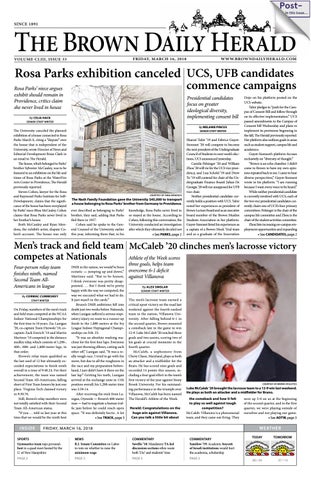
The men’s lacrosse team earned a critical upset victory on the road last weekend against the fourth-ranked team in the nation, Villanova University. After falling behind 6-1 in the second quarter, Brown mounted a comeback late in the game to win 12-9. Luke McCaleb ’20 notched three goals and two assists, scoring two of his goals at crucial moments in the fourth quarter. McCaleb, a sophomore from Chevy Chase, Maryland, plays as both an attacker and a midfielder for the Bears. He has scored nine goals and recorded 14 points this season, including a four-goal effort in the team’s first victory of the year against Stony Brook University. For his outstanding performance in the triumph over Villanova, McCaleb has been named The Herald’s Athlete of the Week. Herald: Congratulations on the huge win against Villanova. Can you talk a little bit about
COURTESY OF BROWN ATHLETICS
Luke McCaleb ’20 brought the lacrosse team to a 12-9 win last weekend. He plays as both an attacker and a midfielder for Bruno. the comeback and how it felt to play so well against tough competition? McCaleb: Villanova is a phenomenal team, and they came out firing. They
were up 5-0 on us at the beginning of the second quarter, and in the first quarter, we were playing outside of ourselves and not playing our game. » See AOTW, page 3
WEATHER
FRIDAY, MARCH 16, 2018
SPORTS Gymnastics team tops personalbest in a quad meet hosted by the U. of New Hampshire
NEWS R.I. Senate Committee on Labor to vote on whether to raise the minimum wage
COMMENTARY Savello ’18: Mandatory TA-led discussion sections often waste both TAs’ and students’ time
COMMENTARY Samilow ’19: Academic boycott of Israeli institutions would hurt the academia, scholarship
PAGE 2
PAGE 3
PAGE 5
PAGE 5
TODAY
TOMORROW
38 / 24
37 / 13
NEWS
PAGE 2 • FRIDAY, MARCH 16, 2018
THE BROWN DAILY HERALD
Gymnastics team sets new season-best at quad meet Multiple Bears notch season-best scores, achieve fourth place finish during New Hampshire meet
a 9.700. The score was a season-best for Gabrielle Hechtman ’19 and a careerhigh for Christman, who debuted a new tucked full-twisting vault. Green matched her teammates’ marks while Rose Domonoske ’21 and Kate Nelson ’21 supported with 9.575 and 9.600, respectively. After an explosive second rotation, the Bears settled in and took advantage of the quad meet’s exciting environment. “We did a great job today staying calm but also feeding off the energy of
the big arena,” Christman said. “After floor, we were pretty determined to make vault a good rotation, and after the success of vault, everyone felt the calm confidence that definitely helped for bars and beam.” Bruno looked consistent on the uneven bars as five gymnasts scored above a 9.600. Anya Olson ’18 and co-captain Claire Ryan ’18 posted twin scores of 9.650 in the center of the lineup, and Erin Howell ’20 supported with a 9.652. Emma Hansen ’21 led the team on the
event with a 9.800, putting the Bears in a solid position going into the last rotation. Brown’s final event, the balance beam, was highlighted by powerful acro series and clutch performances by rookies in the middle of the lineup. “Through the season, our beam has been pretty solid, so I know we all just gain confidence every meet,” Domonoske said. “We’re trying to go all out and just be as aggressive as possible.” Domonoske left little room for
deduction in her routine, sticking her full-twisting dismount en route to a career-high 9.800, while fellow firstyear Hansen upped her own personal best to a 9.725. Ryan and Cassidy Jung ’19 contributed scores of 9.625 and 9.675 while the Bears’ “beam queen” Regan Butchness ’18 closed the competition with a 9.750. With one remaining regular season meet left before the Eastern College Athletic Conference Championships, Bruno is concentrating on fine-tuning performances and possibly upping the difficulty of some routines. “(We’re) keeping our focus on doing what we can do and not letting what other people do affect us,” Christman said. “As far as gymnastics skills, getting all the little details like landings, any form that is potentially contributing to lower scores … those nitpicky things have been a focus … and just going big because we have nothing to lose.” A quad meet at the University of Bridgeport Saturday and the ECAC Championships are Brown’s last chances to raise their regional qualifying score in order to receive a bid to Nationals and qualify individual athletes to the NCAA Regional Championships. The Bears have competed at Nationals for the last five seasons and hope to keep the streak alive this year. Brown has another opportunity to increase its team score as the Bears face off against Bridgeport, Yale and the Centenary College of Louisiana Saturday at 6:30 p.m.
the dispute over the house’s legitimacy as a distraction from the goals of the initial exhibition: informing the public about Parks’ life and struggle. “We don’t want to defend ourselves … we want to just talk about Rosa Parks,” Mendoza said. “To turn their backs now on the Rosa Parks house is to silence the family members.” Evans said the exhibition of Parks’ brothers’ house sheds light on her desperation — penniless and jobless, she fled to the only place she could afford. “The real cost of her leadership as a Civil Rights icon is represented by the fact that she lost her job, she lost her home in Montgomery, and fortunately, Sylvester was able to take her into this home,” Evans said. “She was never occasioned the respect to be able to have an income where she could buy a house of her own. That’s the point.” Mendoza chose Brown specifically
as the first exhibition place for the house, turning down offers in Europe, including a UNESCO World Heritage site. He felt the house needed to return to America and provide an opportunity to educate the public, he said. Mendoza and McCauley both said the University did not contact them immediately after deciding to cancel the project. They found out about the cancellation from the press release, after Mendoza had arrived in Providence from Berlin. The fate of the house for the time being remains unclear. The WaterFire Arts Center is looking to see if the exhibit can proceed without support from the University and is hoping to keep the house in Providence, Evans said. “We understand that for legal reasons Brown had to step back … But for us to continue the exhibition we need to find the dollars to cover several of the
things which were planned.” Partnering with the University provided money for chair rentals, speaker rentals, insurance, security and more, according to Evans. According to Mendoza, the University is asking for the house to be removed from Providence as soon as possible. The University is committed to paying the house’s disassembly and shipping costs, Clark wrote. The University paid for the house’s passage from Berlin, where Mendoza lives, to the U.S., with a $45,000 grant from the Nash Family Foundation. The money was offered with the understanding that the house would be shown at an exhibition in Providence. Nash Family Foundation board member James Nash said that he feels “betrayed” by the University. Nash was also not contacted by the University after the cancellation decision was made,
he said. “I did not give Brown $45,000 so that the Rosa Parks house could have an all-expenses-paid round trip vacation in Providence,” he said, adding that he intends to fight the exhibit’s cancellation. The University was “working with each of the generous donors who had committed to funding the project,” Clark wrote in an email to The Herald. “It’s a complete betrayal of the Rosa Parks legacy,” Nash added. “Rosa Parks risked her life for justice, even though the law was on the wrong side of justice. Brown, because of their pusillanimous fear of a cease and desist order, is demanding the house go back to Germany before any Americans can see it. What more perfect betrayal can you have?” “If this thing gets sent out of the country, that’s embarrassing,” said Peter Mello, managing director of the WaterFire Arts Center.
serves as UFB’s vice chair, and his platform highlights topics including efficiency and transparency. To also pledges not to propose an increase to the student activities fee, which currently stands at $274 for each student and comprises UFB’s budget. The fee will rise to $286 next year, as The Herald previously reported. Schold is currently studying abroad, but she served two years as the liaison between UCS and UFB. Schold would work as UFB chair to increase transparency and improve communication between student groups and UFB, according to her platform. Four students are running for the eight available positions as at-large members of UFB — Phillip Champagne ’21, Nimo Ismail ’21, Daryl Polk ’19 and Alesandro Walker ’20. Walker and Polk both are UFB representatives this year. Several current UCS general body
and executive board members are running for UCS chair positions. Two candidates — Rainy Duan ’21 and Alex Song ’20 — will compete for the chair of the student activities committee. Duan serves on the student activities committee and Song is the UCS treasurer. The current chair of academic affairs, Mar Weiss ’20, will run for re-election against Claudia Liu ’21, a UCS general body member. Sharon Zeldin ’20 is running for reelection as the chair of student wellness against Cole Hansen ’19 and Shivani Nishar ’20. Neither Hansen nor Nishar currently holds a position in UCS. Sara Kutscher ’20, Claire Heiden ’21 and Melissa Lee ’20 will contend for chair of campus life. Kutscher and Heiden are members of the campus life committee, and Lee is a member of the Class Coordinating Board. Austin Lessin ’19, the UCS
parliamentarian, runs unopposed for UCS treasurer. This year, candidates for all UCS and UFB positions were required to gather only 200 student signatures in order to officially declare their candidacy. In previous years, UCS election policy mandated that candidates for UCS president, vice president and UFB chair and vice chair collect 400 signatures while candidates for other positions obtain 250. Members of the general body voted to implement this change at a dinner with President Christina Paxson P ’19 last Thursday night, said Katie Barry ’19, co-chair of the UCS elections board. The change was announced only to those who had already attended one of three required candidate information sessions, and Barry said the signature change “probably wouldn’t get more people to run this year, but hopefully it just made it less stressful for the people who already
had decided to run.” Pelsinger agreed that the change made it easier to become a candidate. It “really helped because I don’t think I would have had time to collect” 400 signatures, she said, though “changes should be made in the future just to make the campaign process a little less overwhelming.” Prospective candidates submitted their signatures at a candidates meeting Wednesday evening and received approval of their candidacies from the elections board later that night. Candidates for UCS president and vice president and UFB chair and vice chair will participate in a public debate Sunday evening. All student groups who plan to endorse candidates must have a representative attend the debate. Voting for all positions will occur from March 20 to 22 through an online survey that will be sent to all undergraduates.
By TESS DEMEYER SENIOR STAFF WRITER
For the past month, the gymnastics team has narrowly missed topping the 193.325 team score it set in early February, but Brown finally beat its season-best with a 193.525 during a quad meet hosted by the University of New Hampshire Sunday. Though Bruno finished fourth behind the University of Kentucky, UNH and Yale, the season-high score helps the Bears as they work to qualify for the USA Gymnastics Collegiate National Championships. “In this final push, so much can happen, so continuing to improve now is what’s going to set us apart,” said Anne Christman ’20. “This is what we’re looking for, and … this is definitely going to put us in a better place (to qualify). It’s super important now, and we’re not done yet.” The Bears began the competition on floor, where Christman and co-captain Maggie McAvoy ’18 received matching scores of 9.675. Julia Green ’19 supported with a 9.725, and Anya Barca-Hall ’18 earned a 9.750 in the anchor spot to cap off the first rotation. A season-high 48.275 on vault put Bruno on track to break the 193.325 team score as three gymnasts notched
» PARKS, from page 1 to feature the house. Clark did not confirm or deny that the University conducted an investigation following Cohen’s call. The University is “not in a position to speak about the nature of the dispute,” Clark wrote in an email to The Herald. Cohen believes that going forward with the exhibit would have devalued Parks’ name. “It’s false information,” Cohen said. “False information tends to degrade, or has the potential to degrade, the value of a person’s publicity rights.” The Rosa and Raymond Parks Institute for Self-Development has taken legal action in the past to protect their intellectual property rights to the name, likeness and image of Rosa Parks. On the other hand, Mendoza and Barnaby Evans, executive artistic director of the WaterFire Arts Center, see
» CANDIDATES, from page 1 the Campus of Consent Bill to include trainings on “sexual violence, diversity and crisis response” as two of his primary goals. “I’m running to help support and further champion student voices and initiatives,” he wrote in his platform. Among other objectives, Pelsinger aims to develop “resources for communities to prevent and heal from interpersonal harm” and increase student group attendance at UCS meetings with administrators, according to her platform. “The deans and the administrators and faculty are genuinely there to support the student community, but people don’t have access to those resources,” Pelsinger said. “UCS is supposed to help facilitate that.” Both candidates for UFB chair have extensive UFB experience. To currently
COURTESY OF BROWN ATHLETICS
Rose Domonoske ‘21 performs a lay-out step-out on the balance beam, where she scored a 9.800. The team recorded a season-high 193.525 Sunday at a quad meet hosted by the University of New Hampshire.
Issue
In This
To Be in The Kitchen
Emerson Tenney 4
The New Generation
Nicole Fegan 2 JAMES FEINBERG 5
Coming Attractions EMMA MARGULIES 6
The Everyday Beauty of Ballet
postCover by Katya Labowe-Stoll
MAR 16
VOL 21 —
ISSUE 7
FEATURES
The New Generation
Building Communities at Brown
W
written By Nicole Fegan – illustrated by Miranda Villanueva & Kira widjaja
hen I joined my high school’s tech crew freshman year, I
Letter from the Editor
was one of the first girls accepted onto the crew in five years— one of the first girls to pick up those drills, gain expertise with a circular saw, and run construction projects. In the years that followed, more girls joined, building impressive set pieces and rising through the ranks to eventually lead the crew. Now, as I am two years out of high school, I can look back like some kind of proud parent to see that nearly two-thirds of the crew are girls. When I came to Brown, I expected to find a variation of the environment I encountered in high school: a field dominated by men, in which I would have to prove myself for years. Instead, I discovered a large theatre company with a tiny tech community run almost entirely by a single woman powerhouse tech director (TD). I was surprised but delighted; there was a place for me where I wouldn’t have to fight to assert myself. I found a space I was enthusiastic about joining and, in a stunning turn of events, was able to do so uncontestedly. As delighted as I am to not have struggled through gaggles of men or
people in general to tech-direct various shows, the entire situation seemed suspicious to me. Building is such a popular interest, especially for men, so where was everybody? One answer I quickly found was the Brown Design Workshop (BDW). All engineering students at Brown must be trained at the BDW as part of ENGN 0030, so many people become familiar with that space. The BDW not only provides a resource for students doing classwork but also houses the Brown Building Society, the Rube Goldberg Society, Brown Formula Racing, RISD projects, and many independent projects. From my estimation, hundreds of students build at the BDW each semester, and yet the technical theatre community is something verging on miniscule. At first, I viewed this distribution of builders with contempt. With 35 BDS monitors and hundreds of students working in the space, why have so few joined the theatre building community? Upon speaking with members of the BDW and other tech directors on campus, however, I’m no longer concerned by this divide. As TD Rebecca Harless ’20 puts it, “I think it’s more of an experience
Numbers
Dear Readers, My body is bruised from my first attempt at
to bring a warm glow to your heart. Emma
cross-skiing, which was in turn an attempt
Margulies’ transcendental photos of the ballet
to get myself as far off campus as possible.
will transport you to another world, while
2. one (hour lost from daylight savings)
Russell Carey further fueled my escapist
Emerson Tenney’s evocative descriptions of
fantasies with his glorious gift of a snow day,
brussels sprouts and oyster mushrooms will
3. three (little pigs, or birds)
during which, rather than coming up with a
remind you of home.
thesis proposal, I watched The Darkest Hour and The Post with my brother. All in all, I’m
Soaking in every second of extra sunshine
very ready to start Spring Break a week early.
thanks to DST with Post- in hand, yours truly,
If you’re in the same boat, this issue’s got you covered. Nicole Fegan celebrates women theatre tech crew, and James Feinberg extols the virtues of The Flick; both pieces are bound
Saanya - EDITOR IN CHIEF
1. two (months I have left to get a job)
4.
se7en (good movie)
5. ǿ[J YMJ RFRGTLJX SZRGJW 6. eight (days a week) 7. 99 (the number of problems I have) 8. 3.14159265358979323 9. 2.71828182845904523 (e, the less popular number to memorize) 10. 'J^TSHLJX XTSL FQXT \MJWJ I get slurpees)
2!post–
thing when it comes to TD-ing as a niche activity— if you got into it and had a positive experience in high school, you’re more likely to TD in college.” Similarly, many aspiring engineers are introduced to the BDW through their classes, and whether or not they stick with that track academically, they stick with the space because of its familiarity. There is certainly something to be said about the gendered divide between engineering and theatre, but I cannot argue with sticking to what you are comfortable with when I myself have not reached
women in engineering classes, women taking over the set construction world on campus—has conviction and is unafraid to challenge societal conventions and expectations. Due to the systems in place that have propelled men to the forefront of these communities, different expectations are set for women from the get-go, both by other people and by ourselves. I never imagined myself as a builder; I even told my eighth-grade technology teacher I would “never have any use for this.” Later, I was only
There is an initial hurdle that must be overcome in order for a woman to enter the world of construction—building is not expected of us, so we need to make it our own. too far beyond my high school interests. Since my experience is only my own and I cannot speak for every woman who has ever constructed anything, I wanted to learn more about what it’s like to be a woman who builds at Brown. In talking to women in various areas of building, I have found two common links. One, there is a distinct power in being a woman who builds, no matter the environment; two, Brown must be doing something right because we all feel like this is a place for us. Despite worthwhile modern progress, building is still a male-dominated field. Emily Sauter '19, one of the BDW’s managers, pointed out that even though there has been progress in getting women into STEM fields, she is still one of the only women in her advanced engineering classes. The head of technical theatre for the Brown Theatre Department and all of the professional adults who work at the BDW are men. Despite this, or perhaps even because of it, the new generation of women—
drawn to my high school’s tech crew because I had developed friendships with all of the guys on the crew who had been developing their skills for years. Emily had a similar experience when beginning to build at Brown. Upon beginning to work at the BDW, she realized she didn’t know as much as those who had grown up working on projects with their fathers. Izzy Bauman ’19, a tech director and engineer, wrote to me, “Often when a man is present, I find myself default to the assumption that he is inherently better at building than I am, which is often untrue, and therefore can become unsafe. To combat this, I have to stick to my gut and embody a degree of confidence that I do not normally have.” There is an initial hurdle that must be overcome in order for a woman to enter the world of construction—building is not expected of us, so we need to make it our own. Because women are believed to have started at a point of disadvantage, building comes with a sense of defying expectations. Izzy recalls, “Recently, I was in a mechanical engineering laboratory, and the instructor was audibly surprised that I, the only woman in the group, was the only person to raise her hand when he asked
who had used a jigsaw before. That never feels great, but I get it a lot, so it doesn’t phase me much anymore.” This act of surprising other people with your competency, though it can sometimes feel uncomfortable or degrading, can also feel powerful. There is power in being a woman teaching a man how to use a power drill. There is power in being a woman in charge of a space. There is power in doing something my way, simply because I have the knowledge and skills. Despite the roadblocks and expectations, something about this particular campus seems to make achieving equality in building feasible. Amanda Morel ’19, member of the Brown Building Society, says, “At BBS, and at Brown more generally, I do not really feel any marginalization or exclusion based upon my gender. I find myself rarely thinking about my gender in association with construction.” This does not minimize the struggle but rather points out something remarkable about the culture of Brown. Nearly half of the 35 monitors at the BDW are women. All of the current tech directors for student theatre on campus are women. The official technical theatre department and Brown Building Society both have many women workers. While I have not taken an in-depth look at every university or organization in America, I know that Brown is doing something right in comparison to the outside world. This transformation has not been immediate; the Brown Design Workshop was created by men, and almost all of the adults in charge in the various shops across campus are men. The change can only be attributed to a growing new generation of women. There are 15 women monitors at the BDW paving the way for future women engineers. Members of the BDW mentor students from the Lincoln School, an all-girls high school in Providence, once a week to introduce them to engineering early. And when I got to campus and saw Stacie Farrow ’18 building every set for student theatre, I knew that could be me. The next generation of women is here, and we do not care that men still hold the highest positions of power in construction. We do not care that the Tony Award for set design is male-dominated. We do not care that the word “engineer” is still maleassociated. Here at Brown, powerful women are doing what we love, simply because we can.
"Diagrams are the foreplay of a good essay." "Isn’t life just LARPing?" "I stopped being cute March of last year."
march 16, 2018&3
NARRATIVE
To Be in The Kitchen
What Happens to Make a Meal By Emerson Tenney illustrated by Pia Mileaf-Patel The time between Christmas Eve morning and Christmas Eve night used to feel weeks long. This year was the first year I realized it was only ever a few hours. Of course there were also the days leading up to the party—the 22nd and the 23rd, and those, too, were small infinities—but it was only ever really on that day that the true violence of Christmas kicked in. Mountains of vegetables appeared in the base of our sink, spilled onto the countertop, waiting to be cleaned and chopped. Brussels sprouts to be quartered, oyster mushrooms to be pulled apart and griddled in butter, parsnips julienned, sweet potatoes sliced into rounds on the mandolin. For most of my life this was an act of mysticism: the enigma of the appearing vegetables. And even more unfathomable, the mystery of my appearing mother. It didn’t matter how early in the morning I woke up, it was certain that when I stumbled downstairs and into the kitchen, Mom would be there already elbow-deep in the prep of clarifying butter, cleaning racks of lamb, slicing bread. I’d stand in the doorway for a moment, silent and barefoot, until I was noticed and swept into the swell of “mix this, toss these, measure that.” As I got older, the directions broadened to include activities that required blades and heat and an eye for timing. But the fundamental atmosphere stayed—I was aboard a
4!post–
ship I did not own, and it was my job to do work, and when the clock face showed 5 p.m., to get out. After five was my time for answering the door, pouring champagne, and remaining tethered to the phone that rang with the arrival of each new car at our gate until the very last guest was upstairs by the fire and chatting comfortably with a miniature poached pear and Gruyere grilled cheese sandwich in hand. When I reached my teens I began to push, lightly, against what went unquestioned for so many years. “Don’t you think 60 lamb chops is a bit much for only 28 people if you’re also making pork ribs and halibut?” I was, inevitably, wrong most all of the time. We wanted 30 cold lamb chops to sit in the fridge or be diced into omelets, and you never knew when you could use some for a hash. Didn’t I know that Grandma and Grandpa would take leftovers home to freeze and de-thaw well into February? Of
I was, perpetually on the losing side of my unknown fight for recognition. Acknowledgement is easy when it comes to desserts. You can say, “That’s my carrot cake,” or “I made the rosemary plum crumble.” You don’t get that when it comes to dinner. There’s no one parsing who chopped the brussels, fried the shallots, cleaned the portobellos. It’s like any dining experience—there is only ever the chef and the food on your plate. Now, I wonder when these roots of disturbance were originally planted. I think it’s too easy to say the whole affair was grounded in some childish form of jealousy toward a celebrated mother. My mom was single for the majority of my upbringing, and this past winter was the first time I’d heard news of a romantic interest on the horizon. So maybe this is why somewhere deep within me, there is a lilting toward her feeling of fundamental aloneness—her
For most of my life this was an act of mysticism: the enigma of the appearing vegetables. And even more unfathomable, the mystery of my appearing mother. course I did know these things. In retrospect I think what I was really looking for was some way to make my presence known in the creation of Christmas. At 6:30 p.m., when we all sat down for dinner, my mother would stand at the helm of our living room, looking out over the hodgepodge of long tables and fine china, and announce the impending meal. “And tonight I’ve made…” Then everyone would applaud, and I, standing beside her, would feel a small pit in my stomach. Here
feeling, and the rage that any expression of that feeling evoked in me. I can’t count the times during my childhood that I heard her say, “Nobody loves me.” And I would cry back, “I love you.” I would cry back, “I love you!” I was in the kitchen. I am still in the kitchen. And this year, for the first time, I felt, or at least hoped, that she saw I could help cook Christmas too.
LIFESTYLE
ARTS&CULTURE
Playing at the Movies
Wilbury Theatre Group’s The Flick at the Cable Car Cinema By James Feinberg illustrated by katya labowe-stoll
Annie Baker’s play The Flick, which won her the Pulitzer Prize for Drama in 2014, is being performed on-site at the Cable Car Cinema through March 25 by the Wilbury Theatre Group. The strengths of a condensed version of the play (the 2015 OffBroadway revival ran for three hours and 10 minutes; this version runs two-and-a-half hours) are remarkably evident in this production directed by Wendy Overy; however, the play's weaknesses, like a tendency to rely on popular culture for some of its more powerful emotional beats, are still present but easier to pass over. In the face of the last five years of depressing cultural developments, not least of which include Baker’s most recent play, the annoying The Antipodes, Overly’s deft presentation of the playwright’s gorgeous characterization is especially vibrant.
The question as to whether The Flick is a historically important work is as of yet open, but it has an empathy for its characters that is colossally moving, and Wilbury gets that right. The premise—three movie theater employees in run-down central Massachusetts are gradually carved into troughs of loneliness, detailed exquisitely by Baker. Avery (Ronald Lewis), a 20-year-old film buff, struggles with paralyzing depression and lack of fulfillment; 35-year-old Sam (the terrific Dave Rabinow) lacks the agency or opportunity to change his life; and 20-something Rose (Anna Basile), trapped by her anger and emotional inadequacy, manages to alienate both of them. (Seth Finkle also shows up in a couple of blink-and-you’ll-miss-’em roles.) These are layered performances, delicate and almost lush in their capacity to invite the audience in. Rabinow, especially, is heartbreaking— at least partially due to Baker’s extraordinary skill in diagramming the male psyche.
The Flick justifies theater, which is thrilling; ironically, the play could never be filmed or adapted to any other medium. But it makes a great argument for art in general, too. Sam and Avery spend a good deal of time talking about movies (including rounds and rounds of a variation on Six Degrees of Kevin Bacon), but the conversation feels just as legitimate as anything else in the play. The play is about how connections form, however they form. Baker writes fantastically in contemporary vernacular, and that vernacular is informed, inevitably, by the ubiquity of pop culture. It’s a modern play, which is why the on-site location is so apt. In a performance theater, the play’s set—the seats in a movie theater facing the audience—has the potential to take the audience out of the action. That’s considerably less of an issue when Sam and Avery are actually sweeping popcorn out from under your feet. And they do sweep, not quite endlessly (thanks to those reductions) but certainly long-windedly. Popcorn, soda, and a single New Balance shoe (don’t ask) are swept cleanly away and deposited in garbage bags, all alongside the action. There is something transporting about the very surroundings of a theater space being transformed in order to allow an audience into it. On the night I saw The Flick, the show began at eight, and the last film of the night had ended at seven-thirty. The Wilbury crew had less than a half an hour to dash into the theater and set up the seats and risers for the waiting crowd. No one can deny that’s romantic, and I’d say it’s pretty Baker-esque. Overly’s The Flick occupies emotional space, which is not always the case with productions of contemporary theater, and deserves recognition. But it’s more the idea of the play than the content itself that resonates here. The Flick is a tremendously human work, and a humanistic one too, and Overly’s production recognizes and embraces that, which is the ultimate endorsement. The question as to whether The Flick is a historically important work is as of yet open, but it has an empathy for its characters that is colossally moving, and Wilbury gets that right.
march 16, 2018&5
ARTS&CULTURE
The Everyday Beauty of Ballet
Capturing Unstaged Moments with Festival Ballet Photographed By Emma Margulies
These photos were born out of a collaboration with Festival Ballet Providence, Rhode Island’s premiere ballet company. I initially reached out because ballet was an unknown art form to me and I wanted to learn more about it through photography. At first, I didn’t really know what moments I wanted to capture, and I shot anything and everything during my weekly visits to the company’s rehearsals. This wasn’t entirely fruitful, as all the dancers moved very quickly, and the rehearsal space doubles as a black
box theater with very dim lighting when there isn’t a performance, making for a tough photographing experience. However, as I spent more time with the dancers, I learned what the best angles were and began to anticipate the moments that I wanted to capture so that I would be ready to release the shutter at just the right time. Ultimately, I hoped to capture the calm and joy, the determination and frustration that I was able to witness as a guest in the dancers’ space.
Editor-in-Chief
Design
Saanya Jain
Sarah Saxe
Feature
Copy
Managing Editor
Chief Alicia DeVos
Jennifer Osborne
Zander Kim
Section Editors
Amanda Ngo
Anita Sheih Kathy Luo
Layout Chief Livia Mucciolo
Narrative
Gabriela Gil
Managing Editors
Ro Antia
Annabelle Woodward
Nina Yuchi
Pia Mileaf-Patel
Jacob Lee
Section Editors Divya Santhanam
Media Claribel Wu
Arts & Culture
Samantha Haigood
Managing Editor
Anita Sheih
Josh Wartel
“Most days, plumbing does not fascinate me.” —Anonymous, Et tu, Laundromat? 3.17.16
6!post–
Section Editors
Illustration
Celina Sun
Heads
Marly Toledano
Miranda Villanueva
Julian Castronovo
Phoebe Ayres
Want to be involved? Email post@browndailyherald.com!
NEWS
FRIDAY, MARCH 16, 2018 • PAGE 3
THE BROWN DAILY HERALD
State to consider raising minimum wage » TRACK, Senate Committee on Labor to vote on four bills addressing statewide income disparity By ISABEL ALEXIADES STAFF WRITER
On March 14, a fight was taking place at the Rhode Island State House — the fight for higher pay. The State Senate Committee on Labor heard four bills yesterday intended to raise the minimum wage. The bills are part of R.I. Democrats’ Fair Shot Agenda, a legislative package that aims to address growing income disparity within the state. The minimum wage in Rhode Island is currently $10.10 an hour for most workers and $3.89 an hour for workers receiving gratuities. The first bill, Senate Bill 2244, commonly referred to as “the fight for 15,” would raise the minimum wage for both regular and tipped workers to $15 an hour by 2022 and 2026, respectively. Sen. Jeanine Calkin, D-Warwick, is the primary sponsor of the bill. “The fight for 15 bill is a great piece of legislature,” said Michael Araujo, executive director of Rhode Island Jobs with Justice, a standing coalition of labor unions, community organizations, students and faith groups. “It’s one that we’ve been working on for more than five years now,” he added, explaining that this slow progress can feel like the coalition is falling behind on its goal. Jobs with Justice advocates on issues of work-based justice, immigration and civil rights. The organization recruited workers, particularly women and restaurant staff, to testify yesterday in favor
of the bills. Araujo said that while Jobs with Justice would be happy to see the minimum wage raised to $15 an hour, he prefers the second bill that was proposed at the State House yesterday. This legislation, Senate Bill 2247, would increase wages to $11 an hour by 2019 and $12 by 2020. “I personally like that bill better because it allows us to build power around it more,” Araujo said. “The fight for 15 would block off renegotiating, re-engaging workers for about five years. A twoyear cycle is better for union-building and collective bargaining.” Legislation is essential to progress, but the strongest impact comes from workers themselves pushing for collective agreements, he added. But a flaw with this second bill is that it excludes tipped workers, Araujo said. This omission is significant because there are “23,000 tipped workers in Rhode Island, 80 percent of whom are women, more than half of whom are mothers. Forty percent of these mothers are sole providers for their households, so not including this vital, rapidly growing section is a huge oversight,” he said. A third bill, sponsored by state Sen. Gayle Goldin, D-Providence, focuses specifically on workers receiving gratuities. The bill would raise the tipped minimum wage to $9 an hour by 2022 and mandate that this wage be the same as the regular wage by 2023. Araujo said that he strongly supports this piece of legislation as well. Maggie Kain, a waitress from Narragansett who testified in favor of the legislation, echoed the need for change. “Lawmakers need to present the fact that they care about workers and not just businesses,” she said.
She also pointed to a widening gulf between workers and politics. “There is a true belief that government has stopped working for (workers), … (who are) disengaged and negative about their upward mobility.” Josh Block, press secretary for Gov. Gina Raimondo, said the governor is pushing to improve the lives of workers within the state. “Too many Rhode Islanders work full-time jobs and still struggle to make ends meet,” Block said. In the past, Raimondo has been an advocate for minimum wage increases. During her tenure, the minimum wage has been raised from $8 an hour in 2014 to $10.10 an hour. Raimondo’s plan would increase the minimum wage to $10.50 in January, Block wrote in an email to The Herald. Block did not comment on Raimondo’s position on the four bills proposed at the State House yesterday. The bills will likely be voted on by the end of April, Araujo said. However, even if any of these pieces of legislation are passed, implementation poses another problem, he added. “Wage theft — not paying workers — is standard business practice,” he said. In his time with Rhode Island Jobs for Justice, Araujo estimates that “nearly every worker (who has approached the organization) has experienced real wage theft in the course of their week.” Araujo emphasized the importance of unionizing and collective bargaining in response to this threat. “We can legislate the best versions of this stuff all day, and we could win real gains … but the real win is when workers are organized together and do the enforcement at the workplace level,” he said.
of pushing going on at the handoff line,” Oyewole said. The senior engaged in a pitched duel for 10th place with Alvin Westbrook of the University of Mississippi. The two sprinted neck-and-neck for 300 meters, but Oyewole shifted into high gear around the final curve. “The last 100 I was able to pass him,” Oyewole said. “That felt pretty good — to improve a spot and be able to pass someone on the national level.” Oyewole had covered his leg in 48.67 seconds and handed off to Emrich just 0.75 seconds behind ninthplace Wisconsin. But that seemingly insignificant time differential translated into a 10-meter gap on the track, leaving Emrich to run solo behind. “In the 800, you really don’t want to be out in no-man’s land running alone — that’s pretty much a recipe for disaster,” Emrich said. “I definitely overcooked it in the first 200 (meters). I think I went out in 24.4 (seconds) or something like that, which is way, way, way too fast.” Ultimately, the pack eluded Emrich, who recorded a time of 1:49.99 as he brought the baton around in tenth position. And so it came to pass that Brown’s anchor, Martinez, began his 1,600-meter leg two seconds and two places outside of the top eight. If he could pass two rivals and hang on for the rest of the race, the Bears would return to Providence with First Team All-American trophies. Given the quality of the field, however, it would be extremely difficult to make up so much ground and then defend it. “Tactically, it was tough,” Martinez said. “You’re presented with a lot of choices: whether to catch right away
» AOTW, from page 1
then, it just looked like a great game and looked like everyone who did it enjoyed it so much.
RELEASE DATE– Thursday, March 15, 2012
C R O SDaily S W OCrossword RD Los Angeles Times Puzzle Edited by Rich Norris and Joyce Nichols Lewis ACROSS 1 “The Fiddler” painter Chagall 5 Brooch part 10 Scraped (out) 14 Miami River locale 15 Postal scale unit 16 Ristorante bottle 17 Capital of 62Across 19 Victorious cry 20 Refines, in a way 21 List-ending abbr. 22 Coffee bar stack 23 Biol. branch 25 Too pooped to pop 27 First ones to spot WKH NLQJҋV JKRVW in “Hamlet” 31 “Stop bugging me!” 34 Eight, in Essen 35 Bellyache <R <RҋV VWULQJV 38 Pronoun on the briny 39 Mark Twain, e.g. 41 Overly permissive 42 Insanely cold 44 Icelandic work that influenced Tolkien 45 Swelter 46 In any way 48 Closed, as a sleeping bag 50 Sealing aids 52 Greenish-blue 53 “Bad Reputation” singer 55 “__ only money!” 57 Mental grasp 61 Clueless 62 Where “The Lord of the Rings” movies were filmed 64 Actress Teri 65 Bridge call 66 Activist Brockovich 67 Dope (out) 68 Bother a lot 69 Stiff hair DOWN 1 Levels the playing field? 2 Cutting-in word
3 Grate 4 Amass 5 Simple soup 6 Tote with difficulty 7 Starting money of a sort 8 Dilbert creator Adams 9 One may be seen behind an ear 10 Sinister stare 11 Capital of 62Across 12 Sooner State city 13 Puts on 18 Strong urge 24 Italian director Sergio 79ҋV ´7KH Amazing __” 27 Scary nestful 28 Allergic reaction 29 With 30-Down, capitals of 62Across? 30 See 29-Down 32 Oddball 33 Deceived 36 1976 Olympics headlines name 39 Coach
40 Reference site for travelers 43 Images used by Wii players 45 With “the,” band with the 2006 remix album “Love” 47 Keep under control 49 Metamorphosis stage
51 Instructions opener 53 Crying spells 54 Old Testament twin 56 Party loot 58 Flower in Bern? 59 Make a wool cap, say 60 “Mother Ireland” ZULWHU 2ҋ%ULHQ 63 When repeated, a Gabor
ANSWER TO PREVIOUS PUZZLE:
xwordeditor@aol.com
By Michael Doran (c)2012 Tribune Media Services, Inc.
03/15/12
03/15/12
from page 1
Then we buckled down, started moving the ball well, pushing it through behind the goal, moving it up top and getting good looks. Our defense couldn’t have played better. … Our coaches were phenomenal with making great choices, and just pulling together and playing as one team rather than individuals to make that incredible comeback. When did you first start playing lacrosse? It’s funny — my dad actually was a baseball player and my grandfather was a baseball player. They played football as well, so I grew up as a baseball and football player. But I played (lacrosse) a little bit because I had some buddies in second and third grade (who also played). Then, I dropped baseball in fourth or fifth grade and focused on football and lacrosse, and it took off from there. So I’ve been playing for however many years, but since as long as I can really remember. When did you decide that you wanted to play lacrosse in college? I’d say probably fifth or sixth grade, honestly. I grew up watching some of the great players like Paul Rabil, Rob Pannell, Steele Stanwick and guys like that. Just watching the college lacrosse games — one time I was watching (the University of Virginia) play somebody in fifth or sixth grade, and they went into like eight overtimes. Ever since
Why did you choose Brown? Really it was the atmosphere, the whole school, the combination of great lacrosse and incredible academics. I came (and) visited, (then) visited a couple of other places, a couple of other Ivy League schools and a couple of the service academies. I just really felt at home at Brown. I liked the diversity of the school and all the different people you see, different people you meet and all the different groups that there are. I was just drawn to it and fell in love with it. What’s your favorite part of being on the lacrosse team? I’d definitely say the camaraderie throughout the team and with the coaches. Our coaches are the best coaches in the country. They really love the game, which is important. They say that if you come up here and this isn’t the best part of your day, then I’m doing something wrong. Everyone on the team is just a great guy, who always (has) each other’s back and (is) always looking out for each other. It’s just a great group of friends who all want that common goal of hopefully winning a national championship and winning an Ivy League championship. Do you have any pre-game rituals? Yeah, it’s actually pretty funky. Before every game, I actually listen to
or whether to slowly try to catch and not blow your load too soon. That was challenging.” Martinez opted for an aggressive approach, covering his first lap in roughly 28 seconds. “I was proud that he was able to keep his poise and chip away at that lead,” said Head Coach Tim Springfield. “It’s not easy to chase down some of the best milers in the country when you have a little bit of a deficit.” Martinez hopped on the train just as the University of New Mexico’s Josh Kerr, the reigning NCAA indoor mile champ, fell off. “He wasn’t feeling very good,” Martinez recalled. “I could hear him laboring in the race. It was cool to beat a guy like that.” In the end, Brown crossed the line roughly five seconds behind eighthplace finisher Villanova University. “I know I could have run a lot faster if we were presented with a different racing situation, where I didn’t have to chase and I didn’t have to go out as hard,” Martinez said. “But (my time) was 4:02 — a good effort. I’m not disappointed with it.” Springfield was pleased with his athletes’ individual performances. “I was extremely proud,” he said. “Some of the guys got the baton in a little bit of a tough spot, but they ran tactically savvy, and when it got hard at the end, they ran really, really tough.” It is unclear where and when the Bears will begin the spring outdoor track season, as the team’s performance could open opportunities to compete at some of the country’s top meets. “I would never have thought at this time last year we would be at Indoor Nationals. So hopefully we’re at Outdoor Nationals,” Lanigan said.
a song called “Gravel Walk” by The Rogues, and it’s a full bagpipe song. I’ve always done that, and it’s kind of weird because I get ready for the game about five or six hours early, while most of the guys (get ready) two hours before. … I always shoot before the game, throw against the wall before the game and listen to that bagpipes song. What are some personal and team goals you have for the season? For team goals, I’d say we’re just taking it one game at (a) time — just playing our best lacrosse, and it’ll all figure itself out from there. My personal goals (are) to be the best teammate I can be and do whatever is necessary to put the team in the best position that I can to win games. What are you concentrating in and what do you hope to do after graduating? I’m doing the organizational study track and am (concentrating in) Business, Entrepreneurship and Organizations. I’d like to go into the military for a little bit after college. I’m actually going to officer candidate school this summer for the Marine Corps. And then, I don’t know, to be honest. Maybe I’ll be a lacrosse coach, maybe be a teacher or maybe do something else. I really don’t know, but I’m just loving life right now and looking forward to where it takes me. This interview has been edited for length and clarity.
COMMENTARY PAGE 4 • FRIDAY, MARCH 16, 2018
THE BROWN DAILY HERALD
CORRECTION LETTER TO THE EDITOR
A previous version of the March 12 article “Bears down Monmouth in decisive victory” featured a caption that stated that the women’s lacrosse team lost to Bryant University March 7. In fact, the team beat Bryant in a 15-14 win. The Herald regrets the error.
Clarifying admission policy on criminal history To the Editor: I write in response to the “Ban the Box” column of March 7, and to make clear the University’s policies on this important matter. Brown University does not consider information related to a prospective undergraduate student’s criminal history during its initial round of admission application reviews. While the information on misdemeanor or felony convictions is collected via the Common Application, it is not available to admission officers at Brown during the initial review process. Only upon selecting a pool of admitted candidates does our admission staff learn whether an applicant has reported a criminal history. Applicants are provided an opportunity to explain the circumstances of any incident at a point in the admission process that follows the initial admission decision. The admission office can then assess those details carefully against any concerns over alignment with the University’s values. This policy was adopted following a period of discussion and constructive engagement with students in fall 2016 and was implemented beginning with students admitted for fall 2018. It aligns the University’s undergraduate admission policy on criminal history with the Graduate School’s policy and with applications for employment at Brown. In each
case, prior misdemeanor or felony convictions are considered only after an initial decision to admit a student or hire an applicant. Our revised policy reflects the University’s commitment to cultivate a more diverse and inclusive campus by confronting practices that may perpetuate structural biases or create obstacles for potential students. The decision was informed by a depth of research and by a May 2016 letter from former U.S. Secretary of Education John B. King Jr., who urged colleges and universities to reconsider admission and employment policies and to take steps to remove unnecessary barriers for individuals with prior histories in the criminal justice system. Our policies do precisely as the writer urges —“keep students safe without perpetuating racial injustice in college admission” — and resulted from a partnership between students and administrators. Today, a misdemeanor or felony conviction informs, but does not determine, a final decision on admission to Brown. Applicants are evaluated based on their academic profile, extracurricular pursuits and potential fit with Brown, and evidence of any criminal history will only be known following an initial decision to admit a student. This ensures a fair and holistic assessment. Logan Powell Dean of Admission
Find us online! facebook.com/browndailyherald
browndailyherald.com
@the_herald
Location: 195 Angell St., Providence, R.I. www.browndailyherald.com
@browndailyherald
youtube.com/browndailyherald
Editorial Leadership
Sections
Multimedia & Production
Editor-in-Chief Elena Renken
Arts & Culture Editors Connor Sullivan Elizabeth Toledano
Design Editors General Managers Kyle Cui Michael Borrello Eduard Muñoz-Suñé Matilda Lynton Assistants: Julie Wang, Kelvin Yang
Metro Editors Emily Davies Bella Roberts
Photo Editors Sam Berube Anita Sheih
News Editors Anna Kramer Eduard Muñoz-Suñé Priyanka Podugu Sarah Wang
Copy Desk Chief Abby Borges
Managing Editor Kasturi Pananjady Senior Editors Julianne Center Madison Rivlin Alex Skidmore Hattie Xu Features Editor Isabel Gensler Editorial Page Editor Anuj Krishnamurthy
Science & Research Editors Jonathan Douglas Jackson Wells
POST- MAGAZINE Editor Saanya Jain
Sports Editors Alexandra Russell Nicholas Wey COMMENTARY Opinions Editors Connor Cardoso Anuj Krishnamurthy Clare Steinman
Illustrations Editor Pia Mileaf-Patel
Business
Office Manager Diane Silvia Directors Sales: Shreya Raghunandan Finance: Ravi Betzig Strategy: Caroline Ziegler
Editorial contact: 401-351-3372 herald@browndailyherald.com
Advertising contact: 401-351-3372 advertising@browndailyherald.com
Submissions: The Brown Daily Herald publishes submissions in the form of op-eds and letters to the editor. Op-eds are typically between 750 and 1000 words, though we will consider submissions between 500 and 1200 words. Letters to the editor should be around 250 words. While letters to the editor respond to an article or column that has appeared in The Herald, op-eds usually prompt new discussions on campus or frame new arguments about current discourse. All submissions to The Herald cannot have been previously published elsewhere (in print or online — including personal blogs and social media), and they must be exclusive to The Herald. Submissions must include no more than two individual authors. If there are more than two original authors, The Herald can acknowledge the authors in a statement at the end of the letter or op-ed, but the byline can only include up to two names. The Herald will not publish submissions authored by groups. The Herald does not publish anonymous submissions. If you feel your circumstances prevent you from submitting an op-ed or letter with your name, please email herald@browndailyherald.com to explain your situation. You can submit op-eds to opinions@browndailyherald.com and letters to letters@browndailyherald.com. When you email your submission, please include (1) your full name, (2) an evening or mobile phone number in case your submission is chosen for publication and (3) any affiliation with Brown University or any institution or organization relevant to the content of your submission. Please send in submissions at least 24 hours in advance of your desired publication date. The Herald only publishes submissions while it is in print. The Herald reserves the right to edit all submissions. If your piece is considered for publication, an editor will contact you to discuss potential changes to your submission. Commentary: The editorial is the majority opinion of the editorial page board of The Brown Daily Herald. The editorial viewpoint does not necessarily reflect the views of The Brown Daily Herald, Inc. Columns, letters and comics reflect the opinions of their authors only.
Directors of Web Development Eli White
Corrections: The Brown Daily Herald is committed to providing the Brown University community with the most accurate information possible. Corrections may be submitted up to seven calendar days after publication.
Directors of Web Development Eli White Ivy Wong
Advertising: The Brown Daily Herald, Inc. reserves the right to accept or decline any advertisement at its discretion. The Brown Daily Herald, Inc. is a financially independent, nonprofit media organization bringing you The Brown Daily Herald, BlogDailyHerald and Post- Magazine. The Brown Daily Herald has served the Brown University community daily since 1891. It is published Monday through Friday during the academic year, excluding vacations, once during Commencement and once during Orientation by The Brown Daily Herald, Inc. Single copy free for each member of the community. Subscription prices: $200 one year daily, $100 one semester daily. Copyright 2018 by The Brown Daily Herald, Inc. All rights reserved. Periodicals postage paid at Providence, R.I. Postmaster: Please send corrections to P.O. Box 2538, Providence, RI 02906.
COMMENTARY FRIDAY, MARCH 16, 2018 • PAGE 5
THE BROWN DAILY HERALD
Rethinking TA sections SAMANTHA SAVELLO STAFF COLUMNIST As is natural for a second-semester senior, I have begun to reflect on my academic endeavors and evaluate which experiences I’ve found valuable at Brown — and which ones I’ve found not so valuable. Out of all of my experiences, I’ve found mandatory TA-led discussion sections the most in need of improvement. As a current TA and a former student of various TA sections, I’ve found that these sections can be helpful and thought-provoking for students, providing them with an opportunity to engage with course material outside of the classroom, ask relevant questions and connect with peers. However, in many cases, these opportunities only exist in theory. In reality, this is only possible when the students are interested in attending and have questions to ask, a scenario which is far too often uncommon. Unfortunately, for many students, TA sections are viewed as just another box to check on their to-do list, and it’s not unusual for them to show up solely for the purpose of getting attendance points while doing the bare minimum in section. As a result, the section can quickly turn into an empty time block, full of awkward silence, blank stares and bored students, who
impatiently text or scroll through Facebook until the hour is up. Having been on both sides, I know how unpleasant it can be for both the TAs and the students when participation is low. This lack of engagement creates an uncomfortable environment; it can discourage even interested students from participating and negate the potential benefit sections could have in encouraging students to speak. There have been countless
fy the root of the problem, which in most cases, is the mandatory nature of the section. By making these TAled sections a class requirement, usually in the form of attendance-based course credit, Brown essentially turns these sections into a transactional obligation rather than an opportunity to learn. Considering that the section is often not graded for quality of effort or participation but simply for attendance, it usually becomes the lowest
from holding biweekly sections to transitioning to attendance-optional open office hours to eliminating section entirely. Reducing the section meeting times from weekly to biweekly could boost engagement by giving students more time to get to the materials and come up with talking points. Students could also use the extra time to craft more thoughtful questions or responses instead of being rushed to
Brown should be aware that discussion sections, while beneficial in theory, can very quickly become a waste of time for both the TA and the student if the dynamics are not right.
times where I have sat there as a TA waiting for a response from a silent crowd; there have also been times where I have been the silent person in the back of the room staring at my TA as they attempt to provoke a discussion. Sections have a lot of potential value: We should have a space to discuss course material and learn from each other outside of lecture. But given the fact that this is so often wasted, the question then stands: How do we improve section and boost student motivation? To start, we must identi-
academic priority and the first place students cut corners when they are short on time — which they usually are. Ultimately, Brown should be aware that discussion sections, while beneficial in theory, can very quickly become a waste of time for both the TA and the student if the dynamics are not right. As a result, I encourage students, professors and TAs to consider the ways that they can rethink the section model to get the most value out of everyone’s time. This could take different forms for every class,
do readings for back-to-back weekly discussions. Further, if some of these sections were made optional, it would give students the opportunity to show up when they are actually interested in the content or when they have an important question — not solely to rack up attendance points. To be clear, making sections optional is not ideal in every course. As a language course TA, I strongly believe that the weekly discussion sections are necessary to help students improve their speaking abilities. Conversing in a foreign
language in an informal setting is not something students normally have access to and is ultimately invaluable to language acquisition. However, for sections for reading-based introductory courses in which students simply go over articles, the need is much less pressing. Instead, optional office hours could be held if students have questions or want to discuss the materials further. In some cases, holding section may not further the goals of the class at all, and in that case professors can consider removing it altogether. I encourage professors to take note of the feedback received in the Critical Review to ensure that sections are productive and useful for learning, and, if not, to consider alternative options such as Canvas discussions. When professors are constructing a curriculum, it important to ensure time is being well-spent by both the TAs and the students. Though there is no one-size-fits-all solution, a more flexible section model can alleviate many of the problems that plague sections and foster more constructive discussions and engagement.
Samantha Savello ’18 is a teaching assistant in HISP 0200 and can be reached at samantha_ savello@brown.edu. Please send responses to this opinion to letters@browndailyherald.com and op-eds to opinions@browndailyherald.com.
Academic boycotts are bad for the academy JARED SAMILOW STAFF COLUMNIST A Supreme Court justice once said, in the context of the death penalty, that when a judge feels unable to apply a law because of his or her personal views, it’s time to resign and either launch a political campaign or lead a revolution. We might venture similar career advice for academics, many of whom, like federal judges, enjoy the remarkable luxury of life tenure, and are constrained in what they do and say largely by their own sense of propriety. In much the same way that judges must be careful to distinguish between what the law is and what they think it ought to be, academics have to keep on the right side of the often blurry line between teaching and political advocacy. Sometimes the line isn’t all that blurry though. Last Thursday, Brown’s Middle East Studies program held a “critical conversation” on the Israeli-Palestinian conflict. This one was called “Permission to Speak: Boycott and the Politics of Solidarity,” and promoted a newly-published collection of essays supporting the boycott of Israeli universities — among other institutions — to protest injustices against Palestinians. (The book in question was actually being sold outside the event.) Perhaps I’m jaded, but it seems pointless to waste perfectly good column space debating whether Israel is diabolical enough to
be boycotted. Rather than further swell that already abundant genre, instead I want to simply point out why — no matter one’s views on Israel — academic boycotts are, by their nature, a form of political activism that invariably corrupts education. What makes academic boycotts so pernicious is that they establish one standard of pedagogy for teaching Israel, and another standard of pedagogy for teaching all other countries. Israel is, along with Saudi Arabia, Iran
often incubating ideas before they take root in media, government and laws. If these institutions are made into lepers, how are students supposed to learn about Israel in the same way they learn about Egypt or Iran or Saudi Arabia? Those who would join the boycott indulge in a rather dangerous solipsism, where the task of education is sacrificed for the moral gratification of this or that educator. This is not to say professors cannot have opinions, even ones that color their teaching. There’s
Middle East Studies program director at Brown, Beshara Doumani, withdrew from the event. It stands to reason that there have been similar incidents that have gone unreported. A link to an Israeli institution should not preclude entirely the possibility of discussion and debate when links to those of other countries do not. Of course, there are those who would say that the circumstances justify the selective treatment, but that’s an argument about politics — not pedagogy. In sum, academic boy-
What makes academic boycotts so pernicious is that they establish one standard of pedagogy for teaching Israel, and another standard of pedagogy for teaching all other countries.
and Turkey, one of the Middle East’s four most politically influential countries. It is the region’s only non-Muslim state. It wields emotional and symbolic influence wildly disproportionate to its actual power — or perhaps it actually wields such disproportionate power because of its emotional and symbolic influence. It is simply impossible to properly instruct students on the history and politics of the Middle East while out-of-hand ignoring a major actor’s academic institutions. Universities are crucial to the development of a nation’s moral ethos and political strategy,
a difference between presenting a perhaps slanted take on a particular topic and treating that topic as if it is not even worth the courtesy of equal analysis. No matter how valid institutionalized support for academic boycotts of Israel might be politically, it is a priori wrong educationally. This is not just some epistemological abstraction. Three years ago, Brown hosted an event with Adi Ophir, current director of the Minerva Center at Tel Aviv University and then-visiting professor at Brown. After his planned participation was criticized by a pro-Palestinian organization, the
cotts philosophically undermine a liberal education and deprive students of the opportunity to consider all views equally and decide which they prefer. It appears that four of nine “critical conversations” hosted by the Middle East Studies have been about Israel. But these conversations all featured panels that were about as sympathetic to Israel as the Texas parole board is to deathrow inmates. Not one has included an individual who defends Israel with half the intensity of the median panelist who criticizes it. Not surprisingly, this isn’t an oversight. At one of the conver-
sations, a student expressed concern that the panel was so lopsided. The director of the Middle East studies program replied that because his approach to the conflict is perhaps the academic consensus, he did not feel obliged to include views that diverged from it in his panel. I don’t mean to suggest professors can’t personally endorse boycotts of Israel. They can. Just as democracies have no choice but to extend their liberties to people who would deny them to others, to avoid censorship universities must brook professors who, to end where we began, allow their teaching to be choked by political passion. But talking about what should happen to Israel without talking with Israeli schools is like deciding policy on abortion without consulting any women. When an entire program routinely puts on activities with people who advocate boycotts of Israel — and almost never sees fit to present a contrary view — the pro-boycott position effectively ossifies into an unofficial policy. And that’s when “critical conversations” become critical only in the sense that they criticize Israel.
Jared Samilow ’19 is a member of Brown Students for Israel and a fellow at the organization CAMERA. He can be reached at jared_samilow@brown.edu. Please send responses to this opinion to letters@browndailyherald.com and op-eds to opinions@browndailyherald.com.
THE BROWN DAILY HERALD
STUDY IN ENGLISH AT TEL AVIV UNIVERSITY Ready to embark on the journey of a lifetime in a city where ancient history meets cutting-edge innovation? Join us! INTERNATIONAL.TAU.AC.IL STUDY UNDERGRADUATE ABROAD SCHOOL
GRADUATE SCHOOL
SHORT TERM DOCTORAL PROGRAMS PROGRAMS
JUNE 25 - AUGUST 10
APRIL 2
brown.edu/summersession