SINCE 1891
THE BROWN DAILY HERALD FRIDAY, APRIL 22, 2022
VOLUME CLVII, ISSUE 34
BROWNDAILYHERALD.COM
UNIVERSITY NEWS
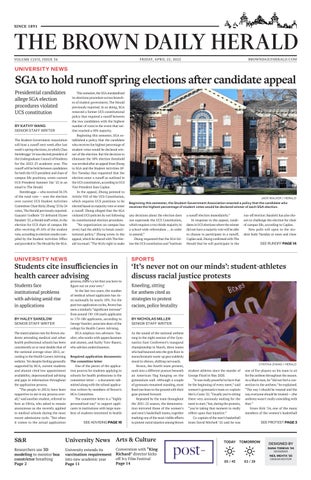
SGA to hold runoff spring elections after candidate appeal
Presidential candidates allege SGA election procedures violated UCS constitution BY KATHY WANG SENIOR STAFF WRITER The Student Government Association will host a runoff next week after last week’s spring elections, in which Chas Steinbrugge ’24 was elected president of the Undergraduate Council of Students for the 2022-23 academic year. The runoff will be held between candidates for both the UCS president and chair of campus life positions, wrote current UCS President Summer Dai ’22 in an email to The Herald. Steinbrugge — who received 34.5% of the total vote — won the election over current UCS Student Activities Committee Chair Ricky Zhong ’23 by 24 votes, The Herald previously reported. Gaayatri Godbole ’25 defeated Elysee Barakett ’25, a Herald staff writer, in the election for UCS chair of campus life after receiving 49.16% of the student vote, according to election results compiled by the Student Activities Office and provided to The Herald by the SGA.
This semester, the SGA standardized its elections procedure across branches of student government, The Herald previously reported. In so doing, SGA removed a former UCS constitutional policy that required a runoff between the two candidates with the highest number of votes in the event that neither reached a 50% majority. Beginning this semester, SGA established a policy that the candidate who receives the highest percentage of student votes would be declared winner of the election. But the decision to eliminate the 50% election threshold was revoked after an appeal from Zhong to SGA and the Student Activities Office Tuesday that requested that the election enter a runoff as outlined in the UCS constitution, according to UCS Vice President Sam Caplan. In the appeal, Zhong pointed to Article VIII of the UCS Constitution, which requires UCS positions to be elected based on majority vote or enter a runoff. Zhong alleged that the SGA violated UCS policies by not following its constitutional election procedure. “No organization on campus has (ever) had the ability to break constitutional policy,” Zhong wrote in the appeal, which he shared with The Herald via email. “The SGA’s right to make
UNIVERSITY NEWS
JACK WALKER / HERALD
Beginning this semester, the Student Government Association enacted a policy that the candidate who receives the highest percentage of student votes would be declared winner of each SGA election. any decisions about the election does not supersede the UCS Constitution, which requires a two thirds majority in a school-wide referendum … in order to amend.” Zhong requested that the SGA follow the UCS constitution and “institute
a runoff election immediately.” In response to the appeal, candidates in UCS elections where the winner did not have a majority vote will be able to choose to participate in a runoff, Caplan said. Zhong confirmed with The Herald that he will participate in the
run-off election. Barakett has also chosen to challenge the election for chair of campus life, according to Caplan. New polls will open to the student body Tuesday at noon and close
SEE RUNOFF PAGE 14
SPORTS
Students cite insufficiencies in health career advising
‘It’s never not on our minds’: student-athletes discuss racial justice protests
Students face institutional problems with advising amid rise in applications
Kneeling, sitting for anthem cited as strategies to protest racism, police brutality
BY HALEY SANDLOW SENIOR STAFF WRITER The matriculation rate for Brown students attending medical and other health professional schools has been consistently at or near double that of the national average since 2012, according to the Health Careers Advising website. Yet despite feeling generally supported by HCA, current students and alumni cited low appointment availability, depersonalized advising and gaps in information throughout the application process. “The people in (HCA) have been supportive to me in my process overall,” said another student, referred to here as Olivia, who asked to remain anonymous as she recently applied to medical schools during the most recent admissions cycle. “But when it comes to the actual application
S&R Researchers use 3D modeling to monitor boa constrictor breathing Page 2
process, there’s a lot that you have to figure out on your own.” In the last two years, the number of medical school applicants has risen nationally by nearly 18%. For the past two application cycles, Brown has seen a similarly “significant increase” from around 130-150 yearly applicants to 170-180 applicants, according to George Vassilev, associate dean of the college for Health Career Advising. HCA employs two advisors: Vassilev, who works with upperclassmen and alumni, and Kathy Toro-Ibanez, who advises underclassmen. Required application documents: The committee letter One of the pieces of the application process for students applying to schools for health professions is the committee letter — a document submitted along with the school application written by members of Brown’s HCA Committee. The committee letter is a “highly personalized way” to support applicants in institutions with large numbers of students interested in health
SEE ADVISING PAGE 16
BY NICHOLAS MILLER SENIOR STAFF WRITER As the sound of the national anthem rang in the night session of the Gymnastics East Conference’s inaugural championship in March, three teams who had bounced onto the gym floor in monochromatic warm-up gear suddenly stood in silence, shifting nervously. Brown, the fourth team present, sunk into a different posture beneath an American flag hanging on the gymnasium wall. Although a couple of gymnasts remained standing, most fixed one knee to the ground with their gaze pressed forward. Repeated by the team throughout the 2021-22 season, the demonstration mirrored those of the women’s and men’s basketball teams, together marking one of the most visible efforts to protest racial injustice among Brown
University News Arts & Culture University extends its vaccination requirement into new academic year Page 11
Converstion with “King Richard” director kicks off Ivy Film Festival Page 14
CYNTHIA ZHANG / HERALD
student-athletes since the murder of George Floyd in May 2020. “It was really powerful to have that be the beginning of every meet,” said women’s gymnastics team co-captain Mei Li Costa ’22. “Usually you’re sitting there very anxiously waiting for the meet to start,” but, during the protests, “you’re taking that moment to really reflect upon that injustice.” Co-captain of the men’s basketball team David Mitchell ’22 said he was
one of five players on his team to sit for the anthem throughout the season. As a Black man, he “did not feel a connection to the anthem,” he explained. “The way I should be treated and the way everyone should be treated — (the anthem) wasn’t really coinciding with that.” Grace Kirk ’24, one of the many members of the women’s basketball
SEE PROTEST PAGE 3
TODAY TOMORROW
DESIGNED BY DANA TONEVA ’24 DESIGNER
65 / 45
63 / 39
NEIL MEHTA ’25 DESIGN EDITOR
2
THE BROWN DAILY HERALD | NEWS
FRIDAY, APRIL 22, 2022
SCIENCE & RESEARCH
Researchers discover how snakes can constrict prey without suffocating themselves With 3D imaging, study finds that boa constrictors control different sections of rib cage when breathing BY JARED ZHANG SENIOR STAFF WRITER A study published this month in the Journal of Experimental Biology led by University researchers used 3D imaging to visualize how boa constrictors adjust the site of breathing within their lungs to constrict and digest their meals without suffocating, according to John Capano MS’18 PhD’20, first author of the study and a postdoctoral fellow in the Fuxjager Lab at Brown. Since a boa constrictor’s lungs sit beneath its heart, which is located in the first third of the constrictor’s length, snakes must take a very large breath in order to get fresh air all the way down their lungs, said William Milsom, professor emeritus of zoology at the University of British Columbia. Milsom was not involved in the study. But since the body of a snake is unable to expand laterally wide enough to
achieve this, “the trick for snakes is to have long saccular lungs (which allow) small lateral movements over great lengths (to) produce large breaths,” Milsom said. “The ability to do this along the entire length of the lung, however, is
constrained when they are digesting a meal,” he added. “The bolus of food moving along the digestive tract compresses the lung in that area.”
The researchers were interested in how snakes are able to overcome the challenge of
If you can see the ribs moving, you can guarantee that ventilation is occurring,” he said. “What we showed is that (snakes) could actually activate different segments of ribs at will,” Capano said. “It seems to be really finely controlled.” By tuning the rib cage and body wall movements to only the areas that are allowing air flow,
breathing while eating. “One of our main ques-
snakes can control the area of lung being used to inhale, he added. To understand rib movements that
tions was how can snakes constrict a prey item, which can take hours or even days, and also not die of asphyxiation,” said Hannah Weller GS. To breathe, snakes do not use a diaphragm like humans do, according to Capano. “Snakes just use the ribcage.
allow the boa constrictors to modulate their breathing, the researchers used blood pressure cuffs to simulate restricted rib motion during digestion and a technology called X-ray reconstruction of moving morphology, Capano said. XROMM, which was developed at the University, is a 3D imaging technology that allowed the researchers to visualize the movement of the rib
cage bones. Using 3D models and X-ray imaging, the researchers could create animations of the boa constrictors modulating their breathing. “We used this animation software called (Autodesk) Maya” — the software used in Jurassic Park —“to … create an animation of the bones moving which were a direct representation of what was happening in the living animal,” Capano said. This study gave scientists in the field “tremendous insights into evolutionary processes as well as biomedical interventions for dealing with respiratory disorders,” Milsom said. From a biomechanics point of view, these findings could also be applied to future research related to designing robots, according to Weller. “There’s millions of species on this planet, and we’re just one of them,” Weller said. “I think it’s cool and respectful to try and ask questions about other (species) that are out there. It’s really a basic human thing to look at something in the natural world and wonder why it is the way it is.” PHOTO COURTESY OF MARK LIU
FRIDAY, APRIL 22, 2022
PROTEST FROM PAGE 1 team who chose to kneel, cited similar motivations to Mitchell. “I have seen what America has done to people that look like me and people who are darker than me as well,” she said. “Who I am as a Black woman wasn’t … in (the writer of the anthem’s) visions for American patriotism, so I already know right then and there that it’s not something that’s for me.” Amid a national reckoning over racial injustice spurred by the police killings of Breonna Taylor and George Floyd, protests like these have taken to a larger stage in Brown athletics, forming a fundamental part of student-athletes’ efforts to confront systemic racism, many athletes told The Herald. All three teams hosted conversations over Zoom in summer 2020 to discuss issues related to racial inequality, with some assigning books and movies about racial identity in America to their athletes. “We were late to talk about these things,” Costa said, mentioning that the gymnastics team focused its conversations particularly on how racial inequality plays a role in gymnastics. Monique LeBlanc, head coach of women’s basketball, said her team made a spreadsheet of materials people could refer to in order to learn more about the Black Lives Matter movement and facilitate team-wide discussions. “The Black women on the team were phenomenal at sharing their experiences,” she said. “Our teammates stepping up and saying, ‘I’m exhausted, but I’m still willing to be here and share my story’… was really incredible.” Kirk said that the team’s discussions were “a success,” particularly after she requested that players be allowed to have conversations without coaches present. But Kirk noted that the discussions sometimes became contentious and the meetings eventually stopped.
THE BROWN DAILY HERALD | NEWS
Many players on the men’s team, in addition to holding conversations, also attended protests against police brutality in their hometowns during the summer of 2020, Mitchell said. But because Ivy League athletic competitions were canceled during the 2020-21 academic year, it was not until a year and a half after the summer of 2020 that teams had the opportunity to protest during collegiate competition. Mitchell said that he made the decision to kneel before the 2022 season. There were “so many instances (in 2020 and 2021) … that really opened my eyes to a lot of the racial injustice that was … not really right in front of me,” he said. For Kirk, the decision to kneel was grounded in personal experience. In the summer of 2020, she heard her name being called from outside her family home in Minnesota as her father was held down and arrested by police officers, she said. She added that the officers charged him with a felony, but that the charge was eventually dropped after the family advocated for his release. “I was so traumatized,” she said. “They say the system (that) tried to dismantle our foundation as a family did it in the name of justice,” she said. “If that’s what that flag stands for, I can’t support it.” “When I see the flag and I’m supposed to stare at it for a minute or whatever before my game, … I see the police officer’s American flag on their uniform,” Kirk said. “I won’t stand for (the anthem), and I can’t because I feel like then I’m letting myself down, I’m letting my family down and I’m letting the millions and millions of people that came before me down by doing that.” Kirk also questioned the necessity of standing for the anthem. “I don’t think a flag is the best method of expressing patriotism or gratitude for freedom,” she said. “I really think that you can do that without standing for a piece
of material.” Costa expressed a similar sentiment, explaining that kneeling adds valuable reflection to what she sees as a typically superficial moment. “The anthem is such a performative thing most of the time,” she said. “You’re not really thinking about how amazing America is.” Kneeling, she added, instead “keeps (racial justice) at the forefront of your mind.” But for all three teams, conversations about whether to kneel did not result in consensus. At least one player on each team remained standing for every game, according to Costa, Kirk and Mitchell. Costa said that some of her teammates cited support for the U.S. military as a reason to stand for the anthem, although she maintained that the demonstration was “not meant as any disrespect to veterans.” Gymnastics Head Coach Sarah Carver-Milne said the coaching staff encouraged gymnasts to make their own decisions. “The first thing we tell them when they get to campus is that they need to use their voice and advocate for themselves, for their beliefs,” she said. The athletic department also encouraged “student-athletes, coaches and staff to use their platform and take a stance,” wrote Kelvin Queliz, associate director of athletics, strategic communications and content creation, in an email to The Herald. Mitchell said the men’s basketball team similarly left the decision up to individual players. “We knew there’d be certain people who would stand (and) there’d be certain people who would sit, but we respected that fact,” he said. Kirk described longer, more emotional conversations within the women’s basketball team about whether players would kneel. She said that before its first scrimmage, the team had a six hour meeting about their plans for the anthem. “It actually turned into an opportunity for the nonwhite players to open
up about their experiences,” she said. “There were tears.” Kirk added that, after the meeting, a majority of the team decided to kneel. Those who remained standing for the anthem explained their reasoning to the rest of the team, which was valuable, Kirk said. “In the moment it might have hurt a little more to hear so much negative feedback from a few people in particular, (but) at the end of the day, we all understood each other so much better,” she said. “It was a really, really powerful moment for us.” But kneeling or sitting for the anthem was not the only way teams acted in support of racial justice. Last November, the women’s basketball team visited the John Hope Settlement House in Providence, an organization founded in the late 1920s by African American community leaders to provide social services — such as child care, education and food distribution — to the Providence community. According to Kirk, the team read books to the children at the facility, which she described as an “amazing” experience. “A lot of my teammates were pushed outside their comfort zones … dealing with kids who aren’t privileged, who are actually very severely in need of help and somebody to just come in and spend time with them,” she said. LeBlanc said the team ran a book drive for the Settlement House after the visit, focusing on providing “culturally competent” books, and is making another visit this week. LeBlanc added that the team also fundraised for the National Association for the Advancement of Colored People Legal Defense Fund and the Rhode Island Coalition for Black Women during the summer of 2020. According to Mitchell, the men’s basketball team made efforts on social media to promote racial justice initiatives. For example, Mitchell mentioned that some team members made posts during Black History Month to highlight
3
Black trailblazers throughout history. Still, some athletes expressed regret that their programs have not done more. “There’s definitely a lot more that we could have and should have done to keep those conversations going,” Costa said, adding that the gymnastics team did not follow through on plans to volunteer in the community, which she partially attributed to public health concerns. Kirk also noted that the women’s basketball team could have been more “prepared and proactive” in promoting racial justice during Black History Month. “An Instagram post is not enough,” she said. “I wish we would have taken the opportunity to have more of those difficult conversations because I think everybody grew from that.” In addition, Kirk noted that she would have liked to see more efforts from her team’s coaches to facilitate conversations and learning surrounding racial justice. “I hope and wish and encourage my coaches to continue to do trainings and listen to talks,” she said. “If it’s just the Black players telling them, ‘Hey, this is how you have to coach me as a Black woman, this is how I feel on a regular basis walking through a (predominantly white institution),’ that’s not fair for us.” Kirk, Mitchell and Costa all said that they expect their programs to continue with similar efforts to combat racial injustice in the future. Our teammates “are all very attentive. They’re all very diligent,” Mitchell said. “They all know that we have the power and a platform both on this campus and in the city of Providence.” “It’s not a phase, it’s not a trend,” Kirk said. “I think that us stopping would send a message (that) we’re over it.” Kirk emphasized that for the Black players on the team, racial injustice is not something they can move on from. “It never has died down,” she said. “It’s never not on our minds.”
4
THE BROWN DAILY HERALD | NEWS
FRIDAY, APRIL 22, 2022
WILDCARD: AN OPEN LETTER TO THE CLASS OF 2025
ALEX NADIRASHVILI / HERALD
Dear incoming sophomores, welcome to your home for the next year: Perkins Hall. Anyone you ask will say that the most memorable thing about Perkins is the gorgeous dumpsters that sit outside its doors. Who doesn’t love the rabid squirrels that spend their days munching on your Ratty dinner from the night before? Or a smell so pungent that you’d rather weather your roommate’s BO than leave your window open? And don’t forget the color — a green so bright it rivals John!
CA L E N DA R
COVID -19 AT BROWN APRIL 14 TO 20
APRIL S
3
M
4
Tu
5
W
6
Confirmed positives
Th
7
F
210
S
1
2
8
9
Students in on-campus, designated off-campus quarantine housing
130* APRIL 7 TO 13 Confirmed positives
10
11
12
13
14
15
16
171
17
18
19
20
21
22
23
Students in on-campus, designated off-campus quarantine housing
24
25
26
27
28
29
30
83* *APPROXIMATE
post-
FRIDAY, APRIL 22, 2022
APR 22 — VOL 29 — ISSUE 9
THE BROWN DAILY HERALD | NEWS
FEATURE
See Other Issues:
5
ISSUU.COM/POSTMAGAZINEBDH
NARRATIVE
Connect the Dots swiping the hours away by Ellie Jurmann I’m going to let you in on a secret: I am obsessed with the game Dots. Maybe you have heard of it or seen it in the App Store, not that either would make my addiction more legitimate. Dots was my go-to game in middle school on my blue iPhone 5C, and I would spend hours a day connecting the stupid but beautiful colored dots together and removing them from the board. The app is simple and sleek in design: a plain white background, over which the red, blue, yellow, green, and purple dots do their magic. At the risk of sounding like a total deadbeat, I must admit that my screen time on Dots—even with the one-hour daily limit I have (though frequently ignore) on the app— is far more than my screen time on any of the other major culprits that kill hours of my day. Yes, that means I spend
The Power of Kvell a love language for the world
more hours per day staring at tiny, colored dots on my phone than I do watching TikToks, FaceTiming friends, or sending and reading text messages. Currently,thereisnobetterfeelingintheworldtomethan creating a square of same-colored dots that causes my phone
By Zoe Creane
to vibrate and thus eliminates all dots of that color from the
Illustrated by john gendron
board. I’m not sure why my euphoria comes from recreating seventh-grade swipesations on a touchscreen; alas, here we
Light twinkled through the windowpane in front of
that global challenges can only improve when each
are. Maybe it is the intoxicating combination of nostalgia,
me, hopscotching across my worktable and glinting off
individual does their part. Every time I meet with Barbara,
gamer’s high, a compulsive need to constantly best myself,
the gems in my fingers. I was beading with rubies, stacking
whether in a professional or friendly setting, she envelops
and the simple pleasure that exists in this beautifully simple
them between my fingers and sliding them carefully onto a
me with compliments, assurance, and gifts. In an undoubt-
game. Whatever is causing my obsession, I cannot seem to
strand of wire. Legs tucked up on my stool, I sat quietly, lost
edly challenging and formative time in my life, Barbara
get enough.
in the simple pleasure of my work. In a moment, distant
fostered confidence and self-love within me; she defined
Deep down, I know that in a week’s time I will likely
footsteps pattered down the hall and I looked up towards
the power of “kvell” in my life. In recent years, I’ve noticed
have forgotten that Dots ever existed. The app will be
the bright smile of my employer and mentor, Barbara
the fundamental role that kvelling plays in wellbeing,
Edel-ston Peterson.
and the many different places it can come from—friends,
“Zoe, you’re just speeding through these strands!” she
Continued on page 8.
parents, partners, strangers, mentors, and ourselves.
exclaimed, peering closely over my shoulders. “Now, look
***
ARTS & CULTURE
at these.” Barbara laid out a pair of earrings, thin gold hoops
At 8 a.m. on a sunny September morning, my parents
with a Tahitian pearl. “They’re phenomenal,” I breathed,
and I rolled out of our Airbnb, loaded my six suitcases into
caught in the soft glimmer that skated along the surface
the rental car, and drove to Brown’s campus. The air was
of the pearls. “Well, I know, and you must have them,” she
muggy, the type of humidity you can feel cluster on your
beamed, holding them up to my ears. “I’m just so proud of
skin—so different from the breezy warmth of my California
you, my little Zoe, off to Brown… I can’t stop kvelling over
home. My mom and dad trailed behind me to the key office,
you!” She watched as I put the hoops in, showering me with
all of us jittery. As the door to my room swung open, reality
words of affirmation. I love Barbara for countless reasons,
settled firmly on our shoulders; I was moving out from
but her talent for kvelling is one of the things that truly
home. We hung tapestries and stuffed clothes into drawers,
I went to my first pen show when I was in
sets her apart.
all of us dancing around the ephemerality of our together-
high school, the annual Los Angeles International
“Kvell”’s direct translation, according to Merriam-
ness. My parents left me to my own devices and the great
Pen Show to be specific. According to its out-
Webster, is “to be extraordinarily proud, [to] rejoice.” It’s a
excitement of college that night, and came by again in the
dated website: “started in 1989, [the Los Angeles
Yiddish word with two roots: the earlier Yiddish verb kveln
morning, before their flight.
International Pen Show is] the West Coast’s premier pen
Tools of the Trade
writing as an art and craft by Joseph Suddleson
(to be delighted) and the German verb quellen (to well,
As we stood on the curb, the pressure of our great
show. It brings together pen dealers, collectors, and writing
gush, or swell). However, kvell has grown to encompass
goodbye surrounded us. My mom and I cried, hugging each
aficionados from around the globe.” Oy vey––what kind of
much more than its origin. In Barbara’s words, “Kvell is a love
other. “We love you and believe in you, Zoe,” she said. “You
useless garbage am I reading about now, you’re probably
language, sending a loud and clear message that you are
can do anything you set your mind to!” My dad gave me
asking yourself! Pens!? The world is crumbling and yet all
adored, you are recognized, and you are doing or did a good
a tight, quick squeeze. “I’m so proud of you, my dear,” he
I can think to write about are writing instruments… meta,
job.” Kvell is “a surge of positive feeling from one person
whispered. Their words held me up, gave me the strength
I guess.
to another,” a gift to both the recipient and the donor.
to say goodbye and to push forward into my independence.
The first fountain pen I used was one I found
Since receiving Barbara’s earrings, I’ve worn them on
In that first week of school, chin-deep in unfamiliar
on my dad's desk. If you’re not sure what a foun-tain pen
countless occasions. Each time, I feel Barbara’s hugs, her
territory, their kvelling fueled my confidence and tenacity
is, first I’d say that a quick Google search should do the
endless support, her doting love. I’ve worked with Barbara
when I needed it the most.
trick; but also, it’s basically just a fancy pen filled with
for nearly five years, moving from beading and jewelry-
***
liquid ink that was the standard pen type through the
making to interning for her nonprofit organization, the
The first semester of college was difficult for me and
first half of the 20th century. The moral of this story, if
Whole Champion Foundation (WCF). WCF provides edu-
my long-distance boyfriend. We were thousands of miles
you’ll indulge me, is that early in my life I discovered
cational and motivational materials to advocate for
apart, our days were misaligned by three hours, and we
a tool that had long been outmoded and replaced
Continued on page 6.
Continued on page 9.
personal awareness, responsibility, and action in order to improve our world; Barbara founded it on the principle
april 22, 2022
5
6
THE BROWN DAILY HERALD | POST
FEATURE Continued from page 5.
had been spent at the mercy of molecular orbitals and pi bonds, only for me to fall two points short. In the next
were in entirely unique and separate experiences. To be in
few days, I grew more and more frustrated, noticing the
a relationship during this tumultuous time of growth is to
silly mistakes or forgotten steps that had set me back. My
learn and mature together; we had to figure out how to nour-
boyfriend and my mom showered me with affirmations,
ish ourselves as individuals and as partners. We discovered
my friends congratulated me, but I couldn’t stop thinking
a now indispensable part of our relationship: kvelling.
about those two points.
FRIDAY, APRIL 22, 2022
You've Got Mail a love letter to writing
by Julia Vaz Illustrated by monika hedman To my observer self,
My boyfriend picked up guitar around six months
A week later, I sat down with Barbara’s soon-to-be-
Since you seem so adamant about denying me
ago, as a creative outlet during a challenging time in his
published book about the power of kvelling, I Kvell. Do
an existence within your marrow, I will address you as
life. Tinny fingerpicking soon progressed to complex and
You? On the last page, she writes:
one separate from me. Independent, unattached to the
resplendent songs. The guitar is his fidget—he reaches for
“We can be our biggest champions.”
hand guiding this pen. I will unravel the threads that join
it in between classes and homework assignments, conver-
I read it again. “We can be our biggest champions.”
us. For when I am putting words on paper, you vanish.
sations and meals. Several weeks ago, he flew out to visit
Her words reverberated in my brain, slotted into the space
And in your absence I find the space to miss you, to long
me, his guitar strapped to his back as a carry-on. Sitting in
those two lost points had been filling. I wasn’t being my
for your naivety and wide eyes. Truly, I am just a vessel:
the cozy orange glow of my lamp, bright against the night
own champion; I was letting a moment of accomplishment
a vase waiting to be filled by the dreams you have while I
of my window, he began to play. They were songs from
escape unnoticed, dragging my feet beneath the weight of
slumber. I sing a lullaby of your own making. Or, maybe I am
my childhood, songs from our teenage years, songs from
a small mistake. We can––we must––kvell over ourselves,
belittling myself. Call me…a translator. Yes, that's how I would
college. I watched as he strummed with soft fluidity and the
just as much as we kvell over others. We need to nurture
like you to picture me. An investigator, a decoder.
chords changed underneath his finger pads, his eyes closed
ourselves before we can thoroughly nurture those around
This long preamble is all to say: stop asking me
as we both listened closely. I felt this bubble of unhindered
us. I needed to take pride in my accomplishments, no
questions. I have received all your letters. They sit in piles
joy swell within me, something much deeper than pride.
matter how imperfect they were, before I could consider
scattered across my office: an archive of all the ways your
When he finished playing, the lamp seemed to dim, the
myself a true kveller.
doubts slip into the verses I trans-cribe every night. See?
reverberations of his final note slowing until the room sat
So, I told myself: This is an accomplishment. This
In your letters you call me a writer, but I am not worthy
in quiet stillness with us. I grabbed his hands, letting my
is your hard work and your tangible triumph. I took the
of that title. My work is mechanical: arranging your
bubble of joy pop and billow over him.
time and the thought to kvell over myself, to take pride
experience of the world into an easily recognisable system.
“I am so proud of you,” I told him simply, “You have
in my efforts and my achievements. My own kvelling
The writer you call for is nothing but your heartstrings,
poured your heart into this and I see it and I am happy and
strengthened my motivation, my confidence, and my
your predisposition to the subjective.
excited and in awe.” I could see the impact these words had,
ability to kvell over others.
the brightening of his spirit and his confidence. Kvelling
Allow me to prove my point. You often write that your passion for storytelling began on the second floor of a small
***
fulfilled both of us.
With these moments, I’ve come to understand
library in your hometown. You were just a kid, sitting on a
A few days ago, my workload had reached a nearly
something about kvelling; it doesn’t matter how or
dirty rug in a circle listening to the librarian tell tales about
insurmountable peak and I felt entirely overwhelmed. I sat
where it’s done, only that it happens. Some people kvell
emperors, silk, and princesses. You first picked up a pen and
down in front of my computer, FaceTimed my boyfriend,
constantly, like Barbara and my mom and my boyfriend.
a notebook because of the possibility of creating for yourself
and burst into tears. He pieced words together between the
Some kvell quietly and sparsely, like my dad. Because the
the worlds you escaped to. But I know that story, even after you
blubbering sobs and waited until I had thoroughly exhaus-
connections between partners, friends, and parents are
have forced me to carefully transcribe it, to be a lie.
ted myself before speaking. “Zoe—
so intrinsically different, the kvelling in these relation-
The truth is here, in the scrapped versions, in
You are strong. You are capable. You do not need to
ships will differ greatly. Parents are often an early and
my failed attempts to translate your actual feelings.
do everything, but I know that you can. You inspire me in
consistent source of kvelling, while partners and friends
In my discarded drafts, you are not even listening
everything that you do, and I love you.”
grow and develop their kvelling. The ability to thoughtfully
to the tales. You are not even looking at the librarian or the
kvell over oneself can be just as challenging to develop,
piles of books around you. Between the wrinkles and ink stains
but it’s a fundamental piece of fulfillment.
of my pages, I catch you watching the rain. That was it, wasn't
I could feel the warm tenderness of my boyfriend’s kvelling, his stabilization and encouragement. Despite
However, in all of my relationships, I value recipro-
it? Something about the way the water cascaded down the
cation, the sharing of time, affection, support, and love—all
window, about the fact you couldn't touch it. Was it the feeling
of these are tied to kvelling. I rejoice in the well-being and
of being an observer? The slightly painful, perfectly lonely, incandescently warm feeling? Am I making you understand?
being thousands of miles apart, our kvelling fuels our wellbeing as individuals and as partners. *** Recently, I got my score back on the second midterm
achievements of my loved ones, and they rejoice in mine.
of my chemistry class. When the email popped up, I anx-
Kvelling is a lifestyle; it is opening yourself up to the joy of
Creation does not start at the page. In fact, it doesn't even
iously opened my Canvas page and stopped short—I had
others. As Barbara told me, “Kvelling is a love language for
start with language. It starts with the way you taught yourself
gotten two points less than I’d been hoping for. It was a
the whole world.”
to breathe, to move through the complexities of existence. You notice the changing of the seasons, the dissipation of the
great score, fifteen points higher than what I’d scored on the first midterm. But still, my heart squeezed tight, my
Barbara’s book I Kvell. Do You? will be published soon
morning mist and the couple walking hand in hand down the
spirits slumped, and tears pricked my eyes. My entire week
and available for purchase on https://wholechampion.org/.
street. You take it all in as if those were versions of yourself.
Letter from the Editor Dear Readers, Most days, the inside of my brain looks like a riotous smear of color. If you’ve caught sight of me on campus (on a good day), maybe you could’ve guessed that about me. My eyelids must be shimmering or neon or lined with a pop of teal at the very least, and my boots are nearly guaranteed to match them. Cerebral cortex like a Hilma af Klint painting. This week has been particularly pastel, mediated by warm earth tones that feel like holding. Our (gorgeous, printed, three-dimensional) issue contains all manner of wonderment. Our Feature writer talks about the idea of “kvell,” considering the types of love and care she has experienced.
In Narrative, one writer discusses a love for the game Dots, while the other meditates on the reasons why she writes. Our A&C section also contains a meditation on the nature of writing as one writer thinks about it as a physical process, as well as a reflection on the paradox of Tinder dating. And our Lifestyle piece provides a bucket list for this last month of our spring semester! This week, we offer up a canvas of color-swatched ideas and watercolor musings. Whether you’re experiencing the tactile wonder of post- on paper or reading these words from the blue light glare of a screen, I hope you can see the colors spilling from our pages.
Feeling pink as ever,
Kyoko Leaman
Editor-in-Chief
6
post–
Days of the Week 1. Yesterday (by The Beatles) 2. Hump day ;) 3. The Weeknd 4. The day of reckoning 5. Sundae 6. Thursday 7. Titsday 8. Chicken Finger Friday 9. Wednesday, from the Addams family 10. Prince Spaghetti Day
LIFESTYLE
Spring Bucket List
bucket list for before the spring semester ends by Nadia Heller Illustrated by Lena He (@liquidbutterflies) It’s that magical time of the year when the trees on campus shimmy into their spring costumes and shed pink petals onto gray pavements. The days sprinkle yellow sunshine over the ancient bricks, warming the buildings and flooding the Main Green with picnic blankets and neglected school books. The warmth nudges the skunks out of hibernation and sends hay fever haywire. The weeks at the end of April are complete bliss. It’s the sliver of time right after the last midterms fizzle out and just before the final exams demons drop down from their evil lair in the sky. It’s a time to take a deep (but not too deep) breath and enjoy the unraveling enchantment of spring. Unfortunately, it’s also the time when my Flex Points That's why you beg for a writer, isn't it? You need someone to
dip below the dollar and I can afford less than two meal
carry the weight of the emotions you take it upon yourself to
swipes a day. The end of the year may mean rationing
tend to. To describe and pass down as family heirlooms. But writing is nothing but a way of seeing: the way you turn your head slightly when someone laughs in a café; how you always smile when a butterfly flutters along your path; or when walking downhill, listening to music, you suddenly have to close your eyes to avoid bursting into tears. What I'm trying to make you see is that writing is not the mastery with which you arrange the words. It's not alliteration, metaphor or synesthesia. Writing is standing at a threshold between all that life is and all that it could be. Writing is standing at a threshold and deciding not to move. So, please, don't expect me to have the answers. The writer is not me, but your shadow on a bedroom wall. Don't worry about me. Don't worry about my process. It's secondary and self-improving. It's nothing. It's only everything because you can look at an orange peel and feel infinite. With love, Your humble translator
EDITOR-IN-CHIEF
NARRATIVE
COPY CHIEF
CO-LAYOUT CHIEFS
Kyoko Leaman
Managing Editor
Aditi Marshan
Jiahua Chen
Siena Capone FEATURE
“But when the day breaks, I am ready to step out of my bedroom, edit with dispassion, and make sense of my mind.” —Joyce Gao, “Finding Coldness,”
04.09.21
Managing Editor
Section Editors
Katheryne Gonzalez
Layout Designers
Alice Bai
Danielle Emerson
Eleanor Peters
Alice Min
Leyton Ho
Tierra Sherlock
Angela Sha
Andrew Lu
LIFESTYLE
SOCIAL MEDIA
Ethan Pan
Managing Editor
HEAD EDITORS
Kimberly Liu
Kelsey Cooper
STAFF WRITERS
Chloe Zhao
Dorrit Corwin
Section Editors
Caroline Zhang
ARTS & CULTURE
“When I first heard the word serotonin—the neurotransmitter that regulates emotion—I liked how it sounded: It sounded saccharine-sweet, and I had the world’s worst sweet tooth. Something about the syllables was enough to make me crave it.” —Kahini Mehta, “Recovery, In Fragments,” 03.06.20
Briaanna Chiu Copy Editors
Gray Martens
Managing Editor
Section Editors
Tabitha Grandolfo
Lily Seltz
Emma Schneider
Tabitha Lynn
Natalie Chang
Alexandra Herrera
Sarah Roberts Section Editors
Olivia Cohen Joyce Gao
Joe Maffa
HEAD ILLUSTRATOR
Zoe Creane
Sam Nevins
Connie Liu
Danielle Emerson Kaitlan Bui Julia Vaz Liza Kolbasov
Want to be involved? Email: kyoko_leaman@brown.edu!
Marin Warshay
april 22, 2022
7
NARRATIVE
Connect the Dots
vanilla lattes at the Blue Room and distancing myself from 1 a.m. Jo's sessions, but it’s also the last chance to try everything else. Before I make the third floor of the Rock a
by Ellie Jurmann Illustrated by connie liu (@the_con_artist)
destination to stare at blank Google documents and finals prompts longer than a page, there are a couple of goals I’d like to accomplish; a bucket list per se: SLEEP IN ALUMNI GARDENS
Continued from page 5.
today from this simply perfect game. Like all of the other activities I make the entirety of
This goal is partially terrifying. The critters of the night traverse the streets of Providence with un-
deleted from my phone, and it could very well be another
my existence for several days, weeks, and sometimes even
predictable appetites in their bellies. If at 4:02 a.m. they
decade before the game even crosses my mind again. I wish
months, the allure of Dots is in exploring the uncharted. I
happen to stumble upon Alumni Gardens with a keen
I could say that Dots is special—that, like love at first sight,
work to set new records for myself, discover every hidden
craving for an English concentrator who just turned 20, I’d
Dots and I are meant to be. And what a great story we—
pattern to develop strategy and skill, and feel the intense
be finished. But the idea of setting up a comfy sleeping bag
Dots and I—would have: Years after we first parted ways,
satisfaction that comes with each successful execution.
and staring at the stars until a light spring breeze carries
the iconic duo is reunited, now better than ever, ready to
Dots, unlike Two Dots, the newer version of Dots with
me into my dreams is a marvel-ous thought. Alumni
set world records and achieve greatness. Sadly, I know all
countless levels and new challenges, is a straightforward
Gardens seems like it would be the ideal place to spend the
too well that this story is a short one. I may be pretty darn
game that demands mastery of the fundamentals. While
night, enclosed in a forest of blooming trees with the scent
good at the game; I should be, considering the number of
games like Candy Crush or Two Dots perhaps appeal to
of blossoming flowers. Not to mention when I wake up, I’d
hours of professional training in dot-connecting I have
some in providing a variety of gameplay, I find them cheap,
be less than a two-minute walk from my morning classes.
per day. But, like all of my other obsessions in life, this is
unoriginal, and boring. Dots is classic, timeless, and elegant,
As someone who lives in Perkins, this aspect is huge.
just another fad, and the dopamine of Dots will soon be
and I am currently committed to learning all the ins and outs
It feels like a pretty achievable goal. I would just need
all but gone.
of the game in order to master the simple art of connecting the dots.
to borrow a sleeping bag and find a friend who will
And it probably should. My college-aged, farsighted
stay up while I snooze and defend me from the Providence
eyes cannot usually handle hours of staring at a screen
wildlife.
that radiates blue light and makes my head throb. I am not
of
sure why I play Dots through that pain until it becomes an
and perfect dot alignments, I feel Dots is one of my
GET AN AUTOGRAPH AT BROWN
unbearable migraine from which I must hide under my
more justifiable obsessions. I see what my younger
SPRING WEEKEND
covers in the dark in dead silence to recover. Nevertheless, I
self once saw in Dots, as the uncomplicated but oh-so-
go through it all, time and time again, just to experience the
satisfying game scratches every corner of my neuro-
pure ecstasy of a successful round of Dots.
divergent brain. I allow myself to completely lean into
I’ve never gone to a concert or a sports game without a piece of paper and a Sharpie. I’ve also probably never sat
In a trance induced by a multi-sensory symphony vibrations,
symmetrical
rectangular
formations,
less than 70 rows away from the performers or athletes,
I sometimes wonder if I just have an insanely
the craze of Dots so that I can squeeze out every last
but you never know. The one time I did forget a piece of
addictive personality, or if others endure similarly int-
bit of pleasure from the game. Just like the platitude
paper was in middle school when Saint Motel did a free
ense yet meaningless phases—ones that people can
says about the people in our lives, my intense interests come
concert in downtown Providence. After the show, my best
move on from as quickly as they can become all-
into my life for a season, a reason, or a lifetime. In my case,
friend and I shimmied our way to the front and met the
consumed by them. As far as I go on Dots, I will surely
the seasons of my interests tend to be very short-lived. I
band. When they offered their signatures my best friend,
be onto something new in just a blip—hopefully ones
think that by accepting that Dots likely won’t be here for the
who always came prepared, handed them her piece of
that are not on my phone screen, for the sake of my
long haul shouldn’t change how I currently feel about the
paper and got a permanent autograph. I, on the other hand,
tired and chronically-strained eyes.
game. At this moment, Dots is everything I need in a pastime,
got a scribble across my arm. Although it is a childish wish
To an outsider, it may seem like lunacy to discuss colored
and my worries blissfully melt away every time my screen
to get a celebrity's autograph, it’s not a goal I will give up
dots so extensively, let alone play the game for hours a day.
lights up at the formation of a new square. Even if tomorrow
this year.
But to me, Dots is a lifestyle—until I drop it all for whatever
Dots becomes exactly that—a simple collection of colored
is to come, that is. I may love Dots so unabashedly today, but,
dots on my screen, as it once did in middle school—I can live
tomorrow, I may live my life as though it never mattered to
with that, knowing that whatever shiny, new interest takes
WATCH A MOVIE AT THE AVON On one of these rainy spring days, I want to watch a
me. But this is no fault of Dots, nor mine. I am not a disloyal
its place will serve me just as well. As good to me as Dots has
movie at the Avon. I appreciate them more when I see
person. Dots was designed to captivate people like me, those
been, I know that the obsessions yet to come will bring me
them at the Avon, but I haven’t been to the little theater
walking through one door of life and into the next. Dots is a
new joys, satisfactions, and dopamine boosts of their own.
on Thayer Street since before the pandemic. The Avon’s
segue between beautiful moments in life: the silent waiting
I just need to continue basking in all that is exciting and
vintage decor sends me back to a decade I never lived
as the bus arrives at your stop, the antsy excitement in a
uncharted.
through. It’s almost as if I’m acting in the movie myself.
Broadway theater right before show-time, the laying on the
Maybe my current phase is almost over, or maybe this
I love that the building only houses one theater and that
grass on a sunny day between classes. In the space between
is only the beginning. Either way, I am grateful to Dots for
the song “Let’s Go to the Lobby” plays before every film.
the colored dots, in the blank whiteness behind them, I find
the here and now.
The Avon introduced me to Whiplash, The Favourite, Sing
a million years of bliss. I am reminded of the tween girl I
Street, Isle Of Dogs, and so many other now-favorites.
once was, who experienced the same simple joy I experience
One of the greatest parts about the Avon is the bathroom. Right before entering, there’s a candy machine that only works occasionally, and is always a very pleasant surprise when it does. Inside the bathroom, there’s a full-length mirror that fuels me with the confidence to stare at myself and think, “Could I make a movie one day?”. They also equip the bathrooms with speakers so people like me with tiny bladders that can’t hold a medium-sized root beer through a two-hour movie don’t have to miss the film’s audio. Before finals steal every hour of my waking life, I want to watch something there and take a trip back in time.
8
post–
Until we meet again, Dots, Dots, Dots.
ARTS & CULTURE Examining any one of Blake’s illus-trated poetry collections, it is easy to appreciate his mastery of artistic form and language. Maybe his talent was God-given, but his skill was surely man-made. We often neglect to acknowledge the years of training, reading and learning it must have taken to properly etch a design into a copper plate, to hand water color the printed pages, and to execute poetic verse. As multimedia creator John Green succinctly put it Wednesday night during his visit to Brown’s Salomon Center, artistic creation is never a solitary process, but a dense web of collaboration with the world around us and the past. Far from presenting an unmediated view of whatever divine force that used Blake as its mouthpiece, Blake’s poetry is suffused with the language of his literary antecedents: principally, the Bible and Milton. As readers, we pick up a finished product, complete and refined as if nature itself had always meant for it to be that way. A great work of literature is like a smooth stone washed up on the shore; all we see is a perfect totality of form, not the millions of years of contin-uous waves that polished something rough into something simply beautiful. I also like to think of the great writer as a great magician, a master of illusion. Writing something worth reading is akin to making someone’s ace of spades jump from the deck into their pocket. The precision of the
Tools of the Trade
trace of your efforts that materializes instantaneously.
by Joseph Suddleson Illustrated by john gendron Continued from page 5.
craftsman, the wonderful effect produced as a result,
I didn’t understand all this until recently, but my
distracts the audience or reader from the unglamorous
foray into the world of antiquated writing instruments
and often messy work that allows the finished product to
was revealing a fact about writing that was hidden in plain
materialize. As readers, we don’t see the endless drafts, the
sight. I was slowly and imperceptibly becoming aware that
hundreds or thousands of rewrites, edits, and cuts: all we
writing wasn’t as opaque and mysterious as I’d been led to
see is a finished page.
believe. Writing doesn’t come to the solitary literary genius
Writing, like any craft, should be a continuous
through divine inspiration or through a muse; writing is
wandering. The goal is to stay moving forward, but
work. Writing requires more work, more practice, and
that
by more advanced technologies. In a very real sense, I had
more intention than one could ever glean from typing
not miraculously manifest itself on a page: it comes
uncovered a relic, and like a relic I treated it with reverence.
on a laptop alone. Writing of any kind is fundamentally a
through
Over a number of years, I built up a collection of my own.
craft in that it is nothing more than the natural product
and effort. This all might be obvious to you but
I loved their ornate finishes and luxurious qualities which
of talent, hard-earned skill through prac-tice, and the
it wasn’t always obvious to me. It’s a fact that’s
made them fun to use and to collect. I also appreciated the
proper tools.
better learned through experience than intellect-ualized.
doesn’t
mean
constant
straight iteration,
ahead.
Writing
failure,
does
invention,
ritualistic processes that using a fountain pen entailed
Many consider the poet and artist William Blake
I found my way towards this level of understanding by
(filling and cleaning the pen, unscrewing the cap, etc.).
to have been a visionary genius, a modern prophet. But
connecting with the tools that make writing possible.
Using something so involved and so focused in its purpose
it’s essential to remember that Blake earned his living
I wanted physical remnants of my work, haptic nodes
brought me closer to the page and to the process of writ-
in London as a copy engraver, a skilled tradesman. He
charting my limitless searching for self expression,
ing. I was making marks—leaving traces.
is also famously eccentric and most likely lived with
connection, and understanding. You do not need fountain
On January 27 of this year, a large box arrived for me.
some combination of undiagnosed mental illnesses—he
pens or a typewriter to appreciate this way of creating,
Within the box and under a lot of packing peanuts sat my new/
claimed to have come upon a tree filled with angels as a
these were just my particular ways in.
old typewriter. It’s a pastel green 1965 model Hermes 3000
small boy (an assertion that brought the scolding
Endings are good places to take stock of the journey
withcurveslikeamid-centurysportscar.It’sbeautiful.Though
of his parents upon him). Later he was visited
you’ve just been on; endings are the season of reflection. I sit
I was initially drawn to the typewriter for its
at his home by a friend who reported that Blake
at my desk by the window typing this out with only a couple
beauty and its novelty, I realize now that I was
and his wife were naked in their garden reciting lines from
of weeks left before I graduate. I feel so much gratitude
unwittingly
out-
John Milton’s Paradise Lost as if they were Adam and Eve.
for all, from Brown and beyond, who’ve shepherded
dated writing instrument crusade. As a tool, the typewriter,
But that’s all besides the point. I mean to stress that even
me and my writing along the way. In particular I want to
like the pen and unlike a laptop, has one job. When you sit
Blake’s poetry and art, divinely inspired as it might have
thank my parents without whom none of this would be
down at the typewriter you’re there to write. Especially
been, took tactile, human labor to execute.
possible; Emma Schneider and all the other generous,
taking
my
next
step
into
this
if you’re using a manual typewriter, there is a physical
Taking on the appearance of modern reinter-
insightful, and patient editors at post- who’ve taken a chance
connection between the pushing of a key and the swinging
pretations
manuscripts,
on me and my writing these past few years; and Professor
of the hammer that stamps out a letter on the
Blake’s artistic production was inextricably bound
Joe Pucci in the Classics Department who, more than
page. Typing becomes a musical endeavor. It’s just you and
up with the tools and techniques of his day job,
anyone, taught me the importance of going beyond the first
the words coming out of your brain through your fingertips.
incorporating
draft and whose passion for supporting students might
And unlike a digital document, there remains a physical
years of apprenticeship to older masters of engraving.
of
medieval
trade
illuminated
skills
he
learned
through
only be matched by his love for Diet Snapple.
“You never wink at me romantically anymore.” “Crime, endearment. That’s all I know.” “We can touch her and we can take her home.”
april 22, 2022
9
10
ARTS & CULTURE
THE BROWN DAILY HERALD | POST
Schrodinger's Tinder Date
FRIDAY, APRIL 22, 2022
A chronic overthinker at my core, I know there’s an infinite
devotion to Taylor Swift’s entire discography without fear of
number of moments to make a right decision, to be wrong.
being cringe or weird or too much. These people don’t exist—
Perhaps this is precisely the reason I’m an avid user of
not really—in the truest sense of the word. Rather, these
dating apps. Especially for a college student bearing the burden
conversations carry all possibilities, each one occurring at
love and other paradoxes
of youth and endless potential, the entire process functions
once. I have not yet arrived at a coffee shop for a date, I have
like a pendulum caught mid-swing. Matching, exchanging
not yet been rejected. There’s no telling if we, our texts, our
by Nasreen Duqmaq Illustrated by elliana reynolds
pleasantries—it’s a no-man’s land where nothing is promised
flimsy attempts at a future, will coalesce in heartbreak, or even
and even less is expected. If a message is botched, there’s another
worse, love.
equally—if not more—likable conversation queued. If someone
I have been in love before, once. It was good,
I don’t mind the gaps. You know the kind. The
seems promising, I can imagine all the little ways we fall in love
until it wasn’t. For a long while, the pain was sharp
moment before an exhale and a laugh not yet realized,
and then out of it, without the onus of living through it. With
and pointed—the words of a lover, now a scythe.
still bundled in the lungs. The instant before a foot
each little icon added to my repertoire of potential suitors, I am
The process of rebuilding myself was tedious. Even
hits the ground, a great crack of thunder right before
comforted with the knowledge that everything and anything is
months after the blow, there were moments where I’d realize
the strike. A liminal space where everything hangs
still possible, should I want it. A cat trapped in a Tinder-shaped
I was doing something we used to do together, now alone
in the air, simultaneously fated and foiled, invariably and all at
box.
for the first time. The crushing weight of knowing I’d have
once.
My fondness for unrealized reality rests on its propensity
to shower alone, sleep alone, write love letters to no one,
There’s a finality to choosing, the ghost of the
for self-preservation, a shield against the digital world. For one,
was almost unbearable. I grew accustomed to the way his
road not taken lingering in a series of troubling, utterly
I’m self-aware enough to concede that I’m a difficult person to
sweaters hung over my knees, how he’d take photos of us
intolerable—utterly
all,
get to know. My social media presence is close to nonexistent,
going grocery shopping. For a while, I wasn’t sure where to
I’m prone to trying on three or four outfits in the morning,
and I take at least five business days to respond to texts.
put all the extra love I still had in me. It festered and hung
just to be sure. And when ordering drinks, I am Sisyphus, the
The feeling of immediate availability through Snap-chat or
like a phantom limb, and I carried on with the weight of a love
menu a tumbling boulder down a steep, steep hill of indecision.
Instagram or whatever makes my throat swell, choking on the
that was more alive than it should be.
A chronic overthinker at my core, I know there’s an infinite
threat of encroaching intimacy. For me, self isolation is familiar,
number of moments to make a right decision, to be wrong.
almost instinctual.
intoxicating—what-ifs.
After
Even after lots of intensive therapy and accepting that I was not treated like I should have been in that
Perhaps this is precisely the reason I’m an avid user of
Maybe it’s because I’m a twin—a constant, breathing
relationship, the process of being vulnerable again is,
dating apps. Especially for a college student bearing the burden
weapon for comparison—or maybe it’s simply because I’m
at best, scary and, at worst, absolutely petrifying. I finally
of youth and endless potential, the entire process functions
quiet by nature. But I adore being self-sufficient. I don’t—
excised him from my life, stopped him from overriding my
like a pendulum caught mid-swing. Matching, exchanging
can’t—drive, so I’m intentional about living in walkable cities
brain at night. And now, when conversing on Tinder, I sense
pleasantries—it’s a no-man’s land where nothing is promised
with decent public transportation. I take the time to be with
myself turning acrid, giving people a reason to leave, instead
and even less is expected. If a message is botched, there’s another
myself and appreciate how my legs get me from place to
of a reason to stay. Another version of relinquishing the cat to
equally—if not more—likable conversation queued. If someone
place, a reliable source of movement. I make my own doctor
another’s hand. I know love will come again, inevitably, as it
seems promising, I can imagine all the little ways we fall in love
appointments, I buy my own groceries, I pay for my own
always does. But what if I find someone who doesn’t mind my
and then out of it, without the onus of living through it. With
apartment. Two years ago, I researched colleges for my mom
unintelligible ramblings about focaccia? What if they don’t
each little icon added to my repertoire of potential suitors, I am
to resume her undergraduate degree. Now, nearing the close of
mind that I still scroll on TikTok before I sleep? What if they rip
comforted with the knowledge that everything and anything is
my own college career, I’m soothed by knowing that wherever I
my heart through my throat? What if I am wrecked and rava-
still possible, should I want it. A cat trapped in a Tinder-shaped
land, I’ll be fine on my own.
ged and—worst of all—what if I like it?
box.
In a similar manner, I frequent Tinder because, for me,
Still, I continue to swipe. Maybe as an act of stubborn self-
I don’t mind the gaps. You know the kind. The
it’s safe. It’s all low-stakes entertainment, a way to turn my
defiance, or maybe because, even at my worst, I am an eternal
moment before an exhale and a laugh not yet realized,
brain off after a long day. There is no legitimate threat to my
optimist. Even when I won’t admit it, and I throw sarcasm at the
still bundled in the lungs. The instant before a foot
independence, my ego. Stuck in a superposition between
wall because it’s easier than sincerity, deep down, I know I am
hits the ground, a great crack of thunder right before
suitor and stranger, I endure Schrodinger’s Tinder date over
fueled by hope. A writer through and through, it’s my job to live
the strike. A liminal space where everything hangs
and over. Rarely do I match with friends (another form of self-
in doubt and come out the other end with a fully fledged world,
in the air, simultaneously fated and foiled, invariably and all at
preservation; I take three hour seminars with most of them), and
forged in my own hands. Perhaps dat-ing apps are another one
once.
so the majority of my time is spent pursuing profiles of people
of those stories, flourishing through a different medium.
There’s a finality to choosing, the ghost of the
who I vaguely register as real. After hundreds of matches, faces
These days, I swipe with no expectation. But still,
road not taken lingering in a series of troubling, utterly
and names are pretty much indistinguishable, with pictures
no expectation is better than expecting the worst.
intolerable—utterly
all,
of European vacations and New York bakeries blending into
I text, I talk, I go on dates. Slowly, I am making a
I’m prone to trying on three or four outfits in the morning,
a single, amorphous mass. In a roundabout way, this banality
direct observation, forcing an outcome, making the
just to be sure. And when ordering drinks, I am Sisyphus, the
opens me up. I can rant about my penchant for niche YouTube
parti-cles align. I cry, and I learn. I lose the cat, and I
menu a tumbling boulder down a steep, steep hill of indecision.
video essays and make grand statements about my unabashed
gain myself.
10
post–
intoxicating—what-ifs.
After
FRIDAY, APRIL 22, 2022
THE BROWN DAILY HERALD | NEWS
UNIVERSITY NEWS
Brown extends COVID-19 vaccine requirement to 2022-23 academic year Sudents, employees must document vaccination, second booster not required BY ALEX NADIRASHVILI UNIVERSITY NEWS EDITOR Entering the 2022-23 academic year, all students and employees will be required to remain up to date with Centers of Disease Control and Prevention guidelines for COVID-19 vaccination and booster shots, according to a Today@ Brown announcement from Executive Vice President for Planning and Policy Russell Carey ’91 MA’06. The mandate is an extension of the vaccination requirement set in place during the 2021-22 academic year. “Compliance with (these) requirements has been essential to maintaining in-person academic and administrative activities on campus throughout this year,” Carey wrote in the announcement. Newly admitted students and employees are required to upload proof of their vaccination to the University’s Health & Wellness Patient Portal, according to the email. Community members who have not previously received a religious or medical exemption and wish to do so for the upcoming academic year can find further information on the Healthy Brown website. Based on current CDC guidelines — which consider a person up to date
JACK WALKER / HERALD
Newly admitted students and employees will be required to upload proof of vaccination against COVID-19 to the University’s Health & Wellness Portal, while returning students and employees who are up to date in documenting their status will not need to take additional steps. on their COVID-19 vaccination if they have received the recommended doses in their primary series and one booster shot — the University will not yet require community members
to receive a second booster, Carey wrote. The University encourages those who are eligible for a second booster, which includes adults at least 50 years of age who received
their first booster over four months ago, to consult with medical professionals about their second booster shot. Returning students and current
employees who are up to date in documenting their vaccination status or have been granted medical or religious exemption will not need to take additional steps.
12
THE BROWN DAILY HERALD | COMMENTARY
FRIDAY, APRIL 22, 2022
EDITORIAL
To the class of 2026: Congratulations on your acceptances to Brown! We’re so excited to welcome you to College Hill. A new class of students is always cause for celebration. But this year, the changing of the guard feels especially meaningful.
Hill. Once you arrive for Orientation in the fall, you’ll walk through the Van Wickle Gates and make friends on the Main Green. You’ll pack into crowded lecture halls during shopping period and discover your favorite restaurant on Thayer Street. You’ll sing your hearts out at Spring Weekend and enjoy the spooky Midnight
For the past two years, the pandemic has upended our lives. Many faced financial struggles or lost loved ones. The world went remote. Masks and testing became the norm, and we grieved for the time and traditions we lost.
Halloween Organ Recital traditions we sorely missed during the height of the pandemic. Though sadly you won’t get to meet Blueno, the beloved bear statue that once graced Ruth Simmons Quad, you’ll get to make fun of the new lumpy sculpture on the Main Green. And of course, you will get to forge new traditions to pass on to future classes.
Through trying times, you navigated high school, a difficult task under any circumstances. And, having convinced admissions officers of your undying love for the Open Curriculum, you got into Brown. We still remember our own disbelief and excitement when receiving our acceptances, how we jumped out of our chairs when the portal read “Congratulations!” and not “We regret to inform you.” But during pandemic times, excitement has been more complicated. It’s often tinged by loss or laced with anxiety. It’s okay to celebrate your success while still acknowledging the ongoing challenges of the pandemic. Still, we are optimistic that your college experience will be a fresh start worth looking forward to. Over the past year, our campus has started returning to normal. First came in-person classes, which we promise we’ll never take for granted again. Meals at the Ratty tasted inexplicably delicious when shared with old friends. Extracurriculars, truly not the same over Zoom, sprang to life again. Even the smallest actions, like meeting with a professor face-to-face during office hours, now carry excitement. Though the pandemic is not yet over, we are hopeful that your class will be the first since the class of 2019 to fully experience everything Brown has to offer — from Convocation to Commencement. Some of you have already experienced your first Brown tradition: A Day On College
Now if you’ll humor us, we’ll give you some unsolicited advice. After all, we are getting old (some of us on this Board are about to graduate). Hopefully, the pandemic has granted fresh relevance to tired cliches. Don’t take anything for granted. Savor the small moments alongside the big ones. Go to office hours. Learn from your classes and learn from each other. Also, learn how to relax. Yes, take that course just because it has a cool name. Pack shower shoes. Bring a warm coat for the winter. Spring is here, and the sun is shining on the Main Green. Doja Cat is blasting from a portable speaker. Frisbees are being flung. Bewildered tour groups look on as the pole dancing club twirls around in broad daylight, and as the aerial arts club does death-defying drops from 20 feet high. Nearby, there is a large rock stuck in a tree. And everyone is outside, no doubt procrastinating their homework. It’s the kind of scene you have to see for yourself. Congratulations, again! We’re excited to see you next year. Editorials are written by The Herald’s Editorial Page Board. This editorial was written by its editor Johnny Ren ’23 and members Catherine Healy ’22, Caroline Nash ’22.5, Augustus Bayard ’24, Devan Paul ’24 and Kate Waisel ’24.
SINCE 1891
THE BROWN DAILY HERALD
132nd Editorial Board Editor-in-Chief Ben Glickman Managing Editors Benjamin Pollard Caelyn Pender Senior Editors Katie Chen Gaya Gupta Jack Walker post-magazine Editor-in-Chief Kyoko Leaman Sections Arts & Culture Editors Rebecca Carcieri Irene Chou Laura David Metro Editors Brendan Gardner Oliver Kneen Liza Mullett Katy Pickens Sameer Sinha
University News Editors Corey Gelb-Bicknell Will Kubzansky Caleb Lazar Alex Nadirashvili Shilpa Sajja Kaitlyn Torres Science & Research Editors Kathleen Meininger Gabriella Vulakh
Multimedia Photo Chiefs Danielle Emerson Victoria Yin Photo Editors Elsa Choi-Hausman Roslyn Coriz Julia Grossman Dana Richie
Senior Science & Tech Editor Claire Liu
Illustrations Chiefs Ashley Choi Loki Olin
Sports Editor Peter Swope
Social Media Chief Alejandro Ingkavet
Commentary Editorial Page Editor Johnny Ren
Podcasts Chief Livi Burdette
Opinions Editors Augustus Bayard Bliss Han Jaehyun Hong Jackson McGough Matt Walsh
Podcasts Producer Da-Young Kim Production Copy Desk Chief Lily Lustig
Submissions: The Brown Daily Herald publishes submissions in the form of op-eds and letters to the editor. Op-eds are typically between 750 and 1000 words, though we will consider submissions between 500 and 1200 words. Letters to the editor should be around 250 words. While letters to the editor respond to an article or column that has appeared in The Herald, op-eds usually prompt new discussions on campus or frame new arguments about current discourse. All submissions to The Herald cannot have been previously published elsewhere (in print or online — including personal blogs and social media), and they must be exclusive to The Herald.
Design Editors Julia Grossman Lena He Neil Mehta Anna Ryu Brandon Wu
Submissions must include no more than two individual authors. If there are more than two original authors, The Herald can acknowledge the authors in a statement at the end of the letter or oped, but the byline can only include up to two names. The Herald will not publish submissions authored by groups. The Herald does not publish anonymous submissions. If you feel your circumstances prevent you from submitting an op-ed or letter with your name, please email herald@ browndailyherald.com to explain your situation.
Digital News Graphics Chief Aanchal Sheth
You can submit op-eds to opinions@browndailyherald.com and letters to letters@browndailyherald. com. When you email your submission, please include (1) your full name, (2) an evening or mobile phone number in case your submission is chosen for publication and (3) any affiliation with Brown University or any institution or organization relevant to the content of your submission.
Director of Technology Jed Fox Business Office Manager Chelsey Barton-Keenes General Managers Alexandra Cerda Sophie Silverman
Please send in submissions at least 24 hours in advance of your desired publication date. The Herald only publishes submissions while it is in print. The Herald reserves the right to edit all submissions. If your piece is considered for publication, an editor will contact you to discuss potential changes to your submission. Commentary: The editorial is the majority opinion of the editorial page board of The Brown Daily Herald. The editorial viewpoint does not necessarily reflect the views of The Brown Daily Herald, Inc. Columns, letters and comics reflect the opinions of their authors only.
Sales Directors Joe Belfield Amit Levi
Corrections: The Brown Daily Herald is committed to providing the Brown University community with the most accurate information possible. Corrections may be submitted up to seven calendar days after publication. Periodicals postage paid at Providence, R.I. Postmaster: Please send corrections to P.O. Box 2538, Providence, RI 02906.
Finance Director Andrew Willwerth
Advertising: The Brown Daily Herald, Inc. reserves the right to accept or decline any advertisement at its discretion.
Design Chief Raphael Li
@the_herald
facebook.com/browndailyherald
@browndailyherald
youtube.com/browndailyherald
88 Benevolent, Providence, RI (401) 351-3372 www.browndailyherald.com Editorial: herald@browndailyherald.com Advertising: advertising@browndailyherald.com
The Brown Daily Herald, Inc. is a financially independent, nonprofit media organization bringing you The Brown Daily Herald and Post- Magazine. The Brown Daily Herald has served the Brown University community daily since 1891. It is published Monday through Friday during the academic year, excluding vacations, once during Commencement and once during Orientation by The Brown Daily Herald, Inc. Single copy free for each member of the community. Subscription prices: $200 one year daily, $100 one semester daily. Copyright 2021 by The Brown Daily Herald, Inc. All rights reserved.
FRIDAY, APRIL 22, 2022
THE BROWN DAILY HERALD | NEWS
13
PODCAST
The Bruno Brief: A look into the history of Lippitt Hill white — were displaced by the Lippitt Hill Redevelopment project. Here’s Dannie Ritchie, a professor of family medicine and Africana studies at Brown. Dannie Ritchie They were able to declare eminent domain. If you’ve looked at any of the pictures, you just see that the neighborhood was bulldozed over. I think it was about 35 acres.
BY THE BRUNO BRIEF TEAM Urban development in Providence has historically led to displacement of minority communities, The Herald previously reported. One such community displaced by urban renewal projects was Lippitt Hill, an area that predominantly was home to residents of color who were forced to move before the entirety of their neighborhood was demolished in the late 1950s. This episode of The Bruno Brief is part of a three-part special series on housing and gentrification. This week, we’ll be examining one neighborhood of Providence that no longer exists: Lippitt Hill. Drawing on the words of experts and first-hand archival accounts, we will take a look at the causes that led to the neighborhood’s destruction. The following is a transcript of The Bruno Brief Podcast, available on Spotify, Apple Podcasts or The Herald’s websiter. Send tips and feedback for the next episode to herald@browndailyherald.com. The Bruno Brief is produced in partnership with WBRU. Newscaster Archival Footage via the Rhode Island Historical Society - 1969.92.1775 Providence is a city 323 years old. It’s a good-looking city when viewed, let’s say from here on Prospect Terrace above the city. But Providence, like many cities in this nation, and some of them only 75 or 100 years old, has its problems — problems of its physical appearance, economic and social problems tied up in them. And when you consider that a city 75 or 100 years old have these self same problems, it may not be strange that Providence has them, too. You look a little deeper into this city or any city, and these problems exist. They’re often referred to as depressed areas or slum areas, if you will. Now, just a few blocks from here is Lippitt Hill. We’ve discussed the problem of Lippitt Hill. Talked about it, read about it, talked with some of the people who live there. And we wonder, often, how does a situation like this get started? Why should it exist? And of course what can be done about the situation? You know, in many cities much is said, but very little is done. Livi Burdette I’m Livi Burdette. This is the Bruno Brief. In this episode, we’re continuing our series on housing by looking at one community that no longer exists: Lippitt Hill. You just heard a clip from a broadcast filmed in the late 1950s about Lippitt Hill — a predominantly Black neighborhood just north of College Hill that was considered a slum. Lippitt Hill would eventually be destroyed in the name of urban renewal, a publicly funded program to beautify and redevelop communities within the city. Urban renewal was happening throughout the country at this time. 650 residents — 450 of them non-
Livi Burdette But, before all this destruction, there had been a lively community where Black, Polish, Jewish, Italian, Portuguese and Cape Verdean people could be neighbors without much conflict. According to Stages of Freedom, the community dated “back to the freed slaves of the Brown family.” Today, we’re going to take a look at what the community was like, what factors led to its destruction and what is there today. I’m with Katy Pickens, Bruno Brief producer and metro editor for The Herald. Hi, Katy. Katy Pickens Hi, Livi, good to be back. Livi Burdette So, Katy, in your reporting, what did you learn about what the Lippitt Hill community was like prior to urban renewal? Katy Pickens Well, one important thing I learned was that while we may call it Lippitt Hill now, that’s not what its residents knew it as. Dannie Ritchie The people that lived there don’t define it as Lippitt Hill, they define it as the East Side. Katy Pickens In 2017, Ray Rickman, Executive Director of Stages of Freedom conducted an oral history about the Lippitt Hill neighborhood. Residents who participated in Rickman’s oral history described a lively and diverse neighborhood. Some described how there were fish vendors who would come down the streets, ringing a bell and selling from their carts. There was an ice cream man, a crab man and a rag man, too. There were dozens of businesses, mostly on North Main and Camp Streets, that were owned and operated by Black families. Several East Siders described the Bates Street playground as well, a spot where kids could gather to play in a small pool. The Holy Name Club was a Cape Verdean-owned business, according to the East Siders, and the Celebrity Club was visited by celebrities like Fats Domino and Billie Holiday in its heyday. The East Siders described buying pickles from Jewish families, interacting with Italian vendors, and a general sense that, although they were Black and would experience racism in other parts of the city, they could go about their business in this part of town without much trouble. But, despite this vibrant sense of community, there were definitely structural problems with some of the homes — sometimes porches would be falling or decaying. There were some houses that had been left vacant for many years. And I talked to Ray Rickman, and he mentioned that oftentimes, discrimination made it difficult for structural problems to get fixed.
problem for me. Ray Rickman People went to church a block from their house. You know, there were a lot of nice things going on, separate from your house falling down. And then remember, every sociologist will tell you, Black folks’ houses were falling down, but they had beautiful table cloths. Now the house is spotless to make up for the landlord not taking care of the property. Livi Burdette One resident, who was interviewed for a television special about Lippitt Hill in 1959, described that while she recognized that some parts of the neighborhood had deteriorated, residents were not solely to blame. Lippitt Hill Resident My home thankfully will not be affected by the Lippitt Hill project. I’m deeply concerned about my friends and neighbors whose lives will be. In a great progressive step such as this, some suffering is involved, but progress is inevitable, and I’m for it. In the case of Lippitt Hill, it is long overdue. Some of the houses are unfit for human habitation and are a disgrace to the community and to the city. I feel that a little foresight on the part of our city government and landlords would have forestalled the possibility of this great upheaval. I feel this might have been accomplished had our government demanded a higher standard of landlords, as well as the tenants, failing to do this. This is the result, and hundreds of families face displacement. Livi Burdette Ultimately, a huge section of the neighborhood was condemned and slated for demolition. Providence Redevelopment Agency Representative 57 acres - 1969.92.1775 This is the project area more bounded on the west by North Main, on the north by Doyle Avenue, on the east by Hope Street and on the south by Olney Street. After considerable study of the area, we’ve concluded that the only reasonable thing to do is to clear everything within this black line. Everything, homes, churches, pools, streets, everything. Katy Pickens That was a Providence Redevelopment Agency representative describing what was to be demolished for the Lippitt Hill Project. In April 1959, residents would have opened their doors to see small, blue pamphlets from the Providence Redevelopment Agency. It read, “To the families in the clearance sections of the Lippitt Hill Project: Because your home is located within one of the clearance sections of the Lippitt Hill Project Area, it is to be purchased by the Providence Redevelopment Agency. It will be torn down to make room for new private housing and other facilities to be built in the proposed Lippitt Hill Urban Renewal Area. This means that at a later date you must find a new home.” Here’s what some residents of Lippitt Hill thought about the project and the difficulty of relocating. Lippitt Hill Resident 57 acres - 1969.92.1775 I’ll wait and see. I’ve got to move my business, my family, that’s a big
Lippitt Hill Resident Lippitt Revisited 1969.92.1808.1 We would like to be sure when we do move that we move into an area which will be near our children’s schools. Neither want to change schools, and we would like them to continue where they are. We also would like to move where we will have nice neighbors. Neighbors such as those that surround us now. And then we would like to move into a home with a pleasant backyard, spacious enough so that in the summertime, we can have cookouts and entertain our friends. We’d like a place which lends itself to good, happy family living. Katy Pickens “There is no guarantee that the residents of the Lippitt Hill redevelopment section will be able to move back into the neighborhood, even if they can afford it,” said David Joyce, administrator of the city’s relocation service at the time, during an info session about the project, the Providence Journal reported Feb. 9, 1959. Joyce told a group of over 100 residents of Lippitt Hill that the “best potential” neighborhood for them to find different housing would be South Providence. When Joyce opened the event up to questions, one resident said, “We as a people are tired of moving, and we expect a certain degree of stability one day. We are tired of running, and we have to stop one day.” Dannie Ritchie So it’s not only about people losing their homes, it’s about losing their livelihoods. It’s about losing their community. It’s about being disconnected. And it was in a period that there was still discrimination. So the idea that you can just up and move was ridiculous. Where were you going to get something comparable that you had already invested in? Any kind of remuneration there, we want to look at that, we would love to look at that. And it’s not easy, but to find out what people were compensated for, but mostly anecdotal, people will say they did not get the fair market value. Livi Burdette It was often, as Ritchie just said, extremely difficult for residents to find new homes outside of Lippitt Hill. Here’s what some residents had to say about it. Lippitt Hill Resident RIHS 1969.92.1808.1 We found the problem of relocating our family more difficult than we expected. The racial issue was much greater than the economic considerations. The problem was so discouraging that we thought perhaps instead of renting, we would attempt to buy a house. And while looking at real estate, we finally were able to find an apartment to rent, which was in a very pleasant house, in a very attractive neighborhood. We would have been left with a greater sense of satisfaction had we had the goodwill of the real estate agencies in helping us to solve our problem instead of it ultimately being solved by a stroke of good luck. Lippitt Hill Resident RIHS 1969.92.1808.1 In moving out of the Lippitt Hill area, I’ve been very fortunate in relocat-
ing myself on my own initiative. Had I waited for the relocation agency to find me a place in which to live, I would have been probably out in South Providence or somewhere way out of my territory. I have lived on the East Side here for quite some time since 1908. And it would have created hardship on me personally, to have gone in some other direction. And the relocation agency is very slow in finding homes for the non-whites in the neighborhood. In my opinion, there were about 94% who had to find their own home. Lippitt Hill Resident RIHS 1969.92.1808.1 I believe that most of the families, both white and non-white, who moved out of the Lippitt Hill redevelopment area are in better houses and homes than they were in in their former area. Most of the people who moved from the Lippitt Hill area are satisfied in their new surroundings, but many are dissatisfied. And among the non-whites, this dissatisfaction takes the place of adding a feeling that they had to pay more for their homes than white people had to pay for the same kind of accommodations. Also, they are dissatisfied because they feel that they have moved into an area which was already on the verge of some deterioration or blight. And that if this blight continues, they will be blamed for this condition. This is true not only of this community, this situation prepares in some other areas also. Also, the Negroes have a feeling that the reason that they had to pay more was because of their race and color, and because they didn’t have free access and equal opportunity to the total market in the community. One real danger of the shift of population from Lippitt Hill to this area north of Doyle Avenue is the fact that it is creating already a new ghetto or a new all-Negro neighborhood. If this condition is not corrected, it will mean that in maybe 10 or 15 years if conditions aren’t changed, that we’ll have a new Lippitt Hill. This concentration of Negroes in this new all-Negro area also is not good for the Negroes who have moved there, it’s not good for race relations in this community and it doesn’t contribute at all to the development of a democratic community. Katy Pickens And this is what a representative from the relocation committee had to say about these concerns. Relocation Representative 1969.92.1775 We are ever mindful of the fears and anxieties that face the Lippitt Hill families. It’s a safe statement to say that these same fears were experienced by the over 2,000 families we have moved to date. But I can reassure the families that this program has been proven, that the ability of the relocation service to find adequate housing for families in the past certainly should prevail in the future. However, I know that there are many other problems that will come up as this project progresses. We feel that with the thorough inspection system we have in our service, that each home that is listed with us either for rent or for sale, will be thoroughly inspected by professional inspectors. If a family so chooses to have their own, find their own home, we likewise if the family gives us an opportunity, will inspect this home to make sure it’s decent, safe and sanitary. I know what is difficult to break old ties, to have the children go to other schools or
SEE LIPPITT PAGE 16
14
THE BROWN DAILY HERALD | NEWS
FRIDAY, APRIL 22, 2022
ARTS & CULTURE
Conversation with director Reinaldo Marcus Green kicks off IFF Green discusses success of ‘King Richard,’ activism in film industry
Ivy Film Festival officially kicked off its 2022 program Monday with a screening of “King Richard” at the Granoff Center for the Creative Arts followed by a virtual conversation with director Reinaldo Marcus Green moderated by Gabriella Wrighten ’25, an IFF student leader. “King Richard” is based on the true story of Richard Williams (Will Smith), father of tennis stars Venus (Saniyya Sidney) and Serena Williams (Demi Singleton). It follows the girls from their hometown tennis courts in Compton, Calif. to the very beginning of their professional success. It also focuses on the role of Richard in shaping his daughters’ eventual athletic careers. With intense commitment, a 78-page plan and the careful support of his wife Brandi (Aunjanue Ellis ’92), Richard was able to do more for Venus and Serena than most fathers will ever be able to say. As one of the film’s closing remarks puts it: “Nearly everything he planned for his daughters back in Compton came true.” In his discussion, Green recognized that Richard Williams wasn’t perfect. In the film, he is often portrayed as restricting young Venus and Serena’s potential. Like most people, he fears
“Any time you don’t fit into a certain box, people sort of write you off as a looney,” he said. Feeling that Williams had been “brushed aside as a crazy man,” Green wanted to make audiences aware of what he believes matters most: that “he certainly loved his kids.” Green got his start in the cinematic world with the help of his brother Rashaad Ernesto Green, who needed a lead actor in some short films. Without him, movies like “King Richard” probably would have never come to fruition, Green added. “My brother proved that it was possible to support himself as a filmmaker,” Green said. “It was amazing to see (him) living out his dreams.” Looking to his brother for inspiration, Green left his job on Wall Street in his late twenties to study film at New York University. Over the course of his time at NYU, Green said he developed a passion for scripts. He would go on to win the title of emerging director from the African-American Film Critics Association Awards as well as earn six Academy Award nominations for “King Richard.” Green compared the process of choosing a script to trying on clothes. “There are things that I like but couldn’t wear, or that I couldn’t make look cool,” he said. When picking a film to direct, he added, he looks for what fits him — what has his voice. “King Richard” was exactly this movie, he said. Although Green was impressed by the success of Venus and Serena Williams, he noted that it was
the prospect of telling a story yet to be told. “This was a unique window into a
are the previously unseen details Green wanted to get across to the audience, he said.
Despite a semblance of progress, Green explained that he still feels that much could be changed. He described
failure. “It’s a fine line between liking your protagonist and hating them,” Green said. While he explained that he didn’t condone all of Williams’s actions, he felt able to understand them nonetheless. But Green said his main goal was to do Richard Williams justice.
their family dynamic that drew him into the story. As a child, he lived in a community similar to Compton and had a relationship with his father quite like the one the sisters have with their father. “I grew up with a father who wore those short shorts,” Green said. He said he was also excited about
period of their lives that not a lot of people knew about, myself included,” Green said. Throughout the filmmaking process — which involved interviewing almost every living person in the Williams family — he described learning about Venus and Serena’s siblings and their mother’s work and infinite ability to care for anyone under her roof. These
After discussing “King Richard” and Green’s upcoming project collaborating on Paramount’s biopic about Bob Marley, the focus of the evening’s conversation turned to activism. “It’s never enough, but I definitely think we’re taking the right steps,” Green said in reference to the film industry.
a need for more Black writers and producers. “We have to really start thinking about diversity and inclusion in a way that’s not just window shopping,” Green said. He then looked at his audience, urging from a movie-sized screen: “You guys are the future, so make it happen.”
RUNOFF FROM PAGE 1
Zhong’s appeal “was not filed correctly.” “According to the bylaws, you have to file a complaint within 24 hours after polls close,” he said. According to the appeal provided to The Herald, Zhong filed the complaint 27 hours after polls closed. Zhong wrote to The Herald that this bylaw clause “is void” because the election appeals board it outlines as the recipient of election complaints “does not exist this year,” meaning that there is “no possible way for me to make an appeal … within 24 hours.” Steinbrugge also stated that SGA has repeatedly violated the UCS Constitution and its bylaws throughout the election process, making it “completely unfair and unconstitutional” for SGA to “selectively change one rule in order to … overturn the election results.”
Steinbrugge published an open letter outlining SGA’s violations just after midnight April 22. He filed 25 formal complaints against the election board in the letter. Dai and Caplan will explain why the SGA decided to adopt plurality votes this year in a letter that will be sent to the student body Friday morning. The letter, which Dai and Caplan shared with The Herald, outlines that “Qualtrics, the voting platform used in UCS elections, does not provide a way (to our knowledge) to redistribute the votes of the candidate who receives the (fewest) votes, a key component of instant runoff elections.” According to Dai, two referendums that were passed last year made UFB and CCB equal branches in the student government with UCS and led to the formation of the SGA. SGA “felt that (these referendums) gave us the authority to run the elec-
tions this year,” she said. Caplan emphasized that no branch of the SGA intended to break the bylaws of their organization. He added that decisions about the election procedures were not made “unilaterally.” “Developing these election procedures, we had multiple meetings in which the full body of every organization was invited,” he explained. Zhong said that when SGA proposed its changes to student election policy during UCS general body meetings, “UCS was completely against it,” and that SGA did not allow current UCS members to vote before commencing new election procedures. “We realized (later) that the elections board had full … purview … over the election procedures and did not need a general body vote (from UCS) to change the elections code,” Dai said. Dai added that she and Caplan
“decided that we need to follow our constitution to the best of our ability.” “We are trying to make this right this time. We definitely know this has been causing a lot of confusion and frustration,” she said. “We are very sorry about that.” Caplan added that President Christina Paxson P’19 advised UCS leadership to immediately institute a runoff election, since the constitution clearly states that UCS members need to be elected by majority vote. Zhong said that he hopes SGA issues an apology “to the entire student body about … breaking the constitution.” He added that an apology should also be issued to Steinbrugge “for lying to him and telling him that he was president when constitutionally he cannot be the president yet.” Zhong emphasized that his appeal was “more about the student rights enshrined by the UCS constitution.”
BY RYA VALLABHANENI SENIOR STAFF WRITER
Wednesday at 4 p.m. under the same campaign policies as the initial election, Caplan added. Runoffs will take place unless the second-place candidate for a position does not choose to challenge the results of the election, he said. The election for chair of equity and inclusion also did not reach a majority, but Ana Boyd ’24 will serve in the position because Marcos Montoya Andrade ’25, the second-highest vote recipient, chose not to challenge the results of the election. According to Steinbrugge, “the creation of the runoff election was done unconstitutionally.” “Once they declare the results, they can’t overturn themselves,” he told The Herald. “They don’t have the authority to do that.” Steinbrugge also alleged that
RYA VALLABHANENI / HERALD
Director Reinaldo Marcus Green won the title of emerging director from the African-American Film Critics Association Awards as well as six Academy Award nominations for his film “King Richard.”
FRIDAY, APRIL 22, 2022
THE BROWN DAILY HERALD | NEWS
15
SCIENCE & RESEARCH
Graduate students present research at annual ‘Research Matters’ event Topics discussed range from moral impacts of economic inequality to ancient Chinese manuscripts BY KATHLEEN MEININGER SCIENCE & RESEARCH EDITOR The Graduate School hosted an event entitled “Research Matters” Thursday evening in which 12 graduate students presented their research at Grant Recital Hall. The speakers showcased their research in their respective fields — ranging from biotechnology to history to psychology — in five-minute talks addressing the prompt “Why my research matters.” “We have so many occasions to celebrate our students when they graduate … What makes (this event) special is that we’re shining a spotlight on them now during their studies, allowing them to share with you what they’re contributing every day to research at Brown and to the world,” said Vanessa Ryan, co-deputy dean and associate dean of student development in the graduate school, in her introductory remarks. Speakers were selected from a competitive pool of nominations and 22 semi-finalist presentations, Ryan said. Some were nominated back in 2020 but were unable to present until this year due to the pandemic. Dean of the Graduate School Andrew Campbell also gave opening remarks, emphasizing the importance of scientific communication in research. “Oftentimes we think about research, especially in certain disciplines, as a solitary, monastic experience,” he said. “That’s why events like this are critically important. This is how you bring your work (forward) and share your work with a larger community.” Master of Ceremonies Jeremy Lomax PhD ’22, who presented his work at Research Matters 2019, introduced each speaker. Speakers included Aarit Ahuja GS, Danielle Blum GS, Sarah Christensen ’16 GS, Joe Colleyshaw MA’18’21 GS, Cooro Harris GS, Joey Heffner GS, Kristin Kimble GS, Ethan Kyzivat GS, Jorge Ledesma GS, Alison Veintimilla ’19 GS, Donnell Williamson, Jr. GS and Baoli Yang GS. The art of fingerprinting air pollution “One of the misconceptions about air pollution is that it stays near where it’s produced,” said Blum, a PhD candi-
COURTESY OF THE GRADUATE SCHOOL
The event’s speakers showcased their research in fields ranging from biotechnology to history to psychology in five-minute talks discussing the importance of research in different facets of life and academics. date in chemistry, in her presentation. This means that the people who suffer from the effects of pollution are not necessarily the ones who created it. In 2017, eight northeastern states sued the Environmental Protection Agency for failing to enforce pollution controls after air pollution that settled in the Northeast was proven to be from the Midwest. Blum’s research involves using
pollution samples, they know that they aren’t risking their health and their safety for nothing.”
isotopes — variations of the same element with different molecular weights — to trace pollution back to its source, a process she refers to as “pollution fingerprinting.” She specifically focuses on nitrogen pollution, which can lead to algae blooms that negatively affect aquatic wildlife and water quality. “I make sure that the fingerprint accurately matches the suspect so we don’t end up accusing the wrong person and punishing them unjustly,” Blum said. Because air pollution samples are collected in a highly variable outdoor environment, Blum tests how factors such as humidity and temperature play into the fingerprinting process. “I spend every day in the lab changing one variable at a time to figure out which ones will or will not affect how we collect air pollution,” Blum added. “So when other scientists are out chasing wildfires and climbing 20 feet in the air over open water to collect these air
lengthy, fragmented and sometimes annoyingly illegible,” she said. But historical documents such as these are integral to Yang’s study of Sinoscript, a writing practice using Chinese characters common in medieval East Asia. “I use these texts to answer one important question still relevant today,” she said. “What can a script do?” Literary texts written in Sinoscript can convey cultural knowledge that wouldn’t be apparent through other historical sources, such as military records, Yang said. In collaboration with the Brown Center for Digital Scholarship, she discovered that Chinese poets of the Tang dynasty preferred to write about the western regions of the empire that were not originally under Chinese rule rather than the southwest part of the empire. In another project, Yang has used Sinoscript texts to study the cultural impact of the story of Wang Zhaojun, commonly known as one of the Four
Resurrecting sleeping medieval Asian manuscripts To start her presentation, Yang, a PhD candidate in comparative literature, displayed a picture of a medieval Chinese manuscript. “As you can tell, these sets of manuscripts are messy,
Great Beauties of ancient China. While some regional texts portray Zhaojun as the victim of male elites venting their political frustration, “the frontier regions have a different take on this character.” One woodblock painting featured in Yang’s research shows that Zhaojun became a literary person, while another manuscript portrays her as “an articulate lady, reflecting on her imperial
ing how this increasing inequality affects societal health and economy, Heffner is interested in its impact on personal moral character. To study this, he creates scenarios for participants in his lab with real monetary consequences. “I would pair you up with another individual and give you both a random endowment, kind of like winning the lottery. Sometimes you get a little bit,
agenda and defying her fate.” “Along with many other examples, Zhaojun tells us medieval Asian culture is much richer and more diverse than (how) … later (Chinese) culture portrayed it,” Yang said. “Written words have power,” she added. “My studies on Sinoscript demonstrate that the power of writing does not only belong to the Chinese empire, who tried to homogenize its cultural capital, but also the (individual) people who used it everyday,”
sometimes you get a lot,” Heffner explained. Participants can keep their money or donate to a public good, which will increase the money by 150% and redistribute it evenly. Pairs that receive equal endowments tend to donate a slightly higher percent of money than they originally intended to, while individuals who receive less money than their partner tend to donate slightly less money. But individuals who receive significantly more money than their partner donate significantly less than they pledged. “Wealth creates moral hypocrites. It provides an incentive to systematically lower your moral standards to be aligned with your newfound financial status,” Heffner said. “I believe policymakers and citizens should understand the effects of the rising inequality that we’re experiencing and how it corrupts our internal moral compasses for the worse.”
Economic inequality corrupts moral standards “We live in an unprecedented era where three individuals can own more wealth than the bottom half of the country,” said Heffner, a PhD candidate in psychology. “Not a day goes by where I don’t see an article or see a media piece about the rising inequality in the United States.” While many researchers are study-
Follow us on Instagram! @browndailyherald
16
ADVISING FROM PAGE 1 professions and is constructed from a student’s interview with a member from the HCA committee as well as the HCA Dossier completed in February, Vassilev said. “The committee letter … highlights achievements, contextualizes challenges and focuses on the essential aspects of each individual applicant’s journey,” Vassilev said. Medical schools, especially those on the East Coast, “expect or appreciate” committee letters from institutions that provide them, he added. The HCA Dossier is a “consolidated form” modeled after the primary medical school application, according to Vassilev. It enables students and alumni to “reflect on (their) journey up to that point,” about a half year before applications are submitted. To schedule this required interview, an email is sent out by the HCA committee with a Google Calendar for students to reserve a time slot. But there are not enough initial spots for all prospective applicants, and many get placed on a waiting list, said a student, referred to here as Quinn, who chose to remain anonymous because she has recently applied to medical schools. “It literally felt like you’re buying tickets for a concert,” Quinn said. “They dropped the email and (then) they’re booked up for like, two months … It just feels really frustrating because you know how many students have submitted their HCA Dossier.” “Brown is notorious for sending (committee letters) out extremely late,” Quinn added. Quinn’s committee letter was sent to medical schools last year in mid-August. The HCA committee meets regularly throughout the application cycle and offers interviews to students with completed applications, according to the HCA website. “Leading into the summer … we work on these additional letters,” Vassilev said. “Completing applications early … increases (students’) chances of being interviewed early in the cycle if (the) application is well-liked,” according to the website. Olivia’s application was verified by the American Medical College Applica-
LIPPITT FROM PAGE 13 perhaps not to be as conveniently located to your employment. However, we feel that families in the past have done it and I know the Lippitt Hill families are capable of doing that. In essence, if the whole community works as a team, upholding the high moral standards that we have tried to adhere to in the past, I’m confident that this project will be a success. Katy Pickens According to the 1959 Study of Housing Needs of Non-White Families in the Lippitt Hill Area, residents who tried to purchase a home during the study were unsuccessful 71% of the time. Renters were unsuccessful 92% of the time. Livi Burdette Eventually, though, the residents moved. Some stayed on the East Side, others went to South Providence. And a redevelopment plan for what would be built on the remains of Lippitt Hill was selected in 1962. Newscaster 1969.81.11476 After reviewing five excellent plans during the past three months, the Prov-
THE BROWN DAILY HERALD | NEWS tion Service in mid- to late-June, days before medical schools began to send out secondary school-specific applications. But her committee letter was submitted at the end of August. “I think to some extent, (people) have to kind of come to terms with understanding that their committee letter might not come at the earliest date possible, and it’s kind of out of their control,” said Lang Liang ’22, who applied to dental school this past cycle. Liang added that while he thought his overall experience was “pretty well-organized,” HCA “could expand their team a little bit so that they have more slots available for HCAD interviews.” This would allow for letters to be written quicker, he said. A medical school cannot consider an applicant for an interview until they receive their complete application, which includes the applicant’s committee letter, according to Shekinah Elmore ’04, assistant professor in the department of radiation oncology at the University of North Carolina at Chapel Hill. As a fourth-year medical student at Harvard, Elmore served on the main admissions committee for their medical school. The timing of the committee letter “certainly matters because there are only so many interviews that can be done in a season,” Elmore said. Individual advising Elmore, who advises “premedical and medical students across the country,” said she often sees a “gatekeeping mechanism” among advisors. “I’ve seen it happen to applicants where an advisor is really playing kind of a preemptively evaluative role, like they’re trying to act a little bit like the committee,” Elmore said. “I think it’s good to give students a heads up as to what the challenges to their application might be, but I think often times … especially when things are busy, advisors really may take liberties with who they select to provide more advising to or more support for their success.” Both Olivia and a student referred to here as Benjamin, who also chose to remain anonymous because he is currently applying to medical schools, said it was hard to make an appointment with Vassilev, as individual appointments filled up quickly once made
idence Redevelopment Agency has selected the University Heights plan as the most promising for the future of Lippitt Hill and the whole Providence community. University Heights is a combination of the Star Market Company and some 60 local citizens who represent the variety of the Rhode Island people. Investing seven and a half million dollars, this group will create a new neighborhood of homes, stores and play fields near the heart of downtown Providence. The Redevelopment Agency is confident that this new neighborhood will be a source of pride to all Rhode Island. Livi Burdette Today, the area abutted by North Main, Camp and Olney Streets and Doyle Avenue in the west looks like any other shopping area in America. There’s a Whole Foods, a Starbucks, a sushi place and a bank. The University Heights apartments still stand. There isn’t much left that hints at the neighborhood that used to be there. One small sign on the corner of Olney Street and Pratt Street commemorates Jeffrey Osborne Square. Osborne was a soul singer whose family once lived in the Lippitt Hill area. This sign is one of the few reminders of the community that was.
available to students. “I think a lot of universities feel sort of under-resourced when it comes to things like Health Careers Advising,” said Sarah Taylor, instructor and senior academic advisor in the biology department. Brown’s HCA is no exception — “that’s been a persistent issue for years … their office is just absolutely swamped,” she added. HCA advises about 600-800 students and alumni in any given year, according to Vassilev. “Sometimes it takes a couple of weeks for us to meet individually,” he said. “It’s also our duty to provide really informative guidance to students.” But Benjamin felt his individual advising meetings were “very impersonal.” “I felt no personal connection at all,” Benjamin said. “It’s more of a, ‘you have to come to us and prove to us that you’re ready.’” Olivia, Quinn and Liang all said they felt supported in their individual advising meetings. Vassilev has “been supportive, and I think that speaks volumes,” Quinn said. “But I really think that the office is short-staffed with how many pre-meds are applying. … I just think there’s not enough resources for this personalized approach.” “We always approach students with empathy and care, with honesty and with their interests at heart,” Vassilev said. “In each of our individual advising conversations, I make it a point to talk to students holistically about their own interests (and) about where they are in their own process.” Lack of communication, gaps in information HCA hosts five application seminars throughout the year, which cover approaching the application process, writing a personal statement, selecting schools and preparing for interviews. While the first and fifth sessions are mandatory for all prospective applicants, the other seminars are “highly recommended,” according to the HCA website. This is one of the ways HCA supports students, along with their “really detailed website,” Vassilev said. “The overall advising program is really based on the premise that we need to be able to proactively reach out to students and be available as much as possible, in as many modalities as
Dannie Ritchie But people don’t know about — again, I call it Mount Hope and call it Lippitt Hill — but this integrated, mixed community with a large population of African Americans on the East Side, and what their story of being pushed out was. So I’ve been here for a long time, and when I first found out about Mount Hope because I hadn’t known about the area until after I finished my studies, and I always tell people it felt like I got punched because I had no idea there was a community of color living so close, right there, you know like a mile away. But I’m still really very focused on telling the story of this particular community because it hasn’t been told. And it’s disgraceful that people don’t know. Livi Burdette This has been the Bruno Brief. Our next episode of this special series will look at the state of housing on the East Side today. This show was produced by Katy Pickens, Jacob Smollen, Finn Kirkpatrick and me, Livi Burdette. If you like what you hear, subscribe to The Bruno Brief wherever you get your podcasts and leave a review. Thanks for listening. We’ll see you next week.
possible,” he added. Yet students still reported feeling a lack of guidance in navigating particular areas of the application process, such as knowing which deadlines to stay on top of and how to construct a balanced list of medical schools to apply to. “There were a lot of questions that I had throughout the process,” Olivia said. “I found that most of the help I was getting was from my friends, who were also applying during the cycle. Some of it (was) from mentors, some from networking.” Olivia also said she did not “really get a good idea of how to figure out the balance” between which schools to apply to from the HCA seminars. She mentioned using Reddit and other websites where fellow students share insights on the application process to get more information. Benjamin had questions about what specific medical schools to apply to, and said it was “unclear” how helpful the applicant seminars would be in constructing an application strategy. As part of Brown’s HCA team, there are six Health Careers Peer Advisors, who are undergraduate students and “could be especially helpful in providing a peer perspective to (first-year) and sophomore students,” Vassilev said. Quinn said she thinks the peer mentorship program is an “underutilized tool,” but it would be more helpful to expand the program and include alumni and people already accepted to medical school. Looking for improvements In 2016, The Herald published an article describing structural flaws in HCA following interviews with dozens of students and alumni. Olivia said she felt her experiences were similar to those in the article, adding that “nothing has changed.” “Brown is obviously known to be a school where supposedly if students protest about something, that change is enacted,” Olivia said. “But I feel like that’s not the case with health advising.” Quinn said that while she thinks HCA does listen to feedback, they’re just “slow to the feedback.” “Any concern, questions or sug-
FRIDAY, APRIL 22, 2022 gestions are really welcome,” Vassilev said. “We approach everyone with open hearts and open minds. Both my colleagues and I speak with students and alumni all the time and write emails all the time, and our focus is always on providing the best possible guidance and conveying care.” Taylor emphasized how the remote format due to the pandemic may have diminished advising’s “visibility” among students. “I’m sort of interested (in) how much of the shift back (to in-person meetings) might help mitigate some of the continued frustrations that students have about” resource accessibility, Taylor said. Elmore stressed a “strengths-based approach” to advising instead of advising from an “evaluative standpoint.” “Oftentimes people just don’t have the imagination to see the excellence in people who don’t fit what has been a historical frame for excellence,” Elmore said. When Elmore received a C on an exam in her first semester at Brown, she was told by the health careers advisor at the time that she “probably wouldn’t go to medical school.” “I know that all the steps are different now than when I was there, but I think the circumstances sound really similar,” Elmore said. “It really felt like it wasn’t meant to be a process that looked at you holistically, … but more of ‘we see these mistakes on your transcript.’” While previously working as an advisor for undergraduates applying to medical school at Harvard and as a current mentor for premed and medical students across the country, Elmore said she has enjoyed helping students tell stories of their improvements and circumstances. “I really love when I can be an advisor to someone and say, ‘okay, you have a C on your transcript, we’ll deal with that, we can talk about that in your statement,’ because it’s a story about how you improved or what the context of that was.” Brown is “such a unique and enriching environment that really cares about individual intellectual trajectories,” she added. “I am tremendously hopeful that if anyone can get pre-health advising right, it’s Brown.”