SINCE 1891
THE BROWN DAILY HERALD FRIDAY, SEPTEMBER 29, 2017
VOLUME CLII, ISSUE 76
WWW.BROWNDAILYHERALD.COM
Mark Lilla talks institutional, identity politics Lifespan
sued for lack of interpreters
Lilla discusses dangers of liberal identity politics, importance of national unity By LIORA MORHAYIM SENIOR STAFF WRITER
“In America, institutional politics can always, at some point, undo whatever gains are made through movement politics,” said Mark Lilla during his lecture Thursday night. As part of the Reaffirming University Values series, the Columbia humanities professor and essayist for the New York Review of Books, delivered a lecture titled “After Identity Liberalism.” Following the publication of his book, “The Once and Future Liberal: After Identity Politics,” Lilla discussed the detriments of identity politics to the Democratic Party and ways of unifying the country under common values and a shared destiny. Lilla credited “movement politics,” an activist approach to politics, with helping to make the United States a more tolerant and inclusive place. But he argued that a more traditional hold on institutional politics is necessary to long-term success effecting change. The pres ent d anger is a
Lawsuit alleges two Deaf individuals were unable to communicate clearly with medical staff By BELLA ROBERTS SENIOR STAFF WRITER
LIORA MORHAYIM / HERALD
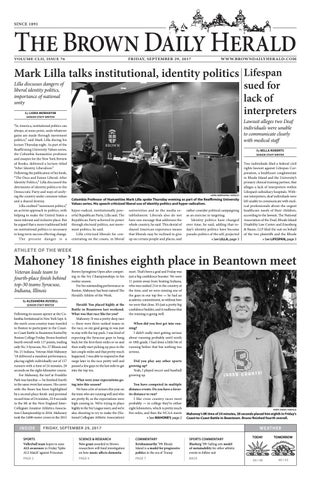
Columbia Professor of Humanities Mark Lilla spoke Thursday evening as part of the Reaffirming University Values series. His speech criticized liberal use of identity politics and hyper radicalism. hyper-radical, institutionally powerful Republican Party, Lilla said. The Republican Party achieved its power through electoral politics, not movement politics, he said. Lilla criticized liberals for concentrating on the coasts, in liberal
universities and in the media establishment. Liberals also do not have one message that addresses the whole country, he said. This denial of shared American experience means that liberals may be inclined to give up on certain people and places, and
rather consider political campaigning as an exercise in targeting. Identity politics have changed over time, he said, adding that today’s identity politics have become pseudo-politics of the self, projected » See LILLA, page 3
Two individuals filed a federal civil rights lawsuit against Lifespan Corporation, a healthcare conglomerate in Rhode Island and the University’s primary clinical training partner, that alleges a lack of interpreters within Lifespan’s subsidiary hospitals. Without interpreters, deaf individuals were left unable to communicate with medical professionals about the urgent healthcare needs of their children, according to the lawsuit. The National Association of the Deaf, Rhode Island Disability Law Center and Eisenberg & Baum, LLP filed the suit on behalf of the two plaintiffs and the Rhode » See LIFESPAN, page 3
ATHLETE OF THE WEEK
Mahoney ’18 finishes eighth place in Beantown meet Veteran leads team to fourth-place finish behind top-30 teams Syracuse, Indiana, Illinois By ALEXANDRA RUSSELL SENIOR STAFF WRITER
Following its season opener at the Columbia Invitational in New York Sept. 8, the men’s cross country team traveled to Boston to participate in the Coastto-Coast Battle in Beantown hosted by Boston College Friday. Bruno finished fourth overall with 117 points, trailing only No. 3 Syracuse, No. 27 Illinois and No. 21 Indiana. Veteran Matt Mahoney ’18 delivered a standout performance, placing eighth individually out of 157 runners with a time of 24 minutes, 28 seconds on the eight-kilometer course. For Mahoney, the turf at Franklin Park was familiar — he finished fourth in the same event last season. His career with the Bears has been highlighted by a second-place finish and personal record time of 24 minites, 23.9 seconds in the 8K at the New England InterCollegiate Amateur Athletics Association Championship in 2016. Mahoney took the 3,000-meter crown in the 2015
INSIDE
Brown Springtime Open after competing in the Ivy Championships in his rookie season. For his outstanding performance in Boston, Mahoney has been named The Herald’s Athlete of the Week.
Herald: You placed highly at the Battle in Beantown last weekend. What was that race like for you? Mahoney: It was a pretty deep race — there were three ranked teams in the race, so my goal going in was just to stay with the top pack. I was kind of expecting the Syracuse guys to hang back for the first three miles or so and then really start picking up pace in the last couple miles and that pretty much happened. I was able to respond to that surge later in the race pretty well and passed a few guys in the last mile to get into the top ten. What were your expectations going into this season? We have a lot of seniors this year on the team who are running well and who are pretty fit, so the expectations were high coming in. We’re trying to place highly in the Ivy League meet, and we’re also shooting to try to make the (National Collegiate Athletic Association)
meet. That’s been a goal and Friday was just a big confidence booster. We were 11 points away from beating Indiana, who was ranked 21st in the country at the time, and we were missing one of the guys in our top five — he had an academic commitment, so without him we were that close. It’s just a pretty big confidence builder, and it reaffirms that the training is going well. When did you first get into running? I didn’t really start getting serious about running probably until ninth or 10th grade. I had done a little bit of running before that but nothing too serious. Did you play any other sports growing up? Yeah, I played soccer and baseball growing up.
You have competed in multiple distance events. Do you have a favorite distance to run? I like cross country races most probably — in college they’re either eight kilometers, which is pretty much five miles, and then the NCAA meets » See MAHONEY, page 2
ANITA SHEIH / HERALD
Mahoney’s 8K time of 24 minutes, 28 seconds placed him eighth in Friday’s Coast-to-Coast Battle in Beantown. Bruno finished fourth overall.
WEATHER
FRIDAY, SEPTEMBER 29, 2017
SPORTS Volleyball team hopes to raise ALS awareness in Friday ‘Spike ALS Match’ against Princeton
SCIENCE & RESEARCH New grant awarded to Brown researchers will fund investigation on how music affects dementia
COMMENTARY Krishnamurthy ’19: Rhode Island is a model for progressive politics in the era of Trump
SPORTS COMMENTARY Blasberg ’19: Sailing sets model of sustainability for other athletic events to follow suit
PAGE 2
PAGE 4
PAGE 7
BACK
TODAY
TOMORROW
69 / 48
60 / 43
SPORTS
PAGE 2 • FRIDAY, SEPTEMBER 29, 2017
THE BROWN DAILY HERALD
W. VOLLEYBALL
Bears battle Princeton in ‘Spike ALS Match’ to raise awareness Bruno hopes to raise awareness about ALS, which affects members of coach’s family By TESS DEMEYER SENIOR STAFF WRITER
For Head Coach Diane Short, Friday’s volleyball match against Princeton isn’t just a chance for the Bears to move up in the Ivy League rankings, it’s “an evening of hope.” For the sixth year, Brown is hosting a “Spike ALS Match” to raise awareness about the disease. The fundraising event has added significance for Short, as she lost her mother to amyotrophic lateral sclerosis 12 years ago while two of her siblings currently have the disease. At the time Short’s mother passed away, there was no cure for the neurodegenerative disease. But as advancements in research have continued, and with the ALS Ice Bucket Challenge bringing attention to the cause, Short is optimistic that a breakthrough is on the horizon. “I’m very proactive about trying to improve the situation,” Short said. “It’s not only going to help ALS, it’s going to help a lot of the neurological diseases like Parkinson’s, Alzheimer’s” and multiple sclerosis. For me, it’s even bigger than ALS. Because ALS has hit me personally, I’m a fighter. I want to fight it. I’m very hopeful there will be a cure.” The entire volleyball team came together this year in support of Short
COURTESY OF BROWN ATHLETICS
The “Spike ALS Match” holds a special place in Head Coach Diane Short’s heart. Her mother passed away 12 years ago from the illness, and her brother and sister are both currently fighting it. Admission will be free, and the first 200 students will receive t-shirts. Fans are encouraged to wear red. and her efforts to generate awareness surrounding ALS. “This season in particular, our team has really rallied around this cause,” said co-captain Melissa Cairo ’18. Short “means a lot to us. We’ve learned a lot about the disease through her and through having this game. … She’s so positive all the time and so proactive
» MAHONEY, from page 1
three hours before the meets.
regionally and nationally are 10K. I’d say cross country races are probably my favorite, and, on the track, I’d say my favorite race is the 5K.
Do you have any pre-race rituals or things you do to get in the zone? Are you superstitious at all? No, I’m not superstitious. We do the same thing before every race with the warmup routine. We do the same stretches and the same drills; we always go for a 20-minute warmup run before that, so that’s all the same. But outside of that, I’m not really superstitious. I don’t have any weird quirks or anything else I do before the race.
Do you have a favorite meet day breakfast or meal? Not really, I know a lot of people have a go-to meal and they eat it a certain amount of time before the race. But I don’t really have that — I try to eat something light and try to not eat like
about it. It reflects on our team a lot.” Last season, the team received a visit from Short’s brother, who was a source of inspiration for the student-athletes. “It was incredibly powerful,” Cairo said. “He came to a couple of our games, and even though he could hardly move and was talking to us through an iPad, it was so powerful. All the things that
Do you like to listen to music when you work out? What do you like to listen to? One of the good things about being on a college team is that there are always guys to run with, so I don’t really listen to music that much because (I’m) mostly running with other people. Do you feel that you have developed as a runner in your time at Brown? Yeah, I have. I’ve physically matured
he said and his outlook on the entire experience had a profound effect on our entire team.” Short has already raised $5,000 of this year’s $6,000 goal, but she doesn’t plan on stopping any time soon. “This is not the end of what I’m doing,” she said. “To me, the money is not the biggest deal. The biggest deal
is to have something like this to show awareness.” Bruno will try to knock off the reigning Ivy League champion Princeton 7 p.m. Friday. Short and her team are looking forward to packing the Pizzitola and ask all fans to wear red. Admission is free and t-shirts will be given to the first 200 students.
a lot with the training — three years ago to right now I’m a much better runner. … The mental part, the psychological part of running, I’m a lot tougher. … That’s a big part of running that when you’re only in high school you don’t really realize. (With) these long races, there’s a big mental aspect that you can cultivate and grow, (and) being part of this program I’ve been able to do that. I’ve also run personal bests in pretty much every distance here; I’ve beaten guys that beat me in high school pretty routinely. The race
on Friday — Syracuse is the number three ranked team in the country, and they held out their best runner, but I broke up their top five; I beat some of their scores. I wasn’t expecting to be at that level coming out of high school, but it’s been exciting. The Bears return to action Oct. 13 to host their annual home meet, the Rothenberg Cross Country Invitational, at Goddard Memorial State Park in Warwick. This interview was edited for length and clarity.
NEWS
FRIDAY, SEPTEMBER 29, 2017 • PAGE 3
THE BROWN DAILY HERALD
» LIFESPAN, from page 1 Island Association of the Deaf Sept. 6. According to the lawsuit, Lifespan violated the Americans with Disabilities Act by not providing on-site sign language interpreter services at the Rhode Island Hospital and Hasbro Children’s Hospital, the pediatric division of Rhode Island Hospital. The plaintiffs both use American Sign Language as their primary means of communication and assert that Lifespan discriminated against them by not providing interpreters. The discrimination left the plaintiffs unable to clearly communicate with doctors and healthcare professionals about the treatment of their children, which included blood transfusions, surgery and psychiatric treatment. In the suit, one plaintiff claims she has been unable to receive clear communication about her son’s life threatening medical conditions since 2014. The second plaintiff makes similar claims, alleging that she could not communicate clearly with hospital staff about her son or husband’s medical needs. In both cases, instead of providing on-site interpreter services to facilitate communication, Hasbro used Video Remote Interpreting, a remote service cart that video calls interpreters, but this service was largely ineffective, according to court documents. The plaintiffs ask the court to require Lifespan to provide and pay for qualified healthcare interpreters and have Lifespan staff trained on the rights of deaf patients. “We filed this lawsuit to bring attention to the very important need to ensure that deaf and hard of hearing individuals have the same access to healthcare” that all individuals are entitled to, said Caroline Jackson, a staff attorney for the National Association of the Deaf Law and Advocacy Center. “The laws we are enforcing have been on the books since 1973 and 1990, respectively,” and The National Association of the Deaf has seen many similar cases of lack of provisions for necessary medical communication, she added.
» LILLA, from page 1 onto society. Students have tremendous energy, but have to direct that energy in the right way, he said. He advised students to spend their summer working in swing states and winning the Democratic Party more seats in Congress. He told students that their adversary is not the person who uses the wrong word or has a different opinion, but the radicalized Republican Party. Professor of Philosophy Charles Larmore and Assistant Professor of
COURTESY OF BROWN UNIVERSITY
Lifespan allegedly failed to provide on-site sign language interpreters at the Rhode Island Hospital and Hasbro Children’s Hospital. The two plaintiffs were unable to communicate clearly about the treatment of their children, including blood transfusions, surgery and psychiatric treatment. “Since the Americans with Disabilities Act was passed in 1990, hospitals in Rhode Island have neglected deaf patients by providing inadequate access to accommodations which infringe on Deaf individuals’ basic human rights,” said Todd Murano, acting president of the Rhode Island Association of the Deaf, in a press release. Lifespan failed to take the necessary steps to provide effective communication and have violated federal requirements, Jackson said. “When someone is deaf or hard of hearing, and they primarily use sign language to communicate, … then it means providing a qualified sign language interpreter so they can … have a real chat with doctors and nurses,” Jackson said. “A lot of hospitals try to do video
interpreting services where they bring in a cart that has a camera on it and they call a remote interpreter, who listens and tries to interpret what’s in the room,” said Tim Riker, lecturer of language studies. But the video interpreting services “aren’t reliable, people who use it aren’t trained, the Internet can be choppy and the patient might not be able to see the screen if they are incapacitated due to their condition. They need a live person in the room to interpret,” he said. “A doctor refusing an interpreter is forcing a patient to accept a lack of communication.” Accurate communication is also necessary for successful care, wrote Hayley Jamroz Baccaire, president of the Rhode Island Registry of Interpreters for the Deaf, in an email to The Herald.
“Personalized care is essential and can be rendered with the greatest outcome by working with licensed interpreters who are on-site,” she wrote. There is a lack of interpreters overall in the state, according to multiple sources. This is correlated to the lack of training programs for interpreters and low levels of retention, Riker said. “One way to solve the problem is to create full-time staff positions,” Riker said. Large hospitals can hire several full-time interpreters to travel between hospitals in the state, Riker said, adding that this “might help a little of the retention rate of interpreters if it’s a full-time position with benefits.” The Rhode Island Disability Law Center has received many complaints about lack of interpreter services in Rhode Island, particularly after the
press following this suit, said Kate Bowden, staff attorney for the Rhode Island Disability Law Center. “We think this is an important case because all parents should have the ability to speak and communicate with doctors about the care of their children and loved ones. This level of communication is required by law,” Bowden said. Rhode Island Hospital and Hasbro Children’s Hospital “are committed to providing family-centered care for all patients,” David Levesque, director of communications for Lifespan wrote in an email to The Herald. Lifespan declined to comment on the lawsuit. The suit is still in its initial stages, and the plaintiffs will not hear an answer or a motion to dismiss from Lifespan until the middle of October, Jackson said.
Political Science and International and Public Affairs Prerna Singh, who were selected to engage with Lilla in front of the audience, questioned Lilla’s opinions on identity politics and achieving unity in the United States. While agreeing with Lilla on how identity politics is changing the Democratic Party, Larmore said it is an overgeneralization to say that identity politics is taking over the party. Disagreeing with Lilla, Larmore said identity politics should not supplement institutional politics, but that
both are equally important. Larmore countered Lilla’s idea of a collective American “we,” specifically regarding citizenship as a unifying factor. “Just because something is desirable, it doesn’t mean it exists,” Larmore said. Responding to Lilla’s “The Once and Future Liberal,” Larmore said that American exceptionalism is a myth and that America is founded on crimes against humanity, like genocide and slavery, not on values Lilla mentions in his book. Singh raised similar concerns on
Lilla’s ideas on unifying America through citizenship. Nationalism, while dangerous, will be the unifying factor, not citizenship. After the discussion, students asked Lilla about what ideas unify the United States, the country’s common values, and why liberals hesitate to focus on unifiers like liberty and equality. Another student who identified as Muslim criticized Lilla on his opinion on identity politics and argued how certain policies affect marginalized communities. The student asked Lilla how his own privileges as
a white man influenced his beliefs. Lilla answered the questions by talking about how Trump presents a danger to the Muslim community and how this should upset all Americans. One of the attendees, Daniel Shemano ’19, said that he attended the event because he read Mark Lilla’s piece in the Wall Street Journal in which he talks about how Democrats lost because of identity politics. He said he agreed with Lilla on the effects of identity politics but added that Lilla was too vague in defining citizenship.
STAY UP-TO-DATE. FOLLOW US ON FACEBOOK. FACEBOOK.COM/BROWNDAILYHERALD
NEWS
PAGE 4 • FRIDAY, SEPTEMBER 29, 2017
THE BROWN DAILY HERALD
New grant awarded for music therapy, dementia research Trial will be first to provide systematic data for potential approach to therapy By MIA PATTILLO SENIOR STAFF WRITER
A grant recently awarded to University researchers will allow them to investigate whether personalized music playlists can help patients suffering from dementia. The study, which will build on previous research conducted at the University, will eventually involve up to 60 nursing homes over the next five years and incorporates detailed data collection. The project was originally inspired by “Alive Inside,” a documentary examining music therapy for patients with dementia, said Vincent Mor, principal investigator of the grant and professor of health services, policy and practice. His team got in touch with Dan Cohen, the creator of the show, and learned that the patients receiving music therapy were doing better on a variety of different measures. Lacking adequate systematic data on the program, the team decided to do a more in-depth study. Researchers will first launch a pilot trial involving patients from four nursing homes to define exact forms of data collection and how to personalize the playlists, said Rosa Baier, associate director of Brown’s Center for LongTerm Care Quality and Innovation. Researchers will ask the patients themselves about their music tastes, reach out to family members and play music from earlier eras in order to create playlists personalized to each patient. A “trial and error sort of process” of playing different songs and watching patient reactions will also be tested,
Baier added. “Music can stimulate memories from a time that is hard-wired and this helps people cope with anxiety,” Mor said. Those with dementia often struggle with processing their constantly changing environment and listening to songs that bring back familiar memories from a younger age can provide relief. The study will then be expanded to the full trial, which will take three years and involve working with groups of nursing homes one after the other, Baier said. A number of different types of data will be collected, including interviews with patients, observations, comments from the nursing home staff and administrative data from the nursing homes. The iPods given to patients will also capture meta-data, showing which songs were played and when.
MADDIE BILLINGS / HERALD
Though research has been done previously on the correlation between music and dementia healing, this study’s rigorous data collection will provide more solid evidence than currently exists, Baier said. Her research center at Brown focuses on testing interventions that have promise but haven’t been proven. With the evidence provided by this study, “a non-pharmological approach could be disseminated more broadly to the population.”
“I think it’s fantastic that this kind of scientifically rigorous research is being done on this topic,” said Aimee Baird of Macquarie University in Australia, whose work also focuses on the correlation
between music and memory. “Anecdotal reports are not enough to convince people to fund these sorts of programs in age-care and medical facilities.”
Find Post- magazine on Facebook! facebook.com/postmagazinebdh
TODAY
FRIDAY, SEPTEMBER 29, 2017 • PAGE 5
THE BROWN DAILY HERALD
menu
s m o k e o n t h e wat e r
SATELLITE DINING ANDREWS COMMONS
Pizza: Harvest, Bacon Ham and Alfredo, Buffalo Chicken Steam Bun Tacos JOSIAH’S
BLUE ROOM
Chicken Wings Bar, Quesadilla Station
Sushi Night
DINING HALLS SHARPE REFECTORY LUNCH
DINNER
Grilled Ham with Pineapple, Fried Samosa Patty, Snicker Doodle Cookies
Red Fish Provencal, Baked Sweet Potatoes, Pumpkin Cream Cheese Brownies
VERNEY-WOOLLEY LUNCH
DINNER
Breaded Chicken Fingers, Fresh Vegetable Melange, Snickerdoodle Cookies
Cajun Baked Fish, Broccoli Quiche, Raspberry Focaccia with Kalamata Olives
sudoku
ANITA SHEIH / HERALD
The denizens of Providence gathered Saturday for a flame-filled evening upon the Providence River. This tradition brings together students and other members of the community throughout the year.
crossword
Q U O T E O F T H E D AY
“ALS has hit me personally, I’m a fighter. I want to fight it. I’m very hopeful there will be a cure.” — Head Coach of Volleyball Team Diane Short
See volleyball on page 2. CORRECTION A previous version of an article published Thursday, Sept. 27, titled “Brandon Keith Brown offers new direction for U. orchestra,” stated that Visiting Professor of Music and Orchestra Director Brandon Keith Brown’s experience with classical music began at age six. In fact, it began at age nine. The Herald regrets the error.
calendar FRIDAY
SEPTEMBER MARCH
S S
M M
T T
W W
Th Th
F F 1
S S 2
3
4
5
6
7
8
9
10
11
12
13
14
15
16
17
18
19
20
21
22
23
24
25
26
27
28
29
30
1
tk 12:00 P.M. List Art Building, 2nd Floor
f@b Model Call 4 P.M. List Art, Room 120
SATURDAY Startup@Brown 10 A.M. Alumnae Hall
Dreamlandia 8 P.M. Leeds Theatre, Lyman Hall
SUNDAY Catholic Mass 10:30 A.M. Manning Chapel
Class Presentations 7 P.M. J. Walter Wilson, Room 203
COMMENTARY PAGE 6 • FRIDAY, SEPTEMBER 29, 2017
THE BROWN DAILY HERALD
BROWN BITES
Brown Bites: Sept. 22-29 Pokanoket progress The Pokanoket Nation ended its month-long encampment after signing an agreement Thursday. As part of the agreement, a portion of Bristol land, which will be determined by a cultural resources survey, will be placed in a preservation trust. Two sacred sites that will be part of the trust include where Chief Metacom — also known as King Phillip — was killed and where he held tribal council meetings. The University will also fund a land survey and is willing to find “a mediator to assist in facilitating an agreement among the parties,” according to the agreement. The University is dedicated to conserving the “unique historical, sacred and natural resource” of the Bristol land through appropriate management and “stewardship.” Challenging a $5.63 million deal Patti Galluzzi ’83, an alum of WBRU and the former VP of music programming at MTV, emerged as a leading force in conjuring a plan to save rather than sell. Station General Manager Kishanee Haththotuwegama ’19 wrote to over 800 alums informing them of the station’s intention to authorize a sale in concurrence with the board of directors’ vote. The decision became a topic of heated debate. The first student vote failed to authorize the sale, but the second vote gained enough votes for authorization. Alums have struggled to find ways to challenge the sale, as state regulations prohibit the attorney general from intervening in a private deal, and the University seems reluctant to get involved. In another letter to alums, Haththotuwegama and other station leaders wrote that “We chose to sell because we no longer see a future for our student workshop in commercial radio.” Although plans are not totally clear yet, the station intends on reinventing itself on a new digital platform.
HA NA O D S O N
A groundbreaking innovation center Gov. Gina Raimondo, President Christina Paxson P’19 and several state officials gathered to commence the transformation of I-95 land into what will be the new Wexford Innovation Center. The complex will allocate 50,000 square feet for the School of Professional Studies, allowing the University to expand its programs and enhance its ability to innovate, according to Paxson. Raimondo noted that the center marks a crucial step in expanding the state’s economy, as it will generate about 1,000 jobs throughout the construction process. Karen Sibley, dean of the School of Professional Studies said, “Experiments like this, if you navigate them effectively, they can lead to even more positives than you imagine at the outset.” A new conductor in town “If you aren’t speaking for the art, you should be quiet.” Brandon Keith Brown, visiting professor of music and orchestra director, exudes an appropriate balance of intimidation and passion, inspiring students. So far he is “very impressed” by Brown orchestral students, a compliment not to be taken lightly from this recipient of the Felix Mendelssohn Bartholdy Scholarship — a once-in-a-lifetime award. The future of ultra-fast communication What is small enough to go undetected by the human eye but big enough to have trouble passing through large objects? Terahertz waves. The Federal Communications Commission has given the University the go ahead to be the first testing site for wireless communication using ultra-fast Terahertz frequencies. Daniel Mittleman, professor of engineering and the principal investigator for Brown’s research lab on Terahertz, foresees a future where Terahertz technology will allow users to download an 8K movie in one second. The researchers will begin outdoor tests this fall, sending data wirelessly to various locations around campus.
Find us online! facebook.com/browndailyherald
browndailyherald.com
@the_herald
Location: 195 Angell St., Providence, R.I. www.browndailyherald.com
@browndailyherald
youtube.com/browndailyherald
Editorial Leadership
Sections
Multimedia & Production
Business
Editor-in-Chief Lauren Aratani
Arts & Culture Editors Ethel Renia Madison Rivlin
Design Editors Christy Leung Ameer Malik Jessica Yu Assistant: Eduard Muñoz-Suñé
General Managers Henry Ritter Ben Wesner
Managing Editors Matt Brownsword Rebecca Ellis Kate Talerico POST- MAGAZINE Editor Saanya Jain BLOGDAILYHERALD Editor Angelica Cotto
Metro Editor Gwen Everett News Editors Isabel Gensler Alex Skidmore Hattie Xu Science & Research Editor Elena Renken Sports Editors Ben Shumate Nicholas Wey COMMENTARY Opinions Editors Connor Cardoso Anuj Krishnamurthy Mili Mitra
Photo Editors Head: Marianna McMurdock Assistant: Lilly Nguyen Gus Reed Sara Runkel Anita Sheih Copy Desk Chief Abby Borges Multimedia Editor Roland High Illustrations Editor Pia Mileaf-Patel Graphics Editor Laura Felenstein Directors of Web Development Eli White Ivy Wong
Directors Sales: Erin Lueck Sales: Matilda Lynton Finance: Reena Zhan Strategy: William Nober Strategy: Caroline Ziegler Managers Sales: Michael Borello Sales: Elizabeth Doykan Sales: Ariel Shusterman Finance: Austin Lessin Collections: Ravi Betzig
Editorial contact: 401-351-3372 herald@browndailyherald.com
Business contact: 401-351-3260 gm@browndailyherald.com
Submissions: The Brown Daily Herald publishes submissions in the form of op-eds and letters to the editor. Op-eds are typically between 750 and 1000 words, though we will consider submissions between 500 and 1200 words. Letters to the editor should be around 250 words. While letters to the editor respond to an article or column that has appeared in The Herald, op-eds usually prompt new discussions on campus or frame new arguments about current discourse. All submissions to The Herald cannot have been previously published elsewhere (in print or online — including personal blogs and social media), and they must be exclusive to The Herald. Submissions must include no more than two individual authors. If there are more than two original authors, The Herald can acknowledge the authors in a statement at the end of the letter or op-ed, but the byline can only include up to two names. The Herald will not publish submissions authored by groups. The Herald does not publish anonymous submissions. If you feel your circumstances prevent you from submitting an op-ed or letter with your name, please email herald@browndailyherald.com to explain your situation. You can submit op-eds to opinions@browndailyherald.com and letters to letters@browndailyherald.com. When you email your submission, please include (1) your full name, (2) an evening or mobile phone number in case your submission is chosen for publication and (3) any affiliation with Brown University or any institution or organization relevant to the content of your submission. Please send in submissions at least 24 hours in advance of your desired publication date. The Herald only publishes submissions while it is in print. The Herald reserves the right to edit all submissions. If your piece is considered for publication, an editor will contact you to discuss potential changes to your submission. Commentary: The editorial is the majority opinion of the editorial page board of The Brown Daily Herald. The editorial viewpoint does not necessarily reflect the views of The Brown Daily Herald, Inc. Columns, letters and comics reflect the opinions of their authors only. Corrections: The Brown Daily Herald is committed to providing the Brown University community with the most accurate information possible. Corrections may be submitted up to seven calendar days after publication. Advertising: The Brown Daily Herald, Inc. reserves the right to accept or decline any advertisement at its discretion. The Brown Daily Herald, Inc. is a financially independent, nonprofit media organization bringing you The Brown Daily Herald, BlogDailyHerald and Post- Magazine. The Brown Daily Herald has served the Brown University community daily since 1891. It is published Monday through Friday during the academic year, excluding vacations, once during Commencement and once during Orientation by The Brown Daily Herald, Inc. Single copy free for each member of the community. Subscription prices: $200 one year daily, $100 one semester daily. Copyright 2017 by The Brown Daily Herald, Inc. All rights reserved. Periodicals postage paid at Providence, R.I. Postmaster: Please send corrections to P.O. Box 2538, Providence, RI 02906.
COMMENTARY FRIDAY, SEPTEMBER 29, 2017 • PAGE 7
THE BROWN DAILY HERALD
Small state, big dreams ANUJ KRISHNAMURTHY opinions editor
Last week, the U.S. Senate — a chamber charged with safeguarding the “national character” and resisting the “impulse of sudden and violent passions,” according to our founding fathers — voted to increase the defense budget by $80 billion. That’s enough money to pay for the elimination of tuition at four-year public universities in the United States, a reform that might benefit a system of higher education that, according to President Trump, currently leaves “our young and beautiful students deprived of knowledge.” (Who knows, maybe missiles and fighter jets can fix our national character and our schools.) This extraordinary surge in military spending passed by a comfortable margin, 89-8. An overwhelming majority of Democrats, even the ones who promised to “keep fighting back” and “stand with the people of the country” in the aftermath of Trump’s election, voted in favor of the budget. Thankfully, we live in a federal republic; that means legislators in Washington, D.C. don’t wield a complete monopoly on the country’s future. Individual states have the power to chart their own course, even in defiance of the White House — and in the past couple of months, some have been vigorously exercising that power. Lawmakers in California have unveiled an ambitious regulatory agenda to strengthen environmental protections that the Trump administration may try to dismantle. And in April, New York announced a program to make the state’s public colleges and universities tuition-free. But California and New York are populous, wealthy states; in the Trump era, their flashy, large-scale, and expensive
pushes toward long-standing progressive dreams are poor models for states closer to the mean. That, my dear reader, is where Rhode Island enters the picture. As it turns out, there is a whole state — with a General Assembly, a governor and the fourth-largest domed marble building in the world for a State House! — beyond College Hill. Admittedly, it’s easy to overlook the happenings of the smallest state in the Union, but it’s worth our while to pay attention. In the face of dysfunction and
have access to five paid sick days by 2020. More impressive than the scope of the bill, though, is how it came to exist in the first place. A grassroots coalition of labor, healthcare and human rights advocates, organized by the left-leaning Working Families Party, used state and local elections to promulgate the importance of paid sick leave. As the Intercept reported, four WFP candidates, recruited for their progressive pedigree and commitment to paid leave policies, ran as Democrats and defeated right-leaning incumbents. By approaching lo-
vealed that Rhode Island had secured $170,000 to pay for the $495 fee that undocumented residents protected by Deferred Action for Childhood Arrival program need to extend their status. (Currently, 1,200 Rhode Island residents are recipients of DACA; up to 350 are eligible for status renewal.) And a few days ago, Raimondo celebrated the one-year anniversary of her plan to reduce the financial burden of college course materials, known as the Open Textbook Initiative. The College Board estimates that students at four-year public col-
In the face of dysfunction and alt-right regress at the national level, Rhode Island is incontrovertible evidence that it doesn’t take an enormous tax base or garish promises to meaningfully enact a progressive agenda — one that actually makes a difference in the lives of average Americans.
alt-right regress at the national level, Rhode Island is incontrovertible evidence that it doesn’t take an enormous tax base or garish promises to meaningfully enact a progressive agenda — one that actually makes a difference in the lives of average Americans. Just this week, Gov. Gina Raimondo signed a bill that guarantees sick leave to 100,000 workers in Rhode Island starting in 2018. According to the new law, which benefits nine-in-10 working Rhode Islanders, workers in smaller firms will be entitled to three unpaid sick days per year; workers at larger companies will
cal and state elections with energetic progressivism, activists were able to produce positive results for an entire state. It’s not black magic. Grassroots organizing wins votes, and that’s what Democrats — who are minorities in both chambers of Congress and at an all-time low in state legislatures — desperately need: votes. Under Raimondo’s leadership, Rhode Island has also been on the frontlines in supporting immigrants and making college more affordable. (Full disclosure: I interned with the Governor’s office last fall; I was an awful intern — but I was a big fan, if that counts.) Last week, Raimondo re-
leges spend nearly $1,200 annually on books; at Rhode Island College, the initiative has saved students close to $100,000 in 2016. In the age of Trump, when a single tweet can upend the news cycle and maybe start a war or two, Rhode Island’s experience may appear insignificant. But it does offer crucial lessons for progressives across the country. For example, it seems wise to pursue incremental legislative change that will benefit people in the immediate term, as opposed to grander, less politically practical projects. That is, before we start clamoring for a single-payer healthcare system — which
will require a dramatic overhaul of the country’s healthcare infrastructure and remains hopelessly unpopular among conservatives — we ought to make sure American workers have access to more basic benefits, like paid sick leave. (Before Rhode Island adopted them, only seven U.S. states and Washington, D.C. had paid leave policies in place.) Of course, I can’t seriously pretend that Rhode Island’s recent policy initiatives, no matter how egalitarian, are going to magically compensate for Trump’s retrogressive proposals or deconstruct the impregnable grip of establishment politics. They won’t automatically give all Rhode Islanders easier access to college, healthier working conditions, or a better shot at surviving abrupt upheavals in immigration policy. They’re not easily replicable in other states. And they certainly won’t solve all of the state’s problems. But, in totality, they do paint a picture of tremendous hope. Rhode Island has shown that it is possible, even for smaller states, to triumph over uncertainty and embrace a kinder, smarter sort of politics; and that it is possible, still, for people to come together, take care of each other and construct a more compassionate society. The fundamental precept of our democracy, that ordinary people can bring about extraordinary change, has not yet been extinguished. That is something Rhode Islanders — and all Americans who care about salvaging decency and dignity in our political culture — ought to be extremely proud of. True greatness, after all, comes from small beginnings. Or, in this case, from really, really small states.
Anuj Krishnamurthy can be reached at anuj_krishnamurthy@ brown.edu.
SPORTS THE BROWN DAILY HERALD
FRIDAY, SEPTEMBER 29, 2017
Sailing for sustainability CHARLIE BLASBERG sports columnist Spanning 45,000 nautical miles, four oceans and six continents, the Volvo Ocean Race is the world’s premier long-distance sailing event. It takes place every three years and puts the world’s top sailors in an around-theclock, around-the-world pursuit of history. For the second time, Charlie Enright ’08 and Mark Towill ’11 will take to the sea as teammates in the event. Both were stars on the men’s sailing team and kept their passion alive after graduation. With Enright skippering the boat in 2014, the two finished fifth of seven in their first Volvo Ocean Race, sailing for team Alvimedica. With experience under their belt this time around, Enright and Towill are chasing an overall victory in the 2017-18 race. All the while, this event operates against the backdrop of a larger issue: Sporting events create large amounts of waste, especially from the food and beverages served in single-use containers. The Guardian estimates that each fan consumes about 4 kilograms of CO2 when attending a sports event, and this number jumps up if fans drive to the event or consume food there. But the sport of sailing, perhaps because of its reliance on the ocean environment, is leading the charge in sustainability efforts in sports. In all
levels of sailing competition, singleuse plastic water bottles are banned. In collegiate sailing, a race committee has the power to disqualify a sailor that they see littering in the water. Enright and Towill are entering this race with their own sustainability message. The team has two title sponsors: Vestas and 11th Hour Racing.
sustainable team in the race. Furthermore, 11th Hour Racing is working closely with the Volvo Ocean Race as a whole to devise more sustainable ways to transport supplies. It has also banned single-use plastic in the race and is providing a model of sustainability for other world sporting events to follow.
More generally, most international sporting events disrupt the environment by building stadiums, stands and other structures that must be disassembled after or are not met with long-term demand. One striking example of this is the infrastructure built for the 2008 Beijing Summer Olympics. With the exception of the
While the sailing world waits with baited breath for this epic race to begin next month, the Volvo Ocean Race has built a model of sustainability for other sporting events to follow. These occasions are too important to society to be eliminated; the challenge is to adjust our mentality surrounding them so that we are as environmentally concious as possible.
11th Hour Racing, based in Newport, is a foundation that promotes ecofriendly marine activity, especially in sailing and recreational boating. While sailing events can often have unintentional consequences for marine ecosystems, Enright and Towill, through their partnership with 11th Hour Racing, aim to be the most
The Volvo Ocean Race’s partnership with 11th Hour Racing is a huge step for the sport and sends a clear message regarding the priorities of sailors and sailing events as a whole. For the Volvo Ocean Race, 11th Hour Racing has taken on the role of consulting on waste removal in stopover cities and throughout the race.
famous Bird Nest, which primarily serves as a tourist attraction rather than an event space, the vast majority of stadiums, fields and bleachers assembled for the event have simply been abandoned. Event organizers and venues need to realize that outsourcing waste removal to sustainability organizations
is a clear and surefire way to minimize this environmental harm. Few events involve these groups to clean up the stadium’s waste after the event has finished. Recently, the Rio Olympics took a step where Beijing and Sochi fell short by partnering with local sustainability organizations to manage recycling and waste removal from event areas. The Volvo Ocean Race circumnavigates the globe over eleven legs, separated by stopovers at host cities. In each host city, the teams engage in an in-port race, which tests the sailors’ tactics and boat handling on a smaller course. With a more experienced team this year, Enright and Towill look to improve their ocean racing tactics as well as familiarity and comfortability with the longer legs. While the sailing world waits with baited breath for this epic race to begin next month, the Volvo Ocean Race has built a model of sustainability for other sporting events to follow. These occasions are too important to society to be eliminated; the challenge is to adjust our mentality surrounding them so that we are as environmentally concious as possible. The Brown community should be heartened to see two graduates taking on such an extreme athletic challenge while promoting sustainability practices in sports.
Charlie Blasberg ‘18 can be reached at charles_blasberg@brown.edu.