SINCE 1891
THE BROWN DAILY HERALD FRIDAY, OCTOBER 6, 2017
VOLUME CLII, ISSUE 81
WWW.BROWNDAILYHERALD.COM
City Council restricts early trash pickups Students circulate petition in support of former professor After forced removal of Daulatzai from flight, petition demands apology for racism, Islamaphobia By PRIYANKA PODUGU SENIOR STAFF WRITER
LIORA MORHAYIM / HERALD
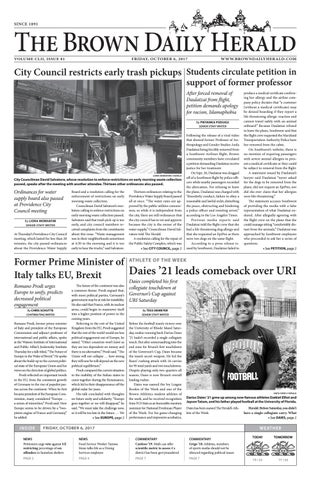
City Councilman David Salvatore, whose resolution to enforce restrictions on early morning waste collection passed, speaks after the meeting with another attendee. Thirteen other ordinances also passed.
Ordinances for water supply board also passed at Providence City Council meeting By LIORA MORHAYIM SENIOR STAFF WRITER
At Thursday’s Providence City Council meeting, which lasted for less than 20 minutes, the city passed ordinances about the Providence Water Supply
Board and a resolution calling for the enforcement of restrictions on early morning waste collection. Councilman David Salvatore’s resolution calling to enforce restrictions on early morning waste collection passed. Salvatore said that trash pick-up is too early, and city council members received complaints from the constituents about this issue. “Waste management was in their neighborhoods sometimes at 4:30 in the morning and it is too early to hear the trucks,” said Salvatore.
Thirteen ordinances relating to the Providence Water Supply Board passed all at once. “The water rates are approved by the public utilities commission, so while it is independent from the city, there are still ordinances that the city council has to vet and approve because the city is the owner of the water supply,” Councilman David Salvatore told The Herald. A resolution calling for the repair of the Public Safety Complex, which was » See CITY COUNCIL, page 2
Following the release of a viral video that showed former Professor of Anthropology and Gender Studies Anila Daulatzai being forcibly removed from a Southwest Airlines flight, Brown community members have circulated a petition demanding Daulatzai receive justice for her treatment. On Sept. 26, Daulatzai was dragged off of a Southwest flight by police officers while nearby passengers recorded the altercation. For refusing to leave the plane, Daulatzai was charged with “disorderly conduct, failure to obey a reasonable and lawful order, disturbing the peace, obstructing and hindering a police officer and resisting arrest,” according to the Los Angeles Times. Previous media reports said Daulatzai told the flight crew that she had a life threatening dog allergy and that she requested an EpiPen as there were two dogs on the same flight. According to a press release issued by Southwest, Daulatzai failed to
produce a medical certificate confirming her allergy and the airline company policy dictates that “a customer (without a medical certificate) may be denied boarding if they report a life-threatening allergic reaction and cannot travel safely with an animal onboard.” Because Daulatzai refused to leave the plane, Southwest said that the flight crew requested the Maryland Transportation Authority Police have her removed from the cabin. On Southwest’s website, there is no mention of requiring passengers with severe animal allergies to present a medical certificate or they could be subject to removal from the flight. A statement issued by Daulatzai’s lawyer said Daulatzai “never asked for the dogs to be removed from the plane, did not request an EpiPen, nor did she ever claim that her allergies were life-threatening.” The statement accuses Southwest of providing the media with a false representation of what Daulatzai endured. After allegedly agreeing with the flight crew on the plane that she could manage sitting “comfortably distant from the animals,” Daulatzai was approached by Southwest employees who proceeded to ask her a series of questions. » See PETITION, page 2
Former Prime Minister of ATHLETE OF THE WEEK Daies ’21 leads comeback over URI Italy talks EU, Brexit Daies completed his first Romano Prodi urges Europe to unify, predicts decreased political engagement By CHRIS SCHUTTE CONTRIBUTING WRITER
Romano Prodi, former prime minister of Italy and president of the European Commission and adjunct professor of international and public affairs, spoke at the Watson Institute of International and Public Affair’s Joukowsky Institute Thursday for a talk titled, “The Future of Europe in the Wake of Brexit.” He spoke about the build-up to the current political state of the European Union and his views on the direction of global politics. Prodi reflected on important trends in the EU, from the consistent growth of Germany to the rise of populist parties across the continent. When he first became president of the European Commission, many considered “Europe … a union of minorities,” Prodi said. Now Europe seems to be driven by a “twopiston engine of France and Germany,” he added.
INSIDE
The future of the continent was also a common theme. Prodi argued that, with more political parties, Germany’s government may be at risk for instability. He also said that France, with its nuclear arms, could begin to maneuver itself into a higher position of power in the coming years. Referring to the exit of the United Kingdom from the EU, Prodi suggested that the rest of the world would see less political engagement out of Europe, he stated. “Other countries won’t leave as they are too dependent on money and there is no alternative,” Prodi said. “The Union will not collapse … how strong they will now be will depend on the new political equilibrium.” Prodi compared the current situation to the inability of the Italian states to come together during the Renaissance, which led to their disappearance off the global radar for years. His talk concluded with thoughts on future unity and solidarity. “Europe goes together or we will disappear,” he said. “We must take the challenge now, or it will be too late in the future. … We » See EUROPE, page 2
collegiate touchdown at Governor’s Cup against URI Saturday By TESS DEMEYER SENIOR STAFF WRITER
Before the football team’s victory over the University of Rhode Island Saturday, rookie running back Darius Daies ’21 hadn’t recorded a single collegiate touch. But after somersaulting into the end zone for Bruno’s first touchdown of the Governor’s Cup, Daies became the team’s secret weapon. He led the Bears’ rushing attack with 16 carries for 95 total yards and two touchdowns. Despite playing only two quarters all season, Daies is now Bruno’s overall leading rusher. Daies was named the Ivy League Rookie of the Week and one of the Brown Athletics student athletes of the week, and he received recognition from FCS Stats as an honorable mention nominee for National Freshman Player of the Week. For his game-changing performance and impressive acrobatics,
ANITA SHEIH / HERALD
Darius Daies ’21 grew up among now-famous athletes Ezekiel Elliot and Jayson Tatum, and his father played football at the University of Florida. Daies has been named The Herald’s Athlete of the Week.
Herald: Before Saturday, you didn’t have a single collegiate carry. What » See DAIES, page 2
WEATHER
FRIDAY, OC TOBER 6, 2017
NEWS Petitioners urge veto against bill restricting percentage of sex offenders in homeless shelters
NEWS Food Service Worker Tanissa Stone talks life as a Dining Services employee
COMMENTARY Cardoso ’19: Math can offer scientific metric to assess if a district has been gerrymandered
COMMENTARY Grigo ’18: Athletes, members of sports media should not be silenced regarding political issues
PAGE 2
PAGE 4
PAGE 7
PAGE 7
TODAY
TOMORROW
79 / 55
77 / 65
NEWS
PAGE 2 • FRIDAY, OCTOBER 6, 2017
» DAIES, from page 1 were you thinking when Coach Phil Estes ’18 called your number to go into the game? Daies: I was kind of confused at first because there was about a minute left in the first half. I thought he was just going to put me in just so the other running backs wouldn’t get too tired or hurt. You went on to score two rushing touchdowns that gave Brown a chance to beat URI. What was that like? That was super exciting — probably the most exciting thing that’s ever
» PETITION, from page 1 “She was never asked for medical certification, nor would she have needed to carry that because her allergies are not life threatening. Despite trying to convince the crew that she would be completely fine on the plane, she was asked by another Southwest representative to leave the plane,” according to the statement. After disclosing that Daulatzai was pregnant at the time and that the police ripped her pants when aggressively pulling her from her seat, the statement also states that she was “profiled, abused, interrogated, detained and subjected to false reporting and the trauma of racist, vitriolic public shaming precisely because she is a woman, a person of color and a Muslim.” Daulatzai contests her charges and will seek legal action against Southwest. The maltreatment Daulatzai experienced prompted her former student, Amara Majeed ’19 to create an online petition to demand justice for her professor and an apology from Southwest. The petition, which as of press time has over 2,000 signatures, argues that Daulatzai’s removal was rooted in
happened to me in football. It just felt surreal. Was that flip into the endzone really necessary? Looking at it now, no. But I thought it was then! Why did you choose Brown? I was looking between here, Harvard and Columbia, and I just really liked the atmosphere here a lot more than I liked the other ones. The other ones — at least Harvard — seemed a little more cutthroat and intense. Here, it’s a really chill vibe. No matter if you play a racism and Islamophobia. The petition also demands Southwest to issue “an official apology, not some staged cover-up, to Daulatzai, acknowledging the Islamophobic and racist roots of this horrible incident.” Additionally the petition demands the airline company to “implement anti-Islamophobia, anti-racism, … implicit biases trainings for all of its employees working on its aircrafts … (and) condemn police brutality.” It closes with a demand to obtain justice for Doulatzai in addition to “justice for passengers of color, Muslims passengers and passengers racialized as Muslims that are subject to this form of institutionalized Islamophobia and racism.” If Southwest fails to meet these demands, the petition also states that the signatories will refuse to “fly (with) an airline that treats people of color and Muslims in this way.” Majeed, who took a class taught by Daulatzai last spring, said she was compelled to create the petition because she cares about Daulatzai as a former professor and friend. “She’s the best professor that I’ve ever had,” Majeed said. “As a visible Muslim in the Trump era, she provided such a
THE BROWN DAILY HERALD
sport, if you’re in clubs or if you’re just a regular student, everybody is easy to get along with and talk to. I like that a lot. How’d you get into football? My dad played defensive back at the University of Florida, so it’s just a thing in my family. I started playing in first grade. Do you have superstitions or pregame rituals? I just like to listen to my music. What’s your go-to pre-game song? Right now it’s “I Get the Bag” by safe space for me and made me feel so comfortable.” After watching the video of Daulatzai being removed by officers from the plane, Majeed added, “to see someone, especially someone (I) care about, being treated … and handled in that way was absolutely heartbreaking and very painful for me to watch.” “It was very important to create this petition and … Southwest needs to be held accountable,” Majeed said. While Southwest issued an apology for how the situation unfolded and Daulatzai’s removal by law enforcement officers, Majeed said their apology did not go far enough because they failed to acknowledge that their initial representation of events was misleading. “She never had any kind of life-threatening allergy … (but) for that to be in all these (news) articles is a total cover up.” For that reason, Majeed said that she “strongly urge(s) for them to admit the racist and Islamophobic underpinnings of this incident.” While Majeed organized the petition on her own, she said that a letter expressing solidarity and addressed by a coalition of Daulatzai’s former students will be released soon.
Gucci Mane. It’s our team song sort of, so I listen to it a lot. Is there another athlete you model your game after? In St. Louis I was good friends with (Dallas Cowboys running back) Ezekiel Elliott’s family, so he was always a mentor to me growing up. He was my big brother for our track team growing up, so I’ve always wanted to be like him. You went to the same high school as Boston Celtics rookie and third overall pick in the NBA draft Jayson Tatum. What was that like?
» EUROPE, from page 1 will fall off the world stage for centuries.” Responding to an audience member’s question about the Euro’s impact on the Union, he said the currency is critical for Europe’s future. “There is no unity without a common currency … (Europe) started with two pillars — army and currency — and one was conquered.” “I hope we shall link as it was in the past, American-European interests,” he said. “We need a more assertive Europe otherwise this will be for nothing.” Numerous students, faculty and staff were in attendance at the Joukowsky Forum. “He is a leader of European political thought, and parts of his talk resonated with me,” said Alok Beeharry ’19.
» CITY COUNCIL, from page 1 introduced by Councilmen Luis Aponte and John J. Igliozzi passed. There were also resolutions which were referred to different committees. A resolution introduced by Councilwoman Carmen Castillo requesting the Traffic Engineer to install a taxi stand on Fulton Street between Dorrance Street and Eddy Street after 9
We were pretty good friends. We were in the same homeroom for two years, so we got to know each other. I have his number still and his snapchat and everything. He’s a really cool guy. He’s funny as heck. Who’s on your fantasy football team? I’ve never played in my life and still don’t play. But if I had a fantasy team, I’d have Kareem Hunt, Julio Jones and Tom Brady because he’s amazing. — This interview has been edited for length and clarity. Also present was David Kertzer, Dupee University professor of social science, who spoke on bringing Professor Prodi to Brown. “He spends a couple weeks a semester here and he feels tied and linked to the University. I obviously thought it would be great to bring him back to talk, especially considering his role in the EU.” Edward Steinfeld, director of the Watson Institute, spoke on bringing Prodi to Brown once again. “Europe is on everybody’s minds, and Prodi has been so central in the building of the EU … He provides a view from an academic side and from the view of someone involved in it.” “I would be very happy to have him back, and I’m eager to find ways for him to be a member of the community,” Steinfeld added. p.m. and before 8 a.m. was referred to the Department of the Public Works committee. Castillo called the council to support the taxi drivers who are financially affected by the prevalence of Uber and other car-sharing services. A resolution designating the intersection of Smith Street and Chalkstone Avenue as “Guy Alba Square” was referred to the Urban Renewal and Redevelopment committee.
NEWS
FRIDAY, OCTOBER 6, 2017 • PAGE 3
THE BROWN DAILY HERALD
Bill restricting sex offenders in homeless shelters passes R.I. House, Senate Proposed bill says no more than 10 percent of beds can be occupied by registered sex offenders By SOPHIE CULPEPPER CONTRIBUTING WRITER
Last month, a bill that would cap the proportion of registered sex offenders in homeless shelter beds at 10 percent for shelters whose capacity exceeds 50 people passed in the Rhode Island State House. A coalition of activists are now asking via petition that Gov. Gina Raimondo veto the bill, arguing that the legislation is “against the public interest.” The bill passed the state Senate in May, and the Senate Judiciary Committee recommended it for passage in early June. The bill was passed in concurrence by the Rhode Island House of Representatives Sept. 19, and the veto petition was sent to Raimondo Sept. 26. Seven individuals, including several directors of homeless shelters and non-profits, co-signed the petition to the governor. Forty to 50 individuals will be displaced if the bill is passed, which would create a public safety concern both for the displaced individuals, as well as the larger community, according to the petition. If passed, the bill would take effect Jan. 1, 2018, and the petitioners note that this would leave people homeless in the dead of winter. This would also increase risks of recidivism, petitioners say. Perceptions of the bill are sharply polarized, and while detractors argue that the legislation jeopardizes public safety, supporters say the bill actually defends it. State Sen. Frank Lombardi, DCranston, is a co-sponsor of the bill and introduced it alongside State Sen.
Hanna Gallo, D-Cranston. Cranston is the location of Rhode Island’s largest homeless shelter, Harrington Hall. Harrington has 112 beds which are open to single men. “Harrington Hall has the highest number per capita of registered sex offenders transported there at any given time in the state of Rhode Island,” Lombardi said. This disproportionate concentration of sex offenders in a single neighborhood was the impetus for the bill especially because “the residence hall surrounds at least three elementary schools,” he said. The question of appropriate maintenance of distance between schools and sex offenders is no new issue in Rhode Island. Convicted sex offenders have been restricted from living closer than 300 feet from any school property since 2008, The Providence Journal reported. In June 2015, the General Assembly expanded this to 1,000 feet for Level III sex offenders — those most likely to re-offend. This law placed 64 percent of Providence off-limits to these registered sex offenders, according to the Journal. In October 2015, the lawsuit Freitas et al. v. Kilmartin was filed challenging the law’s constitutionality as violating
due process; after the case was filed, a judge placed a restraining order on the law, effective to this day and as long as the case remains unresolved. “It’s very sad that we have a significant population of people who are required to register as sex offenders that have no place to live but Harrington Hall,” said Andrew Horwitz, petitioner and assistant dean for experiment education at Roger Williams University. Although the 1,000-foot rule is not in effect, the critics of this bill say that sex offenders do not have options other than Harrington Hall because of policies in other shelters and the 300-foot restriction. “We’ve got such incredible restrictions on where registered sex offenders are allowed to live that pretty much any place in Rhode Island that has affordable housing is off-limits for somebody who is a registered sex offender,” Horwitz added. Concerning the safety of the public, “what reduces recidivism is stability,” Horwitz said. “When you render somebody homeless” by limiting the number of beds available to them in shelters, “you destabilize them,” he said. One of the “public safety” concerns in Lombardi’s district is cases of sex
Sex offenders. Horwitz himself is in favor of building more homeless shelters and having a more decentralized homeless system to relieve Harrington and the neighborhood; but fundamentally he said he views shelters themselves as only rudimentary solutions to homelessness. He would prefer legislation creating more affordable housing and repealing “irrational” housing restrictions to address Harrington’s predicament. The main plaintiff in Freitas et al. v. Kilmartin, John Freitas, is a Level III sex offender. Barbara Freitas, director of the Rhode Island Homeless AdvoMATTHEW BROWNSWORD / HERALD cacy Project and formerly homeless offenders being dropped off at the herself, is his widow. She was another shelter and loitering if no beds were of the seven signatories of the petition. available. He characterized the bill Freitas echoed Horwitz’s concerns. as an “incentive to have all of these The bill’s “attempt to keep the public homeless shelters share — not over- safe is failing miserably, because they burden Harrington Hall only with will end up in the street,” she said. registered sex offenders.” Freitas explained that sex offenders Lombardi had not heard about are at least accounted for in a homeless the petition but was not surprised shelter due to the requirement to regto learn there was one; “there was a ister. This means that “public safety” very vibrant debate” in the Senate, is better served by keeping homeless he recalled, “given the polarizing is- shelters’ numbers of sex offenders unsues involved; on one side the issue of capped for community members and public safety and on the other side is visitors alike. the issue of homelessness.” Though he Freitas does not expect Raimondo supports the bill, Lombardi recognizes to heed the petition. Freitas says she more progress is needed to be made was part of a previous attempt to contoward finding permanent solutions vince Raimondo to veto the 300-foot to homelessness, including for sex of- rule, without success. “Nobody wants fenders. “We need the judiciary, we to have the veto go through about sex need law enforcement, we need the offenders. That’s a sure way to have public housing folks,” he said. yourself not get elected,” Freitas said. The petition proposes an alternaIf the governor were to veto the tive path from the bill: a “study com- bill, there would be no effort by the mission” that would devote time and legislative branch to override the veto, resources to considering viable op- according to Lombardi. The bill was tions for housing for registered sex transmitted to the governor Oct. 3. She offenders, which could inform future is required to sign or veto legislation legislation. It also suggests potential within six days of transmittal. The bill amendments to the bill, such as chang- is “currently under consideration for ing the date it would take effect and action in the coming days,” according limiting its applicability to Level III to the governor’s press office.
NEWS
PAGE 4 • FRIDAY, OCTOBER 6, 2017
THE BROWN DAILY HERALD
Dining Services employee reflects on 13 years at U. Stone reacts to administrative changes following Bon Appétit’s new partnership with U. By EMILY DAVIES SENIOR STAFF WRITER
The drip of the coffee machine and grumbles from the kitchen complement the pitch of CNN’s Chris Cuomo. A lone student waits for his omelette, and a pair of friends eat in silence at a table nearby. Tanissa Stone emerges from behind the pizza bar with gleaming pearl earrings and a smile that stretches between them. Her energy might have to do with the fact that it’s break time. It is 8 a.m. and after an hour and a half of work, Stone is getting ready to enjoy her first 30-minute rest with a fried egg sandwich and a bowl of watermelon. “The first 10 years here, I loved it,” Stone said. “I used to hate it when work ended. But it’s different now. Jobs weren’t as hard back then.” In the 13 years that Stone has worked as a Food Service Worker in the Ratty, this past year has been the most taxing, she said. She started feeling more stressed and pressured under time at work after the University began contracting with the Bon Appétit Management Company in September 2016, she said. The partnership developed with an interest to provide new and fresh menu options that would focus on fromscratch cooking techniques, The Herald previously reported. But according to dining service workers, the new company has brought on new responsibilities — with little change in compensation. “The changes are good for students,” Stone said. “You’re paying a lot of money, you should get good things. But on our end, it affects us because it’s double the work. If you want to have these changes that’s cool, but add more workers.”
Under Bon Appétit, Stone and her colleagues are expected to slice four kinds of meat instead of two, staff two salad bars as opposed to one and create an extra two or three pizzas per shift. Employees who work the morning shift have to man each station alone, and in the afternoon, there are two workers per station. Dining Services management said they see the new partnership as beneficial to employees. “I would say that one of the benefits of our partnership with Bon Appétit has been opportunities for staff members in Brown Dining Services to expand their skill sets while we continue to enhance food offerings across campus,” wrote Ann Hoffman, director of administration at Dining Services, in an email to The Herald. “The focus on sustainable, fresh ingredients and scratch-cooking have introduced some adjustments for the staff and we are continually refining our approach to make sure we are providing both great food to students and a positive workplace experience for our dining employees.” Juggling stations “The pizzas!” Stone exclaimed. “I should have started right away with the pizzas.” Stone’s friend and colleague Maria Noro agrees that Bon Appétite’s involvement has had drastic effects. The pizza station is now one of the hardest to work. “We go home exhausted,” Noro said. “They add stuff and not employees, so we have to do double the job.” It is now 8:49 a.m. and Stone is on pizza duty. She stands behind the pizza bar, flour sprinkled across her onceblack apron. By 11 a.m., she is expected to turn 15 round pieces of dough into 15 steaming pizzas in four different flavors. She begins by kneading her first ball of dough in a bowl of flour before dropping it through a flattening silver machine. She then stretches it meticulously
EMILY DAVIES / HERALD
Food Service Worker Tanissa Stone is in the Ratty from 6:30 a.m. to 3 p.m. five days per week. After work on three of those nights, she goes to CCRI to work toward her GED. over a Vegalene-covered rack before pushing a spiked roller across the surface to prevent sticking. Knead, drop, stretch, roll, repeat. After the tray beside her is full of well-flattened, stick-resistant pieces of dough, Stone moves to the topping bar. Scoop, spread, sprinkle, repeat. Once the stack of uncooked pizzas looks to her liking, the 732-degree ovens come into play. Open, heat for 90 seconds, remove, repeat — then she slices. The from-scratch approach to dining service requires Stone to not just serve food but also to act as a chef, she said, adding that her pay does not reflect her new responsibilities. “Lately since the new changes, we’re cooking — pizza, omelettes, hotdogs, hamburgers, stir fry, pancakes, french toast. The same stuff the cook’s helpers are doing downstairs, we are doing upstairs,” Stone said. “But we are not getting the same pay.” Though a cook’s helper makes only a dollar an hour more than Stone, “that dollar can go a long way.” Both Noro and Stone said they had raised concerns with management multiple times at monthly meetings but had
not seen any changes. Looking beyond dining services Stone has used her compensation from the University to change her life drastically. When Stone was first employed 13 years ago, she was a 20-yearold with an infant living under the roof of an emotionally abusive aunt. “When I was 11, my mom died so I lived with my aunt,” Stone said. “She treated me bad. I had to find a way to get out of her house.” Without any education-oriented influences, Stone saw a way out through motherhood. After she dropped out of high school and gave birth to her daughter, Stone was dismayed to find herself strapped and stuck under her aunt’s roof. Stone found inspiration in her older sister and applied to Dining Services. Now, with her daughter acing classes at Esek Hopkins Middle School, Stone is able to reflect on her 13 years at the University. The health care provided by the University is phenomenal, Stone said. Co-payments are only ten dollars, and her daughter is also covered under the
plan. She also gets three and a half weeks of paid vacation and twelve sick days, she added. Even the Bon Appétite-inspired changes have not been all bad, Stone said. In fact, the increasingly strenuous work partnered with her increasing age might have been just the kick she needed to go back to school. “I woke up and said, ‘I am not going to be doing this all my life. I am not. I want to be dressed up in the office, I want to be in that corporate world.’ This helped me out over the years but, now that my daughter is older and can take care of herself, it’s my turn,” Stone said. After Stone gets off work at 3 p.m., she drives home, prepares dinner for her daughter, then makes the trek to the Community College of Rhode Island three times per week for night classes. She passed her social studies pre-test Wednesday and is taking the official GED pre-test on Friday. Stone has a goal: In seven years, by the time she is 40, she wants to be settled in a new career.
STAY UP-TO-DATE. FOLLOW US ON FACEBOOK. FACEBOOK.COM/BROWNDAILYHERALD
TODAY
FRIDAY, OCTOBER 6, 2017 • PAGE 5
THE BROWN DAILY HERALD
menu
roasting rodent
SATELLITE DINING ANDREWS COMMONS
Pizza: Harvest, Bacon Alfredo, Buffalo Chicken JOSIAH’S
BLUE ROOM
Chicken Alfredo Bowl, Quesadillia Station
Sushi Night
DINING HALLS SHARPE REFECTORY LUNCH
DINNER
Pork Vindaloo, Lentils with Roasted Vegetables, Pumpkin Cheesecake Swirl Brownies
Veggie Chicken Stir Fry, Steamed Sugar Snap Peas, Frosted Brownies
VERNEY-WOOLLEY LUNCH
DINNER
Three Bean Casserole, Breaded Chicken Fingers, Cranberry Pumpkin Seed Energy Bar
Chicken Marsala, Baked Acorn Squash, Pound Cake with Blueberries and Whipped Cream
sudoku
crossword GUS REED / HERALD
A student piece in the List Art Center features a rodent perched on a dark cylinder, clutching what appears to be hotdogs on a stick. Its expression seems to be one of confusion, but also may reflect a contemplative state.
Q U O T E O F T H E D AY
“Nobody wants to have the veto go through about sex offenders. That’s a sure way to have yourself not elected.
”
— Barbara Freitas, director of the Rhode Island Homeless Advocacy Project
See regulation on page 3. calendar FRIDAY OCTOBER MARCH
S
M
T
W
Th
F
S
1
2
3
14
52
63
74
85
96
10 7
8 11
12 9
10 13
11 14
12 15
13 16
14 17
15 18
16 19
17 20
18 21
19 22
20 23
21 24
22 25
23 26
24 27
25 28
26 29
27 30
28 31
29
30
31
Clothing Swap 11:00 A.M. J. Walter Wilson, lobby
Mesa de Conversacion 12:00 P.M. Sharpe Refrectory, 6
SATURDAY Latinx Art Exhibition 7 P.M. Campus Center, 211
Dreamlandia 8 P.M. Leeds Theater, Lyman Hall
SUNDAY Catholic Mass 10:30 A.M. Manning Chapel
Mid-term Preparation 7:00 P.M. J. Walter Wilson, Room 203
COMMENTARY PAGE 6 • FRIDAY, OCTOBER 6, 2017
THE BROWN DAILY HERALD
BROWN BITES
Brown Bites: Oct. 1 – Oct. 7 Endowment hits all-time high The University’s endowment soared to around $3.5 billion over the 2017 fiscal year, increasing by 13.4 percent. While Dartmouth and Penn had top endowment returns, Brown outperformed Harvard and Cornell. Joseph Dowling, chief investment officer, is impressed by Brown’s relative success but emphasized the goal of providing the University with “the financial support and flexibility it needs” as well as focusing on “long-term performance of the endowment.” The endowment distributed $179 million to the University’s budget, a third of which financed scholarships and fellowships, while 20 percent funded professorships, and 48 percent went to other uses such as libraries, athletics and instructional programs. Dowling cites the endowment’s exposure to equity markets as the stimulus for the year’s returns, equating it to the speed you run a single mile in a marathon. “You’re pleased if you ran a fast mile, but you keep your focus on the larger goal,” Dowling wrote in an email to The Herald. Supporting the Dreamers Students rallied Wednesday to demand the passage of a revised DREAM act and aimed to raise awareness about the pressing issues facing undocumented immigrants in the United States. The event was part of a national effort, with over 100 colleges hosting similar events. While there was significant participation from the Brown community, Angel Mendez-Flores ’20, a member of Brown Immigrant Rights Coalition thought “the entire student body” should have been involved. This issue hits close to home for the Brown community: There are students at Brown who could lose their legal status along with their ability to attend Brown as a result of the decision to roll back the Deferred Action for Childhood Arrival program, Mendez-Flores said. Dreamers will be unable to work after DACA expires, so there is push for the University to create funds or fellowships for students who may lose their jobs as campus employees. Gabrielle Martinez ’20 cited problems with the current version of the DREAM act as it would create barriers for immigrants and could break up families. “At the end, we’re all immigrants,” Mendez-Flores said.
HA NA O D S O N
Broadway meets Sayles Musical Forum’s production of the Broadway hit “West Side Story” came to Sayles Hall last weekend. It was a musical with minimal dialogue and no set but filled with rich plot and emotions. The performance included “impressive vocals and passionate portrayals of character,” as well as themes of racism, police brutality and a tense U.S.–Puerto Rico relationship. The depiction of Puerto-Rican immigrants’ experiences led the production team to collect donations totaling to $1,066.74, for the Hurricane Maria relief initiative, United for Puerto Rico. Director Nicole Comella ’19 expressed the importance of the “human connection of love and community that exists between all of us,” not just within the musical’s story but also nationwide. A meditative refuge The Cohen Gallery will transform into a space with burning thyme, film, music, lighting and pews. The exhibit, titled “Lumen,” is a collaboration between composer Eric Nathan, architects Loretta Gargan and Thomas Kelley and artist Catherine Wagner. It has been featured twice before in a Cryptoporticus at the American Academy in Rome in 2014 and the Yellow Barn Festival in Vermont in 2015. The feedback from these former exhibits was overwhelmingly positive with one visitor wishing for “Lumen” to be at his funeral. This secular space is meant to express hope, and Wagner describes it as a “site-specific immersive multisensory experience.”
Find us online! facebook.com/browndailyherald
browndailyherald.com
@the_herald
Location: 195 Angell St., Providence, R.I. www.browndailyherald.com
@browndailyherald
youtube.com/browndailyherald
Editorial Leadership
Sections
Multimedia & Production
Business
Editor-in-Chief Lauren Aratani
Arts & Culture Editors Ethel Renia Madison Rivlin
Design Editors Christy Leung Ameer Malik Jessica Yu Assistant: Eduard Muñoz-Suñé
General Managers Henry Ritter Ben Wesner
Managing Editors Matt Brownsword Rebecca Ellis Kate Talerico POST- MAGAZINE Editor Saanya Jain BLOGDAILYHERALD Editor Angelica Cotto
Metro Editor Gwen Everett News Editors Isabel Gensler Alex Skidmore Hattie Xu Science & Research Editor Elena Renken Sports Editors Ben Shumate Nicholas Wey COMMENTARY Opinions Editors Connor Cardoso Anuj Krishnamurthy Mili Mitra
Photo Editors Head: Marianna McMurdock Assistant: Lilly Nguyen Gus Reed Sara Runkel Anita Sheih Copy Desk Chief Abby Borges Multimedia Editor Roland High
Directors Sales: Erin Lueck Sales: Matilda Lynton Finance: Reena Zhan Strategy: William Nober Strategy: Caroline Ziegler Managers Sales: Michael Borello Sales: Elizabeth Doykan Sales: Ariel Shusterman Collections: Ravi Betzig
Editorial contact: 401-351-3372 herald@browndailyherald.com
Business contact: 401-351-3260 gm@browndailyherald.com
Submissions: The Brown Daily Herald publishes submissions in the form of op-eds and letters to the editor. Op-eds are typically between 750 and 1000 words, though we will consider submissions between 500 and 1200 words. Letters to the editor should be around 250 words. While letters to the editor respond to an article or column that has appeared in The Herald, op-eds usually prompt new discussions on campus or frame new arguments about current discourse. All submissions to The Herald cannot have been previously published elsewhere (in print or online — including personal blogs and social media), and they must be exclusive to The Herald. Submissions must include no more than two individual authors. If there are more than two original authors, The Herald can acknowledge the authors in a statement at the end of the letter or op-ed, but the byline can only include up to two names. The Herald will not publish submissions authored by groups. The Herald does not publish anonymous submissions. If you feel your circumstances prevent you from submitting an op-ed or letter with your name, please email herald@browndailyherald.com to explain your situation. You can submit op-eds to opinions@browndailyherald.com and letters to letters@browndailyherald.com. When you email your submission, please include (1) your full name, (2) an evening or mobile phone number in case your submission is chosen for publication and (3) any affiliation with Brown University or any institution or organization relevant to the content of your submission. Please send in submissions at least 24 hours in advance of your desired publication date. The Herald only publishes submissions while it is in print. The Herald reserves the right to edit all submissions. If your piece is considered for publication, an editor will contact you to discuss potential changes to your submission. Commentary: The editorial is the majority opinion of the editorial page board of The Brown Daily Herald. The editorial viewpoint does not necessarily reflect the views of The Brown Daily Herald, Inc. Columns, letters and comics reflect the opinions of their authors only. Corrections: The Brown Daily Herald is committed to providing the Brown University community with the most accurate information possible. Corrections may be submitted up to seven calendar days after publication.
Illustrations Editor Pia Mileaf-Patel
Advertising: The Brown Daily Herald, Inc. reserves the right to accept or decline any advertisement at its discretion.
Graphics Editor Laura Felenstein
The Brown Daily Herald, Inc. is a financially independent, nonprofit media organization bringing you The Brown Daily Herald, BlogDailyHerald and Post- Magazine. The Brown Daily Herald has served the Brown University community daily since 1891. It is published Monday through Friday during the academic year, excluding vacations, once during Commencement and once during Orientation by The Brown Daily Herald, Inc. Single copy free for each member of the community. Subscription prices: $200 one year daily, $100 one semester daily.
Directors of Web Development Eli White Ivy Wong
Copyright 2017 by The Brown Daily Herald, Inc. All rights reserved. Periodicals postage paid at Providence, R.I. Postmaster: Please send corrections to P.O. Box 2538, Providence, RI 02906.
COMMENTARY FRIDAY, OCTOBER 6, 2017 • PAGE 7
THE BROWN DAILY HERALD
Math can save us from gerrymandering CONNOR CARDOSO opinions editor
Near the end of the Supreme Court’s oral argument in Gill v. Whitford, a case on the constitutionality of partisan gerrymandering, the court’s most junior justice, Justice Neil Gorsuch, began peppering the petitioner with questions. Where, exactly, in the Constitution was the provision that allowed the court to force states to redraw their district lines, he asked, in not so few words. Justice Ruth Bader Ginsburg responded with the justices’ equivalent of a suplex: “Where did one person one vote come from?” Gorsuch did not ask any more questions for the remainder of the oral arguments. While most Americans familiar with the episode probably see it as another step in Ginsburg’s cultural apotheosis to be enjoyed briefly on Buzzfeed, her argument is one that has hounded the court for decades. If the Supreme Court has previously embraced a principle of “one person, one vote,” which it did all the way back in 1964, why is it that North Carolina has 10 Republican representatives out of 13 when only 50 percent of the population voted for congressional Republican candi-
dates? In fact, the court recognized in the 1986 case Davis v. Bandemer, that it had constitutional authority to intervene in cases of partisan redistricting, but refused to do so without some clear metric with which to inform their decision. The court held again in the 2004 case Vieth v. Jubelirer that it simply cannot rule on gerrymandering because there is simply no fair, practical way for
analyze partisan redistricting with more scrutiny. Many have even proposed solutions. Mathematicians like Jonathan Mattingly have developed computer software that is capable of cross-referencing thousands of maps along with relevant voting data. From the data, one is able to compare actual districts and their electoral outcomes with randomized districts or independently drawn districts. The
viously should, considering the basis for its opinion is no longer valid, but whether it will do so is less clear. Voting against outlawing gerrymandering in Davis or Vieth, where evidence was less compelling and the standards for resolving gerrymandering were less obvious, could be ascribed to caution on the part of the justices. But voting against outlawing gerrymandering in Gill v. Whitford
While there was no practical metric for measuring gerrymandering in 1986, this argument is less compelling in 2017. Why? Because of math.
the court to resolve these questions. However, while there was no practical metric for measuring gerrymandering in 1986, this argument is less compelling in 2017. Why? Because of math. And in fact, the court should use math to put an end to gerrymandering once and for all. In recent years, as gerrymandering has garnered more attention from the public and the news media, social scientists have begun to
results — that many states’ district maps offer certain political parties disproportionate advantages — is unsurprising. What is important, however, is that programs like Mattingly’s and others’ (there are many, many others) offer the court a clear, scientific metric to assess whether a district has been “gerrymandered.” The question, then, is no longer whether or not the court should overturn its opinion in Vieth. It ob-
is not cautious. Rather, it is reckless, dangerous and profoundly anti-democratic. In the 2017 Electoral Integrity Project, conducted jointly by Harvard’s John F. Kennedy School of Government and the University of Sydney, the United States ranked 55th out of 158 countries and last among Western democracies in voting fairness. This is astonishing for a country whose identity and concep-
tion of itself is so profoundly intertwined with its perceived democratic traditions. Proponents of gerrymandering — both Democrats and Republicans — support it for nakedly partisan reasons. When asked by Justice Sonia Sotomayor what value gerrymandering has for democracy, the lawyer representing Wisconsin’s lawmakers responded by noting that gerrymandering “produces values in terms of accountability that are valuable so that people know who is and who isn’t in power.” If you had trouble understanding that, don’t fret — it doesn’t make any sense. To hold that gerrymandering is important because it allows voters to know who is in power is an offensively disingenuous argument, but speaks to the partisan and anti-democratic motivations of its proponents. The stakes of this case cannot be overstated — when the Supreme Court makes a ruling of such significance, it is very unlikely to overturn it in the near future. But with quantitative tools provided to us by social science, the Supreme Court can and should outlaw partisan gerrymandering once and for all. The health of our democracy depends on them doing so.
Connor Cardoso ’19 can be reached at connor_cardoso@brown.edu.
It’s not the time to ‘stick to sports’ SAM GRIGO
op-ed contributor If it wasn’t obvious before, it has now become clear: “Stick to sports” is nothing more than a hypocritical tool used to undermine the political participation of athletes. For the uninitiated, “stick to sports” is a common criticism aimed at sports reporters and athletes who wade into political territory with their columns or public statements rather than settle for analysis focusing on defensive schemes, salary caps and the latest trading block buzz. It’s a simplistic concept that doesn’t make any sense. “Stick to sports” suffers from a crippling logical failure: After all, the very act of attempting to police what people say is profoundly political. More importantly, “stick to sports” naively assumes that sports naturally exist in some apolitical bubble that only gets punctured when journalists or athletes go out of their way to pursue a political agenda. But this is blatantly not the case: The structure of the professional sports leagues and the NCAA engenders class warfare waged between the leagues’ players and their wealthy capitalist owners. The underrepresentation of people of color and women in high-level front office positions within sports franchises is a concrete manifestation of a culture that continues to systematically favor white men. The mere two-game suspension Ray Rice received in 2014 for sucker-punching his girlfriend revealed the NFL’s apathy regarding domestic violence. I could go on, but the point is clear: Sports are about people, and anything involving people is political. There has been, of course, very little sticking
to sports recently. Last fall, Colin Kaepernick began kneeling during the national anthem before each game in protest of police brutality, a demonstration other NFL players have joined in on this season even as Kaepernick remains a free agent. Then, during a speech in Alabama two weeks ago, President Trump recommended NFL owners deal with players who kneel by getting each “son of a bitch off the field” and firing them. NFL Commissioner Roger Goodell and several owners, including Trump’s friend Robert Kraft, criticized the president’s comments. Three teams — the Pittsburgh Steelers, Seattle Seahawks and
temic injustices currently poisoning our society. And don’t expect the players to pipe down any time soon: Trump is now the biggest story in sports, and if the past few weeks are any indication, the jocks seem poised to lead the resistance. While it’s true that sports have always been inescapably political, we find ourselves at a particularly delicate moment — a time when the politics of the athletes in America’s favorite sports leagues, the diverse NBA and NFL, are inevitably clashing with the values held by our president. Let me be clear: Most of Trump’s ac-
If nothing else, the president’s bid at censoring professional athletes he disagrees with made clear that “stick to sports” is a disempowering, mindless slogan invoked by those privileged enough to not be directly impacted by the systemic injustices currently poisoning our society. Tennessee Titans — refused to take the field for the anthem on Sept. 24 in protest. That same weekend, Trump rescinded the NBA champion Golden State Warriors’ invitation to Washington, D.C., after star guard Stephen Curry had announced he didn’t want to celebrate his team’s championship at the White House due to the president’s beliefs. If nothing else, the president’s bid at censoring professional athletes he disagrees with made clear that “stick to sports” is a disempowering, mindless slogan invoked by those privileged enough to not be directly impacted by the sys-
tions throughout his adult life — from his 1989 ad campaign to have the “Central Park Five” executed to his “very fine people” comment in the wake of Charlottesville — suggest that he, at the very least, sympathizes with white supremacy. The black athletes who populate nearly three-quarters of the NBA and NFL rosters are uniquely equipped to protest such bigotry, even as so-called “real Americans” denigrate them as unpatriotic, ungrateful “brats,” to quote the comments section of the right-wing website The Blaze. Sport is one of the few spheres of life where African Americans have a platform large
enough to shape public discourse regarding racial inequality. But even as we elevate black superstars like LeBron James for the entertainment value they provide us, we invalidate those same athletes’ political views by telling them to “stick to sports” and intentionally misrepresenting their positions. We insist on calling the anthem protests disrespectful to our military and country even though they are explicitly not anti-military or anti-American demonstrations, but seek to emphasize the racial injustice of police brutality in a peaceful and profoundly American way. We insist on referring to the legitimate concerns of black athletes as “petulant” and “whin(y).” And we insist on rationalizing the blackballing of the NFL’s Colin Kaepernick, a man guilty of having the nerve to underscore the systemic injustice perpetrated against black men in the United States by refusing to stand for an anthem that — lest we forget — honors the flag of a country founded on the enslavement of his ancestors. That type of rhetoric serves no purpose other than to deny athletes their basic humanity. But the events of recent weeks have proved that players recognize the folly of sticking to sports in a country that has permitted the rise of Trumpism, and they appear united in the effort to dismantle both the credibility of this president and the pervasive racial biases that have plagued the United States since its inception. Sports have finally embraced the resistance — and all because Donald Trump couldn’t stick to politics.
Sam Grigo ’18 is a Herald sports columnist and can be reached at samuel_grigo@brown.edu.
SPORTS THE BROWN DAILY HERALD
FRIDAY, OCTOBER 6, 2017
How Kevin Durant can shake his haters GEORGE KLEIN sports columnist
The Golden State Warriors are on top of the basketball world. They dominated last season by an incredible margin, losing only one playoff game on their path to the championship. To make things even easier, thanks to Kevin Durant taking less money on his contract, the team was able to re-sign all of its players facing free agency. Golden State actually improved over the offseason, adding Nick Young and Omri Casspi to their already spectacular bench. Without a catastrophic series of injuries, the Warriors are almost sure to capture another championship this year and are likely to add two or three more in the future. Everyone in the organization should be riding high. But one person is not riding so high right now — superstar Kevin Durant himself. One would assume that the Finals MVP spent his summer enjoying his status as champion. After all, Durant left the Oklahoma City Thunder and co-star Russell Westbrook for
the Warriors and was rewarded with an easy championship run. With four of the NBA’s top 15 players, a dynamic second unit and a roster without any weaknesses, the Warriors were expected to roll over the rest of the league — and that is just what they did. No other team came close to touching them. Why should Durant care what some angry fans have to say about him and his perceived sell-out move? His team won. Durant has said he does not care. But his actions tell another story. Durant cares so little that his new shoes feature insoles with common criticisms of him written on them — so he can effectively “stomp” on his haters. Durant cares so little that a commercial appeared after the Finals all about him “proving his critics wrong.” Durant cares so little that he spent his summer engaging in Twitter wars against fans who insulted him and created a series of alternate Twitter and Instagram accounts to compliment and defend himself in arguments with other random users. The Warriors were reportedly “perplexed” by his offseason activities, which makes sense. Someone
like his teammate, Draymond Green, cannot possibly understand Durant — Green feeds off hate and performs best when treated with hostility on the court. Durant, on the other hand, just wants to be liked. Durant mistakenly thought that a championship would turn public opinion around. The commercial, mentioned above, showed him hushing up his critics by winning the Finals. That is the whole issue, though. Everyone believed the Warriors would win the championship from the day of Durant’s decision. The entire reason everyone was mad at Durant was because it would be so easy for him to win, joining the team that knocked him out of the playoffs in 2016 and won the championship in 2015. He did not prove anyone wrong by going 16-1 in the playoffs. He proved the public right. The championship was never in doubt, not even for a second, and I’m saying this as a Cleveland Cavaliers fan. The reaction to the victory rattled Durant. He expected to be loved again, especially after watching LeBron James gain back the admiration of the sports world by toppling Golden State in the 2016 Finals. When fans continued their
criticism of his move to Golden State, among other things, he lashed out on Twitter more and more, sometimes spending hours arguing with trolling fans. Everything came to a head when he was caught bashing the Thunder organization. Durant forgot to switch to an alternate account and tweeted from his main account that he “didn’t like playing for Billy Donovan. His roster wasn’t that good.” The story went nationwide. Durant said, when apologizing, that he had not eaten or slept over the past two days. In what should have been the happiest summer of his career, Durant was miserable and at his lowest point. Believe it or not, Durant was a free agent this summer as well. He resigned with the Warriors, of course, as was planned last year. But by doing so, he lost his escape route. Durant wants to be liked again, a superstar without polarization. More championships with Golden State certainly will not help him in that cause. If Golden State wins 70 games and sweeps through the playoffs this season, the hate will only increase. Same thing if they win the 2019 championship. And so on in
2020. That is why Durant should have left the Warriors this past offseason. Durant needed to take more time to consider his decision to re-commit to the Warriors. If he had left and signed with his hometown Washington Wizards, or the Miami Heat, or the Los Angeles Clippers, or even the Boston Celtics, then the hate might have faded away. In that case, a championship would truly shut the haters up. The Warriors and Cavaliers, after all, would still be the favorites. A single championship victory like LeBron’s in 2016 or Dirk Nowitzki’s in 2011 would do far more for Durant’s legacy than the three or four he will probably win in Golden State. But Durant lost his chance and now he is stuck. In the end, he made the best possible decision for the Golden State Warriors and the worst possible decision for Kevin Durant. As this season unfolds, watch out for Durant’s off the court antics — they could become even bigger stories than the Warriors themselves.
George Klein ’20 can be reached at george_klein@brown.edu
Who is the Red Sox’s best option as Game 3 starter? CHARLIE BLASBERG sports columnist
Phew. After a stressful two weeks of the Red Sox fending off the surging Yankees, Boston finally won the American League East on the penultimate game of the season. But the Red Sox did not have much time to rest or celebrate, as its American League division series matchup against the Houston Astros began Thursday afternoon. Squaring off against the dangerous Astros offense presents a difficult challenge for the Red Sox pitchers. Their starters for the first two games were decided early, and the team decided the third Thursday afternoon: ace Chris Sale, Drew Pomeranz and Doug Fister, respectively. Sale and Pomeranz have had spectacular seasons and are the unequivocal two best pitchers on the team. Heading into the series, the pitcher that would start for the third game was up for debate among the media. The Red Sox must play the first two games of this best of five series in Houston, and Game 3 will undoubtedly be a high-leverage game. With David Price now pitching out of the bullpen, the Red Sox had three real options to round out the playoff rotation: Eduardo Rodriguez, Rick Porcello and Doug Fister. While each player has the potential for a great start but also has major weaknesses. After Sale and Pomeranz, the Red Sox don’t have a starting pitcher who can threaten the Astros in the playoffs. In my mind the most probable starter for Game 3 would have been Rick Porcello, last year’s Cy Young Award winner. He has the most recent postseason experience of the three. Despite last
year’s success, Porcello has struggled this season and in prior playoff appearances, racking up an earned run average of 5.66 over seven postseason starts. Last year’s nightmarish flop in Game 1 of the 2016 ALDS against the Indians is still fresh in the minds of Red Sox fans. His struggles this year boil down to his fastball lacking movement and his breaking pitches hanging up. While his fastball, especially his twoseam fastball, had a really nice tail to it last season, it has been flat in 2017. Likewise, his sliders, which resulted in many groundball outs last season, haven’t been breaking as hard. As a result, Porcello yielded career highs in home runs, hits, runs and losses. Furthermore, he is particularly susceptible to giving up big hits, which can be lethal in
t he postseason. While he has shown glimpses of the pitcher he was last year, Porcello is a major gamble to put on the mound in a potentially series-deciding game, especially against a team as offensively savvy as the Astros. Fister was strong for much of the second half of the season and is a viable
choice as a postseason starter. He has been to the playoffs four times and actually owns a respectable 2.60 ERA through 55 innings. But two major issues have arisen, in Fister’s recent outings. The first is fatigue. It is evident that his arm has been ailing him this September, as he has not finished the sixth inning in any of his last four starts. Those recent starts were highlighted by giving up six runs to the Oakland Athletics and four to the Baltimore Orioles. Fister’s other weakness is the first inning. Fister has yielded first inning runs in eight of his last nine starts. And playing from behind is never a situation a
team wants to be in, especially during the playoffs when runs are at a premium. If Fister gets the Red Sox in an early hole, its offense, which lacks home run power, will likely struggle to come back. Eduardo Rodriguez is perhaps the least accomplished of these three pitchers, but he is the starter I would have liked to see at home in Game 3. Though he has been struggling with similar fatigue issues as Fister, he has shown tremendous positives through the first five innings of his starts during the season. Trouble generally seems to arise when Rodriguez stays in the game with his pitch count high, but he does have a knack for keeping the Red Sox close through
five innings. In the playoffs, there is no need for Rodriguez on the mound late in games, seeing as the Red Sox now have two strong multi-inning relievers in Joe Kelly and David Price. The bullpen has been one of the Red Sox’ major strengths throughout the season and the team would be wise to ease the load on the Game 3 starter by leaning on relief pitchers. Especially if the starter is Rodriguez or Fister, the bullpen will definitely play a role in the game. Red Sox manager John Farrell has his work cut out for him this weekend both on and off the field. If the Red Sox are to advance in the postseason, he must constantly manage his starters well.
Charlie Blasberg ’18 can be reached at charles_blasberg@brown.edu
OLIVIA REAVEY