SINCE 1891
THE BROWN DAILY HERALD FRIDAY, NOVEMBER 2, 2018
VOLUME CLII, ISSUE 93
WWW.BROWNDAILYHERALD.COM
Gubernatorial candidates Whitehouse, Flanders face off for Senate seat clash on economy, gun safety Candidates differ on issues of climate change, Kavanaugh confirmation, attitude toward Trump By ALEX REICE & JACKSON TRUESDALE SENIOR STAFF WRITER & STAFF WRITER
JACK BROOK / HERALD
Moderator Gene Valicenti facilitated debate among the four candidates on topics including public education and government corruption.
Raimondo, Fung, Trillo, Gilbert spar in final televised debate before election next week By JACK BROOK SENIOR STAFF WRITER
In the final televised gubernatorial debate before voters head to the polls, the four candidates clashed over whether incumbent Democrat Gov. Gina Raimondo deserved credit for improving Rhode Island’s economy and prompted heated discussions about education, school safety and the Department of Human Services’ and Executive Office of Health and Human Services’ controversial public benefits registration system. WJAR news anchor Gene Valicenti » See DEBATE, BACK
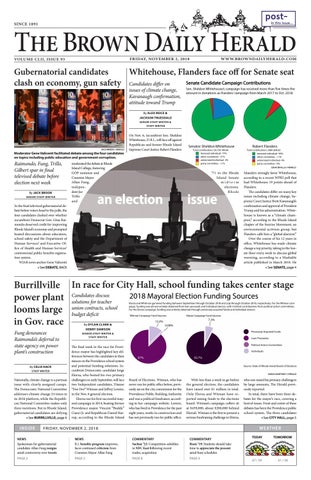
On Nov. 6, incumbent Sen. Sheldon Whitehouse, D-R.I., will face off against Republican and former Rhode Island Supreme Court Justice Robert Flanders
moderated the debate at Rhode Island College, featuring GOP nominee and Cranston Mayor Allan Fung, independent Joe Trillo and
USHA BHALLA / HERALD
an election
’71 in the Rhode Island Senate midterm elections. R ho de
issue
Islanders strongly favor Whitehouse, according to a recent WPRI poll that had Whitehouse 19 points ahead of Flanders. The candidates differ on many key issues including climate change, Supreme Court Justice Brett Kavanaugh’s confirmation and approval of President Trump and his administration. Whitehouse is known as a “climate champion,” according to the Rhode Island chapter of the Sunrise Movement, an environmental activism group, but Flanders calls him a “global alarmist.” Over the course of his 12 years in office, Whitehouse has made climate change a top priority, taking to the Senate floor every week to discuss global warming, according to a Mashable article published in March 2018. He » See SENATE, page 4
Burrillville In race for City Hall, school funding takes center stage discuss power plant Candidates solutions for teacher contracts, school looms large union budget deficit in Gov. race Fung denounces Raimondo’s deferral to state agency on power plant’s construction By CELIA HACK STAFF WRITER
Nationally, climate change is a partisan issue with clearly assigned camps. The Democratic National Committee addresses climate change 24 times in its 2016 platform, while the Republican National Committee makes only three mentions. But in Rhode Island, gubernatorial candidates are defying » See BURRILLVILLE, page 6
INSIDE
By DYLAN CLARK & HENRY DAWSON
SENIOR STAFF WRITER & STAFF WRITER
The final week in the race for Providence mayor has highlighted key differences between the candidates in their stances on the Providence school system and potential funding solutions. Incumbent Democratic candidate Jorge Elorza, who bested his two primary challengers in early September, will face two Independent candidates, Dianne “Dee Dee” Witman and Jeffrey Lemire, in the Nov. 6 general election. Elorza ran his first successful mayoral campaign in 2014, beating former Providence mayor Vincent “Buddy” Cianci Jr. and Republican Daniel Harrop, according to the Rhode Island
SARAH MARTINEZ / HERALD
Board of Elections. Witman, who has never run for public office before, previously sat on the city commission for the Providence Public Building Authority and was a political fundraiser, according to her campaign website. Lemire, who has lived in Providence for the past eight years, works in construction and has not previously run for public office.
With less than a week to go before the general election, the candidates have raised over $1 million in total. Only Elorza and Witman have reported raising funds to the elections board. Witman’s campaign coffers sit at $439,000, about $200,000 behind Elorza’s. Witman is the first to present a serious fundraising challenge to Elorza,
who out-raised his primary challengers by large amounts, The Herald previously reported. In total, there have been three debates for the mayor’s race, covering a host of issues. Front and center of these debates has been the Providence public school system. The three candidates » See CITY HALL, page 5
WEATHER
FRIDAY, NOVEMBER 2, 2018
NEWS Spokesman for gubernatorial candidate Allan Fung resigns amid controversy over tweets
NEWS R.I. benefits program improves, faces continued criticism from Cranston Mayor Allan Fung
COMMENTARY Sachan ’22: Competition solidifies in NFC East following recent trades, acquisition
COMMENTARY Bosis ’19: Students should take time to appreciate the present amid busy schedules
PAGE 2
PAGE 3
PAGE 8
PAGE 9
TODAY
TOMORROW
67 / 59
61 / 38
NEWS
PAGE 2 • FRIDAY, NOVEMBER 2, 2018
THE BROWN DAILY HERALD
Gov. candidate’s spokesperson resigns over offensive tweets Republican candidate’s former spokesperson sent misogynistic, racist tweets while in college By COLLEEN CRONIN SENIOR STAFF WRITER
Andrew Augustus resigned as a spokesperson for Mayor of Cranston Allan Fung’s gubernatorial campaign after misogynistic and racist tweets from his time at Rhode Island College were discovered this week. “Upon hire, an inspection of (Augustus’s) social media account was conducted, but obviously not six or seven years back,” wrote Fung Campaign Manager Andrew Vargas Vila in an email to The Herald. “While Andrew is a different person now, and is extremely embarrassed by this, he does not want to reflect poorly on the Mayor or distract from any part of this campaign.” One tweet from Jan. 2, 2012, read, “Lucky to be where I am in life, I have the balls to say what others are thinking(.) I am going to get a tattoo on my chest saying No Fat Chicks.” Another tweet posted 11 days later read, “Black people + ice skates = hilarity.” Other tweets included language of a sexual nature, making fun of women, black people and politicians.
The Huffington Post originally reported on the tweets and Augustus’ resignation Tuesday after they were discovered by digital strategist and Cranston native Lindsay Crudele. Screenshots of the deleted tweets were posted by Crudele to Twitter and are included in the Huffington Post article. “What does South Carolina have in common with #NewtGingrich? They both like being full of whores,” he wrote that same January 2012. The tweets were written during Augustus’ time at RIC from 2008 to 2014, according to his LinkedIn profile. Before working on Fung’s campaign, Augustus was a press associate at Providence City Hall under Mayor Jorge Elorza. Crudele found the tweets after seeing that one of her followers criticized Augustus for a misogynistic tweet. When she tried to see the mentioned tweet, she discovered that it was already deleted and resorted to a Boolean search to find it. She found the original tweet and others like it. “It’s just how he tweeted, all the time, for a couple of years spread. Not a fluke, but a trend,” Crudele wrote in an email to The Herald. Crudele has been keeping up with the race because her parents still live in Cranston, she wrote. Crudele’s mother, who suffers from multiple sclerosis, called Augustus and asked about Fung’s
COURTESY OF LINDSAY CRUDELE
Andrew Augustus resigned from his role as a spokesperson for gubernatorial candidate Allan Fung this week. His resignation came after the discovery of racist and misogynistic tweets Augustus sent while in college. position on health care to provide information to an MS support group but never received an answer. Still needing an answer, Crudele tweeted at Fung asking about his position on healthcare and was then blocked by him. “You can imagine how it feels for me to realize that I have been posing
serious policy questions to a team whose spokesperson publicly joked about ‘No Fat Chicks,’ and made other dehumanizing remarks,” Crudele wrote. Joseph Trillo, independent candidate for governor, took to Twitter to criticize Fung for Augustus’ hire. “Allan
tried to sweep this under the rug. THIS is the type of people working on his campaign,” Trillo posted to Twitter with a link to the Huffington Post article. “BAD leaders hire BAD staff,” he wrote in another tweet Tuesday night. By press time, The Herald was unable to confirm Augustus’ replacement.
R.I. college students navigate politics on different campuses
TALIA MERMIN
Students work to increase voter registration, engage fellow students in activism, public service By PEDER SCHAEFER CONTRIBUTING WRITER
When Alyssa Cohen enrolled in Providence College she expected a conservative campus because of its Catholic affiliation. But she said she was not anticipating the difficulties that accompanied her liberal views. “It’s hard sometimes,” said Cohen, who is now a sophomore. “People can be very judgmental in knowing that you’re liberal. I have a pin on my backpack that says ‘Betsy DeVos Can’t Read’ and I get dirty looks all the time.” Cohen’s story is just one of many from students across the Ocean State, who, regardless of their political persuasion, are navigating the biases, assumptions and partisanship that come with trying to voice an opinion on campus. PC students are increasingly interested in politics, according to President
of PC Republicans Jeff McCormac. “This year we have almost 500 people registered for the (Republicans) club,” he said, adding that he hopes to bring more conservative speakers to campus. Earlier this month, Republican gubernatorial candidate Allan Fung visited PC’s campus. The group also organizes a trip to the Conservative Political Action Conference every year. Adjunct Lecturer in International and Public Affairs Bob Hackey, who serves as the chair of the Department of Health Policy and Management at PC, said he has seen “limited involvement” on PC’s campus in terms of political activism. Many students, instead, are involved with public service through the Office of the Chaplain, which partners with nonprofits and schools throughout the state, he added. “We’ve seen an increase in student activism over the past few years, but for a lot of college students, activism takes a back seat with midterms, papers and projects to complete,” Hackey said. “Brown students are atypical in that they take a larger interest in student activism.” Hackey mentioned that there is a large
pro-life contingency on PC’s campus, with the Office of the Chaplain sponsoring student busses to the March for Life in Washington D.C. each January. Though they are in the minority, PC Democrats have organized protests in light of Supreme Court Justice Brett Kavanaugh’s hearings, in addition to marches against racial bias in campus security incidents. “There was a march on campus for survivors of sexual assault, and in the past there has been a lot of protesting and student activism surrounding race relations on campus,” said Caleigh Rockwal, a senior at PC. “We’ve had several instances over the past four years of racial bias, especially when it comes to our campus security, so that’s been an ongoing presence of activism on campus.” In addition to national events, controversies on campus over the past year have drummed up political participation and interest, McCormac said. Last fall during Halloween, a group on campus invited “stressed” students to stab a “Trumpkin,” a pumpkin with President Trump’s face drawn on it. Micol Striuli, a member of PC’s College Democrats, said that liberal students on campus feel frustrated with the political climate.“I don’t think the majority of the students realize how much recent events will affect them or other people,” she said. “It’s kind of hard to accomplish anything. It’s kind of demoralizing. People are either not willing to learn or not willing to take part.” Savannah Plaisted, a sophomore at PC, said she has seen a discrepancy in funding between the College Republicans and Democrats. According to PC Student Congress documents for the 2018-19 school year, Student Congress awarded the College Democrats $450 last year and the College Republicans $2,265. “ That’s coming from the
administration and the Student Congress itself,” Plaisted said. Though the Providence College Republicans are the dominant political voice on campus, they said they want to work with the Democrats to promote constructive conversation. “We are looking to do something with them,” McCormac said. “We think that might be very constructive. Any kind of constructive dialogue is always good for both sides.” While students are active along party lines, some also are organizing around voter turnout. Rockwal has been involved with voter registration efforts on campus, working with PC’s Office of Citizenship and Off-Campus Life to run an event on National Voter Registration Day, Sept. 25. She has also worked with TurboVote to register students to vote. Over 80 students were signed up via TurboVote, according to Katrina Alicea, an administrative coordinator with PC’s Office of Residential Life. At the University of Rhode Island, College Democrats and Republicans have worked together on a variety of initiatives — from lobbying for funding from URI to voter registration drives, among other initiatives, said Ed Tarnowski, president of the URI College Republicans. “We had a bipartisan voter drive this past week,” Tarnowski said. “We’re also working with Bridge USA and the College Democrats to get funding for political groups.” The URI College Republicans have brought in speakers through the Foundation for Individual Rights in Education, a national organization that advocates for free speech on college campuses. The speakers have touched on how the URI student handbook infringes on student rights and have advocated against the lack of funding from the URI administration for political groups.
Tarnowski said that the College Republicans pride themselves on the level of civil discourse and constructive conversation they have with other groups on campus, adding that the College Democrats and Republicans held a bipartisan Super Bowl party last January. At the Rhode Island School of Design, President of the Student Alliance Sophie Chien said that while students are increasingly interested in politics, there has not been an equal increase in student activism. “I think there’s a rise in people talking about (politics). I’m not convinced yet that there’s a rise in people doing stuff about it,” Chien said. “We talk a lot about politics on this campus, but it’s hard for people to vote here because I’d say maybe two percent of our student body is from Rhode Island.” Chien ran voter registration drives before the midterm elections in affiliation with the Global Initiative and the Student Alliance. She emphasized the importance of facilitating absentee request forms and voter registration given the make-up of the student body. RISD is 33 percent international students, so engaging students politically can be difficult when the U.S. government is not their primary representative, Chien said. Chein is unsure who will continue her voter registration efforts after she leaves RISD next year. “It’s really just me,” she said. “It’s a one man show. I don’t know what will happen when I’m gone.” Across campuses in the Ocean State, students expressed a desire for better political discourse between groups with different political ideologies. “I would like to see my campus become more politically aware and engaged and … (have) more respect (for different) … genders, political persuasions and races,” Cohen said. “Something that gets lost in the thick of it is empathy.”
NEWS
FRIDAY, NOVEMBER 2, 2018 • PAGE 3
THE BROWN DAILY HERALD
UHIP improves timeliness, efficiency Gov. Raimondo supports benefits program, challenger Fung criticizes implementation, costs By SOPHIE CULPEPPER SENIOR STAFF WRITER
Last week, Cranston Mayor and Republican candidate for Governor of Rhode Island Allan Fung released a television advertisement attacking incumbent Gov. Gina Raimondo for mismanaging the United Health Infrastructure Program, a Department of Human Services and Executive Office of Health and Human Services initiative. An integrative online portal that combined 15 programs was launched in September 2016 as the UHIP program expanded to distribute health care, food stamps and benefits to over 300,000 eligible citizens. UHIP, created in 2011, had successfully implemented a health exchange program to a more limited base in the first phase of its implementation. The online portal suffered significant technical failures, which meant that some benefit recipients were unable to access the web page. Eligibility was incorrectly evaluated under the new guidelines, benefits were delivered late and thousands of applications were not processed at all. Raimondo endorsed the integration of welfare services through a single platform at the time, but Fung has taken issue with the program’s flawed implementation and ballooning costs. History of the program Then-Governor Lincoln Chafee ’75 P’14 began UHIP to integrate social programs, save the state money and save benefit recipients time and effort. In 2012, the Affordable Care Act incentivized states to overhaul their benefit systems by requiring “updates to technology and an integrated eligibility system for federal funding,” wrote Department of Health and Human Services Chief Public Affairs Officer Alisha Pina in an email to The Herald. Federal funding would “cover up to 90 percent of digital infrastructure costs,” according to a 2015 EOHHS press release. Rhode Island was among several states to seize this opportunity to modernize, and the state began replacing its 30-year-old collection of computer systems, Pina wrote. “It’s about government efficiency; it’s about customer service and ease; and it’s about continuity of coverage. If it functions right, it has a lot of benefits,” said Anya Wallack, professor of the practice of health services, policy and practice. Wallack, a former UHIP steering committee member, also formerly served as HealthSource RI chief and Medicaid director for Raimondo’s administration.
“The idea was to have a unified system,” Wallack said. She applauded the idea but cautioned that “there’s a fair amount of risk involved” in any revamp of that scale, especially one that is time-sensitive and heavily reliant on a single vendor. Chafee signed a state contract with private contractor and consulting firm Deloitte to build the online system. It is standard for states to hire external experts for projects that require specific technical knowledge. The government often lacks the resources to “properly staff and oversee these projects because they’re often so strapped and so sensitive to the taxpayer burden,” Wallack said. “States don’t pay like high-tech firms do, so attracting and retaining the kind of talent that you need to oversee enormous information technology projects is just a real challenge for state governments,” she said. This issue is “not in any way unique to Rhode Island,” she added. The state divided UHIP’s implementation into two phases. During the first phase, which the state launched in 2015, Rhode Island set up a health insurance coverage exchange by creating a portal intended only to process “simple Medicaid” requests, making the care available to people below a certain income level. UHIP outperformed equivalents in other states, including Vermont, in timeliness and accessibility at this stage, Wallack said. UHIP’s roadblocks in Phase II Phase II was launched in autumn 2016, two years after Raimondo’s election. This second stage was much more “complex,” since it served as a joint platform for other benefits and increased the number of people it served. Unlike “simple Medicaid,” which requires only a certain income level to establish eligibility, Phase II’s Medicaid component covered a wider base. Federal overseers warned Rhode Island to wait before it rolled out Phase II, but Deloitte and the state deemed the program ready for expansion. The Rhode Island chapter of the American Civil Liberties Union has cosponsored two lawsuits against UHIP. The ACLU filed the first with the National Center for Law and Economic Justice in December 2016 because applications to the Supplemental Nutrition Assistance Program were not being processed in a timely manner. The ACLU will continue to monitor the state until it demonstrates that it has processed 96 percent of applications on time over the course of 11 to 12 months, The Herald previously reported. “They have yet to make it to 96 percent on either (expedited or nonexpedited application rate processing), a whole year beyond where they are supposed to be. So we have been very
actively involved,” said Lynette Labinger, an attorney for the ACLU. “They’re still processing around 4,000 applications a month, and they supposedly implemented some major computer fixes.” The second lawsuit was filed in January 2018 on behalf of customers whose health insurance access was blocked by a computer glitch, The Herald previously reported. Besides experiencing technical failures, the program has also exceeded its budget. Originally intended to save the state “over $90 million a year,” the current total projected cost of UHIP is $647.7 million, according to WPRI. The program is expected to be completed in 2020. Program progress According to the most recent EOHHS Oversight report, dated Oct. 19, the number of reported issues with the online system has dropped from 7,649 in December 2017 to 2,217 as of Sept. 29 this year, which is “a 71 percent decrease.” At least 90 percent of SNAP applications have been processed on time over the past six months, Pina noted, compared to 56.5 percent in November 2017. Timeliness for all programs stands at 77 percent, she added, compared to 66 percent nearly a year ago. “Rhode Island has one of the lowest uninsured rates in the country at 4.3 percent. The state is third in the nation for children’s health coverage, with 98 percent of children covered,” she wrote, crediting UHIP and its online portal as “an important factor.” But the difference between a 90 percent timely processing rate and a 96 percent rate is “still a significant number of households,” said Greg Bass, senior attorney for the National Center for Law and Economic Justice. “Our top priority has always been ensuring people have access to benefits,” Pina wrote. While the platform has “largely stabilized and is not affecting access for the majority of customers, we remain focused on ensuring all Rhode Islanders have timely access and on bringing the system into compliance with all federal rules and regulations.” Program oversight Many individuals employed by the state and Deloitte share responsibility for UHIP, Wallack said. “Deloitte is actually building the system, but state people are involved to try to make sure that they’re adhering to the state specifications and building the system so that it works,” she added. “Every governor ultimately bears responsibility for what’s going on within their government when they’re the boss,” Wallack said. Even so, “any governor that undertook this worthy project would find it difficult because it’s a difficult project,” she added. “The
project was laudable – many parts of it went well, and I think every state that got into this space faced challenges to a greater or lesser degree.” Raimondo has apologized repeatedly for UHIP’s unanticipated failures. “Mistakes were made, which I own,” she acknowledged in the first gubernatorial debate, The Herald previously reported. In comparison to the rest of the country, “the scope (of UHIP) is broader than most states, … and the success is probably about average,” Wallack said. Other states either did not implement programs that were as ambitious as Phase II or also experienced significant technical issues, she said. Deloitte has partnered with other states including Georgia, according to Bass. Outcomes have varied, Wallack said. “Some Deloitte states went disastrously, and some Deloitte states went really well. … It’s hard to blame it on any particular vendor in different circumstances,” she said. Raimondo “continues to hold Deloitte accountable to delivering the system we asked for,” Pina wrote. “We are in a much better place today than we were at go live. This past year, for instance, we had the largest year-overyear growth of insured Rhode Islanders through the state’s health exchange.” Looking toward election day “The governor should be directly involved in contractual negotiations related to high costs and high risks projects, which have a direct impact on the lives of thousands of Rhode Islanders,” wrote independent candidate for governor Luis-Daniel Muñoz in an email to The Herald. “The governor also has a role in establishing leadership and structuring initiatives within EOHHS. The governor also sets forth expectations around project management and project outcomes.” More transparency and piloting of the program were called for, Muñoz added. Nevertheless, he supports the idea of an integrated system for benefits, he added. “Whenever comparing technology solutions, it is important to measure success on the basis of whether we’ve improved the lives of those using the solution, and based on the challenges resulting from the UHIP system, I think that we still have a lot of work to do,” he wrote. “I believe in small, local implementation of community self-help, and my ReGenerative Funding plan will eliminate the need for centralized software of service providers which are too big and too easy to corrupt,” wrote Compassion Party gubernatorial candidate Anne Armstrong in an email to The Herald. Candidates Raimondo, Fung, William Gilbert and Joe Trillo did not respond to requests for comment.
Find Post- magazine on Facebook! facebook.com/postmagazinebdh
NEWS
PAGE 4 • FRIDAY, NOVEMBER 2, 2018
» SENATE, from page 1 authored the American Opportunity Carbon Fee Act, which would instate a national carbon fee whose proceeds would go back to U.S. citizens. Whitehouse introduced a second version of the act to the Senate in February 2018 and it was referred to the Committee on Finance. Since then, a carbon tax has received bipartisan support. Following this proposal, “prominent Republicans who are serious about solving the challenge of climate change have endorsed a revenue-neutral carbon fee like the one I’ve proposed,” Whitehouse wrote in an email to The Herald. But not all environmental activists believe that Whitehouse is doing enough to address climate change. He is still “set in this establishment mindset,” said Sunrise R.I.’s Hub Coordinator Lauren Maunus ’19, adding that she wishes he would publicly oppose natural gas projects and refuse funding from fossil fuel companies. The group has criticized Whitehouse for refusing to sign the No Fossil Fuel Money Pledge,
which asks signatories to commit to adopting “a policy to not knowingly accept any contributions over $200 from the PACs, executives or front groups” of oil, gas or coal companies, the pledge states. Sen. Bernie Sanders, I-V.T., New York congressional candidate Alexandria Ocasio-Cortez and candidates for Rhode Island State Senate Melissa Murray and Bridget Valverde, among others, have signed the pledge. In April 2018, Whitehouse voted to confirm vocal climate change denier Mike Pompeo as Secretary of State. Pompeo has also accepted numerous campaign donations from the Koch brothers, Maunus said. In contrast to Whitehouse, Flanders prefers that private businesses, as opposed to government actors, address climate change. “I have great faith in our private enterprise and I’d rather let them do their best,” Flanders told The Herald. He criticized Whitehouse’s prioritization of the issue, and while he admitted that it is important to “work around potential effects of climate change,” the United States will still need to “depend
THE BROWN DAILY HERALD on fossil fuels for the foreseeable future,” Flanders said. The candidates are also at odds when it comes to Kavanaugh, as Flanders sharply criticized Whitehouse’s contributions to Kavanaugh’s confirmation hearing for being too partisan. Whitehouse decided to vote against confirming Kavanaugh after the first Senate Judiciary Committee hearing, The Herald previously reported. “The biggest factor for me is the array of indicators that he would be a highly partisan Supreme Court judge,” Whitehouse said in a previous interview with The Herald. During the hearing, Whitehouse called attention to Kavanaugh’s high school yearbook, reading out loud snippets from Kavanaugh’s personal page referencing beer and “flatulence.” “I thought his performance was abysmal,” Flanders said, adding that Whitehouse’s use of Kavanaugh’s high school yearbook writings was an “exercise in character assassination and personal attack.” In the end, while Whitehouse voted against Kavanaugh’s confirmation, Flanders remains in
support of the judge. Flanders said that the allegations against Kavanaugh from Christine Blasey Ford “were completely unsubstantiated and not corroborated by even the people that the accuser said were there.” Neither candidate is a big supporter of Trump, but while Whitehouse ardently opposes the president on most key issues, Flanders is more closely aligned with some of the administration’s policies. In an email to The Herald, Whitehouse pledged to protect “our shared American values from President Trump’s attacks” and wrote that “the battles ahead are going to have enormous consequences for the generation that’s just coming of age” with Trump as president. Flanders said he would not hesitate to oppose Trump, but “when he does things that are good for the country and Rhode Island I’ll support him.” Flanders criticized Trump’s choice to separate families at the U.S.-Mexico border, his meeting with Russian President Vladimir Putin and his “across the board tariff raises,” he said. But on
issues such as immigration and gun control, Flanders is more aligned with the Trump administration. He warned against the “caravan of thousands of Central Americans trying to storm our borders” and generally emphasizes border security as a key priority. Flanders favors “beefing up security” rather than imposing a ban on assault weapons and is not in favor of doing anything “that would potentially be in violation of the Second Amendment,” he said. Flanders believes that rather than looking to Congress to pass legislation, the country should improve security in places like schools and other communal areas, he added. Since March 2017, Whitehouse’s campign has raised $4.7 million compared to the Flanders campaign’s $881,000, according to Federal Election Commission data. Flanders’ donors are made up of mostly private individuals, while Whitehouse has received funds from technology companies, labor unions, military contractors and energy companies, including National Grid.
NEWS
FRIDAY, NOVEMBER 2, 2018 • PAGE 5
THE BROWN DAILY HERALD
PAYSAGISME
Art and Ecological Responsibility TALIA MERMIN
» CITY HALL, from page 1 have presented vastly different visions for Providence’s future. Providence schools face major infrastructure issues, school teachers have been without a contract since August 2017 and the bus drivers union recently ended an 11-day strike, according to WPRI. Teachers union contract issues have still not been settled. Elorza expressed his frustration with the negotiation tactics the teachers union has used, such as the union’s decision to have all members under work-to-rule status, where employees only perform the basic duties required by their employer. “I think it’s a position they’ve taken intentionally because it hurts children,” Elorza said during the Oct. 9 debate. In an interview with The Herald, Witman stressed the importance of sitting down and talking with the teachers unions and other civil servant unions in the city. “They are your civil workers, they’re on the front line,” she said. “How do you dare … not talk with them? You can be sure I would.” Witman also pointed to Elorza’s handling of the firefighters union as another strike against his ability to work with unions. “He was really caught with his pants down on that one. That was failed leadership,” she said. Lemire voiced his admiration for the teachers of Providence. It’s “the toughest job in the city,” he told The Herald. Lemire said he did not have a solution to settle a contract with the teachers union. “I have no idea what these teachers want. We don’t know!” Providence schools also face financial troubles. Elorza recently wrote a letter to Providence citizens stating that the School Department will face a $37 million deficit over the next five years because of federal funding cuts and other decreases in funding, according to the Providence Journal. “That means really dramatic cuts that we’re going to have to make in our School Department over the coming years,” he said in the Oct. 9 debate. Witman echoed that sentiment. “We have a population that has more needs than any other city in Rhode Island … in terms of funding,” she said. She added that solving this issue would require undoing some of the decisions made by the Elorza administration, and the city would have “to do more with less.” An independent report commissioned by the School Building Authority at the Rhode Island Department of Education estimated $627 million was necessary to bring R.I. schools up to the standard of “warm, safe and dry.” The report said it would take a further $1.59 billion to bring the schools to the highest standards outlined in the assessment. Elorza has suggested leasing the city’s Water Supply Board, which was valued at $404.2 million in 2017, The Herald previously reported. The money would be used to help ease the financial troubles facing schools and help pay for the city’s pension liabilities, which have exceeded $1 billion. “Unless we do something, the city’s going to die a slow … and painful death, so something
has to be done,” he said in the Oct. 9 debate. The National Resource Network, which advises cities on how to address economic issues, suggested that Providence sell or lease city assets to cure its budget woes. Leasing the Water Supply Board would be authorized through the Municipal Water Supply Systems Transactions Act, which would allow the board to contract with other public and private entities without oversight from the R.I. Public Utilities Commission. “We believe that monetization of our water system is a viable and sustainable solution,” wrote Victor Morente, press secretary for the office of the mayor, in an email to The Herald. Witman agrees that the city should be allowed to profit off of the Water Supply Board, but selling the board outright is “not going to happen” if she were to be elected, she said. Witman said she and her campaign were thinking of inventive ways to address the issue, but that she was “not at liberty” to explain them. “We sell our water to other cities,” she said. “We sell it, but we’re not allowed to make a profit on it.” Lemire, however, was staunchly opposed to monetizing the Water Supply Board. “We can’t sell it,” he said. “If I’m elected mayor, everybody that’s in the Providence Water Department on the Board of Directors is fired.” Another potential solution for Providence schools’ funding disparities lies in Rhode Island referendum question one and local Providence referendum question four. Question one would allow the state to issue a quarter of a billion dollars in bonds to fuel school infrastructure spending across the state. Question four would allow the city of Providence to issue up to $160 million in bonds for school improvements for fiscal years 2019-24. Witman was reluctant to support the passage of question one. “I hope a lot of money goes to Providence, (but) I’m not sure it will,” she said. She stressed the importance of supporting schools statewide. Despite her reservations about question one, she supports referendum question four. “We certainly need to do (it) for city schools.” Lemire was not in favor of the local Providence referendum. “We don’t need to borrow any money,” he said. Lemire added that he worries the money would leave the state through contract hiring outside the city of Providence or even the state. “The money’s going to go so fast you aren’t even going to realize it,” he said. Elorza could not be reached for comment on this particular issue. Megan Geoghegan, communications director for RIDE, recognized the impact that improving school building quality would have on school culture and student performance. After “a complete and accurate evaluation of the state of our school buildings, … we believe this once-in-a-generation investment is necessary for our students,” she wrote in an email to The Herald. Geoghegan said that RIDE played a supporting role in drafting the language used in question one.
Usually translated as “landscaping,” “landscape design” or “landscape architecture,” paysagisme incorporates a wide range of land-use issues, including urban planning, public spaces, sustainable agriculture, land reclamation, and ecology; it has a pronounced aesthetic element in garden and park design, and overlaps with the important late 20th century and contemporary movement known as Land Art.
Friday, 2 November at 7 pm McCormack Family Theater, 70 Brown Street Gilles Tiberghien will present a slide lecture on a largely-American movement known as Land Art, both its history and its present. Sponsored by the French Center for Excellence in the Cogut Institute for the Humanities, the Brown Arts Initiative and Paris 1 Panthéon Sorbonne
Issue
In This
Den Den v. Den Den
Abbie Hui 4
Little State of Hauntings
Andrew Liu 2
post- scarecrows 4
Scary Sentences James Feinberg 5
Love and Marriage Julian Towers 6
Power to the People
postCover by Halle Krieger
OCT 26
VOL 22 —
ISSUE 7
FEATURE
Little State of Hauntings
Reflection on Vampires, Spirits, and Halloween By Andrew Liu Illustrated by Cricket McNally
I
was easily scared growing up. There was one episode of Scooby-Doo in particular that my sister and I would rent repeatedly from the local library: Its main villain was a disturbingly well-drawn vampire with the most startling hyena laugh. Yet, the most unsettling part came near the end of the episode. Instead of the standard unmasking of the culprit with a detailed explanation of his elaborate ploy, he turned out to be an actual vampire—an undead, distant relative of one of the characters. There was something so jarring and fascinating to me about how the
monster was real that I couldn’t sleep alone the nights after we watched that episode. Still, I returned to the library to rent it out again a few weeks later. It was fun to re-experience that bit of fear, to emerge from the episode feeling a little less safe than before. With Halloween arriving soon, horror-lovers and thrillseekers on the Brown campus won’t have to travel far to find their fix. Despite its inconspicuous size and pleasant New England scenery, Rhode Island has a surprisingly rich collection of dark fables and attractions that have
Chester Hill Cemetery and the Story of Mercy Brown In the 1890s in Exeter, Rhode Island, George and Mary Brown were happily married with three children—that is, until tuberculosis struck. Tuberculosis, or “consumption,” as it was called
Halloween Costumes
Letter from the Editor Happy Halloweekend! post- has
inspired many storytellers and filmmakers, from H.P. Lovecraft to the makers of The Conjuring. In researching this spooky history, I’ve compiled a couple of our state’s most chilling attractions and their backstories.
1. CPax
(just turned 50!). Alternatively, schlep
2. Blue exam book
prepared some haunting RI stories and a
down to the Trinity Rep theater to admire
list of ultra-scary sentences to get you in
the new production of Pride and Prejudice,
the mood before your night out, as well as
dressed as yourself or Elizabeth Bennet.
suggestions for some delicious sodium-
Either way, consume and admire the
5. 'QZJSTLJX QFRU
packed late-night meals you can partake
aesthetic of some good ol’ candy corn.
6. 9MJ 5N]FW QFRU
in after your Halloween treats. Halloween ascetics, fear not! We suggest you block out the obligatory “Spooky Scary Skeletons” remix floating down your hall tonight by bopping along to The Beatles’ White Album
3. 'QZJ 7TTR RZKǿS 4. 'QZJST
7. & XFI HTQQJLJ XYZIJSY F[TNINSL Drink responsibly,
Jennifer
editor-in-chief of post-
RNIYJWR XYWJXX G^ HJQJGWFYNSL FS &RJWNHFSN_JI UFLFS MTQNIF^ 8. & UJWXTS \MT [TYJI 9. 9\NYYJW IWJXX QNPJ F GQZJ GNWI FSI XMTZY ^TZW TUNSNTSX FY XYWFSLJWX 10. & 512* IFSHJ YT YMJ YZSJ TK >2(&
2!post–
at the time, was the root cause of countless waves of paranoia that gripped New England in the late 19th century. Filled with gruesome and prolonged symptoms, consumption was also associated with wickedness, turning neighbors and families against each other in pious hatred. At one point, this tension led to a widespread “Vampire Panic,” causing a number of New Englanders to believe that those who died from consumption later reanimated at night to draw blood from their family. Mary Brown was the first in her community to contract and die of the disease, followed by her eldest daughter, Mary Olive. Then her other daughter, Mercy Brown, fell ill and died shortly after. These quick successive deaths prompted a panic throughout Exeter, whose leaders insisted that they must exhume the bodies of the dead. They unearthed the corpses sequentially. First, Mary Brown’s body—though it still had some tissue and sinew—had no blood left in its heart or veins and thus could not possibly reanimate. Next, presumably due to variation in the soil and burial conditions, Mary Olive had nothing left on her but bone and hair. Then came Mercy Brown. To the shock of the village leaders, her body exhibited minimal decomposition, and her heart was filled with fresh blood. They concluded that the wicked culprit had been found, and Mercy’s heart and organs were quickly incinerated shortly following her exhumation—with the ashes given to her brother to drink in an unsuccessful attempt to cure his own tuberculosis. It is easy to forget that this incident occurred in the late 19th century, in a progressive society with fairly advanced medicinal resources. Inspired by how paranoia created a vampire hunt within just a few months, famous horror writer H.P. Lovecraft wrote the character of Mercy Dexter in his novel The Shunned House based on the story of Mercy Brown. Lovecraft shaped the novel’s plot out of horror that such barbarism could still reign in a peaceful New England town in the 19th century. Today, Mercy lies in Chestnut Hill Cemetery, where she may or may not be resting in peace after her disinterment. There are many theories of why her body remained so fresh, such as a possible winter chill preserving her organs and keeping the blood in her body. Another theory is that her body retracted due to lack of moisture, causing both her hair and nails to appear longer in relation to the rest of her figure and giving the illusion of growth. Mercy Brown’s case remains one of the most welldocumented exhumations in history though her story has largely faded into legend. If you are ever in the Chestnut Hill area this coming Halloween, feel free to pay your respects. The Perron House In 1971, Roger and Carolyn Perron moved into a new farmhouse in Harrisville, Rhode Island, with their five daughters. Almost immediately, the paranormal activity began.
In the first few weeks, a broom mysteriously relocated itself around the house, leaving behind piles of collected dust in various locations. An orange oozed blood, and the smell of rotten flesh permeated the house, causing whoever caught the scent to experience the shivering sensation of a presence. If these events seem too cryptic, other incidents included the slamming of doors, levitation of beds and furniture, and perhaps the most famous: the morning Carolyn woke up to an apparition hanging over her bed. It was an old lady whose head hung to the side at an impossible angle. The lady said, “Get out! Get out!” Convinced that something was amiss in their home, the Perrons enlisted the help of Ed and Lorraine Warren, the founders of the New England
Despite its inconspicuous size and pleasant New England scenery, Rhode Island has a surprisingly rich collection of dark fables and attractions that have inspired many storytellers and filmmakers, from H.P. Lovecraft to the makers of The Conjuring. Society for Psychic Research, the oldest ghosthunting group in New England. “Oh boy, that was something else, that Harrisville case,” said Lorraine when interviewed by the Providence Journal. When questioned by USA Today, she recalled, “The things that went on there were just so incredibly frightening. It still affects me to talk about it today.” One of the Perron children stated that, as soon as Lorraine entered the house, she remarked, “I feel a dark presence, and her name is Bathsheba.” According to legend, Bathsheba was a practicing Satanist who sacrificed her daughter to the devil and proceeded to hang herself to bind her spirit to the property. Supposedly, the haunting came to a head one night when Carolyn Perron seemed to be possessed. Andrea, one of the Perron daughters, remembered that “the only time I was truly terrified in that house was the night I thought I saw my mother die. She spoke in a voice we had never heard before, and a power not of this world threw her 20 feet into another room.” “Her body was distorted...it lasted several hours,” said Carolyn’s husband, Roger. Despite all of this, the family continued to live in the house for nine more years. Every morning, levitating beds and the stench of rotting flesh would greet them. “Eventually, the family accepted the fact that [they] were not living there alone,” said Carolyn. Andrea went on to write a trilogy on the
hauntings in the Perron House titled House of Darkness: House of Light. Regardless of whether this is smart marketing or a desire to confront terrifying experiences, there is no doubt that whatever happened in the Perron House stayed with Andrea for many years after. “Both my mother and I would just as soon swallow our tongue than tell a lie,” said Andrea. “People are free to believe whatever they want to believe. But I know what we experienced.” The happenings in Perron House also inspired the blockbuster hit The Conjuring. The film heavily marketed its believability; it was known to be so scary that some screenings invited priests to bless the audience before the movie began. According to Carolyn, the film captured “the essence of what [the family] went through.” Nathanael Greene Homestead Located in Coventry, Rhode Island, this historical landmark was built and occupied by the Revolutionary War hero Nathanael Greene, who was appointed by Washington to command the southern colonial forces during the war. Nathanael would commonly refer to it as “Spell Hall” in his letters. Since the 1920s, this house has been reported to exhibit odd behaviors. Doors, handles, and even a baby carriage have been seen to move on their own. Occasionally, the kitchen abruptly fills with the smell of baking bread, even though the room hasn’t been used for centuries. There are sounds of voices, and at times, even that of a horse carriage pulling up to the front of the house. At night, there are reports of disembodied screams—but this may come as no surprise, given that the Homestead Cemetery, located right down the hill from the house, contains the bodies of four soldiers who failed to be nursed back to health at Spell Hall. Currently, the Nathanael Greene Homestead Association is interviewing those interested in managing the landmark. Members get unlimited free tours of the house. It’s amazing, the lengths we will go to in order to frighten ourselves with the unknown, with these and countless more mysterious attractions residing in our tiny state of Rhode Island. To this day, I cannot brush my teeth in front of a mirror immediately after seeing a horror film. And yet, the thought of going to see a scary movie with friends remains just as exhilarating. No matter how chilling the scene, I always keep one eye halfopen. Now that we are older, perhaps Halloween’s magic lies no longer in the pillowcases of free candy, but in having a day to confront the things that make us shiver. We are lucky that we do not truly fear death via supernatural means today as people did in the 19th century, when deaths by polio, tuberculosis, or vampires were still common threats. On Halloween, we can embrace the ghosts and vampires that no longer haunt us. For a day, we can stare death and horror in the eye, and maybe even give them a friendly nod.
“Any action before an event is just pregaming for said event.” “Usually when I speak into the void, someone responds.” “Is there something deeply wrong with Den Den?”
October 26, 2018'3
NARRATIVE
Scary Sentences
Things You Don't Wanna Hear By post- scarecrows Illustrated by Halle Krieger
Never gonna say goodbye.
here are two Den Dens within 0.5 miles of each other. These sister restaurants share great service and tasty, artfully presented food, but both have distinct personalities—evident through their food, decor, and more.
vegetables, a sunny-side fried egg, and your choice of protein (beef, seafood, chicken, mushrooms, and more). I tried and recommend both of the two sauces: one spicy and one citrusy. I got the perfect dish for a chilly day in Providence—bibimbap served in a hot stone pot. After you order at the counter, bring your table stand—which is pretty neat— back to your table and get settled. I remember my first time taking in the restaurant’s minimalistic decor and stylish exposed brick interior, which evinces a rustic feeling, while I waited for my food. Complementing the brick walls and yellow lighting are wooden tables, good for double dates and large groups. The nice open space and high windows further bring out the charming, hip, and laid-back ambience. When our food arrived, I took an obligatory picture of its colorful presentation and my friends. Then, we put our phones away and dug in. The bibimbap remained hot throughout the meal, and the sizzling stone bowl made the rice extremely crunchy at the bottom. There were many different vegetables, my egg was perfectly fried, and the protein was tender and full of flavor. All in all, I was very satisfied with the dish’s quality and quantity. Since that first visit, I have tried an extensive selection of the menu. Den Den’s bento boxes come with a bed of rice, Japanese pickles, vegetables, and a choice of protein, such as moist, flavorful eel. The translucent, sweet potato Japchae noodles with beef are bouncy and healthy, and I will definitely be back again to try it with a different protein. The edamame— salty, creamy soybeans—is an ideal appetizer for sharing. Den Den Cafe Asiana is a unique dining experience: in this “fast-casual” cafe, consistently tasty food pairs well with great company for a relaxed, fun time. The service is always friendly and knowledgeable–especially for first-timers. However, Den Den often attracts a crowd on weekend nights. Additionally, it no longer accepts reservations as they renovated the building next door to expand seating capacity. Nonetheless, check out this casual spot, perfect for a catch-up date.
Den Den Cafe Asiana
Den Den Korean Fried Chicken
The first time I went here, I celebrated my first college Friendsgiving. Since then, I have returned countless times with more friends. My roommate and I always eat our first meal here to catch up when we return to campus. Located in a neat, old brick building on the outskirts of College Hill, this quaint cafe overlooks the Providence skyline. With the restaurant’s brick exterior giving off an unassuming vibe, its delightful and cozy interior is a surprise. As you enter, you are greeted by welcoming servers and quickly directed to a table (when the restaurant is not packed). A server hands you a menu and tells you to order at the counter when you are ready. It might feel strange to pay before you eat, but it saves you from the post-meal bill struggle when you’re eating with a big group. The menu features an excellent variety of Korean and Japanese dishes. Behind the counter, an artsy chalkboard menu adds to the restaurant’s cafe-esque feel. Several of the popular options are boxed on the standard menu, which definitely helps first-timers narrow down the delicious options. Despite this, I struggled to make up my mind on my first visit and asked the server at the counter what to order. Deciding between the bibimbap and the bento boxes, I ultimately chose the former: rice topped with plenty of traditional Korean marinated
The evening before a snow day, my roommate and I, excited to watch the snow fall heavily yet beautifully and hibernate in our dorm, couldn’t choose what to eat on Thayer to celebrate the upcoming cancelled classes. We decided to give Den Den Korean Fried Chicken a try as we had such great experiences at its sister restaurant. Spinning off the original Den Den’s minimalistic decor, Den Den KFC adopts a clean, cool, and crisp style with its modernist dining room and partially open kitchen. My first impression was that the place was pretty sleek—subway tiles, black-and-white décor, wooden tables. There are two seating areas, butthe restaurant is still relatively small: tables and chairs are squished together with only one large-party table available. As you settle down, servers hand you a simple and straightforward menu. Though it doesn’t feature all of the original Den Den’s classics, it does offer quite a few dishes in common—like kimbap—in addition to its own delicious snacks. Known for its fried chicken, Den Den KFC has interesting spins on Korean bar food. Since it’s a namesake dish, I was initially surprised that Den Den KFC serves more than fried chicken. After a few visits, I have tried dishes ranging from whole-chicken stew to beef bulgogi served in a pan-like display. Recently, I tried an appetizer of pork
At least I’m gonna say that I tried. What’s the sense in hurting my pride? It’s laundry day.
~~It’s spooky time~~ Please leave a message after the tone. *beep* Baby shark, doo doo doo doo doo doo. Never gonna tell a lie and hurt you. Your instructor has released grade changes and new comments for Midterm 1. These changes are now viewable.
I really can’t stay. Baby, don’t hold out. Let’s go to this party right when it starts.
I want to give back your essays one-on-one, in my office.
Let me check my schedule.
Your midterm isn't tomorrow; it was yesterday.
I’m PLME.
Never gonna give you up.
Read 11:47 p.m.
I really can’t stay. Baby, it’s cold outside.
She fell asleep to something scratching underneath her floorboards.
The SciLi basement is my favorite place to study. Let’s go to the CIT. Never gonna let you down.
I’m sorry, but you don’t have enough credits to graduate. Harry woke up in his bedroom under the stairs and realized it had all been a dream.
I’ve got to go away. Baby, it’s cold outside.
Den Den v. Den Den
Playing next: "Scott’s Tots." Panic! at the Disco is an American rock band from Las Vegas, Nevada, formed in 2004 by childhood friends Brendon Urie, Ryan Ross, Spencer Smith, and Brent Wilson. Never gonna run around and desert you. Say, what’s in this drink? No cabs to be had out there. This is not a simulation.
Comparing Sister Restaurants By ABBIE HUI illustrated by RÉMY POISSON
T
Chicken Finger Friday is cancelled. Never gonna make you cry. I ought to say no, no, no. Mind if I move in closer? Out of the corner of your eye, you spot him: Shia LaBeouf. I thought I was alone, and then Christina Paxson stepped out of the shadow.
4!post–
ARTS&CULTURE
and veggie tang su dumplings that came drowned in a sweet and tangy sauce. And, like the original Den Den, Den Den KFC is a non-tipping establishment— convenient and ideal for the budget of broke college students. More importantly, this policy allows its workers to receive fair wages without relying on customers’ unreliable generosity. Den Den KFC is definitely a great place to drop by for a tasty meal when you’re on Thayer. Try a few of its delicious dishes in addition to its fried chicken because the huge portions are meant to be shared. Although there is sometimes a wait during popular meal times, you can use this time to check out the menu. Both Den Dens offer great service, delicious food, and reasonable prices. Whenever you’re in the mood for comfort food, go to either Den Den—the original for a cute, clean, cafe feel or KFC for modernist, fun, and trendy vibes.
Love and Marriage
Pride and Prejudice at the Trinity Repertory Theater by James Feinberg Illustrated By Stephanie Wu
P
laywright/performer Kate Hamill’s stage adaptation of Pride and Prejudice, which premiered at Primary Stages Off-Broadway in 2017, has now made its way to the Trinity Rep, where it runs through November 4th. In last year’s production, Hamill herself played Lizzy Bennett, and it’s possible the author’s presence made for a jolt of energy that lent the play more staying power. At Trinity, in a production directed and choreographed by Birgitta Victorson, the show, despite its sleek professionalism and commitment to the bit, seems to be struggling for a reason to exist. Though I prefer Sense and Sensibility, Pride and Prejudice is the Jane Austen novel that has inspired a laundry list of adaptations. The most prominent is the 1995 British miniseries, a complex, wellcrafted, and ambitious work remembered today for the approximately 30 seconds in which Colin Firth
wears a slightly wet shirt. Hamill’s take is not sufficiently revisionist to be called a reinvention. There are all sorts of bells and whistles, all to do with the idea of performance. For instance, the actors cross-dress, play multiple roles, and pause between scenes for extended dance breaks to classic rock. Given that the matrimonial drama of Austen’s era was essentially an extended pageant, that’s a great starting point. However, her double-casting gets into trickier territory. Michael McGarty’s set design leaves the backstage area exposed, so we see heroes changing into villains and men into women live. But the point escapes me, especially since the fast-paced, gag-ridden adaptation, while consistently funny, is never funnier than the novel, which has always been underrated for its wit. The program grandly announces that the double-gendering choice asks “us as the audience to consider how gender shapes the narrative event.” It seems to me it has exactly the opposite effect—in a world of rigid gender distinction, allowing characters to slip easily across those lines has the effect of erasing the threat of singledom specific to women of the time, and thus robs Lizzy’s commitment-phobic choices of their significance. Most of the weaknesses really aren’t the actors’ fault. Rachel Warren and Rebecca Gibel, both Trinity Company members, play Mr. Darcy and Lizzy respectively (Warren also plays Wickham). The necessity of reducing the sprawling novel to two acts of theater leaves Darcy more
communicative than strictly fits his character, but Warren nonetheless delivers a more-thanadequate performance with hints of Janet McTeer. Gibel is as dignified and impressive as the sensible Lizzy, who gives the best performance in the show, but is also isolated by the wackiness around her and never seems to fit in. Joe Wilson Jr.’s portrayal of the fumfering clergyman Mr. Collins is borderline incoherent—though he gets the audience on his side, it often plays like he’s mugging for laughs (which, of course, he is). What’s great about the performance’s dance sequences is that they give the actors an unvarnished chance to contribute something new. They’re a motley crew of performers of all ages, shapes, and backgrounds, and seeing them grind to “The Final Countdown” is inherently funny and exciting. When they’re doing Pride and Prejudice proper, though, they continually strain to inject something into the proceedings we haven’t seen a million times before; in other words, they try to banish Colin Firth and other preceding iterations of the story, with little success. This production and adaptation won’t do much for fans of Austen’s work. It’s not loyal enough to the book to be rote re-creation, yet not slapstick enough to be outright silly. It’s slickly directed and charmingly acted, but not memorable enough to last through the time it would take to read the novel—an eminently more rewarding experience—or watch the miniseries. Have you heard about that part where Colin Firth wears a wet shirt?
October 26, 2018'5
ARTS&CULTURE
Power to the People
Fifty Years of the Beatles' White Album By Julian Towers illustrated by Katya Labowe-Stoll
L
et’s talk about that cover. Or, to focus the issue, let’s see how long we can talk about it. White background, black text, “The Beatles,”—that’s all we’re given to work with. Context is everything. So, placed in proper aesthetic sequence, following the detailed, popart explosions of the Revolver and Sgt. Pepper’s Lonely Hearts Club Band covers, and far beyond the boy band posing of earlier albums, The Beatles’ artwork has obvious significance: it’s the first troll. By 1968, the band had grown so big, so world-devouringly important, it knew that, like Jesus or clean water, it had transcended the need to market itself. There’s a reason the album’s actual title was immediately and forever discarded for the colloquial White Album; confronted with the cultural vastness of The Beatles, a blank, infinite field of space seems more manageable. But behind narcissism lurks a curious, inadvertent generosity. The artwork names the biggest musical phenomenon that had ever walked the earth, erases the phenomenon, and leaves the consumer to fill in the blank. As though that weren’t enough, each of the record five million original copies was stamped with another troll—an individualized “collector’s number.” And that’s only the cover to a sprawling double album that, in so many more ways, bridged the gap between listeners and pop stars and fifty years on, still looms large in our understanding of that relationship. It’s fitting that such a loose, undisciplined statement grew out of what was in many ways the tightest strung and most self-consciously iconic era of the band’s career. The previous year’s Sgt. Pepper had been rigorously conceived—a psychedelic song cycle that demanded to be heard complete and in order, each successive track like a chapter in a novel. Though commonplace now, this sonic unity was unprecedented. Albums were rarely conceived as more than a reproduction of a live performance, and never as a performance in themselves—a notion the Beatles shattered explicitly with the bookending music-hall concept of Sgt.Pepper. Today, listening to the title track segue seamlessly from rowdy applause to the plinking riff of “With A Little Help From My Friends,” it’s difficult not to get a little giddy imagining the minds blown. And the response was indeed overwhelming. Radio stations reorganized programing to play Sgt. Pepper in full, Time Magazine called the album “a historic departure in the progress of music,” and the band ascended from stadium pop stars to high artists with serious expectations on their back. So they ran away, decamping to India for a transcendental meditation retreat with guru Maharishi Mahesh Yogi. Famously, this would prove neither restorative nor pleasurable, and per Lennon, the band mostly “sat in the mountains eating lousy vegetarian food.” In this bored isolation, with no more than a shared bag of hash keeping them together, the
unity that had shone through Pepper’s day-glo military outfits fell apart. No longer pitted against the world, the Beatles turned upon themselves, upon everything they had created. Their seamless interplay, on which so much praise had been heaped, was forsaken, as members retreated into isolation to write new songs. When it came time to record, the four were rarely in the same room together, electing to combine their parts through studio overdubs. It’s often said that The White Album doesn’t quite sound like an album, or even the work of a group, and that it more often resembles a series of random tracks stitched together. That’d constitute a critique were this most bands, but the Beatles encompassed three songwriters of idiosyncrasy unrivaled in rock ’n’ roll. That they could ever pool into a stable creative unit, an unshakeable brand, was remarkable. And for the first time, listeners could hear them forgoing the group identity to forward their own creative whims. This brought no loss in brilliance; classics like “Blackbird” and “Julia” feature only their songwriters on the track. But across the record’s many sounds—grounded in their basic pop/rock, but incorporating hard blues, mournful folk, some truly frigged-up experimentation, and a whole bunch of English novelty crap—the band’s genius appears fractured and abstract. And then there was the flip side—in the literal sense of “flip over the record side please; this song is bad and I don’t want to hear it anymore.” The Beatles had produced flawed music before, but without a united front, the missteps now had individual targets on their backs. “Ob-La-Di, Ob-La-Da” and “Honey Pie” revealed McCartney’s inexplicable obsession with sing-along children’s kitsch. Sick of being undervalued, Harrison strained too hard with the overblown arrangements for “Piggies” and “Savoy Truffle.” Lennon, bit hardest by India's spiritual disillusionment, had grown unbearably cynical— with songs like “Glass Onion” and “Bungalow Bill” laying it on all too thick. And then there was Ringo, a first-time songwriter whose selfconsciously titled contribution—“Don’t Pass Me By”— had ironically produced the most skippable track on the album. But taken as a whole, The White Album is unimaginable without these songs; minus their flaws, it certainly wouldn’t be as important, and it probably wouldn’t be as great. There’s nothing else
Chantal Marauta, The Cheerleader Effect 10.27.16
6!post–
EDITOR-IN-CHIEF
Section Editors
Assistant Copy Editors
CO-LAYOUT CHIEFS
Jennifer Osborne
Julian Towers
Mohima Sattar
Jacob Lee
a
Liza Edwards-Levin
Sonya Bui
Nina Yuchi
Managing Editor
NARRATIVE
HEAD OF MEDIA
Amy Choi
Anita Sheih
Managing Editor
Samantha Haigood
Utkan Dora Öncül
Section Editors
Celina Sun
Kathy Luo
Section Editors
HEAD
Sydney Lo
Divya Santhanam
ILLUSTRATOR
Jasmine Ngai
Remy Poisson
Managing Editor
COPY CHIEF
BUSINESS LIAISON
Josh Wartel
Amanda Ngo
Saanya Jain
FEATURE
Layout Designers
Jiyeon Park
ARTS & CULTURE
Steve Ju WEB MASTER Jeff Demanche
Want to be involved? Email: post@browndailyherald.com!
“Despite their bucket hats, awkwardlyhanging jackets, and baggy dad jeans, their confidence, smooth voices, and synchronization make them awfully sexy.”
like it: pure chaos—the most iconic moments in music history competing against songs that baffle belief. Occasionally, a stretch of something like logic will arise in the track listing—the run of animal titled songs on side B, the cheeky joke of putting the wholesome “I Will” right after “Why Don’t We Do It in the Road,” the long, wet fart of bullshit on Side A that lets you skip right from “Dear Prudence” to “While My Guitar Gently Weeps”—but on the whole, as the tracks scroll by, there's a constant feeling of discovery. Figuring out the best way to listen to 90 minutes of The White Album can therefore feel like an economic exercise, a measuring of opportunity cost. Am I so sick of hearing “Back in the U.S.S.R” that I want to start the album on “Dear Prudence”? Do I lift the needle between “Birthday” and “Mother Nature’s Son,” or do I give John Lennon screaming “I WANT TAH DIEEE” another chance to win me over? Do I suffer all the way through “Revolution 9” just to hear Ringo sing me “Good Night?” Does hearing Ringo sing me “Good Night” mean anything if I haven’t just suffered all the way through “Revolution 9?” All these judgements will be made at some point, though it’s unlikely they’ll stick. The White Album is curious in that people’s opinions about its songs will often shift wildly, even though their actual opinion about the album itself rarely does. It will always be overlong and unwieldy, but any day we might wake up and realize with shock that “Martha My Dear” is the prettiest song in the English language. It’s therefore a remarkably individuating record, the platform from which many music nerds have reverse engineered their taste and preference (a love for loud music often begins with “Helter Skelter”). It grants the courage to direct sacrilegious words— “garbage,” “trash,” “whaaaa—??”—against the most important band of all time, and opens the doorway to critical thought of all stripes. And right now, it’s an especially depressing contrast to our era of curated streaming, where Spotify Discover makes actual discovery unnecessary, and Drake’s Scorpion can be the most popular album in the world despite nobody actually listening to the whole thing. And while double albums would come from other bands—often just as indulgent, sprawling, and overflowing with ideas— never again would one prove so humbling of its artist and elevate so many of its listeners. So come on, take the Magical Mystery Tour.
NEWS
PAGE 6 • FRIDAY, NOVEMBER 2, 2018
» BURRILLVILLE, from page 1 partisan expectations in reference to one contentious piece of fossil fuel infrastructure: the proposed natural gasburning power plant in Burrillville. Republican candidate Allan Fung opposes the power plant, while Democrat Gov. Gina Raimondo lauded the plant upon its plan for construction in 2015, though her rhetoric has become more neutral in recent months. Independent Joe Trillo has also spoken out against the plant. For some Democrats in Burrillville, Raimondo’s wavering stance is causing them to think twice about the party they will support in the upcoming gubernatorial election. Since 2015, the town of Burrillville and the Conservation Law Foundation have vehemently fought against the plant’s ability to get a building permit from the Energy Facility Siting Board, which has yet to make the decision and continues to hold hearings on potential construction. The initial 2015 press release by Invenergy, the company building the plant, stated that construction would begin in 2016, but no ground has been broken. “It’s a land issue, it’s an open space, clean water, clean air issue,” said Paul Roselli, president of the Burrillville Land Trust. “With climate change being more and more prevalent, each and every one of us has to oppose anything to do with fossil fuels.” Roselli ran as a Democratic candidate for the Senate seat representing the 23rd district of Rhode Island in this year’s primary and strongly backed Democrat Matt Brown in the gubernatorial primary. This presents Roselli with a quandary when he enters the ballot box on Nov. 6: Should he vote for his party’s representative if she hasn’t taken the same strides as her Republican opponent to block
THE BROWN DAILY HERALD
the plant? “To be bluntly honest, I don’t know (who I’m voting for),” Roselli said, adding that he is not enthusiastic about any candidate. Professor of Environmental Studies and Sociology Timmons Roberts has already pledged his support for Raimondo, but he believes the power plant puts liberal voters in an “uncomfortable position.” Roberts testified to the EFSB in 2016 and 2018 that the power plant would make it impossible for the state to achieve its carbon emission reduction goals. Raimondo could not be reached for comment, but in recent months, she has backed off from her previous support of the power plant and emphasized the autonomy of the EFSB in its decision to grant the power plant a permit. “I’m not going to ram the decision through. I trust the process and respect the outcome that they come up with,” Raimondo said in a general election debate hosted by ecoRI News. Throughout her time as governor, Raimondo has prioritized environmental issues, rolling out a plan to increase renewable energy production by 100 percent by the end of 2020. She has emphasized that the EFSB should take into account the recent growth of renewables, like offshore wind, when considering the need for the new plant. Despite the EFSB being an independent “quasi-judicial body that should be ruling like a judge rules,” Burrillville residents have expressed concern that the process is political, said Jerry Elmer, senior attorney for CLF. Many worry that two of the three EFSB board members, who “sit at the pleasure of the governor,” feel implicit encouragement to allow a permit because of Raimondo’s history of support for the plant, Elmer added.
Donna Woods, a Burrillville resident, voted in 2014 for Raimondo, who she saw as “a woman and a Democrat (I) thought was supporting my own beliefs.” But Raimondo’s unwillingness to oppose the power plant drove Woods to look elsewhere for the 2018 election. Since the primaries, Woods has been organizing “town hall forums” for prospective politicians to pitch their platforms to Burrillville residents. She hosted Fung Oct. 25. Woods does not conduct official polls, but she sees residents’ interactions with the various contenders and receives feedback on candidates. Though Burrillville residents feared Fung would be aligned with President Trump’s environmental policies, they found he would diverge from some of the traditional Republican policies, she said. Fung advocated for communities to have “local control” over infrastructure projects like the power plant. Woods has now made up her mind to vote for Fung — and, according to her, she’s not alone. “We are painfully aware that the governor says one thing but does another on the environment, but we have been afraid of the national implications of voting for Fung,” Woods said. Yet, “more people than not are saying that they will lean toward voting for Fung now” after his town hall forum, Woods said. Brown students involved in Rhode Island Sunrise, a chapter of a national youth movement to stop climate change, have shown up to multiple EFSB hearings and rallies in opposition of the power plant, said Lauren Maunus ’19, a member of the group. Maunus saw a connection between Raimondo’s stance on the power plant and the money she has received from fossil fuel companies, including a $250,000 August donation from oil
Find us online! facebook.com/browndailyherald
browndailyherald.com
@the_herald
@browndailyherald
youtube.com/browndailyherald
Sections
Multimedia & Production
Business
Editors-in-Chief Elena Renken Kasturi Pananjady
Arts & Culture Editors Ethel Renia
Design Editors Kyle Cui Eduard Muñoz-Suñé Assistants: Julie Wang, Kelvin Yang
General Managers Michael Borrello Matilda Lynton
Metro Editors Emily Davies Isabel Gensler
Senior Editors Madison Rivlin Hattie Xu Ben Shumate
News Editors Eduard Muñoz-Suñé Priyanka Podugu Sarah Wang
Editorial Page Editor Anuj Krishnamurthy
Science & Research Editors Jonathan Douglas Jackson Wells
POST- MAGAZINE Editor-in-Chief Jennifer Osborne
Sports Editors Alexandra Russell James Schapiro COMMENTARY Opinions Editors Connor Cardoso Anuj Krishnamurthy Clare Steinman Emily Miller
Photo Editors Sam Berube Anita Sheih Copy Desk Chief Kelley Tackett Illustrations Editor Daphne Zhao Video Editor Celia Hack Graphics Editors Marlis Flinn Sarah Martinez
and gas company Samson Energy Company. But for Maunus, Fung’s opposition to the power plant isn’t sufficient to earn a vote.“I never will approach fossil fuel money or climate change as a single issue, and I think it’s very dangerous to put that before other human rights and social justice and civil rights issues,” Maunus said. “I would not say that just because Fung is opposed to the power plant, he should have any more attraction or any more support for candidacy.” Roberts agreed with Maunus. While Fung and Trillo may oppose the power plant, he predicts their actions on climate change issues would
Location: 195 Angell St., Providence, R.I. www.browndailyherald.com
Editorial Leadership
Managing Editor Alex Skidmore
MARLIS FLINN / HERALD
Office Manager Diane Silvia Directors Sales: Shreya Raghunandan Finance: Ravi Betzig Strategy: Edwin Farley
be insufficient or even stifling to the plans already in place. “The two other candidates are just totally unacceptable,” he said. “On climate and many, many other things. They have not expressed any leadership or concern (on) the issue of climate change and would be at the head of dismantling what state agencies we have to deal with issues like climate change.” Even after three years of hearings on the power plant, Burrillville residents will continue to wait on a decision from the EFSB into the new year. More hearings are scheduled throughout January, Elmer said.
Editorial contact: 401-351-3372 herald@browndailyherald.com
Advertising contact: 401-351-3372 advertising@browndailyherald.com
Submissions: The Brown Daily Herald publishes submissions in the form of op-eds and letters to the editor. Op-eds are typically between 750 and 1000 words, though we will consider submissions between 500 and 1200 words. Letters to the editor should be around 250 words. While letters to the editor respond to an article or column that has appeared in The Herald, op-eds usually prompt new discussions on campus or frame new arguments about current discourse. All submissions to The Herald cannot have been previously published elsewhere (in print or online — including personal blogs and social media), and they must be exclusive to The Herald. Submissions must include no more than two individual authors. If there are more than two original authors, The Herald can acknowledge the authors in a statement at the end of the letter or op-ed, but the byline can only include up to two names. The Herald will not publish submissions authored by groups. The Herald does not publish anonymous submissions. If you feel your circumstances prevent you from submitting an op-ed or letter with your name, please email herald@browndailyherald.com to explain your situation. You can submit op-eds to opinions@browndailyherald.com and letters to letters@browndailyherald.com. When you email your submission, please include (1) your full name, (2) an evening or mobile phone number in case your submission is chosen for publication and (3) any affiliation with Brown University or any institution or organization relevant to the content of your submission. Please send in submissions at least 24 hours in advance of your desired publication date. The Herald only publishes submissions while it is in print. The Herald reserves the right to edit all submissions. If your piece is considered for publication, an editor will contact you to discuss potential changes to your submission. Commentary: The editorial is the majority opinion of the editorial page board of The Brown Daily Herald. The editorial viewpoint does not necessarily reflect the views of The Brown Daily Herald, Inc. Columns, letters and comics reflect the opinions of their authors only. Corrections: The Brown Daily Herald is committed to providing the Brown University community with the most accurate information possible. Corrections may be submitted up to seven calendar days after publication. Advertising: The Brown Daily Herald, Inc. reserves the right to accept or decline any advertisement at its discretion. The Brown Daily Herald, Inc. is a financially independent, nonprofit media organization bringing you The Brown Daily Herald, BlogDailyHerald and Post- Magazine. The Brown Daily Herald has served the Brown University community daily since 1891. It is published Monday through Friday during the academic year, excluding vacations, once during Commencement and once during Orientation by The Brown Daily Herald, Inc. Single copy free for each member of the community. Subscription prices: $200 one year daily, $100 one semester daily. Copyright 2018 by The Brown Daily Herald, Inc. All rights reserved. Periodicals postage paid at Providence, R.I. Postmaster: Please send corrections to P.O. Box 2538, Providence, RI 02906.
TODAY
FRIDAY, NOVEMBER 2, 2018 • PAGE 7
THE BROWN DAILY HERALD
CHIMNEYS AND CHILLIN’
MENU SATELLITE DINING ANDREWS COMMONS
Pizza: Spicy Five Cheese, Italian Sausage, Buffalo Chicken Pho Bar, Grinders, Ban Mi Sandwiches, Poke Bowls JOSIAH’S
BLUE ROOM
Fish and Chips, Rodeo Burger, Quesadilla Station
Chunky Beef Chili, Grain Bowls, Bread Bowl Soup Station
DINING HALLS SHARPE REFECTORY LUNCH
DINNER
Cajun Pasta with Chicken, Kashooli, Falafel Burger, Sauteed Collard Greens, Samosa Patty
Chicken Parmesan, Egg Noodles with Olive Oil, Pizzaiola Pork Chops, R Quahog Chowder
VERNEY-WOOLLEY LUNCH
DINNER
Clam Chowder, Lentil Soup, Chicken Fingers, Soy Nuggets, Roasted Curried Broccoli
Clam Chowder, Lentil Soup, Beef Carnitas, Colorado Pork Chili, Frijoles De Olla, Chocolate Cake
SUDOKU
SAM BERUBE / HERALD
As midterm season comes to a grinding halt, consider taking a stroll or biking through India Point Park to take in views of downtown Providence as the sun sets.
Q U O T E O F T H E D AY
RELEASE DATE– Monday, March 12, 2012
Los Angeles Times Puzzle C R O SDaily S W OCrossword RD
“I don’t think the majority of the students realize how much recent events will affect them or other people.” — Micol Striuli, a member of Providence College’s College Democrats
Edited by Rich Norris and Joyce Nichols Lewis
ACROSS 1 Professional org. 6 Like bachelor parties 10 Slightly open 14 Gift from an oyster 15 Old El Paso product 16 General principle 17 Motto of 50Across 19 Whodunit hint 20 Org. for mature audiences only? 21 “Small” allegations 23 Climbs 27 Common takeout cuisine 28 Seats at the bar 29 Hot-platter stand 30 State flower of Indiana 31 Argentina neighbor 6XQEDWKHUҋV JRDO 35 Invisible or indelible fluids 36 Practiced, as a trade 37 Video game giant 38 Show with regional spinoffs 39 Epic 40 Pastrami peddlers 41 Donkey of kiddie lit 43 Giant among Giants 44 Actor Armand 46 Clean up, as RQHҋV WR\V 47 Pure as the driven snow 48 Capitol topper 49 Easter bloom 50 Organization that held its first troop meeting 3/12/1912 56 Vicinity 57 Airline that serves only kosher meals 3DWW\ +HDUVWҋs nom de guerre 59 Pigsty, so to speak 60 Hardwood trees 61 Enjoyed Aspen
DOWN 3ROLFH GHSW ҋV ´%H on the lookout!” alert 2 Observe 3 Sticky trunk stuff %REE\ RI KRFNH\ 5 With no mistakes 6 Red carpet interviewees 7 Rain delay roll-out 8 Expert %DE\ VSRQVRUHG at a baptism 10 Mysterious 11 Founder of 50-Across 12 Reunion attendees, for short 13 Witherspoon of “Walk the Line” 18 Walks on little cat feet 22 In real time 23 Fancy-shmancy jelly %ULWLVK submachine guns 25 Popular funding source for 50-Across 26 Eternities, seemingly 27 Shed some tears
29 Yours of yore 31 Saint of Assisi 33 High anxiety 34 Objectionable, as a habit 36 Eliza Doolittle, to Henry Higgins 37 “The Fugitive” actress Ward ,EVHQҋV ´3HHU BBµ 40 Picks up on 42 Courses taken to ERRVW RQHҋV *3$
43 Many-petaled flowers, familiarly +DSS\ DV BB %ULWLVK FRXQWy 46 Surveys :HH ELW Rҋ 6FRWFK say 51 Under the weather 52 Tree on the Connecticut quarter 53 Prefix with verse 54 Deadlock 55 Unhappy
ANSWER TO PREVIOUS PUZZLE:
See ACTIVISM on page 2 CORRECTION A previous version of the Oct. 31 article “Med School promotes humanistic medicine” misspelled the name of Naaman Mehta MD’21. The Herald regrets the error. A previous version of the Sept. 30 article “Students protest sexual assault at rally” incorrectly attributed quotes to a student. Minae Choi ’19 spoke to The Herald, not Monita Minea ’19. The Herald regrets the error.
C L A R I F I C AT I O N A previous version of the Oct. 31 article “Deputy treasurer discusses career following Brown” stated that Deputy Treasurer Kelly Rogers has been part of major policy decisions related to the 38 Studios Bond Deal. In fact, Rogers helped to create a debt management reform package after the deal. The Herald regrets the error.
xwordeditor@aol.com
CALENDAR
03/12/12
TODAY NOVEMBER
S
4
By Donna S. Levin (c)2012 Tribune Media Services, Inc.
03/12/12
M
5
T
6
W
7
Th
F
S
1
2
3
8
9
10
11
12
13
14
15
16
17
18
19
20
21
22
23
24
25
26
27
28
29
30
“Joy + Justice” Exhibit 9:00 A.M. Center for the Study of Race and Ethnicity in America
Reflections on Race in the Time of TV 4:00 P.M. Pembroke Hall
On Protest, Art and Activism 5:30 P.M. Granoff Center
Gilles Tiberghien — “Land Art” 7:00 P.M. McCormack Family Theater
TOMORROW Engineering Career Fair 12:00 P.M. Engineering Research Center
Escape the Haffenreffer 1:00 P.M. Manning Hall
Free Hip Hop Dance Workshop 2:00 P.M. T.F. Green Hall
Brown University Chorus Concert 8:00 P.M. Sayles Hall
COMMENTARY PAGE 8 • FRIDAY, NOVEMBER 2, 2018
THE BROWN DAILY HERALD
The new NFC East looks much more interesting KSHITIJ SACHAN SPORTS COLUMNIST Putting together an NFL team is hard. Teams have to navigate a balancing act, deciding whether they can go for a playoff run this year at the cost of future years’ success. We’ve seen major trades this week as teams have raced to decide if they’re in win-now or rebuild mode. All four NFC East teams recently made acquisitions; this is a game-changer in a division with three teams that suddenly look much more threatening. The Cowboys made the biggest splash by grabbing Amari Cooper, and the Eagles brought in veteran receiver Golden Tate from the Lions. The Redskins traded a fourth-round pick to Green Bay for safety Ha Ha Clinton-Dix, and the Giants sent cornerback Eli Apple to the Saints for fourth- and seventh-round picks. These trades have confirmed what was already becoming evident midway through the season: It’s clear which NFC East teams think they’ve got what it takes to make a run and which teams are content to wait until next season. The Cowboys made an excellent trade by obtaining Cooper, despite having to sacrifice a firstround pick. It is evident that the Cowboys think they have the weapons they need to make a playoff bid, and though their 3-4 record might not suggest it, they actually do. Dallas currently has the second-best defense in the league by points allowed. They have one of the league’s best running backs in Ezekiel Elliott and a solid offensive line to back him up. The only weak spot is their passing game.
The Cowboys are 30th in the league in passing yards per game because they have no one for quarterback Dak Prescott to throw to. Adding Cooper will give the Cowboys a viable number one receiver. Defenses playing the Cowboys need to focus on shutting down the run game because of Elliot, which will make it even easier for Cooper to make big plays downfield. It’s an even better deal because the Cowboys likely would have used the first-round pick they gave up to take a wide receiver in the draft, and there are none as good as Amari Cooper available. The Cowboys now have the advantage of a young player — Cooper is only 24 — who has already
playing at a high level since he returned, and Tate can fill in for injured receiver Mike Wallace. Tate’s contract expires after this season, so the Eagles are essentially renting him for eight months: They’re going all-out because they still see a path to this year’s playoffs. Perhaps the best time to judge these trades will be two weeks from now when the Cowboys face off against the Eagles. In their last matchup, Tate torched the Cowboys for 132 yards and two touchdowns. The Redskins, quietly leading the NFC East with a 5-2 record, added safety Clinton-Dix to an already formidable defense. Adding Clinton-Dix alongside standout D.J. Swearinger should give the
It’s clear which NFC East teams think they’ve got what it takes to make a run and which teams are content to wait until next year. proven himself in the league. His numbers have dropped recently, most likely due to the dysfunctional Raiders’ offensive system, but Cooper is still far more skilled than any other Cowboys receiver. His talent should elevate the entire Dallas offense. Meanwhile, the Eagles, second in the division at 4-4, bolstered an elite receiving corps of Nelson Agholor and Alshon Jeffery by acquiring Tate. The established veteran is an underrated receiver and a deep threat. Just as their acquisition of running back Jay Ajayi last season paved the way for their Super Bowl run, Tate may be Philadelphia’s missing piece. Quarterback Carson Wentz has been
Redskins one of the best safety duos in the league. The question for them is whether their offense will be able to sustain the success the Redskins have found in the first eight weeks of the season. Sure, defense wins championships, but the NFL is more pass-heavy than ever with offenses like the Rams and Chiefs leading the league. The Redskins are having a hard time with their passing game, which may haunt them later in the season. But for now, the Redskins’ recipe for success is working, and Clinton-Dix should make the team even better. Lastly, the 1-7 Giants. Let’s take a second to appreciate Eli Manning. He’s fought for the only job
he ever wanted, won two Super Bowl MVPs and been the face of the franchise for a long time. The Giants are struggling. They keep finding ways to lose games, and the only exciting thing about their team is running back Saquon Barkley. People hold quarterbacks accountable for the team’s success, but Manning is not at fault here. He has made mistakes, but he’s playing behind an offensive line that lets anything and everything through. The fact that Manning goes onto the field every week knowing he’s behind an abysmal offensive line takes courage. So what does all of this have to do with the Apple trade? Everything! The Giants made a decision last year when they drafted Barkley. They decided that they had the talent to make a run for the playoffs and felt that they could do that with Manning throwing the ball. Unfortunately, none of that went according to plan: So far, the Giants have surpassed even the most pessimistic predictions in a remarkably bad first half. The Apple trade came 24 hours after a loss to Atlanta, and it was a sign that the Giants have officially entered a rebuilding phase. What this trade should tell us is to take some heat off of Manning. The whole organization needs a revamp. But the Cowboys, Eagles and Redskins all bet on themselves and look better for it. So keep your eyes on the NFC East. It should be a tight threeway race for the playoffs.
Kshitij Sachan ’22 can be reached at kshitij_sachan@brown.edu. Please send responses to this opinion to letters@browndailyherald.com and other op-eds to opinions@browndailyherald.com.
City responsible to low-income residents, students ANDREW FRIEDMAN STAFF COLUMNIST In an Oct. 19 op-ed, Colin Kent-Daggett ’19 made a simplistic and misguided argument against Edge College Hill II — the new luxury student housing development on Canal Street — in a rebuttal to my column published earlier that week. I have to thank Kent-Daggett for his harsh and highly personal criticism, as it encouraged me to re-examine my argument from a new perspective and reformulate some of the points I had originally made. However, that is the extent of the praise I can offer KentDaggett. His analysis doesn’t “dredge much deeper” than a cursory review of slum clearance, a not-so-slick-math comparison of median household incomes and a simple claim that I am part of a “much larger problem.” I was, and still am, highly cognizant of these issues, yet their existence alone does not justify the total shutdown of all real estate development other than affordable housing. Building on the points I made in my Oct. 15 column, I believe Providence is still justified in granting the $19 million property tax relief to student housing (a relevant public issue), but going forward, the City should set up a direct funding program to local public housing authorities and should reduce the amount of tax relief it grants to future developments. First, the warped framework connecting federal and local government institutions to the lives of low-income Providence residents has created a system of perverse incentives that allows the City to grant tax breaks with little consequence. Kent-Daggett did not mention this, but the City of Providence does not directly fund or subsidize low-income housing out of its own budget. Instead, it repurposes federal money, usually allocated by the U.S. Department of Housing and
Urban Development through programs like the Community Development Block Grant system or the Home Investment Partnership Program for affordable housing development. There are also local public housing authorities, such as Rhode Island Housing, that sponsor public housing projects; these entities are “self-sustaining” and usually generate their own operating income without state funding. This means that Providence can approve tax breaks that bolster city coffers and precipitate gentrification without compensating Rhode Island Housing and
ing in Providence, so that it is forced to exercise a level of discipline when deciding on tax agreements. Second, I think that the City should gradually ramp down its well-established policy of granting tax stabilization agreements over time, as it is ultimately not the role of the City to make the financing of projects easier for developers. The city has granted 69 tax breaks to development projects since 1996, according to WPRI. That is ludicrous — equivalent to at least three tax breaks a year. These tax breaks artificially
I believe student housing projects, because they address an urgent public need, unlike most other development projects, deserve a tax agreement.
the Providence Community Development Department, who are then left to grapple with the inequitable side-effects of said tax breaks. The system, as it stands, encourages the City to hand out tax reduction frivolously — a practice that started with Providence Place Mall’s paymentin-lieu-of-taxes program and has more recently made possible a potential $18.5 million public subsidy to Hope Point Tower. To address this miscalibration of incentives, I believe the City should voluntarily carve out a portion of its annual budget toward financing affordable hous-
boost a development’s financials to achieve a market-rate return on cost, essentially the financial hurdle that determines whether a project is constructed. Many developers (cough, cough, Jason Fane) play a game of chicken with the City, complaining about low return on cost and project feasibility until the City caves with a tax agreement. The City needs to realize that this practice is self-reinforcing and that if it is serious about saving money, it needs to be okay letting developers walk away from a few projects. So what if Fane doesn’t like the risk-re-
turn profile of Hope Point Tower without a tax break? The real estate market will find someone else who does. It ultimately is not up to the City to step in and make Fane’s life easier. The same should follow for any real estate developer in Providence. That being said, I believe student housing projects, because they address an urgent public need, unlike most other development projects, deserve a tax agreement. The fact that the average Brown student household income is significantly higher than the average Providence household income does not immediately subordinate student problems to low-income problems in some sort of hierarchy. I don’t see the point in creating a totem pole of whose problems are more important; this does not need to be zero-sum game. Student housing is a major issue in Providence. Student-rented houses on the East Side are usually overcrowded with students, usually stuffed in converted-attic units that often do not comply with zoning or fire code occupancy standards. Many of these houses also present a nuisance to long-time neighbors because of noise complaints. This is a problem, not only for students, but for East Side residents. Edge College Hill II would introduce competitive new supply into a supply-starved market — there is clearly more to be gained than lost on a tax agreement. Yes, slum clearance happened in Providence. Yes, Brown students are wealthier than most residents of Providence. The City’s decision to grant Edge College Hill II a tax break is still justified. There are some things the City needs to change about its current approach toward development.
Andrew Friedman ’19 can be reached at andrew_friedman@brown.edu. Please send responses to this opinion to letters@browndailyherald.com and other op-eds to opinions@browndailyherald.com.
COMMENTARY FRIDAY, NOVEMBER 2, 2018 • PAGE 9
THE BROWN DAILY HERALD
‘Global studies’ proposal bites off more than it should chew EMILY MILLER STAFF COLUMNIST Editor’s Note: Due a technical error, a draft version of this column was posted in the Oct. 31 print issue. The final version is below. The Herald regrets the error. The Dean of the College recently released a report that synthesized the work of a committee created last semester to review the Watson Institute for International and Public Affairs and its three undergraduate concentrations — development studies, international relations and public policy. The report provided a detailed analysis of the structures, curricula, faculty advising and overall “strengths and opportunities” across the three concentrations. The report concluded, somewhat abruptly, that the three concentrations should be merged into a single “global studies” concentration with two tracks — governance, focused on comparative policy, and development, based on the current development studies program. To start, this specific committee was comprised of students who graduated with degrees in development studies, public policy and history, according to their respective LinkedIn profiles. No student on the committee graduated with a degree in international relations. At the very least, the study was not conducted with a fair representation of the international relations concentration from the perspective of someone who had completed the requirements. In the class of 2018 alone, there were 62 possible such candidates to join the committee. The report specifically criticizes the term international relations for being somewhat outdated, mentioning that several schools, including Yale, the University of Chicago and the University of California, Berkeley have moved away from “international relations, with its roots in the Cold War-era.” Yes, Watson was founded in 1979, at the height of the Cold War. But it is a naive assertion that interactions between na-
tions were born out of the 1970s ideological battle between the United States and the Soviet Union. Furthermore, why should Brown have to follow the pied piper of its academic peer institutions and consolidate its concentrations when it can chart its own path that caters to the needs of its student body? These other universities do not have the same commitment to an open curriculum, wherein students may tailor their paths to their individual likings. Choice is a hallmark of Brown, mentioned over and over again by administration, faculty and students in admission materials. Unlike some of its peers, Watson is not an institute lacking funding in its coffers, searching for economic consolidation. UC Berkeley, by contrast, com-
classes corresponding to the language. (The report includes a throwaway line — “Further discuss language requirement for students focusing on ‘U.S.’ region”— that might limit the regional or language requirements for students looking to focus on U.S. policy. This has not yet been fleshed out, so I will avoid discussing its vague implications for such students.) A facility for language can be helpful in any major, but language learning should not compromise public policy’s focus on the policymaking and implementation process. And what about students who really just want to focus on the nitty-gritty, statelevel of U.S. politics? Will fluency in French or Russian give further insight into Iowa politics? Why would a
suffers the most from these proposed changes. While the core five classes and language requirements are retained with slight modifications, both tracks of the existing concentration have been folded into the global studies concentration, which focuses on either development studies or public policy. International relations currently offers two tracks — political economy and society and security and society — each of which offer five courses, with many different options available each semester. These broad opportunities will be confined to the margins, and students will have to either focus on development or public policy. Students looking to specialize as international diplomacy and governance experts, or political econ-
Most importantly, this Watson merger will flatten the nuances of politically and diplomatically relevant areas of study, homogenize an incoming group of students and strip each concentration of its scholastic distinction. bined development studies and peace and conflict studies into a nebulous “global studies” in order to increase the resources these majors would receive once incorporated into a larger framework — despite student protest. Watson has received a $50 million gift with the express purpose of constructing a new building and hiring new faculty, which proves it is in no way short of money — yet it is the students who will be shortchanged. Most importantly, this Watson merger will flatten the nuances of politically and diplomatically relevant areas of study, homogenize an incoming group of students and strip each concentration of its scholastic distinction. The report bemoans the lack of international perspective in the public policy concentration, particularly the fact that the concentration has no language requirement at present. Their proposed remedy: Students would now be required to take the equivalent of six semesters of a language and four regional
student policy wonk looking for further insight into the workings of our government at the state or federal legislative level gain depth via 10 mandated courses of, for example, Italian or Italian history? The addition of a language requirement takes the place of six other classes that could facilitate exploration of other interests. Plus, imagine applying to a job in domestic politics as a selfcontradictory “global studies concentrator with a focus on the U.S.” Development studies remains mainly unchanged in the global studies development track; the report waxes lyrical about the concentration’s distinct atmosphere. This boutique major, usually of 15 concentrators, would most likely receive a new influx of students as a result of the proposal. But with this growth, its spirit may be lost, as the number of new concentrators could disrupt the tightknit community established between students and faculty. International relations — by far the largest concentration of the three —
omy whizzes, will almost completely lose an opportunity for in-depth study in their chosen field. It is almost unfathomable to me that Brown, a school committed to academic exploration and nuance, is considering stripping students of valued and popular options. The open curriculum already provides students an opportunity to further their concentration with electives in any department, including language and language-related coursework. As a public policy major, you may take classes in international relations or pick up a new language if you are looking for a global perspective. As an international relations concentrator, you are welcome to take development classes or public policy courses in order to get a better understanding of the ways in which we govern ourselves and the impact governance has on others. By design, the University already affords students these opportunities for exploration, making these mandates unnecessary. Isn’t the purpose of Brown’s open curriculum to
enrich student academic options both within and outside a single concentration? There are opportunities for increased synergies and cross-pollinization among the Watson concentrations — a major concern of the committee — but stripping them down and mandating only two paths is not the proper solution if the desire is to foster creative scholarship in a field. This report should not be treated as gospel. It can be changed, and the leaders of Watson, including Director Edward Steinfeld and Associate Director Steven Bloomfield, have dutifully listened to students in three town hall meetings in order to gauge responses to such a drastic change. This is yet another opinion and suggestion. I respectfully urge the assembled Watson faculty committee to view the concentration consolidation suggestion from the Dean of the College report as a tarnish on the Brown open curriculum model. Doing otherwise would strip nuance from three popular and distinct concentrations and severely limit students who came to Brown specifically to find their own niche. While there is room for improvement within all three concentrations, this does not mean Watson should melt down their essences and sculpt Frankenstein’s monster with bits and pieces from each. Watson has the funds to continue to grow all three concentrations while leaving them substantively intact and recognizing their distinct purposes on campus. Brown should be creating more opportunities for students to craft their concentrations and chart their own paths rather than leaving them with fewer options to pursue their goals. It is the quintessence of what makes Brown the Brown to which we came.
Emily Miller ’19 is an international relations concentrator and can be reached at emily_miller@brown.edu. Please send responses to this opinion to letters@browndailyherald.com and other op-eds to opinions@browndailyherald. com.
Making time to live in the present BEN BOSIS STAFF COLUMNIST Over my first three years at Brown, semester after semester, the times I’ve felt the best were always when I was the busiest. I packed my schedule with activity after activity, and my days would take on a rhythm to which I’m sure many of you can relate: wake up at 8 a.m. and shower, maybe get breakfast before you run out the door. Head to class, then finish some last-minute work in a coffee shop before you head back to class. Eat lunch while doing work in a library, then head to a few meetings, work at Jo’s and go back to the library. If you finish everything on time, head back home at 2 a.m. and fall asleep, ready to do the same the next day. With so much on my plate, I barely had time to scroll through Facebook, let alone be introspective in any healthy capacity. But despite my best efforts to mindlessly go about my day-to-day, I’ve come to an epiphany. While I was grumpily washing dishes, thinking that I was at least learning a good skill for real life,
I experienced the bizarre sensation of discovering that the way I envisioned my life didn’t align with the way I was actually living it. All of a sudden I realized: As a college student, I’m not preparing for my “real life.” I’m living it. If there’s one thing Brown students do well, it’s committing to the grind. (If you don’t believe me, go to the SciLi basement pretty much any week-
tally overburdened by their work often have a variety of resources that can serve as a lifeline. When it comes to just getting by, I’m often my own worst enemy. For better or worse, life as a Brown student can be unbelievably busy, but for a long time, I honestly preferred it that way. Don’t get me wrong, I hate the frequent feeling that I’m running on a log in water, just one misstep away
As a college student, I’m not preparing for my “real life.” I’m living it. night during midterms and again in the morning, and count the number of people who are still there). It’s incredibly easy to become a workaholic here — everywhere you turn, there are people you can look up to who seem to be juggling 10 leadership positions, sleep and a thriving social life with ease. Of course that’s not really true of anyone, but it contributes to a culture of feeling like you should always be doing more. Fortunately, enough people sustain this illusion that we’ve developed something of a support network, and people feeling to-
from flying off in spectacular fashion. But it was actually those times when my routine afforded me some free time that I began to compare myself to my friends here and to think that I wasn’t doing enough to succeed. (Friends: You are amazing, I love you, but please for the love of God stop being so good at everything). So I kept myself busy, and tried desperately to find a way to love the things I thought I was supposed to be doing. That constant frenetic pace of life is so common here that I never really questioned it, but
it’s also 100 percent responsible for the fact that I somehow never stepped back enough to realize that I need to make the most of the present. This is what we get. It’s not like this is an extraordinary or even original idea, but it is one that I thought I knew and at least in some way lived by. Unfortunately, by and large, I haven’t — that much has been made clear by the changes I’ve had to make while trying to remedy the dissonance. I’ve given up resume-building positions for the chance to just sit and write, and I’ve committed myself to spending more time with my friends and pursuing things I enjoy at the (unfortunately) intentional expense of my grades. And while I’m still far from having a great or easy time, I find myself with two things I previously didn’t think could coexist: free time and contentment with my semester. It’s just a shame it took me so long to get here.
Ben Bosis ’19 can be reached at benjamin_bosis@brown.edu. Please send responses to this opinion to letters@ browndailyherald.com and other op-eds to opinions@browndailyherald.com.
NEWS THE BROWN DAILY HERALD
» DEBATE, from page 1 Moderate Party nominee Bill Gilbert, along with Raimondo. “When I started as governor (in 2015) we had the highest unemployment rate in the country,” Raimondo said. “We were struggling, … and I put in place a strategy to make it easier and cheaper to do business.” Fung and Trillo would dismantle her administration’s signature tax credit programs — such as Rebuild Rhode Island — that have encouraged investment in the Ocean State and created thousands of well-paying jobs, Raimondo said. “Stop with the fairy tales about the economy,” Fung said in response. “This corporate welfare culture is going to stop. The governor should be fired, period.” Raimondo’s tax credits should be scrapped and repurposed as “sales tax cuts” and a “low-fee guarantee” to lower licensing and administrative fees for local businesses, Fung added. In a discussion about education, Raimondo championed her administration’s investments in the state’s public school infrastructure and
curriculum. “Rhode Island is one of the only states in the country where we teach computer science in every grade starting in kindergarten,” she said. “And Cranston had pretty much no pre-K programs until I became governor and brought it about.” Fung criticized Raimondo for having public universities raise tuition under her tenure, adding that he would end free tuition for students at the Community College of Rhode Island and instead offer them “tax credits” to pay off debt if they stayed in the state to work. The other candidates offered their own proposals for education reform. Gilbert advocated for the creation of a large-scale vocational training program, while Trillo argued that teachers deserved more control in designing their own curricula. Candidates also touched on the subject of gun violence in schools. In September, 15-year-old William Parsons was fatally shot outside Providence Career and Technical Academy. Raimondo urged that the state ban guns on campuses, but the other candidates scoffed at this solution. “Just passing a law that says ‘Don’t
FRIDAY, NOVEMBER 2, 2018 bring a gun to school’ isn’t going to help anything,” Gilbert said. “We can live with the Second Amendment and not expect people to get shot.” Trillo declared that school buildings should be made more secure, and Fung advocated for funds to let schools decide how to improve their safety — whether through metal detectors, single point entry or bulletproof glass. Raimondo also came under fire for Unified Health Infrastructure Project, the much-maligned public benefits computerized registration system rolled out under her administration by the Department of Human Services, which has cost the state hundreds of millions of dollars due to faulty programming. “We’ve made mistakes, and I’ve learned from those mistakes,” Raimondo said. “But we’ve turned the corner.” Both Trillo and Fung said they would fire Deloitte, the company responsible for developing the computer software for DHS’ UHIP. Raimondo failed to show effective leadership in fixing the situation, they added. Raimondo hit back by targeting
Fung’s controversial involvement in a cover up for the Cranston police department in 2015, which was revealed in a 2015 state police report. “You cannot compare an IT glitch with public corruption,” Raimondo said, referencing a report in which an unnamed officer described Fung as running the department “like the mafia.” “That’s public corruption, and that’s the culture that’s held this state back for too long,” Raimondo said. Fung countered that Raimondo only “cares about … six-figure jobs for cronies” and denied the corruption charges as “hearsay.” Candidates were also divided on Rhode Island’s attitude toward undocumented immigrants. In June, Raimondo signed a bill that would allow participants in the Deferred Action for Childhood Arrivals program in the state to procure driver’s licenses. Fung said that undocumented immigrants should not be allowed to receive driver’s licenses. Local police should collaborate with Immigration and Customs Enforcement officials to deport undocumented immigrants, he added.
Enabling undocumented immigrants to legally drive would encourage more “illegal migrants” to move to the state, Trillo said. But Fung’s recent public announcement that Cranston will not be a sanctuary state under his watch was merely symbolic, Trillo added. Fung “is politicizing public safety to scare people to get votes before election,” Raimondo said. “We follow the law, we follow the constitution. ICE knows every time someone gets finger printed.” Raimondo supports licenses for all undocumented immigrants, she added. In their final statements, the candidates streamlined their campaign messages for voters. “I’m asking you for a chance to continuing bringing change and finish the job we’ve started together,” Raimondo said. Fung promised to bring his ethos of hard work to the job, show strong leadership and avoid wasting taxpayer dollars. Trillo touted his self-funded campaign and independence from lobbyists, while Gilbert emphasized his proposal to revamp the state’s tourism industry. The election will be held Nov. 6.
WE HAVE
WHAT YOU WANT Berk’s - 272 Thayer Street - 401.831.0174 - @berksonthayer