SINCE 1891
THE BROWN DAILY HERALD FRIDAY, MARCH 3, 2017
VOLUME CLII, ISSUE 26
WWW.BROWNDAILYHERALD.COM
Experts discuss effects of nuclear disaster Transparency, suppressed information among criticism of Japanese government after disaster By MIA PATTILLO SENIOR STAFF WRITER
STEPHANIE REYES / HERALD
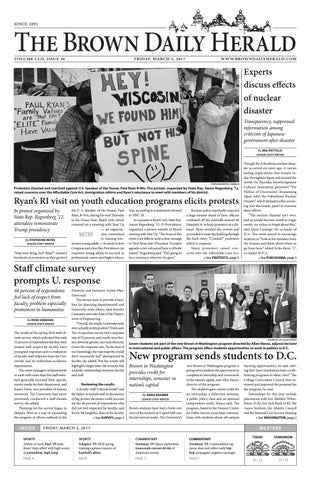
Protesters chanted and marched against U.S. Speaker of the House, Paul Ryan R-Wis. The protest, organized by State Rep. Aaron Regunberg ’12, raised concerns over the Affordable Care Act, immigration reform and Ryan’s reluctance to meet with members of his district.
Ryan’s RI visit on youth education programs elicits protests In protest organized by State Rep. Regunberg ’12, attendees remonstrate Trump presidency By STEPHANIE REYES SENIOR STAFF WRITER
“Stop your lying, lyin’ Ryan!” chanted hundreds of protesters as they greeted
the U. S. Speaker of the House, Paul Ryan, R-Wis, during his visit Thursday to the Ocean State. Ryan’s visit, which centered on a meeting with Year Up — an organization committed to training lowincome young adults — focused on how Congress and cities like Providence can empower young adults to succeed in professional careers and higher educa-
METRO
tion, according to a statement released to NBC 10. In response to Ryan’s visit, State Rep. Aaron Regunberg ’12, D-Providence, organized a protest outside of Ryan’s meeting with Year Up. “The focus of this event is for folks to send a clear message to Paul Ryan that (President Trump’s) agenda is not welcomed here in Rhode Island,” Regunberg said. “He’s going to face resistance wherever he goes.”
Because police reportedly expected a large turnout ahead of time, officers cordoned off the sidewalk around 40 Fountain St. to keep protesters at a distance. Ryan avoided the crowds and proceeded to enter the building through the back entry. “Coward!” protesters yelled in response. Many protesters raised concerns over the Affordable Care Act, » See PROTESTS, page 3
Though the Fukushima nuclear disaster occurred six years ago, it carries lasting implications that remain today throughout Japan and around the world. On Thursday, Brown’s Japanese Cultural Association presented “The Politics of Uncertainty: Reassessing Japan After the Fukushima Nuclear Disaster,” which included a film screening and discussion panel to examine these effects. “The nuclear disaster isn’t over, and as people become numb to tragic events, we refuse to forget about this,” said Akira Camargo ’18, co-leader of JCA. The event aimed to encourage students to “look at the mistakes from the disaster and think about where to go from here,” added Erika Byun ’17, co-leader of JCA. » See FUKUSHIMA, page 3
Staff climate survey prompts U. response 48 percent of respondents feel lack of respect from faculty, problem especially prominent in humanities By ROSE SHEEHAN SENIOR STAFF WRITER
The results of the spring 2016 staff climate survey, which indicated that only 52 percent of respondents felt they were treated with respect by faculty, have prompted responses and re-evaluation of faculty-staff relations from the University and its individual academic departments. The senior managers of departments or units with more than five staff members generally received their specific survey results for their department, said Karen Davis, vice president of human resources. The University had never previously conducted a staff climate survey, she added. Planning for the survey began in January 2016 as a way of measuring the progress of efforts outlined in the
INSIDE
Diversity and Inclusion Action Plan, Davis said. The survey aims to provide a baseline for planning departmental and University-wide efforts, said Jennifer Casasanto, associate dean of the Department of Engineering. “Overall, the results University-wide were actually pretty positive,” Davis said. The 14-question survey had a response rate of 52 percent, and results were broken down by gender, race and ethnicity. Given the response rate, “to the best of our knowledge, the vast majority of staff don’t necessarily feel” disrespected by faculty, she added. But the results still highlight a larger issue: the tensions that underlie relationships between faculty and staff. Reviewing the results A faculty-staff “cultural divide” and the failure to include staff in discussions of big picture decisions could account for the 48 percent of respondents who did not feel respected by faculty, said Kevin McLaughlin, dean of the faculty. » See SURVEY, page 2
COURTESY OF ALLEN HANCE
Seven students are part of the new Brown in Washington program directed by Allen Hance, adjunct lecturer in international and public affairs. The program offers students opportunities to work in politics in D.C.
New program sends students to D.C.
Brown in Washington provides credit for internships, semester in nation’s capital By ANNA KRAMER SENIOR STAFF WRITER
Brown students have had a front-row view of the turmoil on Capitol Hill over the last several weeks. The University’s
new Brown in Washington program is giving seven students the opportunity to complete an internship and coursework in the nation’s capital, said Allen Hance, director of the program. The students gain course credit for an internship, a reflection seminar, a public policy class and an optional independent study, Hance said. The program, based in the Swearer Center for Public Service, arose from conversations with students about off-campus
learning opportunities, he said, adding that “peer institutions have creditbearing programs in other cities.” The College Curriculum Council then reviewed and approved the proposal for the program, he said. Internships for this year include placements with Sen. Sheldon Whitehouse, D-RI, Sen. Jack Reed, D-RI, The Aspen Institute, the Atlantic Council and the National Low Income Housing » See WASHINGTON, page 2
WEATHER
FRIDAY, MARCH 3, 2017
SPORTS Athlete of week Paul ’18 leads Bears’ Heps effort with high scores in pentathlon, high jump
SPORTS Schapiro ’19: MLB spring training captures essence of baseball’s allure
COMMENTARY Steinman ’19: Space exploration transcends current divide of American society
COMMENTARY Friedman ’19: Commodified rap music does not reflect early hiphop, propagates negative messages
PAGE 4
BACK
PAGE 7
PAGE 7
TODAY
TOMORROW
37 / 12
21 / 10
NEWS
PAGE 2 • FRIDAY, MARCH 3, 2017
» WASHINGTON, from page 1 Coalition, Hance said. A donor provided seed funding for the program, said Mathew Johnson, the director of the Swearer Center. The program is funded and paid for as if it were part of study abroad, he added. The program requires an application and is offered only in the spring semester, though the Swearer Center is considering expanding it to include the fall, Hance said. “We are seeking
» SURVEY, from page 1 Different faculty and staff priorities might contribute to staff “feeling a little bit like they’re subordinate to faculty,” McLaughlin said. While staff are focused on the world of the University, faculty are “in a place — intellectually and professionally — that really isn’t at all limited to the campus,” he added. Faculty can be impatient with staff when they are under pressure, in a hurry or expect perfect service immediately, McLaughlin said. Kenneth Silva, physics laboratory manager, said that if he were a new staff member unfamiliar with his position, his interactions with faculty might not feel positive. But, he said, “I’ve been working here for 15 years … so generally my labs are fairly smooth.” In administrative offices and academic departments, “staff people are usually operating at one step in a chain of a longer process and they … don’t have a sense of what the big project is,” McLaughlin said, adding that this could make staff members “feel understandably like they’re not important.” “Faculty and students are really the reason we’re all here,” Davis said. “I think staff sometimes feel they get lost in that equation.” Throughout the University, many staff members “do feel pigeonholed” and deprived of opportunities for
THE BROWN DAILY HERALD
to expand the program to 10 to 12 students” per semester, he added. The Swearer Center tentatively plans to create programs in two to three domestic locations over the next five years, Johnson said. But “the core of (Swearer’s) existence … will always be in Providence,” he added. More than 20 students met with the Swearer Center to express interest in the program for the first semester, Hance said. Given the compressed outreach and application timeline for
its first year, Hance does not feel the Swearer Center has an accurate sense of the demand for the program. “Of all the Swearer programs I’ve been a part of, this has gone the most smoothly,” said Kai Salem ’18, who currently works for Whitehouse in Washington. “It feels very different from anything else I’ve done at Swearer,” she added. Working for Whitehouse is “a complete immersion experience,” Salem said. Other students in the program
echoed her support and appreciation for the experience. Salem identified a few areas that could be improved. Though program leaders suggested they would help in the search for internships, they left that task primarily to students, she said. But Hance said that a program coordinator does help identify internship opportunities for students. The program takes advantage of the University’s “extensive alumni network in D.C. … which has been very helpful,”
he added. Brian Atwood, professor and senior fellow at the Watson Institute for International and Public Affairs, teaches PLCY 1821: “Bilateral and Multilateral Policy and Diplomacy” over video call with students at Brown, Salem said. But it’s often difficult to fully engage and participate in class via camera, she added. In spite of the occasional difficulties, “I’m having so much fun” and “the classes are great,” Salem said.
“advancement” and “cross-training,” said Purvang Patel, member of the Staff Advisory Council and a biology department manager. When staff “approach their managers … they’re often reprimanded,” he added. Staff members could also have a general perception of the faculty as “uncaring” as a whole, but that sentiment might not extend to specific faculty members in their respective departments, McLaughlin said. “If there’s one faculty member in a department who treats people with less respect, people will tend to feel that very intensely, and it will carry over to their feelings about the rest of the faculty,” said Willis Peter Bilderback, brain and neural systems department manager. McLaughlin said that “the level of staff feeling appreciated in the humanities departments was lower than that in other parts of the University.” This discrepancy could be due to the greater amount of collaboration and contact between staff and faculty in STEM departments, who work together on research and in labs, he added. Humanities staff “may feel that there’s a lot of faculty in their department who don’t even know they exist,” McLaughlin said.
address the reasons for the lack of respect some staff perceive. When the staff climate survey was announced, the engineering department was already planning its own staff survey, Casasanto said. “We asked to collaborate and we found a way to add our own engineering questions to the survey because we wanted to dig deeper into inclusion topics,” she added. Eighty percent of respondents from the engineering department indicated that they felt respected by faculty, Casasanto said. Engineering has also since launched four staff recognition awards, Casasanto said. Recipients are nominated by other staff members, faculty and students and receive a small gift donated by the upper management of the department, she added. A sense of disrespect towards staff is specific to some departments, Patel said, adding that the survey results do not reflect his department. Biology tries “to do things that bring staff and faculty together” to promote personal connections and collective decision-making, he said. McLaughlin also suggested inviting staff to meetings hosted by the dean of the faculty so they can get a larger picture of the University’s priorities. Department chairs should make an effort “to team-build and have events that incorporate both faculty and staff,”
Bilderback said. Educating faculty in the proper ways to interact with staff is also vital, he added. Through faculty and staff retreats and team-building exercises, the engineering department encourages faculty and staff members to see themselves as a united group working to overcome the same challenges, Casasanto said. The engineering department hopes to continue to improve its work environment and use the survey data to spark conversations with staff about how such improvements can be made, Casasanto added. With feedback from staff members, the department has already begun to run custom diversity and inclusion trainings that focus on concerns specific to the department, she said. A turnover in department leadership may be necessary to implement changes that would increase a sense of respect among staff, Patel said. Managers who have been at Brown for many years may be insulated and lack input from resources outside the University, he added. The University recently replaced its Management Development program with the new Leadership Certification program, which allows staff to choose their own courses of study as they train for leadership roles, Davis said. The program “teaches you about how to coach employees, how to make them strive for excellence … and how to deal with
different employees,” Patel said. “I would highly recommend it.” The program is currently available to all “newly hired, newly promoted staff ” and can serve 175 to 200 staff members at any one time, she added. A participant must take 12 courses to graduate from the program. The first graduation ceremony took place in fall 2016, Davis said. The University’s performance review program has also been overhauled based on community feedback, Davis said. The revised process, which will be rolled out this spring, should “feel less bureaucratic … and do a better job of supporting a good conversation between an employee and their supervisor,” she added. At a University and departmental level, the results of the staff climate survey are being used to evaluate and make alterations to the various departmental Diversity and Inclusion Action Plans, Davis said. Plans are also underway for more qualitative studies to further explore the survey results, she said, adding that the survey will likely be repeated every two or three years. “It may be that we’ll find an answer (to the root cause of perceived disrespect) that cuts across all employee groups,” Davis said. “But it may be that it does really depend on what your role is at the University, where you work, (and) what your relationship is to faculty.”
Planning a response The University and its departments are aiming to better understand the results of the survey and take steps to
Respect for U. staff members
In a staff climate survey distributed last spring, just over half of University staff members responded that they felt respected by faculty. Brown is a place where staff members are treated with respect by...
STAFF COLLEAGUES 83.0% STUDENTS 69.9% DEPT. HEADS AND SENIOR ADMIN. 66.1% FACULTY 51.9% 0
20
40
60
80
*the overall response rate was 52%
Source: Brown University LAURA FELENSTEIN / HERALD
NEWS
FRIDAY, MARCH 3, 2017 • PAGE 3
THE BROWN DAILY HERALD
MIA PATTILLO / HERALD
The Japanese Cultural Association hosted a film screening and discussion panel last night to highlight the Japanese government’s lack of transparency following the Fukushima disaster.
» FUKUSHIMA, from page 1 The event began with a film screening of “A2-B-C,” a documentary by Ian Thomas Ash, which told the stories of children who were found to have thyroid abnormalities 18 months after the 2011 disaster. Following the screening, a panel answered questions from the audience and JCA about the disaster. Among the panel, two members Skyped-in: Ian Thomas Ash, the film director, and Kono Taro, an active anti-nuclear member of Japan’s House of Representatives. Daniel Aldrich, director of the security and resilience program at Northeastern University, and Kerry Smith, associate professor of history and east Asian studies at Brown, also spoke Thursday evening. Shosuke Hasegawa, an international
» PROTESTS, from page 1 immigration reform and Ryan’s reluctance to meet with local constituents in his district, even as several other Republicans have rallied to do so in their own districts. “He’s refused to hold any town hall meetings in his district in Wisconsin,” Regunberg said. “No matter where he goes or where he runs or hides — the resistance to this agenda is going to
student from Japan who experienced the effects of the disaster firsthand, asked about the overarching movement by the government, hospitals and even teachers attempting to hide information about radioactivity in Japan. “This suppression of information isn’t unique to Japan — it’s simply the way that governments react when something bad happens,” Ash said. “But it does make the Japanese government lose credibility, even six years later.” Aldrich added that the deliberate acts of cover-up — for example, the government’s failure to release radiological data assessment — detrimentally affected citizens who unknowingly fled to areas that still had exposure to radiation. “Knowingly allowing people to evacuate into areas that were more heavily contaminated than where they
began — that’s criminal,” Ash added. The government’s moves to hold back facts and the ramifications of doing so were thoroughly scrutinized in the evening’s question and answer session. “The Japanese nuclear industry has always been corrupt and secretive, and both their and the government’s failure to release information became obvious later on,” Taro said. Panelists said this lack of transparency led many Japanese citizens to doubt the government, scientists and so-called nuclear and medical “experts.” “The disagreement between experts can be quite disconcerting to the public when they typically rely on science for certainty,” Kerry said. He added that the earth science community was deeply cognizant of its failure to provide a satisfying answer as to the after-effects
of the disaster. Beyond the physical dangers posed by the radiation, the emotional and psychological impacts on Japanese citizens have also been largely ignored, even as the increase in “divorce rates, domestic violence, gambling and prostitution since the disaster has shown measurable social impact,” said Aldrich. “The government says no one has died as a direct result, but how can you say that the increase in suicides has nothing to do with the natural disaster?” Ash pointed out. Yet even as these consequences linger, panelists said the Japanese government is still failing to provide adequate help to its endangered citizens, choosing instead to focus their money and resources on other areas such as the 2020 Tokyo Olympics.
“I definitely do see that the government is trying to move attention away from this issue when, in reality, many lives are still emotionally damaged from this event,” Aldrich said. Taro brought up the importance of United States-Japan relations in reprocessing nuclear fields in Japan to remove plutonium, hoping that both governments will “put this issue on the table” in order to stop plutonium preparation by the Japanese nuclear industry. In concluding, Ash expressed hope that people watching his film would consider what would happen if such a disaster occurred in their own country. He reminded the audience of Japan’s outpouring of funding toward the Olympics “when there are people still living in temporary housing in Fukushima six years after the accident.”
follow him.” Marina Dimitrijevic, executive director of the Wisconsin Working Families Party, voiced her support for the Rhode Island protest to The Herald from her home state. “We’ve asked him in Jamesville to have a town hall meeting and nothing is ever scheduled,” Dimitrijevic said. “He’s working on his health care plans to change Medicare, Medicaid and affordable health care, and he refuses to speak directly to his
constituents.” Dimitrijevic added that over 80,000 postcards were sent to Ryan’s district office, and that his staff did not accept them. “He’s leaving Wisconsin — he can’t escape us, and we’re just getting started,” Dimitrijevic said. Regunberg took the House Speaker’s actions as direct threats to Rhode Island principles. “The values that Rhode Island was founded on — religious tolerance, democracy and justice — those
are values that face bigger threats from the Trump/Ryan agenda,” Regunberg said. “It’s important that people get involved.” Though hundreds chanted and marched in defiance of Ryan’s visit, not all Rhode Islanders were supportive of the protest. Austin Rose ’19, treasurer of Brown’s College Republicans, said the protest was ineffective due to the fundamental differences between views held by Ryan and those by President Trump
on topics ranging from tax policy to health care reform. “Anybody who went out (to the protest) with the intention of getting back at Republicans does a lot of damage,” Rose said. “To say ‘Because Trump is elected, now there’s no one left with a rational policy voice on the conservative side’ paints everyone with a bad brush, limits bipartisanship and limits the potential to have middle ground,” he added.
SPORTS
PAGE 4 • FRIDAY, MARCH 3, 2017
THE BROWN DAILY HERALD
ATHLETE OF THE WEEK
Paul ’18.5 leads Bears at Ivy Heptagonal Championships Junior places second in high jump, fourth in pentathlon, collects 11 team points By ALEXANDRA RUSSELL SENIOR STAFF WRITER
After a semester off from Brown to travel and volunteer, Carly Paul ’18.5 has returned to track and field with a vengeance. Paul reintriduced herself to the Ivy Leagye at the conference’s Heptagonal Championships in New York last weekend, at the end of the team’s indoor competition. Paul posted two standout performances in the high jump and pentathlon, placing second and fourth, respectively. After earning a total of 3,618 points in the pentathlon Friday — which consists of the 60-meter hurdles, high jump, shot put, long jump and an 800-meter run — Paul cleared a height of 5-08.00 the following day to take second place in the individual high jump event. Her scores contributed a total of 11 team points to Brown’s total — seven for the high jump and four for the pentathlon. In 2016, she placed eighth in the heptathlon with a total of 4,712 points at the Ivy League Championship and earned runner-up in the javelin throw and third in the high jump at the Brown Springtime Open. She will return to competition Mar. 24-25 at the North Carolina State Raleigh Relays. For her significant point contributions in the high jump and pentathlon at Heps last weekend, Paul is The Herald’s Athlete of the Week. Herald: What were your expectations going into Heps? Paul: I actually just came back from a semester off from Brown — I took a semester off instead of going abroad just to travel and volunteer, and so I’ve only been training for a couple of months. My coach and I went into it with a very “what do we have to lose” mindset, and it ended
up going really, really well. How did your events feel? Did you think that you were on track to place so highly? The pentathlon is a very different thing from other events because you just have to do all-around okay. I knew that throughout the day I had a really strong start in hurdles, and so that gave me a good rhythm for the whole day. I knew that if I did fairly well in all my events, I should end up on the podium in the pentathlon. (For the high jump), I knew my body would be tired the next day, but I went in ranked second, so I knew there was potential for me to get on the podium. But it was only my third time highjumping this season. In high jump, there’s less room for error, whereas in the pentathlon, one thing can go okay and the other things can make up for it, so I knew that I could do enough in every event. How do you prepare yourself mentally for a meet? I used to be more of a superstitious person where I had a very big routine — I would always have the same dinner, have the same breakfast kind of thing, but I tore my ACL when I was a freshman. I had knee surgery and coming back from that I just decided to not make any superstitions, so I just kind of tried to make sure I eat well, make sure I get enough sleep. I don’t really have any silly routines anymore because I think that it can be a barrier, like an excuse. You compete regularly in all of the pentathlon events. Do you have a favorite? Hurdles and high jump are my favorite events. Hurdles is just fun, and high jump is kind of my baby — it’s always been my main event, so I have a very big love-hate relationship with it. I know it so well that it can be the most frustrating to me but it’s also, at the end of the day, my favorite. The 800 is my favorite and biggest challenge — whenever I have
COURTESY OF BROWN ATHLETICS
After taking a semester off, Carly Paul ’18.5 delivered successful performances in the pentathlon and high jump last weekend. The junior will compete again on the Bears’ visit to North Carolina in late March. success in the 800, it has a lot more gravity than other events because it’s definitely the one I’m learning the most. So whenever I have success in that or an improvement, it’s the most gratifying. When did you initially get into the sport? I started doing track in junior high because my mom high-jumped in high school, and because of that, my brother high-jumped in junior high, and because he did it I was like, “I’m going to do it, too!” What’s your go-to meet day
breakfast? If I’m just doing a couple of events, like hurdles and high jump at a normal meet, I try to eat a really big hearty breakfast sandwich — like a bagel with eggs, spinach, sausage and cheese on it. If I’m doing a pentathlon, I basically just try to eat as much as I can possibly eat. So I’ll eat eggs, sausage and toast, and also some yogurt and granola, because you can eat during the pentathlon, but it’s hard. You just have to kind of force yourself to eat, so I try to eat a bunch beforehand.
As a team as a whole, we have the potential to do really, really well. I think by outdoor, people will have things sorted out more and I think (where) we’ll have a lot more potential is scoring higher as a team. Personally, I’d love to PR in all my events, that’s what you always say. I’d really love to PR in the heptathlon and I’m really looking forward to working on javelin again. Last year was my first season, so I was just trying to figure it out. Now, I think that I have some basics, (so) it will be fun to work on it more.
Looking ahead, what are your aims for the upcoming meets?
This interview was edited for length and clarity.
TODAY
FRIDAY, MARCH 3, 2017 • PAGE 5
THE BROWN DAILY HERALD
menu
c r i t i c a l c o n v e r s at i o n s
SATELLITE DINING ANDREWS COMMONS
Pizza: Bacon Alfredo, Harvest, Buffalo Chicken JOSIAH’S
BLUE ROOM
Jambalya, The Isabella Burger, Pizzadilla
Build-Your-Own Burrito Bowl, Chicken Tortilla
DINING HALLS SHARPE REFECTORY LUNCH
DINNER
Beef Rendang With Potato, Portuguese Style Peas, Chocolate Chip Cookies
Orange Teriyaki Haddock, Carrots In Parsley Sauce, Lemon Rice, Apple Squares
VERNEY-WOOLLEY LUNCH
DINNER
Breaded Chicken Fingers, Roasted Tomato Soup, Banana Chocolate Cupcake
Herb Crusted Sole, Braised Rainbow Swiss Chard, Italian White Beans, Pound Cake
sudoku
GUS REED / HERALD
A panel of scholars discussed Palestine and Israel in the context of the current political climate yesterday evening in the Joukowsky Forum. The event was part of Brown’s ongoing ‘Critical Conversations’ series.
Q U O T E O F T H E D AY
RELEASE DATE– Friday, March 2, 2012
Los Angeles Times Daily Crossword Puzzle c rNorris o s sandwJoyce o rNichols d Lewis Edited by Rich
ACROSS 1 Stands 7 Load in a basket 11 Label 14 Busts 15 Potent introduction? 16 Nabokov novel 17 Source of mints, at times 19 With “on” and 59-Across, a hint to the theme hidden in three places in this puzzle 20 7-Across destination, eventually 21 New York City’s __ River 22 Chowderhead 23 They often accompany stretches 25 “I Loves You, Porgy” and others 26 House on TV, e.g. 30 Poker star Hansen 31 River from the Cantabrian Mountains 32 Invasion leaders of the ’60s 39 It prohibits illegal search and seizure 41 The recent past 42 Huit + trois 43 __-Aztecan languages 44 Buyer, in legal usage 46 Love 49 Roundup need 52 Zoom 53 Sub 54 Once and again 59 See 19-Across 60 Subject of a 1922 archaeological discovery 62 Santa __ winds 63 One who often doesn’t pick up? 64 Some chickens 65 Craving 66 Show closers, perhaps 67 Balmoral attraction
DOWN 1 Start of a tots’ song 2 1922 physics Nobelist 3 “__, old chap!” 4 Taj Mahal topper 5 Developmental stage 6 Prescott-toTempe dir. 7 Smith attendee 8 Round up 9 Hissy fit 10 Went underground 11 Attraction near U.S. 395 12 Go with the flow 13 Jenga and jacks 18 Remote letters 22 Broom alternative 24 Prefix with -pod 25 Pair 26 Challenge 27 Clarinet cousin 28 French vineyards 29 Agony 30 Blues and others 33 It’s cut and dried 34 Morph ending 35 Emmy-winning Arthur 36 Provided temporarily
37 Auto designer Ferrari 38 Prank ending 40 Head of Québec 45 Lepidopterous opponent of Godzilla 46 Orderly grouping 47 “Tell It to My Heart” singer Taylor 48 Expanse with crests 49 Reveal
“He’s leaving Wisconsin — he can’t escape us, and we’re just getting started.” — Marina Dimitrijevic, executive director of the Wisconsin Working Families Party
50 Most Syrians 51 Cain was the first 53 Dance with flowing gestures 55 Distance 56 “__ a man with seven wives” 57 Forearm exercise 58 Start of Massachusetts’s motto 60 Medicine amt. 61 “Original, crispy or grilled?” co.
See protests on page 1.
ANSWER TO PREVIOUS PUZZLE:
xwordeditor@aol.com
calendar
03/02/12
FRIDAY MARCH
S
By Frank Virzi (c)2012 Tribune Media Services, Inc.
03/02/12
M
T
W
Th
F
S
1
2
3
4
5
6
7
8
9
10
11
12
13
14
15
16
17
18
19
20
21
22
23
24
25
26
27
28
29
30
31
Brown Bag Concert 12:00 P.M. Sayles Hall
Asian Arts Fest 7:00 P.M. Salomon Center, DECI
SATURDAY Israeli Folk Dancing 7:00 P.M. Hillel Social Hall
Orchestra Concert 8:00 P.M. Sayles Hall
SUNDAY In The Heights 2:00 P.M. Stuart Theatre
The Interview 5:00 P.M. CareerLAB
COMMENTARY PAGE 6 • FRIDAY, MARCH 3, 2017
THE BROWN DAILY HERALD
BROWN BITES
Brown Bites: Feb. 25-Mar. 3 Happy days Kiera Peltz ’16, an independent concentrator in happiness and political science, was selected as one of 36 members of the 2017 class of Gates Cambridge Scholars. Peltz studied the effect American institutions have on general well-being, writing her senior thesis on how research on happiness can be used to influence policy. As a Gates Scholar, she will study at Cambridge University, where her tuition and expenses will be covered. “Obviously now more than ever, (considering) how divisive American politics is, happiness is needed,” Peltz said. Just batty University researchers were involved in a project funded by the National Science Foundation and the United States Air Force Office of Scientific Research to create a robot modeled after a bat. The researchers hoped to emulate the unique ability of bats to fly in tight spaces and quickly change directions. The prototype could eventually be used to navigate confined areas, and its practicalities could include assisting search and rescue missions. To develop the robot, the researchers used a wind tunnel and cameras to study exactly how bats fly. RISD resists recent vandalism RISD students demonstrated opposition to recent incidents of campus vandalism, which included the drawing of a swastika in human feces in an on-campus bathroom the weekend of Feb. 18. There have been multiple incidents of a similar nature on campus in the past year, said RISD first-year Felicita Devlin. The perpetrators of these incidents have not been identified.
D O R O T H Y W I N D HA M
comic Cat Ears | Najatee’ McNeil
New kid on the block Replacing Au Bon Pain at 223 Thayer Street, by CHLOE will open in summer 2017. The eatery boasts an entirely vegan menu while also offering gluten-free, nut-free and soy-free options. By CHLOE will have three new locations in New England, with one already open in Boston and another slated to open there this spring. For now, the Thayer location entices future customers with signs outside reading “Take a study break with by CHLOE,” and “Skip the dining hall.” Your move, Ratty.
Find us online! facebook.com/browndailyherald
browndailyherald.com
@the_herald
Location: 195 Angell St., Providence, R.I. www.browndailyherald.com
@browndailyherald
youtube.com/browndailyherald
Editorial Leadership
Sections
Multimedia & Production
Business
Editor-in-Chief Lauren Aratani
Arts & Culture Editors Julie Center Madison Rivlin
Design Editors Christy Leung Ameer Malik Jessica Yu Assistant: Eduard Muñoz-Suñé
General Managers Henry Ritter Ben Wesner
Managing Editors Matt Brownsword Rebecca Ellis Kate Talerico POST- MAGAZINE Editor Monica Chin
News Editors Kyle Borowski Kasturi Pananjady Suvy Qin Elena Renken Alex Skidmore Hattie Xu
BLOGDAILYHERALD Editor Anica Green
Sports Editors Jackson Chaiken Ben Shumate COMMENTARY Opinions Editors Margaret Hu Anuj Krishnamurthy Mili Mitra
Photo Editors Head: Eli White Assistant: Sam Berube Anita Sheih Sara Runkel Copy Desk Chief Julia Stemmer Multimedia Editor Roland High Illustrations Editor Dorothy Windham Graphics Editor Laura Felenstein Directors of Web Development: Lucy Wei Ivy Wong
Directors Finance: Reena Zhan Sales: Antonia Alvarez Sales: Erin Lueck Strategy: William Nober Strategy: Gianna Jasinski Managers Sales: Elizabeth Doykan Sales: Gabriella Elanbeck Sales: Matilda Lynton Sales: Ariel Shusterman Collections: Ravi Betzig Operations: Gür Ağci
Editorial contact: 401-351-3372 herald@browndailyherald.com
Business contact: 401-351-3260 gm@browndailyherald.com
Submissions: The Brown Daily Herald publishes submissions in the form of op-eds and letters to the editor. Op-eds are typically between 750 and 1000 words, though we will consider submissions between 500 and 1200 words. Letters to the editor should be around 250 words. While letters to the editor respond to an article or column that has appeared in The Herald, op-eds usually prompt new discussions on campus or frame new arguments about current discourse. All submissions to The Herald cannot have been previously published elsewhere (in print or online — including personal blogs and social media), and they must be exclusive to The Herald. Submissions must include no more than two individual authors. If there are more than two original authors, The Herald can acknowledge the authors in a statement at the end of the letter or op-ed, but the byline can only include up to two names. The Herald will not publish submissions authored by groups. The Herald does not publish anonymous submissions. If you feel your circumstances prevent you from submitting an op-ed or letter with your name, please email herald@browndailyherald.com to explain your situation. You can submit op-eds to opinions@browndailyherald.com and letters to letters@browndailyherald.com. When you email your submission, please include (1) your full name, (2) an evening or mobile phone number in case your submission is chosen for publication and (3) any affiliation with Brown University or any institution or organization relevant to the content of your submission. Please send in submissions at least 24 hours in advance of your desired publication date. The Herald only publishes submissions while it is in print. The Herald reserves the right to edit all submissions. If your piece is considered for publication, an editor will contact you to discuss potential changes to your submission. Commentary: The editorial is the majority opinion of the editorial page board of The Brown Daily Herald. The editorial viewpoint does not necessarily reflect the views of The Brown Daily Herald, Inc. Columns, letters and comics reflect the opinions of their authors only. Corrections: The Brown Daily Herald is committed to providing the Brown University community with the most accurate information possible. Corrections may be submitted up to seven calendar days after publication. Advertising: The Brown Daily Herald, Inc. reserves the right to accept or decline any advertisement at its discretion. The Brown Daily Herald, Inc. is a financially independent, nonprofit media organization bringing you The Brown Daily Herald, BlogDailyHerald and Post- Magazine. The Brown Daily Herald has served the Brown University community daily since 1891. It is published Monday through Friday during the academic year, excluding vacations, once during Commencement and once during Orientation by The Brown Daily Herald, Inc. Single copy free for each member of the community. Subscription prices: $200 one year daily, $100 one semester daily. Copyright 2017 by The Brown Daily Herald, Inc. All rights reserved. Periodicals postage paid at Providence, R.I. Postmaster: Please send corrections to P.O. Box 2538, Providence, RI 02906.
COMMENTARY FRIDAY, MARCH 3, 2017 • PAGE 7
THE BROWN DAILY HERALD
A new hope CLARE STEINMAN staff columnist
With last week’s groundbreaking discovery of seven Earth-sized planets just 40 light-years away, I felt a familiar feeling: the sense of exhilaration and wonder that only outer space can provide. Growing up, I was fascinated by outer space and readily answered “astronaut” whenever I was asked what I wanted to be when I grew up. Today I’ve adjusted those expectations slightly, but this discovery reminded me how extraordinary space exploration is and how refreshing it is to live for a while with a broadened, galactic perspective. Of these seven planets, which orbit a star called TRAPPIST-1, three are in what is known as the “habitable zone,” or the appropriate distance from their sun to theoretically have liquid water, and perhaps even life. These planets are rocky, like Earth, but the similarities stop there. They are so close to the star that their years are between 1.5 and 13 days long, and might even be in tidal lock, the way the moon is to the Earth, with one side always facing the sun and one always away. Yet there remains a strong possibility that these planets, due to
their proximity to us, will be our first good chance to find life outside the solar system, or at least to closely study other Earth-like planets. It seems likely that the discovery of the TRAPPIST-1 planets will be remembered retrospectively as a milestone in exoplanet research, if not this year or next, then 40 or 50 years down the road. It’s a refreshing break from the constant barrage
once a unifying force in this country. In “Hillbilly Elegy,” his bestselling memoir about growing up poor in rural America, J.D. Vance links the end of the space race era to the general feeling of isolation among working-class whites, writing, “As a culture, we had no heroes … The space program, long a source of pride, had gone the way of the dodo, and with it the celebrity
photographs of Earth from space reminded humanity that, no matter our differences, we are all united on a pale blue dot. At its peak in 1966, NASA represented 4.41 percent of U.S. federal spending. By 2015 that number is estimated to have fallen almost 90 percent to 0.47 percent of the budget. Maybe there’s no truly compelling reason for the federal
If life is found on the TRAPPIST-1 planets, changing the way in which we view our entire universe, then the truly important news of 2017 might even have nothing to do with President Trump.
of anxiety-inducing news to think about a story that will have positive ramifications long beyond the next four years. If life is found on these planets, changing the way we view our entire universe, then the truly important news of 2017 might have nothing to do with President Trump. There is a deep irony to this. The exploration of the final frontier was
astronauts. Nothing united us with the core fabric of American society.” Whatever once divided us seemed small when put on the level of lightyears and astronomical units. The space race — geopolitical implications aside — was nonpartisan and attention-grabbing, simultaneously emblematic of American primacy and the achievement of humans. Awe-inspiring, perspective-shifting
government to spend such exorbitant amounts on space research and travel (after all, 4.41 percent of the budget is more than we spend today on veterans, agriculture, education or transportation). But the 50-year decline of the space program has come in conjunction with an erosion of American unity and identity, and, like Vance, I am confident the two are interrelated. Every day pri-
vate sector space travel comes closer and closer to becoming a reality, with Elon Musk’s company SpaceX announcing on Monday that they plan to send two tourists in orbit around the moon by next year. But while all space travel is exciting, it is considerably harder to find the same pride in a corporation’s accomplishments as it is in your own nation’s. The TRAPPIST-1 planets, whether or not they have life or liquid water, will outlive the United States of America and all of planet Earth by about 9,995,000,000,000 years. When our sun dies, theirs will still be in its infancy. To be sure, this is depressing, but it is also one of the most compelling reasons to study the universe beyond us. In the words of Randall Munroe, the cartoonist and former NASA engineer, “The universe is probably littered with the one-planet graves of cultures which made the sensible economic decision that there’s no good reason to go into space — each discovered, studied and remembered by the ones who made the irrational decision.” This week’s news was a small taste of what might be out there, as long as we are motivated to keep looking.
Clare Steinman ’19 can be reached at clare_steinman@brown.edu.
Dancing to the right tune ANDREW FRIEDMAN staff columnist Upon walking into the V-Dub for breakfast last week, I was disappointed to hear Migos’ new song “Kelly Price” blaring from the omelet station. The refrain of the song essentially encourages “getting drugs for the right price.” My experience with public spaces at Brown — the Nelson, the dining halls, the mail room, the Zucconi Varsity Center, Marston Boathouse, even Perkins’ hallways in the afternoon — unfortunately has been inundated by heavy doses of base and vulgar lyrics from hip-hop songs. Of course, hip-hop hasn’t always featured these kinds of lyrics: hip-hop has served as a powerful avenue for self-expression and has led to social change and government reform. In fact, the commodification of the genre of hip-hop at the hands of predominantly white music executives has cheapened the political and social power of the genre; as students we ought to be aware of the cheapened quality of rap music we consume and how we can become desensitized to its messages of violence and misogyny. While Migos songs frequently discuss drugs, Big Sean songs deal with sex: “Knew that ass was real, when I hit it bounce back,” and as one can observe from a music video featuring Future and producer Hudson Mohawke, Future can’t freestyle over any beat without saying “we poppin’ bottles, we smokin’ kush.” Don’t get me wrong, I do enjoy listening to trashy lyrics from time to time, but the popularity of this “trap” or “gangsta hip-hop” music has made my days into somewhat of a daily onslaught of degenerate messages.
It is difficult to deny the popularity of this sort of hip-hop at Brown and among young listeners across the country. Twenty-four percent of the songs on the Billboard Top 50 are hip-hop records. According to a 2011 study by Statista, hip-hop is the “most-liked” music genre among college students on Facebook. Brown invited Young Thug to headline Spring Weekend this April after booking Fetty Wap to headline last year. The supremacy of hip-hop’s recently rede-
urban, working-class African Americans — and it has roots in the “African oral tradition.” But its core message has been cheapened at the hands of white corporate America as young rappers have been pressured to take on new, more marketable personas through their music. As journalist Christopher Farley wrote in Time, “rap’s commodification has also disenfranchised it as a form of resistance.” The violence frequently depicted in earlier rap mu-
But these artists aren’t pushing anything revolutionary, and by choosing to book artists like these we are supporting commodified music at the expense of hip-hop that more accurately reflects the struggles of the black artists who created it.
fined “trap” and “gangsta” offshoots, relative to other genres, is indisputable. This isn’t necessarily a bad thing. But, on the whole, the music these artists produce represents an aboutface from hip-hop’s more authentic traditions. When we book artists like these, we choose to support commodified music at the expense of hip-hop that more accurately reflects the struggles of the black artists who created the genre. Hip-hop was conceived as a voice for an “otherwise underrepresented group” — young,
sic can actually be viewed a symptom, rather than a cause, of America’s urban problems and a manifestation of America’s culture of “conquest, rebellion and bloodshed.” Rap’s current struggle for cultural legitimacy is a far-reaching consequence of the genre’s sequestration from the community in which it originated. Rap has been “repackaged by money-minded businesspeople looking to create a wider appeal by erasing hip-hop’s historic function” and “sold back to the streets through marketing ploys such as
music videos and Top-40 charts.” Indeed, Top40 hip-hop may be the biggest cause of hollow hip-hop. Today, the lyrics in rap music convey violent and sexist messages. Researchers at Elon University found that many rap songs are guilty of “graphic derogatory presentations of women using lyrics that objectify, exploit or victimize them.” And, according to a 2011 paper in the Journal of Black Studies, rap music “ultimately supports, justifies, instills and perpetuates ideas, values, beliefs and stereotypes that debase women.” These ideas can distort our understanding of normal gender relations; the same study reports that “more than half of a sample of young educated adult males agreed that rap accurately reflects at least some of the reality of gender relations between black male and females.” The increasing popularity of rap music can legitimize misogynistic messages that the genre frequently promotes. Perhaps today’s hip-hop music truly represents the zeitgeist or spirit of the times; perhaps the music profoundly illustrates exactly the kind of lifestyle that we, as ambitious college students, are hoping to one day achieve. If so, this may also represent an attempt by young people to appropriate the genre and distort the messages it contains to suit our own needs. We, as college students, ought to be more aware of the messages we consume on a daily basis. We must remember that when we listen to bad hiphop, we simultaneously fund its future production and squelch the better artists of the genre. Hip-hop is a cultural cornerstone of the black cultural experience in America, and contemporary hip-hop does not do justice to these roots.
Andrew Friedman ’19 can be reached at andrew_friedman@brown.edu.
SPORTS THE BROWN DAILY HERALD
FRIDAY, MARCH 3, 2017
The sun shines on baseball JAMES SCHAPIRO sports columnist In Fort Myers, Fla., the winter is over, and signs of the summer ahead have already appeared. In Scottsdale, Arizona, shopkeepers and restaurant owners are in the first days of a month of frantic excitement. And in Port St. Lucie, Florida, a small town has welcomed back its favorite long-time residents for another year. These three cities, along with 19 others, are participating in the annual American ritual that is MLB’s spring training. And across the country, millions of fans are doing the same. Slowly but surely, baseball’s offseason is receding; the darkest period has ended, and now we are in the home stretch. Espousing my love for spring training, as I do every year around this time, I inevitably come across someone who simply is not as enthusiastic about it as I am. “Why do you care?” they’ll say. Or, “It doesn’t count for anything, it’s meaningless.” Or, worst of all: “There’s no reason to get excited about it.” Spring training — that is, the practice among MLB teams of spending a month or so in warmer climes, preparing for an upcoming season — began taking hold in the 1890s. By 1910, it was a widely established and accepted practice. It was already an annual phenomenon that Americans got excited about — so much so that in the 1912 book, “Pitching In A Pinch,” Christy Mathewson, legendary pitcher for the New York Giants, devoted an entire chapter to stories from spring training. It is nearly as old as modern organized baseball itself, and since 1912 it has only gotten better. Why do I place so much emphasis on the level of excitement and
awareness that spring training generates? Simply to note that if it’s really so meaningless and if there is really no reason to get excited, you’d think everyone who gets excited about it would have figured that out by now. But they haven’t, of course, be-
makes baseball great. Spring training is warm, sunny days, ice cream in the stands, autographs over fences, picnics in the outfield. Spring training is games that do not count but are all the more fun because of it, two teams made up of players who do not
together for the first time. Everything that happens from April to November — the wild walk-off wins, the diving catches, the complete-game shutouts, the rookie who comes out of nowhere to become a star — starts down in Florida and Arizona in February.
cause they’re right. When spring training begins, there is everything to be excited about. The regular season is right down the road, for one, but even beyond that, there’s a lot to like about spring training itself. Spring training is everything that
mind the outcome one way or another but just want to have some fun. Spring training is first looks at promising rookies, tenth looks at beloved veterans and, when you put them all together, a new look at a new team. In Spring training, your team comes
Even the way spring training is covered is part of its allure. There’s no 24/7 news channel, no live stream, often not even a TV broadcast. Often, all we get are a few pictures a day of teams and players alike, stretching out under the sun or doing the same
ground ball drills we all used to do in Little League. We see players laughing, talking, relaxing, smiling. Baseball players are human, but over a long season, this is sometimes forgotten. During spring training, it’s on full display. Now, none of this should be construed as claiming that spring training is preferable to the regular season — it’s not. On the first day ofspring training, everything gets a little bit better; on Opening Day, the world is right once again. Spring training is a lovely prelude, but a prelude is all it is. The regular season is where baseball stands out, where it earns its title as the national pastime. For the truest of baseball fans, the regular season, April through October, is the best time of the year. Then there’s the postseason and spring training; spring training, theoretically, could be as low as third in the baseball importance rankings. But either way, the second or third best part of the greatest game in the world? That’s not too shabby. Spring training games have already begun, and soon, things start to move. The days get longer and warmer, the games get more important, and the regular season roster begins to take shape. And before you know it, there’s a week left until Opening Day, and you are agonizing over every minute that passes, counting down the seconds until baseball begins again. Well, that’s what I will be doing, anyway. I don’t know about you. But either way, one thing is clear: The long dark winter of our discontent is over. From now through late October, baseball is back, and the world is happy once again.
James Schapiro ’19 can be reached at James_Schapiro@brown.edu.
Red Sox’ bullpen is team’s most attractive asset CHARLIE BLASBERG sports columnist After they were swept in last fall’s American League Division Series, the Boston Red Sox have reported to Fort Myers, Florida for spring training. Expectations for this year’s team have been soaring with the return of last season’s Cy Young Award winner, Rick Porcello, and MVP runnerup, Mookie Betts. While the Red Sox were the offensive leader in almost every category last season, the front office traded for five-time All-Star pitcher Chris Sale, giving the Red Sox three aces in their starting pitching staff in Sale, Porcello and David Price to complement their offense. Despite the Sox’ potent offensive weapons
and starting pitchers, their greatest strength lies in their bullpen. Great pitching wins championships. As baseball evolves, though, less of that pitching needs to come from the starter, while the bullpen takes on a much heavier role, both eating up innings to get the team through the season and shutting down opposing offenses in tight, lategame situations. The Red Sox have a history of overlooking their bullpen needs and having bad luck with the relievers they do get. Often, the Red Sox pass up good relievers for power-hitting righties who have the right swing to hit balls over Fenway’s Green Monster. These acquisitions, like Wily Mo Peña and Yoenis Céspedes, rarely pan out, as the hitters often get too pullhappy and stop hitting for average. In the bullpen last season, the Red Sox got unlucky with the two reliev-
ers they acquired in Carson Smith and Craig Kimbrel. Smith needed seasonending Tommy John surgery just one month into the campaign and Kimbrel was ineffective for a large portion of last season due to knee issues. This increased the load for the other pitchers and took a toll toward the end of the season. The outlook for the Red Sox’ bullpen this season is positive. With Kimbrel — who is now healthy — Joe Kelly and Matt Barnes, they have three pitchers who consistently throw in the high 90s. When Smith returns to the field — probably in June — the Sox will have three quality lefties in the bullpen with Smith, Fernando Abad and Robby Scott. This simply gives the team more options and favorable matchups in close-game situations. There are a few key offseason events that led to this year’s bullpen
looking so promising. First, Kelly has fully transitioned from a starter to a reliever. Last season, Kelly’s role with the team was in limbo as he spent a chunk of time in the minor leagues with the Red Sox’ AAA team, Pawtucket, as a starter. But late in the season, the team’s needs took him from Pawtucket to the Boston bullpen. Although he was a reliable bullpen arm, his midseason transition left a lot of room for error in managing him. Another major improvement to the bullpen will be Kimbrel’s recovery. He came to the Red Sox in a blockbuster trade but struggled to get quick outs, especially in non-save situations. He was on the disabled list for about a month in July after knee surgery, and he may have come back too early, as his confidence and command often wavered. The offseason gave Kimbrel a chance to fully recover, and reports
Follow Sports! twitter.com/bdh_sports
from spring training indicate that he is healthy and throwing confidently again. The third key event was the acquisition of Tyler Thornburg from the Milwaukee Brewers. The promising, young pitcher who can handle a hefty workload was a footnote in the offseason that brought in Sale, but his arrival eases the job for the other relievers while giving American League opponents a look that they are unfamiliar with. While the media likes to focus on the stars, like Mookie Betts and Chris Sale, the Red Sox’ relief pitchers may be the players who make the difference between playoff appearances and playoff victories.
Charlie Blasberg ’18 can be reached at Charles_Blasberg@brown.edu.