SINCE 1891
THE BROWN DAILY HERALD FRIDAY, MARCH 10, 2017
VOLUME CLII, ISSUE 31
WWW.BROWNDAILYHERALD.COM
U. releases first DIAP progress report Nonprofit ‘Choices’ emphasizes Report highlights increase in faculty, grad applicants to U. from historically underrepresented groups By RHAIME KIM AND PRIYANKA PODUGU
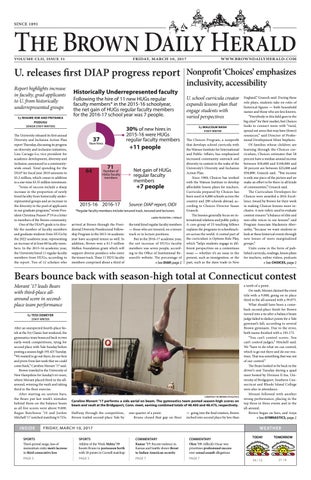
Historically Underrepresented faculty Following the hire of 11 new HUGs regular faculty members* in the 2015-16 schoolyear, the net gain of HUGs regular faculty members for the 2016-17 school year was 7 people.
SENIOR STAFF WRITERS
The University released its first annual Diversity and Inclusion Action Plan report Thursday, discussing its progress on diversity and inclusion initiatives, Liza Cariaga-Lo, vice president for academic development, diversity and inclusion, announced in a communitywide email. Total spending for the DIAP for fiscal year 2018 amounts to $5.2 million, which comes in addition to a one-time $3.35 million investment. “Areas of success include a sharp increase in the proportion of newly hired faculty from historically underrepresented groups and an increase in the diversity in the pool of applicants to our graduate programs,” wrote President Christina Paxson P’19 in a letter to members of the Brown community. One of the DIAP’s goals is to double the number of faculty members and graduate students from HUGs by the 2022 academic year, representing an increase of at least 60 faculty members. In the 2015-16 academic year, the University hired 11 regular faculty members from HUGs, according to the report. Two of 12 scholars who
30% of new hires in
2015-16 were HUGs regular faculty members
37
New hires
64
+11 people 71
Number of HUGs faculty members
Net gain of HUGs regular faculty members
+7 people
2015-16 2016-17
Source: DIAP report, OIDI
*Regular faculty members include tenured track, tenured and lecturers LAURA FELENSTEIN / HERALD
arrived at Brown through the Presidential Diversity Postdoctoral Fellowship Program in the 2015-16 academic year have accepted tenure as well. In addition, Brown won a $1.5 million Mellon Foundation grant which will support diverse postdocs who enter the tenure track. These 11 HUG faculty members comprised about a third of
the total hired regular faculty members — those who are tenured, on a tenure track or in lecture positions. But in the 2016-17 academic year, the net increase of HUGs faculty members was seven people, according to the Office of Institutional Research’s website. The percentage of » See DIAP, page 2
inclusivity, accessibility U. school curricula creator expands lessons plan that engage students with varied perspectives By MALCOLM NASH STAFF WRITER
The Choices Program, a nonprofit that develops school curricula with the Watson Institute for International and Public Affairs, has emphasized increased community outreach and diversity in content in the wake of the University’s Diversity and Inclusion Action Plan. Since 1988, Choices has worked with the Watson Institute to develop affordable lesson plans for teachers. Curricula prepared by Choices has been used in 8,000 schools across the country and 200 schools abroad, according to Choices Director Susan Graseck. The lessons generally focus on international relations and public policy. A core group of 25 teaching fellows explains the programs to schoolteachers across the world. A central part of the curriculum is Options Role Play, which “helps students engage in different perspectives on a contentious issue — whether it’s an issue in the present, such as immigration, or the past, such as the slave trade in New
England,” Graseck said. During these role plays, students take on roles of historical figures — both household names and those who are less known. “Everybody in this field goes to the big cities” for their market, but Choices looks to connect more with “rural, spread out areas that may have (fewer) resources,” said Director of Professional Development Mimi Stephens. Of families whose children are learning through the Choices curriculum, Choices estimates that 58 percent have a median annual income between $50,000 and $100,000 and 30 percent are between $25,000 and $50,000. Graseck said. “But income is only one piece of the picture and we make an effort to be there in all kinds of communities,” Graseck said. The Curriculum Developers for Choices were awarded a 2016 Excellence Award by Brown for their work in making Choices lessons more inclusive. A new rubric used to evaluate content ensures “a balance of elite and non-elite voices in our lessons” said Program Associate Mackenzie Abernethy, “because we want students to look at these historical events through new lenses of more marginalized groups.” Units come in the form of published curricula, readings, lesson plans for teachers, online videos, podcasts » See CHOICES, page 2
Bears bounce back with season-high total at Connecticut contest
Morant ’17 leads Bears with third-place allaround score in secondplace team performance By TESS DEMEYER STAFF WRITER
After an unexpected fourth-place finish at the Ivy Classic last weekend, the gymnastics team bounced back in two early-week competitions, tying for second place with Yale Sunday before posting a season-high 193.425 Tuesday. “We wanted to go out there, do our best and prove from last week that we could come back,” Caroline Morant ’17 said. Brown traveled to the University of New Hampshire for Sunday’s tri-meet, where Morant placed third in the allaround, winning the vault and taking third in the floor exercise. After starting on uneven bars, the Bears put last week’s mistakes behind them on the balance beam as all five scores were above 9.600. Regan Butchness ’18 and Jorden Mitchell ’17 notched matching 9.725s.
INSIDE
COURTESY OF BROWN ATHLETICS
Caroline Morant ’17 performs a side aerial on beam. The gymnastics team posted season-high scores on beam and vault at the Bridgeport, Conn. meet, earning combined totals of 48.400 and 48.475, respectively. Halfway through the competition, Brown trailed second-place Yale by
one-quarter of a point. Bruno closed that gap on floor
— going into the final rotation, Brown inched into second place by less than
a tenth of a point. On vault, Morant claimed the event title with a 9.800, going on to place third in the all-around with a 39.075. What should have been a comeback second-place finish for Brown turned into a tie after a balance beam judge failed to deduct points for a Yale gymnast’s fall, according to several Brown gymnasts. Due to the error, both teams finished with a 193.175. “You can’t control scores. You can’t control judges,” Mitchell said. We “have to do what we can control, which is go out there and do our routines. That was something that was out of our control.” The Bears looked to be back in the driver’s seat Tuesday during a quad meet hosted by Division II foe, University of Bridgeport. Southern Connecticut and Rhode Island College were also in attendance. Morant followed with another strong performance, placing in the top three in three events and in the all-around. Brown began on bars, and Anya » See GYMNASTICS, page 2
WEATHER
FRIDAY, MARCH 10, 2017
SPORTS Third-period surge, loss of momentum sinks men’s lacrosse in third consecutive loss
SPORTS Athlete of the Week Mehta ’19 boosts Bruno to postseason berth with 28 points in Cornell matchup
COMMENTARY Kumar ’17: Recent violence in Kansas and Seattle shows threat to Indian-American security
COMMENTARY Okin ’19: Affleck’s Oscar win prioritizes professional success over sexual assault allegations
PAGE 3
PAGE 3
PAGE 7
PAGE 7
TODAY
TOMORROW
34 / 12
21 / 8
NEWS
PAGE 2 • FRIDAY, MARCH 10, 2017
THE BROWN DAILY HERALD
Brown at UNH (3/5)
Uneven bars
1. Morant 9.800 2. Ryan 9.750 3. Rudd 9.625
Balance Beam
1. Mitchell 9.725 2. Butchness 9.750 3. Ryan 9.650
» GYMNASTICS, from page 1
BEN SHUMATE / HERALD
Olson ’18 stuck her double back tuck dismount to earn a 9.700 and third place. After a team pep talk, Bruno attacked beam with a newfound confidence, scoring a season-high 48.800. Morant received a 9.850 to nab second place, and Mitchell scored a solid 9.800 to close out the second rotation. At the competition’s midpoint, it looked as though Bridgeport and Southern Connecticut would claim the top two spots, but the rankings changed swiftly as Brown took the floor. Sky-high tumbling passes and clean split leaps earned Morant a 9.875 and a tie for third. After three events, Brown sat in second with a
and graduate students from HUGs. The authors also recommended conducting a survey on campus accessibility. “Disability is a major blind spot,” the authors wrote. They addressed the need for greater unity amongst departmental DIAPs and a more consistent definition of HUGs. The Corporation committee on Diversity and Inclusion stressed the need for “broad participation in the creation of departmental DIAPs,” Paxson wrote. Concerns that faculty members from HUGs within their respective departments bear the brunt of diversity and inclusion efforts have been raised during the creation of the DDIAPs. One way the University is attempting to increase community participation in diversity and inclusion efforts is through the undergraduate curriculum. The DIAP aims to double the offerings of first-year and sophomore seminars centered around topics like “power, privilege, inequality and social justice.” According to the report’s findings, the University managed to
increase the number of offered Diverse Perspectives in Liberal Learning seminars in both class years. In the 2015-16 academic year, 13 percent of first-year seminar courses bore a DPLL designation while 29 percent of sophomore seminars were labeled DPLL. However, for the 2016-2017 academic year, 21 percent of FYS courses and 50 percent of sophomore seminars were listed as DPLL. The University has hosted talks this year to help students “become more knowledgeable about social justice issues … (and) through the curriculum you can have a formal way (of doing that),” said Arely Diaz ’17. “I thought that the (inclusion) of curriculum was very important.” The report also made mention of the opening of the First-Generation and Low-Income Student Center in September 2016 and the search for its director, which is currently underway. The center, which is located on the fifth floor of the Sciences Library, contains “two to three offices … and (the students) also have to share that space
Vault
Floor
1. Morant 9. 800 2. Mitchell 9.750 3. Ryan 9.650
1. Morant 9. 800 2. Christman 9.575 3. Olson 9.555
Brown at Springfield (3/7)
Uneven bars
1. Olson 9.700 2. Ryan 9.650 3. Mitchell 9.625
Balance Beam 1. Morant 9.800 2. Mitchell 9.750 3. Green 9.750
Floor
Vault
1. Morant 9. 875 2. Olson 9.750 3. Green 9.650
1. Morant 9. 775 2. Mitchell 9.725 3. Green 9.675 Source: Brown Athletics
» DIAP, from page 1 HUGs faculty remained flat between the 2015-16 and 2016-17 academic years at 9 percent. But the number of faculty from HUGs increased by 1 percent from the 2014-15 to 2015-16 academic year. “Diversification of the staff workforce at all levels and across all job types remains a top priority” for the University, according to the report. This includes mentorship and support for staff members from HUGs and creating hiring guidelines and outreach efforts to recruit staff members from HUGs, especially for higher pay grade levels. The University also implemented its pilot professional development workshops for administrative fellows in January 2017. The graduate school is far from the DIAP’s goal of doubling the number of students from HUGs by 2022, according to the report. The percentage of graduate students from HUGs has remained around 9 percent between 2012 and 2015, according to
the report. In 2015, the proportion of medical students from HUGs dipped slightly, especially for African American males. Early decision statistics for the class of 2021 were also highlighted in the report. For example, 13 percent of early admits are first-generation students, of whom 50 percent are from HUGs. Members of the Diversity and Inclusion Oversight Board, which is charged with overseeing the implementation of the DIAP, wrote suggestions emphasizing the need for better data in a memo addressed to Paxson and Provost Richard Locke. The memo was signed by 14 members of the DIOB that include faculty members, staff members and students. Members of the DIOB will be reappointed on a yearly basis “given that the board cannot represent the full diversity of the University in any one year,” Paxson wrote. Possible areas of improvement include expanding Counseling and Psychological Services resources and support for untenured faculty members
comfortable lead of more than two points over third-place Southern Connecticut. A season-high 48.475 on vault guaranteed a second-place finish over Southern Connecticut and Rhode Island College. Morant and Mitchell finished second and third on the event with scores of 9.775 and 9.725, respectively. The pair also tied for third in the all-around with 38.625s. “It was so exhilarating to watch all the girls before you go and nail it —just knowing that your teammates are there for you,” Mitchell said. The Bears hope to maintain this energy as they compete on the road one last time at Springfield Saturday before hosting the ECAC Championship on March 18. with classes … or other students that come to study that might not identify as first-gen or low-income,” Diaz said. “While it is progress, it definitely is not enough. … If you start accepting more students that are first-gen, lowincome, as (University administrators) claim they are doing, … that means needing more space and needing more resources.” Diaz also noted that while the report mentioned supporting undocumented students, it made no mention of how that support would continue into the future. “That’s kind of worrying … that makes me think that there isn’t going to be any support.” “The entire report is a way to hold the university accountable, … and, even though there are a few holes,” it’s still progress, she added. “In year one, I think the University made significant but very early progress,” said Brain Clark, director of news and editorial development. Though “there’s a tremendous amount of work to be done in the years ahead.”
COURTESY OF SUSAN GRASECK
» CHOICES, from page 1
www.browndailyherald.com
and more. Topics range from the American Revolution and President Trump’s inaugural address to an upcoming unit on the History of Nigeria. Each unit costs an average of $40, which is roughly half the price of the industry standard, according to Graseck. “We’ve wanted this to be so affordable” that teachers could even buy it
themselves if their “school(s) won’t buy it,” said Curriculum Development Director Andrew Blackadar. Over the last four years, sales of Choices program material have “doubled,” as sales following the 9/11 attacks and leading up to the 2016 presidential election have spiked, Graseck said. Going forward, Choices will continue to help give voices to underrepresented groups of all opinions across the globe using “a system we’ve created
that so far, especially using the rubric, has had a real effect on the content that we produce,” said Assistant Director of Curriculum Development Susannah Bechtel. “The process of working with DIAP didn’t necessarily change us — those are values that we’ve had for a long time,” Blackadar said. “But it helped us take time to think about and become more systematic about inclusivity.”
SPORTS
FRIDAY, MARCH 10, 2017 • PAGE 3
THE BROWN DAILY HERALD
M. LACROSSE
Villanova’s third-quarter run downs men’s lacrosse Luke McCaleb ’20 leads Bears with five goals, one assist in midweek nonconference loss By NICHOLAS WEY SENIOR STAFF WRITER
Heading into its final non-conference game against Villanova Tuesday, the men’s lacrosse team looked to bounce back from consecutive losses and gain momentum before beginning Ivy League play Mar. 18. Despite keeping the game close throughout most of the contest, Bruno (1-3) could not recover after conceding seven goals in the third quarter and fell to the Wildcats 17-15. “We were disappointed with the result against Rutgers,” said Jack Kniffin ’20, who currently ranks second on the team in scoring. “We wanted to come out strong against Villanova and pull out a win.” Villanova (2-4) struck first. Despite the Bears winning the opening face-off, the Wildcats made the most out of a turnover by co-Captain and 2016 All-American Dylan Molloy ’17. Villanova took over possession and scored on its third shot on goal with 12:54 on the clock. The Wildcats then won the ensuing faceoff and again capitalized, with Kurtis Naslonski rifling a shot past Bruno’s first-year goalie, Phil Goss ’20, just 14 seconds later. But the Bears fought back in the first period, with two goals apiece from attackmen Steve Hudak ’18 and Luke McCaleb ’20 and another from Michael Panepinto ’19. After
this 5-1 run, Bruno took a three-goal lead heading into the end of the first. During the stretch, Molloy also dealt two assists. In the second quarter, Villanova’s attack rallied. Despite Brown winning nine of nine faceoffs, the Wildcats responded with a 5-3 run of their own to tie the game at eight going into halftime. Villanova took 19 shots on goal to the Bears’ nine and only committed two turnovers to the Bears’ six. “We came out pretty well,” Kniffin said. “If we can play the full 60 minutes like we did at the start and end of the game, we will put ourselves in a better position to win some games.” Villanova’s offense continued to roll in the third period. The Bears opened up scoring in the second half after Molloy beat Nick Testa with an unassisted goal. But Villanova answered, tying the game at nine with 11:37 to go before going on a 6-2 run to bring the score to 15-11 heading into the final period. The Bears struggled to come back from this momentum swing. Jack Curran increased the Wildcats’ lead to five with 12 minutes remaining, a deficit that proved insurmountable for Bruno. With 4:32 left, McCaleb cut into Villanova’s lead with his fifth goal of the game and then assisted midfielder Matt Graham ’17 a minute later for a score. As the clock wound down, the Bears could not overcome the two-goal deficit, as the Wildcats drained the clock with under a minute to go after winning the final faceoff. “We hustled and competed throughout the whole game,” Hudak said, who notched his second career hat trick in the contest. “Our team is
ELI WHITE / HERALD
The men’s lacrosse team was unable to maintain its goal-scoring momentum in a non-conference matchup against Villanova Tuesday, falling to a record of 1-3. Bruno will open conference play Saturday against Harvard. going to continue to work hard every day in practice and just focus on continuing to get better each day.” Kniffin noted that the team has room for improvement of “fundamentals.” “If we can eliminate unnecessary mistakes from our game, we will definitely be in a better position for
success,” Kniffin said. “We have a solid break coming up with no games this weekend. We will definitely look at the film and identify weaknesses in our play.” The Bears continue their season Saturday with their first conference game of the year against Harvard. Last year, Brown played the Crimson on
two occasions — once in the regular season, an 11-8 victory, and then again in a 13-12 loss in the semi-final of the Ivy League Tournament. “We are very excited for Ivy League play to begin,” Hudak said. “We are making strides in the right direction toward becoming the team we know we can be.”
ATHLETE OF THE WEEK
Mehta ’19 powers Bears to postseason Ivy League Tournament berth Guard averages fourthmost conference points per game in her postseason debut Saturday By CAL BARASH-DAVID SENIOR STAFF WRITER
With the season on the line, the women’s basketball team entered the final week of Ivy League play knowing it had to win both of its remaining contests to keep its postseason hopes alive. The Bears responded to the challenge and beat both Columbia and Cornell by double digits. Bruno was powered by Shayna Mehta ’19. The sophomore guard tallied a double-double in the win against the Lions, and then dropped 28 points in the following day’s game against the Big Red. Her performances helped send the Bears to the Ivy League Tournament this weekend in Philadelphia. Mehta averaged the fourth-most points per game in the Ivy League during the regular season, notching 15 points per contest. She also swiped the second-most steals and dished out the fifth-most assists in the conference this year. For her efforts, Mehta has been selected as The Herald’s athlete of the week. The Herald: How did it feel to
score 28 points in the final game of the regular season? Mehta: It was cool to be able to do it then. During the game, I wasn’t even thinking about it. The crowd was so loud — it was their senior night — I didn’t even know how many points I had because they didn’t have a scoreboard (that displayed individual points) or anything. But it was awesome to be able to come out for my team and get the W. What’s the team’s attitude going into the tournament? We’re all super pumped. We know we can beat Penn — it’s hard for a team to beat another team three times in a row. We lost to Penn last time by three … so we’re all so excited. Yesterday during practice, (Athletic Director) Jack Hayes came to our locker room and congratulated us.
wear his number. He’s an undersized guard. He came into the league very small, and I think people around the league have also said I was small and undersized. But I can shoot, and I think Steph can, too. I think we have similar games — that’s why I like to wear number 30. Do you do the Steph warm-up before a game? I have done it. We don’t do them at practice, but over the summer I would try to do the Steph warm-up. Do you have any siblings? I have a younger sister (Nina Mehta). She plays basketball and she’s actually going to come here when I’m a senior for basketball.
Did you always know that basketball was your main sport? Not always … I used to love soccer but I grew up in a sort of basketball family where my dad was a really big basketball fan and a really big (Golden State) Warriors fan. Just growing up with all that … I think I just veered toward basketball.
Do you have a favorite basketball memory? I think it would be last year when I went 7-7 from three. During the game, I didn’t realize I hadn’t missed a shot, but then after the game everyone was like, ‘Oh my god you didn’t miss a shot.’ And it was a special game because the day after I was getting surgery on my meniscus. It was the first game my dad came to, … so it was fun to do that in front of my dad.
Do you model your game after any WNBA or NBA players? Steph (Curry). That’s why I like to
What are the expectations going into the weekend? I don’t think we have expectations
COURTESY OF BROWN UNIVERSITY
After posting a double-double Friday night against Columbia, Shayna Mehta ’19 notched 28 points Saturday in Bruno’s victory over Cornell. because any of these Ivy games could go any way. We’re just hoping (to) — and we think we can — beat Penn, and then whoever else wins the other (game). I
don’t think we could go in with any expectations. We have to go in trying our hardest and knowing that if we put in our all, we easily can win.
The Military and the University Changing Dynamics and Civic Benefits Thursday, March 16 5:00 p.m. Institute at Brown for Environment and Society Room 130 85 Waterman St. Reception to follow
Alienation between the U.S. military and society has grown in recent decades. Such alienation is unhealthy, as it threatens both sufficient civilian control of the military and the long-standing ideal of the “citizen soldier.” Donald Downs, co-author of Arms and the University, will speak about his research on the changing relationship between the military and institutions of higher education, and how military presence on civilian campuses, including Ivy League Universities, enhances diversity of thought for both the military and the academy.
TODAY
FRIDAY, MARCH 10, 2017 • PAGE 5
THE BROWN DAILY HERALD
s i n c e 1898
menu SATELLITE DINING ANDREWS COMMONS
Pizza: Bacon Alfredo, Harvest, Buffalo Chicken JOSIAH’S
BLUE ROOM
BBQ Chicken Burrito Bowl, Jambalaya, The Isabella Burger
Build-Your-Own Burrito Bowl, Chicken Tortilla Soup
DINING HALLS SHARPE REFECTORY LUNCH
DINNER
Crunchy Cheese Baked Cod, Sauteed Artichokes, Cream Cheese Brownies
Slow Roast Pork Loin, Mac And Cheese, Marshmallow Chocolate Cake Roll
VERNEY-WOOLLEY LUNCH
DINNER
Breaded Chicken Fingers, Gumbo With Red Beans, Cream Cheese Brownies
Kareem’s Catfish, Mexican Cornbread Casserole, Lobster Bisque, Jelly Roll Cake
sudoku
SAM BERUBE / HERALD
Students and faculty enjoyed a bout of pleasant weather this week as temperatures in Providence rose to 50 degrees. The city is set to face a cooler weekend, with snow forecasted for Friday morning. RELEASE DATE– Saturday, March 10, 2012
Los Angeles Times Daily Crossword Puzzle c rNorris o s sandwJoyce o rNichols d Lewis Edited by Rich
ACROSS 1 Natural liniment 11 Beliefs 15 MacLeish work inspired by a treatise published circa 18 B.C. 16 “The Grapes of Wrath” traveler 17 Decent sort 18 Turner of records 19 Rubble creator 20 WWII leadership monogram 21 Picks up 23 Like many poll questions 25 “Paradise Lost” figure 28 Period in a sonnet 29 Without getting excited 31 Govt. benefits provider 32 Bleep 35 Sauté 36 Golfer’s concern 37 Mexican salamander 39 The States, to Mexicans 41 Reunión attendees 42 Word of awe 44 Main arteries 45 Sudanese leader? 46 “Age before beauty!” 48 __-Julie: Montreal suburb 49 Media workers’ org. 50 Employ against, as tear gas 54 Develop canines, say 56 Welcome site 58 Jacuzzi setting 59 Last Stuart monarch 60 Participant in an annual event since 1951 64 Year of Alexander V’s death 65 Dude ranch problem 66 Nuisance 67 They require discussions
DOWN 1 Toady? 2 Castle seen in “The Whirl of Life” 3 USAF E-6’s 4 Apple core, briefly 5 Keep 6 Command 7 Idle 8 First half of an indirect course? 9 Antique French coin 10 Dylan hit originally written for “Midnight Cowboy” 11 Speck 12 Getaway that gives you a lift 13 Where Brooklyn Park is 14 Eel-like marine reptiles 22 Ethyl ending 24 Nobelist Bohr 26 Boxer’s cry 27 Weary 30 Basketball formation with numerous play options 32 Office gadget
33 Ontologist’s concern 34 Unfinished business 36 Falcon-headed god 38 Longtime Mississippi senator 40 Bad sign for one seeking a shortcut 43 Unnamed woman
46 “That feels great!” 47 Inn choice 51 These, in Tijuana 52 Bridget Riley genre 53 Nasal passages 55 Modern dialogue unit 57 One who’s with you 61 Humanities degs. 62 Plugs 63 Helmsman’s hdg.
Q U O T E O F T H E D AY
“We want students to look at these historical events through new lenses of more marginalized groups.” — Mackenzie Abernethy, Choices Program Associate
See choices on page 1.
ANSWER TO PREVIOUS PUZZLE:
CORRECTION A previous version of the article “Bloco da Brown drums up Afro-Brazilian beats” misspelled “pandeiro,” a Brazilian tambourine, as “pondeiro.” The Herald regrets the error.
xwordeditor@aol.com
calendar
03/10/12
FRIDAY MARCH
S
By Barry C. Silk (c)2012 Tribune Media Services, Inc.
03/10/12
M
T
W
Th
F
S
1
2
3
4
5
6
7
8
9
10
11
12
13
14
15
16
17
18
19
20
21
22
23
24
25
26
27
28
29
30
31
Education in Africa 9:00 A.M. Watson Institute, Joukowsky Forum
Challah Sales 11:00 A.M. Campus Center, Upper Blue Room
SATURDAY Piano Extravaganza 2:00 P.M. Grant Recital Hall
Gala 2017: Galaxy 8:00 P.M. Rhodes on the Pawtucket
SUNDAY In The Heights 2:00 P.M. Stuart Theatre
Screening of Kiki 2:00 P.M. Campus Center, Leung Gallery
COMMENTARY PAGE 6 • FRIDAY, MARCH 10, 2017
THE BROWN DAILY HERALD
EDITORIAL
Brown Bites: March 5 - March 10 Ivy bound The women’s basketball team scored its ticket to the Ivy League Tournament last weekend, beating out Columbia and Cornell after four straight losses. Originally projected to finish the season 7th in the League, the team surprised many with their success, including Assistant Coach Tyler Patch who — jokingly — pledged to get a tattoo if the team made it to Penn’s Palestra for the tournament this coming weekend. The Ivy League Women’s Basketball Tournament will take place Mar. 11-12. It is unclear when Patch will receive his new ink — a “B” to be located on either his rib cage or back. Cookies on College Hill Though it seemed at first too good to be true, Insomnia Cookies has finally come to College Hill, settling in the charming storefront of 307 Thayer. A small ribbon cutting ceremony Monday celebrated the opening of the store, which will feature an array of cookies, ice creams and other desserts deliverable until 2 a.m. Naomi Altman ’19 rushed from class to attend the opening and told the Herald that “this is going to be the go-to place” for students on the Hill. Considering Insomnia’s established cult-status in countless college towns across the country, it’ll surely be a mainstay for students interested in cramming for that Orgo midterm… and those just interested in cramming delicious cookies into their mouths. D O R O T H Y W I N D HA M
Reaching new heights “In the Heights” — the musical that brought Lin-Manuel Miranda renown before “Hamilton” — has come to Brown’s Stuart Theatre. Featuring a diverse cast of characters based in New York City’s Washington Heights neighborhood, “In the Heights” blends the struggle of everyday life in the city with “salsa interludes” and “saccharine monologues” from its talented cast. The musical will have its final weekend of performances Mar. 9-12.
comic Cat Ears | Najatee’ McNeil
Lowry looks back Renowned children’s author Lois Lowry talked to The Herald about her writing style, the importance of children’s novels and, most importantly, her take on the 2014 film adaptation of her award winning 1993 young adult fiction novel, “The Giver.” “I have somewhat mixed feelings about the movie,” Lowry said. “There are certain aspects of it … that I wish they hadn’t changed. … At the same time, I know why they changed them.”
Find us online! facebook.com/browndailyherald
browndailyherald.com
@the_herald
Location: 195 Angell St., Providence, R.I. www.browndailyherald.com
@browndailyherald
youtube.com/browndailyherald
Editorial Leadership
Sections
Multimedia & Production
Business
Editor-in-Chief Lauren Aratani
Arts & Culture Editors Julie Center Madison Rivlin
Design Editors Christy Leung Ameer Malik Jessica Yu Assistant: Eduard Muñoz-Suñé
General Managers Henry Ritter Ben Wesner
Managing Editors Matt Brownsword Rebecca Ellis Kate Talerico POST- MAGAZINE Editor Monica Chin
News Editors Kyle Borowski Kasturi Pananjady Suvy Qin Elena Renken Alex Skidmore Hattie Xu
BLOGDAILYHERALD Editor Anica Green
Sports Editors Jackson Chaiken Ben Shumate COMMENTARY Opinions Editors Margaret Hu Anuj Krishnamurthy Mili Mitra
Photo Editors Head: Eli White Assistant: Sam Berube Anita Sheih Sara Runkel Copy Desk Chief Julia Stemmer Multimedia Editor Roland High Illustrations Editor Dorothy Windham Graphics Editor Laura Felenstein Directors of Web Development: Lucy Wei Ivy Wong
Directors Finance: Reena Zhan Sales: Antonia Alvarez Sales: Erin Lueck Strategy: William Nober Strategy: Gianna Jasinski Managers Sales: Elizabeth Doykan Sales: Gabriella Elanbeck Sales: Matilda Lynton Sales: Ariel Shusterman Collections: Ravi Betzig Operations: Gür Ağci
Editorial contact: 401-351-3372 herald@browndailyherald.com
Business contact: 401-351-3260 gm@browndailyherald.com
Submissions: The Brown Daily Herald publishes submissions in the form of op-eds and letters to the editor. Op-eds are typically between 750 and 1000 words, though we will consider submissions between 500 and 1200 words. Letters to the editor should be around 250 words. While letters to the editor respond to an article or column that has appeared in The Herald, op-eds usually prompt new discussions on campus or frame new arguments about current discourse. All submissions to The Herald cannot have been previously published elsewhere (in print or online — including personal blogs and social media), and they must be exclusive to The Herald. Submissions must include no more than two individual authors. If there are more than two original authors, The Herald can acknowledge the authors in a statement at the end of the letter or op-ed, but the byline can only include up to two names. The Herald will not publish submissions authored by groups. The Herald does not publish anonymous submissions. If you feel your circumstances prevent you from submitting an op-ed or letter with your name, please email herald@browndailyherald.com to explain your situation. You can submit op-eds to opinions@browndailyherald.com and letters to letters@browndailyherald.com. When you email your submission, please include (1) your full name, (2) an evening or mobile phone number in case your submission is chosen for publication and (3) any affiliation with Brown University or any institution or organization relevant to the content of your submission. Please send in submissions at least 24 hours in advance of your desired publication date. The Herald only publishes submissions while it is in print. The Herald reserves the right to edit all submissions. If your piece is considered for publication, an editor will contact you to discuss potential changes to your submission. Commentary: The editorial is the majority opinion of the editorial page board of The Brown Daily Herald. The editorial viewpoint does not necessarily reflect the views of The Brown Daily Herald, Inc. Columns, letters and comics reflect the opinions of their authors only. Corrections: The Brown Daily Herald is committed to providing the Brown University community with the most accurate information possible. Corrections may be submitted up to seven calendar days after publication. Advertising: The Brown Daily Herald, Inc. reserves the right to accept or decline any advertisement at its discretion. The Brown Daily Herald, Inc. is a financially independent, nonprofit media organization bringing you The Brown Daily Herald, BlogDailyHerald and Post- Magazine. The Brown Daily Herald has served the Brown University community daily since 1891. It is published Monday through Friday during the academic year, excluding vacations, once during Commencement and once during Orientation by The Brown Daily Herald, Inc. Single copy free for each member of the community. Subscription prices: $200 one year daily, $100 one semester daily. Copyright 2017 by The Brown Daily Herald, Inc. All rights reserved. Periodicals postage paid at Providence, R.I. Postmaster: Please send corrections to P.O. Box 2538, Providence, RI 02906.
COMMENTARY FRIDAY, MARCH 10, 2017 • PAGE 7
THE BROWN DAILY HERALD
Bleeding Kansas NIKHIL KUMAR staff columnist On Mar. 3, Deep Rai, a Sikh American of Indian origin was shot in a Seattle suburb by a white man who told him to “go back to your own country.” Less than two weeks earlier, Srinivas Kuchibhotla and Alok Madasani, Indian immigrants educated in the United States, were shot at a bar in Kansas by another white man, Adam Purinton. Kuchibhotla died of his injuries. As a half-Indian American with a father who immigrated to the United States from India in the early 1980s and has since obtained American citizenship, I felt chills flash down my spine upon learning of these violent episodes. The sense of security I feel for my Indian-American family and friends — immigrants or natural-born citizens — has been undoubtedly corroded. Indian-Americans perfectly fit the description of a model minority. On average, they are well educated and affluent; they are doctors and engineers and entrepreneurs. As a result, it seems to me that many Indian-Americans have been lulled into believing that they are immune to the racial tensions that define so much of American politics and history. Protected in their spacious suburban homes, it is easy to forget that they, too, are categorized as the “other” by the most racially, ethnically and religiously intolerant Americans. The recent outbreak of shootings
should serve as a jolting reminder that a model minority is still a minority, subject to many of the hardships faced by other disadvantaged groups. This is not to say that all IndianAmericans fail to integrate fully into society or are unwelcome in their communities — far from it. In fact, Kuchibhotla’s tragic story speaks to the multicultural reality that so many Indians who have recently arrived in the United States enjoy. According to the New York Times, Olathe, Kan-
against him. The violence in Kansas and Seattle reveals that much work remains in the fight to stamp out intolerance, though. Lessons abound in the wake of these shootings (not the least of which is the need to address the gun violence epidemic plaguing the country). For Indian-Americans in particular, there must be a concerted effort at solidarity with other minorities. Indeed, the members of the political group “Hindus for Trump” might
Indian-Americans ensure their own security in American society. In addition, government officials and policymakers must reverse course on their strategy of exclusion. The latest executive order banning visitors and migrants from six Muslim-majority countries fuels the belief that only people of certain faiths, nationalities and ethnicities belong in the United States. This distorted vision of a country founded on “liberty and justice for all” will only
Only by fighting to free African Americans, Muslims and other minorities from discrimination can Indian Americans ensure their own security in American society.
sas, the town in which Kuchibhotla worked, is “a hub of South Asian immigrants where 84 languages are spoken in the local school district.” Moreover, another patron of the bar where he and Madasani were relaxing offered to pay for their drinks after they were verbally attacked by Purinton. After three and a half decades in the South, including several years in small-town North Carolina, my own father would struggle to think of a single instance of discrimination
look with suspicion at the Black Lives Matter movement or cling to Islamophobic prejudices rooted in India’s own religious conflicts. But it is hard to ignore the parallels between these shootings and white supremacist violence against African-Americans, or the fact that they may have been motivated by the misguided belief that all people with brown skin are terrorists. Only by fighting to free African-Americans, Muslims and other minorities from discrimination can
make America less safe, especially for minorities like Indian-Americans. The New York Times reported that “Mr. Purinton was arrested without incident … and invoked his constitutional rights.” Let us not forget the constitutional rights that IndianAmericans enjoy, too, be they recent immigrants or natural-born citizens. Work also remains for those Americans who embrace the diversity Indians offer. One of my IndianAmerican friends lamented on Face-
book the remarkable lack of buzz surrounding the shootings, whether on social networks or in traditional media. It is not sufficient to support a multicultural society in theory without acting to defend it. For many Indian-Americans, the past couple of weeks have been tinged with sadness, fear and even a sense of isolation in a country they call home. Reminding your Indian-American friends that you value their presence and will stand up for them, as basic as it may seem, could be a powerful gesture at this time. During Presidents’ Day weekend, just days before the Kansas shooting, I visited my twin sister at Swarthmore College. On the day of my departure, I took the regional rail from Swarthmore into Philadelphia and was taken aback by a crowd of South Asian men and women waiting for the train. If I were to generalize, I would have guessed that many of them were immigrants working as engineers or information technology professionals in the city and making their home in the suburbs. I thought about the struggles they would experience and the successes they would celebrate in becoming a part of the American fabric. In light of recent events, that process may prove more difficult than I realized in the moment. Much room for optimism remains, though, as long as we refuse to grow complacent in the face of these shootings.
Nikhil Kumar ’17 can be reached at nikhil_kumar@brown.edu.
What’s in an Oscar legacy? REBECCA OKIN staff columnist Whether it was right for Casey Affleck — who has been charged with sexual assault on multiple occasions — to win the Oscar for best actor was initially obvious to me. Regardless of his performance in “Manchester by the Sea,” his criminal allegations should have penalized him from receiving the prestigious award. Yet in articulating my opinion to a friend the next day at lunch, I was caught off guard by her valid refute: “But when did the Academy Awards become a justice league?” Immediately, I was reminded of my paradoxical childhood obsession with Roald Dahl. On one hand, my favorite author had created the wondrous chocolate factory, given a little girl coveted mind powers and allowed giants to be kind. On the other hand, he was a raging anti-Semite. Yet I cannot help but look fondly on my time in the world of Dahl’s books, where I had some of my first experiences of feeling totally transported through literature. In conjuring some of my favorite childhood memories, I do not immediately think about his hatred for Jews. In fact, I don’t think about Dahl at all; instead, I think of Charlie Bucket, Miss Honey and the Big Friendly Giant. Just as Dahl’s stories remain distinct in my mind from his personal convictions, an actor’s
performance can remain separate from his individual integrity. When we interact with a piece of literature or film, we are primarily interacting with that work’s world and the characters who inhabit it — not with the human being behind the art. Thus, if the Oscars explicitly seeks to recognize cinematic achievements, there is nothing wrong about assessing Affleck’s portrayal of his character as worthy of such an award. From here on out, Casey Affleck will always be identified as an “Oscar-winning” actor — in articles, on social media and when casually ref-
tual accomplishments to supplant one’s history of alleged crimes, the message conveyed is that these transgressions are insignificant relative to one’s talent. Look at the most powerful man in the country: if the president is someone accused of sexual assault in the double digits, there is no denying that we allow alleged assailants to rise up in society. But more so, maybe if more people had considered President Trump as a multipletrangessor of sexual assault — at least as equally as they considered him a successful businessman — he would currently be enjoying fewer
While award shows may not consider morality, we can and should.
erenced in conversations. This is what bothers me most. Perhaps the issue on hand is not even a question of whether this label should have been earned in the first place, but where the status of “alleged assaulter” will stand in the actor’s legacy. Because, whereas the former is an esteemed modifier that Affleck will have the privilege of sporting for the rest of his life — and afterwards — the latter will most likely be camouflaged by the blinds of large professional achievement. When we permit professional or intellec-
prestigious titles. More generally, this is how legacy functions: We choose certain primary labels to associate with people, and they stick. The others fade in time and are ultimately forgotten by the history books. By determining one’s legacy overwhelmingly by their professional achievements, we perpetuate the idea that sexual assault — and other obstructions to human decency — is insignificant relative to one’s list of accomplishments. In encouraging the notion that one’s legacy is not
tarnished as a consequence of assault, we fail to prevent future cases. In determining what goes down in history, we shape the present. Affleck shouldn’t be barricaded from winning the prestigious Academy Award, as the Oscars intend to solely consider theatrical ability, not moral character. Yet, members of society — who hold the power of determining how we remember people — should be able to recognize this: While awards shows may not consider morality, we can and should. Among the career achievements, net-worth rankings and high IQs of powerful figures, we must include moral character in recalling their legacy. As students, our capacity to choose what issues to spotlight in our studies allows us the power of focusing our historical lens. In doing so, we can delve into the legacy of important figures with questionable backgrounds and spotlight the points of unease, instead of disguising it with the shield of professional success. This can involve writing the essay about a leader’s lesser-known relationships with his inferiors instead of describing the more obvious success of his lucrative empire. Or maybe it’s bringing the question of someone’s ethics to the seminar table before examining the triumph of their executive style. Only in altering how we expose the past can shape how society acts in the present and future.
Rebecca Okin ’19 can be reached at rebecca_okin@brown.edu.
SPORTS THE BROWN DAILY HERALD
FRIDAY, MARCH 10, 2017
The right way to fix baseball GEORGE KLEIN sports columnist
Major League Baseball Commissioner Rob Manfred and Chief Baseball Officer Joe Torre are on a mission to reduce the time of games and to make baseball more “fun.” They have already eliminated the intentional walk for this upcoming season — to save an entire 35 seconds every 2.6 games — and have proposed a frankly ridiculous idea to start with a runner on second base in extra innings (James Shapiro ’19 has written his own thoughts on the matter). What if baseball officials, instead of destroying a beloved, centuriesold game in one fell swoop, actually decided to improve upon the current game with minor changes that did not drastically affect rules and strategy? Impossible? Not in the slightest. First of all, the replay system needs to be overhauled. Replays last season took an average of two minutes and 30 seconds. That’s longer than the standard two minute 25 second commercial break in between innings. The argument that society’s attention span is too short for baseball is overused and inaccurate, but asking a fan to wait two minutes and 30 seconds with nothing but the same replays to watch is asking far too much.
The system is too complicated and unwieldy. Replays are conducted in a review center in New York. The umpires stand around oblivious with headphones on while they wait for a ruling. But most calls in baseball can be determined on the first and second replay showing. There is no need to wait around for people watching a feed across the country. It would be far easier if baseball adopted a protocall similar to basket-
dergone Tommy John surgery in the past three seasons. It’s time to take the training wheels off. Manfred has proposed a pitch clock of 20 seconds, meaning that pitchers would have 20 seconds between each pitch. The average pitcher takes 22.6 seconds between each pitch. We already know that at least half of baseball pitchers have no problems with a rate almost that of the pitch clock, so, if people com-
the sports world into chaos if there were ever a pitch clock of 12 seconds. A 20-second pitch clock does not seem so terrible in comparison. It still falls way short of MLB’s actual rule. A pitch clock of 20 seconds, more than anything else, would speed up those pitchers who take seemingly hours between each pitch. As a Cubs fan, it was pure agony at times to watch the laborious Dodgers bull-
What if baseball officials, instead of destroying a beloved, centuries-old game in one fell swoop, actually decided to improve upon the current game with minor changes that did not drastically affect rules and strategy? Impossible? Not in the slightest.
ball, where umpires could watch the replay on the field and come to a decision much more quickly. Secondly, baseball needs to enforce its pace-of-play rules. Schapiro disagrees, but only good can come from spending less time watching pitchers stand on the rubber scratching themselves. Baseball has been trying to protect pitchers from their arms for the past decade with no success. Fifty-six pitchers have un-
plain, they can be told with assurance that it is not so difficult. After all, Rule 5.07c of the MLB Baseball rulebook states: “When the bases are unoccupied, the pitcher shall deliver the ball to the batter within 12 seconds after he receives the ball.” Each time the pitcher delays the game by violating this rule, the umpire shall call “Ball.” How often do we see this rule enforced? Never. Baseball purists would send
pen stand on the mound for an entire six-game series. Dodgers reliever Pedro Baez spent 30.2 seconds between pitches during the regular season. In one playoff matchup against Cubs hitter David Ross, Baez spent 111 seconds between pitches after he and Ross both called timeout during the at-bat. That is not fun for anyone. Batters should not be exempt from pace-of-play rules either. Ross had just as much to do with the 111
seconds of terrible boredom last postseason as Baez. MLB made a rule before the 2015 season that hitters could not step out of the batter’s box after taking a pitch. I believe that pace-of-play rules for hitters could be broached even further with the addition of the pitch clock. Hitters should be ready for a pitch within 12 seconds similar to rule 5.07c for pitchers. Gone are the days of David Ortiz stepping out of the box, tapping his cleats with his bat, unstrapping his batting gloves, spitting into his hands, re-strapping his gloves, tapping the plate with his bat and taking a couple of practice swings. There is no need for baseball officials to start enacting random, ridiculous rules. A runner on second for every extra inning — where does it end? Why not decide games by a coin flip? Or a home run derby type of shootout? Baseball has been played for over 150 years. Drastic changes to fundamental rules are not necessary. If everyone is so concerned with the amount of time games are taking, then why not just shorten the time in between baseball, rather than baseball itself? If game seven of 2020 World Series goes into extra innings and a runner marches out to second at the top of the tenth inning, that is when we will know that baseball is truly doomed.
George Klein ’20 can be reached at george_klein@brown.edu.
Tell me it’s real ANDREW FLAX sports columnist
Life as a Washington, D.C. sports fan is an exercise in disappointment. Of the cities with at least one team in each of the four major American sports leagues — the NFL, MLB, NHL and NBA — Washington is the only one to not have any team reach the semifinals since 1998. In other words: No team I support has even come within a round of a championship since I was three. But a recent turn of fortune has put three of the city’s four teams in title contention. After so many disappointments, I just want the same thing as R&B duo K-Ci & JoJo: Tell me it’s real. The past failings of Washington teams are a poisonous melange of terrible teams and great teams that choked spectacularly. This tragedy is best encapsulated by the team I follow most closely: the Washington Nationals. The national pastime returned to the nation’s capital in 2005 after a 35-year absence when the Montreal Expos relocated to Washington. The team did not win more than half of its games in any of its first seven seasons, bottoming out as the worst team in baseball in both 2008 and 2009.
But those two putrid years yielded a pair of historic first-overall draft picks: Stephen Strasburg and Bryce Harper. With those two players came success, as the Nationals were the best team in baseball in 2012. That October, they held a 6-0 lead in the decisive game of their first-round playoff series and were a strike away from advancing to the National League Championship Series before
of the playoffs once again. But the team is primed to be even better this year than in 2016. Prized rookie Trea Turner will have a full season in the majors after taking the league by storm for the second half of last year. General Manager Mike Rizzo loaded his team up this offseason — sending away a trio of prized prospects for outfielder Adam Eaton — with an eye toward a title in the next two
hockey’s best team. The Caps made a splash at the trade deadline, acquiring the best player on the market in defenseman Kevin Shattenkirk. With stars like Ovechkin, center Nicklas Backstrom and young goalie Braden Holtby under contract for the foreseeable future, their success seems sustainable. The Washington Wizards disappointed in the usual way: perform-
But a recent turn of fortune has put three of the city’s four teams in title contention. After so many disappointments, I just want the same thing as R&B duo K-Ci & JoJo: Tell me it’s real.
blowing a save to lose in the most painful way imaginable. Since then, the Nats have won two more division titles but still have never won a playoff series. The 2017 baseball season starts in under a month, and the Nationals are in a strong position to contend again. They won their division despite a down year from Harper last year before losing in the first round
years before Harper and All-Star second baseman Daniel Murphy reach free agency. Washington’s hockey team, the Capitals, have a similar story. Behind three-time MVP Alex Ovechkin, the team has twice had the best record in hockey in the past two seasons only to bomb out of the playoffs early. Nearly 80 percent of the way through this season, they are once again
ing awfully. They won under a third of their total games from 2008 to 2013 before returning to respectability in the past few years. With a new coach this season, their young stars have broken out to put them within reach of the franchise’s best record since the Carter administration. Point guard John Wall has continued his All-Star play, while sharpshooter Bradley Beal has finally stayed
healthy and small forward Otto Porter Jr. has emerged as one of the top shooters in the sport. Each of those players is under team control for a while as well, though Porter can become a restricted free agent this offseason. Any reasonable — or perhaps naive — reader would feel very optimistic about the future of D.C. sports after reading the above. These are three well-run organizations, with a strong balance of current stars and promising youngsters. But any Washington fan will tell you how often a similar story has played out in this city. The Wizards were sure to have quick success when they chose Wall first overall in the 2010 draft, but it has taken seven years for the team to be taken seriously. A championship was imminent for the Capitals when they had hockey’s best record in 2010, but they lost in the first round of the playoffs. The Nationals were primed for a long reign after their first division title in 2012, but they have made the playoffs just twice since then, never once winning a series. Of course it is irrational but, after being burned so many times, bracing for failure just makes more sense. After all this time, there’s only one thing I want to hear: that it’s finally real.
Andrew Flax ’17 can be reached at andrew_flax@brown.edu.