SINCE 1891
THE BROWN DAILY HERALD FRIDAY, FEBRUARY 3, 2017
VOLUME CLII, ISSUE 8
WWW.BROWNDAILYHERALD.COM
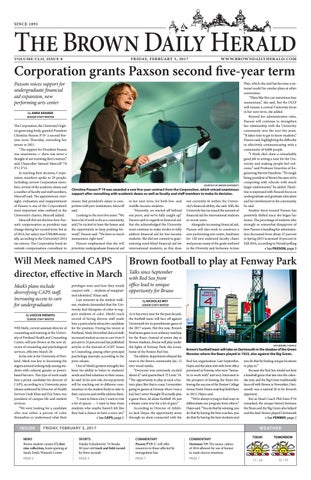
Corporation grants Paxson second five-year term Paxson voices support for undergraduate financial aid expansion, new performing arts center By ANNA KRAMER SENIOR STAFF WRITER
The Corporation, the University’s highest governing body, granted President Christina Paxson P’19 a second fiveyear term Thursday, extending her tenure to 2021. “The support for President Paxson was unanimous — there was never a thought of not renewing (her) contract,” said Chancellor Samuel Mencoff ’78 P’11 P’15. In reaching their decision, Corporation members spoke to 59 people, including current Corporation members, several of the academic deans and a number of faculty and staff members, Mencoff said. The appointment, oversight, evaluation and reappointment of Paxson is one of the Corporation’s most important roles outlined in the University’s charter, Mencoff added. Mencoff did not disclose how Paxson’s compensation as president may change during her second term, but as of 2014, her salary was $700,000 annually, according to the University’s 2014 tax returns. The Corporation hired an outside compensation consultant to
COURTESY OF BROWN UNIVERSITY
Christina Paxson P’19 was awarded a new five-year contract from the Corporation, which voiced unanimous support after consulting with academic deans as well as faculty and staff members to make its decision. ensure that president’s salary is competitive with peer institutions, Mencoff said. Looking to the next five years: “We have a lot of work to do as a community, and I’m excited to have the honor and the opportunity to keep pushing forward,” Paxson said. “We have so much momentum right now.” Paxson emphasized that she will prioritize undergraduate financial aid
in her next term, for both low- and middle-income students. “Honestly, we started off behind our peers, and we’ve fully caught up,” Paxson said in regards to financial aid. But she acknowledged the University must continue to make strides to fully address financial aid for low-income students. She did not commit to guaranteeing need-blind financial aid for international students, as this does
not currently fit within the University’s financial ability, she said. Still, the University has increased the amount of financial aid for international students in recent years. Alongside increasing financial aid, Paxson will also work to construct a new performing arts center, fundraise for 120 new endowed faculty chairs and pursue many of the goals outlined in the Diversity and Inclusion Action
Plan, which she said has become a national model for similar plans at other universities. “Plans like this can sometimes lose momentum,” she said. But the DIAP will remain a central University focus in her next term, she added. Beyond her administrative roles, Paxson will continue to strengthen her relationship with the University community over the next five years. “It takes time to get to know students,” Paxson said, highlighting the difficulty in effectively communicating with a community of 9,000 people. “I think she’s done a remarkably good job in setting a tone for the University and making people feel welcome,” said Professor Emeritus of Engineering Barrett Hazeltine. “It’s tough being president of Brown because we’re competing with schools with much larger endowments,” he added. Hazeltine is impressed with Paxson’s focus on undergraduate and graduate education and her involvement in the community, he said. Student favor toward Paxson has positively shifted since she began her tenure. The percentage of students who strongly or somewhat disapprove of how Paxson is handling her administration decreased from about 25 percent in Spring 2015 to around 10 percent in Fall 2016, according to Herald polling » See PAXSON, page 3
Will Meek named CAPS Brown football to play at Fenway Park since September director, effective in March Talks with Red Sox front Meek’s plans include diversifying CAPS staff, increasing access to care for undergraduates By UGOCHI IHENATU SENIOR STAFF WRITER
Will Meek, current assistant director of counseling and training at the University of Portland Health and Counseling Center, will join Brown as the new director of counseling and psychological services, effective March 20. In his role at the University of Portland, Meek was key in decreasing the stigma around seeking help among students with cultural, gender or powerbased barriers. This type of work made him a prime candidate for director of CAPS, according to a University press release authored by Director of Health Services Unab Khan and Eric Estes, vice president of campus life and student services. “We were looking for a candidate who was either a person of color themselves or understood what their
INSIDE
privileges were and how they would connect with … students of marginalized identities,” Khan said. Last semester at the student walkout, students demanded that the University find therapists of color to support students of color. Meek’s track record of hiring diverse staff made him a particularly attractive candidate for the position. During his tenure at Portland, Meek diversified clinical staff, increased student access to care from 8 percent to 24 percent and has published articles in the Journal of LGBT Issues in Counseling, among other principal psychology journals, according to the press release. One of Meek’s greatest strengths has been his ability to listen to students’ needs and find solutions to their issues, he said. In his new role, his top priority will be reaching out to different communities in the student body to take in their concerns and swiftly address them. “I want to listen a lot; I want to visit a lot of spaces … I want to hear from students who maybe haven’t felt like they had a chance to have a voice yet,” » See CAPS, page 2
office lead to unique opportunity for Bruno By NICHOLAS WEY SENIOR STAFF WRITER
As it has every year for the past decade, the football team will face off against Dartmouth for its penultimate game of the 2017 season. But this year, Bruno’s final home game is no ordinary matchup for the Bears. Instead of senior day at Brown Stadium, Bruno will play under the lights of Fenway Park, the iconic home of the Boston Red Sox. The athletic department released the news to the Brown community Jan. 12 over social media. “Everyone was extremely excited about it,” said quarterback TJ Linta ’18. “The opportunity to play at such a historic place like that is crazy. I remember going to games at Fenway when I was a kid, but I never thought I’d actually play a game there, let alone football. It’s just a dream come true for a lot of guys.” According to Director of Athletics Jack Hayes, the opportunity arose through an alum connected with the
SAM BERUBE / HERALD
Brown’s football team will take on Dartmouth in the shadow of the Green Monster where the Bears played in 1923, also against the Big Green. Red Sox organization. Last September, Hayes and the alum met with front office personnel at Fenway, who were “fantastic to work with” and very interested in the prospect of hosting the Bears following the success of the Boston College versus Notre Dame matchup held there in 2015, Hayes said. “We’re always trying to find ways to differentiate our program from others,” Hayes said. “You do that by winning, you do that by having the best coaches, you do that by having the best students and
you do that by finding unique locations to play in.” Because the Red Sox would not host a baseball game that late into the calendar year, and the Big Green traditionally faces off with Brown in November, Dartmouth was a natural fit to be Brown’s opponent. But as Head Coach Phil Estes P’18 remarked, the unique history between the Bears and the Big Green also helped seal the deal: Brown played Dartmouth » See FENWAY, page 2
WEATHER
FRIDAY, FEBRUARY 3, 2017
NEWS Brown student curates U.’s first zine collection, hosts opening at Sarah Doyle Women’s Center
SPORTS Natalie Schudrowitz ’18 breaks 30-year-old track and field record by three seconds
COMMENTARY Paxson P’19: U. will offer resources to those affected by immigration ban
COMMENTARY Steinman ’19: The meme culture of 2016 allowed for use of humor to mask sincere emotions
PAGE 2
PAGE 3
PAGE 7
PAGE 7
TODAY
TOMORROW
17 / 34
22 / 33
NEWS
PAGE 2 • FRIDAY, FEBRUARY 3, 2017
THE BROWN DAILY HERALD
U. appoints academic director of executive master’s program Hollmann’s ’76 MD’79 program to advance health care careers for executive students By OLIVIA KATCHER STAFF WRITER
Peter Hollmann ’76 MD’79, clinical assistant professor of family medicine, was named the new academic director of the Executive Master of Healthcare Leadership program at the School of Professional Studies Jan. 18. Hollmann joins the program after a long career in medical management and offers “extensive experience,” said Elizabeth Kofron, director of public and corporate relations at the School of Professional Studies. Prior to this position, he served as the chief medical officer for University Medicine, an affiliate of the University and a medical
group that provides outpatient services in Rhode Island, according to a University press release. Hollmann was also formerly an associate chief medical officer for Blue Cross and Blue Shield of Rhode Island. The EMHL program is intended for “mid-career students seeking to advance their health care careers into more significant leadership positions,” said Karen Sibley, dean of the School of Professional Studies. The program aims to foster “an understanding of leadership and some of the issues of managing health care,” Hollmann said. “The goals are to create a cohort of leaders in health care … a group of people that can help our country move forward, whether it’s developing businesses, developing public policy or taking care of patients,” Hollmann added. Developed in 2012, the 16-month program is based on a “blended delivery model,” Sibley said. Students living
all over the world come together for a series of intensive week-long residential periods. When they are not on campus, they complete work online, she said. Sandra Ferretti, senior adviser for professional programs, said EMHL is “unique” in its course design. The program’s combination of face-to-face and online interaction allows students to continue their careers while also participating in the program. Additionally, students must complete a “critical challenge project,” which helps them apply what they have learned to realworld problems, she said. The program brings together “students … with very different perspectives on the health care field,” Kofron said. “It magnifies the value of the learning opportunity.” While the idea for the program came out of the School of Professional Studies, the curriculum was designed by the School of Public Health to focus
COURTESY OF BROWN UNIVERSITY
Peter Hollmann ’76 MD ’79 will lead the innovative 16-month Executive Master of Healthcare Leadership program at the SPS. on “changing the dynamics in health care,” Sibley said. Moving forward, Hollmann will continue to recruit a strong student body, one of the program’s persistent
Student curates U.’s first zine collection » FENWAY, SDWC hosts opening of collection, LGBTQ Center co-sponsors workshops on curation, zine-making By PRIYANKA PODUGU SENIOR STAFF WRITER
On Feb. 1, Malana Krongelb ’18 unveiled a zine collection that she had spent over a year curating to members of the Brown community. The collection, which will be stored in the Sarah Doyle Women’s Center, features hundreds of zines covering topics ranging from gender identity exploration to do-it-yourself tutorials on vegan cosmetic recipes. “A zine is an independently published work that’s made for passion rather than profit,” Krongelb said. The zines in her collection “take on many forms” from standard magazines to smaller publications featuring handmade artwork. Students gathered over hot chocolate and cookies to examine the zines Krongelb had catalogued for the University. “They kind of seem like memes for books … something that our generation and maybe future generations can appreciate,” Alexander SkovronDow ’18 said. Krongelb was first introduced to zines at Brown. Struggling with PostTraumatic Stress Disorder after being sexually harassed by a graduate student during her freshman year, Krongelb said she found comfort in helping Bluestockings Magazine create a zine called “Silence In Voice” that contained the stories of sexual assault survivors. “It really helped me heal, and for the first time I had some sense of closure,” she added. Krongelb also said that zines appealed to her because “people who don’t have access to large, corporate publishing houses can have their voices heard through zine making … that sense of agency can be really healing.” Krongelb obtained over $3,000 in grants to build the collection on top of the zines which she received as donations from around the world, she said. “I’m a queer, disabled woman of color … In some ways that made it easier for me to put together a collection that represented marginalized voices that I wasn’t seeing in other University
GUS REED / HERALD
Malana Krongelb ’18 unveils a collection of zines, which are independently published, nonprofit works that take many forms. collections.” The opening event for Krongelb’s zine collection was followed by two workshops sponsored by the LGBTQ Center that featured Jenna Freedman, associate director of communications and zine librarian at Barnard College. Freedman has maintained and catalogued Barnard College’s zine library for the past 13 years. “This generation is so much wiser about mental health issues and taking good care of each other … So many zines are made by people college-age(d) so you really get to see your experience reflected back at you,” Freedman added. Krongelb said that the SDWC was an appropriate home for Brown’s zine collection because it already has an “established library … and zines have a feminist history.” Gail Cohee, director of the SDWC and associate dean of the College agreed with Krongelb and said the collection “covers all the areas of feminist inquiry … (the Center) is at least a good starting place for it.” Cohee added that zines are a “different way of creatively doing literature and political work.” Zines have made appearances in campus activism at Brown, most
recently during the University’s campus walkout. Stickers distributed at the protest came from a zine compiled by students taking VISA 1240: “Art of the Book,” said Jake Kuhn ’17, a student in the course who helped distribute the stickers. Creating the zines and stickers were a way for “people who might not be organizers or consider themselves activists to express political sentiments or contribute to the movement.” Lara Henderson, an adjunct lecturer in visual arts, said she encouraged her students to make zines in her course because she believed that “getting away from screen time and actually having conversations with people you don’t know but (with whom) you have this common interest” has considerable power. Zines “have a big role in getting the message out there,” Kuhn added. “They’re at the intersection of art and politics … It’s really important for artists to think about how their art can contribute to conversations and start conversations.” Looking ahead, Krongelb hopes to create an official student group dedicated to raising awareness about the collection and zine making in general, she said.
from page 1
at Fenway in 1923. Dartmouth is also a local, New England team, and both programs have “a very good alumni base in Boston,” Estes said. According to Estes, the Ivy League is already excited about making the event one of its premiere televised games. “If it is on TV,” Estes said, “it will be an attraction to our alumni base around the country.” Not only do numerous alums from both schools come from the Boston area, many current players on the teams are from the region. “As a Red Sox fan growing up, to play at Fenway would be an honor,” said tight end Anton Casey ’19 “A lot of the guys on the football team are from the Northeast, so it’s really a once-in-alifetime deal.” As the winter cold beckons and the long off-season takes its toll, Estes also hopes that the opportunity will provide extra motivation for the players. “I’d watch our guys when we’d practice at MetLife (stadium),” Estes said, referring to the home of the New York Jets and Giants. “Being at a pro venue gets them excited. To be in a place like Fenway, their eyes are going to open up and it’s going to be a fun time.” Either way, Estes remarked that the game’s location “does give a little extra motivation for some of the guys to make sure they get on that bus.” For recruiting, as well as for cultivating Brown grads, the news has become a strongly promoted focal point for Estes and Hayes. “It’s been great,” Estes said. “We were able to tweet that out to all our incoming recruits and our alumni base to say we’re going to play at this iconic venue. It’s very good for recruiting.” Brown just announced its recruiting class for the class of 2021 Wednesday, which features future players from 17 different states,
» CAPS, from page 1 Meek said. “I want to be as available to students as possible.” Meek also plans on increasing access to counseling for students. In recent years, students have had to wait two weeks after making an appointment to see a counselor, which many feel is too long. CAPS has now shortened the length of counseling sessions so that more students will be able to see counselors and eliminated the
challenges, he said. As the health care delivery system and medical landscape change, Hollmann said he sees the world as an “opportunity” rather than a challenge. including Massachusetts, New Hampshire and Connecticut. Hayes emphasized the event as more than just a game, but as a “University event.” “It is an opportunity for Brown to extend its reach to Boston,” Hayes said. “That will help us build a large crowd for the game, and it will be a good opportunity for alums to stay connected with Brown in a very unique way. I was at a Brown football event in New York City, and they were all talking about it.” Amid all of the excitement, Estes stressed that playing at Fenway Park will also present special challenges. “What we can’t do is let the team get too focused on the venue and not what they have to do,” he said. Several “unique quirks” include both teams sharing the same sideline, which can make substitutions more difficult and could create unforeseen advantages and disadvantages for both teams, Estes said. The placement of the communications box and its sight line to the field has not yet been specified. Estes noted that the coaches will likely consult the Boston College staff — who have experience playing at Fenway before — to learn more of the stadium’s nuances. Regarding the financial nature of the deal, Hayes said the team will incur certain special costs, such as team traveling expenses and shuttling students. Because of this, the University does not have to guarantee a certain number of people in attendance or tickets sold. Still, Hayes emphasized a push from Brown and Dartmouth to “get as many people there as possible” and “make it a great event.” Moving forward, Hayes remained optimistic about the opportunity for Brown to continue its relationship with Fenway. “I’d image they’d want to continue to do it. I know the Brown folks are excited, and hopefully it’s something we can look to continue if it’s successful.” seven-session-per-year cap on appointments, Khan said. Meek plans to explore ways to further decrease wait time for appointments when he arrives at Brown in March. Adding to his priorities, Meek will play an instrumental role in completing CAPS’ departmental Diversity and Inclusion Action Plan, which will be released this semester, Estes said.
SPORTS
FRIDAY, FEBRUARY 3, 2017 • PAGE 3
THE BROWN DAILY HERALD
FOOTBALL
Bryant hires James Perry ’00 as new head football coach Alum looks to bring high-powered, fast-paced offense to Bulldogs before first game against Bruno By CAL BARASH-DAVID SENIOR STAFF WRITER
The football team’s season opener against Bryant University on Sept. 16 will be equal parts antagonism and amity for both teams. The perennial clash of the in-state foes is one marked by familiarity and desire to stake the claim of football supremacy in the country’s smallest state. But the game will feature a head coaching matchup between mentor and protege, in which mutual respect gives way to passionate determination to best an old friend. Across the gridiron from Head Coach Phil Estes P’18 will stand Bryant University’s newly-appointed Head Coach James Perry ’00. Perry’s contributions to Brown football are numerous. Throughout his career, he has collected an extensive list of accolades: 1999 Ivy League Player of the Year, 1999 All-New England, 1999 Rhode Island Athlete of the Year and First-Team All-Ivy from 1997 to 1999. He holds an Ivy League record for career passing yards, completions and touchdowns, as well as seven others. Perry led the Bears to an Ivy League
Championship in 1999, and he was inducted into the Brown Athletics Hall of Fame in Fall 2016. “I’m certainly going to try to borrow a lot of the techniques that (Estes) used to make (Brown) a perennial winner and bring that to Bryant,” Perry added. He was a “tremendous competitor,” Estes said. “He was a winner, he knew the game inside and out. As a player, he just got to that point where he controlled everything around him. His presence in the huddle was something that commanded a lot of respect,” he added. Perry had a busy career between his time as a student athlete and his Jan. 3 appointment as head coach of Bryant. After brief stints as positions coach at the University of Delaware, Dartmouth, University of San Diego and Williams College, Perry went back to school. He received a master’s degree in education policy and leadership from the University of Maryland in 2006 while working as a graduate assistant for the football team. Perry then returned to Brown, where he served as the program’s recruiting coordinator and quarterbacks coach. “Nobody on any level, in any part of the country does a better job than Phil Estes at running his program,” Perry said. “Everybody who plays for Phil knows how much he cares about them. The amount of energy, the amount of
effort he puts into making them the best they can be is a very real thing to players who play for him, and I’m going to bring that same energy and attitude toward my players.” His time coaching under Estes was a formative experience for him, he said. His career then took him to Princeton for seven years, where he helped the Tigers win the Ivy League title in 2013 and 2016 as offensive coordinator. Bryant’s Athletic Director Bill Smith said that Perry’s constant success, both as a player and a coach, was the most appealing aspect about him. “We liked Coach Perry’s background with Ivy League institutions and … it’s both about winning on the field and also winning in the classroom,” he added. “We’re strongly committed to both here at Bryant.” Boasting a 4-2 conference record last year, Bryant football is poised for success. “I think the program’s in good shape,” Perry said. “We’re going to change the way that we play, especially in the way that we approach the game. From a tempo perspective, it’s going to be much faster.” This should come as no surprise, as Perry’s Princeton offenses were prolific. In 2016, the Tigers scored an Ivy League best 34.6 points per game. Estes compared Perry’s offenses with the University of Oregon’s high-speed squads under Chip Kelly.
COURTESY OF BROWN ATHLETICS
James Perry ’00, a former All-Ivy quarterback for Brown, seeks to challenge his alma mater as the new head coach of Bryant University’s football team. “We’re expecting success right away with Coach Perry, primarily because of the style of football that he plays,” Smith said. Another member of the Estes coaching tree will be joining Perry on the Bryant sidelines, as Ed Morrissey will be the offensive line coach for the Bulldogs. Morrissey coached at Brown while Perry was a player and at Princeton while Perry was also a coach. Perry will face off against his former coach for the first game of Brown’s season — with their football careers
intimately linked, the contest will carry an extra significance for the two men. “Once he got the job we started breaking down Bryant film and personnel,” Estes said. “It’s certainly going to make that first game next year a lot of fun.” “Once the referee blows that whistle and the game starts, I have no love for James Perry,” Estes said. “But then, after the game, I love him again.” “I root for Brown every time I’m not playing them,” Perry said, mirroring the sentiment.
ATHLETE OF THE WEEK
Schudrowitz ’18 shatters 30-year-old school mile record Junior sets new personal best, finishes fourth out of 140 runners in race at Boston invitational By ALEXANDRA RUSSELL SENIOR STAFF WRITER
The women’s track and field team competed at the John Thomas Terrier Invitational at Boston University Friday, continuing its strong start to the season. Natalie Schudrowitz ’18 posted a standout performance in the mile, finishing fourth out of 140 runners and setting a new personal record with a time of 4 minutes, 42.54 seconds. Schudrowitz also broke the school record for the event by three seconds, previously set in 1987 by Wendy Smith ’87. Since arriving at Brown in 2014, Schudrowitz has had an illustrious cross country and track career. In 2015, she earned NCAA All-American, NCAA Northeast All-Region and Second Team All-Ivy honors for cross country, running 20 minutes,16.7 seconds in the six-kilometer course at the NCAA Championships, finishing 23rd. Schudrowitz will return to competition next weekend at the Boston University Valentine Invitational. For breaking the school record and setting a new personal best,
» PAXSON, from page 1 data. “I don’t know why approval ratings change that much over time … I don’t really worry about (it) that much,” Paxson said. She added that the administration may not always agree with students, but it supports them.
Schudrowitz has been named The Herald’s Athlete of the Week.
Herald: What were your expectations going into the meet? Schudrowitz: I had kind of a difficult cross country season in the fall, so my expectations going into the race were just to get back into the feeling of racing and get back to how I felt last year racing track. I didn’t expect to PR or anything, but I just wanted to feel good in the race and see where my fitness levels were at. How did the race feel? Did you think that you had set a new PR when you finished? It was definitely a fun race; it felt really good. It was definitely the best I’ve felt running a mile in a long time. The mile was my race in high school, but for the last two years in track I’ve done mostly three-kilometer courses and I did a five-kilometer course last year, so I was really happy with how this one went. I knew that we were on pace for a PR. From the start, I could latch on to the three people in front of me, so that was really exciting, and I knew that I felt good during the race and I just went with it and it turned out well.
You have to really be in a confident place with your training and just know that the training is there beneath you and that you’re just ready to put it all out there on the track. You have to convince yourself that you’re in the best possible state that you can be in for that particular race, no matter what little mishaps happen on the way to get there.
You’ve competed in cross country and other distance events. Do you have a favorite? Yeah, my favorite event is probably the 3K, which I will be running next weekend in Boston again. It’s longer than the mile, a little less than double the distance and it’s just more time on the track, so there’s more time for interesting things to happen.
How do you prepare yourself mentally for a race?
When did you initially get into the sport? I played soccer for 10 years, and then I switched to running my sophomore spring of high school. (I was) a little late in the game, but my sister had been a runner in college at a Division III school, and she loved it, so I just thought I should try it out and see how it went, and I’m really happy with that decision. I’m really grateful to be running in college and to have some success also in college. I just hope for the best moving forward.
Some students have voiced concerns about Paxson’s growth of graduate programs in the past, but she defended their role as invaluable to the University. “I don’t see undergraduate and graduate education as being at odds with each other. It is not a zero-sum game if you do it right,” she said. Cameron Johnson ’17, a member
of the Brown University Community Council, said he hopes that in Paxson’s next term, the University will “boldly (lead) the stand against all threats to freedom and humanity.” The most successful moments of Paxson’s first term involved collaboration with students, he added. Whether the University continues this practice will determine the
NAOMY PEDROZA / HERALD
After running the three-kilometer and five-kilometer courses for Brown’s cross country team, Schudrowitz ’18 found success in the mile on Friday. What’s your go-to race day breakfast? Definitely oatmeal. I love chocolate oatmeal— it’s delicious. And probably some peanut butter — we’re all obsessed with peanut butter! I like animal crackers before a race, that’s one of my favorites just to snack on so you’re not hungry during the race. They’re nice and dry, so it soaks up some water. The track and field teams have had a strong start to the season. Looking ahead, what are your aims for the upcoming meets? I hope to run a competitive 3K time success of her next term, he said. “The country is very divided,” Paxson said, addressing her role as president during the new Trump administration. “I haven’t seen divisions on issues of race, class and gender … like this in my lifetime,” she added. The University will have to forcefully articulate its values in the coming
definitely. I might run the 5K at our conference meet, depending on race plans. I probably won’t run the mile again, but we have a really great team, really competitive — I wouldn’t be surprised if someone breaks the mile record again, if they run it. It’s just been really awesome seeing the team grow and advance from the cross country season, and I really hope it keeps going. We’ve got some momentum, so it’s exciting. This article has been edited for clarity and length.
years, Paxson said. She highlighted concerns about federal research funding for environmental issues and women’s reproductive health. “President Paxson is the voice of Brown University to the outside world,” Mencoff said, adding that he places his full faith in her leadership in handling conflicts that may arise.
NEWS
PAGE 4 • FRIDAY, FEBRUARY 3, 2017
THE BROWN DAILY HERALD
TODAY
FRIDAY, FEBRUARY 3, 2017 • PAGE 5
THE BROWN DAILY HERALD
menu
a n a f t e r n o o n at t h e wat s o n
SATELLITE DINING ANDREWS COMMONS
Pizza: Bacon Alfredo, Harvest, Buffalo Chicken JOSIAH’S
BLUE ROOM
BBQ Chicken Burrito Bowl
Soup: Turkey Chili, Fire Roasted Vegetable
DINING HALLS SHARPE REFECTORY LUNCH
DINNER
Hot Roast Beef Au Jus, RI Quahog Chowder, Penne Pasta, Frosted Cupcakes
Chicken Coconut Curry, Steamed Zucchini and Summer Squash, Magic Bars
VERNEY-WOOLLEY LUNCH
DINNER
Breaded Chicken Fingers, Potato Skins Bar, Assorted Frosted Cupcakes
Kareem’s Catfish, Spinach Strudel, Broccoli Cuts, Carrot Cake
sudoku HUAYU OUYANG / HERALD
Speakers at a Careers in Public Policy panel addressed students about what it’s like to work with policy on issues ranging from health care to climate change at the Watson Institute’s Joukowsky Forum on Thursday.
Q U O T E O F T H E D AY
“I don’t see undergraduate and graduate education as being at odds with each other. It is not a zero-sum game
”
if you do it right. RELEASE DATE– Friday, February 3, 2012
— President Christina Paxson P’19
Los Angeles Times Daily Crossword Puzzle Edited by Rich Norris and Joyce Nichols Lewis c r o s s 39 wThing o rto d 52 Beach flier ACROSS 7 Activity centers do in
1 Pre-Columbian Indians 6 Went headfirst, maybe 10 Persian, for one 13 Wild weather 14 Heavy reading 16 Suffix with Seattle 17 Communications problem? 19 Sleep acronym 20 Summary of a shrinking mass? 22 Capital of Colorado? 24 T designation 25 Marlin’s son, in a 2003 film 26 Caused an insurrection 28 Court maneuver 32 Jungle noise 33 Characterize 36 Title for the longest bridge? 40 Two-part answer 41 Vet 42 Bangkok natives 43 Pennsylvania home of Lafayette College 45 Control 48 Well-chosen 49 Colorado native 50 Construction site order? 56 Signs of press conference uncertainty 57 Hardly the award for Chernobyl? 60 Type of screen, briefly 61 Put down 62 Prey catcher 63 “__-hoo!” 64 Marine: Abbr. 65 City south of Florence DOWN 1 Co. for surfers 2 Degree in math? 3 Work together 4 Florence’s river 5 Is suspicious 6 Firewood measure
8 Apple’s G5, e.g. 9 Take out 10 Enchantress who lived on the island Aeaea 11 Starters 12 Presto, for one 15 35mm camera initials 18 Continue violently 21 Draws in 22 Medicine, one would hope 23 Modeling aid 27 Agamemnon’s avenger 28 Lowly workers 29 “This __ joke!” 30 Taper? 31 Its processing produces slag 33 Actress Conn 34 Critter in a domed shell 35 Cereal killer 37 “Forget it!” 38 “‘Twas white then as the newfa’en __”: Alexander Anderson
style 43 Foil alternative 44 Diamond turns 45 For real 46 Transmission repair franchise 47 Screw up 48 Stop on the Métro? 51 “Charlotte’s Web” monogram
See paxson on page 1.
53 Yu the Great’s dynasty 54 Famous last words 55 Berry used as a dietary supplement 58 Bass ending 59 Proteinbuilding polymer
ANSWER TO PREVIOUS PUZZLE:
xwordeditor@aol.com
calendar
02/03/12
FRIDAY FEBRUARY
S
By David Steinberg (c)2012 Tribune Media Services, Inc.
02/03/12
M
T
W
Th
F
S
1
2
3
4
5
6
7
8
9
10
11
12
13
14
15
16
17
18
19
20
21
22
23
24
25
26
27
28
Free Speech on Campus 3:00 P.M. Watson Institute
Game Night with RUF 7:00 P.M. List Art Center, 110
SATURDAY Strait Talk Info Session 12:00 P.M. MacMillan Hall, 115
Open Mic Night 7:00 P.M. King House (St. Anthony Hall)
SUNDAY The Valentine’s Horn 3:00 P.M. Grant Recital Hall
Crepe Night 7:00 P.M. Machado
COMMENTARY PAGE 6 • FRIDAY, FEBRUARY 3, 2017
THE BROWN DAILY HERALD
Brown Bites: Jan. 28 to Feb. 3, 2017 Providence protests Hundreds descended on the steps of the Rhode Island statehouse Sunday in response to President Donald Trump’s executive order barring immigration from seven predominately Muslim countries. Political leaders including Gov. Gina Raimondo and U.S. Rep. David Cicilline D-RI spoke out against the ban, labeling it as antithetical to the ideal of religious tolerance fundamental to both Rhode Island and the United States. As per the text of Trump’s order, members of the University community from the listed countries will be unable to return to campus if they leave. Nearly 1,000 alums have signed an open letter urging Paxson’s administration to take a strong stance in decrying the ban and protecting members of the community. Paxson responded Friday with an op-ed in The Herald, listing the steps the University has taken to reaffirm its values during this time. Blazing a trail Advocates have high hopes for a recreational cannabis bill headed to the R.I. General Assembly. Though similar bills have been introduced multiple times in the past, recent successes in states like Massachusetts could increase the likelihood of passage. With public approval of cannabis at an all-time high, Nadir Pearson ’19 — founder of the Student Marijuana Alliance for Research and Transparency — said the potential for the plant is endless. “Every subject can involve cannabis, from biology to engineering,” Pearson said. “Brown can be a place where we open up the dialogue.” Cookies come to College Hill Students can count on another option for late-night snacking with the establishment of an Insomnia Cookies on Thayer. The franchise has attracted the adulation of college students everywhere with its delivery of cookies, ice cream and brownies until 2 a.m.. Deliveries will be available within a two-mile radius of the store and with renovations on the store’s location at 307 Thayer already underway, Insomnia could start rolling out baked treats as early as April.
D O R O T H Y W I N D HA M
comic
The secrecy of Sofar Sounds A select few Providence residents were privy to a unique auditory experience Sunday as audience members of a Sofar Sounds concert. The announcement of one of the organization’s show is shrouded in secrecy, and only a handful of people are selected to witness the popup performances which can take place in venues ranging from coffee shops to attics across the world. Meant to provide the purest experience possible, concert rules stipulate that guests cannot chat or check their phones, and attendees are prohibited from leaving a show early. For fans like Lindsay Sack ’19, such experiences provide “those few hours every month to connect to music and connect to people.”
Super Bowl Party | Najatee’ McNeil
Find us online! facebook.com/browndailyherald
browndailyherald.com
@the_herald
Location: 195 Angell St., Providence, R.I. www.browndailyherald.com
@browndailyherald
youtube.com/browndailyherald
Editorial Leadership
Sections
Multimedia & Production
Business
Editor-in-Chief Lauren Aratani
Arts & Culture Editors Julie Center Madison Rivlin
Design Editors Christy Leung Ameer Malik Jessica Yu Assistant: Eduard Muñoz-Suñé
General Managers Henry Ritter Ben Wesner
Managing Editors Matt Brownsword Rebecca Ellis Kate Talerico POST- MAGAZINE Editor Monica Chin
News Editors Kyle Borowski Kasturi Pananjady Suvy Qin Elena Renken Alex Skidmore Hattie Xu
BLOGDAILYHERALD Editor Anica Green
Sports Editor Jackson Chaiken Ben Shumate COMMENTARY Opinions Editors Margaret Hu Anuj Krishnamurthy Mili Mitra
Photo Editors Head: Eli White Assistant: Sam Berube Marianna McMurdock Lilly Nguyen Copy Desk Chief Julia Stemmer Multimedia Editor Roland High Illustrations Editor Dorothy Windham Graphics Editor Laura Felenstein Directors of Web Development: Lucy Wei Ivy Wong
Directors Finance: Reena Zhan Sales: Antonia Alvarez Sales: Erin Lueck Strategy: William Nober Strategy: Gianna Jasinski Managers Sales: Elizabeth Doykan Sales: Gabriella Elanbeck Sales: Matilda Lynton Sales: Ariel Shusterman Collections: Ravi Betzig Operations: Gür Ağci
Editorial contact: 401-351-3372 herald@browndailyherald.com
Business contact: 401-351-3260 gm@browndailyherald.com
Submissions: The Brown Daily Herald publishes submissions in the form of op-eds and letters to the editor. Op-eds are typically between 750 and 1000 words, though we will consider submissions between 500 and 1200 words. Letters to the editor should be around 250 words. While letters to the editor respond to an article or column that has appeared in The Herald, op-eds usually prompt new discussions on campus or frame new arguments about current discourse. All submissions to The Herald cannot have been previously published elsewhere (in print or online — including personal blogs and social media), and they must be exclusive to The Herald. Submissions must include no more than two individual authors. If there are more than two original authors, The Herald can acknowledge the authors in a statement at the end of the letter or op-ed, but the byline can only include up to two names. The Herald will not publish submissions authored by groups. The Herald does not publish anonymous submissions. If you feel your circumstances prevent you from submitting an op-ed or letter with your name, please email herald@browndailyherald.com to explain your situation. You can submit op-eds to opinions@browndailyherald.com and letters to letters@browndailyherald.com. When you email your submission, please include (1) your full name, (2) an evening or mobile phone number in case your submission is chosen for publication and (3) any affiliation with Brown University or any institution or organization relevant to the content of your submission. Please send in submissions at least 24 hours in advance of your desired publication date. The Herald only publishes submissions while it is in print. The Herald reserves the right to edit all submissions. If your piece is considered for publication, an editor will contact you to discuss potential changes to your submission. Commentary: The editorial is the majority opinion of the editorial page board of The Brown Daily Herald. The editorial viewpoint does not necessarily reflect the views of The Brown Daily Herald, Inc. Columns, letters and comics reflect the opinions of their authors only. Corrections: The Brown Daily Herald is committed to providing the Brown University community with the most accurate information possible. Corrections may be submitted up to seven calendar days after publication. Advertising: The Brown Daily Herald, Inc. reserves the right to accept or decline any advertisement at its discretion. The Brown Daily Herald, Inc. is a financially independent, nonprofit media organization bringing you The Brown Daily Herald, BlogDailyHerald and Post- Magazine. The Brown Daily Herald has served the Brown University community daily since 1891. It is published Monday through Friday during the academic year, excluding vacations, once during Commencement and once during Orientation by The Brown Daily Herald, Inc. Single copy free for each member of the community. Subscription prices: $200 one year daily, $100 one semester daily. Copyright 2017 by The Brown Daily Herald, Inc. All rights reserved. Periodicals postage paid at Providence, R.I. Postmaster: Please send corrections to P.O. Box 2538, Providence, RI 02906.
COMMENTARY FRIDAY, FEBRUARY 3, 2017 • PAGE 7
THE BROWN DAILY HERALD
Supporting our students and scholars CHRISTINA PAXSON op-ed contributor I want to thank the Brown alums who shared their concerns about the executive order on immigration and refugee policy in a Letter to the Editor in the Feb. 2 issue of The Herald. This is indeed an issue of the utmost importance for Brown, principally because it has significant implications for the personal well-being and mobility of members of our community and their families. Accordingly, in the days since the order was enacted, the University has taken a number of steps to make clear our position and ensure that our international students and scholars are safe, secure and free to study, teach and conduct research at Brown. I would add that we have done so even as developments related to its implementation remain fluid. For students and scholars from the seven countries covered by the executive order, we have reached out to assure them that Brown is intent on protecting their status as members of the Brown community. More concretely, we are making available the following resources to support these individuals: — Access to immigration and legal advising; — Expanded opportunities to remain on campus throughout their time at Brown, including research engagements and internships during University holidays and breaks; — Housing assistance and other resources during these break periods. For students and scholars who are prevented from traveling to cam-
pus, we are exploring the use of virtual teaching and learning platforms so that these individuals can continue to participate in the Brown educational experience. For all other international students at Brown who have concerns about whether the executive order will impact their status at the University in any way, we have set in motion a number of processes aimed at providing up-to-date information and answering practical questions. The Office of Global Engagement, in partnership with relevant offices across campus, will host several community gatherings and information sessions to support our international
al Assistance Program so that we can provide up-to-date medical and security information as well as other forms of travel assistance. With the launch of the Global Brown Community and Support referral system, we are encouraging all members of the Brown community to contact the OGE should they need any assistance to ensure their support and inclusion on campus. The OGE is also meeting with various international student groups and departments to answer questions and provide general support. Further, I have asked the Office of the Provost to convene a working group comprised of the heads of ma-
affected countries to reassure them that the executive order will not in any way affect their chance for admission and that, if admitted, their spots will be held until they are able to secure a visa. More generally, Brown has made its position on the executive order crystal clear: The order runs counter to our commitment to free inquiry and the advancement of knowledge; it is antithetical in letter and spirit to our insistence that individual students and scholars should be free to pursue their scholarship and learning without fear of intimidation or discrimination of any kind; and it contradicts our unconditional rejection of every form of bigotry, discrimination, xenophobia
I firmly believe that education and knowledge creation are global public goods. Our charge as a leading university is to engage fully in the world, bringing the most talented faculty and students to Brown without regard to nationality or religion. students. On Feb. 7, a legal advising workshop with an immigration lawyer is planned, followed by a panel discussion that includes staff members responsible for government and community affairs, visas and their compliance and campus life. We have added additional administrative staff members and an immigration consultant to assist with the increase in traffic to the Office of International Student and Scholar Services, which manages visa services and compliance for the University. And we are encouraging all Brown community members, especially our international students and scholars, to register their international travel through the Brown University Glob-
jor units on campus to address issues as they arise in a rapidly changing environment and to think proactively about how to safeguard our international students and scholars going forward. Lastly, we are creating a web page on Brown’s website that will serve as a central platform for all information, guidance, materials and resources related to the executive order and its impact on our community. We expect that web page to launch in the coming week. Looking ahead, we anticipate questions from prospective students who are awaiting admissions decisions in the coming months. We are therefore contacting applicants from the seven
Universities, the American Association for the Advancement of Science and a group of peer university presidents — calling on the Trump administration to, variously, rescind the executive order; affirm the valuable contributions of international students to research, innovation and economic vitality; and shape immigration policies that honor the founding principles of the United States. In addition, the University’s initial responses to the executive order are reflected in two statements to our community that are posted on Brown’s website. Going forward, I would encourage alums and all members of our community to check Brown’s website to learn about Brown’s response to this and other issues that may arise in the future. Finally, the executive order has placed all of us in uncharted territory to some extent, and like so many other colleges and universities, Brown is in the early stages of responding. In light of this, you should know that as Trump administration guidance under the order continues to be developed, it will remain our highest priority to ensure the safety, security and status of all affected Brown students and scholars. Again, I thank our alums for sharing their views on this critical issue and for their passionate commitment to upholding Brown’s values.
and harassment. I firmly believe that education and knowledge creation are global public goods. Our charge as a leading university is to engage fully in the world, bringing the most talented faculty and students to Brown without regard to nationality or religion. The executive order runs counter to American traditions and values, and it restricts the ability of Brown and other institutions of higher education to fulfill their misChristina Paxson P’19 is the sions. president of Brown University. Brown is working closely with othShe can be reached at er universities to develop collective represident@brown.edu. Please sponses to the executive order. send responses to this opinion to On Brown’s behalf, I have signed letters@browndailyherald.com several letters of condemnation — and other op-eds to from the Association of American opinions@browndailyherald.com.
Tag yourself CLARE STEINMAN staff columnist
Misery loves company. This saying is as old as humanity. Communities have come together in times of grief as far back as we know. When times are hard, we band together to sympathize, to comfort and often to identify a common enemy. This year the forum for much of that grief was online via social media, and the common enemy was the year 2016 itself. Online, 2016 was anthropomorphized into a scapegoat for an outpouring of fear and confusion that felt endless. Memes, the recurring cultural touchstones that use humor to go viral, became almost a national pastime. Countless articles portrayed 2016 as a force that aged us all, the year that every Onion article came true. No one came out of 2016 quite the same. In a way, this characterization was perfect. It gave us the ability to consolidate disparate and upsetting events in one place, from the election to celebrity deaths to killer clowns. In addition to its convenience, this depiction was optimistic; a year must end, after all, breaking the curse. It’s easy label a set period of time as beyond the pale. I’m no anthropologist, but I do read a lot of Buzzfeed articles, so here’s my take: The memeification of 2016 was not caused by chaotic current events alone. Rather, we’re living in a time
when isolation and pain can be digitally packaged and made shareable — ironically, of course. On the one hand, this seems to be a healthy break from the way that social media is often used to display a greatest-hits selection of one’s life, from carefully curated Instagrams and Snapchat stories to posts about personal achievements. Sharing or tagging a friend in a meme about being lonely, scared or overwhelmed is a type of honesty that’s rarely found on these platforms. But the inevitable backlash of this kind of transparency occurs when pictures of Kermit the Frog replace
of grief and turned them into jokes — the more sincere, the funnier. On the opposite note, so-called “wholesome” memes, or memes that derived their humor from positivity, developed as a counterculture. Pictures of Bill Clinton playing with balloons at the Democratic National Convention and of Barack Obama and Joe Biden united in a bromance caught on as welcome reprieves from the persistent negativity. Still, the fact that wholesome memes have come into a category of their own accurately sums up the general mood of 2016.
The meme-ification of 2016 was not caused by chaotic current events alone. Rather, we’re living in a time when isolation and pain can be digitally packaged and made shareable — ironically, of course. complex emotions and when humor, though often a great outlet for negative emotions, becomes the only available outlet, either online or offline. When current events are turned into memes, it’s nearly impossible to remember the significance they held in the first place. The death of Harambe in May 2016 was upsetting for many animal rights activists, as well as a source of pain for those wondering why the killings of people of color garnered far less media attention. But the meme of Harambe, which was almost inescapable that summer, took sincere expressions
Perhaps the strangest effect, and maybe the most harmful, of 2016’s meme-ification is the barrage of online dark humor and self-deprecation. The first time I really considered the potential harm of this blurring of public and private emotion was, unsurprisingly, at the end of a Buzzfeed article. The article itself was a list of jokes, but at the end the author provided links to mental health resources — just in case anyone actually felt the emotions that everyone was jokingly expressing online. In providing these resources, one could argue that Buzzfeed recog-
nized its role in facilitating a culture of irony that overlooks mental health challenges and was going out of its way to counteract it. But more than that, Buzzfeed’s inclusion of these resources was the culmination of the strangeness of our time, when we laugh to keep from crying and crying makes us laugh. I haven’t even begun to delve here into the more sinister corners of internet humor, into websites like 4chan where the alt-right thrives, and I don’t plan to. The story of how Donald Trump’s youngest and most radical supporters capitalized on these message boards to build a culture of meme-ified hatred — in which racism and anti-Semitism go unchecked in an echo chamber — has been well-documented since the election. But even far from these extreme corners of the web, it was hard to escape unscathed from both the real 2016 and its online presence. While policing internet culture is not an easy or necessarily worthwhile task to attempt, it is important to more thoughtfully consider the forms of media that many of us consume passively every day. Thanks to its ubiquity and unprecedented relevance this past year, digital culture shapes our outlooks whether we notice it or not. And the subconscious, repeated exposure to self-deprecation and repressive irony has the potential to wither us more than 2016 ever did.
Clare Steinman ’19 can be reached at clare_steinman@brown.edu.
SPORTS THE BROWN DAILY HERALD
FRIDAY, FEBRUARY 3, 2017
Mariano Rivera: the greatest baseball player of all time ANDREW FLAX sports columnist
In all sports, debates about the greatest player of all time are common. In baseball, the most popular answer is New York Yankees legend Babe Ruth. But, in my mind, Ruth does not hold a candle to Mariano Rivera. For those who are unfamiliar, Rivera was the Yankees closer for 19 years, retiring in 2013. He has 652 career saves, an all-time high, and a sterling 2.21 earned run average. He was a 13-time All-Star and received votes for Most Valuable Player nine times, an incredibly rare feat for a relief pitcher. He also received votes for the Cy Young award six times and finished in top three four times. Though he never won any of these awards, his credentials on the whole are more than enough to cement him as the greatest reliever of all time. Other closers like Rollie Fingers and Dennis Eckersley may have won a Cy Young and even an MVP, but neither has the body of work to compare to Rivera’s, as illustrated by a stat called ERA+. ERA+ is a player’s ERA, adjusted for the parks in which he pitches and the ERAs of the rest of the pitchers in the league. It is measured as a percent-
age of the league average, so an ERA+ of 90 is 10 percent worse than average and 110 is 10 percent better than average. Fingers and Eckersley have career ERA+ marks of 120 and 116, respectively. Rivera has a career ERA+ of 205, far and away the best of all time, with a minimum 1,000 career innings pitched. The second-best ERA+ belongs to Pedro Martinez, at 154. Not only was Rivera 105 percent better than the average pitcher, he was 33 percent better than the next best. Ruth is comparable as a hitter, with an all-time best 206 career OPS+, which is on base percentage plus slugging and similarly adjusted. As a closer, Rivera falls short in measurements of cumulative value. His 56.6 career Wins Above Replacement, a stat designed to measure the number of wins a player contributes to his teams over a career, is dwarfed by Martinez’s 86.0 and Ruth’s staggering 163.1. But WAR discriminates against closers for one critical reason. WAR treats all of a player’s appearances as contributing equally to winning, ignoring in-game circumstances. Obviously, not all situations are equal. This situational blindness works well for starting pitchers, whose value should not depend on how their offenses fare. But closers like Rivera are deployed almost exclusively in save situations, where
their team leads by three runs or fewer in the ninth inning. As their success or failure essentially determines whether the team wins or loses, they contribute much more to the number of games a team wins than WAR would indicate. For a better measure of a closer’s value, we can look at Win Probability Added. WPA is a simple cumulative stat: it measures the change in a team’s probability of winning based on what a given player does. If each team’s odds of winning are 50 percent and one team hits a walk-off home run, the hitter is credited with 0.5 WPA and the pitcher with -0.5 WPA. Rivera’s career 56.65 WPA trails only that of Roger Clemens and Greg Maddux, two pitchers who threw 3633.0 and 3724.2 more career innings than Rivera did, respectively. For Rivera to finish third all-time in a cumulative stat when most of his competition has pitched roughly four times as many innings as he did is truly remarkable. These stats, for the most part, compare Rivera to starting pitchers. It is generally considered harder to be a starter than a reliever, as failed starters like Rivera can turn into excellent relievers. But what makes Rivera the greatest of all time is the fact that he was a better closer than anyone else was anything. And while Rivera had
difficulty starting, no starter could have been as great as a reliever as Rivera was. Ordinarily, a discussion like this would be stuck as a hypothetical forever, but history lends us a telling case study. Debuting in 1988, Hall of Fame pitcher John Smoltz was an otherworldly starter at the outset of his career. He compiled a 121 ERA+ during the first 12 seasons of his career and won the 1996 NL Cy Young. But a serious elbow injury cost him his entire 2000 season, and he returned to baseball the following season as a closer. For the next four years, Smoltz pitched from the bullpen but could only compile a 162 ERA+, far short of Rivera’s career mark. Of course, Smoltz was coming off of an injury, and he was 37 by the end of the 2004 season. Surely he was not at the height of his powers, right? But Smoltz returned to the rotation better than ever in 2005, at the age of 38. He compiled a 134 ERA+ over the next three seasons, proving that he was still at his peak pitching ability. If a Hall of Fame starter in his prime could not perform nearly as well as Rivera in the closer’s role, few or perhaps no starters can. Finally, for those who believe most in a player’s heart and his grace under pressure, I submit to you Rivera’s playoff statistics. He truly seemed to shine
when the lights were on, registering a dumbfounding 0.70 ERA in 141.0 playoff innings, or about two seasons’ worth. League-adjusted stats do not exist for the playoffs, given their small samples, but a 0.70 ERA in Yankee Stadium in 2000 (roughly the middle of his playoff career) would have been an ERA+ of 687. Rivera was fortunate to be on a number of very talented Yankees teams and won five championships in his career. He was named MVP of the 1999 World Series. Overall, whether you believe Rivera is the greatest baseball player ever depends on how you define “best.” If you think relievers are simply starters who could not hack it, so be it. If value is your end-all, be-all, then Ruth is an excellent choice for the best player ever. But I keep coming back to the simple fact that Rivera is, by a colossal margin, the best pitcher ever on an inning-by-inning basis. Ruth may have been as good a hitter as Rivera was a pitcher, but he was merely shades better than his peers, while Rivera was in a league of his own. In the history of baseball, no player has done his job better and for a longer time than Mariano Rivera. And that’s what makes him the greatest of all time.
Andrew Flax ’17 can be reached at andrew_flax@brown.edu.
College basketball needs Grayson Allen GEORGE KLEIN sports columnist
Duke’s Grayson Allen has dominated college basketball headlines all season long, tripping opponents, losing his captaincy and serving an “indefinite suspension” of one game. He has evoked much ire and opposition from the sports world. ESPN analyst Seth Greenberg recently said that Allen “can’t control his actions.” Broadcaster Rece Davis said the junior “acts like a petulant toddler.” The internet has been full of negative articles about the Blue Devil — a simple Google search yields results such as “Duke’s Grayson Allen Needs To Be Put In Check,” “Coach K Went Way Too Easy on Grayson Allen” and “Grayson Allen Is The Biggest Villain In College Sports.” There was much outcry after Allen quickly returned from a self-imposed, one-game indefinite suspension after his third tripping incident. Greenberg said Duke should suspend Allen for the rest of the season. Though Allen’s antics are ridiculous and infuriating, the sports world is
lucky to have him. Like it or not, college basketball needs Grayson Allen. After the NBA instituted the “one-and-done rule” in 2005, allowing players to go pro after one college season, much of the conversation surrounding college basketball has concerned the sport’s own issues. Basketball purists say play has suffered because of the one-and-done; the most talented players come and go too quickly, leaving in their footsteps disorganized and disunified teams with unfulfilled potential. Claims that college basketball is a worsening product rule the day. ESPN analyst and Duke alum Jay Bilas, Dallas Mavericks owner Mark Cuban and Sports Illustrated writer Seth Davis have all made headlines in recent years for trashing the sport. Many buy into this belief; complaints about the game have led to the reduction of the shot clock from 35 seconds to 30 in the sport’s recent past. The negative stigma has impacted viewership as well. A look at recent National Championship game ratings reveal largely lackluster numbers. The 2011 championship between UConn and Butler garnered a 11.7 rating, and the 2012 matchup of Kentucky and Kansas, two of college
basketball’s most historic teams, did only slightly better with a 12.3 rating. Last year’s game, an all-time classic between North Carolina and Villanova, amassed a 10.6 rating. There is an outlier: The 2015 championship put up far more impressive numbers. The game between Duke and Wisconsin put up a 16.0 rating, and the semifinal between Kentucky and Wisconsin accumulated a 12.4 — better than several championships in recent years. So what was so different about the 2015 season? One word is all that’s necessary: Kentucky. The Wildcats threatened to go undefeated and all the way to the championship before losing to the Badgers in the Final Four, finishing the season with a 38-1 record. The team was the story of the season in and out of college basketball, as they became a formidable villain, coupling tremendous on-court play with less than stellar sportsmanship. Coach John Calipari’s pompous post-game interviews, Willie CauleyStein’s refusal to shake hands with Wisconsin and Andrew Harrison’s coarse language with Frank Kaminsky all serve as prime examples of the team’s villainy. Villains are good for the game.
They draw in viewers. Basketball purists love to talk about the glory days of the sport: UCLA’s dominance under John Wooden, the Big East in the 1980s and the famous 1992 Duke-Kentucky game. And the common theme between these golden eras? The villains — Kareem Abdul-Jabbar and Bill Walton, the goliaths of UCLA; Patrick Ewing and the dominant Georgetown Hoyas and of course, Duke’s own Christian Laettner. Ratings, once again, show how the public has flocked to watch the most hated players and teams. Four of the top 10 highest rated college basketball championship games since 1975 include the teams above. Villains also drum up much needed enthusiasm into the dialogue about college basketball that too often borders on melancholy. Instead of becoming entirely bogged down with discussion of pace of play and lackluster offense (yes, both could use some fixing), villains give college basketball fans something to rally around and enjoy: rooting against them. This season has been marked not by the usual articles and analysis about how unskilled and weak college basketball has become but with
impassioned debate and wonderment at Grayson Allen and his actions. The college basketball season is not perfectly structured. The postseason tournaments hold so much sway over the regular season that there does not often appear to be much at stake. But every Duke game is now a must-watch and it’s all because of Grayson Allen. Will he trip another player? Will he get into an argument with an opposing coach? Will he rampage into an opponent’s student section? With Allen, anything is on the table. Instead of demanding that Allen serve a longer suspension, the college basketball world should embrace him as the perfect villain. He is arrogant, whiny and prone to temper tantrums on the sidelines — it’s almost as if the sports gods have sent him to fans as a gift. Allen will almost certainly enter the NBA draft at the end of the season, so fans should enjoy the rest of this ride as long as they can. Because as much as college basketball hates on Grayson Allen, it will miss him terribly once he is gone.
George Klein ’20 can be reached at george_klein@brown.edu.
Follow us on Instagram! @browndailyherald