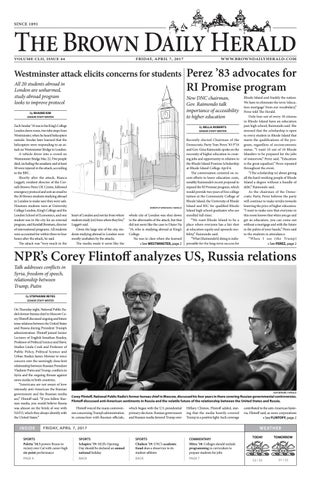
SINCE 1891
THE BROWN DAILY HERALD FRIDAY, APRIL 7, 2017
VOLUME CLII, ISSUE 44
WWW.BROWNDAILYHERALD.COM
Westminster attack elicits concerns for students Perez ’83 advocates for
RI Promise program
All 20 students abroad in London are unharmed, study abroad program looks to improve protocol
New DNC chairman, Gov. Raimondo talk importance of accessibility to higher education
By RHAIME KIM SENIOR STAFF WRITER
Zach Smolar ’18 was in his King’s College London dorm room, two tube stops from Westminster, when he heard helicopters outside. Smolar later learned that the helicopters were responding to an attack on Westminster Bridge in London. A vehicle drove into a crowd on Westminster Bridge Mar. 22. Five people died, including the assailant, and at least 50 were injured in the attack, according to the BBC . Shortly after the attack, Bianca Leggett, resident director of the Cornell-Brown-Penn UK Centre, followed emergency protocol and sent an email to the 20 Brown students studying abroad in London to make sure they were safe. Nineteen students were at University College London, King’s College and the London School of Economics, and one student was in the city for an external program, said Kendall Brostuen, director of international programs. All students were accounted for within three to four hours after the attack, he said. The attack was “very much in the
By BELLA ROBERTS SENIOR STAFF WRITER
DOROTHY WINDHAM / HERALD
heart of London and not far from where students study (or) from where they live,” Leggett said. Given the large size of the city, students studying abroad in London were mostly unshaken by the attacks. The media made it seem like the
whole city of London was shut down in the aftermaths of the attack, but that did not seem like the case to Diane Na ’18, who is studying abroad at King’s College. Na was in class when she learned » See WESTMINSTER, page 2
Recently elected Chairman of the Democratic Party Tom Perez ’83 P’18 and Gov. Gina Raimondo spoke on the necessity of higher education in creating jobs and opportunity in relation to the Rhode Island Promise Scholarship at Rhode Island College April 6. The conversation centered on recent efforts to lower education costs, notably Raimondo’s recent proposal to expand the RI Promise program, which would provide two years of free college tuition at the Community College of Rhode Island, the University of Rhode Island and RIC for qualified Rhode Island high school graduates who are enrolled full-time. “We want Rhode Island to be a place where everyone has a fair shot at education equity and upwards mobility,” Raimondo said. “What (Raimondo’s) doing is indispensable for the long-term success for
Rhode Island and frankly the nation. We have to eliminate the term ‘education mortgage’ from our vocabulary,” Perez told The Herald. Only four out of every 10 citizens in Rhode Island have an education past high school, Raimondo said. She stressed that the scholarship is open to every student in Rhode Island that meets the qualifications of the program, regardless of socioeconomic status. “I want 10 out of 10 Rhode Islanders to be prepared for the jobs of tomorrow,” Perez said. “Education is the great equalizer,” Perez repeated throughout the event. “(The scholarship is) about giving all the hard-working people of Rhode Island a degree without a bundle of debt,” Raimondo said. As the chairman of the Democratic Party, Perez believes the party will continue to make strides towards lowering the price of higher education. “I want to make sure that everyone in this room knows that when you go and get an education, you can come out without a mortgage and with the future in the palms of your hands,” Perez said to the students in attendance. “When I see (the Trump) » See PEREZ, page 2
NPR’s Corey Flintoff analyzes US, Russia relations Talk addresses conflicts in Syria, freedom of speech, relationship between Trump, Putin By STEPHANIE REYES SENIOR STAFF WRITER
On Thursday night, National Public Radio’s former bureau chief in Moscow Corey Flintoff discussed ongoing and future tense relations between the United States and Russia during President Trump’s administration. Flintoff joined Senior Lecturer of English Jonathan Readey, Professor of Political Science and Slavic Studies Linda Cook and Professor of Public Policy, Political Science and Urban Studies James Morone to voice concern over the seemingly close-knit relationship between Russian President Vladimir Putin and Trump, conflicts in Syria and the ongoing threats against news media in both countries. “Americans are not aware of how intensely anti-American the Russian government and the Russian media are,” Flintoff said. “If you follow Russian media, you would believe Russia was almost on the brink of war with NATO, which they always identify with the United States.”
INSIDE
SAM BERUBE / HERALD
Corey Flintoff, National Public Radio’s former bureau chief in Moscow, discussed his four years in there covering Russian governmental controversies. Flintoff discussed anti-American sentiments in Russia and the volatile future of the relationship between the United States and Russia. Flintoff voiced the many controversies concerning Trump’s administration in connection with Russian officials,
which began with the U.S. presidential primary elections. Russian government and Russian media favored Trump over
Hillary Clinton, Flintoff added, stating that the media heavily covered Trump in a positive light. Such coverage
contributed to the anti-American hysteria, Flintoff said, as news corporations » See FLINTOFF, page 2
WEATHER
FRIDAY, APRIL 7, 2017
SPORTS Paletta ’18.5 powers Bruno to victory over Cal with career-high six-point performance
SPORTS Schapiro ’19: MLB’s Opening Day should be declared an annual national holiday
SPORTS Chaiken ’19: UNC’s academic fraud does a disservice to its student-athletes
COMMENTARY Mitra ’18: Colleges should include programming in curriculum to prepare students for jobs
PAGE 4
BACK
BACK
PAGE 7
TODAY
TOMORROW
52 / 35
51 / 32
NEWS
PAGE 2 • FRIDAY, APRIL 7, 2017
THE BROWN DAILY HERALD
» PEREZ, from page 1
COURTESY OF REINHARD SOKOL
Democratic National Committee Chairman Tom Perez ’83 P’18 spoke in favor of Gov. Gina Raimondo’s proposal to offer two years of tuition for R.I. high school students attending the Community College of Rhode Island, the University of Rhode Island or Rhode Island College.
» FLINTOFF, from page 1 published headlines such as: “If Hillary wins, she will surround Russia with nuclear weapons.” Russian analysts originally hoped that Trump’s instability would distract Americans from foreign affairs, Flintoff said. However, that same instability is now a possible threat to Russia, he added. Less than 100 days into Trump’s presidency, Russian media have shifted their portrayal of Trump. “They are covering him in a lot more critical ways, just as American media,” Flintoff said, adding that Russian news outlets are “mocking” Trump, particularly for the American Health Care Reform Act, which failed to pass in the United States House of
» WESTMINSTER, from page 1
STAY UP-TO-DATE. FOLLOW US ON FACEBOOK. FACEBOOK.COM/BROWNDAILYHERALD
about the attacks through her mother, who had contacted her to check if she was safe. Class was not cancelled on the day of the attack, and besides a delay in public transportation, “you couldn’t really sense that there was anything different, because it’s such a big city,” Na said. Smolar’s parents also called after hearing about the attack. His parents seemed “more worried than … necessary,” because the news coverage of the attack “painted it as being more dangerous” than it was for people in the city, Smolar said. The news of the attack was “frightening and very saddening,” but
administration cut funding for higher education, it makes no sense,” Perez told The Herald. But investing in higher education is not just a partisan issue, Perez said, pointing to a Republican governor in Tennesee who introduced similar legislation regarding education investments. “College affordability isn’t just an issue for Democrats — it’s an issue for Democrats and Republicans alike,” Perez told The Herald. “Education is what Democrats have always fought for. Budgets are moral documents — we want people to know not the rhetoric of the administration but the actions,” Perez said. “It doesn’t ‘make America great’ to cut investments in human capital,” he added. Simply put, investing in education makes the nation stronger, Perez said. “This is about equipping Rhode Island for the future,” Raimondo said. “Let’s be the state that isn’t stuck.” Grassroots organizing is an important method to mobilize both parties toward adapting education reform policy, Perez said. “We need to be a nation of dreams and a nation of doers,” he added. The conversation was hosted by the Rhode Island Democratic Party, the Young Democrats of Rhode Island and the College Democrats of Rhode Island. The event was open to the public.
Representatives Mar. 24. Flintoff also stated that the differences between Trump and Putin will make the relationship between the United States and Russia unpredictable in the future. An evolved leader with over 17 years in power, Putin has the charisma and poise to dominate foreign affairs, Flintoff said. Trump, meanwhile, lacks the “policy experience — or policy interest — to elevate (himself) to Putin’s power,” he added. In light of the chemical attack that killed over 70 people in Syria, questions concerning the future relations of the United States and Russia continue to emerge. White House Press Secretary Sean Spicer reportedly placed blame on Syrian President Bashar al-Assad, while Putin contested the stance, standing
behind Assad despite evidence pointing to the Syrian government’s involvement, according to CNN and the Guardian. Though Flintoff said Russia has enough military force to take land in Syria, he speculates that it does not have the military force to maintain hold of such land, just as the U.S. did in Iraq. CNN reported that US Ambassador to the United Nations Nikki Haley stated that the administration’s priority is shifting away from Syria. “Russia is not a normal state. Russia is a mafia state — it’s run almost like a criminal enterprise,” Flintoff said. “You can’t expect to be able to conduct the normal diplomacy we conduct with Germany, for instance, because you’re dealing with a state whose aims and interests are altogether different.”
Smolar was amazed by how quickly “the police had it under control,” he said. Smolar took the tube that evening, and things seemed to be proceeding as normal, he added. Though no students were harmed during the attacks, next semester, the Cornell-Brown-Penn UK Centre might conduct a safety drill to obtain data to determine the fastest way to get in touch with students if such attacks occur in the future, Leggett said. “The fact is we live in a very volatile world, and that’s certainly been demonstrated in recent years,” Brostuen said. “Safety protocols are going to be increasingly important,” he added. There
are safety and emergency protocols that are unique to each international location depending on local officials and support provided by the U.S. federal government, he said. Leggett hopes the attack has “sharpened students’ engagement with the intellectual context of … the complexity of what Britain is going through right now,” she said. “We are living in a more polarized country post-Brexit.” Leggett also hopes the attack has driven students to develop a “sense of solidarity with London,” with the understanding that the city is “still very safe, prosperous and very excited about moving on to a brighter future,” she said.
NEWS
FRIDAY, APRIL 7, 2017 • PAGE 3
THE BROWN DAILY HERALD
SOFTBALL
ELI WHITE / HERALD
Kaitlin Okimoto ’20 takes off after a batted ball. The first-year leads the team in homers after a slow start to the year, hitting two home runs in her first Ivy League game against Princeton.
Bears turn focus to Ivy League doubleheaders after rivalry loss Bears fall 10-0 to Providence College, look to gain ground in Ivy League North Division By BEN SHUMATE SPORTS EDITOR
The Brown softball team dropped a midweek contest to crosstown rival Providence College Wednesday, falling to the Friars 10-0 in five innings. Brown (9-17, 1-3 Ivy) surrendered
seven runs in the top of the second as Providence (10-18) rattled off five hits, including back-to-back triples with two outs. Starter Emily Waters ’20 took the loss for Bruno and was relieved by Megan Wimmer ’19 in the second inning. Gina Chieffallo ’17 threw 2.1 innings of scoreless relief to close out the game. Christina Ramirez earned the win for the Friars, striking out five Bears over the full five innings. Brown loaded the bases in the first inning with no outs after two walks and
a single but failed to do any damage against Ramirez. Bruno totaled just five hits to Providence’s 12. Second baseman Christina Andrews ’17 led with two hits to bring her batting average to .316 on the season. Shortstop Katilin Okimoto ’20 added a single, extending her hitting streak to eight games. The Bears will turn their attention back to conference play this weekend, welcoming Columbia and Penn in the first Ivy League games at Brown’s newly renovated turf facility. The two doubleheaders present an
opportunity for Bruno to gain separation against North-conference foes Harvard and Dartmouth, who both started conference play 1-3. “Trying to come out and get some wins this weekend will really help,” said pitcher Katie Orona ’18. The Bears are “just trying to stay even with them in terms of record, because (those teams) are the ones that really matter.” Bruno has enjoyed success against the Quakers in past seasons, winning three of the four past contests dating back to 2015. The teams have historically been
Water in Grad Centers safe to drink, facilities says Discolored water should disappear as Providence Water finishes work around Power, Benefit St. By BEN SHUMATE
around that area. Why weren’t students notified about the work? Facilities Management was not notified by Providence Water before the work began.
SPORTS EDITOR
Students living in Graduate Center were surprised to find brown water coming from their faucets and toilets Thursday morning. Vice President for Facilities Management Stephen Maiorisi answered The Herald’s questions about the issue. Students received e-mails about the matter late Thursday evening. What was the cause of the discolored water? Providence Water is exercising valves and flushing water lines at the corner of Power and Benefit Streets as they prepare to reroute the lines
Is the water safe to drink? Yes, the discoloration is not hazardous. Students can shower and use the water as they normally would. When might water return to normal? The water will return to normal gradually. The work concluded Thursday at 6 p.m. Students can get rid of discoloration by running the water for several minutes. How many people complained? Facilities Management received 10 different calls about the water throughout the day.
KATE TALERICO / HERALD
Upon discovering discolored water in Graduate Center Thursday, 10 students contacted facilities management.
evenly matched, Orona said. While Head Coach Katie Flynn has not announced the starting pitchers for this weekend’s games, Orona got the starting nod twice in Brown’s opening Ivy League games, earning the win against Cornell Apr. 2. Should Orona get another start this weekend, pitch control will be key. Her most important tactic? “Just throw a lot of strikes,” she said. “They swing a lot, historically, so just going out there and making sure I don’t give them any free passes.”
SPORTS
PAGE 4 • FRIDAY, APRIL 7, 2017
THE BROWN DAILY HERALD
ATHLETE OF THE WEEK
Paletta ’18.5 leads lacrosse to victory over Cal with team-high six points Junior discusses differences between UNC, Brown, rivalry between siblings at Cornell By CAL BARASH-DAVID SENIOR STAFF WRITER
During a spring break road trip to San Diego, the women’s lacrosse team collected an important 14-13 win over University of California at Berkeley. Carolyn Paletta ’18.5 netted a careerhigh five goals and added an assist to power the Bears (4-6, 0-3 Ivy) to a narrow win. Paletta, who transferred to Brown from the University of North Carolina at Chapel Hill, has found immediate success at Brown. She and Hafsa Moinuddin ’19 lead Bruno in goals with 21 each. Going into the final month of the season — a period that includes four conference games — Brown is in the hunt for an Ivy League tournament berth, given to the top four teams. For her six-point effort against Cal and her early success this season, Paletta has been named The Herald’s athlete of the week. Herald: Your six points against Berkeley were a career high, what was that game like for you? Paletta: That was just a really fun game. They were a fun team to play because they shot so much, and it was really high-paced, so I think we fed off of that. … A lot of girls on my team took a lot of shots that day. Had you played a game like that before in high school? In high school, yeah, a couple of times. But not since (I’ve been in
college). Freshman year I didn’t play too much at UNC, and then I took my sophomore year off. So this is almost like freshman year round two for me. But this is the first time this season that I’ve gone on that much of a run.
When did you start playing lacrosse? My entire family plays lacrosse. My dad plays (and played at Cornell) and both of my (younger) sisters play at Cornell. So I basically played my entire life. I was a gymnast for most of my life until eighth grade, so I didn’t really play lacrosse seriously until that point. But it’s a lifelong sport. It’s a family sport. Shouldn’t you be at Cornell right now? I love Cornell, but I don’t know. I can’t go to school with both of my sisters for four years. And when I stepped on campus at Brown, I felt very comfortable, very at home and I really go off of gut feeling for stuff like this. Are you looking forward to playing your sister this weekend and your sisters in the coming years? I’m very excited to play against my sisters. Sadly, my sister tore her meniscus — or she thinks that she did — so she’s actually not playing right now, but it’ll be great to see her. My whole family’s coming up, and it’s just going to be a fun rivalry for the next two years. … My dad’s going to wear both (Cornell and Brown gear), but I’m not sure which tailgate we’re going to go to afterwards. Was it competitive between you and your sisters in high school? My senior year of high school, all
three of us were on the same team. I was a senior, my sister was a junior and my other sister was a freshman. And we actually played a middie line together so that was really fun. But we’re all very competitive with each other, especially me and my middle sister because we’re so close in age — we’re a year apart — so she’s been my main competitor since birth.
How has the transition been since transferring from UNC? It’s been great. It’s been interesting because it’s definitely a very different type of school and it’s also a different program. Coming from a championship program to an Ivy League program has been a completely different experience but equally as intense. So how’s that culture been different to the culture here at Brown? It takes a lot more self-motivation, but … that’s one of the big differences, (at Brown) we really play for each other, and it’s more of wanting to be the best for your teammates and wanting to be the best for your school. At UNC you want to be the best to be the best. Here, we know where we’re at in terms of the national level, but we all strive every single day to be the best that each of us can be individually for our team. What do you like most about Brown? The quality of the people. I think everyone at this school is so selfmotivated and does a million things. Everyone on my team — we’re all athletes, but at the same time everyone’s got a hundred other things going on, and it’s just so impressive to see how everyone balances their school, their sports and their extracurricular
COURTESY OF BROWN ATHLETICS
Midfielder Carolyn Paletta ’18.5 notched five goals and one assist in last week’s win over University of California at Berkeley. activities. What do you think is the strongest part of your game? My speed. That’s one thing that no matter how I show up on a given day, I know that I’ll be the fastest girl on the field. So I lean on that for days
that I’m having poorer stick skills or I get in my head. I know I can beat a girl to a ground ball, I can beat her down the field. This interview has been edited for clarity and length.
TODAY
FRIDAY, APRIL 7, 2017 • PAGE 5
THE BROWN DAILY HERALD
corey-spondent from moscow
menu SATELLITE DINING ANDREWS COMMONS
Pizza: Bacon Alfredo Panini Station, Make Your Own Bento Box JOSIAH’S
BLUE ROOM
Jambalaya, Pizzadilla, Mozzarella Sticks
Soup: Minestrone, Chicken Tortilla, Clam Chowder
DINING HALLS SHARPE REFECTORY LUNCH
DINNER
Falafel, Lemon Rice, Cajun Pasta with Chicken, Blondie Bars, Banana Chocolate Cupcakes
Tequila Lime Chicken, Carrots with Tequila Sauce, Crispy Thai Tofu, Lemon Meringue Pie
VERNEY-WOOLLEY LUNCH
DINNER
Baseball Burrito Bar, Breaded Chicken Fingers, Baked Potatoes, Blondie Bars
BBQ Beef Sandwich, Pudding Macaroni, Agave Sesame Veggie Saute, Lemon Meringue Pie
sudoku
SAM BERUBE / HERALD
National Public Radio Moscow correspondent Corey Flintoff discussed the current relationship between the United States and Russia in front of a packed Metcalf Audtorium Thursday evening.
Q U O T E O F T H E D AY
“We want Rhode Island to be a place where everyone R
AS
DA
A
S
has a fair shot at education equity and upwards
A
c r o s s w o rD d
C
ACROSS 1 Human mind 7 Petty disagreement 15 Show whose original house band was The Buckaroos 16 Shoe parts 17 Phrase that gets a caller’s attention? 18 Clancy’s Jack Ryan, e.g. 19 Closer 20 Round Stic maker 21 Frond part 22 __ jure 23 Nut crackers 25 Modify 26 21st Greek letter 27 Hairstyles like MacGyver’s 29 Understand 30 Upright citizen? 32 Meshed dividers 34 Words from the head of a line 35 Kind of justice 39 Work that can’t be done alone 41 Undermine 42 Wagner’s “__ Rheingold” 45 Pump pick 47 Rabbit friend 48 Marine predator 50 Leg strengthener 51 Streamlet 52 City in Florida’s horse country 54 Carrier letters 55 Enter 56 Home entertainment piece 58 Delivery class? 59 Regularly monitored, in a way 60 Brings out 61 City near the Khyber Pass 62 Shooting locale? DOWN 1 City where a Pauline letter was received 2 Ranking angels 3 Reminiscent of the 1919 poem “The Second Coming”
4 City with a California State campus 5 Dish of leftovers 6 Lea bleater 7 Talkative 8 Popular financial software 9 Hagen of the stage 10 “Immediately!” 11 “I made more lousy pictures than any actor in history” speaker, familiarly 12 Homogenizes 13 “Of Mice and Men” rabbit lover 14 Impressive spread 20 Middle manager? 23 Raid squad 24 Run an errand, say 27 Error 28 It’s often preceded by a warning 31 “Pushing Daisies” pie maker 33 Ninth in a series: Abbr. 36 Japanese restaurant order
37 Adored 38 Hipster’s trait 40 Only word heard in a 1958 song of the same name 41 Reunión attendees 42 Genre characterized by nonsense syllables 43 Recherché
44 Works near an arena, perhaps 46 Assemble, as troops 49 To whom many pray 51 Clean again 53 Vibes 55 Island brew 57 “Immediately!” 58 The Once-__: “The Lorax” character
ANSW R
R
O
”
mobility.
Edited by Rich Norris and Joyce Nichols Lewis
O S
— Gina Raimondo, Governor of Rhode Island
See perez on page 1. CORRECTION Correction: A previous version the article “Health, wellness director to depart in June” misstated that Vice President of Communications Cass Cliatt said the search process for a new director will not necessarily seek the doctor most immediately available for hire. In fact, she said the director most immediately available for hire. A previous of this article also misstated that Cliatt said Health Services will fill any gaps in student care. In fact, she said Health Services will ensure there are no gaps in student care. The Herald regrets the errors. Correction: A previous version of the article “Faculty members defend academic freedom” misstated that Assistant Professor of History and Religious Studies Andre Willis said, “Students need to learn ‘intellectual humility.’” In fact, Willis was referring to a conversation he had with peer faculty members regarding the importance of intellectual humility for the community in general, not just for students. A previous version of the article also misstated Willis’ title. He is an assistant professor of history and religious studies, not an associate professor. The Herald regrets the errors.
calendar FRIDAY MARCH APRIL
S
By Peter A. Collins (c)2012 Tribune Media Services, Inc.
M
T
W
Th
F
S
1
2
3
14
25
36
47
85
69
10 7
11 8
12 9
10 13
11 14
12 15
13 16
14 17
15 18
16 19
17 20
18 21
19 22
20 23
21 24
22 25
23/30 26 24 27
25 28
26 29
27 30
28 31
29
Challah Sales 11:00 A.M. Faunce Campus Center
Public Health Career Panel 12:00 P.M. 121 South Main Street, 375
SATURDAY Short Stories With Ken Liu 1:00 P.M. Salomon 001
Invasion! 8:00 P.M. Leeds Theater, Lyman Hall
SUNDAY BRYTE Science Day 3:00 P.M. Barus and Holley, 166
Songs I Stole From Anya 8:00 P.M. TF Green
COMMENTARY PAGE 6 • FRIDAY, APRIL 7, 2017
THE BROWN DAILY HERALD
BROWN BITES
Brown Bites Apr. 2-9 Slowing H-1B visa processing Until the Trump administration removed this option Monday, the type of visas granted to the highly skilled and educated were processed in 15 days. Applicants like Brown’s international students and visiting staff might now have to wait six to eight months just to hear back about their visa applications, according to Elke Breker, director of the Office of International Students and Scholar Services. There are faculty members who may not be able to get back into the country by July to begin their work, said immigration attorney Dan Berger. In a recent interview with CNBC in Hong Kong, President Christina Paxson P’19 said that this change may have a bigger effect at Brown than the immigration ban did. The student surpasses the master Caroline Klivans, senior lecturer in applied math and computer science, recently disproved a long-standing conjecture proposed by her former advisor Richard Stanley. The Partitionability Conjecture speaks to the interactions among classes of spaces, lending beauty and structure to this specific area of algebra. But Klivans and her colleagues, who chat over weekly Skype sessions, found a counterexample which proved the conjecture to be false. “Which other conjectures can we ruin?” wondered Art Duval, one of Klivans’s collaborators. Klivans and Stanley are still on good terms, though — Klivans even helped organize Stanley’s 70th birthday party. Charting a career path in the Trump era With all the changes coming from the Trump administration, some upperclassmen are rethinking their career options. Especially in fields like climate science and politics, this new political climate has inspired changes in students’ plans. Some seniors have adjusted their career trajectories, now hoping to create change on local instead of national levels. Others hope to tackle issues raised by the Trump administration through paths like social justice work and environmental research that engages communities. U. against the immigration ban, part two Thirty one universities, Brown included, filed a brief Friday contesting Trump’s revised immigration ban. This follows the brief Brown and other schools filed against the original ban. The revised order was blocked, but it might be considered by the U.S. court of appeals next month. It bans nationals from Iran, Libya, Somalia, Sudan, Syria and Yemen — an act which would interfere with universities’ goals to “attract the world’s best scholars, faculty, and students and work across international borders,” according to the brief. Already the order has had “serious and chilling implications for … students, faculty and scholars.”
D O R O T H Y W I N D HA M
comic Cat Ears | Najatee’ McNeil
Protect your bike! The log of crimes that took place throughout the month of March included the theft of an iPhone, two MacBooks, a set of musical equipment and a Nigerian flag. Also stolen were three bikes, as well as the tires and rims from another. Make sure to lock your bike securely before it becomes the next victim.
Find us online! facebook.com/browndailyherald
browndailyherald.com
@the_herald
Location: 195 Angell St., Providence, R.I. www.browndailyherald.com
@browndailyherald
youtube.com/browndailyherald
Editorial Leadership
Sections
Multimedia & Production
Business
Editor-in-Chief Lauren Aratani
Arts & Culture Editors Julie Center Madison Rivlin
Design Editors Christy Leung Ameer Malik Jessica Yu Assistant: Eduard Muñoz-Suñé
General Managers Henry Ritter Ben Wesner
Managing Editors Matt Brownsword Rebecca Ellis Kate Talerico POST- MAGAZINE Editor Monica Chin
News Editors Kyle Borowski Kasturi Pananjady Suvy Qin Elena Renken Alex Skidmore Hattie Xu
BLOGDAILYHERALD Editor Anica Green
Sports Editors Jackson Chaiken Ben Shumate COMMENTARY Opinions Editors Anuj Krishnamurthy Mili Mitra Clare Steinman
Photo Editors Head: Eli White Assistant: Sam Berube Anita Sheih Sara Runkel Copy Desk Chief Julia Stemmer Multimedia Editor Roland High Illustrations Editor Dorothy Windham Graphics Editor Laura Felenstein Directors of Web Development: Lucy Wei Ivy Wong
Directors Finance: Reena Zhan Sales: Antonia Alvarez Sales: Erin Lueck Strategy: William Nober Strategy: Gianna Jasinski Managers Sales: Elizabeth Doykan Sales: Gabriella Elanbeck Sales: Matilda Lynton Sales: Ariel Shusterman Collections: Ravi Betzig Operations: Gür Ağci
Editorial contact: 401-351-3372 herald@browndailyherald.com
Business contact: 401-351-3260 gm@browndailyherald.com
Submissions: The Brown Daily Herald publishes submissions in the form of op-eds and letters to the editor. Op-eds are typically between 750 and 1000 words, though we will consider submissions between 500 and 1200 words. Letters to the editor should be around 250 words. While letters to the editor respond to an article or column that has appeared in The Herald, op-eds usually prompt new discussions on campus or frame new arguments about current discourse. All submissions to The Herald cannot have been previously published elsewhere (in print or online — including personal blogs and social media), and they must be exclusive to The Herald. Submissions must include no more than two individual authors. If there are more than two original authors, The Herald can acknowledge the authors in a statement at the end of the letter or op-ed, but the byline can only include up to two names. The Herald will not publish submissions authored by groups. The Herald does not publish anonymous submissions. If you feel your circumstances prevent you from submitting an op-ed or letter with your name, please email herald@browndailyherald.com to explain your situation. You can submit op-eds to opinions@browndailyherald.com and letters to letters@browndailyherald.com. When you email your submission, please include (1) your full name, (2) an evening or mobile phone number in case your submission is chosen for publication and (3) any affiliation with Brown University or any institution or organization relevant to the content of your submission. Please send in submissions at least 24 hours in advance of your desired publication date. The Herald only publishes submissions while it is in print. The Herald reserves the right to edit all submissions. If your piece is considered for publication, an editor will contact you to discuss potential changes to your submission. Commentary: The editorial is the majority opinion of the editorial page board of The Brown Daily Herald. The editorial viewpoint does not necessarily reflect the views of The Brown Daily Herald, Inc. Columns, letters and comics reflect the opinions of their authors only. Corrections: The Brown Daily Herald is committed to providing the Brown University community with the most accurate information possible. Corrections may be submitted up to seven calendar days after publication. Advertising: The Brown Daily Herald, Inc. reserves the right to accept or decline any advertisement at its discretion. The Brown Daily Herald, Inc. is a financially independent, nonprofit media organization bringing you The Brown Daily Herald, BlogDailyHerald and Post- Magazine. The Brown Daily Herald has served the Brown University community daily since 1891. It is published Monday through Friday during the academic year, excluding vacations, once during Commencement and once during Orientation by The Brown Daily Herald, Inc. Single copy free for each member of the community. Subscription prices: $200 one year daily, $100 one semester daily. Copyright 2017 by The Brown Daily Herald, Inc. All rights reserved. Periodicals postage paid at Providence, R.I. Postmaster: Please send corrections to P.O. Box 2538, Providence, RI 02906.
COMMENTARY FRIDAY, APRIL 7, 2017 • PAGE 7
THE BROWN DAILY HERALD
Rethinking humanities in the tech age MILI MITRA opinions editor Steve Jobs once said, “Everyone should learn how to program a computer, because it teaches you how to think.” I imagine when he first made this claim in 1995, it was met with laughs and eye-rolls. The reaction today would likely be different: Now, more and more people are treating rudimentary programming as a basic skill. Just this week, the New York Times ran a story titled, “Where NonTechies Can Get with Programming.” It describes programming as the “lingua franca of the modern economy,” a tool that can be used to improve productivity in almost any field. The article paints a startling picture of the pervasive role of computer science in the job market — one that should be an eye-opener for all students thinking about developing employable skills. But as we move forward in the age of technology, it is not just students that need to think strategically about learning computer science — universities need to reconsider their curricula too.
In the last decade, an increasing number of fields, from journalism to consulting, are becoming computational in nature. Many job postings in industries unrelated to technology now list proficiency in languages like Java as a requirement or preferred skill. Ten years from now, Python and C++ might well become the next Microsoft Office. And even if this isn’t the case, it is indisputable that computing skills have become increasingly valuable in recent years.
the uninitiated and uninterested; they are not ideal for students who only want to pick up the basics of computing and apply them to other disciplines. This dilemma was something I struggled with for the last few months. As a public policy concentrator, I had little interest in intense programming. But with the rise of datadriven policymaking, jobs in government and policy are increasingly relying on computing skills. I wanted to
achieve this without compromising other skill sets and promoting a diverse array of interests? Some undergraduate programs, like Harvey Mudd College, now have mandatory CS courses for the entire student body. While this model could work in other schools, it does not align with the open curriculum and admirable emphasis on academic freedom. Yet, as industries gradually adapt to the onset of the Information Age, it is time universities like Brown
As we move forward in the age of technology, it is not just students that need to think strategically about learning computer science — universities need to reconsider their curricula too. Sensing this trend, over 50 percent of college students are now enrolling in at least one computer science class. At Brown, enrollment in computer science courses doubled between 2005 and 2013. CSCI 0150: “Introduction to Object-Oriented Programming and Computer Science” is one of the most popular courses every fall, regularly filling up Salomon 101. But even the most basic computer science courses are notorious for being time-consuming and challenging for
learn the basic tools so I could apply them in policy or political journalism contexts, but I didn’t know where to look. In the last few months, I have met many other students facing similar struggles. So this leaves universities with a pressing question: How should they integrate programming and data science into the curriculum so that students are prepared to enter the competitive and increasingly tech-oriented job market? And how can they
follow suit. Brown has already made a start by offering courses like CSCI 0030: “Introduction to Computation for the Humanities and Social Sciences” and CSCI 0040: “Introduction to Scientific Computing and Problem Solving.” These courses use computing tools to tackle real-world problems in a range of other disciplines. Other departments have also developed courses that hone programming skills in other contexts, including ECON 1660:
“Big Data” and LITR 0110D: “Digital Language Art I.” I would love to see other departments continue this trend and create computing-oriented courses that are specifically targeted toward other fields and require no programming experience. At the same time, students — particularly those in the humanities and social sciences — should consider taking at least one computing course during their time at Brown. It might not be the most fun or casual elective, but it will probably be one of the most useful. And with the sheer variety of programming courses geared toward other disciplines (with hopefully more on the way), there is something for almost everyone out there. Last year, former President Barack Obama declared that computer science is “a basic skill, right along with the three R’s” — reading, writing and arithmetic. I don’t think that statement is true yet, but in another decade or two, it probably will be. So it is time for both departments and students to stop treating computer science as a niche skill. It is all around us, and it is here to stay. We need to make sure we’re not left behind.
Mili Mitra ’18 can be reached at mili_mitra@brown.edu.
SPORTS THE BROWN DAILY HERALD
FRIDAY, APRIL 7, 2017
Give Opening Day its due JAMES SCHAPIRO sports columnist A few years ago, Budweiser began promoting a White House petition aimed at making Major League Baseball’s Opening Day a national holiday. After it surpassed the requisite 100,000 signatures a few days before the deadline, it was considered by the Obama White House. I was a signatory, so I received the response from Josh Earnest, deputy press secretary at the time, and — even though he seems like a nice guy on TV — a Royals fan. “For more than a century, American presidents have celebrated Opening Day — from President William Taft’s 1910 first pitch from the stands to former President Barack Obama toeing the rubber at Nationals Park in 2010,” it read. For a White House Press Secretary, Earnest wrote eloquently on the meaning of baseball and especially Opening Day. It’s a new beginning — a clean slate, any one of the many metaphors that are available. He went on: “While we are sympa-
thetic to your pitch to make Opening Day a national holiday, it’s a little outside our strike zone: Creating permanent federal holidays is traditionally the purview of Congress,” he wrote. “So, it’s up to the men and women on Capitol Hill to decide whether to swing at this pitch.” Earnest is correct: While a President can use an executive order to declare a one-time holiday, it takes Congressional approval to create a permanent one. While he’s lived up to his promises to be wildly unpredictable, somehow I don’t see President Trump utilizing executive power to celebrate the national pastime — just this week, he became the first sitting president in 100 years not to throw out a ceremonial first pitch on Opening Day after citing a scheduling conflict. So, if Opening Day is ever to take its rightful place as a national day of celebration, it will fall to Congress to make it happen. At first glance, it probably seems unlikely: After all, Congress, as a body, is not known for its speed and efficiency or for making decisions that make a majority of Americans happy. But right now, the Opening Day holiday may be just what the country needs. Consider it for a moment: Opening Day, the first Monday of every
April, as a national holiday. A day of celebration — celebration of Spring, of warm weather and the sun finally showing itself, of new hopes and old friends, of the start of a new season of a very old game. Kids — who the day is really about — could be off from school, free to watch baseball or frolic in the outdoors. Jaded veterans, who work too hard the other 51 weeks of the year, would be given a day to enjoy the spring time and, if they choose to, the ballgame. Family reunions, a barbecue or a picnic at the park, baseball on the radio, spring in the air, nonagenarians grumbling about how the game was better when they were young, which it probably was. Just look at the history of organized baseball. Professional baseball was first played in 1869, 24 years after the sport’s initial formulation. The first federal holidays were created in 1870. That’s right: Professional baseball is older than the concept of the federal holiday itself. It’s existed for about 61 percent of our nation’s history. It’s older than the Statue of Liberty, “The Star-Spangled Banner” as our official National Anthem and the President’s desk in the Oval Office. And baseball isn’t just old — it’s storied too. Dizzy and Daffy, Satchel, Jackie and Hank, Home Run Baker,
Cookie Lavagetto, the Hondo Hurricane, Bobo Holloman, the Homer in the Gloamin’, Merkle’s Blunder, Tinker to Evers to Chance … we can list iconic moments in baseball history until the cows come home. How about the game played at Hilton Head on Christmas Day 1862, with both teams made up of members of the Union army? Or how about, 149 years later, Mike Piazza’s home run after 9/11? As Josh Earnest correctly notes, U.S. Presidents have been celebrating Opening Day since the early 20th century — and baseball fans have been celebrating Opening Day since just about the first one. So, come on — look at baseball’s history and its inextricable connections with America in the 20th and 21st centuries. It’s as American as apple pie. Federal holidays mark events of great importance, some practical — Inauguration Day — but mostly symbolic — such as Presidents’ Day or Martin Luther King Jr. Day. Opening Day is both. It’s practical, in that there’s a very tangible reason to give the country a day off: There’s a ballgame to watch. But it’s also deeply meaningful. One need not be a baseball fanatic to appreciate the importance or novelty in taking one day
in early spring each year and getting outdoors, enjoying life, spending time with family and friends and celebrating a pastime older than “God Bless America,” 23 states and the Washington Monument. Undoubtedly, some will say that this is hardly what Congress should concern itself with these days. To them, I say: Doesn’t it seem like the country needs some unification and common ground right now? And how better to find that than baseball? Not that this should become an urgent legislative priority, of course — spend a few days, whip some votes and see what you can do. I will admit that I’m a complete stranger to the politics of federal holidays, but, at the very least, I’m sure the Freedom Caucus has some kind of objection. But objections can be worked out. That’s the beauty of baseball. There’s no baseball beef in the world that can’t be solved over a hot dog and a beer, cracker jacks if you’re up to it. And it’s for that same reason that right now, Opening Day is just the holiday we need.
James Schapiro ’19 can be reached at james_schapiro@brown.edu.
UNC’s poor example for student-athletes JACKSON CHAIKEN sports editor Collegiate athletics is littered with stories of departments, coaches and teams fighting to gain the upper hand — legally or not. Amidst an impermissible benefits scandal at the University of Southern California, the football team was stripped of its 2004 National Championship and current Buffalo Bills running back Reggie Bush lost the Heisman Trophy he won that year. The University of Michigan’s “Fab Five” basketball team was brought down years after they played when it was revealed that a booster, Ed Martin, had provided over $600,000 in loans to players on the team, including future-NBA All-Star Chris Webber. Michigan then vacated 101 wins over a fiveyear stretch in response. The University of Louisville’s basketball team, a powerhouse, was enveloped in scan-
dal when it was revealed that a former graduate assistant coach threw parties for players and recruits filled with strippers and even paid them for sex with the players. Louisville has since received four Level I violations from the NCAA. As Tar Heel fans rejoice and Duke fans weep after Monday’s National Championship victory over Gonzaga University, the media has made a point to remember a scandal from 2014 involving the University of North Carolina Chapel Hill: an academic cheating scandal in the university’s African and Afro-American Studies department. For over a decade, 200 fraudulent classes were offered by the department. The reports that stemmed from this scandal were shocking. Forty percent of the students in the classes were football and basketball players, some professors never showed up to teach classes, and, in some cases, the only requirement was a final paper. Numerous, dubious independent study programs were offered by the department, and there was even a case
where the department chair was listed on the syllabus. He told university investigators he did not teach the class. In a report from former U.S. Justice Department official Kenneth Wainstein, it was alleged that over 3,100 athletes were affected by this scandal, which helped them maintain GPAs above the minimum for eligibility. UNC’s internal intentions may never be known, but what is known is that over 3,100 student-athletes were failed by their institution. At top programs across the country, athletes are often regarded with godlike status on campus and in the local community. Many athletes at these programs have never been cut from a team before nor realized they do not have what it takes to succeed at the next level. Yet, in the NBA, the average career-length for a player is six years, as of 2010. The National Football League Players Association estimates the average career-length of a football player is only 3.3 years. Most professional athletes will not make enough money in their careers to re-
tire on — they will need their education. But athletes today are raised in a cutthroat collegiate recruiting system that focuses on their current value. A national championship today means much more for the universities than the players, because schools benefit from merchandise sales, television revenue and other windfalls from the publicity, including a boost in applications for the next year. For the select few who achieve lengthy careers and manage their money well, their college years are merely a connection between high school and the pros. Yet, these players are few and far between, considering the vast number of athletes who play at the collegelevel. The others will have to rely on their college education to succeed in life. Those colleges that offer athletes easy routes to graduation and means for meeting minimum-GPA requirements are failing all those who do not make it in pro athletics. They are not living up to their mission statement; they are missing the mark for the athletes who give these universi-
ties so much in return. This is not an indictment of UNC’s National Championship-winning team this year, who still answer questions about a scandal many were not involved in. Rather, it is a reminder of a college’s true mission: to educate its students and provide the skills necessary to thrive. Universities and athletic departments must be aware of the stark reality facing many of its college athletes after they graduate. Without the skill to succeed in the professional leagues, these players must rely on their education to contribute to society and have a safe, secure life. Actions like UNC’s send a message that athletes’ educations do not matter to the university, but their accomplishments on the field do. Colleges and athletic departments must find common ground between success for the school today and for the player tomorrow.
Jackson_Chaiken ’19 can be reached at jackson_chaiken@brown.edu.