SINCE 1891
THE BROWN DAILY HERALD THURSDAY, MARCH 14, 2019
VOLUME CLIII, ISSUE 33
WWW.BROWNDAILYHERALD.COM
New Asian/Asian-American Program House to join campus U. agrees to
$3.5 million settlement, ending suit
Program house to occupy Buxton House beginning fall semester 2019, celebrate Asian identities By SPENCER SCHULTZ SENIOR STAFF WRITER The University has approved the formation of an Asian/Asian-American program house, which will occupy Buxton House on Wriston Quadrangle beginning fall 2019, wrote Assistant Director for Greek and Program House Engagement Megan Fox in an email to The Herald. The AAA House will join the University’s six other program houses for the 2019-2020 academic year. Buxton International House, which previously inhabited Buxton House, will not be returning to campus next year, after the University suspended the group’s housing privileges until fall 2020, The Herald previously reported. The move might complicate Buxton International House’s ability to find space if reinstated in Fall 2020. Jasmine Yang ’22 and Amanda Zhang ’22, co-founders of the new program house, hope that the AAA program will “create a familial, communal space” for students within the Asian community,
Denying wrongdoing, U. settles retirement plan lawsuit in light of prospective legal battle By DANIEL GOLDBERG SENIOR STAFF WRITER
TIFFANY DING / HERALD
Jasmine Yang ‘22 and Amanda Zhang ‘22 co-founded the AAA Program House, which will occupy the first two floors of the former residence of Buxton International House starting next semester. Zhang said. “By providing this space where we can merge Asians and AsianAmericans, there is a place where we can communicate and interact and share how our experiences are different,” she added. Through its space and programming,
the AAA house hopes to celebrate “people of all Asian descent and experiences, including South East Asians and South Asians,” Yang wrote in a follow-up email to The Herald. Because Asians are often seen as a “model minority,” there is often a lack
of campus spaces dedicated to those of Asian identities, Yang said. “We were thinking that there’s … Casa Machado, French House and a bunch of other program houses, well why isn’t there a space for us?” Zhang » See AAA HOUSE, page 3
The University agreed March 11 to a $3.5 million settlement in a class-action lawsuit that alleged the University breached the Employee Retirement Income Security Act and mishandled two of its 403(b) retirement plans — tax-sheltered plan options available to employees of tax-exempt organizations. The University decided to settle Short et al. v. Brown University after “considering the prospect of years of costly litigation,” Director of News and Editorial Development Brian Clark » See SETTLEMENT, page 4
U. to hire transformative Williams leads songwriting masterclass justice program coordinator Following UCS proposal to Provost last fall, U. funds two-year pilot for new position By KAYLA GUO SENIOR STAFF WRITER
At the Undergraduate Council of Students’ Wednesday general body meeting, Assistant Director for Community Dialogue and Campus Engagement Marc Peters spoke about the search for a program coordinator to develop and implement transformative justice models for conflict resolution. Transformative justice seeks to find conflict resolutions beyond punitive measures such as disciplinary measures and sanctions. The position, which Peters hopes will be filled by July, will sit within the University’s Institute for Transformative Practice and work collaboratively with other efforts in Peters’ office, according to a presentation by UCS President Shanzé Tahir ’19. UCS proposed the program coordinator position to Provost Richard Locke P’18 in the fall semester in
INSIDE
order to “expand (the University’s) capacity to address harm in our communities,” Tahir said. Locke approved funding for a two-year pilot run of the position. “The (transformative justice) model presents us with an opportunity to heal the trauma of past violence, prevent violence from occurring in the future and transform the toxic dynamics that beget harm,” Tahir added, referencing the need for resources that “support communities in dealing with harm” in ways “outside of the existing punitive system.” The program coordinator would “hold several workshops and trainings with students, faculty and staff on transformative justice practice, work to develop initiatives to make (transformative justice) processes accessible and extensively work with UCS in its efforts in this area,” Tahir added. Workshops with student groups such as sororities, fraternities and athletic teams would ask community members to “think through with intention what their community values are, what are the ways they engage with each other, how do they communicate, how do they make decisions » See UCS, page 3
DANIELLE EMERSON / HERALD
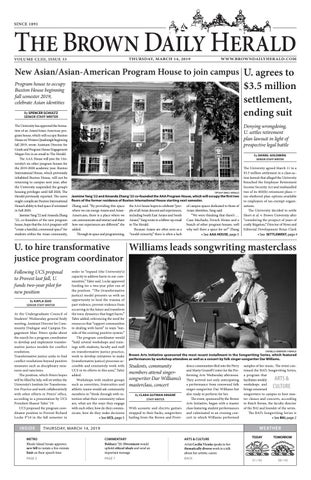
Brown Arts Initiative sponsored the most recent installment in the Songwriting Series, which featured performances by workshop attendees as well as a concert by folk singer-songwriter Dar Williams.
Students, community members attend singersongwriter Dar Williams’s masterclass, concert By CLARA GUTMAN ARGEMÍ STAFF WRITER
With acoustic and electric guitars strapped to their backs, songwriters hailing from the Brown and Provi-
dence communities filed into the Perry and Marty Granoff Center for the Performing Arts Wednesday afternoon. They arrived not only anticipating a performance from renowned folk singer-songwriter Dar Williams but also ready to perform for her. The event, sponsored by the Brown Arts Initiative, began with a master class featuring student performances and culminated in an evening concert in which Williams performed
samples of her music. The event continued the BAI’s Songwriting Series, a program that facilitates weekly workshops and brings renowned songwriters to campus to host master classes and concerts, according to Butch Rovan, the faculty director of the BAI and founder of the series. The BAI’s Songwriting Series is » See BAI, page 2
ARTS & CULTURE
WEATHER
THURSDAY, MARCH 14, 2019
METRO Rhode Island Senate approves new bill to instate a five-minute limit on floor speech time
COMMENTARY Bokhary ’21: Divestment would uphold ethical ideals and send an important message
ARTS & CULTURE Artist Cecilia Vicuña speaks to her thematically diverse work in a talk about her artistic career.
PAGE 2
PAGE 7
BACK
TODAY
TOMORROW
51 / 42
58 / 42
NEWS
PAGE 2 • THURSDAY, MARCH 14, 2019
THE BROWN DAILY HERALD
Senators approve bill to effectively eliminate filibustering Four hours of debate culminate in decision to pass five-minute limit on floor speeches By JACKSON TRUESDALE SENIOR STAFF WRITER
After four hours of argument over changes to Rhode Island Senate rules Wednesday night, the senators voted to approve a bill that will effectively end filibusters and increase the Senate President’s power over committee assignments. The rewritten R.I. Senate rules bill passed the Senate floor 33-3. Under the new rules, all floor speeches will be limited to five minutes, eliminating the filibuster as a political tactic moving forward. Over the course of the debate, Sen. Sam Bell, PhD ’16, D-Providence took the liberty of filibustering for the last time. Toward the end of the session, he proposed an amendment to remove the five-minute limit from the bill. Bell “says he is going to keep speaking on his amendment to strike the 5-minute rule until there’s a motion to stop him,” tweeted the Providence Journal’s Patrick Anderson. Sen. Erin Lynch Prata, D-Warwick and Cranston, eventually brought that motion to the floor, which the Senate voted in favor of 31-2. Sen. Donna Nesselbush ’84, D-Pawtucket and North Providence, and Sen. Adam Satchell, D-West Warwick, were the only two who voted to let Bell keep talking. Bell’s amendment then failed 5-30. “This rule would make legitimate, transparent legislative debate far more difficult. Even more seriously, it constitutes an effort to eliminate the filibuster,” activist group Rhode Islanders For Reform wrote in an official statement. The updated rules bill will now allow the Senate president to “change the committee assignment of a member without the member’s consent, for cause only.” The definition of “cause” remains unclear and has sparked criticism from Bell. Bell tweeted last month that the proposed rules bill was “a shameless power grab, a naked attempt to legalize
METRO
JACKSON TRUESDALE / HERALD
The Senate voted Wednesday evening to expand the Senate President’s power over committee appointments. But the new rule faced backlash over what was called “a power grab” by Senator Sam Bell PhD ‘16. the worst kind of retribution and political bullying.” Senate spokesman Greg Pare told the Providence Journal that the change comes after former Sen. Nicholas Kettle, R-Coventry, Foster, Scituate and West Greenwich remained on the Senate Finance Committee after he violated campaign finance rules. The new rule will allow the Senate
president to remove those who have committed serious crimes like Kettle’s, Pare told the Providence Journal, adding that “the intent is that such serious finance violations could constitute cause for removal from the finance committee.” The new rules also stipulated that any heavily rewritten legislation must be posted at least 24 hours before
Senate consideration. Current Senate President Dominick Ruggerio, D-Providence, introduced the rewritten bill of rules along with Sens. Lombardi, McCaffrey, Algiere and Goodwin. Lombardi called it “a significant movement in the direction towards transparency.” Bell, Nesselbush and Satchell were the only senators to oppose the bill.
» BAI, from page 1 open to Providence community members, some of whom performed at Wednesday’s event. Called “one of America’s very best singer-songwriters” by The New Yorker’s Hendrik Hertzberg, Williams has produced more than ten albums and three books, including one about the numerous towns in which she has toured throughout her almost threedecade career. The University selected Williams to host the class after receiving a list of student recommendations, Rovan said. “She’s a perfect fit for Brown. She’s an amazingly talented singer-songwriter, she’s engaged in public service and she’s a great teacher,” Rovan added. Songwriters in the master class would benefit from Williams’s perspective on lyric-writing, given her “ability to get inside someone else’s song and read between the lines,” Rovan said. Morgan Johnston, a singer-songwriter based just outside Providence who attends the weekly workshops, said it is “very special that the program reaches out into the (Providence) community.” She felt excited to learn from Williams because she wanted to “see the person behind the songwriter.” Tracie Potochnik, singer-songwriter and co-facilitator of the series’s workshops, said that participants would “learn a lot by hearing feedback from someone who’s established in her career.” She added that the master class allows songwriters and audience members to “see a different side of the artist” in a casual, supportive setting. If writers are receiving comments on songs when the “ink is still wet,” fostering a comfortable environment is deeply important, Potochnik said. Lily Porter Wright ’20 was one of the seven participants from the series selected to perform at Williams’ master class. Wright expressed gratitude toward the University for providing her the opportunity to “play a song in front of a celebrity” and added that she joined the Songwriting Series to receive constructive feedback from other songwriters. “There isn’t really a class space for that on campus,” she said. As artists performed at the master class, Williams nodded along to the music, jotting down notes. After asking each performer what motivated them to write their song, she offered feedback on how to best adapt the song’s musical form to its lyrical message. “When you write a line, you are the goddess of time and space,” she told one songwriter. “Stretch the line out on your own terms.” Williams’s concert Wednesday evening featured a brief but broad sample of her songs, both old and new. Singing about topics ranging from traveling to motherhood while drawing on Greek mythology and childhood memories for inspiration, her repertoire remained cohesive through her use of familiar melodies and her poignant, often humorous, style. The Songwriting Series’ first guest artists were Rosanne Cash and John Leventhal, The Herald previously reported. Rovan expects the series to keep expanding: He is planning to launch a parallel series of writing workshops that focus on rap and hip-hop next spring, although this program is “still in the development stage.”
NEWS
THURSDAY, MARCH 14, 2019 • PAGE 3
THE BROWN DAILY HERALD
» AAA HOUSE, from page 1 said. The desire to establish a space for students within the Asian community also stemmed from Yang and Zhang’s unique cultural backgrounds. Yang and Zhang both spent part of their childhood in China, before Yang moved to Canada and Zhang moved to America. Through this mix of backgrounds, it can sometimes be difficult for some students to balance their identities, Zhang said. “We wanted to bring (our identities) holistically together. You don’t really have to choose, you are just you and we all accept that.” Discussions about forming a new program house began in early January, when the co-founders reached out to Fox during a University-wide information session about the rushing process. Following that meeting, Fox directed Yang and Zhang to complete a series of forms outlining the program house’s focus, mission statement, intended campus impact and expected membership numbers.
By mid-February, the co-founders received notice that their program house had been accepted and would be placed in Buxton for the 2019-2020 academic year. While the AAA program completed the application process in about a month, most program houses take a full semester for University approval, Yang said. But “luck, great timing” and Fox’s “willingness to work with us every week” allowed the application process to move more quickly, she added. Fox “really saw our vision and our dreams for what this would be. I’m just really happy that Brown saw that as well,” Zhang said. Due to the expedited nature of establishing the new program house, the AAA program plans on “starting small, establishing our presence and growing from there,” Zhang said. This will include forming the program’s executive board, for which the group is currently accepting applications, she added. “We do want to spend a lot of time this semester and next semester
(establishing) ourselves better, and then perhaps we might enter the rushing process in spring of next year,” Yang said. The co-founders of the new program house completed recruitment of members March 7, in accordance with all program housing deadlines, Zhang said. Greek and program houses are required to maintain a minimum of 15 active in-house members, according to Greek and Program House Housing policies. Through an online Google Form application, the AAA program attracted interest from over 85 students, including international students from China, Hong Kong, the Philippines, Thailand and Korea, as well as some students from multiracial and non-Asian backgrounds, Zhang said. Of the 85 students who applied, 25 students will be living in Buxton next fall. The remainder of accepted students will be recognized as “family members” who will not be living in-house but will still have swipe access to the Buxton building, Zhang said.
AAA program members will occupy the first two floors of Buxton, with access to the house’s kitchen, lounge and library, Yang said. The remainder of the building will be filled with independents placed in Buxton through the housing lottery. The co-founders hope that the AAA program will provide a space for not only Asians but all students “who appreciate or are somehow involved in Asian culture,” Zhang said. “Definitely the stigma is that we only want Asians — that’s not true and we made that very clear to everyone when we were gathering interest in the house,” she added. While Sobhit Singh Arora ’21, president of the now-suspended Buxton International House, expressed approval of the University’s support for new living-learning communities, the AAA program’s placement in Buxton has prompted concerns that housing may not be available should Buxton International House return in fall 2020. “We love to see that the University is still promoting these diverse groups on campus and allowing new communities
to grow and develop, but at the same time it does raise concern for us that (the University) may not have a space for us when we come back to campus,” Arora wrote in communication to The Herald. Buxton House “is special to us, after all we are named Buxton International House, and it just wouldn’t be Buxton International House if we got a new building,” he wrote. Following an organization’s removal from campus, they must re-apply for housing after the University officially recognizes the group again, Fox wrote. However, residential space is not guaranteed for suspended programs hoping to return to campus. “It depends on how many new groups apply for spaces and get recognized and changes to existing spaces,” she wrote. The AAA program had “no choice in where we would be placed,” Yang said. Still, the group recognizes the historical and cultural significance of the Buxton House. “We definitely respect Buxton’s history and Buxton’s linkage to the International House,” Zhang said.
» UCS, from page 1 … how do they build an inclusive environment?” Peters said. The program coordinator position will not serve in a direct support role for students like CAPS or SHARE Advocates, but will work instead to develop and implement “processes that hopefully will help with the support and healing process” for harm that might affect group dynamics. In the hiring process, the University will look for “someone who’s going to work with existing communities,” including student groups and student government, “to build capacity to infuse transformative justice and … (consider) how we resolve conflict and how we engage with one another,” Peters said. The program coordinator will serve primarily in an educational capacity, but also as a resource in instances of significant harm within groups. “We want to find someone who has that experience and also has the ability to meaningfully connect with students,” Peters told The Herald after the meeting. The candidate search committee, comprised of Peters, two Campus Life staff members and two students, one of whom is also a member of UCS, will begin direct outreach to community organizations, conflict resolution master’s programs and leaders in the social justice field, Peters said. Peters explained the transformative justice framework as a “link between the personal and the collective. It’s not only the experiences of people who’ve been directly involved in whatever happened — it’s the experiences of the entire community
JASMINE RUIZ / HERALD
The University aims to hire a program coordinator for the Institute for Transformative Practice. The coordinator will work with existing communities to facilitate support and healing to address harm within groups such as sororities, fraternities and athletic teams. around them.” Connecting individuals and their communities in addressing harm is important because “harm doesn’t happen in isolation,” he added. “There’s societal, systemic issues
that can create conditions, that can be internalized, that can contribute to perpetuating harm … And so (transformative justice) looks really holistically.” During the presentation, Tahir
said that former UCS Vice President Camila Pelsinger ’20 “helped considerably with these efforts.” “The scope of what this could be is immense, and important and can be really powerful,” Peters said. “What
it ends up looking like, and what success ends up looking like, depends certainly on student buy-in, but also what do students see as the needs in their community for where harm is occurring.”
Enjoying this free paper? Support The Herald www.browndailyherald.com/donate
NEWS
PAGE 4 • THURSDAY, MARCH 14, 2019
THE BROWN DAILY HERALD
» SETTLEMENT, from page 1 wrote in an email to The Herald. The settlement agreement states that the “defendant denies any fault, liability or wrongdoing.” Furthermore, the University is “fully confident that our retirement plans are in compliance with all applicable laws,” including ERISA, Clark added. The settlement agreement states that the University must make a request for proposal for the creation of an “independent investment advisor” role for the retirement plans, as well as hire an independent fiduciary “whose sole loyalty is the settlement class” to evaluate and authorize the settlement. The motion for preliminary approval of the settlement was filed over two and a half years after participants in the retirement plans filed the initial complaint in July 2017. The four primary plaintiffs’ concerns stemmed from the management of the University’s Legacy Retirement Plan and Deferred Vesting Retirement Plan. Faculty and staff “who are regularly scheduled to work 1,000 or more hours per year” are usually eligible for these plans, the University’s website states. The plaintiffs alleged that the University’s managers for the plans “consistently selected and retained investment options … that historically and consistently underperformed their benchmarks and charged excessive management fees,” according to the complaint. The plaintiffs also argued that the plan managers should have chosen one recordkeeper for the
HERALD FILE PHOTO
In addition to paying $3.5 million to some 403(b) plan participants, the University will make a request for proposals for an independent investment advisor role for the plans and hire a temporary independent fiduciary to authorize the settlement. plans rather than the two chosen by the University, The Herald previously reported. The settlement will be paid to current and former plan participants, and “the distribution will be made into
(each participant’s) account,” according to the agreement. The settlement also calls for the University to “use commercially reasonable best efforts to further reduce recordkeeping fees” for a period of three years, beginning
OUR BUS IS YOUR BEST BET. Plan your next group outing to Mohegan Sun on Flagship Trailways!
Why Drive? For Information and Special Offers Call: Flagship Trailways 401.946.6705 or 1.800.672.6705 www.flagshiptrailways.com
Bonus packages are issued to individuals 21 years of age or older. To receive a casino bonus package, passengers must have a Momentum card or be able to sign up for a Momentum card on day of travel. Proper identification required. Please visit the Bus Marketing Window for official rules. Offer subject to change without notice. mohegansun.com
Why not extend your stay? Visit mymohegansun.com to view your hotel rates.
from the date of the settlement’s Final Approval Order. If fees increase during this period, the University must notify the plans’ participants to inform them and provide an explanation for the increase.
“This class action is one of a number of similar actions that were filed in 2016 and 2017 against universities that sponsor plans designed to offer employees financial security during retirement,” Clark wrote.
TODAY
THURSDAY, MARCH 14, 2019 • PAGE 5
THE BROWN DAILY HERALD
menu
spring still absent
SATELLITE DINING ANDREWS COMMONS
Chicken Parmesan Pizza, Barbecue Bam Bam Pizza, Baked Pasta, Pho Bar, Boneless Chicken Wings, Make Your Own Salad JOSIAH’S
BLUE ROOM
Taco Bar, Southwestern Burger, Seasonal Fruits and Vegetables
Chicken Artichoke Florentine, Focaccia Sandwich, Turkey Chili
DINING HALLS SHARPE REFECTORY LUNCH
DINNER
Grilled Italian Seasoned Chicken, Pies, Jasmine Rice, Green Curry Shrimp, Quinoa
Roasted Potatoes with Sun-Dried Tomatoes, Grilled Latin Spiced Pork Chop, Baked White Fish
VERNEY-WOOLLEY LUNCH
DINNER
Chicken Rice Soup, Cannellini Bean Ragout, Brown Rice Pilaf, Enchilada Bar, Sauerkraut
Chicken Pasta Carbonara, Chickpea Shawarma, Cauliflower Au Gratin, Chocolate Cake
sudoku
HUAYA OUYANG / HERALD
crossword
Whatever else may change, bland building-scapes endure as a fact of life in New England. We eagerly await a leafy spring and its promise to conceal the harsh geometries of Brown’s concrete towers and brick walls.
Q U O T E O F T H E D AY
“People are afraid of grief; people are afraid of pain. … All these emotions exist in the naked space of the soul.” — Cecilia Vicuña, artist and activist
See vicuña on back page.
calendar TODAY
MARCH
S
3
M
4
T
5
W
6
Th
7
F
S
1
2
8
9
Narratives of China’s Environment 12:00 P.M. Gerard House
Brown Bag Series: MindTraps and Pornoboskoi 12:00 P.M. Rhode Island Hall, Room 108
Natural Skin Care for Winter 12:30 P.M. South Street Landing 499
A History of Urban Violence 4:00 P.M. Watson Institute
TOMORROW
10
11
12
13
14
15
16
17
18
19
20
21
22
23
24
25
26
27
28
The Brown Legal History Workshop 9:00 A.M. Brown Faculty Club
Anthropology Talk by Acanthi Subramanian 12:00 P.M. Giddings House 212
Philosophers on Diversity Lecture 4:00 P.M. Kassar House
Brown University Wind Symphony 8:00 P.M. Di Ciccio Auditorium
COMMENTARY PAGE 6 • THURSDAY, MARCH 14, 2019
THE BROWN DAILY HERALD
STAY UP-TO-DATE. FOLLOW US ON FACEBOOK. FACEBOOK.COM/BROWNDAILYHERALD
Find us online! facebook.com/browndailyherald
browndailyherald.com
@the_herald
Location: 195 Angell St., Providence, R.I. www.browndailyherald.com
@browndailyherald
youtube.com/browndailyherald
Editorial Leadership
Sections
Multimedia & Production
Business
Editor-in-Chief Emily Davies
Arts & Culture Editors Elise Ryan Annabelle Woodward
Design Editors Kyle Cui Bilal Ismail Ahmed Dylan Tian Julie Wang
General Managers Ravi Betzig Nicholas Masiakowski
Managing Editors Anna Kramer Priyanka Podugu Senior Editors Anita Sheih Sarah Wang
Metro Editors Colleen Cronin Sophie Culpepper Celia Hack
Editorial Page Editors Grace Layer Krista Stapleford
News Editors Katherine Bennett Jacob Lockwood Melanie Pincus Allie Reed
post- magazine Editor-in-Chief Anita Sheih
Science & Research Editors Cate Ryan Chris Schutte Sports Editors Alexandra Russell Alex Smolar COMMENTARY Opinions Editors Rebecca Aman Emily Miller Derek Simshauser
Head Photo Editors Tiffany Ding Benjamin Turuño Copy Desk Chief Kelley Tackett Illustrations Editor Daphne Zhao Video Editor Victoria Caruso Max Dekle Graphics Editor Sarah Martinez
Office Manager Diane Silvia Directors Sales: Bersabel Yifru Finance: Rudra Srivastava, Reynaldo Blandon Strategy: Edwin Farley
Editorial contact: 401-351-3372 herald@browndailyherald.com
Advertising contact: 401-351-3372 advertising@browndailyherald.com
Submissions: The Brown Daily Herald publishes submissions in the form of op-eds and letters to the editor. Op-eds are typically between 750 and 1000 words, though we will consider submissions between 500 and 1200 words. Letters to the editor should be around 250 words. While letters to the editor respond to an article or column that has appeared in The Herald, op-eds usually prompt new discussions on campus or frame new arguments about current discourse. All submissions to The Herald cannot have been previously published elsewhere (in print or online — including personal blogs and social media), and they must be exclusive to The Herald. Submissions must include no more than two individual authors. If there are more than two original authors, The Herald can acknowledge the authors in a statement at the end of the letter or op-ed, but the byline can only include up to two names. The Herald will not publish submissions authored by groups. The Herald does not publish anonymous submissions. If you feel your circumstances prevent you from submitting an op-ed or letter with your name, please email herald@browndailyherald.com to explain your situation. You can submit op-eds to opinions@browndailyherald.com and letters to letters@browndailyherald.com. When you email your submission, please include (1) your full name, (2) an evening or mobile phone number in case your submission is chosen for publication and (3) any affiliation with Brown University or any institution or organization relevant to the content of your submission. Please send in submissions at least 24 hours in advance of your desired publication date. The Herald only publishes submissions while it is in print. The Herald reserves the right to edit all submissions. If your piece is considered for publication, an editor will contact you to discuss potential changes to your submission. Commentary: The editorial is the majority opinion of the editorial page board of The Brown Daily Herald. The editorial viewpoint does not necessarily reflect the views of The Brown Daily Herald, Inc. Columns, letters and comics reflect the opinions of their authors only. Corrections: The Brown Daily Herald is committed to providing the Brown University community with the most accurate information possible. Corrections may be submitted up to seven calendar days after publication. Advertising: The Brown Daily Herald, Inc. reserves the right to accept or decline any advertisement at its discretion. The Brown Daily Herald, Inc. is a financially independent, nonprofit media organization bringing you The Brown Daily Herald, BlogDailyHerald and Post- Magazine. The Brown Daily Herald has served the Brown University community daily since 1891. It is published Monday through Friday during the academic year, excluding vacations, once during Commencement and once during Orientation by The Brown Daily Herald, Inc. Single copy free for each member of the community. Subscription prices: $200 one year daily, $100 one semester daily. Copyright 2019 by The Brown Daily Herald, Inc. All rights reserved. Periodicals postage paid at Providence, R.I. Postmaster: Please send corrections to P.O. Box 2538, Providence, RI 02906.
COMMENTARY THURSDAY, MARCH 14, 2019 • PAGE 7
THE BROWN DAILY HERALD
LETTER TO THE EDITOR
University should prioritize ethics over profit To the Editor: In his column titled “Divestment has severe costs — and nobody is talking about them,” Anuj Krishnamurthy ’19 seeks to discredit Brown Divest and essentially places the University’s financial well-being over the ethics of being a stakeholder in companies that profit off the suffering of Palestinians. While he claims to acknowledge the positivity of imbuing the University’s investment philosophy with moral and ethical considerations, Krishnamurthy then goes on to state, “Divesting from public companies involved in the repression of Palestinians, or any social ill, will not actually hurt those companies.” Even if we assume that divesting creates no economic repercussions, as Brown students, how can we be morally and ethically content with continuing the status quo of the University profiting from such companies? Furthermore, if divesting does not have any repercussions on the targeted companies, then why is there such a ruthless struggle among politicians in this country seeking to criminalize BDS? Ac-
cording to the Guardian, “BDS has caused two dozen states to pass bills or issue orders inhibiting or penalizing those boycotting Israel or its settlements.” This does not even include the debate over the Israel Anti-Boycott Act introduced in Congress last year, which sought to prohibit American corporations from joining boycotts against Israel, restricting fundamental First Amendment rights. You would not try to pass legislation against boycotts if you believed the act of boycotting would not have any repercussions. Krishnamurthy then critiques Brown Divest’s calls for financial transparency and student oversight, saying that first, the investment managers should be maximizing profit for the University, not “gathering disparate information on the social and moral soundness of the thousands of companies in which the endowment is invested,” and second, that the investment managers cautiously safeguard their investments for competitive edge. The problem here is that once again, the ethics of where we invest matter, and that the moral soundness of the companies in which University money is invested does need
to be evaluated. Brown’s principle priority should be toward its students, and we deserve to know how funds are being invested. I can understand that Brown would want to keep its competitive edge with its portfolios, but in my opinion, Brown Divest takes that into account; it asks the University to “establish a means of implementing financial transparency.” The University could potentially find a way to establish financial transparency to its students without disclosing its portfolio to the general public and thus without risking its competitive advantage. At the end of the column, Krishnamurthy writes, “Reformulating Brown’s portfolio will not fill Palestinian stomachs; it will not boost Palestinian wages; it will not spare innocent Palestinians from blockades, bulldozers and bullets.” Of course, a reformulation of Brown’s portfolio does not have the power to single-handedly achieve the aforementioned on its own. But the reformulation of Brown’s portfolio would allow the University to stay true to its commitment to refraining from supporting companies engaged in “social harm” as out-
lined by its Advisory Committee on Corporate Responsibility and Investment Policies charter. Divestment may not fill Palestinian stomachs, but a University decision to divest would send a strong message to our peer institutions, community members and Rhode Island politicians — with whom Krishnamurthy suggests critics of Israel should spend time lobbying — condemning the injustice and human rights violations committed in the occupied Palestinian territories. Divestment may not singlehandedly spare innocent Palestinians from blockades, bulldozers and bullets, but it allows us to express that we will not stand for the injustices Palestinians face while living under occupation and that we will use every privilege we have as Brown students to urge our University to do better, no matter the cost.
Luqmaan Bokhary ’21
ARTS & CULTURE THE BROWN DAILY HERALD
THURSDAY, MARCH 14, 2019
Cecilia Vicuña delves into multi-disciplinary artistic canon
COURTESY OF CECILIA VICUÑA
Cecilia Vicuña's work involves subjects from the women's rights movement in Chile to the ecologically destructive consequences of microplastics. One of her most well-known pieces consists of a series of installations addressing indigenous histories through imagery of quipus, an ancient Incan form of communication using knotted wool.
Artist, poet, activist Vicuña describes her trajectory from Chilean Revolution to today By KATHERINE OK SENIOR STAFF WRITER
On Wednesday, the University’s Visual Art Department hosted a talk by artist Cecilia Vicuña, in which she discussed themes and subjects surrounding her artistic career that ranged from ecological destruction to women’s rights. Featured in acclaimed museums like
ARTS & CULTURE
Tate Modern, MoMA and the Guggenheim Museum, Vicuña’s work includes a wide range of poetry, films, installations and paintings. She is most well-known for her series of installations that seek to comment on indigenous histories through the use of spatial and material imagery of wool quipus, an ancient Incan form of communication using knots. University community members as well as RISD students and members of the local Providence community gathered in the packed auditorium of List Art Center to hear Vicuña speak. Singing into the microphone, she drew laughter from the audience by greeting an infant in the crowd. She then went on to describe the beginnings of her professional artistic career after she emigrated from
Chile to the United States. As Vicuña elaborated on her early experiences in the United States, she revealed how her work addresses aspects of culture and heritage. Some of the primary works that Vicuña focused on during her talk related to the women’s rights movement in Chile. She compared a colloquial phrase of modern feminism, “By resisting we persist,” to one of her early works in the mid-’60s that emphasized the relationship between the words ‘resisting’ and ‘existing.’ “Poetry does not exist in books alone,” Vicuña stated, referencing the echoes of her word choice in the practices of modern activism. “It exists somewhere else as well.”
Much of her work centered around the themes of nudity and identity in relation to social freedom. One painting she discussed depicted nude figures marching for feminist ideals, flying out of prison and proclaiming the music of Janis Joplin. During the question-and-answer portion of the talk, an audience member asked Vicuña if she intentionally connects the ideas of grief and nudity in her work. In Vicuña’s response, she touched on the notions of body and suffering. “People are afraid of grief; people are afraid of pain,” she said. “All these emotions exist in the naked space of the soul.” Vicuña’s other artwork comments on ecological destruction, such as the
invasion of microplastics on historically significant Chilean beaches. One installation on this theme, “Balsa Snake Raft to Escape the Flood,” was featured in the Contemporary Arts Center New Orleans. The work, which focused on the losses suffered from Hurricane Katrina, consisted of plastics and other debris hauntingly suspended in mid-air. Audience member Kenneth Neighbors ’22 found Vicuña’s presentation to be particularly illuminating in terms of the comprehensiveness of the social histories she focuses on. “It was really interesting how Cecilia highlighted so many marginalized stories and narratives through her work,” he said. “It makes you think about how many perspectives we miss in everyday art.”