SINCE 1891
THE BROWN DAILY HERALD WEDNESDAY, OCTOBER 23, 2019
VOLUME CLIV, ISSUE 35
UNIVERSITY NEWS
UNIVERSITY NEWS
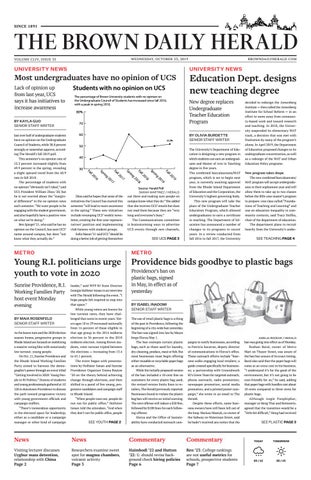
Most undergraduates have no opinion of UCS Lack of opinion up from last year, UCS says it has initiatives to increase awareness BY KAYLA GUO SENIOR STAFF WRITER
70 60 53.5%
50 40
9
18
19
20
8
01
g
rin
ll 2 Fa
Sp
20
01
ll 2 Fa
As the leaves turn and the 2020 election season looms, progressive groups in Rhode Island are focused on mobilizing a massive voting bloc with notoriously low turnout: young people. On Oct. 21, Sunrise Providence and the Rhode Island Working Families Party aimed to harness the demographic’s power through an event titled “Getting Involved in 2020: Young People in RI Politics.” Dozens of students and young professionals gathered at AS 220 in downtown Providence to discuss the path toward progressive victory with young government officials and campaign staffers. “There’s tremendous opportunity in the electoral space for leadership, either as a candidate or a campaign manager or other kind of campaign
g
SARAH MARTINEZ / HERALD
Zhou said he hopes that some of the initiatives the Council has started this semester “will lead to more awareness in the spring.” These new initiatives include revamping UCS’ weekly newsletter, creating the first-year representatives’ position and implementing club liaisons with student groups. Sofia Mason ’21 said UCS “should be doing a better job of getting themselves
Young R.I. politicians urge youth to vote in 2020
BY MAIA ROSENFELD SENIOR STAFF WRITER
rin
7
17
20
6
01
g
rin
ll 2 Fa
Sp
01
METRO
Sunrise Providence, R.I. Working Families Party host event Monday evening
Sp
30
leader,” said WFP RI State Director Georgia Hollister Isman in an interview with The Herald following the event. “I hope people felt inspired to step into that space.” While young voters are known for low turnout rates, they have challenged that norm in recent years. Voters ages 18 to 29 increased nationally from 16 percent of those eligible in that age group in the 2014 midterm election to 36 percent in the 2018 midterm election. Among Brown students, voter turnout tripled between the elections — increasing from 13.4 to 45.1 percent. The event began with presentations by Hollister Isman and Sunrise Providence Organizer Emma Bouton ’20 on the theory behind achieving change through elections, and then shifted to a panel of five young, progressive candidates and campaign staff in Rhode Island. “When people tune out, people do not run for public office,” Hollister Isman told the attendees. “And when they don’t run for public office, people
SEE YOUTH PAGE 2
Education Dept. designs new teaching degree
New degree replaces Undergraduate Teacher Education Program
80%
ll 2 Fa
Just over half of undergraduate students have no opinion on the Undergraduate Council of Students, while 38.8 percent strongly or somewhat approve, according The Herald’s fall 2019 poll. This semester’s no opinion rate of 53.3 percent increased slightly from 49.9 percent in the spring, revealing a slight upward trend from the 48.9 rate in fall 2018. The percentage of students with no opinion “obviously isn’t ideal,” said UCS President William Zhou ’20, but he is not worried about the “marginal difference” in the no opinion rates each semester. “We want people to be engaging with the student government, and also hopefully have a positive view on what we’re doing.” Ben Spiegel ’21, who said he has no opinion on the Council, has seen UCS’ name around campus, but does “not know what they actually do.”
BROWNDAILYHERALD.COM
out there and making sure people on campus know what they do.” She added that she receives UCS’ emails but does not read them because they are “very long and everyone’s busy.” The Communications committee is brainstorming ways to advertise UCS events through new channels,
SEE UCS PAGE 3
BY OLIVIA BURDETTE SENIOR STAFF WRITER The University’s Department of Education is designing a new program in which students can earn an undergraduate and Master of Arts in Teaching degree in five years. The combined baccalaureate/MAT program, which is set to begin next year, is currently awaiting approval from the Rhode Island Department of Education and the Corporation, the University’s highest governing body. This new program will take the place of the Undergraduate Teacher Education Program, which allowed undergraduates to earn a certificate in teaching. The Department of Education has announced a number of changes to its programs in recent years. In a review conducted from fall 2016 to fall 2017, the University
decided to redesign the Annenberg Institute — then called the Annenberg Institute for School Reform — in an effort to move away from community-based work and toward research and teaching. In 2018, the University suspended its elementary MAT track, a decision that was met with frustration by many of the program’s alums. In April 2019, the Department of Education proposed changes to its undergraduate concentration, as well as a redesign of the MAT and Urban Education Policy programs. New program takes shape The new combined baccalaureate/ MAT program will accept undergraduates in their sophomore year and will allow them to take up to two classes before the fifth-year master’s program to prepare: one class called “Foundations of Teaching and Learning” and one on education inequality in community contexts, said Tracy Steffes, chair of the department of education. The department plans to recruit heavily from the University’s under-
SEE TEACHING PAGE 4
METRO
Providence bids goodbye to plastic bags Providence’s ban on plastic bags, signed in May, in effect as of yesterday BY ISABEL INADOMI SENIOR STAFF WRITER The use of retail plastic bags is a thing of the past in Providence, following the beginning of a city-wide ban yesterday. The ban was signed into law by Mayor Jorge Elorza May 1. The ban exempts certain plastic bags, such as those used for laundry, dry-cleaning, produce, meat or fish. But most businesses must begin offering either reusable or recyclable paper bags as an alternative. While the initially proposed version of the ban included a 10-cent fine on customers for every plastic bag used, the revised version limits fines to retailers, The Herald previously reported. Businesses found to violate the plastic bag ban will receive an initial warning. The next offense will induce a $50 fine, followed by $100 fines for each following offense. Elorza and the Office of Sustainability have conducted outreach cam-
AMELIA ROZEAR / HERALD
paigns to notify businesses, according to Patricia Socarras, deputy director of communications in Elorza’s office. These outreach efforts include “business walks engaging local retailers; a guide created specifically for businesses; a partnership with Groundwork RI’s Green Team for targeted outreach; phone outreach; radio promotion; newspaper promotion; social media promotion; and a printed poster campaign,” she wrote in an email to The Herald. Despite these efforts, some business owners have still been left out of the loop. Mariusz Masnyk, co-owner of the Subway on Waterman Street, said he hadn’t received any notice that the
News
News
Commentary
Commentary
Visiting lecturer discusses Uyghur mass detention, relationship with China Page 2
Researchers examine sweet spot for magma chambers, volcanic activity Page 3
Haimbodi ’22 and Hutton ’22: U. should revise background check hiring policies Page 6
Ren ’23: College rankings are not useful metrics for schools, prospective students Page 7
ban was going into effect as of Monday. Roshan Baral, owner of Metro Mart on Thayer Street, was aware of the ban but unsure of its exact timing. Baral also said that the paper bags will come at an extra cost to his business. “I understand it’s for the good of the environment, but it’s not going to be cost-friendly for us,” he said, adding that paper bags with handles cost about 10 cents compared to three cents for plastic bags. Although Angie Panphiphat, manager at Heng Thai and Rotisserie, agreed that the transition would be a “little bit difficult,” Heng had received
SEE PLASTIC PAGE 3
TODAY
TOMORROW
66 / 42
66 / 45
2
THE BROWN DAILY HERALD | NEWS
WEDNESDAY, OCTOBER 23, 2019
UNIVERSITY NEWS
Visiting lecturer details mass internment of ethnic Uyghurs in China Adeeb Khalid describes historical tensions behind Uyghur mass detention BY MORGAN MCCORDICK CONTRIBUTING WRITER In light of recent media attention on the ongoing mass detention of the Uyghur Muslims in China, Carlton College’s Professor of Asian Studies and History Adeeb Khalid spoke on the history of the people and their relationship to the Chinese government in a talk at the Watson Institute for International and Public Affairs Oct. 22. The Center for Middle East Studies hosted the event, entitled “The Uyghurs’ China Problem, or How We Got to the Political Re-Education Camps of Xinjiang.” Over roughly the past five years, the Chinese government has detained over a million Uyghur Muslims in what it calls “vocational training centers” scattered across China’s Xinjiang province, according to the Council on Foreign Relations. Khalid, who has visited the region himself, said the government’s policing of Uyghurs in Xinjiang amounts to a “surveillance state of a kind we have never seen before.” Khalid has written a handful of works on Central Asia’s history, the most recent entitled “Making Uzbekistan: Nation, Empire, and Revolution in the Early USSR.” Khalid was invited to the University to discuss the ongoing Uyghur internment through a collaborative effort between the Center for Middle East Studies and the China Initiative, the Watson Institute’s “interdisciplinary hub for the study of modern China.” Much of Khalid’s lecture revolved around the fundamental ideological rift between the Uyghur population and the
REBECCA HO / HERALD
Carlton College’s Adeeb Khalid, a historian with expertise in South Asia, described how the Chinese Communist Party’s “transhistorical” identity conflicts with the Uyghur’s Turkic ethnic identity, which dates back to the days of the Russian Empire. Chinese government, which he said is based in a centuries-long historical tension. Khalid observed “a fundamental (ideological) dissonance at the heart of the problem.” The Communist Party’s “belief that China is a transhistorical entity with inviolable political boundaries” inevitably comes into conflict with the Uyghur’s Turkic ethnic identity, he added. The historical roots of this ideological fracture are especially important because the notion of a distinct Turkic political identity dates back to days of the Russian Empire and inception of
the Soviet Union, he said. Khalid’s historical survey of the Uyghur conflict particularly resonated with Frishta Qaderi ’20, one of event’s attendees. “I thought it was important to frame the issue as having historical roots in the Russian Empire and the emergence of Turkic ethnic consciousness,” Qaderi told The Herald. Khalid attributed the more recent buildup of surveillance and detention infrastructure in Xinjiang to the rise of the Belt and Road Initiative, the name given to China’s controversial cam-
paign for global economic development. The Chinese government has “co-opted post-9/11 anti-terrorist discourse” to label the Uyghurs as a destabilizing entity in a region integral to the Belt and Road Initiative, Khalid said. In the eyes of the Chinese government, “if Xinjiang is an area of turbulence, Belt and Road falls apart.” When asked by a member of the audience if the Chinese government should be concerned about the detainments’ impact on China’s international reputation, Khalid said that “China has
enough soft power that no one is going to complain.” Their vast economic reach explains the “deafening silence from other Muslim countries,” he added. Despite this bleak outlook, Khalid’s lecture generated positive reactions from attendees who thought it was important that such a dire human rights issue receive as much attention as possible. “Chinese media is incredibly biased on this issue,” said Jenny Huang ’23. “It’s great to hear and consider the truth of the issue from a professional viewpoint.”
YOUTH FROM PAGE 1 who share our values don’t win public office, and we’re right back with more politicians who don’t share our values.” Bouton echoed this message, talking about the importance of grassroots efforts. “We see elections as key to winning that political power and getting those enthusiastically supported public officials in office,” she said. “But also using it as an opportunity to build that people power, getting people out and canvassing, and coming together as a movement around elections.” The panelists discussed the importance of youth, women and people of color getting involved in politics. They also shared their own campaign experiences and talked about the challenges of running for office as young people. “Young people for a long time and for a whole host of reasons have felt disempowered and excluded from the political process,” said Sunrise Organizer Mara Dolan ’19.5 , who moderated the panel. “And this event was just one way to highlight the young people who are saying ‘no’ to that and are stepping up to the plate anyway.” Providence City Councilor of Ward 12 Kat Kerwin, who first ran for office two years ago at the age of 20, said that “everyone in the establishment” discouraged her from running. Tiara Mack, a candidate for Rhode
COURTESY OF STEVE AHLQUIST
Panelists discussed the importance of youth running and working on political campaigns in order to advocate for their political views. Island’s Sixth District Senate seat, said that seeing a wave of strong women of color as leaders in their districts helped her realize that “people could show up as their authentic selves in a movement and actually make change.” Aaron Regunberg ’12, former member of the RI House of Representatives (District 4) who launched an unsuccessful bid for RI lieutenant governor last year , added that “we need to focus on winnable races, but we also need to stretch, we need to push for things that are right at the edge of what’s winnable, because that’s how we’re going to move the conversation forward.” He noted that the political system is not made for large-scale change, but progressives can “make significant change if enough people get involved.” Hollister Isman echoed Regunberg’s
sentiment, emphasizing the possibilities to make impact in the small Ocean State. “Races are relatively small, people with a few good organized friends and volunteers can run for office,” she said. “It’s possible for community activists, for young people, for people from all kinds of backgrounds to run and actually win.” Jonathan Acosta, Central Falls city councilor of Ward 1 and candidate for RI Senate (District 16), and Keith Jillette, campaign manager for Woonsocket City Councilor Alex Kithes, also spoke on the panel and emphasized the importance of identifying issues that unite communities. The event ended with a breakout session during which attendees could participate in small group discussions with any of the panelists.
WEDNESDAY, OCTOBER 23, 2019
THE BROWN DAILY HERALD | NEWS
3
PLASTIC FROM PAGE 1
SCIENCE & RESEARCH
U. researchers investigate volcanic activity Researchers study magma chambers, volcano behavior on Earth, other planets BY PREETI GANESH STAFF WRITER In an effort to better understand volcanic activity and its origins on Earth and beyond, University researchers have examined the creation of magma chambers to help explain why these chambers exist at relatively the same depth across the globe. A recent study by Christian Huber, lead author of the research and an associate professor of earth, environmental, and planetary sciences, and a group of researchers investigated the observed depth of explosive magma chambers, which they found exist only between six and 10 kilometers underground. Huber’s team conducts research on volcanic activity on Earth, the moon and other planets in the solar systems. “Volcanoes are perhaps the most spectacular demonstration of heat and mass transport through the planet, and not just on Earth but also all four of the inner plants in the solar system,” said Meredith Townsend, assistant professor in the department of earth sciences at the University of Oregon and one of the co-authors of the paper. Magma chambers are formed through “repeated magma injections,” wrote Agust Gudmundsson, chair of structural geology at the Royal Halloway, Unviersity of London, in a research article unaffiliated with the study. Magma, which is mostly solid and semi-molten rock and “crystal
UCS FROM PAGE 1 including Today@Brown, posters and social media, said Co-Communications Director Nadia Goldberg ’21. The Council also plans to bolster its social media presence to improve how information about UCS is disseminated to the student body, Zhou said. “The idea of all of that is to try to recruit people to UCS events even if they haven’t had UCS experience in the past,” Goldberg said. The poll results also revealed that the no opinion rate decreases by class year — 37.3 percent of first-years said they had no opinion compared to 13.8 percent of seniors. “When I was a first year and I came to Brown, what UCS was doing was not necessarily the top thing on my mind,” Zhou said. But this trend is “encouraging” because “it means that over time, people … have seen the impact that UCS has been able to create on campus.” Zhou said he hopes the new first-year representatives will advocate on behalf of first-years and act as a resource by increasing channels of communication. The first-year representatives recently introduced themselves and their goals to the Class of 2023 via email, he added. Meggie Baron ’23 voted for the firstyear representatives’ position earlier this fall, but said she has a “limited opinion” on the Council. “I just don’t think they have that much power to make that much change,” she said. “They say all these things that they’re (going to) try to do … but I don’t
mush,” is collected in rock layers under the surface of the Earth. As magma accumulates within rock layers, specific temperature and pressure conditions develop so that “the magma is drawn towards a molten zone” during explosions, Gudmundsson added. The researchers hoped to unearth the “optimal depth range,” its causes and why it tends to lie between six to 10 kilometers, Townsend said. Additionally, the team worked to analyze the planetary conditions that allow for magma chamber growth and the effect water may have on these dynamics.
to come from about six to 10 kilometers deep.” One of the main challenges of the project was not being able to observe the chambers directly, as well as the “limited ways to infer the state of magma inside the magma chambers,” Huber said. To conduct their research, the team focused on analyzing the chemical properties of rocks, Huber said. They analyzed the eruption frequency of volcanoes, collected rocks from old eruptions and traveled to places on the Earth with magma chambers that
SUMMER ZHANG / HERALD
“If you go deeper, the same magma chambers don’t tend to erupt, and if you go shallower, they don’t seem to stay there (or) grow much,” Huber said. “When magma cools down, it crystallizes. Water doesn’t like to go into crystals, so it dissolves in the magma … leading to gas formation.” When a volcano explodes, analyzing the rocks that come from the eruption allows researchers to understand their origin, Townsend said. “(They) usually point to the same depth over and over again, no matter what volcano you’re at around the world. They tend
think any of it really comes to fruition.” First-Year Representative Zane Ruzicka ’23 said that the Council plans to engage students with a “renewed motivation” to ensure that students understand UCS’ role and ability to advocate on behalf of students. “If we are able to solve problems and publicize that we have solved those problems, then people will recognize that we are a viable and active avenue to solving problems on Brown’s campus,” he added. Ruzicka plans to hold open hours in the Stephen Robert ’62 Campus Center alongside First-Year Representative Joon Nam ’23 to engage first-years on selected topics each week. The poll results “surprised me and alerted me to the fact that we do need to work a lot on engagement,” Nam said. Nam will use the Council’s fall poll to gather feedback about topics first-years care about, he added. The Council will also hold “Chip in on the Conversation” sessions, a project introduced in the spring which invites students to converse with UCS members around campus and aims to “put our presence out there and make us just more visible to the overall Brown population,” Goldberg said. The poll results “made me just want to work even harder to make sure that … people know what UCS is doing,” she added. “Whether or not they support UCS is going to differ person to person, but I do think that it’s really important that the student population knows what UCS is up to.”
are now exhumed by erosion. Huber compared their methodology to those used by physicians when conducting brain scans, shooting waves to identify core changes in the properties of the medium through which the wave travels. Shooting waves long distances, when combined with many hidden objects underneath Earth’s surface, can affect wave travel and make the research difficult. The team set out to build a “physical interpretation of the processes (of magma formation) and then codify that into equations” to identify the
causes and consequences of volcanic activity, Huber said. They built physical models, attempting to “simulate a broad range of conditions,” Townsend said. “I think we ran the model hundreds or thousands of times to make sure we’re covering a parameter space that’s representative of all the possible conditions on the Earth.” The team also looked at “volcanoes on different planetary bodies,” Huber said, adding that “Mars has the biggest volcano in the solar system, about 20 kilometers high. … Even icy bodies have their own type of volcano — it’s a feature that connects deeper parts of planetary bodies.” When working on planetary bodies outside of Earth, the team had and still has limited access to the same kinds of data that might be collected on Earth. As a result, it was “more difficult to make a distinction between different hypotheses,” Huber said. The team has also conducted research on volcanic activity on the moon: “there is remote-sensing satellites that have been launched some time ago that map the surface chemistry through remote sensing spectroscopy pretty well. One of the things that they measured is the proxy for water … The moon should be decently dry, and we see patches that are more water rich than expected, and they correlate with places where we know there was three or four billion years ago relatively large volcanic eruptions.” The team is currently conducting research projects on Mercury, Mars and the moon and has already worked with sample returns from the moon. “The way that magma is generated and stored in the crust is really important for understanding how planets work,” Townsend said.
a letter from the city about the ban and began using paper bags last week. The plastic bag ban is part of the city’s efforts to make Providence healthier and more sustainable. “The Office of Sustainability has the Sustainable Providence Plan to implement a zero waste strategy by 2033 and is working to identify strategies on how Providence can become carbon neutral in the coming years,” Socarras wrote. “I think some customers would still prefer to have plastic, but that’s not an option,” said Harry Adler, co-owner of Adler’s Design Center & Hardware. Adler’s has switched over to paper bags, and despite “minor inconveniences,” Adler said that the plastic bag ban is “the right thing to do, and we’re glad to do it.”
STAY UP-TO-DATE. FOLLOW US ON FACEBOOK. FACEBOOK.COM/BROWNDAILYHERALD
4
THE BROWN DAILY HERALD | NEWS
WEDNESDAY, OCTOBER 23, 2019
TEACHING FROM PAGE 1 graduate classes, so that these students make up “about half or even more of our MAT students.” The MAT cohort will be 25 to 35 candidates, Steffes added. Additionally, two new faculty positions at the University have been created for a math education teacher and a specialist in English language learning. According to Director of Teacher Education Sarah Leibel ’97 MAT ’06, these faculty will train teachers for the Providence Public School District, which is in more need of math and science teachers, teachers of color and teachers who are skilled at supporting English language learners. PPSD’s needs are “totally in line with our focus on urban education,” Leibel said. As part of this shift in focus, the Department of Education will partner with four local schools where MAT candidates will spend their entire year student-teaching, as opposed to the one semester they spent in prior years. “We don’t just want to build great teachers,” Leibel said. “We want to be part of school improvement and capacity-building, and we hope that our MAT residents will really be able to serve that mission.” Steffes said that now is “an exciting moment of growth and university investment” in teacher education. The department is working on a new financial aid program that will allow more first-generation MAT candidates and candidates from low-income backgrounds to participate. Though administrators are still working out the details, the MAT program will likely have a similar financial aid process to the University’s for its undergraduates, which will utilize the Free Application for Federal Student Aid. “If you attended the kind of high schools we want to serve, we want you to consider teaching and we want to make it an option for you,” said Leibel. Director of Teacher Education is an inaugural position that Leibel has held since September. Leibel hopes the program will inspire more University students to pursue careers as classroom teachers. “Part
COURTESY OF BROWN UNIVERSITY
The Department of Education (above) has recently announced a number of changes to its undergraduate concentration and its Urban Education Policy and Masters in Arts and Teaching programs. The changes reflect a new emphasis on urban education. of what we’re here to say is that this is Education mandate doubling the stu- graduate with a teacher’s certification an undergraduate academic schedule. amazing, rich, intellectual work where dent teaching requirement for prospec- and begin teaching immediately, with- Dudak, who concentrated in physics, you can have a deep impact on kids tive teachers from one semester to one out having to pay for an extra year of said that though he had completed most and also a social justice impact. It’s year would have made UTEP impossible graduate school to get a master’s de- of the requirements for his concentratransformative work that absolutely by 2022, according to a Rhode Island gree. Currently, the University’s MAT tion before entering UTEP, he had to is an option that Brown undergrads School Superintendent’s Association program costs $57,112. switch his degree from a Bachelor’s of should be considering.” press release. Dudak, who is now in his second Science to a Bachelor’s of Arts because In addition to the department’s re“This RIDE mandate reflects larger year of teaching science at a public he could not fit the extra concentration cent structural changes, “there’s a focus trends in the field of teacher education, high school outside of Chicago, said requirements into his schedule while now on urban education,” Leibel said. which is moving towards longer time in the program prepared him well for his doing UTEP. “The decision before I came on was to school placements as an essential part current job. Elena Maker ’12.5, another UTEP see the undergraduate concentration, of the pedagogical training,” Steffes Now that UTEP is canceled, stu- alum, also attested to the challenges the UEP and the MAT program as all said. dents interested in becoming teachers of the program. “When I was at Brown, trying to tighten around that focus on While UTEP is in its last official can either apply for the new combined I took five classes a semester, I did all urban schools from (a) systems level year, no undergraduates are currently program or utilize the University’s ex- the extracurriculars and I was working to classroom teaching,” Leibel added. enrolled in the program. According to isting Concurrent Bachelor’s/Master’s part-time, and none of that was even Leibel, UTEP has only enrolled three Degree program in order to receive both a quarter as hard as being a student Cancellation of UTEP students in the last five years. their undergraduate and MAT degrees teacher for the semester.” The combined program will replace UTEP students took “essentially in five years. But the latter option may The new combined program rethe department’s Undergraduate Teach- all the same classes with the MAT” be difficult for students to complete moves the year of student teaching er Education Program, which allowed candidates, said UTEP alum Matthew because of the Education Department’s from the undergraduate experience. students to earn a certificate in teaching Dudak ’18. newly-redesigned MAT program, which Steffes affirmed that “opportunities for by the end of their four undergraduate “I think there was a one or two-re- requires candidates to participate in a undergraduates in teacher education years by participating in student-teach- quirement difference, but it pretty much year-long residency at an urban school (are) something that’s very important ing and taking classes starting the sum- offered all the same preparations as as part of their student-teaching expe- to us, and so that’s why we’re rolling mer before their senior year. the MAT program did,” Dudak said. But rience, The Herald previously reported. out this new combined baccalaureate/ A new Rhode Island Department of UTEP allowed students like Dudak to UTEP, too, was challenging to fit into MAT program.”
Want daily headlines or weekly Brown Bites in your inbox? linktr.ee/browndailyherald
WEDNESDAY, OCTOBER 23, 2019
THE BROWN DAILY HERALD | TODAY
5
CA L E NDA R TODAY
OCTOBER S
6
M
7
Tu
W
Th
F
S
1
2
3
4
5
8
9
10
11
12
13
14
15
16
17
18
19
20
21
22
23
24
25
26
27
28
29
S U D O KU
30
31
Worksheet Basics 10:00 A.M. Center for Information Technology
Sexy for Jesus: Contemporary Gospel Performance 11:00 A.M. Churchill House
Faculty/Staff Trivia 12:00 P.M. Kasper Multipurpose Room
Teach-in on the Crisis in Ecuador 12:00 P.M. Watson Institute
TOMORROW Engineering Seminar: Biomedical Engineering 9:00 A.M. Barus and Holley
Student Employment Open Lab Session 10:00 A.M. Center for Information Technology
Leavetaking Info Session 12:00 P.M. Stephen Roberts ’62 Campus Center
Mellon Mays Application Writing Session 12:00 P.M. Rhode Island Hall
Q U OTE OF TH E DAY
“We don’t just want to build great teachers. We want to be part of school improvement.”
— Sarah Leibel, director of teacher education SEE TEACHING PAGE 1
CR O S SWO R D
C L A RI F I CAT I ON The Oct. 18 article “‘Rigged: the Voter Suppression Playbook’ examines voting laws, gerrymandering” quoted Zoe Mermelstein ’21 as saying “it’s at risk if populations are counted correctly,” without explaining the subject of the risk. In fact, the “it” she referred to is one of Rhode Island’s congressional seats. Further, the correct transcription of the quote is “if populations are not counted correctly.” The Herald regrets the errors.
B LU E N O I N TH E G LO OM
NICOLE KIM / HERALD
As sunset creeps ever earlier, the non-functionality of Blueno’s light is increasingly apparent to passing Bluenonians. Its hulking metal frame grows colder daily as winter’s icy grip descends on Providence.
6
THE BROWN DAILY HERALD | COMMENTARY
WEDNESDAY, OCTOBER 23, 2019
U. needs to change its hiring practices for people who have been incarcerated BY KUNOVENU HAIMBODI ’22 AND ANIKA HUTTON ’22 OP-ED CONTRIBUTORS
No judge in the United States has ever sentenced anyone to a lifetime of unemployment. However, the collateral consequences of the American carceral system ensure that, although not codified into law, this is often the case. While the immediate effects of incarceration are profound enough — from severe mental health consequences to physical abuse to inadequate heating and food provision — people who are previously incarcerated encounter a disturbing set of barriers upon leaving prison. The process is often extremely difficult for people who return to unstable familial, housing or educational situations. All of these issues are compounded by the inability to access dependable sources of employment — at Brown and beyond. An analysis from the Prison Policy Initiative found that formerly incarcerated people face an unemployment rate of over 27 percent, which is significantly greater than the national unemployment rate of 3.5 percent as of this September. Within the first two years of release, the number is an even more staggering 31 percent. For people who are formerly incarcerated, stable work is important for paying bills and providing for families and communities. Moreover, employment reduces the chances of recidivism — the tendency for rearrest, reconviction and/or reimprisonment. A study from the Manhattan Institute found that six prison-to-work programs in different cities reported recidivism rates between 3.3 percent and 8 percent when people were offered jobs immediately after their release, compared to the general rates across the corresponding states which ranged from 31 percent to 70 percent. Clearly, employment among people who have been incarcerated mitigates this cycle of release, impoverishment and return to prison. More than 2.3 million people nationally are locked up in a correctional facility at any given time, with 4.5 million more on parole or probation, according to the PPI. Additionally, mass incarceration disproportionately affects predominantly low-income, Black and Latinx communities, as well as those who experience high levels
of trauma or have a mental illness. The Initiative finds that in Rhode Island, Black people comprise 30 percent of the prison population despite making up a mere 6 percent of the general population; Latinx people make up 12 percent of the state population, yet 24 percent of the prison population. As such, the discriminatory barriers to employment faced by formerly incarcerated individuals inherently affect the economic and social outcomes of marginalized communities.
“If our commitment to historically underrepresented groups in higher education is to be comprehensive, it must include people who have been convicted of crimes.”
The disproportionate difficulty experienced by people with conviction histories in finding employment opportunities can be ameliorated through addressing one of the root causes of the disparity: intentional and implicit biases in hiring practices. These biases often manifest through background checks and screening processes which arbitrarily evaluate incarceration and arrest history. As such, it is of the utmost importance that institutions and employers recognize and amend these discriminatory practices, including and especially Brown University. Brown’s current criminal background check and screening policy is vague, stating that in its review of criminal convictions the University will consider “1) The nature and seriousness of the offenses … 2) The number of such offenses; 3) Whether such convictions are related to the duties of the position; (and) 4) The accuracy of information provided by the finalist in the application process.” This policy lacks specificity, particularly regarding what constitutes job-relatedness and which jobs demand background
SINCE 1891
THE BROWN DAILY HERALD Editorial Leadership Editor-in-Chief Emily Davies Managing Editors Anna Kramer Priyanka Podugu Senior Editors Anita Sheih Sarah Wang Editorial Page Editors Grace Layer Krista Stapleford post-magazine Editor-in-Chief Anita Sheih
Sections Arts & Culture Editors Elise Ryan Annabelle Woodward Metro Editors Dylan Clark Sophie Culpepper Alex Reice News Editors Celia Hack Jacob Lockwood Melanie Pincus Allie Reed Science & Research Editors Cate Ryan Chris Schutte Sports Editors Alexandra Russell Alex Smolar
checks. Additionally, the policy does not appear to entail a conviction review or appeals process. There are no official statistics on the number of formerly incarcerated individuals employed by the University, but the inadequacy of this policy is certainly limiting, if not completely preventing, the hiring of formerly incarcerated individuals for the over 300 entry-level jobs, including over 100 custodial and entry-level administrative positions, along with numerous other em-
Commentary Opinions Editors Rebecca Aman Jamie Flynn Derek Simshauser Multimedia/Production Design Editors Bilal Ismail Ahmed Keelin Lyons Dylan Tian Head Photo Editors Tiffany Ding
Business General Managers Ravi Betzig Nicholas Masiakowski Office Manager Diane Silvia Directors Sales: Bersabel Yifru Finance: Rudra Srivastava Reynaldo Blandon
Copy Desk Chief Kelley Tackett Illustrations Editor Summer Zhang Graphics Editor Sarah Martinez
@the_herald
facebook.com/browndailyherald
@browndailyherald
youtube.com/browndailyherald
195 Angell St., Providence, RI (401) 351-3372 www.browndailyherald.com Editorial: herald@browndailyherald.com Advertising: advertising@browndailyherald.com
ployment opportunities at Brown. Brown is the fourth largest employer in Rhode Island and thus wields immense power through its hiring practices. In addition, Brown serves as a standard bearer for other institutions in the region. Its employment practices, therefore, impact the practices of both other institutions in the state and peer universities throughout the nation. The University also benefits from its reputation as a progressive and socially aware institution, a status it regularly boasts. This reputation is furthered by the University’s purported commitments to supporting local communities by prioritizing diversity, equity and inclusion. The University has established investment in diversity, equity and inclusion as a core priority. The Diversity and Inclusion Action Plan states a focus on strategies to “identify, recruit and retain faculty, students and staff who have been historically underrepresented in higher education.” If our commitment to historically underrepresented groups in higher edu-
cation is to be comprehensive, it must include people who have been convicted of crimes. Brown engages with incarcerated communities in academic, service and other contexts, benefitting from their ideas and experiences. The University offers classes related to prison education and the history of incarceration; Brown students work as teaching assistants in adult education classes in local prisons through the Petey Greene Program; Brown professors teach classes in prisons. As a University, we must be committed to addressing the real, fundamental issues facing incarcerated and formerly incarcerated people as opposed to disengaging once we spend time with these people in a strictly academic context. The University should revise its current hiring practices to better align with a fair-chance hiring policy — which would prohibit employers from asking about an applicant’s criminal history until they review the merits of the application. But the University should consider further changes. In an attempt to initiate this process, Railroad — a student group focused on resisting the prison industrial complex and reimagining criminal justice — has researched and drafted a proposal designed to modify the language of Brown’s non-discrimination statement to include formerly incarcerated people, revise its institutional background check policy and commit to increasing the hiring of formerly incarcerated people. Members of Railroad have met with University Human Resources administrators in order to begin the conversation. Beyond College Hill, the Providence community organizing group Direct Action for Rights and Equality currently promotes a Fair Chance Licensing Campaign aimed at reducing the barriers to professional licensing for people with criminal records. As such, now is the perfect time for Brown to join in solidarity with the Providence community by taking a strong stance against employment discrimination.
Kunovenu Haimbodi ’22 and Anika Hutton ’22 are both members of Railroad. They can be reached at kunovenu_haimbodi@brown.edu and at anika_hutton@brown.edu, respectively. Please send responses to this opinion to letters@browndailyherald.com and op-eds to opinions@browndailyherald.com.
Submissions: The Brown Daily Herald publishes submissions in the form of op-eds and letters to the editor. Op-eds are typically between 750 and 1000 words, though we will consider submissions between 500 and 1200 words. Letters to the editor should be around 250 words. While letters to the editor respond to an article or column that has appeared in The Herald, op-eds usually prompt new discussions on campus or frame new arguments about current discourse. All submissions to The Herald cannot have been previously published elsewhere (in print or online — including personal blogs and social media), and they must be exclusive to The Herald. Submissions must include no more than two individual authors. If there are more than two original authors, The Herald can acknowledge the authors in a statement at the end of the letter or op-ed, but the byline can only include up to two names. The Herald will not publish submissions authored by groups. The Herald does not publish anonymous submissions. If you feel your circumstances prevent you from submitting an op-ed or letter with your name, please email herald@browndailyherald.com to explain your situation. You can submit op-eds to opinions@browndailyherald.com and letters to letters@browndailyherald. com. When you email your submission, please include (1) your full name, (2) an evening or mobile phone number in case your submission is chosen for publication and (3) any affiliation with Brown University or any institution or organization relevant to the content of your submission. Please send in submissions at least 24 hours in advance of your desired publication date. The Herald only publishes submissions while it is in print. The Herald reserves the right to edit all submissions. If your piece is considered for publication, an editor will contact you to discuss potential changes to your submission. Commentary: The editorial is the majority opinion of the editorial page board of The Brown Daily Herald. The editorial viewpoint does not necessarily reflect the views of The Brown Daily Herald, Inc. Columns, letters and comics reflect the opinions of their authors only. Corrections: The Brown Daily Herald is committed to providing the Brown University community with the most accurate information possible. Corrections may be submitted up to seven calendar days after publication. Periodicals postage paid at Providence, R.I. Postmaster: Please send corrections to P.O. Box 2538, Providence, RI 02906. Advertising: The Brown Daily Herald, Inc. reserves the right to accept or decline any advertisement at its discretion.
The Brown Daily Herald, Inc. is a financially independent, nonprofit media organization bringing you The Brown Daily Herald, BlogDailyHerald and Post- Magazine. The Brown Daily Herald has served the Brown University community daily since 1891. It is published Monday through Friday during the academic year, excluding vacations, once during Commencement and once during Orientation by The Brown Daily Herald, Inc. Single copy free for each member of the community. Subscription prices: $200 one year daily, $100 one semester daily. Copyright 2019 by The Brown Daily Herald, Inc. All rights reserved.
WEDNESDAY, OCTOBER 23, 2019
THE BROWN DAILY HERALD | TODAY
7
The persistent problem of college rankings BY JOHNNY REN ’23 STAFF COLUMNIST With college application season in full bloom across the country, many university applicants will come into contact with college rankings. US News, Forbes and the Wall Street Journal publish some of the more well-known lists, though many more exist. Each operates in a similar fashion: quantifying the otherwise abstract idea of excellence into hierarchical lists. The exact criteria vary between the rankings, but the basic premise remains the same. In their dizzying abundance, college rankings have permeated the ethos of American higher education. This is obvious to anyone who has ever received an email or a pamphlet from a university. In bold print, colleges will tout their statuses as “top ten,” “top twenty” or “top fifty” institutions. This obsession with categorization, however, is not just a banal business tactic but damaging to the ways in which we understand the university landscape. I have always found the idea of ranking colleges to be a perplexing one. Unlike ice cream flavors or boy band members, colleges should transcend simplistic description and comparison. While we can use an unjustified opinion to vouch for the merits of rocky road or Harry Styles, our evaluation of a college, a vast and varied academic institution, ought to be of a higher standard. For the organizations creating the rankings, this higher standard usually entails some form of holistic evaluation — an attempt to create a broad picture of a school. The issue is that holistic evaluations almost always prove to be selectively holistic. No matter how much a ranking tries to consider a wide range of factors, it necessarily neglects many others. The US News Best Colleges ranking, a staple in many students’ college application processes, looks at attributes such as faculty resources, student excellence and financial resources, attempting to account for many different facets of a school. But US News also excludes factors such as social life and athletics in the process, in their own words, “for better or for worse.” Researchers at the Stanford Graduate School of Education released a report last year titled “A ‘Fit’ Over Rankings,” which essentially dispelled the utility of ranked college lists, particularly for students looking to decide where to apply for college. The piece argued that the rankings
employ metrics that do not indicate the quality of a college. Moreover, the report notes that many statistics used by rankings are convenient ones rather than meaningful ones. If anything, rankings mislead students by encouraging them to think that factors such as selectivity are more important than prospective students’ compatibility with a school’s culture. News outlets themselves often attempt to
“In their dizzying abundance, college rankings have permeated the ethos of American higher education.” address or acknowledge the faults of their own college lists. The Wall Street Journal ranking opts for adaptability, letting users personally choose which parameters matter most to them — such as outcomes, resources, engagement or environment — in an attempt to combat generalization. Just this year, Forbes published a piece titled “The Limits of College Rankings,” cautioning readers about its own list’s oversimplifications. But self-awareness does nothing to solve the fundamental flaws of these rankings. Above all, they contribute nothing constructive to the national conversation on colleges. They give us a vague picture of higher-education crafted from largely meaningless statistics. What can students learn from looking at the US News Best Colleges list that they couldn’t learn elsewhere? A cursory glance at the top of the list shows nothing more than a monolith of already powerful institutions. Even sorting a list by “engagement,” as you can on the Wall Street Journal’s ranking, simply replaces one layer of distortion with another. Further, for the confused or uninformed applicant, rankings are doubly dangerous because they are both appealing in their convenience and misleading in their simplicity. They only serve to hinder a productive search for a good fit college, when applicants might be better off starting somewhere else, whether looking at net-price calculators or learning about specific curricula.
And yet, rankings continue to be marketed as resources for students making decisions on where to apply. I find this baffling. Why does a hierarchy need to exist for this purpose? Are aspirational students meant to start from the top and then work their way down? In a ranking, so many important details, particularly subjective elements like student culture, are lost in the space between one and two, twenty-one and twenty-two. As they are, college rankings are just another piece of sensationalist media. Their methods may be rigorous in a technical sense, but in the end they result in a rigorous exploration of nothing at all. As students, we should shift our focus away from rankings. So too must our universities. Rankings are currently granted legitimacy by the very institutions they rank. Colleges care about their positions on the list, or at the very least, they enjoy boasting about them. This year, Brown celebrated its own high performance on various rankings. In a display of measured humility, University officials stated “While no ranking can ever fully capture the unique character of the academic experience at Brown, we are pleased to see such a wide range of rankings recognize the distinctiveness of living and learning in this vibrant intellectual community.” I wonder why the University felt the need to share this at all. I highly doubt that intellectual vibrancy was a factor on anyone’s rubric. Sure, in the grand scheme of things, boasting about a ranking may just be an innocuous form of self-congratulation, and I understand that it may serve to help advertise and attract applicants. But at the same time, I think Brown could do better. What a college says reflects what it values. I personally have always seen Brown as an institution that is constantly growing through self-examination, a trait that ironically eludes every ranking of our school. In that sense, participating in the meaningless discourse of being among the “best,” whatever that means, seems antithetical to our values. After all, there are so many better things we could talk about. In making dogmatic statements of excellence, we obscure the importance of other, more relevant issues. For whom are these institutions the best? And in what ways can we change Brown, not in attempts to maintain our status on some list, but to actually better serve our students, our community and the world? The answers to these questions do not include higher yield rates and higher average SAT scores.
Earlier this year, a fascinating phenomenon occurred on the US News Best Colleges list. Five schools, including the University of California at Berkeley and Scripps College, were found to have misreported statistics. In response, US News removed these schools from their list and deemed them “unranked.” Most of these schools scrambled to get right back on the list. Berkeley, for example, now sits at number 22. But what these schools may have perceived as a hit to the ego when deranked represents, in my view, the potential to thrive without a ranking. For a few brief months, they escaped. It wasn’t as if they stopped existing, vanishing into the void while they were unranked; rather, they could have seen the experience as a test of freedom from the expectations and unnecessary burden of the rankings. Across the college landscape, it would be good for all schools and all students to experience such freedom.
SUMMER ZHANG / HERALD
I am not saying that all colleges should suddenly start misreporting statistics. There is already too much false information floating around as is. But I do think it is an interesting thought experiment to imagine a world without a list of best colleges. It is a world where we are more well-informed, more critical and more wary of our own preferences when it comes to where we go to college. It is also not hard to imagine at all.
Johnny Ren ’23 can be reached at jiawei_ren@brown.edu. Please send responses to this opinion to letters@browndailyherald.com and op-eds to opinions@browndailyherald.com.
LETTER TO THE EDITOR
Maintaining the spirit of open debate To the Editor: I appreciated The Herald’s coverage of my “Family Weekend” lecture on the protest movement in Hong Kong. As the article correctly pointed out, I described a series of economic, social and political factors that I believe are motivating those protests, including the Mainland Chinese government’s deepening authoritarianism and growing use of extralegal coercive measures, all of which directly affect people in Hong Kong. As the article also correctly points out, I welcome the expression of views that differ from my own. However, I was disappointed in the Herald’s decision to repeat a questioner’s ad hominem assertion that I am funded
by — or otherwise an agent of — the Chinese government and its propaganda arms. The assertion, of course, is wholly untrue. Equally important, such ad hominem attacks undermine the spirit of free and open debate so central to Brown’s mission and, frankly, so vital for the resolution of the great challenges of our time. Among those, I would include the threats to democratic governance and freedom facing people in Hong Kong.
Edward S. Steinfeld Director of the Watson Institute for International & Public Affairs Professor of Political Science
Have opinions?
Tell us about them! See guidelines at browndailyherald.com/submissions
8
THE BROWN DAILY HERALD | NEWS
WEDNESDAY, OCTOBER 23, 2019