SINCE 1891
THE BROWN DAILY HERALD WEDNESDAY, OCTOBER 9, 2019
VOLUME CLIV, ISSUE 26
BROWNDAILYHERALD.COM
UNIVERSITY NEWS
Students reflect on Trump impeachment inquiry Support for impeachment vies with concern for 2020 election implications
BY OLIVIA BURDETTE SENIOR STAFF WRITER
The investigation has sparked mixed reactions from students with varying political leanings. Most students interviewed by The Herald cited the whistleblower report as the rea-
The University’s Native American and Indigenous Studies Initiative plans to establish a concentration with the help of a $750,000 grant awarded by The Andrew W. Mellon Foundation last month. The NAISI Steering Committee and staff will work to implement the concentration before the end of the three-year grant period with the help of new Associate Director Rae Gould, who was hired this summer. “From my perspective, it’s one of the most important things we can do for Indigenous Peoples,” Gould said. NAISI is “an interdisciplinary initiative of faculty and students interested
son they support an investigation of the president. In The Herald’s semesterly poll of the student body — conducted Oct. 2 and 3 — 15.9 percent of students
SEE IMPEACH PAGE 3
SEE ACCRIP PAGE 4
UNIVERSITY NEWS
Native American, Indigenous Studies to establish concentration
BY CAELYN PENDER CONTRIBUTING WRITER
answered that “current government leadership” is the most important issue facing the country today. Only
A new working group of faculty, staff and students will seek to amend a former proposal to replace the Advisory Committee on Corporate Responsibility in Investment Policies, said James Morgan, chair of the Faculty Executive Committee, at a community forum yesterday. The FEC clarified at the meeting that the original, controversial proposal to replace ACCRIP with an “Advisory Committee on University Resource Management” is no longer under consideration. ACCRIP handles issues of “moral responsibility” in the University’s investment policies. The forum was co-sponsored by the FEC, the Undergraduate Council of Students and the Graduate Students Council.
USHA BHALLA / HERALD
UNIVERSITY NEWS
$750,000 grant from Andrew W. Mellon Foundation to support concentration
Working group to consider ACCRIP replacement FEC confirms that current ACURM proposal no longer option
BY ISABEL INADOMI SENIOR STAFF WRITER As debate over the impeachment inquiry against President Trump dominates discourse nationwide, some students on campus are weighing the implications of the investigation. The Herald conducted interviews with 10 undergraduate students over the last week and found that many support holding Trump accountable but are concerned over the inquiry’s potential effect on the 2020 presidential election. House Speaker Nancy Pelosi (D-Calif.) launched an official impeachment inquiry Sept. 24, which marked the fourth time in history that Congress has taken this step against a president. Pressure for an inquiry mounted after a whistleblower report revealed an alleged secret call between Trump and Ukrainian President Volodymyr Zelensky, in which Trump pressured Zelensky to investigate political rival and Democratic presidential candidate Joe Biden.
UNIVERSITY NEWS
in teaching and research that explores and increases the understanding of the cultural traditions and political experiences of Indigenous Peoples,” according to its website Building this concentration made sense for the University, said Shankar Prasad, deputy provost for global engagement and strategic initiatives. The University is uniquely positioned for this effort because of resources like the Haffenreffer Museum of Anthropology, the John Carter Brown Library and interested faculty and students, Prasad added. Concentrators will have access to collections at the Haffenreffer, which is home to more than one million objects and includes an extensive collection of Native American artifacts. “It’s important that we work with Native people today and we understand what is happening within their communities,” said Robert Preucel, director of
SEE STUDIES PAGE 2
SV, students partner on variety show Lineup features student band, rapper, dance company at Pawtucket location BY EMILY TENG SENIOR STAFF WRITER National art and entertainment company Small Victories partnered with a group of University student artists to spotlight the creative talents on College Hill. Last Thursday, Oct. 3, marked the team’s first joint event. The night combined student acts such as the band Orange Guava Passion, rapper Té Kav and dance company Impulse to put on a vibrant multimedia show at The Met, a popular downtown party venue. “We decided that it was really cool if we use music and art altogether as a force pulling people together, so we came up with the idea of a variety show,” said Vivek Pandit ’20, the student musician and creator of the
COURTESY OF SMALL FRYE PHOTOGRAPHY / SMALL VICTORIES
The variety show, created by student musician Vivek Pandit ’20, featured a range of arts performances from jazz-funk music to hip hop dance.
series. Pandit advertised the event as a “variety show” to refer to his team’s entertainment initiative, which will combine dance, music and other artistic mediums. The team said they felt the first show last Thursday was a big
Metro
News
Commentary
Commentary
Alex Morse ’11 to run against incumbent for U.S. House Representative seat Page 2
Medani ’87 returns to campus to present on Sudanese uprising, grassroots activism Page 3
Flynn ’20: College students place too much faith in pseudoscience of astrology Page 7
Ren ’23: Students should take advantage of artistic opportunities at the University Page 7
success — selling around 350 tickets. Pandit and his roommate Devonte Kavanaugh ’20 — also known by his stage alias Té Kav —have been produc-
SEE SV PAGE 3
TODAY
TOMORROW
58 / 51
54 / 51
2
THE BROWN DAILY HERALD | NEWS
WEDNESDAY, OCTOBER 9, 2019
METRO
Alex Morse ’11 challenges 30-year incumbent in Congress 30-year-old mayor from Holyoke challenges longtime incumbent Richard Neal BY TYLER JACOBSON STAFF WRITER At age 22, Alex Morse ’11 was elected the youngest mayor of Holyoke, MA, just months after graduating from the University. Now, Morse has his sights set on a new office: the U.S. House of Representatives. “I want to be in Washington to work in collaboration with the residents of the first congressional district of Massachusetts to bring about change, move the needle and improve lives here,” Morse said. “There’s an urgency to this moment in time in our country and certainly here in western Massachusetts, and I don’t think that urgency is met by our current representative in Congress.” The competition The current representative for Massachusetts’s 1st is long-time incumbent Richard Neal (D-MA), who has been in office since 1989. For Morse, the incumbent Neal lacks the progressive vision Morse believes he can bring to his district. For example, Morse supports policy initiatives such as Medicare for All and a Green New Deal. “When you look at disparities in outcomes in western Massachusetts, … where you are born dictates your destiny. Whether in education, in health, in transportation, the opioid epidemic — things have either stayed the same or gotten worse.” Neal “has power, has seniority… (but) he is not using that power for the people and places of western Massachusetts,” Morse said. “I think it’s time we had a progressive Congressman in western Mass. speaking up for a whole set of values that
STUDIES FROM PAGE 1 the Haffenreffer Museum, professor of anthropology and member of the NAISI steering committee. Currently, the University’s curricular offerings in Native American and Indigenous Studies are limited to areas of focus within the ethnic studies, American studies and Latin American and Caribbean studies concentrations. “It’s not just something that we’re setting up for Native students to study their communities, though I do think that’s something that’s important,” said Elizabeth Hoover, chair of NAISI and associate professor of American studies. “It’s also focused on helping non-Indigenous students understand all those different facets.” Hoover believes that it is important to study indigenous history in a number of contexts. “There are a lot of positions in which somebody could find themselves interacting with Indigenous folks, whether as an educator or a politician or a healthcare provider or any number of roles,” Hoover said. “I want people to be able to have a grounding and an understanding of this bit of history and people and cultures and languages so that they will be better humans in these areas.” Though students are not yet in-
people care about.” This past January, Neal was selected to chair the House Committee on Ways and Means, the chief tax-writing committee for the House of Representatives. In Congress, Neal helped write the Affordable Care Act and has pushed for legislation to save pensions for organized labor workers, wrote Peter Panos, Neal’s campaign spokesman, in an email to The Herald. As chair of Ways and Means, Neal has overseen the committee’s approval of legislation to create a tax cut for middle class and low-income families, Panos added. He has also held the first committee hearing on climate change in over a dozen years. But Morse is concerned that Neal is neither accessible nor transparent. Morse has criticized what he sees as Neal’s lack of constituent outreach and limited town hall appearances. Additionally, Morse takes issue with Neal’s willingness to accept corporate political action committee money. In 2018, more than three-quarters of Neal’s campaign fundraising — over $2.5 million — came from corporate PACs. “I never want anyone… to ever wonder why I take a vote or (make) a certain decision. I think that when you look at the way our current Congressman votes… he is using his power for corporate interests… and not the people that live here.” Morse says the majority of his fundraising will come through grassroots campaign efforts, and he has promised not to accept any fundraising donations from corporate PACs. Morse’s time as a student and a mayor During his middle and high school years, Morse was heavily involved in Holyoke’s community of 40,000 people, founding his high school’s Gay Straight Alliance and serving on Holyoke’s School Committee, the Holyoke Youth Task Force and the Holyoke Youth Commission, The Herald previously reported. At the University, Morse was an Urban Studies concentrator, where he took classes
volved in planning the concentration, the steering committee intends to eventually include students in the process, Prasad said. In addition to creating the new concentration, NAISI plans to use the grant to fund student internships and courses that include traveling. They also intend to hire a Tribal Community Member in Residence, who will help Native students transition to campus and provide resources to the University community, Hoover said. “One of the many challenges for many Native students coming from a place so far from home is the culture shock and being in such a different place, a monogenerational space,” Hoover said. In addition to giving some students a cultural connection, the member in residence could “help the (University) community to be able to better connect with indigenous communities and the research and cultural needs of those communities.” The planned concentration and grant funding comes more than three years after the University announced its intention to launch a “Native American and Indigenous Peoples Initiative” in its Diversity and Inclusion Action Plan. That announcement followed long-term advocacy from students and faculty, The Herald previously reported.
COURTESY OF ALEX MORSE
Morse was elected mayor of Holyoke, MA at the age of 22 — the youngest mayor in the city’s history. focused on Providence public schools and public policy. While Brown “wasn’t Holyoke,” the classes and connections Morse made at Brown allowed him to take back a “set of experiences and applications that I otherwise wouldn’t have considered,” he said. “There’s no better place to make an impact than the place that made you who you were, and that’s why I felt so strongly about going back to Holyoke and running for mayor,” Morse said. Once dubbed the “Paper City” for its large industrial and paper-making presence, Holyoke has struggled with high unemployment and a failing school system for many decades, Morse said. “I grew up in the backdrop of a struggling city that people had given up on. … It’s a small city with big city challenges.” Over the last eight years, Morse has overseen a rise in the city’s graduation rate from 48 percent to 72 percent and a fall in the unemployment rate from 13 percent to 5 percent, he said. “Mayor Morse has been a real champion for education in the city,” said Holy-
oke Superintendent Dr. Stephen Zrike Jr. “He knew the system worked for him, … but he recognized that the system didn’t work for many, many children,” Zrike said. Over the past eight years, Morse has been “a champion of the arts,” supported the development of ethnic studies curricula and helped create a restorative justice program in the local public school system, Zrike said. In addition, he has pushed to build two new middle schools in Holyoke, “a facelift for a school system that has woefully outdated facilities and has not had a new school since 1989,” Zrike added. “(Morse) is incredibly accessible to the young people,” Zrike said. “He is not that far removed from being in high school himself, and that brings a unique appeal to have a mayor that’s as young and connected to the students that are in the school.” Marcos Marrero, director for planning and economic development in Holyoke, applauded Morse’s promotion of affordable housing projects and efforts to increase local hiring through new industries
in Massachusetts, like the cannabis market. Morse wanted to “build the type of public infrastructure that adds to people’s quality of life and supports a local economy, including walkable and bikeable streetscapes (and) cheap, green energy,” Marrero wrote in an email to The Herald. But “more important than any data point or statistic,” Morse said, “the thing I’m most proud of is the way in which we have opened up the doors of city hall, … making investments in people that never saw local government as a force for good in their lives.” Currently, more than half of the residents in Holyoke are Hispanic or Latino, and Morse has worked to diversify the makeup of local city officials to better represent the population of Holyoke. “I admire his judgment and values, his democratic approach to governance (and) empathy and love for the people he represents. Taking those qualities to Washington, D.C. can only be a great thing for Holyoke, the district and the country,” Marrero wrote.
USHA BHALLA / HERALD
WEDNESDAY, OCTOBER 9, 2019
THE BROWN DAILY HERALD | NEWS
UNIVERSITY NEWS
IMPEACH FROM PAGE 1
Experts explore root causes of Sudanese uprising
AREEZ KHAN / HERALD
Khalid Mustafa Medani ’87 and Nada Mustafa Ali presented on the historically authoritarian regime in Sudan and obstacles to achieving democracy, especially after the unrest following the secession of South Sudan.
Medani ’87, Ali discuss grassroots movements, women’s activism in uprising BY SPENCER SCHULTZ SENIOR STAFF WRITER Informal grassroots movements and women’s activism helped catalyze the successful uprising against now-former Sudanese President Omar al-Bashir earlier this year, said two academic scholars speaking at the Joukowsky Forum yesterday. The event, hosted at the Watson Institute for International and Public Affairs, was titled “New Voices from Sudan” and featured presentations from Khalid Medani ’87, associate professor of political science and Islamic studies at McGill University, and Nada Mustafa Ali, lecturer of women’s, gender and sexuality studies at the University of Massachusetts Boston. The event was hosted by the Center for Middle East Studies and co-sponsored by the Africa Speaker Series. Medani’s presentation provided a brief background to the 2018-19 Sudanese Revolution and explored possible reasons for the historical dominance of an authoritarian regime in Sudan. Medani also examined how informal networks and grassroots organizing contributed to the successful overthrow of President al-Bashir earlier this year. In April 2019, the Sudanese army ousted al-Bashir after a series of anti-government demonstrations across the country and a sit-in protest outside the military headquarters in Khartoum. The anti-government demonstrators were protesting against 30 years of corruption, civil war, genocide and human rights abuses under al-Bashir. Following the coup, military generals announced
3
a two-year period of military rule. But civilian protests continued,
fessionals Association, were powerful enough to overcome these challenges,
and in May, protesters backed by the Sudanese Professionals Association engaged in demonstrations that called for the military to step aside and allow for a civilian-led transitional government. On June 3, the Sudanese government’s security forces called the Rapid Support Forces raided a sit-in protest in Khartoum, killing almost 200 civilians, Medani said. “The violence that ensued includ(ed) sexual assault, rape and throwing bodies into the Nile River,” he added. Because of the international community’s reaction to the massacre, discussions began to transition Sudan from an authoritarian regime to a civilian government, Medani added. The military and civilian leaders reached a power-sharing agreement after the June 3 massacre, but Medani questioned whether the agreement was an actual step toward creation of a true democracy. “The real issue at stake is: ‘Are we transitioning from an authoritarian regime to a civilian democracy, or is this just another example of a hybrid authoritarian regime?’” Although the new government now includes a sovereign council with civilian representation, the overwhelming authority of the government remains with the military and its council. To Medani, this means that the government is a “quintessential hybrid authoritarian regime.” “It’s really problematic to say we are on the road to full civilian democracy,” he said. Medani also discussed other obstacles to democratic government in Sudan, including the “long history of the deep state” in the country and the general trend of “authoritarian persistence in the Arab world.” Emerging grassroots organizing networks, especially youth organizations and the Sudanese Pro-
Medani said. In addition, the country was primed for civilian unrest following a 2011 economic collapse caused by the secession of South Sudan. Following Medani’s presentation, Ali discussed the role of women during the Sudanese uprising and how women remain involved in activism as they fight for increased female representation in the new Sudanese government. Ali’s presentation centered around the “dynamics of the uprising from a feminist and gender perspective,” she said. In particular, Ali discussed her research on the digital ethnography of social media, and how Sudanese Facebook pages became platforms for mobilizing young women to challenge the regime. “Women have actively been involved in addressing the violations of the regime against women,” she added. For example, groups of women held trainings on peace-building and conflict resolution in the war-affected Nuba Mountains in 2013, Ali said. Ali described how women’s activists groups have successfully pushed for increased female leadership in the newly-forming Sudanese government. Now, women represent two out of 11 positions in Sudan’s Supreme Court and a woman holds the role of minister of foreign affairs for the first time in the Arab world, Ali added. Caroline Allen ’22 attended the event both because she was interested in the subject and as part of a requirement for the course HIST 1080: “Humanitarianism and Conflict in Africa.” Allen was impressed by how Medani and Ali both “had very deep backgrounds in Sudan but also international academia.” “Hearing them break apart current events that we only know about at the surface level in a historical context was very fascinating,” she added.
STAY UP-TO-DATE. FOLLOW US ON FACEBOOK. FACEBOOK.COM/BROWNDAILYHERALD
“environmental/climate change” drew more responses, with 37.8 percent of the students polled. Andrew Castillo ’20, who worked on Sen. Kamala Harris’s (D-Calif.) campaign this summer, was opposed to an impeachment inquiry as recently as a few months ago. He was concerned about the potential political ramifications for Democrats if the public reacted poorly to an inquiry, but his opinion changed following the whistleblower report’s revelations. “Impeachment now is the road that we have to go down,” he said, adding that the impeachment inquiry could be a way to “remind the American public that these are the things that he’s done, these are the promises that he’s broken, and he needs to be accountable for that.” Zoë Mermelstien ’21, president of Brown College Democrats, similarly saw the report as a turning point. “This latest scandal with Ukraine shows not only substantiated evidence that he has broken his oath of office, but that he is undermining the very institution of voting,” she said. “It would be irresponsible not to hold him accountable for that.” But not all students feel the Ukraine scandal is worthy of an impeachment inquiry. Julian Haag ’20, president of Brown College Republicans, said the inquiry feels like a political attack, and the constant investigations of Trump have limited the president’s ability to accomplish anything in office. “I want people to understand that, for the right, this is not a bipartisan Richard-Nixon-type thing,” he said. “As a culture, as a nation, I don’t think we’re any better from this.” While Ukraine was the last straw for some students, others interviewed by The Herald feel that an inquiry was long overdue. “I really think that the president, from the beginning of the campaign up until now, has shown a pattern of reckless and self-serving behavior,” said Michael LeClerc ’20.5, speakers and events chair of the Brown College Democrats, adding that he was surprised it took Congress this long to take action. “There are a lot of other impeachable offenses that the Trump
SV FROM PAGE 1 ing music and playing shows together since their sophomore year. Since then, Pandit has befriended fellow artists, photographers and musicians who also enjoy sharing their creativity with others. “What we’ve done is proving that an artist has a gravitational force that pulls people together,” Pandit said. Having previously thrown concerts at off-campus locations, Pandit said it can be difficult to promote these events to busy students. “It’s hard to get people to show up, but once they show up, we had people who said it was the best night of their whole semester or year,” he said. “We want to be known as a promoter, which provides a platform for aspiring acts seeking a bigger stage,” said Alex Norocea ’14, who founded Small Victories. Norocea came up with the idea for the company in an introductory-level entrepreneurship class. The headliner for the show was
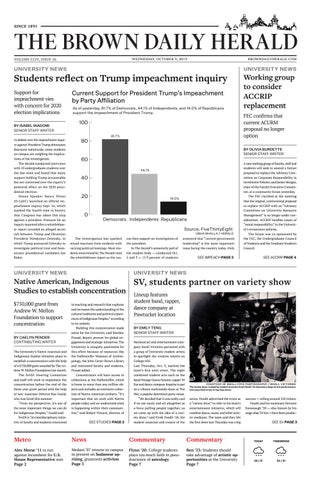
administration did,” added Samy Amkieh ’21. “I think what Speaker Pelosi did was limit the investigation to solely Ukraine, and I think that that’s a mistake.” While many students interviewed by The Herald expressed approval of a congressional move to hold Trump accountable for his actions, some were concerned that the inquiry would only fuel the president’s popularity. “The impeachment hearings might not be doing the Democrats as big of a favor as they might expect or hope,” said Michael Yuan Tian ’20. He added that he worried this move would spur increased campaign donations from Trump’s base. Margherita Micaletti-Hinojal ’23 said that proceeding with the impeachment process “kind of plays into what the conservatives usually attack the Democrats (for), which is that they try and villianize Trump and then proceed to get nothing done in the House.” “If the impeachment is conducted in a way where swing voters and independent voters feel that it’s mainly a partisan thing, and it’s not being held in an impartial manner, I think then it might backfire,” said Viknesh Kasthuri ’21. The impeachment inquiry is moving forward in the House of Representatives, with committees issuing subpoenas and hearing testimonies. But even if Trump is impeached by the House, it is unlikely that the Senate, controlled by Republicans, would vote to remove the president from office. Richard Arenberg, visiting professor of the practice of political science who worked on Capitol Hill for 34 years, sees a possibility that the Senate vote could be more bipartisan than expected. He emphasized the rapid shift in public opinion on the impeachment inquiry. According to polling site FiveThirtyEight, 48.9 percent of Americans support impeachment and just 43 percent disapprove. The data shows that support spiked following the whistleblower report. “If that pattern were to continue, that’s one factor that would put a lot of pressure on members of the Senate when the trial took place,” Arenberg said. — With additional reporting by
Orange Guava Passion, a jazz-funk band consisting of nine University sophomores. According to guitarist Ben West ’22, Orange Guava Passion is a student band with “undying love for funky jams.” The band connected with Norocea when lead vocalist Jackson Jones ’22 went to an alumni-student networking event over the summer in Los Angeles. “We were all freshmen, and a couple of us had met at some of the opening jazz events and ended up getting together a smaller group of us jamming,” said Maya Polsky ’22, guitarist and background vocalist of the band. The band performed the four songs from their latest EP “Enjoy!” at the variety show. Several members of the band agreed that this event was special to them because they headlined and saw the crowd supporting and enjoying their music. Pandit and his friends have two more variety shows in the works this
4
THE BROWN DAILY HERALD | NEWS
WEDNESDAY, OCTOBER 9, 2019
LEON JIANG / HERALD
At a community forum yesterday, a representative from the Faculty Executive Committee announced that a proposed overhaul to the University’s Advisory Committee on Corporate Responsibility in Investment Policies had been scrapped. Instead, a working group with students, faculty and staff will collaborate to come up with their own proposal. The proposal drew opposition from proposal is not on the table anymore. committee that will streamline faculty statement also praised the University ACCRIP FROM PAGE 1 student coalition Brown Divest, which It’s up for grabs, we’re here now to talk governance and have oversight of eth- for scrapping ACURM. criticized the proposal for shrinking the about it, we’re here to listen to you.” ical issues concerning the University’s “Brown Divest is glad to hear that The decisions come in response to size of the committee, broadening its Ben Bienstock ’20, a member of gift acceptance policies. last semester’s proposal for ACURM is community concerns about the pro- scope and giving Paxson more influence Brown Divest present at the forum, “What we’re trying to do is find a no longer being considered in its preposal to replace ACCRIP with ACURM over the makeup of the committee. As was glad to learn that ACURM will not way to look together back at that pro- vious form, yet is concerned with the in May. The proposed replacement a result, a faculty vote in May about exist. But he still feels unsure that the posal and come up with something that administration’s continued efforts to committee would have expanded on replacing ACCRIP with ACURM was final proposal will address the concerns does not completely disregard the good expand and alter the responsibilities of ACCRIP’s duties by “specifically (iden- canceled, and the University scheduled of Brown Divest, which include trans- things that ACCRIP has done, but per- ACCRIP,” the statement read. “We look tifying) issues related to social respon- the community forum to discuss the parency and divestment. “It was good haps streamline some of its running,” forward to seeing increased transparensibility with regard to the endowment, issue, The Herald previously report- to hear that that proposal is likely not Jacobs said. cy surrounding the proposed changes business practices, labor issues, gift ed. Brown Divest, a student coalition, what is being proposed,” Bienstock told Paxson did not attend Monday’s in the future.” acceptance and other related matters,” calls on the University to divest from all The Herald. “While it was … relieving to forum because she did not want the There have not yet been any conaccording to the proposed motion. An- companies “complicit in human rights hear that, we don’t necessarily have full discussion to become a “creature of crete steps toward a working group, other proposed change includes the abuses in Palestine,” according to its faith that the administration is going the administration,” Morgan told The Morgan said. He added that the pronomination process for faculty mem- Facebook page. to listen to our demands.” Herald Monday evening. posal for ACURM would likely serve as bers. If ACURM had passed, candidates Nancy Jacobs, professor of history Instead of moving forward with In a statement to The Herald, Brown a “starting point” for a new proposal would have gone through a committee and FEC member, addressed student ACURM, faculty decided to create a Divest criticized Paxson’s absence, writ- — meaning that the FEC, undergraduate that consulted with President Christina concerns about ACURM at Tuesday’s fo- working group made up of students, ing “Brown Divest is troubled by the students and graduate students will Paxson P’19 — a break from ACCRIP’s rum. “We’re here now recognizing that faculty and staff to draft a new propos- absence of President Christina Pax- continue to communicate with each policy, where faculty members are elect- that was not a good proposal,” she said. al for a committee to replace ACCRIP. son and Executive Vice President for other. ed by other faculty. “As far as the FEC is concerned, that Jacobs said that she hopes to create a Planning and Policy Russell Carey.” The
WEDNESDAY, OCTOBER 9, 2019
THE BROWN DAILY HERALD | TODAY
5
CA L E NDA R TODAY
OCTOBER S
6
M
7
Tu
W
Th
F
S
1
2
3
4
5
8
9
10
11
12
13
14
15
16
17
18
19
20
21
22
23
24
25
26
27
28
29
30
31
Science and Security 12:00 P.M. Horace Mann House
Korean Wave and Diplomacy: Korea’s Soft Power 4:00 P.M. Friedman Hall
Is Meditation Secular? 5:30 P.M. Friedman Hall
Fall StorySLAM Auditions 7:00 P.M. Sayles Hall
TOMORROW Dr. Rebecca Carter Book Launch 12:00 P.M. Pembroke Hall
Study Abroad 101 Info Session 4:00 P.M. Page-Robinson Hall
TEDx BrownU Workshop 7:00 P.M. Friedman Hall
Baha’i Conversation 8:00 P.M. Stephen Robert ’62 Campus Center
Q UOT E OF T H E DAY
S U D O KU
“The impeachment hearings might not be doing the Democrats as big of a favor as they might expect or hope.”
—Michael Yuan Ting ’20 SEE IMPEACH PAGE 1
MESSAG E FR O M A MU R AL
LEON JIANG / HERALD
“Greeings from Rhode Island,” howls this lone coyote, loyally stationed on a wall bordering the outskirts of Pembroke Campus. Characteristic monuments and features of the Ocean State adorn each bubble letter of its name, and a bright moon glows above, glimmering its own welcome to students and community members passing by every day.
6
THE BROWN DAILY HERALD | COMMENTARY
SINCE 1891
THE BROWN DAILY HERALD Editorial Leadership Editor-in-Chief Emily Davies Managing Editors Anna Kramer Priyanka Podugu Senior Editors Anita Sheih Sarah Wang Editorial Page Editors Grace Layer Krista Stapleford post-magazine Editor-in-Chief Anita Sheih
Sections Arts & Culture Editors Elise Ryan Annabelle Woodward Metro Editors Dylan Clark Sophie Culpepper Alex Reice News Editors Celia Hack Jacob Lockwood Melanie Pincus Allie Reed Science & Research Editors Cate Ryan Chris Schutte Sports Editors Alexandra Russell Alex Smolar
Commentary Opinions Editors Rebecca Aman Jamie Flynn Derek Simshauser Multimedia/Production Design Editors Bilal Ismail Ahmed Keelin Lyons Dylan Tian Head Photo Editors Tiffany Ding
Business General Managers Ravi Betzig Nicholas Masiakowski Office Manager Diane Silvia Directors Sales: Bersabel Yifru Finance: Rudra Srivastava Reynaldo Blandon
Copy Desk Chief Kelley Tackett Illustrations Editor Summer Zhang Graphics Editor Sarah Martinez
@the_herald
facebook.com/browndailyherald
@browndailyherald
youtube.com/browndailyherald
195 Angell St., Providence, RI (401) 351-3372 www.browndailyherald.com Editorial: herald@browndailyherald.com Advertising: advertising@browndailyherald.com
WEDNESDAY, OCTOBER 9, 2019
Submissions: The Brown Daily Herald publishes submissions in the form of op-eds and letters to the editor. Op-eds are typically between 750 and 1000 words, though we will consider submissions between 500 and 1200 words. Letters to the editor should be around 250 words. While letters to the editor respond to an article or column that has appeared in The Herald, op-eds usually prompt new discussions on campus or frame new arguments about current discourse. All submissions to The Herald cannot have been previously published elsewhere (in print or online — including personal blogs and social media), and they must be exclusive to The Herald. Submissions must include no more than two individual authors. If there are more than two original authors, The Herald can acknowledge the authors in a statement at the end of the letter or op-ed, but the byline can only include up to two names. The Herald will not publish submissions authored by groups. The Herald does not publish anonymous submissions. If you feel your circumstances prevent you from submitting an op-ed or letter with your name, please email herald@browndailyherald.com to explain your situation. You can submit op-eds to opinions@browndailyherald.com and letters to letters@browndailyherald. com. When you email your submission, please include (1) your full name, (2) an evening or mobile phone number in case your submission is chosen for publication and (3) any affiliation with Brown University or any institution or organization relevant to the content of your submission. Please send in submissions at least 24 hours in advance of your desired publication date. The Herald only publishes submissions while it is in print. The Herald reserves the right to edit all submissions. If your piece is considered for publication, an editor will contact you to discuss potential changes to your submission. Commentary: The editorial is the majority opinion of the editorial page board of The Brown Daily Herald. The editorial viewpoint does not necessarily reflect the views of The Brown Daily Herald, Inc. Columns, letters and comics reflect the opinions of their authors only. Corrections: The Brown Daily Herald is committed to providing the Brown University community with the most accurate information possible. Corrections may be submitted up to seven calendar days after publication. Periodicals postage paid at Providence, R.I. Postmaster: Please send corrections to P.O. Box 2538, Providence, RI 02906. Advertising: The Brown Daily Herald, Inc. reserves the right to accept or decline any advertisement at its discretion.
The Brown Daily Herald, Inc. is a financially independent, nonprofit media organization bringing you The Brown Daily Herald, BlogDailyHerald and Post- Magazine. The Brown Daily Herald has served the Brown University community daily since 1891. It is published Monday through Friday during the academic year, excluding vacations, once during Commencement and once during Orientation by The Brown Daily Herald, Inc. Single copy free for each member of the community. Subscription prices: $200 one year daily, $100 one semester daily. Copyright 2019 by The Brown Daily Herald, Inc. All rights reserved.
WEDNESDAY, OCTOBER 9, 2019
THE BROWN DAILY HERALD | COMMENTARY
7
When the stars don’t align: The failures of astrology BY JAMES FLYNN OPINIONS EDITOR
As a student at Brown, you have probably been asked at some point about your astrological sign. People you have just met garner information about your personality from how your time and date of birth align with the patterns of the stars. If you were born between Nov. 22 and Dec. 21 like me, you are a Sagittarius (according to the stars, I am generous and idealistic, but also impatient). Many will look to their horoscope to predict their futures or explain their pasts. If you get rejected from a job, it is because your horoscope predicted that you would be unlucky in your professional life. These attempts to imbue the randomness of life with cosmic significance seem to be ubiquitous among college students. It goes without saying that astrology is pure pseudoscience. There is no more evidence that astrological signs produce accurate information than there is evidence that the earth is flat, that the universe is 6,000 years old or that climate change is a hoax . While some do believe that astrology works, many others embrace a paradox: they acknowledge it is fake but still take it very seriously. Others may consider zodiac signs and horoscopes — two core tenets of astrology — to be harmless gimmicks that they use merely for fun or to bond with others. In what the Atlantic calls “The New Age of Astrology,” millennials are increasingly turning to the stars to take comfort and to deal with
their problems. These superstitions are becoming worrisome. Astrology is harmful, even if one acknowledges it as pseudoscience while fully embracing it. It encourages people to make decisions on the basis of superstition, justify outcomes in their lives on the basis of fate and prejudge others on the basis of fictitious cosmic characteristics. In this sense, astrology serves as a way of avoiding any genuine confrontation with the inevitable uncertainty of life. We must not underestimate how many people literally believe that zodiac signs reveal
that 78 percent of students considered astrology “very” or “sort of” scientific. But another subset of astrologers — I reckon that most astrologers at Brown fall into this category — acknowledge that astrology is probably fake, but still use it to inform their decisions, whether ironically or not. The Atlantic describes the attitude of many millennials: that astrology is useful, whether or not it is real. One millennial in the article says: “We take astrology very seriously, but we also don’t necessarily believe in it … because it’s a tool for self-re-
“If people actually want to help themselves, they should consider dropping the pseudoscience.”
character traits and that horoscopes predict the future. A 2018 Pew Research poll found that 29 percent of Americans, both religious and non-religious, subscribe to astrology. In 2014, the National Science Foundation found that over a quarter of Americans said astrology was “sort of scientific,” and 6 percent said it was “very scientific.” College students in particular are at risk of falling for the pseudoscience. A 2011 survey at the University of Arizona tracked attitudes toward science of nearly 10,000 undergraduates over a 20-year period, and found
flection, it’s not a religion or a science. It’s just a way to look at the world and a way to think about things.” I have tried my hardest to understand the appeal of astrology as a “tool for self-reflection.” In our increasingly secular age, astrology taps into an all too human urge to transpose cosmic certainty onto the terrifying randomness of life. My friends who practice astrology say that it provides them with a framework for making sense of something that has happened in their lives that is otherwise inexplicable. It is
also a coping mechanism. A 2015 study found that people tend to consult astrology because of stress in their lives. Given the many sources of stress to which college students are incessantly subjected, it is hard to deny someone any kind of stress relief. But it is important to understand that astrology is not a viable long-term solution —nor even a good short-term relief — to stress. Astrology misrepresents the nature of the stressful problems of life. It says that those problems are due to fate and are out of one’s control. It makes people look for certain outcomes that will never come. Once people’s horoscopes prove incorrect, they are bound to feel disappointed, and no less stressed. If something is to serve as an effective “tool for self-reflection,” then that tool ought to help people come to real insights about themselves. Astrology is a tool that is not merely inaccurate, but fundamentally misleading. It will provide insights that are fake and meaningless, and will inspire one to act in uninformed ways. There are so many ways of reflecting on oneself and of reducing stress that have actual scientific basis, such as cognitive therapy, walks in nature and meditation. If people actually want to help themselves, they should consider dropping the pseudoscience. James Flynn ’20.5 can be reached at james_ flynn1@brown.edu. Please send responses to this opinion to letters@browndailyherald. com and op-eds to opinions@browndailyherald.com.
We should all go see a show BY JOHNNY REN STAFF COLUMNIST
On the fourth floor of Emery-Woolley Hall, I have met a great number of artists, whose sheer abundance seems to defy the limited space of the narrow residential hallways. A glance into the floor lounge may not reveal it. There, you may only find a group of students in conversation or hard at work on their studies. But once you get to know each person a little bit better, as I have, their talents become apparent. I have come to witness them in the form of a violin concerto scintillating outward from behind a closed door or in the expressive visage of a photorealistic portrait, gazing down upon the viewer during an impromptu dorm tour. And still there are more artists to count: A flautist in the orchestra, an aerial acrobat, a trumpeter in the band, a budding guitarist, a ballet dancer, an architectural artist or even an a capella pirate. I don’t think I expected it when I first came here — the extent of artistic experience all around — at least here at Brown. But now that I have acclimated myself to life in college and in Providence, I have come to deeply appreciate it. Part of my perspective no doubt comes from my proximity to art. Again, it surrounds me, as I return in the afternoon, and I hear Stravinsky’s Petrushka twittering from a piccolo a few doors down. I am constantly reminded of art’s unexpected and immediate beauty. But beyond its hedonistic value, I would argue that art is not just an addition, but an integral factor to the Brown identity. As supporters and makers of art ourselves, we should treat it as such. We ought to see art not just as an extraneous joy, but as an imperative, something in which we should consciously and constantly immerse ourselves. Art is ill-defined, but at its core, it challenges what it means for something to be worthwhile. Why do we choose to augment something, to highlight a particular melody or the nuances of a still-life? Why do we find things beautiful? There is an immense value to artistic
creation, because we are forced, in some sense, to reflect on the things that we are making. In the process, we become more prone to introspection, more attuned to the things that make us feel happy or inspired in the world. These feelings are not exclusive to art, but art possesses a special kind of universality. Art transcends academic categorization. All people can find value in it. In fact, it is often most valuable for those who think that they are not artistic, those who think that their own academic interests somehow preclude them from the enjoyment of painting or theater. Of course, there are cynics in the world who may deride such a view — the idea that art is
arts is equally important. For those of us with so many artistically inclined peers, this should be an easy task. We can readily go to a show and see our friends perform or display their work. But doing so also requires deliberation and a certain sacrifice. We have to make time for these events, and in the flurry of midterms and under the weight of a boatload of extracurriculars, this can become difficult. Part of the solution, I think, is to give art more precedence. We can treat artistic experience as equally worthwhile to conventional concepts of academic experience. And I do think we have the time for it. We can all exchange a couple sessions of Netflix reruns for a visit to a new ex-
artistic resources remain covert. But if you simply look— and really look — at Today@Brown or the flyers on bulletins, you will realize that interesting shows and exhibitions are open all the time around campus, and oftentimes, there are even faculty and artists that present perspectives and stories about the work. Furthermore, many of these events are free. In the end, I urge us to explore the arts because they are crucial to the Brown experience. As I reflect on my first few weeks at Brown, I realize that so many of my fondest memories have involved art, whether I knew it or not. From singing sea-shanties in the lounge with a member of ARRR!!! to painting a banner for
“These feelings are not exclusive to art, but art possesses a special kind of universality.”
a necessity, particularly for a college student. Some still hold the view that college is a vocational ladder, preparing us for a career that requires a rigid set of skills and knowledge. These same people often also hold the view that creative experiences and “practical” skills are somehow mutually exclusive. But as students at Brown, a place that prides itself on the Open Curriculum and the idea of intellectual freedom, I think we should ignore such outside pressure. Every time we take a class on Ghanian drumming or try a Bob Ross painting in our dorms just for fun, we contribute to the ethos of the Brown identity — the idea that we do things because we are curious about them and because we love to do them. Indeed, we all ought to become artists in some form or another during our time here at Brown. But our identity as supporters of the
hibit on campus. It may be a little inconvenient, and the weather will only get colder, but I think that the trip will be worth it. Art can be intimidating. Sometimes it is difficult to understand. Having been to a number of modern art museums and having once seen an exhibition of a basketball suspended in a resin fish tank, I recognize that art can at times be esoteric, daunting and utterly absurd. But I would challenge us all to try and understand different forms of expression and thought. In some types of art, understanding and enjoyment are inherent. Take, for example, the bubbling vitality of a Lizzo song or the solemnity of a nocturne. But other times, there is a burden on the observer to engage with the piece. At Brown, learning about art is more accessible than many people realize. Students are often aware of Brown’s academic resources; its
Unit Wars to witnessing an a capella show under the Wayland Arch, my own life has been enriched by these weird and always wonderful artistic experiences. They have required me to open myself up to the new and unfamiliar, and time and time again they have proven to be unequivocally worthwhile. I know that these experiences exist for all of us here at Brown — a play, a performance or a painting that inspires or moves us — but I also know that they are more often found when we choose to pursue them. To that end, I encourage us all to go out and seek them. Johnny Ren ’23 can be reached at jiawei_ ren@brown.edu. Please send responses to this opinion to letters@browndailyherald. com and op-eds to opinions@browndailyherald.com.