SINCE 1891
THE BROWN DAILY HERALD THURSDAY, OCTOBER 3, 2019
VOLUME CLIV, ISSUE 22
UNIVERSITY NEWS
U. suspends Sigma Chi fraternity Fraternity faces fiveyear ban for hazing, alcohol violations, endangering students
ARTS & CULTURE
UNIVERSITY NEWS
Reports of pest infestation in student housing spike Facilities Management responds to reports of mold, lead paint in dorms
BY LI GOLDSTEIN AND KAYLA GUO SENIOR STAFF WRITERS The University suspended Sigma Chi for five years Sept. 6 after an investigation found the fraternity guilty of hazing and alcohol violations that endangered students. The investigation, which launched in March, also found the fraternity responsible for misrepresenting information and violating University operational rules. Brian Clark, director of news and editorial development, confirmed the suspension in an email to The Herald. “Given the utmost seriousness with which Brown takes hazing incidents, and its expectation that students act with integrity and honesty during the course of an investigation, a number of sanctions will be imposed on the fraternity,” Clark wrote. Two leaders of Sigma Chi at the
BROWNDAILYHERALD.COM
to go to a hotel room because her room was absolutely infested,” Jiménez said. Jiménez said she does not know how the bugs got into the rooms and is concerned that the issue may arise again. But she praised Facilities for its efficiency, recalling that exterminators came to her room quickly and the bug problem was resolved that night. Elena Jin ’21 experienced a similar pest problem early September. She woke up after her first night in her Hope College room with 20 bug bites on her legs. She reported the incident to Facilities, who moved her out of the room and called exterminators. They later informed her that a number of spider webs had been discovered in the room. Guglielmo partially attributed high pest numbers to humid weather but also cautioned that the problem may be connected to open trash. He reminded students of their responsibility to dispose of trash from dorms. In addition to bugs, students this semester have found mold and lead paint in their dorms, though the fre-
BY SOPHIE BUTCHER CONTRIBUTING WRITER HERALD FILE PHOTO
Initiated members of Sigma Chi cannot join other fraternities on campus following the group’s suspension Sept. 6. time of the violations and the Brown Sigma Chi alumni association did not respond to requests for comment. Three former members declined to comment. The Office of Student Conduct and Community Standards notified members of Sigma Chi of their suspension Sept. 6, and the fraternity did not appeal the decision, according to Clark. During the suspension period, which extends to fall 2024, Sigma Chi “may not operate in any capacity and loses all rights and privileges associated with being a recognized student group at the University,” Clark wrote. Initiated members of Sigma Chi are ineligible to join any other Greek or-
ganization at Brown, he added. Sigma Chi’s suspension comes after the University instructed the organization April 1 to cease all of its on- and off-campus activities over the course of the investigation. Over the summer, the University revoked Sigma Chi’s housing privileges for this academic year while the investigation was still ongoing, The Herald previously reported. In addition to sanctioning Sigma Chi, “individual students found responsible for violations are subject to sanctions as well,” Clark wrote. Uni-
SEE SIGMA PAGE 2
When students returned to the University in September, many moved into dorm rooms alongside unconventional roommates: pests. Facilities Management received 53 calls about pest control in September alone, an unusually high number, according to Vice President of Facilities Management Michael Guglielmo. Students have also reported mold and lead in their rooms. Katherine Jiménez ’20, who coordinates housing for Alpha Chi Omega in Sears House, reported that residents discovered drain flies a few weeks ago in their rooms and in all of the house’s bathrooms. Drain flies are small, non-biting gnats that breed in standing water. “One of my sisters had
SEE PESTS PAGE 3
METRO
Rankine explores imagination, race
Rhode Island behind in emissions goals, study shows
Author lectures on ‘racial imaginary,’ social implications of creative works
BY ISABEL INADOMI SENIOR STAFF WRITER
Acclaimed poet, essayist and scholar Claudia Rankine conveyed the multi-faceted cultural conception of race — equal parts abstract and material — during an Oct. 2 lecture at the University. “The ask I am making of everyone here, is that you begin to think of the racial imaginary, as that of which is already living,” Rankine said during her talk titled “The Creative Imagination and Race.” Rankine is most well known for her book of poetry, “Citizen: An Ameri-
SEE RANKINE PAGE 2
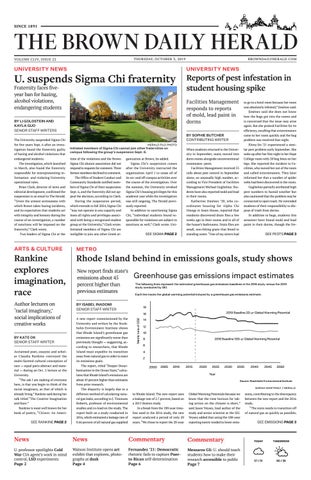
Greenhouse gas emissions impact estimates The following lines represent the estimated greenhouse gas emissions baselines in the 2016 study versus the 2019 study conducted by SEI. Each line tracks the global warming potential induced by a greenhouse gas emisisons estimate.
18 2019 Baseline 20-yr Global Warming Potential
16
A new report commissioned by the University and written by the Stockholm Environment Institute shows that Rhode Island’s greenhouse gas emissions are significantly worse than previously thought — suggesting, according to researchers, that Rhode Island must expedite its transition away from natural gas in order to meet its emissions goals. The report, titled “Deeper Decarbonization in the Ocean State,” calculates that Rhode Island’s emissions are about 45 percent higher than estimates from prior research. The disparity is largely due to a different method of calculating natural gas leaks, according to J. Timmons Roberts, professor of environmental studies and co-lead on the study. The report built on a study conducted in 2016, which estimated a leakage rate of 0.66 percent of all natural gas supplied
Metric tons of CO2
BY KATE OK SENIOR STAFF WRITER
New report finds state’s emissions about 45 percent higher than previous estimates
14 12 10 2016 Baseline 100-yr Global Warming Potential
8 6 4 2 2000
2005
2010
2015
2020
2025
2030
2035
2040
2045
2050
Year Source: Stockholm Environmental Institute
SARAH MARTINEZ / HERALD
to Rhode Island. The new report uses a leakage rate of 2.7 percent, based on a 2015 Boston study. In a break from the 100-year timeline used in the 2016 study, the new report analyzed a period of only 20 years. “We chose to report the 20-year
Global Warming Potentials because we know that the time horizon for taking action on the climate is short,” said Jason Veysey, lead author of the study and senior scientist at the SEI. Veysey added that using the 100-year reporting metric tended to lower emis-
News
News
Commentary
Commentary
U. professor spotlights Cold War CIA agent’s work in mind control, LSD experiments Page 2
Watson Institute opens art exhibit that explores, photographs at dusk Page 4
Fernandez ’21: Democratic rhetoric fails to capture Puerto Rican self-determination Page 6
Meszaros GS: U. should teach students how to make their research accessible to public Page 7
sions, contributing to the discrepancy between the new report and the 2016 study. “The state needs to transition off of natural gas as quickly as possible,
SEE EMISSIONS PAGE 3
TODAY
TOMORROW
57 / 51
60 / 39
2
THE BROWN DAILY HERALD | NEWS
THURSDAY, OCTOBER 3, 2019
UNIVERSITY NEWS
Kinzer speaks on Cold War mind control
DANIELLE EMERSON / HERALD
Poet, essayist and scholar Claudia Rankine is most famous for her book of poetry titled “Citizen: An American Lyric.”
RANKINE FROM PAGE 1
AREEZ KHAN / HERALD
Stephen Kinzer, professor of international and public affairs, spoke about moral implications of Cold War CIA.
U. professor gives talk on leader of CIA’s MKUltra operation, LSD experiments BY KATHLEEN MEININGER CONTRIBUTING WRITER In the height of the Cold War, a CIA agent named Sidney Gottlieb worked quietly to weaponize mind control against Soviet Russia. The story of Gottlieb and his mission to “find the best ways to destroy a human mind” was chronicled by Stephen Kinzer, professor of international and public affairs, in his new book titled “Poisoner in Chief: Sidney Gottlieb and the CIA Search for Mind Control.” Kinzer walked an enraptured audience through the story during a lecture at the Watson Institute for International and Public Affairs Tuesday night. The critically acclaimed book, published Sept. 10, offered new insight into Gottlieb’s work as head of the CIA’s infamous MK-Ultra operation during the early Cold War. Gottlieb believed that he had to wipe the mind clean in order to control it, and took inspiration from experiments carried
SIGMA FROM PAGE 1 versity and federal policies limit what school officials can share regarding individual cases, he added. The University has previously taken disciplinary action against other student groups found guilty of violating the Student Code of Conduct. For instance, Buxton International House, which can return in fall 2020, lost its housing privileges in January 2019 for unauthorized possession of alcohol, The Herald previously reported. In 2015, fraternity Phi Kappa Psi lost its recognition and housing privileges after a University investigation found a “strong likelihood” that two students were given alcohol “and/or some other drug diminishing their normal functions to a degree that placed them at risk of harm” at the group’s party, according to a community-wide email sent by University administrators. Sigma Chi had been on the University’s campus since 1914. Following the suspension period, the organization will be able to petition for reinstatement.
out in Nazi concentration camps by using a combination of drugs and physical torture. The audience listened intently as Kinzer described Gottlieb’s “unendingly inventive” experiments on victims over the course of a decade, which targeted those in the U.S. prison system as well as people he termed “expendables” overseas in Germany and Russia. It took countless deaths and ruined lives before Gottlieb concluded that mind control was not possible. Kinzer described the former CIA agent as “the most prolific torturer of his generation.” Kinzer also discussed the unintended cultural impact of Gottlieb’s experiments — particularly, the popularization of LSD. Gottlieb believed the drug was “the key that would unlock the universe” and frequently used it in his MK-Ultra experiments. He also paid hospitals to test LSD on volunteers, such as influential writers like Allen Ginsberg and Ken Kesey, who were among the first to ingest it. Kinzer called Gottlieb the “unwitting godfather of the LSD counterculture” because of his role in distributing the drug. Throughout the talk, Kinzer referenced the duality of Gottlieb’s character. Personally, Gottlieb identified
as a humanist, someone who lived in an eco-house and taught speech therapy to children. At the end of his life, Kinzer said, Gottlieb was “clearly troubled,” and “wracked by guilt.” “He felt that the extremity of his work was made necessary by the urgency of the threat,” Kinzer said, adding that Gottlieb thought mind control would win the Cold War for the U.S. and potentially save millions of lives. “Commitment to a great cause is perhaps the most profound motivation for committing immoral acts. Patriotism is among the most transcendent and seductive of causes, and Gottlieb was very much caught up in that.” Kinzer told the audience that he was inspired to undertake this book project by the potential to uncover and amplify a hidden story. He conducted original interviews and drew on new research — such as Senate committee investigations in the mid-1970s — to tell of Gottlieb’s life as a cruel and influential player in history. “I’m looking for stories that are very important and had a big impact on the world but nobody knows about them,” Kinzer said. “When it became clear to me that this person had existed, and when I understood the scope of his MK-Ultra project, I thought this was a great untold story.”
can Lyric,” which unites conversations about race with lyricism, covering transgressions in the classroom to transgressions against Serena Williams on the tennis court. Rankine’s lecture and subsequent book signing delved into the discourse around race in creative histories through discussions and analyses of Eurocentric narratives. Audience members first heard Rankine discuss Édouard Manet’s painting “Olympia,” which depicts a white naked woman and a black maid named Laure. Referencing Denise Murrell’s exhibition titled “Posing Modernity: The Black Model from Manet to Matisse to Today,” Rankine spoke about how Laure is historically ignored by art historians, and this omission represents the Eurocentric ideologies of our society. “The same attentiveness we give to salutational anxiety, we should be giving to the globe of the racial imaginary in every image or sentence composed or consumed,” Rankine said. She asked the audience how society could achieve this, and replied, “We have to be willing to think.” Rankine further engaged the audience in deliberate thought about racial and social implications of creative work by presenting a number of
other discussions and art pieces that challenged racial norms of art and culture. These ranged from voiceovers of Stanley Kubrick’s film “Eyes Wide Shut” to paintings that rethought the racial dynamics of Manet’s “Olympia.” Timothy Bewes, the interim director of the Cogut Institute of Humanities, discussed how Rankine’s lecture and work fits into the mission of the Cogut Institute. “Claudia Rankine has crystallized the conversation about race in America. … It’s impossible to read (her work) and not be reminded that race is a social experience, part of our collective imaginary,” he told The Herald. “(She is) the perfect speaker to help contribute to that ongoing conversation.” Rankine’s lecture served as one event in the Cogut Institute’s Greg and Julie Flynn Speaker Series. Lecturers for the series are chosen from a list of individuals nominated by the Brown community. Adam Gopnik, staff writer at the New Yorker, is slated to speak as part of the series early next year. Audience member Nick Michael ’22 spoke about his appreciation for Rankine’s talk. “I like how she incorporated others’ voices into her lecture while still remaining true to her own,” he said.
THURSDAY, OCTOBER 3, 2019
EMISSIONS FROM PAGE 1 because it always will leak,” Roberts said. Methane, a major component of natural gas, is 86 times worse than carbon dioxide in the short run in terms of climate change impacts, he added. Rhode Island currently has non-binding goals to reduce emissions to 90 percent of its 1990 levels by 2020, 55 percent by 2035 and 20 percent by 2050, as dictated in the Resilient Rhode Island Act of 2014. “We’re not on track and … we need to really get busy,” Roberts said of the findings. Elizabeth Stone, programming services officer at the Rhode Island Department of Environmental Management, said that the state conducts its own inventory on greenhouse gases every year. “We account for methane in our inventory in a different way with different global warming potentials,” she said, adding that Rhode Island attempts to follow reporting methods used by other New England states. But Stone said that Rhode Island is not consistent in how it conducts the inventories and that the state would be open to changing its methods in the future to better account for methane. “The information in this report adds to our knowledge base and reinforces that we have much hard work ahead,” wrote Janet Coit, director of the Rhode Island Department of Environmental Management, in a statement. The report outlines three new courses to slash emissions by 70 to 80 percent, charting pathways to reach this goal by either 2030, 2040 or 2050. Though costs would rise much more quickly to meet the 2030 plan, Roberts said that the 2040 and 2050 plans “are fairly inexpensive in that you can replace most things when they wear out.” Roberts and Veysey presented the study to the Executive Climate Change Coordinating Council Sept. 12. “It’s no longer crazy to be more ambitious,” Roberts said. “I’m hopeful that the state agency heads were really interested. I think that the message may be getting through to the governor and the leading people in her cabinet that we need to be doing much more, and we can.”
PESTS FROM PAGE 1 quency of these incidents has not been above-average, according to Guglielmo. After a walk-through of Marcy House earlier this year, Facilities informed members of the Zeta Delta Xi fraternity that couches in their basement were contaminated with mold and needed to be removed. Zete members replaced the couches,
THE BROWN DAILY HERALD | NEWS
3
UNIVERSITY NEWS
Grad Student Council to bring speakers to campus GSC announces speakers, plans to hold elections at November meeting BY KAMRAN KING SENIOR STAFF WRITER The Graduate Student Council announced at its meeting Wednesday evening that they invited two speakers to campus to give talks later this month. Marie Solange Lopes, a teaching fellow at Stonehill College and founder of blog “The Corporate Sister,” will speak to grad students about personal finance Oct. 17.
but worry that the mold will return because heavy rain still occasionally reaches the basement, according to Christien Hernandez ’21, Zete’s president. “We do an annual preventive maintenance where we go in and clean out all the storm drains,” Guglielmo said. “But some of those 100 or 500 year storms, where you just get so much rain, the system gets overloaded.” “When it’s really humid and rainy,
CHRIS BENNETT / HERALD
This past September, Facilities Management received 53 pest control complaints. Humidity and open trash are possible contributing factors.
The scheduled event comes after the GSC discussed having a personal finance workshop for graduate students at its September meeting, The Herald previously reported. Lopes’s talk will cover topics such as spending habits and tax basis, with a section specifically tailored for international students, said GSC Vice President for Advocacy Melaine Ferdinand-King GS. Graduate students will be able to submit questions for Lopes before her presentation. Later in the month, co-host of NPR podcast “Code Switch” Shereen Marisol Meraji will also come speak at the University at GSC’s invitation. Meraji will be the inaugural guest in the Council’s Distinguished Speaker Series, which aims to bring speakers to campus who
the walls just start dripping water,” Hernandez said. The fraternity plans to purchase an air purifier to combat the effects of the mold, though its members remain concerned about the larger problem of flooding. The presence of lead paint in some University dorms may prove more difficult to resolve. Lead paint was not banned in Rhode Island until 1978, and as a result, a number of older buildings on campus were coated with lead-based paint, according to Tracy Mansour, director of residential operations for the Office of Residential Life. Jason Carroll ’21 and David Charatan ’21 tested their rooms in Marcy House and Slater Hall, respectively, for the presence of lead paint after noticing that the paint seemed to be peeling and chipping. Both tests came back positive. Charatan complained to Facilities, who came to his room and painted over the lead paint. He appreciated the speed of the response, but expressed some concern that the methods used by the University were insufficient to prevent health impacts caused by the paint’s toxicity. “Usually, you’re supposed to cover
specifically cater to graduate students, The Herald previously reported. Contracting Meraji cost the GSC between $10,000 and $12,000, GSC President Alastair Tulloch GS said. The Council will also launch a pilot program that will allow grad students to present their research to first-year students at the Warren Alpert Medical School. The “Research in Medicine Flashtalks” pilot is a collaboration that “bridges the gap between the Graduate School and Medical School,” Tulloch said. The program will allow graduate students whose research corresponds to the curriculum of first-year medical students to present their research at the end of Medical School lectures. There are currently three of these talks scheduled for the fall semester, he added.
everything up, have people come and get rid of the old paint, put on new paint, inspect the dust to make sure there’s no lead in the dust,” he said. “They definitely didn’t do that.” According to Mansour, “Rhode Island is a lead-safe state, not leadfree,” meaning that chipping lead paint should be painted over, but there is no requirement to strip paint from the walls. With regards to health concerns, Guglielmo added that “as long as that paint is encapsulated, and you’re not eating it, you should be fine.” Guglielmo said the University has a s”ummer paint program” when they restore chipping paint, but that paint is sometimes damaged again by those living in dorms during the summer. He added that if students see chipping paint, he recommends that they contact Facilities’ service response so the situation can be resolved by professionals. Carroll, who is currently the vice president of the Undergraduate Council of Students, said he may use his position to tackle the issue of lead paint in University housing in the future. “I’ve tested one room, I don’t know what may be in other dorms, other buildings,” he said.
Tulloch also said that the University will host a forum on Tuesday, Oct. 8 to discuss the University’s decision to review the Advisory Committee on Corporate Responsibility in Investment Policy, and potentially replace it with a different body, called the Advisory Committee on University Resources Management. Faculty discussed organizing a forum at their May meeting following criticism over the proposed replacement of ACCRIP, The Herald previously reported. Tulloch said the forum is part of an effort to make investment policy more transparent. GSC will hold its annual elections for the ten positions on its executive board when the Council meets Nov. 6. Graduate Student Departmental Representatives will vote to elect leaders.
4
THE BROWN DAILY HERALD | NEWS
THURSDAY, OCTOBER 3, 2019
ARTS & CULTURE
Exhibit explores art as environmental advocacy
BY AUBREY LI CONTRIBUTING WRITER A new exhibition of photographs in Stephen Robert ’62 Hall invites viewers to contemplate the interaction between humans and nature through abstract renderings of nature at dusk. Artist and writer Pamela Petro ’82 opened her exhibit, “The Blink of Our Lifetimes: The Ecology of Dusk,” at the University Oct. 2. The artist captured her images by deliberately and quickly moving her digital camera up and down so that each picture is out of focus. All set at dusk, the photos display distinct locations including Wales, New England, Oregon, Nova Scotia and the Brazilian Amazon. “At dusk, the world is partially hidden from us, we have to both project outward and see harder what’s there, but we also have to look inward more than we would during the day,” Petro said. Petro recounted her inspiration for creating “The Dusk Series,” explaining that the theme of the exhibition relies heavily on the Celtic notion of “dusk,” which is considered a “thin time.” Petro explained the ancient Celts’ conception of thin time, describing “moments when worlds became permeable, when the world of the living overlaps with the world of gods and the dead.” She sees this concept — “where we can hold more than one world view in our mind simultaneously” — as symbolizing empathy. The exhibition includes 25 discrete photographs clustered in ten groups of two or three photos with accompanying writing. Petro decided to structure her art this way in part because of her experience as a “Writing and Illustration” independent concentrator at the University. She values both photography and writing, and has published books related to travel, photography and language. Petro suggests that the
audience appreciate the photos together with the narratives attached to each image group. “The multiple works titled together created a space for narrative: for description, reflection, summary, exposition,” she said. “The images drew forth and inspired the labels and the narratives condition the way we see the images. They’ve become inseparable.” Jo-Anne Hart, an adjunct professor of international and public affairs at the Watson Institute for International and Public Affairs, commented on the relevance of Petro’s artwork to the Watson Institute. “It is international,” she said. “These (photos) are from multiple countries and places, but it also is about seeing things from different perspectives.” Hart emphasized the power of empathy in art to transform humans’ relationship with nature, which she said is especially important given the climate crisis. “When you see and experience how beautiful it is, you learn to care about it,” she said. “This is how artists can bring their works to be social advocates; these are good examples of trying to bring not just attention, but also the visceral connection with the wrongness that is happening.” The audience at the opening reception responded positively to the exhibition. “It makes me feel inspired. It makes me feel more in touch with nature, and also aware of how much more complicated and layered the world is,” said Sophie Willard Van Sistine, a student at Smith College who assisted Petro with the exhibition. “Dusk is when students are normally working. I think it’s good to step back and look at it from a different perspective,” said Lauren Choi ’23. This exhibition, sponsored by Art at Watson, will be on display through the fall semester. Hart noted that there will be other exhibitions that touch on environmental threats sponsored by Art at Watson in the following months. “Art at Watson is very interested in art and activism, and bringing out not just intellectual attention, but also emotional and visceral attention to important issues,” she said.
VICTORIA YIN / HERALD
“The Blink of Our Lifetimes: The Ecology of Dusk” opened at the University Oct. 2. The exhibit, created by artist and writer Pamela Petro ’82, features 25 discrete photographs set at dusk.
SYMPOSIUM
Art at Watson’s new exhibition opens, draws attention to ‘ecology of dusk’
Register: whalingmuseum.org or 508-997-0046
de wind is op! Climate, Culture and Innovation in Dutch Maritime Painting
October 18 9 am – 6:30 pm Presented by New Bedford Whaling Museum Partners: Museum of Fine Arts, Boston; Harvard Art Museums; Dutch Culture USA Program of the Consulate General of the Kingdom of the Netherlands
$50 Museum Members $65 Non-Members $25 Students with ID
18 Johnny Cake Hill, New Bedford, MA 02740
THURSDAY, OCTOBER 3, 2019
THE BROWN DAILY HERALD | TODAY
5
CA L E NDA R TODAY
OCTOBER S
6
M
7
Tu
W
1
2
8
9
Th
F
S
3
4
5
10
11
12
v
13
14
15
16
17
18
19
20
21
22
23
24
25
26
27
28
29
S U D O KU
30
31
Talk by Sarah Wright 12:00 P.M. Rochambeau House
Student of Color Luncheon 12:30 P.M. 121 South Main Street
Google BOLD Info Session 6:00 P.M. Salomon Center for Teaching
Independent Studies Info Session 6:00 P.M. List Art Building
TOMORROW Womxn in STEM Symposium 11:30 A.M. College Green
i-BSHS Seminar Series 12:00 P.M. 121 South Main Street
Charlas en español 3:00 P.M. Rochambeau House
STS Book Talk and Signing 4:00 P.M. Rhode Island Hall
Q U OTE OF TH E DAY
“Commitment to a great cause is perhaps the most profound motivation for committing immoral acts.” — Stephen Kinzer professor of international and public affairs
SEE MK-ULTRA PAGE 8
AU TUMN B EG I N S CR O S SWO R D
MUKUL KHANNA / HERALD
As students begin their long descent towards mid-semester burnout, campus leaves also begin to burnout, turning from green to brown. Happy Fall!
6
THE BROWN DAILY HERALD | COMMENTARY
THURSDAY, OCTOBER 3, 2019
Democratic politicians must do more to acknowledge Puerto Rico’s right to self-determination MARYSOL FERNANDEZ ’21 STAFF COLUMNIST Puerto Rican issues have long been sidelined in D.C. Puerto Ricans are denied representation in Congress as well as the right to vote for president. They are unable to contribute to the decisions that affect them, and historically, their issues have seldom been discussed in mainstream political conversation. But recently, Puerto Rico has made headlines for its massive debt, natural disasters and political protests — and major figures in the Democratic Partyare starting to take stronger stances on Puerto Rico. While increased attention on Puerto Rican issues is an important step in the right direction, it is crucial that we consider what this discourse actually looks like. More specifically, we should consider how Democratic rhetoric might inadvertently contribute to the U.S. government’s treatment of Puerto Rico as a colony — denying the territory true say in its own future. Democratic rhetoric fails to capture a complete vision of Puerto Rican self-determination because it excludes the possibility of an autonomous process for determining the island’s political status. The stances of the leaders of the Democratic party, including the three front-runners for the U.S. Democratic presidential nomination — former Vice President Joe Biden, Sen. Bernie Sanders (I-Vt.) and Sen. Elizabeth Warren (DMass.) — illustrate the shortcomings of current conversations on U.S. policy for Puerto Rican issues. Through his relative silence on Puerto Rico, Biden has tacitly signaled his intention to continue the trend of excluding Puerto Rico from political conversation. He has failed to outline a policy plan that addresses Puerto Rico, and his weak statements on the issue have only expressed discontent with the Trump administration’s treatment of the island. His most recent comment on Puerto Rico’s political status was in 2015, when he ex-
pressed in vague terms that it is up to Puerto Ricans to “fight hard until you reach your goal of equality,” which seemingly absolves the U.S. government of all responsibility for helping the island’s people. On the other hand, both Sanders and Warren have much more comprehensive stances on Puerto Rico — though their rhetoric does not capture all of the possibilities for the island’s future. Both candidates have released debt-restructuring bills and have called for a people’s referendum to deal with Puerto Rico’s ambiguous political status. Sanders and Warren pro-
“Democratic rhetoric fails to capture a complete vision of Puerto Rican selfdetermination because it excludes the possibility of an autonomous process for determining the island’s political status.”
vide a beacon of hope to Puerto Ricans, who are used to mainstream rhetoric that merely affirms the island’s lack of economic sustainability and political autonomy without offering avenues for change. But even the progressive rhetoric of Warren and Sanders is unsatisfying. Though their stances are in some ways a refreshing departure from colonial attitudes by amplifying voices on the island, their consistent dismissal of independence as a viable option reaffirms these traditional attitudes. In a speech to Puerto Ricans, Warren demanded self-determination for Puerto Rico, saying she would support statehood if that’s what residents chose.
SINCE 1891
THE BROWN DAILY HERALD Editorial Leadership Editor-in-Chief Emily Davies Managing Editors Anna Kramer Priyanka Podugu Senior Editors Anita Sheih Sarah Wang Editorial Page Editors Grace Layer Krista Stapleford post-magazine Editor-in-Chief Anita Sheih
Sections Arts & Culture Editors Elise Ryan Annabelle Woodward Metro Editors Dylan Clark Sophie Culpepper Alex Reice News Editors Celia Hack Jacob Lockwood Melanie Pincus Allie Reed Science & Research Editors Cate Ryan Chris Schutte Sports Editors Alexandra Russell Alex Smolar
Tellingly, she made no mention of whether she would also support independence if Puerto Ricans were to decide on national sovereignty instead. Sanders has called for restoration of “selfrule in Puerto Rico by ending the rule of greedy Wall Street vulture funds.” To me, this suggests that Sanders believes that building democracy in Puerto Rico would not require substantial change in the island’s relationship to the U.S. government; it is not politics that is causing the problems, he seems to say, it is corporate interests. Rep. Alexandria Oca-
Commentary Opinions Editors Rebecca Aman Jamie Flynn Derek Simshauser Multimedia/Production Design Editors Bilal Ismail Ahmed Keelin Lyons Dylan Tian Head Photo Editors Tiffany Ding
Business General Managers Ravi Betzig Nicholas Masiakowski Office Manager Diane Silvia Directors Sales: Bersabel Yifru Finance: Rudra Srivastava Reynaldo Blandon
Copy Desk Chief Kelley Tackett Illustrations Editor Summer Zhang Graphics Editor Sarah Martinez
@the_herald
facebook.com/browndailyherald
@browndailyherald
youtube.com/browndailyherald
195 Angell St., Providence, RI (401) 351-3372 www.browndailyherald.com Editorial: herald@browndailyherald.com Advertising: advertising@browndailyherald.com
sio-Cortez (D-N.Y.), though not a presidential candidate, is notable here for holding one of the most radical stances on supporting Puerto Rico. Yet even her stance does not genuinely consider the possibility of the island’s independence. She has called for canceling Puerto Rico’s debt and dismantling La Junta, the fiscal control board, in favor of oversight that Puerto Ricans can hold accountable. Imposing a governing body on Puerto Rico, even one that is completely accountable to its people, still does not address the bigger issue: a lack of sovereignty. I do not wish to express too much criticism of U.S. politicians who are inserting Puerto Ri-
can issues into political discourse — their voices are certainly better than silence. I merely hope to point out that all policy that relates to Puerto Rico must be viewed in the context of its historical treatment as a colony. Furthermore, I am not suggesting that independence is what the people of Puerto Rico want. The island is extremely fractured on the topic of political status, and the Independence Party has hardly received any votes over the last decades. I would like to suggest, however, that Puerto Ricans might lack confidence in independence because they have been told for centuries that they do not have what it takes to build a sovereign state. Current Democratic rhetoric that excludes independence is contributing to a tradition of sidelining Puerto Rican voices and, in so doing, falling short of what Puerto Rico desperately needs: policy that calls for genuine self-determination. Democrats ought to show support for nascent movements advocating the self-determination of Puerto Rico and be explicit that they would accept whatever the island decides. After a summer of protesting against the current political institutions, many Puerto Ricans are now demanding constitutional assemblies, which would allow Puerto Ricans themselves to participate in restructuring their constitution. Puerto Rico has its own constitution, and yet that constitution has been violated by the U.S. government, U.S. corporations and Puerto Rican politicians time and time again. Politicians like Warren, Sanders and Ocasio-Cortez, who claim to support Puerto Rican self-determination, should also support the radical movement for constitutional assemblies. It is only through a willingness to listen and accept the true desires of Puerto Ricans that U.S. politicians can break from a history of colonial treatment.
Marysol Fernandez ’21 can be reached at marysol_fernandez@brown.edu. Please send responses to this opinion to letters@browndailyherald.com and op-eds to opinions@browndailyherald.com.
Submissions: The Brown Daily Herald publishes submissions in the form of op-eds and letters to the editor. Op-eds are typically between 750 and 1000 words, though we will consider submissions between 500 and 1200 words. Letters to the editor should be around 250 words. While letters to the editor respond to an article or column that has appeared in The Herald, op-eds usually prompt new discussions on campus or frame new arguments about current discourse. All submissions to The Herald cannot have been previously published elsewhere (in print or online — including personal blogs and social media), and they must be exclusive to The Herald. Submissions must include no more than two individual authors. If there are more than two original authors, The Herald can acknowledge the authors in a statement at the end of the letter or op-ed, but the byline can only include up to two names. The Herald will not publish submissions authored by groups. The Herald does not publish anonymous submissions. If you feel your circumstances prevent you from submitting an op-ed or letter with your name, please email herald@browndailyherald.com to explain your situation. You can submit op-eds to opinions@browndailyherald.com and letters to letters@browndailyherald. com. When you email your submission, please include (1) your full name, (2) an evening or mobile phone number in case your submission is chosen for publication and (3) any affiliation with Brown University or any institution or organization relevant to the content of your submission. Please send in submissions at least 24 hours in advance of your desired publication date. The Herald only publishes submissions while it is in print. The Herald reserves the right to edit all submissions. If your piece is considered for publication, an editor will contact you to discuss potential changes to your submission. Commentary: The editorial is the majority opinion of the editorial page board of The Brown Daily Herald. The editorial viewpoint does not necessarily reflect the views of The Brown Daily Herald, Inc. Columns, letters and comics reflect the opinions of their authors only. Corrections: The Brown Daily Herald is committed to providing the Brown University community with the most accurate information possible. Corrections may be submitted up to seven calendar days after publication. Periodicals postage paid at Providence, R.I. Postmaster: Please send corrections to P.O. Box 2538, Providence, RI 02906. Advertising: The Brown Daily Herald, Inc. reserves the right to accept or decline any advertisement at its discretion.
The Brown Daily Herald, Inc. is a financially independent, nonprofit media organization bringing you The Brown Daily Herald, BlogDailyHerald and Post- Magazine. The Brown Daily Herald has served the Brown University community daily since 1891. It is published Monday through Friday during the academic year, excluding vacations, once during Commencement and once during Orientation by The Brown Daily Herald, Inc. Single copy free for each member of the community. Subscription prices: $200 one year daily, $100 one semester daily. Copyright 2019 by The Brown Daily Herald, Inc. All rights reserved.
THURSDAY, OCTOBER 3, 2019
THE BROWN DAILY HERALD | COMMENTARY
7
Increase training in public scholarship E.L.MESZAROS GS STAFF COLUMNIST In an era rife with accusations of and reactions to “fake news,” engagement between scholars and the public is crucial for sharing and correctly interpreting research. But public scholarship — and communicating research to the public — has never been a priority for academia, which has instead emphasized old-fashioned methods of publication targeted only at other academics. Departments at Brown should embrace public scholarship by teaching students how to make their work more accessible in an increasingly connected world. There are many different ways to be a public scholar; almost all of them involve sharing research and interests with people not just outside of a particular field, but outside of academia altogether. Previously this task has often fallen to journalists, who translate academic jargon into a digestible news language. But this model has been changing with the creation of popular scholarly online magazines — like Lady Science, Nursing Clio and Eidolon — that retain the rigor of peer review but publish pieces with a broad audience in mind. This model bridges the gap between the ponderous, old-fashioned print journal publications and the unrigorous personal blogs of the early internet. It’s about bringing information more quickly to a wider, digital audience. Thanks in no small part to the preponderance and dissemination of social media apps, a lot of networking that used to happen behind closed doors in academia now takes place online. Twitter exchanges can now foster intraand cross-disciplinary work at universities, a
shift away from bureaucratic allegiances between academic departments. We should embrace this public academic life as a way of providing students with as many opportunities as possible. And in order to embrace it, students should be provided with adequate training. Writing for a public audience can help students hone their academic writing skills by focusing on how to present information and
spond to feedback on our writing for classes — we get feedback from professors but never the chance to make changes. Public scholarship can involve pairing writers with editors, providing the opportunity for students to respond to critique productively and to modify their writing based on feedback. I know from personal experience that this has helped me not only as a writer but also as a scholar, and
“Departments at Brown should embrace public scholarship by teaching students how to make their work more accessible in an increasingly connected world.”
avoid jargon for the sake of jargon. It can also help by forcing students to further evaluate their arguments in order to explain them with clarity. This isn’t a matter of dumbing down a topic, necessarily, but rather of ensuring that there are no gaps in the information presented and no assumed niche knowledge. Public scholarship therefore becomes an exercise not just in writing but in argument-crafting and research. Writing for public venues also affords students additional opportunities for feedback on their writing, research and scholarship. Most of us rarely get an opportunity to re-
has certainly made it easier for me to productively receive criticism on my academic work. Engaging in public scholarship also prepares students for careers outside of academia. Writing in a professional setting, from journalism to tech documentation to annual reports, privileges a style so different from academic writing that it requires different training. Work on translating research for a public audience can provide this training. Explicating jargon, being quick and clear with a thesis and walking through arguments are hallmarks of public scholarship and valuable for other professional writing as well. Providing students with train-
ing in this type of writing will therefore prepare us for additional career options and opportunities. Brown does offer some ways in which students can train in and engage with public scholarship. The Public Humanities program offers courses in public scholarship. The Writing Center provides general training in writing, although not specifically public-focused writing. Additionally, groups like the Brown Daily Herald provide training in non-academic writing and a platform to publish it. I’m also helping organize a platform called the Ratty, which will provide training in public scholarship for graduate students at Brown. But while these departments and groups serve an important function, they are all opportunities that we students must seek out on our own. We have to recognize the importance of public scholarship and then use our spare time to work with the Ratty or take classes in the Public Humanities program. Treating public scholarship as somehow “extracurricular,” as an addition to — or a distraction from — our regular studies, means that many students who are unable to devote extra time will never receive this training. Incorporating public scholarship as a priority within departments, requiring coursework or participation in writing programs and allowing students to engage in public scholarship as a part of their expected academic work would provide better training for students and improve our opportunities both in academia and beyond.
E.L. Meszaros GS can be reached at e.l.meszaros@brown.edu. Please send responses to this opinion to letters@browndailyherald.com and op-eds to opinions@browndailyherald.com.
8
THE BROWN DAILY HERALD | NEWS
THURSDAY, OCTOBER 3, 2019
UNIVERSITY NEWS
Save BuDS calls for increased number of student workers, transparency Members of student coalition present at UCS general body meeting Wednesday night BY KAYLA GUO SENIOR STAFF WRITER Student coalition Save Brown University Dining Services presented to the Undergraduate Council of Students at the Council’s general body meeting Wednesday evening. Save BuDS aims to increase the number of student workers in dining halls and promote transparency between Brown Dining Services and BuDS. Recently instated BDS policies, such as a 20-hour weekly cap on student working hours, a limit on student worker recruitment and the removal of some student leadership positions, have made it difficult for student employees to manage their job responsibilities and other commitments, members of the coalition said. No BDS administrators attended the UCS meeting. “We are deeply committed to serving students, to serving all customers,” BuDS supervisor Erica Kim ’22 said at the meeting. But it has become “increasingly difficult to provide a quality of service and food that we would like to.” The new cap on working hours, for instance, has made it harder for students who need to work over 20 hours
REBECCA HO / HERALD
Save Brown University Dining Services presented at the Undergraduate Council of Students general body meeting. Following policy changes from Brown Dining Services, Save BuDS aims to increase the hiring of student workers and promote transparency between BuDS and BDS. per week to meet financial needs, said BuDS supervisor Mathilde Barland ’21. Many shifts have also been filled by temporary workers, whose three-semester turnover makes it difficult for them to be trained by supervisors, Kim said, particularly in fast-paced working environments like the Blue Room. These policy changes come after former BDS student employees Maxwell Kozlov ’20 and Herald staff columnist Benjamin Bosis ’19, among other students, filed a complaint in a collective
civil action lawsuit against the University in January, The Herald previously reported. Save BuDS is unaffiliated with the lawsuit, Kim said. Kim also said that because of understaffing, “we are genuinely concerned that we won’t be able to serve all of our customers, and that we won’t be able to keep the unit running.” As part of its efforts, Save BuDS has created a list of demands and a petition outlining its goals. Save BuDS plans to present a more
comprehensive letter to BDS administrators about the effects of recent policy changes once they garner more support. At the start of the meeting, Undergraduate Finance Board Vice Chair Fatoumata Kabba ’22 presented information about the new Event Assistance Fund created by the Board. The fund will help cover the cost of tickets to student-run events and food at off-campus conferences, The Herald previously reported. Transformative Justice Program
Coordinator Dara Bayer ’08 also facilitated a discussion about transformative justice at the meeting alongside Transformative Justice Student Coordinators Camila Pelsinger ’20 and Xochi Cartland ’21. Bayer presented on the Transformative Justice Practitioner Program, which will be piloted later this year, and sought feedback from Council members on how to make transformative justice more accessible to the broader campus.
A book talk
“Proving Einstein Right” with authors S. James Gates, Jr.
Ford Foundation Professor of Physics
and
Cathie Pelletier Discussants Joan L. Richards Professor of History
Christopher Rose
Professor of Engineering
Thursday, October 3, 2019 • 4 p.m. The Joukowsky Forum Watson Institute for International and Public Affairs 111 Thayer Street Reception and book signing to follow. “Proving Einstein Right” An adventure story about a scientific fellowship among astronomers who traveled the world from 1900 to 1922 and whose daring efforts launched and solidified the global superstardom of physicist Albert Einstein. To request special services, accommodations or assistance for this event, please contact the University Event & Conference Services Office at universityevents@brown.edu or 401-863-3100