SINCE 1891
THE BROWN DAILY HERALD WEDNESDAY, APRIL 24, 2019
VOLUME CLIII, ISSUE 54
Education department plans redesign Curriculum changes anticipated for concentration, MAT, UEP programs
State high school students push for suicide prevention bill Bill would standardize mandatory suicide awareness, prevention trainings for school staff
By DANIEL GOLDBERG SENIOR STAFF WRITER
The University’s Department of Education discussed its plans to implement widespread curricular changes across all of its undergraduate and graduate programs Monday in a forum with students. The proposal, which would go into effect over the next two years, is still in the development process, Chair of the Department of Education Tracy Steffes told The Herald. If enacted in its current form, the redesign would focus on unifying the direction of the department’s three programs — the undergraduate concentration in Education Studies, the Brown Master of Arts in Teaching Program, and the Brown Master of Arts in Urban Education Policy Program — through an increased attention to urban education, diversity in education and hands-on experience in the classroom. “One of our strengths as a department is urban education, and
WWW.BROWNDAILYHERALD.COM
By CLARA GUTMAN-ARGEMÍ STAFF WRITER
COURTESY OF BROWN UNIVERSITY
If the Department of Education moves forward with the redesign, its undergraduate concentration would eliminate the current two-track system. we decided to really put that in the The education department is conforefront in thinking about our direc- sidering eliminating its two-track contions moving forward,” Steffes told The centration and “replacing all existing Herald. The department also seeks to concentration requirements with a new “strengthen our commitment to di- set of concentration requirements,” versity and inclusion in the required Steffes wrote in an email to The Herald. coursework,” he added. If the department enacts the changAs conversation develops sur- es, the concentration would become rounding the future of education stud- more student-defined with “flexible ies at the University, faculty in the MAT specializations,” rather than the curprogram, undergraduate concentration rent two-track system of either Hisand UEP program are working to con- tory/Policy or Human Development, sider the best way forward. Steffes said. While students could still specialize in these areas under the new Education Studies Undergraduate Concentration » See EDUCATION, page 4
On an August night in 2018 in Portsmouth, RI, seven high school sophomores were playing video games and eating whipped cream in their friend’s basement, discussing how to write their suicide prevention proposals into law. Eight months later, their bill, which would require all school personnel in Rhode Island to receive standardized training in suicide prevention, is being held for further study in the state’s House and Senate. The bill, titled the “Nathan Bruno and Jason Flatt Act,” is partially named after Nathan Bruno, a former classmate of the boys’ who died by suicide in February 2018. Modeled after the Jason Flatt Act — which has already been passed in 20 states — the bill would put the Rhode Island Departments of Health and Education in charge
of standardizing mandatory suicide prevention and awareness training for all staff. In addition to the Jason Flatt Act component, the bill also proposes a protocol for student-staff conflict resolution and suggests changing the title of “school counselor” to “academic advisor.” The Herald sat down with students and legislators to understand the motivations behind the bill. No statewide policy The bill would require suicide prevention trainings to take place during official training programs or professional development days. PD days are already built into the school calendar, but it is currently up to each school district to decide whether and how they want to train their school staff in suicide awareness and prevention. “We don’t necessarily track at the state level how districts are spending their PD time,” said Megan Geoghegan, communications director of the Rhode Island Department of Education. For example, while some districts » See PREVENTION, page 3
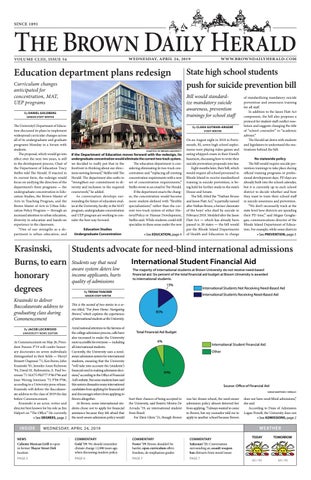
Krasinski, Students advocate for need-blind international admissions Burns, to earn Students say that need aware system deters low income applicants, hurts honorary quality of admissions degrees The majority of international students at Brown University do not receive need-based financial aid. Six percent of the total financial aid budget at Brown University is awarded to international students. 15%
International Students Not Receiving Need-Based Aid
By TRISHA THACKER
Krasinski to deliver Baccalaureate address to graduating class during Commencement By JACOB LOCKWOOD UNIVERSITY NEWS EDITOR
At Commencement on May 26, President Paxson P’19 will confer honorary doctorates on seven individuals distinguished in their fields — Sheryl Brissett Chapman ’71, Ken Burns, John Krasinski ’01, Jennifer Anne Richeson ’94, David M. Rubenstein, E. Paul Sorensen ’71 MA’75 PhD’77 P’06 P’06 and Joan Wernig Sorensen ’72 P’06 P’06, according to a University press release. Krasinski will deliver the Baccalaureate address to the class of 2019 the day before Commencement. Krasinski is an actor, writer and director best known for his role as Jim Halpert on “The Office.” He currently » See DEGREES, page 2
INSIDE
International Students Receiving Need-Based Aid
SENIOR STAFF WRITER
This is the second of two stories in a series titled, “Far from Home: Navigating Brown,” which explores the experiences of international students at the University. Amid national attention to the fairness of the college admission process, calls have also increased to make the University more accessible for everyone — including all international students. Currently, the University uses a needaware admission system for international students, meaning that the University “will take into account the (students’) financial need in making admission decisions,” according to the Office of Financial Aid’s website. But some students have said this system dissuades many international candidates from applying for financial aid and discourages others from applying to Brown altogether. At Brown, some international students chose not to apply for financial assistance because they felt afraid that the need-aware admission policy would
85%
Total Financial Aid Budget 6%
International Student Financial Aid Other
94% Source: Office of Financial Aid SARAH MARTINEZ / HERALD
hurt their chances of being accepted to the University, said Beatriz Silveira De Arruda ’19, an international student from Brazil. For Eleni Gkini ’21, though Brown
was her dream school, the need-aware admission policy almost deterred her from applying. “I always wanted to come to Brown, but my counselor told me to apply to another school because Brown
does not have need-blind admissions,” she said. According to Dean of Admission Logan Powell, the University does not » See ADMISSIONS, page 2
WEATHER
WEDNESDAY, APRIL 24, 2019
NEWS Caliente Mexican Grill to open in former Thayer Street Deli location
COMMENTARY Gold ’19: We should remember climate change 12,900 years ago when discussing modern policy
COMMENTARY Foster ’19: Brown shouldn’t be harder, open curriculum offers freedom, de-emphasizes grades
COMMENTARY Sahyouni ’21: Conversation surrounding an assault weapon ban distracts from moral issues
PAGE 3
PAGE 6
PAGE 7
PAGE 7
TODAY
TOMORROW
65 / 43
64 / 45
NEWS
PAGE 2 • WEDNESDAY, APRIL 24, 2019
» DEGREES, from page 1 stars in “Tom Clancy’s Jack Ryan,” and he co-wrote and starred in the 2018 Oscar-nominated film “A Quiet Place.” Krasinski got his start in acting as a first-year at the University after joining the student sketch comedy group “Out of Bounds.” He will receive a Doctorate of Fine Arts. In nearly three decades as executive director of the National Center for Children and Families, Chapman has led the organization to serve over 50,000 people experiencing homelessness, domestic violence or parental abuse and neglect. While studying at the University, Chapman participated in the 1968 Black Student Walkout as a student leader. For her work on issues including poverty, homelessness and childhood trauma, Chapman will be awarded a Doctorate of Humane Letters. Burns is a documentary filmmaker known for directing and producing several acclaimed historical documentaries, including “The Civil War,” “Jazz,” “Jackie Robinson” and “The Vietnam War.” His films have been nominated for two Oscars and have won 16 Emmy awards and two Grammy awards. Burns will receive a Doctorate of Humane Letters. Richeson, a professor of psychology at Yale, conducts research on the psychological and political implications of increasing cultural and racial diversity. She was named a MacArthur Fellow, which is also commonly referred to as agenius grant, in 2006 for her work that explores how people respond to various kinds of inequality and examines the role of prejudice in people’s lives. Richeson was also elected to the National Academy of Sciences in
» ADMISSIONS, from page 1 consider financial need in the initial stages of the admission process. “The first principle of our admission process is that we always admit the strongest applicants regardless of need,” he said. “It’s only at the very end of the process, after we have selected the groups of (potential) students … that we have a better sense of what their financial need is.” Powell explained that the University first selects international applicants based on other factors including intellectual promise and their fit with Brown. After this pool has been selected, the Office of Financial Aid determines how much financial aid the tentatively admitted international student group needs. “If we are in our (budget), then wonderful. If we are not in our range, we might have to make some need-aware decisions,” he added. Fifteen percent of the University’s international student population is currently receiving need-based scholarship, making up 6 percent of the University’s total financial aid budget, the Herald previously reported. “Thankfully, I had the opportunity to attend Brown on full financial aid, but I am very much aware that I am one of the few who had the chance,” said Iman Musa ’21, a student from Brazil. Going forward, students have expressed hope that the University will consider implementing a need-blind admission policy for international students. “Brown tries to bring the brightest young minds to this place, and it’s quite impossible to do that if you don’t acknowledge that the brightest minds may be from
THE BROWN DAILY HERALD
2015. She will be awarded a Doctorate of Humane Letters. Rubenstein serves as co-executive chairman of the Carlyle Group, an investment firm he co-founded. He is a philanthropist who has made donations to restore historic landmarks — such as the Washington Monument and the Library of Congress — and has loaned the U.S. government rare copies of historical documents he owns, including the Declaration of Independence and the U.S. Constitution. Before he co-founded Carlyle, Rubenstein was deputy assistant to the president for domestic policy under President Jimmy Carter. He will be given a Doctorate of Humane Letters. For over 25 years, Paul Sorensen worked to develop and promote a product engineering software package called ABAQUS. He currently serves as co-chair of the University’s BrownTogether fundraising campaign and sits on University committees such as the Engineering Advisory Council, the Middle East Studies Advisory Council and the Brown University Sports Foundation. Paul Sorensen has also chaired nonprofit organizations such as Equitable Origin, GOALS Haiti and the Raiz Foundation. He will receive a Doctorate of Humane Letters. Joan Wernig Sorensen, a trustee on the Corporation, has worked with the University on alumni relations and fundraising for over 45 years. She cochairs the BrownTogether fundraising campaign along with her husband, Paul Sorensen. She has also served as a consultant to a number of nonprofit organizations, co-chair of the Brown Annual Fund and the first woman president of the Brown Club of Rhode Island. Joan Wernig Sorensen will be awarded a Doctorate of Humane Letters.
low-income backgrounds,” Musa said. By adapting to new places and connecting with different communities, international students have proven “able to push boundaries and … could give so much to the Brown community and benefit current, past and future students,” said José Soria ’19. Need-blind admission for international students is a high priority for the University, Powell said. But administrators are still in the initial conversation stage of building a new system. There has been a lot of conversation, planning, researching and thinking about what need-blind admission would mean and what resources would be needed, he added. “It requires a joint effort between the President, the Provost, the Office of Admission (and) the Office of Financial Aid,” he said. To raise enough money to fund a need-blind admission system, the University should consider adjusting its fundraising model, Soria said. Soria previously wrote in an op-ed in The Herald that the University should commit to a public timeline for reforming international student admissions, citing need-blind policies at peer schools like Harvard, Yale and Princeton. Although having need-blind admission may not be possible at the moment, increasing the amount of financial aid allocated to international students so that more low income students can attend would be a step in the right direction, Silveira De Arruda said.
JOIN
The Brown Daily Herald SINCE 1891
NO EXPERIENCE NECESSARY
Photo Graphics Web Video Opinion Sales thebdh.org/join STUDENT RESEARCHERS SOUGHT
Alum author seeks research assistants for book about Brown. Should be sociable and outgoing.
Pay approximately $40/hour Send resume to: Richard Montauk rmontauk@aol.com
NEWS
WEDNESDAY, APRIL 24, 2019 • PAGE 3
THE BROWN DAILY HERALD
Caliente Mexican Grill to replace Thayer Street Deli Owners initially planned to open Mexican grill, but were prevented from doing so by lease By OLIVIA GEORGE STAFF WRITER
TIFFANY DING / HERALD
267 Thayer previously hosted Thayer Street Deli, UMelt and a pop-up sandwich shop. The new Caliente Grill will be the restaurant’s second location in the state, with the first in Kingston near the University of Rhode Island.
» PREVENTION, from page 1 might prioritize mental health trainings, others might focus more time and resources on developing English teaching skills. Statewide legislation passed in 1986 mandates suicide prevention education for high school students and those teachers responsible for providing this education. A 2017 law specifies the content and duration of these trainings. But unlike the proposed Nathan Bruno and Jason Flatt Act, neither law requires all school personnel to be trained in suicide prevention. The Jason Flatt Act was first passed in Tennessee in 2007, requiring all teachers to undergo two hours of suicide awareness and prevention training each year in order to be licensed to teach in the state, according to the Jason Foundation’s website. This training can be completed through free online modules provided by the Jason Foundation, and it applies to all staff with a teaching license, which can include principals and school counselors. Morgan Marks, national director of divisions and outreach/manager of operations at the Jason Foundation, said that the Foundation is aware of the efforts in the Ocean State to pass the Nathan Bruno and Jason Flatt Act. He added that while the Foundation does not help draft bills modeled on the Jason Flatt Act, they will testify in these bills’ favor if the sponsoring legislators ask them to do so. “We truly believe that it’s the right thing to do, especially (because) there is no cost added to (implementing the act),” he said.
Building the bill The road that took the bill from a high schooler’s basement to the State House has been long and unexpected. After Bruno’s passing early last year, the boys took to gathering regularly in each other’s basements, coping with the grieving process as a group. Steven Peterson, who had been their football coach, was often invited to these gatherings. With his help, the friends launched a fundraiser titled “Be Great for Nate” and the Every Student Initiative, a platform that works toward preventing teen suicide by creating support systems in schools and communities. In August, the students presented ESI at a public event, which drew the attention of Sen. Dawn Euer, DNewport, Jamestown, who proposed that the students turn their efforts into legislation. “It was kind of surreal to think we could do that,” said Angel Duclos, vice president of ESI, who was a close friend to Bruno. “But it made me think that I was accomplishing something great for my friend.” In drafting the legislation, the students emphasized including the clause that changes the title of “school counselor” to “academic advisor.” According to Geoghegan, school counselors are not required to be trained in suicide prevention and awareness. The students from ESI found the term “school counselor” confusing, because to them it suggested the contrary. “We were misled in the idea that our guidance counselor could help us at the moment,” Duclos said. Peterson added that the
term “academic advisor” would have made things clearer for the students, who did not know who to turn to in the wake of Bruno’s passing.
Funding RIDE currently allocates funds for mental health teacher trainings based on school districts’ demonstrated needs, Geoghegan said. These funds come from both the state and the federal government. Last October, Rhode Island received a $2.5 million grant from the U.S. Department of Education dedicated to improving social and emotional well-being of students, The Herald previously reported. Previously, in September, the state received a $9 million grant from the U.S. Department of Health and Human Services to train school personnel in “mental and behavioral health services,” according to RIDE’s website. On the state level, Gov. Gina Raimondo recommended that $590,000 of Rhode Island’s FY2020 budget go toward funding classroom-based “mental health/behavioral health” teacher trainings, which would be voluntary. At her State of the State Address this January, Raimondo announced that these funds would “provide educators with the training they need to support their students’ mental health needs.” If the Nathan Bruno and Jason Flatt Act were to pass, it is unclear whether any of the state’s funding currently allocated for mental health trainings would help with its implementation.
Caliente Mexican Grill is set to open by the end of April as the most recent addition to Thayer Street’s restaurants. Replacing Thayer Street Deli, Caliente will be the fourth eatery to occupy the 267 Thayer address since August 2017, The Herald previously reported. Previously, 267 Thayer has housed UMelt and a popup sandwich shop before transforming into the deli. Despite the high turnover rate at the address, owners and brothers Arlin, Franquin and Jose Rodezno — who also operated Thayer Street Deli — feel confident that their homestyle cooking can succeed on Thayer. “We’ve been making Mexican food for the past 14 years. It’s just what we do,” Arlin Rodezno said. The brothers began renting the property in fall 2018, when they opened the Thayer Street Deli in October. Arlin said they had always wanted to open a Mexican grill at the location but previously could not because of their original leasing agreement, which permitted only sandwich-making. The brothers only recently received permission to open a Mexican restaurant. Angell Alley Associates LLC leases the building to the brothers, and could not be reached for comment about the leasing agreement or the frequent turnover the location
has seen. Caliente’s move onto Thayer Street marks the restaurant’s second location in Rhode Island. The Rodezno brothers also operate a Caliente Mexican Grill in Kingston. The other Caliente is near the University of Rhode Island, a factor the owners said has played an important role in the business’s success. Caliente’s owners said they are excited to bring their “authentic Mexican street food” to residents of the East Side, in addition to University and Rhode Island School of Design communities. Gabriela Carson ’21 will miss Thayer Street Deli. “I liked Thayer Street Deli because it was an affordable, simple option for people who are off meal plan like myself,” she said. “I’ll have to wait and see how the Mexican grill is before I decide to eat there,” Carson added. “With other TexMex options like Bajas on Thayer, I don’t know if I will (eat at Caliente), unless it turns out to be a cheaper or better option.” When asked about the proximity of Caliente to Baja’s two locations, Rodezno was unfazed, stressing the difference in food that his eatery will offer from other Thayer businesses. “We are going to serve original Mexican tapas, not like Bajas,” he said. Both Baja’s Tex Mex Grill and Baja’s Taqueria declined to comment on Caliente’s opening. Rodezno hopes their mission of providing tasty, quality food at a good price will secure the success of their new Thayer Street location.
Since 2007 20 states have passed the Jason Flatt Act, which aims to reduce teen suicide rates by mandating that all educators in the state undergo two hours of teen suicide prevention and awareness training each year in order to remain licensed. In 2018, the United States average number of deaths by suicide per 100,000 adolescents aged 15 to 19 was 8.9. In Rhode Island, this average was 4.7 deaths by suicide per 100,000 adolescents aged 15 to 19.
States that have passed the Jason Flatt Act States that have not passed the Jason Flatt Act
Source: United Health Foundation, The Jason Foundation SARAH MARTINEZ / HERALD
Reactions to the bill Rep. Terri-Denise Cortvriend, D-Portsmouth, Middletown, who is sponsoring the House bill, said that she sees this bill as a response to an increase in teenage suicide nationwide, and as part of a broader effort to advocate for mental health in public schools. She is hopeful that the bill will pass, adding that she is not aware of any opposition to the legislation. In an email reviewed by The Herald, Ken Wagner, commissioner of education at RIDE, wrote to Sen. Hanna Gallo, D-Cranston, West Warwick that “while I am very supportive of these aims, I am concerned that this bill as written does not take into account
efforts that are already happening to address youth suicide prevention (and) funding needed to support this effort.” Wagner cites the existing funding for mental health within Rhode Island schools, “which includes training … around suicide prevention.” The students marvel that a year after their friend’s passing, legislators are working to pass a bill that they drafted in his name. “How did it work?” Duclos asked himself during the interview, referring to the process of bringing the bill from its first inception to its current state. Peterson shrugged. “It worked. Look at where we are now.”
NEWS
PAGE 4 • WEDNESDAY, APRIL 24, 2019
» EDUCATION, from page 1 direction, they would also be able to “define other meaningful specializations within education based on their interests and in consultation with their advisors,” Steffes wrote. “As a professor, I’m excited to work with students to work through (their) interests and to make their education work for them,” said Andrea Flores, assistant professor of education. “I’m really glad that they’re trying to reform the requirements to make them more inclusive of other specializations,” said Moriah Tom ’21, an education concentrator. “I know that having to choose between the two current tracks can be restricting to some students,” she added. Additionally, changes to the curriculum would alter the current breakdown of core courses and electives. In the redesign, all concentrators would take three required classes, four courses in their specializations and three additional electives. Currently, concentrators are required to take courses in Methods, History, Policy and Human Development; they then must take three or four Area of Emphasis courses, depending on their concentration track, as well as two electives. The department is also in the process of developing a required “experiential component” for the education studies concentration, Steffes said. While still in the highly conceptual phase of planning, the department hopes to provide more practice-based experiences to its undergraduate students. Proposed changes extend beyond course and track requirements. In response to student feedback that the
THE BROWN DAILY HERALD
concentration lacks a sense of community, the department also intends to create a two-course sequence required for all concentrators. The sequence would consist of an introductory class and a senior seminar that would together tackle issues of diversity and inclusion in education. “We want to increase our DIAPdesignated courses … and we do plan to be developing some new courses over the next couple of years,” Steffes said. To complement strengthening its undergraduate program, the department is considering building a concurrent BA/MAT program, which the University hopes would attract Brown undergraduates to pursue a master’s in education at the University. The program would coordinate teaching experience with content preparation, Steffes said. The department believes that the development of these concentration changes will take months of further discussion, including feedback from students and a presentation before the College Curriculum Council. MAT Program In the secondary education track of the MAT program, the redesign would expand students’ one-semester student-teaching experience to a “yearlong residency” in an urban school. Currently, MAT students are placed throughout over a dozen schools in the state, mostly concentrated in suburban areas, Steffes said. Going forward, the department would “want to have three or four urban schools that we work really closely with,” she added. The department has approached the Providence Public School District
as well as charter schools Blackstone Academy and Paul Cuffee School about hosting MAT students during their residencies. While PPSD has expressed interest and recommended the implementation of an application process for interested schools in the district, the department has not yet “made any commitments” with any individual schools, she added. The department would also change its recruiting tactics to emphasize that urban education is “the center of our program,” Steffes said. An additional semester of residency would require MAT’s curriculum to undergo further changes, such as decreasing the number of electives that students take. MAT students currently take electives in their academic content area, but in this new direction, “we’re instead going to ask people … to already have a strong content background” when applying to the MAT program, Steffes said. The shift away from content-based preparation would allow the department to develop courses in areas not previously prioritized by the department. Such coursework would include a class on technology and data assessment, as well as a class on special education, Steffes said, adding that “these are key issues for urban schools in particular.” In addition to the anticipated new classes, the department is looking to train its students to work with English Language Learners across subject areas. The redesign would include an English Language Learner endorsement from the Rhode Island Department of Education. “(Having) teachers who are equipped to work with English Language Learners is one of the key
Find us online! facebook.com/browndailyherald
browndailyherald.com
@the_herald
@browndailyherald
youtube.com/browndailyherald
Sections
Multimedia & Production
Business
Editor-in-Chief Emily Davies
Arts & Culture Editors Elise Ryan Annabelle Woodward
Design Editors Bilal Ismail Ahmed Dylan Tian Julie Wang
General Managers Ravi Betzig Nicholas Masiakowski
Metro Editors Colleen Cronin Sophie Culpepper Celia Hack
Head Photo Editors Tiffany Ding Benjamin Toruño
Office Manager Diane Silvia
Senior Editors Anita Sheih Sarah Wang Editorial Page Editors Grace Layer Krista Stapleford
News Editors Katherine Bennett Jacob Lockwood Melanie Pincus Allie Reed
post- magazine Editor-in-Chief Anita Sheih
Science & Research Editors Cate Ryan Chris Schutte Sports Editors Alexandra Russell Alex Smolar COMMENTARY Opinions Editors Rebecca Aman Emily Miller Derek Simshauser
Copy Desk Chief Kelley Tackett Illustrations Editor Daphne Zhao
UEP Program The Urban Education Policy program is anticipating changes that emphasize issues such as race, community context and educational inequality,
Location: 195 Angell St., Providence, R.I. www.browndailyherald.com
Editorial Leadership
Managing Editors Anna Kramer Priyanka Podugu
needs of urban schools, and in Providence there is an especially critical shortage,” Steffes added. The department also plans to add a math certification to the secondary education science program, in addition to the biology, chemistry and engineering/physics certifications already offered. Steffes said she hopes to begin implementing changes in the 202021 school year. “The hope is to roll out a lot of changes” in that time, she added. While the secondary education track may soon see extensive changes, the primary education track remains suspended. “Our strengths as a department and as a university are around secondary,” Steffes said, adding that “elementary education is critically important … (but) as a small department, we just didn’t feel like we did it to the level of excellence it requires.” The University’s decision to suspend the elementary track beginning in the 2018-19 academic year, which sparked controversy on campus, was also due in part to the University’s observation of greater shortages in secondary education teachers than elementary, Steffes said. The elementary track is “definitely not cancelled or eliminated,” Steffes said. “My hope is that in a couple of years we can think about what it would take to have an excellent elementary program as well.”
Directors Sales: Bersabel Yifru Finance: Rudra Srivastava, Reynaldo Blandon Strategy: Edwin Farley
Steffes said. Student feedback on the program had suggested that these issues were “too much in the background and needed to be a more central part of the coursework,” she added. To address student concerns, the UEP program is planning on introducing two new courses that focus on race, democratic practices and community capacity building, wrote Director of the UEP Kenneth Wong in an email to The Herald. These courses will help to “form a more holistic body of knowledge and skills” in UEP students, Wong added. The path to a redesign The planning of the department’s new structure began over the summer of 2018, Steffes said. The stewardship of the agenda was organized by a committee consisting of Steffes, Flores, Director of the Annenberg Institute for School Reform Susanna Loeb and Director of Undergraduate Studies John Papay. But all faculty within the department were involved in developing the proposed program changes, Steffes said. In crafting the direction of education studies, the department organized focus groups, conducted surveys of current and former students across all programs and collected expert opinions from peer institutions and community partners, Steffes said. All of the department’s proposals are “still under discussion, and this discussion will continue into the next year,” but the department hopes to make a more definitive announcement about its new direction in the fall semester, Steffes added.
Editorial contact: 401-351-3372 herald@browndailyherald.com
Advertising contact: 401-351-3372 advertising@browndailyherald.com
Submissions: The Brown Daily Herald publishes submissions in the form of op-eds and letters to the editor. Op-eds are typically between 750 and 1000 words, though we will consider submissions between 500 and 1200 words. Letters to the editor should be around 250 words. While letters to the editor respond to an article or column that has appeared in The Herald, op-eds usually prompt new discussions on campus or frame new arguments about current discourse. All submissions to The Herald cannot have been previously published elsewhere (in print or online — including personal blogs and social media), and they must be exclusive to The Herald. Submissions must include no more than two individual authors. If there are more than two original authors, The Herald can acknowledge the authors in a statement at the end of the letter or op-ed, but the byline can only include up to two names. The Herald will not publish submissions authored by groups. The Herald does not publish anonymous submissions. If you feel your circumstances prevent you from submitting an op-ed or letter with your name, please email herald@browndailyherald.com to explain your situation. You can submit op-eds to opinions@browndailyherald.com and letters to letters@browndailyherald.com. When you email your submission, please include (1) your full name, (2) an evening or mobile phone number in case your submission is chosen for publication and (3) any affiliation with Brown University or any institution or organization relevant to the content of your submission. Please send in submissions at least 24 hours in advance of your desired publication date. The Herald only publishes submissions while it is in print. The Herald reserves the right to edit all submissions. If your piece is considered for publication, an editor will contact you to discuss potential changes to your submission. Commentary: The editorial is the majority opinion of the editorial page board of The Brown Daily Herald. The editorial viewpoint does not necessarily reflect the views of The Brown Daily Herald, Inc. Columns, letters and comics reflect the opinions of their authors only.
Video Editor Victoria Caruso Max Dekle
Corrections: The Brown Daily Herald is committed to providing the Brown University community with the most accurate information possible. Corrections may be submitted up to seven calendar days after publication.
Graphics Editor Sarah Martinez
Advertising: The Brown Daily Herald, Inc. reserves the right to accept or decline any advertisement at its discretion. The Brown Daily Herald, Inc. is a financially independent, nonprofit media organization bringing you The Brown Daily Herald, BlogDailyHerald and Post- Magazine. The Brown Daily Herald has served the Brown University community daily since 1891. It is published Monday through Friday during the academic year, excluding vacations, once during Commencement and once during Orientation by The Brown Daily Herald, Inc. Single copy free for each member of the community. Subscription prices: $200 one year daily, $100 one semester daily. Copyright 2019 by The Brown Daily Herald, Inc. All rights reserved. Periodicals postage paid at Providence, R.I. Postmaster: Please send corrections to P.O. Box 2538, Providence, RI 02906.
TODAY
WEDNESDAY, APRIL 24, 2019 • PAGE 5
THE BROWN DAILY HERALD
T h e S ta i r c a s e
menu SATELLITE DINING ANDREWS COMMONS
Grinder, Baked Pasta, Pho Bar, Spicy Sausage and Garlic Pizza, Assorted Roasted Mushroom Pizza JOSIAH’S
BLUE ROOM
Chicken Wings Bar, Southwestern Bean Burger
Blue Room Grain Bowl, Hearty Country Vegetable Soup
DINING HALLS SHARPE REFECTORY LUNCH
DINNER
Red Pepper, Gouda and Garbanzo Bean Sandwich, French Toast, M&M Bars
Siberian Style Grain Bowl, Southwestern Inside Out Burgers, S’mores Cupcakes
VERNEY-WOOLLEY LUNCH
DINNER
Chinese Style Chicken Wings, Noodle Bowl Bar, Mexican Salad Bar, Brown Rice Pilaf
Mashed Red Bliss Potatoes with Garlic, Corn O’Brien, Pork Carnitas, Chocolate Cannoli
sudoku VICTORIA YIN / HERALD
List Art Center’s stairway is home to an ever-changing canvas of students’ work. The walls serve as a canvas for students to express whatever they choose; murals, love letters, calls to action.
Q U O T E O F T H E D AY
“Thankfully, I had the opportunity to attend Brown on full financial aid, but I am very much aware that I am one of the few who had the chance.
”
— Iman Musa ’21, a student from Brazil
See Admissions on page 1.
crossword
C L A R I F I C AT I O N The April 22 article “LGBTQ+ panelists examine experiences, challenges in tech” said that Izaak Baker ‘15 identifies as gay. In fact, Baker identifies as bisexual or queer. The Herald regrets the error.
CORRECTION Due to an editing error, the April 19 article “University researchers design LEGO-block like material” mis-titled Assistant Professor at Harvard Medical School Shrike Zhang as an associate professor. The Herald regrets the error.
calendar TODAY
APRIL
S
7
M
T
W
Th
F
S
1
2
3
4
5
6
8
9
10
11
12
13
Growth Lab LunchMasahiro Kubo 12:00 P.M. Page-Robinson Hall
Earth Week Clothing Swap: Walk-in Closet 12:00 P.M. Main Green
Copyright in the Academy 2:00 P.M. Rockefeller Library
Macro Seminar-Ludwig Straub 4:00 P.M. Robinson Hall
TOMORROW
14
15
16
17
18
19
20
21
22
23
24
25
26
27
28
29
30
‘Everything Waffles’ Community Buffet 11:30 A.M. Faculty Club
Puppy Dogs and Hot Dogs 12:00 P.M. Sciences Library
Screen on the Green 7:00 P.M. Wriston Quadrangle
FourPlay 8:00 P.M. Salomon DECI
COMMENTARY PAGE 6 • WEDNESDAY, APRIL 24, 2019
THE BROWN DAILY HERALD
Earth’s history shows we need a Green New Deal RACHEL GOLD
op-ed contributor
table. February 6, 2018: “Floods are Getting Worse, and 2,500 Chemical Sites Lie in the Water’s Path.” March 12, 2018: “Hotter, Drier, Hungrier: How Global Warming Punishes the World’s Poorest.” September 25, 2018: “Climate Change is Killing the Cedars of Lebanon.” The operative verb tense in these titles is the present continuous. Climate change is killing, is eroding, is getting worse. A world getting hotter, drier, hungrier is a world that is frightening but still predictable. We think we will have time to respond. The Younger Dryas reminds us we may not have this time. No climate scientist would claim an ability to
global temperatures by 5-8˚C (and because the same methane deposits exist today, waiting to be destabilized in our warming ocean). We need a Green New Deal because humans could force another Younger Dryas, transforming society as we know it. We have the technology to reach zero emissions today. We can build new solar arrays and windmills, we can invest in sustainable family farms, we can upgrade all buildings to maximize their energy efficiency — while creating well-paying jobs, cutting energy costs and cleaning up a history of environmental degradation in places where poor peo-
This planet’s climate systems are capable of transformations on far more rapid timescales than we myopic humans can imagine.
about how close we are to the runaway-greenhouse-warming or species-extinguishing tipping points. We know these tipping points exist because geoscientists have documented the effects of crossing them. Take, for example, the Permian Extinction, when abrupt carbon dioxide release 252 million years ago acidified the ocean and caused the extinction of 96 percent of marine life. The geologic record teaches us that climate tipping points are real — but we never talk about them. Most climate reporting that I see in the media describes global warming as a process of continuous deterioration. A quick skim of the stories the New York Times selected to represent the 2018 “Year in Climate Change” creates an image of a planet gradually becoming less hospi-
Read Join
When we think about climate change, we should think about the Younger Dryas. You probably haven’t heard of the Younger Dryas, a cold period that started 12,900 years ago — at the end of the last glacial period — with a 10˚C cooling over two centuries, and ended 1,200 years later with a 15˚C warming over a few decades. (To appreciate the magnitude of these temperature changes, remember that 1.5˚C is the current scientific consensus for planetary warming that humanity can absorb without major upheaval.) The Younger Dryas was the last of around 25 violent temperature swings that occurred in the last glacial period. It’s named for the Arctic flower, the Dryas octopetala, that migrated far south as the polar tundra overtook forested land. We should be asking whether a sudden upheaval in climate like the Younger Dryas could happen again. The Younger Dryas reminds us that the stability of the Holocene — the past 11,000 years of Earth history — belies the volatility Earth has experienced in the not-so-distant past. This planet’s climate systems are capable of transformations on far more rapid timescales than we myopic humans can imagine. Only when our conception of the possible includes climate change as abrupt as the Younger Dryas will we understand the risk we’re choosing to live with. The scientific definition of abrupt climate change is a change that occurs when the climate system crosses some threshold, triggering a transition to a new climate state at a rate faster than the cause. The National Academy of Sciences offers this analogy: Imagine that you have a curved track balanced on a fulcrum. There are two curves, each on either side of the fulcrum, that form “cups” in which a ball can rest. A ball placed in either one of
the curves is stable. If pushed, it will roll for a short time but return to its original position. A ball placed on top of the fulcrum is unstable. If pushed ever so slightly, the ball will fall into one of the cups, putting the system in a completely new state. This is an abrupt change. Now imagine that you are in a dark room, unable to see what state the ball is in or what the device looks like. You have no idea how close the ball is to its tipping point, but you continue to push the ball. Sound short-sighted? Well, we’re playing this game now, with our Earth. We’re in a dark room, pushing our planet’s systems without being sure
predict when the Younger Dryas would happen, only that it’s possible — and that’s why we need a Green New Deal. We certainly need a Green New Deal — the resolution introduced by Rep. Alexandria Ocasio-Cortez (DNY) and Sen. Ed Markey (D-MA) to mobilize the United States to reach zero emissions by 2030 — because of continuous climate change, because hurricanes are increasing in intensity and frequency and because the ranges of disease-carrying insects are expanding and exposing more people to Zika and Lyme. But we also need a Green New Deal because of abrupt climate change; because 12,900 years ago, the North Atlantic plummeted into the Younger Dryas; because 55.5 million years ago, a warming ocean triggered the release of frozen methane, raising
ple and people of color live. We’ll still be operating in a dark room, but at least we’ll be less at risk of knocking the ball off its fulcrum. The Green New Deal is a mobilization that will operate on the same timescale of abrupt climate change; that is, over decades. It’s easy for critics to say neither one — neither abrupt climate change nor the Green New Deal — can happen that fast. But both can. The Green New Deal is ambitious — some say too ambitious — but since it is the only policy on the table that sets its sights on zero carbon emissions, it is a policy worth pursuing. As a science student, the potential for abrupt climate change drives me to the lab; as an inhabitant of planet Earth, it keeps me up at night; as a citizen, it compels me to support the policy proposals that
will most immediately and most intensely reduce our carbon emissions. The Green New Deal, which demands an immediate move to zero emissions, is that policy. Many scientists think the Younger Dryas began when meltwater from the Laurentide Ice Sheet, which covered half of North America at the end of the last glacial period, drained into the North Atlantic ocean. Because freshwater is less dense than salty water, this meltwater formed a “lid” that prevented saltwater from sinking, inhibiting the Atlantic Gulf Stream from carrying warmer water northward from the tropics, and causing abrupt regional cooling. Right now, as we speak, the Greenland Ice Sheet is rapidly melting into the North Atlantic, nearly twice as fast as it did during the 1990s and 2000s. Of course, the context today is vastly different from that of 12,900 years ago — there was a lot more ice to melt at the end of the glacial period, and the warming then was natural, unlike the anthropogenic greenhouse warming we’re experiencing today. Will we see a Younger Dryas in our lifetimes? Who knows. But 12,910 years ago, hunter-gatherers probably didn’t think abrupt climate change was coming, either. And then it came.
Rachel Gold ’19 wishes everyone a Happy Earth Week and wants you to stop by the Main Green today to see her mud from the Younger Dryas. Please send responses to this opinion to letters@browndailyherald.com and op-eds to opinions@browndailyherald.com.
The Herald browndailyherald.com/join herald@browndailyherald.com
THE BROWN DAILY HERALD
COMMENTARY WEDNESDAY, APRIL 24, 2019 • PAGE 7
Brown shouldn’t be harder. The open curriculum wasn’t meant for that. RUTH FOSTER
op-ed contributor I was surprised to read Aidan Calvelli’s ’19 opinion in last Friday’s Herald. This is not just because it seemed like a change of tune from his op-ed earlier this year — which praised the “exploratory, individualized and empowering” learning experiences that can arise when we are “freed from the shackles of grades” — but also because it seemed to lose sight of two ideas that are central to the open curriculum. First, the de-emphasis on grades, and second, the more fundamental notion that it is up to us to make choices about how to spend our time at Brown. There is an entire chapter of the Magaziner-Maxwell Report — the foundational text of Brown’s open curriculum — that grapples with the many and varied problems that arise out of the grading process. Grades evaluate a narrow set of skills which may or may not capture what a student has gained from the course. They have a tendency to measure solely the retention of material (some might regard this as scholastic achievement, others may not) rather than broader conceptual fluency or improved critical thinking. Moreover, a professor teaching one section of a course might value the development of different skills than a professor teach-
ing another section of the same course, such that the same student might get an A if they were enrolled in one section but a B if they were enrolled in the other — further demonstrating how grades fail to represent the idealized notion of academic growth. The report concludes that there is “doubt as to what grades measure and as to the reliability of this measure-
ous to suggest that academic expectations at Brown are low because students have time to watch TV and participate in clubs. There is a difference between rigor and onerousness — we ought not make things harder for harder’s sake. In fact, the Magaziner-Maxwell Report warns against the University placing “excess demand on the student’s time” precisely because the process of self-re-
be an “environment in which students are encouraged to formulate and consider the problems which are most basic to them — what their lives are about, why they seek the goals they do, where they want to go and what they want to do.” Each Brown student is a bit different, and so each of us chooses to take a slightly different path during our time here. That’s part of what makes this
The minds behind the open curriculum deliberately construed ‘education’ broadly — the growth that takes place during our time at Brown is bigger than the growth that takes place solely in the classroom.
ment.” Stricter grading isn’t a meaningful tool for producing the kinds of behavioral change Calvelli hopes to see. Rather, it amplifies the ways in which grading is a largely imperfect endeavor. If anything, it seems to me that stricter grading would incentivize the mindless “grade-getting” behavior that the authors of the Magaziner-Maxwell Report decry. Brown is a school with a remarkable concentration of skilled readers, writers and thinkers. It is disingenu-
alization requires time to contemplate oneself and one’s choices — the very kind of contemplation Calvelli calls for. Our academic lives are a single piece of the larger puzzle of a Brown education, and that’s the way it ought to be. This brings me to the bigger underlying problem with Calvelli’s thesis. It is our job as participants in the open curriculum to make our own choices about how we move through this university. Chapter nine of the Magaziner-Maxwell Report argues that Brown should
place special. Some students choose to take on extracurricular leadership roles, seek out avenues for creative expression or pursue community engagement opportunities. Some students arrive on campus with choices that are constrained by factors outside of their control and find themselves working multiple jobs to send money back home to loved ones. Some students juggle health problems alongside their academic and extracurricular pursuits. Some students are
striving to figure out how to balance all of these things and still have time to kick back and watch Game of Thrones at the end of the day. The minds behind the open curriculum deliberately construed “education” broadly — the growth that takes place during our time at Brown is bigger than the growth that takes place solely in the classroom. Again, the document speaks for itself: “Those people who think that intellects develop in proportion to the number of hours in a class, or the number of books read, … (have) failed to realize what the development of intellect means.” We become educated not only by reviewing notes and editing papers, but also by building community, solving real-world problems and learning how to decide for ourselves what is valuable. But of course, the beauty of the open curriculum is its flexibility. If a student feels that academic learning ought to be the biggest part of their college experience, they can rest easy knowing there is no shortage of additional responsibility on this campus for them to undertake.
Ruth Foster ’19 reads the Magaziner-Maxwell report for fun. She can be reached at ruth_foster@brown.edu. Please send responses to this opinion to letters@browndailyherald.com and op-eds to opinions@browndailyherald.com.
Questioning an assault weapons ban DONNIE SAHYOUNI op-ed contributor In the midst of seemingly perpetual mass shootings including the massacres in Parkland, Sante Fe and Christchurch, there are increasingly strong calls to outlaw the purchase of high capacity magazines and the so-called “weapons of choice” for mass shooters: assault weapons. An assault weapon, as defined in most proposed legislation, is a semi-automatic firearm with a few distinguishing features that improve functionality — a foregrip or a threaded barrel, for example. Proponents of a ban contend that it would reduce the lethality and prevalence of mass shootings, lower homicide and save lives generally. There is, however, scarce and conflicting evidence for this conclusion; a federal ban on assault weapons appears to be nothing more than a political distraction from the important moral questions we ought to be asking about guns in America. While the limited available data on gun ban effects is not conducive to rigorous statistical analysis, most statistical analyses of state assault weapon and high capacity magazine bans and Sen. Dianne Feinstein’s (D-CA) expired 1994 federal assault weapon/high capacity magazine ban do not find statistically significant effects of the bans on homicide or suicide. As for mass shootings, a review of existing literature by the RAND corporation, a non-partisan American think tank that reviewed over 1,000 published studies pertaining to effects of gun policy, found “inconclusive evidence for the effect of assault
weapon bans on mass shootings.” The analysis by the RAND Corporation also found inconclusive evidence for the effects of assault weapon bans on violent crime and homicide. A similar review of firearms research in 2004 by the National Academies of Sciences, Engineering and Medicine found that the 1994 federal
gests that an assault weapons ban is correlated with a decrease in the lethality of mass shootings. The same author also found that assault weapon bans could result in fewer school shooting victims. Each of these studies — both suggesting and refuting the effectiveness of gun reform — rely on limited available data about effects of gun legislation and
shootings in American history, as examples of the devastation that such firepower can generate. Of course, these tragedies do far more harm than that which is incurred by the victims, their friends and families. Mass shootings, in which assault weapons are disproportionately used, strike fear and leave deep scars across the country, so much
A federal ban on assault weapons appears to be nothing more than a political distraction from the important moral questions we ought to be asking about guns in America.
ban “did not reveal any clear impacts on gun violence outcomes.” Another fact-check by the independent, investigative journalism team at ProPublica refuted Feinstein’s claim that her ban worked, writing “gun violence experts say the exact opposite.” Even the 2016 Epidemiologic Review meta-study often cited by gun control advocates reports only one statistically significant result pertaining to the 1994 federal ban: a study out of Quinnipiac University which found a 19.3 percent increase in murder rates during the effect of the ban, after controlling for socioeconomic and demographic variables. This is not to say that there is no evidence for positive effects of an assault weapon ban. One statistical analysis that met RAND’s criteria for inclusion in their meta-study, for example, sug-
thus should not be convincing enough to enact new policy. Lack of data and comprehensive research prevents us from making certain conclusions as to the effects of gun policy, even if the vast majority of research on this issue has not found conclusive evidence for positive effects from assault weapon and high capacity magazine bans. Further, our focus on assault weapons distracts from the vast majority of violence perpetrated using firearms, as in practice, assault weapons are overwhelmingly less dangerous to American society than handguns. In 2016, a rifle of any kind was used in about three percent of gun related homicides, according to the FBI. Still, some will point to Las Vegas and Stoneman Douglas and Pulse Nightclub, some of the most deadly
so that it can be hard or impossible to quantify the suffering. Still, it is important to keep our fears consistent with statistical reality. Americans are more likely to be struck by lightning than they are to die in a mass shooting. We do not have sufficient evidence to conclude that an assault weapons ban would have positive effects on gun safety outcomes, and enacting a ban certainly would not lead to a conclusion to the political squabbling regarding guns. So then what is the purpose of such a policy if it might not make us safer or improve discourse? Instead, we must focus on the deeper questions of values and rights that serve as the groundwork for debates on gun reform. For argument’s sake, let us grant gun control advocates some conclusions on gun violence and defensive
gun use. If a society with dramatically fewer firearms, or even no private gun ownership, is a safer society (for which there is currently scant if any causal evidence), is this a moral path to take? Are we willing to strip away the individual right to self-defense in favor of a less violent collective? Should I be denied the right to defend myself and my family because infringing on that right may reduce the lethality of acts of violence, or because those fatalities may outnumber lives saved by defensive firearm use? There are real debates here to be had about collective good, individual liberty and the purpose of the 2nd Amendment, even accepting many claims that I and other gun rights supporters want to contest. But none of this is possible without civil discourse on the issue of guns. While some right-wingers peddle cruel and baseless conspiracy theories that the Parkland survivors were crisis actors, some liberals also make gross and false claims, calling the NRA and its 5 million members “funding the killers” and “child murderers.” As ambassadors of higher education, we need to be leading the way with fact, reason and philosophy-based discussion about firearms in this country, knowing that we all want a better society for our children and putting aside our strong feelings to achieve it.
Donnie Sahyouni ’21 can be reached at donnie_sahyouni@ brown.edu. Please send responses to this opinion to letters@browndailyherald.com and op-eds to opinions@browndailyherald.com.
NEWS THE BROWN DAILY HERALD
WEDNESDAY, APRIL 24, 2019
Injustice Anywhere: The Shared Struggle to Expand Constitutional Liberties for Everyone in America Featuring
Anthony D. Romero Executive Director American Civil Liberties Union
Thursday, April 25, 2019 5 p.m. Granoff Center for the Creative Arts Martinos Auditorium 154 Angell Street Providence Supported in part through the Jill Rose Distinguished Presidential Lecture Fund
For tickets and more information, please visit
brown.edu/go/reaffirmingvalues
REAFFIRMING UNIVERSITY VALUES: Campus Dialogue and Discourse Sponsored by the Office of the President, Office of the Provost, Department of American Studies and Taubman Center for American Politics and Policy To request special services, accommodations or assistance for this event, please contact the University Event and Conference Services Office at universityevents@brown.edu.