SINCE 1891
THE BROWN DAILY HERALD WEDNESDAY, APRIL 10, 2019
VOLUME CLIII, ISSUE 47
WWW.BROWNDAILYHERALD.COM
Jabberwocks to accept all genders, all voices Paxson
responds to national admissions scandal
Changes to begin fall 2019 as a cappella group celebrates 70th anniversary By ELISE RYAN ARTS AND CULTURE EDITOR
The Jabberwocks, the University’s oldest a cappella group, will begin accepting singers of all genders and all voices beginning fall 2019. Founded in 1949 and traditionally an all-male group, this change comes as the group celebrates its 70th anniversary. “Every singer is welcome to participate, no matter what voice part you subscribe to, what gender you might identify as,” said Sam Grady ’19, the group’s alumni relations coordinator. By inviting all voice parts — soprano, alto, tenor, baritone and bass — to audition, the group hopes to avoid the implicit exclusion that only welcoming tenor or bass voices would have maintained. “We wanted to make sure that we weren’t making a change” that remained exclusive in some way, said Mark Séjourné ’20, the Jabberwocks’ design and brand manager. This announcement follows internal changes implemented by the group to increase its inclusivity. These changes
University will review admission process, alumni relations, athlete recruitment By JACOB LOCKWOOD UNIVERSITY NEWS EDITOR
COURTESY OF TAMAO KISER
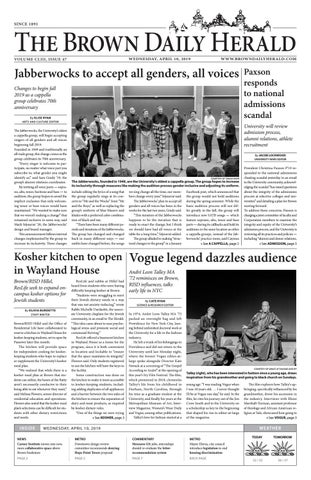
The Jabberwocks, founded in 1949, are the University’s oldest a cappella group. The group hopes to increase its inclusivity through measures like making the audition process gender inclusive and adjusting its uniform. include editing the lyrics of a song that the group regularly sings at its concerts to “Me and the Wocks” from “Me and the Boys,” as well as replacing the group’s uniform of blue blazers and khakis with a preferred color combination of black and tan. “There have been many different periods and iterations of the Jabberwocks. The group has changed and changed back in many different ways — our outfits have changed before, the songs
we sing change all the time, our members change every year,” Séjourné said. The Jabberwocks’ plan to accept all genders and all voices has been in the works for the last two years, Grady said. “This iteration of the Jabberwocks happens to be the iteration that is ready to enact the change, but I think we should have had all voices at the table for a long time,” Séjourné added. The group alluded to making “structural changes to the group” in a January
Facebook post, which announced that the group would not hold auditions during the spring semester. While the basic audition process will not differ greatly in the fall, the group will introduce new SATB songs — which feature soprano, alto, tenor and bass parts — during its callbacks and hold its auditions in the same location as other a cappella groups, instead of the Jabberwocks’ practice room, said Caymus » See A CAPPELLA, page 2
President Christina Paxson P’19 responded to the national admissions cheating scandal yesterday in an email to the University community, acknowledging the scandal “has raised questions about the integrity of the admissions process at selective colleges and universities” and detailing a plan for Brown moving forward. To address these concerns, Paxson is charging a joint committee of faculty and Corporation members to examine the integrity and equity of the University’s admission process, and the University is reviewing all its practices and policies — including “alumni and donor relations, » See ADMISSION, page 3
Kosher kitchen to open Vogue legend dazzles audience André Leon Talley MA in Wayland House Brown/RISD Hillel, ResLife seek to expand oncampus kosher options for Jewish students By OLIVIA BURDETTE STAFF WRITER
Brown/RISD Hillel and the Office of Residential Life have collaborated to reserve a kitchen in Wayland House for kosher-keeping students, set to open by Passover later this month. The kitchen will provide space for independent cooking for kosherkeeping students who hope to replace or supplement the University’s kosher meal plan. “We realized that while there is a kosher meal plan at Brown that students can utilize, the hours of the Ratty aren’t necessarily conducive to their being able to eat whenever they want,” said Melissa Flowers, senior director of residential education and operations. Flowers also noted that the kosher meal plan’s selections can be difficult for students with other dietary restrictions and needs.
INSIDE
ResLife and rabbis at Hillel had heard from students who were having difficulty keeping kosher at Brown. “Students were struggling to meet their Jewish dietary needs in a way that was not anxiety-inducing,” wrote Rabbi Michelle Dardashti, the associate University chaplain for the Jewish community, in an email to The Herald. “This idea came about to ease psychological stress and promote social and communal thriving.” ResLife offered a basement kitchen in Wayland House as a home for the program, since it is both convenient in location and lockable to “ensure that the space maintains its integrity,” Flowers said. Only students registered to use the kitchen will have the keys to the facility. Some construction was done on the kitchen to make it more accessible to kosher-keeping students, including adding duplicates of all appliances and a barrier between the two sides of the kitchen to ensure the separation of dairy and meat products, as required by kosher dietary rules. “One of the things we were trying » See KOSHER, page 3
’72 reminisces on Brown, RISD influences, talks early life in NYC By CATE RYAN SCIENCE & RESEARCH EDITOR
In 1974, André Leon Talley MA ’72 packed an overnight bag and left Providence for New York City, leaving behind unfinished doctoral work at the University for a life in the fashion industry. He left a trunk of his belongings in Providence and did not return to the University until last Monday night, where the former Vogue editor-atlarge spoke alongside Director Kate Novack at a screening of “The Gospel According to André” at the opening of this year’s Ivy Film Festival. The film, which premiered in 2018, chronicles Talley’s life from his childhood in Durham, North Carolina, through his time as a graduate student at the University, and finally his years at the Metropolitan Museum of Art, Interview Magazine, Women’s Wear Daily and Vogue, among other publications. Talley’s love for fashion started at a
COURTESY OF GRACE ATTANASIO AND IFF
Talley (right), who has been interested in fashion since a young age, draws inspiration from his grandmother and going to black church on Sundays. young age: “I was reading Vogue when I was 10 years old. … I never thought I’d be at Vogue one day,” he said. In the film, he cites his journey out of the Jim Crow South and to the University on a scholarship as key to the beginning that shaped his rise to editor-at-large of the magazine.
The film explores how Talley’s upbringing, specifically influenced by his grandmother, drove his ascension in the industry. Interviews with Eboni Marshall-Turman, assistant professor of theology and African American religion at Yale, showcased how going to » See VOGUE, page 3
WEATHER
WEDNESDAY, APRIL 10, 2019
NEWS Carney Institute moves into new, more collaborative space above Brown bookstore
METRO Downtown design review committee recommends denying Hope Point Tower proposal
COMMENTARY Meszaros GS: jobs, internships should re-evaluate the letterrecommendation system
METRO Mayor Elorza, city council introduce legislation to end housing discrimination
PAGE 2
PAGE 5
PAGE 7
BACK PAGE
TODAY
TOMORROW
52 / 32
56 / 37
NEWS
PAGE 2 • WEDNESDAY, APRIL 10, 2019
THE BROWN DAILY HERALD
Carney Institute settles in above Brown bookstore » A CAPPELLA, Brain Science Institute moved to 164 Angell following $100 million donation By AURIA ZHANG SENIOR STAFF WRITER
About two months ago, the Carney Institute for Brain Science moved into its new home above the University’s bookstore, which provides new and improved collaborative spaces. “It’s very exciting for us to have a home that is right in the middle of campus, just right in the center of everything,” said Diane Lipscombe, director of the Institute. “It’s a wonderful community, and I think we’re all walking around with (a) spring in our step.” “Everyone is a little more brighteyed and excited” about the new space, said Henry Jones ’19, who received an Undergraduate Teaching and Research Awards grant in the Carney Institute last summer. “The design of the rooms is really good (for) communicating a quick idea.” The Institute’s former building was not a good gathering space for students and faculty, said R. John Davenport, managing director of the Carney Institute. The offices ranged in size, and people were scattered throughout the building. The new space at 164 Angell St., which includes offices, conference rooms and space for collaboration, is much more conducive to communication across the team, he added. “I think of this place as the town square or the town hall of Carney,” Davenport said. “It’s a place where … everyone can come and meet and discuss ideas and discuss new scientific projects.” The new space is also used by four research laboratories that are primarily focused on computation,
BENJI TORUÑO / HERALD
The Carney Institute for Brain Science’s new location above the University bookstore facilitates communication and collaboration. The faculty using the labs come from the neuroscience, engineering and CLPS departments. Lipscombe said. Thomas Serre, principal investigator of one of the research labs in the new facility and professor of cognitive, linguistic and psychological sciences, identified the openness of the space as one of its main benefits. “The challenge with computational neuroscience is that it really draws on many, many disciplines, and as a result, we have students scattered across campus,” Serre said. The Institute’s new space allows students to meet, collaborate and start projects, he added, which will hopefully attract more students to computational neuroscience. The faculty using the labs at 164 Angell St. come from three different departments: neuroscience, engineering and CLPS. “It really is a collaborative facility (with) faculty from
three different departments coming together,” Lipscombe said. The goal of the new facility was to “create the opportunity to do something different,” she added. “And I would say we really succeeded in that.” The move to 164 Angell St. follows a $100 million donation to the Institute last year from Robert Carney ’61 and Nancy Carney, one of the largest gifts in University history, The Herald previously reported. The donation provided a long-term financial foundation for the Institute and solidified it as a permanent entity that the University will continue to support, Davenport said. “The primary impact in the immediate term was that the Carney gift just instantly changed the visibility of the Institute and put us in a new realm of being recognized around the country,”
he added. The donation will also help the Institute facilitate faculty growth over and likely beyond the next decade, and will allow the Institute to continue speaking with “generous donors about providing funding in certain areas,” such as graduate work or research in a particular field that interests donors, Davenport added. Looking to the future, Davenport discussed the idea for a lab space for “cutting-edge microscopy,” which would require more funds and more room than the current lab space at 164 Angell St. Brain science is “a very expensive business,” Lipscombe said. “It’s just really difficult for any individual department or any individual lab to keep up with the advances in technology, so we are extremely interested in ensuring that we can do that.”
from page 1
Price ’20, a member of the group. “We’re going to be having several talks, announcements (and) maybe posters leading up (to the auditions) saying this is for everyone,” Price added. Not only does the group hope to emphasize its acceptance of students of all genders and voices, but they want to ensure that students from all years feel comfortable auditioning. Going forward, the group also plans to use their platform to advocate for all-female and gender-inclusive groups to receive equal pay and opportunity for performing at gigs and events, Price said. “We’re coming from a place that is an aggregate of all of our privilege,” Price said. “It is obviously a process to be more inclusive, a process to try and break down any sort of boundaries that are limiting any people on campus from singing.” “We’re still going to perform the same style of music that we have been performing, which is contemporary,” Grady said. While Grady will be graduating this spring, they are excited to watch the group carry out the change next fall. “It’s been a labor of love for me, this process. I’m very excited to see where this group goes,” they added. “I’ve seen myself grow a lot in the Jabberwocks in the last three years. I’ve also seen the Jabberwocks grow a lot as a group into something I think is much better,” Séjourné added, emphasizing that this change is the “next step for the Jabberwocks to better ourselves.” With 70 years of performance, honoring its history has played an important role in the Jabberwocks’ identity — something that Grady and Séjourné say the group will continue to celebrate as it evolves. After four members of the University’s Glee Club separated to form an independent a cappella group that they named after the Lewis Carroll poem “Jabberwocky,” the Jabberwocks have gone on to travel internationally and domestically, performing in venues big and small, and have released numerous albums. “On the one hand, it feels really good to be part of something larger than yourself,” Grady said, noting that acknowledging tradition can be a beautiful way to achieve that feeling. “At the same time, (we have) been thinking about tradition in a more nuanced way and analyzing how various traditions that people take for granted can have very deleterious effects,” they added. Grady hopes these changes will forge new traditions and reconceptualize the old. “The Jabberwocks are a family,” Séjourné said. “There are 70 years of that family, 70 generations. It’s really exciting to welcome any new family members.”
NEWS
WEDNESDAY, APRIL 10, 2019 • PAGE 3
THE BROWN DAILY HERALD
» VOGUE, from page 1 black church every Sunday shaped his views of fashion. “When they went to church, they pulled out all the stops,” Talley said. The film’s consideration of Talley’s upbringing and his participation in black church left an impression on event attendees, such as Valentine Amari ’21. “I appreciated the attention given to André’s appreciation for fashion stemming from the opulence and celebration of African American livelihood in the church,” she wrote in an email to The Herald. The film discusses other aspects of race and his identity as well, including his experience of prejudice and cruelty from some in the fashion industry. “Clothes are my armor, and they always were,” he said. “The Gospel According to André” is set against the backdrop of the 2016 election — interviews with Talley were filmed both weeks before President Donald Trump won the election and immediately after, as well as during his inauguration. When Novack asked him about the significance of the film’s timing, Talley said the election was
“kind of depressing because I think we are in a downward spiral.” Though Talley is frustrated with the direction of the Trump White House, his yearslong friendship with Melania Trump continues, as the two grew close when he helped her select her wedding dress. He also revered the Obamas and in the film, he grows emotional when imagining how his grandmother would have felt seeing Michelle Obama on Vogue’s cover. After the screening, Talley, dressed in his signature black caftan, entered the Granoff Center for the Creative Arts to applause from the audience. He began his talk by regaling the audience with tales from his time at the University. As a master’s student, he wrote his thesis on the influence of French poets on 19th century paintings and representation of North African women in these works. Novack won Talley’s respect when she approached him with his thesis before they began filming. “She did her research. … She had a copy of (my) master’s thesis in her pocketbook. … She made arrangements to get it from Brown,” Talley said. “I had two lives when I was here at
CAMERON CHALEFF / HERALD
The new kosher kitchen in Wayland House is set to open before Passover and will be divided into meat and dairy sections.
» KOSHER, from page 1 to do is set up the space in a way that avoids the potential for mistakes,” said Rabbi Moshe Moskowitz, who directs the University’s chapter of MEOR and performed the ritual process of making the kitchen kosher. MEOR is an Orthodox outreach organization. Having the kitchen available “eliminates a barrier to (enrolling at Brown) for people,” Moskowitz said. “Limited kosher options make it hard to pick Brown. This is a really big step in the right direction for that.” When the kitchen opens for Passover, a group of students will cook and eat together over the holiday. Herald Photographer Cameron Chaleff ’20.5, an engagement intern at Hillel who keeps kosher, is helping to organize the kitchen after years of Passovers at Brown where she found it difficult to participate in the holiday while being vegetarian. “I know so many other students
who … want to be able to eat dairy meals and not meat meals. Let’s get together and cook as a group,” Chaleff said. “Let’s do this as a community instead of being sad (with) our microwaved dorm meals.” Moskowitz said the kitchen will stay open after Passover for kosher-keeping students who have signed up for access to the kitchen to use at any time. “As the observant population grows on campus … I can only see it growing,” he said. “I would love for us to outgrow this space.” Chaleff emphasized the importance of University support for kosher-keeping students. “The message that this sends from Brown about caring about observant Jewish students and meeting our needs is so powerful,” Chaleff said. “Food is so important to community, and having a space where I can fully participate in that is game-changing for what it means to be an observant student on campus.”
Brown. … I had my Brown life, and then I had my RISD life.” One was “formalistic and serious” — the other not so much, Talley said. “My RISD life was the life.” He fell in with an affluent crowd at RISD. “I had never seen young people like that,” he said, recalling the luxurious lives of his new friends. They showed off their wealth with Chippendale furniture in a top-floor apartment on Benefit Street, new cars and even a skunk coat a friend brought to school after Christmas. “We were living for skunk,” he said. Many of his stories found ties to the University and Providence. Talley wrote a column for the RISD newspaper, which introduced him to the world of social and fashion journalism that would come to define his career. In his University mailbox, he received a response to a letter he had sent to Vogue from an editor who later served as a crucial connection. And, during one spring break, he traveled to Paris for the first time, a city he often cites as a crucial inspiration. Talley never returned to Providence to finish his doctoral degree because New York had too much to
offer. Soon after arriving in the city, he was introduced to Diana Vreeland, former editor-in-chief of Vogue and consultant at the Met’s Costume Institute. After he volunteered for her at a Met show, she helped him find a job as a receptionist under Andy Warhol at Interview Magazine. Around Christmas 1974, Talley recalled Vreeland telling him, “‘Do not go home, it will happen for you.’” Shortly after, he got the job at Interview, which catalyzed his career in fashion reporting. In addition to stories about Brown and his early life, Talley described his writing process. “My memory tells me which dress is the most important in the collection,” he said. “I don’t take notes. They are mental impressions.” He often wrote quickly and immediately after a show, employing a Telex machine in the early days to send his writing from Paris to New York. For his first big interview with the late Karl Lagerfeld, he researched every aspect of the designer’s life. Working with Lagerfeld on the story fostered a friendship with the man, and the designer sent him home with custommade silk shirts, his first wardrobe from Paris.
Talley also had advice for students. “You want to be exposed to everything, you want to be curious about everything. … You want to know about aeronautic space exploration, (but) a little bit, not much.” Talley also interacted directly with the audience. After only a few minutes on stage, he picked Amari out of the crowd and asked her to come onstage and even invited her as his guest to a Vogue ball. “The only thing in my mind in that moment was how many seats I need to vault to get over there,” Amari wrote. “The event definitely breathed a second wind into me during a time when I needed it a lot.” “His character and his grandeur is matched in the way he interacts with people on any level,” Jack Nelson ’21 said after the event. “He stopped his interview multiple times to ask people what their concentration was or what they were interested in, what they were wearing,” Nelson said. “Fashion is a serious, serious thing. It is emotional, it is objective, it is not a science. Fashion today is everything. … It is freedom, liberation and it gives you confidence,” Talley said.
» ADMISSION, from page 1
Academic Affairs Committee, will cochair the ad hoc committee. While the committee will include only faculty and Corporation members due to privacy and confidentiality concerns, it will consult with students, staff and alums and aim to report its findings in the fall, Paxson wrote. Though the University has not been implicated in the nationwide admissions scandal, which began last month when the U.S. Department of Justice indicted over 40 individuals for bribery to influence college admissions, the University conducted a review of all varsity athletes enrolled in the past four years and found no instances of bribery or deception, Paxson wrote. “None of the indicted families have children at Brown, and none of the indicted athletics staff has worked at Brown,” she wrote. Gordon Ernst ’89, a Division I tennis coach indicted in the scandal, was offered a position at the University in 2016 while he was allegedly accepting millions of dollars in bribes, The Herald previously reported. The University’s Office of Institutional Risk Management, Audit and Compliance and the athletics department will work together to strengthen “protocols and procedures around (athlete)
admissions,” Paxson wrote. Paxson noted that the University cannot identify falsified SAT scores, which many of the indictments alleged. “We rely on the integrity of the testing process,” she wrote. “It is very disturbing that the integrity of the testing process was compromised, and we understand that there may be more federal indictments to come.” Paxson also responded to recent criticism of practices at the University, including invitations to private dinners sent to students by the Advancement Office, charges of unfair treatment in the housing process and instances of Advancement employees asking faculty to meet with and write admission notes for certain prospective students, as The Herald previously reported. “Preferential treatment, real or suspected, for students based on wealth or privilege is corrosive to our community,” Paxson wrote. “We are looking carefully at all our practices across the University — from alumni and parent engagement, to residential life, to academic concerns, to student conduct — to make sure that favoritism has no influence on students’ experiences.”
residential life and academic matters” — to ensure students are treated equitably, Paxson wrote in the email. “Brown’s core values include commitments to academic excellence, access and equity,” Paxson wrote. “I feel strongly that students should be admitted to Brown based on demonstrated achievement and future promise, regardless of their ability to pay for college. And, once students come to campus, they deserve to be treated equally, with no special preferences due to family wealth or connections.” The bribery scandal has sparked debate about questions of equity in admission, including what advantages students from wealthy backgrounds receive and “whether test scores reflect qualifications of students across the income distribution,” Paxson wrote. The new ad hoc Committee on Equity and Integrity in Admissions will consider these and other questions of equity in admission. The committee will also investigate whether the University’s admission process has “adequate safeguards” against manipulation, she wrote. Provost Richard Locke P’18 and Maria Zuber, chair of the Corporation’s
NEWS
PAGE 4 • WEDNESDAY, APRIL 10, 2019
THE BROWN DAILY HERALD
Hope Point Tower design-concept proposal denied
HENRY DAWSON / HERALD
The hearing featured speeches by members of the community representing groups including City Council, non-profit art organizations and the Providence Preservation society.
Committee cites issues with height, appearance, final decision moves to I-195 Commission By HENRY DAWSON SENIOR STAFF WRITER
The most recent design-concept application for Hope Point Tower, a proposed luxury apartment building, was denied in a unanimous advisory vote Monday by Providence’s Downtown Design Review Committee. The developer of the project was seeking approval for zoning waivers that would allow the building to exceed the 100-foot height maximum by almost 500 feet. Height has been a major obstacle for Hope Point Tower developers, who would like to make the building the tallest in the state. The hearing room at 444 Westminster St. was packed Monday
METRO
evening with dozens of unhappy residents, who gladly received the DDRC recommendation to reject waivers vital to the completion of the project’s current design, including the proposed height. If built, Hope Point Tower would sit on parcel 42 within former I-195 state highway land. Under special state legislation, the I-195 Commission will have final say on the tower’s design, making DDRC’s rejection of the waivers nonbinding. Following a presentation of the design from the building’s Chief Architect Gianni Ria, the staff report recommended the DDRC deny the design-concept application. Chief among the report’s recommendations was a suggestion to reject a permit that was approved by the Providence City Council and the I-195 Commission, which would allow the tower to rise to 46 stories, despite the 100-foot height limit in the area, The Herald previously reported. “A height of 556 feet and 46 stories … raises a serious concern that this
building will never relate to adjacent structures. Staff does not recommend that this waiver be granted,” a council member read from the staff report. The statement was met by immediate applause from many in the room. The report urged the DDRC to recommend the I-195 Redevelopment District Commission deny conceptual design approval altogether. In addition to rejecting the height waiver, the DDRC recommended against the current design of a “podium” structure, which would include parking and sit below the residential portions of the building. “The building design is unsuccessful in its attempt to create a uniform transition between the upper tower and lower podium story,” according to the DDRC staff report. After reading the report and before voting, 25 members of the public spoke at the meeting, representing organizations including the Providence City Council, Providence Preservation Society, neighborhood associations and construction companies, among others.
First to speak was City Councilman Seth Yurdin (Ward-1), who directed his statements to the DDRC : “The economic impact (of the tower), all the impacts that you were to take into consideration, lead to a denial. … I would urge you to follow the staff recommendation and not approve the request.” Providence Preservation Director Rachel Robinson agreed with the report, adding that, “If and as this project moves forward, we’d like to support the recommendation for a traffic and shadow study.” “Mr. Fane asked to deliver an iconic building for Providence,” said Sharon Steele, acting president for the Jewelry District Association. “We have one, Mr. Fane. It’s called the Superman Building. He asked to put Providence on the map. Roger Williams did it in 1636. So we’re here to say, ‘A day late and a dollar short. Please build it somewhere else. Thank you.’” The Superman Building is currently the tallest building in Rhode Island but lies vacant in Downtown Providence.
Chris Sarli ’22 also expressed opposition to Hope Point Tower. “Now I’m a lifelong Rhode Islander, and currently I’m a college student in Providence,” he said during the meeting. “Sometimes I wish I’d gone to school somewhere farther away, but that’s usually a fleeting thought because I remember how much I love this city. … The building and the policy that went into (the development of Hope Point Tower), it’s not the Providence I’ve known and it’s not the one I’d like to know.” William Landry, a lawyer representing developers of Fane Tower LLC, said the report potentially went beyond its purview. “There were certain portions of the staff report tonight that potentially raised some legal interpretative issues as to when design review ceases to be design review” and becomes about more than the design itself, he said. A meeting to present the recommendation to the I-195 Commission has not been scheduled, but the Commission will have the ultimate decision over the design’s fate.
Renowned philosopher Martha Nussbaum addresses animal ethics Known for bridging political philosophy, public policy, Nussbaum extends work to animal ethics By CLARA GUTMAN ARGEMÍ STAFF WRITER
Can academic philosophers work side by side with policymakers? Martha Nussbaum, a former Brown professor and the current Ernst Freund Distinguished Professor of Law and Ethics at the University of Chicago, not only knows they can but believes that such a collaboration creates opportunities for progress in many areas. On Tuesday, Nussbaum shared how she believes such a partnership can advance animal rights. A philosopher with 24 published books and 57 honorary degrees, Nussbaum worked alongside Nobel laureate and economist Amartya Sen to develop a moral theory of human capabilities that has influenced global lawmaking. The “capabilities approach” measures a nation’s well-being not by looking at its overall productivity but by focusing on whether its individuals have “substan-
tial freedom to choose things that they value,” Nussbaum said. In an email to The Herald, Nussbaum wrote that her and Sen’s theoretical framework is used to measure welfare in every country and is present in policy debates at places such as the World Bank. Nussbaum now wants to extend that theory to protect animal rights, which was the focus of her Tuesday lecture: “Creatures and Capabilities: A New Approach to Animal Ethics and Law.” She argued that the capabilities approach could be used to develop a lifequality standard for animals based on generic categories such as bodily integrity and health, which emphasize personal autonomy. This framework could then be turned into policies that protect animal rights, which would be species-specific. “If the human list (of capabilities) is a template for constitution making, so too might be the list for each animal species,” she said. Nussbaum and Sen founded the Human Development and Capabilities Association, which is comprised of scholars and practitioners who work on developing the capabilities approach and applying it to human development policy.
At a 2017 HDCA conference in Cape Town, Nussbaum’s intention to apply the capabilities approach to animal ethics was criticized, she mentioned in her Tuesday lecture. The pushback came from people who “think, perhaps wrongly, that we’re in this life-or-death conflict with other animals,” she told The Herald. “But justice hasn’t been done until there is an adequate living standard for all.” Whether for developing policies relating to humans or animals, Nussbaum highlighted the value of developing ethical standards that can be applied to law. Although “no major crimes have been curved by ethics alone,” having the right theoretical framework “is important to get a strategy that will get us in the right direction.” Professor of Philosophy David Estlund said that Nussbaum was very popular among undergraduates during her time at Brown and highlighted the value of having her back on campus. “There is nobody else who could have given that talk,” he said, stressing her importance as a role model for women thinking about becoming philosophers. “It’s hard to attract women into the field, and she really inspires young women into philosophy.
It’s sort of embarrassing that we don’t have more role models like that.” Shyam Arya ’22, who attended the lecture, said he wouldn’t have known who
Nussbaum was if he hadn’t studied her in class. He believed there was value in hearing her speak in person: “students should engage with the ideas they’re studying.”
BENJI TORUÑO / HERALD
Philosopher Martha Nussbaum considered animal ethics within the framework of the moral theory of human capability Tuesday.
TODAY
WEDNESDAY, APRIL 10, 2019 • PAGE 5
THE BROWN DAILY HERALD
menu
f r e e c o n e d ay
SATELLITE DINING ANDREWS COMMONS
Spicy Sausage and Garlic Pizza, Four Cheese and Basil Pizza, Grinder, Pho, Queen’s Green Salad, Baked Pasta JOSIAH’S
BLUE ROOM
Chicken Wings Bar, Quesadilla Station, Southwest Bean Burger
Blue Room Grain Bowl, Build Your Own Burrito Bowl
DINING HALLS SHARPE REFECTORY LUNCH
DINNER
Butternut Squash and Apple Soup, Steamed Zucchini and Summer Squash, M&M Cookies
Carne de Porco Alentejana, Broccoli Pasta Alfredo, Italian Bread, Chocolate Cream Pie
VERNEY-WOOLLEY LUNCH
DINNER
Pasta Bar with Meatballs, French Fried Onion Rings, Lime Balsamic Grilled Chicken
Italian Chicken Parmesan, Vegetable Risotto, Chocolate Cream Pie
sudoku
BENJI TORUÑO / HERALD
During their annual Free Cone Day yesterday, Ben and Jerry’s customers excitedly waited in a line that stretched to the end of the block, later braving the cold and rain for free ice cream.
crossword
Q U O T E O F T H E D AY
“Preferential treatment, real or suspected, for students based on wealth or privilege is corrosive to our
”
community.
— President Christina Paxson P’19
See ADMISSION on page 1.
calendar TODAY
APRIL
S
7
M
T
W
Th
F
S
1
2
3
4
5
6
8
9
10
11
12
13
Am I Hungry? Mindful Eating Program 12:00 P.M. Smith-Buonanno Hall
A New mHealth Technology Paradigm? 12:30 P.M. Medical Education Building
Empathy vs. Sympathy Workshop 6:30 P.M. Salomon Center
Conversation with Dining Services 7:00 P.M. Stephen Robert ’62 Center
TOMORROW
14
15
16
17
18
19
20
21
22
23
24
25
26
27
28
29
30
Panel - The Challenges to Global Governance 10:00 A.M. Alumnae Hall
“Fondue Bar” Community Luncheon 11:30 A.M. Faculty Club
Art Objects and the Writing Process 12:00 P.M. RISD Museum
Anthropocene Workshop 4:00 P.M. Sciences Library
NEWS
PAGE 6 • WEDNESDAY, APRIL 10, 2019
THE BROWN DAILY HERALD
Find us online! facebook.com/browndailyherald
browndailyherald.com
@the_herald
Location: 195 Angell St., Providence, R.I. www.browndailyherald.com
@browndailyherald
youtube.com/browndailyherald
Editorial Leadership
Sections
Multimedia & Production
Business
Editor-in-Chief Emily Davies
Arts & Culture Editors Elise Ryan Annabelle Woodward
Design Editors Bilal Ismail Ahmed Dylan Tian Julie Wang
General Managers Ravi Betzig Nicholas Masiakowski
Metro Editors Colleen Cronin Sophie Culpepper Celia Hack
Head Photo Editors Tiffany Ding Benjamin Toruño
Office Manager Diane Silvia
Managing Editors Anna Kramer Priyanka Podugu Senior Editors Anita Sheih Sarah Wang Editorial Page Editors Grace Layer Krista Stapleford
News Editors Katherine Bennett Jacob Lockwood Melanie Pincus Allie Reed
post- magazine Editor-in-Chief Anita Sheih
Science & Research Editors Cate Ryan Chris Schutte Sports Editors Alexandra Russell Alex Smolar COMMENTARY Opinions Editors Rebecca Aman Emily Miller Derek Simshauser
Copy Desk Chief Kelley Tackett Illustrations Editor Daphne Zhao
Directors Sales: Bersabel Yifru Finance: Rudra Srivastava, Reynaldo Blandon Strategy: Edwin Farley
Editorial contact: 401-351-3372 herald@browndailyherald.com
Advertising contact: 401-351-3372 advertising@browndailyherald.com
Submissions: The Brown Daily Herald publishes submissions in the form of op-eds and letters to the editor. Op-eds are typically between 750 and 1000 words, though we will consider submissions between 500 and 1200 words. Letters to the editor should be around 250 words. While letters to the editor respond to an article or column that has appeared in The Herald, op-eds usually prompt new discussions on campus or frame new arguments about current discourse. All submissions to The Herald cannot have been previously published elsewhere (in print or online — including personal blogs and social media), and they must be exclusive to The Herald. Submissions must include no more than two individual authors. If there are more than two original authors, The Herald can acknowledge the authors in a statement at the end of the letter or op-ed, but the byline can only include up to two names. The Herald will not publish submissions authored by groups. The Herald does not publish anonymous submissions. If you feel your circumstances prevent you from submitting an op-ed or letter with your name, please email herald@browndailyherald.com to explain your situation. You can submit op-eds to opinions@browndailyherald.com and letters to letters@browndailyherald.com. When you email your submission, please include (1) your full name, (2) an evening or mobile phone number in case your submission is chosen for publication and (3) any affiliation with Brown University or any institution or organization relevant to the content of your submission. Please send in submissions at least 24 hours in advance of your desired publication date. The Herald only publishes submissions while it is in print. The Herald reserves the right to edit all submissions. If your piece is considered for publication, an editor will contact you to discuss potential changes to your submission. Commentary: The editorial is the majority opinion of the editorial page board of The Brown Daily Herald. The editorial viewpoint does not necessarily reflect the views of The Brown Daily Herald, Inc. Columns, letters and comics reflect the opinions of their authors only.
Video Editor Victoria Caruso Max Dekle
Corrections: The Brown Daily Herald is committed to providing the Brown University community with the most accurate information possible. Corrections may be submitted up to seven calendar days after publication.
Graphics Editor Sarah Martinez
Advertising: The Brown Daily Herald, Inc. reserves the right to accept or decline any advertisement at its discretion. The Brown Daily Herald, Inc. is a financially independent, nonprofit media organization bringing you The Brown Daily Herald, BlogDailyHerald and Post- Magazine. The Brown Daily Herald has served the Brown University community daily since 1891. It is published Monday through Friday during the academic year, excluding vacations, once during Commencement and once during Orientation by The Brown Daily Herald, Inc. Single copy free for each member of the community. Subscription prices: $200 one year daily, $100 one semester daily. Copyright 2019 by The Brown Daily Herald, Inc. All rights reserved. Periodicals postage paid at Providence, R.I. Postmaster: Please send corrections to P.O. Box 2538, Providence, RI 02906.
COMMENTARY WEDNESDAY, APRIL 10, 2019 • PAGE 7
THE BROWN DAILY HERALD
Reduce recommendation letter requirements E.L. MESZAROS staff columnist One of the most stressful parts of the University experience isn’t taking midterms or writing final papers: it’s applying to jobs, internships and graduate school. Often, employers and schools ask students to provide numerous recommendation letters supporting their applications. The process of obtaining these letters is time-consuming, anxiety-inducing and can sometimes prevent students from applying. Worse still, these letters may not even be read during the initial round of evaluation. Further, writing these letters is so time-consuming that recommenders sometimes even outsource their responsibility to someone else. Therefore, internships, jobs, graduate programs and other student opportunities should only require recommendation letters during the later stages of the application process or rethink the requirement all together. One job advice website articulates some of these concerns. For students, approaching professors to request letters of recommendation can be uncomfortable because they are learning how to build relationships with faculty members on campus. In some cases, the prospect of asking professors for a letter may even dissuade some students from applying to opportunities that they might be qualified for. Letters of recommendation also place a burden on letter writers, requiring a significant time and emotional commitment. And despite this burden, these letters often go unread, especially if the candidate is not a great fit or does not make it past the initial round of application review. While many arguments have been made in favor of re-evaluating the recommendation letter system, one component is often not analyzed — who is doing the actual writing. Many recommendation letters are not written by the person who signs their name at the bottom.
Rather, having professional ghostwriters create initial drafts, and even asking students themselves to write them, is rampant in industry and academia. I used to work as a professional recommendation letter writer for visa applications for an immigration law firm in Michigan. My 20 co-workers and I wrote letters that eminent professors from around the world would sign as their own. As a student, I have also been asked to
language. But it also feels immediately dishonest, even if sanctioned. If the point of including a letter of recommendation is to provide others with the opportunity to express what makes the student a qualified candidate, writing the letter themselves gives no additional information to what they could — and probably did — include in a cover letter or other application materials. Additionally, students who are not professional ghostwriters are
Rethinking the role that these letters of recommendation play is crucial to ensuring accurate and useful applications. If these letters burden those who write them, actively prevent application in some cases, rarely matter to those evaluating applications and fail to add any additional information to the application materials, then they should not be prioritized in the application process. Changes to the recommendation
If the point of including a letter of recommendation is to provide others with the opportunity to express what makes the student a qualified candidate, writing the letter themselves gives no additional information.
write initial drafts of recommendation letters for myself. This is not an uncommon practice for job applications — many busy professionals will request that current and former employees draft their own letter of recommendation, which the “letter writer” will then edit and sign. Such a ghostwriting practice saves the letter writer’s time and allows the applicant to have some control over the
likely unfamiliar with the demands of writing a recommendation letter. It’s unlikely that they have drafted one before, so meeting format and tone requirements will be difficult. Writing praise about oneself is also an incredibly uncomfortable process, especially if the student knows that those in positions of power will be reading these letter drafts. Adopting the necessary proud tone can be a difficult skill to learn.
letter system can take many forms. Eliminating recommendation letters entirely would have the largest impact on students, professors and employers. Instead of submitting these letters, applicants could submit a list of references, already a common practice in job applications outside academia. If a program is actively considering a particular applicant, they can then reach out to the references for more
information. Another modification to the recommendation letter system would be to request letters, but only at a later stage in the application process. Students who have been shortlisted or have made it past an initial round of review could provide letters of recommendation at this later time. This would reduce the number of applicants providing recommendation letters and subsequently lower the burden on letter writers. Requesting recommendation letters during a second stage of review has additional benefits as well. With this structure, applicants would know that they were being seriously considered for a position, which would reduce fears about job fit and allow them to celebrate at least partial success. Often applicants will experience a great deal of rejection when applying to programs, especially within academia, so allowing students to experience even partial success could go a long way toward fighting imposter syndrome. Brown can play an important role in changing the culture surrounding recommendation letters. The University offers a number of application-required programs, such as entrance into its graduate schools, so it is worthwhile for the University to consider the demands that recommendation letters place upon its students and faculty. Because the letter-writing process is so stressful and disingenuous, requiring letters during later stages or not asking for them at all could both offer relief. Brown, and other institutions, should recognize who may actually be writing these letters and move to make the applications less burdensome and more meaningful.
E.L. Meszaros GS can be reached at e.l.meszaros@brown.edu. Please send responses to this opinion to letters@browndailyherald.com and op-eds to opinions@browndailyherald.com.
LETTER TO THE EDITOR
Divestment a thorny issue, students should consider new strategies, partnerships To the Editor: In an April 4 op-ed in The Herald, I was impressed with Anuj Krishnamurthy ’19 ’s debating skills regarding divestment in support of Palestinian civil rights. Although he is critical of Brown Divest, his arguments challenge the group to rethink some of their arguments on this vital issue. Having been involved as an alumnus in a
similar divestment effort a few years ago over Brown’s endowment investments in fossil fuel and gas companies, I learned that divestment is a thorny issue with no clear answers. A strategy bridging the divided positions that was suggested at that time has not been mentioned, as far as I can tell, in the current articles I have read in The Herald. Today, comments
present Brown as standing alone on the issue, which minimizes any impact Brown might have even if it did divest. On the fossil fuel campaign, the student leaders worked hard to connect Brown with scores of other universities considering divestment, which is how the campaign against tobacco succeeded at an earlier time. Unfortunately, President Christina
Paxson P’19 and the Corporation rejected that partnership as a viable strategy with regard to fossil fuels. Further, the recent forceful faculty letter in support of Brown Divest argues that the group should be welcomed into a discussion with the administration and others rather than dismissed, as it has been. The theme of inclusiveness promoted vigorously
by Brown should include controversial political issues as well. One can be skeptical about divestment and yet encourage the students involved to join the administration, faculty and alums to find ways for Brown to support concerns about civil rights abuses in Palestine and Israel, and wherever they exist. Tom Bale ’63
METRO THE BROWN DAILY HERALD
WEDNESDAY, APRIL 10, 2019
Mayor, city council support ending housing discrimination Ordinance introduced in Providence City Council to ban discrimination based on source of income By ISABEL INADOMI SENIOR STAFF WRITER
Landlords will be banned from discriminating against potential lowincome tenants who intend to pay rent using federally-funded housing vouchers, if an ordinance introduced to the Providence City Council March 21 passes. Mayor Jorge Elorza and a majority of City Council members support the proposal, according to a city press release. Although the Federal Fair Housing Act currently prohibits housing discrimination based on a myriad of factors such as race, gender and religion, Rhode Island landlords can still reject prospective tenants due to their source of income, according to the press release. The ordinance would prevent discrimination based on “lawful alternative source of income,” such as Section 8 housing vouchers, Social Security or child support. This type of housing discrimination is a serious obstacle to those looking to obtain affordable housing, wrote Victor Morente, spokesperson for Elorza, in an email to The Herald. Many landlords adopt a “blanket policy” that denies families who participate in the housing voucher program an opportunity to rent, he added. President of Providence Apartment Association Clinton Aneni said landlords are in support of eliminating housing discrimination, but he questioned some of the specific language used in the ordinance. “You can’t ... find out how (a potential tenant) generates their legal source of income,” he said. He added that he personally has not witnessed fellow landlords discriminating based on source of income.
In February 2018, SouthCoast Fair Housing conducted a phone audit to gauge landlord opinion on renting to tenants with housing vouchers. In urban and suburban zones, landlords expressed similar levels of willingness to rent to tenants with housing vouchers. But in rural regions, a higher proportion of landlords expressed willingness to rent to tenants holding housing vouchers. 7.7%
8.7%
METRO
Not willing ot rent to tenant with voucher 21.7% 35.9%
Unclear/Depends 69.6%
56.4%
Willing to rent to tenant with voucher
Urban
Urban Ring 11.8%
11.8%
33.3% 76.4%
Suburban
66.7%
Rural
Source: South Coast Fair Housing SARAH MARTINEZ / HERALD
The Providence Human Relations Commission will enforce the ordinance by taking housing complaints based on income discrimination. Currently, they are not able to do so. “We would expect source of income discrimination complaints to make up the majority of housing complaints if enabling legislation were to pass,” Morente wrote. Only 34 percent of listings in Rhode Island are affordable for those using housing vouchers, said Lucas Fried ’21, who worked on the SouthCoast Fair Housing report cited in
the city press release. When housing discrimination is taken into account, the number drops to 7 percent, he said. Getting a housing voucher can take five to seven years and once received, holders are given 60 to 90 days to find housing, or they are forced to turn it in, according to Nathaniel Pettit ’20, who also worked on the report. Though the voucher is widely seen as the solution for those struggling to find housing, “there is usually yet another massive hurdle, which is finding a landlord who will accept it,” he said. In Rhode Island, many voucher
holders are families, single women and people of color, according to Pettit. “Allowing something like source of income discrimination certainly allows more orthodox forms of discrimination to continue,” he said. Although both Fried and Pettit stressed the importance of the city ordinance, Fried also added that “a lot of the refusals we saw were outside of Providence,” and that passing state legislation is the ultimate goal. The ordinance mirrors statewide legislation that passed in the Senate last year but did not pass in the House, according
to WPRI. Similar legislation was introduced earlier this year, The Herald previously reported. Pettit echoed this sentiment, adding that statewide geographic mobility was a cornerstone of the voucher program in order for families to take advantage of better schools or employment options in different areas. “The program was intended in large part to let people move to areas of opportunity,” he said. “By not addressing discrimination in more suburban, more white communities, we are undermining the original intent of the program.”
STAY UP-TO-DATE. FOLLOW US ON FACEBOOK. FACEBOOK.COM/BROWNDAILYHERALD