SINCE 1891
THE BROWN DAILY HERALD WEDNESDAY, FEBRUARY 27, 2019
VOLUME CLIII, ISSUE 22
WWW.BROWNDAILYHERALD.COM
U. ends Advancement Office support for private events
CCC discusses combining Watson concentrations
Following reporting on select dinners hosted by Martin Granoff, Paxson responds
College Curriculum Council also talks proposed Anthropology concentration tracks
By MELANIE PINCUS AND COLLEEN CRONIN UNIVERSITY NEWS EDITOR AND METRO EDITOR
President Christina Paxson P’19 denied knowledge of University involvement with private dinners hosted by Martin Granoff P’93 and committed to ending Advancement Office assistance in the coordination of future private events in a letter to the editor published in Tuesday’s Providence Journal. Her letter follows an article written by four University undergraduate students that was published in Sunday’s edition of the Providence Journal. The article reported that Granoff hosts semesterly dinners coordinated with the assistance of some Advancement Office staff for a select group of students. Though the University declined to provide a guest list to the story’s writers, the article stated that many invited students are wealthy and well-connected and that attendance at the dinners can confer a number of advantages. The reporters interviewed 12 University
By TYLER JACOBSON STAFF WRITER
SAM BERUBE / HERALD
Vice President for Communications Cass Cliatt wrote that the Providence Journal article did not substantiate its allegations, while ProJo Executive Editor Alan Rosenberg refuted University criticism about the reporting. students and alums who had attended at least one dinner. Paxson’s letter criticized the reporting of the story, stating that it was based on “no data or facts” and that it mischaracterized Granoff ’s good intentions. Specifically, the story failed to provide support for “claims about housing or other preferences arising
from independent dinners,” wrote Vice President for Communications Cass Cliatt in an email to The Herald. Cliatt continued that “as we have seen, when these activities are misconstrued, they cast a shadow over Brown’s work demonstrating our commitment to equity,” a commitment that she called “unwavering.”
Providence Journal Executive Editor Alan Rosenberg defended the article against the University’s criticism. “The story is full of facts, none of which (Paxson) actually rebutted,” he told The Herald. In an editor’s note, which ran alongside Paxson’s letter, Rosenberg wrote » See GRANOFF, page 2
Director of the Watson Institute for International and Public Affairs Edward Steinfeld P’20 presented a draft proposal that would combine the Institute’s three concentrations — development studies, international relations and public policy — at yesterday’s College Curriculum Council meeting. The CCC — a group of students, faculty and administrators that oversees the University’s curriculum — also evaluated an internal review carried out by the Anthropology Department. A committee of Watson faculty members created the draft, which proposed creating a single “International and Public Affairs” concentration with a common foundational core of » See WATSON, page 3
Students criticize University U. strengthens QuestBridge partnership support for Granoff dinner
After the Providence Journal reported that the University provided logistical assistance to private dinners hosted by Martin Granoff P’93, members of the student body are voicing concerns about University involvement in the events. President Christina Paxson P’19 criticized the Sunday story and announced that the Advancement Office would no longer provide support for private events in a letter to the editor published in Tuesday’s edition of the Providence Journal, The Herald reported today. “When people read and believe claims about an independent dinner in any way affecting any aspect of University operations, it has an unfortunate impact on our community,” wrote Vice President of Communications Cass Cliatt in an email to The Herald. “Brown’s commitment to
INSIDE
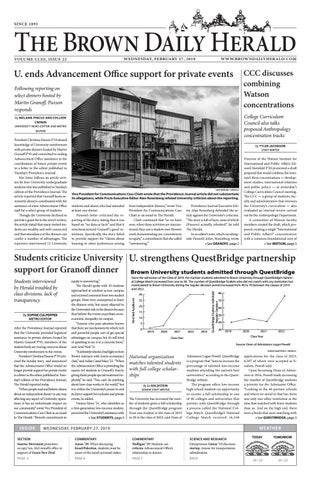
Since the admission of the Class of 2019, the number students admitted to Brown University through QuestBridge’s National College Match increased from one to 30. The number of QuestBridge finalists who did not match with any institution but matriculated to Brown University during the regular decision period increased from 40 to 76 between the classes of 2019 and 2022. 80 30 25
70
20
60
15
50
10
40
5 0
QuestBridge Students Admitted Regular Decision
By SOPHIE CULPEPPER METRO EDITOR
equity is unwavering.” The Herald spoke with 10 students approached at random across campus and received comment from two student groups. Most were unsurprised to learn the dinners exist, but many objected to the University’s role in the dinners because they believe the events exacerbate socioeconomic inequality on campus. “Anyone who pays attention knows that there are mechanisms by which rich and powerful people sort of get special advantages on campus, but it’s still kind of upsetting to see it in a concrete form,” said Ariel Weil ’21. “It definitely (sheds) a bad light on how Brown interacts with (socio-economic) class,” said Aidan Cassel Mace ’22. “When the Advancement Office is providing the names (of students to Granoff), they’re giving those people special treatment implicitly,” he said. “You can’t do anything about how class works in the world,” but it is within the University’s power to end its direct support for exclusive and private events, he added. Vanesa Mora ’21, who identifies as a first-generation low-income student, perceived the University’s assistance with » See STUDENTS, page 4
Matched Applicants
Students interviewed by Herald troubled by class divisions, lack of transparency
2019
2020
2021
2022
2023
30
2019
2020
2021
2022
Class Year
Class Year
Source: Dean of Admissions Logan Powell SARAH MARTINEZ / HERALD
National organization matches talented students with full college scholarships By LI GOLDSTEIN SENIOR STAFF WRITER
The University has increased the number of students given a full scholarship through the QuestBridge program from one student in the class of 2019 to 30 in the class of 2023, said Dean of
Admission Logan Powell. QuestBridge is a program that “aims to increase the percentage of talented low-income students attending the nation’s best universities,” according to the QuestBridge website. The program offers low-income high school students an opportunity to receive a full scholarship to one of 40 colleges and universities that partner with QuestBridge through a process called the National College Match. QuestBridge’s National College Match received 16,248
applications for the class of 2023, 6,507 of whom were accepted as finalists, Powell said. Upon becoming Dean of Admission in 2016, Powell made increasing the number of QuestBridge students a priority for the Admission Office. “Looking at the 40 partner schools and where we stood in that list, there was only one other institution at the time that matched with fewer students than us. And on the high end, there were schools that were matching with » See QUESTBRIDGE, page 3
WEATHER
WEDNESDAY, FEBRUARY 27, 2019
SECTION Sunrise Movement protestors occupy Sen. McConnell’s office in support of Green New Deal
COMMENTARY Aman ’20: When discussing Israel/Palestine, students must be aware of the issue’s personal stakes
COMMENTARY Mulligan ’19: Students can criticize Advancement Office’s relationship to donors
SCIENCE AND RESEARCH Entrepreneur Gunay ’13 discusses startup, visions for transportation subsidization
PAGE 4
PAGE 6
PAGE 7
BACK
TODAY
TOMORROW
29 / 22
34 / 22
NEWS
PAGE 2 • WEDNESDAY, FEBRUARY 27, 2019
THE BROWN DAILY HERALD
U. event highlights complexity of Yemeni conflict Harvard professor discusses Arabian Peninsula’s aggression toward Yemen By PEDER SCHAEFER SENIOR STAFF WRITER
Addressing faculty and students in the Stephen Robert ’62 P’91 Hall, Rosie Bsheer, assistant professor of history at Harvard, focused on the political narrative of the Yemeni war, the history surrounding the conflict and the factors that led to the crisis. Bsheer stressed in her talk that powerful states on the Arabian Peninsula put forward narratives that hide the actual roots of Yemeni conflict. These roots are based in a long history of Saudi Arabian control and aggression, as well as powerful social movements in Yemen, she said. “We are very privileged out of these settings to speak truth to power,” said Bsheer, who specializes in the history of the Arabian Peninsula and conducted research in Saudi Arabia from 2009 to 2012. “It’s very difficult, but if one really wants to know it’s possible.” In her talk, Bsheer disagreed with the perspective that conflict in Yemen is rooted in sectarian, religious disagreements between Saudi Arabia and Iran. Instead, she said that social movements for rights and democracy within Yemen threatened Saudi Arabia, leading to war. “Sectarianism has very little to do with much of what is happening in the modern Middle East today,” Bsheer said. “Social movements are a big part of this history, but they are usually not factored into the many wars that Yemen has experienced.” Bsheer also described how modern Yemen has rarely been ruled as a single political entity. Instead, Bsheer showed how different nations have controlled certain parts of Yemen, either through direct military intervention or through
» GRANOFF, from page 1
LEON JIANG / HERALD
Assistant Professor of History at Harvard Rosie Bsheer gave a talk on the ongoing conflict in Yemen. She argued that the conflict was precipitated by Saudi Arabian opposition toward democratic movements in Yemen. cultural interference via the funding of conservative religious institutions, which Saudia Arabia pushed in the 1990s. “The Saudi government has since intervened each and every time there was a chance of democratic movements in (Yemen),” Bsheer said. Throughout the evening she underscored the extensive role that Saudi Arabia has played in Yemeni history, and the way in which the current war in Yemen continues to revolve around Saudi Arabia and its interests. Bsheer recounted the long history of civil war in Yemen as well as the United States’ role in facilitating the ongoing war, which includes engaging in drone warfare after 9/11 and selling weapons to Saudi Arabia. “What’s happening in Yemen is beyond what one can imagine, the suffering there,” Bsheer said.
Have opinions?
Tell us about them! See guidelines at browndailyherald.com/submissions
Shahzad Bashir, professor of Islamic humanities and director of Middle East studies, was one of the leaders in bringing Bsheer to campus to speak. “Yemen is a very undercovered topic, and there’s a huge humanitarian crisis happening in Yemen now that’s extended over years,” Bashir said, also mentioning that Bsheer was one of the few experts in the field in the entire United States. “In terms of our job of making this topic accessible to the academic community at Brown, this was an important thing to try and cover.” “The powerful regimes on the peninsula have a lot of power in how their message is shown in the world,” said Bsheer, mentioning the sanitized version of events that Saudi Arabia often pushes to the West. “Anyone who tries to question this narrative will get in trouble.” Havi AlGhosain GS, who attended
the event, is a second-year student in the University’s Biomedical Engineering Masters Program. He grew up in Saudi Arabia, and still goes back frequently. “People who talk about these topics are silenced in Saudi Arabia,” AlGhosain said. “A lot of what she was saying were just things that my grandparents would say: to not believe in the news and everything that you hear.” In a question-and-answer period after the talk, Bsheer was asked about the chance of peace in Yemen. “If we allow people on the ground to accomplish the future they want, the futures they are fighting for, I see that as grounds to a peaceful resolution,” Bsheer said. “But that will never happen, because Saudi Arabia will never let that happen. They don’t want a democratic government on their southern border.”
JOIN
THE BROWN DAILY HERALD
SINCE 1891
No experience necessary browndailyherald.com/join
that the initial story “went out of its way” to fairly characterize Granoff ’s charitable work while also reporting on the dinners. “We made sure this was not a story that ignored the good things that (Granoff) had done,” Rosenberg told The Herald. The Providence Journal’s coverage provided an overview of Granoff ’s philanthropy, including donations to the University and other institutions. Granoff, who is a former textile industry executive, serves as a trustee emeritus and has made large donations to the University for purposes such as endowing student scholarships and supporting the arts, The Herald previously reported. Many students have reacted negatively to the dinners, praising the Providence Journal’s article and scrutinizing the University’s involvement, The Herald reported today. “We hope that the story in the Providence Journal and executive editor Alan Rosenberg’s response to President Paxson’s letter speak for themselves,” the story’s writers, Lucas Smolcic Larson ’19, Julia Rock ’19, Harry August ’19 and Jesse Barber ’19, wrote in a joint statement to The Herald.
Photo Video Graphics Opinion Web Sales
NEWS
QUESTBRIDGE, from page 1 50, 60, 80 plus students,” Powell said. “So I made it a commitment to match with more QuestBridge scholars because they’re some of the best in the country.” The Admission Office has internally committed to accepting 30 students per year through QuestBridge’s National College Match, though that number may vary from year to year based on the QuestBridge applicant pool, Powell added. “QuestBridge was started as a way to identify extraordinarily talented low-income students,” Powell said, adding that President and Co-founder of QuestBridge Michael McCullough, who is also a physician, used the medical school match process as a model in the conception of QuestBridge. Prospective students rank up to 12 of the partner institutions, which in turn rank those students based on their QuestBridge application and their institutionspecific application, Powell said. QuestBridge students in the class of 2023 received their match decisions in early December of 2018, according to the QuestBridge website. Students accepted through the match program become part of the University’s chapter of QuestBridge scholars. This group includes not only scholars admitted through the National College Match, but also finalists who did not match with any institution but were accepted through regular decision. Aside from the one student who matched with the University in the class of 2019, 40 unmatched finalists enrolled through the regular decision process that year. For the class of
» WATSON, from page 1 courses and specialized tracks which would culminate in a final project in academia or the real world. The Watson committee began work on the proposal after an April 2018 report from the Office of the Dean of the College recommended combining the concentrations into one concentration with two tracks, The Herald previously reported. The original report was met with mixed reviews from students and faculty, and the Watson Institute has since worked to develop its own proposal for changes to its concentrations. At two town hall meetings held Oct. 16 and 23, the Watson Institute learned that “students don’t want to be treated as Watson concentrators but rather development studies or public policy concentrators,” Steinfeld said. But the Watson Institute “recognizes that there are overlaps between concentrations.” Through a common foundational core and specialized tracks, the Watson Institute hopes to “preserve a lot of sides of the three concentrations” while still maintaining an interdisciplinary approach to learning about “social science, inquiry and action from both a political and social angle,” Steinfeld said. Multiple specialized tracks have been proposed, including security, development, and governance and policy, each of which is meant to offer a “place of specialization for students,” Steinfeld said. Each specialization would culminate in a project, such as a thesis, a capstone or a “practically-oriented project,”
2022, 76 unmatched finalists enrolled at the University. Jenna Knueppel ’20, former liaison of the University’s QuestBridge chapter, matched with the University through the National College Match. While she sees the increase in representation of QuestBridge students on campus as a positive trend for the University, Knueppel emphasized the importance of admitting even more QuestBridge scholars. “We need to increase the number of students admitted through the match, not only QuestBridge scholars who are admitted,” she said. Jai Chavis ’21, who also matched with the University through QuestBridge, said that the program “makes Ivy League schools and other upper level ‘tier one’ schools feel more accessible.” Chavis was enthusiastic about the increase in accepted students through QuestBridge over the past four years. “Having a program specifically designed to help (underrepresented) students matriculate and feel comfortable coming here is incredibly important,” he said. QuestBridge scholar Marie-Anne Barron ’22, who matched with the University, described QuestBridge as “a program for low-income, high achieving students.” Had it not been for the National College Match, Barron said that she never would have considered applying to the University given its “sticker price.” QuestBridge also offers programs to help eligible high school students in their college search and application process. Barron was offered a travel scholarship to visit Emory University in the summer after her high school junior year where she was able
like an in-depth government policy draft, which would be a new option for Watson concentrators. “Students need to learn how to put different conceptual efforts into practical use,” Steinfeld said. Current Watson Institute concentrators will not be required to adhere to these new requirements if they are implemented. Instead, there would be a “multi-year transition where students would be able to choose” between the old and new requirements, Steinfeld said. The Watson Institute is currently preparing an abbreviated memo for students, which they hope to release “within the next few weeks,” he added. CCC members discussed the possibility of making the concentration’s foundational core courses prerequisites for upper-level courses in the specialized tracks. While Steinfeld was “open to the idea,” he prefers “to guide (students) as much as possible” without making them beholden to a specific course order. He hopes the foundational core will “really allow for (first-years) and sophomores to explore what a Watson concentration is about” before deciding on a specialized track. After Steinfeld’s presentation, Chair of the Anthropology Department Daniel Smith and Associate Professor of Anthropology Andrew Scherer spoke before the CCC to discuss a review of the anthropology concentration, the first in over ten years. Similar to the changes recommended in the Watson’s draft report, the Anthropology Department proposed creating five tracks for
to meet admission representatives from various institutions, including Brown. Once on campus, QuestBridge scholars can remain involved with the organization. Throughout the year, QuestBridge scholars at the University can “lead service projects during the Month of Service or go out into the community to talk about QuestBridge to local high schools and help students who are going through the application process,” Barron said. The chapter frequently engages in service projects in the Providence community organized by the group’s Executive Board. The group also collaborates with the U-Fli Center to provide professional development initiatives for low-income students on campus through workshops and speaker presentations, Knueppel said. But Barron believes that the University chapter could be more involved overall. “I’d like to see us do more service projects and get together more frequently,” she said. In Knueppel’s view, QuestBridge offers a “connection to a national network,” as well as “the ability to communicate with other low-income students throughout the nation as well as at the University.” Knueppel added that the QuestBridge scholar community at the University has a total membership of about 250 students, or around 400 when including the alumni network. The University’s commitment to QuestBridge reflects a commitment to diversity and inclusion, Knueppel said. “It’s an ability for Brown to say, ‘we see low-income students who have talent, and we want to invest in them,’” she added.
Read Join
WEDNESDAY, FEBRUARY 27, 2019 • PAGE 3
THE BROWN DAILY HERALD
The Herald browndailyherald.com/join herald@browndailyherald.com
STAY UP-TO-DATE. FOLLOW US ON FACEBOOK. FACEBOOK.COM/BROWNDAILYHERALD
HUAYU OUYANG / HERALD
During a meeting of the College Curriculum Council, Director of the Watson Institute Edward Steinfeld P’20 presented potential changes to the structure of the Institute’s three concentrations. concentrators, including a medical anthropology track, an idea that the department has been discussing for years, Scherer said. The creation of tracks will “sharpen students’ specific interests” within anthropology, he added. “One of the challenges we have in the department … is that it’s possible for students to go through a lot of classes that are not with just anthropology concentrators,” Smith said.
But, through the creation of tracks, “students with like-minded interests will be more likely to take classes together.” A general anthropology track, which would allow more flexibility for double concentrators, was also suggested. “I believe that there are students out there that would benefit from (studying) anthropology, if they only knew” what the department had to
offer on topics such as sociolinguistics, Scherer said. “Hopefully, students will discover that CLPS isn’t the only option” for studying anthropology, he added. “We don’t want to poach students from other concentrations,” Scherer said. Rather, these changes will “stimulate the flow of students between departments,” Smith said, helping students decide which concentration is best for them.
NEWS
PAGE 4 • WEDNESDAY, FEBRUARY 27, 2019
THE BROWN DAILY HERALD
Environmental activists stage sit-in on Capitol Hill Four University students arrested following protest in Sen. Mitch McConnell’s D.C. office By ISABEL INADOMI SENIOR STAFF WRITER
Over 200 young people from Sunrise Movement, including 11 University students, swarmed the hallways outside Senate Majority Leader Mitch McConnell’s Capitol Hill office Monday, protesting his plan to bring the Green New Deal to a Senate vote and his acceptance of money from fossil fuel companies. McConnell, R-K.Y., announced that he would force a vote on the resolution Feb. 12, CNBC reported. “I’ve noted with great interest the Green New Deal, and we’re going to be voting on that in the Senate to give everybody an opportunity to go on the record,” McConnell told CNBC. McConnell did not respond to The Herald’s request for comment. With insufficient support from Republicans and moderate Democrats, the bill as stands is almost certain to fail in the Senate. The Sunrise Movement, a youthbased environmental activist group, mobilized hundreds of activists from across the country to support its Kentucky members in opposition to McConnell and in favor of the Green New Deal. Over 40 protesters were arrested as a result of the sit-in, reported CNN, four of whom are University students, said Emma Bouton ’20, a member of Sunrise R.I. At McConnell’s office, protesters “delivered over 100,000 petition signatures for people calling for a Green New Deal,” Bouton said. At the event, young people from Kentucky shared “their stories of what they were fighting for,” she added. The Green New Deal is a resolution introduced by Rep. Alexandria OcasioCortez, D-N.Y., and Sen. Ed Markey, D-M.A., that proposes environmental
» STUDENTS, from page 1 the event as special treatment for wealthy, select students. Mora acknowledged that the University depends on donors and support to fund its mission, but said “this goes beyond legacy admissions. It goes beyond trying to get those donations. It’s just outright trying to give people (a) leg up,” she said. She hopes to see more transparency from the University moving forward. “It didn’t need to take a journalist to expose them for them to be up-front (about) these things,” she said. Georgia Gallant ’22 acknowledged that institutions like the University need wealthy alums to fundraise, but “the lack of transparency” around the University’s relationship to the Granoff dinner was a concern for her as well. “What was the impact of this dinner? Did it actually help the University in terms of funding or was it just kind of to boost the morale (of select students)?” she asked. Robbie Combs ’22 agreed that the University must work to increase its transparency. “What is surprising is how long it took to come to light. Because it sounds like this sort of thing has been going on for a very long time without recognition,” he said. “While I commend (Paxson) for
and economic reform aimed at minimizing the effects of climate change. It also includes language that would reduce carbon emissions in the U.S. to zero by 2030. Out of Rhode Island’s four congressional delegates, only Rep. David Cicilline, D-R.I., has signed on as a cospon-
Instead, the senator has been focused on imposing a carbon tax. “I applaud the passion of the Sunrise students,” Whitehouse wrote in a statement. “In the Senate, I’m in the trenches building momentum for an actual bill — one that would dramatically reduce emissions and could become law in time
Markey and others to translate ideas into action and ensure the United States is the world’s most energy-efficient nation with the strongest economy.” Rep. James Langevin, D-R.I., who has also not signed onto the resolution, did not respond to The Herald’s request for comment.
COURTESY OF SUNRISE MOVEMENT
Youth from environmental activist group the Sunrise Movement lined the hallways of Sen. Mitch McConnell’s office in Washington, D.C. to protest McConnell’s call to force a vote on the Green New Deal in the Senate. sor of the resolution. “The Green New Deal is an ambitious plan because that is what the challenge of climate change demands,” Cicilline wrote in a statement. “All it takes is for our country to come together united in a common effort.” Sen. Sheldon Whitehouse, D-R.I., has previously been outspoken on government action to address climate change but has not signed on as a cosponsor of the Green New Deal.
to prevent the worst effects of climate change.” Sen. Jack Reed, D-R.I., similarly supports climate change action but has not committed to supporting the Green New Deal. “The Green New Deal had a rocky roll out, but it can have a positive impact in terms of shaping the discussion,” Reed wrote in a statement. “I am carefully studying the bill’s implications and am committed to working with Senator
ensuring that the University does not continue to aid … Granoff in the planning of these events, she definitely could have denounced the exclusivity of (them) and the messages that they send about Brown’s commitment to low-income students,” he wrote in a follow-up email to The Herald. Jaimar Alvarez ’22 found the University’s public claim to support for diversity and equity troubling in light of the lack of transparency surrounding the dinner. Though she has hosted an exhibit in a Granoff space and acknowledged Granoff ’s contributions to the University, “you just create this smokescreen of secrecy and conspiracy. And all it does is send a really convoluted message to the people that you claim to help,” she said. Support for the dinner contradicts the University’s stated commitments to increasing diversity, Alvarez said, echoing similar sentiments shared by other students with The Herald. “Brown needs to find other ways to make money, and I think if you’re not going to find other ways to make money you need to be honest about it. … You can’t just … hide behind (initiatives like) the Diversity Inclusion Action Plan and still do shit like that, ” she said. Paxson’s statement that she was unaware of the “logistical support” provided by the Advancement Office was “difficult
to believe,” wrote Valerie Castro-Gomez ’20, a leader of First-Gens@Brown, in an email to The Herald. She was not writing on behalf of First-Gens@Brown. “We can only hope to see that this practice stops immediately,” she added. Despite the University’s efforts to support the UFLi community, “there is so much more Brown can and should do to not only give us a seat at the metaphorical (and literal) dinner table, but also allow our voices and experiences to be heard without pity or judgement once we own a place there,” she wrote. In response to the revelations, “FirstGens@Brown plans to allow a space for checking-in and discussion with ourselves,” Castro-Gomez wrote. Mora found that from her perspective as a U-FLi student, the University’s support for the dinners creates “a lot of anger and frustration. … We’ve all struggled to get in, but some of us had to work a lot harder, had to go through adversity,” she said. U-FLi Center staff has reached out to members of the U-FLi community about the article’s impact. “Our priority is to work closely with our student community and address their immediate, as well as long term needs,” wrote U-FLi Director Julio Reyes ’12 in an email to The Herald. — Additional reporting by Metro Editor Celia Hack.
The Rhode Island chapter of the Sunrise Movement will “continue to be pressuring our representatives to come out and cosponsor the resolution,” Bouton said. “While this might be frustrating to not be winning the support of all of the members of our Rhode Island congressional delegation, we’re still building this momentum.” Professor of Environmental Studies and Sociology J. Timmons Roberts expressed support for the Green New
Deal and condemned McConnell for forcing a vote on the resolution. “The basic idea is that the times for gradual solutions on climate change are passed,” Roberts said. “The Green New Deal is a bold attempt to make up for lost time, and really we’ve known for 30 years that this was the problem.” Roberts also said that McConnell’s move to bring the Green New Deal to a vote is a “political ploy” to kill the resolution that “disregards” the work of young people. The choice to force senators to pick a side on the resolution early in its development is a “slap to young people,” Roberts said, crediting the work that Sunrise has done in bringing the issue to center stage. Visiting Assistant Professor in Economics Alex Poterack supports the Green New Deal’s efforts to address climate change, but is wary of the breadth of the resolution. The Green New Deal also addresses many topics including universal healthcare, green investment and free college. “I think any one of a green investment bill, or a jobs guarantee, or a universal healthcare bill or a free college bill, might be just barely politically feasible, but I see no path for something that rolls all of those into one thing,” Poterack wrote in an email to The Herald. “I think some sort of carbon pricing scheme, be it a carbon tax or cap and trade, will be necessary for decarbonization,” he added. “This is an issue on which the Green New Deal is silent.” Moving forward, the Sunrise Movement is determined to continue advocating for the Green New Deal, Bouton said. “Momentum around the Green New Deal certainly won’t be brought to a halt by these political tactics,” she said, referencing McConnell. “We anticipated that this resolution was not going to be able to pass the Senate in this political climate, so the idea is to take the next two years to make the Green New Deal a key issue in the 2020 election.”
Follow us on ...
TODAY
WEDNESDAY, FEBRUARY 27, 2019 • PAGE 5
THE BROWN DAILY HERALD
menu
s t u d e n t s o n t h e e d g e o f t h e i r s e at s
SATELLITE DINING ANDREWS COMMONS
Andrews Commons Birthday Meal Pho Station, Grinder Station JOSIAH’S
BLUE ROOM
Empanada Bar, Quesadilla Station, Grill
Frittata, Danish, Chunky Beef Chili, Bread Bowl
DINING HALLS SHARPE REFECTORY LUNCH
DINNER
Chicken Vegetable Soup, Grilled Lemon Pepper Chicken, Granola Bars, Sugar Cookies
Palak Saag, Honey Bran Bread, Creamy Squash Bisque, Boston Cream Donut
VERNEY-WOOLLEY LUNCH
DINNER
Italian Sausage Soup with Tortellini, Cavatini, Plain 10 Veggie Patty, Sugar Cookies
Antipasto Bar, Baked Polenta, Stuffed Shells with Meatless Sauce, Boston Cream Donut
sudoku
JENNAH GOSCIAK / HERALD
Michael Ching, associate professor in the department of mathematics and statistics at Amherst College, spoke to students about a course titled “Inequality,” which he co-taught in Spring 2017 and 2018.
Q U O T E O F T H E D AY
“Everyone should look into their own hearts and really figure out what they want to do and pursue that crossword
relentlessly.
”
— Kaan Gunay ’13
See FIREFLY on BACK.
CORRECTION The Feb. 26 article “Archeological Illustration Club promotes observation, drawing skills” stated that Sophie Moore was a member of the University’s undergraduate class of 2018 and that Carl Walsh is a member of the University’s undergraduate class of 2019. In fact, they are both postdoctoral fellows and were not undergraduate students at the University. In addition, the article stated that Sophie Moore drew a digital camera. In fact, Ella Rosenblatt ’21 drew the digital camera. The Herald regrets the errors.
calendar TODAY
FEBRUARY
S
3
M
4
T
5
W
6
Th
7
F
S
1
2
8
9
Talk: Raul Castro Fernandez, MIT 12:00 P.M. Watson Center
Artist Talk: Jane Dickson 5:00 P.M. List Art Building
Dean Vassilev Talk 5:00 P.M. Sciences Library, 3rd Floor
Foreign Flicks Film Series Presents: 1968 7:00 P.M. Metcalf Research Building
TOMORROW
10
11
12
13
14
15
16
17
18
19
20
21
22
23
24
25
26
27
28
A Taste of Mardis Gras Community Lunch Buffet 11:30 P.M. Faculty Club
White Supremacy and the American City 12:00 P.M. Joukowsky Forum
Robotics Talk: Renee Hobbs, URI 12:00 P.M. Lubrano Conference Room
LingLangLunch Series 2:00 P.M. Metcalf Research Building
COMMENTARY PAGE 6 • WEDNESDAY, FEBRUARY 27, 2019
THE BROWN DAILY HERALD
Creating productive dialogue on Israel/Palestine REBECCA AMAN opinions editor I used to spend a lot of time avoiding news about Israel and Palestine. In particular, learning about human rights violations committed by the Israel Defense Forces was deeply upsetting — it was hard to discover that the fairy tale place I learned about as a child in Hebrew school wasn’t so magical after all. Thus, for a long time, I retreated from the issue altogether. During my time at Brown, I have realized that this kind of avoidance is not productive, and now I frequently engage with issues relating to Israel and Palestine, both formally and informally. So, to my fellow Jews: I understand these issues are hard, but it is crucial to learn to sit with this discomfort. And to my non-Jewish friends, I ask for your patience with me when we discuss these issues. I cannot speak for all Jews, but I believe my upbringing in regards to Israel is common. Growing up, I learned about Israel in Hebrew
school, said “next year in Jerusalem” every year at Passover and saw relatives breaking a glass during their weddings — which is meant to symbolize the destruction of the Second Temple in Jerusalem. The land of Israel, and Jerusalem specifically, has al-
cause of my Jewish identity. Upon deeper reflection, I realized that these attacks hurt not because they are necessarily anti-Semitic, but because they so sharply bring into focus Israel’s failure to live up to the collective dream, among many Jews,
sarily anti-Semitic. While rhetoric like “Israel is an apartheid state” does not fully capture the complexities of issues pertaining to Israel and Palestine, it is inaccurate and unhelpful to dismiss these statements as anti-Semitic. Moving forward, I invite my
What I feel in the pit of my stomach is not the result of anti-Semitic attacks, but rather a deep feeling of disillusionment.
ways been intertwined with my Jewish identity. As such, attacks on Israel often feel like personal attacks, even if they are not intended to be. Comments like “Israel is an apartheid state” or “Zionism is racism” always sting the most, sometimes feeling like a punch to the gut. For a long time, I considered these types of attacks on Israel anti-Semitic. After all, these attacks hurt me, and they hurt me be-
of a homeland that fosters a sense of belonging without violence or oppression. What I feel in the pit of my stomach is not the result of anti-Semitic attacks, but rather a deep feeling of disillusionment. Thus, while it is important to recognize anti-Semitic tropes are sometimes used when criticizing Israel, that does not mean all statements about Israel that hurt me are neces-
Jewish friends to join me in reflecting on issues in Israel and Palestine, even when it is uncomfortable or painful. To my non-Jewish friends, if you would like to engage in a productive conversation about Israel with me, please be patient. Realize that although Israel is halfway across the world, it’s still an intensely personal and emotional topic for me. I recognize that I am not the only person
for whom political issues carry emotional weight, and I am certainly not arguing that my emotions are more important than anyone else’s. In fact, I can imagine these same issues are also deeply personal and emotional to Palestinians and people of Palestinian descent. It is also important to validate those feelings, and I ask that my pro-Israel friends take care to avoid hurtful, sweeping generalizations as well. If you truly want to engage in productive dialogue together, it’s important to recognize the intensely personal nature of this topic. Try to understand where I am coming from. In turn, I will do my best to listen. Moving forward, let us try to create spaces for open, honest and thoughtful dialogue.
Rebecca Aman ’20 can be reached at rebecca_aman@brown.edu. Please send responses to this opinion to letters@browndailyherald.com and op-eds to opinions@browndailyherald.com.
Want daily headlines or weekly Brown Bites in your inbox? linktr.ee/browndailyherald Find us online! facebook.com/browndailyherald
browndailyherald.com
@the_herald
Location: 195 Angell St., Providence, R.I. www.browndailyherald.com
@browndailyherald
youtube.com/browndailyherald
Editorial Leadership
Sections
Multimedia & Production
Business
Editor-in-Chief Emily Davies
Arts & Culture Editors Elise Ryan Annabelle Woodward
Design Editors Kyle Cui Bilal Ismail Ahmed Dylan Tian Julie Wang
General Managers Ravi Betzig Nicholas Masiakowski
Managing Editors Anna Kramer Priyanka Podugu Senior Editors Anita Sheih Sarah Wang
Metro Editors Colleen Cronin Sophie Culpepper Celia Hack
Editorial Page Editors Grace Layer Krista Stapleford
News Editors Katherine Bennett Jacob Lockwood Melanie Pincus Allie Reed
post- magazine Editor-in-Chief Anita Sheih
Science & Research Editors Cate Ryan Chris Schutte Sports Editors Alexandra Russell Alex Smolar COMMENTARY Opinions Editors Rebecca Aman Emily Miller Derek Simshauser
Head Photo Editors Tiffany Ding Benjamin Turuño Copy Desk Chief Kelley Tackett Illustrations Editor Daphne Zhao Video Editor Victoria Caruso Max Dekle Graphics Editor Sarah Martinez
Office Manager Diane Silvia Directors Sales: Bersabel Yifru Finance: Rudra Srivastava, Reynaldo Blandon Strategy: Edwin Farley
Editorial contact: 401-351-3372 herald@browndailyherald.com
Advertising contact: 401-351-3372 advertising@browndailyherald.com
Submissions: The Brown Daily Herald publishes submissions in the form of op-eds and letters to the editor. Op-eds are typically between 750 and 1000 words, though we will consider submissions between 500 and 1200 words. Letters to the editor should be around 250 words. While letters to the editor respond to an article or column that has appeared in The Herald, op-eds usually prompt new discussions on campus or frame new arguments about current discourse. All submissions to The Herald cannot have been previously published elsewhere (in print or online — including personal blogs and social media), and they must be exclusive to The Herald. Submissions must include no more than two individual authors. If there are more than two original authors, The Herald can acknowledge the authors in a statement at the end of the letter or op-ed, but the byline can only include up to two names. The Herald will not publish submissions authored by groups. The Herald does not publish anonymous submissions. If you feel your circumstances prevent you from submitting an op-ed or letter with your name, please email herald@browndailyherald.com to explain your situation. You can submit op-eds to opinions@browndailyherald.com and letters to letters@browndailyherald.com. When you email your submission, please include (1) your full name, (2) an evening or mobile phone number in case your submission is chosen for publication and (3) any affiliation with Brown University or any institution or organization relevant to the content of your submission. Please send in submissions at least 24 hours in advance of your desired publication date. The Herald only publishes submissions while it is in print. The Herald reserves the right to edit all submissions. If your piece is considered for publication, an editor will contact you to discuss potential changes to your submission. Commentary: The editorial is the majority opinion of the editorial page board of The Brown Daily Herald. The editorial viewpoint does not necessarily reflect the views of The Brown Daily Herald, Inc. Columns, letters and comics reflect the opinions of their authors only. Corrections: The Brown Daily Herald is committed to providing the Brown University community with the most accurate information possible. Corrections may be submitted up to seven calendar days after publication. Advertising: The Brown Daily Herald, Inc. reserves the right to accept or decline any advertisement at its discretion. The Brown Daily Herald, Inc. is a financially independent, nonprofit media organization bringing you The Brown Daily Herald, BlogDailyHerald and Post- Magazine. The Brown Daily Herald has served the Brown University community daily since 1891. It is published Monday through Friday during the academic year, excluding vacations, once during Commencement and once during Orientation by The Brown Daily Herald, Inc. Single copy free for each member of the community. Subscription prices: $200 one year daily, $100 one semester daily. Copyright 2019 by The Brown Daily Herald, Inc. All rights reserved. Periodicals postage paid at Providence, R.I. Postmaster: Please send corrections to P.O. Box 2538, Providence, RI 02906.
COMMENTARY WEDNESDAY, FEBRUARY 27, 2019 • PAGE 7
THE BROWN DAILY HERALD
The burden of gratitude CAROLINE MULLIGAN staff columnist
After reading the Providence Journal’s recent profile about dinners hosted by Brown donor Martin J. Granoff P’93, I was deeply troubled and wanted to write a piece in response. At the dinner, hand-selected students, many from wealthy backgrounds, get together to network and attend an event with an approximately $9,000 tab. I found it especially concerning that the Division of Advancement claims that these are not school-sponsored events, yet they assisted in setting them up. I am also concerned by the way these events widen the divide between wealthy students and the rest of us. But as I sat down and tried to articulate an argument out of my classbased frustration, I found myself hesitating. I receive financial aid. As far as I know, I’m not the recipient of any of Granoff ’s scholarships, but I’m here at least in part because of donors like him. I felt the need to constantly qualify my anger: to say that it isn’t directed at Mr. Granoff himself or anyone else who answers the calls of the Brown fundraising team. Rather, I realized that I am most upset about the fact that Brown quietly helps set up off-campus happenings that disproportionately benefit the most privileged students, often with the least need for making connections. So instead of echoing the frustration that my peers have expressed across social media, I want to write about gratitude. As the Brown community continues to work through the unsurprising revelations of elitism, I’d like to propose that we keep in mind the ways that financial aid recipients get caught between wanting to discuss the benefits that our wealthier peers receive and knowing that our access
to Brown may depend on the generosity of those same peers’ families. While well-connected students have received emails from the Division of Advancement with the details of a clandestine networking event, I and the rest of the 44 percent of the student body on financial aid receive an unfailing email each fall that, while from the same office, is quite different in tone. It begins politely enough, with the subject, from fall 2018’s email, “Request for Annual ‘Thank You’ Letter for Financial Aid Donors — Please Read — Important.”
creased, even as I grew more comfortable here. The surveys were time-consuming — asking me to answer questions about what makes me unique, memorable moments at Brown, research experiences and my plans for the future. I felt an uncomfortable obligation to put myself and my experiences on display so that Brown could continue benefitting from donors. This wasn’t a thank-you letter so much as it was a carefully curated exhibition. When I received my fall 2018 email, I ignored it. I was busy, tired
the last email I received, the subject had gone from treating the survey as a “request” to my “responsibility.” My final semester is paid for, so I’m not particularly concerned that I’m suddenly going to find myself struggling because I didn’t properly genuflect to the 1 percent. My casual refusal to cooperate with Brown’s increasingly demanding emails left me with a bad taste in my mouth. Was my gratitude requested, or was it mandatory? If the latter, how sincere could my thank-you actually be? I hadn’t been thinking about these
Our gratitude toward donors like Granoff should not require us to be silent about Brown’s faults.
The email contains a link to a survey to fill out so that the Division of Advancement can “create important and meaningful impact reports for our scholarship donors.” The survey also functions as a “personal message of thanks” and, so the survey claims, “often results in networking opportunities and contacts between you and your scholarship donor!” I still remember the confusion I felt when I received this email as a first-year. I hadn’t thought that my time at Brown was contingent on my performance of gratitude. But, after all, that email was just a request. Donating was a kindness that I benefited from. Even as I struggled to adjust to a campus that seemed to instantly be a second home to everyone around me, I recognized that it was a privilege to be here, one afforded in part by scholarship donors. As the years went on, my cynicism about the scholarship letters in-
and a little curious about what would happen if I just didn’t reply. The answer was nothing, in the sense that there were no actual consequences for my decision. Though, I did receive numerous emails that gradually became less cheerful than the first email. After I missed the first deadline, I received a second email from the Division of Advancement with the header, “Your Important Task as Financial Aid Recipient — Urgent ‘Thank You’ Letter Survey.” Five days later, when I received, from the same sender, an email entitled, “Repeat Notification: Your Named Scholarship Pairings,” I was informed that I was “required to thank the donors of these scholarships directly and in your own words through our recently-requested ‘thank you’ letter survey.” A “required” thank-you felt a bit contradictory — shouldn’t a sincere thank-you be given of my own free will? I ignored those emails, too. By
questions until Sunday’s Providence Journal article, and suddenly all the feelings came rushing back. Some of those who posted on an anonymous student-run confessions page expressed sentiments that seemed in-line with the Division of Advancement’s thank-you policies. “[T] hose who are complaining about the Granoff dinners should calm down. These donors are literally giving Brown money to fund our professors, classes, dorms, amenities, fin aid, TA programs, dinning halls, everything,” read one. Another, claiming to be an international student who left because of Brown’s lack of affordability, spoke directly to the students infuriated at the news, saying, “I hope you’re aware of the damage you’re doing to donor relations in the search of ‘transparency’.” There’s no way to confirm the identity of the submitters, of course — they could all be fake attempts to
incite class warfare. But there’s nothing anonymous about the comments that President Paxson made in a letter to the Providence Journal, announcing that the Division of Advancement would no longer provide support for the dinners. Paxson concludes by saying, “[T]he report does a grave disservice to Mr. Granoff by casting his generosity in a negative light … It is highly unfortunate that the Granoffs’ generosity and commitment to the well-being of Brown students has been distorted and misconstrued.” Paxson’s words and the anonymous comments reflect similar sentiments: If students aren’t properly expressing their thanks to the richest of the rich, then we are harming Brown, other students and, ultimately, ourselves by not being fully appreciative. Criticizing the actions of the wealthy may cause them to huddle Smauglike over their treasures instead of benevolently offer them to Brown, and thus, we should keep quiet. By voicing our dissatisfaction, we may even be seen as ingrates. Our community should discuss how burdensome it can be to get an education that puts you in debt not only to traditional loans but also to the benevolence of those who can afford to start scholarship funds in their names. About the emotional toll that occurs when you’re always aware, in the back of your mind, that there but for the grace of God — or donors — you go to your classes and reap the privileges of an elite education. Our gratitude toward donors like Granoff should not require us to be silent about Brown’s faults.
Caroline Mulligan ’19 can be reached at caroline_mulligan@brown.edu. Please send responses to this opinion to letters@browndailyherald.com and other op-eds to opinions@browndailyherald.com
NEWS THE BROWN DAILY HERALD
WEDNESDAY, FEBRUARY 27, 2019
U. alum develops startup to support ride-share drivers
COURTESY OF KAAN GUNAY
Kaan Gunay ‘13 wants to work toward making transportation through ride-share services more accessible, as well as supplement the income of ride-share drivers. Gunay believes in the philanthropic capacity of entrepreneurial enterprises and described his personal interest in the future of ride-share, hoping for a day when transportation is free.
Gunay ’13 discusses ride-share startup Firefly, aims to reduce costs of transportation By CHRIS SCHUTTE SCIENCE AND RESEARCH EDITOR
Though it began as an idea between two friends in their college dorm room, a startup called Firefly has grown into a community-centered company that aims to supplement the income of ride-share drivers around the country and reduce the costs of transportation by allowing drivers to make money by displaying digital ads on their cars. Kaan Gunay ’13, Firefly’s chief executive officer, spoke with The Herald about his company and how his experiences at the University shaped him into the person he is today. Herald: Can you introduce yourself and talk about how you came to Brown? Gunay: I am originally Turkish, and I lived in Turkey until I was 18. At 18, I moved to the States for college, and I came to Brown, where I studied mechanical engineering. I graduated from Brown in 2013, and I had a phenomenal experience. I look on my days at Brown very fondly. After Brown, I went and worked at a hedge fund in Boston and
New York for a couple years, then got my (Master of Business Administration) at Stanford, where I started Firefly. Is there a particular reason you chose Brown, and can you talk about your Brown experience? Interestingly enough, one of the main reasons I chose Brown was (that) I was looking at those college ratings. … I remember seeing rankings for happiest students, and Brown was number one. Brown was the only college I applied to, and I don’t regret it. Obviously, it has a great reputation but, aside from that, the fact that everyone seems to be happy made it stand out to me. I wasn’t exposed to entrepreneurship as much as I would have liked to be at Brown, so if there was any feedback that I would give towards the school curriculum I would say more entrepreneurship-heavy classes that are actually entrepreneurial, I think would be helpful. … I do wish I had been exposed to something like that earlier. Other than that, I had a phenomenal time. Can you describe how Firefly evolved from an idea into a company? We conceived Firefly at Stanford with one of my closest friends in the world (cofounder Onur Kardesler). He was actually not a student at the time; he was working at another company
based in Palo Alto. So we worked on brainstorming ideas every day after my classes, and when we landed on the idea of Firefly, he immediately quit his job and moved into my dorm room. We started pitching investors, and being at Stanford is amazing because you get exposed to lots of venture capital investors, which you don’t necessarily get at Brown. Initially we had a lot of rejection because we didn’t have a prototype, and so we ended up investing a little bit of our own money to build our initial prototype. Once we had it, we spoke to a bunch of ride-share drivers, … and we finally landed on a driver who was willing to put one of our initial prototypes on their car. We ended up partnering with them and collecting statistics. We started working with a venture capital firm NFX, and (NFX and other venture capital firms have invested) a total of $21.5 million. That’s where we are today.
focus to pursue). I deeply care about the driver demographic, which I believe is mainly constituted of disadvantaged minorities. The income streams going to drivers are decreasing because these ride hailing companies are taking more and more money as they prepare initial public offerings. I believe that there is a real need to actually help these people, and the fact that we could one day subsidize transportation costs for everyone I believe is incredible, too.
Was there a reason you decided to focus on ride-share drivers? First of all, I have always been interested in transportation. And I firmly believe that in the near future, transportation … will be subsidized by companies. I see transportation as a basic human right. This whole new economy has been created around it, and seeing the drivers’ income was (a great area of
How do you balance entrepreneurship and philanthropic pursuits? I don’t think there needs to be balance, to be honest. If you are an entrepreneur who is focused on creating a company that has a good cause, then I think you can create a profitable venture around it that can scale quickly and help a lot of people at the same time. It’s all about mentality and making sure you
Do you have a specific goal in mind for the future? We’re launching in new markets. We’re launching soon in New York, and we will be launching in multiple other markets as well. In the future, our goal is to subsidize enough of the drivers’ income so that transportation can be made free … for people who want to go from point A to point B.
pick the right industry. How can for-profit entrepreneurs contribute to civic life? I think it’s all about making sure that you are putting civic life first. Everything that we do here is for our driving partners. I think as long as you do a phenomenal job, people will want your product more. Do you have any advice for likeminded students who want to pursue similar ventures? I firmly believe the three years in which I was working in finance were a very inefficient use of my time, and I wish I could get that back. I think internships are perfect ways in which you can be exposed to entrepreneurship and to do things that you wouldn’t have a chance to do otherwise. Is there anything you’d like to add and get out there? I firmly believe that especially Brown students must have done something phenomenal throughout the past to get accepted to such a special college. Everyone should look into their own hearts and really figure out what they want to do and pursue that relentlessly. This article was edited for length and clarity.