SINCE 1891
THE BROWN DAILY HERALD TUESDAY, FEBRUARY 5, 2019
VOLUME CLIII, ISSUE 9
WWW.BROWNDAILYHERALD.COM
‘Space Horizons’ boosts research for life beyond earth R.I. Senator
discusses climate change challenges
U. researchers, astronauts, scientists advance space colonization research By EMIILIJA SAGAITYTE
Whitehouse cites fossil fuel corporations’ influence over advancements in policy process
SENIOR STAFF WRITER
In a seemingly endless expanse of darkness, planets orbit around shining stars and an invisible frontier awaits exploration, begging a number of questions: How far has prior knowledge guided us? How much further can latest advancements take us, and how long could we survive in space? This year’s Space Horizons event, which took place Feb. 1 and 2 at the University, took a step toward answering these questions by gathering an array of speakers with expertise in space and the research essential to its exploration. These presenters included former astronauts, scientific researchers, engineers and scholars of the humanities, said Adjunct Associate Professor of Engineering and co-organizer of the event Rick Fleeter ’76 PhD ’81. The conference was titled “A Century in Space: Designing 2056,” an homage
SCIENCE & RESEARCH
By ISABEL INADOMI SENIOR STAFF WRITER
METRO
DANIELLE EMERSON / HERALD
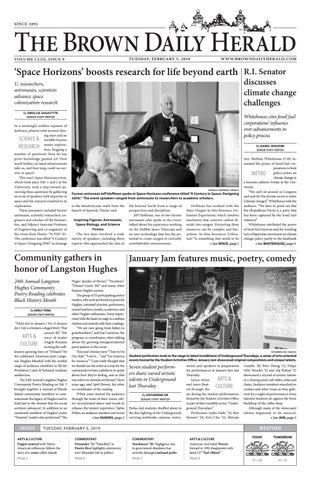
Former astronaut Jeff Hoffman spoke at Space Horizons conference titled “A Century in Space: Designing 2056.” The event speakers ranged from astronauts to researchers to academic scholars. to the hundred-year mark from the launch of Sputnik, Fleeter said. Inspiring Figures: Astronauts, Space Biology, and Science Fiction The two days involved a wide variety of speakers, including three experts who approached the idea of
Community gathers in honor of Langston Hughes 24th Annual Langston Hughes Community Poetry Reading celebrates Black History Month By EMILY TENG SENIOR STAFF WRITER
“Hold fast to dreams / For if dreams die / Life is a broken-winged bird / That cannot fly.” The voice of reader Angela Romans reciting the wellknown opening lines of “Dreams” by the celebrated American poet Langston Hughes blended with the soulful snaps of audience members to fill the Providence Career & Technical Academy auditorium. The 24th Annual Langston Hughes Community Poetry Reading on Feb. 3 brought together a myriad of Rhode Island community members to commemorate the legacy of Hughes and to hold fast to the dreams that his social activism advanced. In addition to an emotional rendition of Hughes’ poem “Dreams,” readers also performed “The
ARTS & CULTURE
INSIDE
Sen. Sheldon Whitehouse D-RI, lamented the power of fossil fuel corporations to limit policy action on climate change in a keynote address Friday at the University. “We can’t sit around in Congress and wait for the private sector to solve (climate change),” Whitehouse told the audience. “We have to point out that the (Republican Party) is a party that has been captured by the fossil fuel industry.” Whitehouse attributed the power of fossil fuel interests and the resulting lack of bipartisan movement on climate change policy partly to the landmark » See WHITEHOUSE, page 4
Negro Speaks of Rivers,” “Freedom,” “Dinner Guest: Me” and many other famous Hughes poems. The group of 53 participating poetry readers, who each performed a poem by Hughes, consisted of artists, performers, school teachers, youths, academics and other Hughes enthusiasts. Some improvised with the band on stage to combine rhythm and melody with their readings. “We are now going from babies to grandmothers,” said Kai Cameron, the program co-coordinator, when talking about the growing intergenerational participation in the event. This year’s themes were “Time Is On Our Side,” “Love Is…” and “Let America Be America.” “I just really thought that we should use the event as a way for the community to have a platform to speak about how they’re feeling, and so that was when we introduced themes” three years ago, said April Brown, the other co-coordinator of the reading. While some moved the audience through the tones of their voices, others incorporated dance and vocals to enhance the viewers’ experience. Taylor Polites, an audience member and recent » See HUGHES, page 3
life beyond Earth from a range of perspectives and disciplines. Jeff Hoffman, one of two former astronauts who spoke at the event, talked about his experience working on the Hubble Space Telescope and on new technology that has the potential to create oxygen in currently uninhabitable environments.
Hoffman has worked with the Mars Oxygen In-Situ Resource Utilization Experiment, which involves machinery that converts carbon dioxide into oxygen. Extracting these resources can be complex and hazardous. In-Situ Resource Utilization “is something that needs to be » See SPACE, page 2
January Jam features music, poetry, comedy
KATHERINE OK / HERALD
Student performers took to the stage in latest installment of Underground Thursdays, a series of arts-oriented events hosted by the Student Activities Office. January Jam showcased original compositions and unique talents.
Seven student performers share varied artistic talents in Underground last Thursday By KATHERINE OK SENIOR STAFF WRITER
Parka-clad students shuffled about in the dim lighting of the Underground, carrying notebooks, cameras, instru-
ments and speakers in preparation for performances at January Jam last Thursday. Lyrics, verses and tunes floated through the air during the student performances hosted by the Student Activities Office as part of their monthly series, “Underground Thursdays.” Performers Lydia Haile ’19, Ben Stewart ’20, Kris Cho ’22, Shivam
ARTS & CULTURE
Gandhi ’20, Bree Zhang ’22, Felipe Felix Mendez ’22 and Alp Koksal ’22 showcased a myriad of artistic talents in a clearing amid cafe tables, sofas and chairs. Audience members munched on cookies and other treats as they gathered for a night of performances from talented students set against the brick backdrop of the coffee shop. Although many of the showcased talents happened to be musical, » See JAM, page 3
WEATHER
TUESDAY, FEBRUARY 5, 2019
ARTS & CULTURE Puppet musical with Native American influences follows the story of a crane called Ajijaak
COMMENTARY Fernandez ’21: “Hamilton” in Puerto Rico highlights controversy over Miranda’s role in politics
COMMENTARY Simshauser ’20: Negligence due to government shutdown has severely damaged national parks
ARTS & CULTURE American rock band Weezer formed in 1992 disappoints with latest LP “Teal Album”
PAGE 2
PAGE 6
PAGE 7
PAGE 8
TODAY
TOMORROW
57 / 28
41/ 33
NEWS
PAGE 2 • TUESDAY, FEBRUARY 5, 2019
THE BROWN DAILY HERALD
Touring puppet musical inspired by Native American stories Show explores theme of nature, environmental conservation through music, puppets By GRAYSON LEE SENIOR STAFF WRITER
“Ajijaak on Turtle Island” captivated audiences last week at Moses Brown School with soaring kites, graceful puppetry and a heartwarming story about family and nature. The puppet show was created by performance artist Ty Defoe and puppeteer Heather Henson and hosted by the FirstWorks Arts Learning Program, a Providence-based arts education organization that hosts festivals, workshops and other arts-related activities for the local community. The story follows a whooping crane as she attempts to find her family and subdue the evil serpent Mishibizhiw. As Ajijaak migrates south for the first time, she learns about different cultures and ecosystems through a variety of traditional Native American songs, dances and stories. The beauty and theatricality of the performance allowed for children and grandparents alike to find enjoyment in the music and narrative. In a question and answer session following the performance, Henson, co-director of the show and daughter of legendary puppeteer Jim Henson, explained how the story of the crane’s long migration across the North American continent allowed the show to be intertribal. According to the show’s website, Ajijaak meets “communities of people from Ojibwe, Ho-Chunk, Lakota and
ARTS & CULTURE
» SPACE, from page 1 developed. We’re still at a very basic stage … MOXIE is just the very first, very tiny experiment. There is much more that has to be done,” Hoffman said. MOXIE machinery will be attached to an upcoming planned Mars rover, which should reach the red planet February 2021. While the prospect of colonizing space may seem like a fantasy to some, Adjunct Professor of Molecular Biology, Cell Biology and Biochemistry Lynn Rothschild PhD ’85, discussed the potential applications of synthetic biology to supporting the existence of life beyond Earth. As a member of the team on the Eu:CROPIS mission, which is the “first dedicated satellite synthetic biology mission,” she helped conduct biological experiments on a satellite in space, testing cell growth
COURTESY OF RICHARD TERMINE
“Ajijaak on Turtle Island” featured animal puppets, dancing and songs to share the story of a young crane completing her first migration. This story originates from traditional Native American folklore about the environment and teaches audience members to protect natural habitats. Cherokee Nations, living in balance with their environments.” Musician John Scott-Richardson also commented on how the show incorporated many Native American traditions. “Different areas could interject things into this because it’s all about how we’re taking care of Mother Earth, how we’re supposed to be stewards of the land,” he said. Musician and composer Kevin
Tarrant also spoke on the subject of inclusivity, saying, “We wanted to make sure that the show would be authentic but not insulting to anybody.” The writers drew inspiration from traditional songs and dances when creating their original compositions, but were careful not to replicate music that could potentially be used in hallowed ceremonies. Themes of environmental conservation and protection pervaded “Ajijaak
on Turtle Island.” The evil Mishibizhiw only “awakes” when human greed brings imbalance to the environment, and Ajijaak’s mission is to restore this balance. Tarrant discussed the message of the play in the Q&A, describing how the show illustrates everyone’s responsibility to protect the natural world. “We’re all in this together whether we want to believe it or not. We’re not the same color, we’re not the same shades,
but … without all of us, like the story says, we’re not going to have anything.” Many audience members were enthralled by the beauty of the puppetry. Valerie Bassett ’89 found the show magical and absorbing. “Certain little things will just stay with me a long time, like the birch trees that folded into the deer. I could cry thinking about it. It was like a spell; it was so beautiful,” she said.
rate and other processes. These tests allowed the team to examine how gravity on a different planet or in space would affect Earth life forms. The Eu:CROPIS mission also tested the concept of PowerCells, which involves microbes — specifically, ruptured cyanobacteria — that produce energy; other organisms could theoretically use that energy to produce oxygen or other resources. A BrownStanford International Genetically Engineered Machine Competition team initiated this concept in 2011, The Herald previously reported. “If you have a synthetic-biology enabled colony on Mars,” PowerCells and related organisms could become the “biological power center” for human life in that colony, Rothschild said. While Rothschild anticipated some success from the mission, she was “absolutely shocked when it
(looked) like something (was) actually happening … for every one of (the experiments).” In the end, she thinks the application of synthetic biology can be “a totally different way of thinking” and “has the potential to be the big gamechanger” in the space field. Finally, speaker Allen Steele, a science fiction author, reminded attendees that humanity’s relationship to space has historically been inspired by outlandish and fictional ideas. He argued that ideas presented in fictional literature can serve as jumping-off points for others who may be able to turn those concepts into reality.
the next 50 years was a recurring theme of the event, said Asutosh Swain ’20, one of the student organizers of the event and the research and development lead of Brown Space Engineering. Swain’s group built and launched the EQUiSat satellite last spring, The Herald previously reported. Other goals for the conference included “giving students a perspective on where their careers are (going to) most likely be centered” and allowing professionals to reflect on past accomplishments, as well as providing a glimpse into what could be in store for the future, Fleeter said. “There are exciting things going on up there that … you as a student can be a part of. So, get down and come up with some innovative ideas that will allow us to do things that up to now have been too hard,” Hoffman
said, adding that the future holds “a new generation of people with new ideas, and we’ve got to make it happen.” Swain added that no one has to be a scientific expert to join in on the action. “Space is accessible to even the general public. You don’t have to be a scientist at NASA” or “an aerospace engineer, specifically, to be involved with this.” Ugo Piovan ’22 attended the event because he “really (enjoys) aerospace engineering and the whole concept of exploring other worlds” and was likewise excited to see the astronauts speak, as well as hear from Rothschild about the biological science behind space. Specifically, Rothschild’s graphs depicting results from the experiments were an aspect he “found … very interesting and easy to understand,” he added.
2056: The Incoming Generation of Astro-Scientists The potential for new developments in space exploration within
ARTS & CULTURE TUESDAY, FEBRUARY 5, 2019 • PAGE 3
THE BROWN DAILY HERALD
» HUGHES, from page 1
» JAM, from page 1
winner of the Public Humanities Scholar Award given by The Rhode Island Council for the Humanities, described the show as seeing “poetry alive.” Polites added, “It was really fabulous to really see both the energy and creativity people put into their performance.” The addition of youths from the Refugee Dream Center was a new element to this year’s poetry reading . During the transition between the themes “Love Is…” and “Let America Be America,” a couple of refugee youths read Hughes’ poems in their mother tongues. “This is the poetry community reading. That means that if the mayor, the governor or the council person is part of the community, so is the immigrant, the refugee,” Brown said. “The process of coming together is about building and knowing that you’re in a community and seeing the … diversity in all of these different voices,” said Elizabeth Francis, executive director of the Rhode Island Council for the Humanities and one of the readers for the event. Jean Patiky, an audience member and board member of the Rhode Island Council of the Humanities, described Hughes’ work as timeless. The purpose of the event was to encourage every member in the community to foster the enduring ideals that Hughes pioneered. “I’ve always said to my students when I had a class that you need to know who Langston Hughes is, like (you know who) … Shakespeare is,” Brown said. “He needs to live in your psychology; he needs to live in your emotion. When people talk about ‘to be or not to be,’ as they do a phrase, you need to understand ‘hold fast to dreams.’”
students were encouraged to perform poetic and comedic acts as well. After Stewart sang a variety of acoustic songs accompanied by his guitar, Cho gave a spoken word poetry performance. Cho, a member of the Brown/RISD Poetry Slam Team, read poetry for the crowd, conveying thoughtful musings on femininity and complex elements of queer identity. The compact audience sat in front of her, engrossed by the performance. With a background in speech and debate, Cho spoke about how poems are more “personal and have a different sensation of speaking from the heart.” January Jam allowed fellow students to appreciate and showcase talents in a comfortable environment. Zhang, who performed a multitude of songs on her guzheng, a Chinese plucked string instrument, elaborated on her performance. “I just composed a new song, and I wanted to show it to people,” Zhang said. “January Jam was the perfect place (to do this) because it was intimate … and it’s a place where people who enjoy music can comfortably congregate and listen.” Zhang further reflected on how the Underground’s the familiar atmosphere enhanced the performances. Audience members were able to relate more to the performers because “you are listening to a friend. Faces in the crowd are recognizable,” she added. Many of the audience members were aware of the Underground’s previous events; Iman Husain ’22 attended Gigs Underground last November. “It’s just really cool being able to see these students show off their unique talents,” she said.
COURTESY OF CARL VAN VECHTEN
Langston Hughes, social activist and poet of the Harlem Renaissance, wrote timeless works of poetry, touching on themes that are still relevant to communities today. His work was celebrated at a local poetry reading.
MEAL PLAN
changes
STEP ONE:
Choose a Meal Plan. VIEW OPTIONS AT BROWN.EDU/FOOD
Have opinions?
Tell us about them! See guidelines at browndailyherald.com/submissions
REMINDER:
T DAY THE LASEA L PLAN
TO MAKE M EDNESDAY, CHANGES IS W
FEB. 6!
• You can ADD a new Meal Plan at any time during the year • You can make one CHANGE per semester. The deadline for spring semester changes is Wednesday, Feb. 6. • Meal Plan CANCELLATIONS are not available during the spring
STEP TWO:
Let us help!
EMAIL DINING_SERVICES@BROWN.EDU OR CALL 863-3343 WITH QUESTIONS
• Changes may be made in person weekdays from 9:00AM to 4:00PM at the main Brown Dining office located at 144 Thayer Street (Sharpe Refectory).
METRO
PAGE 4 • TUESDAY, FEBRUARY 5, 2019
» WHITEHOUSE, from page 1 2010 U.S. Supreme Court case, Citizens United v. FEC. The case ruled that the government cannot impose limits on corporate spending on political advertisements; ever since,“not one Republican in the Senate has gotten under one serious bill to do anything about carbon dioxide emissions,” Whitehouse said. Given the influence of fossil fuel corporations over the Republican Party, Whitehouse emphasized the need to bring climate change to the attention of “good” corporations in order to put pressure on Congress to pass productive climate policy. Despite the fact that many American corporations wield significant power and influence in Washington, none of these companies, with the exception of Patagonia, “puts the slightest bit of effort into getting something done in Congress,” Whitehouse added. The R.I. Senator has also proposed a bill that would put in place a fee on carbon emissions, which would allocate 20 percent of those revenues toward transitioning low-income and rural households to cleaner energy industries. Action to prevent climate change can be costly. Paxson commented on the University’s high-cost plan to decarbonize campus Friday in response to Whitehouse’s keynote address, stating that “the transition costs are really high.” She asked how others with lower incomes would be able to manage that transition. Whitehouse did not have a definite solution but encouraged further action on the issue. “That’s a separate problem that we need to continue to work on,” he said in response.
Lauren Maunus ’19, a member of the climate change activist group Sunrise Rhode Island, attended Whitehouse’s keynote address at the “America’s Climate Change Future: Housing Markets, Stranded Assets, and Entrenched Interest” conference, which was organized by the Rhodes Center for International Economics and Finance, the Institute at Brown for Environment and Society and the Office of President Christina Paxson P’19. Maunus asked Whitehouse whether he would sign a pledge rejecting contributions from the oil, gas and coal industries, given his strong stance against fossil fuel corporations. The senator responded by saying, “I don’t even take any corporate (Political Action Committee) money at this point,” but he refused to sign the pledge. Maunus told The Herald that Sunrise has asked Whitehouse multiple times to sign the pledge against fossil fuel money, and that “with the 2020 election coming up, we need to know where our elected officials stand right now.” Professor of the Practice of Environment and Society Curt Spalding asked Whitehouse if he has seen economic “deficit issues flowing into these climate issues.” Whitehouse responded that climate change should be considered a natural resource deficit, seen in the same way as the budget deficit. “We worry a lot about deficits in the economic sphere; we are now running a deficit in the natural sphere,” Whitehouse said. The day-long conference also featured conversations regarding coastal properties, climate denial and the state of public opinion on global warming.
THE BROWN DAILY HERALD
COURTESY OF UNITED STATES SENATE
In an event, which also featured University President Christina Paxson P’19, U.S. Senator Sheldon Whitehouse (D-RI) spoke about the lack of bipartisan progress in implementing climate change policy.
TODAY
TUESDAY, FEBRUARY 5, 2019 • PAGE 5
THE BROWN DAILY HERALD
sudoku
wa r m e r d ay s a h e a d
RELEASE DATE– Monday, September 17, 2012
Los Angeles Times Puzzle c r o sDaily s w oCrossword rd Edited by Rich Norris and Joyce Nichols Lewis
ACROSS 1 Sunday celebration 5 Streisand, to fans 9 __ d’art 14 “Don’t think so” 15 Spherical hairdo 16 “We tried everything” 17 Frozen dessert franchise 18 Experienced tradesperson 20 “I knew it!” 21 Wrestling duo 22 Set (down) 23 2002 Best New Artist Grammy winner Jones 25 Openly declares 27 Military stint 31 High-end German car 34 Dutch bloom 35 Neeson of “Unknown” 36 Rocker Bon __ 39 Al or Bobby of racing 42 Old Ford models 43 Fields for flocks 44 Delete 46 Marine predator 47 Bank heist idler 52 Fed the poker pot 54 “Groovy!” 55 Plop down 57 Gave power to 61 Old hand 62 Pulverizing tool powered by gravity 64 A blue moon, so to speak 65 Overplay the part 66 Actor McGregor 67 One of the deadly sins 68 Pastor’s abode 69 Tax return IDs 70 Tunneling insects DOWN 1 Deviant sci-fi character 2 Sound of a sneeze 3 Outback automaker 4 Bashful
40 Historical span 51 Henhouse 5 Peninsula bordering 41 Uncooked perches California 45 Hourglass 53 Little laugh 6 In __: out of it stuff 55 Champagne flute 7 Very dry, as 47 Actress part Champagne Rowlands 56 “__ la Douce” 8 Angry with 58 High-end 48 One of four 9 “__ Time”: ’70s singing German cars jazz musical 10 Baby in blue brothers 59 Tilt to one side bootees 49 Toy that goes 60 Sea eagles 11 Skydiver’s outfit 63 Liq. measures “bang” 12 Biblical birthright 50 Not moving 64 Pie __ mode seller 13 Canvas shelter ANSWER TO PREVIOUS PUZZLE: 19 Seagoing military force 21 Commandments pronoun 24 Craftsperson 26 South Dakota’s state fish 28 Winter bug 29 Very loud noise 30 Surprise win 32 Family man 33 AOL pop-ups 36 “The Back-up Plan” actress, in tabloids 37 Atop, poetically 38 Break suggested by the starts of this puzzle’s four 09/17/12 longest answers xwordeditor@aol.com
LEON JIANG / HERALD
Sunny days like this may not be far away, according to Punxsutawney Phil, who did not see his shadow on Groundhog Day last week. Today’s unexpectedly warm weather gives students hope that he might be right.
Q U O T E O F T H E D AY
“We’re not the same color, we’re not the same shades, but … without all of us, like the story says, we’re not
”
going to have anything.
— Kevin Tarrant, musician and composer
See puppets on page 2. CORRECTION An earlier version of the Feb. 2 article, “Formula racing team prepares for annual Michigan race,” stated that Senior Lecturer and Director of the Brown Design Workshop is Chris Bolt. In fact, he is Christopher Bull ’79 PhD ’06. The Herald regrets the error. By Gail Grabowski and Bruce Venzke (c)2012 Tribune Media Services, Inc.
09/17/12
calendar TODAY Marijuana and Adolescents 7:30 A.M. Thundermist Health Center
Royce Fellowship Information Session 12:00 P.M. John Nicholas Brown Center
German Language Table 12:30 A.M. Stephen Robert ’62 Campus Center
Lecture: Late Have I Loved You 7:00 P.M. Petteruti Lounge
TOMORROW
RÉMY POISSON / HERALD
Narratives on Race and Gender in Brazil Elections 12:00 P.M. Watson Institute
English Language Workshop: Academic Speaking Series 3:30 P.M. Sciences Library
Biafra at 50: A War Remembered 4:00 P.M. Watson Institute
Fondue Night 7:00 P.M. Caswell Hall
COMMENTARY PAGE 6 • TUESDAY, FEBRUARY 5, 2019
THE BROWN DAILY HERALD
Hamilton comes home? MARYSOL FERNANDEZ staff columnist On Jan. 11, Lin-Manuel Miranda starred in his hit musical “Hamilton” on the opening night of the almost three-week fundraising performance series in Puerto Rico. “Hamilton” in Puerto Rico was marketed as a huge effort to support the island’s people, who are still struggling to recover nearly a year and a half after Hurricane María hit the island in September 2017. Miranda’s “homecoming,” as it was referred to, was intended not only as a concrete effort to boost the devastated economy but also as a meaningful gesture of solidarity that was greatly celebrated by many. However, as much as I, too, love and respect Miranda as a representative of Puerto Rican culture, his production in Puerto Rico ignored and contributed to already-existing points of tension on the island, including slow hurricane relief efforts and contentious political structures. As the performances come to a close, it is worthwhile to reflect on what this event revealed about how Puerto Rico has changed, and how it hasn’t, almost a year and a half after Hurricane María. As Puerto Ricans from all around the island gathered to receive Miranda at the airport, the “Hamilton” production team was busy at the theater of the University of Puerto Rico, working on a million-dollar renovation to prepare the space for the longawaited performance. The decision to host the show at the UPR was important in defining what Miranda was trying to accomplish — supporting and honoring the struggle of the recuperating community. The UPR is an institution that has suffered tremen-
dously over the past several years, not only as a result of Hurricane María’s devastation but also due to the huge budget cuts demanded by the 2016 Puerto Rico Oversight, Management and Economic Stability Act, the fiscal control board undemocratically imposed by the U.S. government to deal with the island’s debt crisis. Nevertheless, the students of the UPR have been leaders in Puerto Rico’s struggle for fair political representation as well as for adequate and responsible hurricane relief. Choosing to host “Hamilton” at the UPR was a sign of solidar-
night had to be postponed — not only undid all that “Hamilton” had accomplished by endorsing the UPR, but further cemented the characterization of students as radical, violent and dangerous. “Hamilton” and Miranda lost many supporters after this move and were seen as participants in the efforts to subdue the voices of the UPR and, by association, those of the Puerto Rican people. This incident, combined with the fact that despite holding extensive auditions on the island, only one Puerto Rican was cast in the show, tainted Miranda’s time in
However, as much as I too love and respect Miranda as a representative of Puerto Rican culture, his production in Puerto Rico ignored and contributed to already-existing points of tension on the island, including slow hurricane relief efforts and contentious political structures. ity for these efforts as well as a confirmation of the cultural, social and political importance that the University holds. Unfortunately, it only took one email from a union representing university staffers warning the production team that protests might arise if “Hamilton” were performed on campus to get the performance moved to a different venue, even after its renovation was underway. The students at the UPR have been protesting PROMESA and the United States’ inadequate response to the Puerto Rican crisis for years. Student efforts have been criminalized and marginalized, and yet students have continuously held their ground as one of the most powerful social and political forces on the island. The hasty decision to move venues on such short notice — so much so that opening
Puerto Rico. These incidents reminded me and others of other recent conflicts surrounding the superstar. Miranda had already received some heat for meeting with former President Barack Obama to lobby in favor of PROMESA when the Obama administration was first drafting the bill. When Miranda gave a talk at the UPR in 2017 to announce “Hamilton” in Puerto Rico, a group of students marched on stage with a sign that read, in Spanish, “Lin-Manuel, our lives are not your theater,” in response to his involvement in PROMESA. When questioned about his stance after a performance in Puerto Rico, Miranda said that while he supported the idea of the control board initially, he does not support the strict austerity measures that have been implemented. During this same questioning, Miranda
Find us online! facebook.com/browndailyherald
browndailyherald.com
@the_herald
@browndailyherald
youtube.com/browndailyherald
Sections
Multimedia & Production
Business
Editor-in-Chief Emily Davies
Arts & Culture Editors Elise Ryan Annabelle Woodward
Design Editors Kyle Cui Bilal Ismail Ahmed Dylan Tian Julie Wang
General Managers Ravi Betzig Nicholas Masiakowski
Senior Editors Anita Sheih Sarah Wang
Metro Editors Colleen Cronin Sophie Culpepper Celia Hack
Editorial Page Editors Grace Layer Krista Stapleford
News Editors Katherine Bennett Jacob Lockwood Melanie Pincus Allie Reed
post- magazine Editor-in-Chief Anita Sheih
Science & Research Editors Cate Ryan Chris Schutte Sports Editors Alexandra Russell Alex Smolar COMMENTARY Opinions Editors Rebecca Aman Emily Miller Derek Simshauser
Head Photo Editors Tiffany Ding Benjamin Turuño Copy Desk Chief Kelley Tackett Illustrations Editor Daphne Zhao Video Editor Victoria Caruso Max Dekle Graphics Editors Sarah Martinez
edgeability we should require from political lobbyists, to which Miranda should be held if he continues to behave as a representative of Puerto Rico in Washington. As a Puerto Rican, I admire Miranda as a Puerto Rican cultural icon who has done a lot of good for the island’s people. However, within the context of Puerto Rico today — existing as neither a state nor a nation, governed by an undemocratically imposed control board, devastated by a Category 4 hurricane, denied the necessary aid and relief and continuously insulted by a U.S. leader who has done nothing but belittle the state of emergency — Miranda and his team seem to be missing something. Miranda is an artist, not a politician. By lobbying for political causes, he disrespects qualified Puerto Rican professional politicians, including our
Location: 195 Angell St., Providence, R.I. www.browndailyherald.com
Editorial Leadership
Managing Editors Anna Kramer Priyanka Podugu
was asked about Trump’s recent proposal to take money from disaster relief efforts to pay for the U.S.-Mexico wall, to which he responded that he had not yet heard of the proposal but that he considered the idea “absolutely monstrous.” The way Miranda and his team handled the “Hamilton” production in Puerto Rico casts doubt on the consistency of Miranda’s words and actions. Furthermore, Miranda’s political statements might be quite appropriate for a socially conscious actor and writer but do not meet the standards of consistency and knowl-
Office Manager Diane Silvia Directors Sales: Bersabel Yifru Finance: Rudra Srivastava, Reynaldo Blandon Strategy: Edwin Farley
only representative in Congress. It could even be said that his spotlight draws more attention than the voices of Puerto Rico’s chosen political representatives. Similarly, while I find it extremely exciting that Miranda brought “Hamilton” to Puerto Rico, attitudes around the show’s run have served to further highlight a dangerous force that has long plagued the Puerto Rican people: complacency. Despite political and physical circumstances that should infuriate even the least politically involved, Puerto Rico is consistently presented as a tropical paradise that has succeeded in bringing itself back up from ruin. This representation has only been further cemented by the press surrounding Miranda’s homecoming and the “Hamilton” performance, as well as other celebrity appearances such as the Jimmy Fallon special held in Puerto Rico featuring Puerto Rican rapper Bad Bunny. Puerto Rico has not recuperated — not from the devastation of Hurricane María and not from the hardship that has resulted from the intensifying austerity measures imposed by PROMESA. Ignoring this fact, a practice adopted both from inside and outside of the island, serves to rationalize an attitude of complacency toward the current circumstances. The focus needs to be shifted toward the struggle that lies ahead rather than the strides we have already made. There is a lot left to fight for and, unfortunately, this is a time for action, not celebration.
Marysol Fernandez ’21 can be reached at marysol_fernandez@brown.edu. Please send responses to this opinion to letters@browndailyherald.com and other op-eds to opinions@ browndailyherald.com.
Editorial contact: 401-351-3372 herald@browndailyherald.com
Advertising contact: 401-351-3372 advertising@browndailyherald.com
Submissions: The Brown Daily Herald publishes submissions in the form of op-eds and letters to the editor. Op-eds are typically between 750 and 1000 words, though we will consider submissions between 500 and 1200 words. Letters to the editor should be around 250 words. While letters to the editor respond to an article or column that has appeared in The Herald, op-eds usually prompt new discussions on campus or frame new arguments about current discourse. All submissions to The Herald cannot have been previously published elsewhere (in print or online — including personal blogs and social media), and they must be exclusive to The Herald. Submissions must include no more than two individual authors. If there are more than two original authors, The Herald can acknowledge the authors in a statement at the end of the letter or op-ed, but the byline can only include up to two names. The Herald will not publish submissions authored by groups. The Herald does not publish anonymous submissions. If you feel your circumstances prevent you from submitting an op-ed or letter with your name, please email herald@browndailyherald.com to explain your situation. You can submit op-eds to opinions@browndailyherald.com and letters to letters@browndailyherald.com. When you email your submission, please include (1) your full name, (2) an evening or mobile phone number in case your submission is chosen for publication and (3) any affiliation with Brown University or any institution or organization relevant to the content of your submission. Please send in submissions at least 24 hours in advance of your desired publication date. The Herald only publishes submissions while it is in print. The Herald reserves the right to edit all submissions. If your piece is considered for publication, an editor will contact you to discuss potential changes to your submission. Commentary: The editorial is the majority opinion of the editorial page board of The Brown Daily Herald. The editorial viewpoint does not necessarily reflect the views of The Brown Daily Herald, Inc. Columns, letters and comics reflect the opinions of their authors only. Corrections: The Brown Daily Herald is committed to providing the Brown University community with the most accurate information possible. Corrections may be submitted up to seven calendar days after publication. Advertising: The Brown Daily Herald, Inc. reserves the right to accept or decline any advertisement at its discretion. The Brown Daily Herald, Inc. is a financially independent, nonprofit media organization bringing you The Brown Daily Herald, BlogDailyHerald and Post- Magazine. The Brown Daily Herald has served the Brown University community daily since 1891. It is published Monday through Friday during the academic year, excluding vacations, once during Commencement and once during Orientation by The Brown Daily Herald, Inc. Single copy free for each member of the community. Subscription prices: $200 one year daily, $100 one semester daily. Copyright 2019 by The Brown Daily Herald, Inc. All rights reserved. Periodicals postage paid at Providence, R.I. Postmaster: Please send corrections to P.O. Box 2538, Providence, RI 02906.
COMMENTARY TUESDAY, FEBRUARY 5, 2019 • PAGE 7
THE BROWN DAILY HERALD
The government’s natural disaster DEREK SIMSHAUSER opinions editor Hardly a week has passed since President Trump agreed to a stopgap deal to reopen the government, ending the prolonged 35-day shutdown at least for a brief spell. An unmitigated political and practical disaster, Trump’s accession has done little to slow his rising disapproval ratings. Nor has it healed the damage wrought on thousands of federal workers left without pay for over a month. And while the commander-in-chief continues to bluster about the necessity of his border wall, that ziggurat of idiocy and xenophobia, the rest of the country tries to recover from the physical and economic damage inflicted by the shutdown. It was in the Edens of America’s National Parks, however, where some of the most enduring harm occurred. As protected habitats continue to suffer from a dispute over border security, they illustrate the damaging capacity of any government shutdown. Unlike the shutdown of October 2013, the Department of the Interior elected to keep the parks open through this most recent government closure , while simultaneously furloughing over 21,000 Park Service workers. Overseen by skeleton crew staffs, many areas of National Parks nonetheless remained available to the public during the initial stage of the shutdown. But the parks proved unready for normal levels of tourism. National Parks host an enormous volume of visitors; there were an estimated 331 million recreational visits in 2017, a higher annual figure than the combined attendance for every game of professional football, basketball and baseball. Lacking ordinary services such as restroom maintenance, trash collection and snow plowing, the typically pristine biospheres became overrun with debris. Uncollected piles of garbage were strewn about by the wind, hurling waste throughout the parks. Sewage backed up without maintenance workers. And the lack of Park Rangers made these serene landscapes magnets for vandalism. In Southern California’s Joshua Tree National Park, the damage from
IMAN HUSAIN / HERALD
sponsible visitors ran roughshod over the park. Volunteers hauled out trash and cleaned toilets but were steeply outmatched by the scale of the damage. Off-road vehicles forged new, unauthorized trails. Gates and signs were destroyed. And several Joshua Trees (Yucca brevifolia) themselves were cut down. In the aftermath, former park superintendent Curt Sauer surveyed the gravity of the damage. “What’s happened to our park in the last 34 days,” he said at a rally, “is irreparable for the next 200 to 300 years.” Indeed, the wanton destruction at Joshua
reopened. Park officials were horrified by the amount of waste that accrued in their absence, calling it disturbing. Superintendent Mike Reynolds reported that workers removed 1,655 clumps of toilet paper and over half a ton of human waste left outside restrooms; he estimated that staffers spent a combined 1,500 hours this week documenting and repairing the damage. But even the arduous work of park officials cannot act as a panacea for the month of contamination; while the litter may be removed, the park’s ecosystem suffered from weeks
During a fraught time, when the nation’s protected habitats required compassion and competency, they received neither.
a few weeks of sordid negligence will refract into the future centuries. About three hours east of Los Angeles, weathered rock formations and the park’s eponymous trees crisscross its desert terrain. Joshua Tree is massive — its 1,235 square miles makes it larger than Rhode Island — and is thus particularly vulnerable to a downturn in maintenance. During the weeks of the shutdown, with a majority of its rangers furloughed, vandals and irre-
Tree showed the fragile stasis of these parks; left unsupervised for a short amount of time, human disruptions can have centuries-long effects. As Joshua Tree emerges from the shutdown bruised and battered, many other parks attempt to recover from a sparsely supervised January. At Death Valley National Park, which hugs the California-Nevada border, crews worked round-the-clock in order to repair the part after the government
of neglect. The senseless defilement of these protected lands reveals the fundamental myopia of any would-be shutterer of the government. How far removed from border security is the issue of trail accessibility at Mount Rainier? As with the shutdowns in 2018, 2013 and 1996, polling continually indicated a strong level of disapproval as the government remained closed. Much to the chagrin of quasi-anarchist Re-
publicans, the American public has persistently demonstrated a preference for a government with functioning institutions — not one organized according to the Scripture of Atlas Shrugged. Unfortunately, the institutionloathing GOP remains in charge of vital bureaucratic outposts. The National Parks issue was directly attributable to the DOI’s complete mismanagement. Their decision to both keep the parks open and to furlough workers was immediately decried as a disastrous choice. “The worst of all worlds,” former Sec. of the Interior Sally Jewell said of the move. “Our nation’s treasures are put at risk (with the) very small number of law enforcement who can stop looting and vandalism.” During the shutdown, the DOI happily placed the parks at the mercy of an unsupervised public. In what former Park Service Director Jonathan Jarvis described as “an attempt to avoid public outcry,” the department evidently believed that beleaguered staffs and undermanned crews could maintain order in the parks. The departmental chaos extended to the head executive: former Secretary of the Interior Ryan Zinke, never one for the deadening ennui of bureaucracy, was replaced on Jan. 2 by then-deputy David Bernhardt. During a fraught time, when the nation’s protected habitats required compassion and competency, they received
neither. Bernhardt is a former lobbyist, who attempted to ease regulations to allow oil and water companies access to protected lands. As the newly confirmed Secretary of the Interior, Bernhardt channels the ethos of Scott Pruitt, manning the same regulatory agency he once worked to undermine. All of this — the gross negligence, the institutional tumult, the naked corruption — fails to shock at this point, simply meeting the depressingly low expectations of the Trump administration. Still, it seems particularly egregious when it is National Parks which get caught in the crossfire of incompetence. These protected lands once represented American exceptionalism: “National parks are the best idea we ever had,” said novelist Wallace Stegner. “Absolutely American, absolutely democratic, they reflect us at our best.” By letting these aspirational symbols fester in garbage and human waste, and placing them at the mercy of Zinke and Bernhardt, the Trump administration reflects America at its worst.
Derek Simshauser ’20 can be reached at derek_simshauser@ brown.edu. Please send responses to this opinion to letters@browndailyherald.com and op-eds to opinions@ browndailyherald.com.
NEWS THE BROWN DAILY HERALD
TUESDAY, FEBRUARY 5, 2019
Weezer eviscerates their sound with cover LP ‘Teal Album’ Weezer disappoints with poor production, toneless guitar-playing compared to previous peak in 1990s By CONNOR SULLIVAN STAFF WRITER
Most artists inevitably grapple with what critics term “the anxiety of the influence” — the frustrating sense that nothing new can be created because the most influential have already charted all viable artistic ground. Because of this weight, the artist wages a psychological war against the tide of their influences to assert their own aesthetic, reaping the timeless techniques devised by their elders while simultaneously uncovering something revelatory. This process typically entails some imitative period wherein the artist mimes the work of their predecessors before making something truly original. Before Fleetwood Mac was Fleetwood Mac, they were one of the many middling groups influenced by the Byrds. Before Outkast was Outkast, they were a couple of Atlanta teens trading Funkadelic tapes. However, in recent years, the usual interplay of influence and creativity has curiously broken down. In Retromania, the music critic Simon Reynolds attempts to explain the kind of creative atrophy that afflicts today’s musicians, arguing that artists’ lightning accessibility to older music through music publications and streaming services hems in their capacity for innovation. Contemporary music, Reynolds contends, simply aspires to replicate other artists’ work and, consequently, marks something more akin to a book report than art — a familiar trend given how preoccupied our era’s neoliberalized kids are with checking demarcated boxes. Weezer’s “Teal Album,” the power-pop outfit’s twelfth studio LP, tragically exemplifies this cultural nadir, serving simultaneously as a pitch-perfect record of bygone music and the band’s worst release to date. In the 1990s, the band promised so much more than the sterile production and flaccid guitar noodling that currently pollute their music. They produced art, which approached the power-pop canon charted by greats like the Cars, Big Star and early Weezer’s near-contemporary Teenage Fanclub. Given power-pop’s inherent indifference relative to more accomplished and explicitly political genres (i.e. jazz, punk and everything in between on Sun Ra’s discography), this was a relatively easy hurdle for the band to clear — provided they channel that irresistible conveyor, melody. Though universally impaired by a conservative commitment to cut-and-paste guitar riffs and too well produced to sound anything other than stilted next to their ’60s source material, the best power-pop has long excelled at melody. All of the genre’s shrill choruses and awkward guitar bits coalesce behind tuneful melodies that manage to be much more compelling than any of their component parts. The best work by Weezer — found almost exclusively on 1994’s “Blue Album” and 1996’s “Pinkerton”
COURTESY OF SAM HOWZIT
The four members of the power-pop group Weezer released “Teal Album,” their twelfth studio LP, which disappointed some critics despite compelling melodies. The best work by Weezer is found almost exclusively on 1994’s “Blue Album” and 1996’s “Pinkerton.” — suggests power-pop’s strengths and failings. The impeccable melodies found in such classic cuts as “Buddy Holly” and “El Scorcho” — familiar to anyone that came of age to Guitar Hero and the now-primordial FM alternative rock station — were still tempered by tired guitar sounds and sophomoric song-writing whose misogynistic, orientalist overtones warrant much more criticism than the band’s fans let on. Still, there’s something comforting in Cuomo’s early lyricism, which at least registers more sincerely than the forced earnestness imparted to us by the wave of bedroom pop released in Frankie Cosmos’s wake. “Pinkerton,” the former dark horse favorite, marked the most radical reconfiguration of the power-pop aesthetic and a true conquering of “the anxiety of the influence.” The song offered listeners a tour-de-force that traded power-pop’s slick production for an unadulterated firestorm still unrivaled in the genre. Listening to “Blue” and “Pinkerton” now produces a kind of madeleine effect for me, one conducive to a fuzzy headrush that is complexly undercut by a recollection of the loneliness that characterized the middle school days in which I first encountered Weezer’s music and of the awkwardness that has plagued Cuomo’s entire life up
to this point, apparently. 2001’s “Green Album” delivered more of the same, albeit with a certain detachment. By its release, Weezer had effectively abandoned their nascent progression and innovation, aping all the strategies that had catapulted them to success while simultaneously shedding the more sludgy and guttural sounds that had made releases like “Pinkerton” more than just the sum of the band’s influences. In a move that preempts the vanilla attempts at emulating “Blue,” the album art of “Green” recalls the seminal posturing of the group on “Blue,” which is the first evidence of the band’s inclination towards imitation. Though the band performing on “Green” does faintly sound like the band that brought us “Blue,” listening to the album still feels like looking at a picture of a Bruegel painting (or, more appropriately, the work of a lesser artist) on your friend’s iPhone — an experience that seeks to mirror the consumption of the source material while falling impossibly short of capturing the sound of early Weezer. The “Red” and “White” albums that followed “Green” only extended the trend of colored LPs that harken superficially to the band’s roots, with “Teal” comprising the fifth and latest iteration. Betraying the original
by a few hues, the color of “Teal” resembles the off-color .jpeg cover of the “Blue” album that one would pirate from Limewire back in the day. The two albums’ chromatic similarity formally illustrates the band’s internalization of the past, the fruitlessness of which resounds across every note on the album. As a cover album, “Teal” tries to painstakingly recreate songs drawn largely from the 1980s synth-pop catalog, including well-worn hits such as “Africa,” whose cover has since become one of the many bloated memes Weezer has driven to the graveyard. While missing indie’s own fixation on the ’80s by just a few years — a predictable misstep given how behind the curve Weezer has always been — they unequivocally succeed at this project of recreation. Every vocal track and synth line sounds uncannily like its source, contributing to a weird similarity that owes itself to the considerable energy and deliberateness expended by the band. According to the iTunes Editor’s Notes for the LP, Cuomo reportedly spent upwards of seven hours trying to accurately sing “Billie Jean”: a literalistic way of covering music that at once precisely mimics its source material and excises all of its soul and flair. Instead of an ecstatic reconfiguration of Electric
Light Orchestra, for instance, listeners are subject to what essentially amounts to the lifeless, robotic din of a karaoke machine’s “Mr. Blue Sky,” fatuous backing track and all. In light of this, the record only intrigues through its intensely artificial design. The snake’s tail in mouth at last, Weezer has finally divined what has been in the stars for them since “Green,” creating a work completely devoid of the ego and imaginative impulse that drives everything that could possibly be deemed art. In one of the more salient criticisms published about the group, the writer Saby Reyes-Kulkarni remarked on Weezer’s ability to conjure “a feeling of being nowhere.” Reyes-Kulkarni cited the band’s attempt at crafting a Californian aesthetic on their 2017 LP “Pacific Daydream,” which sooner resembles a record birthed by a personality-less, purgatorial clone of the Beach Boys than a new album by the “Buddy Holly” guys with Big Sur imagery. “Teal” similarly sounds like nowhere at all, evoking for me the functional atmosphere of a dental office’s waiting room. If this really is the future of music, God help us.