SINCE 1891
THE BROWN DAILY HERALD
WWW.BROWNDAILYHERALD.COM
TUESDAY, SEPTEMBER 25, 2018
VOLUME CLII, ISSUE 69
UTRA program to cover research costs ‘Searching’ fails to realize Award launched in 1980s Asian American cinema previously funded only student stipends, now covers project expenses
Aneesh Chaganty’s film extends problems of ‘Crazy Rich Asians,’ offers archetypal characters
By JONATHAN DOUGLAS SCIENCE & RESEARCH EDITOR
At the annual Summer Research Symposium in August, hundreds of students presented their work on topics from archeology to biomedical engineering, and roughly 85 percent of the presenters received Undergraduate Teaching and Research Awards grants for their work. This year, the University introduced the Supplementary UTRA program to support student research projects, allowing faculty sponsors to buy equipment, send students to conferences and meet other needs that are outside of the traditional grant. UTRAs are typically awarded to students working closely with faculty members on research projects or teaching collaborations. The Undergraduate Teaching and Research Awards have existed for more than 30 years, but the program has continued to evolve as » See UTRA, page 2
By KION YOU CONTRIBUTING WRITER
SCIENCE & RESEARCH
“Searching,” the debut film of director Aneesh Chaganty, opens up by presenting a very Silicon Valley family in a very Silicon Valley way: David Kim (John Cho) and Pamela Kim (Sara Sohn) are pictured raising their daughter Margot (Michelle La) entirely through the perspective of a computer screen, every childhood moment neatly compartmentalized and stilted. Margot’s entire adolescence is seemingly mediated through the dim, digitized hyperreal — birthdays are shown on video files, important dates are shown through calendar events and family pranks are uploaded on YouTube. When Margot enters high school, Pamela passes away from cancer, setting off a chain of events: Margot eventually goes missing and
ARTS & CULTURE
COURTESY OF BROWN UNIVERSITY
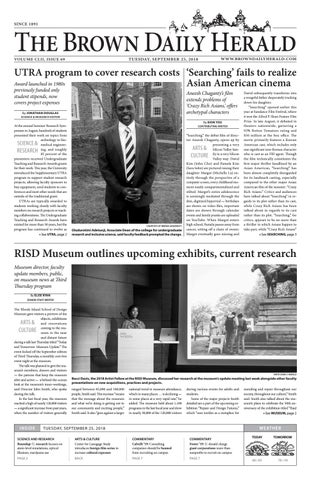
Oludurotimi Adetunji, Associate Dean of the college for undergraduate research and inclusive science, said faculty feedback prompted the change.
David subsequently transforms into a vengeful father desperately tracking down his daughter. “Searching” opened earlier this year at Sundance Film Festival, where it won the Alfred P. Sloan Feature Film Prize. In late August, it debuted in theaters nationwide, garnering a 92% Rotten Tomatoes rating and $50 million at the box office. The movie primarily features a Korean American cast, which includes only one significant non-Korean character who is cast as an FBI agent. Though the film technically constitutes the first major thriller headlined by an Asian American, “Searching” has been almost completely disregarded for its landmark casting, especially compared to the other major Asian American film of the summer: “Crazy Rich Asians.” Critics and audiences have talked about “Searching” in regards to its plot rather than its cast, while Crazy Rich Asians has been talked about in regards to its cast rather than its plot. “Searching,” for critics, appears to be no more than a thriller in which Asians happen to take part, while “Crazy Rich Asians” » See SEARCHING, page 3
RISD Museum outlines upcoming exhibits, current research Museum director, faculty update members, public, on museum news at Third Thursday program By ELISE RYAN SENIOR STAFF WRITER
The Rhode Island School of Design Museum gave visitors a preview of the objects, exhibitions and renovations coming to the museum in the near and distant future during a talk last Thursday titled “Today and Tomorrow: Museum Update.” The event kicked off the September edition of Third Thursday, a monthly cost-free event night at the museum. The talk was planned to give the museum’s members, donors and visitors — the patrons that keep the museum alive and active — a behind-the-scenes look at the museum’s inner-workings, said Director John Smith, who spoke during the talk. In the last fiscal year, the museum reached a high of nearly 120,000 visitors — a significant increase from past years, when the number of visitors generally
ARTS & CULTURE
INSIDE
ANITA SHEIH / HERALD
Becci Davis, the 2018 Artist Fellow at the RISD Museum, discussed her research at the museum’s update meeting last week alongside other faculty presentations on new acquisitions, practices and projects. ranged between 85,000 and 100,000 people, Smith said. This increase “means that the message about the museum and what we’re doing is getting out to our community and exciting people,” Smith said. It also “goes against a larger
national trend in museum attendance, which in many places … is declining — in some places at a very rapid rate,” he added. The museum held about 1,100 programs in the last fiscal year and drew in nearly 30,000 of the 120,000 visitors
during various events for adults and students. Some of the major projects Smith detailed are a part of the upcoming exhibition “Repair and Design Futures,” which “uses textiles as a metaphor for
mending and repair throughout our society, throughout our culture,” Smith said. Smith also talked about the museum’s plans to celebrate the 50th anniversary of the exhibition titled “Raid » See MUSEUM, page 2
WEATHER
TUESDAY, SEPTEMBER 25, 2018
SCIENCE AND RESEARCH Roundup: U. research focuses on atom-level simulations, optical illusions, marijuana use
ARTS & CULTURE Center for Lanugage Study introduces foreign film series to increase cultural exposure
COMMENTARY Calvelli ’19: Consulting companies should be banned from recruiting on campus
COMMENTARY Foster ’19: U. should charge giant corporations more than nonprofits to recruit on campus
PAGE 2
BACK
PAGE 7
PAGE 7
TODAY
TOMORROW
68 / 65
78 / 59
NEWS
PAGE 2 • TUESDAY, SEPTEMBER 25, 2018
Science & Research Roundup BY JACKSON WELLS, SCIENCE & RESEARCH EDITOR
University awarded grant to help expedite atom-level simulations Since atomic-level simulations are becoming more accurate and growing more complex, it takes more time for them to run their courses. Machine learning may be the key to speeding up these simulations by “magnitudes,” said Andrew Peterson, an associate professor in Brown’s School of Engineering, in a University news release. Research spearheaded by University scientists is funded by a $3.5 million grant from the United States Department of Energy and will take place over the course of four years. The research will initially involve electrochemical reactions and utilize a software called the Atomistic Machine-learning Package, which was developed by Peterson’s research group. All of these different simulations, including ones that analyze chemical reactions and material properties, run on similar calculations, so machine learning may be able to identify these underlying calculations and figure out how to speed them up.
Researchers examine brain perceptions of optical illusions University computer experts conducted research to understand the neural operations that go into comprehending a certain type of optical illusion. The team used a computational model, which was subject to the bounds of different parts of the visual cortex, to see how neurons interacted with one another when viewing the illusion. The study focused on contextual phenomena, a type of optical illusion in which context influences the perception of an image. One example of this illusion is color differentiation, in which one color is contrasted with differently hued backgrounds, which results in differences in color detection. The team created a model of hypothesized feedback connections of neurons, which respond differently depending on the context. The team found that their model’s reaction to the optical illusions mirrored that of humans.
Mothers’ marijuana use tied to children’s earlier use New research found that the children of mothers that use marijuana between their child’s birth and 12th birthday start using the drug two years earlier than their peers. The study was coconducted by Natasha Sokol, a postdoctoral fellow in the Center for Alcohol and Addiction Studies, and was based off of longitudinal surveys from across the United States. Sokol conducted the research as a graduate student, and the study was published in the American Journal of Preventive Medicine Sept. 24. Cassandra Okechukwu, a researcher at Harvard, worked with Sokol on the study.
THE BROWN DAILY HERALD
» UTRA, from page 1 funding has expanded and projects have diversified. The program has grown tenfold since its inception, said Oludurotimi Adetunji, associate dean of the college for undergraduate research and inclusive science. The award acts as a stipend for the student conducting the work, but funds for project-related expenses have historically been provided from alternative sources, Adetunji added. The new S-UTRA aims to alleviate the financial pressure faced by faculty members who support undergraduate student work by providing $500 to fund costs associated with the student project. The grant was initiated in response to faculty feedback on the UTRA program, as many faculty members thought the money would lessen financial pressure from their work, Adetunji said. The supplementary grant was left open-ended so the money could be used toward a variety of purposes, he added. The new program differs slightly from the larger, general UTRA grant in that faculty members rather than
» MUSEUM, from page 1 the Icebox” curated by Andy Warhol in 1969-1970. The original project directors invited Warhol to create an exhibition from the museum’s existing collection, which “was both a scandal and a success at the time,” Smith said. The museum has invited ten artists and artist-collectives to rethink the task, with related projects to be rolled out over several months, Smith explained. Associate Curator of Costume and Textiles Laurie Brewer discussed one of the museum’s recent additions to the department’s 30,000 object collection — a fish leather jacket created by American designer Rick Owens as part of his 2016 “Mastodon” collection. Owens’ collection explored his uneasiness about environmental change, Brewer said. The leather, made from the durable skin of a large Brazilian pirarucu fish, was once a waste product thrown out in the process of cooking the fish’s meat but has been turned into a viable economic resource for communities in the Amazonian region to which the
students apply for the S-UTRA. Student sponsors submitted budget requests attached to the project and were granted funds accordingly. The S-UTRA was granted across several disciplines in its inaugural year, including history and chemistry. One of the first recipients of the award was Kareen Coulombe, assistant professor of engineering, molecular pharmacology, physiology and biotechnology. Coulombe worked with Jasmine Gabor ’21, who spent the summer investigating the effects of BPA, an environmental toxicant, on female heart cells, Coulombe said. The chemical mimics estrogen and thus provided a unique insight into women’s heart health. Gabor compared both male and female cells, using the male heart cells as controls because they do not have as many estrogen receptors, Gabor said. The SUTRA allowed the group to purchase an important antibody for their work without placing additional financial pressure on Coulombe. Though Gabor’s work benefitted from the additional grant, she wasn’t aware that her project had received the
money until mid-summer, she said. Ultimately, Coulombe was the main beneficiary as she no longer had to rely on outside funding, Gabor said. But $500 does not cover the entirety of the costs associated with supporting an undergraduate researcher, Coulombe said. She typically uses funds from within the department that can be used to cover extraneous costs to fund projects outside the realm of her grants, she added. So far, Adetunji has heard “stellar” feedback from faculty members who received the supplementary award. He said that the S-UTRA is a “program that everyone is proud of ” and allows students to take their research further. The S-UTRA is only the latest example of how the UTRA program has adapted to meet research demand from undergraduates and faculty. In the 2014-15 academic year, the University introduced the Interdisciplinary Team UTRA, which brings together groups of faculty members and students from different areas for a research project. This grant has flourished and was also motivated by faculty demand, Adetunji said.
fish is native, Brewer said. This piece fits into Brewer’s personal concerns of human ecology and textiles but also into the larger collection, she said, as it joins other pieces made of aquatic materials, such as a purse composed of walrus leather that has had a place in the collection since 1958. This additional piece exemplifies one of the other key thematic tenets of Smith’s presentation — the growth of the museum’s collection and the new ways in which the collection will be displayed. Along with an increase in the number of items available for viewers online, Smith outlined plans for the renovation and reopening of Gallery C9, the museum’s original exhibition space built in 1897, which has been closed for almost a decade, he said. The renovation will bring the gallery up to date on fire and safety codes and create room for the display of more objects. Gina Borromeo, the museum’s curator of ancient art, discussed some of the ethical concerns of exhibiting ancient objects in her presentation on research conducted on Nesmin, the museum’s
resident mummy. Though Nesmin’s body has been displayed outside of his coffin in the past, the museum is “now rethinking whether it is ethical at all to show human remains in an art museum, and so we are in the process of putting Nesmin back in the coffin, where he will once again be embraced by Nut and surrounded by protective sky creatures,” Borromeo said, emphasizing that learning about ancient Egyptian funeral practices will still be possible without viewing the body. The coffin that Nesmin was buried in gives insight into his life, Borromeo said. One section of hieroglyphs explains not only that he was priest of the fertility gods but also that the previous five generations of his family were as well, she added. The detail provided on the inscriptions of his coffin has allowed researchers make a connection between Nesmin and his mummified relatives. His father is currently being preserved at the Cairo Museum, and his grandfather, also named Nesmin, is on view at the Metropolitan Museum of Art, Borromeo said.
STAY UP-TO-DATE. FOLLOW US ON FACEBOOK. FACEBOOK.COM/BROWNDAILYHERALD
ARTS & CULTURE TUESDAY, SEPTEMBER 25, 2018 • PAGE 3
THE BROWN DAILY HERALD
» SEARCHING, from page 1 is nothing short of an Asian American movement, heralded for its watershed casting decisions while escaping any of the derision that could be directed at its reductive plot. At its surface, “Searching” appears much more representative of Asian America than “Crazy Rich Asians.” It takes place in the heartland of model minority excellence, Silicon Valley, and centers itself around a full Korean family, complete with an engineering dad and a piano playing, AP Biology-taking daughter. However,
this is where the purported “Asian Americanness” of the film ends; once the central search for Margot begins, the shortcomings of the movie quickly become evident. After the film’s exposition, the characters, namely David, become essentially raceless and devoid of deeper identity, and turn into vehicles that simply serve to push the plot along. The computer screen framing of the film further reduces actors to one dimensional digital personas; David even turns his supposed “suspect list” into an Excel doc, where Facebook profile photos are paired next to one sentence
bios. As a result, it is no wonder why critics have ignored the supposedly revolutionary casting of the film and instead focused squarely on its genre and technical gimmickry. “Searching” should have been as much about David’s growth as it was a crime mystery, but instead does almost nothing to take advantage of John Cho’s excellent acting, depriving him of any serious chance of development while under crisis. As Richard Brody of The New Yorker writes, “for all its reflection of secrets and traits both contained and dispersed in a person’s digital identity, it (“Searching”)
offers almost nothing of its characters’ identities. It renders them virtually faceless and lacking in inclinations, interests, and idiosyncrasies.” Asian Americanness aside, the film only allows Cho to vacillate between two emotions: rage and despair, and even these emotions are dulled through being presented through a distilling, secondary medium (FaceTime, voice call). Of course, filmmakers should never be responsible for educating viewers on racial histories and intricacies, but the film falls flat largely because character development—Asian
American character development, informed heavily by racial histories and intricacies—is ignored. Director Aneesh Chaganty—himself a Bay Area, second generation Asian American— may have intended for “Searching” to be an attempt to normalize Asians on screen, implicitly saying that they are no different from their white counterparts. The effect of this decision, however, is that the Kim family could seamlessly be replaced with the family from “Roseanne” or any family from “Modern Family” with no serious changes. Undoubtedly, “Searching” kept me
COURTESY OF SPORTS FILE
“Searching,” directed by Aneesh Chaganty, is a hyper-modern thriller told solely through the technological forms of communication used in daily life, such as FaceTime and text messaging. captivated from beginning to end. However, as a Korean American viewer, I constantly longed to see more meaningful moments, especially in regards to David’s inability to address grief with his daughter, which served as an unexplained underpinning that set the plot of the movie in action. The film could have presciently explored how Asian Americans suppress any acknowledgement of trauma between generations, trauma that subsequently bleeds through in more insidious ways. I also longed for a better understanding of David’s isolation during
the period after his wife’s death—the film vitally misses a window to situate this isolation in terms of Han, the distinctly Korean mode of collective suffering, as well as the profound isolation many adult Asian Americans undergo in periods of grief, as many are separated from their families by thousands of miles. I began to wonder if this is what mainstream “Asian American cinema,” a genre that does not currently exist, had to be, one in which either everything Asian American is rendered inconsequential (“Searching”)
or in which everything Asian American is pulled to the extremities of lavish excess (“Crazy Rich Asians”). I thought of the small budget Asian American films made in past decades, such as 2002’s Better Luck Tomorrow, in which John Cho and a cast of Asian American actors violently overturn their high achieving student lifestyles, or the gripping Asian American narratives presented by the Asian American “Class of ‘97,” in which John Cho, again, took part in. Twenty years later, it appears that the industry enforced stereotyping
and whitewashing that comes with the transition from small budget to major studios is as firm as ever, and it is still largely accepted that this is a necessary first step to creating a more authentic Asian American cinema—but is it? Summer 2018 has been a particularly fecund time for Asian American cinema, with titles such as “Killing Eve,” “To All the Boys I’ve Loved Before,” “Kim’s Convenience” and the obvious “Crazy Rich Asians.” John Cho himself has signed on to star in Alan Yang’s forthcoming “Tigertail,”
a Netflix film about a Taiwanese immigrant family that will hopefully explore the East Asian American family in a more substantive way than “Searching.” Nevertheless, “Searching” meaningfully contributes to this list of films, providing much-welcomed on-screen representation—albeit in an aspirationally white, model minority type of way. It is only my regret that a movie that could have been a powerful meditation on the grief and trauma of the dissolution of the Asian American family became a nondescript, meek facsimile of “Taken.”
NEWS
PAGE 4 • TUESDAY, SEPTEMBER 25, 2018
THE BROWN DAILY HERALD
ROBERTO SIMANOWSKI
1984: On Surveillance, FOMO and the Pleasure of the Screen Wednesday, 26 September 2018 at 6:30 pm Pembroke Hall, Room 305 for details visit: 172 Meeting Street, Providence brown.edu/cw/events
This talk is sponsored by Literary Arts at Brown, with additional support from the Cogut Institute for the Humanities, the German Department and Modern Culture and Media.
MEAL PLAN
changes
STEP ONE:
Choose a Meal Plan.
REMINDER:
T DAY THE LASEA L PLAN
TO MAKE M EDNESDAY, CHANGES IS W
SEPT. 2 !
VIEW OPTIONS AT BROWN.EDU/FOOD
• You can ADD a new Meal Plan at any time during the year • You can make one CHANGE per semester. Fall deadline is 9/2 • Meal Plan CANCELLATIONS for the whole year are due by 9/2
STEP TWO:
Let us assist you!
EMAIL DINING_SERVICES@BROWN.EDU OR CALL 863-3343 WITH QUESTIONS
• Changes can only be made in person weekdays from 9:00AM to 4:00PM at the Brown Dining office located at 144 Thayer Street (Sharpe Refectory).
brown.edu/food
TODAY
TUESDAY, SEPTEMBER 25, 2018 • PAGE 5
THE BROWN DAILY HERALD
menu
b a by b lu e n o
SATELLITE DINING ANDREWS COMMONS
Pizza: Cajun Chicken, Spinach and Feta, Sausage and Jalapeño Curry Bar, Pulled Pork Sandwich JOSIAH’S
BLUE ROOM
Dumpling Bar, Mac and Cheese Bacon Burger
Chicken Kadhai, Avial Vegetable Curry, Three Bean Chili
DINING HALLS SHARPE REFECTORY LUNCH
DINNER
Braised Chicken Tinga, Red Wheatberry Pilaf, Oven Roasted Potatoes with Herbs
Huli Huli Chicken, Asian Style Sweet and Sour Meatballs, Cumin Spiced Cabbage
VERNEY-WOOLLEY LUNCH
DINNER
Chinese Chicken Wings, Sweet and Sour Tofu, Sticky Rice, Edamame Beans with Peppers
Turkey Pot Pie, Peas with Mushrooms, Ginger Pasta, Parslied Rice
sudoku
crossword ANITA SHEIH / HERALD
Blueno, the most eccentric of Brown’s bear statues, has a furry, miniature doppelgänger. The smaller Blueno quite literally lives in the shadow of the statue, behind the glass of a window in an adjacent building.
Q U O T E O F T H E D AY
“Learning a language is a really important part of being a global citizen.” — Jane Sokolosky, Senior Lecturer in German Studies and Director of Language Studies
See Language on BACK.
calendar TODAY SEPTEMBER NOVEMBER MARCH
S
2
5 9
M
3
6
10
T
4
7
11
W
Th
F
S
1
2
3
4
9
10
11
5
8
12
6
13
7
14
1
8
15
12
13
14
15
16
17
18
19
20
21
22
23
24
25
16 23
26
30
17
24
27
18
25
28
19
26
29
20 27
30
21
28
31
22
29
BIG Fall Career Fair 11:00 A.M. 235 Hope Street
Asian/Asian-American Welcome Back 5:30 P.M. Sayles Hall
Galileo and the Grey Sister - Lecture 5:30 P.M. Annmary Brown Memorial
Tombraiders Screening and Discussion 7 P.M. Salomon 001
TOMORROW Peer Career Advisor Open Hours 1:30 P.M. CareerLAB
VA Concentrator BBQ 4 P.M. LIST Art Building
Brown Pre-Dental Society First Meeting 4:00 P.M. Stephen Robert ’62 Campus Center
Visiting Artist Lecture 5 P.M. LIST Art Building
COMMENTARY PAGE 6 • TUESDAY, SEPTEMBER 25, 2018
THE BROWN DAILY HERALD
Find us online! facebook.com/browndailyherald
browndailyherald.com
@the_herald
Location: 195 Angell St., Providence, R.I. www.browndailyherald.com
@browndailyherald
youtube.com/browndailyherald
Editorial Leadership
Sections
Multimedia & Production
Business
Editors-in-Chief Elena Renken Kasturi Pananjady
Arts & Culture Editors Connor Sullivan Ethel Renia
General Managers Michael Borrello Matilda Lynton
Managing Editor Alex Skidmore
Metro Editors Emily Davies Isabel Gensler
Design Editors Kyle Cui Eduard Muñoz-Suñé Assistants: Julie Wang, Kelvin Yang
Senior Editors Julianne Center Madison Rivlin Hattie Xu Editorial Page Editor Anuj Krishnamurthy POST- MAGAZINE Editor Jennifer Osborne
News Editors Eduard Muñoz-Suñé Priyanka Podugu Sarah Wang Science & Research Editors Jonathan Douglas Jackson Wells Sports Editors Alexandra Russell James Schapiro COMMENTARY Opinions Editors Connor Cardoso Anuj Krishnamurthy Clare Steinman Emily Miller
Photo Editors Sam Berube Anita Sheih Copy Desk Chief Kelley Tackett Illustrations Editor Daphne Zhao Video Editor Celia Hack Graphics Editors Marlis Flinn Sarah Martinez
Office Manager Diane Silvia Directors Sales: Shreya Raghunandan Finance: Ravi Betzig Strategy: Edwin Farley
Editorial contact: 401-351-3372 herald@browndailyherald.com
Advertising contact: 401-351-3372 advertising@browndailyherald.com
Submissions: The Brown Daily Herald publishes submissions in the form of op-eds and letters to the editor. Op-eds are typically between 750 and 1000 words, though we will consider submissions between 500 and 1200 words. Letters to the editor should be around 250 words. While letters to the editor respond to an article or column that has appeared in The Herald, op-eds usually prompt new discussions on campus or frame new arguments about current discourse. All submissions to The Herald cannot have been previously published elsewhere (in print or online — including personal blogs and social media), and they must be exclusive to The Herald. Submissions must include no more than two individual authors. If there are more than two original authors, The Herald can acknowledge the authors in a statement at the end of the letter or op-ed, but the byline can only include up to two names. The Herald will not publish submissions authored by groups. The Herald does not publish anonymous submissions. If you feel your circumstances prevent you from submitting an op-ed or letter with your name, please email herald@browndailyherald.com to explain your situation. You can submit op-eds to opinions@browndailyherald.com and letters to letters@browndailyherald.com. When you email your submission, please include (1) your full name, (2) an evening or mobile phone number in case your submission is chosen for publication and (3) any affiliation with Brown University or any institution or organization relevant to the content of your submission. Please send in submissions at least 24 hours in advance of your desired publication date. The Herald only publishes submissions while it is in print. The Herald reserves the right to edit all submissions. If your piece is considered for publication, an editor will contact you to discuss potential changes to your submission. Commentary: The editorial is the majority opinion of the editorial page board of The Brown Daily Herald. The editorial viewpoint does not necessarily reflect the views of The Brown Daily Herald, Inc. Columns, letters and comics reflect the opinions of their authors only. Corrections: The Brown Daily Herald is committed to providing the Brown University community with the most accurate information possible. Corrections may be submitted up to seven calendar days after publication. Advertising: The Brown Daily Herald, Inc. reserves the right to accept or decline any advertisement at its discretion. The Brown Daily Herald, Inc. is a financially independent, nonprofit media organization bringing you The Brown Daily Herald, BlogDailyHerald and Post- Magazine. The Brown Daily Herald has served the Brown University community daily since 1891. It is published Monday through Friday during the academic year, excluding vacations, once during Commencement and once during Orientation by The Brown Daily Herald, Inc. Single copy free for each member of the community. Subscription prices: $200 one year daily, $100 one semester daily. Copyright 2018 by The Brown Daily Herald, Inc. All rights reserved. Periodicals postage paid at Providence, R.I. Postmaster: Please send corrections to P.O. Box 2538, Providence, RI 02906.
COMMENTARY TUESDAY, SEPTEMBER 25, 2018 • PAGE 7
THE BROWN DAILY HERALD
#BCG: Ban Consulting Groups AIDAN CALVELLI staff columnist When fall dawns on campus, you’re sure to see two things: first-years with lanyards around their necks and upperclassmen in business-casual-but-don’tworry-I’m-still-chill outfits flocking in hordes to consulting recruiting events. The lanyards fade away with time and wisdom, but on-campus recruitment is here to stay. Consulting companies have spread through Brown like an invasive species, infiltrating our buildings and emails with an incessant drum of events and exhortations. This relentless recruiting is clearly effective, as the students who don’t want to work in consulting (or finance and technology) are becoming a rarer and rarer breed. That doesn’t mean we have to resign ourselves to the limited future that consulting presents. In fact, the ubiquitous presence of consulting companies on campus undermines the spirit of the Open Curriculum. That spirit traces back to 1967, when Ira Magaziner ’69 and Elliot Maxwell ’68 wrote “Draft of a Working Paper for Education at Brown University,” the report that ignited the curricular revolution Brunonians still benefit from today. The report details the values that should animate the Open Curriculum, but today, with many students seeing their education as a stepping stone to a lucrative consulting career, those values are under attack. To be responsible stewards of the freedoms that our intellectual predecessors fought for, we should ban consulting companies from recruiting on campus. Brown students love to tout their peers’ independence, creativity and ded-
ication to changing the world. These values harken back to a core tenet of the Magaziner-Maxwell report: that “education should be fundamentally an individually oriented process.” It argued that individualism was laudable, and that students would learn better and grow more as people if empowered to make their own choices. Today, however, it would be nonsensical to suggest that the mobs of students kissing up to recruiters are doing so to foster a deep sense of individuality. Instead of the breadth of careers you’d expect from a purportedly intellectually diverse student body, the paths actually followed are all too similar. Among 2017 Brown graduates, there are as many
think these people are being evasive, nor do I mean to insult them. Rather, I think the omnipresence of consulting firms on campus inhibits reflection on why a person genuinely would want to be a consultant, or anything else for that matter. Recuiting transforms the process of finding a vocation into an exercise in following the crowd, normalizing conformity and discouraging critical thinking about the future. Amid the constant inundation of recruiting pitches, what students can see is that consulting is prestigious — a safe next step along the elite path they’ve been on since taking their first SAT prep classes. The mad rush to help rich companies get richer obscures a search for
professionalism removes the possibility that there can be anything valuable in education other than professional training.” If education is reduced to job training, it’s no surprise students flock to the most profitable careers. The admission office loves to tout how the open curriculum means classes are all populated with people passionate about the course material. In reality though, plenty of your classmates are in ECON 0710: “Financial Accounting” because they want to signal to a consulting firm that they know business. Spending four years at an institution of higher learning only to use it to catapult yourself into the top decile of
To be responsible stewards of the freedoms that our intellectual predecessors fought for, we should ban consulting companies from recruiting on campus. students working in consulting and finance as there are in the entire nonprofit sector. Forty-two percent of the class of 2017 went into just three industries: consulting, finance and technology. There are more consultants than there are people working in environment and sustainability, community service and development, government and public policy and the arts combined. Looking at this data, it seems disingenuous to claim Brown students are exercising independent, creative thought in their career choices. Beyond the data, it manifests in the reasons people proffer for wanting to be consultants. Ask your friends (or yourself) why they’re following this path, and many won’t have a thoughtful answer about their values and goals for the world. And I don’t
employment animated by an independent quest for meaning and social fulfillment. That’s a grave consequence, one that Brown shouldn’t tolerate if it’s more committed to educating students than to building its future donor base by ensuring its graduates land lucrative careers. This college-to-consulting corridor is another key way recruiting violates the spirit of the Open Curriculum. Magaziner and Maxwell warn of the onset of a “narrow professionalism,” a trend away from a liberal education emphasizing human flourishing and toward a parochial concern with job training. As they wrote, “human relevance is replaced by future practical relevance. For many students this leads to a deadening of the educational process. For many, narrow
income earners as a baby-faced 22-yearold is the acme of narrow professionalism. Predetermining your job after a lucrative summer internship is the opposite of exploration — it’s an explicit rejection of the personal and intellectual openness that the open curriculum was designed to foster, that Brown is supposed to protect. Whether by disincentivizing individualism or encouraging narrow professionalism, consulting firms’ presence on campus orients the motivations of students away from the high ideals of the open curriculum. Brown needs to end its complicity in the degradation of the educational atmosphere it claims to foster. To do so will require refusing to host consulting recruiting events on campus and ending the relentless publi-
cization of consulting job opportunities. Brown shouldn’t dictate to its students what they do after graduating. But Brown is not and does not claim to be a value-neutral institution. The University understands itself as having a public and institutional responsibility, and we should demand it live up to this ideal. Brown’s values are most clear in its mission statement, which is worth reading: “The mission of Brown University is to serve the community, the nation and the world by discovering, communicating, and preserving knowledge and understanding in a spirit of free inquiry, and by educating and preparing students to discharge the offices of life with usefulness and reputation.” As accomplished close readers, you’ll notice the statement does not say: “The mission of Brown University is to serve the interests of wealthy companies by encouraging its students to sell out in a spirit of greed and cynicism, and by preparing students to discharge the offices of life with fancy-sounding jobs that perpetuate inequality and conformity.” I, for one, am happy with the mission the way it is. It’s time Brown reaffirms its founding values by proclaiming that making PowerPoints for Fortune 500 companies is neither a “useful” nor a “reputable” way to lead a life.
Aidan Calvelli ’19 once applied to McKinsey in a state of deep sadness and confusion, but then felt like a sellout and turned down the interview. He can be reached at aidan_calvelli@brown.edu. Please send responses to this opinion to letters@browndailyherald.com and op-eds to opinions@browndailyherald.com.
Don’t fall into the fall recruiting trap RUTH FOSTER staff columnist The career fair is today. As Brown students weave through a sea of recruiters, they’re likely to see table after table of technology, finance and consulting companies. These large, moneyed corporations have something very attractive to offer students — certainty. In a 2017 Financial Times piece, senior employees at a handful of management consulting firms described their ideal employees as “insecure overachievers” — workers that are eager to please others by drowning themselves in, and excelling at, their work. Human resources directors admit that they seek out insecure overachievers and try to “(get) them hooked on the high-status identity of the firm.” I submit the following to you: If you go to Brown, you are probably an overachiever. In fact, you probably derive a lot of satisfaction from being an overachiever. Otherwise, you probably wouldn’t have spent time in high school studying to ace standardized tests and earning top marks in your classes, all while balancing a smorgasbord of extracurriculars. You’re really good at jumping through hoops. And, if you’re a graduating senior, you’re probably feeling insecure. I know I am. I worry about leaving the security of an educational institution and jumping headfirst into the job market. Will I find the right job? What if I graduate without finding any-
thing while all my friends get ready to move away and start at a new company? These companies know that we’re scared and smart, and so they recruit early, scooping up young talent that’s hungry for a start date before they even receive a diploma. I understand that some students choose these roles because they have family to support or massive debt to pay. But for the vast majority of students participating in the recruiting process, this is not the case. Recruiting is appealing because it’s a ticket out of uncertainty and into a high salary
working on big problems. I think we can be some of those people. We can do things with our skills that are more socially valuable than coding widgets and making spreadsheets to tell a tire company how to make one percent more each year. We can do more with our degrees than make a ton of money for someone else. (The average employee of a “Big 3” management consulting firm brings in $400,000 to $500,000 in revenue for the company per year.) This problem, however, is larger than individual choice. CareerLAB should shift the recruiting land-
The world needs smart and dedicated people working on big problems. I think we can be some of those people. We can do things with our skills that are more socially valuable than coding widgets and making spreadsheets to tell a tire company how to make one percent more each year. and a relocation bonus. The truth is that most organizations are not large or bureaucratic enough to predict their staffing needs almost a year in advance. Positions in arts, education, public service and many other fields don’t start posting their fall openings until graduation season. It’s scary to wait until the spring to start interviewing for positions, but this timeline is completely normal. The world needs smart and dedicated people
scape for graduating seniors. First, they ought to emphasize that most students do not solidify their postgraduate plans until the spring of their senior year. Second, they could adjust the fee schedule for employers recruiting on campus. CareerLAB currently offers a reduced fee to nonprofit companies recruiting at Brown. To incentivize greater entry into the nonprofit sector, CareerLAB ought to lower this fee to zero. Conversely, CareerLAB ought to assess an additional surcharge for
technology giants, large financial institutions and high-powered consulting firms. These additional fees can be used to expand the Careers in the Common Good program, an initiative that aims to help students pursue nonprofit and public interest careers. These giant companies aren’t hurting for cash, and they certainly won’t be dissuaded from recruiting at Brown due to a fee hike. Companies like Bain and McKinsey purposefully hire employees from prestigious universities to shore up their own legitimacy. They sell expertise to their clients — what better way to do that than to start growing talent from a crop of newly minted graduates from ultra-selective schools? It’s up to us to help create the world we want to see. If we want a society where every child can access quality education, where people of color are not subjected to an unfair criminal justice system and where our environment is protected, it’s up to us to choose to work for it, and it’s on Brown to help make that happen.
Ruth Foster ’19 applied to an internship at a hedge fund in a fit of desperation but was deemed “not a good fit” after arguing in her application that Brown should pay higher taxes — in hindsight, this ideological mismatch should have been obvious. She can be reached at ruth_foster@brown.edu. Please send responses to this opinion to letters@browndailyherald.com and op-eds to opinions@browndailyherald.com.
ARTS & CULTURE THE BROWN DAILY HERALD
TUESDAY, SEPTEMBER 25, 2018
Center for Language Studies institutes film series CLS screens La Heine, begins plans for new undergraduate programming By ANNABELLE WOODWARD SENIOR STAFF WRITER
When Distinguished Senior Lecturer in German Studies Jane Sokolosky was named the new director of the Center for Language Studies this past June, she decided that she wanted to give students the ability to access languages in a “study break, daily routine, casual” sort of way. She concluded that the best way to realize this goal was through a weekly foreign film screening that would showcase some of the most venerated and loved films made in every language. To curate the film selections and run the screenings, she reached out to two extremely enthusiastic, filmsavvy students in her Intensive German class, Layla Beckhardt ’20 and Emine Ciger ’21. Ciger was already working as a projectionist for the Modern Culture and Media department, and both girls were “always talking about films in class,” according to Ciger. Now every Wednesday at 7 p.m. in the Metcalf Auditorium, the CLS will host a foreign film screening, with each week featuring a film in a different language. Last week, the group showed “La Heine,” a 1995 French black-and-white drama that follows three first-generation immigrant boys in the twenty-four hours that transpired after a violent riot killed their friend. This film was chosen because it “combines amazing stylistic technique with subtle messages of the political situation in France,” according to Beckhardt.
ARTS & CULTURE
Beckhardt and Ciger have compiled a “huge Excel spreadsheet” of foreign movies that they enjoy, but they are also reaching out to student and faculty language groups to inform their selections. “If it’s a film from a culture that we’re not acquainted with, we’ll find someone” who can identify seminal films from that area, Ciger said. Next week, they will screen “In The Mood for Love,” a beloved Chinese romance-drama from 2000. In the future, they plan to show films in languages such as Persian, Russian and German, and they will partner with the Korean Student Association and the South East Asian Studies Group to bring undergraduates films in Korean and Vietnamese. Aside from the film series, the CLS plans to launch other new initiatives to inform people about different languages and cultures. They are going to start holding lunchtime language tables in Faunce so that students can learn about less-spoken languages and get information about student groups and events. Recently, the CLS prompted the University to start offering Yoruba through distance learning with Cornell, and they are looking into offering Vietnamese on Brown’s campus. At First Year Orientation, the CLS hosted a language panel featuring over fifteen upperclassmen who spoke about about their experiences learning languages at Brown and the doors that languages opened for them. “Someone was an artist-in-residence in Russia, someone taught English in Germany. It’s so cool,” Sokolosky said. “One of my goals is to bring languages into the center of campus at Brown. Learning a language is a really important part of being a global citizen,” she added. “Now undergraduates know that Wednesdays mean they can watch a foreign film at Brown.”
HERALD FILE PHOTO
195 Angell St. is home to the Center for Language Studies, which recently named Jane Sokolosky as its new director. Every Wednesday at 7 p.m., CLS will screen a foreign language film in Metcalf auditorium.