SINCE 1891
THE BROWN DAILY HERALD FRIDAY, NOVEMBER 11, 2016
VOLUME CLI, ISSUE 105
WWW.BROWNDAILYHERALD.COM
Students abroad grapple with responses to Trump victory Students in Europe, Latin America draw parallels between American campaign, foreign politics By KATE TALERICO STAFF WRITER
KYLE BOROWSKI / HERALD
Around 800 students and community members rallied outside the State House Wednesday night following the election of President-Elect Donald Trump. The protest moved to the East Side and went down Thayer Street.
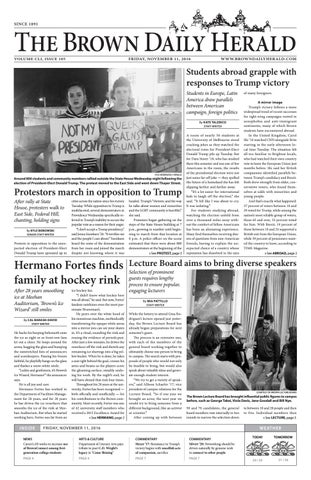
Protestors march in opposition to Trump After rally at State House, protesters walk to East Side, Federal Hill, chanting, holding signs By KYLE BOROWSKI SENIOR STAFF WRITER
Protests in opposition to the unexpected election of President-Elect Donald Trump have sprouted up in
cities across the nation since his victory Tuesday. While opposition to Trump is multifaceted, several demonstrators in Providence Wednesday specifically referred to Trump’s inability to secure the popular vote as a reason for their anger. “I don’t accept a Trump presidency,” said Jenna Soenksen ’20. “It terrifies me and the people I care about.” Soenksen heard the noise of the demonstration from her room and joined the march despite not knowing where it was
headed. Trump’s “rhetoric and the way he talks about women and minorities and the LGBT community is horrible,” she said. Protesters began gathering on the steps of the State House building at 7 p.m., growing in number until beginning to march from that location at 8 p.m. A police officer on the scene estimated that there were about 800 demonstrators at the beginning of the » See PROTEST, page 3
A room of nearly 50 students at the University of Melbourne stood cracking jokes as they watched the electoral votes for President-Elect Donald Trump pile up Tuesday. But for Dara Storer ’18, who has studied there this semester and was one of few Americans in the room, the results of the presidential election were not just some far-off joke — they spelled the future of a homeland she has felt slipping farther and farther away. “It’s a lot easier for international kids to laugh off the election,” she said. “It felt like I was about to cry. It was isolating.” For students studying abroad, watching the election unfold from over a thousand miles away without the comfort of fellow Americans has been an alienating experience. Many find themselves receiving dozens of questions from non-American friends, having to explain the unexpected choice of a country whose reputation has dissolved in the eyes
of many foreigners. A mirror image Trump’s victory follows a more widespread trend of recent successes for right-wing campaigns rooted in xenophobia and anti-immigrant sentiments, many of which Brown students have encountered abroad. In the United Kingdom, Carol Shi ’18 watched CNN alongside Brits starting in the early afternoon local time Tuesday. The situation felt all too familiar to Brighton locals, who had watched their own country vote to leave the European Union just months before. Shi said her British companions identified parallels between Trump’s candidacy and Brexit. Both drew strength from older, conservative voters, who found themselves at odds with minorities and young people. And that’s exactly what happened: 37 percent of voters between 18 and 29 voted for Trump, while among the nation’s most reliable group of voters, those 65 and over, 53 percent voted for him. With Brexit, 19 percent of those between 18 and 24 supported a British exit from the European Union, while 59 percent of pensioners wanted the country to leave, according to TIME Magazine. » See ABROAD, page 2
Board aims to bring diverse speakers Hermano Fortes finds Lecture Selection of prominent requires lengthy family at hockey rink guests process to ensure popular, After 28 years smoothing ice at Meehan Auditorium, ‘Brown’s Ice Wizard’ still smiles By CAL BARASH-DAVID STAFF WRITER
He backs his beeping behemoth onto the ice as eight or so front-row fans let out a cheer. He loops around the arena, hugging the glass and bumping the outstretched fists of announcers and scorekeepers. Passing his frozen faithful, he playfully bangs on the glass and flashes a snow-white smile. “Ladies and gentlemen, it’s Brown’s Ice Wizard, Hermano!” the announcer says. He is all joy and care. Hermano Fortes has worked in the Department of Facilities Management for 28 years, and for 28 years he has driven the ice resurfacer that smooths the ice of the rink at Meehan Auditorium. But when he started working here, Fortes was far from an
INSIDE
ice hockey fan. “I didn’t know what hockey here was all about,” he said. But now, Fortes’ fandom outshines even the most passionate Brunonian’s. He peers over the white hood of his monstrous machine, methodically transforming the opaque white arena into a mirror you can see your skates in. It’s a ritual, rounding the rink and erasing the evidence of periods past. After just a few minutes, he drives the resurfacer off the rink and shovels any remaining ice shavings into a big yellow bucket. When he is done, he takes a seat right behind the goal, crosses his arms and beams as the players score the gleaming surface, steadily undoing his work. By the night’s end, he will have shined that rink four times. Throughout his 28 years at the university, Fortes has been recognized — both officially and unofficially — for his contributions to the Brown community. Most recently, Fortes was one of 42 university staff members who received a 2015 Excellence Award for » See HERMANO, page 2
engaging lecturers
By MIA PATTILLO STAFF WRITER
While the lottery to attend Gina Rodriguez’s lecture opened just yesterday, the Brown Lecture Board has already begun preparations for next semester’s guest. The process is an extensive one, with each of the members of the general board working together to ultimately choose one person to bring to campus. The search starts with proposals of people who would not only be feasible to bring, but would also speak about valuable ideas and generate enough student interest. “We try to get a variety of speakers,” said Allison Schaefer ’17, vice president of campus relations for the Lecture Board. “So if one year we brought an actor, the next year we would try to bring someone from a different background, like an activist or scientist.” After coming up with between
COURTESY OF BROWN LECTURE BOARD
The Brown Lecture Board has brought influential public figures to campus before, such as George Takei, Viola Davis, Jane Goodall and Bill Nye. 50 and 70 candidates, the general board members vote internally in two rounds to narrow the selection down
to between 10 and 20 people and then to five. Individual members then » See LECTURE, page 3
WEATHER
FRIDAY, NOVEMBER 11, 2016
NEWS CareerLAB works to increase use of BrownConnect among firstgeneration college students
ARTS & CULTURE Department of Literary Arts pays tribute to poet C.D. Wright’s legacy in ‘Come Shining’
COMMENTARY Meyer ’17: Resistance to Trump’s victory begins with unselfish acts of compassion, sacrifice
COMMENTARY Silvert ’20: Networking should be driven naturally by genuine wish to connect to other people
PAGE 4
PAGE 4
PAGE 7
PAGE 7
TODAY
TOMORROW
59 / 29
51 / 36
NEWS
PAGE 2 • FRIDAY, NOVEMBER 11, 2016
THE BROWN DAILY HERALD
» ABROAD, from page 1 Despite warning signs, the results still supplied a shock that hit home for students abroad around the world. In Oxford, England, Kyoka Kosugi ’18 began the night watching the election results at a university bar with nearly 50 people, Americans and Brits, around her. When it seemed like the swing states would not be called until the early hours of the morning in Britain, Kosugi made a plan to leave and head to bed optimistic that her preferred candidate — former Democratic presidential nominee Hillary Clinton — would take the lead. But before she could leave, a Brit stopped her and told her that “one of the worst parts of Brexit was waking up and finding out about Brexit.” She resigned to stay up the entire night and watched as nearly every decisive state on the map turned red. In France, Leah Steans-Gail ’18 opted for an early bedtime after a night of celebrating what she thought would be Clinton’s imminent victory. But when she woke up the next morning, the vote was all too different and reflected the presidential race she’d seen just getting off the ground in France. There, right-wing politician Marine Le Pen has run a campaign for president as leader of France’s National Front, a right-wing group with a strong anti-immigration stance that has been gaining popularity. Le Pen congratulated Trump Wednesday, hailing his victory as part of a “great movement across the world.”
ELI WHITE / HERALD
Hermano Fortes has driven the ice resurfacer at Meehan Auditorium for 28 years. Known as “Brown’s Ice Wizard,” Fortes comes to the rink seven days a week even before the women’s ice hockey team arrives at 7 a.m.
» HERMANO, from page 1 service, which acknowledges those who have made “contributions in making Brown a better place to work,” according to the University Human Resources website. Fortes’ notable care was on display last Friday night, when women’s ice hockey player Maddie Woo ’17 broke her femur and had to go to the hospital after a collision with the boards. Fortes rushed behind the scenes to supply towels to both Woo and the
paramedics and attempted to comfort the injured senior captain. “After the game on Friday, I went over to say ‘Thanks, Hermano,’ for everything that he did,” said Sam Donovan ’18, one of Woo’s teammates. “He said that we’re part of his family. He’d do anything for us.” You can always find him behind the wheel of the resurfacer. “Every day,” Fortes said. “Seven days a week.” Fortes is at the rink even before the team arrives at 7 a.m., Donovan said. “He’s always the first one to greet us in
the morning and say goodbye when we leave,” she said. “Sometimes I wonder if he just stays there all the time.” He never gets tired of his work, Fortes said. He punctuates every sentence with a smile. “He’s my favorite person at the rink, and I think all of us can agree with that,” Donovan said. “He’s just always smiling.” Fortes’ favorite part of the job is his daily interactions with the players, he said. His least favorite part? “There isn’t any,” he added with a grin.
Disconnects beyond borders Just 10 hours after the final call, Kosugi said that British students had already stopped discussing the American election. “They’ve already accepted it.” The same could be said for France. “A lot of responses I’ve seen have been a little glib, which is the opposite of Brown,” Steans-Gail said. The day of the election brought feelings of isolation as well. Suzanne Warshell ’18 was one of just a few Americans watching the election with 20 other international students studying in Buenos Aires, Argentina. She decided around 1 a.m. her time — when it was clear Clinton would lose — that she needed to go home and process the election by herself. “It was kind of uncomfortable to be surrounded by non-Americans,” Warshell said. “There was that gap — it felt a lot more significant to an American.” “I feel powerless here. But at the same time I think everyone on the ground feels that way, too,” SteansGail said. Confronting shame “I feel so ashamed to be from America right now,” Shi said. “I wish I had a British accent.” That way, she could blend in and hide from the questions, she said. Several sources said that one of the first questions foreigners have asked the last few months upon hearing an American’s accent is “Who are you voting for?” Many Brown students feel the need to explain themselves
to those they meet and own up to the embarrassment Trump has caused their nation. While many Brown students abroad have already been asking themselves how a Trump victory could happen, as one of comparatively few Americans in their host countries, many are also expected to provide answers to friends and classmates there. For the past few weeks, Storer has been overwhelmed by questions over dinner while at the dining hall, confronted by peers with questions like, “What’s going on?” and “Why do you (Americans) suck so much?” “It’s hard to give a real explanation,” Storer said. “It definitely feels like being tokenized.” Embarrassment, shame or having to answer foreigners’ questions about Trump will be among the smallest of impacts this election has on dayto-day life, “but it’s also one of the hardest things right now,” Warshell said. She particularly feels the weight of having to explain herself in Argentina, a place where the United States has drawn considerable ire. From his perspective between Israel and the West Bank, Marcelo Rivera-Figueroa ’18 is also reeling from the shame of being American right now. On top of having to discuss Trump with his peers in the Middle East, “there’s still a huge feeling of guilt for all of the awful things we (Americans) have done here.” Coming back to America As the sun faithfully rose over Haifa, Israel, Rivera-Figueroa stood outside a bar with several other American friends studying abroad. Flicking ashes of their cigarettes to the side, they half-joked about staying another semester. No one laughed. In many ways, it has been a privilege to be away from the United States during this election. Students noted that they were more easily able to separate themselves from the drone of the 24-hour election news coverage and tune into election news when they chose. But now, returning to the United States seems daunting, especially having gained a new perspective on how some of the tactics proposed by Trump in his campaign are similarly applied in foreign countries. Rivera-Figueroa, a Latino who says he is often mistaken for Arab, thinks about the times he has been randomly selected while at Ben Gurion Airport in Tel Aviv, Israel and is reminded of Trump’s threat to promote stop-and-frisk policing. “I get nervous now when I see a soldier at a checkpoint, and the thought of bringing that back with me to the (United States) … doesn’t make me feel good,” he said. While many on social media joke about leaving for Canada, some students abroad look forward to their return back, even to a United States they no longer know or love the same way. “I don’t think it’s fair that I just get to leave,” Warshell said. “I want to be in the (United States) working against this. … It’s a large setback, but it’s not the end.”
Letters, please! letters@browndailyherald.com
NEWS
FRIDAY, NOVEMBER 11, 2016 • PAGE 3
THE BROWN DAILY HERALD
» LECTURE, from page 1 reach out to the speakers’ agencies to determine availability and pricing before coming together to figure out what would work and what wouldn’t, said Viet Nguyen ’17, co-chair of the Lecture Board. From there, the group sends out a poll to all Brown students so they can vote on their favorite potential guest speaker. But even after figuring out a campus favorite, the board must make sure everything lines up schedulingwise. “Salomon is the biggest room that Brown has, and it gets booked up pretty quickly,” Nguyen said. “It can be challenging to find a time that works for us that also works for our high-profile guests who already have limited availability.” Finding a speaker is only the beginning. Contributing members of the Lecture Board also work on publicity, design and the actual execution of the production. “The operation for getting 600 people into Salomon in 45 minutes takes a lot of coordination,” said Connor Grieve ’17, co-chair of Lecture
Board. With all of the work that the Lecture Board puts into finding a viable speaker, the guest ultimately chosen is often popular among students, such as previous speakers Bill Nye, Jane Goodall and Nick Offerman. Yet with only 600 seats in Salomon, the Lecture Board must use a lottery system to determine who receives a coveted spot. This past spring, when actress Viola Davis came to Brown, around 3,000 students entered the lottery, Grieve said. But in special situations, the Lecture Board is willing to be flexible. In light of the election of President-elect Donald Trump, the Lecture Board will allocate tickets to multiple centers on campus that provide support to marginalized students, including the Latinx Council, LGBTQ+ Center, Sarah Doyle Women’s Center, Brown Center for Students of Color and First-Generation College and LowIncome Student Center, Nguyen announced in a Facebook post Nov. 9. “Representation is one of our main priorities, and it is one of the reasons I joined Lecture Board,” Nguyen wrote on Facebook.
In the past, the Lecture Board has also offered additional opportunities beyond hearing one speaker. Jane Goodall had a book signing that was open to all, not just students who attended the lecture. In 2014, television stars Laverne Cox from “Orange is the New Black,” Aasif Mandvi from “The Daily Show” and RJ Mitte from “Breaking Bad” came together for a collective panel to discuss diversity and the transcendence of stereotypes. The Lecture Board focuses on bringing people who can provide important perspectives to issues relevant to campus. “Once you leave college, it can be hard to get these opportunities like speaking one-on-one with Jane Goodall,” Schaefer said. “It’s very important and empowering to be able to interact with such influential people.” The Brown Lecture Board will be bringing award-winning actress Gina Rodriguez from television series “Jane the Virgin” and the film “Deepwater Horizon” to campus Nov. 21. Sources said they view Rodriguez as a positive role model for women, Latinas, firstgeneration college students and those with Hashimoto’s disease.
» PROTEST, from page 1 night. Carrying a number of anti-Trump signs and shouting slogans like “pussy grabs back,” and “hey hey, ho ho, racist Trump has got to go,” protestors set out from the State House, winding throughout the downtown area and Federal Hill before turning to the East Side and marching through College Hill. A police escort followed the protesters throughout, blocking oncoming traffic as demonstrators walked through normally bustling streets like North Main and Thayer. The protest was peaceful in its entirety. “This is what we need,” said Annie Voss-Altman. “We need to come together and fight hatred.” Voss-Altman rushed onto the street with her family upon hearing the protestors marching, displaying her own campaign sign for former Democratic presidential nominee Hillary Clinton to roars of approval from the crowd. Rick Grosso, a junior at the Community College of Rhode Island, learned about the protest through Facebook and marched from the beginning of the night to its end. “I’m a little bit
tired,” he said. Grosso said he does not stand for Trump’s attitude, “be it (toward) Muslims, Hispanics, black people, women, anyone at all.” He added that if he could tell Trump one thing, it would be, “Please don’t make our worst fears possible.” The group waned in number over the night, with only about 100 protesters remaining when the march returned to the steps of the State House at 10:30 p.m. Despite their reduced numbers, protestors remained defiant in the face of a Trump presidency. “Since we have a rigged system, we should use it to save our country,” one protester shouted at the assembled group. “We should organize in contested states and argue that half the electors vote for Hillary.” Some others were still less optimistic even in the midst of such an electric movement. Zach Nelkin ’17 referred to Trump’s “racism, sexism and xenophobia” in explaining his sense of dread and uncertainty about the future. “Quite honestly I have no idea what to expect from him,” Nelkin said. “Sometimes it’s very hard to tell what he stands for except for pure hate.”
CareerLAB directs resources to first-generation students Herald poll finds first-gen students less likely to use BrownConnect while U. data show equal usage By GALEN HALL STAFF WRITER
According to results from The Herald’s 2016 fall poll, first-generation students at Brown are significantly less likely to use CareerLAB’s BrownConnect service than their non-firstgen peers. But CareerLAB has been collaborating with the First-Generation College and Low-Income Center to connect first-gen students with its resources, and CareerLAB statistics show the efforts are paying off. BrownConnect, launched in November 2014, is an online tool created by CareerLAB that allows students to apply for jobs and internships and contact alums working in fields of interest to them. Of the first-gen students who responded to the Herald poll, 24.4 percent said they had used BrownConnect. Of the non-first-gen students, 33 percent reported using the service. By contrast, a summer survey from CareerLAB found that approximately 50 percent of first-gen students used BrownConnect in their search for a job or internship — a proportion mirrored almost exactly in the rest of the student population, according to CareerLAB’s numbers. “The top five services (first-gen students) use match exactly the top five services that non-first-gen students use,” said Aixa Kidd, director of BrownConnect. While the FLi Center has focused on getting its students to use the tools provided to them, “we haven’t necessarily within the first-gen community talked about BrownConnect versus CareerLAB,” said Yolanda Rome, codirector of the First-Generation College Student Program and assistant dean of the College for first-year and sophomore studies. Some first-generation students
may be intimidated by the process of networking through BrownConnect, several sources said. “We’re not used to the professional world, where everything works by connections,” said Angel Mendez-Flores ’20, a first-gen student from Los Angeles. He added that first-gen students often “can’t ask our parents for guidance or support” in the process of networking. “I think it’s about intimidation,” Rome said. She added that the FLi Center is trying to frame the process of reaching out to alums as “building a relationship” instead of “networking,” because “networking can feel a little cold.” Some first-gen students may find networking less intimidating when the alums who post jobs are also firstgen, Mendez said. “I think it would definitely be easier to reach out to first-gen alumni,” Mendez said. CareerLAB identifies alums on BrownConnect who are interested in hiring first-gen students, but that doesn’t mean those alums were firstgeneration college students themselves. A coming update to the directory should help identify first-gen alums, and “once we do that, it may be a little bit more obvious to students who they might feel comfortable connecting with,” Rome said. Matthew Donato, director of CareerLAB, understands the obstacles that some in the first-gen community face in the job search. As a first-generation student at Georgetown University, Donato recounted, “I didn’t know how to use a career office.” Some students may be hindered by “just not knowing what networking is,” he added. CareerLAB has been working to help students overcome these barriers. “Close to 70 percent of the firstgen students at Brown engaged with us last year,” Donato said. “I would like that number to be over 90 percent.” “The Peer Career Advisors have weekly hours over at the FLi Center because we realized we want to do better outreach to the first-gen
MATT BROWNSWORD / HERALD
community,” Kidd said. Though Kidd and Donato are pleased with data from CareerLAB indicating that first-gen students and their peers are using career-oriented resources at comparable rates, they
think there is still work to do. “We want to make sure that we’re making an impact,” Kidd said. “If you’re a first-gen student, and you see peers at Brown who come from more privileged backgrounds
or have family connections stretching back many years, you can think … ‘I don’t have access to that,’” Donato said. “So how do you get around that? Start using the network you’re part of, which is the Brown community.”
ARTS & CULTURE PAGE 4 • FRIDAY, NOVEMBER 11, 2016
THE BROWN DAILY HERALD
‘Come Shining’ remembers C.D. Wright’s poetic legacy Department of Literary Arts hosts memorial service to pay tribute to renowned poet, professor By BELLA ROBERTS STAFF WRITER
The literary arts department hosted “Come Shining,” a two-day memorial tribute to the late award-winning poet and Professor of Literary Arts C.D. Wright Nov. 9 and 10. The memorial commemorated Wright’s life and work through readings, presentations and exhibits by her colleagues and former students. The memorial events began Wednesday evening in the Granoff Center for the Creative Arts with an introduction from President Christina Paxson P’19. “To me, C.D. embodies all I could hope for in a poet: Her voice revealed the injustice in the world and celebrated the goodness in life,” Paxson said. Paxson recounted memorable stories of Wright’s interactions with professors, deans and students at Brown. “C.D. was an inspiration to a new generation of poets. Her passing left a hole in this community,” she said. “At Brown, we teach students to live lives of meaning, and C.D.’s poetry gives inquiry into the lives of other human beings.” Professor of Literary Arts Carole Maso recounted her experiences working with Wright. “I taught with C.D. for 20 years. She was the one who hired me and made Brown seem an irresistible adventure I couldn’t refuse,” Maso said. “She loved every minute of being in the world — it all fascinated her.” Maso also addressed C.D.’s work in the context of the current political climate, specifically the victory of
ELI WHITE / HERALD
The literary arts department hosted a two-day memorial to celebrate the life of Professor of Literary Arts C.D. Wright. President-Elect Donald Trump, which had occurred the night before. “Today is a day where so much courage is required,” Maso said. Author Peter Gizzi also discussed Wright’s work as it pertained to the election, quoting the poet’s own work: “The division between urban and rural is the only serious border left to us. One serves to undermine the other,” he read. William Johnston, a professor at Wesleyan University, walked through a series of photographs in a project he collaborated on with Wright. “If the word ‘sharp’ had never been used as a metaphor for the mind, it would have been used to describe hers,” Johnston
said. Author Joan Retallack also shared her memories of working with Wright. “C.D. brought skewed angles of noticing to everything she did,” Retallack said. “Poetry is the language of intensity. Because we are going to die, a language of intensity is justified,” Retallack read. “There is soul and urgency and humor in her work that keeps things moving,” she added. Author Steve Stern spoke of his lifelong friendship with Wright and the impact of their friendship on his writing. Stern began his speech by telling the guests, “Forgive me if I tend to view her as somewhat larger than life — the
problem is, she was.” Stern’s friendship with Wright began in her native Arkansas and continued at Brown, where she was a “feminist rabble rouser” who was “possessed of a passion for social justice.” Stern commented on Wright’s friendship with the Clinton family, noting how “their conversation back then seemed to take for granted that the arc of the moral universe really did bend towards justice.” The memorial continued Thursday with more readings of Wright’s poetry and commentary. Poet Laynie Browne MFA’90, a former student of Wright’s, said “C.D. was an amazing role model for me and one
of the first poets I met that showed me a life in poetry — an admirable and enviable life — might be possible.” Author Camille Guthrie MFA’96 also spoke of her experience being Wright’s student. “When C.D. was my teacher at Brown, we read all sorts of books and poets. Only later I had realized she had plucked me out of my youth and (given) me two years to read and see what it was to be a poet,” Guthrie said. “She was witty and lively and loyal and magnanimous.” “I can’t go anywhere at Brown without thinking of C.D.,” Senior Lecturer in English Catherine Imbriglio MA’88 PhD’95 said.
TODAY
FRIDAY, NOVEMBER 11, 2016 • PAGE 5
THE BROWN DAILY HERALD
‘not my president’
menu SATELLITE DINING ANDREWS COMMONS
Pizza: Na’cho, Spicy Five Cheese and Garlic, BBQ Bam Bam Make-Your-Own Pasta JOSIAH’S
BLUE ROOM
Philly Cheese Steak Quesadillas
Fire Roasted Vegetable Soup, Chicken Artichoke Florentine
DINING HALLS SHARPE REFECTORY LUNCH
DINNER
Chicken Mulligatawny Soup, Cajun Spiced Sandwiches, Samosa Patties, Butterscotch Bar
Baked Garden Style Hake, Baked Sweet Potato, Garlicky Green Beans, Fudge Bar
VERNEY-WOOLLEY LUNCH
DINNER
Chili and Cheese Soup, Breaded Chicken Fingers, Baked Beans, White Chocolate Cookies
Tortellini, Spinach Pie Casserole, Grilled Turkey Burgers, Pineapple Upside Down Cake
sudoku
crossword SARA RUNKEL / HERALD
Students held a sit-in on the Main Green all day against the election of Donald Trump as President of the United States. Students have participated in other forms of protest such as rallies in downtown Providence.
Q U O T E O F T H E D AY
“Poetry is the language of intensity. Because we are going to die, a language of intensity is justified.” — Author Joan Retallack, quoting C.D. Wright
See memorial on page 4.
calendar FRIDAY NOVEMBER
S
M
T
W
Th
F
S
1
2
3
4
5
6
7
8
9
10
11
12
13
14
15
16
17
18
19
20
21
22
23
24
25
26
27
28
29
30
Post-Election Art Therapy 4:00 P.M. List Art Building
Fermata Concert 8:00 P.M. Grant Recital Hall
SATURDAY Le Salon Francais 1:00 P.M. Sciences Library
The Voice of RI - Singing Competition 7:00 P.M. Salomon Center, 101
SUNDAY The Love Song of J. Robert Oppenheimer 2:00 P.M. Stuart Theatre
Boris Berman Piano Recital 3:00 P.M. Grant Recital Hall
COMMENTARY PAGE 6 • FRIDAY, NOVEMBER 11, 2016
THE BROWN DAILY HERALD
IN CASE YOU MISSED IT
Brown Bites Students, community members march in opposition to Trump After the announcement early Wednesday morning that President-Elect Donald Trump won the presidential election, students and members of the Providence community took to the streets Wednesday night in protest of the election. Protesters gathered on the steps of the Rhode Island State House at 7 p.m. and began marching at 8 p.m. With about 800 demonstrators, the protest moved from downtown into Federal Hill and then turned to the East Side of Providence through College Hill. Police officers escorted the marchers to ensure their safety in areas of heavy traffic and keep the peace. “I don’t accept a Trump presidency,” said Jenna Soenksen ’20. “It terrifies me and the people I care about.” Paxson’s approval ratings improve from spring The Herald’s fall 2016 undergraduate poll shows that approval ratings for President Christina Paxson P’19 increased nearly 7 percentage points, with 14.9 percent and 39.7 percent of respondents strongly approving and somewhat approving, respectively, of Paxson’s performance. Paxson’s disapproval rating decreased by nearly 7 percentage points as well, with only 9.6 percent of respondents somewhat disapproving. The president’s approval includes stronger support from white men, with women twice as likely to somewhat disapprove of her performance. D O R O T H Y W I N D HA M
Women’s ski team loses head coach Head Coach of the women’s ski team Michael LeBlanc stepped down from his role and is leaving Brown to become the program director of the Mount Washington Valley ski team. After five years of struggling to gain sufficient fundraising for the team, LeBlanc decided he could no longer jeopardize his career and decided to pursue another opportunity that provided a more stable financial environment. The women’s ski team will compete in the 2016-2017 season, but future seasons are still in question. If the team cannot gain enough funding for next season, it faces a demotion to club status. Poll shows college rankings widely used by applicants The Herald’s 2016 fall undergraduate poll shows that one-third of undergraduate students took into consideration college rankings when making their decisions to attend Brown. Students and college advisors said that applicants are more interested in schools in the top rankings, but the schools’ exact placement within the top rankings is not a major factor.
comics Cat Ears | Najatee’ McNeil
A Horse of Any Other Name | Zach Silberberg
Find us online! facebook.com/browndailyherald
browndailyherald.com
@the_herald
Location: 195 Angell St., Providence, R.I. www.browndailyherald.com
@browndailyherald
youtube.com/browndailyherald
Editorial contact: 401-351-3372 herald@browndailyherald.com
Business contact: 401-351-3260 gm@browndailyherald.com
Submissions: The Brown Daily Herald publishes submissions in the form of op-eds and letters to the editor. Op-eds are typically between 750 and 1000 words, though we will consider submissions between 500 and 1200 words. Letters to the editor should be around 250 words. While letters to the editor respond to an article or column that has appeared in The Herald, op-eds usually prompt new discussions on campus or frame new arguments about current discourse. All submissions to The Herald cannot have been previously published elsewhere (in print or online — including personal blogs and social media), and they must be exclusive to The Herald. Submissions must include no more than two individual authors. If there are more than two original authors, The Herald can acknowledge the authors in a statement at the end of the letter or op-ed, but the byline can only include up to two names. The Herald will not publish submissions authored by groups. The Herald does not publish anonymous submissions. If you feel your circumstances prevent you from submitting an op-ed or letter with your name, please email herald@browndailyherald.com to explain your situation.
Editorial Leadership
Sections
Visuals & Production
Business
Editor-in-Chief Emma Jerzyk
Arts & Culture Editors Rebecca Ellis Jaclyn Torres
Design Editors Sonia Geba Nicola Ho Jessica Yu Assistants: Minah Seo, Christy Leung
General Managers Moniyka Sachar Joshua Tartell
Managing Editor Joseph Zappa Senior Editors Andrew Flax Caroline Kelly POST- MAGAZINE Editor-in-Chief Yidi Wu
News Editors Lauren Aratani Matt Brownsword Elena Weissmann Sports Editor Taneil Ruffin COMMENTARY Opinions Editors Margaret Hu Mili Mitra Lainie Rowland
Photo Editors Head: Eli White Sam Berube Marianna McMurdock Copy Desk Chief Julia Stemmer Illustrations Editor Roland High
Directors Business Dev.: Antonia Alvarez Finance: Neil Wathore Finance: Benjamin Wesner Strategy: Abraham Galindo Sales Managers Gaby Elanbeck Maisie Lynton Ari Shusterman Lizzy Doykan Finance Managers Collections: Reena Zhan Collections: Varun Narayan
You can submit op-eds to opinions@browndailyherald.com and letters to letters@browndailyherald.com. When you email your submission, please include (1) your full name, (2) an evening or mobile phone number in case your submission is chosen for publication and (3) any affiliation with Brown University or any institution or organization relevant to the content of your submission. Please send in submissions at least 24 hours in advance of your desired publication date. The Herald only publishes submissions while it is in print. The Herald reserves the right to edit all submissions. If your piece is considered for publication, an editor will contact you to discuss potential changes to your submission. Commentary: The editorial is the majority opinion of the editorial page board of The Brown Daily Herald. The editorial viewpoint does not necessarily reflect the views of The Brown Daily Herald, Inc. Columns, letters and comics reflect the opinions of their authors only. Corrections: The Brown Daily Herald is committed to providing the Brown University community with the most accurate information possible. Corrections may be submitted up to seven calendar days after publication. Advertising: The Brown Daily Herald, Inc. reserves the right to accept or decline any advertisement at its discretion. The Brown Daily Herald, Inc. is a financially independent, nonprofit media organization bringing you The Brown Daily Herald, BlogDailyHerald and Post- Magazine. The Brown Daily Herald has served the Brown University community daily since 1891. It is published Monday through Friday during the academic year, excluding vacations, once during Commencement and once during Orientation by The Brown Daily Herald, Inc. Single copy free for each member of the community. Subscription prices: $280 one year daily, $140 one semester daily. Copyright 2016 by The Brown Daily Herald, Inc. All rights reserved. Periodicals postage paid at Providence, R.I. Postmaster: Please send corrections to P.O. Box 2538, Providence, RI 02906.
COMMENTARY FRIDAY, NOVEMBER 11, 2016 • PAGE 7
THE BROWN DAILY HERALD
Bad and worse DANIEL MEYER staff columnist
Tuesday night brought me closer to the alienation and anxiety that some on this campus and so many off it have coped with for generations. It is a visceral phenomenon to feel estranged and hated by much of America. Hated is not too strong a word. Institutions like Brown and places like my home, Washington, D.C., were the object of Trumpian fury. Friends said they shared my election-night experience: lying in bed, wondering “What do we do?” over and over without answer. The question of the Donald Trump presidency lies in the great gulf between bad and worse. Bad were the conditions for people of color in the United States before Nov. 8. Worse is what they may yet become if Trump’s white nationalist vision is realized. Bad is what his administration will be if met with principled resistance. Worse is if he is met with despair, infighting among his opponents or ostrich-like sheltering. The difference between a bad and a worse Trump era will be concrete. It will be measured in meals skipped, families dismantled and lives lost here and overseas. We
face a moral calling to fight for the bad over the worse. Many have written that we must continue to defend our values through the next four years, that we cannot hunker down or give up. But what exactly does hunkering down mean to us on campus? We all will have the security and power of our diplomas. Brown students will still
cy in coastal pockets that went blue and count the many days until he is gone. Thankfully, we have models for times like these. We can take our example from President Barack Obama, whose integrity and goodness will grow more obvious in the relief of Trump’s presidency. Even more, Brown students can follow
New York as a young Ivy grad must have been really fun. But Obama left. He chose to uproot, to move to Chicago and defend his values where they were threatened. It was an unselfish act. Unselfishness is a good starting point for resistance. The value is a repudiation of everything Trump personally embodies. Selfishness
Unselfishness is a good starting point for resistance. The value is a repudiation of everything Trump personally embodies.
be able to get good jobs and wait out Trump’s term in affluence if they so choose. Consulting firms, corporations and investment banks will not stop recruiting on campus. Those who aren’t brown, female, nonChristian or indigent might not face immediate personal peril. More than the rest of the country, lots of Brown students will have the ability to wait out the Trump presiden-
the young Obama who worked as a community organizer in Chicago during the Reagan administration after graduating from Columbia. He fought for tenants rights and organized job training and college prep. Obama didn’t go straight to the South Side though. He first worked at the Business International Corporation, a research and consulting firm in New York. Living in mid-80s
led us to Trump. It made Republican politicians sell lies to believing constituents — that climate change is a hoax, that Obama is an alien and a liar, that the Affordable Care Act meant death panels — before Trump came on the scene. It made white voters band together like a threatened minority even though they are an empowered majority. It made cowards like Speaker of the House
Paul Ryan, R-WI, and Republican National Committee Chairman Reince Priebus back a man who made a mockery of their party. But the Republican Party didn’t have a monopoly on selfishness. The predatory lending and fraud that contributed to the financial crisis weren’t partisan. The politically powerful tolerated decades of growing inequality. Unmaking this mess means abandoning the politics of selfishness. Brown can equip us with the tools to help fix our country, but we have to choose to use them. That involves personal sacrifice. Trump’s election has changed the moral consequences of the choices we make after graduation. Our generation can recognize the call to action or shrink from duty. Each of us can choose to help defend vulnerable communities and fight the retrograde policies that will threaten the country. Or we can hunker down in an isolated comfort. I hope I see more “Black Lives Matter” bumper stickers than “Don’t Blame Me, I Voted for Clinton” (or Sanders) stickers over the next four years. Moreover, I hope our resistance comes in political deed as well as political speech. If there was ever a time to join a cause, it is now.
Daniel Meyer ’17 can be reached at daniel_meyer@brown.edu.
An evolving opinion on networking ELI SILVERT staff columnist After reading Cindy Zeng’s ’20 recent column on networking (“Zeng ’20: The net wrong with networking,” Nov. 1), I felt relieved to hear someone else voice dissatisfaction with contrived networking events. I had never attributed my ambivalence toward networking to its insincerity and ineffectiveness, as Zeng does in her column, but I still felt solidarity in our general disappointment with the existing system. It’s not that I have a deep-rooted aversion to networking. My disinclination can instead be traced back to a networking event I considered attending the very same day Zeng’s column was published. When I first heard about a Google information session on campus, I jumped at the idea like any other excited freshman would. The Facebook event page advised students to bring resumes to be considered for coffee chats. I fiercely began editing mine — changing the subpar formatting and updating content — while my friends pulled up their impressively polished versions and offered helpful (if overwhelming) advice. But between the stress of writing a resume, resume comparison, my all-science, technology, engineering and mathematics workload and an incessant stream of midterms, I realized that I could not do everything. With that, I gave up on my resume for the night and turned to The Herald to find comfort in Zeng’s harsh critique of the activity that I had just opted out of. Networking fell to the back of my mind until I began studying endosymbiotic theory for my BIOL 0190R: “Phage Hunters” midterm.
Millions of years ago, large prokaryotic cells ingested smaller prokaryotic cells, providing them with safe haven in return for energy. This was a classic symbiotic relationship. Eventually, the smaller cells became the mitochondria and chloroplasts of newly evolved cells called eukaryotes. Two scientific authors, Lynn Margulis and Dorion Sagan, summed up endosymbiotic theory with the reflection: “Life did not take over the globe by combat, but by networking.” Endosymbiotic theory offers a comfort-
making human connections — on a platonic, emotional or professional level — builds our networks. We usually only label making professional connections as networking, but the term can actually apply to being social in any aspect of life. While the Brown CareerLAB hosts many networking sessions, networking cannot be confined to designated timeframes or set locations. Networking follows us throughout each day and is integral to who we are. Our networking abilities manifest themselves when-
While the Brown CareerLAB hosts many networking sessions, networking cannot be confined to designated timeframes or set locations.
ing and insightful perspective on networking. When we consider networking in the natural context of cells interacting millions of years ago, it simplifies the idea of making professional connections to something more natural, genuine and destined. This leads to a more constructive view on networking that can reduce the unwarranted stress. When we think of networking in the more general sense — as an activity that takes time, occurs naturally and lets individuals build off each other — we can broaden our conception of networking sessions. We should realize that
ever we say “hello” to an acquaintance, have a deeper exchange with a close friend or simply call our parents. We are always networking, sustaining and building connections regardless of the tone of conversation or who it’s with. In comparing vocation-related networking to phone conversations with parents or intimate relationships, I am not arguing that genuine relationships are motivated by a shallow desire to climb the professional ladder. Rather, my purpose is to point out that networking on all levels is motivated by the natural and un-
conscious desire to connect. Nature knows that growth and productivity are only possible with cooperation, just as prokaryotic cells evolved into more advanced eukaryotic cells through networking with their neighbors. As we navigate our various connections, let’s remember that they are all products of a deep-rooted desire — embedded in each cell in our body — to survive and be productive. Networking is a natural process; we inherently love the idea of building connections. Yet networking-designated events do not feel natural at all. In these settings, we attempt to speed up the evolution of our work lives by entering contrived environments to deliberately build connections. We fear that we don’t have enough time to let the networking come naturally and spontaneously, so we throw ourselves into insincerity. Perhaps we should try to tone down the excitement and stress over recruitment and just let our networking take its natural course. This could simply be by bonding with a professor during office hours, reaching out to a researcher about a real curiosity or maintaining friendships with upperclassmen as we search for opportunities. If we leave it up to our inherent, natural and genuine desire to reach out and connect, our networks should eventually fall into place. But we shouldn’t blame those who let their eagerness drive them to designated networking events. While we can vocally disparage these go-getters (and perhaps secretly aspire to be them), at least we know that at the root of their seemingly disingenuous pursuits lies a natural desire for productive symbiosis.
Eli Silvert ’20 can be reached at eli_silvert@brown.edu.
SPORTS THE BROWN DAILY HERALD
FRIDAY, NOVEMBER 11, 2016
ATHLETE OF THE WEEK
Will Cross ’16.5 powers Bears past Yale in two-goal performance Senior reflects on team’s pivotal win over Bulldogs, 2016 season as a whole, career as a Bear By NICHOLAS WEY SENIOR STAFF WRITER
With only two games left in the 2016 season, the men’s soccer team headed into its Saturday evening matchup against Yale occupying the fifth spot in the conference rankings. The Bears (8-7-1, 3-2-1 Ivy) desperately needed a win in order to keep their hopes of a strong Ivy League finish alive. For veteran forward Will Cross ’16.5, this game also meant inching ever closer to the end of his career as a Bear — a mix of urgency and intense emotions that culminated in a lifetime performance. Cross led a routing of the Bulldogs (3-9-2, 1-4-1) with two goals and an assist, giving the Bears a 1-0 lead in the
55th minute and putting the cherry on top of Brown’s 3-1 victory with another goal with just 12 seconds remaining in the match. The Bears are now tied for third place in the conference. A win Saturday against Dartmouth would be enough for the team to take a portion of the Ivy League title. For his pivotal role in Brown’s victory, Cross has been named The Herald’s Athlete of the Week. Herald: It was your second-to-last career game. What was going through your mind? Cross: So my family and friends from home had actually come to watch me play in that game, and I think that the main thing going through my mind was validating their effort. That was probably my main concern — giving them a reason to be happy — and it motivated me a pretty significant amount. But I didn’t feel like this massive sense that things are ending. I
ELI WHITE / HERALD
Will Cross ’16.5 scored twice for the Bears as the team led the Bulldogs in both shots on goal and corner kick opportunities.
guess that part just hasn’t really sunken in yet. It was just another game and another chance for me to play. How did it feel after you scored the team’s opening goal? What about the second, with less than a minute to go? I felt really good going in, particularly on my game. I don’t really know why. But I scored the goal, and I immediately felt extremely confident about my play and not really stressed out about making mistakes. It was my first goal of the season, so it ended a very burdensome goal drought that I had. So I was really relieved and was capable of relaxing enough to really enjoy the occasion, and (I also allowed) that state of mind to impact the rest of my play. Could you talk a little bit about how the season has gone in general? It’s tough to characterize. It doesn’t seem like there’s a general formula for our season. Obviously we would have liked to have done better in certain games in particular. But we haven’t gotten into a particular bad streak that we weren’t able to get out of. We lost to Penn last weekend, and the team was pretty devastated because it had pretty severe implications about our ability to win the Ivy League. We have also not been able to pick up the momentum that we would have wanted from winning games. What do you think the last game is going to be like for you and for the rest of the senior class? I think that it still hasn’t hit us that we could potentially just be done after this weekend. We are still very much in a routine of going to practice, and we have been in that routine so long that it is hard to imagine life at Brown without the team or without the season. So I don’t know how much or when it will sink in. We could still win the Ivy
NAOMY PEDROZA / HERALD
After securing a critical win over Yale Saturday, Bruno will be vying for a share of the Ivy League crown this weekend at Dartmouth. League and move onto the NCAA tournament. But I think people are mostly excited to play because Dartmouth is a team we will enjoy beating more than other Ivy League teams. So I anticipate us coming out and playing very hard. When did you start playing soccer and what do you love about the sport? I started kicking with my dad as soon as I could walk. I think the thing that I still appreciate about the game the most is the feeling that you get when you connect with someone else, and you develop an understanding with that player or group of players (that) is intangible and ineffable. It’s magical, and whether it happens at the Division I level or just playing pickup soccer with a random group of people, that’s what I enjoy the most
about soccer. What are you going to most remember from your career as a Bear? Probably the community of the team. I’m going to sound like a broken record here, but it’s walking into a locker room every day with people you respect and who care about you. That’s the most profound aspect of being on a team, especially this team. It has very good people on it, and that is something that you take for granted if you get used to it. I’ll probably miss that support group and just the experience. You are sharing an experience with others, suffering with others, and that makes your friendships even stronger. This interview has been edited for clarity and length.
Rebuild the hot stove JAMES SCHAPIRO sports columnist With Major League Baseball’s offseason ramping up, it’s only a matter of time before baseball’s system of free agency gets put under the microscope. This annual scrutiny is a good thing because baseball’s free agency system needs a change. Two elements of the system stand out as needing reform, both of which have been debated heavily over the last several years: the system of qualifying offers and the sudden prevalence of opt-out clauses in multi-year contracts. I’ll start with the opt-out issue, because it already affects me. Outfielder Yoenis Céspedes, who hit 30 home runs and held the New York Mets’ offense together in 2016, has already opted out of the final two years of his deal. He deserves neither blame nor condemnation: There was an opt-out clause in his contract, and he was fully
entitled to exercise it. But the clause should not have been in his contract in the first place. It’s not hard to see the problem with opt-outs: They automatically work for the benefit of the player over the team. Say a player signs a four-year deal with an opt-out after two years. If the player is playing well, he opts out and signs somewhere else for more money. If his production has dropped off, he doesn’t opt out, and the team is stuck, paying more than the player himself has acknowledged he’s worth. Essentially, an opt-out clause turns one contract into two separate deals, neither of which benefits the team: a long-term deal for a bad player, or a deal for a good player that ends too soon. Supporters of opt-outs will undoubtedly argue that the value of the clauses lies in their motivating factor: Players will play better because an optout in their future will reward them for it. But this implies that the entire system of contract is insufficient, a position that doesn’t seem realistic. No other professions require opt-out clauses to ensure that part of a contract
is carried out in the best possible way. Imagine a lawyer, for instance, adding a provision to a deal that if a case were going well, the lawyer could withdraw halfway through and demand a higher fee from his client. The argument of performance incentive does not stand up: Contracts themselves should be all the incentive players need. Any restrictions on opt-outs will be firmly opposed by the players’ union, since they benefit players enormously. But there are solutions. The MLB could lobby for ending opt-outs, for example, by increasing the major league minimum salary or by expanding team rosters, creating more major-league jobs. These are not necessarily the only solutions, but the point is that opt-outs can be dealt with, and they should be. But if the players’ union is against limitations on opt-outs, its opinion on the qualifying offer system is the opposite. Players are almost unilaterally against the system for a simple reason: It brings down the value of free agents. Under the current system, at the end of each season, teams may offer departing free agents “qualifying offers” — one-year deals for a certain,
league-established value. This year’s qualifying threshold was one year, $17.2 million. Of the 10 players who received offers this season, most or all will decline and hit the open market. A team whose qualifying offer is declined receives compensation: a firstround draft pick. In turn, the team that signs that player must sacrifice its highest pick, unless that pick falls in the top 10. This may seem at first glance like a simple strategy to encourage parity by compensating teams with less financial might. But looking deeper, it is not without its problems. For one thing, being attached to a forfeited draft pick decreases players’ values. A player may deserve a five-year, $100 million contract, but if that player has received a qualifying offer, teams considering signing them must subtract from their value the value of the draft pick they will lose. Contracts received by these players subsequently pay them less than the open market otherwise would. For another, the current system makes it for difficult for teams to simultaneously compete and develop minor league talent. A team that has built its success on a strong farm system now
cannot sign the best major free agents without undermining the project of developing young players. So what is the solution? It’s simple, even if the qualifying offer system is maintained. MLB should simply stop penalizing teams that sign players that have rejected the qualifying offer, while continuing to reward teams that cannot afford to re-sign their stars. This way, no one loses picks: The free agent market can continue paying players what they deserve, and teams can continue competing as best they can. There are all sorts of problems with making changes to the system of free agency: Either the players’ union or the commissioner’s office will almost certainly object to nearly any reform proposed. But both of these entities should see reason. Both should come together and affirm that small concessions are worth the cost so that Major League Baseball can continue to be played at as high a level as possible.
James Schapiro ’19 hopes Céspedes stays. He can be reached at james_schapiro@brown.edu.