SINCE 1891
THE BROWN DAILY HERALD FRIDAY, OCTOBER 14, 2016
VOLUME CLI, ISSUE 85
WWW.BROWNDAILYHERALD.COM
W. SOCCER
Bears down Crusaders in last nonconference matchup Bruno records seasonhigh three goals in contest, scores twice in opening half in road win By ALEXANDRA RUSSELL CONTRIBUTING WRITER
HERALD FILE PHOTO
At a Phi Kappa Psi party in October 2014, two female students alleged that they received drinks spiked with a date-rape drug. The University dropped charges against the alleged druggist, the son of a Corporation member.
Alum sues U. over sexual assault case Doe accuses U. of mishandling case, sues fraternity, trustee’s son accused of spiking drink By HATTIE XU SENIOR STAFF WRITER
A former student, identified as Jane Doe in court documents, is suing the University with allegations that the investigations into her sexual assault
case were improperly handled, the Associated Press reported. The case surrounds an Oct. 17, 2014 incident in which two female students attended a party at the Phi Kappa Psi fraternity house, where they allege they received drinks spiked with the date-rape drug GHB, The Herald previously reported. One of the two students also reported being sexually assaulted after leaving the party. Doe identifies the student who
spiked her drink as the son of a trustee of the University. Doe is also suing the student who spiked her drink — referred to as John Smith in court documents — and both Phi Kappa Psi, Inc. and its Rhode Island chapter. Those close to the case, including Doe’s father, have raised suspicions that the University protected the accused during investigations, The Herald previously reported. “We can’t comment on individuals, » See CASE, page 2
Following a 2-1 win against Princeton Saturday, the women’s soccer team brought home another victory in an away game against the Holy Cross Crusaders, beating the hosts 3-2 Tuesday night. “Coming off a high with our win over Princeton, it was important for us to regain focus and come into this match with the same energy and competitive spirit,” said Head Coach Kia McNeill. Indeed, the team came out strong in its final non-conference game of the 2016 season. Eight minutes into play, Carly Gould ’17 opened scoring with her third goal of the season during an offensive break set up by Abby Carchio ’20 and Jennifer Caruso ’19. Holy Cross’ Andj Seslija responded 20 minutes later with a goalscoring header off of a corner from Carly Flahive to even up the proceedings. Toward the end of the first half,
Maclaine Lehan ’18 gave a touch pass to Gould who transferred the ball to Katy Schmidt ’18 inside the 6-yard box. Schmidt netted a header — her first career goal — giving Bruno a 2-1 advantage going into the locker room at halftime. The first-half fireworks were uncharacteristic for a Brown team that has found as much success on defense as it has struggled on offense. In eight games in September, the Bears scored four goals and allowed just one. But the scoring continued after the intermission, as Celia Story ’19 tallied Brown’s third goal of the contest in the 63rd minute to put the team on top 3-1. Attempting to narrow the widening margin, Holy Cross defender Lucy Acuna proceeded to score an unassisted deflection against Brown goalie Rylee Shumway ’18 two minutes later. In her first start between the posts this season, Shumway stopped eight shots. Shumway’s presence in the goal is a departure from the normal setup with Christine Etzel ’19. Etzel played for the first half of the contest, making one save. A victory secured largely by players who have seen less time on the field this season “just goes to show » See SOCCER, page 2
Gilmore talks industrialized punishment Bears show well in Last in ‘How Structural Works’ series, season-opening regatta Racism Gilmore’s lecture covers CREW
Despite graduating 12 rowers, women find success in Head of the Housatonic race By DANIEL WAYLAND STAFF WRITER
Both the men’s and top-ranked women’s crew teams opened their fall seasons with impressive performances at the Head of the Housatonic Saturday — Bruno won the collegiate women’s eight and placed second in the collegiate men’s eight. The women’s team continued its dominance at the Head of the Housatonic, winning the race for the third straight year. The three-time defending Ivy League champions bested their only Ancient Eight competitors in the race: Yale, which finished second. “I thought it was a pretty good start,” said captain Alia Shafi ’17. “But we obviously have a lot of work left to
INSIDE
do before the spring season.” Brown’s first boat outpaced the 33boat field, finishing the 2.7-mile course in 13:54.6, a full nine seconds ahead of Yale’s top entry. Brown’s second and third entries finished eighth and ninth by sneaking across the finish line just ahead of Massachusetts’ top entry, while Brown’s fourth entry placed 13th. After a season in which the women defended their Ivy League team points trophy while finishing sixth in the NCAA Championships, the team can hold high expectations for the upcoming season despite an influx of rookie rowers. “We graduated 12 seniors last year, but I think we are still setting our goals high,” Shafi said. “But there are definitely a lot of fast teams out there this year.” The men enjoyed a similarly strong performance Saturday, with the Bears’ top entry finishing in 12:33.2, a speedy enough performance to edge out Harvard’s B and A boats, which finished » See CREW, page 3
prison-industrial complex By ISABEL GENSLER SENIOR STAFF WRITER
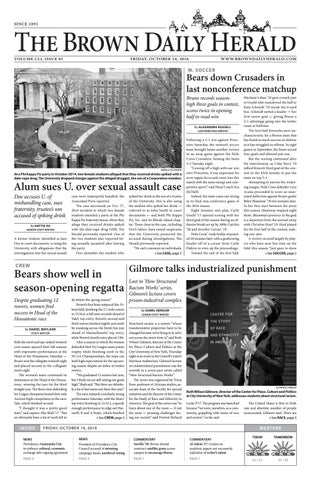
Structural racism is a system “whose transformative properties have to be changed because we’re living in it; we’re not across the street from it,” said Ruth Wilson Gilmore, director of the Center for Place, Culture and Politics at the City University of New York, Thursday night at an event in the Granoff Center’s Martinos Auditorium. Gilmore’s lecture on industrialized punishment was the seventh in a seven-part series called “How Structural Racism Works.” The series was organized by Tricia Rose, professor of Africana studies, associate dean of the faculty for special initiatives and the director of the Center for the Study of Race and Ethnicity in America. The goal of the series was “to learn about one of the most — if not the most — pressing challenges facing our society,” said Provost Richard
ELI WHITE / HERALD
Ruth Wilson Gilmore, director of the Center for Place, Culture and Politics at City University of New York, addresses students about structural racism. Locke P’17. The program was launched because “we were, ourselves, as a community, grappling with issues of race and racism,” Locke said.
The United States is first in both rate and absolute number of people incarcerated, Gilmore said. There are » See RACE, page 3
WEATHER
FRIDAY, OC TOBER 14, 2016
NEWS Providence, Guatemala City to embrace cultural, economic exchange after signing agreement
NEWS President of Providence City Council accused of misusing campaign funds, unethical voting
COMMENTARY Savello ’18: Brown should construct satellite gyms across campus to encourage fitness
COMMENTARY Al-Salem ’17: Grades on academic papers not necessarily indicative of writer’s talent
PAGE 4
PAGE 4
PAGE 7
PAGE 7
TODAY
TOMORROW
61 / 37
61 / 42
NEWS
PAGE 2 • FRIDAY, OCTOBER 14, 2016
» CASE, from page 1 (but) we categorically reject any suggestion that a student’s family connections are ever a factor in our consideration of student conduct cases,” wrote Brian Clark, director of news and editorial development, in an email to The Herald. After bringing the case to the attention of University authorities, Doe submitted blood, urine and hair samples for investigation. Though the urine sample was originally determined to test positive for the drug GHB, it was later deemed inconclusive after the University hired an independent expert to review the test results. Hair samples that Doe provided were studied by an independent company and were found to be inconclusive for evidence of the drug. But this interpretation was called into question because the lab’s work for the University in the past has been called unreliable and misleading by multiple news outlets, The Herald previously reported. The University held three disciplinary hearings: one for Phi Kappa
Psi, one for the student accused of drugging her and one for the student accused of sexually assaulting her. In the hearing for the student accused of sexually assaulting her — referred to as Michael Jones in court documents — the University reached a ruling of not responsible given that Doe’s partial memory of the incident was not considered sufficient to counter Jones’ claim that she provided consent. Doe claims the Student Conduct Board, which assessed the case, “put the burden on Ms. Doe to have consumed just enough of the date-rape drug to both have exhibited obvious symptoms of incapacitation and to remember having exhibited those symptoms; Ms. Doe’s incapacitation was used against her,” according to court documents. Due to lack of physical evidence, the University eventually dropped the investigation and disciplinary charges against the trustee’s son. Doe claims that forensic toxicologists “readily acknowledge that conclusive evidence of drugging is rarely obtained in cases of drug-facilitated sexual assault,” and therefore dropping
THE BROWN DAILY HERALD the case due to a lack of evidence “is a deviation from the standard of care,” according to the court documents. Phi Kappa Psi was originally suspended for four years, though the sanction was later reduced to allow the fraternity to petition the University for recognition after only two years, The Herald previously reported. “The University is confident in the integrity of the process and the decisions that were made,” Clark wrote. The case also claims that Phi Kappa Psi has continued to hold unauthorized events during its sanctions — including rush events — against which “the University failed to take effective corrective measures or take any further disciplinary action,” according to court documents. Doe’s case brings four charges against the University, including the allegations that the University violated Title IX by discriminating against her because of her sex, exhibited negligence and violated Rhode Island law. A fourth request for relief is in regard to retaliation against Doe, which is also in violation of Title IX,
according to court documents. After the very public disciplinary hearings, Doe claims that she was denied an interview with the Alpert Medical School despite receiving interviews from more highly ranked medical schools such as those of Harvard and Stanford University. Doe’s lawyer, Miriam Weizenbaum, also argues in court documents that “University officials refused to accept documentary evidence” demonstrating that Smith ran a fake ID business out of his University mailbox called “I’m 22 Bitch.” The case also brings to light several details regarding the University’s handling of Doe’s case, such as the fact that a staff physician at Health Services advised Doe not to seek treatment for sexually transmitted diseases “because the risks of infection, including HIV, were low on campus,” according to court documents. The student who was allegedly drugged alongside Doe — referred to in court documents as Mary Roe — went to Health Services to have her hair samples harvested by Department of Public Safety Officer Jeanne Peck
for a toxicology analysis. The testing request form for the sample was then allegedly filled out incorrectly by John Carvalho, a patrol sergeant with DPS, according to court documents. Doe also claims that the University failed to support her by providing arrangements for her academic life during the disciplinary proceedings. “Paxson expressed concern to Ms. Doe about the hardships she had endured but declined to intervene with professors on her behalf,” according to court documents. The University refunded $13,900 of Doe’s tuition for that semester — a prorated amount for Oct. 17, 2014 through Dec. 20, 2014. Overall, Doe claims that she had experienced “escalating levels of depression and debilitating anxiety about being in public on campus,” according to court documents. Doe was also “forced to withdraw from her responsibilities as President of the Social Action House,” withdraw from her meal plan to avoid interactions with Phi Kappa Psi members and stop attending classes, according to court documents.
ELI WHITE / HERALD
Mikela Waldman ’18 dribbles the ball up the field in Brown’s 2-1 victory over Holy Cross. The Bears will host Harvard this Saturday at 3:30 p.m.
» SOCCER, from page 1 our depth as a team and how hard everyone has been working,” Etzel said. McNeill echoed this statement. “The win against Holy Cross was a great feat for the team. Anytime you can play a competitive non-conference game in the area it is beneficial for the team because it allows us to try players in different positions, new plays and just hone in on different tactics we might use in conference play. ” With a home game against Harvard coming up Saturday, Etzel was
encouraged by the win. “It’s a great confidence builder going into this weekend,” she said. McNeill also stressed the importance of self-confidence heading into the Ivy matchup. “It is no secret that we have struggled to find the back of the net this year, so scoring three beautiful goals in the run of play surely gives us some confidence going into the Harvard game this weekend,” she said. Bruno will host the Crimson at Stevenson-Pincince Field Saturday at 3:30 p.m.
NEWS
FRIDAY, OCTOBER 14, 2016 • PAGE 3
THE BROWN DAILY HERALD
» RACE, from page 1 about 700 inmates per every one million people in the general population. In addition to the 2.4 million people locked up, there are another seven to eight million people under supervision, she added. There are 65 million people in this country who, because of convictions, are “forbidden from having certain kinds of jobs, and the jobs tend to be the very kinds of jobs that modestly educated people” can have, Gilmore said. Gilmore framed her talk on industrialized punishment into four components: land, labor, capital and legal authority. The first component is “changing the combination of particular kinds of people using particular kinds of land,” she said, referring to the gentrification of both urban and rural spaces. The second component of industrialized punishment is labor, a phenomenon in which waves of “modestly educated people in the prime of life” are cut loose from livable employment when they are imprisoned and are no longer able to support their families. Subsequently, people who are formerly incarcerated are denied eligibility for certain jobs, and the box on job applications asking if someone has been convicted of a felony perpetuates discrimination. The “Ban the Box” movement has gained prominence among student activists. Student demands with regard to the Diversity and Inclusion Action Plan included a request to remove the box from Brown’s application. The third component is capital, meaning the shift in the use of public funds from public schooling and welfare to insidious fortifications for the incarceration system, Gilmore said. The last component for industrialized punishment is the legal authority for the state to organize these systems.
While decisions made by President Lyndon B. Johnson and President Bill Clinton are broadly viewed as responsible for the development of mass incarceration, the “United States criminal justice system is made up of 53 jurisdictions for prisons (and) 3,100 for county jails,” which also have a hand in industrialized punishment, Gilmore said. Each one of these jurisdictions passes and enforces laws that perpetuate the system of mass incarceration. Structural racism also stems from our capitalist system, Gilmore said. Capitalism relies on organized hierarchies, which are linked with racialized thinking, Gilmore said. Gilmore compared the prisonindustrial complex to the militaryindustrial complex in that it requires potential enemies “who must always be fought and can never be vanquished.” There is a vested interest for vendors that supply prisons, as well as for the workers employed by them, to maintain mass incarceration and its revenues. The majority of the money spent on mass incarceration goes to wages and salaries, Gilmore said, adding that it is a service industry that requires mass employment to run. The second greatest expenditure goes toward paying debts, as prisons have been required to expand to meet health and safety standards as the number of inmates grows. While people view private prisons as the biggest beneficiary of mass incarceration, “there are other private corporations that are beneficiaries of the fact that humans — on a scale unprecedented in the world — are locked up in cages,” Gilmore said. Vendors providing food, telephone service, video visits and canteens to prisoners can manipulate prices. Because only authorized dealers can provide these goods, the vendors add huge markups. “Capitalism requires inequality, and racism enshrines inequality,” Gilmore said.
ELI WHITE / HERALD
Members of the 2-V boat of the men’s crew team David Lazris ’17, Viggo Hoite ’18, Peter Wooley ’17 and Rufus Biggs ’19 compete for Bruno. The 2-V boat finished eighth in the Head of the Housatonic regatta.
» CREW, from page 1 the course in 12:34.5 and 12:35.3, respectively. The boat’s time was good enough for second place, but Yale’s top entry grabbed first, finishing a full 15 seconds ahead. “We were expecting for Yale and Harvard to be fast,” said coxswain Benson Stevens ’18. “While we have some work to do to catch up to Yale, it was
good to be ahead of Harvard and to be in the mix in general for the first race of the season.” The Head of the Housatonic allowed Brown to demonstrate its depth, as it placed five boats in the race. Bruno’s B and C boats finished seventh and ninth, respectively, while the D and E boats placed 15th and 22nd, respectively, out of the 25 total entries. “A few of our other boats were able
to beat their respective crew from Harvard and Yale last weekend, which is something we are proud of as a team,” said captain Finn Meeks ’17. “Last week was a starting point. We all know that our job is to keep pushing each other to get faster in practice and get ready to put our bows in front at the Charles.” Brown competes next at the 52nd Head of the Charles Regatta Oct. 22 and 23.
“vigorous, lively performances” - Seattle Times
BLUE HERON
www.browndailyherald.com An ICERM Public Lecture at Brown University
October 16 · 4 PM Why we won’t be able to verify the outcome of the 2016 election Many US election systems are past their prime. Election officials trying to cope with failing voting systems and inadequate funding may consider what they hope are cheaper alternatives, such as Internet voting. Barbara Simons, an expert on electronic voting, will describe how we got to where we are today and what needs to be done to move to an evidence based voting system. She will also discuss some of the false claims made about Internet voting, as well as why Internet voting is a major security threat to our democracy.
Thursday, October 20, 2016 Doors open at 6:00pm, talk begins at 6:30pm Salomon Center at Brown University Free and open to the public. Ticket required. Reserve your seat today: icerm.brown.edu
Ockeghem@600, Concert 4 Missa Ecce ancilla domini ·····
S. Stephen's Church 114 George Street, Providence Doors 3:30 / Student tix: $10
blueheron.org
NEWS
PAGE 4 • FRIDAY, OCTOBER 14, 2016
THE BROWN DAILY HERALD
Providence, Guatemala City sign sister city agreement Mayors Elorza, Arzú focus on promoting trade, cultural exchange between two cities By ANNA KRAMER STAFF WRITER
A visiting delegation from Guatemala City met with Providence officials Wednesday to sign an agreement that will formalize economic and cultural exchange between the two cities. The signing of the agreement on the first day of the summit marked the beginning of intensified efforts to increase trade and cooperation between the now-sister cities. Providence is home to more than 21,000 residents of Guatemalan descent, as well as the Guatemalan Consulate for the New England region, according to Providence Mayor Jorge Elorza and a press release from the mayor’s office. The sister city agreement will allow for Providence to become the natural gateway from Guatemala to New England. “We have a number of cultural and economic ties that already exist,” Elorza said. “We have that foundation, and we want to build off it.” The foreign delegation was led by the mayor of Guatemala City, Álvaro Arzú, who is also the former president of Guatemala and is renowned for his work spearheading the Guatemalan peace process 20 years ago. Efforts for exchange between the two cities will include the pursuit of direct flights between Providence
and Guatemala City and possible increased use of Providence’s port, Elorza said. “We are investing in and looking to expand our port,” he said. Following the official signing ceremony on Wednesday, officials from Providence and the Guatemala delegation met Thursday morning to begin a summit between small businesses in Guatemala City and distributors in Providence. The vendors, many of whom are part of a collective called Guate a Mano, displayed various wares and designs as samples for distributors. Given Providence’s historical textile legacy and the evolution of the textile industry in Guatemala, there are numerous opportunities for craftspeople and designers in Providence and Guatemala City to collaborate, said Stephanie Fortunato, director of the Providence Department of Art, Culture and Tourism. Preserving cultural heritage and promoting sustainability concern the industries in both cities. “We want to start to sell these in the U.S.,” said Claudia Dougherty, one of the founders of grete knitwear, who hails from Guatemala. Grete knitwear currently sells blankets on Amazon and hopes to expand by finding distributors at the summit. “This is a small family business,” Dougherty said. “We have our baby products and our knits, and we know there are many possibilities in Providence and the U.S. for our products.” Through commerce, Providence distributors may augment cultural exchange between Providence and Guatemala.
ELI WHITE / HERALD
Mayor of Guatemala City and former president of Guatemala Álvaro Arzú spoke at the Watson Institute following the newly signed agreement between Providence and Guatemala City, which encourages cultural exchange. “Our company is about producing products that are 100 percent Guatemalan,” said Roberto de la Fuente of Clio’s Food Craft. Clio’s Food Craft products include infused honey, roasted coffee and other regional products. “We’re trying to promote sustainability for rural areas in our country,” he added. The company would like to pursue direct contact with costumers in the United States whenever possible in order to avoid going through trade middlemen. “It’s all about putting Guatemala on the map,” said Augusto Castillo de Ros, a handbag designer for his
brand, Augusto Castillo. “It would be great to find a distributor or someone interested in representing the brand here in the states.” In his opening remarks at the beginning of the summit, Elorza elaborated on the virtues of the educational and culinary systems in Providence. He listed Brown, the Rhode Island School of Design and the College of Culinary Arts at Johnson and Wales University as potential centers for educational exchange. “There’s also a culinary exchange,” Elorza said of the possibility of involving Johnson and Wales. “We have
a strong culinary scene; they have a strong culinary scene.” “There are students already studying both in Providence and Guatemala City,” Fortunato said. “That can be strengthened by engaging more faculty who might have connections in their research and their scholarship.” The summit also includes an archaeology panel Friday at the John Carter Brown Library and a Guatemalan cooking class at Hotel Providence. It will culminate Saturday in an Artisano Expo, a separate event that will allow Guatemala-based businesses to showcase their goods and services.
Prov. council President accused of violating campaign finance regulations Luis Aponte faces accusations regarding personal usage of campaign funds By KYLE BOROWSKI SENIOR STAFF WRITER
Luis Aponte, president of the Providence City Council, stands accused of illegally diverting assets from his campaign fund for personal use, according to a report released by the Rhode Island Board of Elections Sept. 29. The report acknowledges that Aponte reimbursed his campaign account for $15,642 to cover costs that had been incurred. Of the total, $1,729 had been used for personal expenses by Aponte’s ex-wife — Gwendolyn Buckley Andrade — who also currently serves as the treasurer of his campaign. The Attorney General’s office has received the report from the BOE, but Rhode Island Attorney General Peter Kilmartin has not yet reviewed those documents, said Amy Kempe, Kilmartin’s public information officer. It is not yet known whether or not there will be an official investigation, as a review by the attorney general could “take us in
any number of directions that we can’t even start to float,” she added. While there has not been an official charge against Aponte, a statute in Rhode Island General Law states clearly that funds contributed to a political campaign may not have “any use other than expenditures related to gaining or holding public office.” The statute also specifically lists examples of personal use that are prohibited, including “any residential or household items, supplies or expenditures.” The BOE report shows that funds siphoned by Aponte for private use were spent on “groceries and gas as well as iTunes and Netflix charges,” WPRI reported. Representatives of Aponte notified the BOE about possible “inadvertent” expenditures approximately 19 months ago, said Artin Coloian, Aponte’s lawyer. The parties were negotiating a consent decree on the matter before Aponte’s case was forwarded to the attorney general, he added. An agreement of this nature would allow for a settlement without an admission of guilt. “We reimbursed the fund in its entirety,” Coloian said, adding, “We were proactive throughout and cooperated fully with the Board of Elections.” Aponte was under similar scrutiny
ELI WHITE / HERALD
The Attorney General’s office will review a report released by the Rhode Island Board of Elections Sept. 29 accusing Luis Aponte, president of the Providence City Council, of illegally diverting campaign assets. in February when it was revealed that BOE, which resulted in over $47,000 Allegations of impropriety arose in the politician had failed to properly in fines, WPRI previously reported. that case after a Providence man, Allen report a bevy of information regarding Aponte also currently faces an in- Hance, claimed Aponte voted for the his campaign’s finances over the course vestigation by the state Ethics Com- benefit of his own landlord, the leader of five years. In that instance, Aponte mission over a vote on zoning reclas- of a local landlord lobbying group, in neglected to file 25 reports with the sification that took place in April. rezoning a property.
TODAY
FRIDAY, OCTOBER 14, 2016 • PAGE 5
THE BROWN DAILY HERALD
menu
fa l l f e s t a n d f u n f l av o r s
SATELLITE DINING ANDREWS COMMONS
Pizza: Bacon and Feta, Buffalo Chicken, Harvest Sushi Night JOSIAH’S
BLUE ROOM
Lasagna Bowl
Minestrone, Chicken Tortilla Build-Your-Own Burrito Bowl
DINING HALLS SHARPE REFECTORY LUNCH
DINNER
BBQ Chicken Sandwiches, Stir Fried Carrots, Clam Bisque, Pumpkin Cupcakes
Lemon Chicken Thighs, Baked Potatoes, California Veggie Stew, Cream Cheese Brownies
VERNEY-WOOLLEY LUNCH
DINNER
Breaded Chicken Fingers, Seafood Salad, Noodle Bowl Bar, Apple Squares
Grilled Turkey Burgers, Manhattan Clam Chowder, Carribean Rum Cake
sudoku
ELI WHITE / HERALD
The Special Events Committee presented Brown’s annual Fall Fest on Simmons Quad, which featured free fallthemed food, including pumpkin pie, apple cider and corn chowder, and dance and a cappella performances.
Q U O T E O F T H E D AY
“Structural racism … is a system whose transformative properties have to be changed because we’re living in it; crossword
we’re not across the street from it.
”
— Ruth Wilson Gilmore, CUNY director of Center for Place, Culture and Politics
See race on page 1.
calendar FRIDAY
OCTOBER
S
M
T
W
Th
F
S 1
2
3
4
5
6
7
8
9
10
11
12
13
14
15
16
17
18
19
20
21
22
23
24
25
26
27
28
29
30
31
Challah Sale 12:00 P.M. Stephen Robert ’62 Campus Center, Lower Blue Room
Social Innovation Fellowship Info Session 12:00 P.M. Swearer Center
SATURDAY Masterclass Featuring the Neave Trio 10:00 A.M. Grant Recital Hall
A Night in Hollywood: A Ballroom Special 6:00 P.M. Alumnae Hall
SUNDAY Catholic Mass 10:30 A.M. Manning Chapel
Strait Talk Open Space 3:00 P.M. Petteruti Lounge
COMMENTARY PAGE 6 • FRIDAY, OCTOBER 14, 2016
THE BROWN DAILY HERALD
EDITORIAL
Brown Bites Former student brings lawsuit against U., student, Phi Kappa Psi Almost exactly two years after an incident in which two female students were allegedly drugged with the date rape drug GHB, one of the students has filed a lawsuit against the University with allegations that her sexual assault case was improperly handled. The student, identified as Jane Doe in court documents, also reported being sexually assaulted after being drugged, but the University found the accused — referred to as Michael Jones in court documents — not responsible because of Doe’s partial memory of the incident. Now the former student has filed suit against not only the university but also the alleged druggist — whose father is a Corporation trustee — as well as against Phi Kappa Psi Inc., the fraternity to which the druggist belonged, and the organization’s Rhode Island chapter. UCS Besenia Rodriguez ’00, senior associate dean for curriculum and a member of the Task Force on Diversity in the Curriculum, discussed the recommendations of the Task Force on Diversity in the Curriculum at the Undergraduate Council of Students meeting Wednesday night. Liza Cariaga-Lo, vice president for academic development, diversity and inclusion and co-chair of the Diversity and Inclusion Oversight Board, also addressed the recently released Departmental Diversity and Inclusion Action Plans at the meeting. The task force will recommend re-categorizing Diverse Perspectives in Liberal Learning courses to another designation — Race, Power and Privilege. Rodriguez and Cariaga-Lo also discussed training faculty members on diversity and inclusion initiatives and highlighted the DDIAPs from all departments, pointing to the influence of diversity and inclusion in every single curriculum across Brown. Studying domestically The University introduced its first domestic study program this year. The semester-long program will feature a rigorous curriculum and various internship opportunities, according to Mathew Johnson, associate dean for engaged scholarship and director of the Swearer Center. Students will interact with think tanks, governmental and regulatory bodies, development institutions, international organizations, grassroots initiatives and nonprofit organizations, said Allen Hance, director of academic programs at the Swearer Center. Fix America, kids. The heat is on With the changing of the colors of the trees and pumpkin spice and all that nice stuff comes the recruitment of undergraduate juniors and seniors for internships and full-time jobs in the consulting, tech and finance industries. The colder weather also saw students freezing in their rooms in the days before facilities turned the heat on.
D O R O T H Y W I N D HA M
comic Cat Ears | Najatee’ McNeil
Find us online! facebook.com/browndailyherald
browndailyherald.com
@the_herald
Location: 195 Angell St., Providence, R.I. www.browndailyherald.com
@browndailyherald
youtube.com/browndailyherald
Editorial contact: 401-351-3372 herald@browndailyherald.com
Business contact: 401-351-3260 gm@browndailyherald.com
Submissions: The Brown Daily Herald publishes submissions in the form of op-eds and letters to the editor. Op-eds are typically between 750 and 1000 words, though we will consider submissions between 500 and 1200 words. Letters to the editor should be around 250 words. While letters to the editor respond to an article or column that has appeared in The Herald, op-eds usually prompt new discussions on campus or frame new arguments about current discourse. All submissions to The Herald cannot have been previously published elsewhere (in print or online — including personal blogs and social media), and they must be exclusive to The Herald. Submissions must include no more than two individual authors. If there are more than two original authors, The Herald can acknowledge the authors in a statement at the end of the letter or op-ed, but the byline can only include up to two names. The Herald will not publish submissions authored by groups. The Herald does not publish anonymous submissions. If you feel your circumstances prevent you from submitting an op-ed or letter with your name, please email herald@browndailyherald.com to explain your situation.
Editorial Leadership
Sections
Visuals & Production
Business
Editor-in-Chief Emma Jerzyk
Arts & Culture Editors Rebecca Ellis Jaclyn Torres
Design Editors Sonia Geba Nicola Ho Jessica Yu Assistants: Minah Seo, Christy Leung
General Managers Moniyka Sachar Joshua Tartell
Managing Editor Joseph Zappa Senior Editors Andrew Flax Caroline Kelly POST- MAGAZINE Editor-in-Chief Yidi Wu
News Editors Lauren Aratani Matt Brownsword Elena Weissmann Sports Editors Taneil Ruffin COMMENTARY Opinions Editors Margaret Hu Mili Mitra Lainie Rowland
Photo Editors Head: Eli White Sam Berube Marianna McMurdock Copy Desk Chief Julia Stemmer Illustrations Editor Roland High
Directors Business Dev.: Antonia Alvarez Finance: Neil Wathore Finance: Benjamin Wesner Strategy: Abraham Galindo Sales Managers Gaby Elanbeck Maisie Lynton Ari Shusterman Lizzy Doykan Finance Managers Collections: Reena Zhan Collections: Varun Narayan
You can submit op-eds to opinions@browndailyherald.com and letters to letters@browndailyherald.com. When you email your submission, please include (1) your full name, (2) an evening or mobile phone number in case your submission is chosen for publication and (3) any affiliation with Brown University or any institution or organization relevant to the content of your submission. Please send in submissions at least 24 hours in advance of your desired publication date. The Herald only publishes submissions while it is in print. The Herald reserves the right to edit all submissions. If your piece is considered for publication, an editor will contact you to discuss potential changes to your submission. Commentary: The editorial is the majority opinion of the editorial page board of The Brown Daily Herald. The editorial viewpoint does not necessarily reflect the views of The Brown Daily Herald, Inc. Columns, letters and comics reflect the opinions of their authors only. Corrections: The Brown Daily Herald is committed to providing the Brown University community with the most accurate information possible. Corrections may be submitted up to seven calendar days after publication. Advertising: The Brown Daily Herald, Inc. reserves the right to accept or decline any advertisement at its discretion. The Brown Daily Herald, Inc. is a financially independent, nonprofit media organization bringing you The Brown Daily Herald, BlogDailyHerald and Post- Magazine. The Brown Daily Herald has served the Brown University community daily since 1891. It is published Monday through Friday during the academic year, excluding vacations, once during Commencement and once during Orientation by The Brown Daily Herald, Inc. Single copy free for each member of the community. Subscription prices: $280 one year daily, $140 one semester daily. Copyright 2016 by The Brown Daily Herald, Inc. All rights reserved. Periodicals postage paid at Providence, R.I. Postmaster: Please send corrections to P.O. Box 2538, Providence, RI 02906.
COMMENTARY FRIDAY, OCTOBER 14, 2016 • PAGE 7
THE BROWN DAILY HERALD
Make student fitness a priority SAMANTHA SAVELLO staff columnist For many college students, maintaining good health is a top priority and can be difficult to juggle alongside academic and extracurricular commitments. Schools should minimize the barriers preventing students from leading fit and active lives. With Brown’s accessibility issues and limited fitness options, there are significant obstacles to staying fit here, and Brown could do a better job of facilitating healthy lifestyles for students. One obstacle to fitness at the gym is the “bro culture” at the Nelson Fitness Center. For those who do make it to this gym, it can be an intimidating experience, especially when it is filled to capacity, which is quite often. While the cardio and machine sections of the gym are usually populated by people of all fitness levels, the free weights section is largely dominated by experienced male lifters. As someone who is new to fitness and trying to get into lifting or weight training, it can be a daunting task to even get access to a bench — let alone complete a full workout. The unspoken power dynamic between experienced and novice lift-
ers is not only discouraging but also toxic. Still, the Nelson — equipped with state-of-the-art machines and weights— is one of the best gyms in Providence by far. But located on the northern bounds of campus, the modern facility cannot effectively serve Brown’s student body. For
ing workouts. A simple solution to this lack of accessibility would be to create satellite gyms around campus that are well-equipped and user friendly. Right now, aside from the Bear’s Lair, the only other satellite gym is located in Keeney Quadrangle. This gym is newer and better equipped,
Brown could relocate the machines to another centrally located space. Complementing the old machines with newer weights and barbells would significantly improve the experience at a low cost. In addition to offsetting crowding in the other gyms, this could offer students much-needed space to pursue their
With Brown’s accessibility issues and limited fitness options, there are significant obstacles to staying fit here, and Brown could do a better job of facilitating healthy lifestyles for students.
some students, the distance alone is enough to deter them from working out altogether. Others resort to south campus’ Bear’s Lair, a satellite gym with outdated, rusty equipment, grimy carpets, broken cardio machines and a blatant lack of barbells. Unfortunately, this facility constricts students’ fitness experiences given that it can only allow for quick cardio sessions or limited lift-
but it is a small space primarily filled by the first-years who live in Keeney. There used to be a satellite gym next to the Verney-Woolley Dining Hall, but it was recently replaced with a lounge. This gym was never replaced with another fitness facility, and an announcement was never made about its demolition. Perhaps, rather than pretending the V-Dub gym never existed,
fitness goals. In terms of the human support for student fitness, Brown offers personal training classes. But the costs can be prohibitive. The personal training sessions cost $45 for just one hour-long session or $170 for four, which is far from affordable for many Brown students. To combat such problems, some colleges have opted to train and hire
student fitness instructors and personal trainers, which significantly reduces session prices and offers students exciting employment opportunities. Brown could benefit from doing something similar with its fitness resources. Not only would it slash the outrageous personal training prices, but it would also help even out the power dynamic in the gym by opening up opportunities for students experienced in fitness to help those who are looking to learn. Another fitness alternative that Brown offers is studio fitness classes, which have a more affordable membership fee of $45 for a full semester. There are also free yoga sessions offered at Brown/RISD Hillel throughout the week. Increasing the visibility of these events and opportunities could further improve students’ fitness experiences at a low price. Of course, these possible solutions involve trade-offs. Funding does not always come easily. But given the priority placed on health by both students and the administration, the current state of fitness options seems inadequate, and the solutions are within reach.
Samantha Savello ’18 can be found crying in the Bear’s Lair or be reached at samantha_savello@brown.edu.
You’re still a writer if you’re bad at papers SARA AL-SALEM staff columnist Before I arrived at Brown, I used to call myself a writer. Like many others who dabbled in writing, I did not necessarily like my writing style and would throw the occasional pity party, but I still identified as a writer. Now, as a senior, any confidence I may have had as a writer has been tried and tested to the extreme. This is primarily because, at Brown and other colleges, academic writing is generally considered the end-all and be-all of writing as a whole. I am not an academic person. Everything about me, from how I speak during section to how I construct my arguments, is not academic or scholarly. This has always been to my detriment: I often come across as less intellectual than my fellow classmates because I don’t say words like “juxtaposed” and “homogenous” with every other breath. Instead, when I discuss my reaction to a reading or a professor’s argument, I talk like I would to a friend. I hate abstract theories that take three or four reads to understand and hypotheticals that would never actually apply in the real world. I tend to argue in basic terminology
because that’s how my brain processes information. My discomfort with academic writing was compounded by the fact that my high school education involved teachers accepting downloaded Wikipedia articles as essays. As a nonnative English speaker who grew up abroad, I did not have the same training as my peers in the language. I still struggle with grammar because it was never taught to me properly,
I struggle to phrase my opinions in a suitably academic fashion. But I am grateful to have other outlets for my eclectic writing style. As a writer for The Herald and Post-, I never have to force myself to sound smart. I type like I speak, and my editors see this as both a negative and a positive: They may have to tirelessly edit my run-on sentences and grammar mistakes, but at the same time I don’t think my writing is hard to read
At Brown and other colleges, academic writing is generally considered the end-all and be-all of writing as a whole.
and so I feel intense embarrassment when professors point out my errors in papers. I’m not saying I am disillusioned with academic writing because college has made me feel dumb: I am just disappointed that college destroyed my self-confidence as a writer. While I know on a superficial level that no one is equating academic writing to writing as a whole, I can’t help but feel the blow every time
and understand. I would like to think that my writing is accessible and relatable to all readers. Yet I can’t translate those qualities to my papers. When I write passionately for one paper, I receive feedback telling me to be careful about sounding too colloquial. The next time around, in fear of sounding colloquial, I end up writing a paper I do not feel proud of, one that contains just enough academic phrases and syn-
tax to pass. I submit every paper with a wince because I have no idea how my bullshit will be received. While I’ve survived in college thus far, I do not believe the changes in my academic writing reflect my overall growth as a writer. This is ironic considering the WRIT requirement is meant to encourage this very improvement. As a humanities major, my every semester has been filled with paper-heavy WRIT courses, and all I’ve really learned from them is how to make my papers look more academic. I am not arguing that academic writing is useless, or that we should just throw out years of education and conditioning. I am simply using this space to address those who, like me, feel that the feedback on their academic writing has weakened their confidence as a writer. Whatever it is you write, be it prose or poetry, please know that writing encompasses a huge stylistic spectrum with an even wider audience. While your run-on sentences might be frowned upon in an academic paper, remember that there’s some reader out there who likes how those very sentences invoke a sense of excitement and involvement. Just look at James Joyce!
Sara Al-Salem ’17 can be reached at sara_al-salem@brown.edu.
Got something to say? Leave a comment online! Visit www.browndailyherald.com to comment on opinion and editorial content.
SPORTS THE BROWN DAILY HERALD
FRIDAY, OCTOBER 14, 2016
Even-year reality JAMES SCHAPIRO sports columnist As a New York Mets fan, I’m fairly used to picking a new playoff team to root for every October. It’s a simple process, consisting primarily of a weighing of one team’s attributes and shortcomings against those of another. It’s taught me a lot about playoff teams. And it’s also the reason that late Wednesday night, as Aroldis Chapman struck out Brandon Belt to send the Chicago Cubs to the National League Championship Series and eliminate the San Francisco Giants, I was nothing short of thrilled. Outside of the New York Yankees, whom I hate on principle, there are three teams I simply refuse to root for: the Giants, the St. Louis Cardinals and the Kansas City Royals. For interrelated reasons, I can’t stand these teams. I grit my teeth in anger when the Mets have to play them.
I consider them mere annoyances in the otherwise pristine fabric of baseball — through very little fault of their own. If you’re a fan of any team besides the Giants, Cardinals or Royals, you know what I’m talking about. You’ll be playing the Royals, for example, and their leadoff hitter will hit a slow ground ball that trickles through the infield for a single. “They got lucky,” you’ll think, angrily. But on TV, the broadcasters will quickly correct you. “These Royals are relentless,” the play-by-play commentator will say. “Always putting the ball in play.” “Working deep counts, fouling off tough pitches,” the other commentator will chime in. “Then they put the bat on the ball and make things happen.” This is merely an example of a prevalent plague in sports coverage today — one that is irksome beyond words to fans who understand the game and that allows fans who don’t to pretend that they do. That plague is the rise of falsenarrative sports journalism. Besides being beyond irritating for opposing
fans, false-narrative coverage defeats the fundamental point of sports: that the narratives should create themselves spontaneously and play themselves out through competition. It’s also the reason that all three of these teams are on my blacklist. The false narratives surrounding these three teams are largely similar. All are variations on the theme that one team is objectively the best: that one team’s tactics, morals and fan base are superior to all others and that these teams deserve to be showered with unrelenting praise because of it. For the Cardinals, the narrative revolves around the fans. Cardinals fans wholeheartedly believe that they are the best fans in baseball. If you Google “Cardinals best fans,” you’ll find an article claiming that the author has “never … heard a Cardinals fan refer to him or herself as ‘one of the best fans in baseball.’” But just three results down, you’ll find an article entitled, “An open letter to Cubs fans from the best fans in baseball,” written, of course, by a Cardinals fan. The opinion is demonstrably false: The Cardinals have been winning
consistently for more than 50 years, so any argument that Cardinals fans stick with their team during good times and bad has no basis. But the belief persists. The Royals, on the other hand, are “America’s Team,” at least when they’re good. Google “Royals America’s Team,” and you’ll find an article claiming that “you won’t hear the Royals call themselves ‘America’s Team.’” Two results down, you’ll find a post on a Royals fan blog entitled, “The Kansas City Royals are America’s Team.” When the Mets went into Kansas City for the 2015 World Series, the two teams weren’t on equal footing — far from it. The Mets were the big bad bullies from New York trying to stomp on the destiny of the plain, country-boy Royals, who had worked harder than anyone else and been through more trying circumstances than any other team just to reach the World Series. The Mets were Goliath; the Royals were David. Then there are the Giants, whose narrative is similar to the Royals’ but with one extra element. That extra kick, of course, is “even-year magic.”
I prefer a more profane term for it, but the essence remains the same: The Giants won the World Series in 2010, 2012 and 2014 and seemed inevitably poised to do so again this year, before luck finally fell in their opponent’s direction. The Giants’ loss Wednesday night struck a major blow against false-narrative sports coverage, one from which the Giants may not recover. That’s most of the reason I was so happy about it. By ignoring the facts of the game and focusing on things like the Giants’ making the playoffs every other year or the Royals’ deserving to win because they play in Kansas City, sports media outlets detract from the spontaneity that sports embody. Wednesday’s Giants loss won’t end the practice, but it certainly was fun to finally see the Giants lose when they were supposed to win.
James Schapiro ’19 is rooting for the Cubs. He can be reached at james_schapiro@brown.edu.
American heathens TANEIL RUFFIN sports editor Colin Kaepernick is in the news again. It was announced Wednesday that the now-starting quarterback for the San Francisco 49ers has restructured his 2014 contract. The old contract had already given the team significant leverage with a five-year guarantee that only applies if he is injured, but this new contract eliminates the injury provision, allowing the 49ers to cut Kaepernick at any time over the next two years without owing him a cent. Though the new contract could simply be business as usual for the NFL, it is hard to separate the timing of this restructuring from the good deal of grief Kaepernick has caused his team for the first two months of the season. Since Aug. 14, Kaepernick has refused to stand when the national anthem is played before games. Kaepernick has said he began his protest to shed light
on injustices faced by marginalized U.S. citizens, especially African-Americans, who are disproportionately affected by police brutality. According to Kaepernick, “People are dying in vain because this country is not holding (its) end of the bargain up, as far as liberty and justice, liberty to everybody.” While the quarterback’s protest went largely unnoticed during its first two weeks, it has dominated many news cycles since, and not just in sports publications or sports radio shows. Kaepernick’s demonstrations have entered larger national discourse, earning segments in popular cable news shows as well as articles and op-eds in major publications. Many pundits have spoken out to excoriate Kaepernick for an alleged lack of patriotism. In a segment on Fox News Channel’s show “The Five” that aired Sept. 6, show co-host Eric Bolling prompted his four other co-hosts to discuss Kaepernick’s protest. Perhaps the most striking and offensive moment in the brief segment was Bolling’s claim that Kaepernick had converted to Islam. Though Bolling’s co-hosts did not seem
to be familiar with Kaepernick’s conversion, Bolling is not alone in his belief that Kaepernick has recently become a Muslim, as various members of the far-right media and blogosphere have also written conspiracy theories stating that Kaepernick’s protest stems from his identity as a Muslim. Why would anyone contend that Colin Kaepernick — or anyone — is Muslim with the only substantiation being his refusal to honor the national anthem in the traditional way? Bolling’s assertion highlights the Islamophobic sentiment that to be Muslim is to be inherently un-American. Furthermore, conflating one’s religious identity with one’s Americanness undermines the central ideals for which our country strives. It is a commonly held belief that the United States was founded as a nation with religious freedom and tolerance among its core principles. To support these claims, many look to the decisions made by the founding fathers to eliminate language and imagery that explicitly refer to Christianity from federal documents. For example, there is no mention of God or Jesus in the Constitution. But it
is incorrect to assume that all citizens of the early republic subscribed to the idea that the Christian church and state should remain separate institutions because there were no explicit references to Christianity in these federal documents. While there is no mention of God in these federal documents, 12 of the 13 original state constitutions made explicit references to God and Christianity. Furthermore, while there has never been an official religion of the United States, the idea of ethical Christianity has impacted the laws and morals of the United States since the days of the early republic. Just as early Americans were hypocritical and selective in their application of religious tolerance and freedom, the Islamophobic criticism of Kaepernick’s protest evidences the paradoxical nature of being an American. While religious tolerance is a central pillar of U.S. government, American history is littered with violations of that principle. These definitions of American identity have historically been used to exclude and oppress non-Protestant religious identities. For example, Chinese immigrants were deemed
un-American and denied citizenship with the passage of the Chinese Exclusion Act amid growing fear of Eastern religions by white Americans. A prominent advocate for the Chinese Exclusion Act, Senator James G. Blaine, wrote that the Chinese “reek with impurity” and were “sowing the seeds of moral and physical disease.” Critics said Kaepernick had converted to Islam because his beliefs and the actions he has taken are considered to be un-American, and Americanness is perceived by many as inextricable from Christianity. Assuming Kaepernick is a Muslim is in line with the same sentiments that led to the legal codification of antiChinese discrimination and other hypocritical applications of religious freedom throughout U.S. history. While the language that is used may be different — heathen versus Muslim — the message that is being conveyed is the same.
Taneil Ruffin ’17 can be reached at taneil_ruffin@brown.edu.