SINCE 1891
THE BROWN DAILY HERALD TUESDAY, OCTOBER 4, 2016
VOLUME CLI, ISSUE 78
WWW.BROWNDAILYHERALD.COM
New syllabus criteria draw mixed feelings Amid reaccreditation process, U. requires faculty to list hours of coursework expected on syllabi By JULIE CENTER SENIOR STAFF WRITER
ELI WHITE / HERALD
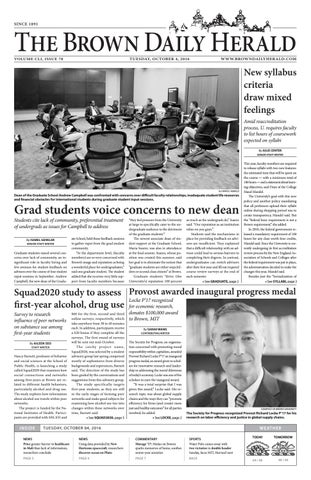
Dean of the Graduate School Andrew Campbell was confronted with concerns over difficult faculty relationships, inadequate student life resources and financial obstacles for international students during graduate student input sessions.
Grad students voice concerns to new dean
Students cite lack of community, preferential treatment of undergrads as issues for Campbell to address By ISABEL GENSLER SENIOR STAFF WRITER
Graduate students raised several concerns over lack of community, an insignificant role in faculty hiring and few avenues for student feedback on advisors over the course of four student input sessions in September. Andrew Campbell, the new dean of the Gradu-
ate School, held these feedback sessions to gather input from the grad student community. “At the department level, (faculty members) are so very concerned with Brown’s image and reputation as being a wonderful place for undergraduates,” said one graduate student. The student added that she receives very little support from faculty members because
“they feel pressure from the University at large to specifically cater to the undergraduate audience to the detriment of the graduate students.” The newest associate dean of student support at the Graduate School, Maria Suarez, was also in attendance at the final session. Suarez, whose position was created this summer, said her goal is to eliminate the notion that “graduate students are either stepchildren or second-class citizens” at Brown. Graduate students “drive (the University’s) reputation 100 percent
as much as the undergrads do,” Suarez said. “Our reputation as an institution relies on you guys.” Students said the mechanisms in place for providing feedback on advisors are insufficient. They explained that a difficult relationship with an advisor could lead to serious barriers to completing their degrees. In contrast, undergraduates can switch advisors after their first year and fill out required course review surveys at the end of each semester. » See GRADUATE, page 2
This year, faculty members are required to release syllabi with two new features: the estimated time that will be spent on the course — with a minimum total of 180 hours — and a statement about learning objectives, said Dean of the College Maud Mandel. The University’s goal with this new policy and another policy mandating that all professors upload their syllabi online during shopping period was to create transparency, Mandel said. But the “federal hour requirement is not a Brown requirement,” she added. In 2010, the federal government released a mandatory requirement of 180 hours for any class worth four credits, Mandel said. Since the University is currently undergoing its first accreditation review process by the New England Association of Schools and Colleges after the federal requirement was put in place, the administration decided to make the changes this year, Mandel said. Besides just the “formalization of » See SYLLABI, page 2
Squad2020 study to assess Provost awarded inaugural progress medal Locke P’17 recognized first-year alcohol, drug use for economic research, Survey to research influence of peer networks on substance use among first-year students By AILEEN SEO STAFF WRITER
Nancy Barnett, professor of behavior and social sciences at the School of Public Health, is launching a study called Squad2020 that examines how social connections and networks among first-years at Brown are related to different health behaviors, particularly alcohol and drug use. The study explores how information about alcohol use travels within peer networks. The project is funded by the National Institutes of Health. Participants are provided with $50, $55 and
INSIDE
$60 for the first, second and third online surveys, respectively, which take anywhere from 30 to 40 minutes each. In addition, participants receive a $20 bonus if they complete all the surveys. The first round of surveys will be sent out mid-October. The catchy project name, Squad2020, was selected by a student advisory group last spring comprised mostly of sophomores from diverse backgrounds and experiences, Barnett said. The direction of the study has been guided by the conversations and suggestions from this advisory group. The study specifically targets first-year students, as they are still in the early stages of forming peer networks and make good subjects for examining how alcohol use ties into changes within these networks over time, Barnett said. » See SQUAD2020, page 3
donates $100,000 award to Brown, MIT By SARAH WANG CONTRIBUTING WRITER
The Society for Progress, an organization concerned with promoting moral responsibility within capitalism, awarded Provost Richard Locke P’17 an inaugural progress medal, an award given to scholars for innovative research and leadership in addressing the moral dilemmas of today’s economy. Locke was one of five scholars to earn the inaugural award. “It was a total surprise that I was given this award,” Locke said. His research topic was about global supply chains and the ways they can “promote efficiency for firms (and create) more just and healthy outcomes” for all parties involved, he added. » See LOCKE, page 2
COURTESY OF BROWN UNIVERSITY
The Society for Progress recognized Provost Richard Locke P’17 for his research on labor efficiency and justice in global supply chains.
WEATHER
TUESDAY, OC TOBER 04, 2016
NEWS Price greater barrier to healthcare in Mali than lack of information, researchers conclude
NEWS Using data provided by New Horizons spacecraft, researchers discover ocean on Pluto
COMMENTARY Murage ’17: Mufao on Bowen sparks memories of home, soothes senior-year anxieties
SPORTS Water Polo comes away with two victories in double header Sunday, faces MIT, Harvard next
PAGE 3
PAGE 4
PAGE 7
BACK
TODAY
TOMORROW
64 / 48
66 / 46
NEWS
PAGE 2 • TUESDAY, OCTOBER 04, 2016
THE BROWN DAILY HERALD
ELI WHITE / HERALD
Faculty members are now required to list a course’s expected time commitment on the syllabus. Some faculty members have taken issue with the policy, noting that students learn and complete work at different rates. On the other hand, Dean of the College Maud Mandel said her office has received a great deal of positive feedback.
» SYLLABI, from page 1 something that already existed,” the new measure also responds to student demand for more syllabi online, Mandel said. While only about one third of faculty members uploaded a syllabus to Canvas before the requirement, 85 percent did this year, with a goal of 100 percent in the future, Mandel said. Faculty members have mixed feelings about the new syllabus requirement. While Ross Cheit, professor of international and public affairs and professor of political science, understands the need to think more systematically about learning goals, he does not approve of the idea of putting specific hour limits
» LOCKE, from page 1 Locke’s past research on this topic included visiting 150 factories in 10 different countries, conducting 800 interviews and analyzing hundreds of thousands of documents. According to Subramanian Rangan, a member of the Society for Progress medal committee, Locke was a clear choice for the award due to his careful, rigorous and balanced research on many aspects of labor efficiency and justice in global supply chains — an issue that is becoming more and more significant.
for activities such as reading and preparing for an exam, which could differ by student, he said. “The idea of doing that contradicts everything we know about learning — which is that people do it differently.” Stefano Bloch, postdoctoral senior research associate in urban studies, also expressed concerns about different learning rates. “Students come with different types of literacy in terms of the knowledge that they bring to an assignment,” he said. “The different levels of literacy can mean that some students will take longer than others.” Bloch said he does not think the requirement is a detriment to the class as long as students understand that the class
syllabus is “a living document” subject to change. But if students take longer than the expected time listed, he doesn’t want them to think they are “failing to accomplish the goal in the proper amount of time,” he added. “How long will it take to do an assignment that should take five hours? I think sometimes it could take the rest of your life,” Bloch said. Mandel said the 180 hours of class time is a minimum requirement for the amount of time “the ideal student” should commit to a given course. The requirement is designed to make faculty members dissect the assumptions they make about how much work students must devote to the class to master the
course material, she added. Cheit said the requirement would have been better if the University had “more foresight.” Faculty members were sent an email in early August that first introduced the requirements and declared the revised syllabi were due August 31, he said. The email also included events intended to help faculty members map out the new hour requirement, but one took place Sept. 13 — after the deadline — Cheit said. “I feel like this came down from above,” Cheit said. Since faculty members scrambled to come up with a time scheme that would reach 180 hours, the number became a fictional redundancy, he added.
“I understand the motivation is to try to establish to the outside accreditation people that all of our courses that are weighted equivalently take the same amount of time, but if the exercise is just that everyone came up with a way for their courses to have 180 (hours), that’s a little problematic,” he added. But to Bloch, the hour estimations should be taken with a grain of salt. “The hours are average ranges for a typical student, and I’ve not known many students at Brown to be typical. I mean that in a very positive way,” Bloch said. The Office of the Dean of the College has received a lot of positive feedback from students about having syllabi available online, Mandel said.
Locke is “somebody that we are very proud to award this inaugural progress medal to,” Rangan said. The society also awarded $100,000 to each winner of the Progress Medal, which Locke has already given to endow an undergraduate scholarship both at Brown and the Massachusetts Institute of Technology, where he earned his Ph.D and taught for multiple decades. Moving forward, Locke said he plans to see how he can promote his ideas so that firms implement them. The ultimate goal is to reform capitalism to be more effective but also more just, Locke said.
Though his research had no direct link to the University, Locke sees a connection between his work and the University’s Diversity and Inclusion Action Plan. “I feel fortunate to be working at Brown right now in this moment that we, as a community, are pushing forward with all sorts of programs to enhance diversity,” Locke said. Rangan hopes the creation of the progress medals will encourage other scholars to prioritize integrating moral causes into their business-related research.
» GRADUATE, from page 1
On the topic of community building, Taka Kanaya GS said, “Foremost, we need a place to gather to nurture camaraderie,” adding that the Universiy is “a little behind in terms of grad student activities” compared to other institutions with which he has experience The process of fostering a strong grad school community across disciplines needs to start at the department level, Suarez said, adding that she is currently meeting with the heads of each department to work toward this goal. Another issue raised concerning student life was that, while the Student Activities Office encompasses graduate students, undergraduate leaders of clubs do not always adhere to this policy. Graduate students are faced with obstacles in joining on-campus clubs, said one graduate student. “I tried to find a co-op, or I tried to live in West House or find some sort of community to grab onto not knowing anyone here,” but was consistently met with “‘no, this is for undergraduates only,’” she said. Campbell hopes “to build deeper connections between graduate students and other student groups,” he wrote. The College, the Grad School and Campus Life need to continue working together to meet “the need to build community, collaborative relationships and mentoring relationships,” Campbell wrote.
In terms of faculty hiring and tenure, graduate students said that while they spend the most time with faculty members, they do not have the opportunity to weigh in on these processes. When faculty candidates visit campus, students have “the opportunity to meet with the prospective faculty formally to discuss their work … (and) are often asked for their assessment of the candidates by the search committee,” Campbell wrote in an email to The Herald. Another concern raised at the input session was that international students do not receive enough support for the unique challenges they face. Thirty-eight percent of graduate students are international students, and international students account for 40 percent of this year’s incoming class. Some challenges for international students may include a language barrier and acquiring visas for them and dependents, Campbell said at the session. “Financially, life can get hard,” said one international graduate student from Canada whose wife moved with him to Providence. While graduate students receive F1 visas that enable them to be paid by the University, spouses receive F2 visas, which do not enable them to be gainfully employed. “We had times we could not afford health insurance, even with Obamacare,” the student said.
NEWS
TUESDAY, OCTOBER 04, 2016 • PAGE 3
THE BROWN DAILY HERALD
Inside Higher Ed BY MATT BROWNSWORD, NEWS EDITOR
Harvard and its endowment Harvard reported a $2 billion loss on its endowment, a steep drop for the nation’s richest university, according to an article published in the Chronicle of Higher Education. Though Harvard still commands an endowment of $35.7 billion, the university received sharp criticism and hired N.P. Narvekar from Columbia to take over the fund’s curation. Narvekar managed Columbia’s endowment, which has posted annual returns of 10 percent or more for 14 years, according to an article published in the New York Times. Narvekar will become Harvard’s fourth endowment manager in just over 10 years. His tenure follows that of Stephen Blyth, who resigned in July after about a year and a half on the job.
CUNY access bolstered for lowincome NYC applicants COURTESY OF ANJA SAUTMANN
University researchers found in a study that lowering the cost of doctor’s visits did not lead to the overuse of healthcare. Underuse was found to be a much more rampant issue that could be amerliorated by subsidies.
Cost primary barrier to healthcare in Mali Researchers find that subsidies, not informational visits, increase use of resources By ELENA RENKEN SENIOR STAFF WRITER
A paper published this summer by University researchers concluded that, in Mali, price is a more significant barrier to healthcare than a lack of information. Researchers offered both subsidies and informational health worker visits to a population of 1,544 Malian children and found that the former resulted in a much broader use of healthcare resources while the latter had minimal effects. Even with subsidies that drastically reduced costs, 70 percent of cases that warranted care in the sample of Malian children were not brought into a doctor — a sign that there is still much work to be done on making healthcare accessible in the region. The research was unusual in that it implemented a model of care-seeking that focused on time dynamics in order to determine whether existing resources are being underused or overused, said Kelsey Jack, assistant professor of economics at Tufts University. “Seeking treatment at the right time is really important, both from a policy standpoint and a household welfare standpoint.” Going to the doctor too soon
» SQUAD2020, from page 1 “We know that (peers) become more important than parents as a source of information and a source for modeling,” Barnett said. “Peers are the most influential when it comes to health-related topics. Social networks allow us to study those connections.” Smaller-scale studies held in past years were used to help identify and develop the methods and scientific questions that are being explored in Squad2020. One such study entailed a cross-sectional examination of students in two dorms on campus and
constitutes overuse because the visit may be unnecessary. “Children often have a cold or a little bit of fever or diarrhea,” wrote Anja Sautmann, lead author of the study and assistant professor of economics, in an email to The Herald. “It’s making them and probably the parent very cranky, but it is a harmless infection that will pass on its own.” On the other hand, waiting too long to see a doctor while symptoms continue or worsen could deprive the child of necessary treatment. That would be considered underuse of healthcare, she added. In offering the study’s population subsidized care while assessing time dynamics, the researchers sought to establish whether increased financial resources for care would lead to overuse. Policy makers are often worried that subsidies lead people to waste resources and that people are not sufficiently well informed to know when they should visit the doctor, Sautmann wrote. “We don’t know what happens when you extend these kinds of subsidies to large populations,” said Jishnu Das, a lead economist at the World Bank, adding that subsidizing an entire city might have very different effects. “There is a big difference between experiment and policy.” Two things influence when people go to the doctor, said Mark Dean, assistant professor of economics at Columbia: how much a doctor’s visit costs and how well people can diagnose themselves.
Some see the provision of financial and informational resources as a delicate balance because cheap healthcare could result in uninformed overuse, but disseminating information does not make doctor’s visits affordable. But the study’s results showed that concerns about overuse given additional resources do not “hold true,” Sautmann wrote. Without intervention by the researchers, overuse of healthcare was found to be very uncommon. “The children in our sample see a doctor in only about 3 percent of illness spells where the symptoms do not indicate a need for care,” Sautmann wrote. But “underuse is rampant,” Sautmann added. Of the cases that warranted seeing a doctor, only 11 percent sought care. With subsidies, there was much greater demand for healthcare — an increase of almost 300 percent. “This increase is much stronger on days when care is required than when it is still too early,” Sautmann wrote, adding that this data suggests parents already know when medical attention is required. Informational visits from healthcare workers did little to lessen overuse and did not remedy underuse. “These people have a pretty good idea about when they should be taking kids to the doctor. It’s just that it’s too expensive to do so,” Dean said. “The barrier to efficient use of healthcare is monetary, not informational.”
the relationships between network ties and substance use. In comparison, Squad2020 is a longitudinal study on a much larger scale offering answers to many more questions, Barnett added. Matthew Meisel, a postdoctoral research fellow working on the project, said he worked on similar studies on a more modest scale during his years of graduate work. “I did some smaller-scale social network studies, but this is really exciting because we are trying to recruit the whole entire first-year class,” Meisel said.
The study has a large presence on social media, including a Facebook page and Twitter account. The accounts are used to advertise student sign-ups through booths on campus. Barnett attributes this heavy social media presence to the need for “as many people in the network observed as possible.” The enrollment campaign was launched with the goal of recruiting 80 to 85 percent of the Class of 2020. So far, the project has 1,132 participants, Barnett said, which is about 67 percent of the class. Hannah Montoya ’19, a public health concentrator and one of
The City University of New York announced Monday that it would allow New York City public school students from low-income families to apply for free, waiving the $65 fee, according to an article in the New York Times. New York City estimated that the change will help about 37,500 families, as over half the city’s public school students who go on to college attend CUNY schools. “I want to remind you that $65 is a lot of money for many families in New York City,” said Mayor Bill de Blasio at a news conference at Franklin Delano Roosevelt High School in Brooklyn, the Times reported. “Sixty-five dollars matters. So for our young people and their families, knowing that that fee is eliminated just clears the way.” The move marks a transition from CUNY’s prior policy of allowing only students with the greatest need to apply for free; now, students who receive federal assistance through free or reducedprice lunch, who are homeless or in foster care, whose families live in federally subsidized public housing or receive public assistance will automatically be able to waive the fee. “The move is part of the de Blasio administration’s effort to improve college access for city students,” according to the article. Previously, the New York City Education Department has taken middle school students on college trips. This year, the SAT will be offered for free and on weekdays for students who would have been discouraged by the cost or its usual weekend morning time slot.
Not supreme enough The Supreme Court will not hear two cases related to the NCAA’s amateurism model and compensation for college athletes, according to an article published in the Chronicle of Higher Education. One of the cases was brought by Edward O’Bannon, a former basketball player at the University of California at Los Angeles. Two years ago, a judge ruled that the NCAA’s player rules violated antitrust laws. The judge ruled that the NCAA could cap its compensation limits but at no less than $5,000 a year and that colleges “could not conspire to set prices,” according to an article published in the Chronicle of Higher Education in August 2014. Last year, a federal appeals court upheld the judge’s antitrust ruling while rejecting the ruling that said colleges should be allowed to cap player payment at more than $5,000. After O’Bannon and the NCAA both asked the Supreme Court to hear their appeals, the court said Monday that it would not take the cases. Squad2020’s student research assistants, helps with the enrollment campaign and provides the research team with a unique perspective on undergraduate and first-year life. “Being a sophomore and having just completed my first year here, I thought that I could play an important role in advising our research team on the first-year experience and the best ways to ensure the study will be worthwhile and successful,” Montoya said. “The other student research assistants and I help to make sure that the work we do is respectful and in the best interest of the first-year
class.” The study’s results are projected to be released in spring 2018, following analysis of the data. Barnett said the studies are useful for understanding peer networks and alcohol use as well as for the students participating in the surveys. “Students can learn about themselves in any survey that they take,” Barnett said. “It makes you reflect on your own thoughts and behaviors. Students who take this survey can know that they are contributing to something important that will be informative.”
Follow Sports! twitter.com/bdh_sports
NEWS
PAGE 4 • TUESDAY, OCTOBER 04, 2016
THE BROWN DAILY HERALD
COURTESY OF NASA
A research team led by Brandon Johnson, assistant professor of Earth, environmental and planetary sciences, connected data from the New Horizons spacecraft with scientific models to discover a basin on Pluto’s surface with a positive mass anomaly. The team then deduced that a denser material, like liquid, must be below the surface.
U. researchers discover ocean beneath Pluto’s surface Using impact models, spacecraft data, researchers estimate a depth of 100 km, salinity of 30 percent By JONATHAN DOUGLAS CONTRIBUTING WRITER
Earth is not the only planetary body with an ocean in our solar system, according to a new study released by a team led by Brandon Johnson, assistant professor of Earth, environmental and planetary sciences. Using data recently collected by the New Horizons spacecraft and models simulating the dwarf planet’s conditions, the team discovered that an ocean over 100 kilometers deep exists beneath Pluto’s surface, with a salinity far above that
of most oceans on Earth. The New Horizons spacecraft collected data in 2015 indicating that the Sputnik Planum basin, a large icy plain on Pluto’s surface, was tidally locked with Pluto’s moon Charon, suggesting the basin has a positive mass anomaly. Basins usually have less mass than the surface as a whole, Johnson said, unless a denser material, such as a liquid, lurked underneath the surface. Though the basin is partially filled in by nitrogen ice, only a denser material — like water — would fully explain the mass, he said.
Johnson assembled a team of scientists from the University of Chicago and Purdue University. Using models based on the amount of water, the salinity of the water and the impact of the meteor that created the basin, the team made predictions about the water underneath the basin. The team ultimately determined that an ocean with a depth of slightly more than 100 kilometers and a salinity of 30 percent could explain the positive mass anomaly. The models that Johnson built are becoming increasingly more important in the field of planetary science, said Christian Huber, assistant professor of Earth, environmental and
planetary sciences. The models are “significant because we only have a few ways to probe other planets,” he added. The models allow scientists to study difficult-to-reach bodies in an in-depth manner, expanding the field of planetary science as a whole. Johnson, who has used impact modelling to research planetary bodies in previous studies, became inspired when the data from New Horizons was first released and was then followed by supporting evidence from tectonic and thermal studies of Pluto. Johnson was able to draw from his previous models, though the new parameters of Pluto’s surface posed a unique challenge to the
team. Johnson said one of the more surprising aspects of the study was the tradeoff between the mass of the ocean and its salinity, since salt content affects the density of the water. James Head PhD’69, professor of geological sciences, called Johnson’s work “very creative and innovative,” adding that the study “raises the possibility that these nurseries for life could be all over the place.” While the discovery of the ocean is certainly significant, much remains to be discovered about Pluto, Johnson said, adding that he plans to continue researching the evolution of the basin and modelling how nitrogen ice within the basin has evolved.
TODAY
TUESDAY, OCTOBER 04, 2016 • PAGE 5
THE BROWN DAILY HERALD
c o l d - b r e w e d c o f f e e o n a wa r m fa l l d ay
menu SATELLITE DINING ANDREWS COMMONS
Pizza: Bacon Chicken Ranch, Pepperoni and Meatball Chipotle Chicken Tacos JOSIAH’S
BLUE ROOM
Make-Your-Own Quesadillas
Turkey Sausage and Kale Soup Chicken Tikka Masala
DINING HALLS SHARPE REFECTORY LUNCH
DINNER
Cajun Turkey Cutlet, Mashed Butternut Squash, Chocolate Banana Cupcake
Turkey Tacos, Roasted Herb Potatoes, Creamy Capellini with Broccoli, Apple Squares
VERNEY-WOOLLEY LUNCH
DINNER
Chicken Gumbo Soup, Bacon Ranch Chicken Sandwich, Grilled Caribbean Jerk Chicken
Ziti Pasta, Roasted Brussel Sprouts, Stir Fried Tofu, Pumpkin Cream Cheese Roll
sudoku
HUAYU OUYANG / HERALD
On the first pleasant day in a week, the Nitro Cart serves cold-brewed coffee, apple cider and doughnuts to customers outside of the Metcalf Research Building on Waterman Street.
Q U O T E O F T H E D AY
“I feel like this came down from above.” — Ross Cheit, professor of international and public affairs and political science
RELEASE DATE– Thursday, October 4, 2012
Los Angeles Times Puzzle c r o sDaily s w oCrossword rd
See syllabi on page 1.
Edited by Rich Norris and Joyce Nichols Lewis
ACROSS 1 They sit at stands 5 Check out with nefarious intent 9 Gyneco-’s opposite 14 Really cruel guy 15 ABA member 16 Man-trap 17 Grievously wound 18 Approach 19 Thirteenth Amendment beneficiary 20 Game with a windmill, usually 23 “__ takers?” 24 Big shots 25 Requiring an adult escort 28 Big London attraction? 29 Handy set 30 Former despot Amin 31 Uncle Remus rogue 36 Big butte 37 Bootcut Skinny brand 38 PC interconnection 39 Like proofed dough 40 Dueler’s choice 41 Insect honored on a 1999 U.S. postage stamp 43 Make a booboo 44 __ Lingus 45 Article in Der Spiegel 46 Not at all out of the question 48 “Shucks!” 50 Friend of François 53 Literally meaning “driving enjoyment,” slogan once used by the maker of the ends of 20-, 31- and 41Across 56 Popular household fish 58 Princess with an earmuff-like hair style 59 Lose color 60 “If __ Would Leave You” 61 Sea decimated by Soviet irrigation projects
62 Done 63 Removal of govt. restrictions 64 Lucie’s dad 65 Boarding pass datum DOWN 1 “I, Claudius” feature 2 Piano teacher’s command 3 Like pickle juice 4 Big rig 5 Ensenada bar 6 Devoured 7 Headlines 8 Rochester’s love 9 Categorize 10 Nabisco cookie brand 11 Most in need of insulation 12 Gun 13 Individual 21 Declares 22 Spunk 26 Four-wheeled flop 27 Title name in Mellencamp’s “little ditty” 28 Runny fromage 29 Powerful pair of checkers
31 Run, as colors 32 Copy, for short 33 Eternally 34 Get fuzzy 35 Prohibition 36 Appearance 39 Run the country 41 Antelope playmate 42 Language of South Asia 44 Secretary of state after Ed Muskie
47 Support for practicing pliés 48 Farmers’ John 49 Diva specialties 50 Sonoran succulent 51 Jason’s jilted wife 52 Like helium 54 “Impaler” of Romanian history 55 Sci-fi staples 56 Rocker Nugent 57 Night before
ANSWER TO PREVIOUS PUZZLE:
xwordeditor@aol.com
calendar
10/04/12
TODAY
OCTOBER
S
M
T
W
Th
F
S 1
By Donna S. Levin (c)2012 Tribune Media Services, Inc.
10/04/12
2
3
4
5
6
7
8
9
10
11
12
13
14
15
16
17
18
19
20
21
22
23
24
25
26
27
28
29
30
31
Rosh Hashanah Services and Lunch 9:00 A.M. Hillel
Effective Class Presentations 12:00 P.M. J. Walter Wilson, 203
Study Abroad 101 General Info Session 4:00 P.M. J Walter Wilson, 440
BCSC Arts and Crafts Night 8:00 P.M. Brown Center for Students of Color, Formal Lounge 1
TOMORROW Brown Dining Farmer’s Market 11:00 A.M. Sciences Park
Black Power and Oral History 12:00 P.M. Center for the Study of Slavery and Justice
Inside Money: Managing Income and Debt 12:00 P.M. Petteruti Lounge
How to Find and Fund an Internship 6:00 P.M. Salomon Center, 001
COMMENTARY PAGE 6 • TUESDAY, OCTOBER 04, 2016
THE BROWN DAILY HERALD
Letters, please! letters@browndailyherald.com P IA M I L E A F- PAT E L
Find us online! facebook.com/browndailyherald
browndailyherald.com
@the_herald
Location: 195 Angell St., Providence, R.I. www.browndailyherald.com
@browndailyherald
youtube.com/browndailyherald
Editorial contact: 401-351-3372 herald@browndailyherald.com
Business contact: 401-351-3260 gm@browndailyherald.com
Submissions: The Brown Daily Herald publishes submissions in the form of op-eds and letters to the editor. Op-eds are typically between 750 and 1000 words, though we will consider submissions between 500 and 1200 words. Letters to the editor should be around 250 words. While letters to the editor respond to an article or column that has appeared in The Herald, op-eds usually prompt new discussions on campus or frame new arguments about current discourse. All submissions to The Herald cannot have been previously published elsewhere (in print or online — including personal blogs and social media), and they must be exclusive to The Herald. Submissions must include no more than two individual authors. If there are more than two original authors, The Herald can acknowledge the authors in a statement at the end of the letter or op-ed, but the byline can only include up to two names. The Herald will not publish submissions authored by groups. The Herald does not publish anonymous submissions. If you feel your circumstances prevent you from submitting an op-ed or letter with your name, please email herald@browndailyherald.com to explain your situation.
Editorial Leadership
Sections
Visuals & Production
Business
Editor-in-Chief Emma Jerzyk
Arts & Culture Editors Rebecca Ellis Jaclyn Torres
Design Editors Sonia Geba Nicola Ho Jessica Yu Assistants: Minah Seo, Christy Leung
General Managers Moniyka Sachar Joshua Tartell
Managing Editor Joseph Zappa Senior Editors Andrew Flax Caroline Kelly POST- MAGAZINE Editor-in-Chief Yidi Wu
News Editors Lauren Aratani Matt Brownsword Elena Weissmann Sports Editors Taneil Ruffin COMMENTARY Opinions Editors Margaret Hu Mili Mitra Lainie Rowland
Photo Editors Head: Eli White Sam Berube Marianna McMurdock Copy Desk Chief Julia Stemmer Illustrations Editor Roland High
Directors Business Dev.: Antonia Alvarez Finance: Neil Wathore Finance: Benjamin Wesner Strategy: Abraham Galindo Sales Managers Gaby Elanbeck Maisie Lynton Ari Shusterman Lizzy Doykan Finance Managers Collections: Reena Zhan Collections: Varun Narayan
You can submit op-eds to opinions@browndailyherald.com and letters to letters@browndailyherald.com. When you email your submission, please include (1) your full name, (2) an evening or mobile phone number in case your submission is chosen for publication and (3) any affiliation with Brown University or any institution or organization relevant to the content of your submission. Please send in submissions at least 24 hours in advance of your desired publication date. The Herald only publishes submissions while it is in print. The Herald reserves the right to edit all submissions. If your piece is considered for publication, an editor will contact you to discuss potential changes to your submission. Commentary: The editorial is the majority opinion of the editorial page board of The Brown Daily Herald. The editorial viewpoint does not necessarily reflect the views of The Brown Daily Herald, Inc. Columns, letters and comics reflect the opinions of their authors only. Corrections: The Brown Daily Herald is committed to providing the Brown University community with the most accurate information possible. Corrections may be submitted up to seven calendar days after publication. Advertising: The Brown Daily Herald, Inc. reserves the right to accept or decline any advertisement at its discretion. The Brown Daily Herald, Inc. is a financially independent, nonprofit media organization bringing you The Brown Daily Herald, BlogDailyHerald and Post- Magazine. The Brown Daily Herald has served the Brown University community daily since 1891. It is published Monday through Friday during the academic year, excluding vacations, once during Commencement and once during Orientation by The Brown Daily Herald, Inc. Single copy free for each member of the community. Subscription prices: $280 one year daily, $140 one semester daily. Copyright 2016 by The Brown Daily Herald, Inc. All rights reserved. Periodicals postage paid at Providence, R.I. Postmaster: Please send corrections to P.O. Box 2538, Providence, RI 02906.
COMMENTARY TUESDAY, OCTOBER 04, 2016 • PAGE 7
THE BROWN DAILY HERALD
The tree on Bowen Street DANIEL MURAGE
OP-ED CONTRIBUTOR Being more than 7,000 miles away from home, it is rare to find anything on College Hill that closely relates to Kangaita, Kenya. It is even more unlikely to come across something around College Hill that would also occur naturally in Kangaita — apart from the “touristy” paraphernalia some of us hang on our walls. So I was very surprised when I was walking to the Nelson Fitness Center right near the intersection of Bowen Street and Brook Street and I came across a tree. Not just any tree, but a mufao! Now, under normal circumstances, trees neither catch my attention nor attract me in any particular way. (Though I must admit that seeing the leaves change colors during this time of the year does appeal to my romantic side.) And yet, this mufao caught my attention because it brought back memories of home and reminded me of my current status as a senior. I am from Kangaita, a rural area on the slopes of Mount Kenya. Kangaita is so beautiful, strewn with mufaos and grass that is so perfect that only grass grown alongside tea bushes can ever be that green. Skies take on varying shades of blue and red, and the weather is so varied that you forget you are living right along
the equator. You will not find photos of Kangaita on National Geographic or in travel magazines, for tourists have (luckily) not visited this area. But it is too bad that no one gets to see the beauty of Kangaita except the people who live there. A mufao is what we call this specific tree back in Kangaita. I would provide the English name for it here, but I am afraid such a word would not capture the godly persona we
its bark and eventually fall off, like a snake shedding its skin. In Kangaita, when you are born, your parents plant a mufao, sometimes two or three of them. It takes a mufao about 20 to 50 years to mature, depending on how well you take care of it — weed it, water it, cut down the branches on its sides and apply fertilizer or manure to its soil. When you are 20 years old, your father cuts down the mufao, and you
and worms. Though I could not detect many similarities with the rich loamy soils in Kangaita, I could tell that this was the best offering that this mufao had. I patted the mufao and it felt short but sturdy. I had a smile on my face as I walked to the Nelson. My parents never planted a mufao for me. Well, that’s not entirely true; my parents did plant a mufao, but I told them that I would not need
A mufao is what we call this specific tree back in Kangaita. I would provide the English name for it here, but I am afraid such a word would not capture the godly persona we have bestowed upon this tree.
have bestowed upon this tree. A mufao, any mufao, looks majestic. The mufao on Bowen Street was not as majestic as the ones in Kangaita, for the mufao in Kangaita are tall and void of any branches but at the peak. A mufao has a medium-sized trunk and thins out as it rises into the sky up to four or five stories high, and it has patches of skin that peel off from
are allowed to use its wood to build a house close to that of your parents. So when I saw this mufao on Bowen Street, my nurturing instincts took over: I bent down, kneeling on one knee, and grabbed a bit of the soil at the base of the mufao. I rubbed it between my fingers and smelled it. It was a combination of sawdust, fertilizer, soil, dead leaves
it. I intended to leave Kangaita, to grow taller than the mufao. I would reach the skies and my branches would disappear in the clouds, so that if they ever cut my trunk, my branches would have already drifted with the winds to a faraway land, where the seeds would have fallen and hopefully grown into a healthy mufao.
The encounter with the mufao on Bowen Street reminded me of my impending independence and current worry of getting a job after I graduate. Like most seniors, I got a little anxious upon thinking about this. I called my dad and inquired as to the whereabouts of my disowned mufao. He told me that my mufao had recently been cut down, and they had built a three-story chicken house with it. A fancy chicken house! I was regretful about my refusal to own a mufao. But then I realized that I was being silly — I had not only given up my mufao for chickens to have a nice house, but I had given up the mufao so that I could dream big, travel abroad and get an education. It seems trivial now, but the fact that I no longer have a mufao to build a house out of is a bit liberating. Similarly, maybe the end of my academic career at Brown should not cause much anxiety; I will be able to move to any region in the world and start a new life. Maybe, just maybe, when I get a job, I will be able to buy my own mufao if I want to — then I can go to Kangaita or even to Jamaica and build my own house.
Daniel Murage ’17 is now caring for the tree on Bowen street until he graduates and will reveal its English name if you email him at daniel_murage@brown.edu.
SPORTS THE BROWN DAILY HERALD
TUESDAY, OCTOBER 04, 2016
M. WATER POLO
COURTESY OF BROWN ATHLETICS
After losing to Princeton 11-7 Saturday, the men’s water polo team won two matches in a double-header Sunday against St. Francis Brooklyn and Iona College. The Bears pulled out late victories during the fourth quarter and overtime, respectively. The team will travel to Boston to play MIT and Harvard in another double-header this Saturday.
No. 15 men’s water polo secures double-header wins Bears’ rallies to close victories versus St. Francis Brooklyn, Iona build confidence for future matches By NICHOLAS WEY SENIOR STAFF WRITER
The members of the men’s water polo team had less than 24 hours to collect themselves after a tough 11-7 loss against Princeton Saturday, with two back-to-back Northeast Water Polo Conference competitions against St. Francis Brooklyn and Iona College Sunday. But the Bears were able to rebound quickly and win both contests — an 11-9 victory over the Killians (6-8) and a sudden death overtime 11-10 win versus the Terriers. Things did not look so promising for the Bears early on. In the team’s first match of the day, Bruno quickly fell behind the Terriers, facing a 3-0
deficit by the end of the first quarter. St. Francis capitalized on Brown’s fatigue after the Princeton game, scoring three goals in fairly quick succession to build a sizeable lead over Bruno. But the Bears turned a corner and focused on closing the gap. The team rallied back in the second quarter, with goals by Spencer Carroll ’19, Warren Smith ’17, Luke Irwin ’17 and Rico Burke ’18 to cut the Terriers’ lead down to just one goal with the score 5-4 at halftime. In the third quarter, Irwin found the back of the St. Francis goal once again, firing a shot past goalie Viktor Klauzer for his second on the day. But the Bears found themselves
substantially down once again midway through the fourth quarter, with the score 9-6 after a thunderous run by St. Francis’ offense. Bruno needed some late-game heroics to fight back into the game. Utility player Tyler Kirchberg ’18 answered, netting three goals in the final minutes of regulation to tie up the contest at 9-9 and send the game into overtime. This chance was all the Bears needed. In overtime, attacker Tommy Bush ’18 struck first with a goal that gave Brown its first lead. When the Terriers responded to level the score again to 10 apiece, it was Irwin who finally came to the rescue, scoring a sudden-death goal for the hat-trick and the win. Just as importantly on the defensive end, veteran goalkeeper Luke
Weiser ’17 tallied a staggering 16 saves — including four pivotal stops during overtime — in the contest, also recording three steals and an assist for the Bears. Coming off a draining win versus St. Francis, Bruno faced another difficult opponent shortly after in Iona. In what was the third and final game of the weekend for Bruno, the Bears won the game in similar fashion — very close, very late. Against Iona, Brown benefited from numerous goals by multiple players including one contribution by freshman Armen Deirmenjian ’20. Still, after three grueling periods, the scoreboard read 6-6. But having learned from its experience versus the Terriers, Brown struck first and often in the fourth quarter, outscoring the Killians 5-3 in the fourth quarter to claim the
11-9 victory. Kirchberg and Smith netted two goals each in the contest, and Kirchberg’s total of five goals that day led all Brown players in goal scoring for that weekend. Backup goalkeeper Will Renken ’19 also contributed valuable playing time in the Iona matchup, coming up with three saves, an assist and a steal. The men’s water polo team will continue its NWPC conference play away this Saturday, with a pair of games versus MIT and Harvard that will cap off regular-season contests for quite a while. Bruno will travel back to Cambridge on Oct. 16 for the Harvard Invitational and then make the trek to California the following weekend for the Santa Clara Bronco Invitational, where first round matches begin Oct. 21.