SINCE 1891
THE BROWN DAILY HERALD FRIDAY, SEPTEMBER 30, 2016
VOLUME CLI, ISSUE 76
WWW.BROWNDAILYHERALD.COM
DDIAPs emphasize faculty recruitment, student support Departmental DIAPs now available on OIDI website, administrative DIAPs to come soon By KASTURI PANANJADY SENIOR STAFF WRITER
NAOMY PEDROZA / HERALD
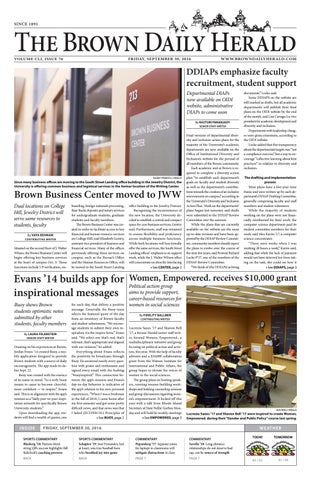
Since many business offices are moving to the South Street Landing office building in the Jewelry District, the University is offering common business and logistical services in the former location of the Writing Center.
Brown Business Center moved to JWW Dual locations on College Hill, Jewelry District will serve same resources to students, faculty By VAFA BEHNAM CONTRIBUTING WRITER
Situated on the second floor of J. Walter Wilson, the Brown Business Center will begin offering key business services at the heart of campus Oct. 3. These functions include I-9 verification, on-
boarding, foreign nationals processing, Bear Bucks deposits and notary services for undergraduate students, graduate students and faculty members. The Brown Business Center was created in order to facilitate access to key financial and human resource services on College Hill, said Elizabeth Gentry, assistant vice president of business and financial services. Many of the offices previously offering these services on campus, such as the Bursar’s Office and the Human Resources Office, will be moved to the South Street Landing
office building in the Jewelry District. Recognizing the inconvenience of the new location, the University decided to establish a central and compact space for core business services, Gentry said. Furthermore, staff was retrained to ensure flexibility and proficiency across multiple business functions. While both locations will functionally offer the same services, the South Street Landing offices’ emphasis is on support work, while the J. Walter Wilson office will concentrate on directly interfacing » See CENTER, page 2
Final versions of departmental diversity and inclusion action plans for the majority of the University’s academic departments are now available on the Office of Institutional Diversity and Inclusion’s website for the perusal of all members of the Brown community. Each academic unit at Brown is required to complete a diversity action plan “to establish each department’s goals on faculty and student diversity as well as the department’s contributions towards the creation of an inclusive environment on campus,” according to the University’s Diversity and Inclusion Action Plan. Work on the departments’ plans began last semester, and drafts were submitted to the DDIAP Review Committee over the summer. While the plans that are currently available on the website are the most up-to-date versions and have been approved by the DDIAP Review Committee, community members should expect the plans to evolve over the course of the next few years, said Provost Richard Locke P’17, one of the members of the DDIAP Review Committee. “We think of (the DDIAPs) as living
documents,” Locke said. Some DDIAPS on the website are still marked as drafts, but all academic departments will publish their final plans on the OIDI website by the end of the month, said Liza Cariaga-Lo, vice president for academic development and diversity and inclusion. Departments with leadership changes were given extensions, according to the OIDI website. Locke added that this transparency about the departmental targets was “not a compliance exercise,” but a way to encourage “collective learning about best practices” in relation to diversity and inclusion. The drafting and implementation process Most plans have a five-year time frame and were written up by each department’s DDIAP Drafting Committee, generally comprising faculty and staff members and student volunteers. While the majority of students working on the plans were not financially reimbursed for their work, the computer science department paid its student committee members for their work, said Alex Karim ’17, a computer science concentrator. “There were weeks when I was working 20 hours a week,” Karim said, adding that while the lack of payment would not have deterred her from taking on the task, she could see how it » See DDIAPS, page 3
Women, Empowered. receives $10,000 grant Evans ’14 builds app for Political action group to provide support, inspirational messages aims career-based resources for Buoy shows Brown students optimistic notes submitted by other students, faculty members By LAURA FELENSTEIN SENIOR STAFF WRITER
Drawing on his experiences at Brown, Jordan Evans ’14 created Buoy, a mobile application designed to provide Brown students with a source of daily encouragement. The app made its debut Sept. 22. Buoy was created with the essence of its name in mind: “As a verb, buoy means to cause to become cheerful, more confident — to inspire,” Evans said. This is in alignment with the app’s mission as a “daily peer-to-peer inspiration network for specifically Brown University students.” Upon downloading the app, students will find a wealth of quotes, one
INSIDE
for each day, that deliver a positive message. Generally, the Buoy team selects the featured quote of the day from an inventory of Brown faculty and student submissions. “We encourage students to submit their own inspiration via the inspire form,” Evans said. “We select one that’s real, that’s relevant, that’s appropriate and aligned with our mission,” he added. Everything about Evans reflects the positivity he broadcasts through Buoy. He answered nearly every question with praise and enthusiasm and signed every email with the hashtag “#stayinspired.” This connection between the app’s mission and Evans’s day-to-day behavior is indicative of the app’s relation to his own personal experiences. “When I was a freshman in the fall of 2010, I came home after my first semester and got some pretty difficult news, and that news was that I failed (ECON0110:) Principles of » See BUOY, page 2
women in social sciences By FIDELITY BALLMER CONTRIBUTING WRITER
Lucrezia Sanes ’17 and Shavon Bell ’17, a former Herald senior staff writer, formed Women, Empowered., a multidisciplinary initiative and group focusing on political action and activism, this year. With the help of faculty advisors and a $10,000 collaboration grant from the Watson Institute for International and Public Affairs, the group hopes to elevate the voices of women in the social sciences. The group plans on hosting speakers, running resume-building workshops and holding counseling sessions and group discussions regarding women’s empowerment. It kicked off this year with a talk from Rhode Island Secretary of State Nellie Gorbea Monday and will hold bi-weekly meetings » See EMPOWERED, page 3
GUS REED / HERALD
Lucrezia Sanes ’17 and Shavon Bell ’17 were inspired to create Women, Empowered. during their “Gender and Public Policy” course last spring.
WEATHER
FRIDAY, SEPTEMBER 30, 2016
SPORTS COMMENTARY Blasberg ’18: Patriots thirdstring QB’s success highlights Bill Belichick’s coaching prowess
SPORTS COMMENTARY Schapiro ’19: José Fernández, kid at heart, was true baseball hero who breathed joy into game
COMMENTARY Papendorp ’17: Separate zones for laptops in classrooms will mitigate distractions in class
COMMENTARY Savello ’18: Long-distance relationships do not deserve bad rap, can be source of strength
BACK
BACK
PAGE 7
PAGE 7
TODAY
TOMORROW
61 / 55
61 / 56
NEWS
PAGE 2 • FRIDAY, SEPTEMBER 30, 2016
THE BROWN DAILY HERALD
ATHLETE OF THE WEEK
Chow ’19 lifts Bears over University of Rhode Island in overtime Sophomore midfielder displays stellar form with both goals in Brown’s 2-1 victory over URI By NICHOLAS WEY SENIOR STAFF WRITER
Sitting at .500 with its first Ivy League matchup just seven days away, the men’s soccer team hoped to take the win over local rival University of Rhode Island Saturday to build momentum heading into a very important week. Bruno (5-3) did just that, edging URI (3-6-1) 2-1. The victory was powered by two goals from midfielder Matthew Chow ’19. One of the two goals was a spectacular overtime score that clinched the win for the Bears. His freshman year, Chow was a constant in the Brown lineup, starting 15 of Brown’s 16 games in the Bears’ 2015 campaign and scoring three goals. Now in his second year, Chow brings added experience and poise to the midfield position. Never has this been more apparent than against URI with his pivotal role in the team’s win. For his game-winning efforts this weekend, Chow has been named The Herald’s Athlete of the Week.
— sometime near the beginning of overtime. I didn’t know who was going to get the goal. But they were tired, so we came out pretty strong, pretty intense in the beginning of overtime. We calmed their pressure, and I was able to score. How did it feel after you scored the game winner? It was sort of a sense of relief because those are really tough minutes. It was a grind for the whole game because both teams played with pretty high pressure and intensity. So it was definitely a sense of relief, but also having scored two goals for the team, I was quite proud of myself — proud for the team and what I could provide for them. You started almost every game last season. Again, you’re assuming a pretty big role. Could you talk a little bit about the transition to sophomore year? As a freshman, everything was new and, well, fresh in a sense. You’re not really familiar with anything, and it’s hard to get into games early, hard to be active early. As a sophomore for me, being able to be a bigger impact early on as opposed to floating around is really good.
The Herald: It’s overtime, a golden goal situation. What’s going through your mind? Chow: I honestly thought that we were going to get (the goal) soon
How is the preparation and mindset different for the team going into its first Ivy League game against Columbia? The Ivy League games are a mustwin kind of mindset. Everyone is more
» CENTER, from page 1
» BUOY, from page 1
with students and faculty members. In addition to being situated at the heart of campus, the office’s proximity to other services in the J. Walter Wilson building, such as Mail Services, Office of International Student and Scholar Services and Counseling and Psychological Services will be a welcome benefit, Gentry said. Physically, the Brown Business Center is divided into two sections, both on the second floor. One is a larger space, which will handle the bulk of the services, and the other is an annex of the Bursar and Loan Offices, conveniently situated near the Financial Aid Office. The Brown Business Center will take the place of the Writing Center, which has moved to the Sciences Library, said David Paine, associate provost and professor of engineering. But the University has not decided what will replace the offices previously housed in the Brown Office Building, he added.
Economics,” said Evans, who was a BEO concentrator. “Fortunately, what got me through were my friends … who regularly encouraged me,” he added. From there grew his desire to incorporate that kind of encouraging substance into his daily life, he said. Inspiration for the project was also derived from Brown’s culture. “I think Buoy is a direct result of our experience(s) at Brown and being challenged to be unique,” said James Clemmons ’14, a founding team member. “At Brown, it wasn’t so much (a question of) if I could do something, it was a matter of when. And that mindset I think is what drives Buoy,” he added. According to Evans, Buoy’s development began with a business plan in October 2015. By January the team’s initial members were making more concrete steps toward the app’s creation. One crucial element of the product’s growth has been feedback. To better understand their consumers, the Buoy team “distributed a survey to 150 Brown students,” Evans said. “We asked questions that would help us understand how students get their inspiration.” “The takeaway was (that) over 51 percent of Brown students appreciate and enjoy enlightening messages or inspirational quotes,” Evans said. “So that really gave us the green light.” Once the app had been generated, a process that required a third-party app builder, Buoy “did a pilot launch on campus” using a minimal viable product, which “targeted about 15 students” who used the app for a week and then gave feedback, Evans said. “We were able to get feedback that validated our assumption again that
in-tune and focused on winning the Ivy League and qualifying for the NCAA Championships. So when it’s Ivy League season, I feel like everyone turns a certain switch on. What are some expectations you have for the team this season? Just to win the Ivy League and get the ring. We definitely thought we deserved to win last season but just had some unlucky breaks, which cost us a little bit. And I feel like this year we have a stronger team and a better style of play — not so much kick and run but possession-based. And I think that all works in our favor. It’s surprising that Ivy League games do not go into PKs, don’t you think? We were third in the League last year, but it was really tight. We had a couple (of) ties. I think there should (be penalty kicks) to determine who wins. I don’t like ties. I’m not a big fan of tying. It’s frustrating. NAOMY PEDROZA / HERALD
What drew you in to play soccer here at Brown? The official visit had a huge impact on why I decided to come to Brown. I had offers from a number of schools, but I actually only went to Brown. It was my first official visit and my last. I really like the atmosphere, the locker room chats, watching games and talking with the coach. The official visit was really the students would actually want and use the app,” he added. Though the app’s initial construction is complete, it continues to evolve based on feedback. “We realized that this process is about constant iterations and constant changes. We know we’ve made mistakes, and we know we’re going to make mistakes. But the biggest thing for us is making adjustments quickly,” Evans said. Following the official launch, the company is working on promotions and marketing, a process aided by five current Brown students who work as Buoy Campus Ambassadors. Beyond spreading the word, BCAs “review the content submissions” and decide what to post, Evans said. On average, about 10 inspirational submissions are sent in per day, and the app has been downloaded about 200 times, Evans said. But some of the best elements of the app’s success are not so tangible. “The most rewarding part of this experience was definitely coming back to campus,” said Oyeleye Odewunmi ’15, another founding team member. When back at school for alumni weekend, Odewunmi met students who have downloaded and enjoyed the app. “It was just really a feel-good experience to have this whole bus full of young students get excited about something that we created,” Odewunmi said. For now, the Buoy team is working on extending the app’s outreach at Brown, but going forward the goal is to expand to other colleges as well. “We are going to grow Buoy to create inspiration networks also on other college campuses,” Evans said. Despite having ambitious goals, Evans doesn’t succumb to discouragement when the path forward
Matthew Chow ’19 clinched men’s soccer’s win over URI last weekend. Chow thinks the team has a strong shot at winning the Ivy League this year. biggest part of my decision. So, when did you start playing soccer and what do you love about the sport? I actually started playing soccer when I was six, so I don’t even remember what drew me into the sport. But
whenever I watch soccer, or documentaries about soccer, I feel like it’s an art. There are so many amazing aspects of the game that, even outside of practice, are not involved in other sports. This interview has been edited for clarity and length.
MARIANNA MCMURDOCK / HERALD
Launched Sept. 22, Buoy is an online app designed by Jordan Evans ’14 that features daily inspirational quotes from other Brown users. seems tough. “I have to stay encouraged because I’m literally looking at
inspirational messages every day,” he said.
NEWS
FRIDAY, SEPTEMBER 30, 2016 • PAGE 3
THE BROWN DAILY HERALD
» DDIAPS, from page 1 could be prohibitive for low-income students. “There’s an expectation that Brown students can volunteer to serve on these committees, which is not always realistic.” Karim will be taking on an expanded role as a student advisor this semester now that the plan is finalized — not only will she continue to serve on the CS DDIAP Drafting Committee as it updates the plan, but she will also hold office hours for students to drop by and share concerns. In addition, she leads diversity trainings for teaching assistants within the department. Most DDIAP Drafting Committees will not disband now that the plans have been finalized. Rather, members will be tasked with releasing annual reports about DDIAP implementation and progress in the future. Progress toward DDIAP goals will be considered during external reviews of departments as an additional accountability mechanism, Locke said. Above and beyond Broadly, the DIAP seeks to increase the representation and retention of historically underrepresented groups on campus. The University defines historically underrepresented groups as American Indian, Alaskan Native, African American, Hispanic or Latinx and Native Hawaiian or Pacific Islander ethnicities. In addition, women in science, technology, engineering and math and Asian American or Pacific Islanders in the social sciences and the humanities also fall under the DIAP’s conception of HUGs. The history department’s DIAP also notes that current metrics for determining the ethnic diversity of the Brown community are themselves inadequate. For instance, many people of Middle Eastern and North African descent are classified as white by the 2010 U.S. Census. Brown does not recognize them as a distinct racial or ethnic category at this
» EMPOWERED, from page 1 with the goal of creating a network among members. The group aims to focus on intersectionality, which members view as an unrecognized challenge to women in politics and policy. One of the biggest difficulties for women in politics is “being her whole person and reflecting dimensions of herself in ways that might not fit into a box,” said Susan Moffitt, associate professor of political science and international and public affairs and a faculty advisor for the group. “I just want to defy the boxes and allow for prisms.” Sanes and Bell noticed a need for this group after taking POLS 1823Z: “Gender and Public Policy” with Moffitt in the spring. They saw that Brown has specific groups for women in business, science and engineering and computer science, but not one for women in the social sciences. “There were all these other groups, but we didn’t really fit into any of them,” Sanes said. There are no organizations on campus asking “What’s it like to be a woman working in the world and pursuing your educational professional career?” said Wendy Schiller, professor of political science and chair of the department as well as professor of international and public affairs and faculty advisor to the group. “If
time, but the University hopes to in the future, according to the DIAP. Some members of the CS department had misgivings about the sheer breadth of some of the categories in the University’s DIAP, Karim said. “You could look at CS and say that Asians seem well represented. But maybe Asians from some countries are better represented than others, skewing all the data,” she said. Nonetheless, all DDIAPs have adopted the University’s terminology for the time being, though some also call attention to the exclusion of socioeconomic status, first-generation status, religious identification, gender identification, sexual orientation, political affiliation, disability and citizenship as HUGs and therefore as criteria for assessing diversity. Departments have attempted to address these concerns in addition to analyzing racial or ethnic disparities in their communities. For instance, the anthropology DDIAP includes an entire section on the “limited” physical accessibility of its two buildings, Giddings House and Feinstein House. As a general trend, many plans also propose to administer climate surveys asking students and concentrators within their respective departments to “fill in” however they self-identify in numerous categories not limited to ethnicity or race. “We want to acknowledge all the groups people can be a part of,” Karim said of the CS climate survey, adding that the resulting data would give the CS department a more holistic idea of its composition and shortcomings. Recruitment and retention Many DDIAPS make note of student demand for greater transparency in the hiring process. In response to this demand, the School of Engineering has committed to holding town hall-style meetings at least once per semester to share hiring plans with the student body. The SOE plans to make nearly a dozen faculty hires in the next five years, and
50 percent of the offers will be made to candidates from underrepresented groups. Departments have also committed to changing their internal hiring and recruitment processes to be mindful of the goals of their DDIAPS. The mathematics department plans to increase its presence at national conferences to attract more diverse applicants, while the comparative literature department is emailing public, state and historically black universities to encourage their students to apply to graduate programs within the department. All departments strongly encourage faculty members to participate in diversity training and propose to make TA diversity training mandatory. The cognitive, linguistic and psychological sciences department is atypical in that it goes so far as to mandate training for faculty members, staff members and students. “This is paramount to sustaining a campus culture in which each individual’s humanity and dignity are acknowledged and accorded the full respect of the entire University community,” the plan states. The OIDI has hired three students — two graduate and one undergraduate — to help keep up with the requests for training, demographic information, hiring pipelines and other support, Cariaga-Lo said. At the time of the interview, Cariaga-Lo indicated that the OIDI would be in a position to hire a fourth undergraduate student soon. The mathematics department uniquely proposes that TAs for math courses also participate in “in-house” diversity training led by a member of the department alongside the OIDI training. “Teaching mathematics can be idiosyncratic. There are challenges that HUGs students may face in this department that are particular to mathematics,” said Assistant Professor of Mathematics Melody Chan. “It’s also important to show that the department is trying to integrate awareness and sensitivity at every level and is not just sending you
you’re interested either academically or professionally in jobs in this area, what does that world look like? What courses might you take? What internships might you pursue? How do you present yourself?” Bell stated that the initiative is open to all who identify as women and all who feel political activism is important to their disciplines. Though the group currently focuses on the social sciences, Moffitt said the group “very much want(s) to expand to the humanities, the fine arts and the hard sciences,” which all “have important political voices to express.” Intersectional voices are important to Women, Empowered., Sanes said. They hope to share perspectives of women of color, queer women and international women. The group aims to define “women” and “politics” “as broadly as (those) term(s) can be defined,” Bell said. There are several barriers and struggles particular to entering politics that women face, Schiller said. “More than 50 percent of the Senate has served in the House of Representatives, and 46 percent of senators have served in state legislatures, so when you think about that career path, that means women have to start pretty early, and I think a lot of women make decisions to go into politics later, particularly if they decide to have children,” she said. Schiller spoke of her own
experiences on the staffs of New York Gov. Mario Cuomo and U.S. Sen. Daniel Patrick Moynihan, D-NY. Women were not allowed to wear pants on the Senate floor in the mid-1980s, and there was not an accessible bathroom for women, who had to go “winding through the Senate floor” to access a facility. “I’m sure there were gender differences in pay, … but I never felt that I couldn’t do what I wanted to do,” Schiller said. The group sought out faculty advisors with diverse sets of experiences and expertise. The advisors include Schiller, Moffitt, Assistant Professor of International and Public Affairs and Sociology Jayanti Owens and Associate Professor of Economics and International and Public Affairs Emily Oster. “We’re social scientists, but we have a big range of social science disciplines we represent,” Schiller said. “What I really like is that we are bringing to the table this really great, diverse set of experiences in different disciplines about being a woman in different eras, and I hope that that will be useful.” Sanes and Bell said they hope to have created something that will have a lasting impact on campus given that they will graduate at the end of this year. “It is something that we have started and something that we have created but also something that we can pass on so it can grow,” Sanes said.
to an office to be trained.” The mathematics plan expresses a concern that junior faculty members who are from HUGs could end up leading the bulk of the diversity efforts. As it stands, Chan is writing a pilot proposal for a summer liftoff program for female graduate students and coordinating a peer mentorship network for women in the department. But Chan said that her department chair has been very careful not to overload her with work, adding that the tenure process does place some emphasis on public service. Elsewhere in the University, other departments have voiced concerns about burdening HUGs faculty members and postdoctorates with extra work and failing to recognize their efforts in the tenure process. The anthropology department aims to schedule a faculty meeting to review the departmental criteria for tenure to address the fact that scholars of color “find negotiating the tenure process difficult due to such pressures as carrying heavier-than-average advising and service responsibilities.” “It’s easy to fall into a pattern of exploitation,” said Stephen Bloomfield, associate director of the Watson Institute of International and Public Affairs. “We’re trying to be aware that postdocs who are from HUGs may do things that their peers don’t.” Many plans have considered reaching out to undergraduates in the pipeline before they even get to campus. The classics department proposes to attract prospective students through massive open online courses, known as MOOCs, hosted on its website, in association with the School of Professional Studies. The SOE proposes to collaborate with the Admission Office to encourage potential HUG engineers to matriculate to the University by calling them. Curricular change is also a prominent feature in the plans. The mathematics department’s plan includes an initiative to create a year-long course to introduce students to the world beyond calculus, while the physics department
suggests making introductory courses mandatory Satisfactory/No Credit “to reduce … anxieties that the grade in introductory courses indicates who can and cannot succeed in physics.” But curricular change doesn’t necessarily involve the creation of new courses. The modern culture and media department is encouraging faculty members to share a list of required course readings with students during pre-registration to reduce financial barriers. Finding the money At this stage, many DDIAPs contain proposals that are contingent on receiving funding, either from the University or from external sources. For instance, the Watson Institute envisions new positions as a result of the merger with the Taubman Center for Public Policy and American Institutions. But all faculty lines come from University funding, Bloomfield said. In addition, Watson’s plans to endow a financial aid program for its Master’s in Public Administration depends on the University’s fundraising success, he added. The University’s Brown Together capital campaign aims to raise $3 billion, of which $165 million will be committed to the implementation of the DIAP. Departments have also been resourceful in using existing funds to finance their initiatives, Locke said. In order to fund her summer liftoff program for incoming mathematics students, Chan applied for a National Science Foundation grant. The CS department has committed to financing diversity initiatives at a rate of at least 50 percent of the annual revenue from the department’s Industry Partners Program for at least the next three years. According to the OIDI website, the DIAPs for the University administrative offices, such as Student and Employee Accessibility Services and the dean of the College, will be released in November.
A Note from the Margin: The Unsafe Spaces of Democracy Jelani Cobb Professor of Journalism, Columbia University School of Journalism, and staff writer for The New Yorker
Tuesday, October 11, 2016 4:00 p.m. Doors open at 3:30 p.m. Martinos Auditorium The Perry and Marty Granoff Center for the Creative Arts 154 Angell Street Providence, Rhode Island
REAFFIRMING UNIVERSITY VALUES: Campus Dialogue and Discourse Co-Sponsored by the Office of the President and the Office of the Provost
To request special services, accommodations or assistant for this event, please contact the University Event and Conference Services Office at UniversityEvents@brown.edu.
TODAY
FRIDAY, SEPTEMBER 30, 2016 • PAGE 5
THE BROWN DAILY HERALD
menu
s h a r e t h e lo v e
SATELLITE DINING ANDREWS COMMONS
Pizza: Bacon and Feta, Harvest, Buffalo Chicken Sushi Night JOSIAH’S
BLUE ROOM
Make-Your-Own Quesadillas
Minestrone, Chicken Tortilla, Clam Chowder
DINING HALLS SHARPE REFECTORY LUNCH
DINNER
Tuna Melt, Grilled Ham with Pineapple, Braised Leeks Provencale, S’more Bars
Italian Chicken Parmesan, Mac and Cheese, Red Fish Provencale, Pumpkin Cheesecake Brownies
VERNEY-WOOLLEY LUNCH
DINNER
Breaded Chicken Fingers, Lobster Bisque, Fresh Vegetable Melange, Snickerdoodle Cookie
Cajun Baked Fish, Mushroom Barley Soup, Feta and Tomato Quiche, Raspberry Mousse Torte
sudoku
ANITA SHEIH / HERALD
The Brown Market Shares Program hosted its first market share pick up of the year in Brown/RISD Hillel Thursday afternoon. The program offers fresh produce from local farms.
Q U O T E O F T H E D AY
crossword
“Whenever I watch soccer, or documentaries about soccer, I feel like it’s an art.” — Matthew Chow ’19
See athlete of the week on page 3.
CORRECTION An article in Thursday’s Herald (“Alum’s production tackles historical racism with comedy,” Sept. 29) referred to Kym Moore as an assistant professor of theatre arts and performance studies. In fact, she is an associate professor of theatre arts and performance studies. The Herald regrets the error.
calendar FRIDAY SEPTEMBER/OCTOBER
S
M
T
W
Th
F
S
1
2
3
4
5
6
7
8
9
10
11
12
13
14
15
16
17
18
19
20
21
22
23
24
25
26
27
28
29
30
1
Mesa de Conversacion 12:00 P.M. Sharpe Refectory
Yoga for Academics 1:00 P.M. Alumnae Hall, Crystal Room
SATURDAY By the Way, Meet Vera Stark 8:00 P.M. Leeds Theatre, Lyman Hall
New Music for Organ 8:00 P.M. Sayles Hall
SUNDAY Catholic Mass 10:30 A.M. Manning Chapel
Effective Midterm Prep 7:00 P.M. J. Walter Wilson, Room 203
COMMENTARY PAGE 6 • FRIDAY, SEPTEMBER 30, 2016
THE BROWN DAILY HERALD
IN CASE YOU MISSED IT
LETTER TO THE EDITOR
Brown Bites
UCS is committed to transparency
Judge overturns Brown’s ruling in sexual assault case In a much-anticipated decision, U.S. District Court Chief Judge William Smith invalidated Brown’s ruling that a student found responsible for sexual misconduct should be suspended from the University until fall 2018. The student was originally suspended until after his alleged victim is slated to graduate, but the University found him guilty and imposed the sanction under a new definition of consent that was implemented after the incident in question had taken place. Smith said that there’s nothing preventing the University from re-trying the student under the policies in place at the time of the incident. UCS fills seven leadership positions The Undergraduate Council of Students elected a new chair of appointments, parliamentarian, historian and webmaster along with new members of its finance board during its meeting Wednesday night, which unlike its previous meeting, was open to the public and media. Faculty members of color at the University Approximately 20 percent of all faculty members and 18 percent of tenured faculty members are people of color, according to the University’s Institutional Research Factbook. A recent report from the Chronicle of Higher Education found that these numbers are in line with the average across the nation. Celebrate good times The Brown Center for Students of Color celebrated its 40th anniversary with a kickin’ block party and a panel of all the center’s former directors. Today, the center serves as a supportive space for students of color on campus. Happy birthday, BCSC!
To the Editor: I’m disappointed by the recent Herald op-ed’s (“Shorter ’17: UCS needs to be transparent,” Sept. 28) framing of the Undergraduate Council of Students’ work toward informing our new members of Brown’s context as part of a conspiring liberal agenda. On Sept. 24, UCS went into an executive session, as has been done numerous times in past administrations. During that meeting, the UCS executive board gave new members an overview of Brown and the context of the past few years. We dove into issues surrounding Title IX, mental health, work done by the various identity groups and much more. These are hard topics to engage with, especially for those just entering Brown. We wanted new members to ask questions and learn without the fear that soundbites would be taken out of context and plastered in the media. This was not a session to create policy nor was it a conspiracy to hide our “own agenda … that could prove unsettling even to the generally liberal Brown consensus” as Shorter suggested. The Herald actually published an article (“UCS introduces accessibility initiatives,” Sept. 15) a week prior clearly outlining our strategic plan and vision for the year. Given campus media’s long history of misrepresentation, taking things out of context and editorial decisions that further marginalized groups of color, we made a choice to not let them record our new members during this educational exercise. This is the only executive meeting planned for the semester. I commit to an open Brown and will continue to talk about the things that matter. Shorter’s argument is a distraction from the good work we must do to continue to move Brown in a better direction. This is the responsibility we inherit, and I hope The Herald chooses to cover what matters as well. We look forward to partnering with The Herald in accomplishing these goals. Viet Nguyen ’17 UCS President
comic Cat Ears | Najatee’ McNeil
Find us online! facebook.com/browndailyherald
browndailyherald.com
@the_herald
Location: 195 Angell St., Providence, R.I. www.browndailyherald.com
@browndailyherald
youtube.com/browndailyherald
Editorial contact: 401-351-3372 herald@browndailyherald.com
Business contact: 401-351-3260 gm@browndailyherald.com
Submissions: The Brown Daily Herald publishes submissions in the form of op-eds and letters to the editor. Op-eds are typically between 750 and 1000 words, though we will consider submissions between 500 and 1200 words. Letters to the editor should be around 250 words. While letters to the editor respond to an article or column that has appeared in The Herald, op-eds usually prompt new discussions on campus or frame new arguments about current discourse. All submissions to The Herald cannot have been previously published elsewhere (in print or online — including personal blogs and social media), and they must be exclusive to The Herald. Submissions must include no more than two individual authors. If there are more than two original authors, The Herald can acknowledge the authors in a statement at the end of the letter or op-ed, but the byline can only include up to two names. The Herald will not publish submissions authored by groups. The Herald does not publish anonymous submissions. If you feel your circumstances prevent you from submitting an op-ed or letter with your name, please email herald@browndailyherald.com to explain your situation.
Editorial Leadership
Sections
Visuals & Production
Business
Editor-in-Chief Emma Jerzyk
Arts & Culture Editors Rebecca Ellis Jaclyn Torres
Design Editors Sonia Geba Nicola Ho Jessica Yu Assistants: Minah Seo, Christy Leung
General Managers Moniyka Sachar Joshua Tartell
Managing Editor Joseph Zappa Senior Editors Andrew Flax Caroline Kelly POST- MAGAZINE Editor-in-Chief Yidi Wu
News Editors Lauren Aratani Matt Brownsword Elena Weissmann Sports Editors Taneil Ruffin COMMENTARY Opinions Editors Margaret Hu Mili Mitra Lainie Rowland
Photo Editors Head: Eli White Sam Berube Marianna McMurdock Copy Desk Chief Julia Stemmer Illustrations Editor Roland High
Directors Business Dev.: Antonia Alvarez Finance: Neil Wathore Finance: Benjamin Wesner Strategy: Abraham Galindo Sales Managers Gaby Elanbeck Maisie Lynton Ari Shusterman Lizzy Doykan Finance Managers Collections: Reena Zhan Collections: Varun Narayan
You can submit op-eds to opinions@browndailyherald.com and letters to letters@browndailyherald.com. When you email your submission, please include (1) your full name, (2) an evening or mobile phone number in case your submission is chosen for publication and (3) any affiliation with Brown University or any institution or organization relevant to the content of your submission. Please send in submissions at least 24 hours in advance of your desired publication date. The Herald only publishes submissions while it is in print. The Herald reserves the right to edit all submissions. If your piece is considered for publication, an editor will contact you to discuss potential changes to your submission. Commentary: The editorial is the majority opinion of the editorial page board of The Brown Daily Herald. The editorial viewpoint does not necessarily reflect the views of The Brown Daily Herald, Inc. Columns, letters and comics reflect the opinions of their authors only. Corrections: The Brown Daily Herald is committed to providing the Brown University community with the most accurate information possible. Corrections may be submitted up to seven calendar days after publication. Advertising: The Brown Daily Herald, Inc. reserves the right to accept or decline any advertisement at its discretion. The Brown Daily Herald, Inc. is a financially independent, nonprofit media organization bringing you The Brown Daily Herald, BlogDailyHerald and Post- Magazine. The Brown Daily Herald has served the Brown University community daily since 1891. It is published Monday through Friday during the academic year, excluding vacations, once during Commencement and once during Orientation by The Brown Daily Herald, Inc. Single copy free for each member of the community. Subscription prices: $280 one year daily, $140 one semester daily. Copyright 2016 by The Brown Daily Herald, Inc. All rights reserved. Periodicals postage paid at Providence, R.I. Postmaster: Please send corrections to P.O. Box 2538, Providence, RI 02906.
COMMENTARY FRIDAY, SEPTEMBER 30, 2016 • PAGE 7
THE BROWN DAILY HERALD
A laptop policy for everyone CARIN PAPENDORP staff columnist
My sophomore year, I took BIOL 0530: “Principles of Immunology” in Friedman Auditorium. Every week, as lecture started, I noticed one student take out his laptop, navigate to www.flashgames247. com and begin an 80-minute Brick Breaker marathon. Eventually, I realized that I was dedicating so much attention to monitoring this student’s high score — and questioning why he would even bother to come to class — that I had no idea what was happening in the realm of immunology. Even if you weren’t sitting near me in BIOL 0530, you’ve probably had a similar experience of being distracted by someone else’s laptop use. A 2011 Herald poll found that 97.5 percent of Brown students own a personal laptop, and many of us use these laptops in class. For some students, the ability to type notes and instantly look up unfamiliar terms outweighs any temptations that laptops and tablets produce. But for the easily distracted among us, widespread laptop use in lectures might be undermining our ability to learn. A 2013 study at York University
in Toronto investigated the effects of classroom laptop use. Unsurprisingly, students who multitasked by browsing the internet performed worse on post-lecture comprehension tests than students who did not multitask. But the researchers also tested whether simply sitting behind multitasking laptop users affected the performance of students who
voluntarily lose focus during a crucial part of lecture. Our whole visual system is wired to home in on interesting stimuli, whether it be the motion of texts popping up on your neighbor’s iMessage account or the irresistible vacuity of the latest Buzzfeed headline. When surveyed, students seated behind multitaskers reported that they were
to this problem. In light of this research on laptop use, in NEUR 1030: “Neural Systems,” Professor Monica Linden asks laptop users to sit on the sides of the classroom, while students who take notes on paper sit in the middle. Of course, students can always self-segregate: if you’re planning not to pay attention during lecture, it’s only polite to sit near
Even if you don’t think you’re sidetracked by the person in front of you, your grades might be suffering all the same.
were taking notes on paper. Alarmingly, students who sat behind multitaskers actually performed worse than the students who were multitasking themselves. When you multitask in class, you can decide to “tune in” when the professor is explaining particularly complicated concepts. But if you’re along for the ride of your neighbor’s internet browsing, you might in-
only “somewhat distracted” and that their learning was “barely hindered” by others’ laptop use. But on comprehension tests, their performance suffered by 17 percent compared to those not in view of multitaskers. So even if you don’t think you’re sidetracked by the person in front of you, your grades might be suffering all the same. Luckily, there’s a simple solution
the back of the classroom where you won’t distract others. Still, it would be easy and effective for more professors of large lecture classes to adopt an official policy of laptop user segregation. Most of Brown’s large lecture halls could easily accommodate a seating arrangement like the one in Neural Systems. If most people prefer to use laptops, this configu-
ration could also be flipped, with laptop users in the middle and longhand note takers on the periphery. The convenience is that students can switch back and forth between laptop and technology-free zones throughout the semester. And if students who take notes on paper wish to sit with friends who use laptops, they can sit in the laptop section. Thus, segregating laptop users has zero drawbacks. Though I have yet to try to challenge my classmate’s Brick Breaker score, I’d be lying if I said I wasn’t guilty of obsessively checking my email during class. If students wish to sabotage their own learning by multitasking in class, they are entitled to do so — if you want to squander your tuition on Brick Breaker, please, don’t let me stop you. As college students, we should take responsibility for our own learning, and paternalistic policies like banning laptops altogether would harm those who do benefit from laptop use. The need for intervention arises when one student’s browsing affects the focus of neighboring students. Adopting Linden’s laptop policy in large lecture classes could drastically improve the effectiveness of our learning at no cost to students.
Carin Papendorp ’17 can be reached at carin_papendorp@brown.edu.
Bad romance: defending long distance SAMANTHA SAVELLO staff columnist The summer before my first year at Brown, I remember people in the Class of 2018 Facebook group creating a long-distance relationship support page. It was called “Love Shows no Bounds” or “Miles of Love” or something equally cheesy. The comments section included a wide range of opinions from “dude, you should dump your girlfriend. She can’t date you from China!” to “I plan on enduring fivehour-long train rides and sending snail mail gift packages.” A year ago, I would have agreed with the former comment. But through my experiences — including learning from my hypocrisy — it’s clear that long-distance relationships don’t deserve the bad rap they get. It’s a common misconception among college students that these relationships aren’t sustainable because they require too much effort and unreasonable commitment. But the reality is much fuzzier and these negative attitudes promote an unhealthy message about meaningful relationships. One of the biggest arguments against long distance is the prolonged separation, which can be difficult, if not painful. Travel expenses, travel time, scheduling differences and in some cases, time zone differences create additional hurdles. In many ways, the comment I saw on Facebook disparaging a transnational relation-
ship was justified. Another perceived disadvantage is the overwhelming amount of effort it takes to stay in touch with your significant other. As a college student, it’s hard enough to juggle coursework, extracurriculars and a social life — anything more may seem impossible. Finally, there’s the perception that there’s an increased risk of infidelity, sustained by the circulation of heartbreaking tales and unhealthy
sume that just because a relationship is difficult or less convenient, young people will throw it away and move onto the next option without a second thought. My peers are not so irresponsible. Such assumptions, while often exacerbated by the “hookup culture” buzz in the media, are unfair and set an embarrassingly low standard for the kind of attitude people should have when they approach romantic relationships.
Many of the couples who do choose to go through with longdistance relationships end up having mature, satisfying relationships.
stereotypes about long-term commitment. But none of these biases against long-distance relationships tell the whole story. At this stage in our lives, most teens and twentysomethings have the emotional capacity necessary to overcome such hurdles. Many students have overcome much more difficult challenges during their college experience, though not always voluntarily. We shouldn’t as-
College-aged students, whose status grants them ample freedom and autonomy, are able to make mature decisions regarding their relationships — and many of them do. Oftentimes, the decision isn’t as simple as choosing to stay with or leave someone based on distance alone. The disgruntled student encouraging his peer to dump his partner because they couldn’t date across borders is unrepresentative of how peo-
ple actually make their decisions. Relationships are more complicated than that. To view it in such absolute terms is an insult to the sensitivity and compassion involved in these situations. Many of the couples who do choose to go through with long-distance relationships end up having mature, satisfying relationships. In fact, they often discover advantages that aren’t otherwise present. Those engaging in long distance learn to cherish and value every moment they spend with their partner. They also learn how to cope when their partner isn’t physically there, eliminating the risk of partner-dependency or clinginess. It can also be relieving to have an off-campus partner to serve as an objective listener and offer advice as you experience stress and drama within your own social group. Ultimately, long distance can make relationships stronger and more mature by giving individuals the skills they need to both love someone else and remain autonomous and selfdriven. It’s ironic that some question the capacity for maturity among college-age students who pursue such relationships, when in reality, their greatest benefit can be their authenticity. Partners who choose to stay dedicated to each other regardless of distance demonstrate both maturity and genuineness.
Samantha Savello ’18 is in a long-distance relationship but is not biased at all and can be reached at samantha_savello@brown.edu.
Got something to say? Leave a comment online! Visit www.browndailyherald.com to comment on opinion and editorial content.
SPORTS THE BROWN DAILY HERALD
FRIDAY, SEPTEMBER 30, 2016
Four Weeks of Jimmy G. … and Jacoby B.? CHARLIE BLASBERG sports columnist
Like all things in life, sports are unpredictable. Missed field goals, dropped third strikes and buzzer-beaters change the fortunes of teams and players on a dime. Similarly, you may be left bewildered in front of your keyboard when, after preparing to write columns about a back-up quarterback’s saga through his first four starts, he sprains his right AC joint halfway through his second game. Such was my case when Patriots interim quarterback Jimmy Garoppolo suffered a right shoulder injury late in the second quarter of the Patriots’ game against the Miami Dolphins two weeks ago. So much for “Four Weeks of Jimmy G.”
But if any team can make it work with a rookie third-string quarterback, it is the Patriots. Jacoby Brissett filled in for the injured Garoppolo for the remainder of the game, and the Patriots were able to hold on for a second straight win. All eyes were on the former NC State standout thrust into the starting role due to Garoppolo’s injury and entering last week’s showdown against the Texans a supposed playoff contender. Brissett employs a style foreign to most Patriots fans. A quarterback who can run? Who knew such a thing existed? All we had seen in our quarterbacks for the past 15 years was pocket presence, an uncanny ability to read the defense and an adequate arm. Never had Patriots fans encountered an athletic quarterback wearing the hometown colors. “Fine,” we acquiesced, scared of leaving our comfort zone of
quarterbacks who stay in the pocket. “We’ll give him a shot.” With Brissett, the Patriots — historically known as a pass-heavy team — beat the Texans on the ground. Brissett only attempted 19 passes but ran for 43 yards, including a spectacular touchdown run in the first quarter. LeGarrette Blount reached the century mark for the second straight game, and the defense shut out the Texans en route to a 27-0 victory. But after all the celebrations had ended, a new dark cloud arose. Brissett had sprained his right thumb and would probably need surgery. The news of yet another injury left fans and coaches alike scratching their heads. With Tom Brady still suspended and both back-ups injured, would the Patriots be forced to sign someone new? Would Julian Edelman, Brady’s favorite receiver, be forced to take the
helm as the starting quarterback? If Wednesday’s practice was any indication of things to come, though, Garoppolo will start Sunday’s game against Rex Ryan’s Buffalo Bills. After his two-quarter dissection of the Dolphins two weeks ago, Garoppolo will be eager to show off his chops Sunday against another conference rival and stamp an exclamation mark on his tenure as the Patriots’ starting quarterback. But while both Garoppolo and Brissett threw well during the practice, neither made any comment on whether he was ready to play in the upcoming game. But that’s just how Patriots head coach Bill Belichick likes it: Keeping his gameday plans a mystery for the opposition is a pastime of his. Regardless of the outcome of Sunday’s game against the Bills, the first three weeks of Brady’s suspension have highlighted Belichick’s coaching
prowess. As a team, the Patriots have simply outplayed each of their first three opponents, yet each time they did it in a very different way. This speaks to Belichick’s knowledge of how to win in any situation that arises in a football game. Smart, physical, disciplined football is what he preaches, and the results are evident week after week. With wins in each of their first three games, the Patriots squad sans Brady has exceeded expectations and put themselves in position to make a deep playoff run. They have shown that it doesn’t matter who starts at quarterback because the other aspects of the team, most notably special teams, can still put them in position to win games.
Charlie Blasberg ’18 can be reached at charles_blasberg@brown.edu.
Miami and baseball lose a hero JAMES SCHAPIRO sports columnist
When I awoke Sunday morning to the news that José Fernández had been killed in a boating accident off Miami Beach, I didn’t know how to react. I’m not sure anyone did. The Marlins canceled their game, as was the right thing to do. Airwaves were inundated with club statements, updates and remembrances. On ESPN, Fernández’s former hitting coach broke down in tears multiple times during a seven-minute interview. During the broadcast of that day’s Mets-Phillies game, I watched game announcer Keith Hernandez do the same. We heard all the stories about Fernández: the story of how he attempted to defect from Cuba three times and succeeded on the fourth; how he’d jumped into the water on the boat from Cuba to save a drowning woman who turned out to be his mother; how the Marlins managed to bring his grandmother to Florida and
captured the reunion on tape. None of the tributes was enough — because nothing could have been enough — but it was a start. Meanwhile, I wasn’t sure what to think. My history with Fernández goes back farther than most. The first Mets game I ever attended fully autonomously — paying for my own ticket and metro card and finding my way through the New York City subway system — was April 7, 2013. My friend and I sat near the field on the first base side. April 7, 2013 was also Fernández’s Major League debut. I knew enough about Fernández to know how strange the circumstances were: Fernández came straight up from single-A ball to the majors. He was just 19 years old. The Marlins were desperate. But right off the bat, Fernández delivered. He wasn’t perfect that day, but he was pretty darn impressive: He recorded five innings, eight strikeouts and one earned run. The Mets eventually salvaged the game, but I came away impressed with Fernández all the same. His career numbers tell the rest of
the story: a 38-17 record, 2.58 earned run average and an average of 11.2 strikeouts per nine innings. Fernández also earned a Rookie of the Year award, two all-star appearances and a third-place finish in the 2013 Cy Young award voting. And as a Mets fan, I had particular cause to dread facing Fernández: He owned us. Fernández made eight career starts against the Mets. In 47 innings, he was 3-0 with a 1.34 ERA and 59 strikeouts. We simply couldn’t touch him. Earlier this year, for example, as Mets pitcher Matt Harvey struggled to return to form, he took on Fernández. Harvey was brilliant: seven innings, one run and only four hits allowed. But then you compared his outing to Fernández’s, and you realized what kind of talent you were facing: Fernández went seven scoreless innings, allowed four hits and struck out 14. That this was little more than a typical outing for him should go a long way toward showing how brilliant Fernández was. Things didn’t always work out for Fernández. He tore his UCL in
2014, recovery from which set him back more than a year. But he came back as good as new: In his return, he pitched six innings, struck out six and hit a home run. Fernández always stayed up and ready — nothing got him down. What will now go down in the history books as Fernández’s last outing was another typically dominant one: eight shutout innings, three hits and 12 strikeouts. But the last time I saw him was a few weeks before that. Aug. 30, the Mets were playing the Marlins at Citi Field with wildcard positioning on the line, and I managed to find a cheap ticket right behind third base. From my seat, I could see into the Marlins dugout. Fernández watched from the top step almost the entire game. And each time he turned back toward the dugout, I saw the trademark smile on his face. Besides his almost unrivaled talent on the mound, Fernández was a personification of happiness, the most important qualification there is on the way to becoming a baseball hero. Whether it was exulting in a teammate’s home run, staring in wonder
as his own first home run left the park or snagging a line drive out of the air and then laughing at Troy Tulowitzki’s disbelief and saying, “Yeah, I caught it,” Fernández, everyone always knew, was as happy as he could be because he got to play baseball for a living. Soon after the news of the accident, a photo began circulating that I think proves this better than anything. Taken by ESPN reporter Allison Williams, it shows Fernández after a win against the Dodgers, sitting in a folding chair on the field and watching the fireworks show going on above him. “A big leaguer,” reads the caption, “but always kid at heart.” It’s how every Major League ballplayer should strive to be seen. And I can think of few people more worthy of being remembered as eternal kids at heart than Fernández.
James Schapiro ’19 has never felt better about the Mets getting beat by the Marlins. He can be reached at james_schapiro@brown.edu.
STAY UP-TO-DATE. FOLLOW US ON FACEBOOK. FACEBOOK.COM/BROWNDAILYHERALD