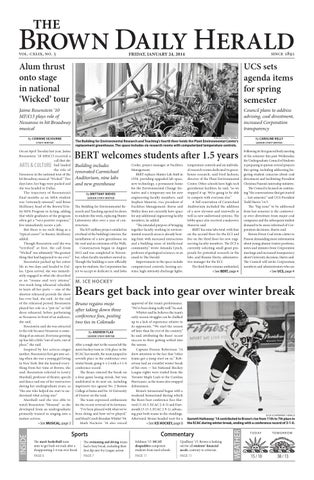
THE
BROWN DAILY HERALD vol. cxlix, no. 3
since 1891
FRIDAY, JANUARY 24, 2014
Alum thrust onto stage in national ‘Wicked’ tour
UCS sets agenda items for spring semester
Jaime Rosenstein ’10 MFA’13 plays role of Nessarose in hit Broadway musical
Council plans to address advising, coal divestment, increased Corporation transparency
STAFF WRITER
On an April Tuesday last year, Jaime Rosenstein ’10 MFA’13 received a call that she had landed the role of Nessarose in the national tour of the hit Broadway musical “Wicked.” Two days later, her bags were packed and she was headed to Dallas. The trajectory of Rosenstein’s final months as an MFA student was “extremely unusual,” said Brian McEleney, head of the Brown/Trinity MFA Program in Acting, adding that while graduates of the program often get a “very positive response,” few immediately secure a job. But there is no such thing as a “typical career” in theater, McEleney added. Though Rosenstein said she was “terrified” at first, the call from “Wicked” was ultimately “the greatest thing that had happened to me ever.” Rosenstein packed up her entire life in two days and headed to Dallas. Upon arrival, she was immediately engaged in what she described as an “insane and very intense” two-week-long rehearsal schedule to learn all her parts — one of the shortest rehearsal periods the show has ever had, she said. At the end of the rehearsal period, Rosenstein played her role in a “put-in,” or full dress rehearsal, before performing as Nessarose in front of an audience, she said. Rosenstein said she was attracted to the role because Nessarose is something of an outcast. Everyone growing up has felt a little “out of sorts, out of place,” she said. Inspired by her actress-singer mother, Rosenstein first got into acting when she was a young girl living in New York. But she learned everything from her time at Brown, she said. Rosenstein referred to Lowry Marshall, professor of theater, speech and dance and one of her instructors during her undergraduate years, as “the one who helped me start to understand what acting was.” Marshall said she was able to watch Rosenstein “blossom” as she developed from an undergraduate primarily trained in singing into a mature actress. » See MUSICAL, page 3
inside
ARTS & CULTURE
TOM SULLIVAN / HERALD
The Building for Environmental Research and Teaching’s fourth floor holds the Plant Environmental Center’s replacement greenhouse. The space includes six research rooms with computerized temperature controls.
BERT welcomes students after 1.5 years Building includes renovated Carmichael Auditorium, nine labs and new greenhouse By BRITTANY NIEVES SENIOR STAFF WRITER
The Building for Environmental Research and Teaching opened its doors to students this week, replacing Hunter Laboratory after over a year of construction. The $35 million project entailed an overhaul of the building’s interior, the installation of a new greenhouse on the roof and an extension of the Walk. Construction began in August 2012 and was completed in November, when faculty members moved in. Though the building is now officially open for students, the Corporation has yet to accept or dedicate it, said John
Cooke, project manager at Facilities Management. BERT replaces Hunter Lab, built in 1958, providing upgraded lab space, new technology, a permanent home for the Environmental Change Initiative and a temporary one for new engineering faculty members, said Stephen Maiorisi, vice president of Facilities Management. Barus and Holley does not currently have space for any additional engineering faculty members, he added. “The intended purpose of bringing together faculty working in environmental research areas is already bearing fruit, with increased interactions and a building sense of intellectual community,” wrote Amanda Lynch, professor of geological sciences, in an email to The Herald. Improvements to the space include computerized controls, heating systems, high-intensity discharge lights,
temperature controls and six individual research rooms dedicated to greenhouse research, said Fred Jackson, director of the Plant Environmental Center. Other schools have high-tech greenhouse facilities, he said, “so we stepped it up. We’re going to be able to compete with everyone else.” A full renovation of Carmichael Auditorium included the addition of a new elevator and stairwells as well as new audiovisual systems. The lobby space also received a makeover, Maiorisi said. BERT has nine labs total, with four on the second floor for the ECI and five on the third floor for new engineering faculty members. The ECI is currently soliciting small grant proposals for potential research in the labs, said Bonnie Horta, administrative manager for the ECI. The third floor remains unfinished, » See BERT, page 4
By CAROLINE KELLY SENIOR STAFF WRITER
Following its first general body meeting of the semester this past Wednesday, the Undergraduate Council of Students is preparing to pursue several projects this spring, including addressing lingering student concerns about coal divestment and facilitating President Christina Paxson’s internship initiative. The Council is focused on continuing “the conversations that got started … last semester,” said UCS President Todd Harris ’14.5. The “big issue” to be addressed from last semester is the controversy over divestiture from major coal companies and the subsequent student demand to be more informed of Corporation decisions, Harris said. Brown Divest Coal wrote a letter to Paxson demanding more information about young alumni trustee positions, notes and minutes from Corporation meetings and increased transparency about University decisions, Harris said. The Council will invite Corporation members and administrators who are » See UCS, page 4
M. ICE HOCKEY
Bears get back into gear over winter break Bruno regains mojo after taking down three conference foes, posting two ties in Colorado By ANDREW FLAX SENIOR STAFF WRITER
After a rough start to the season left the men’s hockey team in 11th place in the ECAC last month, the team jumped to seventh place in the conference over winter break, going 4-1-2 with a 3-1-0 conference record. The Bears entered the break on a four-game losing streak, but was undefeated in its next six, including impressive ties against No. 2 Boston College at home and No. 16 University of Denver on the road. The team expressed enthusiasm for the recent reversal of its fortunes. “I’ve been pleased with what we’ve been doing and how we’ve played,” said Head Coach Brendan Whittet ’94. Mark Naclerio ’16 also voiced
approval of the team’s performance. “We’ve been doing really well,” he said. Whittet said he believes the team’s early-season struggles can be chalked up to a lack of experience relative to its opponents. “We start the season off later than the rest of the country,” he said, attributing the Bears’ recent success to their getting settled into the season. Captain Dennis Robertson ’14 drew attention to the fact that “other teams got a jump start on us.” Robertson had an eventful winter break of his own — his National Hockey League rights were traded from the Toronto Maple Leafs to the Carolina Hurricanes, as the teams also swapped defensemen. Bruno’s turnaround began with a weekend homestand during which the Bears beat conference foes Harvard (5-10-3, ECAC 2-8-3) and Dartmouth (3-13-3, ECAC 2-9-1), advancing past both teams in the standings. Afterward, Bruno headed west for a » See ICE HOCKEY, page 8
Sports
JESSE SCHWIMMER / HERALD
Garnett Hathaway ’14 contributed to Bruno’s rise from 11th to 7th place in the ECAC during winter break, ending with a conference record of 3-1-0.
Commentary
The men’s basketball team aims to get back on track after a disappointing 2-4 run over break
The swimming and diving teams had a busy break, including their first dip into Ivy League action
Feldman ’15: MCAT disqualifies competent students from med schools
Upadhyay ’15: Brown is looking out for all students’ financial needs, contrary to criticism
PAGE 6
PAGE 7
PAGE 11
PAGE 11
weather
By CORINNE SEJOURNE
t o d ay
tomorrow
15 / 10
38 / 13
2 university news
THE BROWN DAILY HERALD FRIDAY, JANUARY 24, 2014
Greenhouse crowns Building for Environmental Research and Teaching Six research rooms in new rooftop greenhouse provide innovative resources for studying climate change By ELANA JAFFE CONTRIBUTING WRITER
Sitting atop the new Building for Environmental Research and Teaching, the Plant Environmental Center — the University’s new greenhouse and conservatory — houses innovative technology for research on climate change and other leading areas of study. The rooftop building — a metallic, crown-shaped structure diverging from classic greenhouse architecture — is in the final stages of completion, and will soon have scheduled visiting hours, tours and events, said Fred Jackson, PEC director and teaching associate in ecology and evolutionary biology. The new roof installment houses six rooms specifically designed for research, each with independent climate controls and adjustable vents, shades and lights, Jackson said. The ability to simulate different environments allows researchers to explore how plants will respond to changing conditions, he said, adding that the computerized research chambers will create an immense database recording various conditions. Seventeen environments with completely programmable conditions and a classroom are located in BERT’s basement, said Mark Johnson, associate professor of biology and the greenhouse’s faculty director. He added that
SCIENCE & RESEARCH
TOM SULLIVAN / HERALD
The Building for Environmental Research and Teaching’s greenhouse is the new home of exotic plants including a brain cactus, 30-year-old bonsai tree, banana plant, coffee plant and jatropha plant named “Buddha’s Belly.” the facility also features a head house — a special room for potting plants. The biggest advantage of the new greenhouse is its ability to develop different growing environments for experiments, creating “modular space,” Johnson said. The basement’s growth chambers allow for more controllable factors than the roof research rooms do, he added, noting that researchers can adjust carbon dioxide concentrations in the chambers and mimic an increase in atmospheric carbon dioxide levels. These new technologies allow researchers to test climate projections and examine climate change’s effects on plant life, Johnson said. Researchers can
also modulate the amount and quality of light by adjusting the wavelength, he added. The space will allow “people studying climate change to work together in an interdisciplinary environment” and will facilitate opportunities for “new types of research that we haven’t been able to do before,” Johnson told Rhode Island NPR. Four faculty members and their lab groups will move into the labs, but there is potential “room to expand,” Johnson said. He added that he expects researchers associated with the Department of Ecology and Evolutionary Biology, the Environmental Change Initiative and
the Department of Geological Sciences will utilize the space, along with other faculty members. Along with the additional research space and technology, the University has hired Christopher Claussen as plant growth facilities manager. Undergraduates have opportunities to become involved with greenhouse research, Johnson said, highlighting one ongoing undergraduate experiment that seeks to understand how temperature affects the production of different varieties of tomato plants. Johnson said this project might preface other research on the effect of rising temperatures on food production, especially for
crops such as rice and corn. The new PEC will house many of the same exotic plants as the old greenhouse, which was located next to Simmons Quadrangle and Metcalf Chemical Laboratory. Though the new conservatory is slightly smaller than the old one, its “light is phenomenal,” Jackson said, adding that the plants are responding well to their new home. The plants housed in the new conservatory include a brain cactus, a 30-year-old bonsai tree, a banana plant, a coffee plant and an jatropha plant called “Buddha’s Belly,” Jackson said. Accessibility to such an interesting collection of plants is a “great way for the research community to interact with Providence,” Johnson said. The greenhouse installment was funded by a $5.5 million donation that was approved by the Corporation last spring, The Herald previously reported. Construction began in August 2012, and the contents of the old greenhouse were moved to the new facility last November, wrote BERT Project Manager John Cooke in an email to The Herald. “Demolition of the existing greenhouse is nearing completion,” Cooke wrote. In its place, a continuation of the pathway that currently connects the Pembroke campus to Waterman Street will be constructed when the ground thaws, Johnson said. Facilities Management and Gilbane Building Company make up the project team responsible for oversight of the new greenhouse’s construction, Cooke wrote, adding that renovations have gone according to schedule and “the first occupants in the building moved into the facility over the winter break.”
Returning students placed into temporary housing Dozens of students returning from study abroad secure off-campus permission from ResLife By STEVEN MICHAEL SENIOR STAFF WRITER
Eighteen juniors returning from study abroad are living in temporary housing while awaiting permanent on-campus housing assignments this semester. Another approximately 40 juniors returning from study abroad were granted off-campus housing permission for the spring semester, even though the Office of Residential Life policy revokes off-campus housing privileges for students studying abroad in the fall semester. Juniors returning from abroad for the spring semester last year were given permanent housing in Metcalf Hall and Miller Hall, both of which had just undergone major renovation projects, said Richard Hilton, associate director of Residential Life. But this year Metcalf and Miller are serving as first-year residence halls, relegating many returning students to temporary or off-campus arrangements. All the juniors returning from abroad last spring were also given singles, The Herald reported at the time. Some juniors were placed in temporary housing two years ago, though the total is higher this year, Hilton
said. ResLife anticipates moving juniors out of temporary housing in two to three weeks as rooms open up, Hilton said. Students may vacate their rooms due to leaves of absence or Student and Employee Accessibility Services accommodations, freeing up space, he said. “For every student in temporary housing, we offer assistance to move into a new room,” Hilton said. All students returning from abroad this semester were granted off-campus housing permission if requested, Hilton said. After studying in Budapest, Hungary, during the fall semester, Ben Siranosian ’15 found that he had been assigned to a double room with two other roommates in Goddard House for the spring semester. Siranosian said he received permission to live off campus after repeated attempts to get in touch with ResLife. Since ResLife does not normally allow students to live off campus in the spring after spending fall semester abroad, “living off campus is the best thing that could have happened,” Siranosian said. But Siranosian said some of his friends were placed in triples. “I was disappointed in the way Brown treats people who come back from abroad,” he said. The majority of juniors in temporary housing were placed on Vartan
Gregorian Quadrangle and Wriston Quadrangle, Hilton said. Many of these temporary dorm rooms were converted from lounges and kitchens. The dorm room conversions involved replacing furniture and covering up glass panes in the lounge doors to give students privacy, Hilton said. But all the kitchen appliances were left in place in the rooms. “Some students in past years liked having a private kitchen,” Hilton said. Once ResLife finds permanent housing arrangements for students in temporary housing, the rooms will be reconverted into lounges, he said. When Jonathan Nicholas ’15 returned from studying in London, he was placed in a lounge converted into a triple in the basement of Diman House. “When I found out I was being placed in temporary housing as a junior, I wasn’t super happy about it,” Nicholas said. His two roommates were granted off-campus housing last Wednesday, so he now has the room to himself, Nicholas said. “It’s nice because I have a giant 550-square-foot room with a kitchen, but it’s up in the air,” he said. Nicholas has left the majority of his belongings in his car, awaiting his permanent housing assignment. “The most frustrating part is not being able to set up in a permanent situation,” Nicholas said. “I have no idea where I’m going to be living this semester.”
TOM SULLIVAN / HERALD
The Office of Residential Life was forced to convert lounges and kitchens into temporary housing for students returning from studying abroad.
university news 3
THE BROWN DAILY HERALD FRIDAY, JANUARY 24, 2014
Third annual JanLab program connects students with alums CareerLAB event focuses on ‘demystifying’ professional skills and job search process By GABRIELLE DEE SENIOR STAFF WRITER
Undergraduate students congregated for a series of panels and networking opportunities with Brown alums last week at the third annual January Career Laboratory, or JanLab, hosted by the Center for Careers and Life After Brown. About 60 alums and 138 students attended this year’s event, which ran Jan. 16 to 18, said Andrew Simmons, CareerLAB director. The numbers constitute a decrease from last year, when 85 alums and 150 students attended, The Herald reported at the time. This year’s program was similar to those of previous years, but JanLab is increasingly geared toward younger students, Simmons said. Thirty-five firstyears, 60 sophomores, 24 juniors and 19 seniors attended the program last week, he added. The event focused on “demystifying” networking skills and opportunities, Simmons said. JanLab was an opportunity to gain “focused career education at a time when you don’t have to go to class, or have other commitments,” Simmons said. “We think it’s valuable especially for students who could go in a lot different directions.” He said many students and alums reported they plan to maintain connections they forged at JanLab. In a change from previous years, the
CareerLAB set up events scheduled to run simultaneously with alum panels. These workshops offered an opportunity for attendees to learn skills such as building LinkedIn profiles, he said. The CareerLAB once again extended its online application deadline in order to accommodate those who might not have heard of the event in time, said Amy Tarbox, career adviser and coordinator for career fields in business, finance and consulting. JanLab featured a new phone application called Guidebook this year to help participants navigate the event. “We wanted to cut down on the amount of paper and materials,” Tarbox said, adding that the app was also useful for spreading updated information instantly. Participants could refer to the app for schedules, speaker biographies and links to tip sheets, she said. Students’ perspectives JanLab’s workshops and panels provided students an opportunity to learn more about professional life. But the absence of professional diversity on alum panels frustrated Miranda Olson ’17, an electrical engineering concentrator, who said she was also disappointed by the lack of focus on her academic interest. Sarah-Eve Dill ’16 said she attended JanLab to hear about opportunities that would allow her to teach abroad. As a student interested in international development and education, Dill said the alums at the event lacked international backgrounds. “There weren’t many good resources for me,” she said. “They should make a
COURTESY OF JILL PIMENTEL
The CareerLAB brought together approximately 60 alums and 138 students for this year’s JanLab event. The program is increasingly geared toward younger students, with 35 first-years in attendance this year. better effort to bring people who work internationally.” But Dill also said she found the program helpful because she was able to develop professional skills and utilize networking opportunities. Interested in fields such as marketing, human resources and law, Asia Nelson ’15 said she enjoyed JanLab because of the wide spread of information available at the panels. “Whatever you’re interested in, you can find some sort of panel to attend,” she said. “There were people who were recent grads and people who were a little further out,” Nelson said, adding that she valued the different perspectives presented. Nelson said she also appreciated the individual time that she was able to spend with alums after the panels.
‘From employers’ eyes’ About 40 students attended the panel that highlighted Derek Aframe ’96, who works in sports and entertainment marketing. Aframe said JanLab catered to students from various backgrounds with diverse interests. “What’s always been great about Brown is it’s a place for exploration and self-discovery,” he said. Melanie Friedrichs ’12, who graduated with a degree in economics and is currently working for a technology company called Andera, spoke on an entrepreneurship and startups panel. The panels could not cover certain aspects of the job application process and the working world properly, because “there are some things you can never really understand” before starting as a
professional, Friedrichs said. But JanLab is useful to help students “see the job search from employers’ eyes,” she added. She said the CareerLAB could improve the event by reaching out to a wider range of students with one-day events during the year. Jonathan Ebinger ’84, who concentrated in history during his time at Brown, participated in a panel about media and journalism. As an adjunct lecturer in journalism at George Washington University, Ebinger said he found JanLab useful for “narrowing the gap” between alums in the professional world and undergraduate students. Networking events provided students with “anecdotal stories that go beyond the data they are familiar with,” Ebinger said.
Winter storm delays students’ arrival back to campus Severe weather conditions across the Northeast result in missed flights and classes for students By ALEXANDER BLUM SENIOR STAFF WRITER
Many students returning to campus this week had to change their travel plans and missed the first few classes of the semester, as Tuesday’s winter storm blanketed much of the Northeast, depositing six inches of snow in Providence. Though the University canceled classes before 10 a.m., some professors also chose to cancel later classes and make adjustments to account for the lost instruction time. “I missed all my classes I was planning to take on Wednesday. It was kind of weird to come in a little bit late,” said Jordana Rosenfeld ’17, whose Tuesday
morning flight from Pittsburgh was canceled Monday evening and rescheduled to Wednesday. Rosenfeld said she emailed her professors to inform them of her situation and “they were really understanding.” Missing one day of classes did not contribute too much stress to shopping period, she added. Mirena Christoff, senior lecturer in Arabic and the Arabic program coordinator, said she decided to cancel her Wednesday classes because of the weather and reschedule some of them for today. Christoff said she chose to cancel her classes out of concern for her students’ safety walking on snowy paths, as well as her own difficulty commuting to campus. She said she once fell and broke her arm when walking from a classroom to her office in snowy conditions. Because she teaches mostly small language classes, Christoff said it should be relatively easy to accommodate her
students’ schedules to make up for missed time today. “I don’t think students lost too much,” she said, noting that the first day of class is usually devoted to administrative tasks, not teaching new topics. The University’s decision to cancel classes held before 10 a.m. was a “helpful measure,” she added. Though the road conditions in Providence and the Northeast have greatly improved since the storm hit, some students are still in the process of returning to campus. After his Tuesday connecting flight from Newark, N.J., to Providence was canceled, Edward Zhao ’16 said he had to rebook a flight that arrives today. “I think overall it was pretty
unfortunate for me,” he said, noting that some of his friends left late Monday night and made it back to school without incident. But he said he was not too worried about arriving late back to campus, since he will still be able to attend classes today. “I don’t really shop that much,” Zhao said, adding that he thinks the first week of semester classes are not usually that important. “If I were to miss the third or fourth class, that would be a big deal.” Maddie Medina ’16 was unable to return to campus from Texas when her connecting flight from Baltimore to Providence was canceled Tuesday. She got the last seat on the next available flight Thursday. “I’m just glad I was able to get a seat,”
she said. Medina said she thought the University should have canceled classes for the entirety of Wednesday — not just those occurring before 10 a.m. — out of courtesy to students unable to return to campus. “Some teachers have been pretty good about it,” she said, noting that her professor for CHEM 0350: “Organic Chemistry” encouraged her to get notes from other students. “I will definitely shop less,” she added, explaining that the first two days of class are ideal for shopping a class, but afterward it becomes more difficult as professors begin to assign homework and readings.
4 university news
THE BROWN DAILY HERALD FRIDAY, JANUARY 24, 2014
Led by first-years, Beard Appreciation Society sprouts first hairs In new group’s first meeting, bearded students bond over shared hair and stories By SAM HEFT-LUTHY STAFF WRITER
To Elliot Grossman ’17, facial hair is a science. Last year Grossman, an intended biology concentrator, shaved his head and face in an attempt to determine which would grow hair faster. Though he had to cut his experiment short to shave for his Brown alumni interview, he said he relished the experience and decided to grow a beard full time. It’s interesting, he said, “evolutionarily that we would keep the ability to grow hair on some parts of our face and only for some people.” Grossman and several of his bearded friends have started a new student organization that seeks to bring together beard owners and aficionados. The Brown University Beard Appreciation Society held its first meeting Thursday and hopes to continue growing strong. Any interested students are invited
FEATURE
» UCS, from page 1 knowledgeable about those issues to speak at either UCS meetings or other student events, he said. Paxson’s recent announcement about student internships will also affect the Council’s agenda, said UCS Vice President Sam Gilman ’15. Last week at a White House summit on higher education, Paxson made public that all undergraduates on need-based financial aid will be funded for one unpaid internship or research opportunity in their time at Brown by 2018. “I think UCS’ role is to facilitate conversations between students and the administration, and also to help get the word out about the different internship opportunities as the president launches her internship initiative,” said Gilman, adding that improving access to internships has long been on the Council’s radar. “As the president starts scaling
» MUSICAL, from page 1
this inspiring speech.” Grossman first had an itch to start the club when he befriended fellow bearded first-years who “all seemed enthusiastic about beards,” he said. “There’s this informal community of beards among the hirsute,” Petro said. “I wanted to give that community a physical manifestation.” Part of the group’s intention is to provide a space for members to discuss the social implications of growing a beard, Grossman said. “It feels like it does change people’s perceptions of you,” said Cody Mello ’15. “People identify you by your beard sometimes instead of knowing you further,” Grossman said. “They’re like, ‘Oh, the guy with the beard.’” Grossman said he believes bearded individuals are sometimes discriminated against, adding that a beard can carry an air of “stranger-ness.” “I walked into a Safeway as a mother and a couple children were walking out, and she sort of corralled them towards herself away from me,” he said. But beards offer some benefits as well, he said. “It is also nice to be remembered by people. To have some recognizable feature.” “It probably is helping me keep warm this winter,” Grossman added, wearing
out her internship effort, I’m sure that we will be working to coordinate student leaders in that effort, and trying to set up different pieces of it.” The Academic and Administrative Affairs committee will also aim to assess undergraduate advising programs, said committee chair Maahika Srinivasan ’15. The committee will rely on information gathered from the strategic planning process as well as the UCS Fall Poll sent out to undergraduates. Though the committee anticipated issues in first-year advising, it also found “a huge gap in what’s going on with sophomores,” Srinivasan said. Sophomores undergo “a transition between … a very specific, defined network of advisers” as first-years to choosing concentration advisers the next year, she said. “We need to take three steps back and look and see if we can do … a systematic evaluation of all our advising opportunity to see “Wicked” when the show came through Providence, and Rosenstein’s performance impressed him. He added that he was able to see his former student grow in “confidence, strength and stamina.” Nine months later and no longer a newcomer to the show, Rosenstein described the cast — a mix of Broadway veterans and actors just starting out — as “incredible.” Rosenstein, who will be finishing her time with the show in about a week, said she found bringing her own truth to the show to be the most fulfilling aspect of the experience. She will be moving to New York for a role in the concert version of the musical “Sweeney Todd: The Demon Barber of Fleet Street,” opening March 5 at Lincoln Center for the Performing Arts.
Mike Petro ’17 has kept a beard since his freshman year in high school. He co-founded the Beard Appreciation Society with Elliot Grossman ’17. a pair of cargo shorts and a black t-shirt in the throes of January. “I haven’t worn any scarves.” Petro said he is excited about the energy members brought to the first
meeting, and he hopes the group can continue that momentum going forward. “Honestly, I thought Elliot was joking when he said we were going to do it,” he said, “and I’m glad he wasn’t.”
programs right now,” she said, “because we’ve got a lot, but we don’t necessarily know how effective they are, and we also don’t have a great model of measuring how effective they are.” The committee is also focusing on writing a transitional memo for the incoming dean of the College, which will outline key student opinions, Srinivasan said. The memo “really is a way for UCS to articulate on behalf of the student body what we think that the new dean of the College should be paying specific attention to,” she said. The Admissions and Student Services committee will try to tackle several online and wireless projects, said Sazzy Gourley ’16, committee chair. Committee members will work with Computing and Information Services to increase Brown-Secure’s reliability and create an instructional video that explains wireless printing, he said. They will also aim to combine various academic
resources into one website, he added. “From ASK to Banner … we’re hoping to put (different hubs) into one centralized thing so that it’s easy for students to see where they need to go for various resources, rather than the current A-to-Z list,” he said. The committee will also pursue smaller projects related to financial aid, such as “continuing to work with admissions on our outreach program that we did last semester … (and) making sure that their programming is more reflective of the information that students need to better understand the financial aid program at Brown,” Gourley said, referencing hopes to adapt financial aid literacy programs for current students. Other smaller plans for the Council include facilitating the implementation of Ventfull, an online campus calendar that would supplement Morning Mail to inform students about campus events, and working on improving
voter registration. Though the program’s specifics are not yet final, “the idea is to bring together a coalition — some of the political groups and the non-political UCS — to make sure that voter registrations are as accessible as possible,” Gilman said. The Council will also plan to continue its tradition of holding UCS Week in March, in which UCS sponsors administrative lectures and entertaining events, Harris said. Council members will also work to hold the second annual Brown/RISD Lawn Party in April, “where we close down Benefit Street for a day, put grass down and just have a concert and a celebration for the two schools to come together,” Gilman said. Applications for the Initiatives Fund, a section of the UCS budget reserved for supporting new student ideas and projects, will soon open up as well, he said.
» BERT, from page 1
Renovation and demolition
as renovations continue in the space designated for engineering. Cooke said he expects the building to be complete and reach its full occupancy by April. Designing the building took nine months, Maiorisi said. The architect hired to work on the project, Toshiko Mori, was instructed to make the building energy-efficient, produce an “artsy and unusual look” and integrate it seamlessly with the Walk, he added. “From an architectural standpoint, aside from the greenhouse, one of the biggest changes to the building on the exterior are the new windows, which provide a more modern interpretation,” Maiorisi said. “So the aesthetics, being able to change the windows, the brickwork and the greenhouse, made all the difference.” BERT’s unveiling represents the most significant milestone in the ongoing effort to connect Pembroke Campus to the Ruth Simmons Quadrangle since the Walk opened in 2008. The removal of the previous greenhouse, which sat beside Hunter Lab,
The Building for Environmental Research and Teaching will house several environmental science programs that were previously located in other buildings on campus. Its roof features a new greenhouse that replaces the now-demolished Plant Environmental Center. ANGELL THAYER
www.browndailyherald.com
SAM HEFT-LUTHY / HERALD
BROWN
Rosenstein is also well-remembered by students and professors from her MFA program. “She became like our darling in some ways,” said Aubrey Snowden MFA’13, who completed her master’s in directing at the same time that Rosenstein was in the acting program. Because Rosenstein missed Commencement while on the road with “Wicked,” the whole class got together at graduation and videochatted with her on Skype, Snowden said. Snowden said she enjoyed being able to develop with Rosenstein, adding that she cried from happiness when she found out Rosenstein was part of a national tour. McEleney said he had the
to join the group regardless of whether they identify as bearded, Grossman said. Facial hair of all types is encouraged, though not mandatory. At the first meeting, attended by about 15 — a mix of bearded and unbearded people of various genders — members discussed plans to meet in the future, as well as activities they may want to undertake. Possibilities included designing a new logo with a mustache-clad sun, lectures on beards throughout history and a “Beards of Brown” Facebook page a la “Humans of New York.” At the meeting, the group members introduced themselves and shared stories related to their beards. Co-founder Mike Petro ’17 started growing facial hair around the end of his freshman year of high school. In a small all-boys school, he said, a beard is a symbol of power, and Petro’s facial hair quickly became his identity. When he was cast in a school play as the only character who didn’t have facial hair, his shaving became a major event on campus. “There was such an uprising in my high school. I had to write an article in the paper to explain,” Petro told the group. “I’ve never had a beard,” said Mia Rollins ’17 when it was her turn to speak. “But I’m considering growing one after
N WATERMA
Hunter Laboratory completed its 1.5-year renovation to become the Building for Environmental Research and Teaching.
The Plant Environmental Center (greenhouse) has been demolished to make way for an extension of the Walk. GREG JORDAN-DETAMORE / HERALD
has cleared a path for the extension of the Walk. Maya Lin, the artist and architect best known for designing the Vietnam Veterans Memorial in Washington,
will create artwork to be placed in the spot where the greenhouse once stood. The expanded Walk will be completed by Commencement in May, Maiorisi said.
arts & culture 5
THE BROWN DAILY HERALD FRIDAY, JANUARY 24, 2014
IN CONVERSATION
John Banville: ‘The sentence is what makes us human’ By EMMAJEAN HOLLEY SENIOR STAFF WRITER
John Banville, the author of 16 novels and recipient of many literary accolades — including the 2005 Man Booker Prize for “The Sea” — arrived on campus Wednesday evening on a delayed Amtrak. Despite the inhumane weather conditions, he managed to deliver a reading from “The Black-Eyed Blonde: A Philip Marlowe Novel,” the latest novel he has written under the pseudonym Benjamin Black. His visit was sponsored by the Department of Literary Arts and the Creative Arts Council. The Irish writer sat down with The Herald to speak about his literary double-life and to consider a prophetic duck he once saw in a London park. The Herald: Your lyrical writing style has often been compared to great Irish writers such as Joyce and Beckett, and you set “The Sea” against the Irish backdrop of your childhood. To what extent has heritage influenced you as a writer? John Banville: Well, that’s very difficult to say. I mean, we have an extraordinary tradition of great literary figures in Ireland. For such a tiny country, we’ve produced some giants, and that tradition is both a burden and an encouragement. It’s very difficult to have the great ones behind us looking over our shoulders, and we have to try to match up to them, but it’s also a deep pleasure to be part of this marvelous tradition. Herald: Much of your work is speculative or philosophical — for example, in “The Infinities,” you explore some of the ontological and theological implications of the multiverse theory.
Was this an exploration of questions that had already been preoccupying you, or did these metaphysical themes develop along with the story? JB: Every book is just a volume, a singular volume in the one big book. One is constantly writing the same book over and over again in different ways. “The Infinities” was not different than anything I’d been doing before — it’s all a continuation. Each book makes the next book. The dissatisfaction with the book drives one on to do better, to explore further, to explore wider. Herald: Speaking of this dissatisfaction, you’re famously critical of your own work and have disowned many of your earlier publications. I won’t argue with you, because I’m sure you wouldn’t listen, but Anne Lamott wrote in “Bird by Bird” that writers “need to make messes in order to find out who we are and why we are here — and, by extension, what we’re supposed to be writing.” JB: Oh look, I don’t wish I’d written them differently. I wish I’d written them better. Page by page, they’re full of mistakes. A friend of mine put it well. He said that every page of prose is an echo of about 2,000 mistakes and miscalculations, and I told him it was more like 20,000. Prose is so difficult to write, as everybody knows. Anyone who’s written a letter in their life knows how difficult language is, how slippery a medium it is. It tries to speak things that we don’t particularly want to say or didn’t mean to say. Language has a power all its own. So that constant struggle, I mean, it’s endlessly fascinating, endlessly fascinating. And I’ve said many times in public that I regard the sentence as the
greatest invention of humankind. It’s the greatest thing we’ve done. There have been civilizations — the Aztecs and the Incas, so many who didn’t have the wheel, but they did have the sentence. Because the sentence is what makes us human. We think in sentences, we speak in sentences, we devise ideas in sentences, we declare love, we declare war in sentences. This is a basic unit of our humanness, and here I am spending my days working with this basic unit of humanness. It’s a great privilege and a great pleasure, but of course it’s very hard work and very frustrating. But I wouldn’t exchange it for anything else. Herald: You have said, however, that it’s easier to write as the Irish noir mystery writer Benjamin Black. Many of the narrators in Banville books are shifty characters, often frauds or criminals of some sort. I was wondering whether there’s any connection between these characters and ... Benjamin Black. ... A fiction within a fiction, so to speak. JB: Unfortunately, I think it’s much less complicated than that, not even a literary thing. I just sort of needed a day job. I have a surplus. I like to work. I hate being idle. I hate holidays. I hate weekends. So this was an ideal way of using up my surplus energy, and it even makes a little bit of money now and then. Not as much as Black would like, but a little. And it’s an enjoyable thing to do. But it’s not complicated. At least, I don’t think it is. They are very different books. And you’re right — I’ve always been fascinated by doubles, by twins, by the doubling of the self. Herald: When you received the 2005 Man Booker Prize for “The Sea,” you made a tongue-in-cheek comment
COURTESY OF WIKIMEDIA COMMONS
John Banville, influential Irish novelist, delivered a reading from his latest novel, “The Black-Eyed Blonde,” on campus Wednesday evening. about a work of art finally receiving the Booker Prize, which you said was usually awarded to “good, middlebrow fiction.” When does a book become literature? JB: I was being most mischievous. I wanted to annoy all the people who thought I didn’t deserve the prize. But I also meant it. Yes, these prizes do go to whopping great middlebrow books, which is quite alright. I’ve nothing against whopping great middlebrow books. Benjamin Black writes them all the time. But now and then it’s good to see a book like “The Sea” getting a prize like that because, you know, nobody thought it had a hope of winning. I didn’t think it had a hope of winning. Mind you, on the day I flew to London for the prize-giving, it was a very beautiful October day, and I was walking through St. James’ Park in London — and you know there are six shortlisted books for the prize — I saw five snow-white seabirds fighting over a crust of bread with a duck. And
the duck won. So I thought, “Maybe this is an omen.” But as to what makes fiction a work of art. It has to do with concentration, I think, that you let nothing go. A novel is a work of art when it’s not about something, but when it is the thing itself. Most novels are about things. Most novels — and quite rightly — deal with the surface of life, with people’s doings, with their love affairs, their hatreds, their jobs, their this, their that. I’m not interested in what people do, I’m interested in what people are. So I try to go beyond the mere doing to get to something essential, some essential quality of being human. That to me is the quality that makes a work of art. Now, whether it’s a successful work of art, I mean a good work of art, I can’t be the judge of that. But at least it attempts to be a work of art rather than — well, rather than something else. Herald: Thank you, John Banville. JB: You’re very welcome.
‘Llewyn Davis’ plays for and reaches artistic immediacy Downtrodden folk singer fights for his career in Coen brothers’ latest career milestone By DREW WILLIAMS SENIOR STAFF WRITER
It’s quirky, dry, repetitive, dark and mysterious. In sum, it’s a Coen brothers’ film. This is why, more than a month after its release, “Inside Llewyn Davis” is still fresh. Through painstakingly deliberate shots that form an innate rhythm, the film elevates itself to masterpiece level. The Coens offer an ambiguous experience that reveals more about the viewers than the filmmakers. Llewyn Davis, played by Oscar Isaac, guides the viewer through his life over the span of a week. As a struggling folk singer in New York City’s Greenwich Village, Llewyn spends much of his time sleeping on couches, hitching rides, contemplating the entertainment business and arguing with friends and family members. He loses a friend’s cat, discovers he has a child, gets rejected by a music mogul and, memorably tying together the film’s melancholy, is punched in the face in a repeated scene that bookends the film. Llewyn also plays the guitar quite a lot, and quite well. Eschewing a narrative in favor of a showcase of daily life, “Inside Llewyn
DAVID DECKEY / HERALD
The Avon Cinema is currently featuring “Inside Llewyn Davis,” the Coen brothers’ look at the struggles of a down-on-his-luck singer in the changing ’60s folk scene. Davis” can at first glance be written off as pessimistic and pointless: a display of failure that merely serves as a vehicle for moving folk music and spot-on performances from the likes of Justin Timberlake, Carey Mulligan, John Goodman and Adam Driver. Llewyn himself is often angry or brooding. By the time he yells at a woman hosting him for dinner, it’s tempting to dismiss him. But the film ultimately exudes optimism. The supporting characters are, in typical Coen brothers fashion, fairly
one-dimensional, fitting into one of two camps — confident and aggressive or demure to a fault. Llewyn’s conversations with these figures are short, tense and often strangely funny as he fights in vain with the obstinate people around him. Having a protagonist who stands out as so clearly human in a world of mechanical people despite his flaws is a breath of fresh air. In the wake of his musical partner’s suicide and his own stalled career, he is vulnerable and insecure, frustrated but hopeful.
Two conversations stand out as especially sensitive. In one, music agent Bud Grossman bluntly denies Llewyn a solo act, offering him candid advice. In another sequence, his friend Jean refuses to let him quit playing, overcoming their rocky relationship in a brief show of support. These scenes anchor the film to a study of Llewyn’s growth rather than a treatise on his demise. The Coens wink at the audience with an otherwise unnecessary shot of Llewyn walking past a Disney movie poster for
“The Incredible Journey,” which indicates that though Llewyn’s life may be no fairy tale, he is unmistakably moving forward. A considerable amount of time is devoted to full-song renditions of Llewyn’s music. He is not a sinking ship, but instead appears a talented musician struggling with the direction his profession has taken. All the singers we meet are more successful than Llewyn, but none have his finesse, and their successes have come at a price — heroin addiction, adultery, lack of creativity. By the time Llewyn lands face-down once again in an alley at the end of the film, he has learned a lot. The flashback to his lowest moment appears to be a representation of Llewyn’s own vicious cycle, until one notices that the camera work in the final scene is much different than that in the first. A fresh perspective, if you will. Whether or not Llewyn succeeds in his struggle and whether or not the audience enjoys the witty dialogue, the Coen brothers are clearly the winners here. Once again, they have created a film with the potential for everlasting cultural debate. Meaning will be stripped by some viewers and added by others. It is easy to picture them laughing as audiences struggle to find the symbolism in Llewyn’s cat. Maybe it’s just a cat. “Inside Llewyn Davis” is playing at the Avon Cinema through Thursday.
6 sports friday
THE BROWN DAILY HERALD FRIDAY, JANUARY 24, 2014
M. BASKETBALL
Bears overwhelmed against stiff winter competition Team hopes good chemistry will help it rebound from a tough stretch over break By ALEX WAINGER SENIOR STAFF WRITER
As students and faculty members return to campus for the start of the Spring semester, the men’s basketball team finds itself in a rough patch. The team went 2-4 over winter break — all four losses were by single digits. The break began with a losing streak for the Bears (8-6, Ivy 0-1). The team lost three straight, dropping games against Northwestern University (10-10, Big Ten 3-4), Niagara University (5-15, Metro 2-7) and the University of Rhode Island (10-10, Atlantic 10 1-4). Bruno managed to right the ship as they picked up wins against Daniel Webster College (11-3, NECC 4-2) and New Hampshire University (3-15, American East 1-4). Their win against Daniel Webster, a 91-50 blowout, was the team’s largest margin of victory so far this season. Winter break ended with a loss at the hands of Yale (7-8, 1-0) in Bruno’s Ivy League opener, 74-67. “We didn’t exactly get the results we wanted,” said co-captain Cedric Kuakumensah ’16. “But I think we
learned a lot about ourselves over the break. We played a wide variety of teams, and we continued to work on the aspects of our game that coach has been stressing all year.” The team stresses defending the interior and controlling the boards, Kuakumensah said. The Bears successfully won the rebounding battle in all but one game over break. “The more rebounds we grab, the more possessions we have, and the more chances we have to score. It’s basic math,” said co-captain Rafael Maia ’15. “Rebounding more than the other team also denies them a second opportunity at the basket.” Maia is the team’s centerpiece in the paint — he averages 8.5 boards per game, 4.5 of which are offensive rebounds. In the four games that Maia played over the break —he missed the other two with a shoulder injury — he averaged 10.5 rebounds. “(Maia) takes a lot of the pressure off of the rest of us because he gets a lot of rebounds, but we all need to chip in,” said Norman Hobbie ’17. “Especially against Yale, we needed our guards to help box out and rebound. Their guards out-rebounded their forwards, so we need to do a better job of helping (Maia) out.” In addition to its interior presence, the team has worked to improve its offensive efficiency, Maia said. Hobbie, along with fellow rookies
Tavon Blackmon ’17, Leland King ’17 and Steven Spieth ’17 have provided the team with fresh legs and scoring. Hobbie posted three double-digit point totals over winter break, while Blackmon, King and Spieth have maintained field goal percentages above 40 percent for the season. The Brunonian freshmen have received five Ivy Rookie of the Week honors — Hobbie three times, King and Spieth both once. “All of our freshmen are really good,” Maia said. “They work hard, and they have a lot of energy ... I think they’re going to continue to get minutes throughout the season, as long as they play well. We need them right now. We’re not saving them for the future.” The veterans on the squad have confidence in their younger teammates and make sure to support the rookies wherever possible, Hobbie said. “I was in a slump early (in the break),” he said, “but my teammates kept talking to me in practice and telling me to keep shooting. It gave me a lot of confidence, because I knew they were going to continue to look for me and to get me the ball in good positions to score.” Team bonding was a theme for the team off the court over winter break, Kuakumensah, Maia and Hobbie said. The Bears frequently met for team
KATIE LIEBOWITZ / HERALD
Sean McGonagill ‘14 leads the squad, which retains high hopes for the Ivy League season, despite a rough, 2-4 winter break record. dinners and watched NFL playoff games at Maia’s house. “We spent a lot of the time together, and I think we benefitted a lot from it,” Kuakumensah said. “We were all close before, but the break made us even closer. We’re going to be spending a lot of time together in the next month and a half, so we
wanted to get a head start on building some chemistry and closeness with each other.” All of the Bears’ remaining games come against conference foes, and the squad begins a three-game homestand Saturday with a rematch against Yale followed by games against Cornell and Columbia next weekend.
SWIMMING AND DIVING
Bruno battered by rivals in first Ivy League action Both men’s and women’s teams fall to Ivy foes Princeton, Harvard and Penn By CORMAC CUMMISKEY SPORTS STAFF WRITER
The men’s and women’s swimming and diving teams, which have largely dominated their non-conference competitors, entered rough waters over the break as they faced Ivy League foes in the Princeton Invitational and in duals against Harvard and Penn. Princeton Invitational The men’s and women’s squads each placed third in the multi-team competition held Dec. 6-8. The men finished behind Princeton and Dartmouth but handily beat out Columbia, Rider University and Villanova University. The women lost to Princeton and Yale, tied Dartmouth and topped Rider, Villanova, and an incomplete Columbia squad. Women’s co-captain Ellen Sellinger ’14 attributed her team’s competitive placement to a mid-season taper in training intensity. “With the amount of work we’re putting in, it can be hard to get up and compete and be mentally in the game,” she said. “It was good to have a meet in the middle of the season where we get to rest a little bit and perform at the top of our capabilities.” Co-captain Kate Dillione ’15 was the lone individual winner for the women’s team at the meet, finishing first in the 200-yard freestyle. She also contributed to Brown’s 200-yard freestyle relay, which
claimed runner-up status behind Princeton. On the men’s side, Tommy Glenn ’14 had perhaps the best showing of any Bear that day, winning both the 100-yard and 200-yard butterfly, a fine display of the prowess which has enabled him to amass four Ivy League titles in those events over the past two seasons. Based on a time he recorded earlier this season, Glenn is “ranked second nationally in [the 200 butterfly],” said Head Coach Peter Brown. “He worked extremely hard to get to that point. He’s paid his dues over the years,” Brown said. The Ivy losses at the Princeton Invitational belied the strong form, which Bruno has displayed in non-conference meets this season. Entering that contest, the men’s and women’s teams boasted perfect records, having rebuffed challenges from the University of Massachusetts at Amherst, the University of Maine and Northeastern University. Following the Princeton meet, both the men’s and women’s teams sustained their non-conference dominance against Providence College, dispatching with the Friars by scores of 121-67 and 13169. “The non-conference meets are kind of like practice runs for the Ivy League competition,” Sellinger said. “It’s a good time to practice your racing skills, but you have to realize that the meets against the Ivy League teams are going to be a lot tougher.” Harvard Dual True to Sellinger’s words, the Bears’ dual against Harvard proved a decidedly more difficult affair. Competing on the road Jan. 11, the men’s team was swamped 194-101 and the women
floundered 202-98. But Coach Brown was not overly concerned by this outcome, pointing out that his program places less emphasis on dual meets than other Ivy League teams. “[Dual meet results] can be really deceptive because everyone takes dual meets differently. We just kind of plow through the dual meet season and do what we can,” Brown said. “These meets are pretty much stepping stones toward the Ivy League Championships.” Nevertheless, certain Bears managed to make a splash. Glenn brought home wins in both the 100- and 200- butterfly, and Briana Borgolini ’14 matched that feat on the women’s side with wins in the 100-yard and 200-yard breaststroke. “She can’t lose breaststroke, really,” Sellinger said of Borgolini. “I wouldn’t be surprised if she steals [the Ivy League title] this year.” Penn Dual The following Saturday’s dual against Penn, which also took place on the road, brought more of the same struggles for Brown. The men lost 179-116, while the women fell 172-126. Still, the women claimed a handful of individual titles. Borgolini duplicated her double breaststroke wins, Dillione was first in the 200 freestyle, Gina Matsumoto ’16 won the 200 butterfly and Megan Viohl ’17 took the 500 freestyle. For the men, Glenn paired a victory in the 200 butterfly with a first-place finish in the 200 freestyle. Later in the meet, Glenn swam a leg on the Bears’ winning 400-yard freestyle relay. Diver Sazzy Gourley ’16 also had a big day, placing second in the three-meter event and recording a score that qualified
DAVID DECKEY / HERALD
The swimming and diving teams struggled through Ivy competition after strong showings against non-conference opponents. him for the NCAA Zone Diving meet. Gourley’s result was a “big deal,” Brown said. “This is one of the stronger diving groups we’ve had since I’ve been at Brown.” This Friday, the team will contend against Bryant University in a dual at home. Brown will also host Columbia for another dual the following day. “Having these meets back to back,
Friday and Saturday, is really good practice for Ivies,” Sellinger said. “Columbia’s going to be tough ... They tend to rest for this meet, while we’re still training pretty hard.” Brown echoed Sellinger’s sentiments. “One of the things that Columbia’s women do is wear their racing suits for all their dual meets,” Brown said. “It kind of gives them a decided advantage.”
sports friday 7
THE BROWN DAILY HERALD FRIDAY, JANUARY 24, 2014
ATHLETES OF THE BREAK
Standout swimmers combine for four first-place finishes in duals Gilley ’14 and Mayfield ’16 notch two victories apiece against crosstown rivals
cannot believe it’s almost over — my last real championship meet ever. After such success, what successes do you hope to have for yourself and for the team in the final weeks of the season? Our team is really close— hoping to score well at Ivies. We want to score higher than we did last year(and) have best times all around. Hopefully everyone will drop time. Keep positive attitudes, especially because it’s our pool.
By CHRISTINE RUSH CONTRIBUTING WRITER
Aside from both being in the pool, Paige Gilley ’14 and Cory Mayfield ’16 play different roles for Brown’s swimming teams. Gilley is a sprinter, competing in the 50-yard freestyle and the 100-yard backstroke competitions. Mayfield is a long-distance swimmer, specializing in the 1650-yard and 1000-meter freestyle events. After impressive performances against Providence College Jan. 4, Gilley and Mayfield earned ECAC New England Swimmer and Diver of the Week honors. Now, the two swimmers are gearing up for their last few conference meets before the Ivy League Championships at Harvard.
You are a senior and this is your final season. What moments have defined your athletic experience at Brown, and what words would you give to your teammates, and future members of the team, for future years? Honestly, (the memories) all kind of blend together — competing and being with my teammates (and) knowing that you are helping your teammates. When you have put in a whole year of work for Ivies — those have been the highlights. I am really hoping that this last Ivy will be the best one. I would do it over again — it completely impacted who I am now. Being a part of the women’s swim team is the best experience, in my opinion.
Paige Gilley You are now in the heart of your season. How has the season progressed for you and for the team? It’s progressed really well. We have been here since Jan. 2 — putting in a lot of work. We swam really well at the beginning of the season (and were) kind of tired at the end. What has been the mentality of the team and the coaching staff during winter session? We all knew what we were here to do. We all came into it knowing what was going to happen and what energy we needed. Your titles in the 50 freestyle and the 100 backstroke helped you win the New England Swimmer of the Week Award. Are these your usual two events? What do you feel contributed most to your strong showing in both of these events? I am a sprinter — sometimes (I) swim 100 free. It was a good week for us; we had a pretty good lineup against them. (We’re) good at knowing what
Cory Mayfield You guys swept all 11 events against Providence. What do you think was the greatest contributing factor to this sweep? We had a good meet getting back from break. Everybody was ready for Ivies.
ZEIN KHLEIF / HERALD
Paige Gilley ’14 and Cory Mayfield ’16 had impressive performances against Providence College Jan. 4, both earning ECAC honors. you need to get done and getting it done. How did you get into swimming and what has helped you have so much success in college? Are you a self-motivator or is there someone that helps you push your own limits? I’ve been swimming since I was a little kid. I’m from California and they
said I had a really good stroke. I got into it and I loved it. It has been exciting. Training gets more difficult — most exciting is being part of a team and contributing to it. The goal is to get the best time. Swimming is a really disciplined sport. You have to be selfmotivated. You don’t want to let your teammates down.
This award is such a highlight of your season. What have been other high points of your season? The Princeton Invite — I swam really well there. I finaled in all of my events. ... The meet is longer and more teams compete. That was a really good meet for our team as a whole. Highlight: end of season, seeing what we can do. I
What has been the energy of the team during winter session? Do you feel ready for the Ivy League season? We had two tough dual meets. We had to go to UPenn this year (and we) had a tough meet there. We lost by 50 points. The energy is still positive. Your success in the 200-yard individual medley and 500 freestyle helped you win the New England Swimmer of the Week — what an honor. Do you feel these two events are your strongest? » See AOTB, page 8
TRACK AND FIELD
Bears get into gear over winter break The indoor season began with the Yale Invitational, in which five Bears won their events By GEORGE SANCHEZ SPORTS STAFF WRITER
The indoor season is well underway for the men’s and women’s track and field teams. In the first meet of the year, the Yale Invitational, five Bears claimed their individual events. Ned Willig ’16 took first place in the 800-meter dash with a time of 1 minute, 51.81 seconds, the best time in the Ivy League this season. On the women’s side, Victoria Buhr ’14 captured the top spot in the discus with a 13.99-meter toss. The following weekend, the Bears traveled to Boston and competed at the Battle of Beantown. The men’s and
women’s squads combined for a total of 12 top-three finishes. Colin Savage ’14 finished second in the mile with a 4:16.06 time, while Ryan Kelly ’16 finished third in the 200-meter dash with a time of 22.17. On the women’s side, Morayo Akande ’16 and Shanelle DeJournett ’17 tied for second in the high jump with a height of 1.65 meters. The team will compete at indoor tournaments each weekend in preparation for the Ivy League Heptagonal Championships in March. This weekend, the squad travels to Boston and Cambridge to compete in three competitions — the Northeastern Invitational, the Boston University Terrier Invitational and the Harvard Multi-Event Challenge. “We can’t just rely on the members of the team who are expected to place,” Akande said. “It’s on every single one of us to catch the competitors in front of us so we could place high at championships.”
KATIE LIEBOWITZ / HERALD
The track and field teams traveled to Yale and Boston for indoor meets over break with their eyes on the Ivy League Heptagonal Championships in March.
8 sports friday
THE BROWN DAILY HERALD FRIDAY, JANUARY 24, 2014
W. BASKETBALL
Bears learn from mistakes after winter break losses
Team’s 1-5 winter break concludes with squad’s first Ivy League game, a loss to Yale By CALEB MILLER SPORTS EDITOR
It was a winter break of bad breaks for the women’s basketball team. The Bears lost two overtime games as well as a nail biter at the New Jersey Institute of Technology on their way to a 1-5 record for the recess. But Bruno guard Sophie Bikofsky ’15 said there are still positive takeaways from the team’s play over break. “Anything before Ivy play is a learning experience, and we were close in a lot of games,” she said. “Experience in tight games is important, and over break we learned from all of them.” The six-game stretch opened with two games at the Georgia Tech Christmas Invitational in Atlanta Dec. 29-30 in which the Bears (6-9, Ivy 0-1) fell 71-50 to Hampton University (14-4) and 82-81 to Alabama State University in overtime. Bruno led much of the way against Alabama State (9-7) but coughed up the lead late in the second half. Trailing by two points with three seconds left in regulation time, Bikofsky misfired on a go-ahead three-pointer, but Lauren Clarke ’14 secured a buzzer-beating putback to send the game to overtime. The Bears tried two desperate shots at the end of overtime to no avail, finally ceding the one-point loss. Bruno returned home to open the new year against the University
» ATHLETES, from page 7 What other events do you swim in? The 500 is my strongest event. 200 IM is not one of my strongest. Other events? 1000 freestyle and the 1650 (freestyle). I swim these at the Ivy Championships. I will swim the 1000 the next three weekends. Strongest event? Either the 1000 or the 1650. How do you stay focused in the pool
of New Hampshire Jan. 3 and the University of Vermont Jan. 6. The Wildcats (10-7) handed the Bears their second consecutive overtime loss despite a career-high 26 points from Clarke. The 77-74 decision saw the Bears score the last seven points of regulation to force overtime. But UNH’s Kristen Anderson scored nine of her game-high 30 points in overtime to propel her team to victory. Bruno finally put one game in the win column against Vermont 61-51 thanks to a 40-point first half led by 10 points from Jordin Alexander ’16 and nine from Bikofsky. The Bears also played stifling defense, holding Vermont (5-13) to a dismal 22 percent shooting from the field. After a 48-43 heart-breaker at NJIT, Bruno opened its Ivy League season Friday against Yale (7-8, Ivy 1-0) at the Pizzitola Center. The Bulldog bench contributed 32 points in the 70-53 Yale win. A jumpshot by Natalie Ball ’16 brought the Bears within four points with eight minutes to play, but the Elis outscored the Bears 24-11 down the stretch to hand Bruno its first Ivy loss. Bruno hopes to right the ship quickly, as all of its remaining 13 games come against conference foes. The Bears have a chance at redemption Friday when they travel to Yale. Bruno is not expected to make a lot of noise in the Ancient Eight, but Bikofsky said the squad feels good about its chances to win a number of games. “A lot of teams will see us as an underdog,” she said. “We know we can score. If our defense is able to get stops, the rest will come to us.”
for so long? (I think about) what is going on during the race. (I) don’t ever really get too sidetracked. As a sophomore, you already have had such a huge impact on the team. What are your individual and team goals for the rest of the season and the rest of your time at Brown? Individual goals are to place in the top three in Ivies for at least two of my events. Beat school records—the 1650 and 1000. I beat the 500 last year. Have a good showing at Ivies. It would be a big finish to finish in the top four. It
KATIE LIEBOWITZ / HERALD
KJ Veldman ‘17 is a new member of the women’s basketball team, which is still finding its legs after a stretch of one win in six games over break. will be close between us, Dartmouth and UPenn. Long-term goals? I want to win Ivies at least once. I want to eventually qualify for the U.S. National team in open water — lake swims or ocean swims. I have been ninth before — (you) have to be in top six to qualify. During the summer, I swam at my club at home. I have to now start thinking about internships. I spent five to six hours a day in the water, pretty much everyday except Sunday. How do you stick with swimming
even with all the long hours and not get exhausted? I think it is rewarding and I get to do a lot of cool things. I swam against the seven-time world champion. These things keep me coming back. I swam for the U.S. team in Canada — open water 10,000. (It was) part of the World Cup circuit. What motivates you and what is the key to your progress and success? What kind of advice would you give to other athletes and swimmers in the heat of their seasons? Just going in everyday and working
» ICE HOCKEY, from page 1 tournament in Colorado. The team drew Denver 3-3 on the strength of two third period goals in the first game, and beat Colorado College 4-2 in the second. A week later, the Bears took on Boston College at home, with 29 saves from goalie Tyler Steel ’17 leading Bruno to another 3-3 tie. In the final weekend before classes resumed, the Bears split a two-game road trip beating St. Lawrence University (8-12-2, ECAC 2-6-2) losing to No. 13 Clarkson University (15-7-2, ECAC 8-2-0). “We’ve played some tough road games,” Robertson said, while Whittet described the team’s schedule as “unbelievably difficult.” If Bruno’s slate has not been tough enough, four of its next five games are against nationally ranked teams
hard — focusing. It’s crunch time, it’s a grind to be here for three weeks during winter session, but it’s worth it. What do you feel is your biggest strength and what do you hope to improve for the upcoming Ivies? (My) biggest strength is work ethic. I could improve race strategy and race planning. I had tough races last year at Ivies. That is something I could hone in on and refine.
These interviews have been condensed for clarity and length. — the fifth coming against a Colgate University team just 12 votes out of the Top 20. The team’s gauntlet begins this weekend with a home-and-home against No. 10 Yale. “Our schedule will not be easy,” Whittet said. But team members said they remain confident. Robertson said the team’s goal is to “play well every night.” “We have a main goal of winning championships,” Naclerio said. Both Whittet and Robertson cited the team’s work ethic as a catalyst of its recent success. Naclerio said he hoped to continue “working on (his)skills” as a competitor. The Bears’ last seven games are an encouraging sign, but the next five will determine whether their championship hopes are realistic, or whether the team will fall back to its early-season depths.
today 9
THE BROWN DAILY HERALD FRIDAY, JANUARY 24, 2014
networking
menu SHARPE REFECTORY
VERNEY-WOOLLEY
LUNCH Vegan Tofu Hot Dog, Vegan Italian White Beans, Israeli Couscous with Vegetables, Hummus Bar
New England Clam Chowder, Vegan Nuggets, Greek Style Asparagus, Breaded Chicken Fingers
DINNER Vegan Stuffed Acorn Squash, Braised Fennel, Nacho Bar with Toppings, Cider Glazed Turkey, Bacon Rounds
Vegan Caribbean Black Bean Soup, Cheese Ravioli with Vodka Sauce, Roasted Spaghetti Squash
sudoku
COURTESY OF JILL PIMENTEL
Students and alums attended the CareerLAB’s JanLab event over winter break to hone their networking and professional skills. The event featured workshops and career panels.
comic A & B | MJ Esquivel
crossword
calendar TODAY
JANUARY 24
12:00 P.M. LECTURE: COMMUNITY APPROACHES TO OBESITY PREVENTION
Tufts University Professor Chris Economos will give a talk about his studies on childhood nutrition and exercise and how this information can be used to spark improvements in juvenile well-being. 121 South Main St., Room 245 5:00 P.M. HACK @ BROWN
Form a team in the first annual hackathon and win prizes. Sign up at www.hackatbrown.org. Alumnae Hall
TOMORROW
JANUARY 25
12:00 P.M. SCHOOL OF ENGINEERING INTERNSHIP AND CAREER FAIR
Meet Brown alumni and other representatives from top companies in the field who will give information about engineering career paths as well as summer internship opportunities. Barus and Holley 9:00 P.M. BROWN STAND-UP COMICS JANUARY SHOW
The Brown stand-up group will perform the first comedy show of the semester. Salomon 101
SUNDAY
JANUARY 26
12:00 P.M. IKHOP: JOIN ST. ANTHONY HALL FOR FREE PANCAKES
Meet and greet with breakfast at the literary fraternity. King House 4:00 P.M. OLNEYVILLE ESOL INFO SESSION
This program for providing English language and literacy classes to adults in the Providence area is recruiting new
q u o t e o f t h e d ay
“I’ve never had a beard, but I’m
considering growing one after this
”
inspiring speech.
— Mia Rollins ’17
See Beard on page 4.
volunteers. Swearer Center
10 diamonds & coal
THE BROWN DAILY HERALD FRIDAY, JANUARY 24, 2014
DIAMONDS & COAL A diamond to novelist John Banville, who reported once having seen “five snow-white seabirds fighting over a crust of bread with a duck. And the duck won.” We saw something similar going down over the last bowl of pho in Andrews Commons last night. Coal to the student who said of the pipe burst and subsequent flood in Graduate Center C, “It definitely played out the best possible way.” Yeah. Or, you know, the pipe could have not burst. Coal to Ira Wilson, professor and chair of the Department of Health Services, Policy and Practice, who said, “People are indecisive and don’t make decisions until they are forced to.” Luckily, we have two weeks of shopping period. A diamond to the administration upon the opening of the Building for Environmental Research and Teaching, also known as BERT. We look forward to the completion of its companion building, preliminarily named ERNIE. A diamond to the former professor and graduate student who found ways to effectively clean paper money without damaging the integrity of the bills. The exotic dancers at the Foxy Lady thank you for your efforts. Coal to Edith Mathiowitz, professor of molecular pharmacology, physiology and biotechnology, for describing her developmental work on the insulin pill as “the holy grail of protein delivery.” Thanks for giving Dan Brown his next plot line. Cubic zirconia to gubernatorial candidate and Providence Mayor Angel Taveras, who said, “The majority of murders in our state are committed by people in possession of illegal weapons.” And the majority of those people live on Williams Street. Cubic zirconia to the newly formed Brown University Beard Appreciation Society, or as we fondly call them, “The Bold and the Beard-iful.” Once the group solidifies its meeting schedule, we’ll be sure to shave the date.
K I M B E R LY S A LT Z
CORRECTION An article in Thursday’s Herald (“Health care enrollment on track to meet federal targets,” Jan. 23) misstated the name of the policy director and co-founder of the Economic Progress Institute and chair of Rite Care Consumer Advisory Council. Her name is Linda Katz, not Lisa Katz. The Herald regrets the error.
Cubic zirconia to senior lecturer Mirenda Christoff for calling the University’s decision to cancel some morning classes Wednesday “a helpful measure.” As if we would’ve woken up for that 8:30 a.m. anyway. Cubic zirconia to the men’s basketball player who said, “We didn’t exactly get the results we wanted.” That’s how we felt after our latest biology exam. And pregnancy test.
Editorial Leadership
Sections
Visuals & Production
Business
Editor-in-Chief Eli Okun
Arts & Culture Editors Katie Cusumano Andrew Smyth
Photo Editors Head: Tom Sullivan Brittany Comunale David Deckey Emily Gilbert Samuel Kase Sydney Mondry
General Managers Jennifer Aitken Nicole Shimer
Managing Editors Mathias Heller Sona Mkrttchian Adam Toobin Senior Editors Maddie Berg Kate Nussenbaum BLOG DAILY HERALD Editor-in-Chief William Janover Managing Editors David Oyer Georgia Tollin POST- MAGAZINE Editor-in-Chief Ben Resnik COMMENTARY Editorial Page Editors Matt Brundage Rachel Occhiogrosso Opinions Editors Gabbie Corvese Sarah Rubin Maggie Tennis
Enterprise Editor Elizabeth Koh Features Editors Sabrina Imbler Maggie Livingstone Metro Editors Kate Kiernan Katherine Lamb Science & Research Editors Isobel Heck Sarah Perelman Sports Editors Caleb Miller Dante O’Connell University News Editors Kiki Barnes Michael Dubin Maxine Joselow Tonya Riley
Video Editor Henry Chaisson Graphics Editors Andersen Chen Avery Crits-Cristoph Greg Jordan-Detamore Jillian Lanney Web Producer Joseph Stein Design Editors Brisa Bodell Einat Brenner Assistant: Carlie Peters Assistant: Taylor Schwartz Assistant: Sean Simonson Copy Desk Chief Claire Postman Assistant: Sara Palasits Illustrations Editor Angelia Wang
Directors Sales: Winnie Shao Finance: Sarah Levine Finance: Sameer Sarkar Alumni Relations: Alison Pruzan Business Dev.: Melody Cao
facebook.com/browndailyherald
Location: 195 Angell St., Providence, R.I. www.browndailyherald.com
@the_herald
Editorial contact: 401-351-3372 herald@browndailyherald.com
browndailyherald.com
Business contact: 401-351-3260 gm@browndailyherald.com
Office Manager Shawn Reilly
Corrections: The Brown Daily Herald is committed to providing the Brown University community with the most accurate information possible. Corrections may be submitted up to seven calendar days after publication.
Sales Managers Regional: Edward Clifford Regional: Sarah Pariser Regional: Ananya Shukla Regional: Jessica Urrutia Student Group: Moniyka Sachar
Commentary: The editorial is the majority opinion of the editorial page board of The Brown Daily Herald. The editorial viewpoint does not necessarily reflect the views of The Brown Daily Herald, Inc. Columns, letters and comics reflect the opinions of their authors only.
Finance Managers Collections: Jacqueline Finkelsztein Collections: Joshua Tartell Operations: Jessica O’Dell Alumni Relations Manager Engagement: Sarah Park Business Dev. Manager Project Leader: Kaden Lee
Letters to the Editor: Send letters to letters@browndailyherald.com. Include a telephone number with all letters. The Herald reserves the right to edit all letters for length and clarity and cannot assure the publication of any letter. Please limit letters to 250 words. Under special circumstances writers may request anonymity, but no letter will be printed if the author’s identity is unknown to the editors. Announcements of events will not be printed. Advertising: The Brown Daily Herald, Inc. reserves the right to accept or decline any advertisement at its discretion. The Brown Daily Herald (USPS 067.740) is an independent newspaper serving the Brown University community daily since 1891. It is published Monday through Friday during the academic year, excluding vacations, once during Commencement and once during Orientation by The Brown Daily Herald, Inc. Single copy free for each member of the community. Subscription prices: $280 one year daily, $140 one semester daily. Copyright 2014 by The Brown Daily Herald, Inc. All rights reserved. Periodicals postage paid at Providence, R.I. Postmaster: Please send corrections to P.O. Box 2538, Providence, RI 02906.
commentary 11
THE BROWN DAILY HERALD FRIDAY, JANUARY 24, 2014
Numbers never lie, but they do on the MCAT ANDREW FELDMAN opinions columnist
Graduate schools constantly look for an objective way to predict a student’s potential. When looking at undergraduate applications, admission counselors strongly consider SAT and ACT scores. These scores can make the difference in whether or not one earns admission, but they aren’t necessarily an immediate disqualification. Low Medical College Admission Test scores, on the other hand, can and often do immediately disqualify students. Most schools require certain scores out of the maximum 15 points in each of the three categories: physical sciences, verbal reasoning and biological sciences. Failing to meet the minimum score in any one of those categories can result in immediate disqualification, regardless of whether the other scores bring the average above the requirement. Early admission programs increase this overemphasis on MCAT scores. Many universities offer pro-
grams that accept students into affiliated medical schools if they meet a required GPA and MCAT score. Not only does this leave out the student’s major and courses he or she took, but it also completely ignores extracurricular activities and anything else that makes a person an individual. Students can spend four years at a top university, get perfect GPAs, volunteer all their free time and
time volunteering or shadowing a physician must spend every waking moment with dusty, cumbersome textbooks. Instead of going home to visit with family and friends, students go home to a library and study group. As of 2015, a new MCAT will be implemented that will include biochemistry, psychology, sociology and statistics. While that makes the MCAT suited for a more well-
ber of pre-med students applying to medical schools, such as physics and chemistry course requirements. Is it necessary to weed out applicants further by setting strict limits on MCAT scores? While most medical schools have thousands of applicants for only hundreds of spots and these applicants do need some measure of a scientific background, setting a requirement based on one test score is not the best option. If
Students can spend four years at a top university, get perfect GPAs, volunteer all their free time and then be told they need to find a different career because their ability to answer timed comprehension questions is not satisfactory. then be told they need to find a different career because their ability to answer timed comprehension questions is not satisfactory. Medical school admission should be based on more than just an eight-hour exam. But just as bad as the pressure students feel is what this turns students into. People who would love nothing more than to spend their
rounded applicant, it also adds on more material and diminishes the value of each point. Already, a subject like organic chemistry, which eliminates many potential medical students, only accounts for about 30 percent of the biological science section — less than 10 percent of the test. Several additional hurdles are already in place to limit the num-
requirements are to be set, schools should lower the minimum score needed from the MCAT while creating a standard for every category, such as a minimum number of community service hours and a minimum number of extracurricular activities. The MCAT is primarily based around multiple-choice questions, which aren’t necessarily relevant to
becoming a successful physician. The test loses sight of many of the key components to being a good physician. An applicant needs to be an effective communicator and be able to talk to future patients. A future physician must also be able to write, which is often necessary when making comprehensive case notes. But most importantly, a physician should be able to relate to patients. Being consumed by an exam won’t help as much as learning outside the field of science. Students should be encouraged to take courses that give them a more wellrounded education and engage in activities that will help them meet new people without the fear of a test destroying their lives. There has been such a large priority placed on creating perfect physicians who will never make mistakes that the importance of doctors being able to relate to patients has been lost along the way.
Andrew Feldman ’15 is creating his own medical school, which applicants can learn more about by emailing andrew_feldman@brown.edu.
A shift toward generosity JAY UPADHYAY opinions columnist
Last week, President Christina Paxson announced a new initiative for students who receive financial aid. Her effort seeks to extend funded research and work opportunities to undergraduates on a need-based criterion. This demonstrates Brown’s commitment to students who lack the financial resources of their peers, which is often ignored by individuals who are unaware of the recent changes to financial aid policy. Paxson’s strategic plan was criticized for ignoring the economically less fortunate. Though the plan outlined a general desire for Brown to become fully need-blind, many felt it was too focused on buildings and curriculum and not focused enough on supporting those most in need. However, delving into the details of Brown’s financial aid shows that this interpretation simply doesn’t fit. Since 2004, the average University scholarship has nearly doubled in value. In fact, including state and federal grants, total scholarship funds have more than doubled over the same time period. While these may have in-
creased due to higher tuition costs or increased grants, it is undeniable that Brown has helped put more money in the pockets of students who need it. In fact, many aid packages are structured generously to benefit students. Because over 63 percent of financial aid is loan-free and 36 percent requires no co-contribution from parents, students now have less burdensome financial obligations in the short and long term. Critics of these numbers may argue that there is some degree of selection bias, as many
recent times. Paxson’s recent proposals to remove the financial stress of unpaid internships and guarantee funding for entry-level jobs further demonstrate the administration’s commitment to helping those who need support. With $500,000 allocated to this initiative for its first summer, the goal of full roll-out by 2018 seems highly probable. Such a program allows students who receive aid to take apprenticeship-oriented, skill-building roles without forgoing wages. On
Many have attacked the Corporation, claiming that a board composed of industry titans is detached from the middle class and unable to connect to the needs of Brown students. The reality is much different. students in need of assistance are being turned away. Still, the facts fail to add up in that perspective. Nearly nine out of 10 undergraduates who applied for aid received an award, according to the University’s website. Pell Grant funding has increased for three consecutive years. Not only are students receiving heftier benefit packages with looser covenants, but distribution has also become appreciably equitable in
top of that, hourly pay for on-campus jobs is nearly $2 higher than Rhode Island’s minimum wage. There is no question that Brown is unwavering in its support for students receiving financial aid. Stepping back from the figures, it is clear that students’ perceptions of our leaders are unjustified. Paxson is lambasted for not making Brown completely need-blind. Many have at-
tacked the Corporation, claiming that a board composed of industry titans is detached from the middle-class and unable to connect to the needs of Brown students. The reality is much different. Direct aid has more than doubled, regulations regarding student loans and parent contributions have loosened, and Paxson has made active efforts to ensure a prosperous future for all students. To be clear, I support careful analysis of any policy regardless of how reliable the source’s history may be. But anecdotal evidence and lofty complaints about the inability of corporate heads to implement efficacious, equitable policies are not worthy of serious consideration. Opponents of Paxson and the Corporation act as though construction and renovation of campus buildings are mutually exclusive with providing an enriching undergraduate experience. I’d argue that the two actually overlap. To avoid personal bias shaped by emotion or ideology, students should consider reading through the University’s budget and looking at the recent trends in financial aid. Ultimately, the University and Paxson are admirably focused on making Brown more accessible for all.
Jay Upadhyay ’15 is an economics concentrator.
Got something to say? Leave a comment online! Visit www.browndailyherald.com to comment on opinion and editorial content.
FRIDAY, JANUARY 24, 2014
THE
BROWN DAILY HERALD
sports friday
W. HOCKEY
Bears notch first ECAC win, but drop four of six games over break
DAVID DECKEY / HERALD
Monica Masucci ’16 and the rest of the women’s ice hockey team earned their first Eastern Collegiate Athletic Conference win against the St. Lawrence University Saints over winter break.
Team’s overall record moves to 1-9-2 over winter break after victory over St. Lawrence By LAINIE ROWLAND SPORTS STAFF WRITER
Women’s ice hockey went 1-4-1 over winter break, bringing the squad’s overall record to 2-13-4 and ECAC record to 1-9-2. Bruno picked up a win against St. Lawrence University and a tie against Dartmouth but fell to Cornell, Harvard, Colgate University and Clarkson University. In notching its first conference win
against the Saints, the team finally capitalized on momentum that had been building all season, said co-captain Jennifer Nedow ’14. “We’ve had strong defense and good forwards, but we never really clicked as a team before the break. Now everyone feels connected and we’re flowing. … We’re all working as a unit now,” she said. But the first weekend of January proved unsuccessful for Bruno, as the team notched two losses against Cornell and Colgate. At the time, the Big Red was unbeaten within the ECAC. Bruno managed to keep the game at a 1-1 tie until the third period, but lost the draw as Cornell scored less
than two minutes into the period, and again later to secure a 3-1 win. Against Colgate, a squad ranked low in the ECAC, a Bruno comeback attempt fell short. Janice Yang ’15.5 scored to cut the deficit to 3-2 in the third period, but the Colgate defense protected the lead, handing Bruno another conference loss. The previous weekend, the team went on the road to face off against Ivy League rivals Dartmouth and Harvard. Traveling to Cambridge, the Bears were shut out 3-0 against a tough Crimson team. Despite strong defense and several close scoring opportunities, Bruno was outshot 33 to 17 and was unable to capitalize on any of its six power play
attempts. The scoreless second period highlighted Brown’s ability to compete, if only in spurts, against strong teams like Harvard. “We’ve had so many frustrating losses this season,” Nedow said. “We had the mentality that we had nothing to lose — then we realized that this attitude was getting us really close to beating top teams.” In a push for redemption, the Bears faced Dartmouth the next day and battled their way to a 3-3 draw. Yang led the way for Brown with two goals, including the final equalizer halfway through the third period. Over the course of the tight, back-and-forth game, Dartmouth held the lead twice
and Brown once. As the match went to overtime, the Big Green failed to capitalize on a power play, leaving overtime scoreless. Most recently, the Bears faced a strong Clarkson team Jan. 18 at Meehan Auditorium, dropping the decision 4-1. In line with trends from earlier in the season, the Bears were outshot, this time by a margin of 34, allowing 49 shots on goal for Clarkson, while the Golden Knights allowed only 15. Aubree Moore ’14 remained a vital defensive asset for Bruno in goal, but neither the defense nor offense was able to stop the Golden Knights from picking up their seventh straight victory. Despite some strong late Bruno efforts to tighten the game, Clarkson’s threegoal win was secured with an empty net goal in the last minute of play. The same weekend, Bruno faced off against St. Lawrence, finding success in a 4-2 win. Kaitlyn Keon ’15 was instrumental for the Bears, scoring two goals in the team’s first ECAC win of the season. Trailing 2-1 in the second period, Keon equalized the game with her first goal, later netting the go-ahead tally early in the third period. The 3-2 lead lasted through a nail-biting Saints 6-on-4 power play. Yang sealed the win with the final goal on an empty net. This weekend the Bears face off against Yale twice — once at home and then in New Haven. “This is a huge weekend. ... We’re hoping to get more points and we’re very excited for the big crowd,” Nedow said. The team will travel on Friday for a 7 p.m. puck drop and will play at home Saturday. Following Saturday’s game, the team will celebrate 50 years of Brown women’s hockey with a reception featuring special guests at the Nelson Fitness Center.
SQUASH
Women surging, men faltering through winter season
Women’s team finishes break with four straight wins, while men’s battles injuries By HANNAH CAMHI SPORTS STAFF WRITER
The women’s squash team won four of its six matches over winter break, most recently with two 9-0 sweeps of Bowdoin College and Amherst College. After dropping its first four January matches, the men’s team rebounded with a 7-2 victory over Amherst Tuesday. Women’s Squash (7-2, 0-2 Ivy) The No. 10 Bears were on fire with a 3-0 record heading into the meat of their frigid winter season. This year’s team is “considerably deep,” said captain Dori Rahbar ’14, a former Herald contributing writer. “We did have two juniors abroad in the fall and now they are back in the lineup — two people back make a big difference.” After returning to campus for training Jan. 6, Bruno kicked off its season with a packed three-match weekend Jan. 11 and Jan. 12 against Ivy League foes Cornell and Columbia, followed by a non-conference matchup with George
Washington University. Brown fell to Cornell, losing eight of nine matches. The lone victorious Bear was Alexandra White ’15, who beat the Big Red’s Meredith Nelson in three straight sets from the ninth position. Bouncing back into Ivy play, Bruno was defeated the next day by a Columbia lineup 6-3. The Bears’ three victories came from the seventh, eighth and ninth positions. After a stinging loss, the Bears returned to the Pizzitola Center later that day with a vengeance to defeat George Washington. Bruno showcased the depth in its lineup with wins from positions four through nine to defeat the Colonials 6-3. Both Isabel Pitaro ’16 and Katherine Elliot-Moskwa ’15 — from the fifth and sixth positions respectively — displayed impressive feats of mental toughness, winning both their matches in five grueling sets. On the road the next weekend, the Bears squared off against more New England competitors. Bruno defeated Bates College in a nail-biting 5-4 match. “We won by close margins,” Rahbar said. The outcome came down to Skylar Murphy ’16 and Emily Richmond ’16, who clinched victory for the Bears in the last two matches on court. “We have a pretty young team, and they pulled it out for us a lot there,” Rahbar said. The Bears marched onward by sweeping
Bowdoin 9-0 the following day. Men’s Squash (3-8, 0-2)
The Bears struggled to find their footing at the start of the winter season. A series of injuries and illnesses left Brown depleted. The men’s team has suffered from the absence of one of its top players, Alex Baldock ’17, who has been ill, wrote Head Coach Stuart LeGassick in an email to The Herald. Columbia and Cornell both swept Brown 9-0 on its winter kick-off weekend. Cornell’s lineup proved tough as the Big Red dropped only a single set — to Patrick O’Neill ’14. The match against Columbia was closer, with four matches going further than three sets. The Bears continued their season by falling to Bates 8-1 and Bowdoin 6-3. “The team was disappointed with their play in the Bowdoin match where we lost 3-6 — but we played a lot better,” LeGassick wrote. Rebounding from these losses, the Bears came back to defeat Amherst 72. LeGassick attributes the turnaround to the team’s increased discipline and focus. The men’s and women’s squash teams return to the floor this weekend in the Yale Round Robin tournament.
EMILY GILBERT / HERALD
Oliver Booth ’16 and his teammates struggled after a series of illnesses and injuries weakened their team for the winter season.