THE
BROWN DAILY HERALD vol. cxlix, no. 2
since 1891
THURSDAY, JANUARY 23, 2014
U. to fund unpaid summer internships
Mayoral, gubernatorial hopefuls talk local issues
Gun control and economic development emerge as key topics of discussion at MLK Day forum
Initiative is part of Obama administration efforts to make higher education more accessible
By ALON GALOR CONTRIBUTING WRITER
By JILLIAN LANNEY
With election season shifting into full force, gubernatorial and mayoral candidates articulated their visions to reduce violence through poverty alleviation, nonviolence education and an increased police presence to a packed audience at the Martin Luther King Jr. Day forum hosted by the Institute for the Study and Practice of Nonviolence Monday. The gubernatorial candidates present at the forum competing for the soon-tobe vacated seat of Gov. Lincoln Chafee ’75 P’14 P’17 were Mayor Angel Taveras, General Treasurer Gina Raimondo and the lesser-known candidate Todd Giroux, who currently works as a contractor. Republican candidate Cranston Mayor Allan Fung, Moderate Party candidate Ken Block and Democrat Clay Pell — political newcomer and grandson of U.S. Sen. Claiborne Pell — were not in attendance. Pell is expected to formally announce his candidacy next week. Both Taveras and Raimondo emphasized their support for increased gun control during the forum. “The majority of murders in our state are committed by people in possession of illegal weapons. We must do everything in our capacity to rid our state of these,” Taveras said, referencing the statewide gun buyback program he initiated last spring. Raimondo spoke of her Crime Victim Compensation Program — which provides financial support for crime victims and their families — and of her efforts to rid the state pension fund of a $20 million investment related to a weapons distribution company as examples of her previous support for gun control measures. The mayoral forum included former Housing Court Judge Jorge Elorza, City Council President Michael Solomon, lobbyist Brett Smiley, businessman Lorne Adrain and fourth-time mayoral candidate Chris Young. Economic development, particularly through increased educational opportunities, was emphasized throughout the forum. Candidates discussed integrating nonviolence courses in school curriculums, expanding pre-kindergarten and afterschool programsand strengthening recreation centers, among other ideas. Candidates examined the drop in the number of city police officers as » See VIOLENCE, page 3
SENIOR STAFF WRITER
HERALD FILE PHOTO
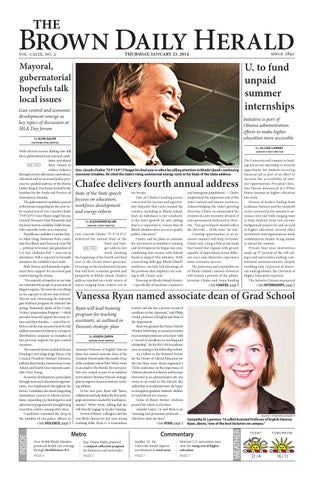
Gov. Lincoln Chafee ’75 P’14 P’17 began his final year in office by calling attention to Rhode Island’s continuing economic troubles. He cited the state’s rising commercial energy costs in his State of the State address.
Chafee delivers fourth annual address
State of the State speech focuses on education, workforce development and energy reform By ALEXANDER BLUM SENIOR STAFF WRITER
Gov. Lincoln Chafee ’75 P’14 P’17 delivered the annual State of the State and budget address last week, marking the beginning of his fourth and final year as the Ocean State’s governor. Focusing on the fundamental factors that will drive economic growth and prosperity in Rhode Island, Chafee’s address touched on a wide variety of topics, ranging from creative arts to
METRO
tax breaks. One of Chafee’s leading points concerned the income and opportunity disparity that exists around the country, including in Rhode Island. Such an imbalance is not conducive to the state’s growth, he said, adding that it is important to “ensure that all Rhode Islanders have access to quality public education.” Chafee said he plans to continue the investment in workforce training and development he began last year, combining state money with federal funds to support this initiative. With a narrowing skills gap, Rhode Island’s workforce can take full advantage of the positions that employers are seeking to fill, Chafee said. Drawing on Rhode Island’s history — specifically of maritime commerce
and immigrant populations — Chafee emphasized the important role of the state’s natural and human resources. Acknowledging the state’s growing diversity, Chafee recommended the creation of a new executive division of state government dedicated to diversity. “Our government should reflect the diversity ... of the state,” he said. Creating opportunities in an inclusive manner will help everyone, Chafee said, citing a PolicyLink study that found that regions with greater equality of opportunity across different races and ethnicities experience more economic success. The protection and responsible use of Rhode Island’s natural resources will remain a priority of the administration, Chafee said. Some funding » See CHAFEE, page 5
Vanessa Ryan named associate dean of Grad School Ryan will lead training program for teaching assistants, as outlined in Paxson’s strategic plan By JOSEPH ZAPPA SENIOR STAFF WRITER
Assistant Professor of English Vanessa Ryan was named associate dean of the Graduate School earlier this month, Dean of the Graduate School Peter Weber wrote in an email to The Herald. Her new position was created as part of an initiative in President Christina Paxson’s strategic plan to improve doctoral students’ teaching abilities. In her new post, Ryan will “listen, collaborate and help define the best pedagogical practices needed by teaching assistants,” Weber wrote, adding that she will directly engage in teacher training. Several of Ryan’s colleagues said she was likely chosen for her own strong teaching skills. Ryan is “a tremendous
teacher and she has a proven record of excellence in the classroom,” said Philip Gould, professor of English and chair of the department. Ryan was granted the Henry Merritt Wriston Fellowship, an award presented to an assistant professor or lecturer with a “record of excellence in teaching and scholarship,” for the 2013-2014 academic year, according to the fellowship website. As a fellow at the National Forum for the Future of Liberal Education for the last three years, Ryan organized a TEDx conference on the importance of a liberal education at Brown and became interested in an administrative job, she wrote in an email to The Herald. She added that as an administrator, she hopes to strengthen graduate students’ abilities to teach liberal arts courses. Some of Ryan’s former students praised her talent as a lecturer. Annette Lopez ’14 said Ryan is an “amazing and passionate professor … who loves what she does.” » See RYAN, page 3
Metro
COURTESY OF BROWN UNIVERSITY
Samantha St. Lawrence ’14 called Assistant Professor of English Vanessa Ryan, above, “one of the best lecturers on campus.”
Commentary
Over 30,000 Rhode Islanders purchased health care coverage through HealthSource R.I.
Rep. Donna Walsh proposed a compost collection program for businesses and universities
Sundlee ’16: The University should improve recruitement in rural areas
Editorial: U.S. universities must stem the rising cost of higher education
PAGE 4
PAGE 5
PAGE 7
PAGE 7
weather
inside
METRO
The University will commit to funding at least one internship or research opportunity for students receiving financial aid as part of an effort to increase the accessibility of summer opportunities, President Christina Paxson announced at a White House summit on higher education last week. Dozens of leaders hailing from academia, business and the nonprofit sector convened at the summit to announce new and wide-ranging ways to help students from low-income backgrounds prepare for and succeed in higher education. Several other institutions and organizations made commitments despite being unable to attend the summit. Private four-year institutions made up 57 percent of the 109 colleges and universities making commitment announcements, despite enrolling only 14 percent of American undergraduates, the Chronicle of Higher Education reported. The initiative Paxson announced » See INTERNSHIPS, page 2
t o d ay
tomorrow
21 / 4
16 / 11
2 university news » INTERNSHIPS, from page 1 seeks to ensure that the need to earn money during the summer does not block students who receive financial aid from conducting unpaid research or working as unpaid interns. The University plans to begin implementing the initiative in the summer of 2014, according to a University press release. By the summer of 2018, the program is expected to provide funding to all eligible students. Summer earnings requirements and the various costs of taking on an unpaid internship or research opportunity are extremely prohibitive, Paxson told The Herald. Missing out on these opportunities can deprive lower-income students of educational
experiences and hurt their chances of building key skills and connections for later career opportunities. “We don’t have a level playing field for aided and non-aided students in regards to summer opportunity,” she said. The University will seek to equalize opportunities for low-income students by making a monetary commitment to expanding the funds available for the Linking Internship and Knowledge (LINK) and Undergraduate Teaching and Research Award (UTRA) programs, specifically for students on financial aid, Paxson said. Both of these programs are available to undergraduates pursuing low-paying or unfunded internships, regardless of financial aid status, but
are not funded enough to serve all students who apply. Additionally, more students will receive Summer Earnings Waivers under the program. The plan was already “in the works” before the White House summit and is consistent both with the goals of the summit and with the goals laid out in the University’s strategic plan, which highlighted improving and expanding financial aid as a major priority, Paxson said. Undergraduates identified financial aid as a top priority in an October poll conducted by the Undergraduate Council of Students, with 38.4 percent of respondents naming financial aid as their number one administrative priority and 61.7 percent listing it among their top three of 10 choices, The Herald reported at the time. Alex Mechanick ’15, president of Brown for Financial Aid, called the internship funding commitment an
THE BROWN DAILY HERALD THURSDAY, JANUARY 23, 2014
“encouraging” departure from previous efforts by the University to help financial aid recipients: The initiative seeks to provide funding opportunities for all eligible students as opposed to announcing a specific dollar amount to be spent on aid, he said. The program is part of a broader effort by the University, led by the CareerLAB and the Division of Advancement, to improve summer internship and research opportunities for all students, regardless of financial aid status, Paxson said. This push, which seeks to strengthen an alumni internship and career-advising network to expand the University’s connections to paid internships, was another component of the strategic plan. By identifying greater numbers of paid internships and research opportunities, the University can reduce costs of funding unpaid opportunities and support a greater number of students, Paxson said.
Full details of the program’s logistics and costs are not yet available, Paxson said, though she anticipates the program could cost $500,000 this summer, increasing by about $500,000 more for each of the next two summers. These “rough estimates” are highly subject to change as logistics are determined and the arsenal of paid opportunities is expanded, she added. “Already there’s a lot of enthusiasm among Brown alumni and parents for building support for this program,” she said. While some students said they see the initiative as a positive move for low-income students, others continue to push the University to become more accessible to and supportive of lower-income students. Becoming completely need-blind in the admission process for international students is a particularly pressing issue, Mechanick said. “I think the administration is moving in the right direction. I just hope they keep moving,” he added. The White House summit came as part of the Obama administration’s national push to improve the accessibility of higher education, which has been an ongoing policy priority throughout President Obama’s tenure. In his remarks at the summit, Obama called the fact that the commitments were undertaken without Congressional action “extraordinary.” Many of Brown’s peer institutions also announced new initiatives to bolster college accessibility at the White House, including Columbia, Harvard, Princeton, Penn, Yale and the Massachusetts Institute of Technology. Several of the schools’ commitments focus on increasing outreach and recruitment efforts for lower-income high school students, according to a White House document detailing each participating institution’s commitment. These efforts include sending admission officers to underserved communities, spreading awareness about financial aid and college affordability to students and offering summer opportunities targeted for students from low-income backgrounds. Brown has existing programs focused on outreach to and college preparation for low-income students, Paxson said, and therefore did not include these as part of its White House announcement. Cornell and Dartmouth were the only Ivy League schools that did not announce new initiatives.
university news 3
THE BROWN DAILY HERALD THURSDAY, JANUARY 23, 2014
W I N T R Y WA L K S
TOM SULLIVAN / HERALD
Students walk along a snowy path near Wriston Quadrangle Wednesday to attend the semester’s first day of classes. The winter storm that hit Tuesday afternoon dumped up to 11 inches of snow around Rhode Island, the Associated Press reported.
» RYAN, from page 1
» VIOLENCE, from page 1
Samantha St. Lawrence ’14 called her “one of the best lecturers on campus,” adding, “It’s sad that she’s leaving undergraduate teaching.” In her role as associate dean, Ryan will also communicate with the Office of the Dean of the College and the Sheridan Center for Teaching and Learning to improve undergraduates’ learning experiences, Weber wrote. The initiative that led to the creation of the new role provides resources to strengthen teaching assistants’ instructing skills, Weber wrote, adding that the initiative will help the University “attract ever-stronger doctoral students.” Both Ryan and Weber highlighted the importance of teaching to the graduate student experience, regardless of whether students remain in the classroom after securing their degrees. “Teaching has been something of a calling for me,” Ryan wrote. She added that she looks forward to incorporating teaching as an essential component of graduate education. Ryan will not be teaching this semester and does not expect to teach undergraduates this fall, she wrote. Two undergraduate courses that she was scheduled to teach this semester — ENGL 1511M: “Victorian Self and Society” and ENGL 1560R: “From Frankenstein to Einstein: Literature and Science from 1800 to 1950” — were canceled. Gould emailed students in December who had preregistered for Ryan’s spring courses after he learned of Ryan’s appointment so they could find alternative courses, he said. The Department of English will discuss the possibilities of hiring another faculty member and offering other courses on Victorian literature to replace those that Ryan would have taught, he added.
a contributing factor in rising crime rates and considered enlarging the police force. The number of officers has dropped from 487 to 412 over the past five years. Deviating from the majority of policy proposals, Smiley announced that if elected mayor,he would work to institute a 10 percent supplemental sales tax on guns and ammunitions that he expects would raise approximately $2 million. Proceeds would be distributed to regional police departments according to the crime levels reported within their jurisdiction, he said. Elorza applauded the fact that Providence currently has the most diverse police department in the state, but said he would strive to promote further diversity to match the composition of Rhode Island’s population.
4 metro
THE BROWN DAILY HERALD THURSDAY, JANUARY 23, 2014
Health care enrollment on track to meet federal targets Lawmakers expand Medicaid, thousands more eligible for federal coverage By MOLLY SCHULSON SENIOR STAFF WRITER
Following the Dec. 31 federal deadline for health care coverage registration, approximately 32,000 Rhode Islanders have signed up for health insurance using the HealthSource R.I. marketplace. Over 20,000 people — approximately 63 percent of enrollments
— have signed up for Medicaid, which puts Rhode Island roughly two-thirds of the way to meeting the original projection made by state officials. And over 11,000 have enrolled in private insurance plans, far ahead of federal enrollment targets, the Providence Journal reported. “Rhode Island’s exchange has been working well since day one and will continue to do so,” said Ira Wilson, professor and chair of the Department of Health Services, Policy and Practice. He credited the program’s success to Lt. Gov. Elizabeth Roberts and former Health Insurance
Commissioner Christopher Koller, among others. In December alone, the number of Rhode Islanders enrolled in Medicaid nearly quadrupled. As of Dec. 28, Rhode Island had reached 174 percent of its federal enrollment target of 12,000 sign-ups by March 31. The New York Times ranked Rhode Island second in its ranking of state-run exchanges. Ninety-seven percent of people who enrolled in private insurance opted for a Blue Cross Blue Shield of Rhode Island private plan that is subsidized by the federal government.
About 87 percent of Rhode Islanders who have purchased private health insurance qualify for federal subsidies. Rhode Island is one of 18 states that chose to create its own health care marketplace instead of utilizing the federal option, which has suffered significant technical difficulties since its Oct. 1 opening. HealthSource R.I. collaborated with different state agencies and insurance companies to determine what marketplace would work best for Rhode Islanders, said Angela Sherwin ’07 MPH’09, director of the Executive Master of Healthcare Leadership program. The exchange was successful from the start because the state was set on creating its own marketplace and hired smart people to do so, Wilson said. Rhode Island also chose to expand its Medicaid program under the Affordable Care Act. The expansion provides Medicaid coverage to all adults with an income of up to 138 percent of the poverty line. As a result, an estimated 45,000 Rhode Islanders became newly eligible. “Rhode Islanders are lucky to live in a state that chose to expand the Medicaid program for low-income adults,” Sherwin said. The exchange also aims to make coverage more affordable and accessible to small businesses, Sherwin said. “Each individual employee can go to the exchange and pick which insurance plan works best for them,” she added. “Creating value for small employers is something that HealthSource R.I. did that was really intentional, and it makes Rhode Island stand apart.” Over 70 small businesses have already signed up for coverage, according to the HealthSource R.I. website. HealthSource R.I.’s “anonymous browsing feature” — which allows customers to explore specific plans without full registration — was one idea that had a much greater impact than expected, Sherwin said. The feature allows the exchange “to streamline customer inquiries in an efficient way,whereas other states have had web traffic bottlenecks,” she added. After the Dec. 31 deadline passed, the rate of sign-ups in Rhode Island did not decrease, Sherwin said. “Interest will continue to grow through
the next couple of months until the next deadline hits at the end of March,” Sherwin added. If people are uninsured by the March deadline, they will have to pay a penalty of $95 the first year. The fee increases to $695 by the third year. Health care experts originally predicted that enrollments would not happen until after February because holiday spending could discourage people from paying premiums, Wilson said. “Everyone expects there’s going to be an absolute flurry in sign-ups in March,” Wilson said. “People are indecisive and don’t make decisions until they are forced to.” “While overall I think HealthSource R.I. is doing great, there’s still a long way to go to enroll uninsured” Rhode Islanders, Sherwin said, adding that the exchange has plenty of room to grow in the coming months. The state needs to continue to work on ensuring that young people “understand the value of health insurance,” said Lisa Katz, policy director and co-founder of the Economic Progress Institute and chair of Rite Care Consumer Advisory Council. Wilson said he is interested in the ultimate cost of the program for consumers. Such costs will be hard to determine, because while more people are going to have regular exams done at the doctor’s office, fewer people will be ill down the road, he said. There are “downstream savings that you can’t see at the beginning,” Wilson added. Federal funding toward the exchange will end in 2015, and state lawmakers are currently deciding how to fund HealthSource R.I. Christine Ferguson, director of the exchange, said the marketplace’s annual budget should be between $17 million and $20 million. On Tuesday, four businesses — the Rhode Island Business Group on Health, Rhode Island Manufacturers Association, Rhode Island chapter of the National Federation of Independent Business and Greater Providence Chamber of Commerce — collectively signed and sent a statement to Gov. Lincoln Chafee ’75 P’14 P’17 stating that HealthSource R.I. should be funded not by state taxpayers but only by people and businesses purchasing insurance through the marketplace.
Like us on facebook! facebook.com/browndailyherald Follow us on twitter! twitter.com/the_herald
metro 5
THE BROWN DAILY HERALD THURSDAY, JANUARY 23, 2014
» CHAFEE, from page 1 will be dedicated to improving local “water and water-waste systems.” He also proposed $10 million to support the construction and development of an events center in Fort Adams State Park in Newport to allow Rhode Island to “host large-scale, world-class sailing events.” To further the development of his environmental initiatives and to combat the rising costs of commercial energy, Chafee said he hopes to embrace clean power sources such as hydropower and wind energy. “We know (climate change) is happening, and humans are causing it with emissions from burning highcarbon fossil fuels,” Chafee said. But, he said, by investing in clean energy infrastructure, “we do have the potential to make this region the lowcost, green energy capital of North America.” Stressing the economic importance of Rhode Island’s arts and culture sector, Chafee said he seeks to bolster the industry, which he credited with supporting 5,200 jobs and generating $324 million in economic activity in one year alone. He called on Rhode Islanders to support $35 million in funding through a bond referendum to further the sector’s development. Chafee also proposed incorporating the State Council of the Arts and the State Film Office into the Commerce Corporation to “synergize and enliven the state’s creative operatus.” “Rhode Island’s infrastructure is more than roads and bridges,” Chafee said, citing his proposal to invest in upgrading state university campuses. Specifically, Chafee is putting “a $125 million bond issue to the voters” to support construction projects for the University of Rhode Island’s College of Engineering. To address Rhode Island’s worsening congestion and gridlock, Chafee announced a $40 million bond issue to help outline mass transit hub systems at key locations in the state. An
additional $250,000 from the Rhode Island Capital Fund Plan would facilitate the early design of this new hub strategy. “Good mass transit will spur economic growth,” Chafee said, adding that runway expansion at T.F. Green Airport remains a priority. “The thoughtful development of the 195 land in the heart of Providence also continues,” Chafee said, adding that the General Dynamics Electric Boat’s recent signing of a 25-year lease agreement to expand its presence in Quonset Point is an achievement worth celebrating. Describing last year’s rebirth of Rhode Island’s tax credit program, Chafee proposed an additional $50 million in funding. This would help meet the tax credit demand, which exeeded last year’s $35 million in funding. Chafee advocated for the passage of the federal Marketplace Fairness Act, which would have several economic implications for the state. Though the proposed legislation focuses on leveling the playing field between online retailers and business owners with physical shops, it would also facilitate Chafee’s proposal to reduce the state’s corporate income tax from 9 to 6 percent, the Providence Journal previously reported. But, he warned, the passage of the act would likely allow other states, such as Massachussetts and Connecticut, to gain similar revenue streams to “make their tax structures more competitive.” Chafee urged legislators to resist the temptation to spend any subsequent revenue on short-term fixes if the House of Representatives passes the legislation. Instead, legislators should focus on investing in Rhode Island’s long-term competitiveness, he said. Citing the 11,100 Rhode Islandbased jobs created since Chafee took office in January 2011, Chafee said he is hopeful for the future. “We are moving in the right direction,” he said. “We are poised to emerge from (the recession) more resilient than before.”
SPOTLIGHT ON THE STATEHOUSE BY KATE KIERNAN, METRO EDITOR
The General Assembly opened its 2014 legislative session Jan. 7. The Assembly received the proposed 2015 budget from Gov. Lincoln Chafee ’75 P’14 P’17 at his annual State of the State address Jan. 15. Among the legislation filed by state senators and representatives since the start of 2014 are bills on the state’s economy, tax structure, environment and criminal justice system.
Rhode to Work The Senate released its annual “Rhode to Work” report Jan. 21 at a Statehouse press conference. The report was created in response to the concerns of business leaders claiming a lack of skilled workers for vacant job opportunities in the state, said Senate President Teresa Paiva Weed. Bills will be introduced in the next several weeks to address issues raised by the “Rhode to Work” report based on an “inability of unemployed Rhode Islanders to find jobs that fit their skills, and concerns that the state’s workforce is not prepared for the demands of tomorrow’s economy,” according to a press release. Legislators will work on creating a comprehensive job training program, creating more high school internship opportunities through the bRIdge.jobs program and “expanding the state’s current apprenticeship tax credit,” according to the release. Proposed legislation would also address workforce education programs — particularly “by offering a $1 million incentive to begin a disruptive new career and technical program that fits the needs of the modern workforce.” Rhode Island’s 9 percent unemployment rate is currently the second highest in the country, according to the U.S. Bureau of Labor Statistics.
State of the estate tax Two different bills have been introduced in the House to reform the estate tax policy in Rhode Island. The current threshold for the inheritance tax is $675,000 but has increased to $921,000 given current inflation rates. Rep. Deborah Ruggiero, D-Jamestown and Middletown, proposed a measure Jan. 7 to make inheritances valued at $1.5 million or greater subject to the estate tax. Ruggiero’s legislation specifies that people would be taxed only on the amount of their estate exceeding the $1.5 million benchmark. Rep. Robert Craven, D-North Kingstown, proposed a reform that would raise the benchmark at which people would be liable to pay the estate tax to $2 million. “A $2 million threshold is not only what I would consider just, but it is also a more appropriate figure for today’s economic reality,” Craven said, according to a press release. Both bills state that these reforms will make Rhode Island’s estate tax policy more competitive with thresholds across the country and attract businesses. In particular, the measures could benefit Rhode Islanders who inherit small businesses and those discouraged from living in Rhode Island because of the current inheritance tax policy, Craven said. “Our state is simply out of line with the rest of the nation on this exemption, and it would benefit our state as a whole if we caught up,” Ruggiero said, according to the release.
(Food) waste not, want not Rep. Donna Walsh, D-Charlestown, South Kingstown, Westerly, New Shorham, filed a bill Jan. 9 to the House Environment and Natural Resources Committee to develop a compost collection system for non-residential personnel, such as large businesses and universities. The bill’s purpose is “to minimize the production of greenhouse gases, recover the nutrient value of food residuals” and “promote the creation of green jobs” by creating a new industry to collect food waste, according to the bill’s text. The bill also requires future compost-processing facilities to use organic methods for treating food waste. The year by which an institution will be required to adhere to the law will depend on the amount of food residuals it produces. The largest producers of food waste would have to abide by the requirements starting in 2015 and the majority of businesses and institutions in the state would have to comply by 2021. Connecticut, Vermont and Massachusetts already have similar legislation to address the collection and processing of food waste. Though the bill does not apply to residents, Walsh said she hopes her composting proposal can encourage individuals to consider their own food waste production, according to a General Assembly press release.
Proposed parole controls Several bills have been proposed in the Senate and House to reform the state’s registry for convicted felons and the parole eligibility requirements, according to a press release from the General Assembly. Sen. Leonidas Raptakis, D-Coventry, East Greenwich, West Greenwich, and Rep. Raymond Hull, D-Providence, have both introduced bills to add criminals convicted of first- or second-degree murder to the state’s existing registry and notification system, which currently only applies to sex offenders. “The public has a right to know that someone who has committed a murder is living in their neighborhood,” Raptakis said, according to the release. There is also proposed legislation to change the parole eligibility requirements for convicted murderers. The House bills — introduced by Raptakis in the Senate and Rep. Patricia Serpa, D-West Warwick, Coventry, Warwick — propose delaying the time of the first parole board hearing for those not sentenced to life imprisonment. This hearing determines parole eligibility and under the proposed legislation would not occur until the convicted individual served at least half the sentence. “This is about fairness in sentencing and requiring individuals convicted of a truly horrible crime to serve a significant amount of time in jail,” Serpa said, according to a press release. “The public expects these individuals to pay an appropriate price for the wrong they have done, and that doesn’t always happen.” Another bill introduced by Hull and Raptakis would prohibit those sentenced to life imprisonment from being eligible for parole until they have served 30 years of their sentence or 30 years for each life sentence if they are serving consecutive life sentences.
6 today
THE BROWN DAILY HERALD THURSDAY, JANUARY 23, 2014
shopping and sliding
menu SHARPE REFECTORY
VERNEY-WOOLLEY
LUNCH Hot Turkey Sandwich with Gravy, Mashed Potatoes, Vegetable Strudel with Cheese Cream Sauce
Saturday Night Jambalaya, Cauliflower Au Gratin, Italian Sausage Soup with Tortellini, M&M Cookies
DINNER Hake, Korean-Style Marinated Beef, Carrots in Parsley Sauce, Yogurt Bread, Banana Cream Pie
Roast Turkey, Vegetable Bean Stew, Green Peas, Bread Stuffing, Pueblo Bread, Cranberry Apple Crisp
sudoku
TOM SULLIVAN / HERALD
Students braved icy pathways on the Main Green yesterday morning after the University announced that classes at 10 a.m. or after would be held as scheduled.
comic Class Notes | Philip Trammell
RELEASE DATE– Thursday, January 23, 2014
Los Angeles Times Puzzle c r o sDaily s w oCrossword rd Edited by Rich Norris and Joyce Nichols Lewis
ACROSS 1 Took in 4 Cartoon huntsman 8 One of the five Olympic rings 14 __ Harbour, Fla. 15 Memo term 16 Jeweled headgear 17 Electrical unit 18 France, in the time of the 6Down 19 Julio’s partner in wine 20 Sponge 22 The Beatles’ “__ Just Seen a Face” 24 ERA and others 25 Enchant 26 Mark 28 Power units 30 Thought before taking a risk 34 Excessively affected 36 First name in Chicago politics 37 Pathetic 38 Good Friday mo., often 39 Lullaby setting, and a hint to the starts of 3-, 4-, 9and 31-Down 41 Group __ 42 4-Across frame 43 Golden __: Drake’s ship 44 How aspirin is taken 46 Single sock, e.g. 48 “We hold __ truths ...” 49 Superfan 51 Art nouveau, say 54 Musical flip 57 Sumac of song 58 Man of letters? 59 Hard to believe 61 __ B’rith 63 Down Under school 64 Mutual respect 65 Second 66 “Football Night in America” co-host Patrick 67 Envelop 68 List maker
69 More than scratch the surface
32 Castro of Cuba 33 Neither cool nor collected 34 Food truck offering 35 Non-news page 36 It may precede meat and potatoes 40 Sweepstakes mail-in 45 Sleuthing films canine
47 Got there 48 Semiconscious state 50 Set 52 Island only 2% owned by Hawaii 53 Barely acquiring, with “out” 54 Tampa NFL team 55 Bamboozle 56 “__ la Douce” 60 Pipe cleaner 62 “Now it’s clear!”
DOWN 1 Enola Gay payload 2 Lake bordering the Silver and Golden states 3 “Sesame Street” segment with Dorothy the goldfish 4 Combat with one ANSWER TO PREVIOUS PUZZLE: survivor 5 Actress Merkel 6 Pre-Christian Celtic priests 7 Go deeply (into) 8 Citrusy drink 9 Input for a personnel interviewer 10 Carried on 11 “The very __!” 12 “__ la vie!” 13 Figs. 21 Oft-checked item 23 Use as a terminus 27 “I know! Pick me!” 29 Città on the Po 31 “Dolphin Tale” co-star 01/23/14 xwordeditor@aol.com
calendar TODAY
JANUARY 23
12:00 P.M. GRANT FINDING @ BROWN AND BEYOND WORKSHOP
Library staff will provide information about funding and awards available as internal and external grants. Rockefeller Library, Hecker Room 7:00 P.M. DON’T BE A STRANGER! 6TH ANNUAL BROWN-RISD DUAL DEGREE EXHIBITION
The Brown-RISD Dual Degree students will showcase their work, which covers topics of community and belonging. The exhibition will feature live performances. Granoff Center for Creative Arts 12:00 P.M. SUPERFUND RESEARCH PROGRAM: WEBINAR PRESENTATION
Jeanne Briskin from the U.S. EPA Office of Research and Development will present on the EPA’s “Study of the Potential Impacts of Hydraulic Fracturing on Drinking Water Resources” as part of a webinar series. Watson Institute, McKinney Conference Room
TOMORROW
JANUARY 24
4:00 P.M. GATHERING TO REMEMBER DANA DOURDEVILLE ’15
Community members are invited to commemorate Dana Dourdeville ’15, who passed away during winter break, in an informal gathering. J. Walter Wilson, Room 411 12:00 P.M. LECTURE: COMMUNITY APPROACHES TO OBESITY PREVENTION
Professor Chris Economos will present a talk entitled “Catalyzing Communities to Prevent Obesity: A Systems Approach” as part of a Research and Innovations Networking Series. 121 South Main St., Room 245
By Jeffrey Wechsler (c)2014 Tribune Content Agency, LLC
01/23/14
q u o t e o f t h e d ay
“Teaching has been something of a calling for me.” — Vanessa Ryan, associate dean of the Grad School
See vanessa ryan on page 1.
Got something to say? Leave a comment online! Visit www.browndailyherald.com to comment on opinion and editorial content.
commentary 7
THE BROWN DAILY HERALD THURSDAY, JANUARY 23, 2014
COLUMN
EDITORIAL
Brilliance in the boonies ROBYN SUNDLEE opinions columnist
Brown is a beautifully diverse campus, but there is a demographic that is underrepresented both here and at other elite institutions: students from rural backgrounds. It’s rare to come across someone who isn’t from a suburb or major metropolis. Only 8 percent of the class of 2016 is from the Midwest, and most of them are from Chicago. The “West/ Mountain” states statistic of 22 percent is misleading because it groups students from major coastal cities with those east of the mountains, where population and affluence dwindle. Our school, supposedly a bastion of diversity, has a serious dearth of students from rural areas. If our university wants to live up to its diversity mantra, it needs to put more effort into recruiting the best and brightest from rural, less wealthy communities. Students from such backgrounds bring different, sorely needed perspectives on life in the inner landscapes of the United States. Even under need-blind policies, a majority of high achievers in rural, lowincome areas do not apply to any highranked colleges because there are still myriad factors besides cost that impede them from considering such schools. I know from experience that few students in rural communities are even aware of the possibility of attending a university such as Brown. For many, the idea is unfathomable. It simply isn’t done in many places. Even if some students do recognize the opportunity, the logistics of attending school so far away are often overwhelming. If parents are overworked and struggle to make ends meet, it’s unlikely that students will be able to rely on them for support or
guidance in navigating the application process. High school counselors are a resource, but too many cannot devote enough time to assisting the outliers and are too quick to advise ambitious juniors to pursue more modest goals. Caroline Hoxby, a Stanford University professor of economics, has attempted to address such problems by creating a customized packet for promising rural students that explicitly compares the cost of the student’s local education with those of elite colleges. The packet explains the application process in clear terms and elucidates all costs that the students would be exempt from and responsible for. After sending out
their assistance. Not everyone is so blessed. Extraordinary potential slips through the cracks each year that Brown fails to reach out to rural schools and their promising students. To expect a presence everywhere is unreasonable, but a presence in places besides wealthy suburbs and cities is essential. If Brown has the resources to send recruiters overseas, it most definitely can afford to establish a relationship with more rural high schools. If actions aren’t taken to facilitate applications from students in these communities, Brown is in danger of overlooking major academic potential and invaluable social and economic perspectives. The failure of elite universities to create economically diverse student bodies is only widening the economic and ideological gulf between urban and rural populations. Uniting these very disparate groups of Americans is essential to our nation’s future, and Brown should put itself at the forefront of such efforts by ensuring rural communities are properly represented in enrollment. Need-blind admission is a solid step toward opening up higher education to all economic classes, but it isn’t enough to attract the American rural poor. The fact that our university is strapped for cash compared to our Ivy League peers is no secret. No one can blame admission officers who focus on wealthy ZIP codes, legacies and prep schools. Still, the insights and perspectives offered by country kids are valuable to our university as well. Mountain towns, vast prairies and isolated valleys hold minds of huge untapped potential, waiting to be inspired. Brown just needs to seek them out.
Extraordinary potential slips through the cracks each year that Brown fails to reach out to rural schools and their promising students. such packets, prestigious schools began to receive more applications from the hinterlands. Brown could work to adopt its own unique policy of targeting rural America’s bright youth. Instead of the customary “think about applying” letter, Brown could borrow ideas from Hoxby’s research to present a more enticing case to these kids, while establishing basic relationships with rural schools that are routinely ignored. I came from a rural community where the highest anyone aims is nearby public universities. While I know Brown actively recruits in Seattle suburbs, there was barely a whisper from the Ivy League on my side of the mountains. When I told people where I was applying, I got some raised eyebrows, but mostly I got: “Brown? Where on earth is that?” I was lucky. My family worked with me on the logistics of the application process, covered my fees and discussed my essays. I would never have applied without their encouragement, and I honestly don’t think I could have kept everything straight without
Robyn Sundlee ’16 wants more hillbillies to hang out with. She can be contacted at robyn_sundlee@brown.edu.
CORRECTION An article in Wednesday’s Herald (“Exotic flavors spice up campus culinary scene,” Jan. 22) misstated the name of the University’s newest campus eatery. In fact, it is Andrews Commons, not Andrews Dining Commons. The Herald regrets the error. Editorial Leadership
Sections
Visuals & Production
Business
Editor-in-Chief Eli Okun
Arts & Culture Editors Katie Cusumano Andrew Smyth
Photo Editors Head: Tom Sullivan Brittany Comunale David Deckey Emily Gilbert Samuel Kase Sydney Mondry
General Managers Jennifer Aitken Nicole Shimer
Managing Editors Mathias Heller Sona Mkrttchian Adam Toobin Senior Editors Maddie Berg Kate Nussenbaum BLOG DAILY HERALD Editor-in-Chief William Janover Managing Editors David Oyer Georgia Tollin POST- MAGAZINE Editor-in-Chief Ben Resnik COMMENTARY Editorial Page Editors Matt Brundage Rachel Occhiogrosso Opinions Editors Gabbie Corvese Sarah Rubin Maggie Tennis
Enterprise Editor Elizabeth Koh Features Editors Sabrina Imbler Maggie Livingstone Metro Editors Kate Kiernan Katherine Lamb Science & Research Editors Isobel Heck Sarah Perelman Sports Editors Caleb Miller Dante O’Connell University News Editors Kiki Barnes Michael Dubin Maxine Joselow Tonya Riley
Video Editor Henry Chaisson Graphics Editors Andersen Chen Avery Crits-Cristoph Greg Jordan-Detamore Jillian Lanney Web Producer Joseph Stein Design Editors Brisa Bodell Einat Brenner Assistant: Carlie Peters Assistant: Taylor Schwartz Assistant: Sean Simonson Copy Desk Chief Claire Postman Assistant: Sara Palasits Illustrations Editor Angelia Wang
Directors Sales: Winnie Shao Finance: Sarah Levine Finance: Sameer Sarkar Alumni Relations: Alison Pruzan Business Dev.: Melody Cao
Middle-class students deserve more attention
The start of a new spring semester often marks the advent of the Corporation’s tuition hike. Last year the Corporation announced a 4 percent tuition hike in concurrence with a 5.6 percent increase in financial aid. While we support this recent commitment to better financial aid, focusing on the importance of financial aid in higher education distracts from a larger systemic issue in the United States: College should not cost this much. With its relatively strong financial aid program, Brown can support students coming from lower-income families, while wealthy families are more likely to be able to bear the cost of a Brown degree. Left out of this equation, of course, are middle- and upper-middle-class students who do not qualify for much financial aid but still lack the financial resources to avoid high levels of debt and the associated pressure to obtain a highpaying job immediately after college. The United States is plagued by not only tuition increases exceeding the rate of inflation, but also the lingering effects of the Great Recession — one of the most lasting of which is a high unemployment rate, particularly among young people. The media have taken to pointing out which majors are perhaps not worth the investment. These majors tend to be in the humanities and social sciences. While it is unfortunate that this information creates a culture of fear about committing to these fields in a world of financial insecurity and inevitably high debt, students wary of prolonged debt may be justified in their concerns. A middle- to upper-middle-class student from a state lacking a strong public university system should not be denied a Brown education in a field that does not lend itself to an immediately high-paying career. But this is the outcome of the current model of higher education. In continuing to raise tuition costs, Brown and its peer institutions are implicitly endorsing this inefficient system by which universities select from a small pool of students who either can afford the high costs or are having them
facebook.com/browndailyherald
Location: 195 Angell St., Providence, R.I. www.browndailyherald.com
covered through financial aid. At the moment, if Brown were to stop raising tuition costs altogether, it would likely be sacrificing its position as a highly ranked university in the long run. Furthermore, it would solve little for Brown to act alone in rejecting the pattern of increased college costs in the face of its peer institutions continuing to do so. The problem is endemic; it requires more change than a single school can enact on its own. We need to have a broader conversation about the cost of college that goes beyond financial aid and increased government loans and asks why college costs so much more in the United States than it does in nations with a comparable standard of living. The effect of such high college costs is an extraordinary disincentive to study fields that do not guarantee high-paying jobs. High costs also put young people in a position where they have to pay off mountains of debt coming out of college, when they should perhaps be most free to determine the extent to which their salaries matter to themselves and to their society. To combat these issues, Australia adopted a model of optional income-contingent loans for students, by which students can opt to pay tuition prices that are dependent on their future incomes. This system eliminates the disincentive to study a subject out of passion even when it may not lead to a lucrative career. Meanwhile, in the United States, little action has been taken to change anything about tuition hikes. The focus is on making college affordable within a failing model instead of changing the model altogether. As Brown students, we bear a responsibility to continually consider and discuss a new model on behalf of those students who could not attend this university for financial reasons. Editorials are written by The Herald’s editorial page board: its editors, Matt Brundage and Rachel Occhiogrosso, and its members, Hannah Loewentheil and Thomas Nath. Send comments to editorials@browndailyherald.com.
@the_herald
Editorial contact: 401-351-3372 herald@browndailyherald.com
browndailyherald.com
Business contact: 401-351-3260 gm@browndailyherald.com
Office Manager Shawn Reilly
Corrections: The Brown Daily Herald is committed to providing the Brown University community with the most accurate information possible. Corrections may be submitted up to seven calendar days after publication.
Sales Managers Regional: Edward Clifford Regional: Sarah Pariser Regional: Ananya Shukla Regional: Jessica Urrutia Student Group: Moniyka Sachar
Commentary: The editorial is the majority opinion of the editorial page board of The Brown Daily Herald. The editorial viewpoint does not necessarily reflect the views of The Brown Daily Herald, Inc. Columns, letters and comics reflect the opinions of their authors only.
Finance Managers Collections: Jacqueline Finkelsztein Collections: Joshua Tartell Operations: Jessica O’Dell Alumni Relations Manager Engagement: Sarah Park Business Dev. Manager Project Leader: Kaden Lee
Letters to the Editor: Send letters to letters@browndailyherald.com. Include a telephone number with all letters. The Herald reserves the right to edit all letters for length and clarity and cannot assure the publication of any letter. Please limit letters to 250 words. Under special circumstances writers may request anonymity, but no letter will be printed if the author’s identity is unknown to the editors. Announcements of events will not be printed. Advertising: The Brown Daily Herald, Inc. reserves the right to accept or decline any advertisement at its discretion. The Brown Daily Herald (USPS 067.740) is an independent newspaper serving the Brown University community daily since 1891. It is published Monday through Friday during the academic year, excluding vacations, once during Commencement and once during Orientation by The Brown Daily Herald, Inc. Single copy free for each member of the community. Subscription prices: $280 one year daily, $140 one semester daily. Copyright 2014 by The Brown Daily Herald, Inc. All rights reserved. Periodicals postage paid at Providence, R.I. Postmaster: Please send corrections to P.O. Box 2538, Providence, RI 02906.