Daily Herald the Brown
vol. cxliv, no. 117 | Thursday, December 3, 2009 | Serving the community daily since 1891
Fund for city schools disburses more gifts
Van Wafels enters the cookie market
By Sara Luxenberg Contributing Writer
By SydneY Ember Senior Staf f Writer
Students entering the Blue Room last week might have spotted a new product on its shelves: soft, round waffle cookies with a thin layer of caramel in their centers. Inspired by Dutch
A University endowment to support Providence public schools disbursed a second round of grants Wednesday to three elementar y schools, as fundraisers seek to build a $10 million permanent fund. Three grants totaling nearly $30,000 were allocated by the Fund for the Education of the Children of Providence, created in 2007 to support local public schools in response to the 2006 report of the University Steering Committee on Slaver y and Justice. The latest round of awards will fund musical education and band programs at Windmill Elementar y School and Carl G. Lauro Elementar y School and will support computer workstations and software updates at Martin Luther King Jr. School, said Hanna Rodriguez-Farrar ’87 MA’90 PhD’09. Rodriguez-Farrar is a member of the Corporation’s board of trustees and a founding member of the committee to oversee the fund, who also serves as assistant to President Ruth Simmons. Each elementar y school will receive about $10,000. “Our main goal was to get money to students,” RodriguezFarrar said. “It’s right at the front line of student learning.” She said the committee that oversees the fund — which is made up of three members of the
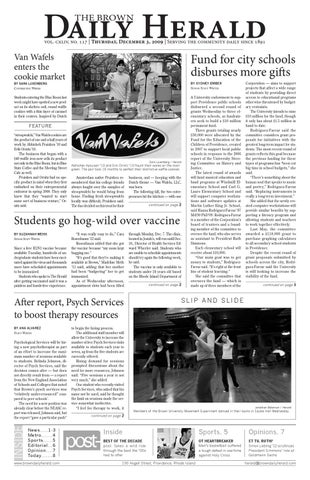
FEATURE “stroopwafels,” Van Wafels cookies are the product of one and a half years of work by Abhishek Pruisken ’10 and Erik Ornitz ’10. The business that began with a $40 waffle iron now sells its product not only in the Blue Room, but in Blue State Coffee and the Meeting Street Cafe as well. Pruisken and Ornitz had no specific product in mind when they first embarked on their entrepreneurial endeavor in spring 2008. They only knew that they “wanted to start some sort of business venture,” Ornitz said.
Sara Luxenberg / Herald
Abhishek Apruisen ’10 and Erik Ornitz ’10 flaunt their wares on the main green. The pair took 18 months to perfect their distinctive waffle cookies.
Amsterdam native Pruisken remembered that his college friends always fought over the samples of stroopwafels he would bring from home. Finding fresh stroopwafels locally was difficult, Pruisken said. The duo decided on this treat for their
business, and — keeping with the Dutch theme — Van Wafels, LLC, was born. The following fall, the two entrepreneurs hit the kitchen — with one continued on page 2
Students go hog-wild over vaccine By Suzannah Weiss Senior Staff Writer
Since a free H1N1 vaccine became available Tuesday, hundreds of undergraduate students have been vaccinated against the virus and thousands more have scheduled appointments to be immunized. Students who spoke to The Herald after getting vaccinated said it was a painless and hassle-free experience.
“It was really easy to do,” Cara Rosenbaum ’12 said. Rosenbaum added that she got the vaccine because “my mom kept bugging me.” “It’s good that they’re making it available at Brown,” Madeline Meth ’11 said, adding that her mother had been “badgering” her to get immunized. As of Wednesday afternoon, appointment slots had been filled
through Monday, Dec. 7. The clinic, located in Josiah’s, will run until Dec. 18., Director of Health Services Edward Wheeler said. Students who are unable to schedule appointments should try again the following week, he said. The vaccine is only available to students under 24 years old based on the Rhode Island Department of continued on page 2
After report, Psych Services to boost therapy resources By Ana Alvarez Staf f Writer
inside
Psychological Services will be hiring a new psychotherapist as part of an effort to increase the maximum number of sessions available to students. Belinda Johnson, director of Psych Services, said the decision comes after — but does not directly result from — a report from the New England Association of Schools and Colleges that noted that Brown’s pysch services was “relatively under-resourced” compared to peer schools’. The need for a new position was already clear before the NEASC report was released, Johnson said, but the report “gave a particular push”
News.....1-3 Metro.......4 Sports......5 Editorial...6 Opinion....7 Today.......8
www.browndailyherald.com
to begin the hiring process. The additional staff member will allow the University to increase the number of free Psych Services visits available to students each year to seven, up from the five students are currently offered. Rising demand for sessions prompted discussions about the need for more resources, Johnson said. “Five sessions a year is not very much,” she added. One student who recently visited Psych Services, who asked that his name not be used, said he thought the limit on sessions made the service somewhat ineffective. “I feel for therapy to work, it
Corporation — aims to support projects that affect a wide range of students by providing direct access to educational programs otherwise threatened by budgetar y restraints. The University intends to raise $10 million for the fund, though it only has about $1.5 million in hand to date. Rodriguez-Farrar said the committee considers grant proposals for initiatives with the greatest long-term impact for students. The most recent round of grants reflects this goal because the previous funding for these types of programs has “been cut big time in school budgets,” she said. “There’s something about the human soul that speaks to music and poetr y,” Rodriguez-Farrar said. “Replacing instruments is really a long-term investment.” She added that the newly created computer workstations will provide similar benefits by supporting a literacy program and allowing students and teachers to work together effectively. Last May, the committee awarded a $118,000 grant to purchase graphing calculators to all secondar y school students in Providence. Despite the recent round of grant proposals submitted by schools across the city, Rodriguez-Farrar said the University is still looking to increase the visibility of the fund. continued on page 3
slip an d sli d e
Jonathan Bateman / Herald
Members of the Brown University Movement Experiment danced in their socks in Sayles Hall Wednesday.
continued on page 2
Inside
Sports, 5
Opinions, 7
best of the decade post- takes a wild ride through the best the ’00s had to offer
OT heartbreaker Men’s basketball suffered a tough defeat in overtime against Holy Cross
ET TU, RUTH? Simon Liebling ’12 scrutinizes President Simmons’ role at Goldmann Sachs
195 Angell Street, Providence, Rhode Island
herald@browndailyherald.com
Page 2
THE BROWN DAILY HERALD
C ampus N EWS
Thursday, December 3, 2009
“We had no idea what we were doing” — Erik Ornitz ’10, Van Wafels creator
New psychotherapist Van Wafels a hit on campus, Thayer may arrive in spring continued from page 1
continued from page 1 needs to be regular visits,” he said. “Since there’s a limit, it’s difficult.” Students in need of more sessions usually ask for an outside referral after a few appointments with Psych Ser vices, Johnson said. Besides increasing the number of appointments available, Johnson said, the new position will “somewhat decrease the waiting period” for sessions. Students normally have to wait about a week for an appointment, she said, but about 25 percent of students have to wait longer. Immediate appointments are always available to students in a crisis, said Margaret Klawunn, vice president for campus life and student services. “Those needs will always be met.” The student who spoke to The Herald said his waiting time for an appointment was just three days, and he was reassured that if he had an emergency, he could see a psychologist immediately. In order to afford the new position, the University “reduced a couple of positions at Health Services and restructured the administration,” Klawunn said. Brown’s psych services, noted the NEASC report, has fewer re-
sources available than other peer institutions. “Most (other institutions) have unlimited number of appointments or are offering more than we are,” Klawunn said. But “we are making improvements as we can” — as evidenced by the new position, she said. Inter views for the position will not begin until after winter break, Johnson said. Though it remains unclear when the new psychotherapist will be hired, she said she hopes the position can be filled as early as the middle of the spring semester. Several students interviewed by The Herald were unaware that Psych Services restricted visits. Perr y Ashenfelter ’13 said that though she has not used Psych Ser vices, she was surprised to hear they had a limitation on sessions. “It would probably deter people from going when they actually might need it,” she said. “To me that doesn’t seem like a problem because the point is to know whether you want to continue therapy,” Vince Sghiatti ’13 said. “So if after seven sessions you still need therapy, it’s probably good that you get a full-time psychologist.” Ashenfelter added that the addition of a new psychotherapist would “probably be helpful.”
Thanks for reading! sudoku
small problem. “We had no clue what we were doing,” Ornitz said. Armed with recipes from the Internet, a small waffle iron and simple ingredients like cinnamon, eggs and butter, he and Pruisken made the first of many trial batches. “It was very experimental,” Ornitz said, “trying to figure out a recipe.” In the middle of October last year, they finally decided to give the public a taste of their product. After 11 straight hours of baking, Van Wafels held a sale on the Main Green and sold every last cookie — including the ones they prepared on-site. After a second successful sale, the duo began making plans to expand.
Stroopwafels, not your simple chocolate chip cookie Pruisken spent winter break researching Holland’s stroopwafel factories and returned with an industrial waffle iron and a new source of advice — the Dutchman who sold Pruisken the iron. He offered Pruisken words of wisdom on how to “tweak (the) recipe and optimize the cookies,” he said. Though Ornitz said he and Pruisken “get more efficient” each time they make the cookies, it is a “labor-intensive process” that they still take on themselves. The dough is baked, pressed in the iron and sliced so they can pour on the caramel layer and put the cookie’s two sides back together. “Every single one must be crafted by hand,” he said. “We joke we should have just made a chocolate chip cookie,” Ornitz said. At best, the duo can “make 150 cookies in an hour,” Pruisken said, adding that Van Wafels has begun to collaborate with the University’s Division of Engineering “to streamline the whole production process.” Beyond bake sales After moving to a bigger kitchen, obtaining a food license and building a following with three Main Green bake sales, Van Wafels started pitching to local cafes. “Most places that we’ve gone to have been really receptive,” Ornitz said. “We offer them a product that’s really unique, and a brand and a cus-
Courtesy of Van Wafels
Van Wafels, once sold only on the Main Green, are now available in the Blue Room, Meeting Street Cafe and Blue State Coffee.
tomer base. It’s mutually beneficial.” The team first approached the Blue Room. “I thought it would be a great opportunity to have a unique product in our unit,” said Linda Whittaker, assistant manager of retail operations for Brown Dining Services. Pruisken brought samples to Whittaker and made the pitch that the cookies were “a unique product to the area, possibly even the country,” Whittaker said. “He really just had all his ducks in a row in order to present the product to us in a professional manner.” Van Wafels cookies debuted in the Blue Room on Nov. 23 and sold out in two days, Whittaker added. Blue State Coffee and the Meeting Street Cafe have quickly followed suit, introducing the cookies this week, and the duo has also reached out to the Rhode Island School of Design, Pruisken said. While the fledgling business is “still in the red,” he said, they project that they will start turning a profit next semester. More than simply students Despite the challenges they have faced in balancing schoolwork with running a small business, Van Wafels’ founders said there’s also a silver lining in being students with a start-up. “One of the cool things about being a young entrepreneur is that people are excited for you,” Ornitz said. Van Wafels was the first student business to pitch to Whittaker, she said. “It’s so fabulous that they had the initiative to do what they’ve done,” she added. “There are really no shortcuts
when you’re starting from the ground up,” Ornitz said. He pointed to the added difficulty of being so young. “When you’re older, you have credentials, you have financial backing,” he said. “At this age, it takes a lot more motivation.” Pruisken said the business’s evolution was “very ad hoc,” citing the pair’s lack of experience. They’ve received advice and support from Barrett Hazeltine, professor emeritus of engineering, “since the very beginning,” Pruisken said. ‘Until the bitter end’ For now, Van Wafels’ founders are “taking it one month at a time,” Ornitz said. The two are exploring new opportunities — and even a chocolate version of their classic Dutch cookie. “Our vision is pretty grand, but there are a lot of steps before we can realize that,” he said. Pruisken and Ornitz don’t plan to let their impending graduation stop them from bringing their plans to fruition. Pruisken said he plans to continue running the business. Where it will be located and how many people are on the payroll “depends on how things unfold,” he said, and “on funding.” Ornitz, who will be working in New York after graduating, said he will “be involved until the bitter end” despite the change in location. “That’s who we are, we’re wafflecookie makers,” he said. “It’s not the next big health invention, it’s not the next big cure to a disease. It’s something simple that you enjoy in your life.”
Finals-wary students sign up for vaccine continued from page 1
Daily Herald the Brown
Editorial Phone: 401.351.3372 | Business Phone: 401.351.3260 Stephen DeLucia, President Michael Bechek, Vice President
Jonathan Spector, Treasurer Alexander Hughes, Secretary
The Brown Daily Herald (USPS 067.740) is an independent newspaper serving the Brown University community daily since 1891. It is published Monday through Friday during the academic year, excluding vacations, once during Commencement, once during Orientation and once in July by The Brown Daily Herald, Inc. Single copy free for each members of the community. POSTMASTER please send corrections to P.O. Box 2538, Providence, RI 02906. Periodicals postage paid at Providence, R.I. Offices are located at 195 Angell St., Providence, R.I. E-mail herald@browndailyherald.com. World Wide Web: http://www.browndailyherald.com. Subscription prices: $319 one year daily, $139 one semester daily. Copyright 2009 by The Brown Daily Herald, Inc. All rights reserved.
Health’s distribution protocol. Still, not all students are lining up to get the vaccine. Alex Wankel ’11 said he is not planning to get the inoculation because the potential risks of the vaccine outweigh the benefits. “They just came out with this vaccine and I don’t think it’s very well understood,” Wankel said. The swine flu is “a lot like other flus, so I’m not worried about it,” he added. “It would be inconvenient to get sick, but I’m sure I could manage.” Tim Terhaar ’11 said he is banking on a strong immune system. “I’ve never gotten the flu in the past,” he said.
On the other hand, Halie Rando ’11, a former Herald copy editor, said she was in a rush to receive the immunization because of her asthma. “If I get (the H1N1 virus) I’ll be in really big trouble,” she said. Between e-mails from the director of Health Services, table slips in the dining halls and, for some, additional e-mails from the athletic director or residential counselors, students said they felt well informed about the vaccine’s availability. Students didn’t all know the logistics, such as having to wait for 15 minutes after the vaccination in case of an allergic reaction, and some were anxious about FluMist, the nasal spray through which the vaccine is administered to individuals without specific health concerns.
Kate Carbone ’12 said she heard, but highly doubts, a story about someone who “can only walk backwards now” because the spray activated a latent neurological disorder. Rosenbaum similarly heard from a peer that she should not kiss anyone for 48 hours after getting the immunization. In reality, the risks of the vaccine are no greater than for any other influenza vaccine, Wheeler said, adding that the only possible side effects are rare allergic reactions. Most students who got the vaccine said they booked appointments mainly because, like Sophie Kainen ’12, they figured that “there’s nothing worse than getting the flu during finals.” “There’s nothing to lose,” Kainen added.
Thursday, December 3, 2009
THE BROWN DAILY HERALD
Page 3
C ampus N EWS
Administrators tell UCS Program planned to advise sophomores about new disciplinary rules By Nicole Friedman Senior Staf f Writer
By Suzannah Weiss Senior Staf f Writer
At the last Undergraduate Council of Students meeting of the semester Wednesday, two administrators gave a presentation on changes to the non-academic misconduct disciplinar y system that they will propose to the Corporation in February. Students facing the highest level of charges, which can result in separation from the University, can choose to have a hearing before the University Disciplinar y Council or with a dean unless there is a need for an expedited process, in which case the hearing will automatically be administrative. According to the administrators, Vice President for Campus Life and Student Services Margaret Klawunn and Associate Dean of Student Life Yolanda CastilloAppollonio, only two students over the past five years have chosen to have a hearing with the UDC. Because students seem to prefer administrative hearings, campus life is tr ying to make UDC hearings easier and more comfortable for them, CastilloAppollonio said. Klawuun and Castillo-Appollonio said they plan to recommend replacing the UDC with a new group called the Student Council Panel, which would include more faculty members on board to help determine sanctions and a quorum of three, rather than five, members for each hearing. “We wanted to make sure there was a way to get students to choose the panel sometimes,” Castillo-Appollonio told the UCS general body. In addition, Campus Life’s proposal would require students charged with sexual misconduct to undergo an administrative hearing, adding another exception to the policy of letting the accused student choose the venue. The Sexual Assault Advisor y Board took issue with the current policy of giving the person charged the privilege to choose which type of hearing takes place, Klawunn said. Requiring a hearing with a dean for this type of case would eliminate the problem of choice
altogether, she said. Also at the meeting, UCS President Clay Wertheimer ’10 reflected on the accomplishments that UCS committees have made this semester and made suggestions on how to move forward. “UCS has been very successful and instrumental in making sure student voices are being heard,” he told the general body. The Academic and Administrative Af fairs committee, in par ticular, has enacted some changes that will be visible over the next year. AAA Chair Robert Taj Moore ’11 said he is “unbelievably excited” that Dean of the College Katherine Bergeron has approved a pilot program for a sophomore advising system, which the committee had been developing throughout the semester. The committee also has convinced the administration to require professors to post syllabi online during shopping period. UCS Vice President Diane Mokoro ’11 said the ability to get course syllabi online is “one of the things I’m most excited about.” Campus Life Chair Ben Farber ’12 said his committee’s most significant actions this year included improving satellite gyms, updating the first-year roommate questionnaire, increasing the amount of outdoor seating on campus for the spring and reviewing the structure of undergraduate residential fees. The campus life committee has also been evaluating student lounge usage to determine which ones would benefit most from renovation. The most significant change UCS has brought about on campus this semester is “to include students in the organizational review process that Brown is undertaking,” Wertheimer told The Herald before the meeting. Adding students to working groups on the Organizational Review Committee and creating a student advisor y board to provide feedback on ORC’s decisions have “had a big impact on how these working groups have been doing,” he said. “I think we’ve had a great semester and I’m looking forward to next semester and doing even more great work,” Mokoro said.
A newly approved advising program will be piloted next semester, pairing 30 sophomores with 30 senior peer advisors for one-on-one mentoring. The senior mentors will also run four panels next semester for the entire sophomore class, said Molly Jacobson ’10, a co-coordinator for general outreach at the Curricular Resource Center who will help coordinate the program, known as the Sophomore Matched Advising Program. These panels will focus on areas of concern to sophomores, like getting to know faculty members, she added. The pilot program is mostly focused on demonstrating that “there is a need, a true need, for increased sophomore advising at Brown,” Jacobson said. The matched advising program, or “SMAP,” will be run by student coordinators at the CRC and the first-year and sophomore deans. It represents the latest of several efforts to improve sophomore advising, Dean of the College Katherine Bergeron wrote in an e-mail. Strengthening advising was a key recommendation of the Task Force on Undergraduate Education, which released its report in
September 2008. Since then, sophomore advising has been significantly expanded, Bergeron wrote. The current sophomore class is the first to be required to have faculty advisers, and each sophomore received an electronic handbook on “Planning Your Sophomore Year” on a free flash drive from the Dean of the College’s office in September. Randall Advisers, faculty members who are trained to advise sophomores, hold weekly office hours in the Advising Central space in J. Walter Wilson. “The peer advisers will supplement the advising provided by regular sophomore advisers in ways that (are) analogous to the Randall program,” Bergeron wrote. If the pilot program receives positive feedback, it will be continued and potentially expanded, Jacobson said. “One of the strengths of the program right now as we envision it is the intimate nature of the program,” she said. “Ideally, it might be a bit bigger, but for now we’re hoping to keep it small.” In selecting sophomores to participate, the coordinators will look for applicants who are “worried” and could benefit from the advising relationship, Jacobson said. “We’re really conscious of the fact that some sophomores have better advising right now than others,”
Nick Sinnott-Armstrong / Herald
Peggy Chang runs the Curricular Resource Center, which will help coordinate the advising program.
she said, adding that organizers are also focused on finding academically curious students who are “good at communicating their needs.” SMAP plans to collaborate with the Randall Advising program and Depar tmental Undergraduate Groups, Jacobson added. While a partnership with the Meiklejohn Advising Program might be considered in the future, Jacobson said Meiklejohns were “kind of expanded to the brink right now.” The Dean of the College’s office will notify all sophomores and seniors about the program next week, and applications will be available online around that time, Jacobson said.
Education endowment makes gifts continued from page 1 “One of the things that we’re looking to do is get more applications,” she said. “The committee would really like to see a lot more coming from the teachers and the schools.” She said part of the problem may be the size of the grants the fund looks to make — many teachers who want to fund smaller projects, such as new desks in the classroom, are daunted by proposals for larger awards. As a result, Rodriguez-Farrar said the committee might consider offering smaller grants in the future to encourage more teachers to apply. Despite the fund’s success since its inception three years ago, Rodriguez-Farrar said she hopes to
support more educational initiatives in Providence that would address “some of those gaps” created by the city’s struggling economy, such as cuts to physical education
programs. “It’s not just $10,000 for crayons,” she said. “Hopefully, bigger things will happen going forward.”
Metro The Brown Daily Herald
“You’re not going to turn around a state’s economy in a one-day session.” — Larry Berman, director of House communications, on the economic panel Thursday, December 3, 2009 | Page 4
House forum talks economics By Alexandra Ulmer Senior Staf f Writer
Economists, business owners and academics congregated Tuesday to discuss Rhode Island’s severe fiscal woes in an economic forum hosted by the state’s House of Representatives. The focus of the event was on galvanizing the “knowledge” economy and “green” economy in the state, which face a large budget deficit and an unemployment rate that reached 12.9 percent in October. Par ticipants — who ranged from an official of the U.S. Treasur y Depar tment to owners of local businesses — also examined measures taken on a national level and by other states in the hopes of reviving Rhode Island, which has been hit hard by the recession. “The members (of the House) wanted to have a brainstorming session” before the General Assembly convenes in Januar y for the 2010 session, said Larr y Berman, director of House commu-
nications. “You’re not going to tur n around a state’s economy in a one day session,” he added, but the discussion will help form a “plan of action” for the following year. There were few specifics decided Tuesday, which was a day for “listening and learning,” Berman said. While the national economy appears to be gradually improving, benefits will take longer to trickle down to the state level, Berman added. “Despite the improvements, challenges and risk remain,” Aaron Klein, deputy assistant for economic policy at the treasur y department, told lawmakers assembled at the State House. The state budget deficit has ballooned to over $200 million and unemployment has not subsided. In addition, a key culprit of the recession — the bursting of the housing market bubble — continues to harm the state, said Robert Tannenwald, vice president of the Federal Reser ve Bank of Boston
and director of the New England Public Policy Center. To counter the effects of the bust, “we need more aggressive inter vention on the household level,” Tannenwald said. Assembling a variety of experts for a forum can be beneficial during a crisis, as novel solutions can emerge, Professor of Economics Peter Howitt wrote in an e-mail to The Herald. Howitt also spoke at the forum. “I was impressed by the seriousness with which the legislators were trying to come to grips with their problems and their openness to new ideas,” he added. But the major problem remains — the state is facing a “shortfall of revenues at a time when rising unemployment and a wave of foreclosures are creating big demands on the state’s fiscal resources,” Howitt wrote. The General Assembly will address the state’s lingering economic struggles when it convenes Jan. 5 to launch its 2010 session.
read | share | recycle
First hearing goes well for nominee Thompson ’73 By Leonardo Moauro Contributing Writer
Rhode Island Democratic senators Sheldon Whitehouse and Jack Reed confirmed their support for the nomination of Justice Ojetta Rogeriee Thompson ’73 to the U.S. Court of Appeals for the First Circuit during a 25-minute hearing on judicial nominations Tuesday in Washington. As chairman of the hearing, Whitehouse called upon Reed to vouch for the nominee. Thompson “has over 20 years of experience on the bench,” Reed said, and “is uniquely qualified to serve on the First Circuit.” Thompson also has a reputation for impartiality, he added, after noting that two Republican governors have nominated her to serve on the state’s district court and on the superior court in the past. Thompson currently serves on the Rhode Island Superior Court. Though no Republicans were in the hall, the record of the hearing will stay open for another week for any additional questions or statements, Whitehouse said. After graduating from Brown, Thompson obtained a law degree from the Boston University School of Law in 1976. She was the first black woman to serve on the Rhode
Island Superior Court in 1977 and on the Rhode Island District Court in 1988. President Obama nominated Thompson to sit on the First Circuit court Oct. 6. At the hearing, Reed spoke about Thompson’s contributions to the Rhode Island community, noting her service as a trustee of Brown and Bryant University. He also mentioned her involvement with the Native American community of Narragansett and her dedication to local charitable organizations. Asked by Whitehouse whether she would have trouble working with federal law as opposed to state law, Thompson replied that she already has extensive experience with federal issues, especially as they relate to criminal law cases. State judges are advised to refer to federal dictum when state law is unclear, she added. Sen. Al Franken, D-Minn., probed Thompson on some of her comments regarding diversity, though he added, “I think diversity on the court is a great idea.” “My job is to make sure that I don’t have preconceived notions about persons,” Thompson said. A judge’s role is to evaluate the facts and apply the law to those facts, she added.
SportsThursday The Brown Daily Herald
Thursday, december 3, 2009 | Page 5
Bears miss chance to put away Crusaders By Tony Bakshi Sports Staff Writer
The men’s basketball team suffered a disappointing loss last night at the Pizzitola Center, falling to the Holy Cross Crusaders in overtime, 85-79. Bruno and the Crusaders were neck-and-neck throughout the entire game. The two teams went into halftime tied, 37-37, after a four-point play by Peter Sullivan ’11 with four seconds remaining. Toward the end of the second half, Brown gained control of the game. Strong inside play from Matt Mullery ’10 and Andrew McCarthy ’13 helped Brown gain the lead, and Matt Sullivan’s ’13 lay-up gave the Bears a commanding 59-49 lead with 7:30 remaining. A jumper from Peter Sullivan gave Brown an eight-point lead, 67-59, with under three minutes left in the game. After that, sloppy ball handling from the Bears (4-5) gave Holy Cross a chance to get back in the game, when the Bears turned the ball over on four straight possessions. Suddenly, the Crusaders were only down by two, 67-65, after a jumper by guard Mike Cavataio. The Crusaders stormed all the way
back with 27 seconds remaining when guard Devin Brown laid the ball in after a strong drive. Brown still had a chance to come away with the victory in regulation. But Adrian Williams’ ’11 baseline jumper rimmed out, causing the Bruno supporters to groan in frustration. Cavataio had a chance to win it for the Crusaders, but he missed his open jumper as time expired. The Bears suffered from poor ball control again in overtime, turning the ball over on the very first possession. A clutch three-pointer by Sullivan from the top of the arc gave the Bears a short-lived lead, 70-69. Holy Cross then rattled off nine straight points to grab a 78-70 advantage, led by seven points from Andrew Beinert. A three-pointer by Williams cut the Bears’ deficit to five points, 80-75. After making its free throws in the final minutes, the Holy Cross squad left the Pizzitola victorious. Sullivan led all scorers with 28 points and Mullery added 21. Guards Cavataio and Beinert led the Crusaders (2-6), finishing with 21 and 15 points, respectively. The Bears go on the road for their next two games, facing Minnesota on Saturday and cross-town rival PC on Monday.
s p o rt s i n b r i e f
Rough night for w. hoopsters
Jesse Morgan / Herald File Photo
Peter Sullivan ’11 had the most points in Brown’s overtime loss to Holy Cross on Wednesday with 28 points.
Escareno ’11 named All-Ivy for cross-country By Fred Milgrim Spor ts Staf f Writer
After four years of high school cross-countr y training, two years at Brown and another on his own, Christian Escareno’s ’11 junior year was highlighted by a First Team All-Ivy League selection and a shot to race the best runners in the country. While other students were heading home and getting ready for Thanksgiving, Escareno was shooting off the line at Indiana State University’s national championship course. Following his strategy to post a solid first half of the race, Escareno met his goal time of 15:08 at the
five-kilometer mark, putting him around 60th place. “When I saw that there were about 60 people in front of me, I panicked, thinking I was never going to get top-40 (All-American status). I talked myself down.” Escareno finished in 204th place out of 250 runners after getting a cramp around the halfway point, he said. “I didn’t do as well as I had hoped,” he said. Escareno took last year off and trained on his own while he was living at home. The time away allowed him to appreciate running more, he said, and “just have fun with it.”
“The way I see it, to run fast, you can’t overanalyze it,” he added. “Just relax. Everyone gets nervous at the line, but you just have to — have fun.” “That’s why we train for months — it’s to race, and I love to race, and that’s why I train so hard.” As the running season stretches through the end of the spring semester, Escareno hopes to push himself in the 5,000-meter indoor competitions and wants to break the school record in the 10,000-meter race, he said. His goal for next year is to make it back to Indiana. But Escareno said he has no aspirations to run after Brown. “I think a lot of people want to con-
tinue training hard after college. I don’t see myself going to the Olympics. My goal is to get a job when I graduate — that’s why I am here,” he said. “I’ll run for fun.”
The women’s basketball team got blown out of the Pizzitola Center yesterday, falling to Boston University, 87-58, to drop to 2-5 on the season. Alex Young, one of four Terriers to score in double figures, burned the Bears for 33 points on 5-of-6 shooting behind the arc. BU scored the first nine points of the game and never looked back, taking leads of 21-3 eight minutes in and 45-20 at halftime. Bruno played a stronger second half, closing well after the Terriers took an 81-45 lead with five minutes left. Christina Johnson ’10 led Brown with 19 points and Natalie Bonds ’10 added 10. The Bears will host the annual Brown BEAR Basketball Classic this weekend, facing UMass on Saturday at 1 p.m. and either Morgan State or Quinnipiac on Sunday at 3 p.m., before traveling to Kingston to face URI on Wednesday in their final game of the semester. — Sports Staff Reports
Editorial & Letters The Brown Daily Herald
Page 6 | Thursday, December 3, 2009
l e t t e r to t h e e d i to r
‘Ethical vegetarian’ analogy flawed To the Editor: Regarding Will Wray’s ’10 column (“Tobin plays hardball,” Dec. 2): A Catholic supporting pro-choice legislation is nothing like an ethical vegetarian working on a factor y farm. First, an ethical vegetarian, by definition, opposes eating meat for ethical reasons. Being pro-life, however, is not a central tenet of Catholicism, just a current social position of the head governing body of the Church. Second, Rep. Patrick Kennedy does not work in an abortion clinic; he simply supports a woman’s legal right to choose. This is perhaps like an ethical vegetarian supporting another’s legal right to eat meat, but certainly not like directly participating in the killing of animals. Finally, it’s not
even clear from polls that a plurality of Catholics are pro-life: A March 2009 Gallup poll found 40 percent of Catholics to believe that abortion is morally acceptable (versus 41 percent of non-Catholics). Also, Wray’s suggestion that Kennedy should not be a politician if he considers himself to be a Catholic is nonsensical. Our political system often forces legislators to make difficult and morally ambiguous decisions. Should ever yone with controversial moral beliefs stay out of government for fear of having to vote for legislation that violates one of these beliefs? I shudder to think of a government like that. Edward Rice ’12 Dec. 2
Send us your letters! Today’s your last chance. letters@browndailyherald.com
t h e b r o w n d a i ly h e r a l d Editor-in-Chief Steve DeLucia
Managing Editors Michael Bechek Chaz Firestone
editorial
Deputy Managing Editors Nandini Jayakrishna Franklin Kanin Michael Skocpol
Arts & Culture Editor Ben Hyman Features Editor Sophia Li Metro Editor George Miller Metro Editor Joanna Wohlmuth News Editor Seth Motel News Editor Jenna Stark Sports Editor Andrew Braca Asst. Sports Editor Han Cui Asst. Sports Editor Alex Mazerov Asst. Sports Editor Katie Wood Graphics & Photos Graphics Editor Chris Jesu Lee Stephen Lichenstein Graphics Editor Kim Perley Photo Editor Max Monn Asst. Photo Editor Jesse Morgan Sports Photo Editor production Copy Desk Chief Ayelet Brinn Rachel Isaacs Copy Desk Chief Marlee Bruning Design Editor Jessica Calihan Design Editor Asst. Design Editor Anna Migliaccio Julien Ouellet Asst. Design Editor Neal Poole Web Editor Post- magazine Arthur Matuszewski Editor-in-Chief Kelly McKowen Editor-in-Chief
Senior Editors Rachel Arndt Isabel Gottlieb Scott Lowenstein
Business General Managers Office Manager Shawn Reilly Alexander Hughes Jonathan Spector Directors Sales Ellen DaSilva Sales Claire Kiely Finance Katie Koh Asst. Finance Jilyn Chao Alumni Relations Christiana Stephenson Managers Local Sales Kelly Wess National Sales Kathy Bui University Sales Alex Carrere Credit and Collections Matt Burrows Opinions Alyssa Ratledge Sarah Rosenthal
Opinions Editor Opinions Editor
Editorial Page Board James Shapiro Editorial Page Editor Matt Aks Board member Nick Bakshi Board member Zack Beauchamp Board member Debbie Lehmann Board member William Martin Board member
Rebecca Ballhaus, Marlee Bruning, Anna Migliaccio, Jessica Kirschner, Designers
erik stayton and evan donahue
e d i to r i a l
To live and drink in Providence Trust us: Bar fights aren’t all they’re cracked up to be. Broken bones, property damage and police calls make Friday nights less fun. These problems are exacerbated when fights spill out of the bar and onto the sidewalk, potentially turning innocent bystanders into collateral damage. Needless to say, bars should try to prevent as many street fights as they can. One constraint on bars’ anti-violent efforts is the mandatory 2 a.m. closing time imposed by the city. We don’t know if you’ve ever been in a local bar at that hour, but it’s safe to say that most of the patrons aren’t exactly regular Alcoholics Anonymous attendees (though some of them probably should be). Predictably, when all of the drunk people are forced out of a bar at the same time, their rowdy behavior, previously confined indoors, does not subside immediately. In particularly barheavy areas of the city, the drunken horde that emerges blocks off sidewalks, creates a ruckus, starts fights and worse. Apparently, the state government is just as tired of this sordid state of affairs as we are. A special legislative session of the General Assembly recently passed a new law allowing bars to apply for a license to close at 3 a.m. To prevent 3 a.m. from becoming the new 2 a.m., bars are prohibited from serving alcohol after 2 a.m. The idea behind the law is a good one. Given another alcohol-free hour to lounge
on cozy barstools, patrons will leave at staggered intervals, reducing the noise level and preventing the idiocy of drunken crowds from escalating into catastrophe. Extremely inebriated patrons will have another hour to cool off before they hit the streets, and another constraint on bad behavior. The city intends to begin a six-month trial period for this law on Jan. 1, and we believe it will go over well. However, we wonder why the city decided to impose any closing time at all. If the law’s purpose is to disperse crowds and give the hyper-inebriated some time to recover, there is no reason to force everyone out the door at 3 a.m. sharp. Exiting crowds would be more scattered, and less drunk, if people could leave whenever they pleased. We believe the goals of the new law would be better served if bars could choose to close after 3 a.m., while keeping 2 a.m. liquor cutoff in place. Different bars would choose different times, leading to greater dispersion. The perfect, however, should not be the enemy of the good. While we would prefer to let bars close whenever they see fit, the new law is an improvement over the status quo. We commend the Assembly for pushing it through. Editorials are written by The Herald’s editorial page board. Send comments to editorials@browndailyherald.com.
Arielle Pick, Adam Rodriquez, Brendan Burke, Copy Editors Suzannah Weiss, Ben Schreckinger, Night Editors Senior Staff Writers Dan Alexander, Mitra Anoushiravani, Ellen Cushing, Sydney Ember, Lauren Fedor, Nicole Friedman, Brigitta Greene, Sarah Husk, Brian Mastroianni, Hannah Moser, Ben Schreckinger, Anne Simons, Anne Speyer, Sara Sunshine, Alex Ulmer, Suzannah Weiss, Kyla Wilkes Staff Writers Shara Azad, Emma Berry, Alicia Chen, Zunaira Choudhary, Alicia Dang, Juliana Friend, Anish Gonchigar, Sarah Julian, Matt Klebanoff, Etienne Ma, Christian Martell, Heeyoung Min, Jyotsna Mullur, Lauren Pischel, Kevin Pratt, Leslie Primack, Luisa Robledo, Dana Teppert, Gaurie Tilak, Caitlin Trujillo, Monique Vernon, Senior Business Associates Max Barrows, Jackie Goldman, Margaret Watson, Ben Xiong Business Associates Stassia Chyzhykova, Marco deLeon, Katherine Galvin, Bonnie Kim, Cathy Li, Allen McGonagill, Liana Nisimova, Thanases Plestis, Corey Schwartz, William Schweitzer, Kenneth So, Evan Sumortin, Haydar Taygun, Webber Xu, Lyndse Yess Design Staff Rebecca Ballhaus, Caleigh Forbes, Gili Kliger, Jessica Kirschner, Leor ShtullLeber, Nicholas Sinnott-Armstrong, Kate Wilson Photo Staff Qidong Chen, Janine Cheng, Alex DePaoli, Frederic Lu, Quinn Savit Copy Editors Jenny Bloom, Brendan Burke, Sara Chimene-Weiss, Miranda Forman, Sarah Forman, Casey Gaham, Anna Jouravleva, Geoffrey Kyi, Jordan Mainzer, Joe Milner, Claire Peracchio, Lindor Qunaj, Madeleine Rosenberg, William Tomasko
C O R R E C T I O N S P olicy The Brown Daily Herald is committed to providing the Brown University community with the most accurate information possible. Corrections may be submitted up to seven calendar days after publication. C ommentary P O L I C Y The editorial is the majority opinion of the editorial page board of The Brown Daily Herald. The editorial viewpoint does not necessarily reflect the views of The Brown Daily Herald, Inc. Columns, letters and comics reflect the opinions of their authors only. L etters to the E ditor P olicy Send letters to letters@browndailyherald.com. Include a telephone number with all letters. The Herald reserves the right to edit all letters for length and clarity and cannot assure the publication of any letter. Please limit letters to 250 words. Under special circumstances writers may request anonymity, but no letter will be printed if the author’s identity is unknown to the editors. Announcements of events will not be printed. advertising P olicy The Brown Daily Herald, Inc. reserves the right to accept or decline any advertisement at its discretion.
Opinions The Brown Daily Herald
Thursday, December 3, 2009 | Page 7
Et tu, Ruth? SIMON LIEBLING Opinions Columnist If there has been a poster child for shameless corporate excess in the throes of the Great Recession, Goldman Sachs — payer of $17 billion worth of bonuses so far this year — must be it. Fortunately, the firm’s outlandish compensation, heedless disregard for its civic debts and cynical attempts to save face with negligible charity projects have been well-documented in mass media and need no further mention here. But still, December means bonus season. So there’s no better time to risk beating a dead horse to expose an unsavory truth about the connection between Goldman’s hilariously out-of-touch bonus payouts and one of our University’s dearest and most esteemed figures. The board of directors at Goldman Sachs is divided into a handful of committees responsible for scattered elements of the firm’s operations, including the Compensation Committee, the body specifically responsible for the $17 billion of bonus packages this year. There are 10 voting members on this Compensation Committee, some big names and titans of industry among them. But included in their ranks is someone a little more downto-earth: one Ruth Simmons, President of
Brown University. It’s true: Our dear President Simmons sits and votes on the committee responsible for the single starkest symbol of corporate greed to emerge from the recession. Compensation Committee aside, the fact that Simmons sits on the board of Goldman Sachs at all raises its own issues. She makes $550,000 annually from her directorial positions at Goldman and Texas Instruments, positions she almost certainly holds thanks
is an aristocratic $1,086,000 each year. With this complete picture, it’s absurd that Simmons can take a voluntary pay cut of all of $64,000 and be lauded for making a sacrifice worthy of sainthood. When you’re pulling seven figures annually, $64,000 is a token PR move of the brand perfected by Goldman Sachs. And just like Goldman owes its existence to the taxpayers who funded the bailout, Simmons owes her directorial profits to the students who fund her Brown
It’s true; our dear President Simmons sits and votes on the committee responsible for the single starkest symbol of corporate greed to emerge from the recession. to her day job as a university president. By employing her here we enable her to make more money elsewhere. Because these half a million dollars in directorial compensation are so intimately tied to Simmons’ role at Brown, they have to be included in any accurate assessment of how much she makes as President. The fact that the University only pays $536,000 out of pocket is unimportant. Between her on-thebooks salary and the compensation she draws from the appointments Brown empowers her to hold, the true salary of Brown’s President
employment. Without us, Ruth, Goldman wouldn’t be paying you a cent. But again, this issue has to be bigger than our President’s personal income. Simmons was, through her seat on the Compensation Committee at Goldman, directly tied to one of the most shameful and embarrassing business decisions in memory. The New York Times has taken a particular interest in the Goldman bonuses, regularly mocking the firm’s executives on its editorial page while demanding that they repay their debts to taxpayers, which the Times places in the
tens of billions of dollars. The bonus fiasco has obviously been publicly humiliating for Goldman, but thanks to her intimate involvement in the bonus-paying process, Simmons has irrevocably tied the University to their high-profile PR nightmare — one that is drawing condemnation from all sides as it plays out in agonizing slow motion and dominates the public consciousness. Though the $550,000 is hers and hers alone, the consequences of her decisions as a director — damaged reputations among them — accrue to the University as a whole. To distance the University from Goldman’s bonus disaster, Simmons should resign her position on the Board of Directors in public protest of the $17 billion bonus outlay. To acknowledge the extent to which she owes her directorial compensation to the University, she should do some more thinking about what constitutes a meaningful pay cut. And while she’s busy pondering all of that, we students need to start thinking about whether she’s lived up to the de facto canonization we’ve thoughtlessly, almost instinctively, bestowed upon her. For the moment, at least, there are 17 billion reasons why she doesn’t deserve that spot on your T-shirt.
Simon Liebling ’12 is from New Jersey. He can be reached at simon.liebling@gmail.com.
Think of the children! DAN DAVIDSON Opinions Columnist Much was made of the GOP’s mid-summer conversion to the party of seniors, despite years of diatribes against Medicare and Social Security. Equally astonishing is Republicans’ assertion that by stonewalling the Democratic agenda they are acting as the noble guardians of young people. House Minority Leader John Boehner (ROhio) decried President Obama’s agenda, arguing that Democrats are “burying our children and grandchildren under a mountain of unsustainable debt … (and) refusing to make tough choices and putting all the sacrifice on future generations.” As a member of one of those future generations, I would find Mr. Boehner’s concern reassuring if it weren’t so phony. Did Boehner only find his thinking-of-thechildren cap in January? In 2000, the national debt was a bit over $5.5 trillion. By 2008, the debt was nearly $10 trillion. Republicans’ newfound concern for deficit spending would have been welcome when they controlled Congress during the Bush administration. The Republican Party now cares about the national debt because it is an effective political tool, not because the thought of our generation
paying it off keeps them up at night. Congressional Republicans could have demanded that President Bush pay for all his initiatives, but they chose to let him spend like there was no tomorrow. Intentions aside, do Republicans have a point? It is apparent, after all, that we do need to get the national debt under control. Yet, as Warren Buffett wrote earlier this year, to do so, “truly major changes in both taxes and outlays will be required.” We will be the ones faced with making the difficult decisions on
us. A bad economy won’t just hurt our prospects for landing great jobs right out of college. Studies show that someone who enters the job market during a period of high unemployment receives lower wages than he or she would if the economy were better. Worse, earnings will likely remain depressed for over a decade. So not only will the recession force us into less favorable jobs with worse pay after graduation, we will continue to suffer for it for many years. The Wall Street Journal reported, “a
While it is concerning to consider how we will pay off the national debt when we’re older, it is also alarming to think of the consequences this recession will have for us. cutting services and raising taxes. Our generation’s future success, however, does not hinge solely on the national debt. We are about to enter the formative stages of our careers during the worst economic downturn since the Great Depression. The unemployment rate for men and women between 15 and 24 years old is around 17 percent. While it is concerning to consider how we will pay off the national debt when we’re older, it is also alarming to think of the consequences this recession will have for
man who graduated in December 1982 when unemployment was at 10.8 percent made, on average, 23 percent less his first year out of college and 6.6 percent less 18 years out than one who graduated in May 1981 when the unemployment rate was 7.5 percent.” The terrible economy is also solidifying low-paying or unpaid internships as a necessary post-graduation stepping stone to a paying job. This arrangement is great for corporations but is highly regressive, as only the most fortunate will be able to afford a year or two
of no pay to advance their careers. The Republican Party is dishonest to act as though the only thing policy makers should focus on is the national debt, while it is clear that other aspects of the recession diminish our prospects for the future, too. In their antispending dogmatism, Republicans are willing to sacrifice any potential benefits of short-term deficit spending. “Families are asking, ‘Where are the jobs?’”, Boehner recently said. Yet the New York Times reported that aides say “Congressional Republicans are likely to oppose new programs” to create employment opportunities. By refusing to consider any proposal that would spend money, Boehner and his allies are stymieing efforts to solve the unemployment problem. The GOP is doing nothing to address the consequences of the recession that we are feeling right now, and will be for years to come. The deficit is a good talking point, but we need leaders who are concerned with both the national debt and helping get the job market back to a position more favorable to youth. No one in the party fits that description.
Dan Davidson ’11 is a political science and music concentrator from Atlanta, Ga. He can be reached at daniel_davidson@brown.edu.
Got something to say? Leave a comment online! Visit www.browndailyherald.com to comment on opinion and editorial content.
Today The Brown Daily Herald
3
Pilot to pair sophomores with peer advisers
5
M. hoops loses close one to Holy Cross
to day
to m o r r o w
60/ 35
49/ 32
Thursday, December 3, 2009
e y e o n t h e ba l l
comics Cabernet Voltaire | Abe Pressman
5
Dot Comic | Eshan Mitra and Brendan Hainline
c a l e n da r Today, december 3
friday, december 4
10 am — Sustainable Gift Fair, Sayles Hall
8 PM — Brown University Orchestra Concert, Sayles Hall
8 pm — “Doris to Darlene,” Leeds Theatre
11 pm — Chattertocks and Yale Duke’s Men Concert, MacMillan 117
Fruitopia | Andy Kim
menu Sharpe Refectory
Verney-Woolley Dining Hall
Lunch — Grilled Ham and Swiss Sandwich, Vegan Tofu Raviolis with Sauce, Asian Noodle Bar
Lunch — Hot Roast Beef on French Bread, Risotto alla Parmigiana, Nacho Bar
Dinner — Roast Turkey with Sauce, Mashed White Potatoes, Stuffing, Cheese and Corn Strata
Dinner — Lemon Broiled Chicken, Pasta Spinach Casserole, Rosemary Potatoes
Hippomanic | Mat Becker
crossword
PAID ADVERTISEMENT
Never miss a day! www.comics.browndailyherald.com
Page 8