1
Benefits Page
2
President’s Welcome
Editor’s Welcome
TOM LEES
ALASTAIR WARREN
It’s been a few weeks since our BTS@40 event at the Guildhall School of Music and Drama, but we are all still buzzing! Everyone at the BTS is incredibly grateful to those who generously gave their time to help us celebrate, and I would like to record my thanks to the BTS Committee, who worked incredibly hard to make the event such a success. The day fittingly remembered people who made the Society what it is today, and looked to the future, too. We welcomed students from across the country’s music colleges, all playing together, young players sitting in alongside top professionals, and enjoyed everyone coming together to play in the massed Community Trombone Choir. That’s what it’s all about for me! We already have lots of things planned for next year, with more to come, so we hope to see you at one of those events. In February, the BTS will be supporting the Bones Apart Low Brass Workshop in Tonbridge, so please check it out. In March, there will be a BTS event at RAF Northolt, hosted by the Trombones of Band of the RAF Regiment, and our usual event at Wells Cathedral School, which will feature Ian Bousfield and James Buckle alongside Emily White and myself. Regional events in Durham and Northern Ireland are currently in the planning stage. Looking further ahead, I am pleased to announce that the British Trombone Festival 2026 will take place at the Royal Birmingham Conservatoire over the weekend of 24 and 25 October. Look out for its launch in the New Year and book early to avoid disappointment! If you are taking advantage of the Christmas music that the BTS has put together to put on your own Christmas Come & Play, then the very best of luck; please let us know how you get on. To everyone in our trombone community, I wish you all a peaceful Christmas and a happy and healthy New Year.
Welcome to the Winter 2025 edition of The Trombonist. As Tom mentioned in his welcome, we are still enjoying the afterglow of the BTS@40 Celebration. Turn to page 12 for a taste of what made the day so special, and I don’t just mean Jurgen Krauss’s trombone biscuits! To further celebrate our anniversary, this edition of The Trombonist features a special front cover design, inspired by the early editions of the 1980’s. The BTS@40 Gala Concert featured the winning entry to the 2025 BTS Composer’s Competition and the presentation of the 2025 Annual Awards; read on to find out more about this year’s recipients. Elsewhere in this edition, a bumper news section again reflects the activities of our vibrant and diverse trombone community, including notable successes of British players achieving orchestral positions overseas. We also learn about the creation of the world’s first concerto for sackbut and orchestra, and Jazz by Jeremy takes a deep dive into one of Richard Edwards’s solos. Ahead of the BTS event at Wells Cathedral School, Wells Head of Brass, Ross Brown, speaks to Ian Bousfield about his new relationship with the school and in Young Bones, we interview a remarkable young British trombonist, feature a top tip from one of the BTS@40 guest artists, and share some of our favourite content from the internet. Finally, we review a diverse selection of new recordings, a new book from Chris Van Hof and Carol Jarvis, and an outstanding concert by the trombones of Opera North. On behalf of The Trombonist team, merry Christmas and happy New Year!
Tom Lees president@britishtrombonesociety.org
Alastair Warren editor@britishtrombonesociety.org
GET IN TOUCH: British Trombone Society, Registered Charity No.: 1158011, Main Telephone: +44 (0)7715 273740 The Crows Nest, Apt. 17, Eastcliff Court, Crescent Road, Shanklin, Isle of Wight, PO37 6EJ INSTAGRAM - FACEBOOK - WEBSITE
3
THE TROMBONIST MAGAZINE TEAM
CONTENTS
EDITOR Alastair Warren editor@britishtrombonesociety.org
03 Welcomes 06 The News
SUB-EDITORS Peter Chester Alison Keep
10 BTS Annual Awards 2025 12 BTS@40 Celebration
NEWS EDITOR news@britishtrombonesociety.org
22 Young Bones
EVENTS EDITOR events@britishtrombonesociety.org
26 Jazz by Jeremy
REVIEWS EDITOR Jane Salmon reviews@britishtrombonesociety.org
30 Proctor Concerto for Sackbut 32 BTS Composers’ Competition 2025
ADVERTISING MANAGER advertising@britishtrombonesociety.org
33 Wild Swans
SOCIAL MEDIA MANAGER Martin Lee Thompson content@britishtrombonesociety.org
36 In Conversation with Ian Bousfield 39 Reviews – The Heroic Trombone and
MAGAZINE DESIGN Alastair Warren
Trombone21
40 Concert Review – Opera North Trombones
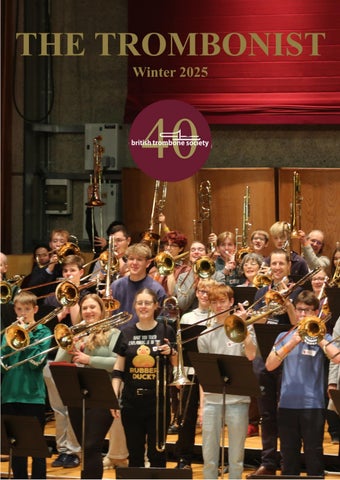
FRONT COVER BTS@40 Celebration Photo credit: Geoff Wolmark
41 CD Review – Silfra 42 CD Review – 18 Monologues Élastiques
CONTRIBUTORS TO THIS ISSUE Alastair Warren Becky Smith Josh Cirtina Tom Lees Peter Chester Becky Pepper Jane Salmon Tom Pilsbury Eric Crees John Kenny Dr Anthony Boorer David Horden Ross Brown Simon Proctor Jeremy Price Rob Egerton Emily White Helena Kieser
43 What’s On? 44 From the Stage to the Pit
British Trombone Society: Officers & Staff | Honorary Patrons | Committee | Officers Opinions expressed in The Trombonist are the authors’ own and do not necessarily reflect the view of the British Trombone Society.
4
5
EDITED BY ALASTAIR WARREN
THE NEWS RCM Appointment Jon Stokes has been appointed professor of jazz trombone at the Royal College of Music. An RCM alumnus, Jon joins the Brass Faculty, bringing vast experience from his distinguished and versatile career. His work spans performances with the Heritage Orchestra alongside artists such as RAYE and Dua Lipa, collaborations with Jules Buckley and John Wilson, and performances on major film soundtracks including Wicked and Mission Impossible.
ITF Comes to Europe The 2026 International Trombone Festival will take place in Riga, Latvia, at the Latvian Academy of Music, between 29 July and 1 August. Keep an eye on the ITF website for further details.
Daws heads Downunder Isobel Daws has been announced as the new Principal Trombone of the Sydney Symphony Orchestra. She will make the move to her new role after completing her commitments as Solo Trombone with the Luxembourg Philharmonic Orchestra, where she was appointed in 2023.
Day Out for Holst’s Trombone Sue Addison recently completed a project recording Gilbert & Sullivan with the Academy of Ancient Music, playing Gustav Holst’s trombone, loaned to her from the Royal College of Music collection. Holst played trombone in the Carl Rosa Opera company, and his first Operetta, Landsdowne Castle, was written in the style of Gilbert & Sullivan.
Slide Action Slide Action have begun an exciting collaboration with Spitalfields Music, St Catherine’s College, Oxford, and composer Toby Young, as the ensemble for the HenfreySpitalfields Composition Prize. The winning piece from the competition will be performed by the ensemble in Oxford in May, and the Spitalfields Music Festival shortly after.
Simon Johnson joins LSO Simon Johnson has taken up the position of Principal Trombone with the London Symphony Orchestra (LSO), moving from the BBC Scottish Symphony Orchestra. Hailing from Bury, Lancashire, Simon studied at Chetham’s School of Music in Manchester before entering the Royal Northern College of Music in 1990. During his time as a student, he played with Besses’ Boys, Leyland and Williams Fairey Engineering Brass Bands. Simon has performed on many occasions as a soloist for BBC Radio 3 and BBC Radio Scotland, including giving premieres of Anna Meredith’s Barchan, Geddes’ Alley Cat and Francisco Coll’s Tapias, as well as a short ballad by the former LSO horn player Terry Johns (‘Drac’) called One Day.
Will Morley Will Morley, a British trombonist from London working in Germany, has been appointed second trombone at the Komische Oper Berlin, moving from the Bergische Symphoniker (Solingen), where he was principal trombone. Will studied at the Guildhall School of Music and Drama under Eric Crees and Peter Gane between 2016 and 2020 and
6
THE NEWS was a member of the European Youth Orchestra for two years. He studied for his master's degree at the Folkwang UDK in Essen, Germany, with Chris Houlding,
Christian Jones At the end of July, Christian Jones performed Benjamin Ellin’s bass trombone concerto, Gresley, at the National Railway Museum in the presence of Sir Nigel Gresley’s most famous locomotive, Mallard. Celebrating 200 years of the Stockton Darlington Railway and the 50th Anniversary of the National Railway Museum, the concert, entitled Steam and Symphony, was set beneath the vast roof of the Great Hall. Christian was accompanied by the Slaithwaite Philharmonic, conducted by Benjamin Ellin.
New appointment at the Salvation Army The Salvation Army has announced that Jonathan Evans will succeed Dr. Stephen Cobb at the end of January 2026 as Bandmaster of the International Staff Band. Currently Bandmaster at Sale Corps, Jonathan's musical journey began as a trombonist in the Wrexham Corps of the Salvation Army and the Territorial Youth Band. He honed his conducting skills while pursuing a music degree at the University of Manchester. Before completing his studies, he was appointed Resident Conductor of the Fairey Band. A former principal trombone of the International Staff Band, Jonathan has also held positions as a Divisional Youth Band Leader and has been a guest at various music schools, camps, and corps centres.
Photo Credit: Emily Taylor/Katy Jones
Best Brass Band Trombones Over the course of the Autumn, trombonists have been competing with their brass bands up and down the country, winning many awards along the way. At the Fife Charities Band Association Contest, the Charles Mcewan Trophy for Best Trombone went to Bathgate Band principal trombone, Garry Kennedy. The Unsung Hero award was presented to the trombone section of the Coalburn Silver Band: Anna Biggart, Joshua Parkhill and Peter Holmes. At the Red Admiral Music Academy Entertainment Contest, the best trombone sections were recognised. Remarkably, the Roberts Bakery Band players, Gareth Broughton (solo), Paddy Bloor (second) and Chris Reid (bass), won in both the Championship and First Section. The Second Section prize went to Pete Sutton (solo), Adrian Cook (second) and Steve Hulme (bass) of the Rolls-Royce (Derby) Band, and the Third Section to Rivington & Adlington Band: Ian Hunt (solo), Ian’s son Adam Hunt (second), and Daniel Taylor (bass). At the National Championships of Great Britain, Andy Leeming, Solo Trombone of the Diggle Band, was declared Best Instrumentalist in the First Section Final. At the Leicestershire BBA Contest, the Derwent Brass trombone section, Rob Wilshaw, Simon Baum, and Chris Clayton, was awarded the Barry Fern Memorial Shield for best trombones in the Open Section. Gary Clegg, Solo Trombone
New No.2 at Brighouse Brighouse & Rastrick Band has welcomed Joe Heartfield to the second trombone seat. Joe began playing the trombone at the age of six under the guidance of Stan Lippeatt. In 2017, he achieved a remarkable double win, taking home the prestigious solo prize at both the National and European Youth Brass Band Championships while performing with the Elland Silver Youth Band. He was principal trombone with both the National Children’s and the National Youth Brass Band of Great Britain, as well as several other bands. Most recently, he served for five years as principal trombone of the renowned Carlton Main Frickley Colliery Band. Now entering his final year at the Royal Northern College of Music, Joe regularly performs beyond the brass band scene with function bands, and is a full-time member of the dynamic brass ensemble Atomic Brass.
7
Continues on next page...
THE NEWS of Elland Silver Band, was awarded the Harry Parker Trophy for best First Section instrumentalist. In November, Rawson Donovan, of Shipston Town Band, was awarded the WFB Soloist Trophy for the best Third Section soloist at the Wychavon Festival of Brass and Chris Thomas, solo trombone of the Flowers Band, received the Don Lusher Trophy for Best Trombone at Brass in Concert.
New Project for Moore Saturday, 31 January 2026, will see the launch of Peter Moore’s new project Trivergence, at Regent Hall, London. Three of the UK’s leading trombonists, Peter Moore, Andy Wood and Mark Nightingale, will come together to celebrate the expressive power and versatility of the trombone, accompanied by a handpicked trombone octet. A programme of premieres will include Mark’s West Side Story Suite, his epic Porgy and Bess Suite by Gershwin, and Trivergence, which explores the unique strengths of each soloist across three diverse movements in a richly textured dialogue with the octet. Supported by the BTS and Michael Rath Trombones, buy your tickets for this unmissable event here.
Photo Credit: Cpl Adrian Calef.
Household Division Musician of the Year Congratulations to Musician Henry Newton, who recently won the Household Division Musician of the Year 2025, becoming the first Household Cavalry Band Musician to receive the prestigious honour. Msn Newton performed Fog City by Michael Davis. Musn Newton began learning the trombone with Leicestershire Schools Music Service, before successfully auditioning for the Royal Birmingham Junior Conservatoire in 2014. In 2018, he performed David’s Concertino with the Rutland Sinfonia. In 2018, Musn Newton began studying at the Royal College of Music, studying jazz trombone under Richard Edwards, and classical trombone under Rob Holliday, Lindsay Shilling, and Byron Fulcher. Highlights of his studies include many big band projects as lead trombone, directed by Pete Long, which included performances with Benny Grebb and Georgina Jackson. He performed as principal in the RCM Philharmonic under the batons of Martyn Brabbins, Peter Stark, Toby Purser, and Jac Van Steen. He also performed in masterclasses for Håkan Björkman, Christian Jones and James Markey. Musn Newton was fortunate to have his final year supported by the RCAM Bursary. Musn Newton’s first assignment was to The Band of the Household Cavalry to support the Mounted Band for His Majesty's Coronation in 2023. Recent highlights include the Festival of Remembrance 2024, Scarlett and Gold 2024, and his first mounted engagements; VE80 celebrations and HM The King’s Birthday Parade. Musn Newton performs regularly in various orchestras and big bands, notably the Orion Orchestra and Starlight Big Band.
Hannah Rebecca Stell Hannah Rebecca Stell has been appointed second trombone in the Sønderjyllands Symfoniorkester, Denmark. Hannah studied for her undergraduate degree at the Royal Academy of Music, where she was taught by Dudley Bright, Matt Gee, Peter Moore, and Ian Bousfield. In 2024, she completed a Master of Music Performance degree at the Hochschule der Künste, Bern HKB/Haute école des arts de Berne HKB, Switzerland, studying with Ian Bousfield. A former member of the National Youth Brass Band of Great Britain, Hannah has performed with major orchestras in
8
THE NEWS the UK and Europe, including a recent period as Substitute Principal Trombone of the Lahti Symphony Orchestra (Finland). Hannah was featured as the Star of the Future in the Autumn 2012 edition of The Trombonist; she is making good on her ambition to tour the world playing her trombone.
During his studies, Alex won the John Solomon Brass Prize at the RAM and was Principal Bass Trombone in the European Union Youth Orchestra for four consecutive years. In 2012, he won the Brass Category of the BBC Young Musician of the Year whilst a student at Chetham’s School of Music in Manchester. In his free time, Alex volunteers with the Air Cadets and fervently supports his beloved football team, Manchester United.
Come & Play 6 On 27 October, the BTS returned to Regent Hall, London, for Come & Play 6. 25 players attended this warm-up event for the BTS@40 Celebration, a mix of familiar faces and first timers, and of all ages and experiences. Conducted by The Trombonist editor, Alastair Warren, a wide range of repertoire was enjoyed, including Repton, Pastime with Good Company, Here’s That Rainy Day, Ave Verum Corpus, The Teddy Bear’s Picnic, Amazing Grace and the first outing of his new arrangement of The Avengers theme tune. As has become tradition, the day ended with 12th Street Rag, and some very tired chops all around. Our thanks, as always, go to the Salvation Army for making such a fantastic venue in the centre of London available to us; we will be returning in April 2026 for Come & Play 7, celebrating International Trombone Week.
New BTS Regional Representatives The BTS has recently welcomed Alex Kelly and Adam Warburton to our team as the new Regional Representatives for Scotland and the North West, respectively.
Now in his final year at the Royal Northern College of Music, Adam began playing the trombone at the age of seven and progressed through the brass programme at Wardle Academy, Rochdale, under the direction of Lee Rigg. During his time at Wardle, he won ‘Best Soloist’ awards at both the 2019 and 2022 European Youth Brass Band Championships. Principal trombone of the National Youth Brass Band of Great Britain from 2019 to 2023, Adam is currently Solo Trombone of the Black Dyke Band, succeeding his former teacher, BTS Past-President Brett Baker. While brass banding remains central to his musical life, Adam also enjoys a diverse performance portfolio. He has played with the Hallé Orchestra and regularly performs at weddings and functions across the North with a variety of groups, in addition to playing as a pit orchestra musician. Adam is proud to be a Performing Artist for both Michael Rath Trombones and Denis Wick Products.
Stop Press NEWS! Date for your Diary! BTS North East Trombone Day Booking is now open for the 2026 BTS North East Trombone Day, to be held once again at Collingwood College, Durham from11.00am on Sunday, 10 May. Confirmed guests include featured soloist Ian Sankey, who will also lead the Massed Blow, and the Cory Band Trombone Ensemble led by Dr. Brett Baker. Visit the BTS website to book your place.
Alex has worked with most of the UK's professional orchestras and is currently principal bass trombone with the BBC Scottish Symphony Orchestra and a professor at the Royal Scottish Conservatoire. Alex studied as an undergraduate at the Royal Academy of Music (RAM), taught by Bob Hughes and Keith McNichol, and subsequently completed a master's degree at the Royal College of Music, studying with Dave Stewart and Paul Milner.
9
BTS ANNUAL AWARDS 2025 By Alastair Warren The BTS Annual Awards 2025 were announced in October and presented during the Gala Concert at the BTS@40 Celebration on 16 November.
Player of the Year – Peter Moore ‘I’m honoured to be named BTS player of the year. It is very gratifying to feel the strong support and encouragement from our community, as we attempt to chip away at the resistance to the trombone in the wider musical world. We must keep going! Thank you, BTS, for all the wonderful and inspiring things that you do.’
2025, having achieved a Master of Music Performance degree with distinction. Prior to this, she studied for her Bachelor of Music degree at the Royal Conservatoire of Scotland, graduating with Honours. Robyn has performed professionally with some of the UK's top orchestras and is currently a member of the Karajan Akademie of the Berliner Philharmoniker.
Peter Moore is one of the most exciting and well-respected exponents of the trombone today. He came to international attention in 2008 when, aged 12, he became the youngest-ever winner of BBC Young Musician, kickstarting a solo career that continues to go from strength to strength. Peter is a former Principal Trombone of the London Symphony Orchestra, joining in 2014 as the ensemble’s youngest-ever player. After 10 years, he resigned to focus on his career as a soloist. He is currently a professor at the Royal Academy of Music and has given masterclasses all over the world, including at the Juilliard School, Paris Conservatoire, and New England Conservatory. Visit Peter’s website to find out more
Peter Gane Teacher of the Year – Bob Hughes ‘I’m delighted and honoured to receive the Peter Gane Teacher of the Year Award. A lovely retirement present! I’ve been lucky to work with so many special and talented young people over more than 40 years, and it’s a privilege to see so many of them enjoying successful careers in music.’ Born in Wales, Bob moved to London in 1976 to study bass trombone at the Royal Academy of Music with Harold Nash, where he won the Sydney Langston Brass Prize. Joining the BBC Scottish Symphony at the age of 20, Bob went on to hold positions with the Royal Scottish National Orchestra, the Philharmonia and the London Symphony Orchestra, making multiple recordings, including soundtracks for blockbuster films such as Star Wars, Harry Potter and Braveheart. Bob began teaching at the Royal Academy of Music in 1989 and retired this year, having mentored a generation of the
Student of the Year – Robyn Anderson ‘I am so honoured and thrilled to have been voted this year’s student of the year and would like to say thank you to all my teachers and colleagues who supported me over the last year! Robyn graduated from the Royal College of Music in summer
10
BTS ANNUAL AWARDS 2025 UK’s most successful trombonists. President of the BTS from 2006 -2010, Bob was first awarded the BTS Teacher of the Year Award in 2015, making him the only double recipient. He was awarded the BTS Outstanding Contribution Award in 2021, and the Society’s bass trombone competition is named in his honour.
Competition, winning the Woodwind & Brass Award and Philip Jones Memorial Prize. Helen was awarded BTS Player of the Year in 2022. Visit Helen’s website to learn more about her. Outstanding Contribution – Richard Edwards ‘Although he was a prize winner, with a wonderful, varied and successful career, Richard never sought accolades. His passion was for the instrument itself, and his goal was simply to be the very best he could be. Those close to Richard know that he would probably have felt humbled and even a little embarrassed to receive this award. No doubt he would have made a joke to play it down. Yet I know he would also have been deeply honoured, especially knowing that this recognition came from his colleagues and peers. I was immensely proud to accept it on his behalf.’ Penny Edwards, Richard’s widow. Richard Edwards was a versatile British trombonist, composer, and educator, known for his mastery across both classical and jazz genres. Based in London, he performed with leading orchestras including the LSO, LPO, and Royal Opera House, and toured with big bands such as James Last and the Pasadena Roof Orchestra. A prolific session musician, he recorded with artists from Carla Bley to Jamiroquai. He was a core member of London Brass since 1991, contributing original works and arrangements. He also served as Professor of Jazz Trombone at the Royal College of Music. He passed away in May 2025, leaving a profound musical legacy. Read more about Richard in the Summer 2025 edition of The Trombonist.
Sheila Tracy Award – Helen Vollam ‘It’s a great honour to receive the Sheila Tracy Award, and I am very grateful to all in the BTS who voted’ Helen has been Principal Trombone of the BBC Symphony Orchestra since 2004, the first woman to be appointed principal trombone of a London orchestra. She is also a member of the Chamber Orchestra of Europe, Septura and Bones Apart Trombone Quartet. Helen studied at the Guildhall School of Music and Drama with Eric Crees and Simon Wills. She was Principal Trombone of the European Union Youth Orchestra and won the Bronze Medal in the 1995 Shell/LSO Music Scholarship competition. In 2003 she was the first ever trombone player to reach the final of the Royal Over-Seas League Music
11
BTS@40 Celebration Sunday, 16 November 2025, Guildhall School of Music and Drama, London By Alastair Warren
After many months of planning, the day chosen to celebrate the BTS’s 40th Anniversary had finally arrived, and trombonists from across the country began to gather, bright and early, at the Guildhall School of Music and Drama (GSMD). Despite the size of the venue, demand was such that tickets had sold out days in advance. So hot was the event on social media we even experienced online ticket scammers touting non-existent returns, a (dubious) first for the BTS. BTS President, Tom Lees, and Jane Salmon, supported by the wider BTS Committee, had planned a day themed around paying tribute to two recently departed greats of the trombone world, Peter Gane and Denis Wick, celebrating the diversity of British trombone life, and inspiring future generations. Many of the guest artists taking part had close connections with Peter and Denis, as students, colleagues or both, and the chosen venue was intimately linked with the birth of the BTS. Peter, the BTS founding President, was a trombone professor at the GSMD from the early 1970s and Head of the Wind, Brass and Percussion Department from 1988-2008. The very first BTS gathering was held at the school in autumn 1985. The day’s activities started with everyone in the Music Hall for a welcome from Tom Lees, followed by a warm-up session led by Mark Templeton, Principal Trombone of the London Philharmonic Orchestra. Mark focussed first on warming up the mind before moving on to warming up body and instrument. Well warmed-up attendees had to make the first choice of the day, whether to stay in the Music Hall for an interaction session with the Trombones of the Band of the Royal Airforce Regiment, join Tracy Holloway in conversation, or head the first Masterclass of the day.
beats in marches longer outside when compared to inside, to compensate for the lack of acoustic. The RAF players shared how they go about learning some of the more difficult passages in their repertoire, made doubly complicated by the need to play whilst also marching with the expected precision!
Photo Credit: Alastair Warren
As always, the standard of playing from the RAF musicians was exceptional; one young player, aged 11, was so inspired she immediately went to find out how, and when, she could join up. Join the Trombones of the Band of the Royal Air Force Regiment again on Sunday, 8 March 2026 , when they will be hosting a BTS Trombone Day at RAF Northolt. Booking opens soon. Life on The Lion King Tracy Holloway, in conversation with Jane Salmon, spoke about her career, and in particular, her life as one of the two trombonists on the West End production of The Lion King, a position she has held since the show started in 1999. Touching on the differences between who she is now and who she was before The Lion King, Tracey talked about her time freelancing immediately after music college, and how her career path has been influenced by holding a seat in the West End. Tracy fielded many questions from the audience, covering everything from the equipment she uses to the fact that The Lion King is the longest-running West End show
RAF Those that chose to stay in the Music Hall were treated to a highly entertaining and engaging workshop by the Trombones of the Band of the Royal Air Force Regiment, demonstrating the skills and versatility required of modern military musicians. Sergeant Matthew Edwardson, Sergeant Josh Hayward, Sergeant Jonathan Hill and Air Specialist Class 1 Maddie Higginson, invited participants to join them to work side-by-side on excerpts from their current repertoire, and learn some tricks of the trade, such as the need to play off
12
BTS@40 CELEBRATION
with a section of two trombones, and the third longest of all time, beaten only by Les Misérables and The Phantom of the Opera, although they only feature one trombone each. Among the audience were Chris Holding and Eric Crees, both of whom taught Tracy and Jane. During a discussion of the kind of skill set an aspiring West End player might require, Eric recalled that earlier in his career, there was a clear distinction between the classical and non-classical players, but a point came, almost overnight, when you had to know how to do everything. The advice, therefore, is to gain as wide a variety of experience as possible: knock on every door, take lessons, make sure you get some kind of big band experience and so on. Tied into this is the ‘dep’ system. When asked how she keeps her standards up for eight shows a week, Tracy replied you have to challenge yourself to play your best every day, but it is also important to take time off to enjoy a variety of other work, and in doing so, help maintain the ‘dep’ ecosystem. Like many shows, the musicians on The Lion King have responsibility for fixing their deputies, and getting a call to ‘dep’ is often the final step on the journey into the West End for aspiring players. What came through most strongly was Tracy’s passion for her job and her desire to keep it there for future trombone players, at a time when technology is encouraging the industry to reduce, or even do away with, live musicians all together.
Sergeant Jonathan Hill with one of Jürgen Krauss’s biscuits. Photo Credit: Alastair Warren
Helen Vollam Orchestral Masterclass Helen Vollam, Principal Trombone of the BBC Symphony Orchestra, worked with college students on orchestral section playing, passing on the knowledge gained from both her own experience and as a student of both Denis Wick and Peter Gane. To allow attendees to benefit from Peter’s wisdom directly, a video he had prepared for the European Union Youth Orchestra on overcoming performance anxiety ran on a loop throughout the day. Click here to view it and download the associated guide.
Helen Vollam Masterclass. Photo Credit: Becky Pepper
Rockschool In another interactive session, jazz trombonist Rory Ingham joined our sponsors from Rockschool to explore their exciting Horn Section exams syllabus. Rory worked on a variety of pieces with the young, and not so young, participants, exploring the stylistic differences of rock, swing and Latin, and introducing some basic ideas and exercises to begin on the path of improvisation.
Photo Credit: Becky Pepper
Jürgen Krauss Known first and foremost to many as a baker, following his appearance on the Great British Bakeoff, Jürgen Krauss is also an enthusiastic trombonist and a qualified Feldenkrais practitioner. Following Tracy Holloway, Jürgen presented a session introducing the Feldenkrais Method, which uses gentle movement and directed attention to help people learn new and more effective ways of living, increasing ease and range of motion, improving flexibility and coordination, and rediscovering a capacity for graceful, efficient movement. These improvements may enhance thinking, emotional regulation, and problem-solving capabilities. True to form, Jürgen not only baked the BTS a magnificent birthday cake, auctioned for a significant amount during the Gala concert, but also crafted a unique and very tasty line of trombone biscuits enjoyed by all of the day's participants.
Photo Credit: Becky Pepper
13
Continues on next page...
BTS@40 CELEBRATION
Amos Miller conducts the Community Trombone Choir. Photo Credit: Geoff Wolmark
Fanfare Rehearsal The final action of the morning was to gather the massed Community Trombone Choir in the Music Hall to rehearse Robin Benton’s Celebration Fanfare, the winning entry of this year’s BTS Composers’ Competition. Any anxiety experienced by the organising committee ahead of time as to whether everyone would fit on the stage was quickly dispelled, thanks to Michael Pilley’s excellent organisation of music and stands. Before long, over 100 players, conducted by Amos Miller, were getting to grips with Robin’s stirring and highly effective work for mixed ability choir. Rehearsal over, it was time for lunch, with the break providing ample time to peruse stands from Phil Parker Ltd, Dan Jenkins Music, Rockshool, Hawkins Mutes, Cala Records, Jürgen Krauss, RAF Music Services, Gender and the Large and Shiny Instruments (GALSI), and Wells Cathedral School. Also on display was a selection of BTS memorabilia, including rare original copies of The Trombonist from the 1980s, and the official photo album of the 1989 International Trombone Workshop, organised by the BTS and held at Eton College, kindly lent by Jim Wortley, Head of Brass at Eton at the time. Additional displays could be found around the various performance spaces, featuring extracts from The Trombonist, facts and figures about the BTS, and memories and tributes from members, a selection of which can be accessed here. As if that was not enough, we were also treated to two lunchtime recitals. First came a short performance by our guest students from the Royal Conservatoire of Scotland (RCS), in the guise of the Inslideout Trombone Quartet. Emma Close, Gregor Dowall, Robbie Dowall, and Mark Gammon performed Donald Miller’s classic arrangement of Achieved is the Glorious Work from Haydn’s Creation, an anonymous Charleston, a suite from Bernstein’s West Side Story arranged by Dennis Armitage, and Isobel Daws’s arrangement of Loch Lomond. The second recital featured Pandora’s Box, a trio comprising John Kenny, Emily White and Miguel
Tantos-Sevilliano, which combines music of the late medieval and Renaissance periods with contemporary composition, improvisation, poetry and physical theatre. Multi-instrumentalists, the ensemble mixes trombone, sackbut, recorder, baroque violin, carnyx, voice, and even a bicycle wheel, to mesmerising effect.
The carnyx.
The recital opened with two pieces by John for the carnyx, a large Celtic lip-reed instrument and ancestor of our modern brass instruments, Cry of the Wolf, for solo carnyx and The Voice of the Carnyx, for carnyx with soundtrack. Two works for three trombones came next, the anonymous 13th-century Alle Psallite and John’s Pandora's Box, followed by another of John’s compositions, Maghera, for recorder, violin, and sackbut. The recital continued with two pieces by Emily, Walk Away Gently, for violin and two trombones and the deeply moving Spring in an Unreal World, for narrator, sackbut and violin, before we moved back in time again for the sound of
14
BTS@40 CELEBRATION
three sackbuts playing La Harpe de Melodie, from the 14th century Chantilly Codex. The recital ended firmly in the present with Emily’s Dark Awakening, for three trombones, Rust for narrator, sackbut and bicycle wheel, Susumo Yoshida’s Equali for three trombones and Miguel’s whimsically titled Lullaby for a Moose.
Milly Deering, from the Royal College of Music (RCM), tackled movement two. ‘Audun definitely gave me new things to think about within my playing. He had some thoughts about how I could improve my legato playing, and how the different types of legato we use are suited to various styles. Working on the second movement of the Gordon Jacob concerto with Audun gave me the opportunity to test out these new approaches to legato, and I will be applying these new techniques into repertoire which I learn in the future.’
Pandora’s Box. Photo Credit: Becky Pepper
Audun Breen Masterclass The afternoon sessions began with a masterclass with Audun Breen on the Gordon Jacob Trombone Concerto, composed for Denis Wick in 1955. Audun, a graduate of the GSMD, has been Principal Trombone of the Oslo Philharmonic Orchestra since 2017, having previously held positions as Co-principal Trombone in the Gothenburg Symphony Orchestra (National Orchestra of Sweden) and Principal Trombone in the Kristiansand Symphony Orchestra. He has been a member of Norsk Tromboneensemble since 2015.
Milly Deering. Photo Credit: Alastair Warren
The final movement was taken by Emma Close, from the RCS. ‘I really enjoyed the masterclass with Audun and learnt so much. The third movement of the Gordon Jacob is not performed as often as the others, so it was interesting to hear Audun’s advice on how to approach it and the nuances in the piece that provide a glimpse of Denis Wick’s playing. I felt I took so much away from the masterclass that I can now continue to work on going forward.’
Morgan Bland.
Morgan Bland from Wells Cathedral School performed the first movement. ‘The masterclass with Audun was incredible. It was really interesting to experience someone with a different view to playing than I am used to, and it was an amazing experience to hear someone talk about the piece and playing in a similar way that Dennis might have. I got a lot out the masterclass in terms of varying certain aspects of playing, such as articulation and tone, for different scenarios.'
Audun Breen and Emma Close. Photo Credit: Helena Marion Photography
15
Continues on next page...
BTS@40 CELEBRATION
Bones Apart Masterclass While Audun was putting the soloists through their paces, Bones Apart Trombone Quartet was doing the same with quartets drawn from the nation’s music colleges. A muchanticipated session saw Room 250 filled to capacity. Indeed, keen spectators spilled out of the door and onto the stairs outside. Reflecting on their experience, the members of Insildeout commented, ‘During our recent trip to participate in the BTS@40 Celebration we were privileged to be invited to participate in a masterclass with Bones Apart Trombone Quartet. We were all extremely excited as they have been a huge inspiration to our ensemble. We decided to take Eric Ewazen’s Myths and Legends, which we have been working on, as we knew Bones Apart had recorded it and so could share their knowledge of the intricacies of the piece, and give tips in rehearsing and preparing it. We were not disappointed, and all felt like we learned a great deal, not only about this work and how to tackle it, but also on ensemble playing as a whole. An unforgettable experience, so many thanks to BTS and Bones Apart for affording us this learning opportunity.’
Inslideout Trombone Quartet. Photo Credit: Alastair Warren
Children’s Orchestras to rehearse and perform the Waltz from Act 1 of Tchaikovsky’s Swan Lake and an aria from Mozart’s The Magic Flute. For a grand operatic finale, the ROH and NCO players were joined by students from the London music colleges for two episodes from Wagner’s Ring cycle, the Entrance of the Gods into Valhalla from Das Rheingold and the Immolation Scene from Götterdämmerung. Both pieces featured Keith’s newly commissioned contrabass trombone, built for him by the legendary Mike Johnson.
Royal Opera House The Royal Opera House Trombones and Tuba, represented by Lindsay Shilling (tenor trombone and bass trumpet), Byron Fulcher (alto and tenor trombone), Pau Alexandra-Hernandez (tenor trombone), Patrick Jackman (bass trombone), Keith McNicoll (bass and contrabass trombone), and Michael Levis (tuba), presented a true masterclass in section playing, drawing on excerpts from Verdi’s Otello, Puccini’s Tosca, Richard Strauss’s Elektra and Wagner’s Die Walküre, and the contemporary ballet Alice in Wonderland by Joby Talbot. Keeping to the theme of inspiring the next generation, the ROH players were joined by members of the National
40 Years of the BTS A panel comprising BTS Past Presidents Chris Houlding, Bob Hughes, and Matthew Gee, Pat Gane, widow of founding President Peter Gane, and Simon Hogg, met to discuss the beginnings of the Society and its growth into the organisation we know and love today. Commenting on the day, Pat writes, ‘I was privileged to be a guest at the day-long celebrations at the Guildhall School in honour of the British Trombone Society's 40th Anniversary. This showcased many of the finest trombone players from the UK and beyond and seemed to involve hundreds of young
Royal Opera House Trombones and Tuba. Photo Credit: Helena Marion Photography
16
BTS@40 CELEBRATION
players of all ages and stages! (including two dancing youngsters at the front of the ensembles with a coloured pBone each!) The range of the events available was a wonderful tribute to this great Society, which Peter Gane was instrumental in starting 40 years ago. Peter’s motivation in initiating plans for the start of BTS was the same as the inspiration shown in his entire career – the wish to support trombone players, musically, socially, personally, giving them the chance to share and fulfil their potential to the maximum. He would have been so proud to see the success and joy evident in a day of varied and diverse activities, from workshops to question-and-answer sessions, splendid full warm-ups and performances by the finest trombone players – professionals, students and young learners – finishing with an unforgettable arrangement of 76 trombones created and conducted by Eric Crees! I was honoured to listen to a specially composed fanfare, created by Eric Crees, who successfully captured some of the key aspects of Peter’s qualities – above all his energy, sense of fun, enthusiasm…. It was great to share some memories of Peter with guys whose careers were in some ways shaped by his magic…. One of Peter’s favourite phrases was “….it made me smile” (and what a smile!) He would certainly have smiled on this day!’
trombones by Moritz von Hessen, before joining in to play Domine ad Adiuvandum by Chiara Margarita Cozzolani, many experiencing playing baroque trombone for the first time. Emily remarked, ‘We explored how quickly we can play vocal music stylishly by speaking our lines together a few times, then playing it really well immediately. They were #incredible. I wasn’t expecting it to happen so quickly, and considering there were people who were totally new to sackbuts, reading treble clef in C and with bells in 4th position, it was astonishing. If we had had another half an hour, we could have been ready for a concert! Three under the age of six had a go, and several at the other end of the age spectrum.’ Final Rehearsal With the afternoon sessions concluded, everybody gathered again in the Music Hall to rehearse what would be the finale of the early evening Gala Concert. 2025 marks the 30th Anniversary of the seminal London Trombone Sound album, and we were determined to mark the occasion with a performance of Eric Crees’s inventive arrangement of Meredith Willson’s 76 Trombones. Fitting a tutti ensemble of over 100, plus the 20 solo ensemble players and several percussionists into the Music Hall had required some thought by GSMD stage management. Never before had so many tiny trombonists appeared on a stage layout, but the plan worked perfectly!
Photo Credit: Helena Marion Photography
Sackbut Jamboree Visitors to Sackbut Jamboree, led by Emily White, enjoyed performances by the GSMD Sackbut Ensemble of Mon Coeur Gist Tousjours by Claudin de Sermisy, and the Royal Sackbut Collective (from the RCM), who played Pavane for five
It was wonderful to hear the memories of several members of the tutti and solo ensembles who had taken part in the original recording, and to witness the progression into the solo ensemble of players who, as students, had been part of the supporting ensemble at the BTS’s 30th anniversary celebrations. How many of the young players in this year’s tutti ensemble will feature in the solo ensemble 10 years hence, when we will no doubt celebrate the album’s 40th and the BTS’s 50th Anniversaries with another performance? Eric describes the opening of his arrangement as something of a ‘trombonist's nightmare’, featuring as it does some of the most famous excerpts associated with our instrument, layered
Royal Sackbut Collective. Photo Credit: Helena Marion Photography
17
Continues on next page...
BTS@40 CELEBRATION
one on top of another, and performed off-stage, just to make things that little more difficult. However, guided by Eric’s firm hand and with only a few tweaks needed here and there, the stellar solo ensemble of Callum Au, Emily White, Matthew Lewis, Audun Breen, Mark Templeton, Helen Vollam, Pau Hernández Santamaria, Rupert Whitehead, Chris Houlding, Matthew Gee, Becky Smith, John Kenny, Tracy Holloway, Jonathan Hill, Jane Salmon, Tom Pilsbury, Keith McNicoll, Sarah Williams, Adam Crighton, and Simon Minshall, soon had everything together. With the tutti ensemble smoothly slotted in, preparations for the Gala Concert were complete. Gala Concert The Gala concert began in spellbinding fashion in the Foyer with a performance by the Intercollegiate Choir of Invocation, composed especially for the occasion by John Kenny and dedicated to Stuart Dempster. Comprising students from the RCS, Royal Northern College of Music, Royal Birmingham Conservatoire, Royal Academy of Music, RCM, Trinity College of Music, and GSMD, the Intercollegiate Choir was split into five groups, positioned on different levels, surrounding the audience in an all enveloping blanket of sound, subtle shifts in dynamic, tone colour and complexity conjured from the ensemble by the magician that is John Kenny.
admitted the latter was a little out of his comfort zone, more suited to his ex-student Isobel Daws, for whom he was deputising, before proceeding to dazzle with a display of pyrotechnics, coupled with tremendous musicality.
Matthew Gee and the GSMD Trombone Choir. Photo Credit: Becky Pepper
Before the Annual Awards were presented, the Intercollegiate Choir returned to perform Eric’s arrangement of The Pink Panther, under the arranger’s direction. Another track from The London Trombone Sound, this performance was dedicated to the memory of the late Richard Edwards, featured jazz soloist on the album. On this occasion, his place was taken by the incomparable Callum Au.
Invocation. Photo Credit: Becky Pepper
In awed silence, performers and audience alike then filed into the Music Hall and the Community Trombone Choir took to the stage to give a rousing performance of Celebration Fanfare. The GSMD Trombone Choir followed, conducted by Matt Lewis and Mark Templeton. Anna Bailey, Christopher Trotter, Tom Wood, Tom Peacock, James Talboys, Helena Kieser, Andy Leeming, Robbie Palmer, Sam Cox, Benjamin Loska, Jamie Cadden, and Tom Hornby performed a new work by Eric Crees, Flourish for P.G. and Bourgeois’s Scherzo Funebre, commissioned by Peter Gane for the GSMD in 1983. The ensemble was joined by Matthew Gee, Principal Trombone of the Royal Philharmonic Orchestra for a beautiful rendition of Bill Geldard’s arrangement of Autumn Leaves and Arthur Pryor’s Blue Bells of Scotland. Matthew
Bob Hughes receives his award from Pat Gane. Photo Credit: Alastair Warren
The BTS was delighted that several special guests were able to attend the concert to present and receive awards: Pat Gane presented the Peter Gane Teacher of the Year to Bob Hughes, the Sheila Tracy Award was presented to Helen Vollam by Chris Punter, the partner of her very first trombone teacher Anne Higgs, and Penny Edwards received the Outstanding Contribution Award on behalf of her late husband Richard. Turn to page10 to learn more about all of this year’s award winners.
18
BTS@40 CELEBRATION
Flourish for P.G. Flourish for P.G. was written specially for the British Trombone Society's 40th Anniversary Celebrations at the Guildhall School, in memory of Peter Gane. Scored for six tenor and two bass trombones, it is dedicated to Peter Ganes’s wife, Pat and was played by an ensemble of Guildhall students. Peter was very much a founding father of the BTS in 1985. I wanted to write something that reflected the great dignity and huge energy of Peter and to make it both a personal and musical tribute, so I based the material on the 'musical letters' in his name, Peter Gane.
These are:
E, T (in tonic sol-fa ti = B), E , R (tonic sol-fa re = D), G, A and finally E. In order, that is E B E D G A E. Peter had a passion for all sorts of music: one of these was jazz. The opening declaims the overlapping notes four times, each interspersed with jazz chords, and an acceleration brings us to a 7/8 Allegro. The piece continues with many changes of metre, dynamics and reworkings of the initial theme, building to a boisterous climax. Eric Crees Views of the Blues. Anchored by the mighty bass trombone of Simon Minshall, this number gave all the players the chance for a blow, and it was fascinating to hear the contrasting styles and unique approaches to improvising of each player. And then it was time for the grand finale. Rather more than 76 Trombones, gathered together in celebration of the BTS and the instrument we all love. A unique and wonderful experience for all involved. Postscript For those not running to catch trains to all parts of the country or facing early starts the next morning (not that it stopped some of us), the party continued long into the night at the Artillery Arms, with a Jazz Jam featuring Five-a-Slide, the UK’s premiere young jazz trombone ensemble. Led by Richard Jones, bass trombonist with the Syd Lawrence Orchestra, the ensemble includes trombonists Matt Seddon, Matt Cooper, James Wade-Sired and Jai Patel, and a rhythm section comprising Joseph Game on piano, Murray Dare on bass and Simon Spies on drums. Members of the band are fast establishing themselves alongside the best in the business, having already performed with the likes of the BBC Big Band, Ronnie Scott’s Jazz Orchestra, Olivia Dean, Slum Village, and the London Jazz Orchestra, to name a few.
Callum Au and friends. Photo Credit: Becky Pepper
Following the Awards came a jazz set arranged by Callum Au, performed by Callum and friends: Andy Wood, Robbie Harvey, Rory Ingham, Matt Lewis and Simon Minshall. A truly world-class line-up. The set opened with a new arrangement of Rogers and Hart’s Little Girl Blue, followed by two movements of a suite originally composed for Matt Lewis’s ensemble, and ended with a new composition, Two
Jazz Jam. Photo Credit: Jane Salmon
19
Continues on next page...
BTS@40 CELEBRATION
Way back when Tom [Lees] said he would like Pandora's Box to perform and that he'd like me to play the carnyx I proposed the idea of doing an intercollegiate piece in honour of Stuart Dempster and the enormous contribution he has made to music and trombone in particular. My intention was to perform one of his own pieces. However, as I started to exchange emails with him, and asked him for the score and playing directions for one of his environmental pieces, he made it clear that he was delighted I was going to do something, but he very firmly wrote the following:
Invocation – to be performed by a large trombone ensemble in a resonant space. Dedicated to Stuart Dempster
So, I took him at his word. He was quite right – his own works for large trombone ensembles were very deliberately conceived to be performed in a hugely resonant space, with total concentration and in a state of tranquillity that would enable ‘deep listening’. There is deliberately no element of virtuosity in those pieces, no soloist in the conventional sense – but this would be exceedingly difficult to achieve in the situation of the public atrium of GSMD, with a coffee bar, trade stands, and a whole conference full of people chatting and trying out instruments! I knew that I would have to do something to STOP that – to arrest attention, and then somehow to build that deep listening concentration. That meant I would have to take on a solo, directorial role, and yet somehow allow a sense of mystery and contemplation to grow, even to become ecstatic - and to attempt to return to silence. Given all this, the first question was how to begin the piece in a manner that would arrest attention and yet do so without any form of spoken introduction, or making a statement on trombone in a loud, virtuosic manner? My answer was, don't use the trombone – sing.
This piece is conceived to be performed by a large number of trombonists, separated into groups and disposed at a wide distance from each other in a large resonant space. Each group elects a leader, and the whole piece is directed by a central soloist. The piece opens with a melismatic vocal introduction, sung wordlessly in a style inspired by the Adhan technique employed by Islamic muezzins. At the sounding of a bronze tingsha crotale the groups enter as directed by the soloist, who sends them a note – this is sustained a very low dynamic for a long time (until it feels right) to send another note to another group. A chord is built very gradually, with members of each group covering each other's breathing, all using the softest possible articulation, until a giant but simple chord structure has developed, filling the space. There should be no modulation in this piece – different registers and dynamics of the chord are highlighted by entries initially directed by the soloist – gradually, the director directs melodic fragments to the leaders of each group, in no predetermined order. Each group leader then develops those melodic fragments into their own improvised commentary of the material that has been transmitted, and in turn works with players in their own group to form cells of melodic improvisation. Throughout the piece the soloist can direct the total and ‘regional’ dynamics until a point of maximum complexity has been reached – from this point the pitch material can be gradually reduced through signals from the soloist, who now transmits a note a 5th above the very first tone of the piece, until that dominant tone has been established by the entire massed ensemble, and the dynamic returns to the opening pianissimo of the piece – at which point the soloist again sounds the tingsha crotale, and the leaders of all groups respond with similar crotales in different pitches, gradually directing their own group members to fade out, thus leaving only the resonance of the little bells. John Kenny
Sponsors and Grand Prize Draw A huge thanks go to our sponsors: Phil Parker Ltd, Conn Selmer, JSV Mouthpieces, Dan Jenkins Music, Rockshool, Hawkins Mutes, Yamaha (whose silent mute was put up for silent auction), Egger and June Emerson Wind Music. Putting on an event like this would be impossible without them.
Many also donated to the BTS@40 Grand Prize Draw, which generated a substantial sum for BTS funds. Other prizes included donations of lessons from Peter Moore, Dr. Brett Baker, Adrian Hirst, Eric Crees and Emily White, and a cake from Jürgen Krauss, for which the BTS is extremely grateful.
‘.... you seem to think that this would be "my" piece. It really should be your piece; you will be the leader through it all and perhaps it will, well, serve you right as you get it all together for the mayhem (or Junehem or Julyhem or, or, or...).
Wishing you all the best – let me know how it all plays out! Take care, Stuart.’
20
Photo Credit: Helena Marion Photography
21
By Becky Pepper, Alastair Warren, Jane Salmon and Tom Lees
Young Bones Spotlight on…Apollo
How old are you? How long have you played the trombone, and who teaches you? I am 11 years old, and have been playing the trombone for eight years. When I was a toddler my mum says that I was very stubborn and I really wanted a trombone. She bought me a pBone mouthpiece and, as I quickly learned to buzz melodies on it, she finally gave in and bought me a pBone mini when I was three and a bit. My teacher is Michael Buchanan. I also have lessons with James Buckle and Enzo Turriziani (Principal of the Vienna Philharmonic).
What skill or piece would you like to learn next? I would like to learn the Bourgeois Concerto and other difficult concertos and pieces like those of Arthur Pryor. What’s your favourite piece to play? All of them if I play them right! But I also love to play Clara Schumann’s lieder transposed to trombone. They are beautiful.
What’s your favourite piece or music to listen to? Probably the Prelude to Tristan und Isolde or Mahler’s 9th, especially the 4th movement. The late Bach cantatas are also marvelous. My favourite composers are Wagner and Mahler.
What made you want to play trombone? I think it was the special, beautiful, wonderful sound that the trombone can make. When I was little, I always used to point to the trombones in concerts, and I wanted to sit next to them in the choir seats at the Royal Festival Hall.
What do you NOT like playing? Super-crazy modern pieces.
If you could go back to being a beginner, what would you tell yourself? I wish I had known that I had the incorrect embouchure for a long time.
Who are your biggest trombone inspirations? I’ve always loved Alessi, who was my teacher for a while. When I was little, I was obsessed with Peter Moore! I just adore Michael Buchanan’s sound; it is incredible. I’m also very inspired by Ian Bousfield. He’s a great teacher. He was also the teacher of my teachers.
What groups or ensembles do you play with? I play for the London Concert Sinfonia (LCS), and I am going to perform a concerto as a soloist with this orchestra this season. I am also second trombone of the Orchestra of the 21st Century, which is a professional orchestra in Barcelona, and I’m principal trombone of the Vienna Philharmonic Youth Opera project. I also play in many RAM Junior ensembles. I also play in other ensembles and orchestras when I go abroad to courses or events.
Can you give us a hot trombone tip? Always think of the resistance of the air while playing. Also, think about the tone you are producing. The quality of the tone is super important and makes a huge difference to your playing. What is your ultimate trombone dream? To play in great orchestras like the Vienna Philharmonic, Berlin, etc. I would also love to be a trombone soloist. I also want to be a professional conductor and composer. I’m one of the conductors of the LCS and sometimes conduct my own pieces, like my second symphony. We do a concert every month. We’ve just performed Schumann’s 4th Symphony.
What are you working on right now? I am working on the full David Concertino, the Hindemith Sonata, Morceau Symphonique and Elegy for Mippy II.
22
YOUNG BONES
What do you want to say to other young players who may be finding things hard at the moment? Just never give up and think of your practice like a sandcastle: it always gets washed away by the sea, but suddenly (magically!) turns into cement and can never get washed away. This is a tip from Mike! My tip is if you are having a bad period, keep playing, keep practising, have breaks more often but don’t give up, and focus on the music to try to enjoy as much as possible the piece you are playing until things go
better again. Technically, just keep working on lots in small points.
How To...Play More Smoothly Continuing our series of top tips from top players, Audun Breen, Principal Trombone of the Oslo Philharmonic, gives some advice on improving legato.
It’s In The Game Great trombone playing pops up in all sorts of places, including on video games, like this solo in Mario Kart World.
Very important question! What is your favourite pre-performance snack? A nice chocolate bar! I also want to thank the BTS for allowing me to practice and perform with a great instrument, so thank you!
Woop Woop Wah What does your phone think your trombone sounds like? Paul the Trombonist found out when he accidentally texted his wife with voice recognition turned on… while playing the trombone.
Turn to page 24 for Audun’s exercise. TV Theme Tunes In the last edition of Young Bones, we asked if any of you knew of another TV theme tune which featured a trombone. The answer is... Jonny Briggs, a children's television series which aired from 1985 to 1987, focusing on the adventures of a young boy, his dog Razzle and his eccentric family in Yorkshire. The theme tune was none other than The Acrobat, as featured on the Trinity grade 6 syllabus.
Stealing Is Bad… Jazz singer Emma Smith says her jazz career started because her grandad, Chris Smith Snr, once stole a trombone. He was 17, and about to be drafted into the army… one broken shop window later, he was in the band instead of the war. Watch her explain all in this video.
KPop Demon Hunters Like KPop Demon Hunters? Like the trombone? Want to learn how to play Golden? Liza Liz Trombone has you covered. Click here to play along with her, and her VERY special trombone. Try This At Home…
...But Maybe Not This!
23
YOUNG BONES
24
25
By Jeremy Price
JAZZ BY JEREMY South Africa by Working Week
If you have not been lucky enough to have played in a section with Richard Edwards or heard him play live in close proximity, either as an audience member or fellow musician, you could be forgiven for wondering why there is so much reverence for his incredible trombone playing but also so much sadness for his recent passing. I’m delighted to have been given this opportunity by The Trombonist to share with you this awesome solo from Richard on a track called South Africa by 1980s pop band Working Week. Whether this introduces young players to an astounding musician or triggers fond memories for those of us who knew Richard well, please click on the video below and enjoy the incredible solo.
boundless stamina and strength. Probably the best way to learn optimal breathing for brass is just to emulate the sound of a great player. If you can hear yourself even approaching this richness of sound, you must be doing it right. Melodically, Richard is embellishing the vocal line that comes before, echoing the main composed theme but personalizing it and expanding its scope. Lots of blues here, and by the second 8-bar section, we are into more improvisatory territory yet still reflecting the pace of the earlier vocal line. All very cool and suave for now, setting the scene nicely for what is coming up. Then, what works so dramatically in this track is the sudden ‘out of nowhere’ extra gear brought in with the pickup to bar 17. The altissimo F still sounds broad and trombone-like, played as if it's effortlessly in the middle of the stave. Perhaps this is the peak of the solo? But no! This herculean soaring sound is sustained for the next 16 bars. More corking Ds and Fs and then the temerity to give us a top G with a sound like the side of a house! Most significantly, this is all done within a really engaging musical line, not merely chops to the fore.
Firstly, this sounds to me like a pop band that is born out of touring and gigging. All fine musicians who can play with great skill and the stylish economy required of the pop area, and all great groove players. A real band. But this is one of those moments when the horn solo undoubtedly makes the track, which might otherwise have been absorbed into a slightly obscure 80s back catalogue. From an instrumental perspective, the solo so clearly exploits the many idiosyncrasies of the trombone, with full lyrical tone and characteristic glissando swoops and slide vibrato. Also notice ‘lip breaks’ and classic arpeggiation on the common slide shifts we all love to play. What air! Streuth, this man had the most incredible tone and projection, and seemingly
26
It is fascinating to me how, despite playing common melodic language and the trombonisms that many of us trombonists share, there is still an indelible personal sound and unique approach coming through in a jazz soloist such as Richard. There is also a connection to the sensibility of the person playing. This solo at once sounds generous and giving while embracing risk-taking and a sense of glee for life. Jazz is a social music, and this is exactly the company you would want to be keeping. Thanks again to Rob Egerton for the transcriptions, appearing both in treble Bb and bass clef. Note well the small figure 8s above the clefs indicating 8va! Richard has left quite a legacy of recordings; many are on YouTube. This recording will lead to others, so I hope you enjoy the journey. Thanks to the BTS for allowing me to wax lyrical about this wonderful musician and incredible personality I was fortunate enough to be in the company of for much of my early career. Nam-myoho-renge-kyo Richard.
27
Continues on next page...
28
29
By Helena Kieser, Simon Proctor and Emily White
Proctor Concerto for Sackbut and Orchestra Emily Whites’s world premiere performance of Simon Proctor’s concerto was also a historical first: the first ever of its kind for sackbut and full symphony orchestra.
On Sunday, 21 September, Emily White premiered Simon Proctor’s Concerto for Sackbut and Orchestra, with the Orchestra of St. John's (OSJ), treating the audience to an exciting union of contemporary writing and historical sound. Performed in Dorchester Abbey, one of England’s oldest Christian settlement sites, the atmospheric setting served as a reminder of the sackbut’s aged and ecclesiastical origins. When juxtaposed with Proctor’s lush Romantic melodies and jazz-influenced motifs, the Abbey became a liminal space in time – a meeting of both new and old. This feeling of suspension from the outside world was only heightened by White’s breathtaking interpretation of the piece, specifically written for her. Holding the packed Abbey in the palm of her
hand, White’s artistry and unwavering commitment to musical integrity left the audience both moved and delighted. Commencing with foreboding orchestral chords that swelled into warmth, White joined the romantic soundscape with sensitivity, blending with her accompaniment before blossoming into the role of protagonist with the expanding melodic line. The movement subsequently transformed into an effervescent allegro, in which White peeked through the orchestration with chattering melodies and sparkly utterances – in conversation, never confrontation with her accompaniment. Meeting in the golden sound of the sackbut’s modern counterparts, White emerged in cadenza, rising with longing before sighing down to the depths of the sackbut’s
30
PROCTOR CONCERTO FOR SACKBUT AND ORCHESTRA
range. In the following movement, this sense of musical dialogue was continued by the sackbut’s soaring melody and echoed utterances of the motif throughout the orchestra. Here, White found a quiet strength and beauty of sound that unfolded with yearning and emotional intensity. The last movement was a ‘big-band-inspired’ finale, which had the whole audience swaying and tapping their feet. Improvisatory in feel and full of zest, White dazzled with her virtuosity before the movement culminated in a thrilling orchestral flourish. Due to the unusual instrumentation of this composition, I wrongfully assumed the premiere would predominantly draw sackbut enthusiasts from far and wide. Instead, it transpired that very few members of the audience had heard of the sackbut, let alone heard it live. What a delight to be introduced to the sackbut as not a thing of the past, but as a voice that can span centuries and genres. In communicating this, there is no one as adept and compelling as Emily White. Helena Kieser
I always compose music with the listener in mind, so there has to be a proper, appealing melody, sumptuous harmonic language, an emotional roller-coaster ride and above all, an intention to entertain. A large proportion of modern music fails to connect with the audience. I aim to do something positive to address this general malaise. One last thing which may be of interest is the fact that I always write music by hand, never on a computer. It is a vital ingredient in my creative process. It's just me, a piano, some manuscript paper and a large supply of 2B pencils, a rubber and a ruler. I enjoy this simple way of working and would hate the idea of staring at a screen all day! That would be horrible and uninspiring! Simon Proctor Reflecting on the premiere, Emily White writes, ‘What I was blown away by was the fun, and the glory of being carried on the sound of a full symphony orchestra. There was a moment when the full lower brass crested a wave of sound, just as the tam-tam filled the Abbey, and I just turned around and gaped in awe, instead of doing my planned empty of the sackbut slide! It's bold to compose for sackbut and these forces. Rather than being an intimidating challenge, it was joyous. I look forward to recording it, and also hearing other sackbut players perform it. The OSJ were incredible, it was an honour to premiere it with such a fabulous orchestra. To John Lubbock and Simon Proctor, thanks on behalf of the international sackbut family.
I am definitely a concerto composing specialist, having just started my 35th! My first ever concerto was the one I wrote for the serpent. That was followed by one for the keyed bugle, then later, one for the ophicleide. I had definitely developed a fascination for historic brass instruments due to their unique appearance and individual sound. Having got to hear them in their typical 'old' music, I felt a strong desire to bring these virtually obsolete dinosaurs into the modern age and give them a new lease of life, combined with the modern orchestra. There had always been one missing part to these concertos for historic brass instruments, and that was obviously the sackbut. I knew I had a sackbut concerto in me, and so a couple of years ago I decided I simply had to write it! In order to ensure the work had an end product, i.e. a performance, the next step was to find a suitable soloist. I asked one of my serpent-playing friends, Phil Humphries, if he could recommend any good sackbutists, and he immediately said, Emily White. So, I got in touch with her, offered to write her a concerto, and she said yes, as well as having a potential performance in mind with the OSJ and its conductor, John Lubbock. We discussed the basic techniques of idiosyncratic sackbut writing and the fact that I had no interest in modern, useless extended methods and that was essentially all I needed to get started. I wanted to write for a full symphony orchestra, but with careful consideration of the balance, as the sackbut is not as powerful as the modern trombone. It was important that the special tonal qualities of the sackbut could be heard and exploited to the full. Even though the sackbut is not the same as a modern trombone, I wanted my concerto to give the sackbut the opportunity to 'think' it's a trombone, and so a lot of the work is about the sackbut looking into the future and wishing it could be just like a trombone with its suave sophistication embracing both the formal and jazz worlds. My concerto does all the typical trombone things, such as big bold tunes, gentle lyricism and then lets its hair down in unabated jazz, but all slightly contained in the unique sound world of the sackbut.
31
BTS Composers’ Competition 2025 By Tom Pilsbury The results of the BTS Composers’ Competition 2025 were announced on 1 September. From the many entries received, the judging panel of Dani Howard, Rachel Stott, and Becky Pepper awarded 1st Place to Robin Benton, 2nd Place to Luís Marrocos and 3rd Place to Joe Galuszka. Entrants were invited to compose an eight-part fanfare for mixed-ability trombone choir, which was performed by a Community Choir of over 100 players during the BTS@40 Celebration Gala Concert.
Suite won 1st place in the Junior Trombone Quartet category of the 2008 BTS Composer’s Competition. Many of Robin’s compositions for brass, handbells, and choirs have been published; visit his website to find out more. Farewell to Constantinople – Luís Marrocos (POR) Luís is a young amateur trombonist and composer from Viana do Castelo, Portugal. He began his studies at the Escola de Música João Costa e Silva, located in his hometown of Lanhelas, under the guidance of Hugo Silva. Luís subsequently joined the Sociedade Musical Banda Lanhelense, a band from his hometown, which he still plays in. In recent years, he has played in several bands around the north of Portugal and developed an interest in composition. Currently studying composition and music theory, Luís has started to explore composing music for smaller groups, while also writing for bands and orchestras Ruby Red – Joe Galuszka (UK) Joe taught himself piano before joining a brass band at 14. As a tuba player, timpanist, and percussionist, he has performed with some of the UK’s finest brass bands, including Tredegar, Flowers, and Aldbourne. Recently appointed Musical Director for the Gloucestershire Music Service and Youth Orchestras, he is also a tutor with the West of England Music Hub and The Bristol Ensemble’s educational arm and has worked for the National Children’s Orchestra. He is currently training with the Association of Brass Band Adjudicators. Joe’s compositions span many genres. His score for Firekeepers of Kakadu, a documentary broadcast on SBS Australia, won Bronze at the Global Music Awards and Gold at the London Independent Film Awards. His works have been shortlisted for the European Brass Band Composition Championship and the A4 Brass Quartet Competition, with his tuba quartet Pandemic winning 1st place in the When Tuba Come One International Composition Competition. Visit Joe’s website to find out more about him.
Celebration Fanfare – Robin Benton (UK) Robin learned piano and G bass trombone from an early age. In his teens, he wrote the music for two local musicals. After qualifying as a teacher, he gained a BMus degree and an ARCM diploma in military bandmastership and taught in junior schools, where he started bands and handbell groups. His school wind band won a McDonald's ‘Child of Achievement’ award playing his arrangement of Tchaikovsky's 1812 Overture. Robin enjoys playing in orchestras, big bands, trombone quartets, and for theatre shows, and is a founder member of a local community big band, for which he has written many arrangements. He also writes for handbells, and his compositions have been chosen to represent Great Britain at International Symposia on three occasions. Robin’s Dance
32
Wild Swans By Alastair Warren
Steve Thompson’s Wild Swans is a haunting multimedia reimagining of Hans Christian Andersen’s fairytale, blending narration, trombone, and surreal visual art into a modern storytelling tapestry. Premiered in October at London’s 1901 Arts Club, Wild Swans transforms Andersen’s tale of Princess Eliza, who must rescue her eleven brothers cursed into swans, into a cinematic soundscape of courage, silence, and transformation. The project features narration by John Suchet OBE, Elena Kats-Chernin’s ballet score arranged for trombone and piano, and Thompson’s dreamlike illustrations, creating a multisensory experience where music and spoken word are inseparable.
bold, lyrical retelling of a classic for today’s listeners and viewers. Thompson writes, ‘I first came across Eliza’s Aria from Elena Kats-Chernin’s Wild Swans ballet back in the early 2000s. I was immediately intrigued, as I’ve always been a huge fan of minimalist music. I love John Adams and think Nixon in China is one of the great masterpieces of the late 20th century. But I’ve always felt that minimalism tends to split in two directions: on one hand, there’s the cool intellectualism of composers like Adams, which some people find a little detached; on the other, there’s the more sentimental approach of someone like Ludovico Einaudi. Elena’s music seemed to strike a perfect balance between the two, emotionally direct yet structurally sophisticated, and I found that really fascinating. I reached out to her to ask if I might arrange some of her music for trombone and was delighted when she said yes. Unfortunately, life got in the way, and I found myself increasingly involved in jazz and commercial projects rather than classical ones, so it didn’t feel like the right time to record it until a couple of years ago. The project has a hardback book with it, and of course, the audiobook narrated by John [an enthusiastic trombonist and one of the BTS’s newest members]. I created a video of the prelude featuring some of the art animated, just for social media. For the launch night, I wanted to play my favourite track, The Magic Spell Tango (which I was lucky enough to receive some brief coaching on from Christian Lindberg when we chatted on Zoom during the pandemic). I thought I had better create a video of that for people to watch for the event!’
©Steve Thompson
Thompson’s version deepens the psychological complexity of the characters, especially the Queen, portrayed as a figure grappling with grief and power. The trombone, often overlooked in narrative music, becomes a voice of emotional resonance, echoing Eliza’s silent struggle. The work is part audiobook, part visual concert, and part contemporary classical performance, defying genre boundaries while remaining faithful to the fairytale’s emotional core. Released as a book and CD set, Wild Swans invites audiences into a world where silence speaks louder than words, and transformation is both magical and deeply human. It’s a
Photo credit: Fiona Fellows
Wild Swans can be purchased from Waterstones in the UK or Barnes & Noble in the US.
33
34
35
In Conversation with Ian Bousfield Ahead of the 2026 BTS Wells Cathedral Trombone Day, Ross Brown, Head of Brass at Wells Cathedral School, chats to Guest Artist and Wells school parent, Ian Bousfield.
Ross Brown: Great to see you, Ian. Shall we start with when you first came to Wells?
RB: You’ve been visiting for a long time! Paul Denegri, who was my fabulous trumpet teacher and Head of Brass, was here for many years, alongside the legendary Alan Hutt.
Ian Bousfield: I first came to Wells in June, I think it was 1995, and I've been coming back almost every year since then! I fell in love with the place right in the beginning, partly because it's the most beautiful school in the UK, one of the most beautiful cities in the UK and probably the most beautiful cathedral in the UK! But I really fell in love with the ethos, the aura of positivity around the school, and after a while, it became clear to me that I wasn't coming back as much to give as to take. I was coming back to recharge my batteries in the positive environment of the school. And it hasn't changed, it's still the same! In fact, where we're doing this interview right now, in the beautiful 14th-century Quilter Hall, is where I've done my favourite concerts in my life. Some of the most special moments have happened in this room.
IB: Alan Hutt, still the greatest teacher of trombone players under the age of 18 that I know. An absolute genius, far too modest, and still doesn't realise what an effect he had on so many trombone players. And what an effect he had on me as a teacher as well! RB: What is it about Alan's students that you most admired? IB: They love music, and they love life. And if you can get a young person in that position, they will achieve anything that they want to achieve. It was just their unquenchable enthusiasm and desire, not only to make music, but also their enthusiasm for listening to music. They were obsessed with this recording, or that soloist, or this piece of music. And they just thought music was the best thing ever. He did that for them, and I know that, because it wasn't just the odd one – it was generation after generation. Also, everyone who studied with him still has an unbelievably positive outlook on life. You can have the odd coincidence, but year after year, generation after generation, it ain't no coincidence, is it? He did it. RB: And one of his ex-pupils is Emily White, who teaches at Wells and will be at the Trombone Day in March, which is wonderful.
Quilter Hall. Photo credit: Wells Cathedral School
36
IB: Emily was one of my first students at the Royal Academy 30 years ago, and she first introduced me to the beauty of early music. I remember when she was a student, she played something on the Baroque alto. It was a real life-changing moment for me. It was something she did completely on her own initiative, and it sounded absolutely wonderful. Emily is such a unique musician and a unique person. I wouldn't be trusting my son’s development at the moment to her if I didn't believe in her, which I totally do. The way Emily and Tom [Lees] collaborate to look after all the young trombonists is wonderful. They really thrive under their dedication and care. We are just so delighted that Aidan has joined Wells as a chorister and as a wonderful young trombone player.
IN CONVERSTATION WITH IAN BOUSFIELD
RB: And what is it about the school now that you think suits him as a young trombonist?
young brass players, play some music with them, share with them what I'm working on and just be supportive – basically, that is it. Hopefully, somehow by osmosis, whatever I may have learned in my life will pass on. I also want to pass on my enthusiasm for playing the trombone. There is still not a single day that goes by that I don't wake up and think, ‘Great, I get to play the trombone!’ It's always like that, and if I can share that with some young people or we can share our love for what we do, then that's what I'm hoping for. Of course, I will also come to visit my kids and to remember what it is to be English, because it is very English here! But basically, I want to be here.
IB: We live in Switzerland, our life is in Switzerland, my future is in Switzerland. Wells Cathedral School is the only school in the UK that I would trust with my children, and we are making incredible efforts to make it happen, also as a family as a whole. What I see in Wells is that Wells Cathedral School wants to know what each child excels at, and they want to rejoice with the child in that excellence. I don't know what my son is going to become. He might become a cricketer! We don't know, he's never played. But if he's got any talent in any direction, I know Wells will find it, and Wells will help him grow in that regard. So we are feeding both of our children, Aidan and Annick, into the beginning of the process. What comes out of the other end, I don't know. [Addendum: Aidan has fallen in love with Rugby and is apparently quite good!] I encouraged Aidan to play the trombone because it's something that I understand. I never intended for him to become a trombone player, but I wanted him to experience excellence in something, and I knew I could help him achieve that. I may now be regretting what I wished for, because he really does seem to want to be a trombone player, and he plays very well. And so we, as a school and as parents, have a job to do in supporting my son as a trombone player. Some people might see that as being a lot of pressure for him, but if he feels that, then I got my job wrong. You know, I have to help him grow and become himself, which is what I try to do with every student that I see, and I know that Wells is an incredibly nurturing environment. So that's what I want for my kids. I want them to be in a safe, nurturing environment, for them to be able to explore all kinds of different things and find out what it is that they want to do. And this is the place to do it! What we are already feeling in Wells is that there is a sense of community and teamwork. It’s a three-part team with the school, the pupil, and the parents all working together for the benefit of the kids, and at any one time, one of those three ingredients is coming to the fore and taking the lead. Certainly, as parents, we already feel incredibly involved.
Photo credit: Wells Cathedral School
RB: Brilliant! And we’re delighted that you will be one of the tutors for the next British Trombone Society Day in Wells alongside our fabulous trombone teachers Tom Lees and Emily White. We've been incredibly lucky over the last few years to host Bones Apart, the Royal College of Music Trombone Choir with Byron Fulcher and ex-Wells student James Buckle from the Philharmonia, as well as the Royal Birmingham Conservatoire Trombone Department. And now we're thrilled that the Royal Academy of Music is coming down in March for the next event. What are you most looking forward to about Trombone Day? What do you think will make it extra special?
RB: And obviously, we're thrilled that you're going to be more closely associated with the school in terms of pedagogy and coaching and just being around as an incredibly experienced musician. What are you hoping to bring to the Brass Department? IB: Like I said, my whole life is in Switzerland. I have a job in Switzerland at the University of the Arts in Bern, and I still have a very busy solo career. But I want to come back here and be part of the Wells community. I want to come here and remind the young people and maybe also to an extent the teachers, because I've been around here a long time, of the positive environment. And just to keep that ball rolling. I want to be part of the team. I want to hang out with the
IB: Again, it's sharing. I'm going to be having fun with my colleagues who were former students and also bringing one or two very special RAM students, including Sophie Bright. I just want to create some more of those special moments. I see the day as a unique opportunity to bring some really amazing trombone players together and gather as many student
37
Continues on next page...
IN CONVERSTATION WITH IAN BOUSFIELD
players, amateur trombonists and brass band players as we can – just to reach out to the wider trombone community and to have a festival of enjoying the instrument on a very nerdy level! RB: Well, speaking as a trumpet player, what I love about the Wells BTS events is all these trombone players from lots of different backgrounds and generations all chatting to each other, having so much fun and sounding amazing playing together! IB: If you're a trombone player, you're part of a very big family. It's really amazing. And to reconnect to that and to contribute back to it is great. So, I'm looking forward to that again. It'll be cool, and it promises to be a great day! RB: I'm looking forward to it already! IB: Me too! And if you can't make it down to the BTS Trombone Day, but you are interested in what we're doing at Wells Cathedral School, reach out. Contact Ross Brown, music@wells-cathedral-school.com, find out when I'm here and let's meet up! RB: It’s been a huge pleasure speaking with you, Ian. I can’t wait for the BTS Day and also to work with you in the Brass Department in Wells, helping to create some more of those special musical moments you mentioned!
Photo credit: Wells Cathedral School
38
Reviews
The Heroic Trombone and Trombone21 Reviewed by Alastair Warren The Heroic Trombone – Dr Brett Baker With his latest recording, The Heroic Trombone, Dr Brett Baker, solo trombone with the Cory Band, pays tribute to the inspirational heroic figures he has encountered on his musical journey. Beginning with Denis Wick’s arrangement of the first movement of Gordon Jacob’s Concerto, he also references Don Lusher, via his arrangement of Makin’ Whoopee, Ray Steadmann-Allen with his Immortal Theme and Mark Freeh, with his arrangement of John Barry’s You Only Live Twice. Of particular interest are the four premiere recordings: Rob Wiffin’s Heroic Etude is a pleasing addition to the grand tradition of the concert étude, pitting technical sections with plenty of double-tonguing against more lyrical passages. Both Belke’s Concertino of 1826 and Zimmerman’s Autumn Dreams, a valse brillante from the early 1900s, are given brass band accompaniments for the first time. Replacing the legendary Arthur Pryor as trombone soloist in the Sousa band, Zimmerman has been somewhat overshadowed by his predecessor, but his compositional legacy shows him to have been every bit as talented. KING! by Australian composer Brenton Broadstock is dedicated to fellow countryman David King, an influential figure for Dr Baker whilst a student at the University of Salford. In three connected movements, King! is a fine addition to the repertoire. The first two movements are highly atmospheric, featuring the soloist in lyrical mode, while the final movement is much more dramatic, full of technical flourishes. Dr Baker is accompanied by Paul Holland and the Flowers Band, their sixth such collaboration. The band provides outstanding accompaniment, particularly in challenging
repertoire, such as the rarely heard brass band version of Lindberg’s Mandrake in the Corner. The Heroic Trombone is a fine tribute to Dr Baker’s mentors, showcasing both his versatility as a soloist and acting as a great introduction to 200 years of trombone repertoire. Buy Heroic Trombone here.
Trombone 21 – Chris Van Hof and Carol Jarvis Trombonists in the 21st century are expected to be ever more versatile, able to turn our hands to a wide range of genres, frequently doubling on different sizes of instrument. With Trombone21, Chris van Hof and Carol Jarvis have taken the music minus one concept to a new level, presenting trombone section excerpts from across the baroque, classical, jazz, funk, pop, and Latin genres, delivering a style guide for navigating the rich and varied soundscape required of the contemporary musician. Users can choose which track to mute before playing along with some of the best in the business, in this case, Chris, Carol and Simon Minshall. With genre-specific stylistic tips, including advice on suitable equipment, and performance insights, Trombone21 is an indispensable addition not only to the freelancer’s toolkit, but also for any trombonist looking to have fun exploring unfamiliar genres, whilst developing listening skills, tuning and sound concept along the way. Purchase your copy of Trombone21 here.
39
Concert Review
Opera North Trombones Howard Assembly Rooms, Leeds, 23 November 2025
By Peter Chester
Opera North is more than just an opera company. Its eight or more imaginative and innovative opera productions per year, and its tremendous outreach work with children and people new to opera more than justifies the awards it has received. At the centre of many of its activities is the long-established permanent Orchestra, which, alongside the operas, has an extensive calendar of performances all of its own. This year has seen yet another innovation, under the heading of Distilled, during which Orchestra members have given a series of recital programmes. One of these, in late November, was presented by the trombone section, comprising Blair Sinclair, Tom Berry, and Christian Jones. Christian of course, needs no introduction to BTS members as he was President 2013-2015, and in fact presided over our 30th Anniversary in 2015, which indeed got a mention in their recital.
The programme opened with a characteristic fanfare written by a little-known French composer from the Paris Conservatoire tradition, Jean Inabelle, which was followed by a superbly antiphonal rendering of one of Daniel Speer’s Sonatas. Included to illustrate the warm, caressing sound that three trombones can provide, an arrangement of a gentle aria, Lascia ch’io pianga from Handel’s Rinaldo followed, to beautiful effect. In significant contrast, Dan Jenkins’s Red, Blue, Yellow, a substantial piece from our 30th Anniversary year in 2015, allowed each of the players to ‘have their moment’, and there were some particularly magical effects from the wah-wah mutes used. To remind the audience of their day job as orchestral players, a couple of contrasting orchestral excerpts were explained and expertly presented: the chorale from Brahms’s First Symphony, followed by a few bars of Britten’s storm from Peter Grimes. A short Aequale from Bruckner was smooth and dignified, as one might expect. Back into contemporary music, Red Silk Shawl, by Jennifer Mitchell, in memory of a leading American Suffragette, and commissioned by the ITF in 2010, proved to be a chorale-style piece, requiring, and eliciting, great control of dynamics and tone colour. Composer Ben Ellin is no stranger to trombone music, and a piece, Hoe Street Demons, from his 2015 suite Stow Sketches, offered a lighter, almost jazzy contrast. The world premiere to which we were treated was a Trio by Duncan Abrahart, a composer (and trombonist), who studied in Leeds with Blair, and its varied elements certainly added to the afternoon’s exploration of the capabilities of the instrument. Opera North players certainly seemed to enjoy playing it, and as was said, they were thrilled to be presenting new music for the trombone for the first time. Perhaps to restore a certain calm and focus, the official programme concluded with an arrangement of Nimrod. Remembering Elgar's affection for the trombone, it is very likely he would have much approved the smooth, dignified and sonorous sound produced by these three excellent players. It was very well received, so much so, we got an extra piece, catchy, fun and brilliantly presented, Brian Lynn’s Ba-Dee-Doo-Dup. A good programme from a great team – Congratulations!
L-R Blair Sinclair, Tom Berry, Christian Jones.
Alongside their supreme musicianship, all three players spoke about the music in a very relaxed yet informative style. They were clearly at ease with the proceedings and, as Blair said quite early on, they hoped to dispel some of the uninformed stereotypes of the trombone section, ‘those who sat in the back row and played very loud’! Their performance did indeed dispel such scurrilous myths and a very wide range of musical epochs, styles, colours and was offered, including a world premiere.
40
CD Review
Silfra Pharos Reviewed by David Horden
Silfra is the debut album of Pharos, a new project from Trevor Mires and Paul Dunlea. Trevor is one of my favourite trombone players and is a long-term BTS supporter and contributor, but I don’t believe I have ever heard Irishman Paul Dunlea’s playing before. Ryan Keberlie adds a third trombone voice on a couple of tracks. Supporting Trevor and Paul are three hand-picked Americans: Billy Kilson on drums, who drives the ensemble along with an amazing feel over many different grooves. His touches and inflections are so interesting and always support the music and musicians brilliantly. Ike Sturm on bass displays lovely melodic playing at the opening of the first track, Frongoch, as well as hip pocket playing on many others. Jim Ridl on piano completes the rhythm section and takes some incredible solos; he improvises with really clear phrases, giving plenty of space whilst developing interesting lines. His solo on track 7, Saoirse, is incredible. One of the parts I most enjoyed upon listening was discovering Paul Dunlea’s writing; he composed four of the tracks on the album, with Trevor contributing the other three. Each of Paul’s conjures really clear pictures in the mind. Silfra, the title track, is a place in Iceland where two tectonic plates meet, and the inspiration came from Paul scuba-diving and touching both plates at once. You can really hear his sense of wonder and amazement, as well as the awe-inspiring and slightly terrifying power of Mother Nature. His writing has such a lush texture and really takes you on a journey over the course of each track. Paul’s solo on Silfra is a masterclass of creating tension and release using harmony, dynamics, and articulation combined. Another track worthy of special mention is Cypher Nutria. Composed by Trevor, it starts with a 12/8 shuffle building tension with a piano ostinato (Billy’s drumming on this
section is some of the best you will ever hear) before settling into an exciting 4/4 groove from the rhythm section that I could listen to all day. In case you aren’t familiar with Trevor’s playing, his technical facility on the trombone is incredible. His solo on this track is an amazing display of technique and harmonic diversity, whilst still putting the music and its message as the focal point. What always inspires me about his playing is his articulation; even when at light speed, he picks out every note and means all of them. Another amazing display of improvisation is on the track Don’t Give Up On Me, in which Trevor combines harmonic language from across the whole history of jazz, transitioning from complex Brecker-esque lines into a hip blues lick, throwing in some bebop, all whilst building such excitement through the whole solo. This tune also features a seriously swinging piano solo from Jim Ridl. The most impressive part of this album is that every musician, and the ensemble collectively, always puts the music first. The improvised solos are sensitive additions to the compositions, not the dominating feature. All the performers' ideas and virtuosity are put towards creating the scene and mood of each track, a true collective effort in service of the music, and the results are sublime. Recorded at the legendary New York studio of Rudy Van Gelder, and superbly mixed and mastered by Louis Dowdeswell, this is an album for everyone, not just the jazz fans. Stream or purchase your own copy of Pharos here.
41
CD Review
18 Monologues Élastiques Samuel Blaser Reviewed by Dr Anthony Boorer Where a wandering trombone meets the shifting acoustics of Berlin’s Funkhaus.
Samuel Blaser’s 18 Monologues Élastiques is a curious, compelling release: a solo trombone album that behaves nothing like a conventional recital and everything like an acoustic exploration of place. Recorded inside the sprawling corridors and chambers of Berlin’s Funkhaus, the project turns the trombone into a wandering narrator, reacting moment by moment to whatever the architecture throws back at it. You hear the performer, of course, but you also hear the building — its surfaces, its shapes, its sudden generosity and occasional hostility. In effect, it becomes a duet between Blaser and the rooms he passes through. The project’s conceptual nod to Blaise Cendrars’ Poèmes élastiques lends it a modernist tilt, characterised by abrupt shifts, fragments, and elastic gestures. In that sense, there is a faint conversation here with twentieth-century ancestors — not as imitation, but as shared instinct. One can catch the ghost of Berio’s performative awareness in Sequenza V, the spatial wandering of Nono, or the timbral sculpting James Fulkerson achieved in his tape-delay works of the 1990s. Blaser isn’t quoting any of them, but the family resemblance is unmistakable. The question of pastiche simply doesn’t arise; the music grows too directly out of the physical spaces he occupies. The album opens with Appearance, recorded in the Künstlergang and adjacent toilets — a wonderfully odd, unexpectedly effective beginning. You encounter the resonance of the corridor before the instrument fully emerges, as though Blaser is letting the building introduce itself. By Missing Marc Sütterlyn, in Saal 3, the trombone stretches into a larger acoustic, letting phrases bloom and dissolve into the room’s natural reverberation. What’s especially striking is how naturally Blaser folds extended techniques into this environment. Sub-tones (false tones), breath noise, vowel-filtered colours, understated multiphonics, pedal fundamentals, lip bends and glissandi all
appear without any sense of grandstanding. They are used the way electroacoustic composers use processing: to shade, distort, or reveal different layers of the sound. These are the same techniques I explored and codified in my own research into trombone-centred sound design, and Blaser uses them with that same emphasis on musical purpose rather than technical display. Some tracks behave almost like studies in listening. The Blues is Green, an anechoic chamber piece, strips the trombone of every safety net, leaving the smallest inflection exposed. Torture Room, in a Kreuzgewölbe (cross vault), does the opposite: the reflections snap back with such force that short articulations turn into jagged rhythmic events. Le grand numéro moves through several spaces in succession, the trombone’s voice reshaping itself with each change of acoustic. And Glissandino, in Saal 1, may well be the album’s highlight: long, quiet glissandi unfolding like architectural arcs drawn into a vast hall. What makes the album so quietly radical is that it achieves an electroacoustic aesthetic without using electronics at all. In my own work with trombone augmentation, the aim is often to create precisely this sense of fluid, responsive interplay between performer and environment. Blaser achieves it acoustically, using nothing more than breath, metal, and the character of the Funkhaus. It is a reminder that the room you stand in can be as expressive as any processor, if you choose to listen to it. In the end, 18 Monologues Élastiques sits in a very beautiful niche — modern without fuss, exploratory without theatrics, and full of subtle details that reward patient listening. For trombonists — students, professionals, improvisers, orchestral players, and anyone curious about colour and resonance — this is essential listening. It is available on all major platforms and deserves attentive ears from those who care about the evolving voice of the trombone.
42
ONYX BRASS 1.00pm, Thursday, 8 January Music by Britten, Dani Howard and more Holy Trinity Church, London IAN SANKEY 1.00pm, Friday, 9 January The Lit & Phil, Newcastle
GEOFF MASON 7.30pm, Tuesday, 13 January East Grinstead Jazz Club CITY OF BIRMINGHAM SYMPHONY ORCHESTRA UK premiere of Dai Fujikura Vast Ocean II w/Peter Moore 7.30pm, Thursday, 15 January Symphony Hall, Birmingham SLIDE EFFECT TROMBONE QUARTET 1.00pm, Tuesday, 20 January Charlton House, Greenwich BONES APART World premiere of Claire Cope’s The Green Chapel w/Foden’s Band 7.30pm, Friday, 23 January RNCM, Manchester 7.00pm, Saturday, 28 February Tonbridge Music Club, Tonbridge RNCM YOUNG LOW BRASS AND YOUNG TROMBONES 12.30pm, Sunday, January 25 RNCM, Manchester
RORY INGHAM 8.00pm, Wednesday, 28 January 8.00pm, Wednesday, 18 February 8.00pm, Wednesday, 25 March 8.00pm, Wednesday, 29 April The Woodman, London DENNIS ROLLINS 8.00pm, Friday, 30 January The Stoke, Guildford 7.00pm, Sunday, 22 February Bakewell Town Hall, Derbyshire TRIVERGENCE 7.30pm, Saturday, 31 January Regent Hall, London BATH PHILHARMONIA Dani Howard Trombone Concerto w/Peter Moore 7.30pm, Wednesday, 4 February The Forum, Bath CONNAUGHT BRASS Scotland Tour 7.30pm, Friday, 13 February Community Hall, Boat of Garten 7.30pm, Saturday, 14 February SA Community Church, Ayr 7.30pm, Sunday, 15 February Municipal Hall, Biggar BBC NATIONAL ORCHESTRA OF WALES UK premiere of Deborah Pritchard’s Trombone Concerto w/Peter Moore 7.30 pm, Thursday, 19 Feb BBC Hoddinott Hall, Cardiff
43
TRINITY LABAN BrassRoots: Lower Brass Masterclass Day for players aged 11–18. 11.00am, Sunday, 1 March Trinity Laban, London PETER MOORE Trombone and Piano Recital 7.30 pm, Wednesday, 18 March Keele University Chapel ENGLISH CORNET AND SACKBUT ENSEMBLE 7.30pm, Saturday, 14 March Sherborne Abbey, Sherborne All Day, Saturday, 21 March Pembroke College, Cambridge 7.30pm, Saturday, 28 March St. James’s Church, London 7.30pm, Thursday, 16 April Trinity College Chapel, Cambridge ROYAL ORCHESTRAL SOCIETY Dani Howard Trombone Concerto w/Peter Moore 7.00pm, Sunday, 29 March Royal Academy of Music, London LILLE TROMBONE FESTIVAL 13 – 18 April Lille, France Visit the BTS website for up-to-date events listings
From the Stage to the Pit... What are you hoping to see from orchestras around the UK this season? For sure, we always want some big Mahler or Strauss; however, I’m more intrigued to see how orchestras continue to develop themselves and innovate. I think it’s not really enough these days to exclusively present the overture-concerto-symphony format. While there is, of course, a space for it, I want to see more innovative collaborations with artists and new music that speaks to all, not just a few. In that vein, this year is shaping up nicely. See what you think.
BY JOSH CIRTINA // PRINCIPAL BASS TROMBONE OF THE ROYAL PHILHARMONIC ORCHESTRA
SYMPHONIC HIGHLIGHTS Musical Painting, Impressions & Intrigue – BBC NOW 7.30pm, Thursday, 8 January BBC Hoddinott Hall, Cardiff Inspired by the playful Cadavre exquis game, where each person writes a line, folds the paper, and passes it on, Anders Hillborg creates a wild, energetic musical collage in Exquisite Corpse, pulling in musical quotes from other composers and weaving them into something chaotic, surprising, and unexpectedly beautiful. Alban Gerhardt returns to BBC NOW by popular demand to perform Shostakovich's Cello Concerto No. 2, a work packed with raw emotion, grit, and haunting intensity. The concert closes with Sibelius's Lemminkäinen Suite, inspired by the ancient Finnish legends of the Kalevala. Originally imagined as a mythic opera, the piece unfolds like an epic adventure film score: mysterious, brooding landscapes, bursts of folk-dance energy, dramatic climaxes, and shimmering orchestral colours. Ryan Bancroft conducts.
personality, while Shostakovich's Ninth Symphony was not the grand artistic statement Russia expected, and instead is a witty, playful and sarcastic work that inevitably led to political trouble. Saxophonist Jess Gillam performs Glasslands by Anna Clyne, inspired by the banshee of Irish mythology. Jonathan Bloxham conducts. Bluebeard’s Castle – BBC Philharmonic 7.30pm, Friday, 23 January Royal Concert Hall, Nottingham 7.30pm, Saturday 24 January Bridgewater Hall, Manchester This special performance by the BBC Philharmonic, conducted by Anja Bihlmaier, is a rare opportunity to hear Bartók's gripping one-act opera, Bluebeard's Castle, in an atmospheric concert hall staging with theatrical lighting. With sinister strings, strident winds and commanding brass, it's both a compelling psychological drama and a masterpiece of orchestral scene painting. The first half is contrasted with Lili Boulanger’s intense D’un soir triste and Kodály’s sparkling Dances of Galánta – great programme!!
Kindred Spirits – Ulster Orchestra 7.45pm, Friday, 23 January Ulster Hall, Belfast Benjamin Britten spoke no Russian, and Dmitri Shostakovich spoke no English, but they found in each other a kindred spirit, becoming firm friends, supporters of each other's work, using a sort of broken German as a shared language. Britten's tribute to his teacher and mentor, Frank Bridge, uses each variation to loosely sketch a facet of Bridge's
The Hallé Presents: Jonny Greenwood 7.30pm, Thursday, 26 February Bridgewater Hall, Manchester Daniel Pioro conducts this concert celebrating Jonny Greenwood's (lead guitar and keyboard of RADIOHEAD) love of orchestral string writing. In Water, the warmth of the Hallé strings envelopes two flutes and an Indian tanpura on a journey of rippling colour. Lutostawski dedicated his moving Musique tunebre to the pioneering composer Béla Bartók, whilst Steve Reich's lyrical Pulse is a tenderly contemplative, yet constantly pulsating, work. Greenwood's ground-breaking Horror Vacui plays upon the artistic concept of 'the fear of empty spaces' to astonishing effect. Using the full sonic
44
FROM THE STAGE TO THE PIT...
potential of the solo violin and extensive string orchestra, he creates an eerily liminal soundscape, building in atmosphere and intensity throughout each movement. These are string instruments as you've never heard them before.
Puccini in Rome – CBSO 7.30pm, Wednesday, 15 April Symphony Hall, Birmingham Enjoy a sumptuous celebration of Italian orchestral music and a look 'under the bonnet’ of two famous operas. While Puccini is rightly famous for the glorious vocal lines in Tosca and Madam Butterfly, his writing for orchestra has always been equally sublime. Conductor Carlo Rizzi's suites from the operas reveal the orchestral colour in all its shimmering beauty. Respighi, meanwhile, was giving Puccini a run for his money in his beautifully evocative depictions of Rome in The Sunset – here sung with her customary opulent flair by Fleur Barron. I’ve recommended this one as we played Rizzi’s Tosca Suite with him in the RPO a few years ago. It was absolutely fantastic, a stunning opera in an incredible symphonic format.
Tchaikovsky, Langer & Pärt – RSNO 7.30pm, Thursday, 19 March Caird Hall, Dundee 7.30pm, Friday, 20 March Usher Hall, Edinburgh 7.30pm, Saturday, 21 March Royal Concert Hall, Glasgow Beauty, passion and the miracles of nature, there’s no tale that an orchestra can’t tell, and there’s definitely no symphony quite like Tchaikovsky’s shattering Fourth. Raw tragedy, roof-raising triumph: it’s explosive stuff, so guest conductor Kristiina Poska begins with something a little more tranquil. Arvo Pärt’s haunting Cantus is the perfect complement to a wonderful new set of songs from Elena Langer, inspired by the songs of birds and the nature poetry of Glyn Maxwell.
BY BECKY SMITH // PRINCIPAL TROMBONE OF ENGLISH NATIONAL OPERA
OPERA PICKS
Looking at the UK's main opera houses, there are lots of exciting shows to see in the New Year, starting with a firm favourite of mine, Turandot, at the Royal Opera House, until 4 February. This is Puccini’s final opera (unfinished at his death), and perhaps as a result, it is by far and away his most musically adventurous. The chorus plays a much more significant role than in Puccini’s other operas, acting as an onstage witness to over half of the action. It is a great blow for the brass section, and of course, it contains arguably the most famous tenor aria of all, Nessun Dorma.
On occasions like this, you find yourself wondering if it may be the greatest opera, period.’ John Findon is singing the role of Grimes; he is a talent not to be missed, and also a trombonist, I am led to believe! For a heart-warming story, take in Welsh National Opera's toe-tapping show Blaze of Glory!. It tells the tale of a group of miners reforming their male voice choir in the aftermath of a devastating mining disaster. ‘Blaze of Glory! is a jubilant celebration of the Land of Song and a tribute to how community spirit can triumph over adversity. Traditional Welsh harmonies blend with a cappella sounds of the 1950s, operetta, gospel and big band as our intrepid band of gleemen Lindy Hop their way to glory.’ Performances in Cardiff, Plymouth, Birmingham, Milton Keynes and Swansea, from 1 April until 22 May.
Travelling less than a mile down the road, English National Opera is staging a new production of the rarely performed Rise and Fall of the City of Mahagonny, by Kurt Weill and Bertolt Brecht. Weill’s musical style in Mahagonny combines opera with the popular music of the time, ragtime and jazz. He mixes the standard orchestra with banjo and bass guitar, creating a unique yet recognisable sound. I am looking forward to performing this with our new Music Director, André de Ridder. Sadly, there is a short run of just 3 shows, between 16 and 20 February, so make sure to get your tickets early!
Finally, to get your Wagner fix, there are a couple of options in spring 2026; the Royal Ballet & Opera is on to the third part of its Ring Cycle, Siegfried, from 17 March until 6 April, and Scottish Opera is performing just two shows of Tristan and Isolde in Glasgow on 7 March and Edinburgh on 11 March. Let’s hope these truncated runs aren't going to become the norm anytime soon. Keep supporting the British opera scene!
Moving north, Opera North is bringing Benjamin Britten’s Peter Grimes to Leeds, Nottingham, Salford and Newcastle between 13 February and 20 March. The Guardian gave the production a five-star review, saying, ‘It is generally accepted that Peter Grimes is the greatest of British operas.
.
45
46