The British School of Bucharest Magazine
Issue 3 - February 2011 Visit the BSB website at www.britishschool.ro
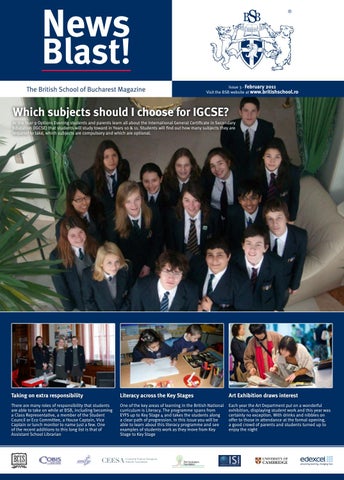
Which subjects should I choose for IGCSE? At the Year 9 Options Evening students and parents learn all about the International General Certificate in Secondary Education (IGCSE) that students will study toward in Years 10 & 11. Students will find out how many subjects they are required to take, which subjects are compulsory and which are optional.
Taking on extra responsibility
Literacy across the Key Stages
Art Exhibition draws interest
There are many roles of responsibility that students are able to take on while at BSB, including becoming a Class Representative, a member of the Student Council or Eco Committee, a House Captain, Vice Captain or lunch monitor to name just a few. One of the recent additions to this long list is that of Assistant School Librarian
One of the key areas of learning in the British National curriculum is Literacy. The programme spans from EYFS up to Key Stage 4 and takes the students along a clear path of progression. In this issue you will be able to learn about this literacy programme and see examples of students work as they move from Key Stage to Key Stage
Each year the Art Department put on a wonderful exhibition, displaying student work and this year was certainly no exception. With drinks and nibbles on offer to those in attendance at the formal opening, a good crowd of parents and students turned up to enjoy the night
Visit the BSB website at www.britishschool.ro
Editor’s Note
I recall when Newsblast was first conceived four years ago. In fact I remember the very meeting that took place in Mr Davidson’s annex, chaired by Key Stage 2 Coordinator Ms Sarah Snocken, who was one of the teachers on the Student Council when the students brainstormed the possible names for the school
magazine and in the end finally decided on Newsblast!. Thinking about the humble beginnings of our magazine, I thought it would be nice to take a trip back down memory lane, to visit our school website and read the very first twenty page issue. It was well worth the effort, for I was pleasantly surprised to find the young faces of Louisa, Mihnea, Tudor, Jasmina, May, and co of the then Year 8 class staring out at me from the front cover. I found myself momentarily lost to a bout of nostalgia, thinking about that year and reflecting on how much has changed both in regard to the students and the school campus itself since then, and how wonderful it is to be a part of this experience. It’s like BSB itself is a living breathing canvas and that we are all, students, teachers, and parents, somehow artists contributing to this continually evolving work. This issue in many ways reflects the idea of art and creativity and also to the idea of change, which artists so often focus on in their work. Thanks to Ms Greaney and the Secondary IGCSE and A Level art students,
Key Dates February Monday 28th
we were treated to a wonderful art exhibition, which you can get a taste of in this issue. We can also see the product of student creativity in drama and music, with reviews of the Primary Winter Productions and Secondary Winter Show, along with an article on how the IGCSE Drama students have been working with students in Year 6. We learn about some of the students who are excelling in the Creative faculty, and in the class pages we find out how students have been getting creative both in and outside the classroom. The main focus area of this particular issue is Literacy and Excellence in Learning. In this regard a big thank you goes out to Ms Tiffanie French-Paris who coordinated a series of articles to show how the literacy focus at BSB changes as our students move from EYFS, where they take their first steps through the Letters and Sounds programme, progressing on through Key Stages 1, 2, and 3, until the end of Key Stage 4 when students take their IGCSE English First Language Exam. You have the chance to see how the programme builds from one level
to the next and to view samples of student work at each level to gain insight into the path of progression your children are on. We hope in future issues to be able to offer similar comprehensive reviews of other subjects taught across the Key Stages. Thank you to all those who have contribute to Newsblast this issue. Thank you to Sarah Waterfield and the PTA and the parent body for helping to organise the various class parties and for all your help with the BSB Clubs and University Courses. Thank you to Naima and Jen for all your help coordinating the various Primary and Secondary articles. Thank you to Anna and Louisa for your many contributions. And lastly, and most importantly this issue, thank you to Mada for organising the various contributions into a single file. This issue has a very different feel to past issues and so I hope you all enjoy the fresh read. Any comments or ideas you have re future issues are very welcome. Mr Kendall Peet Kendall.peet@britishschool.ro
Celebrating World Book Week BSB Book Stalls School starts
March Wednesday 2nd - 4th BSB Book Stalls Monday 7th Clubs Begin Wednesday 9th Key Stage 5 Parent’s Meeting Wednesday 16th-17th Primary Parent’s Evening Thursday 17th Green Day Tuesday 22nd Bucharest International School Debating Competition
March 2nd-4th In the Parent’s Room
Anthony Frost Books & The Oxford Educational Centre
April Friday 1st University 3 Courses begin Friday 1st - 8th Year 10 Exams Year 9 SATS Monday 4th BSB Art Exhibition Friday 8th Gafencu Cherry Blossom Party Term 2.2 Clubs finish Thursday 14th Easter Bonnet Parade Friday 15th Egg Hunt Final day of Term 2 Please note that some of these dates could change
Bake Sale Dates
PTA Coffee Morning
March Friday 11th Year 10 & 11 Friday 18th Eco Bake Sale
Friday 4th 8.30-10.30 Crawford House Dinning Hall
Bake Sale
The British School of Bucharest Magazine
Lots of choice
Book Week
2
Visit the BSB website at www.britishschool.ro
Principal’s Report are already required to focus heavily on the next academic year, and for some projects even beyond this. Students are already choosing courses to start in September, cautiously aware that pathways picked now could affect their university choices and career starting points for almost ten years hence. Budgets and ordering issues are prevalent for the staff as they consider the direction their departments need to develop to provide support for their students so they make the most of the opportunities at BSB. Management issues focus acutely on the school’s staffing for next year, choosing quality teachers to bring the excitement of learning to our students; yet we are barely half way through February. This constant evolution certainly makes for an interesting workplace and I am always impressed by the way staff and students combine future thinking with demands of the moment. Dear Parents & Friends of BSB The dynamics of the school year are often an enigma to those not directly involved in it. So while we are only now starting our Spring term we
Projects planned for this academic year are gaining momentum and I am particularly proud of the Student Voice project that is being supported by Mr Hamacher, Mr McGowan and Ms Lovelock. Students taking responsibility for their learning and work place is an important
move for our BSB community as it formalises a vital learning skill, whilst encouraging students to verbalise their opinions and express their views about their school. The school council has been established for some time, however this month we moved forward by starting pupil training to be student observers. Under the guidance of our visiting inspector Ms Joyce Taylor a group of students from Year 5 to 11 were given training and practice observing teachers’ lessons. Following these they practiced the art of giving positive feedback concerning elements of lessons where they saw good learning happening, and which teacher strategies are most appreciated by the students. I hope that in the next edition of the Newsblast the students will get chance to write up their experiences, and over the coming months we can extend this programme. So far the feedback has been fantastic, sensible, mature students observed some excellent lessons and found a myriad of good points to feedback to their teachers, all of which really enjoyed the experience. Watching this project unfold brings meaning to the previous planning and consideration. Jo Puddy-Wells principal@britishschool.ro
The Front Desk
Pipera Office
Pipera If you need any information or help in regard to your child’s education and support at BSB, please do not hesitate to contact our office team during normal working hours, 8.00am-5.00pm, Monday-Friday. Email: office@britishschool.ro Tel: 021 267 8919 Fax: 021 267 8969 For specific help relating to school transport and student lunches, please contact: Email: services@britishschool.ro Mob: 0728 133 432/3 Tel: 021 267 8919 Fax: 021 267 8969
The British School of Bucharest Magazine
For admissions please contact Ms Madalina Cioc either by e-mail at: Email: admissions@britishschool.ro Phone: 021 267 8919 Fax: 021 267 8969
Gafencu Mrs. Camelia Stoian Email: camelia.stoian@britishschool.ro Mobile: 0731 300 804
Mrs. Camelia Stoian, Gafencu
3
Visit the BSB website at www.britishschool.ro
Contents Editor’s Note
2
Super Scientists in 1M
26
What’s New in the Library?
Key Dates
2
YEAR 1P
26
Stationenlernen 42
Bake Sale Dates
2
1S - Welcome to 2011
26
PTA Coffee Morning
2
Year 2B Assembly
27
Year 9 Student sits IGSCE French in Year 9
43
Celebrating World Book Week
2
Explorations and Experiments in 2S
27
The Dreaded Mocks
43
Principal’s Report
3
Friendship, Fun and Fire
27
The Look Ahead to A Levels
43
The Front Desk
3
Key Stage 2 House Points Race
28
Commitment in Science
44
Pipera 3
Primary Student Council
29
Key Stage 5 Project
44
A Fond Farewell to Anna, Simon, Jan and Oskar, You will all be missed
Eco-Criminals watch out!
29
Chirca Family Story
44
5
Art Competition
29
PTA Review
6
University 2
30
A great big ‘Thank You’ from Gafencu
6
Year 3M
31
Student in the Spotlight
7
Science in 3T
31
Where are they now?
8
Year 4D
31
Who Are the People In Your Neighbourhood?
8
Light Entertainment
32
A Writing Journey
9
5M’s Greek Monologues
32
5L Newsblast Report
32
Science and D.T. in 5M
32
6B’s Time Travelling Assembly Adventure
33
6H Slipper making
33
Secondary Report
33
Year 9 Options: What are they?
34
Student Council Article
34
Primary Christmas Productions
13
Head of Lower School Report
16
EYFS Specialist Session Focus - Library
16
EYFS Problem Solving, Reasoning and Numeracy Workshop
18
The Importance of Storytelling to Child Development
18
The EYFS festive production of “Cheer up Snowman”
20
2010 Art Exhibition
35
EYFS Ready for Winter!
22
Secondary Christmas Show
36
Gafencu Christmas production: The Elves Save Christmas
22
Excellence in Music:
37
On the move in Crèche
23
Excellence in Learning within the Creative Faculty
38
Amazing Winter Animals
23
We Are Family
24
Excellence in Learning using literacy skills, through the medium of Drama, with Year 6
38
What Winter Weather Wassily?
24
Flying High with Gafencu Preschool
25
Meeting Nobel Prize Winner, Professor Ahmed Zewail
39
Take a trip with the Gafencu Reception Class
Human Rights Awareness Week
39
25
A BIG Thank you!
39
Key Stage 1 House Points Race
26
Excellence in Humanities
40
The British School of Bucharest Magazine
41
4
Visit the BSB website at www.britishschool.ro
A Fond Farewell to Anna,Simon, Jan and Oskar, You will all be missed Anna , now is Year 9, first joined BSB in September 2008 and left us at the end of that year to go to Switzerland. She then returned to BSB in September 2010 and is, sadly, leaving us again in February to return to Switzerland. Anna has made a great contribution to the school, always willing to help out with regards to Bake Sales, sports and any other extra-curricular activity. She is a very gifted sports competitor and team player and recently helped BSB to victory against rival schools in Basketball. Anna has also been a great academic success in the school. Anna is also extremely positive, is always smiling, and makes everyone feel welcome. I am very sad that she is leaving us for a second time and know that everyone at BSB feels the same way. We all wish her the best of luck on her return to Switzerland and hope that they realise how lucky they are to have someone like Anna at their school.
Simon, 4D joined BSB in September 2007 and unfortunately is now leaving us and moving to Kuala Lumpur. Simon is a popular member of Year 4 and we will miss him, although we are confident that he will continue to do well in his new school. Good luck with your new school Simon and be sure to write. Mr Iain Davidson, Class teacher
Mr McGowan, Year 9 Form tutor
Doctor Oscar on call
Simon
Oskar has been a wonderful addition to the 1S super class and, although we were very happy to hear his exciting news about the big move, we were also sad to see him go. I think we could call Oskar the junk model king as he would often bring some interesting model into class. He also loved the wooden blocks and, with his fellow class friends, built some wonderful things from volcanoes to castles. Oskar is off to Malaysia where he says he will have a swimming pool with a big slide which sounds like lots of fun. All the children, and myself, hope to hear from Oskar once he has settled and swap stories about life in Romania and Malaysia.
Oscar in the mood to groove
Jan will be missed in 2B. He has been a wonderful addition to our class and we will miss his infectious smile and sparkle. We wish you all the best with your new school in Switzerland and that you will write to tell us all about your new adventures there. Ms Brianna Beitz Class teacher
Ms Helen Stevens, Class teacher
Anna
Jan Anna far right, acting in the Secondary Winter Show
Oscar
The British School of Bucharest Magazine
Jan second from left dressed for the winter production
5
Visit the BSB website at www.britishschool.ro
PTA Review
So, now we look forward to this year and planning the events for the next term. We have a variety of parent activities and to assist with your planning, Kerstin will circulate all the dates for the month ahead in the last Friday flyer of the current month. We always want feedback from you all as to the activities that you are interested in attending and any suggestions that you might have. Please feel free to tell any member of the PTA your ideas. With the current cold weather, there hasn’t been much opportunity to catch up in the playground so we look forward to seeing you at the next social coffee morning on the 4th March, where we can seek shelter in the dining room … but hopefully the cold weather will have passed! Mrs Sarah Waterfield, Head of PTA
A great big ‘Thank You’ from Gafencu Face Painting
We would like to thank our school PTA for sponsoring a number of purchases for our Gafencu site. We greatly appreciate your continued support throughout the year. The Gafencu Team
The start of any New Year always brings the opportunity to reflect on what has been, and plan what the year ahead might bring. For the PTA the end of the school year passed in a bit of a blur! There was a whirlwind of activity organising the Artisan Fair, which we are very pleased to announce raised 10,000 Ron to support the School’s chosen charities. The charity committee has contacted each of the charities to identify the projects that the money will be put towards. We look forward to bringing you an update in the next edition of Newsblast. December was also a busy month for class activities thanks to Wendy for arranging a class party for each class from crèche through to Year 2, which had the children decorating cookies, making ornaments, face painting and playing musical games. For KS2 we had a ‘wrap’ party to celebrate the success of their Production. The pupils had the opportunity to ‘wrap’ their teachers into Snowmen, for which the PTA would like to thank each of the KS2 teachers for being very willing participants. To their credit KS2 probably now have the record for the longest conga line at the BSB. There was also a near takeover of chocolate Santas in Secondary where each student received one as a gift.
Alex is learning how to operate simple equipment such as our new CD player purchased by our PTA
KS2 children wrapping up Mr Davidson
Thanks to Mrs Russell and Mrs Rowlands, wrap parties were a success
Mr Hamacher and Ms Broadbent wrapped up!
The British School of Bucharest Magazine
Year 1M Christmas Party
Calling all cars. Greta and Ben are enjoying our new walkie talkies.
The children are enjoying our new gasket garage, petrol station and racer car thanks to our PTA
6
Visit the BSB website at www.britishschool.ro
Student in the Spotlight
Catriona 5L
Ramla
Ramla is 16 years old, is in Year 11 and comes from Pakistan where she has lived all her life. Ramla has an older brother, and two younger siblings, a sister and a brother, Huzaifa, who is in Year 8. In her free time Ramla likes to surf the internet, read a book, or talk with her friend in Pakistan via phone or computer. Her favourite subject at school is Maths. She finds BSB a lot smaller than other schools but a pleasant environment. If Ramla could live anywhere in the world, she said she would like to live in Dubai.
Andrea Year 9
Andrea is 14 years old, is in Year 9 and comes from Bavaria, Germany. She has lived in Germany all her life and coming to Romania was a big change, she likes BSB, and finds everyone nice. In school, she enjoys PE and Art classes the most, and likes to hang out with friends in her free time. In addition, Andrea also likes to read and play piano. If Andrea could live anywhere she would like to live in Berlin. She really misses Germany.
The British School of Bucharest Magazine
Saher Year 11
Saher is 15 years old, he has been at BSB for four years and is in Year 11. He has three younger brothers and one younger sister. Saher is from Romania and Baghdad, Iraq. His favourite subjects are Art and Music. Saher loves House music and hanging out with friends. He considers himself really outgoing and fun to be with. In the future he would like to live in Dubai, New York or California.
I would like to introduce Catriona who has recently come to BSB and is in class 5L. Before moving to beautiful Bucharest, Katrina was living in the UK but she was born in Russia in 2001. Her first impressions of Romania were that she felt that she was really small and that it was different than where she lived before. Her favourite subject is Drama because it is fun and she enjoys making people laugh and be happy. She doesn’t have a favourite singer because she doesn’t usually listen to songs. Her favourite food is sushi because it’s really delicious and healthy. She has 2 sisters and their names are Tabitha and Flora. She also has 2 Russian blue cats. Have fun at BSB! Hyun Jung 6H
Lara 3T
Tabitha 5L
Lara Tiru is new to the school and is happy to be in class 3T. Before moving to Bucharest she lived in Switzerland and loved skiing in the Alps! Her first impressions she had about BSB was that everything looked exciting and everyone looked happy. She has an older brother named Luca who is in 6H. She loves learning different languages and she can speak Romanian, Spanish, French and English. Her favourite food is pizza and her favourite hobby is Tennis. She doesn’t have any favourite subject at school. Overall, she is a lovely girl and a great addition to BSB.
Tabitha has just come to BSB and is in class 3M. She was born in Moscow, Russia and before she came to Bucharest she lived in England. Her first impressions about BSB focused around how the two different buildings on the campus divided the age of the pupils. Her favourite food is pasta and her favourite hobby is skating. If she could travel anywhere in the world she would travel to a deserted island. Her favourite subject is Art because she really enjoys drawing. She has two sisters Catriona 5L and her smallest sister Flora. We wish her the best of luck at BSB
Rebecca 6H
Angela 6H
7
Visit the BSB website at www.britishschool.ro
Where are they now? What have I been doing since I left BSB? It’s a while ago now, so I’ll tell you about my most recent adventures. Last year I spent 5 months in the UK. I bought a campervan called Lucky which took me for almost 10000 miles to every corner we could reach. I spent a month in Ireland, researching my mother’s family history, and since coming home have had it published in book form. In Scotland I climbed Ben Nevis, the UK’s highest peak. Two friends and I have done a lot of tramping in southern NZ over the past few months – I am keeping fit. On Feb 21st I start work again at Shonan International school in Japan. It is a bilingual school with all Japanese students and I teach English to grades 1 to 5. I have been there twice before and just love it. When they asked me to come back this year I said I thought I was getting too old, but they just laughed. Japanese people respect age! (I am now 71). When I finish there in July I am going to have a shot at climbing Mt Fuji. I have been reading back copies of your wonderful magazine “Newsblast!” and am amazed and delighted at how much BSB has grown and developed. It was great to see some familiar faces – May, Denis, Tudor, Andrei - and teachers Mr Davidson, Ms Moorcroft, Ms Thomas, Ms Hussain and Mr Murchison and of course Mrs Wells. My greetings to you all! Judy Knox
Mrs Knox back in New Zealand
Who Are the People In Your Neighbourhood? “Who are the people in your neighbour, in your neighbourhood, in your neighbourhood, in your neighbourhood, yes, who are the people in your neighbourhood, they’re the peole that you meet each day”.
was studying at a Waldorf Pedagogy school in Germany. When I asked her the secret of learning a language she said that it is important to choose a language you are interested in and to be open-minded about the language’s culture. When I asked Ms Dalila which country she liked most, she answered that the prize would have to go to Switzerland, where she climbed a mountain to 3300 meters. Although she would recommend visiting all the countries she has travelled to, she would particularly recommend Switzerland and Argentina: Switzerland due to the fact that it is a country apart from others in terms of urban structure and like Brasov, the word ‘boredom’ is non-existent; Argentina due to its cultural diversity and interesting climate, which varies greatly from the warm and dry conditions in the North, to very cold climate in the South. Ms. Dalila in Argentina
In this issue of Newsblast, you will get to know a person who greets you every morning in the Parent’s room, Ms Dalila. Ms Dalila joined BSB as a TA in January 2005. She speaks four languages fluently, is currently working on her fifth, and has travelled to Switzerland, France, Germany, Hungary and Argentina, working with children in many of these countries. Ms Dalila was born and educated in Brasov, learning French and English while in high school, before leaving to work abroad as a social assistant for two years in Parana, a city in Argentina, where she learnt Spanish, her fourth language. Ms Dalila told me that she started working on her fifth language, German, while she
I would like to thank Ms Dalila for taking the time to allow me to interview her and to wish her the best of luck mastering the German language. I would also, in return for her kind advice, like to advise her to visit Sweden, because in my opinion it is a rich country, offering visitors spectacular sights and a wonderful culture and way of life to experience. Thank you Ms Dalila!
The British School of Bucharest Magazine
Mihnea, Year 11 BSB Reporter
Looking after her students
8
Visit the BSB website at www.britishschool.ro
From the first time a young learner puts mark making equipment to a surface and attempts to convey meaning, the writing journey has begun. Here we will show you how a child’s writing can progress from the first attempts at writing in EYFS, through to an essay on when they are taking their IGCSEs.
The writing has become more confident. Ideas are starting to be joined together. Marks are being made on paper. Some letters are being formed and there is awareness that print carries meaning.
Children are starting to write their ideas into sentences.
Beginning to recognise letters and words.
The British School of Bucharest Magazine
9
Visit the BSB website at www.britishschool.ro
The Magic Box I will put in my box …… A piece of rotten sushi that popped out of a pig. A weapon of a Roman solider that never died. A snowflake that never melts. I will put in my box …… A germ reading. An Elmo doll that talks Kuku language. All my dreams. I will put in my box ……. The shout of a teacher. A handbag that eats rainbows. The flash of a camera. My box is made out of……. Dragon skin and pink ice. Fire burps out of the locks. The box is as small as a mouse. I will fly in the box. Jump in fire rings. Sleep in a dragon’s mouth. Children learn to use similes, structure and descriptive vocabulary to develop their poetry writing skills
Words are being carefully selected to convey the meaning of the author.
The British School of Bucharest Magazine
This writer can write for a purpose, using complex and simple sentence. They are selecting words for effect and are highly aware of the power of language
10
Visit the BSB website at www.britishschool.ro
Is it possible that intelligent life in outer space exists? Could it be that Earth has already been visited by aliens? Are there traces left for us to find? Is it up to us to make the first step? These thoughts have captivated mankind for centuries, and still inspire the quest to reach out, find out and discover; despite the fact that scientists are fundamentally split on the question of whether or not life outside the Earth exists. Some believe that there are so many planets out there that it would be impossible for us not to find intelligent life someday. Others believe that, due to the lack of evidence, we cannot accept this prospect until presented with proof. So which scientists should we agree with? Those for, or those against? Throughout history our predecessors have shown remarkable resistance to accepting ground breaking concepts, greeting new ideas with denial, sometimes even persecution, only to be proven wrong eventually. There are many examples of this happening: over 2,000 years ago, Aristarchus of Samos wrote about the Earth being just one of many objects moving about the Sun, even though the modern idea of orbits did not exist. His works show geometrical calculations based on observations, showing the Sun to be much bigger than the Earth and the Moon. Even though these calculations supported his ideas, they were not accepted as true until the 17th century. And so throughout the dark ages and beyond, people continued to believe that the Earth was flat and the centre of the universe; to say otherwise was heresy. Indeed even Copernicus and Galileo, who we celebrate today as great visionaries and seekers of truth, were severely punished for challenging the Roman Catholic Church’s
view that the Earth was the centre of the universe (Finnochiaro, 1989). So should we rule out the possibility of extraterrestrial life just because of insufficient evidence? Interestingly, some scientists believe that it is our loneliness in the universe which makes us imagine that extraterrestrial life is possible. The universe is vast, neverending. There are billions of trillions of stars, planets, meteors and comets. To think of this infinite amount of space with no intelligent life other than our own is not a comforting thought to say the least. In fact it is positively terrifying when one really thinks about it. And so, to calm these fears, we invent stories to fill up the void beyond our solar system, to imbue a lifeless universe with intelligent life and thus to make it seem a more habitable and friendly place to live. On the other hand, scientists such as Carl Sagan and Stephen Hawking argue that it is exactly because the universe is so vast that it would be improbable for life not to exist somewhere other than Earth. Hundreds of planets are being discovered weekly. In six weeks alone, National Aeronautics and Space Administration (NASA), found 700 possible planets and 5 new solar systems (QMI Agency 2010). Scientists believe that a small group of these may be capable of supporting life. Many such planets, nicknamed ‘Goldilocks planets’ – not too cold, not too warm, have been found already, including Gliese 581 c, Gliese 581 g, Gliese 581 d and OGLE-2005-BLG390Lb, all of which have Earth-like qualities (Moskvitch, 2010). Recently, on September 29th, 2010, a new Goldilocks planet was discovered by
scientists using one of the most powerful telescopes on Earth - the Keck telescope in Hawaii. Gliese 581 g lies 20 light years away from its star’s ‘Goldilocks zone’ – an area where temperatures are favourable and planets may be capable of containing water, and therefore also life (Fig 1.1). This planet might be the most similar “Goldilocks planet” to Earth yet discovered. “The fact that we were able to detect this planet so quickly and so nearby tells us that planets like this must be really common,” says Steven Vogt an astronomer at the University of California Santa Cruz (Moskvitch, 2010). The planet’s average temperature is thought to be between -12C and -31C, and we know for a fact that there are many intelligent animals living in these types of conditions on Earth, such as polar bears, whales, and even humans, such as the Inuit peoples. Dr. Vogt goes on to state that: “The number of systems with potentially habitable planets is probably in the order of 10% or 20%, and when you multiply that by the hundreds of billions of stars in the Milky Way, that’s a large number…There could be tens of billions of these systems in our galaxy.” (Moskvitch, 2010). Tens of billions of planets. This is a huge number. Surely we cannot be so naïve to think that we are the only intelligent life in such a vast universe? Have we reached a setback in our quest to find intelligent life in outer space? Yes. Does this mean we are going to stop searching? Definitely not. As Mark Twain put it, ‘There can’t be rainbows without rain.’ meaning that until you reach the end result, there are going to be problems along the way. Essay excerpt.
Students learn to write for a variety of purposes including detailed references
Higher order skills such as using bibliography when writing esays are taught in Secondary
The British School of Bucharest Magazine
11
Visit the BSB website at www.britishschool.ro
The Gift Sam was a homeless child, and recently she had run away from the orphanage she had grown up in and now was picking pockets on the streets for a living. She was pretty good at it too, and one night the girl spotted a wealthy looking man wandering alone down an alley. Unable to pass such an opportunity, she tried to pick his pocket, her hand slipped flawlessly into his coat. To her surprise, he noticed, spinning round at an almost impossible speed to confront the thief. The well dressed stranger grabbed her by the throat with his left hand, slamming her against the walls, her feet dangling 30 centimeters above the rubbish covered earth. She tried desperately to get free, scratching at his hands with both of hers. His canines seemed to lengthen as he scowled, not pleased to be disturbed so early in the evening.
Without second thought, he pinned her obstructing left hand to the wall, clearing his path before clamping down on the young street rat’s throat. She screamed, struggling even harder, her neck ablaze. The creature began sucking out her life-blood, her resistance wearing thin as the life slipped for her body; her skin beginning to pale from lack of blood. He dropped her once he was finished and looked down in surprise at the crumpled form, noticing that she was still conscious and glaring at him as best as she could manage. The mysterious vampire kneeled, pulling out a knife and for a moment, Sam thought he was going to finish her off. Then suddenly it came away from her, towards the mans’ own throat, where he used it to slice his vein. The red thread grew and as the blood began to flow freely, he put the weapon away and picked up the 11 year old as one would a toddler. Her head lolled on his shoulder, on the side of his neck that bled. The poor girl
weakly tried to pull away from the blood flow but a strong hand held her there. ‘Shhhh!’ The sound was sinister but somehow also soothing, her eyes fighting to stay open. Blood was gushing from the self-inflicted wound and she couldn’t breathe without inhaling it. The orphan began taking in big gulps in attempts to get some air, the entire time taking in his blood as well. The vampire patted her on the back, trying to keep her from choking. He carried her in this way, back to his estate. An old manor house that looked like it could belong in 19th century Transylvania. Sam had passed out long before they arrived, looking to all the world like a child sleeping on her father’s shoulder after an exhausting day of play. He had cursed her with the gift. The gift of immortality.
AN IGCSE standard piece of narrative writing exemplifying the skills used to complete the task of writing a creative piece in just 350 words.
The British School of Bucharest Magazine
12
Visit the BSB website at www.britishschool.ro
Primary Christmas Productions The Key Stage 2 Production of “Peace Child” was a moving story about how peace can exist between different people. The children in Years 3 and 4 took the lead in this production, showing themselves to be talented actors,
dancers and singers. All the classes contributed their part to the play and the overall show was colourful and vibrant. The singing and dancing were particular highlights and the whole cast enjoyed the thrill of performing in front of an audience
and their families. As always, it was a wonderful end to the term. Key Stage 1 took us on a magical journey for their festive production. The children looked wonderful as they sang and danced on stage. The classes had all worked hard
to learn their lines and the words of each song. When it came to the productions the children really pulled out all the stops and entertained all the parents in great style. Naima Hussain Head of Primary
2S linked their work on fairytales to their performance.
The Year Twos worked with Mr Green to learn the song ‘Hey, hey, hey Mister Postman’.
Nicolas, from 2F, made a very colourful and magical ‘Peter Puppet’.
The Year Ones learnt the words to a traditional Inuit song ’Oke, Toke, Onga’. Here they are looking for fish.
Class 1S had been learning about Polar bears in class and made very convincing ones in the performance.
Members of Class 1M listening hard.
The British School of Bucharest Magazine
13
Visit the BSB website at www.britishschool.ro
Year 6 Warriors and Wisdom discussing the solution.
Year 6B bears performing the bear rap.
The British School of Bucharest Magazine
14
Visit the BSB website at www.britishschool.ro
Be afraid of the Year 6B bears!
Year 5 builders hard at work.
The Year 5 journalists ‘singing’ the news.
Year 5 builders showing how the bridge will be built.
Two of the narrators explaining the problem.
Year 5 journalists announcing the news!
Year 3 awakening from their slumber.
Year 5 spreading the news.
The British School of Bucharest Magazine
15
Visit the BSB website at www.britishschool.ro
Head of Lower School Report This has been a wonderful time for the Lower school.
Naima Hussain
The excitement of end of year productions and parties was felt by both students and staff. I thoroughly enjoyed watching all the children involve themselves in putting on an end of year show. The effort they all put into learning their lines, practicing their songs and performing on the day was outstanding. The costumes and stage sets also helped to bring everything together and ensure that we all enjoyed seeing the children confidently performing to some very proud parents. I have to
say a huge thank you to everyone who was involved in helping with all the productions. Looking at the photos of the shows reminded me how fantastic they were. I have also been enjoying seeing what each class has been up to recently. The class articles have really highlighted for me the variety of work that our students are involved in. They have all been working extremely hard and have been very keen to talk about their achievements. Speaking to the students and hearing how enthusiastic they are about learning is a real pleasure. As was
reading some excellent mid year reports. In this issue we have focused particularly on Literacy in the school. You will read many articles showing examples of what children have been learning and how they make progress. The writing journey has been particularly interesting and it is wonderful to see how, with hard work from pupil, teacher and parents, the children become such competent and creative writers. Naima Hussain Head of Lower School
EYFS Specialist Session Focus - Library At BSB we understand that reading aloud to your child can develop a foundation for fantastic literacy skills and foster a love for literature, particularly in the early years because a child’s brain develops faster during the early years and retains information willingly, with great enthusiasm. That is why in BSB Early Years Foundation Stage, we believe it is very important to begin reading aloud to children, and sharing books with them from a very early age. Through this, children are able to base their foundation of learning upon the first experiences they have with literature. This is because literacy development begins at a very early age and so the staff in EYFS have a great impact and capability to promote this. Reading to children regularly from an early age will support the development of their listening skills and assist them in developing the skills to articulate clearly and concisely, whilst also having an increased familiarity with written language.
In EYFS we believe that a familiar routine established from an early age can help to encourage a child to look forward to time spent exploring books, and we see this as a ‘special time’ filled with discovery, as new words are learnt and their meanings revealed. Therefore we really value the experience of library specialist sessions which the children attend once a week in the Newlands Library. For EYFS the library specialist session takes place each Friday with every class having an individual time for their session with our librarian Ms Ana-Maria. The children are allowed to choose a book each week to take home to share with their family and read together at home. This is also a very valuable experience for the children as this encourages them to make their own choices and develops their taste in books and stories. Children’s skills in reading and writing develop at the same time and are interrelated which means that whilst a child begins to recognise small words and phrases they
Crèche children developing their enjoyment of books and stories
The British School of Bucharest Magazine
also begin to use them, either in their vocabulary or first writing and printing; exploring books also develops their first steps towards independent thought and opinion. These early and beginning comprehension skills stand children in good stead during their later schooling and also throughout their life. Story time can also be helpful when it becomes a forum where aspects of everyday life can be discussed and learnt about in a relaxed manner, in this way topics such as bullying and road awareness can be introduced and made familiar which is a child friendly technique often used in EYFS. Our library time with Ms Ana-Maria is full of enjoyment and enthusiasm for the children. They are always excited about attending library sessions and look forward to changing their books each week and listening to the stories Ana-Maria shares with them. They develop personal choice through choosing their own books but
the type of book that will be read is determined a little by Ana-Maria who has the books arranged in suitable age ranges and categories as some genres or subjects can be beyond a child’s limit of understanding. Whilst it is important to stretch a child’s mind it is also important not to skip the basics. A child’s age and ability to understand will decide the appropriate book to be read. Picture books and those focusing on numbers and colours are best to begin with as they introduce sound and pronunciation and so this is a starting point used in EYFS. Children will often just choose subject matter that interests them or a front cover that catches their eye, but in any case it will open them up to a world of literature and form a strong foundation for further education. Claire Cowlishaw, EYFS Coordinator
Crèche excitedly walking to library showing children’s enjoyment and enthusiasm for the library session
16
Visit the BSB website at www.britishschool.ro
Developing attentive listening skills when being read to
Learning to make their own choices. The children enjoy discussing their choices with their friends
Preschool C walking to the library smartly, and taking good care of their books
Reading to themselves and aloud helps children develop their imagination and language skills
The British School of Bucharest Magazine
17
Visit the BSB website at www.britishschool.ro
EYFS Problem Solving, Reasoning and Numeracy Workshop some examples of how we might use them. All the parents used the opportunity to chat and learn more about what the children are doing on a daily basis at school.
On the morning of Wednesday 19th January, I had the opportunity to attend the Problem Solving Reasoning and Numeracy Workshop led by Kayleigh Evans, one of our Preschool teachers in the EYFS. Kayleigh gave an overview of the three strands of PSRN, which are Numbers as Labels for Counting, Shape Space and Measures and Calculating; she discussed the various ways in which we deliver the curriculum and she discussed how parents can support children at home in learning PSRN.
The parents listened carefully finding out all about PSRN in EYFS at BSB
Our workshops give parents opportunities to discuss and share ideas too
Kayleigh demonstrated how learning intentions are often met through play by showing some pictures and a video. She also discussed how daily routines and the EYFS environment, including the outdoors, provide very valuable learning opportunities. She demonstrated how the children’s interests can be followed in the teaching and learning of PSRN and finally, gave examples of the progression of focused activities from Crèche to Reception. Kayleigh ended the workshop by giving the parents the opportunity to look at some resources we use and she gave
The parents showed great interest in looking at some of the resources we use.
The workshop was extremely valuable and gave the parents an outlook on the teaching and learning of PSRN in the EYFS at BSB. I found the workshop very interesting and useful myself and I know the parents did as well. Thank you Kayleigh. Deanna Beggs, Reception Class Teacher
The Importance of Storytelling to Child Development Story-telling is thought of as the most entertaining and inspiring way to promote healthy growth of development of a child physically, emotionally, and spiritually. The Preschool and Reception classes in Gafencu celebrated National Storytelling Week which is held during the first week in February every year, to increase public awareness on the art, practice and value of oral storytelling. We had guests who came in and read to the children throughout the week.
- Involve me in buying the books, let me choose some. - Make it easy for me to look after my books. Please give me a special basket or shelf that I can easily reach. - I love having stories read to me, please make a special time every day. - Let’s find somewhere comfy to sit. - Turn off the television and put your mobile phone on silent. - Let me decide which book I would like you to read with me, because I might decide to join in at my favorite parts. - Help me to hold the book properly. - Encourage me to start at the beginning of the book and to turn one page at a time. - Encourage me to point to the pictures; I will do if you do. Talk with me about what we can see happening in the pictures. - When you read the words to me place your finger under each word as you say it - Use funny voices and encourage me to join in. Priscilla Varban, Gafencu Coordinator
Greta choosing a book
Information can be found in non-fiction texts to answer questions such as where, who, why and how
Stories are particularly effective in influencing the way children think and behave, because they like to hear or read them over and over again. This repetition, combined with the child’s imagination and the inestimable power of your presence, make stories one of the best ways to influence their thinking. Storytelling is important to a child’s development because it is a particularly good way to teach children realistic thinking, as stories can show children how people realistically solve their problems. Here are a few ways to help your child enjoy reading! The children are learning to retell narratives in the correct sequence, drawing on language patterns in stories
The British School of Bucharest Magazine
18
Visit the BSB website at www.britishschool.ro
World Class Gym has organised
World Class Gym has organised
For more details and information
a junior fitness festival, taking
a junior fitness festival, taking
on World Class junior programme,
plce on Saturday and Sunday
plce on Saturday and Sunday
please visit
the 19th & 20th of February to
the 19th & 20th of February to
www.worldclass-junior.ro
build awareness and teach the
build awareness and teach the
fundamentals of health and
fundamentals of health and
fitness and to promote a healthy
fitness and to promote a healthy
lifestyle.
lifestyle.
The British School of Bucharest Magazine
19
Visit the BSB website at www.britishschool.ro
The EYFS festive production of “Cheer up Snowman” Back in December we had the pleasure of holding the fantastic EYFS Pipera festive production “Cheer up Snowman”. In case you missed it, it was about a Snowman who lost his carrot nose after some hungry bunnies (Crèche) took it. It was then a task for the Polar bears (Preschool E), the Reindeers (Preschool C) and the Penguins (Reception B) to try and make the Snowman happy again. All of the foundation stage classes took to the stage to perform their acts to cheer up the Snowman. In the end, the entire snowman needed was something
that he had all along, ‘Love’. The production ended with everybody singing ‘All You Need is Love’, a very special finale indeed. A lot of hard work went into the production, all of the children worked very hard to learn their lines, songs, know when to come on and off the stage, and most importantly to have the confidence to get on the stage to perform in front of all the Mums, Dads and other audience members, and they did this brilliantly.
The children were also involved in the stage and prop design and decoration. Each child made a beautiful snowflake which was hung from the backdrop to help create a festive scene. Many also helped in the making of the Snowman. Even parts of costumes were made by the children. It was a whole EYFS department effort to stage the production and if you were lucky enough to join us I’m sure you’ll agree it was a wonderful success. Claire O’Brien, Crèche Class Teacher
The finale where all Early Years classes joined together to show how good they were at performing.
All the classes were very lucky to have such supportive parents helping with costumes
These creche bunnies look a little nervous but they were fantastic on stage
Miss Andreea prepares the Reception children for their next performance
Behind the scenes - The children all got ready in their classrooms before the big show
The little Crèche snow bunnies stole the snowman’s nose!
The Reception Penguins take to the stage
Behind the scenes - The Reception Narrators were brilliant learning and practising their lines
The British School of Bucharest Magazine
Behind the scenes - Crèche getting ready for their first stage production at BSB
With my foot I tap, tap, tap. With my hands I clap, clap, clap’
20
Visit the BSB website at www.britishschool.ro
Preschool C waited for their turn to take to the stage
The EYFS children gather on stage for another song
Preschool E waited very sensibly whilst everyone took to the stage for the grand finale
The children worked hard remembering when to go on and off the stage
Reception children waiting anxiously for their turn on stage
The Preschool E polar bears felt quite at home singing ‘Let It Snow’
The British School of Bucharest Magazine
21
Visit the BSB website at www.britishschool.ro
EYFS Ready for Winter! In the Early Years Foundation Stage, we make the most of the exciting outdoor areas even in the chilly weather. This time of year provides many learning opportunities for children not only when they are outside exploring the changes in the environment and investigating with snow, but also preparing to go outside. During the cold weather it is recommended that children wear warm coats, waterproof trousers, suitable waterproof boots, gloves, hats and scarves. These items of clothing can all prove problematic for younger children when dressing for the outdoors, however in EYFS we turn this into a learning opportunity and spend time teaching children how to put their outside clothes on themselves. This enables the children to develop their independence and a sense of pride which in turn increases confidence. Changing into winter clothes also aids children’s physical development as they are required to engage hand-eye coordination when putting on their trousers and coats for example. Fine motor skills are demonstrated when children begin to fasten zips, buttons and buckles by themselves, therefore facilitating other areas of their development simultaneously. Kayleigh Evans, Preschool E Class Teacher
Alexandra demonstrating fine motor skills by fastening her zipper independently
Lena is very proud that she can get ready independently
Crèche children beginning to display independence and self care even in the youngest years
Timothee putting on his coat and fastening his zipper independently, displaying well developed fine motor skills
Gafencu Christmas production: The Elves Save Christmas With Christmas comes the eagerly awaited Gafencu production, which this year was entitled ‘The Elves Save Christmas’. It is Christmas Eve, and Santa Claus is busy making his rounds, delivering presents to children around the world. But then disaster strikes! Rudolph’s sleigh harness breaks, leaving Santa, the reindeer and the presents stuck atop Mistletoe Mountain. Just when it looks as though all the children are set to be disappointed on Christmas morning, the elves come along and mend Rudolph’s harness, saving the day for Santa and co. All the children worked really hard rehearsing for the big day, and the results showed in their performances. Greta and Ben took on the roles of Santa and Mrs Claus, with Akshay, Alex A, Alex S and Jason as the elves. All the actors managed to learn their lines brilliantly. As Rudolph, Philip showed true professionalism, dealing with his flashing nose very well. The other reindeers – played by Albert, Alexandru, Cristian, Gael, Mimi and Nicolas – also rose to the occasion and gave sterling performances, despite the pressure of a live audience of parents and relatives. The singing, too, was excellent. Well done everybody! After all their efforts, the children certainly deserved their visit from Father Christmas. Although we were waiting a while, when he eventually turned up we heaved a sigh of relief when we realised we must have been good after all!
The Elves Save Christmas
The costumes were lovely and the scenery, painted by Miss Loredana, was very authentic. A big thank you to Miss Priscilla, Miss Camelia, Miss Adriana, Miss Alex, Miss Loredana,
The British School of Bucharest Magazine
Miss Nicoleta and Miss Rodica for all their hard work in organising the production. We would also like to thank all the parents and relatives who came to
support us. It was a very enjoyable occasion and a great start to the festive season. Mrs Chris Stowe, Preschool Teacher
22
Visit the BSB website at www.britishschool.ro
On the move in Crèche
Beginning to develop speaking and listening skills through transport show and tell
Transport has been very much the focus of everything in Crèche recently. This has involved creating and designing moving vehicles out of blocks and Lego, using their imaginations when playing with the small world airport to reading a story about a bus that has to stop at traffic lights and the bus stop. The reasons behind the bus stopping was of the most interest to the children and we now know that ‘red’ means we have to stop and ‘green’ means we can go. This was incorporated into many areas of our learning, particularly in our movement and space area of our physical development. The children tried hard to stop and keep still if they could see red and then carry on running or riding their bikes if the lights had changed to green. The language and creative learning from playing a game like this was a big progress in their development. They even created their own set of traffic lights from our junk modeling box.
Amazing Winter Animals In Preschool E, we have been very excited about the cold weather and have very much enjoyed sharing stories about winter and animals associated with it. We have enjoyed turning our classroom into a winter wonderland. We have been using our knowledge and understanding of the world to think about winter animals and different ways in which they can stay warm throughout the cold months. Timothee and Alexander used a blanket to wrap up our polar bears to ensure they stay warm, they then decided that the bear’s thick fur was enough to help keep them warm. We then wrapped ourselves up in a furry blanket and decided that we would be very warm and cozy if we were polar bears. This led us onto talking about different animals that hibernate and migrate for the coldest months of the year. Damian said he wouldn’t do this as he, “likes to play and build in the snow.” Penguins are Maria’s favourite. The class found them very interesting especially that they are birds and have wings, but can’t fly. It was very exciting when we found out about all the different kinds of penguins and how they all look a little different. We have made penguin collages, and decided what colours we need. Whilst doing these activities we were able to enhance our use of one handed tools including scissors and glue spreaders, this also enabled us to improve
our hand-eye coordination, whist showing off our creative side. We talked about how we have changed since we were babies and ways in which penguins change throughout their lives. When reading an information book we found out that penguins hatch from eggs, and then we made our own play dough eggs, to play with in our small world area with Pingu. This term we have been improving our computer skills by learning how to operate simple programs and equipment Max and Stefan helped to turn our class Beebot into a Polar bear, whilst Max drew a map for the Beebot to use. Then we needed to direct the Beebot to different places on the map, this encouraged us to use directional language including, “backwards, forwards and to the side.” This led us onto looking at a World atlas and globe; this was very interesting as we were able to identify which countries we are from and where we live. Overall, our winter animals theme has taken us on a very exciting learning journey, where we have demonstrated not only our creative and investigative skills, but also our super skills at acting and taking on different roles as winter animals from our favourite stories. Kayleigh Evans, Preschool E Teacher
Demonstrating KUW skills, exploring various ways to melt ice and discover a polar bear inside.
The children used their creative and KUW skills and learning to make their own traffic lights
One of the highlights from all this was the Transport Show and Tell session. Each child had the opportunity to bring in a transport object from home. There were boats, police cars, Trains, books on transport and there was even a crane! Having a “show and tell” session serves several purposes. It encourages children to speak in front of a group as well as being an active listener. Doing this helps with their communication skills and can encourage more complex descriptive language. It also shows the children’s developing self-confidence and belief in themselves. Claire O’Brien, Crèche Class Teacher Yassin, Julia and David investigating the effects of boiling an egg in comparison to cracking a raw egg.
The British School of Bucharest Magazine
23
Visit the BSB website at www.britishschool.ro
We Are Family This half-term in Reception the children learnt about past and present events in their own lives. This falls under the topic of Time in the Knowledge and Understanding of the World area of learning. The children started by finding out their first words and they enjoyed sharing these with their classmates. They painted portraits of themselves and made photo frames using a variety of materials. The children learnt how to sequence important events in their lives, such as when they started to walk, talk, ride a bike and start school, and we used these events as a basis for some writing. We then looked at pictures of them when they were babies and tried to figure out who was who. We are now starting to look at non-fiction texts about families and we are going to make family trees. We also looked at 2D and 3D shapes, learnt their names, described them and sorted them. By sorting shapes by their properties the children learnt to use developing mathematical ideas and methods to solve practical problems, which is one of our Early Learning Goals for the EYFS. The
children enjoyed using the junk to make models and they made robots and rocket ships and used the blocks to build houses and castles.
Children displaying KUW skills through sharing their first words and memories with each other.
The children have made so much progress this half-term in all areas of learning, but I think seeing how their independence has developed is what we have noticed the most. During these winter months they have dressed and undressed on their own, taken care of their personal belongings and
they have even hung up their own mittens to dry after playing outside. These are important stepping stones in the EYFS and we are so pleased to see such progress with regards to their self-care.
The children are learning about shapes and their properties.
As usual it has been a very busy and exciting halfterm. We welcome our new friends to our class and we look forward to the weeks ahead. Deanna Beggs, Reception Class Teacher
What Winter Weather Wassily? This half term Preschool C have been learning all about winter, but with the unexpected weather changes we have not had quite as much ‘winter’ as we had hoped for. However, in EYFS we are always up for a challenge and this just makes our learning even more fun! Preschool C worked together to bring winter to our classroom whatever the weather. The children decorated the classroom from top to bottom with wintery decorations and colours, and it has been transformed into a wonderful winter wonderland. However the creativity didn’t stop there… Amongst our winter learning about animals, habitats, weather, freezing and melting, and much more, we also decided to do a side topic on the work of the artist Wassily Kandinsky. This came about after much interest from the children, in shapes and patterns. The children in Preschool C are very creative and love to get messy and imaginative creating wonderful pictures, paintings, collages and all types of art work. At the same time we had been looking at lots of shapes and patterns through PSRN and the children began to incorporate this into their expressive pieces. This led us to look
at some pictures which had different shapes in; the abstract work of Kandinsky was a big hit with all the children.
Sasha and Sonia developing their strength and physical skills digging in the snow
Kandinsky was a painter and art theorist and was also famous for comparing art to music, which led us to express our thoughts through music and dance too. The children tried listening to music while working on their art to see if it helped them to express themselves, and we also did a lot of
The children express themselves through music and dance inspired by their work on the artist Kandinsky
The British School of Bucharest Magazine
dancing and movement to music. The children had lots of fun and also found it very interesting to learn that Kandinsky was also once a teacher just like the teachers in school, except he only taught art. Some of them took turns to role play teachers and had lots of fun ‘teaching’ each other how to paint pictures. The Preschool C children have also been developing their ICT skills, using the computer suite and completing a simple painting program to compose Kandinsky themed artwork, whilst also painting pictures of penguins which have been another big interest in our class this half term. We have learned all about penguins and their homes and have done lots of fun penguin themed activities including making penguin writing books, penguin collages and yummy penguin cookies! We hope to continue our winter learning over the next few weeks and find out much more about this time of year. The children are looking forward to seeing winter change to spring and all the learning associated with this, but they are still hoping the snow will return first so they can make ‘snow penguins’! Claire Cowlishaw, Preschool C Teacher
Hasan showing his creative side designing his own Kandinsky style artwork
24
Visit the BSB website at www.britishschool.ro
Flying High with Gafencu Preschool Since returning for our winter term, things have really taken off for Preschool Gafencu. Quite literally – because we’ve been largely occupied with rockets! Using our creativity, we have been building rockets and playing with them. We have a wooden rocket and astronaut figures, as well as a mesh container that we pretend is a rocket – great for our imaginative play. Through watching videos of the first moon landing we have learnt about a pivotal moment in history, and have also been amazed and delighted at seeing the astronauts floating around and trying to eat and drink! The space theme has helped expand our vocabulary, while our numeracy skills have enjoyed a boost from the countdown
NASA engineers Cristian, Gael and Albert
to lift off! We’ve drawn planets on paper, and sung songs about rockets. All in all: one small step for a child, a giant leap for Gafencu! Still on the travel and transportation topic, which is a continuation of our learning journey of last term, we enjoyed a visit from a taxi driver. It was great fun exploring the vehicle – what a pity we couldn’t have taken it for a drive! We got to look at the sat nav system and learnt something about technology in this field. Appropriately for the winter season, we’ve also been learning about the hibernation of various creatures, and have looked at the different habitats
and homes that suit different climates in both the animal and human worlds. And we’ve been staying warm by keeping active. As well as mastering the obstacle courses set by Mr Mugur, we’ve also had fun playing musical games and singing a new song about a pirate ship with Mr Jonathan. Meanwhile, we continue to work on various areas of learning, improving our knowledge of colours, shapes, numeracy, letters and sounds. That’s all for now... three, two, one, blast off! Chris Stowe, Preschool Teacher
Cristian and Nicolas getting ready for hibernation
Preschool ready for blast off
Take a trip with the Gafencu Reception Class The Gafencu Reception class has been learning about transport and so our role play area has turned into a petrol/car repair shop where the children have enjoyed exploring tools, cars and even old tires. We learned about road safety, road signs and different types of air, land and water transport. During our numeracy carpet time we measured different types of vehicles, completed a graph on ways we come to school and ways
we like to travel. We sorted vehicles by colour, size and length. We discussed occupations that require the use of vehicles and made a chart, we even had a taxi driver come and visit. We provided an assortment of objects in the classroom and had students predict whether objects will sink or float then recorded the results on a chart. We played a Transportation Match Game by labeling three boxes with pictures of air, land, water and
Alex and Ben demonstrating PSRN skills ordering objects by length
The British School of Bucharest Magazine
providing a selection of pictures of transportation vehicles the children had to match each one to the correct box. We enjoyed making delicious ‘apple sailboats’ from an apple slice, a triangular piece of cheese, and a toothpick. Priscilla Varban, Reception Gafencu
Ben, Akshay and Alex finding a solution to a practical problem, talking about their own ideas, methods and choices
25
Visit the BSB website at www.britishschool.ro
Key Stage 1 House Points Race
YEAR 1P Year 1P have embraced this half term’s theme of ‘Castles,’ with their characteristic enthusiasm. This seems to be a topic which captures their imagination with thoughts of shields ,dragons, battlements and fairy tales. We have linked our Literacy Narrative unit of ‘Traditional stories and Fairytales’ to our theme with our first story- Jack and The Beanstalk. The children in 1P love the idea of the castle at the top of the beanstalk, although they don’t like the idea of the giant who lives
there! The children have learnt that there are many versions of this popular, traditional tale and they are able to choose for themselves which one they like the most. They have been busy retelling the story, sequencing pictures of the story, describing the characters with adjectives they find the most appropriate and of course reenacting aspects of the story in our very popular, new role play corner. Miss French-Paris, Year 1P class teacher.
KS1 House Points graph
Here are our House points so far this year. As you can see it is very close with Danube just in the lead. KS1 had the opportunity to earn more class points recently when we had a house
assembly. The students participated in two exciting relay races! Well done everyone for collecting so many points. The House Committee
Super Scientists in 1M The current Science topic in Year 1 is’ Pushes and Pulls’. 1M have been very engaged and excited about this topic and look forward to each lesson. First of all we thought of as many movement words as we could, we were surprised at how many we knew. We then went outside to see if we could act out the words, we hope you like the photograph of us doing this. We looked around the classroom and the playground for things that work by using a push or a pull, we also found some things that were both. We drew some fantastic pictures of the best things we found, we were amazed by how many there were. Our next learning objective will be to understand how forces can make things speed up and change direction. We are going to relate this to our current Year 1 theme of Castles. There are many examples of forces in use in a castle; and eventually we will move onto learning that forces can make things slow down. 1M are also busy designing and building there own role-play castle as well as using lots of junk to make our own models of the different types of castles we have learnt about. Please visit our classroom to see what we have made.
Alex, Niya and Calin defend their castle with the drawbridge up and then down
Tudor defends himself with the shield he made
1S - Welcome to 2011
Miki demonstrating a playground toy that uses ‘push’ and ‘pull’
Tiffany Moorcroft, Year 1 class teacher
Lennie and Paris work together on our class castle
1M show the different ways they can move
The British School of Bucharest Magazine
It has been a fun start to the new year and the class have returned ready to learn. This term we have begun our new topic ‘Castles’ and the class love it. As part of our history focus, Year 1 are going to be investigating and learning about how castles were built, why they were built and what life was like inside a castle. The whole of Year 1 are very excited especially since each class has its very own castle to conquer or defend. In 1S Miss Andreea and Miss Camilla worked together to build it and the children have had the opportunity to paint it, making sure we include all the correct parts. Moritz went home and built his own castle which is now part of our castle display. Arish, Moritz and Efe enjoyed pretending it was a real one. Filomena brought in pictures of different castles she has visited around the world and we saw how Moritz’s castle looked similar to the one she visited in Ethiopia because it had no towers. Anya, Stephanie, Natalie and Moritz have already been out to visit a castle
Omar used the junk modelling to re-create his own castle. He is pointing to his keep
in Romania and enjoyed sharing what they saw with the class. The children have been enjoying DT activities and have been set the challenge of making their own castles out of junk modelling. It has been very interesting to watch the use of milk cartons and yoghurt pots become towers and keeps. Thea and Oskar A have made a very good start with theirs and thought of some clever ways to build them. Oskar H brought in a wonderful 3D castle book with which Emile and he enjoyed showing the class how the drawbridge worked. In class we have been thinking about the past and the present. We used our ‘time travelling thumbs’ to go back, back, back in time to the first castles and compared them to the homes we live in now. Arina, Zsuzsanna, Remi and Omar all spotted lots of differences. I think the rest of this topic is going to be very exciting and interesting, especially with our medieval banquet to look forward to. Miss Helen Stevens, Year 1 Class Teacher
The children drew this castle on our whiteboard without any help. They made sure they included the ramparts and a strong castle door.
26
Visit the BSB website at www.britishschool.ro
Year 2B Assembly This term 2B was able to do an assembly for KS1. After learning about Goldilocks in class for Literacy the students decided to present the play for our assembly. They all did a fabulous job of reading the story while Eva, David, Smruti, Tristan and Claudia preformed as the characters. After performing the play the students then read their alternative ending to the story of what could happen next. It was very entertaining!
in buildings. We have recently completed our own relief tiles depicting areas of the school, and we are looking forward to putting them all together to make a class mural. Ms Brianna Beitz, Teacher
Other items they are learning in Literacy this term are Explanations, Poetry and Different Stories by the Same Author, which I know my class will be very interested in! In Art this term we have been exploring the patterns, textures, materials and shapes we can see
Eva as Goldilocks deciding which bed to try out first.
Friendship, Fun and Fire 2F have had a restful, and chaotic, festive break and we have come back ready and prepared to continue our learning journey. We have been enjoying the snow and frost (which was a shock for Nicolas coming from his hot holiday), using our time outside to explore ice, melting and temperature but we are glad that the sun came back out and the weather thawed out. Tudor and Daniel can often be found outside with the wheelbarrow, transferring melted ice and rain water from one area of the playground to the other. When the weather has improved, we have played football as part of our Golden Time and Honzik, Mete and Rares have been learning how to follow rules and play as a team to participate. We welcomed 3 new people to our class this term. Julia and Amina have joined us and Ms Alina is our new teaching assistant. Amina has been so creative, making presents for her family using crafts and paper. Julia, meanwhile, has been investigating the 3D shapes with Sara, making patterns and models and watching them fall down again. Letitia has been very kind, welcoming the new girls and she is always ready to help them.
Oliver performing his part of Goldilocks.
The three bears from Goldilocks. Daddy Bear played by David, Mummy Bear played by Smruti and Baby Bear played by Tristan.
Year 2 have been enjoying their recent history topic of The Great Fire of London. We have been using ICT to research important people
and the key facts about the event. Furthermore, we have also been evaluating the validity of sources and facts and questioning the truth of what history tells us. Kristian and Thomas were so interested they made a collage of houses and buildings on fire to represent London. Gregory has also been interested in the dates and working out the timeline between 1666 and now, telling us how old Samuel Pepys was when the fire happened. Sophie has been very helpful, contributing ideas and answers during carpet times and Isabella has been enthusiastic and empathetic, asking lots of questions and honing important historical skills. Year 2 have been focusing on PSHCE, talking about friends and what makes us special. We have been learning about why we need rules in place, even as guidance for how to treat each other. Paloma has been the epitome of friendship as she is always helping other people and being kind. We have been making stars and flowers to represent the good qualities that we all have, as individuals and as friends. Tom made a beautiful flower and he wanted to tell me that the thing that made him different from everyone else was that he could make great Lego construction. Ms Kellyanne Feeney Class teacher
Explorations and Experiments in 2S It has been an exciting ride this term in Design and Technology as we explored vehicles. We experimented with axles, wheels and chassis’ to determine how vehicles are put together, and we are now beginning to design our own vehicles. From flying ice cream trucks to alien go carts, we have designed something for everyone. Soon we will begin construction, exploring a variety of techniques and materials in order to fulfill the requirements of our designs.
Materials’, we have been acting as detectives, hunting around the school for clues to the question of which materials are manufactured, natural, transparent, opaque, waterproof and much more. We have also been heating and cooling a variety of substances so that we can observe the fascinating changes that occur. We particularly enjoyed experimenting with chocolate, and we were happy to find that it does not undergo a change in taste once it has been heated.
Speaking of materials, in our Science unit ‘Grouping and Changing
Kristen Swanson, Year 2 Teacher
Amina learning about textures and shapes.
Kristian and Tom using ICT to research the Great Fire of London Lukas and David experiment to make a model car.
The British School of Bucharest Magazine
27
Visit the BSB website at www.britishschool.ro
Key Stage 2 House Points Race Hi, name is Kayla and I am the Vice-Captain for Arges. In Arges we had fun in the inter house competition for bench ball. The Year 5 and 6 boys finished in second place. But we all had fun and that’s all that mattered. We also created acrostic poems for our houses. Some of our lines were athletic, artistic, and rock ‘n’ rule. Arges is a supportive team that works together, and has fun together. I feel very lucky to be the Vice-Captain.
3000 2500 2000
GO ARGES!
1500 1000 500 0 KS2 House Points graph Hi everybody, my name is Alex and as you know I’m the House Captain of Danube for KS2. This term Danube has been working really hard to get house points. Although we are last in house points, we never give up. We made an Acrostic Poem for Danube and here it is: D for Dynamic A for Awesomely Amazing N for Never Give Up U for Unique B for Best E for Energetic Danube will be working hard until the end of the year and trying to be the best House Team! We will try and get to the top of House Points, to win Sports Day and try beating the other House Teams in Inter- House Competitions. We will improve ourselves to be the best House Team ever!
Hi everyone, I’m Francois the vice captain of Mures. In this team we have been having lots of fun wining or even losing! Everyone is enjoying all the house competitions. They are all really nice students and I’m sure they are good players and do their best. Anyway, now let’s get to activities! Mures is doing a great job with the house team activities for example our last activity was Acrostic Poems and here it is: M MAGNIFICENT U UNITED R RESPECTFUL E ENERGETIC S SPLENDIDE
Kayla 6H
Hello everybody, well my name is Patrick and I’m Olt’s House Captain for KS2. Even if Olt is leading we have to get as many house points as we can. Here is a Acrostic Poem that Olt made:
It was a great fun to do that with my team and I want them to know that alone you can’t but together it is possible! Good luck Mures!!!
Go Danube! GO!
O One for all and all for one L Leadership T Tenacity With Antoine our Vice Captain we will make Olt even better. Olt is great because there is always something to improve on. Olt doesn’t do things because they are easy but Olt does things because they are hard. Olt keep on going!!
Francois 6H
Alex 6H
The British School of Bucharest Magazine
Patrick Reynolds 6H
28
Visit the BSB website at www.britishschool.ro
Primary Student Council Hello, This is a Primary Student Council update. Firstly, we would like to tell you about our great success with our first ever ‘Secret Santa’, where each student had the opportunity to send a special message to another student as a winter celebration. Next, we would like to announce that Play Pals are coming back! Play pals are a group of children who go to the KS1playground during break times to play with the children and help teach them new games. In order to become a Play Pal you must interview for the position with the Student Council and then you may be selected if you have a positive attitude and want to be a leader. We will also be choosing Play Pal Leaders who will be Year 5 and 6 students and it will be there job to help the Play Pal groups to select their games and to follow the guidelines for a successful playground helper. Play Pals started last year and were a hit! We have also been continuing the ‘Craze of the Month’ with 5M hosting skipping sessions during break time in KS2. Lastly, we would like to announce some up-coming events that will be continuing on from last year: 1. Friendship Day – Friday, February 18th 2. BSB’s Got Talent show auditions – April 1st to the 15th Alina and Chi Bin 6H
Eco-Criminals watch out! Your days are numbered… the Key Stage Two Eco-committee members will be on the lookout for anyone committing eco-crimes. Lights left on, projectors running in empty classrooms, heaters on when nobody needs them – all of these ecocrimes waste our precious energy resources. Don’t get caught out! The KS2 Eco-Committee
Primary Student Council working as ‘Santa’s little helpers’ to make Winter Celebration cards for all of Primary.
Art Competition EiiR Children’s Art Competition In celebration of Her Majesty The Queen’s 85th birthday, Look and Learn is holding an international children’s competition to paint her portrait. All entries will be included on a digital photo frame to be presented to The Queen, as well as appearing in Look and Learn’s online children’s art gallery. Every child entering will receive a personalised digital participation certificate and his or her own online gallery space. The competition is open to all children (maximum age 18) and entries will be judged in three age categories. The 24 winners will receive cash prizes totalling over £1,000, commemorative mugs, printed certificates, and individual press releases announcing their success. More details can be found at the website: www.lookandlearnart.com Anyone over the age of 12 can register an entry so please feel free to enter the competition directly. Alternatively entries can be sent into the school before March 10th and we will enter the competition on your behalf.
Andrei in action, fighting Eco crimes
The British School of Bucharest Magazine
29
Visit the BSB website at www.britishschool.ro
University 2 Our 2nd University courses of the year are well underway. University focuses on the students learning and practicing new skills. Here are just some of the selections of courses we have this time. Tiffany Moorcroft University Coordinator
The main focus of mixed football is developing and learning new skills
Practicing the important and useful skill of preparing food
Learning Latin is a new course on offer
All ready for cooking in KS1
The British School of Bucharest Magazine
A lot of concentration is needed for Cross Stitch
Concentration on display in Aiming and Target games
Everyone focused in Shakespeare Drama University
30
Visit the BSB website at www.britishschool.ro
Year 3M The boys and girls in 3M have returned from their holidays well rested and eager to begin a new and exciting term. In Literacy we have started studying, ‘Charlotte’s Web,’ by E.B White. It’s a fantastic novel about friendship, changes and salvation. The pupils have enjoyed meeting and learning about all the characters, exploring the setting of this excellent story and learning about spiders (Miss Milligan hated this part!) Some students came up with excellent, ambitious words to describe the characters, and there will be opportunities to develop many skills such as instructional writing, note-taking, debating and co-operative learning. We have learned that E.B White died 25 years ago and that he loved spending time with animals, watching them and getting to know them. We have talked about our favourite authors and we are planning on writing to them later in the term.
Developing our research skills by investigating what clothes the Romans wore
Investigating the qualities of chalk through creating a spider’s web
Finlay learns how to create a spider’s web using wool
Caroline and Karin describe Wilbur using adjectives
In History we are exploring the Romans. We are trying to understand what life was like in Roman times, about 2000 years ago. We are learning about their army, houses, clothes, schools, toys, occupations, hobbies and inventions. Did you know that the Romans invented concrete and ate some very strange foods – such as stuffed dormouse? Tracy Milligan, 3M Class Teacher
Science in 3T
Year 4D In Literacy we read a poem called ‘The Magic Box’ which was all about imaginary things that you could put in the box. Then we wrote our own poem called ‘The Magic Box’. After this we typed them on the computer and displayed the poems outside our classroom. This week we had been reading an extract from a story called ‘Old Dan’. It is very sad because he has lost his wife and dog. Yesterday we went downstairs and acted out old Dan’s story and also what we thought the villagers would say about him. Then we acted out old Dan crossing the road.
In Science we are looking at circuits and all the different things you need to make a circuit work. It is fun to make our own circuits and try to find out why it is not working.
Jenisa and Ipek role playing the characters ‘Old Dan’ and the stray dog
Nina and Sara role playing ‘Old Dan’ and the stray dog
In Geography we have made a list of lots of things we do in our spare time at home in the weekends and after school. Deniz and Alessandro - Year 4.
Testing different objects to see which one travels the furthest
This half term we have been doing different experiments with magnets and springs, for example how far away different magnets needed to be to attract a (big) paper clip. We learnt that not everything is magnetic, but that steel, iron and nickel are magnetic. We took two of the same magnets and put different materials between them to find out if they were still attracted. Our favourite experiment was the paper clip one because it was interesting and exciting. We improved at drawing results tables and writing methods and conclusions. Boris Pavlov and Matthias Grasser, 3T
The British School of Bucharest Magazine
31
Visit the BSB website at www.britishschool.ro
Light Entertainment 5L Newsblast Report Science and D.T. in 5M 4H have again been travelling back in time. This past term we have considered two different periods of history. The Tudors were our focus in our history topic work and we have learnt many fascinating facts about how both rich and poor lived then.
However, we have also learnt about the life of one very significant man from Victorian days: Thomas Edison. He was famous for vastly improving the original design of the telephone by Alexander Graham Bell and making it work much more consistently and clearly. He also invented the light bulb and instigated linking up many houses with electricity for the first time. Our class assembly focused on retelling Thomas Edison’s story. The children worked enthusiastically on this, learning many lines and improving their drama skills. We hope those who were able to watch it, agree that it truly was an enlightening experience. Mr Harrison 4H Class Teacher
We have been very busy so far this term in 5L. In Literacy we have been spending lots of time on improving our writing skills. We have been looking at stories from around the world and we are now writing our own modern day retellings of Aladdin and the Lamp. In these stories you might see Aladdin rubbing his i-Pad or i-Phone to summon the Genie and driving around in a limousine! Geography lessons have focused on ‘Traffic’. We have been discussing the pros and cons of various vehicles and their impact upon people and the environment. We have also learnt how to use Google Map and Google Street View to plan journeys and find out about locations (and of course look at our grandmas’ houses!) We will now be looking at how to solve some of the traffic problems we face here in Bucharest…maybe some of the suggestions could be sent to the mayor of Bucharest, Mr Oprescu?
As a part of both Science and Design Technology 5M have been investigating sound and musical instruments. They have looked at how we can group instruments depending on how the sound is made and what parts of the instruments vibrate. The class studied how our ears pick up the sounds around us and did an online test, listening to sounds of different frequencies. During D.T. lessons the class investigated the different sounds and instruments that could be made using drinking straws. There were two investigations, one where the straw was vibrating to make the sound and one where the air was vibrating through the straw to play a note. These D.T. sessions are in preparation to making tuned pan pipes later in the term. Mr Madsen, Year 5 Class Teacher
Cycle paths, bus routes, extended subway routes perhaps – we’ll see what the children of 5L can come up with. Keep your eyes posted on the Year 5 blog for their presentations. Sonny Leese, Year 5 Teacher
4H rehearse their drama skills as they act out historical events in preparation for their class assembly
Students from 5L collecting information to solve a geographical problem
Vlad and Sasa cutting and measuring their straws to get the correct pitch.
5M’s Greek Monologues During literacy in 5M we were reading and investigating stories from other cultures. In history we were studying the Ancient Greeks, so we focussed on some stories from the Greek culture. One story we read was Pandora’s Box. This story, like many Greek myths has some very interesting characters. The students in 5M chose one of these characters and wrote and performed a monologue as that character. They had been describing their thoughts and feelings and justifying their actions in the story. We filmed these in front of the green screen and then put an image behind the character that applies to their setting. Here are a few screen shots of some students performing their monologues.
Dora chained to the mountain as Prometheus
Radu as Zeus
Klara as Pandora
Screen shot of Vlad as Zeus
Mr Madsen 5M teacher
The British School of Bucharest Magazine
32
Visit the BSB website at www.britishschool.ro
6B’s Time Travelling Assembly Adventure Dear Readers, Our assembly was a wonderful experience because we had lots and lots of fun working as a team, as a class, and as a family. We included: history, geography, music, maths, science and of course drama. Our topic was Time Travel and we chose it because we learned a lot about 1948 up until the current day and we thought time travel would be the funniest way to express our knowledge about this topic. How we created it: We worked in groups and created different scenes. This way everyone got to state their opinion and get it in the assembly. We felt really good, most of us were waiting so much and so excited for our assembly to come. Each of us could act their parts and get to choose what they wanted to act. Mr Davidson came to our class
and said we did a great job; he loved how we acted and spoke. We hope you all had fun watching our assembly as much as we had fun making and acting it in front of you all. This is how a class can become a united family. Thank you for being a great audience and helping us have the time of our lives. We had a lot of fun, and the thing that made this all possible was your encouragement and our wonderful teachers that both helped us to create and perform our assembly for you. Calista O’Brien Laura Becali Stefanie Constantinescu Emma Rosetti Calista, Julia and Hassan travel through time during 6B’s assembly
6H Slipper making In 6H we have been having a great time. We finished our literacy unit on Journalism and are now studying the author Michael Morpurgo. In Numeracy it has been fractions, decimals and percentages. Who would have thought they were all connected? In ICT, we have been learning how to program robots using Pro-Botics and Lego Mindstorm. While in Geography we have been connecting ourselves to the world by planning a trip, plotting coordinates and studying weather. However, our favourite subject was DT when we got to design and make a pair of slippers. To make the slippers we could glue or sew the materials together and we used materials such as cork, felt, and elastic. Also, most of our slipper soles included at least 2 or 3 layers for extra comfort. Lastly, we had to complete a slipper booklet that contained the research, planning and alterations throughout the process. In the end 6H was slip, sliding away! Kayla and Alina 6H
Alina, Angela, Matteo and Patrick demonstrating excellent cross stitching skills while sewing their slippers in DT
Secondary Report A major part of school life and or life in general is to realise your own self worth and to identify positive things about yourself and your achievements. As I walk through school, and talk to students at the secondary school I can see just that. Day by day our students are developing confidence, looking for opportunities to develop their independence, taking on responsibility and making the most of their abilities in different aspects of school. Many of the articles in this issue highlight this. For the secondary review for this issue I want to do an assembly exercise. Below are a number of statements about a successful person, read the statements and see if you know who it is? I first wanted to play cricket, and if I wasn’t doing what I am doing now I would be a fast bowler. I have attended a special driving school lesson at a race track in Germany. I was given a nice BMW as a present. I crashed my car in April 2009. Luckily my only injuries were scratches. My family business is a local grocery store, which my parents still run. In the warm up events 1 month before the Beijing Olympics I came second to my fellow country man – Asafa Powell
I was born in Jamaica, in 1986. I hold three world records I am the fastest man on the planet Did you guess? Do you think this person is excellent in their chosen field? Quite possibly your answer will be ‘yes’ this person shows grit, determination, ambition and drive. All the qualities you would imagine a person to have associated with the quest for excellence. For the second part of the review, I want to continue with the sporting theme and reminisce back to the 2000 Sydney Olympics when Eric ‘the eel’ Moussambani from Equatorial Guinea swam his heat of the 100m freestyle in 1:52.72. His time was more than twice that of his faster competitors, and outside even the 200 m world record. However he had set a new personal best and national record for Equatorial Guinea. Before coming to the Olympics, Moussambani had never seen a 50m (160 ft) long Olympic-size swimming pool. He took up swimming only eight months before the Olympics and had practiced in a 20 m (66 ft) pool at a hotel. Eric never gave up! He had a dream and he fulfilled it! He went to the Olympics, set a personal best and a national record and became a hero over night. Did he also show signs of excellence?
Can you think of 1 or 2 things you have accomplished, or are good at, or think that you have done well? It does not necessarily have to be about sport. Try to think of something that people may not know about you. Share your thoughts with a friend or family member. Then ask them to think of something excellent about you so you have your own thoughts and the thoughts of somebody else. Once you have done this let us see if we can get a ‘Wall of Excellence’ together for us all to see our positive attributes, personal achievements and celebrate our self worth. I will forward more information about this after half term. Ms Jen Kemp Assistant Head of the Secondary School
Eric ‘the eel’ Moussambani
The British School of Bucharest Magazine
33
Visit the BSB website at www.britishschool.ro
Year 9 Options: What are they? Year 9 is a very important year for Year 9 students (I like the word Year!). Year 9 will have to make some very big choices soon that will affect their future. They will have to make a decision on what subjects they want to study for their IGCSE’s. Of course there are some compulsory subjects that they will have to study such as Mathematics, Science, English and MFL. Then, of course, we have the important subjects namely History and Geography, which for some reason are not compulsory. And no, I am not saying that just because I teach them. There will be an options evening in which parents and students will have the opportunity to discuss choices with the teachers. Of course, I will try to convince you that History is the right choice for you! So how will you narrow down the choice of subjects to your final selection? In general we encourage our students to try to choose as broad a range of subjects as possible to allow as many options as possible in the future when choosing a career. Students will also need to think about how their IGCSE studies will prepare them for their A Levels in two years time. In this regard it is important for students to think about the type of subjects they enjoy now and to consider what they might like to study in Year 12 when they start their two year A Level programme. You will also need to check which A Level subjects have prerequisites, meaning that you have to complete IGCSE before you can go on to A Level. If you think you might like to take ICT or Business studies for A Level, for example, you will need to ask if you need to take these subjects for IGCSE first. This is the hardest part of choosing your IGCSE subjects, trying to take into account how it may affect your future choices in life. This is where BSB Pathways helps you. You will learn all about this at the Year 9 Options Evening.
Year 9, soon to be choosing their options
Completing Year 9 is certainly an exciting time for students, finishing Key Stage 3 and moving on to Key Stage 4. We look forward to helping our students through this transition and to discussing
the various options available at the Year 9 Options Evening. Mr McGowan Humanities Faculty/ Year 9 Form Tutor
Student Council Article I know this article has been long-awaited and expected, and now, it’s here. Since the last update, a lot of things have been decided on. For one, there was a pancake bake sale during break and lunch on Wednesday 2nd February to celebrate International Pancake Day, so we hope you all enjoyed the perfect pancakes. Friendship Day on the 14th February is also being organised. Classes will exchange a small gift and a card on this special day. World Book Day is also on our list of things to do. Hopefully on March 2nd, all secondary students will be able to dress up as a book character, they will need to have written a short paragraph on who their character is and why they chose him/ her. Something else also being discussed is Student ID cards. These allow BSB students to have a discount on entertainment and transport and are designed specially for the school. Of course, we welcome any ideas you may have, so please turn to your class rep or to the Student Council Notice Board opposite the library. That’s pretty much everything for now. Ana, Year 9 Student Council
The British School of Bucharest Magazine
34
Visit the BSB website at www.britishschool.ro
2010 Art Exhibition On December 6th, Crawford House celebrated artistic achievements by parents and secondary students in 2010. Students worked enthusiastically during the lead up to the exhibition to ensure that their individual pieces were ready to display and presented in a professional manner. I was very impressed by their dedication and commitment and the pride that they took in their own personal work. Key Stage 3 made quite an impact with their selection of masks, abstract compositions and experimental clay designs. The exhibition also included GCSE drawings, paintings and mixed media from June 2010, as well as developmental work by our current Year 10’s and 11’s. It was wonderful to have the opportunity to display the exciting and innovative work being completed by our current Year 12 students. Parents from the Adult Art class displayed their energetic and expressive oil paintings from the Summer Term 2010.
Focusing on the work of their peers
Emma and Louisa looking at the various works on exhibit
Samples of work
Viewing the exhibition
A group of Primary students clearly impressed by what they see
Ms Greaney explaining the aim and purpose of the student portfolio to Ryan, Akis and Joe of Year 10
Year 6’s visit to the exhibition, a taster of what is in store for them in Secondary
Outstanding work
Ms Greaney enjoying the exhibition
Parents taking the time to enjoy the student work.
I would like to say a very big thank you to everyone who came to support the exhibition. It was a wonderful opportunity for parents and students alike to take the time to celebrate the hard work, dedication and commitment displayed by each individual involved. I would also like to thank the office staff and in particular Madalina Cioc for all her help and support, during the planning and organisation of the Exhibition. Our next Art Exhibition will be on April 4th. I will be in touch with final details in the coming months and I look forward to seeing you all then. Martina Greaney Creative Faculty Coordinator
The British School of Bucharest Magazine
35
Visit the BSB website at www.britishschool.ro
Secondary Christmas Show The Secondary Christmas Show was a major success and it was particularly enjoyable to have both music and drama presented that evening. Many students demonstrated great skills in both of these areas. The theme for the night was Peace, and represented the culmination of Human Rights Awareness Week. I will now share some of the musical highlights of the evening. I was particularly excited to introduce my own after school club, which consisted of Raphele, Seoyarn and Dilara in 7C who sang ‘True Colours’, accompanied by Soo Min from Year 12 on the piano. Sam and Alex, also in 7C, gave a rousing performance of Man in the Mirror by Michael Jackson which had the whole room standing by the end of the song. Megan in 8V gave a heartfelt performance of an old Scottish folk song on the guitar whilst Max, also in 8V, delivered a lively medley from Lord of the Rings on the trumpet. There were two perfectly delivered piano solos from Jasmina in Year 11 who played ‘Circle of Life’ and Eda in Year 9 performed a very complex piece by Einaudi. The evening ended with a rousing performance of Down by the River Side which featured Raphele who sang one verse as a solo and Jasmina on the piano. Overall, a great evening of entertainment. Ms Murch Secondary Music Teacher
Year 8 reading a poem
IGCSE Students acting out their skit
Jasmina on piano playing ‘Circle of Life’
Max on brass
May and Emma singing a duet
Megan in 8V playing a Scottish folk song
Playing to a full house
Mr Kelly enjoying his role as Master of Ceremonies
Eda playing Einaudi
The British School of Bucharest Magazine
36
Visit the BSB website at www.britishschool.ro
Raphele, Seoyarn and Dilara singing ‘True Colours’
Sam and Alex singing ‘Man in the Mirror’
Soo Min accompanying Year 7 on piano
The students returning to the stage to take their final bow
Excellence in Music: Mihnea in Year 11 has been chosen to represent excellence in music. He is an outstanding student both during lessons where he excels with the theoretical side of music, and also during his free time, for example in the many music recitals he has performed in. Here are a few of his thoughts about the music GCSE course: From learning about sonata form in classical music to learning about the use of hemiolas in baroque music, it is all a great encyclopedia of musical theory; the GCSE music course. However GCSE music is not as difficult as it seems and it has brought joy to me. I recommend the GCSE music course highly to any aspiring musicians and/or composers – it’s worth it Ms Murch, Secondary Music Teacher
Mihnea performing in the winter show
The British School of Bucharest Magazine
37
Visit the BSB website at www.britishschool.ro
Excellence in Learning within the Creative Faculty The Creative Faculty have been busy monitoring the progress of each student and we have been impressed by the determination and focus that we have witnessed by each individual. We would like to acknowledge students who have excelled within our departments and whose enthusiasm and natural flair, have proved to be an inspiration to their peers. Excellence in Physical Education: This term PE have been testing the ‘skill related fitness’ and the ‘health related fitness’ of our Yr 7, 8 and 9 students. When we talk about ‘skill related fitness’ we mean a person’s agility, balance, coordination, power, reaction time and speed. By ‘health related fitness’ we mean cardiovascular fitness, (heart and lungs), muscular strength, muscular endurance, flexibility and body composition. When we test the pupils they can often compare their scores with internationally set averages for their age groups.
of time Adam would make a good football or basketball player. While, Nikita would be ideally suited to a game like rugby, where his power would give him an advantage. Great effort boys. Excellence in Music: Mihnea Rusu in Year 11 has been chosen to represent excellence in music. He is an outstanding student both during lessons, where he excels with the theoretical side of music, and also during his free time, when he has performed in many music recitals. Here are a few of his thoughts about the music GCSE course: From learning about sonata form in classical music to learning about the use of hemiolas in baroque music, it is all a great encyclopaedia of musical theory; the GCSE music course. However GCSE music is not as difficult as it seems and it has brought joy to me. I recommend the GCSE music course highly to any aspiring musicians and/or composers – it’s worth it
In 9M Nikita Sharov produced excellent results in many of the tests. He showed great upper body power to launch a 1kg medicine ball over 13 metres. He used his powerful leg muscles to jump 268 cm in the standing long jump and ran an impressive 2600 m in 12 minutes. Another top performer was Adam Savva in 7S. He showed excellent agility in the zig zag run and again ran an impressive 2400m in the 12 minute Cooper’s Run. With his ability to change direction quickly and the capacity to work for long periods
Adam demonstrating his agility
Excellence in Art I have observed the work of many inspiring and budding artists in BSB, from Key Stage 3, 4 and 5 but Andreea Prasacu has to be acknowledged for her exceptional skill and the innovative work that she has produced. Andreea’s passion for art and thirst for knowledge, both on a practical and theoretical basis, combined with her ability to comprehend techniques at a rapid pace, has made her a pleasure to teach and an inspiration to her colleagues. This year The British School has set up A’level Art and the students are responding exceptionally well to the more exploratory and independent design process that is required at this level. Andreea speaks about her experience so far this year At first I thought this course was no different from last years GCSE, but as time passed I recognised a major difference. I am now required to work more independently and experiment with various materials and techniques. Since the beginning of the year, quite a lot has happened. In December, my work enjoyed visitors’ acclaim in the exhibition and I am currently completing my Mock Examination Unit. This has consisted of artist’s research, reproduction pieces, observational drawings as well as experimental work. I have really enjoyed the creative process so far and found it to be a good learning experience. Mr O’Brien, Ms Murch, Ms Greaney Creative Faculty
Andreea experiments with watercolour in the style of Stina Persson
The 12 minute Cooper’s Run
Excellence in Learning using literacy skills, through the medium of Drama, with Year 6 As part of the Community aspect of the GCSE Drama Course, the students devised a play for all of the Year 6 students. They will over the course of the year perform to and work with all age groups and they will follow the National Curriculum guidelines in order to add to the Drama Education the children are already receiving. Mr Kelly will supervise at all stages but the work will be student centered and the Year 10 group will be given credit for it. In our first venture the students started with some observational skills based games and then they saw a short scripted play about misunderstanding and unexpected visitors. After seeing the performance the children were invited to improvise their own scenes and to show them to the group. They all did very well in the short space of time and they will be able to transfer those drama skills to any literacy based lessons which are there to enhance the child’s communication skills.
The British School of Bucharest Magazine
Noa, Marina, Giulia and Robert from Year 10 should all be very proud of themselves and the Year six showed their appreciation with a resounding round of applause. Mr Kevin Kelly Drama Department
Drama Year 10
Primary Drama Workshop
38
Visit the BSB website at www.britishschool.ro
Meeting Nobel Prize Winner, Professor Ahmed Zewail On Wednesday the 17th of November, 2010, I had the honor and pleasure of meeting Professor Ahmed Zewail, an Egyptian scientist who won the 1999 Nobel Prize in Chemistry for his amazing work on photochemistry. For those of you who are perhaps not familiar with the term Photochemistry, it is the science that studies chemical reactions within extremely short periods of time called femtoseconds, which means a reaction that takes places in less than one over a millionth of a billionth of a second (10¬-15). He has the Linus Pauling Chair Professor of Chemistry and Professor of Physics at the California Institute of Technology
and has been nominated to participate in President Barrack Obama’s Presidential Council of Advisors on Science and Technology (PCAST). When I asked him about the key to his success, he said that there are three important components to success: • Passion towards the job you are doing • Optimism toward achieving your goals • Being honest with yourself Miriam, 8V Miriam standing with Nobel Prize Winner, Professor Ahmed Zewail
Human Rights Awareness Week Great news! Our Human Rights Awareness Week run by the Year 10 students and supported by Year 7 and Year 6 students raised over 2000ron for ‘Amnesty International’. A huge thank you to all who bought our pink and orange awareness bands! All money raised has been sent to Amnesty. Also a special mention to all students to decorate wrote a message to the world and added their thoughts on our Human Rights Awareness tree. Miss Jen Kemp Assistant Head of Secondary
A programme of events from the week
Our Human Rights Awareness Tree
Our painting for Peace by Year 10 and 11 students
A BIG Thank you! We would like to thank Mr Sintea, for his very kind donation of 6 professional spotlights, a music centre and a video camera. They are all being used daily and have enhanced the drama studio for educational purposes. The GCSE students use them as part of their exam and are playing with atmosphere through lighting. Thank you very much indeed!
Professional equipment for our excellent drama students
The British School of Bucharest Magazine
39
Visit the BSB website at www.britishschool.ro
Excellence in Humanities When people use the phrase ‘excellence in learning’, most people will think of the Humanities faculty at BSB… and rightfully so. In fact, if you look up the phrase ‘excellence in learning’ in the dictionary (go on, you know you want to), there is simply a photo of Miss Kemp, Mr Brown, Mr Sykes and ME! The History Department is committed to providing the highest standards in learning (and good looks, you know it’s true). One problem with trying to find excellence in History is that there are many examples of this… from the teacher. In addition to this, I am constantly amazed by the high standard of work that is produced by students in the classroom… with my shining example. I have chosen some great pieces of work by two Year 9 students. They are a great class and much credit for this must go to the form tutor and subject teacher (some guy called Mr McGowan apparently).
First up is Ana Pavlova, who has made a habit out of producing outstanding work, pretty much every time. The class were studying Ireland in the inter-war years and she produced an extended piece of project work on Michael Collins. She researched and produced a detailed piece of work on his life, significance and came to a well thought out conclusion that questioned the violent tactics that he used in order to achieve his aim. Ana also showed a detailed knowledge of the complexity of Irish politics, something that is beyond most people (especially me!). She achieved a very good grade for this piece of work, an outstanding Level 6A. Next up to the podium is Hyo Min. I also used the same piece of work: i.e., about Michael Collins. However, students had the option of choosing the type of task that they preferred.
Min is an outstanding artist and this was aptly demonstrated in her work. However, the quality of her art work was matched by the content. She showed great research skills, as well as a great understanding of Irish politics. Hyo Min has shown amazing progress throughout the year and thoroughly deserves to be in this article on ‘excellence in learning’. I am rather sad that I cannot show all the other brilliant work that goes on in the Humanities faculty because the students do deserve recognition for their efforts. And remember, ‘behind every great student stands a great teacher… history teacher… called Mr McGowan’ (from Shakespeare’s ‘Romeo and Juliet’). Mr McGowan Humanities Faculty
Hyo Min opted to do a detailed comic strip on the life of Michael Collins. We all know that Hyo
Ana Pavlova’s History Work
Hyo Min’s History Article
The British School of Bucharest Magazine
40
Visit the BSB website at www.britishschool.ro
What’s New in the Library? Q. Why did the librarian slip and fall on the library floor? A. Because she was in the non-friction section.
Q. When a librarian goes fishing, what goes on her hook? A. A bookworm, of course.
At BSB we are lucky enough to have a fully functioning library, and in order to expand and organise the library a Library committee has been set up. The aim of this committee is to try and get students involved in the library; for them to take responsibility for the library, and, most importantly, take pride in it. In order to apply for the committee we had to write a letter of application explaining why we would be suited for the job and what we would bring to the position. After handing the letters in we had a nervous wait before it was revealed who had made it onto the committee. After becoming student librarians we were given a list of jobs to be done, and asked to come up with new ideas. One new idea is to write reviews for books that we have read in order to recommend them to other students. We will also be introducing new books into the library system and sorting the books on the shelves. In the future we hope to have the Dewey Decimal system in place, a way of cataloguing books, but this will be a huge job and is something that we will aim to be in the library by September 2011.
In November, we had a very generous 2,000 Euro donation from a parent to buy new books for the library. There was much speculation on which books to buy and suggestion sheets have been placed in various classrooms in order for students to say which books they would like to see in the library. Recently new books started arriving, causing much excitement among many of the students. We have got a huge variety of reference books now available to be checked out by students. These include: Biology, Philosophy, Dictionaries, Drama and Theatre and many others. Max and Rhys, as student librarians, have been busy putting away the new books and coming up with ideas of books that they think would benefit the library. It is a challenge to sort through all the books but one we are enjoying.
Q. Why was the T-Rex afraid to go to the library? A. Because her books were 60 million years overdue. Bethan Rowlands, Student Librarian
Q. What does the Mummy do when he goes to the library? A. He gets all wrapped up in a good book. 2011 sees the introduction of the Library Challenge. Different literary (and scientific) challenges will allow students to get creative with the chance of winning house points. You win 15 points by entering and 30 points if you win. The last challenge was to write an imaginative description of a wintry scene,
Helene receives her Library Challenge certificate
Louisa, Bethan and Emma - Student Librarians
The British School of Bucharest Magazine
the winner of this challenge was Helene Miravalls in Year 8 who won 30 house points for her house and she gets to choose five new books for the library. Unfortunately a very small number of students entered, and we are doing a lot of advertising to boost publicity, and encourage participation. The next challenge will be with us soon so keep an eye out for it, and remember to take part.
Rhys and Max perusing the new stock
New stock arrives
Lots of new books to enjoy
New Student Librarians, Max and Rhys, in training
41
Visit the BSB website at www.britishschool.ro
Stationenlernen “Circuit learning” is a teaching method which encourages independent work amongst students. A lesson based on this method consists of a number of “learning stations”; these are points at which students receive information about their task, such as instructions, time to be spent on the activity, as well as the solutions/answer key (where applicable). It is an efficient method of learning, which has also been put into practice in our school – the German A-Level students (Andreea and Senia) prepared a lesson based on these principles, for the students in the “German for Native Speakers” club on the topic nutrition. 1. Was ist Stationenlernen? Stationlernen ist eine Lehrtechnik, wobei Schüler selbstgesteuert anhand vorbereiteter Materialien, die in Stationen angeordnet sind, lernen. 2. Wie funktioniert es? Es gibt mehrere Stationen, die der Reihe nach von den Schülern besucht werden. An jeder Station müssen die Schüler eine Aktivität durchführen.
Es gibt eine Arbeitsanweisung für die jeweilige Station, die von den Schülern aufmerksam gelesen werden muss. Auf jeder Arbeitsanweisung steht, wie viel Zeit die Schüler für diese Station brauchen. Beispielsweise soll man eine Denkaufgabe lösen oder Tabu spielen. 3. Was steckt didaktisch dahinter? Es ermutigt Schüler, selbständig zu lernen, weil alles für sie vorbereitet ist. Die Lösung wird von den Schülern selbst entdeckt, aufgrund der vor ihnen liegenden Materialien. Dabei beschränkt sich die Rolle des Lehrers darauf, Hilfestellung zu leisten. Vorteile dieser Methode sind, dass die Schüler mehr Freiheit bekommen, sich selbst einen Partner finden und in einer Gruppe arbeiten. Selbstkorrektur ist auch eine Vorteil, weil auch die Lösung an der jeweiligen Station vorliegt. Die Gruppe kann am Ende ihrer Arbeit ihre Ergebnisse selbst kontrollieren.
dieser Methode geplant. Zuerst haben wir ein Video angeschaut; wir haben ein Video zum Thema „Ernährung“ ausgewählt, weil es eins von unseren A-Level Topic Areas ist. Danach haben wir ein Brainstorm gemacht, um Ideen für die Lernstationen zu sammeln. Letztendlich haben wir die folgenden Stationen hergestellt: die Schüler sollten die Lebensmittelpyramide erstellen, ein Rezept für ein gesundes Sandwich schreiben, „Fühlkino“ mit Lebensmitteln spielen, ein Quiz über das Video lösen, Tabu mit den wesentlichen Begriffen zum Thema spielen, und sich „Stimmt es, dass...“Fragen stellen. Die deutschsprachigen Schüler haben diese Stationen während des Klubs selbst ausprobiert und viel Spaß dabei gehabt. Senia and Andreea, Year 12
4. Stationenlernen zum Thema Ernährung. Wir, die A-Level Schülerinnen, haben eine Stunde für den Klub für deutsche Muttersprachler mit
Checking the food pyramid against a model
Paraphrasing words in a guessing game (Tabu)
Writing a recipe for a healthy sandwich
Playing a game of tactile recognition
The British School of Bucharest Magazine
42
Visit the BSB website at www.britishschool.ro
Year 9 Student sits IGSCE French in Year 9 I first started learning French in Year 3 – a very long time ago! At the time, only French and German were available as MFL options. I knew that my parents spoke a bit of German, so I decided to learn French because I wanted to do everything on my own. In other words, make my life more difficult.
Now, 6 years later, I am preparing to take French IGCSE in Year 9, something that seems very daunting. In order to get ready for these exams, I’ve had to do some extra work. For example, I’ve written a few 150-word essays in French focusing on a specific topic, e.g. School. I also spend every other Thursday doing French as an after school club, in order to improve my French skills, and revise past material more often than before. At home, when I’m studying, I repeat things over and over again, to get them stuck in my long-term memory.
To get a rough idea of what to expect on the actual exams, I also did mock exams in French with everyone else sitting MFL IGCSE. The fact that it was very formal, and looked very official made it quite nerve-wracking, but on the whole I found it to be a very helpful experience. I now know exactly what I need to expect on the actual exams. I still have a lot to do in the few months left, but hopefully, I’m up to the challenge!
All hell was unleashed upon terrified Year 11 students on their first week back…THE MOCKS ARRIVED! Well, this might a good opening line for a gothic novel, but seen in broad daylight, the dreaded mock exams were a much less sinister and actually rather positive experience.
began counting the exams, hours and minutes left until it was over. For many of us, the panic of the upcoming exams came before they started rather than during, and the exam weeks seemed long but were less stressful than anticipated. The exams were challenging, but helpful and necessary.
BSB moodle, as well as blogs made by staff to help us revise. We soon saw that worksheets began to take over our rooms.
Mock weeks are organised for students to get the feel of IGCSE exams in exam conditions and to help give the teachers an idea of where the students are and what needs to be looked over in the last few months of preparation. Edexcel and CIE are the main exam boards that our school has signed up for.
Overall, we were pretty happy with our results. Our prior concerns about Chemistry were eradicated once we were told our grades. The shortest exam is the speaking exam for MFL (10 min) and the longest is English Literature (2 hours 30 minutes). Subjects that require practical exams are Drama (6 hours) and Art (10 hours).
From my very first lesson, I loved it and enjoyed learning how to pronounce new words. Since Year 3, I’ve learnt a lot! From the simple ‘Je m’appelle Ana’ to more complicated tenses and verb conjugation.
By Ana Pavlova , Year 9
The Dreaded Mocks
The first day back was quite tense for everyone, especially after a winter break that was jam packed with revision and homework. The idea of the mocks coming so soon seemed daunting for us and we all
What we found really useful for revision purposes was completing past papers, working on numerous websites such as bitesize, and the newly founded
Many of us found it easier to revise in a group and this resulted in an enjoyable get together studying Maths and having pizza. In school we also met up and looked over some of the things we covered before the exams. We did things like testing each other and making mind maps. All in all, the mocks went better than expected and the errors we made now will be of benefit to our learning when it comes to the real exams. By Bethan, Emma, Louisa, May, Year 11
Various teachers to the onset of of the mock
The Look Ahead to A Levels The future seems grey at this point in time, taking in account our mock exam results. It is our duty to paint it white and reveal our true inner intelligence. However, in order to achieve that we must all work collectively and set up revision groups as well as revision sessions. This will aid our learning with the fact that we can help each other and by so doing we can succeed in our education and prepare
The British School of Bucharest Magazine
ourselves for the much-anticipated A-levels. Our future is looking down upon us and telling us that we must revise: effectively and efficiently or else we will be unable to carry on with any of our courses for A-level. Since the amount of material we have covered in the courses differs from one course to another, it is a bit early to speculate exactly where we could reach when the proper exams
are knocking on the door, however we promised ourselves to improve by at least 10% for every subject across the board. All in all, we believe that our hard work now will pay off in the future. By Mihnea, Year 11
43
Visit the BSB website at www.britishschool.ro
Commitment in Science When asked to write about excellence within an educational environment, it is far too easy to focus on the end result. A*’s are fantastic, but to be truly excellent we must also focus on the journey that results in an A*. Currently, in Year 11, we have a student whom I would describe as excellent in terms of attitude, motivation and dedication to the journey she is currently undertaking. From the very start of the year, Maria Tachon Gonzalez has shown levels of commitment that can only be described as excellent. Here is what she has to say about the year so far: ‘I have worked very hard in order to pass my mock exams. I have studied constantly and have answered lots of past papers in order to get used to the type of questions from the exam board and how to answer them correctly.
time, but it has helped us all get used to the exam conditions and the type of answers we should give in order to gain confidence for the real exams.’ Maria deserves to succeed and with this attitude, I am sure she will. Her comments about the year so far, show a self awareness and honestly that an excellent journey requires. We look for excellence of all kinds in the people around us and our role models. Maria is proof that we can find excellence much closer to home than we may have first expected and she is a fantastic role model to younger students. Ms Claire Sugdon, Head of Science
The mock exam week has been a very stressful
Key Stage 5 Project
Family Chirca who are building their own house with the help of Habitat for Humanity
BSB is delighted to be able to announce exciting new developments in order to provide Key Stage 5 students with an extension curriculum and extracurricular activities to develop personal, learning and thinking skills. There are three major projects being planned which will include Year 11 as the rising Year 12 as well as the current Year 12.
Maria
The first is a study visit to the United Nations in Geneva where students have open access to almost all areas of the UN complex in the Palais des Nations and participate in seminars and debates covering a variety of current international issues. The visit will take place in October and will be a week long. We may also have the opportunity to visit CERN (the European Centre for Nuclear Research) famous, not only for its particle accelerators, but for being the place where the very first website originated. The study tour is organised by a company called my-work-experience.com, a UK based company connected to the Pearson Foundation. Secondly, we are keen to become involved with Habitat for Humanity which, through volunteers and donations, builds simple, decent, affordable healthy homes for those in need of housing. Habitat for Humanity has a large project underway near Pitesti as well as other projects across Romania and welcomes student volunteers from schools all over the world. Each volunteer must donate €150 to help buy materials and then volunteer their services to help build a house. As part of the students’ extension curriculum, the students are going to raise these funds through a range of fund-raising events and they will be organising these over the next few months. The initial visits to the Habitat for Humanity project will be single days eliminating the need for accommodation but in the future we will perhaps stay for longer. These visits will take place in June after the students’ external examinations.
Finally, there is an opportunity for students to become involved in the future of a university and possibly win a partial scholarship. The IE University in Segovia, near Madrid, has a board of trustees called the Junior Advisory Board which is made up of a highly selective group of pre-university students, aged 15 – 17, who advise IE University about the future of university education. A place on the board requires students to take part in an on-line forum and attend an annual board meeting in Madrid which is entirely funded by the university. There is fierce competition for places and a vigorous selection process involving searching questions and the production of a personal statement. This activity will be undertaken by students as individuals although they will have every support from BSB with applications, interview techniques and personal statements. All of these initiatives provide opportunities for students to develop leadership skills, independent and critical awareness of the world they live in as well as the ability to work in a team and independently. We hope that many students will take part in these activities and benefit from the opportunities available. Pat Lovelock Post-16 Coordinator
Chirca Family Story January 18, 2010 Marinela (58) and Mironel (56) have been married now for 17 years. Marinela had a first marriage at a very young age, but her husband left the family after they had children. Together they had 3 children, Mihaela, Ion and Mihai. Mironel met Marinela and her children at a local village church. He always thought it was hard for her raising the children on her own with no help from anyone. After a few years of helping her and the children, they formed a relationship and knew it was the right thing to do when they got married. A few years after getting married, the couple tried to have another child together. When they were not successful, they realized that adoption would be the best solution. They always wanted to have a sibling for the other children to complete their family. Soon they adopted Cristian and brought him
The British School of Bucharest Magazine
home when he was five days old. Now Cristian is 15 and in the 9th grade. The couple said that they still struggled after getting married and had a problem buying their own house. They have been renting apartments or small houses. Marinela worked at banks her whole career but is now retired. Mironel was driving tractors for an agriculture farm but developed heart problems and could no longer work. Their dream of owning their own house ended after that. Marinela was born in the village of Oarja and heard about Habitat for Humanity in the village. She thought about applying for a house for at least five years but never thought they would be able to complete the program with her husband sick. Now she is very grateful that she has the opportunity to be in the program and has been working on the construction site. They want to earn their very own home and they are grateful to be learning the skills and doing it theirselves.
Family Chirca who are building their own house with the help of Habitat for Humanity
44
Visit the BSB website at www.britishschool.ro
The Club with a difference. With so many health clubs in town deciding which one is right for you and your family is a challenge. Le Club will take the difficulty out of that decision. We guarantee our support for you to live the harmonious healthy life style we all crave. Starting this Summer you have the chance to become a member of our community, and a state of the art facility awaits you. If you have decided that this is the year you unveil a new year, then come along and let us talk about how we can help you accomplish your dreams. A new future awaits you. Contact: 0314329002; office@le-club.ro
The British School of Bucharest Magazine
45
www.britishschool.ro
42, Erou Iancu Nicolae Street, 077190 Voluntari, Ilfov County, Romania T. +40 21 267 89 19 F. +40 21 267 89 69 E. office@britishschool.ro
BSB The home of student creativity