COPYRIGHT: All material published in MOTOrcycLE rIdEr is the copyright of the BMF. Use may be freely made of it without permission on condition that any material used is credited “reproduced by permission of MOTOrcycLE rIdEr, the BMF magazine”. The views of any contribution contained in MOTOrcycLE rIdEr are not necessarily those of the editorial team or of the BMF.
Chair | Jim Freeman
Finance Director | Howard Anderson
Member Services Director | Peter Laidlaw
Political and Technical Services Director
Anna Zee
National and One-Make Club Forum Chair |Stephen davenport Administrator | Helen Hancock
From the Ch A ir
Dear Fellow Rider reader, Summer’s finally here, and hopefully we all did the spring tasks in good time. The bike maintenance, the oil change, resuscitating the battery, (which we meant to leave on a trickle charge over winter but forgot, not for the first time, or is that just me?) The tyre checking and chain tweaking and perhaps wondering if the fuel’s not what it was a few months ago. If you’re a hardier soul than me, who keeps riding all year round, you’ll be thinking, ‘Pah, just keep using it…’ To which I could respond, mine doesn’t look like the mice have been nibbling at the shiny bits and the alloy. Nothing like a good mix of brake pad crud and winter road dirt on those wheels, or in the brake calipers.
This year the BMF is running the Connected event in July at Mallory Park in Leicestershire, where we will be hosting an informal get together for riders and their families, loosely based on the format of the ‘Lakeside Evenings’ that we’ve hosted the last couple of years. Full details further into this issue, around page 8 according to my flatplan, unless Production Ed Peter moves things around, which has been known.
You’ll also find the AGM announcement, a little further in, which will also be on the website nearer the time. The AGM is, as usual, on the second weekend in October, Saturday 11th. I try to keep it as short as possible and it’s online, which hopefully makes it easier to access for our members spread around the UK, irrespective of weather. It’s open to all members and club affiliates, and if you want to have a voice in the way things happen in the BMF, it’s the best opportunity there is.
"Please join us as an individual member if you aren't already! Just point your phone at the QR code to go to the right spot on our website!"
Now’s the time for enjoying the rides, and wondering what those vent things are for in the jacket and helmet. Love it. To go to events and on holiday. No question, all the best holidays I’ve been on in my adult life have been on bikes. My partner and I went on a single, solitary package holiday back in the 1980s, because I rode bikes for a living at the time and fancied a ‘proper’ holiday which didn’t involve mounting up every day. Big mistake. By the second week I was bored witless, so we’ve never done that again. The next year we went to Alsace, one of the best places to ride in Europe , an easy couple of days away. Great scenery (which means loads of corners) and brilliant food and wine. A couple of weeks flew by.
Just a final word. We tend to focus on the state of our bikes first, come the summer. That’s probably not as important as our own skills, and the BMF is big on training. We have many members like Alison Forsyth , writing in this issue, who have developed from OK to ‘great’ on the road, of her training with Blue Riband.
Stay safe, ride safe,
Stay safe, ride safe,
BMF AGM 2025
This is formal notice that the 2025 Annual General Meeting (AGM) of the British Motorcyclists Federation (BMF) will take place on Saturday 11 October 2025 at 10.00am
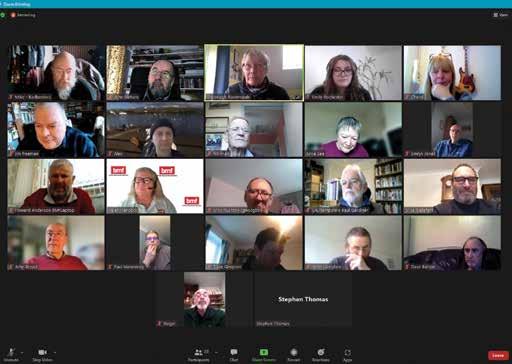
The meeting will be held on Zoom.
All full and affiliate members of the BMF are cordially invited to register their intention to take part in the AGM.
Voting rights of those taking part are set out in Section 6 of the BMF Constitution.
Registration of your intention to attend the AGM will be through the BMF administration – please contact admin@bmf.co.uk
Please take the opportunity to update your BMF membership contact details as soon as possible. All future communications regarding the AGM, including the issuing of all papers and documents will be through the BMF membership database. It is important that we have the most up-to-date contact information for you.
The business of the Annual General Meeting shall include:
A. to elect the Chair of the Federation;
B. to elect members of the Management Team;
C. to receive a progress report from each member of the Management Team, including a report from the Chair on the state of the Federation;
D. to question the members of the Management Team on the contents of the reports submitted in (C) above;
E. to receive financial reports including the annual audited accounts of British Motorcyclists Federation (Enterprises) Ltd;
F. to consider motions placed before it;
G. to alter, amend, rescind or add to the Constitution, Disciplinary Procedures and Standing Orders of the Federation;
H. to ratify the election of the BMF council members.
Because the meeting will be a virtual meeting, you will need to download and print copies of all papers that you will need for the AGM from the Google drive, whose link will be sent to attendees. If you do not have internet access or access to printing facilities, please contact the BMF Office who will be able to send you paper copies of the documentation that you need.
You must be a current BMF or Club member to take part in the AGM.
If you are a voting representative of a club, prior to the meeting, please submit to the BMF Office a letter or email from your Club Secretary showing that you have been appointed to represent the club. It would be helpful if this could be submitted as soon as possible.
Please feel free to contact the BMF office by email admin@ bmf.co.uk or by calling 07918 903 500 – for any further information or with any questions.
As we approach the anniversary of the 2024 General Election, we’ve been looking at what has actually been achieved in the motorcycle space by the no-longer-new Government. The lead up to the election saw a flurry of activity, as the previous administration took some notable steps on things like bus lanes, licensing and other areas. Perhaps this was partly due to desperation, as a fading administration sought the support of various lobbies through finally enacting things they had stalled on for many years. But the level of activity by the permanent administration – the departmental officials – had certainly stepped up a gear, so things were looking promising. If Rishi Sunak had not called the election early, we may have seen some real results.
A new administration coming in after years out of power, does bring with it opportunities, and some of the momentum from the previous Government did carry forward for a while. A Government which pledged to ‘Move fast and fix things’ seemed to start well, with the NMC being called in, along with other mostly safety-based organisations, to meet the new Transport Secretary Louise Haigh. This was to discuss the new Government’s pledge to create a new road safety strategy – something about which the previous Government had done nothing for well over a decade.
Other things also seemed to be happening. Further ministerial meetings to discuss potholes and road maintenance, hints at new strategies on various topics, the launch of a consultation for a new Integrated National Transport Strategy and so on. The NMC and BMF focused activity around engaging ministers and officials and we worked together to relaunch the NMC’s main strategic document in Parliament, following this up by organising a conference with Road Safety GB,
Anna Zee (BMF), Paul Morgan (BMF) and Craig Carey-Clinch (NMC) reflect on progress on motorcycling issues since the new Government came into power.
which the minister addressed, saying broadly positive things about motorcycling, albeit via video link.
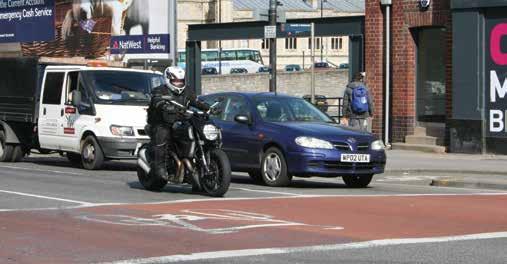
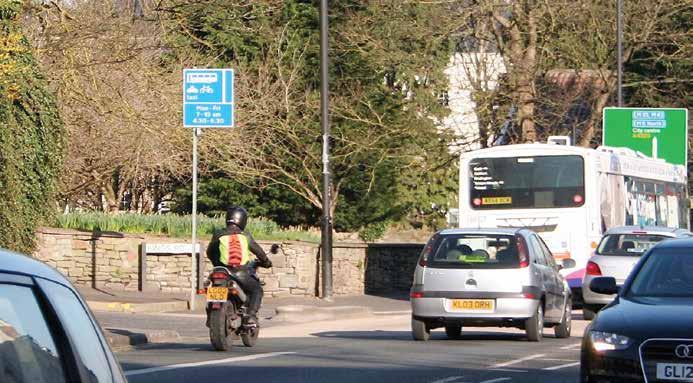
But then hints that all was not well began to emerge. The proposal to open all bus lanes to motorcycles was rejected, with the Department for Transport (DfT) stating in response to the consultation that the, “safety benefits of allowing motorcycles into bus lanes are not clear,” and, “at present the Government has no policy to encourage greater use of motorcycles.”
Silence started to reign supreme on issues such as motorcycle decarbonisation and several consultations disappeared into the ether after responses were submitted. A promise to consult widely on the content of the promised Road Safety Strategy came to nothing and officials have become tight lipped about this and other issues. “Move fast and fix things” started to look more like “move slow and do nothing.”
A ‘Seizure’ in Government?
So, it is just us? Once again, is the motorcycle lobby being ignored? Apparently not – other lobbies among different sectors are reporting a similar ‘seizure.’ Departmental engagement is still as good as it had become prior to the election, but officials restrict themselves to general updates and words about things happening ‘soon,’ and won’t be pinned down to specific activities or actions. Transport Minister Lilian Greenwood did throw us a bone by saying the Government is ‘considering’ holding a review into motorcycle training, testing and licensing, but this was a few months ago and since then...silence. Exasperation is starting grow, even among those lobbies which the Government usually supports.
So what is going on? A clue likely lies in wider ‘events,’ as former Prime Minister Harold Macmillan is reputed to have said. When saying, "Events, dear boy, events," he was commenting on how wider events and unexpected developments, not least the international situation, can easily derail a programme of government. On that score, we are certainly living through interesting times: the ongoing war in Ukraine, wider consequences from the Trump effect, pressure on the public finances, the fallout from decisions made by the current Chancellor and so on. We also hear that officials are being told to do nothing that isn’t directly focused on creating economic growth. All this of course collides with what Labour pledged to do in their mission-driven manifesto and we are all witnessing the fallout of that as it meets the ‘Realpolitik’ of actually running a nation. In the meantime, Reform is breathing down various political necks...all of which appears to be creating a rabbit in the headlights effect, where for many less high-profile areas of public policy, the Government is still deciding which way to jump, scared of doing the wrong thing and then getting the blame for it.
Keeping Up The Pressure
But decisions will need to be made on key policy areas which affect motorcycling, particularly around road safety and specific policy to unlock the benefits that motorcycling can bring to the future of UK transport. So, we will continue to put on the pressure where it is needed. We will continue to push motorcycling issues and combine with other lobbies, as required, so that our voice is augmented and Ministers get the message that the Government can’t sit on its hands forever.
Some of the ongoing hiatus is likely connected to the ongoing Spending Review. This was delivered by the Chancellor on 11th June and set out what each Government department can spend and in what key areas. We expect that after this, with departments finally having a clear framework for budgetary planning and implementation, things may start to move a bit faster. Hence the reason we continue regular behind the scenes contact with government officials, so that we are in the best place when transport policy work starts to move forward. A frustrating time perhaps, but the alternative to give up and resort to publicly attacking the Government instead, would definitely be very counterproductive, even if such a course of action is seductive and may grab a few headlines.
Consultations, Consultations...
The BMF and NMC have not been idle during this strange period, with a great deal of activity taking place to push the riders’ agenda forward. We have continued with our work to build a collaborative and credible relationship with the new Government at both ministerial and officials' level. We have forwarded detailed comments on motorcycling issues in response to the Government's National Integrated Transport Review, and in response to the Scottish Government’s separate ‘Just Transition Plan For Transport.’ We have also responded with detailed comments to the consultation on ‘Cyber-Security and Software Update Requirements for Autonomous Vehicles,’ making clear that all electronically controlled vehicle systems must be safe in every respect, including from hacking, and not present a risk to motorcyclists.
We have lobbied hard on the need for the Government to bring motorcycling into the mainstream of all UK transport and planning policy, as an accessible, affordable, cleaner and greener transport option, with motorcycles contributing only 0.47% of the UK's total domestic transport emissions. We have made it clear that, if properly supported by government, motorcycling can foster increased social mobility and positive economic growth as
part of a £7 billion motorcycle sector (with motorcycle sport alone valued at £1 billion), delivering reduced congestion and improved journey times across our towns and cities.
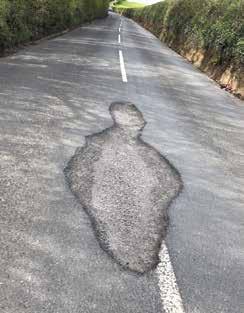
At the same time, we have continued to press the Government to deliver a multi-faceted approach to improving the safety of motorcyclists and, in particular, the need to design interventions that are specifically tailored to the risks and vulnerabilities motorcyclists face whilst using UK roads, such as poor road surfaces, the plague of potholes and inadequate infrastructure design. The BMF and NMC have also recently set up a new Motorcycle Safety Working Group, in partnership with the Parliamentary Advisory Council for Transport Safety (PACTS), which will feed in detailed thoughts and ideas to support the Government's planned Road Safety Strategy.
Clarity On Decarbonisation?
One of the Government's key missions is to make Britain a clean energy "superpower." With lower overall emissions from existing motorcycles, with zero emission models now increasingly establishing themselves in the marketplace, and with the motorcycle sports sector at the forefront of eFuels development, motorcycling has an important part to play both now and in the future in reaching Net Zero.
But it is increasingly clear that for the Government to meet its Net Zero targets it needs to adopt an approach to decarbonisation that utilises all technological pathways, not just battery electric. The world is changing and so must we, making the most of innovation and technological change to ensure that motorcycling is preserved, whilst delivering a sustainable transport option for future generations. Already in the 50cc moped sector over half of the top-selling mopeds are now electric models. However, continuing issues around cost, the limits of current battery
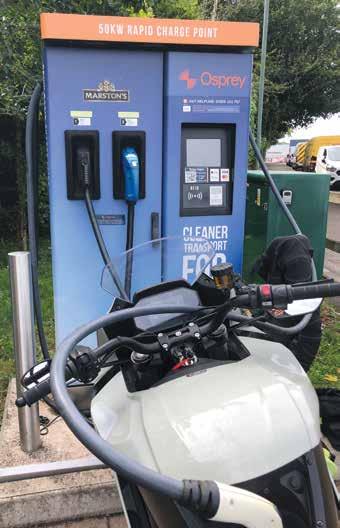
technology in terms of range, and the UK's currently poor recharging infrastructure are likely to hold back development in the larger bike sector for some time to come.
In terms of government transport decarbonisation plans, there is no planned legislation as yet to end the sale of petrolpowered motorcycles. The 2021 Transport Decarbonisation Plan mentions a 2035 target date (subject to consultation) to end the sale of new petrol-powered motorcycles and scooters as part of a broader plan to decarbonise the UK transport sector. However, a 2022 government consultation about the proposed 2035 date, launched by the previous government, did not progress before last year's General Election. And despite the NMC and BMF pressing the new government for clarity on its own motorcycle decarbonisation plans, Ministers are yet to express any views on specific decarbonisation dates for motorcycles.
In April 2025, the Government did confirm that they were maintaining their manifesto commitment to phase out the sale of new petrol and diesel cars by 2030. There was however no mention about any proposals or planned legislation from the current government with regard to motorcycles. Whatever date the Government eventually settles on for phasing out the sale of new petrol bikes, it should be remembered that this date will only apply to new machines. There has never been any suggestion that legislation will be retrospective, so whatever date is eventually firmly proposed for petrol powered phase out, motorcyclists will still be able to buy and sell used petrol bikes after then. Everything motorcyclists are used to doing, from filling up their tank at a petrol station to having their bike serviced, is likely to continue for years to come.
We continue to press for clarity from Ministers on this, and for progress on other important issues, and will provide updates as and when further information becomes available.
Getti NG the hA mmer Do WN
MARK WILLIAMS isn’t a fan of buying bikes at auction – based on experience
Ian Kerr’s feature on page 10 prompts memories of my own misadventures in the whacky world of bike auctions. In fact I’ve bought and sold more cars at auction than I have bikes, but that’s because at car auctions you can hear and see the blighters being driven up to the podium, whereas with bikes you can’t, even at most high end classic sales held at big bike shows.
I mean, think on it for a moment – would you buy a secondhand bike from fleaBay without at least hearing it run? Nevertheless I put the smart alec in me to one side for very specific if not good reasons on the three occasions I bought bikes at auction and herewith are those almost cautionary tales.
First-off was an urgently needed replacement for the Suzuki 125 scooter – yes, scooter – stolen from my then girlfriend’s front garden and found two days later having been dumped and torched on Hampstead Heath – some horrid joyrider’s idea of fun. At the time – the early noughties and of some poverty – a scooter that had been gifted me was my only means of transport so I needed another one, and a cheap one, to facilitate the two part-time jobs I was doing, and an auction seemed like the way to go.
In fact on this occasion the West London hammering did at least offer punters the chance to see and hear the lots being started and running, and this four-stroke Yam – can’t honestly remember the model because, hey, it was a scooter – ran, didn’t smoke or unduly rattle and as one of only two bidders I got it for something south of south of 500 quid. But as I discovered the next day when I went to collect it after arranging insurance (and an overdraft), hearing it run and riding it were entirely different matters: the front wheel bearings were shot and the disc brake squealed and barely served its purpose. Fortunately I managed to replace the necessary components in the aforementioned front garden and after ongoing running repairs that scoot lasted me a further two years before it, too, was nicked and never recovered, after which my financial circumstances had improved to the point where I could see sense and buy a Kawasaki GPz500.
Fast forward 15 years and my second auction highlight was for a Honda CB400N which reading between the lines of the auctioneer’s blurb was obviously knackered, e.g. ‘no MOT… needs
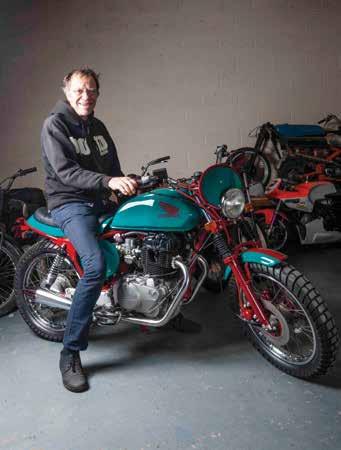
a service… some cosmetic damage etc.’ Was I mad to bid £550 for it, sight unseen 100-odd miles from home? I thought not because I intended to turn it into a ‘street scrambler’ using a mixture of parts from Café Racer Kits and my own, ahem, handiwork, which would include an engine overhaul and extensive mods.
Ha! In the event the engine needed a top end re-build and new clutch, to say nothing of the cost of finding and re-furbing CB400F wire wheels to replace the nasty Comstars. All-in-all the admittedly rather sprauncey customised Honda cost me nearly £2000 more than I was finally able to sell it for after a year of blood, sweat and tears.
However, I was sure that bidding sight-unseen for an SWM Gran Milano which I again blithely saw as the ideal basis for customising, this time into a poor man’s Ronin – and if you don’t know what that is, think a limited edition Buell-based street fighter. And being a brand new item from SWM’s then bankrupt UK importer’s liquidation auction, what could possibly be wrong with it? Well to my surprise after fighting off last minute cold feet, quite a lot actually. My £1900 got me a bike that had briefly been a demonstrator with a tank half full of fuel which having sat for over a year had seized up the in-tank fuel pump which was almost impossible to source. It also had no paperwork with it other than the auctioneer’s receipt, which after achieving my bizarre customizing ambition made registering it a total and expensive nightmare.
So would I buy again at auction? I think you can guess the answer.
...connected by the love of bikes.
Sat 12th – Sun 13th July 2025
Mallory Park Circuit, Leicestershire
Opinions
New Skills
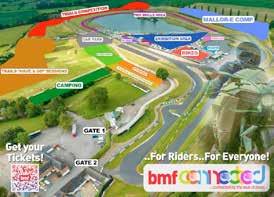
Start your engines...the countdown has begun for the BMF’s brand new biking weekend – BMF Connected. Two full and varied days of displays, talks, demos, Motogymkhana, workshops, trails and trials, competitions, have-a-go sessions, film shows, club stands, lots of traders, information stands and charities. Hawk Racing Team will also be joining us.
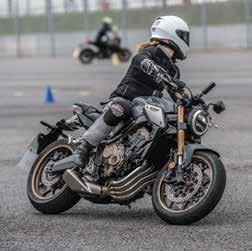
Pro-Skills – 1-hour sessions on your own bike to develop knowledge and skills
Charity Training
Off-Road/Trails –45-minute sessions on a trail bike. Bring A2 licence or CBT.
Everyone Discussions
Try-A-Ride – 30-minute sessions for novice riders – bike and all protective gear provided.
Saturday Ride-In Bike Show
Lots of trophies to win, assessed by our three roaming judges, including Best Adventure Bike, Best Custom and Best ‘Little’ Bike. Winners announced 6pm Saturday.
Talks/Q&A Sessions
Q&A with the BMF Management Team Bike Security
Science of Being Seen
Navigating Navigation
Two-Week Touring
Let’s Talk TT
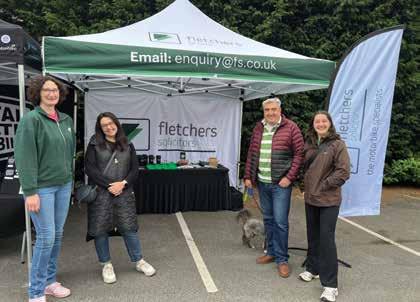
Legal Advice from Fletchers Solicitors
Motorcycle PPE
Motorcycles & Mental Health
PLUS:
• MK Off-Road – Youth and Open races on Sunday
• Mallor-E Park – Electric motocross competition all weekend
• Live Music
• Camping – tents, campervans etc can arrive from 4pm on the Friday
• Family Friendly - under 16s go free
TickETS & info
Day tickets – £15 BMF members, £18
general tickets, under 16s free Weekend tickets – £20 BMF members, £24 general tickets, under 16s free Camping tickets – £15 tent, £20 other (caravan, van, trailer, campervan, etc) Sorry, no dogs (assistance dogs excepted)
website is constantly being updated with more information
We’ve had a good crop of photos entered for our Summer Photo Comp, so thanks to everyone who did, and sorry to those we didn’t have room for this time.
But do keep sending your pictures in. The subject can be anything related to bikes, from twisty roads and rugged scenery to your local bike night. Winner of the Autumn Photo Comp, plus the best of the runners up, will be printed in the next issue of Motorcycle RIDER. Send your photos to: editor@bmf.co.uk
✶ wINNER ✶
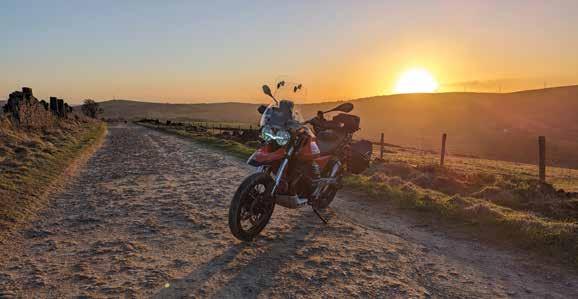
Martin Slater’s big Moto Guzzi at Harrop Edge Lane, Delph Oldham. “It's a little used, mostly unsurfaced lane which I use to practice some mild off-road riding.”
year's F r EE BMF membership
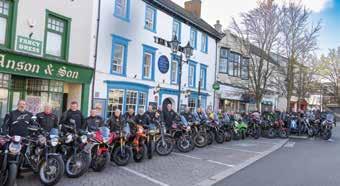
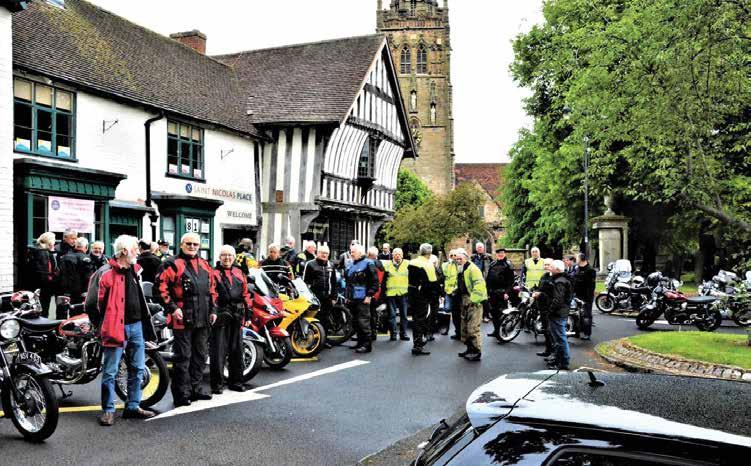
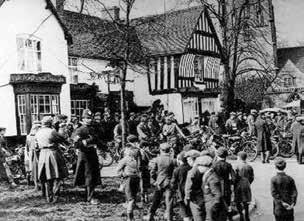
Left: Doncaster and District MC Club, gathered to celebrate its 115th anniversary – one of the longest running clubs in the UK.
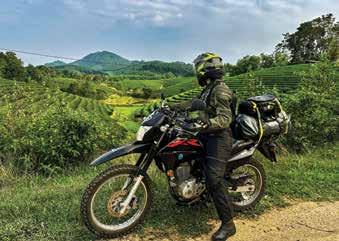
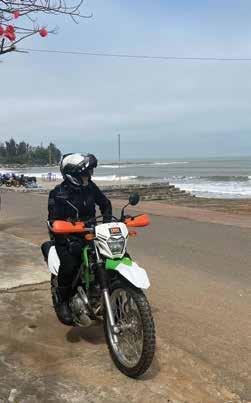
Left: This is Annie Jowett on a borrowed Honda XR150, en route from Hanoi to Ho Chi Minh City, Vietnam.
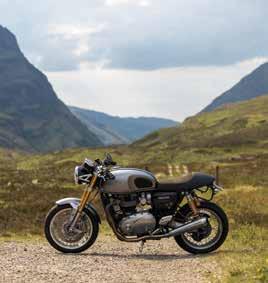
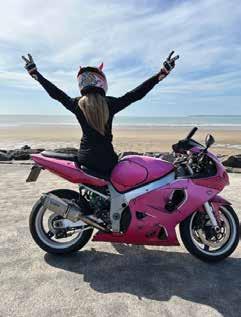
Left: trip to Glen Coe was the setting for Mark Aldridge’s picture of his Triumph Thruxton R. Below: Kayleigh Gilmore loves her GSXR600 even more since she had it resprayed –can you tell?
Under the Hammer
Never been to a bike auction? iAN kerr examines the ups and downs of buying or selling by bids
At the risk of being very controversial, nobody (in the UK at least) actually needs a motorcycle. It’s a lifestyle choice.
Small cheap cars, which actually hastened the demise of sidecars and in fact solo motorcycles in the 1950s as a form of transport, continue to be a more attractive alternative to twowheelers for most people.
Many of these small cars are now cheaper than big motorcycles, more fuel-efficient and come loaded with things like air-con and good stereos. And of course, you only need to pass one government test to be able to drive everything the manufacturers care to offer, from basic to high performance versions, not having to go through a series of CBT, Module 1 and 2, Class A1, A2, and so on.
Modern motorcycles are now sold through a decreasing number of dealers, (albeit via more purchase plans than ever) and once bought, they cover relatively few miles. An MOT tester I know told me he sees an increasing number of older bikes with quite small annual mileages. Obviously the high mileage, adventure seeking riders are still out there, but even they seem to be keeping their mounts longer due to ever rising prices.
Changing Markets
Before you shout me down, consider that the latest sales figures for new bikes are not that encouraging, as people start tightening their financial belts. And it’s not only the modern market that is slowing down, so too is the classic/collector scene, which has seen a considerable softening of prices in the last couple of years.
One of the major factors is that riders interested in older bikes are now getting older themselves and unable to kick-start their mounts and/or be able to maintain them. Inevitably, increasing numbers are now selling them, perhaps hoping for a windfall on a bike they only paid a pittance for years ago. Alas, for them at least, this effectively makes it a buyers’ market! What can someone with a classic bike to sell do?
Modern dealers are not interested in either buying a 40-year-old machine directly or taking it in part exchange on a modern bike, even if this would enable an ageing rider to keep riding. So, it’s either a specialist classic dealer (who have to work with the same market conditions as everyone else), or a private sale via a magazine or online internet. Private sales have their pitfalls, involving as they do potential buyers visiting your home, compromising security. From the buyer’s point of view, it can mean travelling miles to view a bike which may not live up to the description.
The Auction Alternative
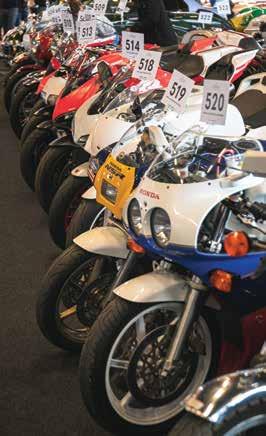
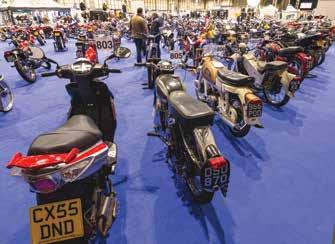
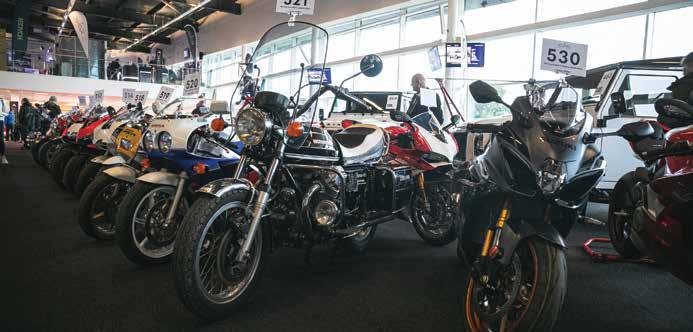
As result of all this auction houses have become more popular for buying and selling older bikes, not only for the serious collector looking to buy, but also for those enthusiasts who want to sell, or purchase their dream machine they could not afford when they were younger.
From a seller’s perspective, access to a worldwide market can result in some healthy prices being achieved, making them very attractive as well as relatively hassle-free.
The basic premise of ‘buyer beware’ still applies, despite the auction houses doing their best to post accurate and honest descriptions in their catalogues. To be fair, in many cases buyers are having to rely on the honesty of the seller, especially if the machine is not seen running. Like any private deal, it is best to thoroughly research the make/model you’re interested in beforehand, and have some idea of the average price. A knowledgeable friend is also an advantage when examining the machine and any paperwork. There’s no point paying more at auction than you could have in a dealer or classified advert!
The most important thing is to set your budget beforehand, taking into account the buyer’s premium which attracts VAT and is added to the hammer price. If you cannot transport the bike home yourself, you will need to add transportation costs as well.
From a selling point of view, going through an auction house does take away the pitfalls of selling privately, as the auction staff do most of the work for you, including making sure you get your money. Obviously there is a cost incurred for all their work, and in most cases this is deducted from the sale price and not payable up front, but you do need to be aware of how much will be deducted from the hammer price. You’ll also have to transport your bike to the auction site and take it away again if it doesn’t sell. Also, if it fails to sell, you will still be liable for some of the charges.
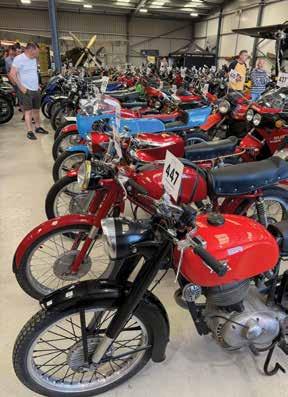
Left: It’s a good way to buy a classic
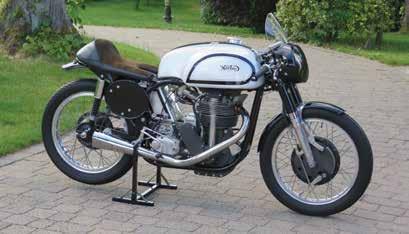
Below: This Manx Norton sold for £36,600
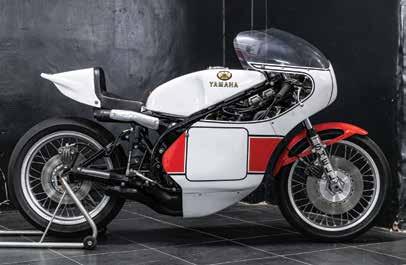
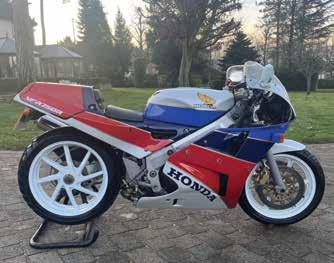
Above: Rare race bikes with history can make good money
Read the Small Print
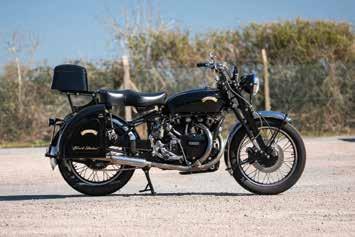
Having said all of that, there is nothing to be feared either as a buyer or seller, and as with anything else in life, just read the small print. And contrary to popular belief, if you scratch your nose or shift in your seat you will not end up with a massive bill for the Brough Superior that was being sold at the time – the auctioneers are true professionals who can see who is actually bidding!
A massive plus is that all the auction houses post their sale results for all to see, is it’s easy to get an idea of prices and market trends and get a rough valuation on your own machine, which obviously helps with insurance valuations, or even selling directly to friends. You will also know when, or if, to sell or buy.
The Auctioneer’s View
To get an accurate update on what the auction scene is doing and an idea of what is becoming collectable I asked Mark Bryan of Iconic Auctioneers, one of the leading auction houses, for his take on how the market is moving away from machines from the turn of the last century, given some very successful recent sales of more modern bikes.
“The last year has confirmed what I've suspected for a while,” he said, “that the new sweet spot for classic and collectible bike sales is somewhere around the 30 years ago mark. Last year in a tough market for many eras of bikes some of the best performing lots were ‘90s machines.
“At the MCN London Motorcycle Show Sale back in February –which was extremely busy – we consigned a collection of Yamaha TZ race bikes, ranging from 125 to 750cc, a big risk but it worked well as we sold the majority of them.
“Historically race bikes have always been a difficult market, and a fairly small one. Often race machines are bought and sold in the paddock, rather than at auction, and many are stripped down, parts are replaced, and bikes are built up from bits. But I think
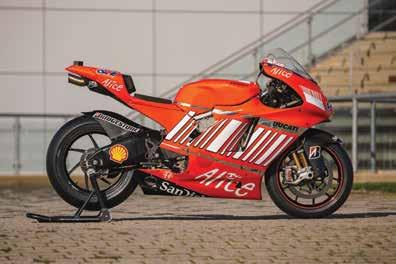
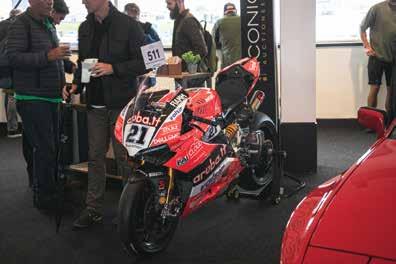
the right estimate – will sell, note the 2007 Ducati GP7 we sold last year at £400,000!
“Classic sales are certainly not all about modern classics though. We've got some nice vintage bikes on offer too at all our sales and veteran, vintage and pre-war bikes can still sell well as they offer something a little different to the more mainstream classics. They're relatively simple and easy to maintain, quirky, and a lot of fun to ride. You can buy a nice, usable, vintage single for £3000/£4000 or less, and they are surprisingly practical once you get the hang of them.
“In the Spring Sale at Shuttleworth in May there was a good cross section of traditional ‘60s and ‘70s classics on offer too. I'm hoping that the slowdown in prices for many of the bikes of this era will spark some interest from non-classic bike riders.
“If they can dip a toe into the classic bike world without spending a fortune, I think some of them will fall right in like the rest of us, including me! It is though becoming a buyers’ market for British
Above:
A Moto Guzzi T3 with touring kit? You might wait a long time to find another
Right:
Another race bike with history...
Left:
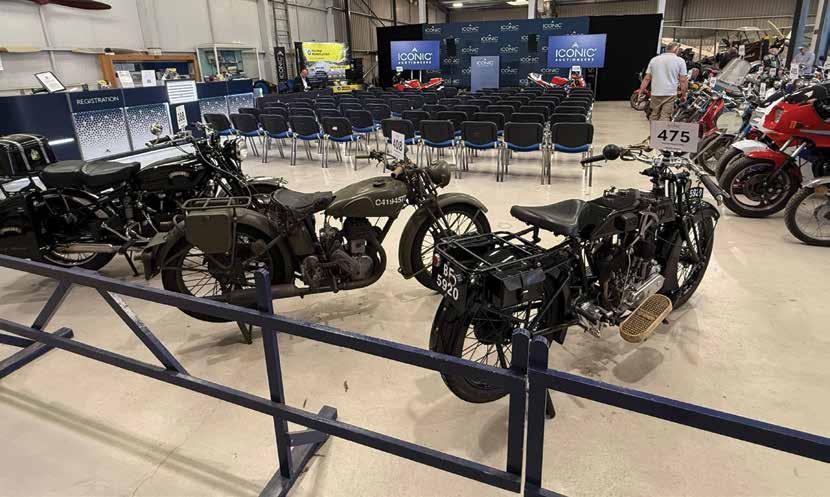
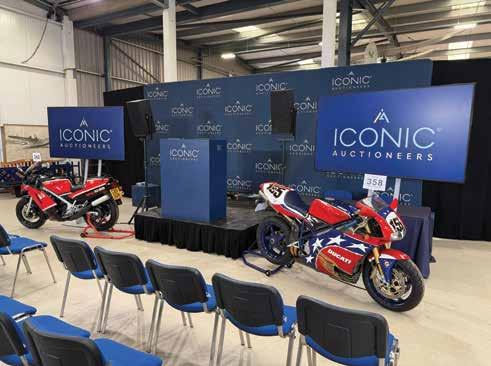
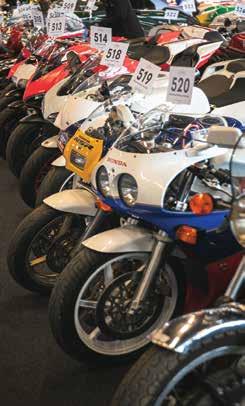
Sports bikes galore at this Iconic Auctions sale
The AucTion houses
Iconic - www.iconicauctioneers.com
Bonhams – www.bonhams.com
Charterhouse – www.charterhouse.co.uk
Spicer – www.spicersauctioneers.com
H and H – www.handh.co.uk
classics from the 1950s and ‘60s due to the numbers coming onto the market.
“That sale consisted of 198 lots, making this our second biggest sale to date, which suggests to me that the market is still buoyant, not diminishing as some claim, just shifting focus. The interest in classic bikes has always been driven by nostalgia though, and who would think that 1995 was actually 30 years ago!
I know my day job is all about selling bikes, but I don’t seem able to resist buying them either. Last year I picked up a 1967 Triumph TR6C and a 1965 Honda CL77 305 Scrambler. Who would have thought that my oldest bike in my small collection would be a Honda!”
As Mark says, if you fancy dipping your toe in the classic market why not have a look at any of the auction houses’ websites (see box) for information on up-and-coming auctions and find an entry level machine which in turn may find you a new set of motorcycling friends and perhaps get that machine you lusted after years ago!
HJ Pugh - www.hjpugh.com
Thanks for Iconic and Charterhouse Auctions for the photos.
The £1 Million MoTorcycle
A new world record was set at the Mecum auction in Las Vegas recently, when a bid for just over £1 million was accepted for a 1915 Cyclone V-twin. It’s said to be the highest amount ever paid for a motorcycle in a public auction - £1,062,070, if you want to be exact. That sale set a new gross world record for a motorcycle auction as well, at £21.2 million for all the bikes sold. Don’t have a spare million burning a hole in your wallet? Then there are plenty more affordable options available in this country – try the auction houses listed below and go along to a sale near you. Even if you’re not intending to buy, it’s an entertaining day out (but beware of getting lured into bidding...)
Watsonian Squire is still going strong after 113 years – DAN SAGAR tells the story.
SiDEkickS
Nestled between the picturesque Cotswold towns of Chipping Campden and Moreton-in-Marsh is a rural industrial estate, home to one of the longest-surviving names in the British motorcycle industry.
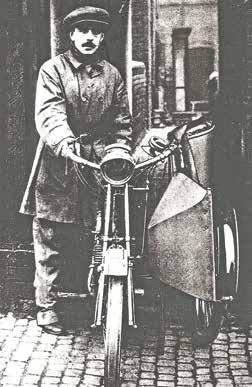
In 1911 a Birmingham builder called ‘Fred’ Watson had a brilliant idea. Sidecars were becoming increasingly popular, but they wouldn’t fit through the narrow alleys between terraced houses. This was a problem for many people who lived in industrial cities, because they needed to park their outfits in the back yard, where they would be safe. Fred designed and patented a ‘collapsible’ sidecar that could be folded up and wheeled through snickets and doorways. Its rectangular chassis had hinged crosstubes at either end, with long vertical hinges on the metal body. The seat locked everything rigidly in place, and could slide aside, allowing the sidecar to fold up. Production started in 1912 and Watsonian sidecars started appearing on Britain’s roads.
They were a hit and, by the time war broke out in 1914, Watsonian was advertising 30 models in its range. Fred kept busy, developing a sidecar ambulance, and when peace returned, new models for leisure, sport and tradesmen were produced. Things were going well, with a move into a new three-storey factory in Birmingham in 1922 and the launch of the Kwikfit chassis in 1926. Another ingenious Fred Watson concept, this featured a
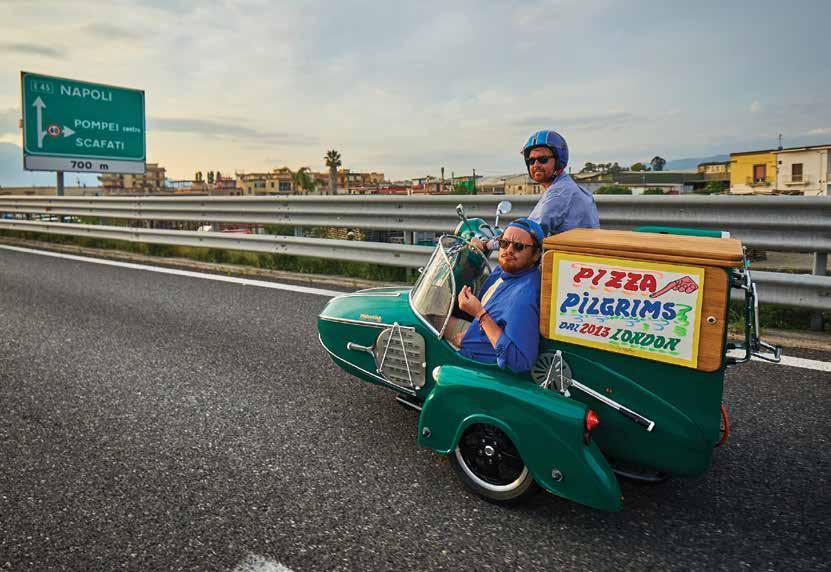
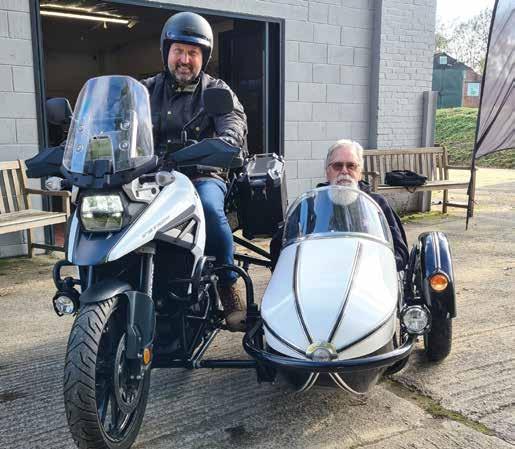
Above: Who said sidecarrists were eccentric?
subframe that was permanently bolted to the motorcycle, while the sidecar chassis was locked into place using quick-release clamps. A Kwikfit gave motorcyclists the opportunity to ride solo for commuting or sport and quickly attach the sidecar when they needed to carry a passenger. Hugely popular, the Kwikfit remained in the range until the late 1950s, by which time motorcycles had become too powerful for the quick-release clamps to provide a secure anchor.
Boom and Decline
Everything was going well until 1930, when a spark from a passing steam train started a fire that burnt down the factory. Ever optimistic, the following year Watsonian relocated to larger premises in Birmingham’s Greet district, and set about developing an exciting new range of sidecars for motorcycles, and bicycles too. By the end of the decade, the company offered a choice of 12 sidecar bodies and five chassis for motorcycles, including the luxury Oxford saloon and aluminium-bodied International trials model.
Once again fate intervened, with sidecar production put on hold for the duration of the Second World War. During this conflict,
Watsonian manufactured a million camp beds, half a million rucksack frames and some portable aircraft hangars! Then as war drew to a close, Fred Watson died and was succeeded by his son Ron, when he returned from the Far East.
Ron had clearly inherited his father’s business acumen and energy, but he was also passionate about motorcycle sport, which he believed was a great promotional tool. Working closely with Norton and genius sidecar pilot Eric Oliver, they pioneered revolutionary sports sidecars, going on to win every sidecar world championship from 1949-53, (four with Eric and one with Cyril Smith). This would be the last time that a British motorcycle manufacturer won the title.
In fact, the 1950s was a golden era for sidecars. By 1952 there were over 130,000 outfits registered on Britain’s roads, half of which were built by Watsonian! Production at the Birmingham factory peaked at 200 units per week, and they embraced new technology, such as the use of fibreglass for bodywork – a ‘jet age’ material at the time.
But all good things must come to an end. Wages were increasing and small, mass-produced cars were becoming more affordable. The Reliant Regal three-wheeler was launched in 1953 and could be driven on a bike licence, attracting many riders away from sidecars. In 1959 the Mini arrived on the scene, and sidecars rapidly fell out of fashion. To put this in perspective, in 1962 Watsonian produced 3461 sidecars – five years later that figure had fallen to just 637.
New Era
Production switched to automotive bodywork, which kept the company going until a major contract with Land Rover ended in 1981. The company relocated from Birmingham to its current location in the North Cotswolds and, in 1988 merged with the up-and-coming Squire sidecars, which gave Watsonian a new lease of life.
Squire entered the market in 1973 with a radical new sports sidecar, designed for the latest generation of high performance Japanese superbikes. They went on to manufacture huge numbers of sidecars for the influx of cheap East European bikes from MZ, Jawa and CZ, bringing the joy of three wheels to a new generation of riders.
Following the merger, Watsonian-Squire set about rationalising the range and streamlining production. And as the 20th Century drew to a close, sidecars started to come back into vogue, their retro appeal fitting in with a new generation of modern classics, like the Triumph Bonneville 790. Appearances on film and television – starting with Two Fat Ladies and culminating with Harry Potter and the Deathly Hallows – have kept sidecars in the public eye.
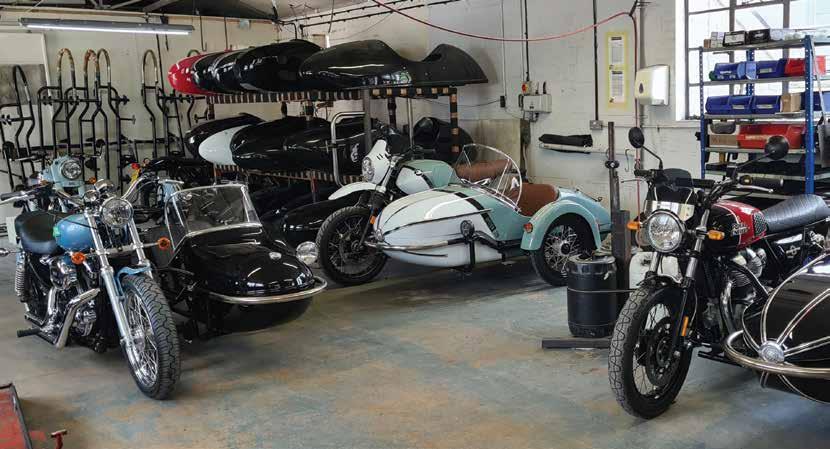
Now in its 113th year, Watsonian still produces sidecars in much the same way it did in the 1950s. Chassis are made inhouse, while the fibreglass bodies are moulded by specialists nearby. Wheels and suspension are made in the UK and everything is bolted together and finished in the factory.
The real skill is fitting sidecar to bike. This involves an eye for toe-in (the sidecar wheel should point slightly inwards to the
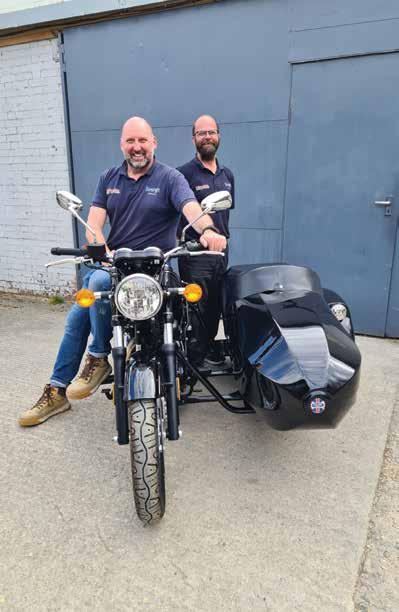
Above: The power behind Watsonian –Ben Matthews (L) and Ben Hall (R)
Left:
Mr Watson and his breakthrough folding sidecar, 1912
front), lean-out, (the bike needs to lean away from the sidecar) and axle-lead (the sidecar wheel should sit in front of the bike’s rear wheel). Plus geometry. Fittings need to be triangulated, so the sidecar remains firmly fixed in position, in spite of the enormous stress it's under during rides.
Who Buys Sidecars?
“Our customers fall into three main groups” says Ben Matthews, Watsonian Managing Director. “People who struggle to balance on a solo motorcycle, usually due to a health issue or disability. Then there are riders whose passengers can’t sit on a pillion seat – maybe it’s no longer comfortable, or they’re too young or, increasingly, because they’re a dog! And finally, people who’ve discovered that sidecars are fun and attract a lot of attention. We recently made an outfit for the owners of Pizza Pilgrims restaurants, complete with a mobile pizza oven!”
“Currently we produce around a hundred sidecars a year” adds Ben Hall, General Manager. “The majority are for customers in the UK, but around 20% are exported to Europe and the USA. Our most popular model is the Grand Prix, with the distinctive octagonal nose and aluminium beading. Introduced in the 1960s, it’s stood the test of time and there are versions for smaller capacity bikes and a wide-bodied version for a couple of children or an adult and small child. Since every sidecar is made to order, you can spec it to suit your tastes, budget and needs. In fact, you can visit the factory and meet the people who’ll build it!”
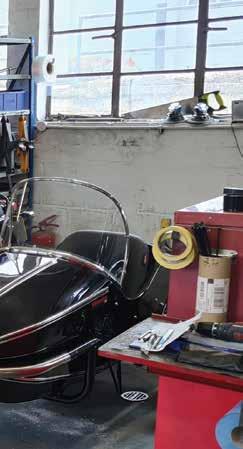
Above: Watsonian’s factory isn’t big, but it all happens here
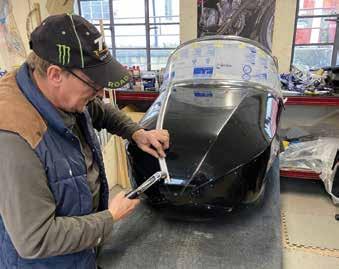
Left : A lot of the work is still done by hand
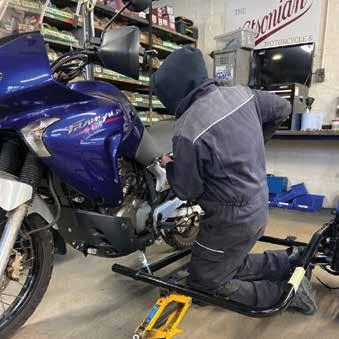
Below left: Preparing a Honda Transalp to accept sidecar platform
The Art of Driving an Outfit
You might ride a motorcycle, but you drive a sidecar outfit and the experience is quite different. Watsonian runs familiarisation sessions for customers, covering all these basic points:
1. Master the Basics First: Begin with expert instruction in a large, traffic-free area. This will allow you to safely learn the unique handling characteristics of a sidecar, which differs significantly from riding a solo motorcycle.
2. Position Like a Car: When on the road, think of your outfit as a car. Give ample space for the sidecar beside you, especially when maoneuvring.
3. Cornering Confidence Starts Slow: Approach corners with caution. Entry speed is crucial for smooth sidecar handling. Remember that left and right turns feel different, so build your confidence gradually. You'll be impressed by how skillfully an experienced rider can navigate curves.
4. Steer Deliberately, Don't Lean: Unlike a solo motorcycle, you steer a sidecar through turns. Avoid the instinct to lean.
5. Park Securely: Always switch off the engine and leave the outfit in gear when parked. This acts as a parking brake, similar to a car.
Visit Watsonian
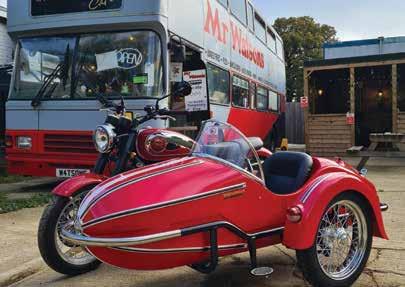
Visitors to Watsonian’s Cotswold base are welcome. The showroom is open Monday to Friday from 8.30am to 5pm and Saturdays from 10am to 2pm. Mr Watson’s Cafe serves freshly prepared food and a selection of beverages in a converted double decker bus parked in the yard!
Back to Basics with Benelli New for 2025, the Squire SB1 is a simplified sidecar outfit perfect for novice three-wheel riders. By streamlining the build and pairing it with the reliable Benelli Imperiale 400, Watsonian says that production costs have been minimised, offering an affordable entry into sidecar riding. The UK-moulded GRP fibreglass body features a durable gloss black finish, a GRP wind deflector instead of a screen, and a comfortable black vinyl cushioned bucket seat. Built on a robust powder-coated tubular steel chassis with rubber torsion suspension and a 10-inch wheel, the SB1 ensures a smooth ride. Pre-set adjustments for the Benelli allow for easy owner detachment and reattachment. The inspiration for this ready-to-ride outfit came from Squire’s 1980s budget-friendly sidecars, aiming to provide an affordable way into the world of sidecars under the Squire brand, distinct from their bespoke Watsonian range. The price is just £7,999 on the road for both motorcycle AND sidecar.
Dan Sagar handles press relations for Watsonian Squire.
Boxing Clever
everything you wanted to know about motorcycle luggage...etc.
iAn Kerr visits a specialist dealer who aims to fill the niche
Whatever type of bike you ride, whatever sort of motorcycling, at some stage or another we all need to carry ‘things.’ Luggage has posed a problem since the early days of motorcycling, and back then no manufacturer offered any convenient method of carrying stuff.
Fast forward to the 1950s and the legendary touring rider Ken Craven designed and produced the fibreglass panniers and top boxes, still produced by Draganfly Motorcycles in Norfolk. Move into the ‘70s and the likes of BMW and Harley Davidson started to offer factory produced panniers with fittings. Plus Honda revolutionised luggage carrying with the Goldwing, while other manufacturers began to take note.
Meanwhile, a thriving aftermarket industry grew up, offering hard and soft luggage, then magnetic tank bags (which became unusable when steel fuel tanks went the way of the dodo). Now of course the choice of luggage carrying kit is vast and caters for every type of rider from the commuter to the round the world adventurer. Quick release day bags have supplanted magnetic tank bags, which when touring enables you to keep passports and other essentials safe when stopping for a coffee or lunch. At the other end of the scale, you can buy luggage which will take the proverbial kitchen sink.
What’s Available?
Go to any of the major shows and you’ll see all the big names in luggage, with proven products so you can buy without any worries as to stability or the strength of mounting points to the bike.
However, that expertise is not available in most dealers. Apart from ‘factory’ hard cases, if most dealers stock anything, it’s normally the odd tankbag or top box – whether this actually suits your needs is up to the customer to decide.
Roy Aaronson is different. He’s been in the motorcycle trade all his working life and there are probably not many roles he hasn’t fulfilled. A few years ago he moved out of the mainstream franchises and started selling motorcycle accessories online.
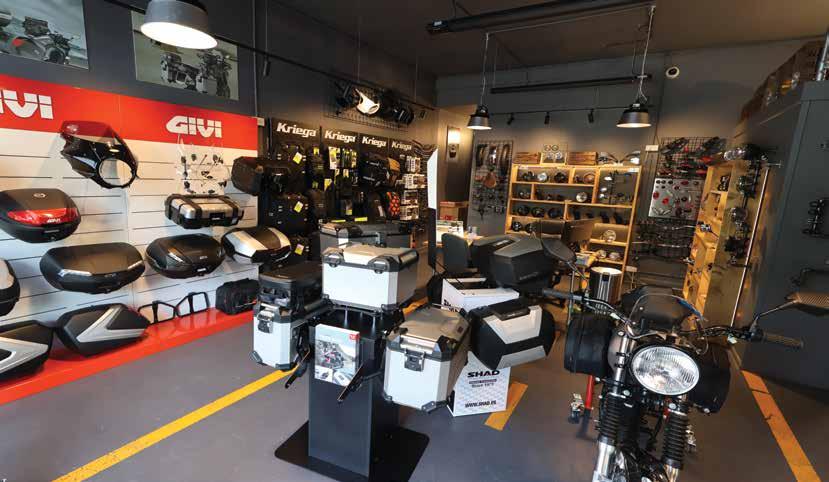
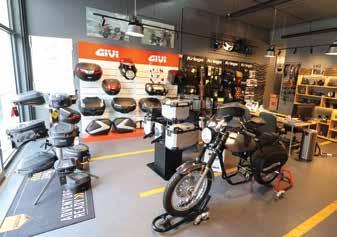
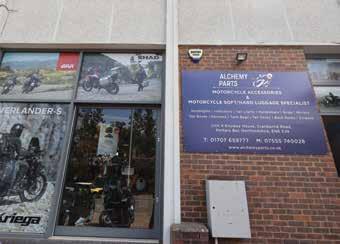
Still an active and regular high mileage rider himself, Roy became aware that many dealers were not able to give expert advice on luggage and they almost all failed to stock a range of products. So after a year working with the various luggage manufacturers he’s opened a showroom in Potters Bar, highlighting the luggage side of the business and giving customers the chance to compare brands.
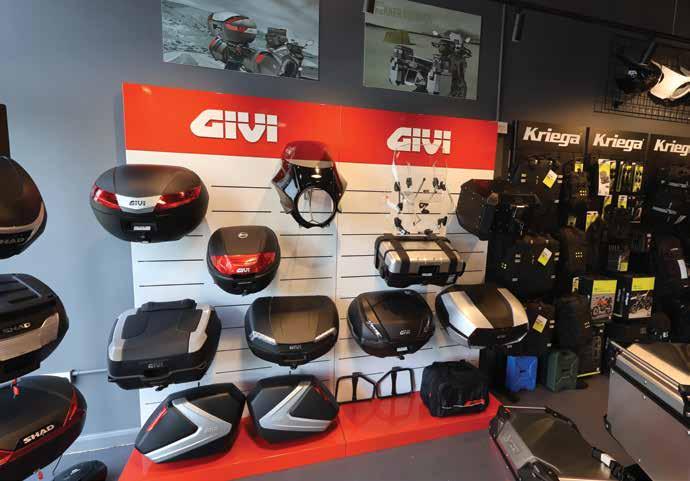
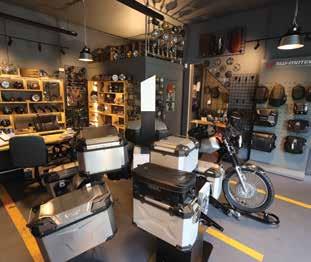
It certainly has the wow factor when you walk in to see displays from the four luggage manufacturers he has decided offer the best products: Kriega from Wales, Shad from Spain, Givi from Italy and SW Motech from Germany. You’re left in no doubt that this is a luggage specialist.
Local Contacts
Over two hours Roy talked me through the various manufacturers’ luggage.
Some products are waterproof, others rely on liners or covers and the options run into literally hundreds of items, as do the mounting options from just throw-over, quick release, to other more permanent attachments.
But what about the safety of valuable items such as cameras and laptops if you don’t opt for a topbox or hard panniers? Roy came up with various options from the different brands, which all had something that would do the job.
As for fitting, that’s done by the customer’s local dealer. “We will send products to a buyer’s local dealer,” said Roy, “and allow them to fit if the customer isn’t local to us. We also have arrangements with several dealers who pass us the luggage business while we pass back the fitting service. This offers customers peace of mind and works for everyone.” The idea is that riders can phone or contact Roy though the company’s website and he will help them identify exactly what they need and supply it.
I have to say that the time I spent in the luggage showroom was a complete education. It was a chance to directly compare all brands and products without any hard sell from someone without a vested interest in one particular product.
The concept is unique and even if you have factory-fitted luggage it is certainly worthwhile visiting the showroom just to have a look at stuff you may have not even realised you need –certainly I was not aware of how big and diverse options from these luggage manufacturers are. Expertise like this is much needed and demand is sure to pick up, besides it is a pleasant ride with good coffee when you get there!
Above: All the options laid out for inspection Right: Hard cases are popular, but there are alternatives Far left: They’ve even got a dummy bike to test fittings
N ATION w I d E ASSO c IATION OF B LOOD B I k ES
ALEX CHALMERS is the new Chairman of the Nationwide Association of Blood Bikes (NABB) – we asked the questions
*So Alex, what’s your biking and professional background?
I’ve been around bikes in one form or another on and off since my teenage years, always loved them. I love the technical/mechanical side alongside the love of riding them. Away from bikes, I’m the director of two small construction companies, one in the south of England and one in Scotland, but being my own boss it gives me time to be out on my bike and volunteer for NABB.
*why was NABB set up originally?
In 2008, a small group of operational blood bike groups met and realised that the blood bike service they provided to the NHS could grow and benefit from further assistance. Inspired by this, NABB was formed to promote blood biking across the UK. This led to helping establish many of the blood bike groups over the country.
*what’s the job of NABB?
Our mandate is to actively work towards parity with other frontline emergency services in terms of legislative support and recognition from various government departments and agencies on national topics. We are also actively involved in promoting the professional activities of our members to the public and our wider NHS ‘clients’.
However, the support we offer goes beyond this, as we strive to arrange things like discounts with manufacturers and provide support in many other ways to our groups. But overall, the NABB's job is to listen to the needs of our member blood bikes groups and work on their behalf on subjects that will help them operate more efficiently.
*Does it require common standards among the blood bike groups?
All our groups must operate their services to the NHS for free. We have a set of standards we call our membership standards and we ask that all groups who wish to be part of NABB meet these standards. One example is that all riders should be trained in advanced riding; another is that all volunteers are trained to the standard required by the NHS for the handling of blood products etc.
*Some groups use cars as well as bikes - what are the pros/ cons of bikes vs cars for this work?
Bikes are at the core of who we are and what we do, but many groups could not operate without cars. The bikes have the ability to carry out runs often much more efficiently than cars but at times with bigger orders or extreme bad weather then cars are essential to a lot of groups.
*Is the Yamaha FJR1300 the perfect blood bike, or are there others?
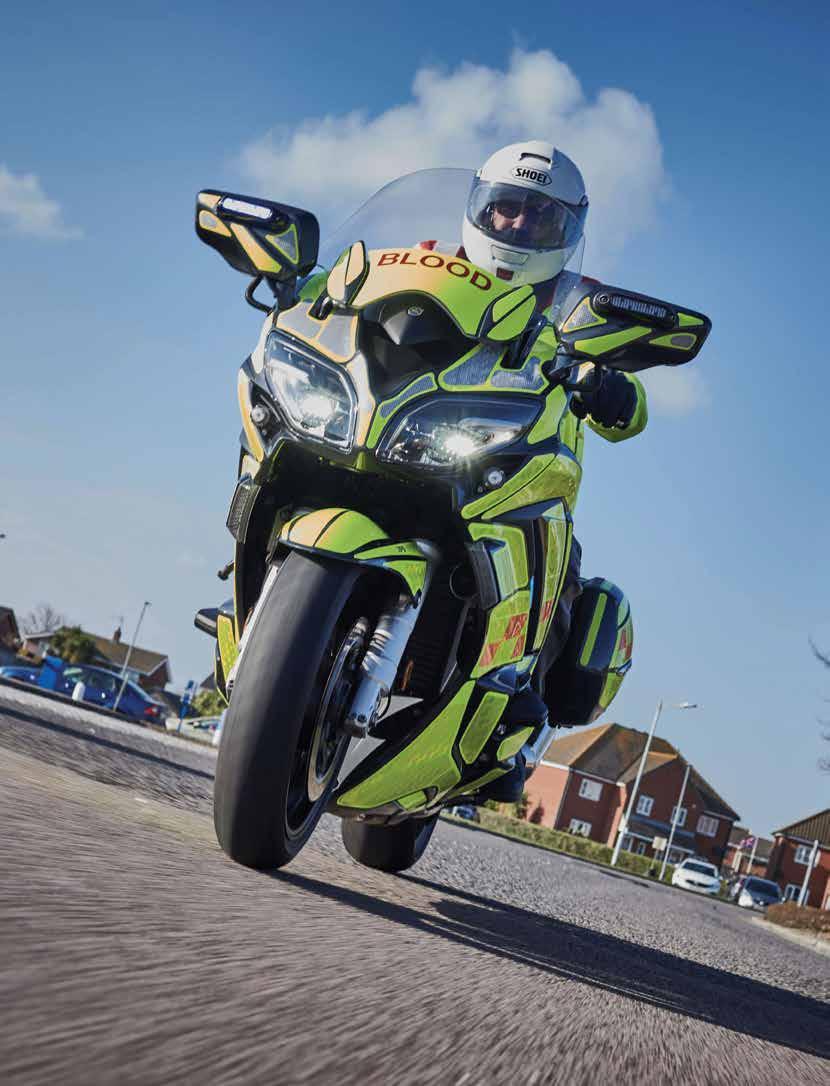
The FJR was a brilliant blood bike – a lot of groups still have FJRs on the fleet and it does the job amazingly. There has always been a mix of bikes across groups but the Yamaha was used heavily. With the FJR now being discontinued it has left a bit of a gap in the market for which bike is now the preferred choice for blood bike groups. Yamaha have done work to produce a Tracer 9GT in blood bike spec and some groups are using that. Other groups have been carrying out great work and are using different manufacturers –currently we have Triumphs, BMWs, Hondas, Ducatis, Zeros and other manufacturers out there being used as blood bikes. Some volunteers also use their own personal bikes.
*Finally, how do you see blood bike groups developing in the future? Is there room for more?
There is no doubt that NABB has a lot of work to do going forward. The most recent AGM brought about some new people into trustee roles, including myself, and we are all very eager to make NABB work hard on behalf of its member groups.
We hope to get blood bikes more publicly recognised at a national level and we have many campaigns to take up on behalf of our members, for example enabling blood bikes to use all bus lanes. There’s plenty to do.
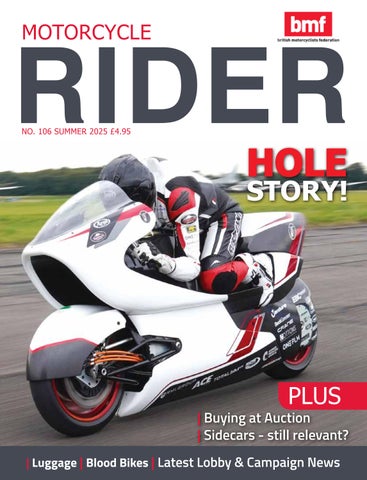
The Hole S T ory
IAN HIRD explains WMC’s pioneering work on motorcycle aerodynamics
A British company currently leads the charge toward a Net Zero future for motorcycles through patented aerodynamic innovation and industry partnerships. We asked one of the Directors, Ian Hird, to tell us more about the company and how it is working to change ideas, not only about electrifying PTW’s, but also about aerodynamics as applied to two-wheelers
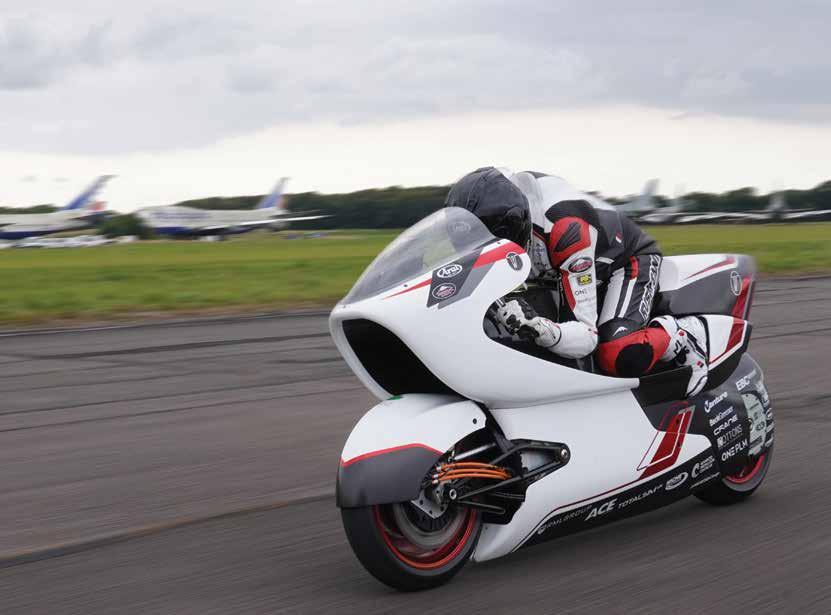
At White Motorcycle Concepts (WMC), we are making significant strides in transforming the future of twowheeled mobility. The company’s singular mission is to reduce the carbon footprint of the global motorcycle industry through practical, performance-driven aerodynamic enhancements. With deep roots in elite motorsport – from Formula 1 to Le Mans and Moto3 to V8 Supercars – WMC combines motorsport grade engineering with visionary design, aimed at achieving real-world sustainability outcomes in both petrol and electric motorcycles. At the heart of WMC’s innovation lies a unique, patented aerodynamic solution, the V-Duct, a venturi duct integrated through the centre of a motorcycle chassis. Conceived by company founder and CEO Robert White during his time in Formula 1, the V-Duct significantly enhances aerodynamic efficiency by allowing air to flow directly through the motorcycle, rather than around it.
Now patented in the UK, USA, and Japan (with EU approval pending), this technology not only improves the range and speed of electric bikes but also reduces carbon emissions and battery demands, an important consideration given that a motorcycle, at just 100km/h, uses approximately 80% of its power to overcome air resistance.
We have rigorously tested the V-Duct technology across multiple prototypes and use cases to prove its value at both ends of the performance spectrum, from ultra-high-speed to everyday utility, demonstrating the duct’s cross-sector viability and scalable impact.
Practical Applications
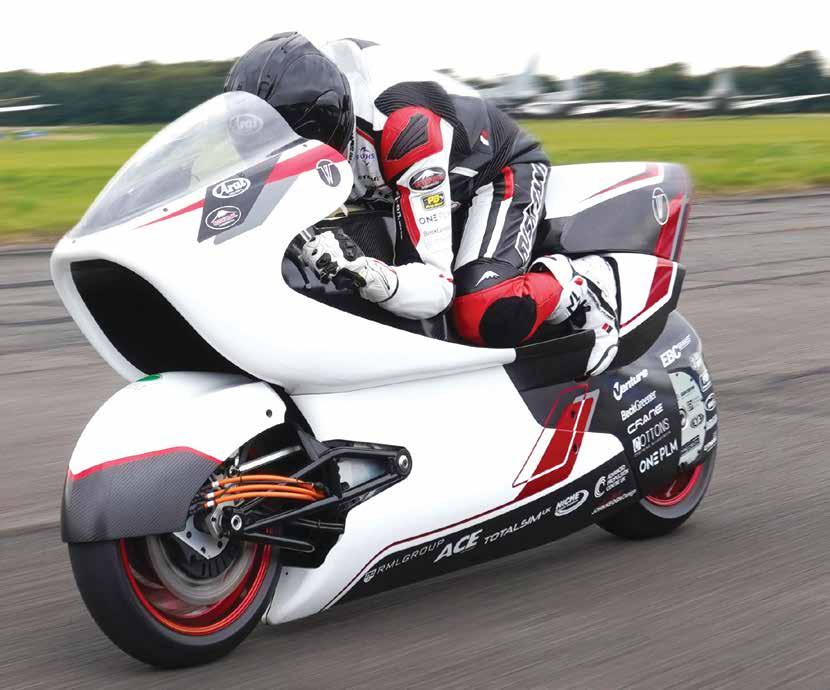
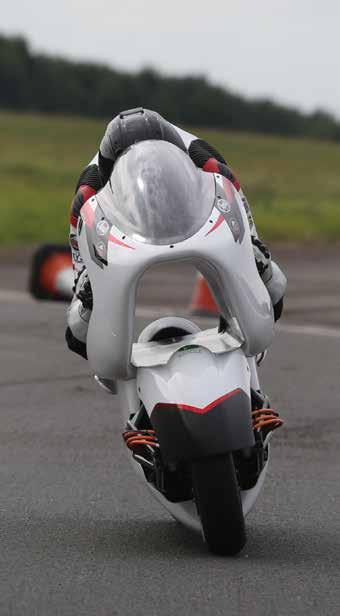
The company’s first proof of concept, the WMC250EV, was a bespoke, fully electric, two-wheel-drive land speed demonstrator. Featuring a central V-Duct, it achieved a world-leading drag coefficient (CdA) of 0.118, making it the most aerodynamically efficient motorcycle ever developed. Engineered from pencil sketch through CFD and FEA simulations to full prototype build, it is currently undergoing high-speed testing.
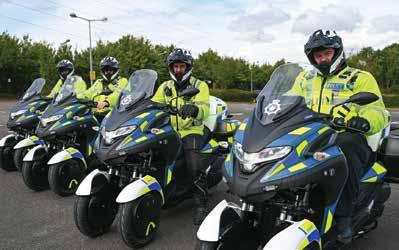
Building on that success, WMC turned its attention to practical, on-road applications. The WMC300FR is a three-wheeled roadlegal hybrid motorcycle(based on the Yamaha Tricity), incorporating
Above: Hybrid petrol/electric trikes are on trial with the police
Left: Weird or what? WMC’s see-through concept bike
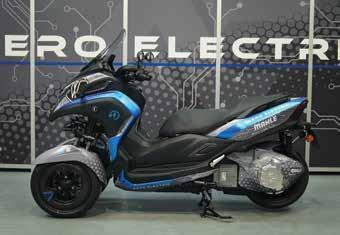
Below: Yamaha-based tilting trike applies the V-Duct to a road bike
two detachable 12Ah 56V batteries and the V-Duct. It delivers a 44% reduction in CO₂ emissions and fuel efficiency in excess of 100mpg. Twenty of these machines are now in service with UK police forces, proving the concept on the road.
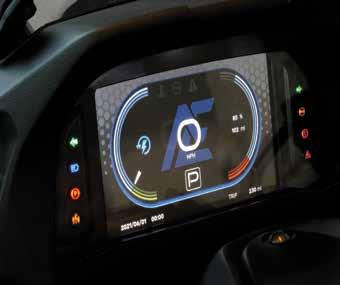
As a follow up, in collaboration with MAHLE Powertrain, a world leader in propulsion technology, we’ve developed the WMC300E+, a purpose-built electric fleet and first responder three-wheeler. This can top 100 mph, offers a 100-mile emergency services range, and features a world-first battery configuration shaped entirely by aerodynamics. Capable of rapid charging in under 10 minutes, the WMC300E+ sets a new benchmark for efficiency and operational readiness in fleet
vehicles. Following its advanced concept delivery in September 2024, a controlled field trial is scheduled for late 2025, with fullscale production targeted for 2027.
Retrofit V-Duct
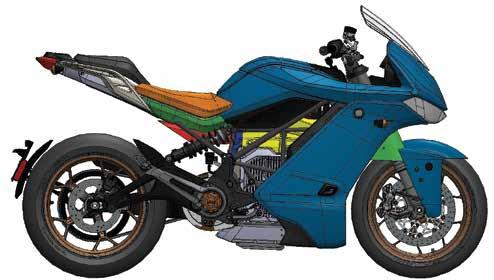
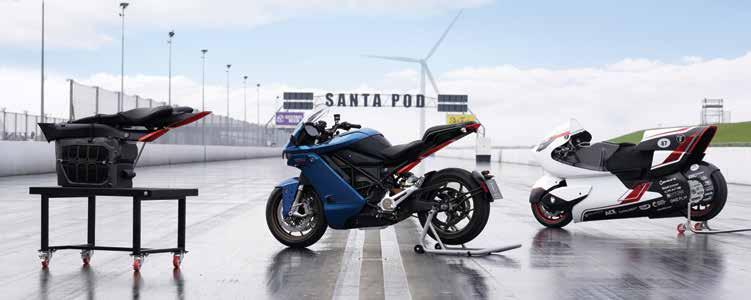
Our next project has been to partner with Zero motorcycles, which resulted in the WMC SRS, shown for the first time at Motorcycle Live in November 2024. Recognizing the scarcity of high-performance electric motorcycles, due primarily to battery limitations, we teamed up with Zero to explore a mid-sized electric sports bike that bridges the gap between current battery performance and market expectations. The WMC SRS is the world’s first electric motorcycle to integrate WMC’s Intelligent Aero V-Duct technology.
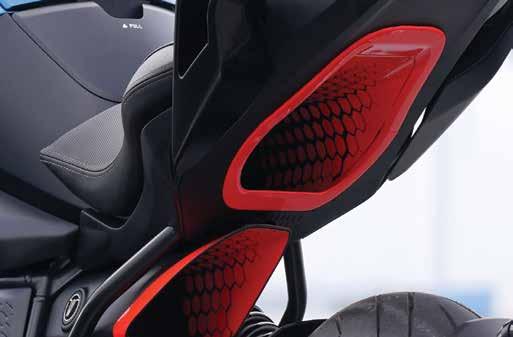
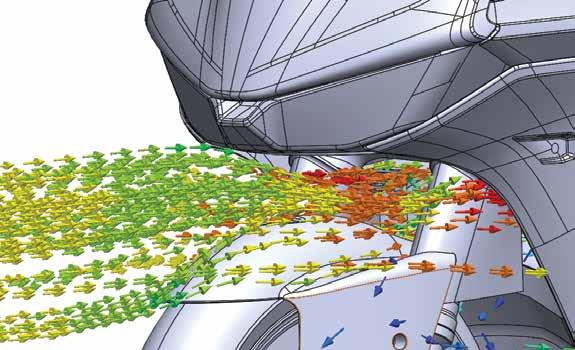
Incorporated into the existing Zero SR/S chassis, the bifurcated duct channels air through the centre of the bike – from behind the front wheel and exiting under the seat – assisted by a specially designed front mudguard and fork shrouds. This retrofit to an SR/S has demonstrated a 10% reduction in drag and a 9% increase in highway range, which allows for a smaller battery footprint without compromising performance.
Zero Motorcycles CTO Abe Askenazi said: “Battery innovation is only one part of the puzzle. Integrating WMC’s aerodynamic duct has opened up entirely new ways of thinking about electric motorcycle design. It’s a critical piece of the performance and efficiency equation.”
Moving on from the Zero-based bike, as part of Pininfarina’s 95th anniversary in March 2025, WMC unveiled
Above: Twin outlets allow air to pass straight through the bike instead of around and over it
Left: Reshaped front mudguard and fork covers aid airflow
Above right: Zero battery plus V-Duct, the modified SR/S and 250EV demonstrator
a bold new design study. It was presented at the ‘Design and Performance in Motion – Shaping Two-Wheel Aerodynamics’ event in Turin, showcasing how the V-Duct can be a structural, aerodynamic, and aesthetic centre piece of future road motorcycle, powered by a compact forced-induction hybrid powertrain.
In this study, the duct does more than streamline airflow, acting as a load-bearing chassis element connecting the steering head to the rear suspension. The result is a semi-faired or naked roadster with a conventional riding posture and class-leading aerodynamic efficiency. It’s a powerful vision of the future, blending functional engineering with refined design language to reimagine what motorcycles can be.
The Long View
WMC is a relatively young company, founded in 2018, but we are applying the knowledge gained over the last seven years to provide aerodynamic consultancy services to established motorcycle manufacturers. Drag reduction enhances efficiency, with practicality – the aim is to provide practical outcomes that manufacturers can implement quickly and affordably.
The global motorcycle industry is facing many technical and commercial challenges to enhance sustainability, whilst meeting customers’ performance expectations. These will be petrol bikes in the short term, and non-fossil fuelled in the medium to long term.
We believe that our patented V-Duct technology is not only a transitional tool but a long-term enabler of sustainability. Unlike batteries, which degrade over time and lose efficiency at high speeds, the V-Duct delivers consistent aerodynamic benefits regardless of riding conditions. It is powertrain agnostic (ie can be applied to a petrol, electric or hybrid bike), low-cost to manufacture, and has a negligible failure risk. Most importantly, when it comes to electric motorcycles, it offers a compelling alternative to simply ‘adding more battery,’ thus cutting weight, cost and charging time.
As battery energy density continues to improve, the
opportunity to increase duct size within the same motorcycle envelope grows. This virtuous circle of efficiency – larger ducts requiring fewer batteries, freeing up more space for even better airflow – can transform motorcycle design for decades to come.
By demonstrating the V-Duct’s effectiveness across prototypes, partnerships and practical deployments, WMC has positioned itself as a foundational player in the shift toward a Net Zero motorcycle future. We’re inviting more manufacturers to join us in rethinking two-wheeled mobility – one aerodynamic enhancement at a time. www.whitemotorcycleconcepts.com
Aerodynamics: Why are Bikes so Bad?
You might think that motorcycles, especially faired sports bikes, are pretty good at slipping through the air. Small frontal area, pointy aggressive fairing...they look fast even when standing still. But as the world and its dog knows, motorcycle aerodynamics are terrible when compared with cars.
Great strides have been made in car aerodynamics, in the interests of efficiency, and the Tesla S (now several years old) has a drag coefficient (cda) of 0.208. For comparison, a simple cube shape, placed in a wind tunnel, has a cda of 1.05, which is about as bad as it gets.
And bikes? A typical sports bike is in the 0.55-0.65 range, which is pretty awful – the old Suzuki Hayabusa was at the better end of that range, thanks to its rounded shape, and Buell did a lot of work on aerodynamics, with the bulbous RR the result. Of course, naked and adventure bikes, with the rider placed bolt upright like the proverbial barn door, are far worse. Then there’s all the bits and pieces to catch the wind and slow you down – fork legs, exposed wheels and drive trains – plus a short, stubby profile which has the air tumbling over itself behind the bike, creating more drag.
Improving motorcycle aerodynamics is easy, or it would be if we were prepared to ride fully enclosed cigar-shaped missiles which slip through the air on a whisper of power. But we’re not.
Beer is Dangerous
SAM MANICOM became an overland traveller one night in a pub – it changed his life
Beer is dangerous, right? We should never get involved in life-changing matters when under the influence should we? Or does a beer or three open our minds to a world of opportunity?
I’ve travelled for much of my life. Hiking, hitchhiking, riding buses and trains, bicycling, sailing, old cars... They were all great ways to get around, and each with very different advantages and disadvantages. My budget was often down to pennies, but I didn’t mind roughing it. Working along the way, I had a ball, along with a learning curve.
One three-year trip that took me as far as Australia had to come to an end and returning to the UK after some very weird travelling through India, I listened to my mother. “Don’t you think it’s time to grow up now?” Other than a few years of training on leaving school, I’d not had a proper job.
Damascene Moment
To my great surprise, work was interesting, but as the years went by, my travel itch grew. One night, supping pints in my local, it occurred to me that I didn’t like my job any more. Not only that, but I didn’t owe anyone any money, my family were well, and I
didn’t have any children, but I did have some savings – I was free. I’m going to ride a motorcycle the length of Africa.
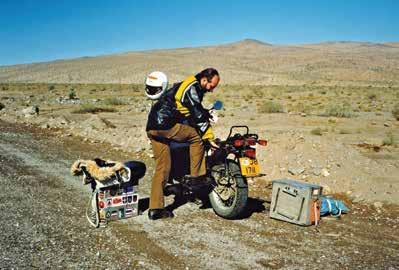
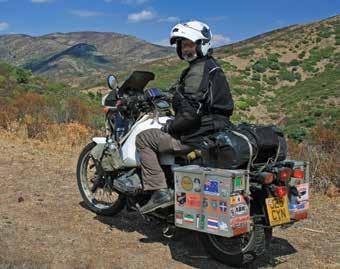
Next morning I handed my notice in at work, bought a 125cc Kawasaki KDX at lunchtime and passed my test just six weeks later. Three months after starting out on bikes, there I was sitting at the edge of the Sahara. With my R80GS’s engine rumbling under me, I looked south over the sands. ‘Sam, you idiot! What have you done?’
That BMW was key to the year that followed. It helped me turn from a clumsy novice into a motorcycle traveller. In fact, the bike was superb – she turned out to be brilliant fun to ride, and utterly reliable.
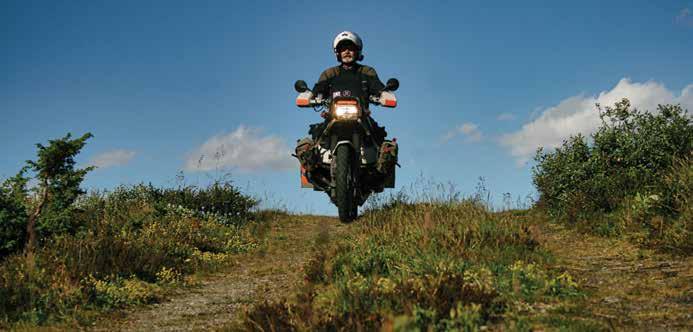
Left: Sam Manicom’s decision to go travelling changed the course of his life
Being Prepared
The thing is that there just isn’t a perfect bike for a really long trip. My GS was a complete pig to ride in very soft sand and thick mud. She was too heavy – especially with the 43-litre tank I had fitted, plus all of the gear I started off with. But riding a pig was only perhaps 5% of the whole journey. The rest of the time she was pure, adrenaline burning fun. That big lump of an engine, being so low down, was a real asset, especially when blasting along gravel.
I’m often asked how I got on with repairs. I always have a little, rather wry grin at that question – mechanical idiot was a pretty apt description for me. I had a bicycle, so fixing a puncture and changing a tyre couldn’t be too different, could it? I’d found out how to check the valve clearances, change the oil and the filters, and that was it.
If a breakdown happened along the way, then I just had to get out my Haynes manual and tools and be methodical. Unless my visa was about to run out, or the rainy season was about to start, there was plenty of time to find the problem. Oh the naivety… But I did have a fiendishly cunning master plan. I was carrying enough spare parts to be able to sit by the roadside and keep changing bits until something made the bike work. Sooner or later, a breakdown might get me so stuck that I’d just have to put the bike on a truck and take her to a large town.
Being such an idiot, I tried to carry enough kit to cope with every eventuality. The road taught me that there are two things to get right, and everything else is just the beginning of an adventure. Look after your body, and your bike. If you eat well, sleep well, and stay clean, you’ll do all right. As for looking after your bike, as well as the obvious maintenance, it helps not to carry more weight than you need to. It took me five months before I decreased my load by more than a third, ditching the spare parts I didn’t actually need. Made the GS nicer to ride as well..
Just Keep Going...
Africa is addictive, so it goes hand in hand with motorcycling. By the time we rolled into Zimbabwe in southern Africa, I’d decided that there was no good reason to go home, as I was hungry to see more. In fact, there were lots of great reasons to keep riding, and my bike now had a name too. Libby, short for liberty, because that’s what she was giving me.
Above: Side tracks are interesting
Below: BMWs aren’t completely bulletproof – fixing a final drive leak on the Pan Am Highway
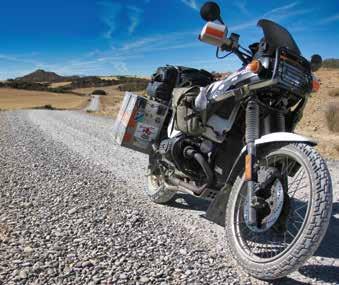
Bottom: Back roads in Spain
Luck is a fine thing isn’t it? In 1992 there was no internet, so it was a case of chatting to strangers and picking brains. By sheer fluke, one of the people I talked to in a ‘where next’ conversation, suggested that I might make it with both my bike and I to Australia via container ship. Four months and a 17-bone fracture in the Namibian desert later, and I was on board the MSC Sabrina. What a perfect way to leave a year of travel behind me. The sounds and scents of Africa eased away as the ship churned its way through the last of the fan shaped red water from Durban’s Umgeni River, and out into the deep blue of the Indian Ocean.
Next stop Australia and so began what turned into an eightyear journey through six continents. From Australia up into Asia, Eastern Europe, back through southern Africa, South and Central America. From there up through Mexico, the USA and Canada.
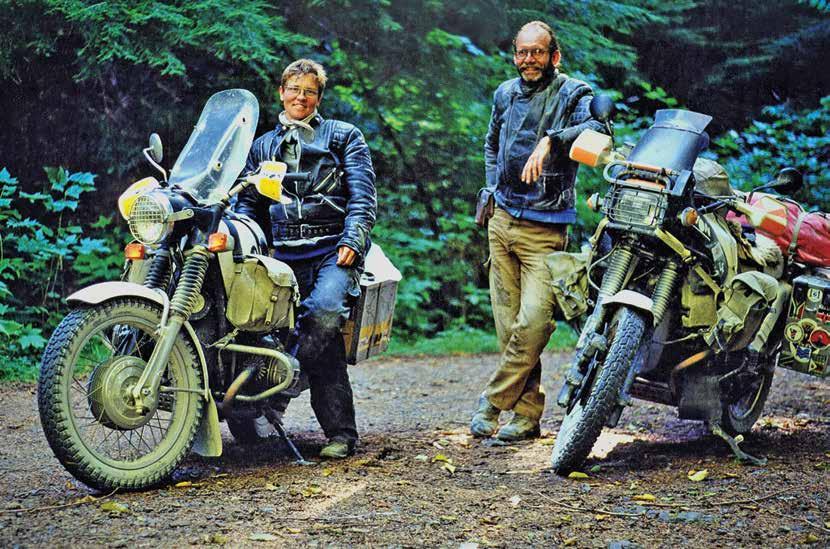
I mentioned luck and talking to people. Taking beer out of the equation and adding New Zealand wine instead, I met a girl on a bicycle in New Zealand. By sheer luck I managed to persuade her that a bicycle with an engine was a much better deal. We started to ride together in Africa on the second time through. Birgit began the ride on her 1971 R60/5 in this incredible land with just 600 miles experience on a bike. It's an amazing world out there, and there’s no better way to see it than from the seat of a motorcycle.
Sam’s Essential Kit
One of my favourite bits of kit was my sheepskin saddle cover. Don’t laugh, but another favourite was my collapsible brolly! There’s not much worse in my book than trawling around doing the visitor thing, in your bike kit, in the rain, in a hot country. Shorts, flip-flops, a T-shirt and a brolly are the name of the game. And the two uses rule? Taking pictures in the rain can result in some stunning shots and your brolly will protect you while you work. A third use is that when it’s really hot, keeping the sun off your brain – so long as you don’t mind looking like an Ethiopian, or a Victorian lady out for a summer stroll!
Read the Books
Sam Manicom is an around the world traveller. He is the author of four motorcycle travel books and is a travel presenter. The books – Into Africa, Under Asian Skies, Distant Suns and From Tortillas to Totems – take the reader travelling through the different sections of the eight-year journey.
He is also the contributing editor for two motorcycle travel collection books. The Moment Collectors & The Moment Collectors ASIA. Each chapter is by a different author, giving readers a wonderful introduction to many parts of the world, and also to authors they may not have come across before.
Sam’s books are available from www.sam-manicom.com, from Amazon and all good bookshops.
You can also find his first four books as audiobooks on Audible, iTunes and Spotify.
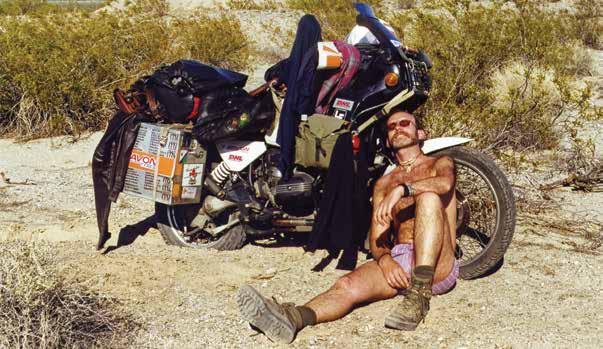
Left: Too tired to ride on –Sam and Libby in the Mojave Desert
THE BEST MOTORCYCLE HELMETS TO BUY IN 2025
Whether you ride daily, occasionally, or just on weekends, your helmet is probably your most essential piece of kit. With modern materials, safety regulations, and tech advances evolving fast, now’s a great time to upgrade.
Before we get into the list, it’s worth noting that helmets now must meet the ECE 22.06 safety standard. This newer regulation replaces 22.05 and puts helmets through tougher impact, rotation, and environmental tests. All our picks are ECE 22.06 certified.
ARAI QUANTIC
One of the safest full-face helmet
If safety is your priority, Arai’s Quantic is hard to beat. Built to absorb and deflect impact forces rather than just resist them, the Quantic’s rounded shell is designed using F1 tech.
This is the first Arai helmet certified to ECE 22.06. You will also find a comfort liner that works for long rides, great airflow, and typical Arai quality throughout.
AGV K6
Try on several before you commit, and look for helmets with removable liners, good ventilation and solid visibility.
BELL BULLIT
One of the coolest retro motorcycle helmet
Let’s be honest, few helmets turn heads like the Bell Bullit. It channels 1970s café racer style with a modern twist. While it lacks some of the advanced safety features of pricier lids, it still meets ECE standards and offers comfort for urban and casual riders.
One of the lightest road helmet
Weighing just 1.25kg, the AGV K6 mixes race-level lightness with road comfort. It’s made using carbon and aramid fibres and offers five air vents, a wide visor for visibility, and a plush interior.
Whether you ride a naked bike, tourer, or sports bike, this helmet feels like it disappears once it’s on.
SHOEI NX-R2
One of the best all-round motorcycle helmet
The Shoei-NXR2 is light, aerodynamic, reduces noise, and is fully ECE 200.06 certified.
This full-face lid is ideal for everything from sport riding to commuting. It features a Pinlockready visor, efficient ventilation, and the premium fit and finish Shoei is known for. If you want a helmet that does it all, this is the one.
SHOEI J-CRUISE II
One of the best open face helmet
For scooter riders, cruisers or warmweather tourers, the Shoei J-Cruise II is a top pick. This open-face lid offers excellent protection, comfort, and a high-quality visor that wraps around for improved aerodynamics and coverage.
LIVALL MC1
One of the most budget-friendly smart helmets
If you are smart-helmet curious but don’t want to pay £600, the Livall MC1 is a great intro to helmet tech. With front and rear lights, SOS alert system, and Bluetooth connectivity, it’s ideal for commuters or casual riders.
It’s not as rugged or refined as the Shoei or Arai, but it’s functional and good for the price.
Bikesure can organise brilliant bespoke motorcycle insurance deals for you and your bikes at affordable and competitive rates. We also offer helmet and leathers insurance from just £35.
Call us on 0800 503 3275 for a quote.
Change is Good
ALISON FORSYTH describes how motorcycling gave her a new career
The love of motorcycling never leaves you and it can in later life provide a worthwhile and challenging change of career. To find out more Ian Kerr spoke to Alison Forsyth, who made that life changing move into motorcycle road safety in later life.
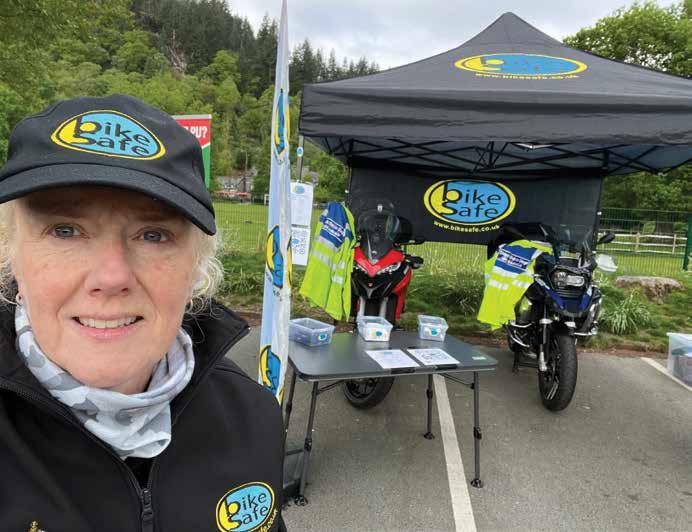
My name is Alison, I ride a BMW R1250GS Adventure and own an F750GS Sport which my daughter also rides. I’m a CBT instructor in North Wales, also currently training to be a driving instructor and deliver speed and motorway awareness courses online. You never know, you may well have come across me already in that role! Finally, I’m a Bikesafe Observer for North Wales Police.
I wanted to ride motorbikes for as long as I can remember, even pretending my bicycle had a throttle as a child. My dad had an eclectic collection of bikes including old British machines, scooters and a Yamaha Fazer, his only modern bike. As soon as I was 17 I bought a Kawasaki KH100 to learn on, passed my test within five months and started moving up the range and engine sizes.
My second bike was a bright yellow Suzuki X5 200. I thought it was brilliant, not only the colour, but it seemed so fast after my KH100. In fact, we still have it in the family, and my brother (also a biker) now maintains it – it seems strange that my old bike now comes into the ‘classic’ category.
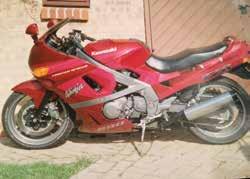
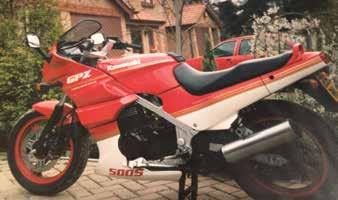
After the X5 I bought my first four-stroke, a red Kawasaki GPZ500. I owned this for a couple of years but as I was wanting to do some touring and realised there wasn’t much space for luggage, (being female, I struggle to travel light!) so the GPZ was traded in for another Kawasaki, a lovely ZZR600 in dark red and pink. As a sports tourer it was very comfy and so smooth and quick – it also attracted a lot of attention so I loved it!
I carried on riding until my early 30s, even whilst I was pregnant with my first child, but with safety in mind, less time, and my second child due, I sold the ZZR and didn’t return to riding until I hit 50, a break of 18 years and having had three children (a son and two daughters). Only one of my daughters is interested in biking – she passed her test in 2023.
Left: ZZR600 had the legs for longer trips
Coming Back to Bikes
I never lost the love of bikes; I just didn’t have the time for them. So, hitting that milestone birthday, getting divorced and with all my three children now able to drive and starting to leave home, I decided it was now my time! After much deliberation, having not been in the market for a bike for a while, and after being ignored in several dealers (ladies, you’ll know what I mean) I bought a Tiger 800. I think my family thought I was having a midlife crisis, but I wasn’t deterred.
I was nervous about coming back to riding, but as they say, “it’s like riding a bike.” I decided if I was going to ride again after such a long break I wanted to be as safe as possible. So I enrolled on a Bikesafe course with North Wales Police and, encouraged by them, signed up to do my IAM Advanced bike test which I passed with a First. The Advanced course was excellent. I picked up techniques to help with planning ahead, reading the road better, slow riding (something I had forgotten how to do), and generally how to give myself the best chance to stay shiny side up.
Alison subsequently decided to become a riding instructor.
I’ve had a few different jobs over the years including running a holiday let, owning a Post Office and bookkeeping and accounts. The final straw was having a difficult manager while doing accounts in a manufacturing company. Feeling bored and disgruntled I decided I wanted to do something that would give me a challenge, but involving something I really enjoy. So, after much research I enrolled on an instructor training course and then stayed with the company as an instructor for CBTs. Work as an instructor can definitely be challenging but it gives a great deal of pleasure when you see the happiness on a pupil’s face. From arriving in the morning never having ridden a bike before, to receiving their CBT certificate at the end of a long day – zero to hero!
Working with BikeSafe
Rider instruction can be challenging. You need to be concise and accurate, plus certain that the student will be able to follow your instructions through a headset out on the road. Safety is always paramount. With the unpredictable UK weather, during the winter months it can be dangerous (not to mention very cold) though fewer people want to learn in the winter, so I needed to keep myself busy with something else apart from CBTs in the chilly winter months.
Above left: GPZ500 was Alison’s first four-stroke
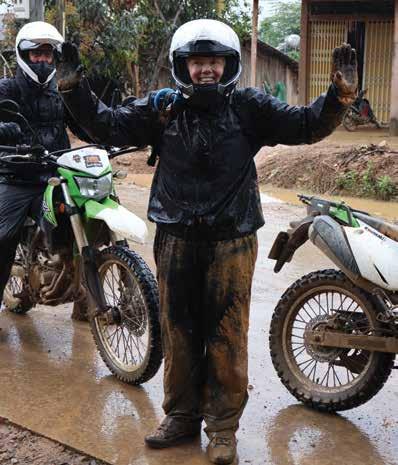
Above: Coming back to bikes means...joy in getting wet and muddy
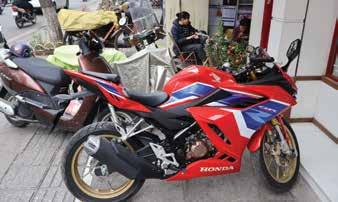
Below: Vietnam runs on bikes
I had toyed with the idea of training as a driving instructor in the past but never quite got around to it. With my roles as a trainer in speed awareness and as a bike instructor, I had skills that have really benefitted me in my training to become a qualified ADI (Approved Driving Instructor). I’ve completed Parts 1 and 2 of the training and am now waiting for a date for my Part 3 test.
I got involved with BikeSafe as a member of North Wales Advanced Motorcyclists. I was asked last year if I would consider becoming an observer for BikeSafe with North Wales Police. All my roles involve safety in some form or another and I wanted to give something back and help other people increase their skills on a bike. As one of the few women involved, I felt it was a good way to encouraged other ladies to join up and have a go.
Quite often women feel unsure about signing up, but I would encourage them to go for it. If you’re thinking about it, don’t be
put off, it is an excellent course that will hopefully encourage you to go on to further training like the IAM or ROSPA. Techniques learnt can help you better process the information you see ahead of you as well as around, plus improve your road positioning for cornering and overall safety out on the road.
Support Women in Biking
There’s a lot the motorcycle industry could do to encourage more women into biking. There is unfortunately an issue when ladies enter a dealer and are simply ignored. I have been overlooked so many times in bike shops, with the male staff assuming I’m there with a bloke. There are many more lady bikers now than when I started out in my teens – my message to the trade is, never assume anything, as we have money to burn too.
The motorcycle clothing industry has finally started to offer a much better choice of clothing for ladies and retailers are embracing it, offering a much better range. Sizing can be inaccurate, often meaning we need to go up a size or two but at least it is shaped for women rather than us wearing uncomfortable men’s clothing.
So here’s a shout out to Motogirl clothing. It’s made for women by women who understand. Their sizing is accurate and much of the clothing has a high safety rating. There is still room for improvement in the industry, but clothing is definitely heading in the right direction.
I am seeing more female staff in bike shops now, so change is happening slowly. Highlighting female rider achievements in showrooms, offering women-only events and training and maybe not hiding the ladies clothing in a corner at the back of the shop. All of these things would certainly help to make showrooms a little less intimidating.
The manufacturers themselves could look at making lower and lighter bikes, with more choice on lower seats without losing the comfort. Instructors often find that seat height, even on a 125cc geared bike, is too high for women, so we end up putting them on a moped to gain their CBT, but that doesn’t help them if they want a full bike licence. Adventure bikes are notoriously tall even for men, so maybe the standard height could be lower whilst still giving ground clearance.
Am I inspired by any female riders? I don’t follow anyone in particular but do follow a few female bike groups for hints and tips dealing with the challenges of being a female motorcyclist. There is lots of help on YouTube from maintenance to how to pick up 268kg of BMW when you drop it! Yes, it has happened to me, and thank goodness for crash bars!
On Tour
I have joined a couple of organised tours since going back to biking. The first was riding down through France then over into Germany, touring around the Mosel region. As it was my first tour I was nervous, but after meeting the rest of the party at the ferry port, my nerves didn’t last long. Touring like this, although more expensive, takes away the hassle of finding routes, provides hotels with safe parking for your bike and gives you a sense of security knowing there is back up if you encounter any problems. As a single female on the tour I wanted to feel safe and enjoy the company of like-minded individuals.
I’ve recently come back from my second trip, in Vietnam, and what an amazing trip that was! We arrived in Hanoi and rode over 14 days to Ho Chi Minh City visiting historic sites as well as many towns and villages off the beaten track. We mostly followed the coastline north to south on 230cc Kawasaki traillies. Great little bikes with plenty of power for the interesting road surfaces we sometimes encountered.
As for the future, I hope it’ll be basically more of the same, enjoying my own riding while putting something back to help others follow suit. I’m hoping to pop over to Ireland now that the weather is improving and will be looking into my next big adventure in 2026. Hopefully I’ll have many more years of safe, enjoyable, motorcycling!
Riding in Vietnam was enjoyed – she’s hoping to another big trip next year
THE LEGAL COLUMN
Riding a motorcycle has a well-known positive impact on mental health and general wellbeing. It is quite often devastating for riders unable to ride due to ill-health, injury or other reasons, which can result a detrimental impact on their mental health.
If a motorcyclist is involved in a collision that isn’t their fault it is important to consider the effects on their mental health as part of the claim. The physical injuries sustained are usually quite apparent and freely spoken about, but the psychological impact can be overlooked.
Bikers might not want to admit to feeling low, or depressed, or anxious. However it is really important to talk about how you are feeling and what you are experiencing. Primarily this is for your own well being and welfare, but also it is an important aspect of your claim.
From this perspective a claim involving consideration of your mental health could bring the following benefits:
1. treatment such as CBt (Cognitive Behavioural therapy, not the other sort of CBt...) or counselling
2. A medical legal report from a psychologist or psychiatrist
3. help with getting back on a bike
4. or help with alternative transport
Treatment is key and it may be the case that after a course of CBT or EMDR (that’s Eye Movement Desensitisation and Reprocessing) your symptoms might abate and you will feel like yourself again. Or more long-term help might be provided.
A medical legal report will give evidence if you have sustained a recognised psychological disorder such as an adjustment disorder, anxiety, depression etc – you will be entitled to compensation for this psychological injury. There are quite specific tests and terms that apply, and the expert can recommend treatment, long-term help or even things like a rider improvement course to help you.
It might be the case that you are unnerved and reluctant to get back on a bike due to anxiety. It may be possible to get funding for a refresher riding course, lessons or advanced riding. If you are unable to return to riding and the bike was your main form of transport you might be able to claim for the extra cost of using a car.
It’s also important to consider other issues such as cognitive impairment and whether this signals a head injury or something more serious – this is a whole other article. Speak to your GP about any psychological symptoms – they might be able to help with treatment in the short-term, and sometimes it is good to just talk to someone about what you are feeling and have an explanation as to why you are feeling that way.
Thera are also plenty of charities out there and you should always think about reaching out to them if things are tough. As well as general charities such as the Samaritans, Mental Health Motorbikes is there to support fellow riders. It has an online peer support group, attends events throughout the country and can be contacted via the website. The volunteers are qualified mental health first aiders, so never be afraid to reach out to them if you are struggling, and always have a chat if you see them out and about.
In short, after a collision your injuries might be more than physical, so always speak up and mention problems to your solicitor – and never be afraid to seek help.
Jim Pee L-Cro SS
30th January 1964 – 2nd May 2025
With great regret the BMF received news that Jim Peel-Cross, the Regional Chairman of Region 7, died suddenly and unexpectedly on 2nd May 2025.
Jim was Regional Chair for many years, and was extremely successful in the role with a very loyal following of local reps and members, all of whom were recruited by Jim himself. By some measures Jim was the most successful Regional Chair the BMF has ever had, in both longevity (at least 20 years) and reach –Region 7 covers the whole of the south west from Land’s End to Wiltshire and Dorset. As a role within the BMF, Regional Chairs have declined in importance in recent years with the growth of communications at a national level, with modern media enabling communication across the whole of the UK at the touch of a button. Jim’s record may remain unsurpassed.
A big presence, in every sense, Jim’s personality shone through in everything he did, kind, encouraging and enthusiastic. The BMF was Jim’s great project, and regional matters were his primary interest – he never showed any great ambition, such as becoming a Director at national level.
Apart from the BMF Jim was a dedicated Honda enthusiast, working with the Honda Owners Club and with the Gold Wing Owners. His first ‘proper’ bike was a CB250, moving onto owning Gold Wings and Pan Europeans.
Less well known is that Jim was his mother’s carer for many years, until she passed on. The BMF extends sympathy to his family and many friends – he leaves a big legacy of goodwill and warmth.
Jim Freeman
kings Norton MotorCycle Club
The Kings Norton MotorCycle Club (KNMCC) is one of the oldest clubs in the country – we meet every Thursday evening at Studley Cricket Club, Warwickshire.
Join the Club e-voice.org.uk/knmcc or email: pmorris4562@ fastmail.co.uk
Promote your Club!
Want your club to be profiled on these pages? Email us: editor@bmf.co.uk
The original club was formed in 1922 by the apprentices of Beardmore Precision Motorcycles, whose factory was in Kings Norton, Birmingham. The club motto was ‘Commune Bonum’ – the common good – but it only lasted until 1926, possibly because Beardmore Precision itself closed in 1925. One of those early young members was Matt Wright, who eventually became Chief Development Engineer at AJS and Race Engineer to 1949 500cc World Champion Les Graham on the AJS Porcupine.
The club was re-formed in 1934, again in Kings Norton, and over the next few years the KNMCC organised various sporting events including trials and grass track racing. For reasons unclear, it folded again after only four years but was revived again in December 1944 by a small number of enthusiasts – this Kings Norton MotorCycle Club (1944) is still running today.
From the late 1940s through to the early 1970s the Midlands was a significant focal point of world motorcycle manufacture, and the KNMCC was well placed to benefit, with a rich history as a result. Many
of the club’s members worked in the well-known factories and some took part in many branches of motorcycle sport, on and off-road. Indeed, some of the members were factory riders for Ariel, Douglas, BSA, and Norton, achieving both National and International success. Sidecar trials man Harold Tozer was a KNMCC member, as was 1964 and ‘65 World Motocross Champion Jeff Smith, Manx Grand Prix winner Dave Bennett, multiple TT winner Mick Boddice and ISDT Gold medallist Norman Vanhouse. So too was Nigel Rollason, one of only two men to have won on both two and three wheels at the TT. Also on the members’ list were industry alumni such as BSA’s Competition Manager Bert Perrigo, suspension and aluminium frame guru Ernie Earles, Ariel’s Chief Development Engineer Clive Bennett, and Classic Motorcycle magazine’s founder Bob Currie.
Today, the club’s motorcycling interests are broad – vintage, classic and modern bikes, with all welcome, and enjoyed. The club is both BMF and ACU affiliated, sporting links being maintained with some members competing in modern and pre-65 trials. Club activities include talks, films, quizzes, natter nights, charity fund raising evenings, ride-outs, a camping weekend, and an annual Concours. The club produces a monthly magazine, which itself has been running since 1950!
In 2022, to mark the centenary since the founding of the original club in 1922, we recreated an original picture on The Green in Kings Norton. And of course, we welcome new members.
Do WN Yo U r WAY
SCOTLAND – REGION 1
regional Chair - Tom Duncan 01506 842131, 07887 835321 tom@tomduncan.co.uk
Jacqueline Bickerstaff - Vincent HRD jacqueline.bickerstaff@btinternet.com
John Nelson - TOMCC jsnlsn@btinternet.com
John Nicholas - Ducati bmfrep@docgb.net
Pete Wilson - BSA Bantam secretary@bsabantamclub.org.uk
MORE BMF REPS NEEDED! If your county is not listed and you would like to be a BMF rep, we would love to hear from you - please email admin@bmf.co.uk wRONG NUMBER?If these aren’t the right contact details, let us know at admin@bmf.co.uk and we’ll put it right.
Ideal for removing traffic film and road muck along with, grease, lubricants, brake dust and oils, Clean MyRide’s non-streak formula delivers superb results without damaging surface finishes, paint, plastics or metals including aluminium, alloys, chromed and anodised components. Simply mist onto surfaces, leave for a few minutes, agitate if necessary and wash off.
Check out our 5* reviews on our website, Facebook and Google and discover the effortless way to keep your bike spotless and gleaming with just one product!
CLEAR
MYVISION
Anti-Fog & Rain Repellant coatings for • visors • goggles • screens See website for details!
• NO HARMFuL SOLVENTS • EcO FRiENDLY 5*Reviews
3690 MILES WORTH OF EUROPEAN ROAd GRIME, bUG SPLATS, TAR SPOTS ANd OFF-ROAd GUNK GONE, THANKS TO CLEAN MYRIdE CLEANER & dEGREASER. SUPERb PROdUCT…MORE EFFECTIVE THAN OTHER bRANdS ANd MUCH CHEAPER TOO. THE RESULTS SPEAK FOR THEMSELVES!
CLEAN MY RIdE dOES WHAT IT SAYS. NO bEFORE PHOTOS bUT THIS IS THE FIRST WASH SINCE THE WINTER STARTEd ANd SHE LOOKS LIKE NEW AGAIN.VERY GOOd PROdUCT!