24
OBGS COMMUNITY FOR LIFE
OBGS COMMUNITY FOR LIFE
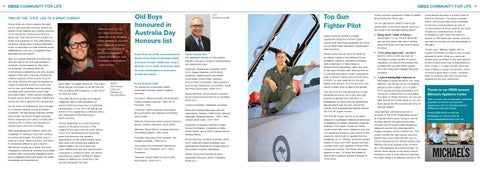
Two of the “3 R’s” led to a great career Doing what you love is always the best job to have and Sam Cooney (2003) has always loved reading and writing; growing up he would just consume books at a great rate. This has led to his position as editor and publisher of The Lifted Brow, a bimonthly literary/arts/culture publication which is described on their website (www. theliftedbrow.com) as “a magazine from Australia and the world”. Sam is a classic example of a BGS boy who did well in his VCE and entered a university course based on the score he achieved. On leaving BGS he commenced a Marketing and Arts double degree at Monash University, finding the creative aspects of the course more to his liking. Halfway through the degree he made the decision that the course was not for him, and instead went travelling overseas with classmates Jono Edge and Giles Fielke. Three months travelling Europe, plus a stint in London, helped put school and life in general into perspective. On his return to Melbourne, Sam enrolled in a Creative Writing course at Deakin University. He had always enjoyed writing and credits his former English teachers Monty Stephens and Olivia Connelly with inspiring him to follow and develop his natural talent and love of writing. After graduating from Deakin, came the challenge of making a living from writing as during his studies, his desire was to write on a wide range of topics. He found it somewhat difficult to get a start in the industry purely as a writer, but soon managed to secure an editorial committee position with Voiceworks magazine which was a stepping stone and gave him great knowledge and experience.
“Read as much as you can, create good work habits and study literature. When applying for positions with magazines or literary
Old Boys honoured in Australia Day Honours list
LEFT David Forsyth AM
Tristan Reincke (2003) is a Flight Lieutenant, flying the F/A18F Super Hornet with the Royal Australian Air Force out of RAAF base Amberley Queensland (near Ipswich).
journals, always know in detail the publication’s content, its audience, and its position in the industry.” – Sam Cooney
Frank Roberts (1943) was awarded the Medal of the Order of Australia (OAM) and David Forsyth (1969) was made a Member of the Order of Australia (AM) for their contributions to Australian Society as follows:
Soon after, he began writing for The Lifted Brow and as time went on he fell into the task of editing the magazine, a task which he says he loves. The Lifted Brow is an arts and cultural magazine with a print circulation of around 2000 per issue and a readership demographic in the 18 to 35 age group. A third of the readership is offshore with a very dedicated online following in North America. Online readership is a most important aspect of the great success of the magazine and Sam and his team spend much time developing and improving apps that enhance the reader’s appreciation of the online written word. Sam says that writing and editing for digital media is an art in itself with many differences and skill requirements compared to writing for print. He will be teaching the subject Writing for Digital Media at Melbourne University in the second semester this year.
ABOVE Sam Cooney, Editor and Publisher of The Lifted Brow
Frank Roberts OAM For service to community health, particularly through patient support services. Convenor, Alfred Hospital, Neurosurgery Patient Support Service, 1994-2010; Founder, 1994. Chairman, Alfred Hospital Foundation Annual Fathers Day Appeal Committee, 2004-2006. Director, Peninsula Home Hospice Service Board, Victoria; Member, since 2008. Member, Royal District Nursing Services Foundation Board, 1997-2004. Founder, Recycling Cork Scheme, Girl Guides Australia, 1989-2010. Immediate Past President, Balcombe Probus Club; President, 2011; VicePresident. Treasurer, Mount Martha Community Association, 2008-2011.
Top Gun Fighter Pilot
David Forsyth AM For significant service to the aviation industry through a range of administrative and leadership roles. Chairman, Airservices Australia, 20082012; Board Member, 2005-2008; Chairman, Safety and Environment Committee, 2005-2008; member, Environment Committee, Remuneration and Human Resources Committee, Audit and Risk Committee, 2008-2012. Board Member, South Eastern Section, Royal Flying Doctors Service of Australia, 2002-2011. Current Chairman, Safeskies Australia. Executive General Manager, Aircraft Operations, Qantas, 1998-2003; General Manager, Regional Airlines, 1997-1998; various other roles, 1970-1997. Chairman of Industry Advisory Panel, School of Aviation, University of New South Wales, since 2003; current Senior Visiting Fellow. Board Member, Aviation Australia, 20042007; skills and trains domestic and international students for employment in the aviation industry worldwide. Fellow, Royal Aeronautical Society (Australian Division), 2000; President, 2008-2011.
Tristan joined the Air Force in 2005 as an Officer Cadet in the Defence Force Academy based in Canberra emerging with a Bachelor of Technology in Aeronautical Engineering. After four and a half years of basic pilot training then on to learning aerobatics, basic navigational skills, formation flying and low level flying in Perth, he was selected for the elite fighter pilot stream, and moved on to the Hawk to learn how to fight in an aircraft. This was the first real experience of high gravitational forces (up to 8G) and high speeds of greater than 900 km/h in preparation to move onto an operational aircraft which was for him, one of the worlds most sophisticated fighter aircraft the F/A18F Super Hornet. The F/A18F Super Hornet is the latest weapon in Australia’s defence arsenal and is designed to protect Australia’s national interests. The Super Hornet (or Rhino) carries more fuel, more weapons and has a re-designed avionics suite. Some of the weapons carried are un-guided bombs (weighing up to 1000kg), precision guided weapons (laser and GPS guided bombs), missiles and a gun capable of firing 6000 rounds per minute. The Rhino will reach speeds of over 1.8 times the speed of sound and a ground speed in excess of 1200 km/h.
Some common questions Tristan is asked about flying the Rhino are: Do you get airsick; what’s it like to go super-sonic; how much fuel do you burn; and what is an average training flight? • Being airsick I relate to being a passenger in a car. People generally get car sick when they aren’t driving since the body can’t tell what is about to occur. • As for going supersonic, you don’t tend to notice it until you look at the Mach number (speed of sound indicator). It’s loud in the cockpit and occasionally you get shock waves off of the wing and fuselage that look amazing. • A typical training flight depends on the phase of work we are in. For “dog fighting”, we will go out to our training airspace and conduct up to 6 fights from varying starting parameters until someone is determined to have killed the other. In these missions, we use full after burner and while doing so we can burn above 30,000 pounds per hour of fuel per engine. “Dog fighting” (combat practice) is possibly of the most challenging aspect of a fighter pilot’s work. Trying to not hit another aircraft, the ground and then not spin out of control while employing weapons and kill the other aircraft is hugely complex, not to mention fun. The Super Hornet can fight slower and turn tighter than most other aircraft. The ‘G’ forces experienced by aircrew during dog fighting can push people close to black out. This happens as a result of high ‘G’ forces which results in the body’s blood tending to pool in ones feet and starving the brain where it is required. Above 4-5G
most people will pass out due to lack of blood to the brain. The pilots however train in the air and also in the centrifuge, to not lose consciousness as loss of consciousness at those speeds can have disastrous consequences. In high G situations heart rates can reach in excess of 250 beats per minute, and this can last for minutes on end depending on the fight. Tristan says, “Being a fighter pilot is hugely rewarding but there is also a huge amount of work. What you see at air shows such as Avalon is the end product of lots of hard work over a long period of time. It took 4 ½ years to train up to the level of being a Super Hornet pilot, which involved a great deal of study. However, there is nowhere else that I would ever experience this epic adventure”.
Thanks to our OBGS sponsor Michael’s Appliance Centre Take a closer look at Michael’s Specialist suppliers of kitchen and laundry appliances. Ask for Old Boys Simon Williams or Michael Wood. Phone 9592 6400 or visit our showroom 24 hours a day at michaelsappliancecentre.com.au
25