journeys
47 West Street, Boston, MA 02111
spring 2017
|
bridgeotw.org
Make a donation online at bridgeotw.org
The Bridge Program System
Street Outreach
Runaway Hotline
Counseling & Support
Drop-in Day Center
Patriot’s wives visit Bridge Wives and signifi cant others of Patriots players and coaches joined Patriots cheerleaders and delivered 100 Empowerment coats to Bridge just before the Super Bowl (and that worked out pretty well). The specialty coats serve as both a winter coat and a sleeping bag for youth experiencing homelessness. The special guests also helped to prepare and serve a meal to those in need.
Medical & Dental Clinic
FEB 23-24
MAR 13-14
APR 1
MAY 1-14
SEPT 20-21
NOV 2
NOV 22
Education & Career Development
Emergency Residence
Single Parent House
Transitional Living Program
National Alliance to End Homelessness-Home Away Panel Bridge attends conference in Houston, Texas.
National Network for Youth: 2017 National Summit on Youth Homelessness Bridge attends
conference in Washington DC.
Bridge Over Troubled Waters Annual Gala and Auction Four Seasons Hotel Boston Gala with proceeds
to benefit homeless youth served at Bridge.
Bridge Takes the Lead for the City of Boston’s Youth Count Volunteers and Youth Ambassadors will
fan out throughout the Boston area to gain as accurate a count as possible of the numbers of homeless youth.
Connection 2017/The Un-Conference National
meeting to explore new insights, latest advancements in youth services field. Bridge to attend conference in Pittsburgh.
Bridge 2 the Future Event Social and networking event with proceeds to benefit homeless youth served at Bridge.
Bridge will host a special Thanksgiving dinner for our kids at Bridge Over Troubled Waters
For more information please contact June Mattioli at jmattioli@bridgeotw.org
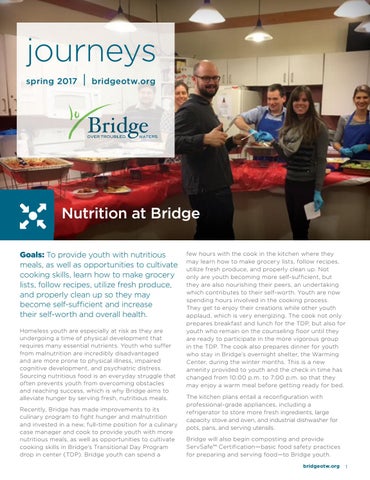
Nutrition at Bridge Goals: To provide youth with nutritious meals, as well as opportunities to cultivate cooking skills, learn how to make grocery lists, follow recipes, utilize fresh produce, and properly clean up so they may become self-sufficient and increase their self-worth and overall health. Homeless youth are especially at risk as they are undergoing a time of physical development that requires many essential nutrients. Youth who suffer from malnutrition are incredibly disadvantaged and are more prone to physical illness, impaired cognitive development, and psychiatric distress. Sourcing nutritious food is an everyday struggle that often prevents youth from overcoming obstacles and reaching success, which is why Bridge aims to alleviate hunger by serving fresh, nutritious meals. Recently, Bridge has made improvements to its culinary program to fight hunger and malnutrition and invested in a new, full-time position for a culinary case manager and cook to provide youth with more nutritious meals, as well as opportunities to cultivate cooking skills in Bridge’s Transitional Day Program drop in center (TDP). Bridge youth can spend a
few hours with the cook in the kitchen where they may learn how to make grocery lists, follow recipes, utilize fresh produce, and properly clean up. Not only are youth becoming more self-suffi cient, but they are also nourishing their peers, an undertaking which contributes to their self-worth. Youth are now spending hours involved in the cooking process. They get to enjoy their creations while other youth applaud, which is very energizing. The cook not only prepares breakfast and lunch for the TDP, but also for youth who remain on the counseling fl oor until they are ready to participate in the more vigorous group in the TDP. The cook also prepares dinner for youth who stay in Bridge’s overnight shelter, the Warming Center, during the winter months. This is a new amenity provided to youth and the check in time has changed from 10:00 p.m. to 7:00 p.m. so that they may enjoy a warm meal before getting ready for bed. The kitchen plans entail a reconfiguration with professional-grade appliances, including a refrigerator to store more fresh ingredients, large capacity stove and oven, and industrial dishwasher for pots, pans, and serving utensils. Bridge will also begin composting and provide ServSafe™ Certifi cation—basic food safety practices for preparing and serving food—to Bridge youth. bridgeotw.org
1
Last November, of Bridge staff members, FSYB 2016a group Conference: led by Executive Director Elisabeth Jackson, traveled Navigating the Needs of RHY down to Florida to attend the national Runaway and
Program Impact FY16 Street Outreach Program and Mobile Medical Van Street Outreach is Bridge’s daily “foot patrol” of trained street outreach workers who make regular, consistent contact with homeless youth. The Van connects with the street outreach team providing medical attention, survival items, clothes, food, and referrals to Bridge’s in-house counselors.
7,437 youth were contacted on the street 5,702 youth received services on the van Counseling Program Provides initial intake for all Bridge youth and in-depth counseling services, assessments, and referral Monday through Friday, 9:00 a.m. through 5:00 p.m. Youth who are not ready to integrate with the TDP population are served breakfast and lunch on the counseling fl oor.
731 youth received survival aid (meals, showers, and laundry) 302 youth received in-depth substance abuse and mental health counseling Transitional Day Program (TDP) This is Bridge’s drop-in center day program which focuses on intensive case management to transition youth off the streets. The daily calendar includes breakfast, showers, laundry, lunch, review of treatment plans, and group activities.
4,886 visits were made by youth throughout the year Medical + Dental Clinics Free, in-house weekly medical and dental services.
237 youth used the clinics
2
bridgeotw.org
Motivational Interviewing , to strengthen skills and gain new strategies for engaging high-risk youth and guiding them through the stages of change, with effective new intervention and communication techniques.
Education + Career Development Program Classes to prepare youth to earn their alternative high-school diploma, guidance counseling to youth who wish to enter or continue college or vocational programs, open job search hours and job soft skills training.
The Importance of Resilience in Recovery and Thriving , to prepare counselors to better understand behavioral change processes and how strength-based approaches can overcome demoralization that can paralyze emotional and psychological development.
462 students and youth were served
Human Traffi cking Screening Tool for RHY and Child Welfare Involved Youth ,
Emergency Residence (ER) This unique residential program is a shortterm transitional residential program for homeless youth who are able to commit to intensive counseling, maintain employment, save 70% of their income, continue their education, and work with case managers to obtain long-term transitional or permanent housing.
55 residents were served Warming Center During the winter months, November - April, Bridge transforms the drop-in center into the Warming Center each night for youth so they may receive a nourishing meal and avoid the harsh winter streets.
118 youth served Single Parent House (SPH) Transitional living program for 11 pregnant and parenting homeless women and their children.
11 mothers and 11 children were served Transitional Living Program (TLP) Long-term transitional residential program for up to 12 young men and women, at any given time.
21 residents were served
Some of the most important training sessions attended were:
L–R: Shaughnessy, Snyder, Jackson and Ducharme Homeless Youth Training Conference, sponsored by the US Administration on Children and Families (ACF) and the Family and Youth Services Bureau (FYSB). Coming on the cusp of a major presidential administration change-over, the conference, entitled “Changing Tides: Navigating the Needs of Runaways and Homeless Youth,” offered important opportunities to connect with federal offi cials, both appointed and civil service employees, who have worked with Bridge over the previous eight years to make sure that the younger homeless population around the country are recognized, counted, and included in efforts to overcome the crisis of homelessness in our communities. Accompanying Elisabeth, who is a member of the Board of the Runaway and Homeless Youth Training and Technical Assistance Center, were Program Director Peter Ducharme; Director of Program Development Arlene Snyder; and Adolescent/Runaway Counselor Jade Shaughnessy, giving Bridge the capacity to spread out among the various workshops and sessions and experience a wide range of learning opportunities. They met Rafael Lopez, Commissioner of ACF; Deputy ACF Commissioner Debbie Powell; and Resa Matthews, the Director of the Division of Adolescent Development and Support. In networking meetings and at meals, Bridge staff was able to share experiences and discuss practice with colleagues from Los Angeles, CA; Seattle, WA; Camden, NJ; as well as around New England and other places across the country.
increasing staff skills to assess and address the needs of young traffi cking victims and understand the challenges of data collection, screening, and service provision.
Interventions to End Homelessness , an examination of housing models that are most effective for stabilizing RHY and helping them to maintain safe housing. This was especially timely as Bridge expands its housing options with two new federal grants this year.
Innovative Practice for Serving Pregnant and Parenting Youth and Their Children. As a long-time provider of transitional housing for pregnant and parenting young women, this was an opportunity to collaborate with other providers and share best practices and new methods for overcoming challenges. This is just a sampling of the broad range of topics explored by Bridge staff over three days of non-stop learning — and fi reworks sponsored by the town of St. Pete’s Beach. As we move forward with a new presidential administration, Bridge staff will continue to build relationships on the government level and advocate for federal support to ensure that homeless youngsters have opportunities to build productive lives away from the streets. Our next challenge is to educate our legislature on the importance of continued funding for the Runaway and Homeless Youth Act, which provides a critically important base of funding for Bridge services.
bridgeotw.org
3
Volunteer Program Update
Winter Walk Update
Volunteers are critical to the ongoing success of our mission to provide a continuum of customized care to homeless youth. Bridge is deeply grateful for the time, talent and generosity from individuals, groups and corporations. Volunteer opportunities are available for individuals and groups. Please visit our new Volunteer Page on Bridge’s website and discover activities that may be of interest to you. www.bridgeotw.org/volunteer-1
A Heartfelt Thanks to our Donors for the In-Kind Support and Donations received during the Holidays
Winter clothing-hats/mittens/scarves Over 250 backpacks delivered 15 bed in a bag 20 bath sheet towels The predicament of Boston’s homeless population, which includes youth and adults, families and the elderly, comes into sharp focus during the winter months when the average winter temperature hovers between 22 and 30 degrees—without taking wind chill into account. Paul English, a local entrepreneur and philanthropist, conceived the idea of the Winter Walk, in which members of the Greater Boston area would come together to experience a small part of what the homeless experience every day in the winter—the freezing cold—in an attempt to raise awareness. English’s vision became a reality, and the fi rst Winter Walk took place on Sunday, February 12, 2017. Organizers of the Winter Walk donated the proceeds to five organizations that address the varied needs of the homeless in the area: Bridge Over Troubled Waters, Boston Health Care for the Homeless Program, Brookview House, Pine Street Inn, and Y2Y Harvard Square. These groups span the scope of demographics and situations represented by the homeless community in the area.
4
bridgeotw.org
The inaugural Winter Walk was the epitome of a community event. Local leaders worked with the Mayor’s Initiative to End Chronic Homelessness, as well as many city departments to create a poignant event that drew positive attention to a worthy cause. A wide array of local businesses sponsored the Winter Walk as well. Several hundred people participated in the Walk. The 2-mile route took participants in a loop from Copley Square, up Boylston Street, through Boston Common, and back down the other side of the Public Garden. After the walk, walkers participated in a community breakfast while watching a video of shared stories and experiences from members of the community affected by homelessness. The Winter Walk is shaping up to be a yearly event that will act as a catalyst for awareness and activism. The organizers and non-profit benefi ciaries of the Winter Walk hope to foster a better understanding of the experiences within the homeless community and strive for the eradication of homelessness in Greater Boston/MA.
Safe Place Update Since being trained as a Safe Place agency in July, Bridge’s Adolescent/Runaway Counselors have been identifying and training potential sites for this outreach and prevention program. Safe Place sites serve as an extension of Bridge’s 24/7 on-call services for 14-17 year olds in need of survival services and emergency placement. Trained employees at these sites make sure the youth feels comfortable and welcome while they call Bridge to request the assistance of the adolescent/runaway counselors. Current Safe Place sites include Bridge’s main location (47 West Street) and Mobile Medical Van (Park Street and Harvard Square), Project Trust (721 Massachusetts Avenue), and the Wang YMCA (8 Oak Street West). Bridge plans to train more sites throughout the City of Boston. MA.
Toiletries to last several months Underwear for boys/girls Thousands of dollars in gift cards Over 200 board games Holiday gifts for all children and youth in residential programs 75 winter coats 100 empowerment coats/sleeping bags
bridgeotw.org
5
Housing Opportunities for Homeless Youth: Rapid Rehousing, ALPS, Co-op Apartments Goal: To continue as the lead agency within multiple collaborative projects, including BYSN, Massachusetts DCF, Boston CoC, and the Mass Bay Network Youth Consortium, to strengthen a continuum of care pathway to address complex issues, maintain positive youth development and trauma-informed approaches, and prevent long-term homelessness through an array of housing options. Bridge’s collaborative work on the following important issues: 1. U pstream identification of youth in need, assessment and measurement of barriers to self-sufficiency, and prioritization for intensive support services, housing options, and referrals, a coalition with the United Way of Mass Bay, Youth Harbors, GLASS, and JRI Health 2. I nnovative transitional housing for homeless youth who have aged out of foster care, a coalition with the Mass Department of Children and Families 3. R apid Rehousing — Homeless Youth will move quickly from shelters or the streets into short- and medium-term rental subsidies for permanent housing that will include security
deposits, utility assistance and other start-up costs needed to quickly secure housing; also included are intensive case management and supportive services to assist them in maintaining long-term stability 4. Apartment Living Pathway Service (ALPS) — provides youth aging out of foster care with safe housing and support to enable them to move successfully into permanent housing 5. C o-op Apartments — an aftercare program, for up to 20 youth and their children, to increase the chances for success among youth who have already lived in the Single Parent House or the Transitional Living Program. Youth will live independently (with 3-4 roommates) while maintaining close connections to support and continuing services at Bridge
The Transitional Day Program, Bridge’s drop-in day center, provides a supportive place for homeless youth and incorporates seven group activities. These skills groups include Cooking, Arts & Crafts, Conflict Resolution, Resources, Mindfulness, Sensory Coping and Youth Advisory. Each activity takes place once each week on a rotation basis.
Cooking: Youth are divided into two groups to work in separate kitchens on different floors. They typically use recipes that are seasonal such as making cupcakes with American flags around July 4th, or baking pies at Thanksgiving. The youth then engage in a cook-off contest with judges (staff) presiding over the tasting. A winner is announced at each session. Arts & Crafts: Youth participate in arts & crafts twice in the rotation. Everyone is provided an easel, paints and brushes. Typically the leader provides an existing landscape painting that the kids recreate on their own canvas. The finished paintings are hung throughout the building. Building confidence, skills and relaxation are some of the benefits of the art group.
Conflict Resolution: This is a psychoeducational session conducted lecture style to impart building social skills. The leader takes youth thought situations and discusses resolution techniques. The kids share some of their own experiences and discuss as a group suggestions and recommendations for resolution.
Resources: Outside social service agencies present some of the services and programs that are available to youth. They may bring forms and applications so kids can sign up for some of these services immediately. Back on My Feet recently came in to present their program which involves running and getting jobs. If kids commit to running twice weekly they will be rewarded with a complete running outfit. With a continued commitment to the running program, they will be connected to a job training program at CVS with the ultimate goal of obtaining a steady and reliable income. Mindfulness: Every morning, the TDP Coordinator leads a 5-10 minute meditation and once in the rotation the session lasts an hour. With dimmed lighting and unplugged phones, the coordinator leads the group toward practicing self-awareness and being centered in the present moment. The goal is to lower hostilities and anxiety levels to ultimately alter negative behaviors.
Sensory Coping: Materials are used by youth to create their own personal “fidget tools” that help to relieve stress through tactile movement. Certain types of music are also introduced to be used as stress relievers. Youth Advisory: This is a community meeting with a set agenda. The topics may range from outlining expectations for appropriate behavior on the TDP to a discussion about Thanksgiving plans. There’s always a time set aside for general feedback and discussion.
Counseling Update Dialectical Behavior Therapy (DBT)
6 staff members have started a year-long intensive training to learn DBT, a behavioral therapy aimed at enhancing emotion regulation… We are implementing DBT at Bridge in 3 phases • Phase 1: Mindfulness training: Added a daily mindfulness exercise to our morning TDP Goals group (all staff are welcome to participate) + mindfulness exercises at the beginning of TLP/SPH house meetings
• Phase 2: DBT Skills Group: Starting in February, we began a DBT skills group for clients across all programs
• Phase 3: Incorporate structured DBT into our individual counseling sessions on the 4th floor beginning in May. 6
bridgeotw.org
bridgeotw.org
7
journeys
47 West Street, Boston, MA 02111
spring 2017
|
bridgeotw.org
Make a donation online at bridgeotw.org
The Bridge Program System
Street Outreach
Runaway Hotline
Counseling & Support
Drop-in Day Center
Patriot’s wives visit Bridge Wives and signifi cant others of Patriots players and coaches joined Patriots cheerleaders and delivered 100 Empowerment coats to Bridge just before the Super Bowl (and that worked out pretty well). The specialty coats serve as both a winter coat and a sleeping bag for youth experiencing homelessness. The special guests also helped to prepare and serve a meal to those in need.
Medical & Dental Clinic
FEB 23-24
MAR 13-14
APR 1
MAY 1-14
SEPT 20-21
NOV 2
NOV 22
Education & Career Development
Emergency Residence
Single Parent House
Transitional Living Program
National Alliance to End Homelessness-Home Away Panel Bridge attends conference in Houston, Texas.
National Network for Youth: 2017 National Summit on Youth Homelessness Bridge attends
conference in Washington DC.
Bridge Over Troubled Waters Annual Gala and Auction Four Seasons Hotel Boston Gala with proceeds
to benefit homeless youth served at Bridge.
Bridge Takes the Lead for the City of Boston’s Youth Count Volunteers and Youth Ambassadors will
fan out throughout the Boston area to gain as accurate a count as possible of the numbers of homeless youth.
Connection 2017/The Un-Conference National
meeting to explore new insights, latest advancements in youth services field. Bridge to attend conference in Pittsburgh.
Bridge 2 the Future Event Social and networking event with proceeds to benefit homeless youth served at Bridge.
Bridge will host a special Thanksgiving dinner for our kids at Bridge Over Troubled Waters
For more information please contact June Mattioli at jmattioli@bridgeotw.org
Nutrition at Bridge Goals: To provide youth with nutritious meals, as well as opportunities to cultivate cooking skills, learn how to make grocery lists, follow recipes, utilize fresh produce, and properly clean up so they may become self-sufficient and increase their self-worth and overall health. Homeless youth are especially at risk as they are undergoing a time of physical development that requires many essential nutrients. Youth who suffer from malnutrition are incredibly disadvantaged and are more prone to physical illness, impaired cognitive development, and psychiatric distress. Sourcing nutritious food is an everyday struggle that often prevents youth from overcoming obstacles and reaching success, which is why Bridge aims to alleviate hunger by serving fresh, nutritious meals. Recently, Bridge has made improvements to its culinary program to fight hunger and malnutrition and invested in a new, full-time position for a culinary case manager and cook to provide youth with more nutritious meals, as well as opportunities to cultivate cooking skills in Bridge’s Transitional Day Program drop in center (TDP). Bridge youth can spend a
few hours with the cook in the kitchen where they may learn how to make grocery lists, follow recipes, utilize fresh produce, and properly clean up. Not only are youth becoming more self-suffi cient, but they are also nourishing their peers, an undertaking which contributes to their self-worth. Youth are now spending hours involved in the cooking process. They get to enjoy their creations while other youth applaud, which is very energizing. The cook not only prepares breakfast and lunch for the TDP, but also for youth who remain on the counseling fl oor until they are ready to participate in the more vigorous group in the TDP. The cook also prepares dinner for youth who stay in Bridge’s overnight shelter, the Warming Center, during the winter months. This is a new amenity provided to youth and the check in time has changed from 10:00 p.m. to 7:00 p.m. so that they may enjoy a warm meal before getting ready for bed. The kitchen plans entail a reconfiguration with professional-grade appliances, including a refrigerator to store more fresh ingredients, large capacity stove and oven, and industrial dishwasher for pots, pans, and serving utensils. Bridge will also begin composting and provide ServSafe™ Certifi cation—basic food safety practices for preparing and serving food—to Bridge youth. bridgeotw.org
1