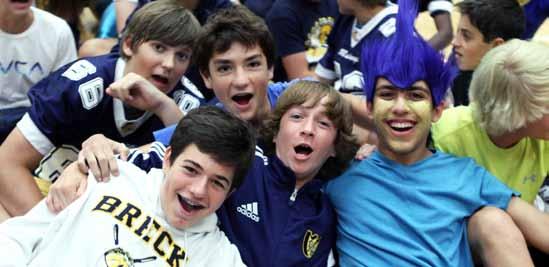
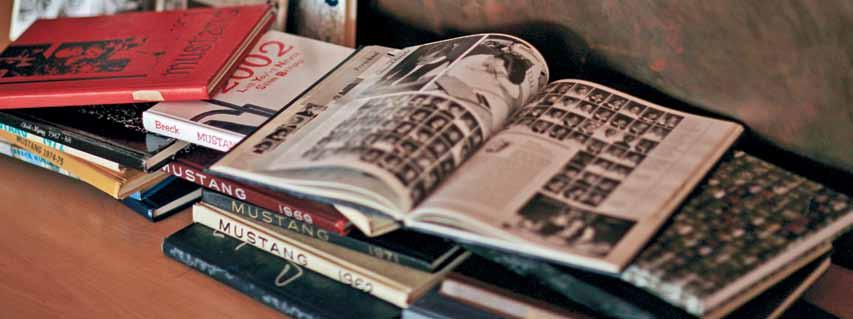
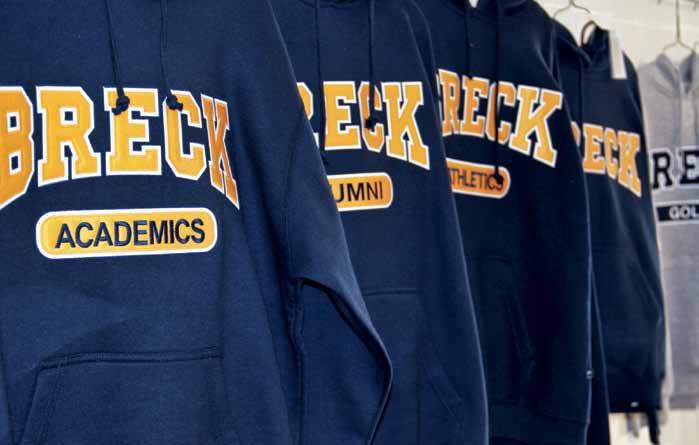
You make Breck Breck with your support of the annual Fund.
Breck students go off into the world as perpetual learners ready to realize their ambitions, effect meaningful change, and find lasting fulfillment. this philosophy of perpetually learning is what makes Breck uniquely Breck. the continual growth and evolution you see at Breck requires strong commitment and a great deal of resources. it requires that we as a community live our ideals.
thank you for making such amazing outcomes possible through your tax-deductible gift to the annual Fund.
Visit breckschool.org to make a secure gift online. Questions? Please contact Laura McCarty tufano at 763-381-8296 or laura.mccarty@breckschool.org.
Traffic Control
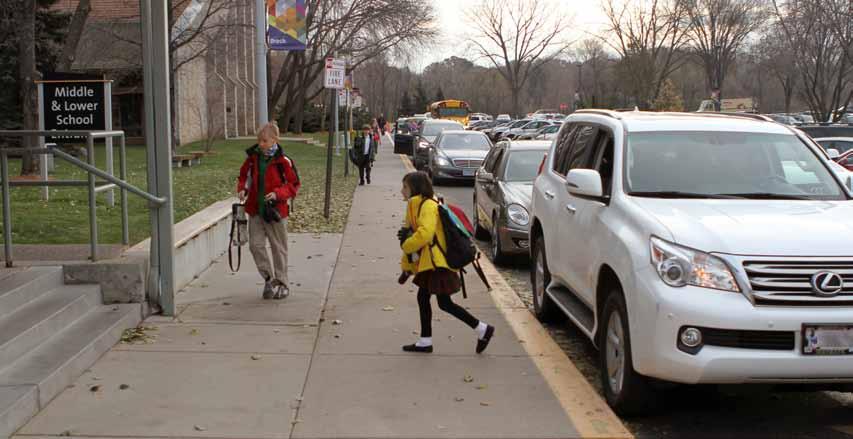
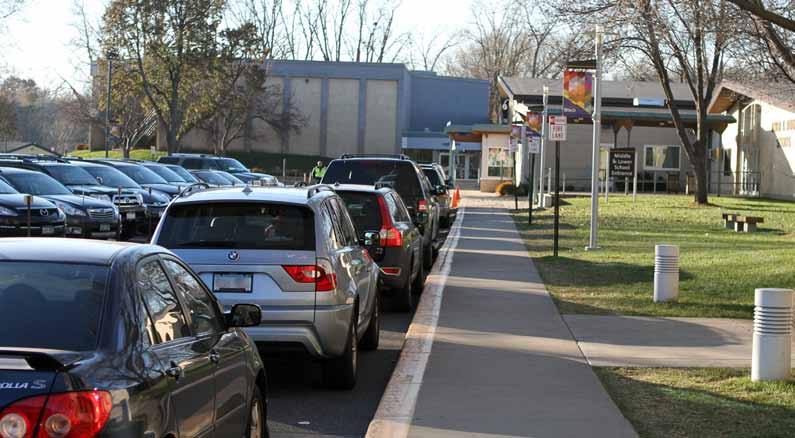
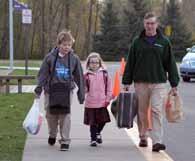
The Parents Association designs a program to improve driving on and around
We Day? We’re All In!
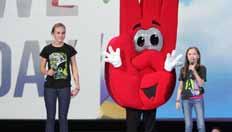
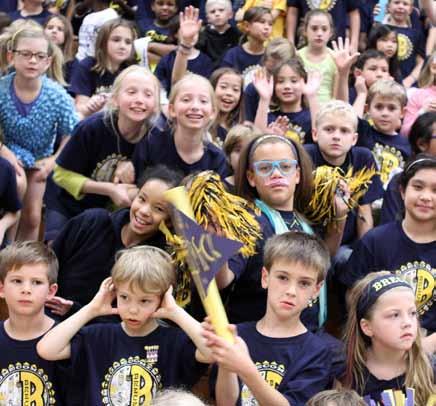
Thanks to huge enthusiasm, our commitment to service and the efforts of We Day Co-Chair Hutton Phillips ’13, We Day was a big event this fall.
Education With a Purpose
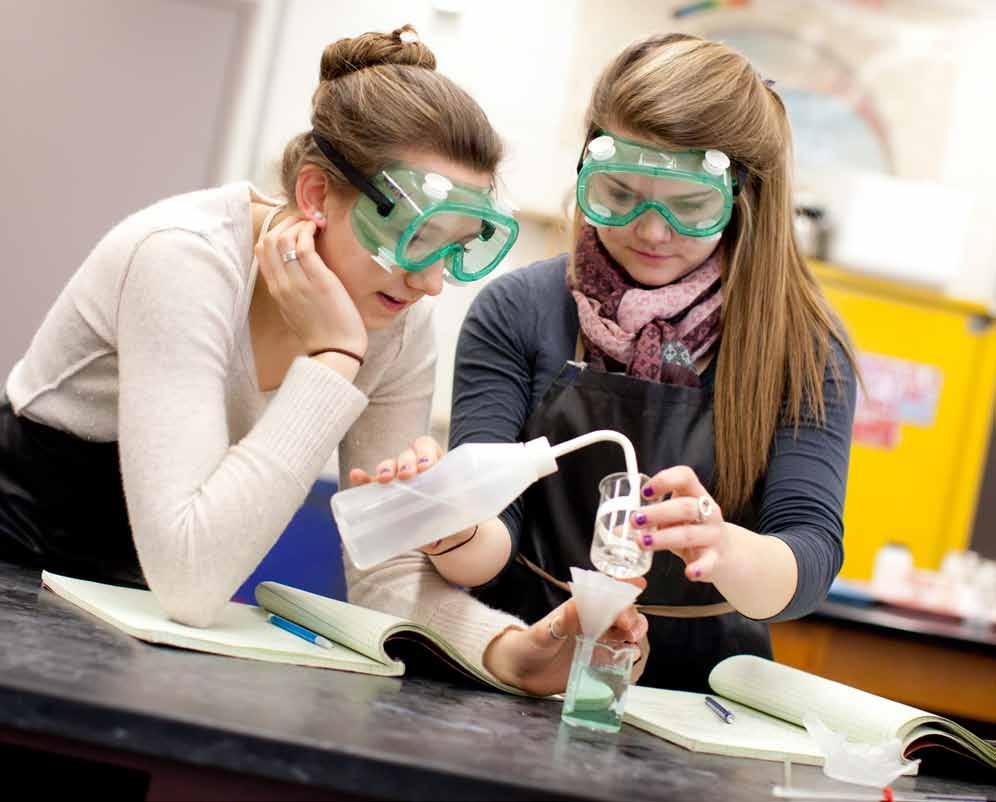
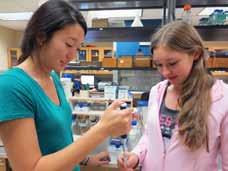
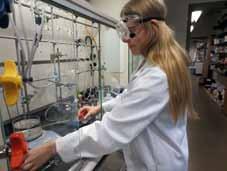
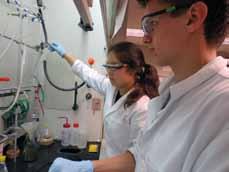
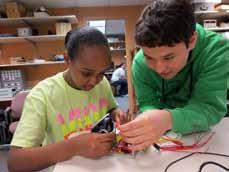
Breck students take advantage of extraordinary opportunities to learn through research in every grade and every division. It’s a critical 21st-century skill being taught across the curriculum.
26 / Perpetually Learning
A few alumni reflect on their current careers and the research experience they gained at Breck.
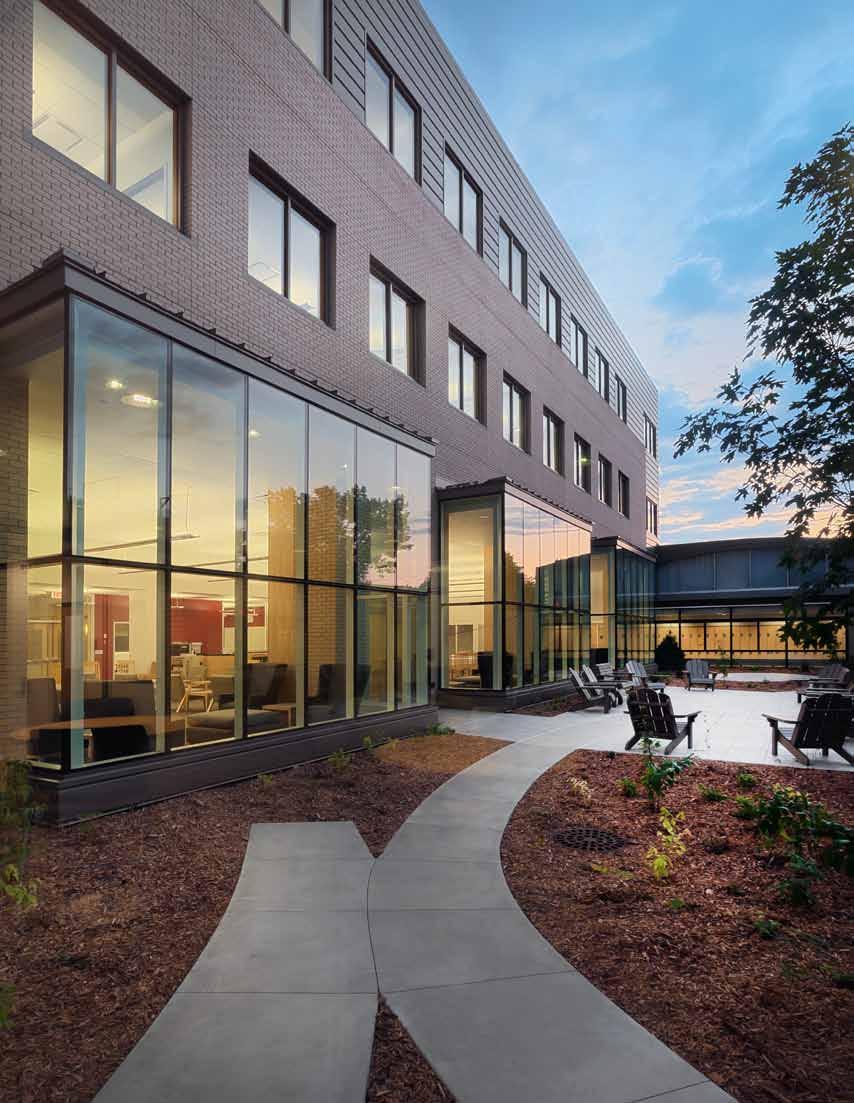
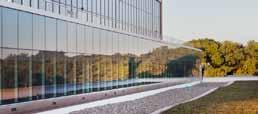
On the cover: The new senior courtyard at dusk.
Photo by Scott Gilbertson
Today at Breck
dePaRtments
Today at Breck is a publication of Breck School, 123 Ottawa Avenue North, Golden Valley, MN 55422 email: communications@ breckschool.org
h ead oF school
Edward Kim
di R ectoR oF advancement
Meredith Cook VanDuyne
editoR and c hieF WR iteR Jill Field
design
ThinkDesign Group: Linda Henneman, Brittney Schneider, Corey Sevett
WR iteRs
Laura McCarty Tufano, Michelle Geo Olmstead
PhotogRaPheRs
Lois Fruen, Scott Gilbertson, Billy Howard, Chelen Johnson, Karyl Rice, Sara Rubinstein
PR inting
Bolger Vision Beyond Print Fall 2013
mission
4 / 20 Questions
We asked, and they answered: Claire Drysdale ’14, Peggy Fifield, and Rob Melrose ’88
7 / 123
Activities, accomplishments, awards, announcements: here are some items from early fall at Breck.
7 / Who Knew?
Fun facts, both current and historical (no, there won’t be a quiz!)
12 / Ten Things You Didn’t Know About…
Our fabulous new Upper School supports students and teachers in style.
32 / Alumni News
Reunions, Homecoming and upcoming events
36
/ Class Notes
Alumni share recent news.
42
/ Sports News
We’ve got all the highlights of a great spring season for the Mustangs.
44 / In Their Own Words
New Upper School Director Thomas Taylor shares his educational philosophy.
Breck is an Episcopal, coeducational, college-preparatory day school enrolling students of diverse backgrounds in grades preschool through twelve.
Breck’s Mission is to:
Prepare each student for a college whose culture is compatible with the individual’s needs, interests and abilities. Help develop each student’s unique talents and potential to excel by nurturing independence and self-worth. Instill in each student a deep sense of social responsibility.
Breck School is committed to environmental stewardship. This publication is printed on paper manufactured with electricity in the form of renewable energy (wind, hydro, biogas) and a minimum of 30% postconsumer recovered fiber.
The September 26 issue of Time Magazine, devoted to a discussion of what colleges will teach in 2025, paints an interesting picture of the challenges facing educational institutions in the modern era. And while the article’s focus is on higher education, much of it is highly relevant to us at Breck.
Author Jon Meacham refers to the tension between “traditionalists” who favor a core-knowledge curriculum focused on what students should know and those whose vision is on lifelong learning and what students should know how to do. “The prevailing contemporary vision, even in the liberal arts,” he writes, “emphasizes action: active thought, active expression, active preparation for lifelong learning. Engaging with a text or question, marshaling data and arguments and expressing oneself takes precedence over the acquisition of general knowledge.”
At Breck, we strive to prepare our students with a firm foundation of cultural literacy but also with their own researcher’s mind, and we work hard to assure that our unique mode of research at Breck is part of every student’s experience—not just the most gifted.
Inquiry-based research works so well at Breck because it relies on skills we value highly including creativity, collaboration, and a curriculum flexible enough to let students create their own knowledge, taking them places they—and we—could never have prescribed.
What’s more, research-based learning has no finite and terminal goal. It’s an especially appropriate dynamic for a school proud to proclaim that it is itself perpetually learning.
Everywhere you look at Breck, you’ll see students engaged in authentic research, from the youngest learners to the most sophisticated and all throughout the faculty members who guide their work. Where else but Breck would you find an advanced mathematics research program that centers on social services and not just pure quantitative analysis? Where else but Breck would you find second graders learning to keep lab books, or faculty members using professional development funds to pose a question that encourages their entire academic department to work together to enhance curriculum for all?
At its heart, research at Breck is the very foundation of education with a purpose. It’s not just acquisition of knowledge for its own sake, but rather a way to prepare students to use what they’ve learned for the common good.
The conclusion of the Time article reassures me that Breck is very much on the right track. Meacham writes, “What is heartening to those who believe in the value of a passing acquaintance with Homer and the Declaration of Independence and Jane Austen and Toni Morrison as well as basic scientific literacy is that there is little argument over the human and economic utility of a mind trained to make connections between seemingly disparate elements of reality. The college graduate who can think creatively is going to stand the greatest chance of not only doing well but doing some good too.
edWaRd KiM h ead oF sChooL
Questions
Claire Drysdale ’14: bReck senioR
1 What’s on your iPod?
The audiobook of Let’s Cure Diabetes with Owls, by David Sedaris. Completely ridiculous and hysterically funny
2 What’s one of the last books you read?
The Interestings, by Meg Wolitzer. Ms. Muzsynski lent it to me.
3 What’s your favorite time of year? Fall, for two reasons: cross country season and apple pie!
4 What’s the most thrilling/adventurous thing you’ve ever done? I jumped off of a waterfall at camp last year. It was so scary!
5 What’s your favorite Breck lunch? Do chocolate chip cookie bars count?
6 Dream job?
It would be fun to be a journalist. I’d travel and learn about something new every day.
7 Best decision?
Deciding to go to here! I really can’t imagine what my life would be like if I had decided to go somewhere else.
8 What advice would you give to yourself 10 years ago?
To not worry too much about the future. It’s a lot better than I ever could have imagined.
9 What do you remember from kindergarten?
It was only half-day. I would sleep in, watch Winnie the Pooh, and eat mac and cheese before going to school. Kindergarten was awesome.
10 What is the most important room in your home?
The kitchen. My mom is a wonderful cook, and if we hang around she’ll let us taste what she’s making. My sister and I do our homework at the kitchen counter every night.
11 What’s your favorite place on the Breck campus?
Probably the art room, although I do like the new fourth floor. It’s so quiet and peaceful up there.
12 Comfort food? Costco pizza
13 If you had a theme song, what would it be? Fergalicious
14 Favorite line from a movie?
“It’s just a flesh wound!” from Monty Python and the Holy Grail. I could watch that movie a hundred times.
15 Favorite website?
The Breck Lunch Menu. My sister and I check it every night before bed.
16 Best trophy/award you ever won?
Making it to the state cross country meet last year. I literally finished last at a meet the year before, so qualifying was more than a dream come true.
17 If you could read anyone’s mind, whose would it be?
Mr. Taylor. I’d like to know how Breck compares to expectation.
18 If you could travel anywhere, where would you go?
I would go to Italy. There’s so much beautiful architecture and art. Plus I love pasta, pizza, and gelato.
19 Pet peeve?
I hate it when people text while they’re talking to you. It’s so hard to have a conversation that way.
20 Unfulfilled wish?
To go to the Metropolitan Museum of Art. I’ve been to New York City twice, but I’ve never had time to go!
Questions
Peggy Fifield:
1 What’s on your iPod?
Patty Griffin, Vince Gill, Avicii, Eric Church
2 What’s your favorite time of year? Fall
3 What’s the most thrilling/ adventurous thing you’ve ever done?
In 2012, I climbed Mt. Kilimanjaro and later took an African safari.
4 What’s your favorite Breck lunch?
Any soup of the day followed by an ice cream sandwich.
5 Who is your personal hero (and why)?
My husband Bob. You have to admire any guy that stays with the same girl (ME) since 7th grade! He is a great husband, father, grandfather, he knows so much about everything, and he “gets me”!
6 Dream job?
Professional athlete or to be a cast member of SNL
7 Best decision?
To have children (is that a decision?)
8 What advice would you give to yourself 10 years ago?
Travel more.
loWeR school, PhYsical edUcation
9 What do you remember from kindergarten?
Do you know how old I am? I don’t remember kindergarten.
10 What’s the most important room in your house?
The kitchen
11 What’s your favorite place on the Breck campus?
The gyms – where strong bodies, smart minds, and strong relationships are formed!
12 Favorite comfort food? Chocolate chip cookies
13 If you had a theme song, what would it be?
“What doesn’t kill you makes you STRONGER”
14 Favorite line from a movie?
“Show me the money,” from Jerry Maguire
15 Favorite website?
Cathe Freidrich workout, fitness, exercise DVD – check it out!
16 Three people living or dead, you’d have over to dinner?
My mom, dad, and Jesus
17 Best trophy/award you ever won? University of Minnesota Hall of Fame —Gymnastics
18 If you could travel anywhere, where would you go?
Back to Africa for another safari
19 Pet peeve?
Airport security
20 What keeps you up at night? Worrying about answering these 20 questions!
Rob Melrose ’88: Questions
theateR
di RectoR and bReck 2013 distingU ished alUmn Us
1 What’s on your iPod?
Nicki Minaj, Ke$ha, Pitbull, Polish for Foreigners, Charles Ives Symphony #2, Infinite Jest Audiobook
2 What’s one of the last books you read?
Le Compte de Monte Cristo by Alexandre Dumas. I read an excerpt of it in 10th grade French class, and it has been my goal to read it in French ever since. I finally did it this summer.
3
What’s your favorite time of year? Summer!
4 What’s the most thrilling/ adventurous thing you’ve ever done? Mountain biking. I broke my arm the first time out, but this summer I rode to the top of Mount Tam in Marin.
5 What’s your favorite Breck lunch? Pizza — In the 80s it was a big rectangle that hung over the plate.
6 Who is your personal hero (and why)?
Samuel Beckett — He was a tremendous artist with exceptional discipline and genius and as a human being he had a huge heart and great moral courage.
7 Dream job?
Artistic Director of the Théâtre Odéon in Paris but really I’d love to run any theater in Europe.
8 Best decision?
Marrying my wife Paige Rogers
9 What advice would you give to yourself 10 years ago?
To worry less and relax more
10 What is the most important room in your home?
The living room because I have my wall of books there
11 What’s your favorite place on the Breck campus? The Theater!!!
12 Favorite comfort food? Real Italian brick oven pizza
13
If you had a theme song, what would it be? “Do I love you?” Cole Porter. I used to sing it to my kids as their lullaby.
14 Favorite line from a movie?
“Never tell me the odds!” from Star Wars 5: The Empire Strikes Back
15 Three people, living or dead, you’d have over to dinner?
Homer, Dante and Shakespeare
16 Best trophy/award you ever won? My new Breck chair! Before that is was when the theater company I founded with my wife Paige, The Cutting Ball Theater won Best Theater in the SF Bay Guardian’s Best of the Bay Issue.
17 If you could travel anywhere, where would you go? Venice, Italy, always
18 Pet peeve?
People who have pet peeves
19 Unfulfilled wish?
Being able to draw well or play an instrument well
20 What keeps you up at night? Am I spending enough time with my kids? The answer is always no.
Today at 123 Ottawa Ave. North
Three Win rare honors in siemens CompeTiTion
There’s one Siemens competition finalist from Minnesota this year...and she’s Breck senior Claire Drysdale. In addition, two of the six Minnesota semifinalists are from Breck: juniors Sofie Kim and Jacob Levy To the best of our knowledge, Claire is the second-ever regional finalist from Breck. The first was Caleb Kumar last year.
GranT TWo Bulls Chosen for ColleGe Board advisory panel
Junior Grant Two Bulls has been selected for the Advisory Panel on Student Opportunity (APSO), a program sponsored by the College Board since 1978. The panel consists of only 16 students, both high school and college, who provide student perspective to College Board staff and committees.
naTional h iGh sC hool
sC holarship aWards Go To four r eC enT alums
The National Society of High School Scholars, which annually recognizes the best in research papers by students across the U.S., chose four projects from Breck among its 25 winners for 2013. Congratulations to the following, all from the Class of 2013:
Darius Bieganski , A Telemedicine Tool for Monitoring Parkinson’s: Using Microsoft Kinect to Engineer the ParkinsonsProtoTracker
Paige Dempsey, Characteristics that Contribute to Nest Success of Endangered Red-headed Woodpeckers (Melanerpes erythrocephalus)
Abby Erdmann , A Study of Distracted Driving Behaviors in the Vicinity of Breck School
Caleb Kumar, There’s an App for That: An iPhone Application for Post-stroke Upper Extremity Rehabilitation
Who Knew?
An Orchard for Sam:
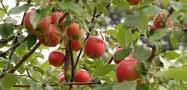
The Salas apple tree bore plenty of fruit this fall.
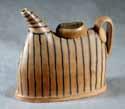
“Black Striped Teapot” by ceramics teacher Jil Franke
madi lommen ’15 earns r eCoGniTion from WomenvenTure
Breck junior Madi Lommen received WomenVenture’s “Nothing Ventured Nothing Gained: One to Watch” award at its annual conference in November.
For over 30 years, WomenVenture has been dedicated to providing women with the resources and support they need for economic success.
Madi is the founder of the Madibanani Bread Company, whose motto is Live. Love. Bake. Change the World. She founded the company to raise funds to support the Children of the Forest Orphanage in Sangkhlaburi, Thailand — a place she first visited on a Breck service trip.
She manages to bake her bread in a leased commercial kitchen, negotiate contracts with retail locations, keep up with her schoolwork and play multiple sports at Breck. Says Madi, “The most difficult days are the days when I feel like it’s a total grind and I don’t have enough time to check e-mail. I never get frustrated with the business, though. The kids — the orphans — are what keep me going every day. It’s only for a good cause.”
six arTisTs’ Work aCC epTed i nTo Juried arT shoW
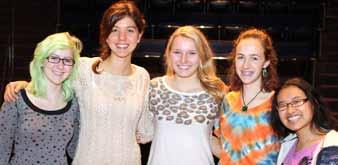
Upper School art students Maddie Diehl , Claire Drysdale, Adria Duncan , Katie Jundt , Uma Oswald and Maddi Youngdale were all juried into the Ninth Annual ShattuckSt. Mary’s Art Invitational.
Their work was on display in the school’s gallery from October 24 – November 8, and Claire won a second-place award.
CorreCTion
Due to an editing error, Samuel Rex was left off the list of high scorers in the National Spanish Exam last spring.
“Little Diamonds,” aka Luke LeBlanc ’14, has a new album, recorded at the studios of Prince’s organ player Dr. Matt Fink and 89.3 The Current. Ordering information at littlediamondsmusic.com
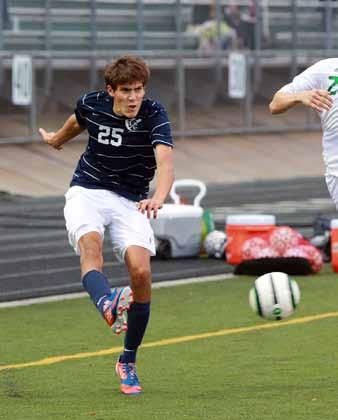
Senior Alex Hasselbring of the boys soccer team was profiled as a featured athlete in the Oct. 8 Star Tribune and was KARE-11’s athlete of the week on Oct. 11
Left to right: Katie Jundt, Claire Drysdale, Adria Duncan, Maddie Diehl, Maddi Youngdale (not pictured: Uma Oswald)
also noTed
Monarch expert and fourth-grade instructor David Kust was interviewed on both MPR and Channel 12 news this summer. Kust spent his sabbatical studying the migration of monarchs, whose population has been dwindling in recent years.
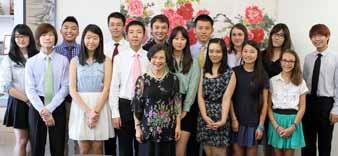
Chinese instructor Margaret Wong was honored for her commitment to international exchange by the Golden Valley Rotary Club, which named her Citizen of the Year.
“Black Striped Teapot” by ceramic teacher Jil Franke is included in the newly released book 500 Teapots Volume 2 (Lark Crafts, Asheville). Franke’s teapot was selected because of her reputation as a current and evolving designer in the world of ceramics.
Seniors Blaze Beecher, Elliott Weiler and Patricia Zhao were chosen by the University of Minnesota Confucius Institute to represent the Midwest region in the International High School Chinese Speech Contest, sponsored by Hanban, the National Office for the Promotion of Chinese Language Learning.
Senior Bryce Johnson qualified for two heats in the Junior Olympics in Detroit in July. He placed 65th in the nation in the 400 and his relay team placed fifth in the nation, winning All-American honors.
Congratulations to Benefits and Accounts Payable Coordinator Katy Stromberg on the birth of son Henry on August 12, and to Director of College Counseling Jonny Nicholson on the arrival of new daughter Hadley Elizabeth, on October 21.
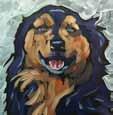
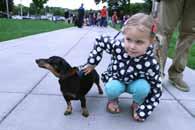
Art instructor Kat Corrigan’s show, “30 Dogs in 30 Days,” was on display at the Riverview Café and Wine Bar in Minneapolis in August.
Junior Grace Kirkpatrick was one of the participants in a program that brought together Chinese, Russian and American students in Beijing this summer. The group was involved in a Model CPPCC (Chinese People’s Political Consultative Conference), which lets students experience the processes by which China’s six political parties identify and address social issues.
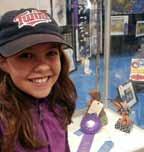
Seventh grader Talia Saklad and third grader Ella Saklad won numerous awards at the Minnesota State Fair Education competition. Ella received a first-place ribbon for her clay piece, and Talia entered five pieces and won five awards: two first, a second, a third and one of only two grand prizes for her grade level.
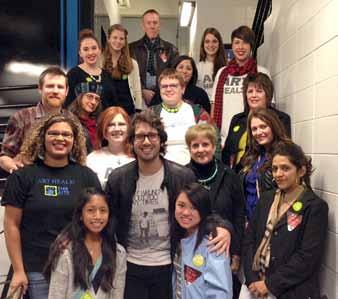
Emily Colwell ’14 (and Michal Sagar) with singer Josh Groban. They were invited backstage by Free Arts MN.
Talia Saklad Ella Saklad
Nearly 200 colleges and universities visiting Breck for the annual MISP College Fair
WelCome To BreC k!
Middle
Upper School: Gretchen
We welcome new faculty and staff this fall
Patricia Anderson, Upper School Chinese
Jill Arens, Upper School office assistant
Sarah Benjamin, Performing Arts department head
Katy Brandl, Lower School teaching assistant
Christian Burrus, Strength and fitness coach
Andre Caron, Upper School mathematics
Michelle Carlson, Lower School physical education
Tom Cierzan, Director of Campaign and Charitable Gift Planning
Angie Geffre, Lower School teaching assistant
Laura Kissinger, Lower School teaching assistant
Alex Law, Middle School history
Laura McCarty Tufano, Assistant Director of Advancement
Debra Mixon ’87, Upper School science
Erika Remillard, Middle School science
Anne Savage, kindergarten
Gretchen Scherer-Luebke, Upper School English
Trisha Skajewski, Associate Director of Advancement
Kate Starns, Middle School English/History
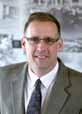
Thomas Taylor, Upper School Director
Betsy Wohlwend, Associate Accountant
New roles for some familiar faces
A.J. Colianni, Upper School Dean of Studies
Tod Dungan, Middle School Athletic Coordinator, Project Adventure (in addition to MS dean)
Emily Jones ’94, Library/Media department head
Carrie Lennox, Associate Director of Admissions and Financial Aid
Carol McFarland, Assistant Director of Advancement
Michelle Olmstead, Associate Director of Advancement
Kimberly Peeples, Director of the Melrose Family Center for Servant Leadership
Peter Saunders, Technology Curriculum Director
Sebastien Saunoi-Sandgren, Modern Language department head
Scott Wade, Director of Admissions and Financial Aid
Two Breck seniors have recently been recognized for their commitment to service. Eileen Bayer received a Caring Youth Award from the city of Minnetonka, and Angela Myers was honored as Volunteer of the Year at the Minnesota Children’s Museum in St. Paul.
Who Knew?
80% of Middle and Upper School students play at least one sport
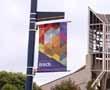
New signs and banners are all over campus this fall!
Today at 123 Ottawa Ave. North
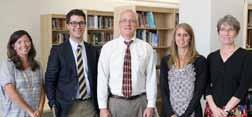
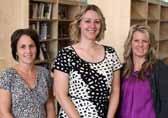
Trisha Skajewski, Laura McCarty Tufano, Betsy Wohlwend
Lower School (left to right): Michelle Carlson, Anne Savage, Angie Geffre, Laura Kissinger, Katy Brandl
Scherer-Luebke, Thomas Taylor, Andre Caron, Debra Mixon ’87, Patricia Anderson
School: Erika Remillard, Kate Starns, Sarah Benjamin, Alex Law
Tom Cierzan
Fifteen International Students Join Our Community in 2013-14
Jeungwon (Sara) Eum, grade 10, Yong in, Keungki, South Korea
Yue (Leah) Hao, grade 11, Beijing, China
Xinruo (Sarah) Hu, grade 11, Beijing, China
Sung Rim Huh, grade 11, Seoul, South Korea
Sung Wan, grade 9, Seoul, South Korea
Rustam Kosherbay, grade 11, Almaty, Republic of Kazakhstan
Tsz Lum (Antonia) Lee, grade 11, Hong Kong
Guohao (Ruskin) Li, grade 11, Beijing, China
Zhuang (Maxwell) Miao, grade 11, Beijing, China
Jana Rezabkova, grade 11, Prague, Czech Republic
Marie Sakloff, grade 11, Paris, France
Yunong (Charles) Wang, grade 11, Chongqing, China
Jinhui (James) Yang, grade 11, Shanghai, China
Youngmin (Jennifer) Youn, grade 11, Seoul, South Korea
Hongrong (Demi) Zhang, grade 11, Chongqing, China
to our wonderful host families: Dr Jinhwa Eum & Mrs. Hyangmee Oh, Art and & Kate Berman, Mark & Laurie Headrick, Jim & Sue Westerman, Steve & Angie Lee, Pamela Kirkpatrick, Gina Bardon, Melinda Caouette, Randon & Kathryn Roland, David & Gabrielle Parish, Jeffrey & Mary Husband, Bryan & Kimberly Morvig, Jianmin He & Jenny Liu, Mr. & Mrs. David Tsao, Hyun Sook Park, Sandra Kim, Jeff & Lauren Kiesel, Ron & Teresa Sit
sTar Tri Bune feaTures The n eW u pper sC hool
The Oct. 9 West Metro edition of the Star Tribune featured a very positive article and beautiful photos of the new Upper School. Education reporter Kim McGuire focused on the new science facilities and what they are making possible for Breck students.
i n memoriam
from The faCulTy Bookshelf
Upper School English instructor Dallas Crow has published Small Imperfect Paradise (Parallel Press of the University of Wisconsin Libraries), available via the Parallel Press website, parallelpress@ library.wisc.edu. In addition, Crow’s poems have been published in the current issues of a number of literary journals (Cloudbank, New Madrid, and Tar River Poetry) and one fishing magazine (The Flyfish Journal). He also has an article on contemporary prose poetry in the current issue of Poet Lore
Former faculty member Meryll Page has published Jewish Luck: A True Story of Friendship, Deception and Risky Business. Available at amazon.com.
Former Upper School Director Kevin Michael died after an illness August 8 in Columbus, Ohio. He was 57. At the time of his death, he was an adjunct professor of philosophy at Ohio Dominican University. He had been a teacher and dean at Columbus Academy, headmaster at Midland School in Los Olivos, California, and at Lake Ridge Academy in Ohio. He is survived by his wife Martha and children Guthrie ’00, Chelsea ’02 and Georgia ’05.
Former Trustee Mary Lee Dayton died on August 21. An energetic community volunteer and great philanthropist and friend of Breck, she served on the board from 1989 to 1994. Predeceased by her husband, Wallace, with whom she donated the funds for the Wallace and Mary Lee Dayton Breck Faculty Chair, she is survived by family including four daughters and nine grandchildren, including Matthew ’97 and Rosamond ’05 Sturgis.
Books and gently used school supplies sent to The Children’s Chance since 2009 after Breck student locker cleanouts 15.5 tons
Thanks
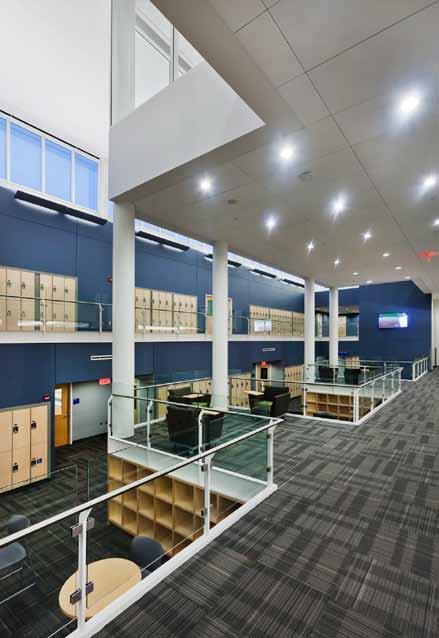
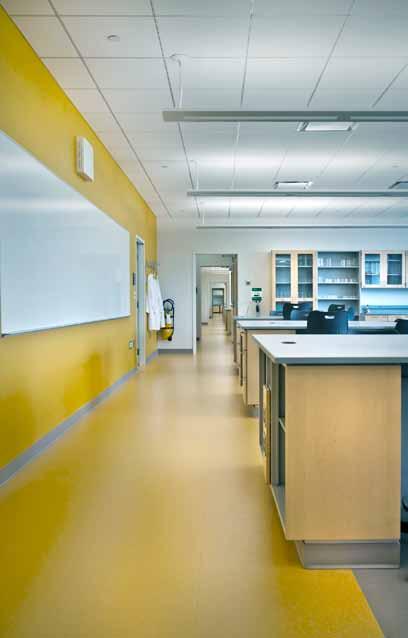
The neW upper sChool Ten Things You Didn’t Know About…
The water fountains are specially designed to make it easy to use refillable water bottles… and they even keep track of how much has been saved since the school made a strong effort to reduce the use of plastic bottles.
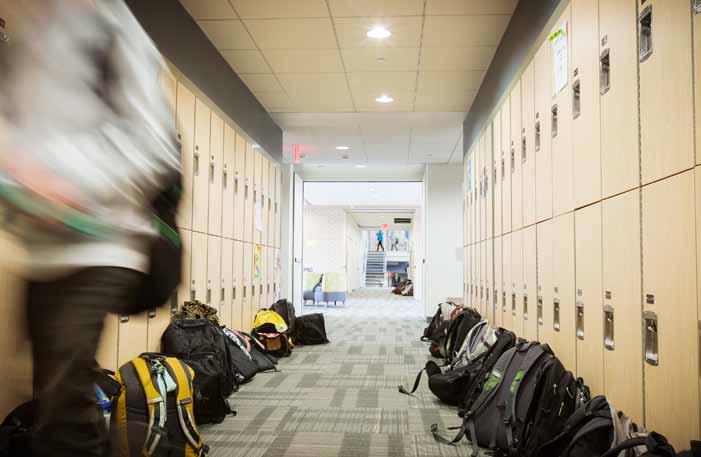
There’s a new north-south hallway. There’s one more passage between the new building and the renovated history (formerly science) wing. It’s home to the new senior Commons area and seniors’ lockers.
You can write on the walls. Walls throughout the space are covered with whiteboard paint, encouraging individual and group work.
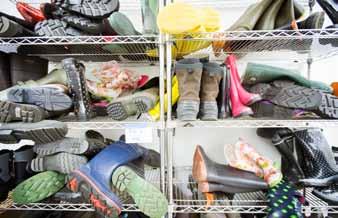
We have a mudroom near the back door for collecting outdoor science wear. Ample shelves and storage area give science students a place to store their gear without tracking the outdoors all through the rest of the building.
Mr. Grossman is no longer on the second floor, but he can still pretend. A portion of the old second-floor railing was installed in Charlie Grossman’s history classroom to remind him of his former perch.
The stairwells are designated “Areas of Refuge”—the first in Golden Valley. There’s plenty of room for students and teachers in the new stairwells, important for severe weather drills and shelter.
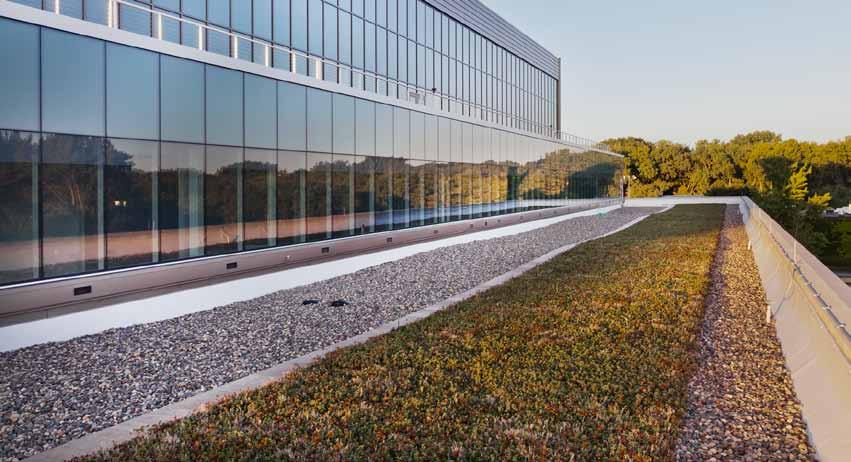
The roofs are green...or made of highreflecting materials. Much of the roof is covered by a green roof of resilient plants, which helps slow storm water runoff, lessens the effects of heat buildup, and provides a great outdoor laboratory for biology students. Areas of roof not covered by green roof has a white membrane to reduce the amount of heat absorbed.
We used mostly local materials. Many of the materials that were specified and installed in the building are produced within 500 miles of Breck, which means we used less fuel in transporting them to our building site.
Let there be (energy-efficient) light. All interior lighting uses fluorescent lamps and much has daylight sensors that automatically turn the fixtures off when there is sufficient natural light. Exterior lighting uses LED technology, which uses a fraction of the energy of either standard or fluorescent bulbs.
The Class of 2013 is a permanent presence. The “senior beam” signed by the Class of 2013, who graciously endured the construction but never got to live in the space themselves, is visible from the top floor.
Driving Change:
One of the school’s great assets is the location of our beautiful, leafy campus so close to Highway 100, I-394 and tucked in to the lovely and vibrant Golden Valley neighborhood of North Tyrol. From time to time, it’s important to remind those who drive on campus that our behavior behind the wheel makes a difference both within our own community and to our neighbors as well.
In the spring of 2012, during the approval process for the Upper School construction project, it became apparent that our driving behavior was having an adverse effect on neighbor relations, says Director of Advancement Meredith Cook VanDuyne. “Neighbors were concerned—and rightly so —that the addition of construction traffic on top of our everyday traffic might pose a real problem. It was an important opportunity for us to take stock.”
The city commissioned a traffic study that showed that while the volume and speed of traffic around campus was within the normal range for our neighborhood, it would benefit us all to engage in an education campaign to improve driving behaviors.
Breck Parents Association President Andrea Kmetz-Sheehy took the responsibility to heart and convened a task force to begin meeting over the summer. Parent Vanessa Heinecke, who chaired the task force, immediately understood the need. “As a car line driver, I knew from first-hand experience that there was plenty of room for improvement,” she says. The task force evolved into a program called C.A.R., which stands for “Community, Awareness, Responsibility.” Heinecke recruited fellow parent Amy Liss to help design a series of eye-catching pieces to help capture parents’ attention. Together, they created a brochure, a sticker, signage for car line and information for the Breck website. They also recruited parent volunteers to distribute a flyer to
Bre C k Parents asso C
iation Lea D s e fforts to i m P rove Driving on an D a roun D Cam P us
afternoon car line drivers, urging them to be more attentive.
In the meantime, the school has replaced the old yellow “No Cell Phones While Driving” signs on both northbound and southbound Ottawa with bigger, brighter, more noticeable signs—with a more modern looking smartphone image. More prominent crosswalk painting is also planned for the next time our roadways are resurfaced.
Heinecke and Liss say they are hopeful that their efforts are making a difference.
“We got a lot of positive feedback from parents,” Liss observes, “and good suggestions from the Golden Valley police and Breck security personnel who help direct traffic. We’re incorporating their ideas into what we’re planning for an awareness week in the spring.”
The pair say they’ll continue their efforts to promote awareness of distracted driving behaviors and expand them to helping parents know where to park—especially on heavy
traffic days such as parent-teacher conferences, the Lower School Christmas program, and Field Day. They’re also working with the Upper School administration to help raise safer-driving awareness among student drivers, and with the Lower School to tie safe driving reminders to C.A.R.E. themes.
“It’s really a question of reminding parents of the rules that are already in place,” Heinecke says. “We hope that we’re helping parents to become better drivers when they’re off campus as well —which will continue to pay off as they set good examples for their children when they start to drive.”
“We know it’s going to take some time,” Liss laughs. “But eventually we know even more people will put their phones down and pay more attention when they’re behind the wheel.”
JF
BreC k su PPorts first-ever minnesota We Day
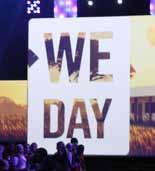
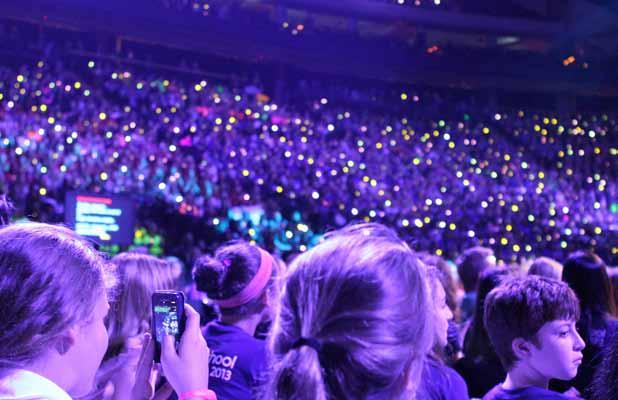
a large contingent from breck traveled to the Xcel center in st. Paul for We day on oct. 8. We day, a celebration of global awareness and service among young people, is a canadian phenomenon that is now catching on in the United states. in fact, minnesota’s event was only the second-ever in the U.s., with many more planned both here and in the United kingdom in the coming months.
We Day is sponsored by a charitable organization called “Free the Children,” which describes itself as “an international charity and educational partner that educates, engages and empowers youth to become agents of change. We Day inspires us into action.”
More than 18,000 young people attended the event at the X, which was co-chaired by Hutton Phillips ’13 and her brother Dean. To attend, students must have completed both local and global acts of service.
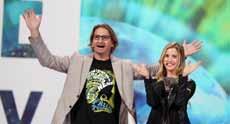
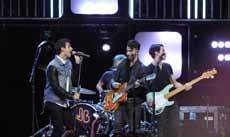
The assembled crowd enjoyed a fast-paced program that included musical performances by the Jonas Brothers and Carly Rae Jepson, an invocation by the Rev. Martin Luther King III, comments from Queen Noor of Jordan and actor and activist Mia Farrow, an appearance by local hero Jack Jablonski and several members of the Minnesota Vikings, and a proclamation from both Gov. Mark Dayton and St. Paul Mayor Chris Coleman.
And there were numerous Breck connections. Students—and
sisters—Gigi and Rachel Gunderson talked about their commitment to the “We Scare Hunger” campaign to collect donations for food shelves on Halloween, as well as Breck parent Kim Nelson, who talked about General Mills’ commitment to “nourishing lives.”
Co-chair Phillips sums up her experience this way: “We Day far surpassed all of my expectations! I was blown away by the enthusiasm of all the students and teachers. I have been hearing about all of the amazing things that individual students and schools have been doing in order to earn their way to We Day—but seeing of all those individuals come together to see the power of their collective impact was overwhelming. With 5,100,000 hours volunteered for local and global causes and $26,000,000 fundraised for 900 different causes, it’s clear that our generation is already changing the world.”
For the students who attended, it was an unforgettable experience. Senior Natalie Roberts, who was a volunteer for
photos by Karyl Rice
the event, observes, “Actually being there was really empowering. The organizers really know their stuff, and they really motivate you. Even if it’s a small thing, there’s no reason not to. We can all get out there and do things to make the world a better place.”
Says seventh grader Brett Schoppert, “I didn’t really know what to expect, but it was so amazing to be there. To look around and see that many people so committed was pretty crazy. I’m not sure I’ve ever been in a crowd of 18,000 before —and that was crazy, too.”
Senior Emily Colwell remarks, “There was so much energy, and it was all youth-driven. I found myself thinking that I will never be in a room like this ever again.” And senior Eileen Bayer says, “It was such a wonderful opportunity for encouraging everyone with charitable tendencies. And it was great to see Breck middle school students be a part of it all. They need to see where their efforts can lead.”
Middle School Chaplain Alexis Kent describes the event as an “inspirational rally” but is quick to add that it’s much more than that. “As an educator,” she explains, “my concern is that we have just wowed our students, but without any lasting effect. But after We Day, my students are constantly asking, ‘What will we do now?’ Their motivation, willingness and engagement is inspiring to me. We Day lights a fire for our students that helping other is not only cool but necessary.”
Her student Brett Schoppert is a case in point. After qualifying for We Day by volunteering at sites from his local library to staffing a marathon water station, Brett says, “Since I got back from We Day I realize that I’m still reflecting on it. I wasn’t just empowered for one day. And if I remember something this long, I know it will stick with me!” JF
a We day Believer
We day in aCTion
In a wonderful example of We Day spirit in action, Breck students enthusiastically supported the We Scare Hunger Halloween food drive effort—bringing in more than 7,000 pounds of food for local food shelves.
It was a spirited competition between Middle and Upper Schools, and with the Middle School victory, there was a payoff: Upper School administrators Taylor, Ohm and Colianni made good on their promise to do the “We Day dance” for the entire Middle School.
Breck’s involvement with We Scare Hunger, now in its second year, came about through the efforts of sisters Gigi and Rachel Gunderson. The Gundersons were featured speakers at We Day Minnesota.
Senior Natalie Roberts, who served as a We Day volunteer, was well prepared for her role. Last summer, she attended a “Take Action” camp sponsored by Free the Children, We Day’s parent organization. Besides feeling “really honored” to be selected to attend, Natalie says that she’s truly excited to be counted among a group of young people who truly want to be leaders in their communities.
“It was amazing to see how passionate everybody was, and great to be together for discussions and activities,” she observes.
Campers focused on a number of topics of interest, including cliques in school, homelessness, bullying, avoiding hurtful and insensitive language, substance abuse and, her personal interest, human trafficking. She was first enlightened about the problem of human trafficking during the Breck service trip to Thailand and is deeply committed to learning more. “After the trip, and after learning about how to construct an action plan from camp, I’m ready to learn more so that I can do more,” she says. “We can all make a difference.”
Beyond Google:
BreC k’s CurriCu Lum teaC hes stu Dents of aLL ages the vaLue of gooD r esearC h
by Jill Field, photos by Sara Rubinstein
There are many reasons why a research, or inquiry-based curriculum works so well —and there are few schools that do it any better than Breck.
It’s among the most important of twenty-first century skills. “It’s impossible to come up with the right answer if you don’t start by asking the right question,” says sixth grade English-History teacher Mary Jane Curran. “Defining what you’re looking for is really the biggest question of all.”
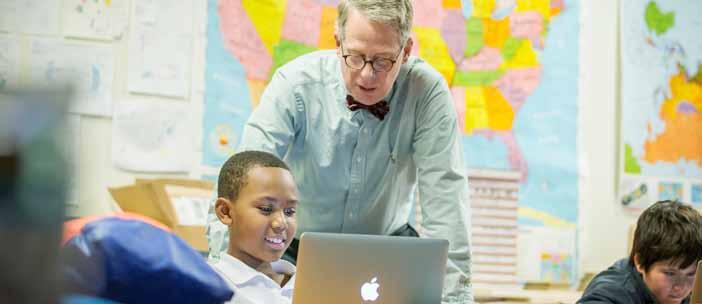
It’s energizing to students of all ages. “Inquiry-based learning is so motivating,” says third-grade teacher Lisa Hunninghake. “For students to get to define their own projects—whatever rattles their bones—is really exciting for them and for their teacher.”
It’s learning that grows along with the student. “In fifth grade,” observes eighth-grade history teacher Sarah Flotten ’85, “a teacher may give a student a topic and the student’s only choice is how to present his or her work. But by eighth grade they’re on their own to go as deep as they want.”
It’s a great way that students of different skill levels can work on the same kind of project. Second-grade teacher Sara Thorne says, “I love seeing what my students can do with a project like our Kidblogs. Some just write, some upload photos, some do whole multimedia presentations, and some help each other by commenting on others’ work. There’s such a range.”
It’s motivating for their teachers, too. Says Advanced Science Research program director Lois Fruen, “I become totally engrossed in each of my students’ projects. From organic solar cells, to ‘click chemistry’ reactions, to causes of porcine diarrhea in post-weaned pigs, I learn so much!”
It’s what truly prepares Breck students for college and beyond. “Advanced Science Research taught me a great deal about myself, showed me the meaning of hard work, and taught me the benefits of putting effort into everything I do,” reflects Lanre Adekola ’09.
Building the Foundation
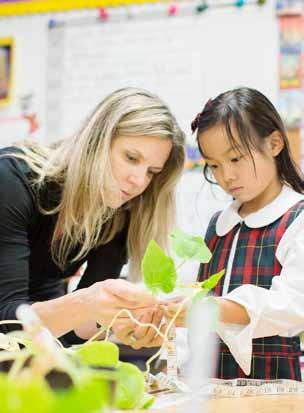
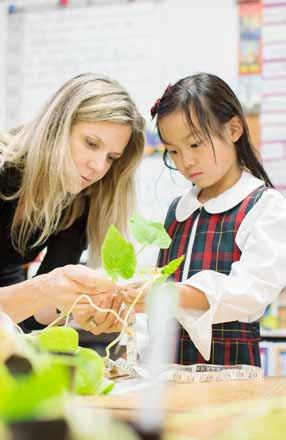
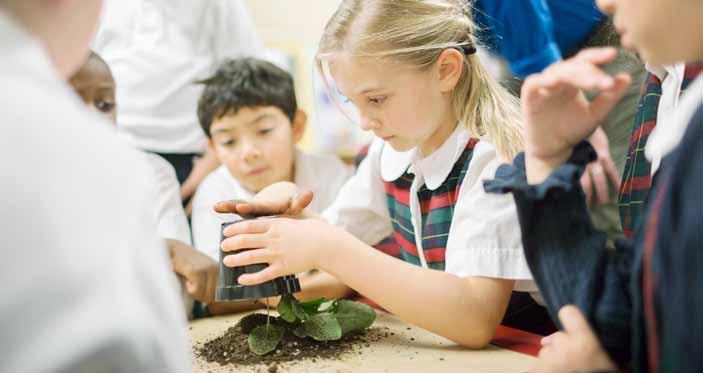
In Lower School, students become researchers in both science and social science, learning how to direct their own projects in ways that interest them. “It’s new every year,” says second-grade teacher Sara Thorne. With their study of plants, for example, Thorne says her class comes up with their own ideas for experiments all the time. “Some classes are interested in the effects of limiting or removing light,” she explains, “or finding out what happens when you throw a bunch of seeds in the same pot. But no matter what the experiment, they all learn to keep notes in their lab journals, measure carefully in the metric system, and draw conclusions from their data.”
Social studies projects in second grade, use research in a way that really meets the diverse range of writing ability. “Kids are naturally interested in research,” Thorne observes. “It’s a great way to introduce them to different genres of nonfiction writing, and they can take it as far as they’re able. And, at the same time, we get to help them understand how to go about looking for information they can use.”
On Grandparents Day, for example, they interview their grandparents about their national heritage, which becomes information they use in creating country reports. And when they choose a subject for their important American reports, second graders start to learn where to look for what they need. “Sometimes a student will look at a book and say, ‘there’s nothing here on my topic.’” Thorne says, “It’s a great opportunity to ask them, ‘Well, have you looked at the index? At captions of photos and illustrations?’ They don’t yet have
no maTTer WhaT The experimenT, They all learn To keep noTes in Their laB Journals, measure
Carefully in The meTriC sysTem, and draW ConC lusions from Their daTa.
the experience to know those things for themselves.”
Thorne is quick to praise the efforts of the Lower School library staff and Department Head Emily Jones ’94 in helping make resources available to her students—and quick to note the increasingly important role of technology in giving students access to primary-source research from the very start. Lower School students have
a wide range of technology tools available to them, including filtered searches through programs such as CultureGrams, BrainPop Jr., netTrekker, Nat Geo and Ask Jeeves, Jr.—all managed by the Lower School library and accessible at home. “Our projects really set a framework,” she says. “It’s the expectation of the school that we’ll all do constant research, and this is where it starts.”
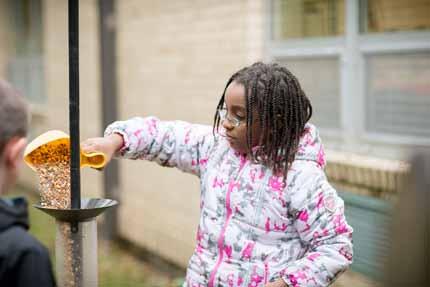
An important research project in third grade is called Project Feeder Watch, a program started at Cornell University. Students set up bird-feeding stations, maintain food and water supplies, and watch what happens over the course of a year. They learn to draw conclusions about the effects of weather conditions, says third-grade teacher Lisa Hunninghake, who loves the moments when her students put it all together. “They come to understand that more birds use the feeders when there’s snow on the ground,” she explains, “and it’s a wonderful moment of discovery when they do.”
In social studies, third graders typically study Minnesota, and they use an inquiry-based approach that gives them plenty of opportunities to help direct their own learning. “They’ll listen to recordings of Native American music, look
at early maps and photos from Fort Snelling,” Hunninghake says. “And they’ll learn about treaties and what the fur traders actually traded. When they start to think about things like how many pelts were trading currency for a gun, or how trading posts developed, they begin to make sense of how Minnesota got its start. They look at Minnesota biomes, animals, logging, Native culture, all with primary sources, and the jigsaw really comes together.”
Fourth-grade teacher Paula Nelson is, herself, studying the whole topic of inquiry-based learning. “It’s such a motivation for students when not everything is teacher-directed. And it gives students so much flexibility to be able to work either on their own or collaboratively.”
A perfect example is the “Mystery Class” project her students do in the second semester. Beginning with daylight clues (how much daylight is currently available in a mystery location), students watch light patterns and use maps. Later, word clues and images help them narrow down the choices further. The project integrates social studies, science and geography, but it does so in an always fresh and interesting way.
“The Mystery Class gives them so many skills,” Nelson observes. “Solving the mystery requires asking good questions to guide their research. But because the content is so fun, they don’t even realize how much they’re learning.”
TraC kinG r esearC h proGress aT BreC k sC hool
By the end of 4th grade students will be able to:
• cite sources using beginner noodletools
• evaluate sources for accuracy and currency
• identify the components of a research process model
• Write a report using multiple resources including both text and electronic
By the end of 8th grade students will be able to:
• cite sources using noodletools/easybib
• evaluate sources for accuracy, quality, currency and bias
• Follow a research process model
• conduct research using multiple resources including both text and electronic
• Write without plagiarizing
By the end of 11th grade students will be able to:
• cite sources using advanced noodletools/easybib
• Use multiple citation styles
• evaluate sources for currency, relevance, accuracy, authority and purpose
• Follow a research process model
• conduct research using multiple resources including both text and electronic
• Write without plagiarizing
• differentiate between fair use and copyright infringement
— Breck School Library/Media Department, Spring 2013
Social Studies Research
From Colonial Day to the long-remembered Washington Reports, sixth graders at Breck are immersed in research opportunities. “We spend a lot of time talking about how to search for information,” explains sixth-grade English/History teacher Byron Rice. “We look for reliable sources written at an age-appropriate level.”
His colleague Mary Jane Curran believes that the Colonial Day project is so successful because it gives students a chance to tell stories based on what they’ve learned. “They choose a character and it takes off so naturally from there,” she says. “So they look at what kind of clothes such a person would have worn, what kind of house he or she would have lived in, or whatever else captures their interest. And when they get the chance to actually be their person, it’s fun because it’s so interactive. They’re proud of everything they do to stay in character and may not even realize how much serious work they’ve done to get there.”
By The end of Their Time in middle sC hool, sTudenTs have The opporTuniTy To dive deeply inTo TopiCs of inTeresT for BoTh h isTory day and World savvy.
And when the sixth-grade experience culminates with the annual trip to Washington, DC, students are better travelers thanks to their work on Washington reports about monuments, memorials, and other things they’ll see there. The reports require
research skills and have become more sophisticated over the years. Says Rice, “We used to have kids write ten reports each, but now it’s more like six or seven because they’re so much more in-depth.”
Completing those reports, he adds, is a big boost to students’ self-confidence as well. “At the end, I think their reaction is often, ‘Hey, I can do this! Maybe it’s not as tough as I thought.’”
By the end of their time in Middle School, students have the opportunity to dive deeply into topics of interest for both History Day and World Savvy. Eighth-grade history teacher Sarah Flotten has seen first-hand how well prepared for Upper School her students become. “Sometimes they’ll come to me and say, ‘There’s nothing on the internet [about a particular topic].’ And that’s the perfect time to say, ‘No, you’ve just done a bad search. Let’s figure out how you can ask a better question.’”
The eighth-grade team uses a process they call AGOP: Ask questions, Gather information, Organize and write, and Present your findings. “It’s messy and fun at the same time,” Flotten says. “And it’s amazing how long they remember their History Day and World Savvy projects well past eighth grade.”
That Legendary History Research Paper
Every Breck Upper Schooler writes a research paper in U.S. History, typically taken in junior year. It’s not just famous, says U.S. history teacher Dulcenee Walsh. “It is infamous. It gets mentioned every year in the senior memories. And it always is me, even though there are several others who can be blamed!”
Walsh says she takes research seriously. She begins with a walk through the steps of how to do things the right way, and she steadfastly refuses to let students take the easy way out. After choosing a topic, students face the challenge of writing their thesis. “It’s really difficult for them,” she reflects, “and they’re not allowed to quit until they have a
concrete, workable and analytical thesis.” A full bibliography and outline precede the actual writing of the paper, which is due in January. “Eight to ten pages sounds short to us, but they have never had anything like this before and it seems like a mountain to them,” she reports.
In addition to the writing, Walsh says students benefit from learning about footnotes, doing sophisticated research with primary and secondary sources as well as journal articles, and learning about footnotes and proper citations. “Most will find the project interesting,” she says, “but they won’t really come to appreciate it until they get to college.”
A Wealth of Opportunities for Advanced Study
The resulTs have Been impressive, and BreC k sTudenTs have aC hieved remarkaBle reCoGniTion in CompeTiTions.
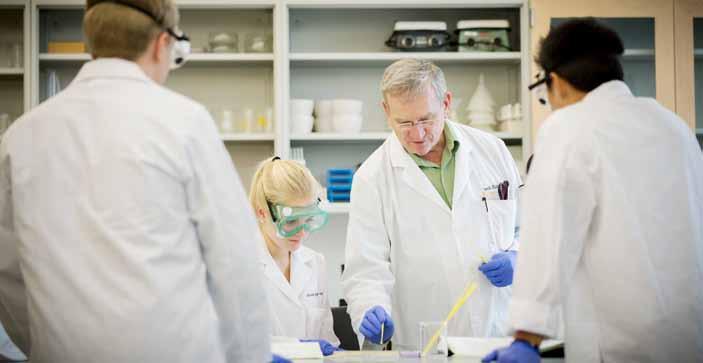
Advanced Research programs, which offer seriously interested and talented Upper School students the chance to do delve into real-world research topics in university or corporate laboratories, got their start at Breck in 1988, when Dr. Jacob Miller served as advisor for the first-ever science research group. Since then the program has grown to encompass research opportunities in history and mathematics (with a unique twist: advanced mathematics research students do their work on behalf of nonprofit or social service organizations). Lois Fruen now directs the science research program, Tim Rosenfield
history research and Brad Kohl mathematics.
The programs are set up in a basically similar way. Students apply to be included in the program and, once accepted, work with their advisors to identify a project and sponsor in the spring. Over the summer students do the bulk of their research. In the fall, they come together as a class to share their work with each other and begin to develop both written and oral presentations. Then, in the following spring, they submit their
presentations to various groups and competitions.
The results have been impressive, and Breck students have achieved remarkable recognition in competitions such as the Intel, Siemens, BioGenius, and Minnesota State Scholars of Distinction programs. On an individual level, each student gains valuable experience in presenting his or her work and in supporting other members of the team. Says science research program alumna Somer Drummond ’10, “Because we spent so much time peer-reviewing each others’ presentations, papers, posters, and PowerPoints, I feel that my classmate’s successes are my own as well.”
Advanced History Research
After several years of working on projects combining history and geography, this year’s history researchers, under the direction of teacher Tim Rosenfield, are taking a deep dive into the Presidency of John F. Kennedy. It’s a timely topic because this November marks the fiftieth anniversary of his assassination. Senior Lorelei Lange has thus far done research about Operation Mongoose, a secret program to topple communism in Cuba, and has looked into the mysterious “babushka lady” who allegedly captured the assassination on film even though her photographs have never been seen.
“It’s been really fun,” she says. “Mr. Rosenfield gives us a nugget and then lets us find the whole cheese.”
Her classmate Nick DeMaris has always been interested in history but finds the Sixties especially intriguing. “There’s so much to learn about: the Cold War, civil rights, JFK. The sheer volume of primary-source resources available is amazing. It would take a lifetime to comb through,” he says.
Nick has been learning to evaluate documents, videos and photos he finds online as he researches the civil rights aspect of the Kennedy Presidency and Jim Ferrie, a man some conspiracy theorists believe was involved in the assassination.
“The whole experience is different from any other class,”
Nick observes. “We get to take our own initiative and then have a class of people to discuss things with. I’m learning more than ever.”
Advanced Mathematics Research
Now in its third year, the advanced mathematics research program combines quantitative research with service as students do work for local nonprofit and social service organizations. Under the direction of mathematics teacher Brad Kohl, students are involved in a wide range of projects (see sidebar below).
Senior Chris Walker says that he’s “having a blast” working with underprivileged children through a program called ACME (Advocates for Community Through Musical Access). What’s more, he feels that he’s enjoying the independence of helping to define and carry out his own work and the feeling that he’s helping others at the same time. “I’ve always
2013–14 advanC ed maTh r esearC h proJ eCTs
Improving Information Dissemination to Constituents client: national Youth leadership council (nYlc)
Assessing the Power of Music II: Increasing Academic Success client: advocates for community through musical access (acme)
Demonstrating the Effectiveness of Acupuncture on Non-Covered Illnesses client: american academy of acupuncture and oriental medicine (aaaom)
Engaging Youth in Breast Cancer Awareness Through Service and WE Day client: general mills, Yoplait division
Analyzing Mathematics Teaching Techniques in a P-8 African-American Charter School client: seed academy/harvest Preparatory
Assessing the Level and Value of Service in Schools client: Jefferson awards/students in action
Creating a Rubric to Assess Domestic and International Service Trips client: area service learning coordinators
Advanced History researchers left to right: Lydia Moran, Foley Simons, David Caruso, Nick DeMaris, Lorelei Lange, Duncan Phelps
wondered how to apply what I’m learning in school to the greater good,” he reflects, “and as I work on ways to assess the kids’ academic and musical literacy I truly have a chance to do just that.”
And senior Emily Colwell is working on a project to raise awareness for the National Youth Leadership Council (NYLC) in order to improve their outreach efforts. She’s analyzing their social media impact, comparing it to similar organizations and making recommendations. In addition to the work itself, Emily says she’s enjoying the responsibility of learning to set up her own meetings, figure out her own timetable, and generally be proactive. “It really feels like a college-level experience,” she says. “And it’s really fun at the same time.”
Advanced Science Research
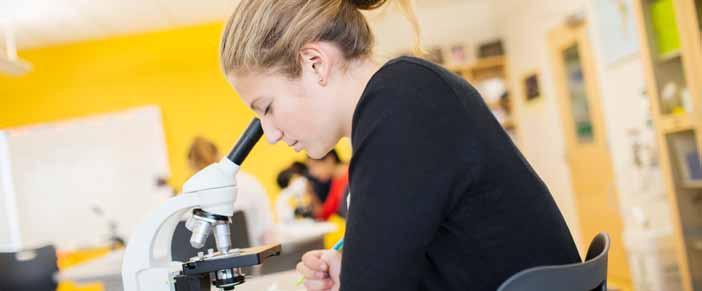
Under the guidance of Lois Fruen, a group of 20 students is pursuing a wide range of science research topics this year (see opposite page). Fruen says that coaching her research team is always an enriching experience. “Besides being fun to teach, coaching the team is amazingly rewarding because the work I do changes students’ lives,” she reflects. “There are days I feel overwhelmed with the workload, but then I receive emails from past students, and I know what I am doing makes a huge difference in my students’ academic lives.”
Senior Claire Drysdale, whose work has already earned her the extremely rare honor of finalist status in this year’s Siemens competition (she’s the only finalist from Minnesota), says that being involved in such a “self-driven” process
BreC k faCulTy are involved in saBBaTiCals, summer GranT Travel and sTudy, GraduaTe Work, aCTion researC h, JoinT proJ eCTs WiTh sTudenTs and independenT Work.
has been enlightening in more ways than one. Besides what she’s learned through her research into the chemistry of artistic patinas, she has greatly enjoyed what she’s learned about the research process itself. “I really understand how accessible science is,” she observes. “Once you go in depth, it’s surprisingly do-able. You don’t have to be Einstein by yourself because there’s so much help and sharing. And it’s a lot of fun to work on something you really care about.”
Faculty Lead the Way
It’s worth noting that Breck students have excellent research role models everywhere they turn. “It’s not just the students,” says Kohl. “Breck faculty members are involved in sabbaticals, summer grant travel and study, graduate work, action research, joint projects with students and independent work. We’re all perpetually learning, too.”
Advanced Science researchers: (1) Luis Guzman and Julia Joern, (2) Claire Simpson, (3) Elliott Weiler, (4) Patty Zhao and Madison Ernst, (5) Sofie Kim and Jake Levy, (6) Darartu Gamada and Rustam Kosherbay
2013-14 advanC ed sC ienC e r esearC h proJ eCTs
twenty Upper school students are participating in advanced science Research in 2013-14.
Zach donahue ’14 and evelen mcchesney ’16, under the supervision of dr. david murr in the department of Physics at augsburg college, engineered a robot that will function year-round in antarctica.
claire drysdale ’14, under the supervision of dr. deanna o’donnell in the department of chemistry at hamline University, examined chemical reactions that take place during syntheses of artistic patinas.
madison ernst ’14 and Patty Zhao ’14, under the supervision of dr. Jayna ditty in the microbiology department of the University of st. thomas, determined the pathway by which the bacteria Pseudomonas Putida F1 metabolizes amino acids alanine and argentine and the cloned a mutant strain.
darartu guzman ’16 and Rustam kosherbay ’15, under the supervision of dr. ben storrup in the department of Physics at augsburg college, designed and engineered a miniature langmuir trough that will be used by the University of minnesota in a study on climate change.
luis guzman ’14 and Julia Joern ’14, under the supervision of breck alum kris simonson and stew Roberts, worked at the Foreign service to develop a hydronic system for a home being built in Roseville, minnesota.
sofie kim ’14 and Jake levy ’15, under the supervision of dr. Ron brisbois in the department of chemistry at macalester college, used “click” chemistry to synthesize two derivatives of a molecule that has shown to be useful in synthesis of pharmaceuticals.
matt mcmillan ’14 and Peter metzger ’14, under the supervision of dr. Prabhakar tamirisa at medtronic, inc., used quartz-crystal microbalance with dissipation to analyze a thermal runway that can produce fires and explosions in lithium-ion batteries.
trevor larsen ’15 and nath samaratunga ’15, under the supervision of angela Panoskaltsis-mortari at the cancer center of the University of minnesota, looked at the effects of mesenchymal stem cells on a syndrome that can affect transplanted lung tissue.
easton mcchesney ’15 and Wolfgang ofstedal ’15, under the supervision of dr. Poornima natarajan at the st. anthony Falls laboratory, engineered and then tested novel steel-wool filters designed to reduces dissolved phosphate levels in stormwater runoff.
claire simpson ’14, under the supervision of dr. chris douglas at the department of chemistry at the University of minnesota, worked on the synthesis of drimentine c that is from a novel family of molecules that exhibit antiobiotic, antifungal, anticancer, and anti-parasitic activities.
elisa villafana ’14, under the supervision of dr. seth l naeve of the agronomy and Plant genetics department at the University of minnesota, investigated treated seeds and conflicting claims from environmentalists that the pesticide used in them is killing honeybees.
elliott Weiler ’14, under the guidance of dr. Ron mcglennen of access genetics, worked with cytokines that may be responsible for periodontitis, a condition that is predictive of heart disease, stroke, and diabetes.
c atching up w ith a Few r esearch p rogram a lumni
After graduating from Breck in 2007, I attended Cornell University and completed majors in Chemistry & Chemical Biology and English Literature and a minor in Law & Society studies. I was also a member of the Varsity Football team for two years and worked as a campus tour guide for three years. After graduating cum laude from Cornell, I moved to Washington, DC to work as a Patent Prosecution Paralegal at Sterne, Kessler, Goldstein & Fox P.L.L.C., a law firm specializing in high-value patents.
In August 2012, I moved to New York City to attend Columbia Law School. I spent last summer in the legal department at Boehringer Ingelheim, a large pharmaceutical company with U.S. headquarters in Ridgefield, Connecticut. I am currently a second-year law student and have accepted a position for next summer in the Patent Litigation practice of Ropes & Gray LLP. I will split my summer between the New York and Washington, DC offices.
In addition, I married Elena Kurtz Ovaitt on July 13, 2013 in Weston, Missouri. Elena is a graduate of the Georgetown University School of Foreign Service. She has worked as a global health communications consultant and recently
founded Ovaitt Health Media, a creative design and communication firm focused exclusively on health.
My experience with Ms. Fruen and the research team has had profound effects on many of these activities. My interest in chemistry largely started in Professor Brisbois’ lab at Macalester College. I carried that interest through my undergraduate career and strongly considered graduate programs in the field. In addition, the intensive writing aspect of the research program supported my interest in English literature and fostered a continuing passion. I also used the speaking experiences as a basis for much of my work as a campus tour guide.
In my work as a paralegal, I utilized many of the skills developed in the research program, including careful proofreading and attention to detail. I often worked as a member of a team and contributed to the prosecution of patents.
In law school, I use my scientific background frequently while participating in intellectual property moot court programs and activities.
Most importantly, I met my wife, Elena, at the International Science and Engineering Fair in Albuquerque, New Mexico in 2007! I am very grateful that this was made possible by my involvement on the research team!
perpetually learning:perpetually learning
sTephen Trusheim ‘09
Stephen Trusheim ’09 : Stephen Trusheim ’09 : Stephen Trusheim ’09 :Stephen Trusheim
I graduated last spring with a BS in Computer Science, and am continuing for one more year to get an MS in Computer Science with Distinction in Research. My primary field of study is artificial intelligence and information analysis (think “Big Data”)—exactly what I did in my Research project!
Stanford has a tradition where graduating students give their stole to “a parent, relative, friend, or mentor who has provided extraordinary influence and support” in their career at Stanford. I wore two, giving one to my mentor at Stanford... and one to Mrs. Fruen.
In my master’s program, I started a project to bring electronic medical records into major humanitarian disasters (think Haiti, Hurricane Katrina, etc.), which is advised by physicians in the Stanford School of Medicine and the Stanford SEMPER program. One of the major goals of the project is to allow meaningful post-event research for these kinds of disasters. During undergrad, I won three awards for service and achieve-
Taylor mCCanna ‘12
ment at Stanford: the James W. Lyons Award for Service (usually given to 8 seniors; received as a junior; past recipients include now-Senator Cory Booker), the Outstanding Achievement Award (awarded to three students at graduation), and the Award of Excellence (given to 10% of the graduating class).
I’ve stayed involved in research-based classes at Stanford, and some of my projects (which were all for class, and therefore a little silly) have included detecting whether drivers are attent or asleep at the wheel by detecting changes in driving patterns, and predicting the stock market using Twitter. Both of those were only moderately successful :)
In the years after Research, I worked at Access Genetics again (same company where I did my research), worked at Intel, and mentioned my research project in at least 100% of my job interviews.
One other research project that was cool that I forgot to mention: I worked for BMW on connecting cars to the internet, and presented my work at their world headquarters in Munich. That was cool.
Taylor McCanna ’12 :Taylor McCanna ’12 : Taylor McCanna ’12 :
I am currently in my third semester at Purdue University, studying Aerospace Engineering. I am extremely excited to start my professional co-op at NASA Johnson Space Center in Houston come January. There, I will be working in Mission Operations, but I am not sure what exactly I will be doing.
Currently, I am involved with the Women in Engineering at Purdue University and the associate member educator for Phi Sigma Rho, Social Engineering Sorority. Come next semester, I should have more exciting things to tell you, but right now I am mainly focusing on schoolwork.
Taylor McCanna ’12 :Taylor
addison Weiler ‘11
During my sophomore year, I worked in a computer science lab on a machine learning algorithm geared towards identifying novel drug structures for targeting specific proteins. It goes without saying that having research experience helped a lot towards securing that position. Last summer after my sophomore year, I worked at Amazon Lab126, a division of Amazon.com that focuses specifically on Kindle Devices. While I can’t talk about the project I worked on specifically, as a part of the developer tools team I was able to design a prototype system for running a Kindle emulator using novel software developed by Amazon. Weiler
I’m currently a junior at Stanford majoring in Computer Science (with a concentration in either Artificial Intelligence or Human-Computer Interaction) and minoring in Management Science and Engineering. I think the decision to focus on more technical topics of study came from my experience participating in the Breck Science Research Program, especially after getting a taste of various disciplines through the projects I observed my peers working on. I think that viewing lots of different areas of study through Science Research helped me narrow down my major choices significantly, as I had no idea what I wanted to study going into college.
In terms of internships, I worked at Access Genetics (Eden Prairie, MN) the summer after my freshman year of high school. I actually was able to secure this internship with the help of Lois Fruen, who introduced me to Dr. McGlennan, the CEO and president of the company. He knew that Breck kids had a good reputation, as he had a few of them through
Science Research, so he was very receptive to having me on as an intern.
Bill miTC hell ‘04
:Bill Mitchell ’04 :Bill Mitchell ’04 :Bill
It has now been nearly ten years since I was in the Advanced Science Research program at Breck. I am writing my dissertation at the University of California, Berkeley, and expect to complete my PhD in chemistry this coming May. Participating in research during my time at Breck opened doors to research as an undergraduate. After college, I went directly to graduate school, where I’ve been involved in a number of different research projects. Editing skills, many of which I learned from a more senior Advanced Science Research student, have been quite useful as I have prepared grant proposals and as I write my dissertation. On the weekends, I volunteer at my local science museum, the Lawrence Hall of Science, helping visitors to understand the results and the process of modern science research.
Lessons from the research program about how to engage non-technical audiences and convey the main points of the research have been invaluable. For instance, my current work involves determining the age of volcanic ash deposits found just above the dinosaurs in Eastern Montana. I describe the theory of radioisotopic dating as similar to a bowl of Halloween candy and a trash bin: each different type of candy in the bowl is like a different element, and each has its
own decay rate. Things like Butterfingers have a short half-life, Tootsie Rolls have a longer half-life, and Jolly Ranchers have an even longer one. Radioactive decay is analogous to unwrapping and eating a candy, then throwing the wrapper in the trash. If you then count the number of wrappers in the trash, and the number of wrapped candies in the bowl, you can determine the length of time that it has been there. You need to know the half-life of the isotope (the nuclear research of the mid-20th century established many of these quite well), and you then need to convince yourself that there was no candy added to the bowl, all the wrappers made it into the trash, and that the trash was either empty to begin with or you know what was in it fairly well. With the right choice of materials and conditions, these assumptions can be shown to be valid. Analogies like this one leave out some of the beautiful and profound complexities of the work, but get the general point across and highlight some of the important details and assumptions.
While I don’t know what I will be doing a year from now, I hope that I will be working with a science museum or other educational institution bringing more people of all ages closer to cutting-edge scientific research. The opportunities I had with the research class were tremendous. I frequently use the skills and knowledge I learned in the class, and I hope to give more people the opportunity to have an experience like the one I had at Breck.
I am currently at Stanford studying to get my masters in Environmental Engineering. Specifically, I am in the Fluid Mechanics and Hydrology program. I graduated in 2011 from MIT with a BS in Chemical-Biological Engineering and I worked as a chemical engineer for two years after graduation. While I was working, I also started volunteering at the Mystic River Watershed Association (MyRWA), which is a non-profit that focuses on protecting the Mystic River Watershed and improving the water quality within the watershed. I picked this organization because I wanted to do something where I could be outside and in the water. I swam for Breck and MIT, and I do a lot of sports (wake boarding, kite boarding, skiing) where water is a main component, so I wanted something that was related to water and water quality.
I did a variety of projects for MyRWA: I developed and implemented methods to quantify the amount of phosphorous that is discharged into the river through one of the tributaries, I sampled the water quality at many locations around the watershed, and I translated twelve years worth of data into a uniform format to make it more accessible to the community. I really enjoyed working at this organization because I spent a lot of time literally in the water taking measurements and surveying the flow, and because I got to
work on my own project and had responsibility for every step from design to implementation.
At Stanford, I’m taking classes in hydrodynamics, ground and surface water flow, contaminant transport, and hydrology. I am enjoying all of my classes and I hope to do both field work and flow modeling in my future career.
I definitely would not have gotten to where I am now without my research experience at Breck. The research program helped immensely with technical writing skills and with public speaking, both of which are extremely important parts of being in the science and engineering community.
I also enjoyed my time researching at the University of Minnesota and was happy I had the opportunity to do research before going to MIT. Breck’s program is a great way to introduce science and engineering to students who could be interested in pursuing a college degree and career in these fields and I am really glad I was able to have that experience.
p.s. Unrelated story: I was on Cape Cod staying with a friend who is renting a house there, and we found a Breck Distinguished Alumnus chair. It was Harlyn Halvorson’s from 1994. He recently passed away, so his family decided to rent the house to someone. I was so excited to find that chair in Massachusetts so far from Breck. The weirdest thing was that I was probably at that ceremony in 1994.
I would say that my research experience at Breck certainly had a direct impact on my academic and career trajectory. While at Breck, I participated in research at the University of Minnesota’s Institute of Child Development, conducting research on relational aggression with Professor Nicki Crick. That experience really solidified my interest in research in the field of developmental psychopathology.
As an undergrad at Stanford University, I remained heavily involved in research, studying the positive effects of expressive writing on physical and psychological health symptoms for victims of intimate partner violence.
From there, things came full circle for me, when I was accepted into the clinical child psychology PhD program at
the University of Minnesota’s Institute of Child Development! I once again found myself walking the familiar halls of ICD, working alongside the same professors that I once had as a student at Breck. It was so incredible to return to ICD, this time as a graduate student. My dissertation research focused on the quality of the early attachment relationship between women with a history of major depression and their infants.
During my graduate training I really fell in the love with clinical work and the ability to use my research knowledge while working directly with patients and families. Although my direct involvement in research has scaled back since graduation, I am constantly utilizing the skills and knowledge that I have developed over the years—tracing all the way back to my time in the Breck research program.
home C oming
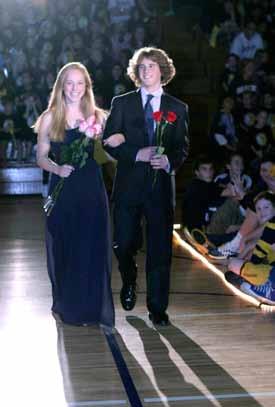
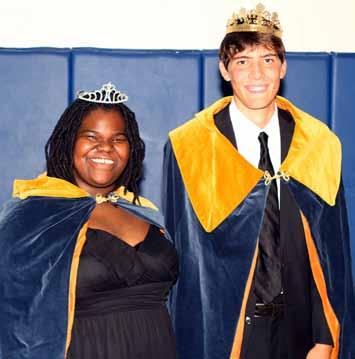
Queen Leslie Hayes and King Alex Hasselbring
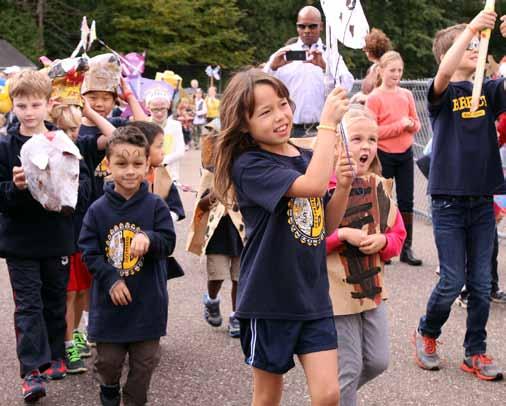
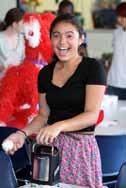
Lower school puppet parade
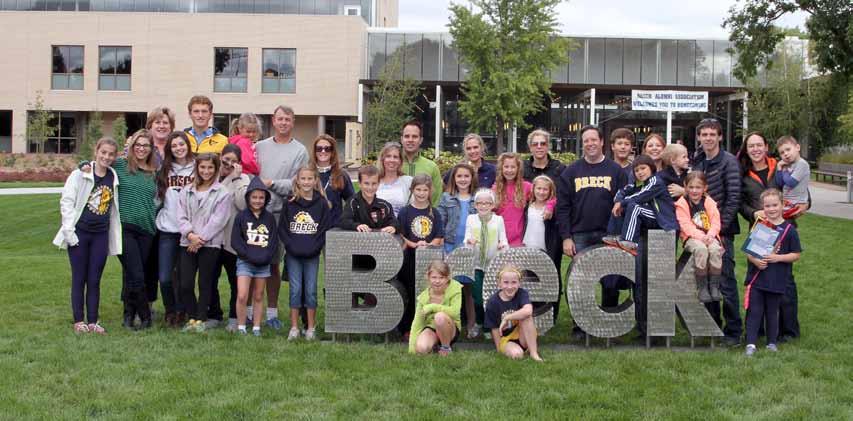
Legacy photo 2013: alumni and their current student children
ath LetiC haLL of fame i n DuCts four n eW memBers
Over Homecoming weekend, the Alumni Association welcomed four new members into the Athletic Hall of Fame. Hall of Fame Committee Chair Michael Proman ’99 served as master of ceremonies for the event, which was held on the third floor of the new Upper School. A group of more than 50 alumni and friends gathered to congratulate the new members:
Ricky Gilkes ’83 reflected on his arrival in Minnesota from St. Lucia as a new Breck eighth grader—on December 1. “Breck gave me the opportunity to do all the things I dreamed of,” he said. “I never thought I’d leave the island, but at Breck I found people who supported me in every way.” Gilkes, who won the Fred B. Anderson award, played varsity soccer, ran track and was named to both the All-State soccer and track teams in grades 10-12.
Shawn McAllister ’88 termed his induction “an honor I didn’t see coming,” and talked about Breck’s environment as one that challenged him both as a student and an athlete. He fondly remembered former soccer coach and Upper School English teacher Martin Hynes and observed, “No one remembers the number of wins in a season, but the friendships last a lifetime.” McAllister, a Fred B. Anderson and Allen Dunn award winner, played basketball and soccer and was named All-State in soccer as a senior.
Jon Simmons ’98 said that he has come to realize there were three key ingredients to his time at Breck: “Having goals, having fun, and surrounding myself with good people.” He
appreciates the lifetime friendships made here and fondly remembers skiing with the late Adam Barron ’98. Simmons’ athletic career at Breck included football, Alpine skiing and tennis. Among his accomplishments: the state championship and a national ranking in Alpine, 2,000 yards rushing in football, All-State honors in tennis both junior and senior year, and the Fred B. Anderson award. He also won a gold medal in the Junior Olympics for skiing.
Anne Knopman ’98 was unable to attend the ceremony. A member of the varsity swim team from eighth grade through senior year, she was named All-State in both her junior and senior years and was the state champion backstroker as a senior.
The evening also included a special tribute to the late Del Carter ’50, who was instrumental in establishing the Hall of Fame. To honor him, the Alumni Association has named the award for coaches, administrators and friends the Del Carter Award.
For information about the Hall of Fame nominating process, please contact alumni@breckschool.org.
Athletic Director Brett Bergene, Jon Simmons ’98, Michael Proman ’99
Ricky Gilkes ’83 and classmates
Gilkes, Shawn McAllister ’88, Simmons
Tom Pohlad ’98, Simmons, Tim Murphy ’98
homeComing 2013
The week started with the annual balloon delivery for our teachers who are also alums. Balloons graced the classrooms of Elizabeth Powers Dempsey ’82, Sarah Flotten ’85, Evan Jones ’86, Deb Mixon ’87, Ty Thayer ’90, Rob Johnson ’90, and Emily Jones ’94.
On September 19 during Upper School chapel, we honored Rob Melrose ’88 with the Distinguished Alumni Award for 2013. Rob’s friend and former teacher, Tom Hegg presented this year’s award. Kirstin Erickson Wilson ’88 chaired this year’s Distinguished Alumni Committee.
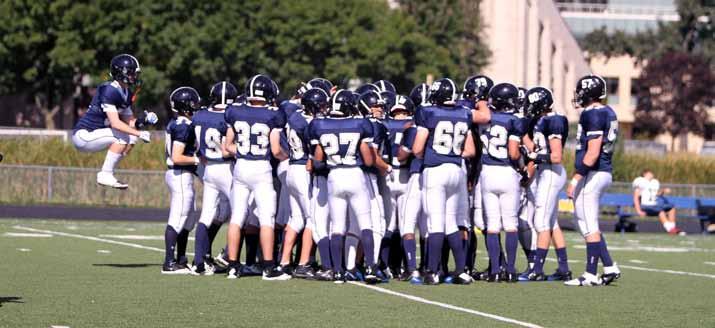
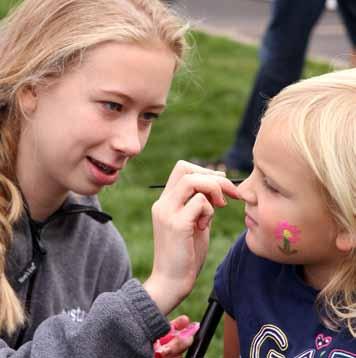
The Breck Alumni Association hosted the annual Homecoming Barbeque on Saturday, September 21. This year’s theme of Never Ending Summer provided many fun family activities including a football toss, Go fishing, Smores Bar, hole-in one, face painting, and clowns. Over 1200 alumni, parents, students, and faculty members took part in the Saturday festivities and cheered the Mustangs on against SPA/MPA.
Our Golden Mustangs, alums who graduated 50+ years ago from Breck, joined Mr. Kim and special guest speaker Rob Melrose ’88 for lunch on Friday, September 20. Forty alums and their guests attended this annual event held at the Heritage Room at the Breck School Anderson Ice Arena. That evening, Breck hosted the 2013 Athletic Hall of Fame induction ceremony. This year’s ceremony was held on the third floor of the new Upper School. Michael Proman ’99 served as chair of this year’s committee and master of ceremonies for the event. This year we honored Ricky Gilkes ’83, Shawn McAllister ’88, Anne Knopman ’98, and Jon Simmons ’98. (See article at left.)
This year’s events and festivities were planned and implemented by the Homecoming Committee of the Alumni Council led by Christy Piotrowski ’04, Colin Brooks ’97, and Ashley Kokal McCarthy ’02. Homecoming 2013 was a huge success thanks to the many alumni, parent, and student volunteers.
alumni evenTs
Grandparents Day –Alumni Faculty Reception
Alums are welcome to join us for Grandparents Day 2013. The Breck Alumni Association will host a special alumni-faculty reception to celebrate the day. Tours of the new Upper School will be available following the reception.
Author Discussion: Paul Bogard ’84
Paul is the author of The End of Night: Searching for Natural Darkness in an Age of Artificial Light. The book draws attention to the darkness as a landscape in its own right—a separate, incredibly valuable environmental condition that we overlook and destroy at our own peril.
Alumni Boys Hockey
Monday, December 23, Breck School Anderson Ice Arena, 8:00pm
Alumni Holiday Party
Monday, December 30
Urban Eatery – Calhoun Beach Club 7:00-10:00pm
Scenes from the Distinguished Alum Chapel with Rob Melrose ’88
Golden Mustangs
Reunions
The classes of 1963, 1973, 1988, 1993, and 2008 celebrated its reunions Homecoming weekend. This fall we held three other reunions—1983 on October 12, and the classes of 2003 and 1998 will both hold their celebrations on the Friday after Thanksgiving. On behalf of Breck and our reunion classes, we would like to thank our 2013 planners:
Bill Harley ’63
Rod Keith ’63
Charlie Hess ’63
Holly Jepson ’73
Kate Winton Poley ’83
Chris Curry ’83
Alycya Hjelm Cardwell ’88
Alison Hitzemann Hardy ’93
Taylor Harwood ’93
Molly Varecka ’98
Mike McKeon ’98
Leah Lussier Sixkiller ’03
Jeffrey Portu ’08
Sarah Johnson ’08
Class of 2013 Send-off
On August 7, members of the class of 2013 came back to Breck one more time before they left for college. Mr. Ohm played grill master and put together a barbecue lunch for our newest alums. The class of 2013 was the first to tour the new building. Class of 2013 representatives Hutton Phillips and Mitchell Foster (above right) organized the event.
Chicago alums gathered on Wednesday, October 9, for an evening of good conversation and great food. At left, Gavin Hoffman ’97 and Kelly Gravier Lockhart ’97
The class of 2008 celebrates five years.
The class of 1993 celebrates 20 years.
class notes
year
1946
Bill Schmalstieg let the Alumni Office know how much he admires his classmate Amos Rosenbloom’s recent racquetball accomplishments.
1948
Raymond McAfee, Dr. Arnold Leonard, Paul Webster, and Louis Mitteco celebrated their 65-year reunion at the Golden Mustangs Luncheon.
The class has a memorial in this issue.
1949
Classmates Peter Pierce and Tony Kimball toured the new Upper School in August.
1963
The class has a memorial in this issue.
1973
The class of 1973 came together on Homecoming weekend to celebrate their 40-year reunion. Holly Jepson served as planner.
1979
In the winter of 1977, Mark Gillman and Jodi Pfaff ’80 developed a crush on each other in Mr. Doheny’s math class. They quickly started “going out” and dated for the next 18 months before deciding to go their separate ways. Both moved onto college, and eventually married other partners and raised families. In the fall of 2009, Mark and Jodi met again and remembered the feelings they had from high school. Sparks flew, and in a matter of weeks, they knew that it was love. They endured a long-distance relationship for the next 12 months, traveling between La Crosse, Wisconsin, St. Paul, Minnesota, and Franklin, Tennessee. Jodi fell in love with the Nashville area, where Mark had been for 13 years. She moved there so they could be together. After a year, Mark asked for Jodi’s hand in marriage while
watching the sunset at Center Hill Lake. Jodi and Mark were married in Franklin, Tennessee, at the historic Carnton Plantation. The couple made their vows under a 200-year-old osage orange tree in the authentic garden next to the house. There were many Breckies who played part in the ceremony, including Donna Gillman (faculty 1971-1988), Tom Gillman’ ’80, Edwin Balcos, Jack Pfaff, Brad Pfaff ’83, and Amy Gillman Broihahn ’83. Jodi’s two daughters, Anelise and Marit, also were in the wedding party. Others in attendance from Breck were Stacy Cram ’80, Phil Sosin, and Kimberly (Shifflett) Balcos. Jodi and Mark live in Franklin, Tennessee.
1980
See the note above for Jodi Pfaff Gillman
1981
Maya Tester is serving as member of Breck’s Board of Trustees.
1983
Thank you to reunion planners Kate Winton Poley and Chris Curry for putting on a wonderful event for the class on October 12.
Picture courtesy of Linda Lange (daughter of the late William Lange).
reunion
1984
Paul Bogard will be speaking at Breck on Thursday, December 4 at 7:00pm. Paul will be discussing his book, The End of Night
To reserve your spot at the event, please email alumni@ breckschool.org.
1985
Breck Middle School teacher Sarah Flotten caoched Middle School girls soccer this fall.
1986
Screenwriter Melisa Wallack’s movie, The Dallas Buyers Club, opened in select theaters on November 1. The movie details the story of Texas electrician Ron Woodruff and his battle with the medical establishment after being diagnosed as HIV-positive in 1986.
Glen Weaver-Lang is coaching junior varsity boys hockey.
1987
Heather Heefner Dart lives in the Bryn Mawr neighborhood of Minneapolis with her husband and four daughters. She is starting a second career as an oil painter. Here is an example of her work.
1988
Charlie Schaitberger continues to coach Breck junior varsity hockey.
The members of the class of 1988 had a weekend full of fun activities thanks to reunion planner Alycya Hjelm Cardwell and host Kathy Anderson Groethe
1990
Breck faculty member Ty Thayer married Betsy Starz on June 29.
1991
Jack Cavanaugh is an assistant coach with Breck boys hockey.
1993
The class of 1993 gathered at the Loring Pasta Bar for their reunion during Homecoming. Alison Hitzemann Hardy and Taylor Harwood planned a fun evening for their classmates.
1994
Majka Burhardt is working on a new project in Mozambique. She is spearheading the efforts to provide for a new conservation area and is exploring cliffside ecology with new species of ants and beetles and frogs on a 2,000 granite cliff face in Mozambique, and creating multi-platform media about the story and potential of integrated conservation. She recently received a grant from the Critical Ecosystem Partnership Fund (CEPF)—a joint program of the MacArthur Foundation, the World Bank, Conservation International and others to fund our conservation work with a local Mozambican civil society organization.
20-Year reunion planner Tony Jewett is working on a special way to commemorate the event—a trip to Vegas set for May 2014.
1995
Matt Fish was married to Xiaoni Niu on June 7, 2013, at the Calistoga Ranch in Napa Valley, California. Matt is the managing director of New Pacific Consulting in Shanghai and a partner in the Parthenon Group in Boston. Xiaoni is head of the Shopper Insight Division of Unilever China. They will continue to reside in Shanghai. Breck’s own Margaret Wong, Matt’s former teacher and mentor, was the guiding force and unsung hero in helping Matt’s dad deliver his rehearsal dinner speech in Chinese. She not only translated his speech from English to Chinese, made a tape of it for him, but also continuously worked with Matt’s dad for month until he was proficient. The Fish family says it’s forever indebted to this amazing woman.
1997
Sarah Bellamy was interviewed on Kare11 Saturday to promote Penumbra Theater.
Gavin Hoffman is making his mark in men’s shoes.
Check out his new business, Austen Heller, at austenheller.com.
1998
The 15-year reunion is set for Friday, November 29, at The Local at 7:00pm. Mike McKeon and Molly Varecka are serving as the event planners.
1999
Jason S. Keene and his wife Lauren welcomed Logan Robert Keene (8 lbs. 9 oz.) on May 21, 2013. Jason and Lauren reside in Chicago where Jason is the director of development and major gifts the for Advocate Charitable Foundation.
2000
Jordan Eisenberg was the subject of an August article in the New York Times, focusing on his company Urgent Rx, and its success at getting its products placed in coveted real estate near the cash registers in large drug stores such as Duane Reade in New York City.
Guthrie Michael and his wife Julie live in Kansas City, Missouri, where he is a regional operations manager for U.S. Bank, managing compliance in Kansas City, Louisville and Nashville. Our condolences go out to Guthrie and his family on the loss of his father, former Upper School Director Kevin Michael.
Meredith Moore married Brian Crosby in a ceremony at St. Peter’s Church with a dinner following at Windows on Minnesota. The couple resides in Elmhurst, Illinois.
Recently, the Minneapolis St. Paul Business Journal put out its list of the Fastest Growing Private Companies in Minnesota. Brendan McCarthy’s Click to Shop ranked in at number 18. Check it out at http://www.bizjournals.com/ twincities/print-edition/2013/10/25/ no-18-clicktoshop.html.
2001
Jessica Meuwissen coached Breck girls soccer this fall.
2002
Neal Busdicker was an assistant coach with Breck football.
Krystal Grigsby was inducted into the University of St. Thomas Athletic Hall of Fame in September for her accomplishments in track and field.
Alexandra (Sacha) Haworth was recently hired as a senior press aide for Congressman Rick Nolan (MN-08), who represents the northeastern part of the state. On top of being a busy staffer in the press shop, she is simultaneously pursuing a Masters of Public Policy (MPP) degree from Georgetown University’s McCourt School of Public Policy. In between classes, she says it is not uncommon for her to engage with colleagues and classmates in high-level health and economic policy discussions at the Tombs, a Breck diaspora favorite.
2003
Susannah Brokl is an assistant coach with Breck girls hockey.
2004
Holiday Eller Samabaly is coaching Breck volleyball again this year.
Last May, Jomi Kramer won an engineering competition at the Technion Engineering School in Haifa, Israel, and went on to compete in the European division in Brescia, Italy where she earned second place. She was also awarded a scholarship to the University of Shan Tou and spent the month of August as part of a month-long Chinese immersion course in Shan Tou, China. Jomi is a third-year mechanical engineering student at the Technion Institute in Haifa.
Marin McCarthy coached Breck girls soccer this fall.
Christy Piotrowski started a new position as a senior marketing associate in the Minneapolis office of Baker Tilly, a full-service accounting and advisory firm.
2006
At Lauren Erickson’s wedding to Christian Burrus on June 2 in Minneapolis at The Minikhada club, alums Sarah Bluhm, Gretchen Goetz, Lauren Erickson and Kelley Teckman posed for a picture. Christian is the new strength and fitness coach at Breck.
After finishing up 2+ years as a management consultant for the Boston Consulting Group in Detroit, Dan Geoffrion is now pursuing an MBA at Wharton where he plans to concentrate on finance and healthcare management. In between work and school, he went to 17 countries on five continents and had the joy of staying with Andrew Upjohn in Shanghai.
Amanda Teska and Richard Thomson were married on July 5 at the Calhoun Beach Club. Katie Brattain Hogan and Leigh Johnston were maids of
honor. Coco Goldenberg, Charlotte Ritz Zwick and Joanie Lennick were bridesmaids. Charlie Weisman and Peter Van Brunt were groomsmen. Amelia Bailey and Sophie Bolger served as greeters. H. Noah Goldberg was an usher along with Scott Teska ’80 and Stephen Teska ’82. Amanda and Richard spent their honeymoon in Australia and Fiji. The couple lives in Manhattan.
Guinness Records official Charlie Weisman was recently featured on E Online. Charlie officiated the world record for twerking in New York. http:// www.eonline.com/news/463176/ twerking-world-record-hundreds-ofpeople-gathered-in-new-york-todayfor-a-record-breaking-booty-shaking.
2008
Brooks Byrd and Matt John served as part of the 2013 Breck football coaching staff.
Riley Conlin is an assistant coach for the Breck golf team.
Will Orlady recently was back on campus and toured the new Upper School. Will graduated from the University of Southern California in 2012 and taught in Ethiopia last fall. He started law school this fall at the University of Colorado at Boulder.
Tom Smolenski is coaching Breck boys basketball this winter.
2009
Rachel Grandstrand and Emily Nimmer got married on May 31 at Silverwood Park. The ceremony was officiated by John Bellaimey. Mayor R.T. Rybak ’74 officiated their legal marriage on August 5 at City Hall.
Elori Kramer is a member of the band Alpenglow and is currently on tour in the United States through December 2013. For details about the tour or to hear some of the band’s performances, check out www.alpenglowmusic.com.
Travis Spangler graduated from Brown University majoring in neuroscience and started medical school at the Alpert Medical School (Brown University) to follow his dream of becoming an orthopedic surgeon
2010
Ties That Bind is a new book published by NPR’s StoryCorps that compiles the best stories of the program since it began ten years ago. Katie Robinson and her dad and former Breck trustee George Robinson are happy to have their story chosen to be part of this wonderful collection of stories. It is the story of George’s finding and meeting his biological father, Jesse, after 62 years. Katie and George, together, are writing a book about this adventure, but until then, it has been published with Ties That Bind
Annalisa Tester, Katie Ross, and Henry Bell participated in the Head of the Snake regatta in Worcester, MA this fall.
2011
Tom Erdmann was mentioned in a Forbes magazine story about a gathering of over 1,200 hackers in the luxury suites of the University of Michigan football stadium on September 20. At the event, participants from over 100 different universities competed for $25,000 in prizes as part of a hackathon event series called MHacks. A hackathon is an event where developers with creative ideas come together and build a prototype in a short period of time. Tom was the director of this year’s event. http://www.forbes.com/ sites/amitchowdhry/2013/09/10/ over-1200-hackers-are-attendingmhacks-at-university-of-michigansstadium-this-month/
Corrie Searls was recently featured on the cover of Connecticut College Magazine. The magazine highlighted Corrie’s dream internship with Christie’s Auction House at New York City’s Rockefeller Plaza this summer.
Annalisa Tester and Libbey Castle ’12 served as the guest speakers at Breck’s Student Leadership Academy in August. Both attend Colby College, where Annalisa is a senior and Libbey is a sophomore.
Nick Hoffman has been selected to be on the squad that practices with the Indiana University women’s basketball team.
The Star Tribune reported that Anna Laorr won the Open title in the Minnesota Women’s Golf Association State Match Play Championship at Jewel Golf Club in Lake City in late July.
2012
Libbey Castle and Annalisa Tester ’10 served as the guest speakers at Breck’s Student Leadership Academy in August. Both attend Colby College where Annalisa is a senior and Libbey is a sophomore.
Nailah Hill participated in the AAU Junior Olympics in Michigan this summer and placed third in discus and sixth in javelin, thereby medaling in both of those events. She also received honorable mention for her performance in high jump, placing tenth, and shot put, placing eleventh.
Caleb Kumar was mentioned in a Star Tribune opinion piece by policy analyst Ted Kolderie, who made a case for educational reform in an article titled, “Let’s Give Adolescents a Chance to Grow Up.”
memoriaLs
Former faculty/staff
Doris Bergevin Neutz, a Breck employee for 25 years, died Oct. 9 in St. Paul. She was 76 years old. Neutz began her Breck career as a bus driver and retired from the Business Office, where she was payroll and benefits administrator. She is survived by her son Len (Pat), two grandsons, a sister, two brothers and many friends.
See p. 11 for a memorial to former Upper School Director Kevin Michael.
1948
Herman Gross passed away on October 5, 2012. Herman was president of Beaucraft, Inc., a Minneapolis furniture manufacturing company. In 1974, he retired and moved to South Padre Island, Texas, where he managed Feldman’s, Inc until his second retirement in 1990 where he returned to Minneapolis. He was preceded in death by his wife of 63 years, Judith Blade. He is survived by his daughters, Cathy (Mark) Dobbelmann and Pamela (Irv) Downing; grandchildren Laura Bestler, Sarah (Andrew) Burd and Irvine Downing and great-grandchildren, Ruth Francis Kagemeier, Max Edward Burd and Luke James Burd; sister Gretchen (Lou) Harris and brother Frank (Betty) Gross.
1963
Steven Kingsbury passed away on October 14, 2013. He was preceded in death by wife Susan; and parents Melvin and Hazel and is survived by brothers, Richard (Linda) and Charles (Phyllis); nephews, Mark, Matthew and niece, Stephanie; other family and friends. Steve served in the US Army during the Vietnam era and was a long-time employee of the Bell Telephone Company.
1972
Connie Woodrich Myhre died peacefully on Nov. 7 after a long battle with breast cancer. She is survived by her loving husband of 37 years, David Myhre, daughter Molly, her father, sister and brother and their families. After Breck, Connie attended Drake University and graduated from the University of Minnesota. Her notice in the Star Tribune described her as “feisty with an incredible sense of humor…and a determined outlook on life. She was an extraordinary wife and mother.” Connie was an active alumni volunteer and a great representative of the first River Road coed graduating class.
assumptions, they showed me the value of doing the same. By taking risks and inviting failure, they developed in me a sense of confidence and a willingness to try and fail in the interest of growing. By asking me to teach, they built for me the scaffolding of future leadership. These models stay with me now as I work closely with students and faculty to create the environments that best support the intellectual, emotional, and social growth of children.
We must fill our schools with laughter. I am always somewhat taken aback when I walk through the halls of a school in session and hear only the sounds of teachers speaking and chalk against the board. Environments such as these seem to me to be fundamentally antithetical to the process of learning. Learning is fun. Learning is funny. Learning should promote laughter and noise. To be sure, it can also be messy and sad and frustrating and aggravating, but the fact remains that learning requires emotional engagement. Students learn best when they care, when they have a connection to that which they’re learning (and to the person from whom they learn), and laughter is a sign that this is taking place in an authentic way.
Laughter signals real connections between teachers and students, between administrators and teachers, between all constituents in the school. Laughter is honest, and it requires that people truly know themselves and each other. Whether we laugh at a good joke, a great physics cartoon, or (as if often the case) at me, the relationship that is built in that moment is invaluable to the learning process.
We must build collaborative communities that reflect diversity of thought and experience. Learning is a team sport. Whether working on the writing process, studying calculus, or playing an instrument, students very often achieve more when they work in collaboration with others. A peer group can provide the motivation to challenge oneself, a context for new ideas, a sounding board for a burgeoning argument, and moral support for continued growth. The same is true for teachers. Faculty teach more effectively, see more engagement from their students, achieve greater positive outcomes, and have more fun when they have the opportunity to discuss their own teaching and intellectual interests with their colleagues.
Collaboration of this sort, however, is somewhat less transformational in communities that tend toward the homogeneous. It is only through open discourse with those whose backgrounds, perspectives, and life experiences are different from our own that we grow. It is imperative, then, for school leaders to build communities that reflect real diversity—di-
versity of thought, religion, ethnicity, socioeconomic status, and family structure, to name a few. These communities are hard to build: they require thought, creativity, attention, insistence, and careful maintenance. Nevertheless, the social and educational value of developing this kind of school atmosphere, not just nominally, but in substantial and sustainable ways, far outweighs the cost.
We must set high but clear expectations for the entire community.
In discussing the roots of his students’ success, Frank Boyden, legendary Headmaster of Deerfield Academy, wrote, “We just treat [them] as if we expect something of them, and we keep them busy.” While many of Boyden’s approaches to school leadership may now be seen as antiquated, holding ourselves, our students, and our faculties to high standards is an important, and lasting, ideal.
Students thrive in settings in which they are expected to achieve at high levels and then (and perhaps most importantly) given the tools and skills needed to do so. Children are born wanting to learn as much as they can and as they gain knowledge and understanding about their world, the desire to learn more deepens. The classroom must foster this innate curiosity, not merely require that our students reach some mediocre standard of proficiency. Holding our students to high standards sends a clear message that we not only expect their best at all times, but that we believe that they are capable of great things. Though subtle, this powerful message empowers students, enabling them to push themselves and to overcome adversity with grace and confidence.
This principle is no less true for a school’s faculty. Teachers, and through them the everyday classroom experiences of students, are the core of any school. No school can be great without great teachers, and teachers must be given the support, guidance, and feedback they need to grow.
In order to foster the continued development of both students and teachers alike, administrators need to see school happening every day. They need to see the school and to be seen in the school. They need to be in classrooms, both teaching and observing so that they understand the daily work of the community. School leaders need to cheer in the audience at the fall play and on the sidelines of the football game. They need to talk to students, teachers, parents, and colleagues about their experiences every day. Administrators need to know their school well if they hope to lead their school well.
Frank Boyden had his desk in the middle of the front hall of Deerfield until the day he retired. He was literally at the center of the school. He expected the best from his school, from his teachers, and from his students. Because he was connected to all of them in a real, lasting, and substantial way, he got it.
Spring Sports: Athletes Have a Great Season Despite Our Non-Spring Weather
Boys Tennis Takes Second at State; Girls Track Takes Fifth; Boys and Girls Golfers
Compete at State Tourneys as Well
Baseball
The Mustangs finished the season with a 2-8 conference record and struggled to complete a 13-game season in less-than-ideal conditions. A fairly young team showed great improvement as the season went on, thanks to leadership from a good group of seniors. Andy Keiser was named All-Conference, with Matt Colford and Jorgen Salveson named honorable mention. Mitch Foster was the MIP, Andy Keiser the MVP, and Bennet Johnson the Mustanger.
Boys Golf
It was a good season for Mustang boys golf, which finished 9-2 overall and 7-2 in the conference. The conference champions sent two golfers to state, juniors Blaze Beecher and Lucas McCormick. Blaze, Lucas and Max Schwartzman were named All-Conference, with Mac Turner receiving honorable mention. Lucas was the MIP, Blaze the MVP, and Mustanger honors went to Matt McMillan and Ben Turner.
Girls Golf
Our girls finished third in the section, and the varsity had a better than .500 record during a season marred by such unseasonable weather. The Mustangs had the lowest team score in the history of our program with their 353 at the section tournament, and Grace Zumwinkle represented us at state. Sarah Webb was named to the All-Conference team, with Madi Lommen, Anna Zumwinkle and Grace Zumwinkle receiving honorable mention. Grace Zumwinkle was the MIP, Sarah Webb the MVP, and Anna Zumwinkle the Mustanger.
Boys Lacrosse
Participation is on the upswing for boys lax, which ended up with a 2-9 record in 2013. With better numbers and a new coaching staff, the team is looking forward to better things in 2014. Lacrosse is not a conference sport, but Jack O’Connor was named honorable mention on the All-Section team. End-of-season awards went to MIP Jay Phillips, MVP Jack O’Connor, Mustanger Donovan Ennevor, and Unsung Hero David Husband.
Girls Lacrosse
A very young Mustang team finished the season at 4-9, with a highlight being wins in the first two rounds of the section tournament. A large group of eighth graders enjoyed strong leadership from five seniors on the team, and the participation rate grew to 40 girls between varsity and jv. Adrianna Keller was the MIP, Maggie MacLennan the MVP, and Bella Valentini the Mustanger.
Softball
Girls softball played a non-varsity schedule in 2013 and struggled to get in games given the bad weather. They finished with a 4-1 record, scoring 86 runs to their opponents’ 32—making for a very successful season for a group of seventh- to tenth-graders from whom we are expecting great things (and, we hope, more hospitable weather) in 2014.
Boys Tennis
Senior Myles Tang, a member of the varsity tennis team since he was in seventh grade, finished out his Breck career by leading the Mustangs to a second place finish at state, a record of 14-3 overall, and a record of 6-1 in the conference. Breck boys took second and third place in the state doubles tournament, led by eight senior players. All-Conference honors went to David Alper, Joey Gamer, Tucker Sjoblad, Myles Tang, Austin Wong and Brenham Wong, with honorable mention for Jake Duxbury and Michael Marzec. Lewis White was the team’s MIP, Myles Tang the MVP, and Joey Gamer the Mustanger.
Track and Field
The Breck girls won their section meet on their way to a fifth-place finish at the state meet. Leading the way was senior Nailah Hill, who set school records in both the shot and discus, which she won at state. All-Conference honors went to Adria Duncan, Nailah Hill, Niara Hill, Kira Hinz and Jaila Tolbert for the girls and Bryce Johnson and Jake Levy for the boys. Honorable mentions went to Claire Drysdale, Elise Garvin and Shayla Henderson-Thomas for the girls; Ira Buffalohead, Will Culliton, Easton McChesney and Nick Thyr for the boys. MIPs were Kwaku Bodom and Elise Garvin; MVPs Bryce Johnson and Nailah Hill; and Mustangers Nick Thyr and Kira Hinz.
Breck Withdraws From Tri-Metro Conference for 2014-15
After a decision by the Minnesota State High School League to expand the Tri-Metro Conference to 16 teams, Breck resigned from the conference and will pursue an independent schedule in 2014-15.
In an email to current families, Head of School Edward Kim wrote, “We did not take this decision lightly. The State High School League’s decision to expand the Tri Metro Conference to 16 schools—with the addition of Columbia Heights, Fridley, and Holy Angels—would have made it by far the largest conference in the state. It would also seriously compromise our ability to design workable, competitive and fair schedules. Our decision to pursue an independent schedule does not preclude us from post-season play.
Please be assured of our ongoing commitment to provide the highest quality co-curricular experience for all athletes at Breck, regardless of our conference status.”
Five other teams (Blake, Minnehaha, Mounds Park, Providence and SPA) also withdrew from the Tri-Metro and will also pursue independent schedules next year.
I N Th EI r O WN W O r DS
“ ”
Thomas Taylor Upper School Director
everything i knoW aBout eDuCation i LearneD taking Quantum meC haniCs
Nothing is certain. Werner Heisenberg proved this in 1927 with his development of the Uncertainty Principle, an idea that stemmed from the work he was doing at the time on quantum mechanics, a then-new branch of physics. In his first paper on the topic, Heisenberg used the German word Ungenauigkeit, which can be translated into “uncertainty,” though Heisenberg actually preferred the invented word, “indeterminedness.” Whatever the name, the principle holds. Stated broadly, it dictates that the more you know about one thing, the less you can know about something else.
The Uncertainty Principle introduces, for the first time, the idea that the universe places a fundamental limit on what people can know, or on what knowledge is accessible to humans. We tend to find this constraint difficult to accept and the idea causes anxiety for many of us: We find comfort in knowing, a comfort manifested in the time we spend searching for the right answers, and dismissing the wrong answers, all of which serves the aim of more closely approaching a complete and absolute understanding. The Uncertainty Principle, however, eliminates, at a fundamental level, the ideas of right and wrong, as well as any hope of absolute knowledge. We simply cannot know anything beyond a certain level.
When I examine the forces that brought me to teaching and, later, to educational leadership, I return time and again to the invitation presented by the Uncertainty Principle, an invitation to push our relationship with knowledge to its furthest limits and to push human learning as far as it can possibly go.
I love this. I love the idea that we can’t know everything. I’m excited by the fact that we are forced into a dynamic relationship with knowledge and by the idea that as we gain perspective on one thing, this necessarily changes how we see and what we know about something else.
Indeed, the need for learning seems to be built into us from the start. In the days following the announcement of the
discovery of the Higgs Boson (a moment of great excitement for all physicists!), a letter to the editor was published in the New York Times. It read, in part, “Our species benefits any time we can say we know more today than we did yesterday.”
To my mind, this speaks clearly and simply to the central and permanent role that learning plays in our lives.
The Heisenberg Uncertainty Principle crystallizes for me, then, the primacy of learning, and thus the importance of building great schools. As educational leaders, we are charged with fostering the intellectual and emotional growth of children and we must, therefore, develop schools that are worthy of this task.
In working to build such schools, we, as teachers, as parents, and as administrators, are faced with a number of responsibilities that will ensure the creation of learning environments that are most conducive to the continued growth and development of our students.
We must develop schools that are true communities of learners.
The most successful schools are those in which the continued growth and development of the entire organization is supported and guided by an administration committed to building a true community of learners.
In order to accomplish this, students need to see their teachers engaged in learning of their own. By modeling what it means to be committed to a lifetime of learning, the faculty and administration provide students with examples to follow in the development of their own academic interests.
In my own life, both as a student and as a teacher and administrator, it is those teachers and school leaders who approached their work with an inquisitive and open stance to whom I look as models now. By asking good questions, they taught me to ask good questions. By challenging their own
continued on page 41
The following is excerpted from Taylor’s education philosophy statement, which was actually part of his job application at Breck.
significant tax advantages for ira distributions donated by december 31, 2013
breckschool.plannedgiving.org
Under the american taxpayer Relief act of 2012, signed into law on January 2, 2013, significant tax advantages are once again available for certain charitable contributions made from individual Retirement accounts (iRas). through december 31, 2013, individuals 70 and older can transfer up to $100,000 in 2013 to certain charitable organizations from their iRa accounts without paying taxes on the distribution. For more information, please contact laura mccarty tufano at 763-381-8296 or laura.mccarty@ breckschool.org.
123 Ottawa Avenue North Golden Valley, MN 55422-5189
Parents of Alumni: Please forward this publication. If your daughter or son no longer maintains a permanent address at your home, please notify us (763-381-8278 or alumni@breckschool.org) of the new mailing address.